





















In this article
Every styled-shelf photo you have copied was built for one photograph, in a room with no kids in it, and then nobody touched that shelf again. The most-upvoted comment under the biggest bookshelf styling post on the internet says the quiet part out loud: the most beautiful bookcase is the one overflowing with creased, well-loved books. Most bookshelf styling and organization ideas fall apart the moment a household starts pulling books off the shelf. What follows runs the rules stylists teach through what happens next: shelves that bow, kids who reach, dust that lands.
Quick Answer
Six principles cover most of what a styled bookshelf needs:
- Style with what you already own before buying a single object
- Group objects in twos and threes, never in a single row
- Vary height inside every group: tall, medium, short
- Mix flat book stacks with upright runs of three to five
- Repeat two or three colors or materials, then stop
- Leave gaps, and put the heaviest books on the bottom shelf
Why Styled Bookshelves Look Cluttered Two Weeks Later
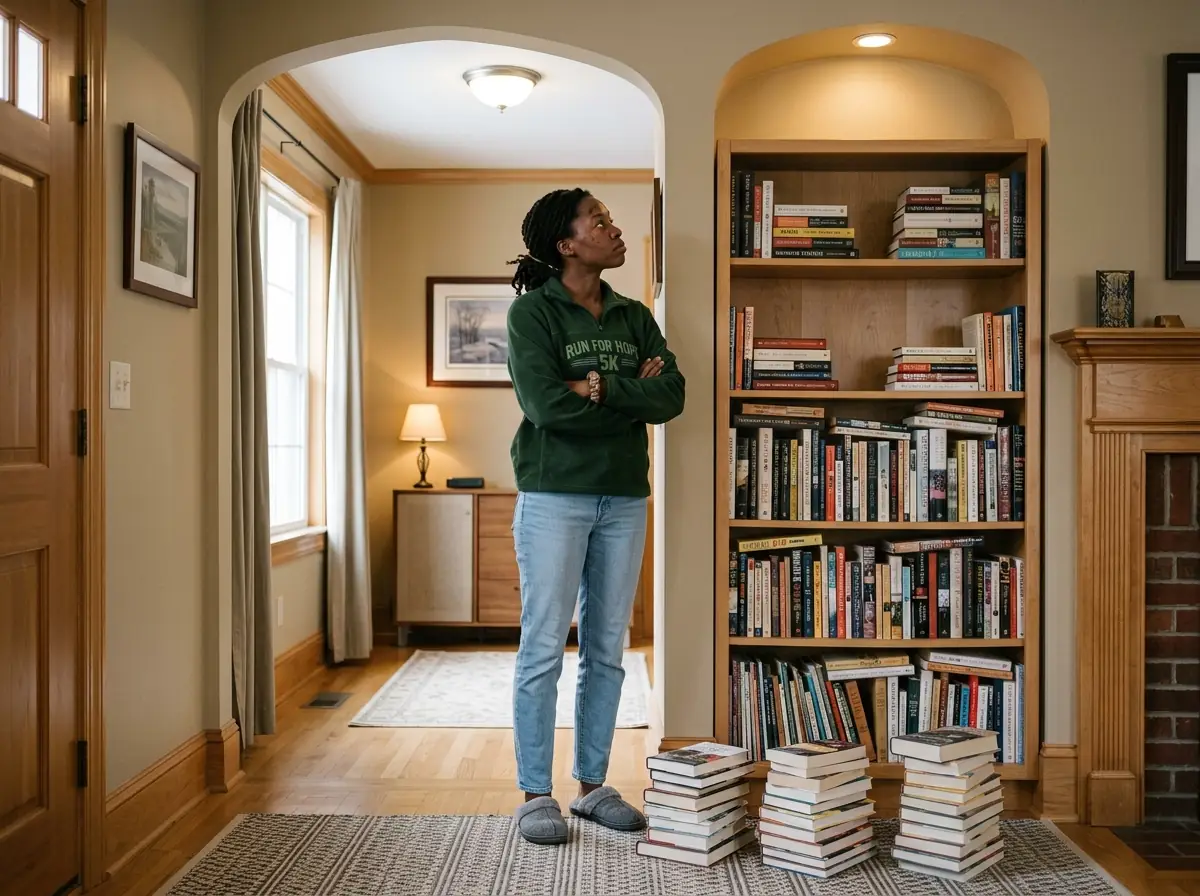
You followed the formula and the shelf looks worse. Busier, tighter, more chaotic than the wall of plain spines you started with. That is not a failure of taste, and it is the most common outcome described in the comment threads under the very posts teaching those formulas.
The mechanism nobody explains: bookcase styling formulas assume spare capacity. They are written against a shelf two-thirds full, because that is the shelf a stylist builds for a photograph. Yours is ninety percent full.
Adding a vase to a shelf with no slack does not style it, it subtracts book space and adds visual noise in the same move. One reader called it shoehorning in decor.
A functional bookshelf and a decorative bookshelf do different jobs, and as one commenter put it in a reply that collected twenty-four upvotes, not every house has room or the need for both. If you own one bookcase and an actual collection, formatting your only shelf as a display costs you the shelf.
The second failure is slower. You reach past the ceramic bowl for a paperback, set the bowl on the shelf above, and it stays there. Three weeks of that and the composition is gone, because it needed weekly upkeep nobody signed up for.
Anything you re-arrange every Sunday has already failed the three-month test. And none of this is about sorting by genre, sorting by author, sorting by size or chronological sorting, which is a separate job with its own logic.
The number worth holding onto: professional organizers cap decor at two or three pieces per surface. Count the objects in the tutorial photo you saved; it is usually more, and the photo compensates with a half-empty shelf you do not have. None of this works on an unsorted shelf either, so if your books are still in the order they landed after the last move, sort the books first and come back. Then decide, per shelf and not per bookcase, whether it carries books or carries display.
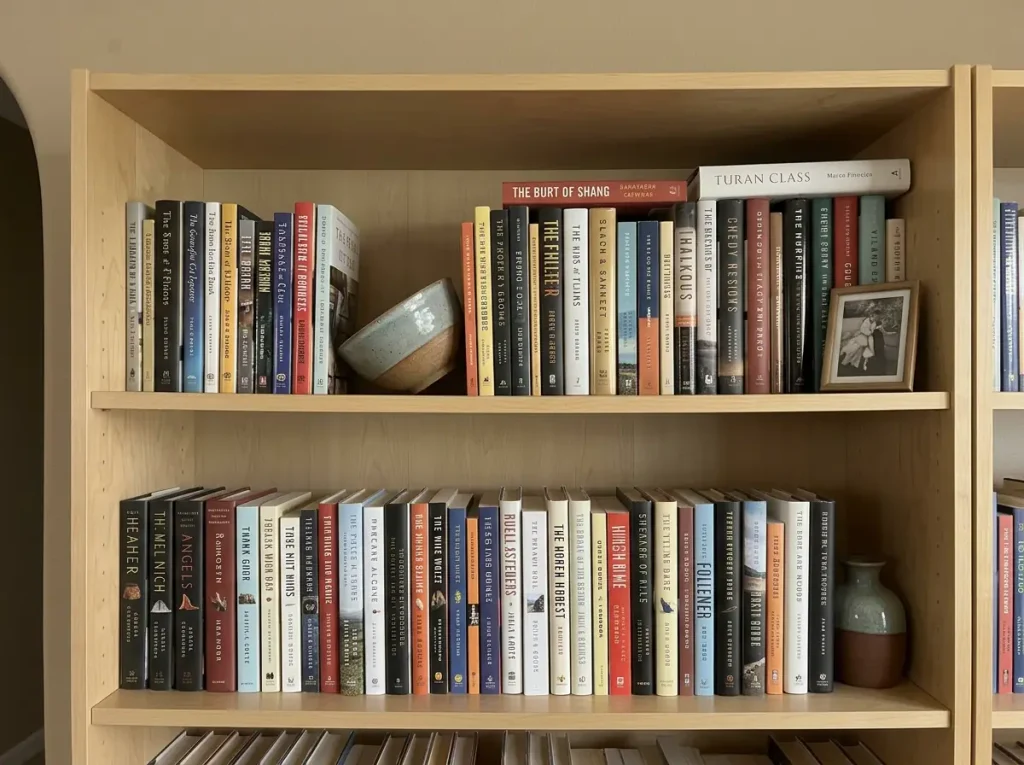
Before adding anything, pull every book on one shelf forward so the spines line up two or three inches in from the shelf edge instead of shoved to the back panel. It is free, takes four minutes, and it is the single change that most reliably makes a packed shelf read as deliberate rather than crammed.
Style It With What You Already Own First
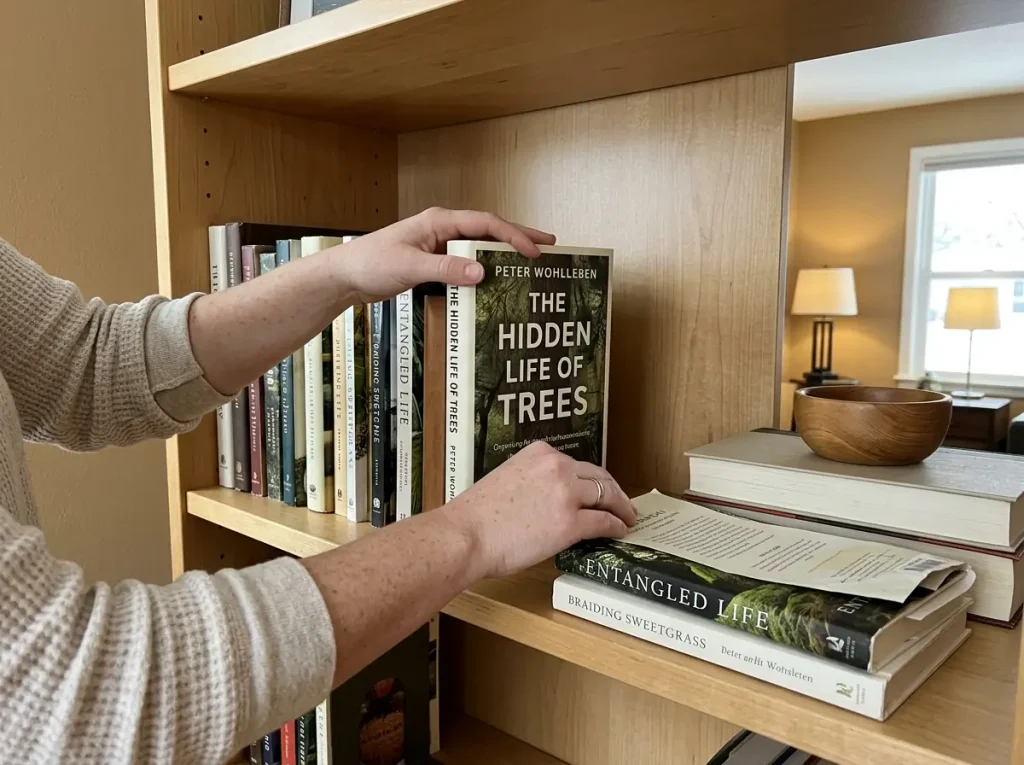
Nearly every styling post is downstream of a decor purchase. The stylist behind the most-copied shelf formulas says outright that you can style a bookcase with books alone, and that permission is worth more than a shopping list. Styling does assume the shelf underneath already works, so get a bookshelf setup that holds together in place first.
Use the Books Themselves as the Decor
Bookstores turn covers out for a reason: covers are designed to be seen, spines are designed to be found, and a wall of spines gives your eye nothing but vertical lines and small text. Three or four books face-out adds a flat plane and a block of color no arrangement of spines can produce, and you do not need a stand for it. One reader called this a free way to decorate your bookshelves, and that is exactly right, because the publisher already paid for the design work.
The other free move is stripping the jackets off a run of hardcovers. Underneath is usually cloth or plain board in muted colors, so you get instant color cohesion and a quieter shelf. The caveat: jackets carry most of the resale value on anything collectible, so store them flat if the books matter.
Shop Your Own House Before You Shop Anywhere Else
Take an empty box and walk every room, looking for a bowl you never use, framed art from a crowded gallery wall, a vase in a cabinet, a decorative box on a dresser. Anything sculptural with some height. Put it on the dining table, then place from that pile.
Bookends work the same way: the more sculptural the object, the better, which describes things you already own rather than a product category. Budget styling that starts here matters more to a renter than to anyone else, because you cannot change the wall, so the books become the only large-scale color you control. Most readers finish this pass of using what you already own and need nothing.
The Three Grouping Rules That Do Most of the Work
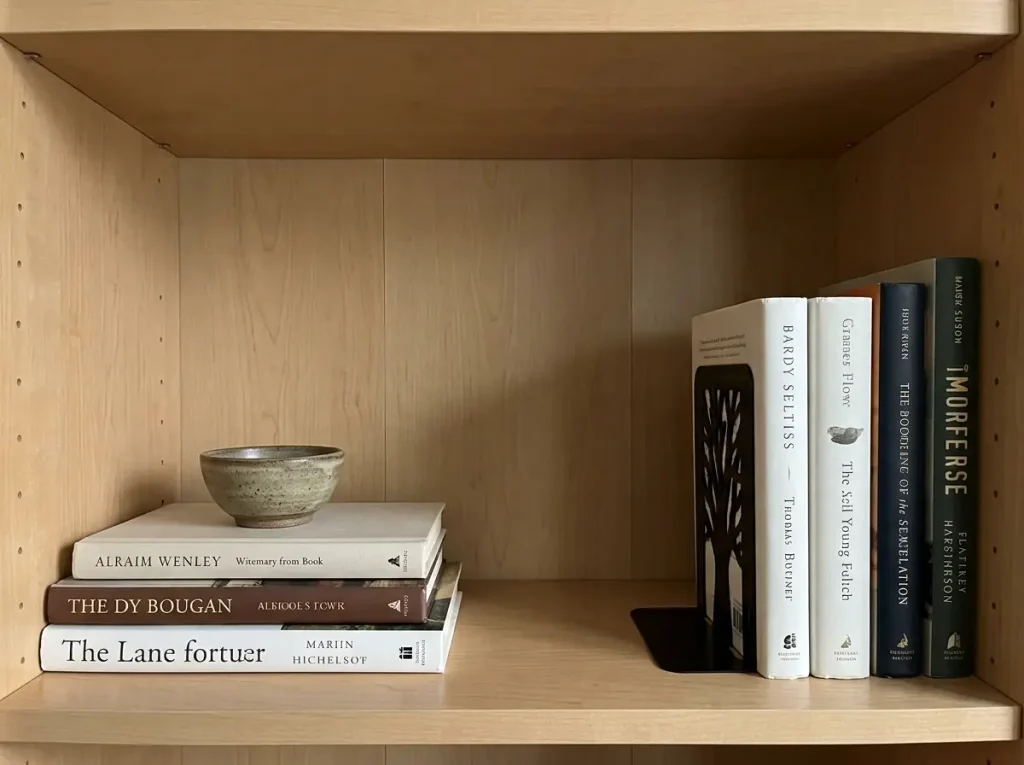
There are roughly three rules underneath every shelf styling formula online, and once you see them you stop needing the formulas.
Group in Twos and Threes, Never in a Row
Objects spaced evenly along a shelf, one, gap, one, gap, one, read as a display case. Push the same objects into odd-numbered groupings of two or three and they read as a composition, the way tablescaping principles applied to shelves would predict. Nothing changed except adjacency.
Vary height inside every group: tall, medium, short. Three objects of the same height together is the most common miss in grouping objects on a shelf.
Mix Vertical and Horizontal Book Stacks
Stack two or three books flat, ascending in size, and put exactly one object on top. One. Those book toppers matter because the space above a flat stack is dead space, and a stack with nothing on it looks like a stack somebody meant to shelve later. Alternate the flat runs with vertical stacks of three to five books flanked by an object or a bookend, which creates the gap separating one arrangement from the next.
That flanking object has a job, and this is where a purely decorative choice falls apart. When someone pulls a book from the middle of a five-book run, the rest lean, and a light ceramic thing tips over with them. A heavy object you already own solves this for free, so try that first.
If nothing in the house is heavy enough and worth looking at, the MaxGear 8.5 in Heavy Duty Metal Book Ends, Tree Design, 2 Pairs stand 8.5 inches in metal, so they hold hardcovers upright instead of sliding under them. The limitation: they sit shorter than oversized art books.
Repeat Two or Three Colors or Materials, Then Stop
Cohesion comes from repetition, not matching. Material variation is the lever: pick two or three finishes, say wood, ceramic and a warm metal, and repeat them across the whole bookcase. Six finishes read as a jumble, because the eye reads the bookcase, not the shelf.
And leave gaps, because negative space on shelves is what lets your eye register a group as a group. I used to treat that as a luxury for people with fewer books than shelf. It is not: even on a packed bookcase, one deliberately half-empty shelf does more for the unit than any object you could put on it.
Style the shelf at eye level last, not first. Your eye returns to it constantly while you work on the others, so it becomes the reference the whole bookcase gets judged against. Build the shelves above and below, then compose the eye-level one to reconcile them.
Add Non-Book Objects Without Losing Shelf Space
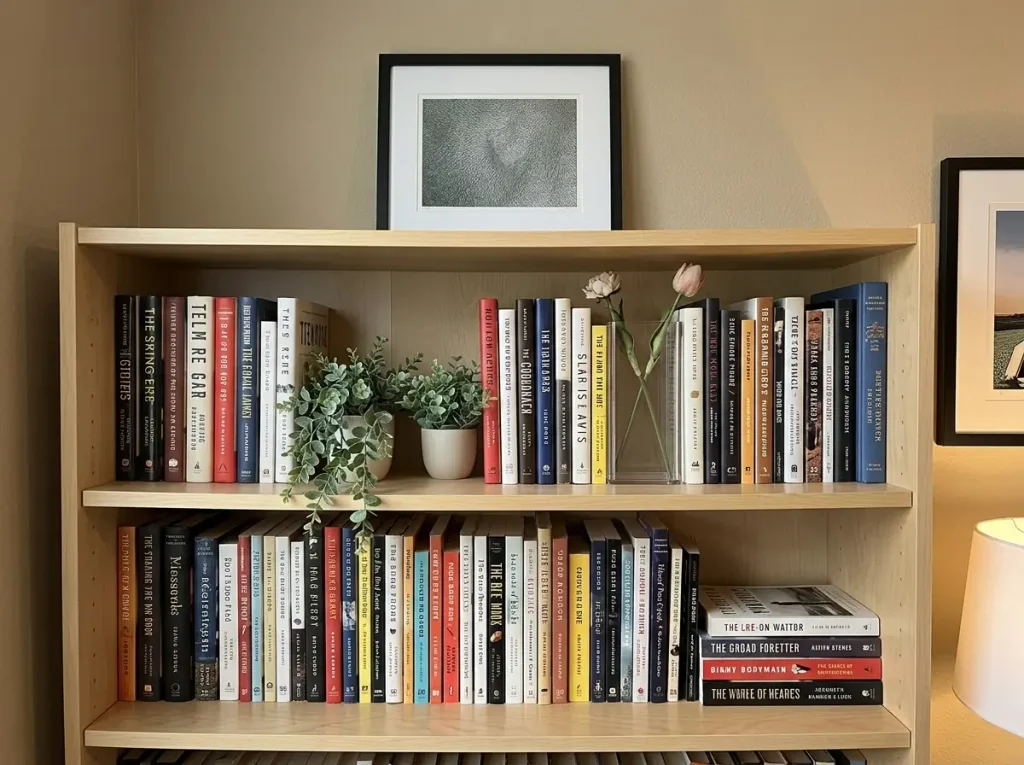
What to put on a bookshelf besides books is really a footprint question, and almost nobody frames it that way. Most props in tutorial photos are large, because tutorial shelves are half empty. Copy the object without the emptiness and you lose two books per shelf. Shelf depth is the other half of it: a standard bookcase is deep enough for a paperback and a small object in front of it, and not much more.
Greenery, and the Honest Version of It
Greenery is the third standard ground rule and the one that fails quietly. A real plant on a bookshelf sits feet from a window, in the darkest vertical plane in the room, being watered directly above paper. It limps along for two months, drops leaves onto the shelf below, then moves to the windowsill where it should have lived.
The honest options: one of the low-light potted plants you already own moved to the top shelf, a cutting in a jar of water, or faux chosen for scale variation rather than realism. If you go faux, buy a set. The Der Rose 4 Pack Fake Plants, Small Faux Plants for Office Desk Decor comes as four small potted pieces in varied pot sizes, exactly the height variation the grouping rule asks for, with no water and no leaf drop. At close range faux is faux, so keep it off the shelf people stand in front of.
Small-Footprint Objects Beat Big Statement Pieces
On a working shelf, the useful objects fit in the gap a single removed book leaves: a short vase, a pair of candlesticks, a small vessel that tops a flat stack, a compact sculptural piece. Anything wider than about six inches competes with books, and books usually win. Leaning art is the exception worth its footprint, because a frame propped against the back panel draws the eye backward and makes the shelf read deeper. Note the weight, though: a leaning frame needs a plan in a house with kids or a cat.
Any small glass jar already in the house does the vase job, and I would start there. If you want something more deliberate, the Puransen Clear Book Flower Vase is an acrylic book-shaped vase at roughly 5.9 by 1.6 by 7.9 inches, a footprint of about one thick hardcover, so it slots into the gap a removed book leaves. The caveat: acrylic scratches and shows every fingerprint.
Then give the bottom shelf to the non-book clutter: cords, board games, the tangle of things with no home. Decorative baskets earn their keep here, and woven baskets or lidded decorative boxes turn all of it into one clean rectangle, which reads calmer than eleven loose objects. Low is also the structurally correct answer, which is the next section.
What Happens When the Shelf Carries Real Weight
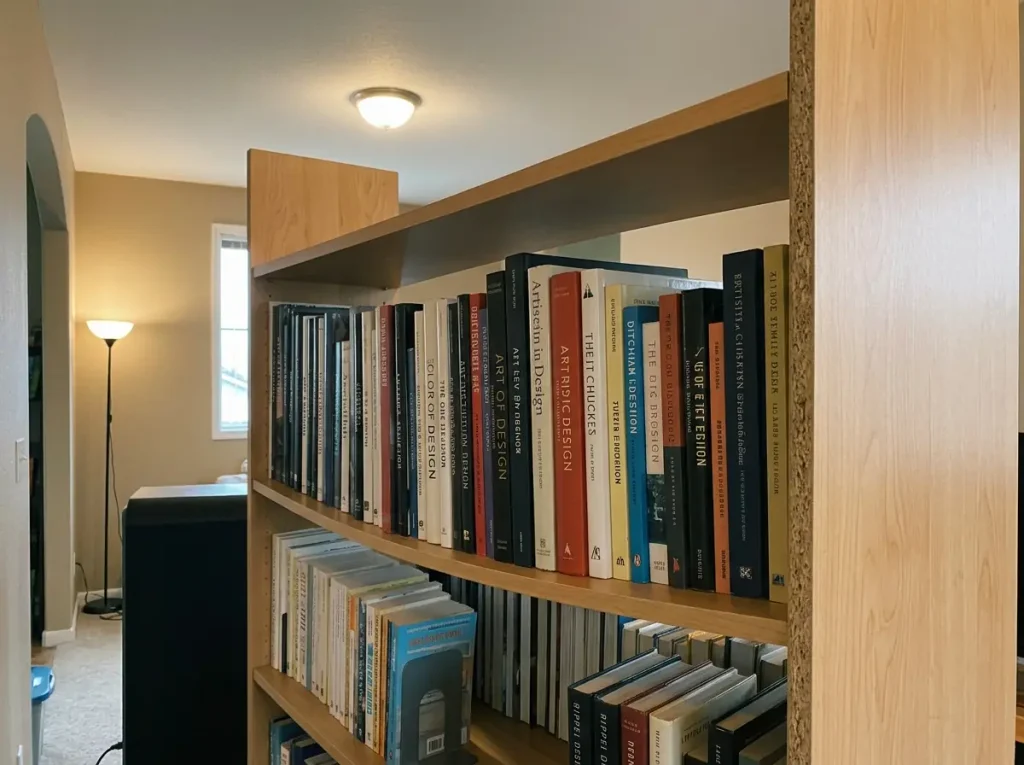
Not one article in this search result mentions the shelf weight limit, which is strange, because the bowed middle shelf in a freestanding bookcase is one of the most universal pieces of furniture damage in existence. Built-in bookshelves are usually stiffer, but shelf sagging finds them too on a long enough span. It is not a defect. It is a normal shelf carrying more than its span was built for.
The number: standard three-quarter-inch particle board shelves spanning the width of a typical flat-pack bookcase holds roughly 30 to 45 pounds of evenly distributed load before the sag becomes visible, and one row of large hardcovers clears that without effort. If your shelves are bowing, it is because particle-board shelving sags under sustained loads well below the point most people expect, slowly enough that you never catch it happening.
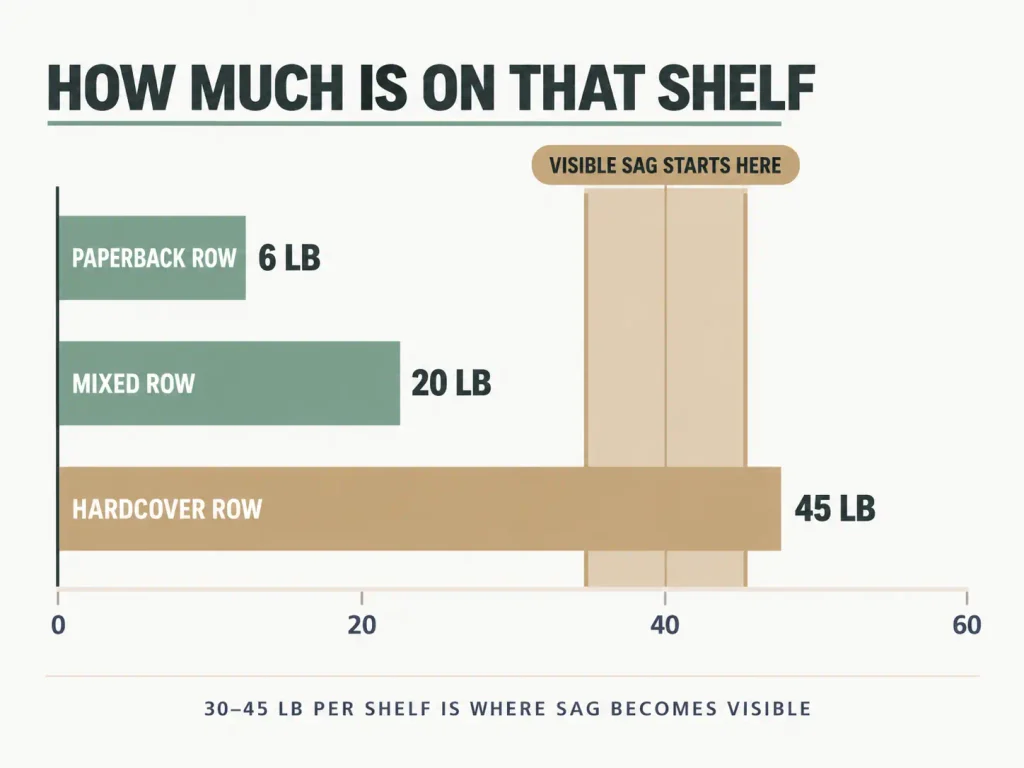
Span is the variable that decides everything. Capacity falls off sharply as the distance between supports grows, which is why a wide bookcase sags in the middle while a narrow one of identical material never does, and doubling a board’s thickness roughly quadruples its resistance to bending. If you add a wall shelf for the overflow, keep the span short and land the brackets on studs rather than drywall anchors alone: brackets typically carry 25 to 50 pounds each at a stud, and shelf bracket load capacity drops sharply as the span between supports grows.
For a shelf already bowing there are three real fixes and one that is not. Reduce the load, shorten the span with a center support, or replace the board with something stiffer. The one that is not: flipping the board so the sag goes the other way. It looks straight for a while, then bows again, because nothing about the load or the span changed.
Which produces the styling rule this section was pointing at. Heaviest books on the bottom shelf. Weight at the bottom makes an arrangement look settled rather than top-heavy, keeps load off the spans most likely to bow, and lowers the bookcase’s center of gravity. One reader who has moved eleven times does it for both reasons at once.
Check a shelf for sag by holding a straight object along its front edge, a metal ruler or the spine of a hardcover, and sighting down the gap. If you can see daylight in the middle, the shelf is already loaded past its span. Move the heaviest quarter of that row down one shelf and check again in a month.
Styling a Shelf That Has to Survive the Household
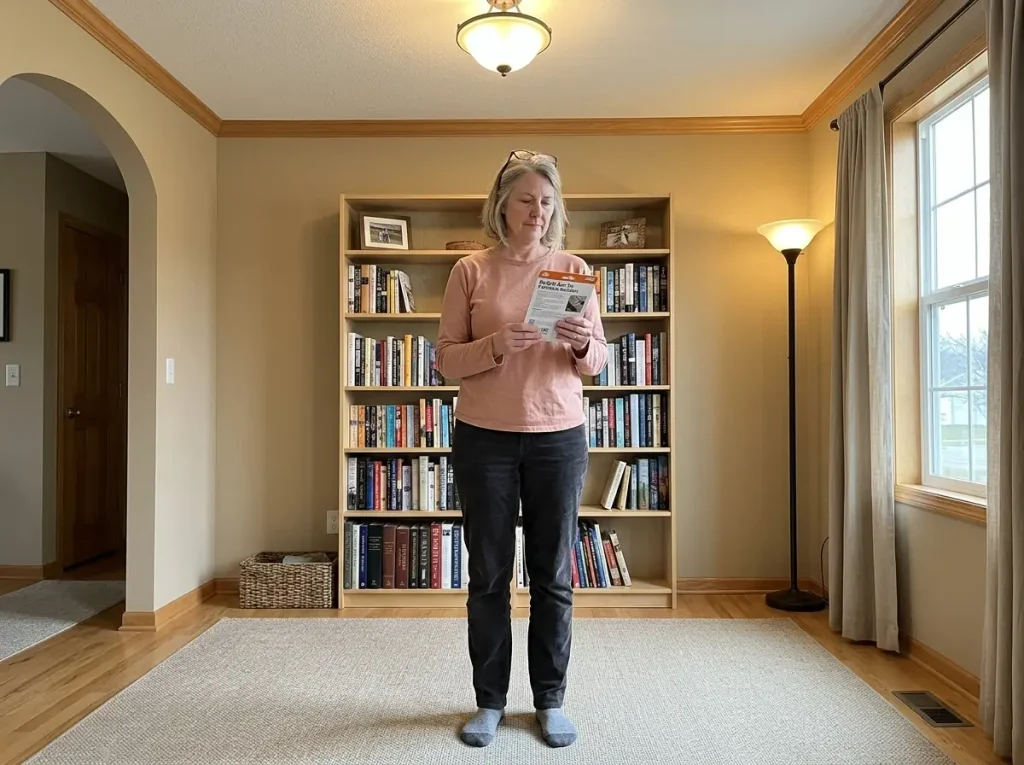
Look at any styling photo in this category and count what is missing. A heavy leaning frame and a cluster of sculptural objects sit on an open shelf, in a room with no children, no cat, and a bookcase nobody anchored. Renter-friendly styling starts by fixing that last one.
Anchoring, and the Part the Official Guidance Leaves Out
The Consumer Product Safety Commission specifically names bookcases in its furniture anti-tip guidance, alongside dressers and TVs. Roughly 17,800 people are injured in tip-over incidents every year, and children account for 44 percent of those injuries. The gap: that guidance assumes you can drill into a stud and offers renters no alternative.
If your lease forbids holes, adhesive anchoring is the path. No Drill Anti Tip Furniture Anchors, Adhesive Wall Anchors (6 Pairs) attach with adhesive pads instead of screws, and six pairs covers a bookcase plus whatever else in the room is tall and narrow. Secured furniture is the point, and the constraint is the surface: adhesive needs it clean and non-textured, so textured plaster or uncured paint will let you down.
If you can drill, go into the wall. Studs are rarely where the bookcase wants to stand, which is where the QUALIHOME Spring Toggle Bolt Anchors, 1/4″x4″, 15-Pack earn their place: a spring toggle opens behind the drywall and spreads the load, carrying far more than the plastic plug that came in the bookcase box. The catch is a larger hole than a screw leaves. And keep the heavy books low, a styling rule and a stability rule in one.
The Reachable Zone, and the People Who Use It
Everything below roughly the height a small child can reach is a functional zone, not a display zone. Glass, ceramic and anything with a sharp corner lives above that line; books, baskets and soft objects live inside it. Anchoring heavy objects that stay low is the other half of getting kids and shelves to coexist, and it usually improves the shelf, because it pushes the interesting objects up to eye level.
Pet-proof shelving needs a different fix, because a cat treats a bookcase as a route: leaning framed art has a small foot, is top-heavy, and slides, so lay a book flat in front of the frame’s foot.
A shelf styled to a tolerance nobody else maintains will not stay styled either. Build for it with fewer and larger groups: three substantial things survive a book being yanked out and shoved back at an angle, and nine small ones do not.
I used to recommend styling each shelf as its own shelf vignette. After enough of the same complaint in those threads, that people restyle weekly and resent it, I switched to styling the bookcase as a whole. And where books outgrow the shelving entirely, let them live in the room where they get used: cookbooks by the kitchen, reference where you work.
What It Costs to Keep It Looking Like That
Nobody quotes the maintenance bill before you commit. Dust on open shelves is the whole of it: every loose object is one more lift-and-replace during cleaning, and ten small objects across a bookcase turn a two-minute wipe into a fifteen-minute reset. That is the real reason heavily styled shelves quietly get abandoned.
Spine-in books deserve a direct answer, since the trend keeps resurfacing: turning every book around gives a wall of uniform cream paper that photographs beautifully and makes every book unfindable. Keep them spine-out. Sun and humidity are the slow ones, since direct sun fades spines over a few months and an exterior wall in a humid room warps paperbacks. Rotate the books on the sunny end twice a year, or give that end to objects.
Maintaining a styled shelf is one routine: once a quarter, pull everything off a single shelf, wipe it, and put back fewer things than came off. One shelf at a time and the bookcase gets a full pass over a year without ever being a project.
Then the honest close. Some shelves are simply for books, and a bookcase filled with well-used ones is a finished object, not a project waiting for decor. The most-upvoted voice in that thread argued exactly that. If you feel fine about your packed bookcase, you are done.
Conclusion
Style with what is already in the house first. The empty-box walk, a few covers turned face-out, the jackets off a run of hardcovers, and the spines pulled forward to a common line will get most bookcases further than a decor order will.
The composition reduces to four moves: group in twos and threes with varied height, alternate flat stacks with upright runs, repeat two or three materials, and leave gaps. Then put the heaviest books on the bottom shelf and anchor the bookcase, the two rules that cover how it looks and whether it stays upright at once.
In three months, look at which objects you have been moving aside to get books out. Those are the ones the shelf does not have room for. Take them off and the arrangement gets easier to keep.
Start with one shelf, the one at eye level. Get that right and copy what worked down the rest of the bookcase.
Frequently Asked Questions
01What do you put on a bookshelf besides books?
Small objects with varied height: a short vase, a bowl, a framed photo leaning against the back panel, a plant. Keep it to two or three pieces per shelf and choose things small enough to sit in the gap one removed book leaves, or you trade book capacity for decorative objects that do not earn it.
02How do you style a bookshelf that is completely full of books?
Style with the books themselves. Turn a few coffee table books cover-out, alternate horizontal stacks with upright runs of spine-out books, align the spines a few inches in from the shelf edge, and take the dust jackets off for a calmer color line. A full bookcase does not need objects added; it needs the books arranged so the eye has somewhere to rest.
03Should you organize books by color?
Color-coded books are a legitimate look and a real trade-off, and sorting by color is the one styling decision that costs findability: calm from across the room, harder to find one title up close. It works on a display shelf and badly on the shelf you pull from daily. Sorting by spine height first, then by color within that, keeps most of the visual benefit and stays findable.
04How many decorative objects should go on each shelf?
Two or three per shelf is the figure professional organizers use, and it holds up on a bookcase. Past that, objects stop reading as a composition and start reading as clutter, which is the most common reason a freshly styled shelf looks busier than it did before you touched it.
05Do I need to anchor a bookcase if I rent?
Yes, and you do not have to drill to do it. The Consumer Product Safety Commission names bookcases specifically in its anti-tip guidance but assumes you can screw into a stud. Adhesive anti-tip anchors cover the same job for a lease that forbids holes, and keeping the heaviest books on the bottom shelf helps as well.