























In this article
You measured the closet, bought the bins that looked right in the photos, and now the door catches on them every time you close it. The number nobody puts in the product listing is that most linen shelves run 12 to 16 inches deep, not the 18-plus that a lot of bin sets are built for. Ask anyone who has posted a linen closet question in an organizing thread: the answers come back as product names, almost never as measurements, which is exactly backwards. The best linen closet organizers are the ones sized to the shelf they sit on, so this guide is organized by zone (eye-level storage, top shelf storage, closet floor storage, door) with a section on what survives on wire shelving and where the free option genuinely beats the purchase.
Quick Answer
Match the organizer to the shelf zone, not to the catalog photo:
- Eye level: open-top fabric bins, no lids, under 14 inches deep
- Toiletries: clear or open-front stackable bins so the back row is visible
- Top shelf: a zippered fabric bag, not a rigid box
- Floor: a woven basket with a lid, because access is seasonal
- Door: an over-the-door pocket organizer that hangs on the top edge
- Wire shelving: a non-adhesive liner plus clip-on dividers, before any bin
What Actually Fits a 12-Inch Linen Shelf
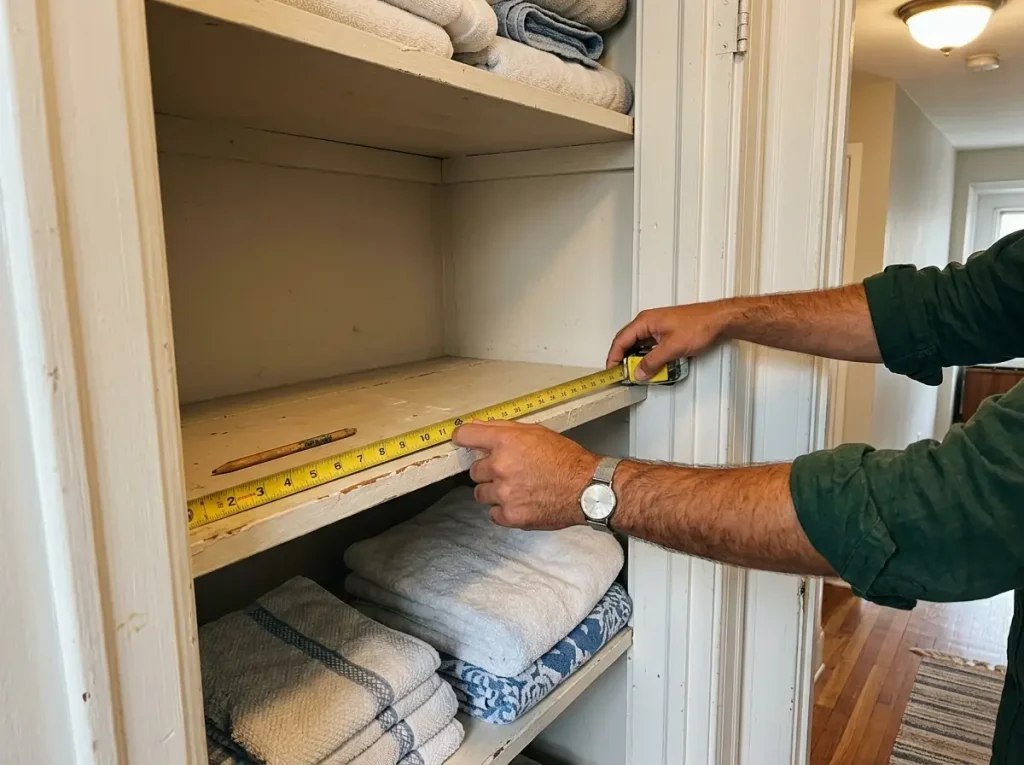
Everyone buys the bin before measuring the shelf and then blames the bin. The measurement takes about ninety seconds and it eliminates roughly half the products in any roundup, including a few in this one.
The trap is that closet depth and shelf depth are two different numbers. A linen closet is usually around 24 inches deep as a room, but the shelves inside it are not. Shelf boards are cut shallower so you can reach the back, which means you measure the closet, feel confident, and buy for a depth that does not exist. Pull a tape measure from the back wall to the front edge of the shelf itself, and you will land somewhere in the standard 12- to 16-inch shelf depth most linen closets are built to.
Depth is only half of it. Vertical clearance is the constraint nobody states out loud, and it is the one that decides whether a bin is usable or just technically present.
Folded sheets need about 10 to 12 inches of headroom. Towels want 12 to 16. The top shelf usually has 16 to 18 inches, which is why it swallows bulky things and refuses rigid boxes with lids.
Floor-to-first-shelf runs 18 to 20 inches, and that single number is why floor containers get to be taller and heavier than anything above them. Whatever is left above a stack is dead space, and vertical storage is just the habit of noticing it.
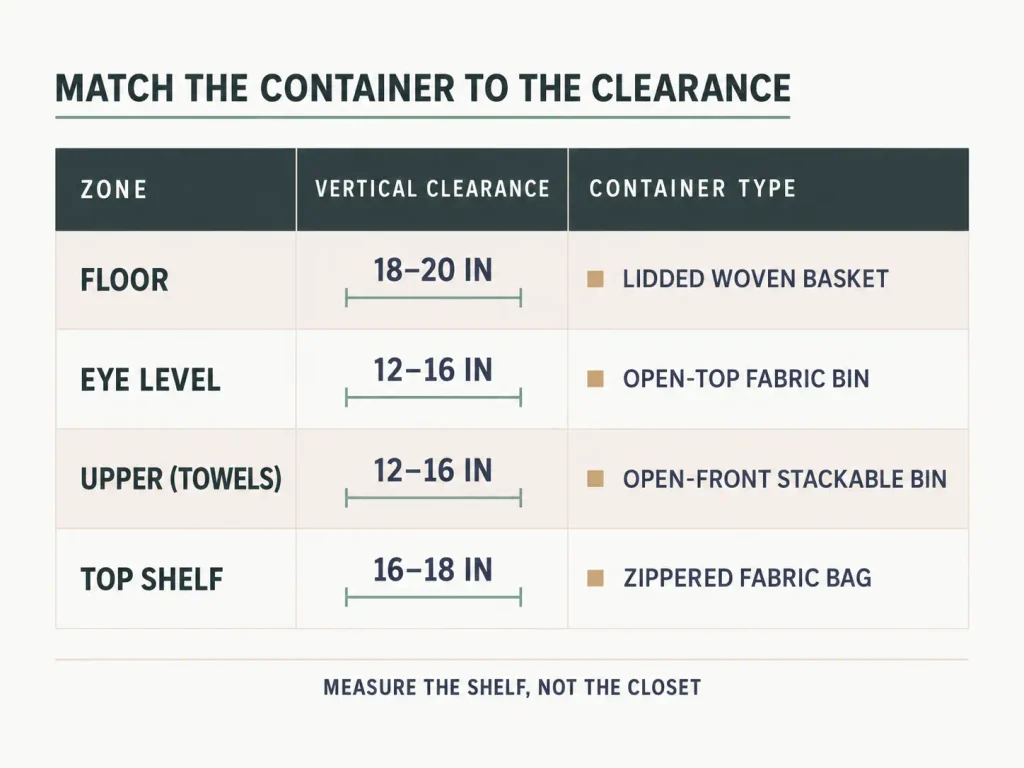
Once you have those two numbers, the buying criteria stop being about brands. Four things decide whether a container survives in a linen closet: an open top wherever you reach daily, a flat bottom, a handle you can hook with one finger while your other hand holds a wet towel, and stackability only in the zones where you genuinely stack. That’s it. Apply those four and you can walk into any store, ignore every product name in this article, and still buy correctly.
There is a question that gets asked fresh in organizing forums every single year, usually by someone with a deep, narrow closet in an older house: what goes on the floor and what goes on the top shelf? It reads like a placement question. It is a dimensions question wearing a placement costume. Once you know the clearances, the zones assign themselves, which is the part the full linen closet system this sits inside walks through end to end.
Best Bins for Sheets and Towels at Eye Level
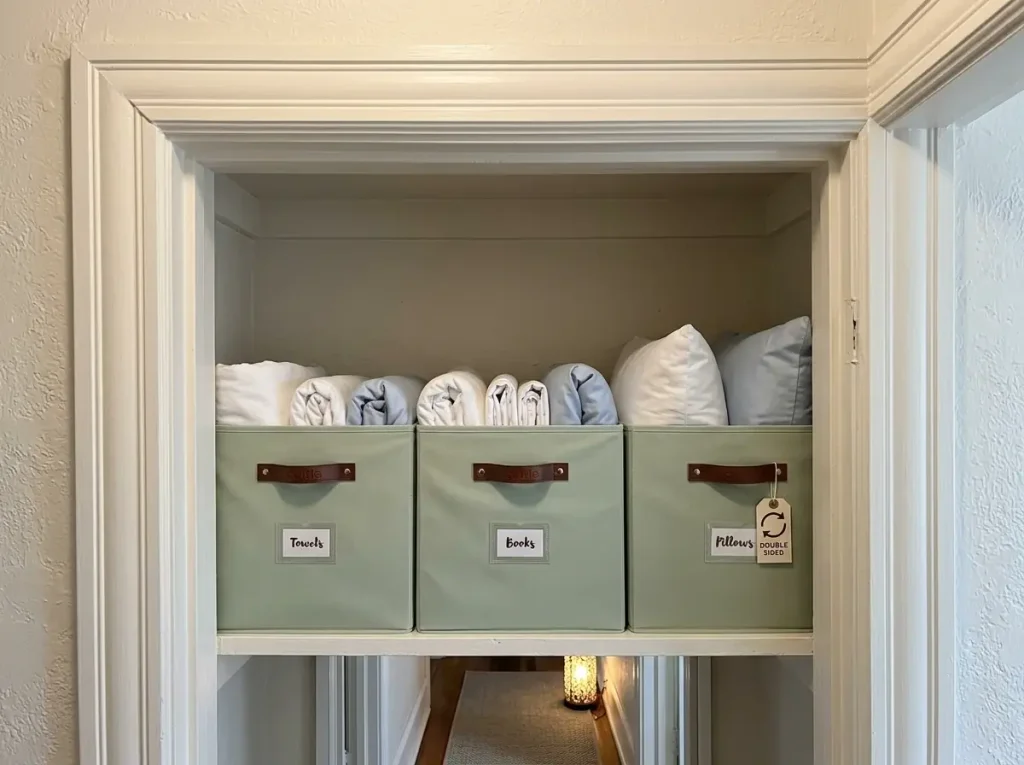
The eye-level shelf is where a system either survives or quietly dies. It is the shelf you reach into half-awake at 6am and again at 11pm, and every extra motion between you and a clean towel is a vote for the pile on the floor. In a small linen closet that one shelf is carrying most of your towel storage by itself.
Which is why lids are wrong here specifically. A lid adds a second motion to a shelf you touch daily: lift, set aside, grab, replace. Give it three weeks and the lid is living on the shelf above, permanently. Lids are not a design flaw, they are just a tax, and up here the tax is too high.
Before you buy anything, the honest check: if your sheet sets already stack flat and stay flat, you do not need a bin on this shelf at all. Bins earn their place where things slump, tip, or migrate into each other.
Towels slump. Fitted sheets slump aggressively. Neatly folded flat sheets often do not.
How you fold sheets and fold towels settles half of this before any container gets involved. Buy for the things that misbehave.
For everything that does misbehave, an open-top fabric bin with a flat bottom and a front label holder sits inside the 12 to 16 inch envelope without overhanging the shelf edge, which is the whole ballgame.
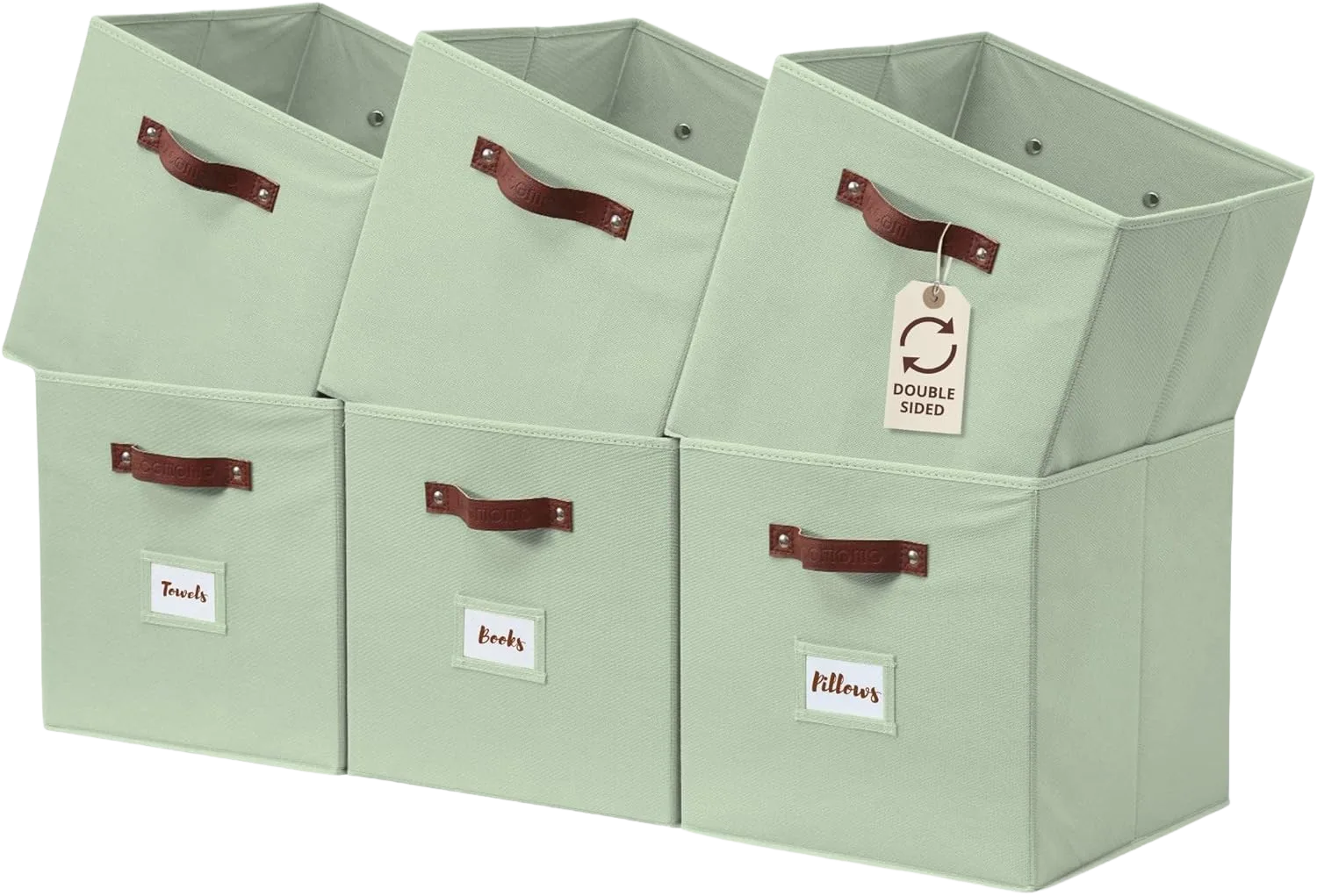
One category per bin. That is the rule that makes a labeling system worth building, and it is not negotiable. The moment one bin becomes the flexible one, it starts collecting the washcloth that did not fit, the pillowcase without a match, the beach towel that belongs in the garage.
A miscellaneous bin eats the whole shelf inside a month, every time, and it does it quietly enough that you do not notice until the shelf is gone. All of this assumes you have already emptied and grouped what you own, which is the sorting sequence that comes before any of this.
Store each sheet set inside one of its own pillowcases. The set stays together, the stack stays square, and you stop pulling three folded flat sheets out to find the fitted one. It costs nothing and it removes the single most common reason an eye-level shelf falls apart within a month.
Toiletry and Backstock Bins That Earn Their Shelf
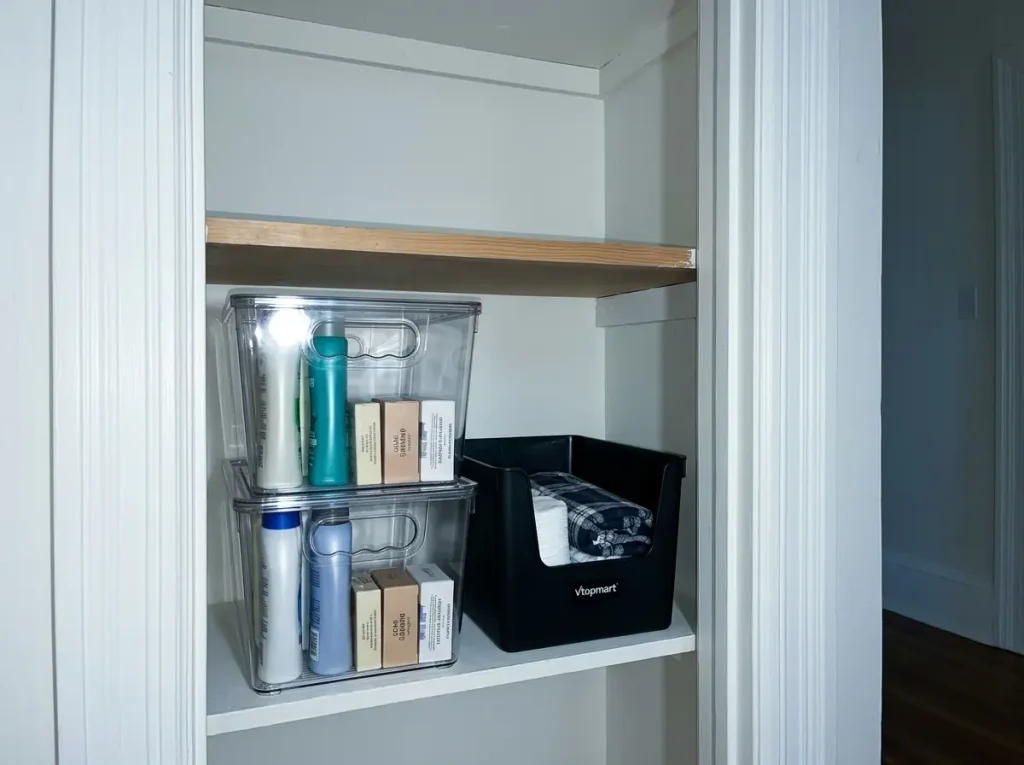
This is the shelf that turns into an archaeology dig. You buy a third bottle of the conditioner you already own two of, because the front row is all you can see and the back eight inches might as well not exist. That is not forgetfulness. That is a visibility problem, and the fix is literally seeing the back of the shelf.
Which is why clear sides are a functional choice here, not a decorative one. On a sheet-and-towel shelf, opaque is fine because you know what a towel bin holds. On a shelf handling toiletries storage and grooming products storage, the contents are twelve different bottles that all look alike from above, and opaque containment just relocates the problem into a smaller box. The same logic drives the same clear-bin logic applied under a bathroom sink, where the geometry is worse and the visibility payoff is bigger.
Before you buy a single bin, though, do the free move: pull everything out of its retail packaging. A box of pads takes about three times the shelf space its contents do. Same with bandage cartons, cotton rounds, and the enormous cardboard sleeve around a four-pack of toothpaste.
The top-voted advice in the organizing thread that inspired half this section was not a product at all. It was to decant daily items into a narrow drawer and to put cotton swabs in a jar the person already owned. Re-containerize first. Buy second.
Backstock is the word that makes the rest of this section work. It means the reserve quantity, the stuff you own but are not currently using, as distinct from daily rotation. Separating those two tiers is what actually stops the duplicate-buying loop, because the reason you buy a third bottle is that the reserve and the rotation are mixed into one undifferentiated shelf.
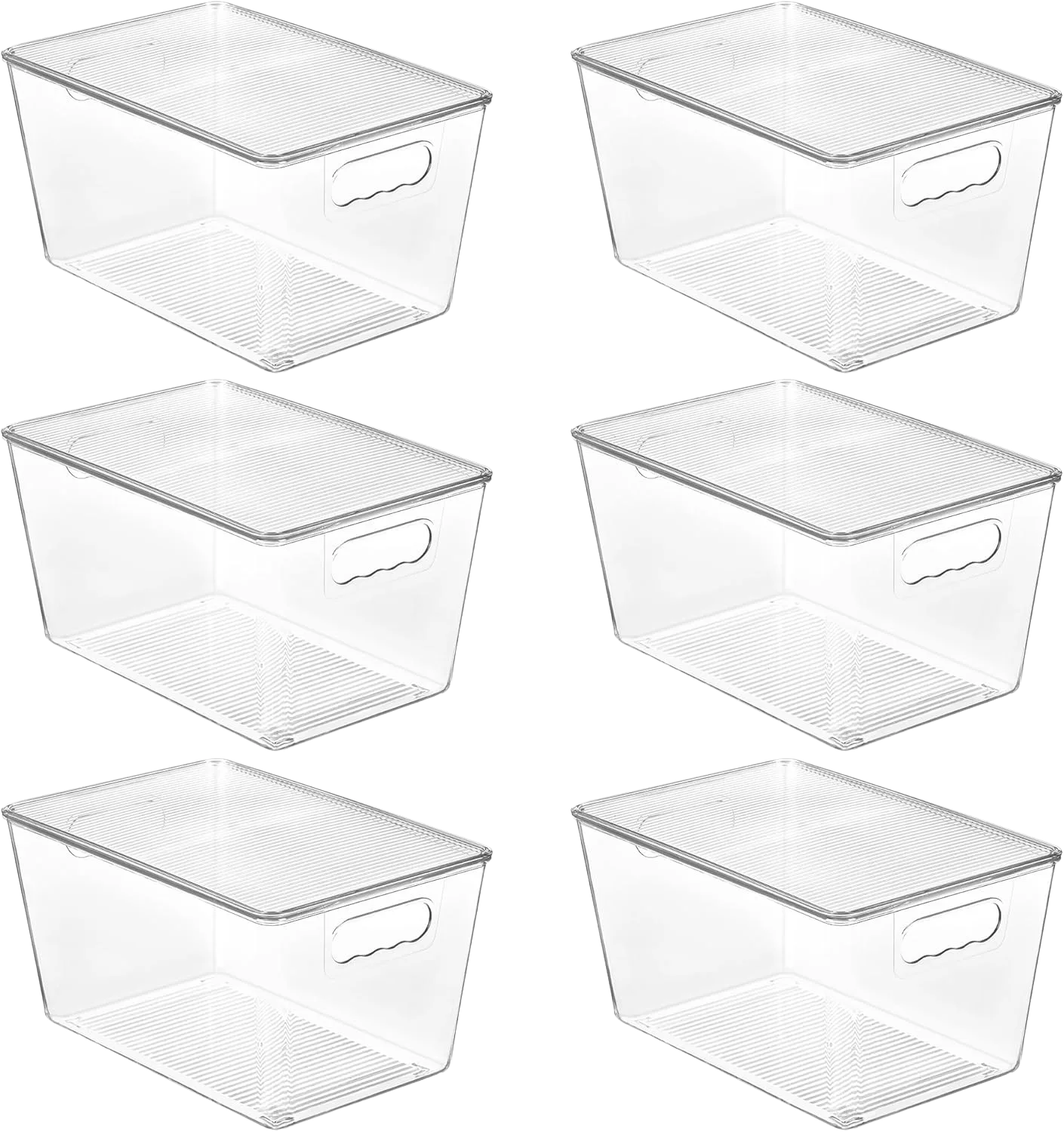
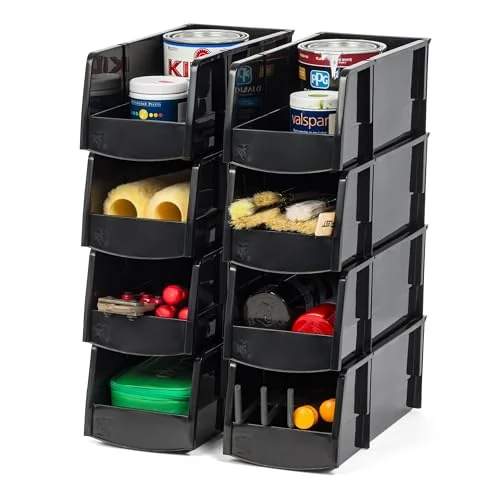
For the tier you touch weekly, though, drop the lid entirely and go open-front. An open-front bin lets you pull the item without pulling the bin, which is the difference between a system you use and a system you admire.
Top Shelf and Floor Zone: Bags and Baskets for the Bulky Stuff
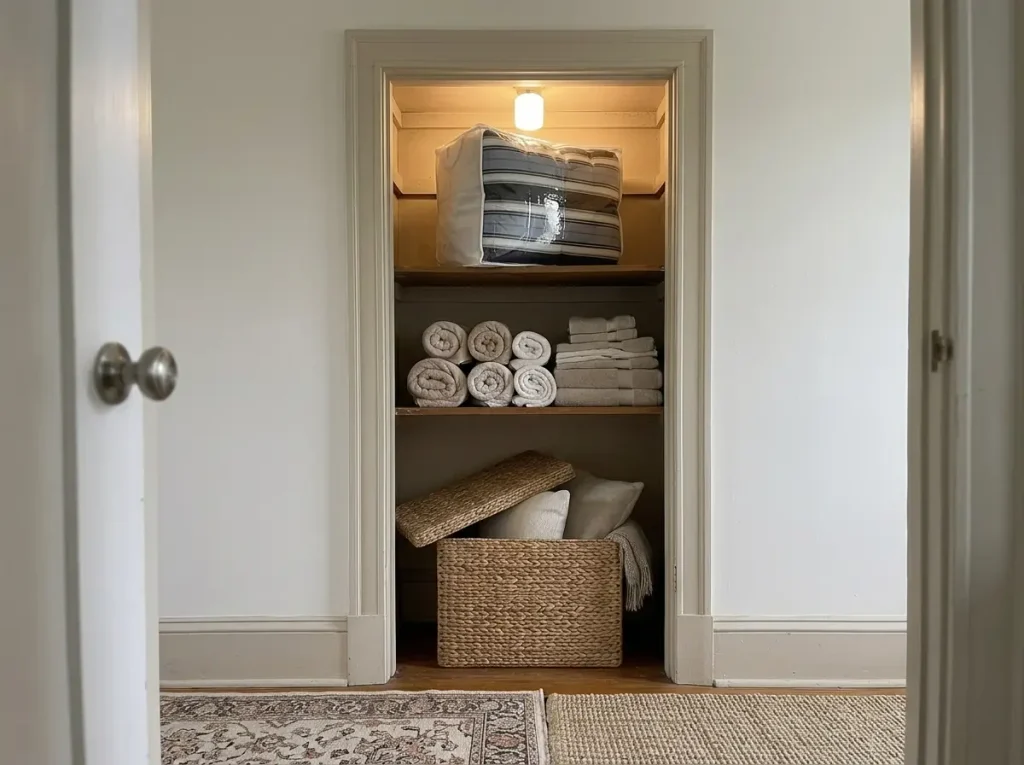
The top shelf is where loose comforters go to become an avalanche, and the closet floor is where everything without a home goes to wait. Both zones need containment. They do not need the same kind, and treating them as interchangeable is how people end up with a rigid bin they cannot reach and a soft bag that has collapsed sideways on the floor.
Start high. That top shelf typically gives you 16 to 18 inches of clearance, which sounds generous until you try to put a rigid bin plus its lid up there and discover you cannot lift the lid off without a step stool and a prayer. A zippered fabric bag wins up high for one physical reason: it compresses to whatever you put inside it, so a half-full bag takes half the space, and it comes down over the shelf lip without a rigid rim catching on the edge.
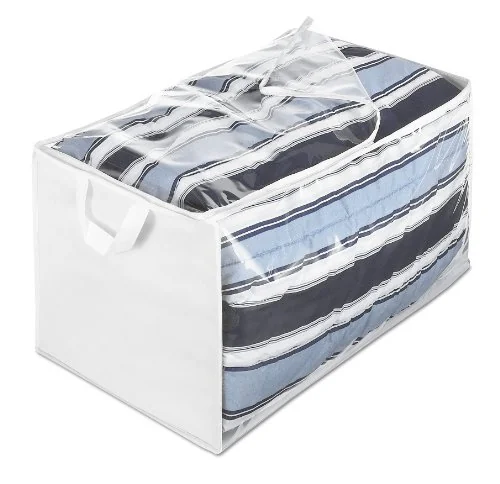
Whatever you put up there, load light. Bulky-but-light is the top shelf’s job description: spare pillows, off-season bedding, the extra blanket nobody uses until January. A zippered storage bag is doing seasonal storage up there, not everyday duty.
Dense folded towels do not belong overhead, because bringing down an armload of stacked terrycloth above your head is how a linen closet reorganizes itself onto the bathroom floor. If you are storing bedding for a full season rather than a few weeks, it is worth reading how vacuum bags compare for genuinely long-term bedding storage before you commit.
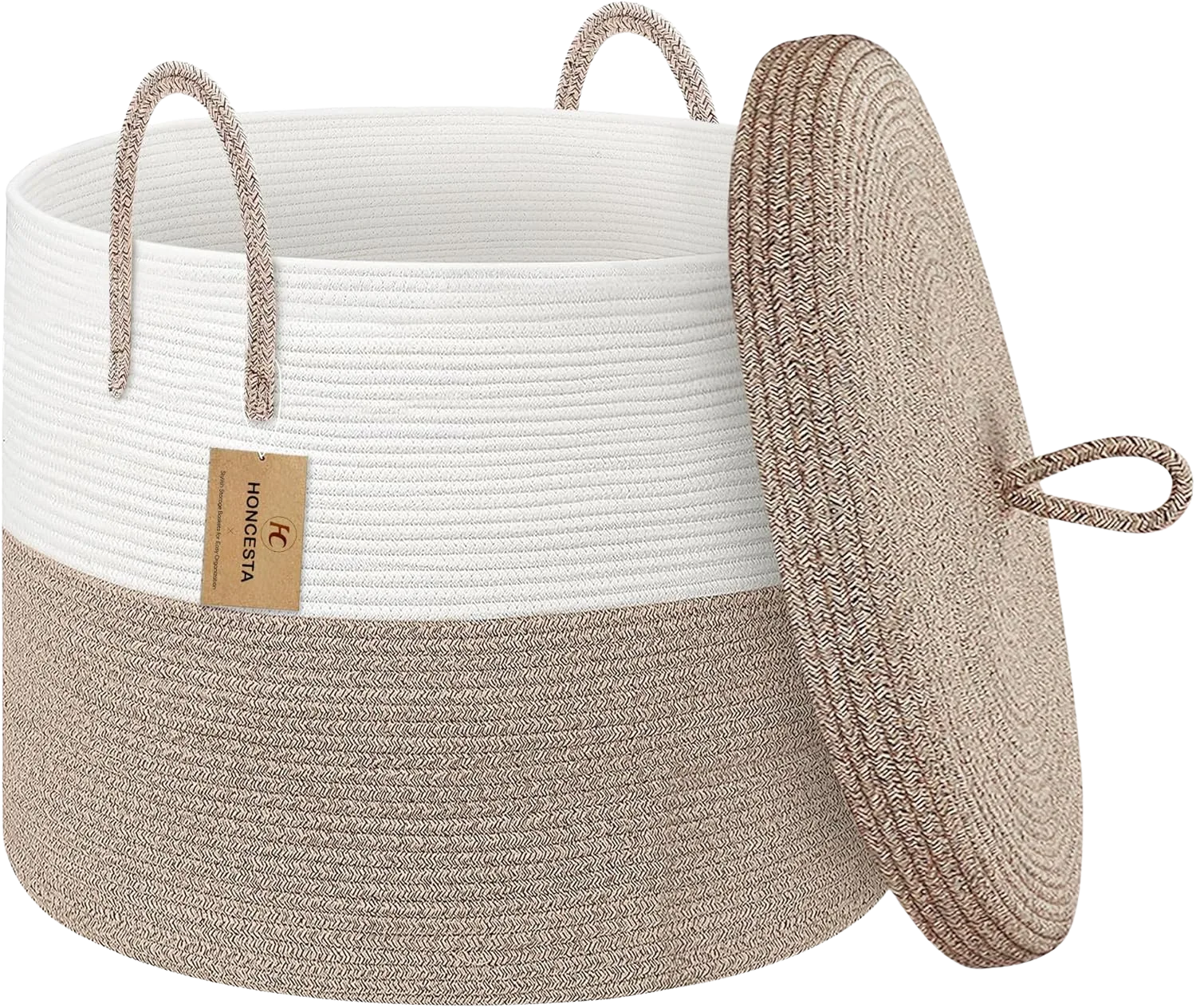
Now go down to the floor, where the rules flip. Everywhere else in this closet a lid is a tax you pay twice a day. On the floor, you open the container maybe four times a year, so the lid costs you almost nothing and buys you a flat surface, dust protection, and something that does not look like a pile. This is the one zone where lidded wins outright.
Door Racks and Labels Without Drilling a Hole

The back of a closet door is free storage that almost nobody uses. It is also where renters get themselves into trouble, because the obvious solution (stick something to it) is the one with the lowest weight ceiling in the entire closet.
Start with the two mounting systems and what they can actually carry. An over-the-door rack hangs on the door’s top edge on steel hooks and never touches the wall at all, which is why it is the backbone of no-drill organization and the renter-safe way to add a whole zone. Those racks are commonly rated 20 to 30 pounds on a standard-thickness door.
Adhesive is a different tool with a much lower ceiling: manufacturer weight ratings for adhesive hooks and over-door racks put individual adhesive hooks between 1 and 7.5 pounds each depending on size, with adhesive rails topping out somewhere around 10 to 20 pounds total. That is genuinely fine for two hand towels and a robe. It is not fine for a loaded pocket of folded sheets, and the failure is not gradual. Adhesive holds, holds, holds, then lets go all at once, usually at night, usually taking a strip of paint with it.
Then there is the door itself, which is the variable nobody accounts for. Hollow interior doors are the norm in rentals: two thin skins with a cardboard honeycomb between them.
The weight rating printed on an over-door rack’s box assumes a door with more structure than that. So on a hollow door, treat the rating as a ceiling you never approach. Put your lightest bulky items in the top pockets (empty pillowcases, washcloths, off-season odds and ends) and keep anything with real mass in the bottom pockets, close to where the door’s hinges can support it.
If money were no object, the reference point in this category is the Container Store Elfa wire door rack, which is what Wirecutter picks and which genuinely sets the standard for a mesh door system. It is also sold exclusively through that retailer, and an Elfa system costs several times what a fabric pocket organizer does.
Here is the thing nobody in that conversation says out loud: it hangs from the same door edge, carries roughly the same load, and holds the same linens. You are paying for rigidity and looks, not for a different capability. The budget alternative does the job that matters in most linen closets.
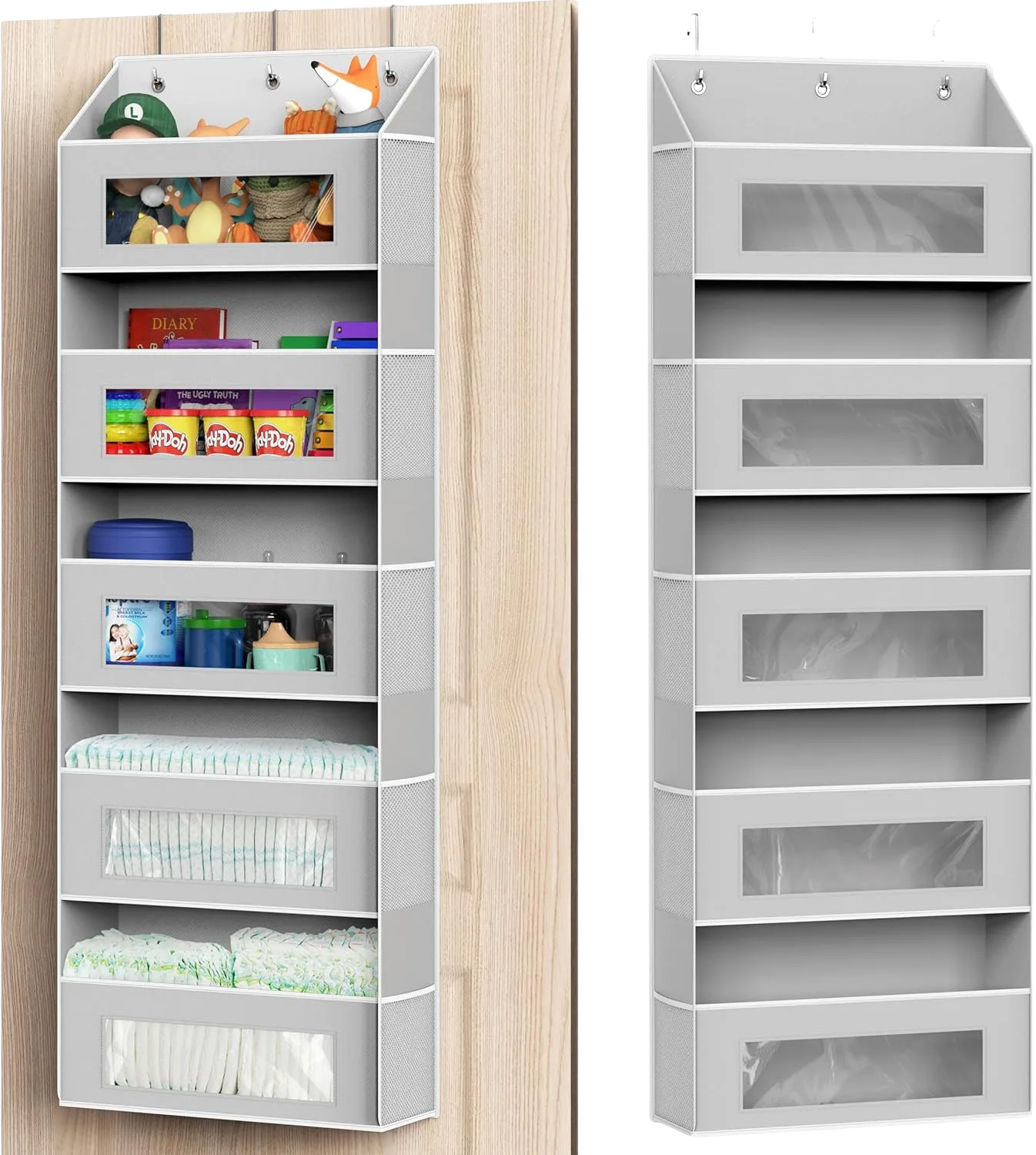
Door thickness is the one spec people skip and then discover the hard way when the hooks will not seat, so it is worth checking which over-door organizers fit which door thickness before you order anything for this zone.
Hang the door organizer, load it, then open and close the door ten times fast. If the pockets swing hard enough to slap the door frame or the rack shifts sideways on its hooks, it is either overloaded or too wide for the door. Find that out now, not at 2am when the whole thing comes off the top edge.
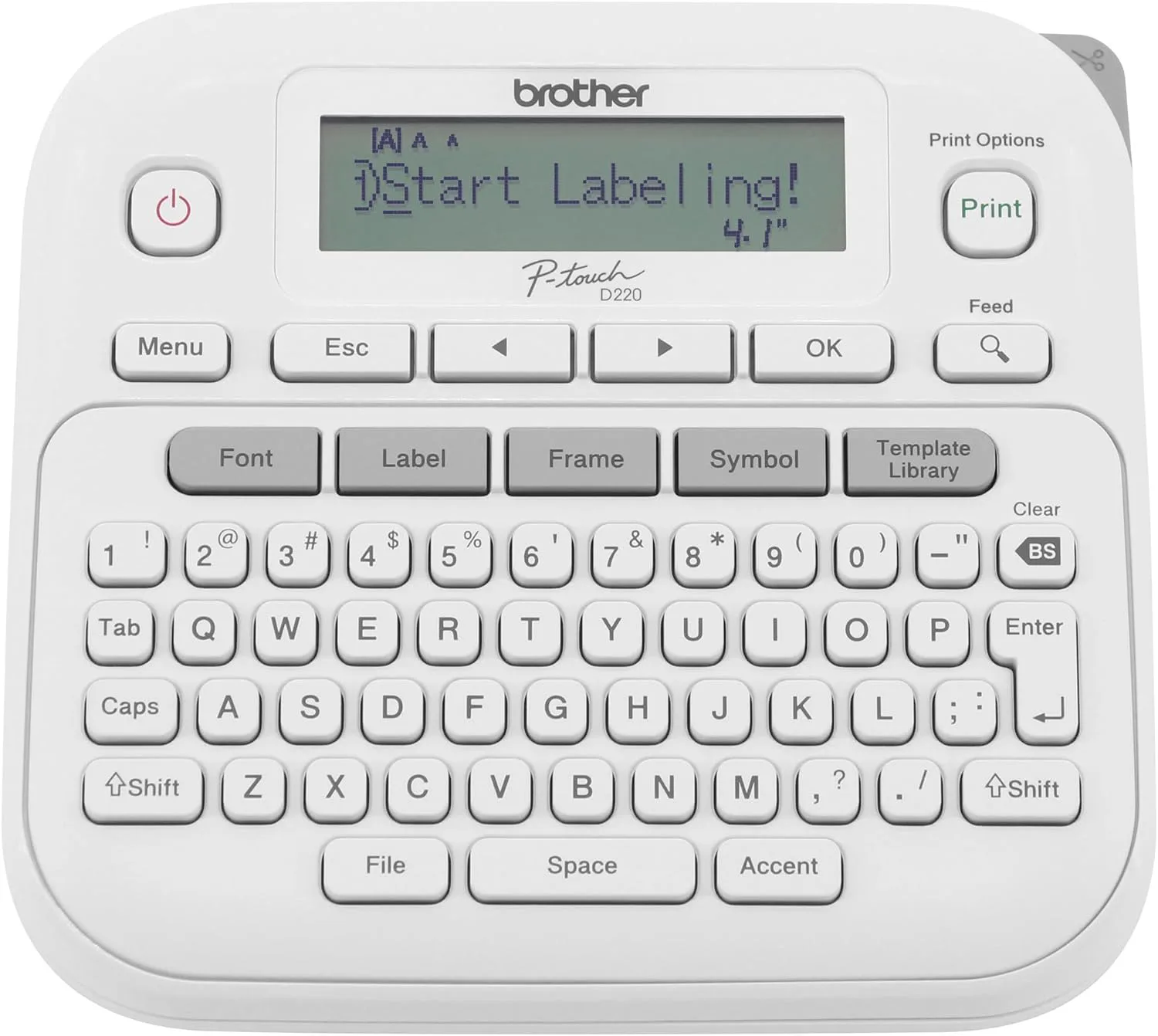
Labels close the loop, and they are what make one-category-per-bin enforceable by somebody other than you. An unlabeled system is a system only its author can maintain, which is fine until you are out of town and someone else puts the guest towels wherever they seem to belong.
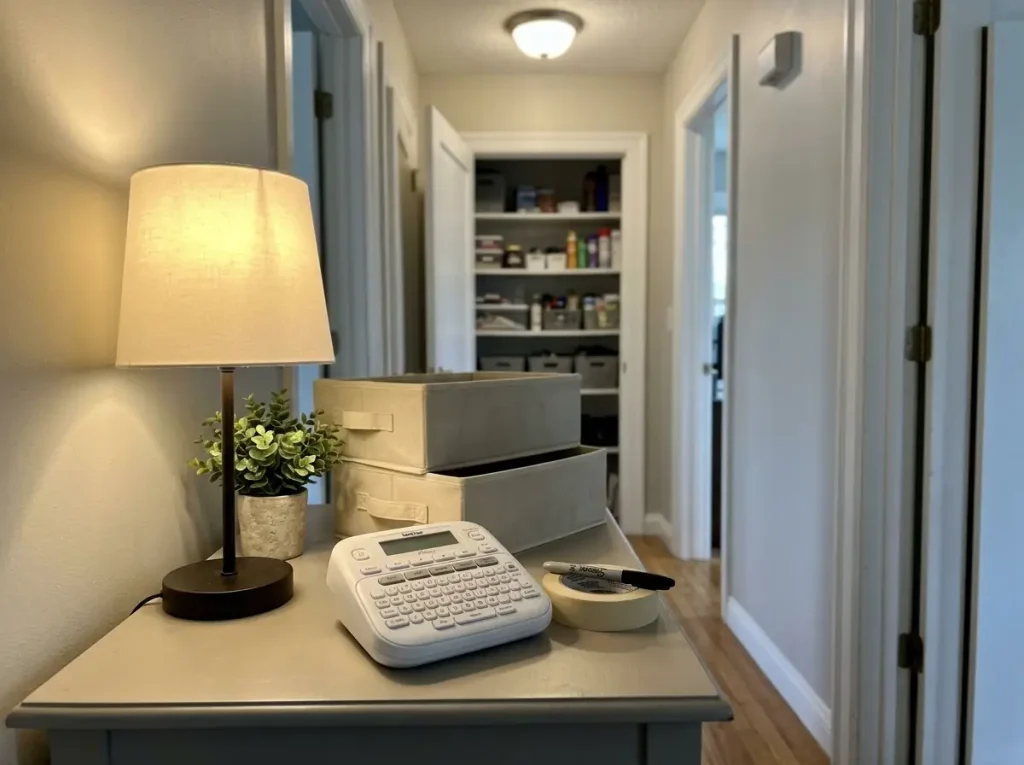
The free version works: masking tape and a marker. I would honestly start there for a month, because handwritten labels are how you find out whether your categories are right before you commit them to laminate. Categories change. Tape peels off.
Making Any of This Work on Wire Shelving
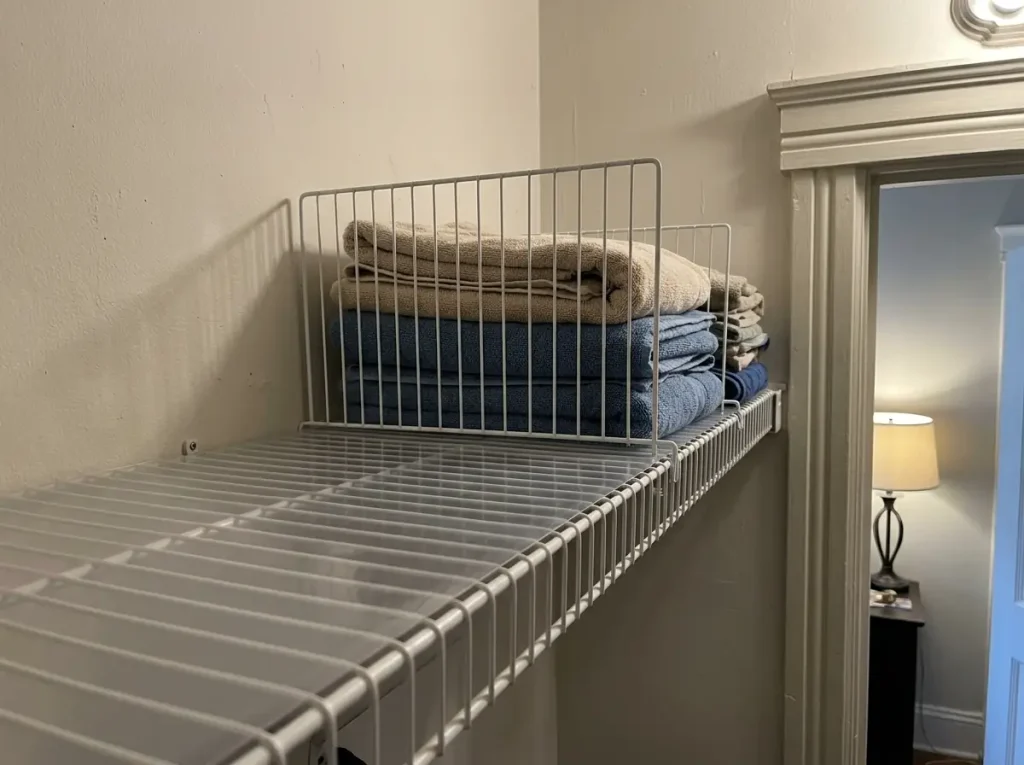
Wire shelving is the rental default, and it is the reason a perfectly good bin tips over for no apparent reason. Nothing in this article performs the way it is supposed to up there until you fix the surface first, and fixing the surface is a ten-minute job that most roundups skip entirely.
Here is the mechanism. Wire shelves are a grid of parallel steel ribs with air between them, so a container only touches the shelf along a handful of narrow lines. A flat-bottomed bin bridges those ribs and sits stable.
Anything with a rounded, ridged, or footed base rocks on them instead, and rocking is not harmless: every time you pull something out of the bin next to it, the rocking bin walks a few millimeters toward the front edge. Weeks later it goes over. The bin was never the problem.
Then there is the gap loss, which is more annoying than dramatic. Small items fall through: a travel-size bottle, a hair tie, a sample packet, the cap off something. People blame the bin for being the wrong size when the real culprit is a shelf with holes in it.
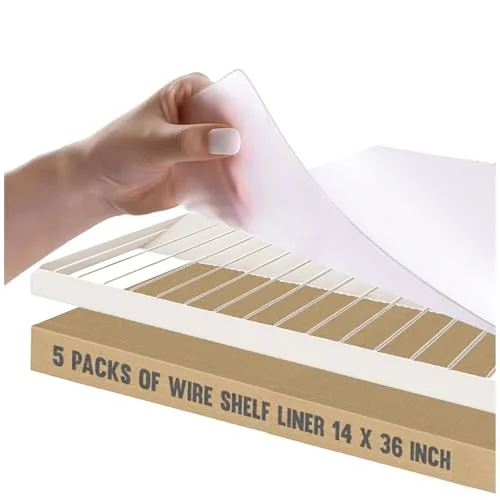
A liner solves both problems in a single move by converting the wire into a flat, continuous surface. Non-adhesive matters here specifically, and not for aesthetic reasons: an adhesive liner leaves residue on a landlord’s shelving, and residue on shared fixtures is exactly the category of thing that quietly comes out of a deposit.
Liner down, the second wire-shelf failure shows up: stacks that slump sideways into each other. Folded towels have no structural rigidity, so a stack four high leans, and once it leans it merges with the stack beside it. Now you have one wide pile and no categories, which is the wire-shelf version of the miscellaneous-bin problem. Clip-on dividers fix it without tools by giving each stack a wall to lean against.
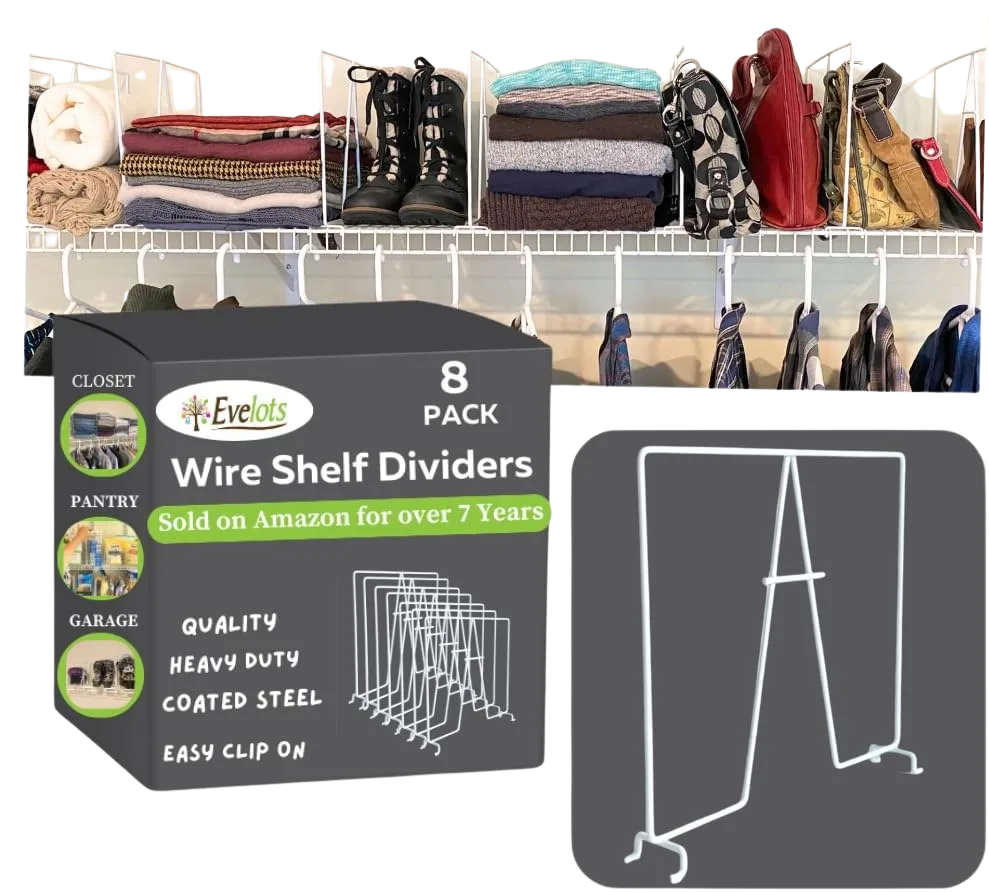
Every fix in this section is reversible, and that is deliberate. Wire shelving is what renters inherit and cannot replace, so renter-friendly storage that involves modifying it is not a solution, it is a deposit deduction with extra steps. Liner in, dividers on, both out again in five minutes. For the rest of the wire-shelf problem, including the dead vertical space these shelves create, there is the full wire-shelf fix for a linen closet.
What to Buy First and What to Skip
Nobody buys all of this at once, and nobody should. There is an order that makes each purchase pay for the next one, and it starts before you spend anything.
Purge, then measure, then buy. Sort by type before you decide anything, and keep a donation bin open beside you as you go, or the bins end up sized for a pile you were about to get rid of. The realistic ceiling most professional organizers land on is two to four sheet sets per bed and two to four towels per person, and the gap between that number and what is actually in your closet right now is usually where the space problem lives. Measure after the purge, because the shelf you are buying for is the one holding what you decided to keep.
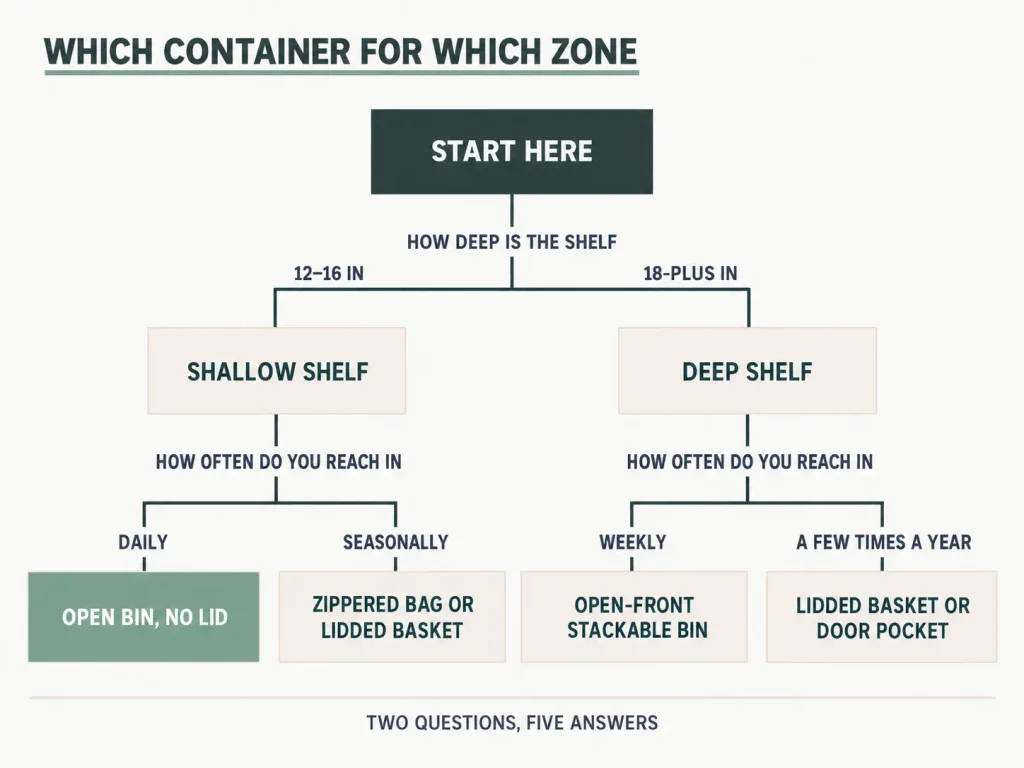
Buy first: the eye-level bins. They fix the shelf you touch every day, so the payoff is immediate and it is the one purchase you notice within twenty-four hours. If you are on wire shelving, the liner comes before even that, because a bin on bare wire is a bin that will annoy you into removing it.
Buy last, or possibly never: the label maker. It is the finishing tool. Masking tape proves whether your categories are right, and categories are wrong more often than people expect on the first pass, especially the one that starts as “extras” and turns into a junk drawer with a lid.
Skip three things. Matching storage baskets bought for how they photograph, because matching is a constraint you are adding on top of the constraint you already have. Anything lidded at eye level. And any bin deeper than your shelf, no matter how good the deal is, because a bin that overhangs by two inches is a bin the closet door will fight with every day until you give up and take it out.
There is a story that gets repeated in organizing threads and it is worth ending on. Someone hired a professional organizer for their bathroom and linen storage, the result was beautiful, and then an apartment flood undid all of it in an afternoon. Everything went into trash bags during the cleanup and never came back out.
What rebuilt it was not a second professional visit, which they could not afford. It was labeled baskets by category and dividers for the small daily items, done alone. That is the actual test of a linen closet system: not whether it photographs well, but whether one person can restore it on a Tuesday evening without help. The same buying order works one room over, as the same buying order applied to a bedroom closet shows.
Write your shelf measurements (depth, width, and the vertical gap for each shelf) in your phone’s notes app the day you measure. Every future purchase for this closet takes thirty seconds instead of a trip back to the tape measure, and you stop guessing in a store aisle, which is where most of the wrong bins get bought.
The Short Version
Measure the shelf, not the closet. Depth decides the bin, and it eliminates half the catalog before you spend a dollar on any of it.
Match the container to how often you reach for what is inside. No lids where you reach daily, lids are fine where you reach seasonally, and every extra motion between you and a clean towel is one more reason the system quietly stops getting used.
On wire shelving, fix the surface before you buy a single bin. A liner and a set of clip-on dividers change what every other product in this article is capable of doing up there.
In three months, open the closet and look for the bin that has turned into the miscellaneous one. That is the category you got wrong, and relabeling it is a ten-minute fix before it spreads to the shelf next to it.
Measure one shelf tonight. Buy for that shelf. Get it right before you buy anything for the other four.
Frequently Asked Questions
01What is the best towel organizer for a linen closet?
An open-top fabric bin sized to your shelf depth, with clip-on shelf dividers added if you are on wire shelving. Towels do not need a lid or a specialty product. They need a container that stops the stack slumping sideways, plus 12 to 16 inches of vertical clearance above it.
02What is the best way to organize a deep linen closet?
Treat the depth as two zones instead of one: daily items in the front, backstock behind them in a bin you can pull out, so you are never reaching blind. A deep shelf without that front-to-back split turns its back half into storage you forget you own.
03How deep are linen closet shelves?
Most run 12 to 16 inches deep, even though the closet itself is often around 24 inches. That gap between closet depth and shelf depth is the single most common reason bins bought online stick out past the shelf edge and catch the door.
04What is the best way to organize my linen closet?
Purge to a realistic quantity first, measure the shelf second, then assign one category per container by zone: daily items at eye level, bulky items up high in a zippered bag, seasonal items on the floor. The containers come last in that sequence, not first.
05Can you use over-the-door organizers on a hollow closet door?
Yes, but load them conservatively. Over-the-door racks hang on the top edge rather than the wall, so they need no hardware, but a hollow interior door is weaker than the box’s weight rating assumes. Put light bulky items up top and keep the weight low.