There’s a pile on the bedroom chair. It was supposed to be temporary. It has been there since the weekend, and now there’s a smaller one forming on the couch arm, which is how these things spread. You clear it, you feel briefly competent, and four days later the chair looks exactly the same.
The reason isn’t discipline and it isn’t that you need a bigger hamper: dirty clothes are the only category of object in your house with no assigned address between the moment they come off and the moment they hit the machine. Everything else has a shelf. This guide covers how to sort laundry in a way that holds, how many streams you actually need, how big each bin has to be, what the system costs at three tiers including free, how to get the rest of the household to use it, and where drying, folding, and ironing fit once the washing is done.
Quick Answer
Build a laundry sorting system in five steps, in this order:
- Pick the fixed spot first, before buying anything.
- Decide how many streams your household actually runs.
- Size each bin to hold at least one medium wash load.
- Give every person a rule they can follow without thinking.
- Attach the whole thing to a named day.
Why Your Laundry Pile Keeps Coming Back
Walk the route your clothes take. They come off in the bedroom or bathroom. The washer is down the hall, in the basement, or three floors down in a shared room. Between point A and point B there’s a gap of anywhere from ten feet to two days, and nothing in your house has been designated to hold clothes during it.

So the nearest flat surface takes the job. It isn’t a choice anyone made. It’s what happens when a daily process runs into a missing container.
That’s why clearing the pile never holds. Clearing is an event; the pile is produced by a process that runs every day, twice a day if anyone in the house exercises. An event cannot beat a process. You clear on Sunday, by Thursday the chair has re-accumulated, and somewhere in there you stop blaming the clothes and start blaming yourself, which is both unpleasant and beside the point.
The trap tightens when the temporary spot picks up a function. The chair was a one-off. Then it was where the jeans lived because you’d wear them again. Then it was where everything lived.
Once a surface has held laundry three times your brain files it as laundry storage, and clearing it feels like a chore rather than a correction. In laundry-system threads people describe this in nearly identical language: they dump on the floor or the couch not out of indifference but because there is genuinely nowhere else.
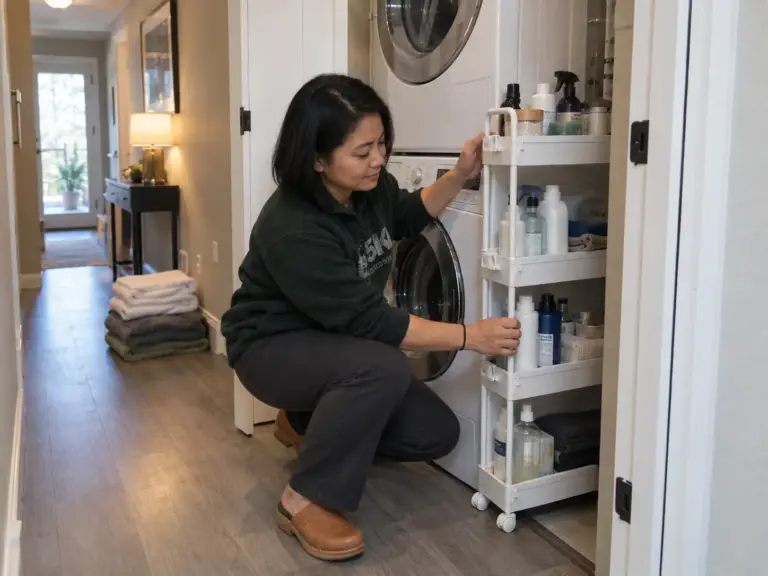
The small-space version is worse. With a stacked washer-dryer in a hallway closet there’s no counter and no landing zone at all. One commenter with that exact setup put it plainly: there is literally no place to fold or hang laundry, so the whole operation migrates to the bedroom and stays there.
Clean and dirty end up in the same room, and the system has inverted. That’s a different problem, worth reading separately when the room itself is the constraint rather than the routine.
So here’s the reframe the rest of this guide runs on. You are not shopping for a laundry sorter. You are assigning an address to the one category of object in your house that doesn’t have one.
The sorter is whatever occupies that address, and it might be a cart, a hamper, or four baskets you already own. Pick the address first.
Before you decide anything, stand in the spot where you actually take your clothes off and look around from there. Not the laundry room. The bedroom corner, the bathroom doorway, wherever the shirt comes off. The system has to start within about three steps of that spot or people will keep choosing the chair, because the chair is closer.
How to Sort Laundry by Color and Fabric
Most guides hand you six categories like adding one is free. It isn’t. Every category is another bin to house, another decision at 7 a.m. when you’re half awake, and another stream that now takes three weeks to fill instead of one.
Start from the smallest number that prevents actual damage. Fewer decisions is the same logic that makes decluttering methods stick past the first enthusiastic week.
The Three Streams Almost Every Household Actually Needs
Lights, darks, and towels or bedding. That’s the floor, not the ceiling. Sorting by color, whites and darks kept apart, handles color transfer: the only failure mode that actually destroys clothing rather than just annoying you.
Towels earn their own stream even in a two-person house, for reasons that have nothing to do with color. They want a longer dry time, so mixing them with shirts means either the shirts cook or the towels come out damp. They’re also the volume item: a week of towels plus one set of sheets is most of a load by itself, so when they’re mixed in they skew every other stream’s fill rate and you can’t tell when anything is ready.
Three bins, three rules, done.
When a Fourth Stream Earns Its Place
A fourth category means you sort laundry by fabric type rather than color: delicates, activewear, or anything that can’t take a hot dryer. Apply this rule before committing a bin to it: a fourth stream is worth having only if it fills at roughly the same rate as the other three. If your delicates bin takes six weeks to reach a load, it isn’t a stream. It’s a holding pen, and you’ll end up washing three bras with the darks anyway.
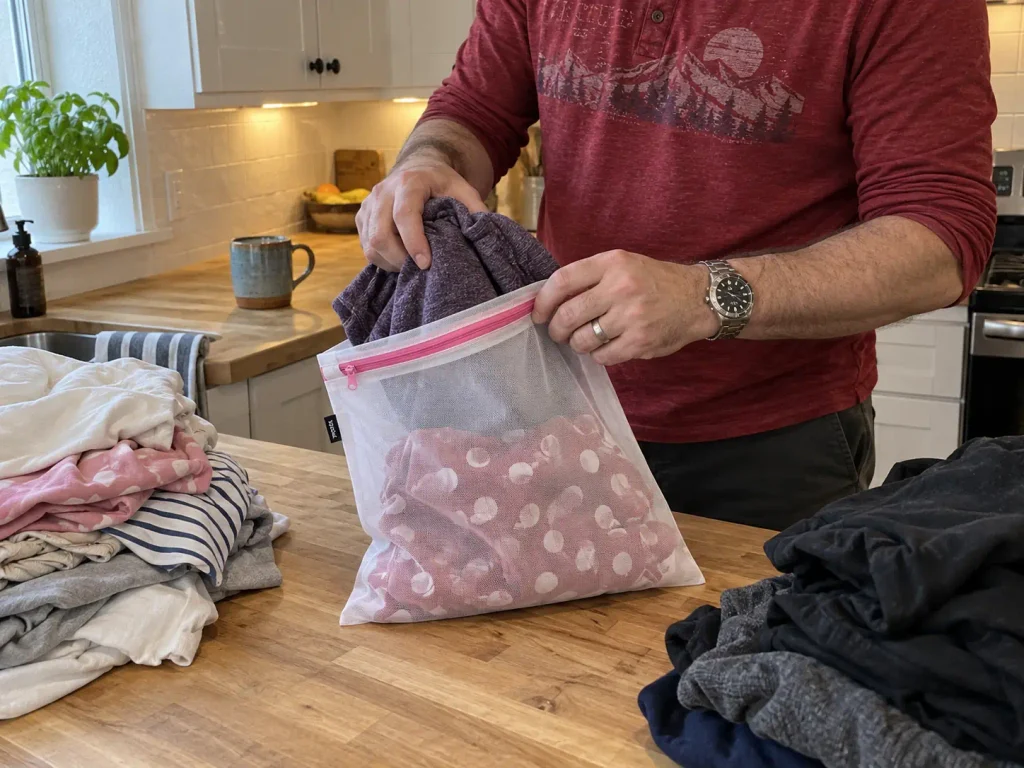
The fix for a slow-filling category is to let it live inside an existing stream instead of beside it. A set of mesh laundry bags does that at close to zero cost, and the BAGAIL Mesh Laundry Wash Bags are the cheap default: bras, hosiery, and anything with straps go in a zipped bag that drops into the darks and comes out without having strangled a sweater.
The limitation is honest. Mesh protects against tangling, not heat, so anything that truly can’t take the dryer still gets pulled before the load moves over. The bag makes that one object to grab instead of nine.
The Color-Bleed Question, Honestly
Cold water is not a guarantee, and this is where the “just throw it all in” camp overstates its case. One person in a laundry thread described the exact sequence: cold cycle, delicate setting, being careful, and a favorite yellow dress came out with dye transfer anyway. Cold reduces the risk. It doesn’t zero it, particularly with new dark denim and cheap red cotton.
The conventional wisdom is that skipping sorting means accepting that risk. In practice, color-catcher sheets make the choice far less dramatic: one goes in with the load, absorbs loose dye, and costs a small fraction of any sorter cart. If your household has already lost the sorting argument, a box buys back most of the protection without asking anyone to change their behavior. Buy those before you buy hardware.
New dark denim and anything red gets washed alone the first two times, no matter what system you’re running. That’s not a sorting category, it’s a two-wash quarantine. After the second cycle it joins the darks stream and you never think about it again.
Hamper, Multi-Bag Sorter, or No Sorter at All
The search results for this question assume you’re buying a three-bag cart, and plenty of households run fine without one. There are three valid answers and one of them is “none.” A sorter nobody uses is furniture.
The Single Hamper (And Who It’s Right For)
One hamper is right for one person, for a household running a single stream, or for anyone who has concluded that sorting is a losing battle in their house. A single hamper plus a color-catcher habit beats a three-bag sorter everyone bypasses.
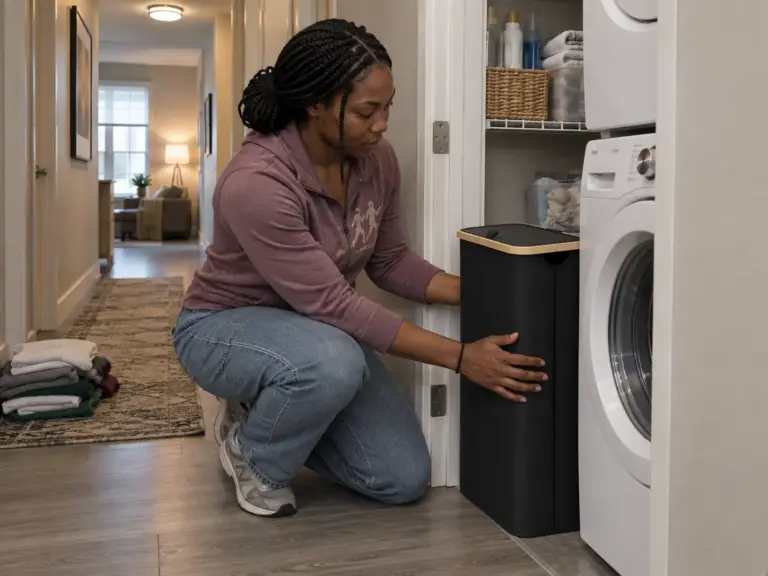
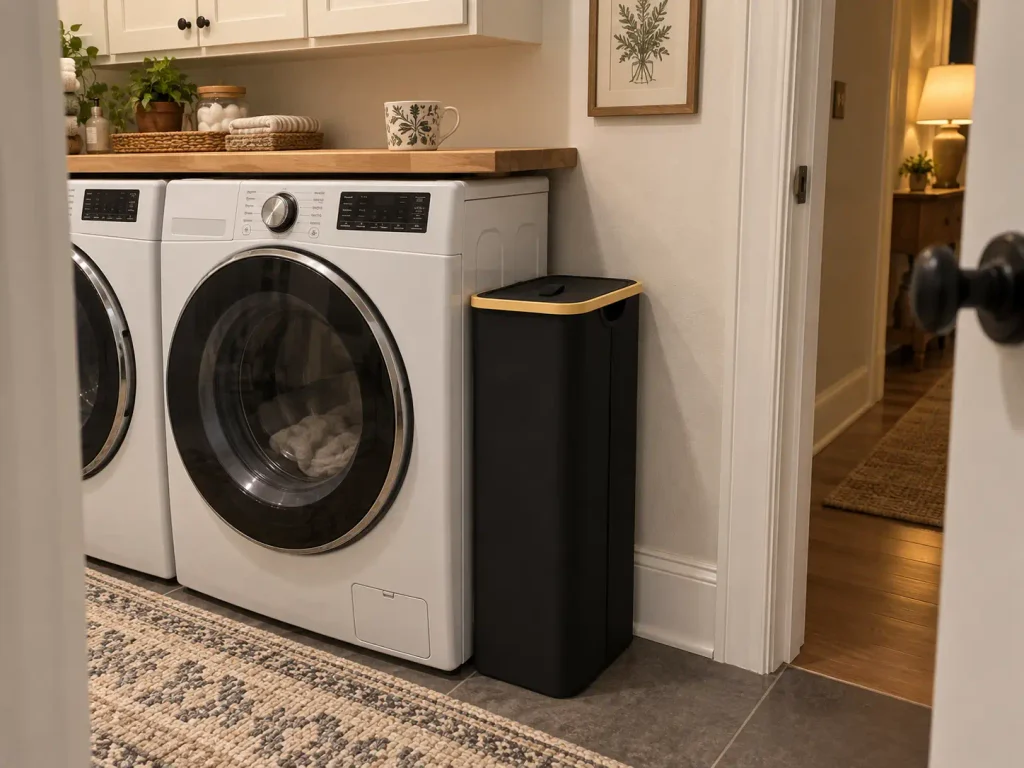
In a small space, depth decides this, not capacity. The gap beside a washer-dryer pair is shallower than people estimate, and a wide round basket won’t go there no matter how much it holds. The SpaceAid Slim Laundry Hamper with Lid runs 16 by 8.75 by 28 inches at 65 liters, and that 8.75-inch depth is the number to check against your own gap. The trade-off is the shape: tall and narrow tips more easily than a wide basket, so it wants a wall behind it rather than open floor.
The Multi-Bag Sorter
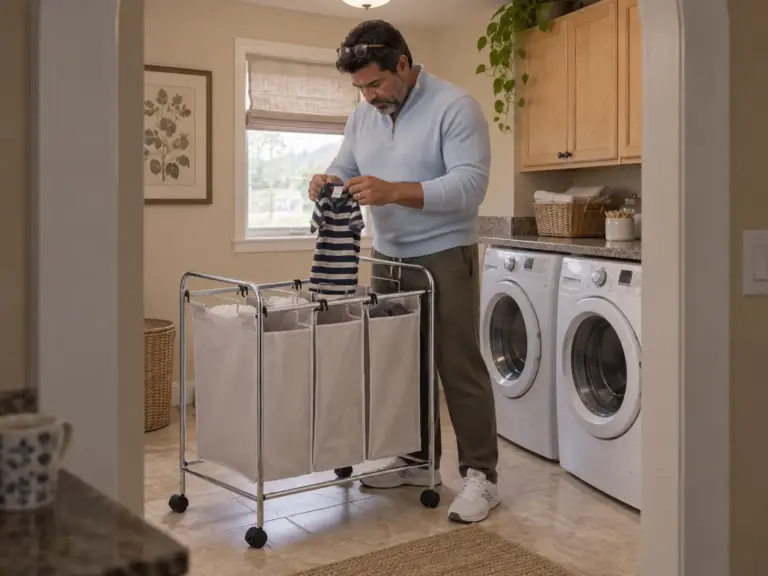
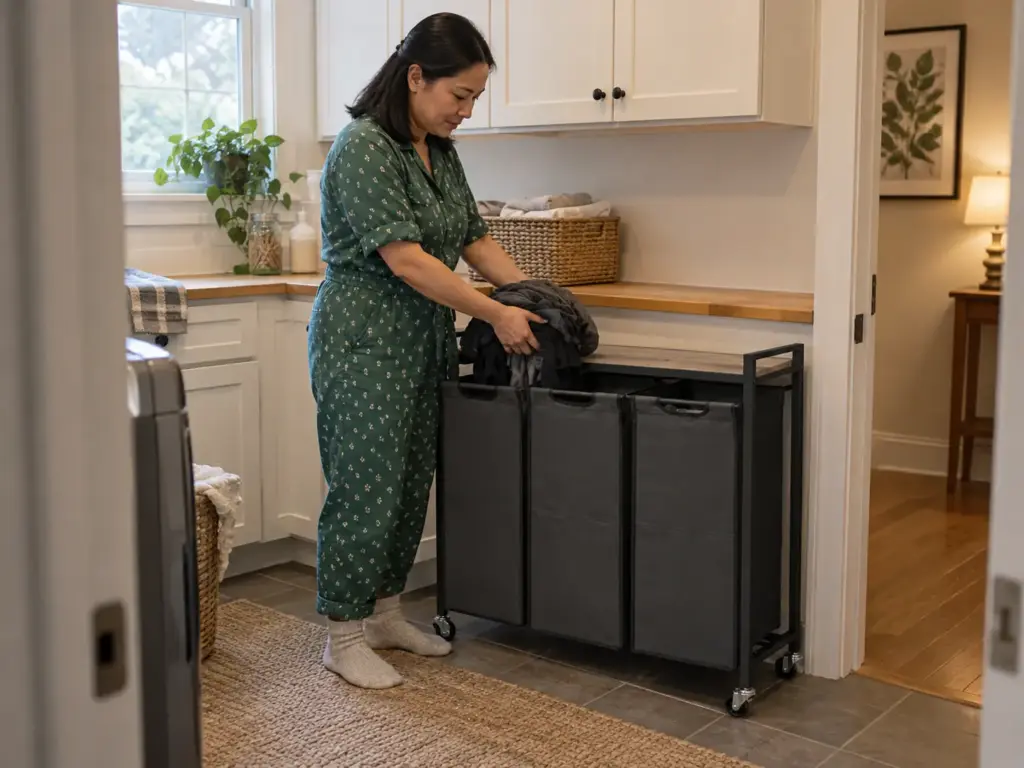
What three bags buy is a shift in when the sorting happens. Instead of a mixed pile separated on the floor on wash day, separation happens once, as each item comes off, by the person taking it off. Thirty seconds across a week instead of fifteen minutes on Sunday. It isn’t storage, it’s moving the work to where it’s invisible.
A wheeled laundry sorter is the underrated answer to the no-drill question. Every DIY sorting build worth copying ends up mounted to studs, a non-starter if you can’t put holes in the wall.
A rolling laundry cart sidesteps it: the system moves to the work instead of living on a wall you don’t own. Skip the wall, not the system. If you want a renter-friendly laundry system, read what you can and can’t mount in a rental laundry room, read that before committing to anything permanent.
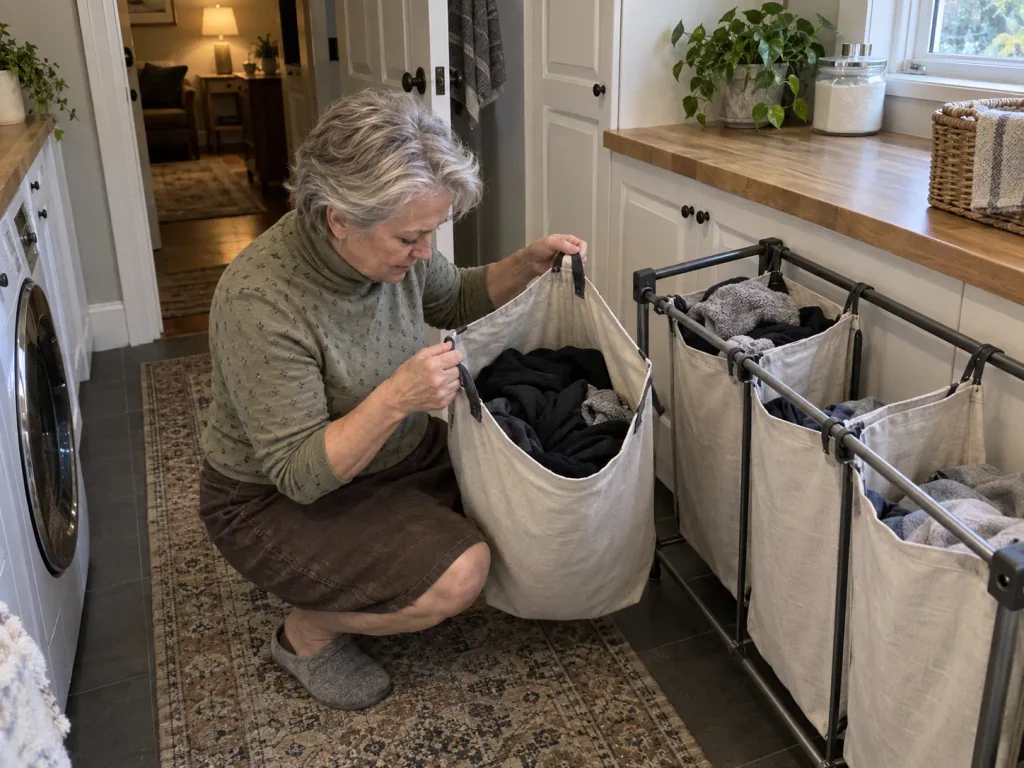
The HOOBRO Laundry Sorter 3 Section matches the three-stream setup directly: three removable bags at 11.5 gallons each on a wheeled frame, close to one wash load per bag. Removable matters more than it sounds, since carrying a bag beats carrying a basket you have to bring back. The caveat is footprint. It’s furniture roughly the size of a small dresser, and in a galley laundry closet it will block the dryer door.
If that’s the right shape but the price gives you pause, the budget laundry sorter in this pair is the Amazon Basics 3-Bag Laundry Sorter with Removable Bags runs identical logic on a metal frame with locking wheels for meaningfully less. The frame is lighter and flexes when all three bags are loaded. Functionally you’re buying the same idea.
The No-Sorter System: One Hamper Per Person
Here’s the laundry basket system buying guides never mention: give every person their own basket and wash person by person. Nobody sorts anything. No decision to get wrong, no category to misjudge, no bin that’s “closest to the door” and therefore gets everything. One commenter with two kids described landing here after the shared-hamper system kept failing.
The math works better than it looks. You lose efficiency, since one person’s week is a smaller load and you run more cycles. You gain complete compliance, worth more than efficiency in any house with more than two people. A parent of three described a middle path: separate only the genuinely special items, then wash each person’s clothes as their own load.
And it costs nothing if you already own baskets. Most houses do.
Run the free version for two weeks before you buy a sorter. Four baskets from around the house, labeled with painter’s tape, sitting in the spot you picked. If the household uses them, you’ve confirmed the location and the number of streams and you can buy the real thing with confidence. If they don’t get used, you just saved yourself a cart.
How Big Your Sorting System Needs to Be
People buy a sorter based on how it looks next to the dryer, then discover each bag hits “full” at a third of a wash load. Now they’re running half-empty cycles, which wastes water and makes the system feel like more work than the pile did. Size the bin against the machine, not against the gap in the room. That’s the number nobody publishes, so here it is.
Match the Bin to One Wash Load
Laundry sorter capacity only means something next to HE washer load size, so start with pounds per load. Per Tide’s load-size guidance and Maytag capacity figures: a medium or regular load runs roughly 6 to 8 pounds, a large load around 11 pounds, extra-large 20 to 22. On the machine side, a standard top-loader takes about 12 pounds and an HE front-loader handles 15 to 18. Your target is a bin that holds at least a medium load, ideally closer to a large one.
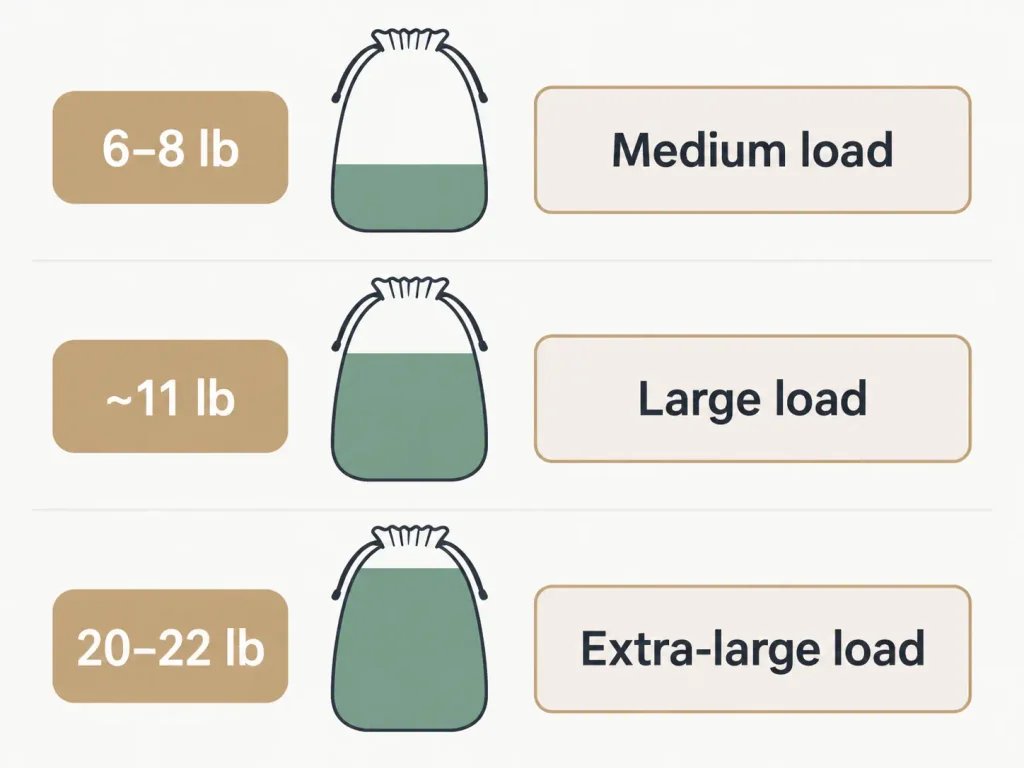
This is also the quiet reason three-section sorters work at all. Bags in the 11-gallon range land near one HE load each, so all three streams reach “full” at about the same pace and wash day becomes one trip with three loads rather than three scheduling problems. Under-size the bins and you trigger a wash when a bag is a third full. Over-size them and clothes sit for two weeks, which is how a sorting system starts smelling like a gym bag.
Where It Physically Goes
Depth before width, always. The gap beside a machine is shallower than people estimate, and the failure mode is discovering that the day the box arrives. Measure depth first, then width, then height if anything sits on a shelf above. In a laundry closet with a few inches to spare on either side, that depth number is the entire decision.
The other half: the sorting station doesn’t have to live in the laundry room. It has to live where clothes come off. If the machines are in the basement and the bedrooms are upstairs, putting the sorter next to the washer guarantees a pile upstairs, because nobody carries a single shirt down two flights.
Put the bins upstairs (hamper parking belongs near the bedrooms) and carry the full bag down once. The machine is a destination, not a home.
The Step People Forget: Somewhere to Put Wet Clothes
Here’s where most systems stall, and it isn’t at the washing. Things come out of the machine, some can’t go in the dryer, there’s nowhere to hang them, so the whole load goes into a basket “for now.” That basket is now a second pile.
It’s clean, which somehow makes it worse: a clean pile has no urgency and can sit a week without anyone feeling bad. Several people describing failed laundry systems land on exactly this bottleneck.
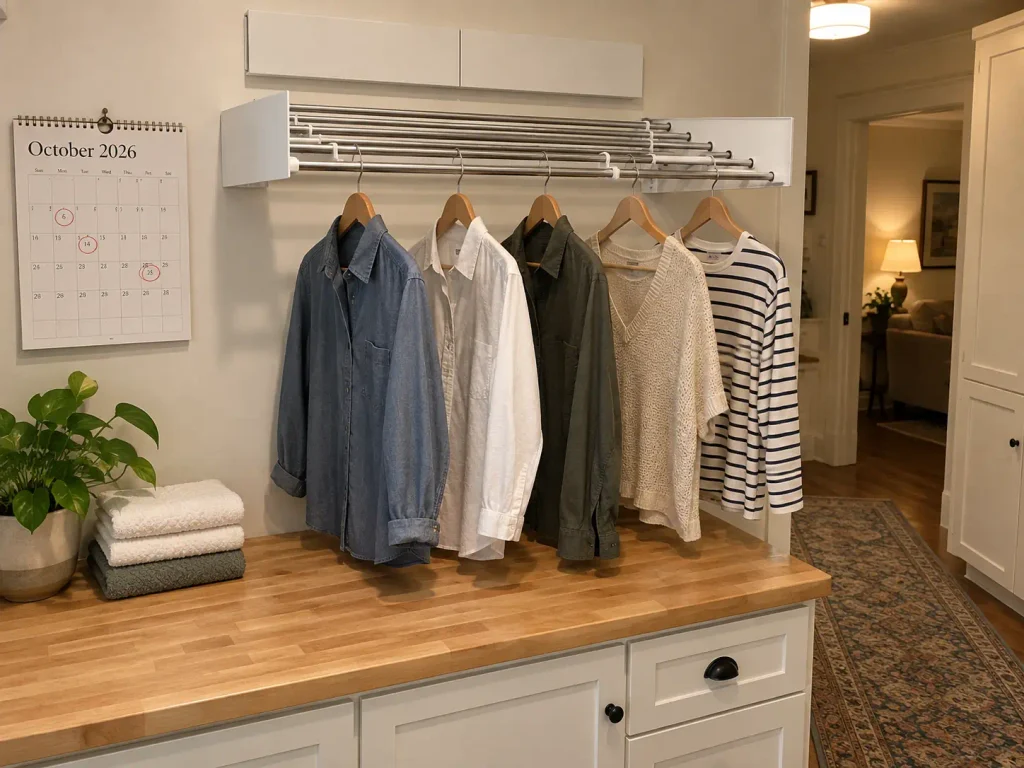
Closing that loop takes a hang spot that exists by default rather than one you set up each time. The Vikaqi Wall Mounted Clothes Drying Rack folds flat against the wall at 32 inches wide and drops down when there’s something to hang, so the hang-dry step stops requiring a decision. The catch is that it mounts to a wall, so check your lease and your wall type first. A tension rod across a closet opening does the same job for renters who can’t mount anything.
Building a Laundry Routine That Survives a Real Week
A sorter is a container, and containers don’t empty themselves. What stops the pile is that the container gets emptied on a schedule you didn’t have to decide on that morning. The hardware half of this gets all the attention because it’s the half you can buy. The time half decides whether any of it holds past month two.
One Load a Day vs. One Laundry Day
One load a day is a daily laundry habit where volume never builds: start a load with coffee, move it after work, fold it before bed, and no mountain gets time to form. The cost is touching laundry every day, including days when you have nothing left. For households with kids that’s usually the only model that keeps up, since three kids outproduce a weekly cycle.
A single laundry day, a weekly laundry schedule, is fewer touches and one large commitment. Four hours on Saturday, six days of not thinking about it. The cost is that Saturday is spoken for, and missing it means carrying two weeks into the next one, which is roughly where people give up and start buying socks.
Pick the one that matches how your week actually runs, not the one that sounds more disciplined. The machines can decide it for you anyway: when the machines aren’t in your unit at all, a daily load isn’t an option: an apartment laundry routine gets built around trips instead of cycles, and shared laundry room etiquette decides how long you can leave a machine sitting.
The Assigned-Day System
The most mature version of this that turns up in real households is to assign laundry days by name. One empty-nester described hers in full: Sunday her own clothes, Monday sheets, Tuesday towels, Wednesday her husband’s laundry, Thursday miscellaneous, Friday cleaning rags, Saturday off. Nothing about it is clever, and that’s the point. Every load knows whose it is and when, and the rest day gives a missed load somewhere to go.
What makes it work isn’t the frequency. It’s the naming. An unassigned load belongs to nobody, which is why “we do laundry twice a week” quietly stops happening around week three.
Twice a week is a target, and targets slip without anyone technically breaking a rule. Wednesday is his laundry is a fact, and facts get noticed when they don’t happen.
Closing the Loop: The Part That Isn’t Washing
Wash, dry, fold, put away. Systems almost never collapse at “wash,” the step people optimize obsessively. They collapse at “put away,” where clean clothes make it through every machine and then stop moving about eight feet from the drawer.
The fix is defining done correctly. The day’s laundry isn’t finished when the dryer beeps, and it isn’t finished when the folding is done. It’s finished when the clothes are in the drawer. Define it that way and the last eight feet become part of the load rather than a bonus round, because a folded basket looks finished and a half-done load looks half-done.
Never start a load you can’t finish that same day. A load left wet overnight has to be rewashed, a load left in the dryer gets wrinkled and dumped on a chair, and both of those outcomes teach the household that the system doesn’t work. Better to skip a day than to start a load at 9 p.m.
Getting Everyone Else in the House to Use It
You can build the best sorting station in the county. If your partner’s laundry habits run to dropping everything in the darks bin because it’s nearest the bathroom door, you have a one-person system installed in a multi-person house, and you’ll spend the next year re-sorting other people’s laundry while feeling mildly aggrieved about it. Laundry compliance is where most systems fail, and rarely in month one. It’s month two, once the novelty wears off and the defaults reassert themselves.
Make the Wrong Bin Harder Than the Right One
Placement does most of the compliance work before anybody gets reminded of anything. The bin someone passes on the way out of the bathroom is the bin that gets used, and no amount of labeling overcomes six extra steps. If the darks bin sits at the end of the row and the lights bin is nearest the door, your lights bin will slowly fill with jeans. Put the highest-volume stream in the most convenient position and let geometry enforce it.
Reduce decisions before you increase reminders. Every reminder carries a small social cost and wears out fast; a system with fewer choices doesn’t need reminding at all.
Running four streams with shaky compliance? Drop to three before printing a single sign. In shared spaces, staggering laundry days between two people removes another class of collision entirely.
Label It, But Label It for the Person Who Isn’t You
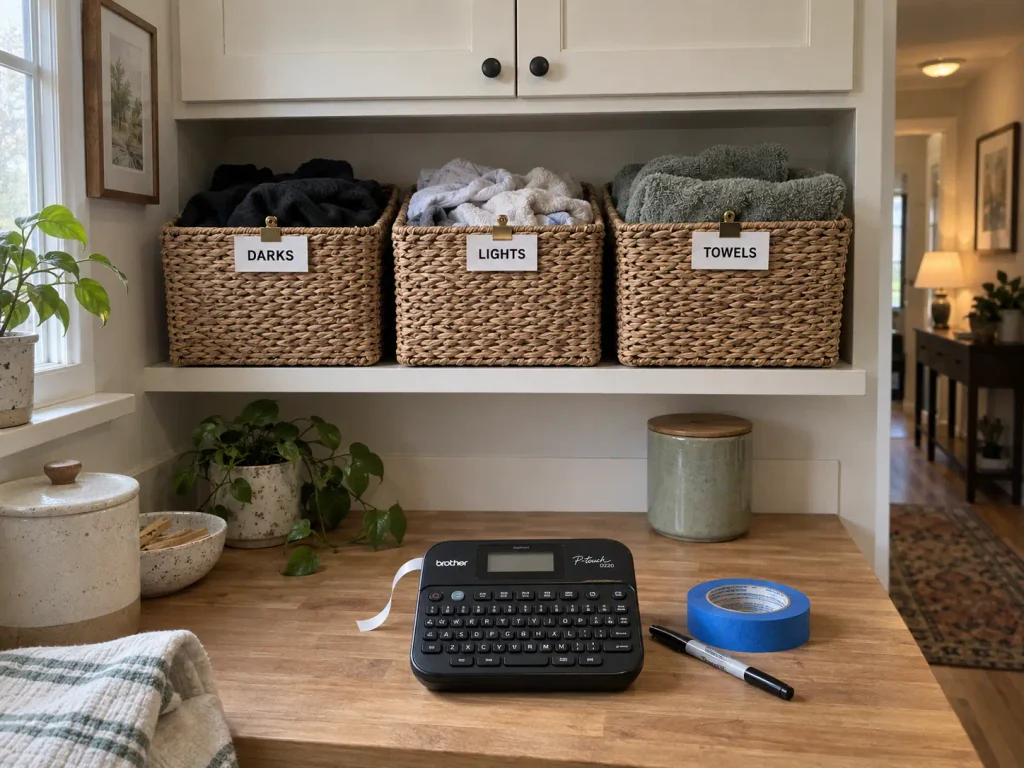
“Darks” is a category. “Jeans + black stuff” is an instruction. A category asks the other person to hold your mental model of laundry. An instruction asks nothing. Label in the words your household says out loud, even when they’re imprecise: “gym + smelly” outperforms “activewear,” and nobody has ever hesitated in front of a bin marked “towels and sheets.”
Start free. Label laundry bins with painter’s tape and a marker on the front, at the height someone looks when holding an armful. The real benefit is that it’s provisional: you can move the labels for a month while the household tells you what the categories actually are, and most people discover one of their four streams was theoretical.
Once the labels stop moving, printed ones survive better. Painter’s or washi tape labels curl in a humid laundry area, and marker fades exactly where hands touch the bin edge. A Brother P-Touch PTD220 Label Maker prints laminated labels that hold up, and it earns its keep elsewhere in the house.
Order matters, though: free first, durable second. Buying the label maker before you know the categories is how you end up with permanent labels on a system you abandon.
When Compliance Fails Anyway
Sometimes no system design closes the gap, because the issue isn’t the system. It’s worth understanding when the other person’s standards are genuinely different from yours before spending another month on labels.
The documented fallback is the one from earlier: stop asking people to sort. One hamper per person, labeled by family member, with no categories to get wrong. That isn’t surrender, it’s removing the step that keeps failing, which is standard practice everywhere except organizing advice, where “try harder at the thing that isn’t working” somehow survives as a recommendation. One step everyone completes beats four steps one person completes and then redoes for everybody else.
A kids laundry system needs one concrete marker, and this is it. In working household systems, around 5th or 6th grade, roughly age 10 or 11, is the threshold where a child takes over their own laundry day: own basket, own day, own load start to finish. Below that they can carry and sort, but the load belongs to an adult.
One safety note applies at any age, and it isn’t organizing-blog caution. If your setup includes a tall or stacked clothing storage unit a child can climb, it falls under the CPSC’s mandatory tip-over safety standard for clothing storage units, and the agency’s own figures explain why: “CPSC staff is aware of 234 fatalities resulting from clothing storage unit tip overs from January 2000 through April 2022, including 199 child fatalities.” Anchor it or keep it low.
Where Ironing and Folding Fit in the System
Sorting gets all the attention in any laundry room workflow because it happens first. But the reason clean laundry sits in a basket for four days has nothing to do with sorting and everything to do with the fact that nothing downstream of the dryer has an address either. You solved pre-wash sorting and accidentally built a post-wash pile, because the post-wash folding routine has no address either. Same mechanism, cleaner clothes.
The Folding Surface Problem
No surface means the bed becomes the folding table, which means folding happens only when somebody wants to sleep: 11 p.m., under time pressure, badly.
Anyone running a small space laundry system has run this loop. Dump the basket on the bed in the morning intending to fold later, sweep it onto the chair at bedtime. The chair. Again.
The smallest working version is any flat surface at standing height that is clear by default. Not “clear once I move a few things.” Clear. If the pair is front-loading, the machine lids are already the right height and cost nothing.
Where there’s no counter, the wall above the machines is usually the last unclaimed real estate in a laundry closet, and a drop-leaf shelf there works. Default state matters more than size: a 24-inch surface that’s always empty beats a 5-foot counter holding the detergent, the lint bin, and a box of light bulbs.
Ironing as a Station, Not an Event
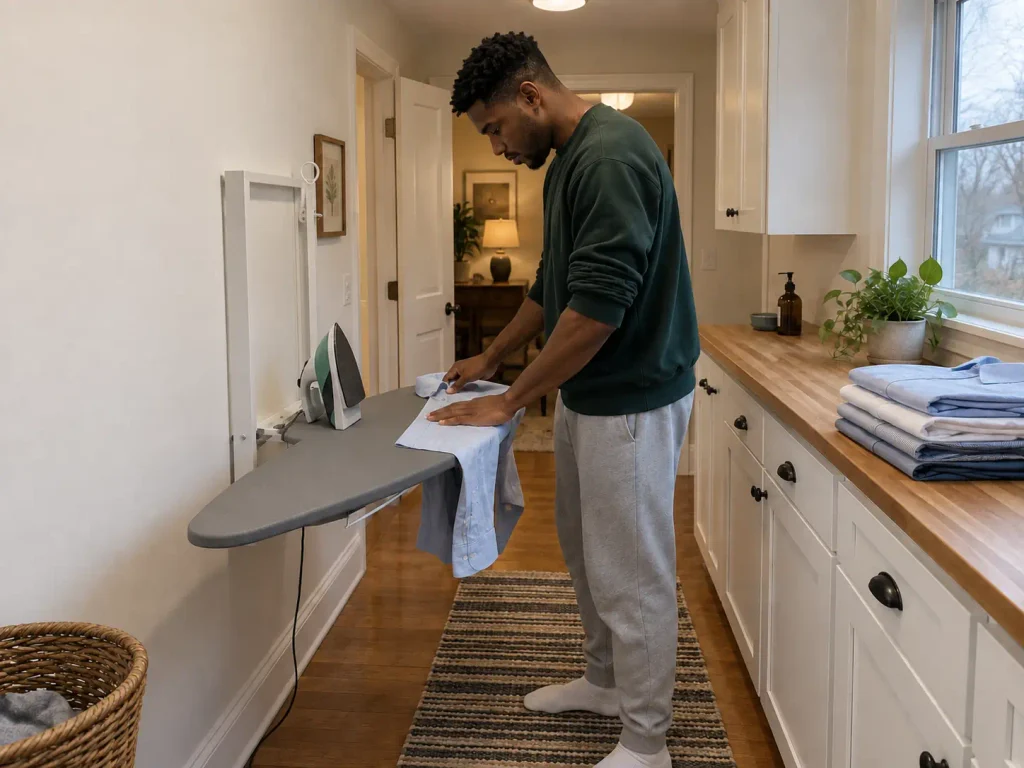
Ask why nobody irons and you’ll hear “no time.” It’s really setup cost. A board retrieved from a closet, carried, unfolded, then put away turns a two-minute job into a fifteen-minute one, and the brain runs that arithmetic instantly and decides the shirt looks fine.
It doesn’t look fine. It will by lunchtime, which is the same thing.
Remove the setup and the math flips. An ironing station, meaning a board that stays where it’s used, converts ironing from a project into something you do while the coffee brews. The Xabitat Wall Mounted Ironing Board folds flat against the wall at 36.2 by 12.2 inches and drops down ready, eliminating the carry-and-unfold step.
The honest limitation is that it needs mounting, making it an owner’s solution or a renter’s conversation with a landlord. The renter version of the same idea is a compact tabletop board that lives on an open shelf rather than folded behind a door. The point was never the board. It’s the number of steps between wanting to iron and ironing.
What Actually Makes the Pile Stop
The pile comes back because dirty clothes have no assigned address between the floor and the machine. Give them one, in a spot within a few steps of where clothes come off, and the rest of this is maintenance rather than repair. That single decision does more than any product in this guide.
Size the bin to a wash load rather than to the gap in the room. A bin that holds roughly one medium-to-large load is what stops half-empty cycles at one end and two-week backlogs at the other, and it’s the difference between a sorter that schedules your laundry and one that just holds it.
And the system that survives is the one the whole household can follow without thinking. If compliance keeps failing in the same place week after week, remove that step rather than reinforcing it. One basket per person and no sorting at all is a legitimate finish line, not a failure.
Your laundry maintenance routine gets one three-month test. At three months, look at which bin is always overflowing and which is always half-empty. That imbalance is telling you your streams are wrong, not that your people are. Merge the slow one into another stream and the whole thing rebalances.
Start by picking the spot. Stand where you take your clothes off, look for the nearest place a bin could live, and put something there this week, even if it’s a laundry basket you already own with painter’s tape on the front. Test it for seven days before you spend anything. The foundation of the entire system costs nothing, and it’s the only part you can’t buy.
Frequently Asked Questions
01What is the correct way to sort laundry?
Sort into lights, darks, and towels or bedding as your baseline, then add a fourth stream only if it fills at the same rate as the others. Most households over-sort. A stream that takes six weeks to fill belongs inside another stream in a mesh bag, not in its own bin.
02What is the easiest way to sort laundry?
Give every person their own hamper and wash person by person. There is nothing to sort, so nothing to get wrong. It is the fallback households land on when color-sorting compliance keeps failing, and it trades a little efficiency for a laundry sorting system everyone can actually follow.
03How many laundry baskets do I need?
One per stream you actually run, plus one for clean clothes waiting to be put away. Most households need three to four total. The clean-clothes basket is the one people skip, and it is why folded laundry lives on the spare bed for a week.
04How do I create a laundry schedule?
Assign named days rather than a frequency. A working pattern is one person or category per day, with sheets and towels holding their own days and one day off. An unassigned load belongs to nobody, which is why we do laundry twice a week quietly stops happening.
05Do I really need a laundry sorter?
No. A sorter moves the sorting to the point clothes come off instead of the floor on wash day, which is a real benefit. But one basket per person gets the same result, and color-catcher sheets cover the color-transfer risk for a fraction of what any cart costs.
Disclaimer: ClutterlessNest is a participant in the Amazon Services LLC Associates Program. As an Amazon Associate we earn from qualifying purchases. This article may contain affiliate links — if you buy through them, we may earn a small commission at no extra cost to you. We only recommend products we have tested or genuinely believe in.