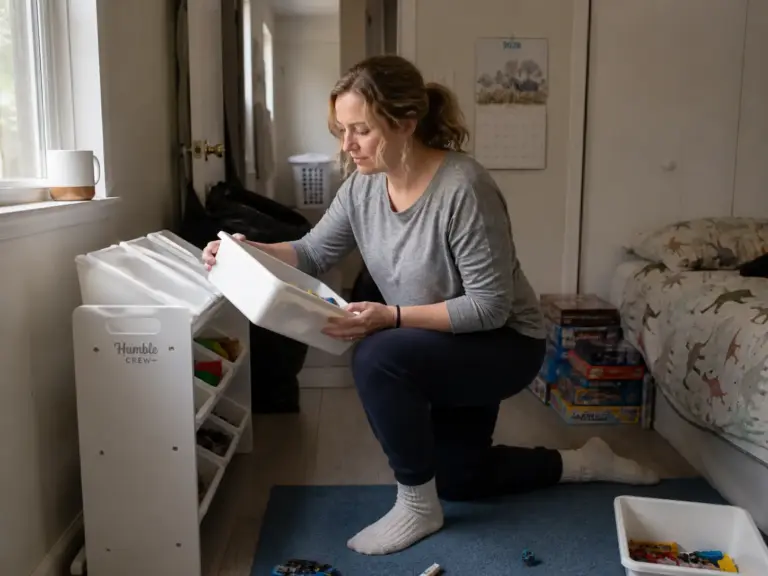
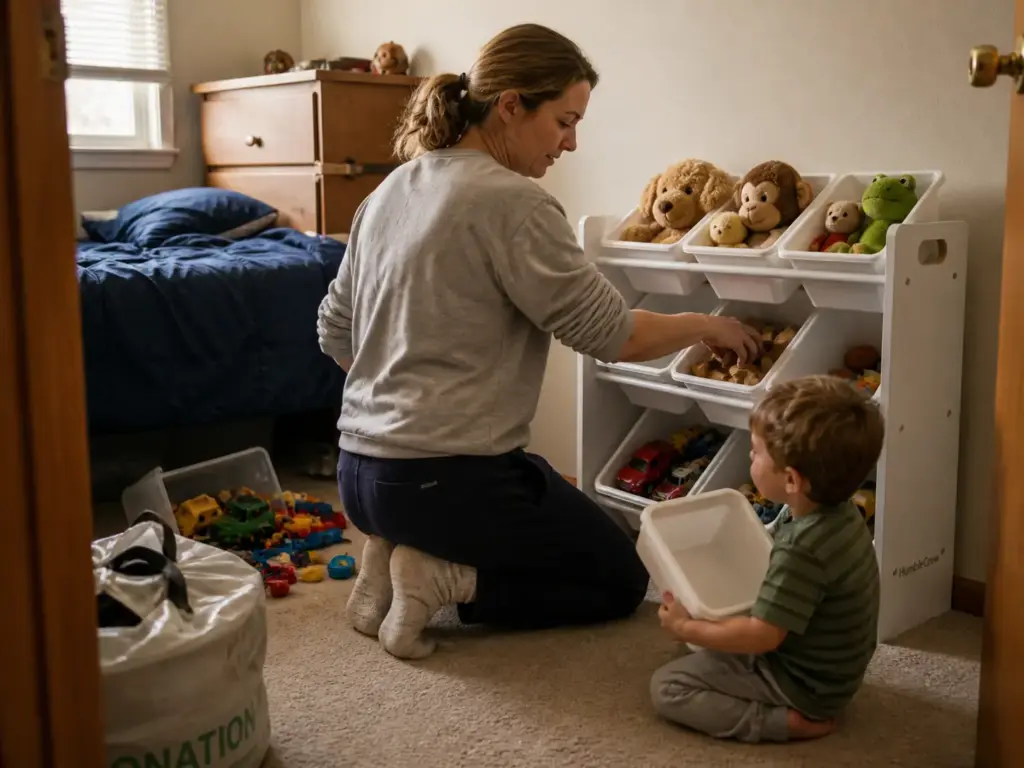
You spent a Saturday on it. Twelve labeled bins, color-coded bins squared up for the after-photo, everything sorted by category. By week three your kid is on the floor pulling every bin off the shelf to find one specific dinosaur, and stepping over the pile on the way out.
That collapse is not a discipline problem, and it has a diagnosable cause: the system was built with an adult’s sorting logic and installed above a child’s reach. Good kids bedroom organization starts by fixing those two things. This guide covers the whole room from that angle: the toy zone, the closet, clothes, labels a pre-reader can actually use, shared rooms, rental limits, and the monthly reset that keeps it alive, with the reach heights and clearances almost nobody bothers to publish.
Quick Answer
A kids’ room system holds up when it matches the child’s height, reading level, and patience span. Five things do most of the work:
- Use fewer, bigger, open bins: 2 to 4 categories, not 12.
- Put everything used daily below the reach line: 24 to 30 inches for a toddler, 40 to 48 inches for school age.
- Use picture labels, not word labels, until the child reads.
- Rotate 60 to 70 percent of the toys out of the room and swap monthly.
- Anchor anything over 30 inches tall or 30 pounds before you organize it.
Why Kids’ Room Organization Collapses in Week Three
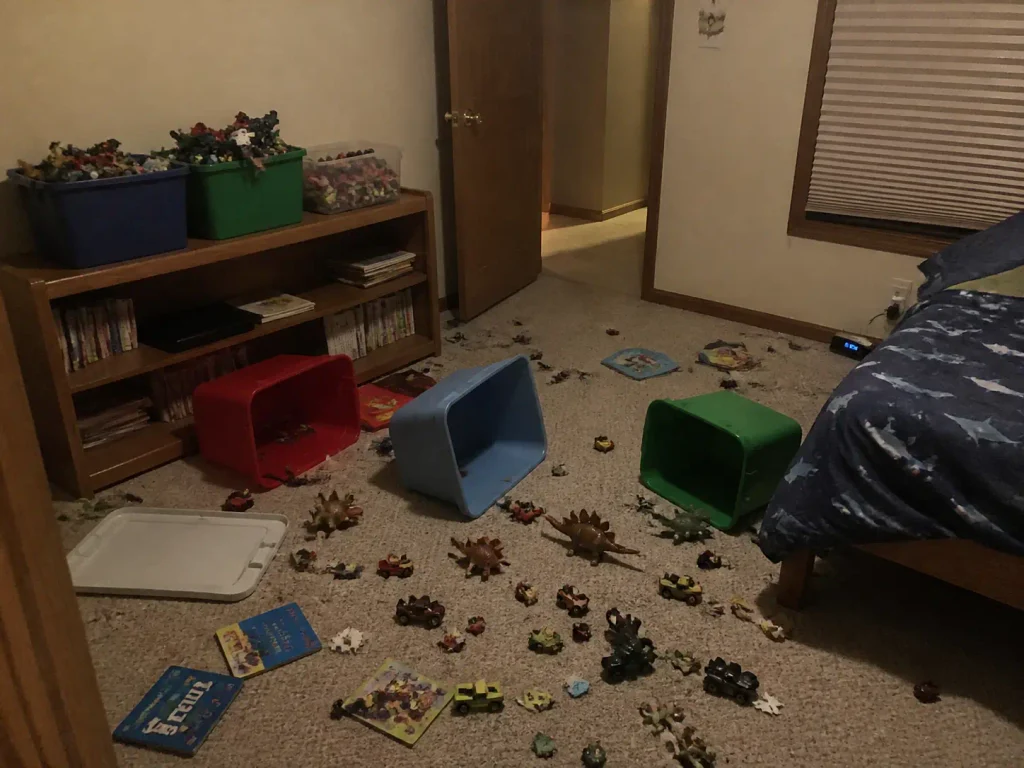
Every parent has built the system that worked until it didn’t, and the usual conclusion is that the kid is messy. That’s almost never what happened. Most kids room organization advice asks for sorting precision and physical reach the actual user can’t deliver, and it takes about three weeks for that mismatch to show up as a floor covered in blocks.
The Four Failure Signatures (and What Each One Tells You)
Kids’ room systems break in four patterns, each pointing at a different design mistake. Read them and you fix the cause instead of re-tidying the symptom every Sunday night.
Too many categories is the most common. A child’s sorting patience runs to two, three, maybe four groups. Give them twelve labeled bins and every toy becomes a decision with two defensible answers: does the plastic dinosaur go in “animals” or “action figures”? A four-year-old picks the floor. Organizing communities have a blunt phrase for the fix: create a system for the children, not the adults.
Lids and opacity are the quiet killers. A lid a toddler needs two hands to work is a step they skip while holding a toy in the other, and an opaque bin is worse, because the only way to check inside is to tip it out. That’s the mechanism behind the behavior that drives parents up the wall: the kid isn’t dumping bins to make a mess, they’re dumping because it’s the only search function the container gives them.
The “miscellaneous” bin becomes the room’s landfill. It’s the most repeated confession in kids’ organizing threads: a parent opens the bin labeled MISC after two months and finds it absorbed half the room. Any category vague enough that the child never has to think will eat everything.
Height mismatch is the invisible one. Storage went where the adult found it convenient, which is chest height for an adult and well above a five-year-old’s reach line. Anything up there is functionally your storage, and the child still leaves things on the floor because from their side there’s nowhere else.
This isn’t a kid-specific flaw, either. Adults do the same thing to themselves, which is why the same three-week reversion pattern shows up in adult bedrooms.
The “Misc Bin” Test — a 60-Second Diagnosis of Your Current Setup
Find the bin the child uses least and open it. If it holds items from four unrelated categories, the label is too vague and that bin is quietly consuming the room. Now find the bin they use most. If it’s usually empty because its contents live on the floor, the category is right and the container is wrong: too small, too far, or too hard to open.
One is a category problem, the other a friction problem, and they get fixed differently. A vague category gets absorbed into a broader one. A high-friction container gets replaced with something open at the right height.
Do the diagnosis on a normal weekday evening, not after you’ve tidied. A room mid-week tells you what the system actually does. A room you just reset tells you what you wish it did.
Why Volume Beats Containers Every Time
The instinct when a room isn’t working is to buy better storage. Parents who’ve cycled through several systems land somewhere else: reducing the number of toys accessible at one time does more for lasting tidiness than any bin purchase. Forty toys in an open bin is a rummage pile. Eight toys in the same bin is a choosable set.
I used to lead with container advice here, because containers are the part people can act on today. Enough week-three collapse stories in parenting threads changed my mind: volume first, containers second.
Measure the Room Before You Buy Anything
The tape measure is the cheapest organizing tool in the house and the one nobody uses. Nearly every returned bin in this category is a measurement somebody skipped, and the idea-listicles give you twenty suggestions without a single number.
The Reach Line — the Single Number That Decides Your Layout
Draw an imaginary line across the room at the height your child reaches without stretching or climbing: around 24 to 30 inches for a toddler, 40 to 48 for school age. Hooks follow the same logic, 28 to 32 inches for toddlers and 36 to 42 for a five-to-eight-year-old. Below that line is the child’s storage. Above it is yours, whatever the label says.
That one number reorganizes the room before you buy anything. Daily toys, current-season clothes, the books they read, the backpack: all below. Small-parts craft supplies, out-of-rotation toys, hand-me-down clothes waiting to fit: above. The line does the sorting for you.
It also shifts as they grow, which is why toddler organization and tween organization look so different in the same room. A toddler’s whole world sits under 30 inches. A ten-year-old can use the closet shelf and mostly wants you to stop touching their stuff.
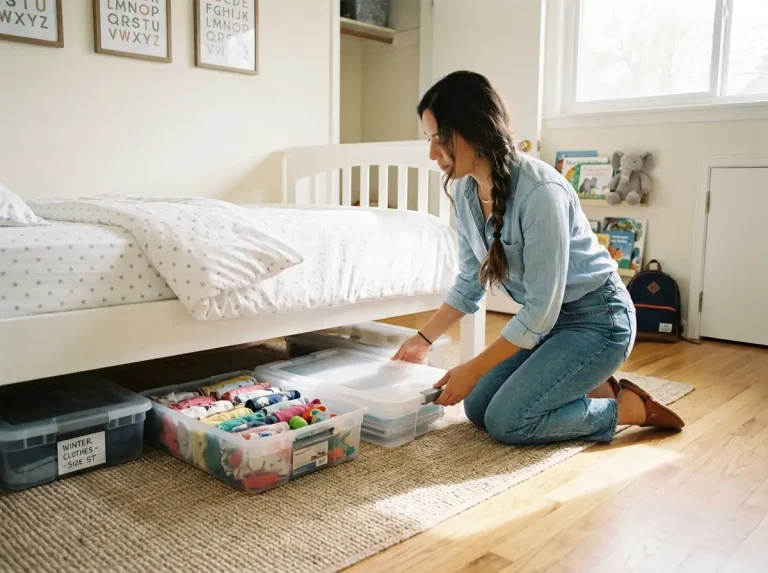
Under-bed storage needs its own measurement, because kids’ beds run low. Platform frames typically leave 4 to 7 inches and metal frames 7 to 11, with children’s beds skewing hard to the bottom of that range. A flat 4.5-inch container clears where the standard 7-inch bin won’t, so it’s worth measuring the gap under a kid’s bed before buying bins. That half inch decides whether the bin rolls out or lives in the garage. Bunk bed storage is the same math with a bonus: the lower frame usually sits higher off the floor than a standard twin, so you get real clearance for rotation bins.
What Your Closet Actually Measures (and Why the Rod Is in the Wrong Place)
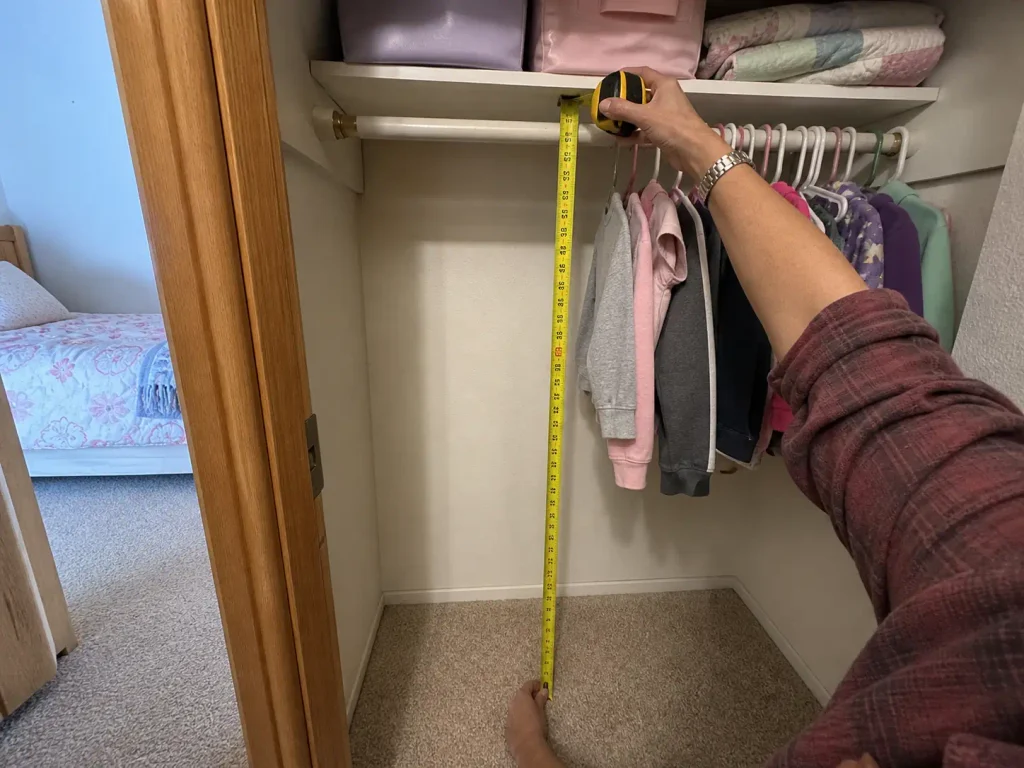
A standard reach-in kids’ closet runs 24 to 36 inches wide and 24 deep, with a single factory rod at about 66 inches. That’s the standard reach-in closet these numbers come from, built for an adult’s shoulder height. For a six-year-old it’s a ceiling.
Kids’ clothes are short: a child’s shirt on a 66-inch rod ends around 46 inches, leaving roughly four feet of empty air below it in the most accessible part of the room’s best storage. That band is the closet dead space every reach-in has, and in a kid’s room it’s the largest single chunk of wasted volume in the house. The closet isn’t small. It’s mostly unused, and the rod height is the reason.
It’s also where a dresser in closet setup earns its keep if the room is tight. Slide a low dresser into that dead band under the rod and the bedroom floor gets a piece of itself back, with the clothes consolidated in one place instead of split between two walls.
Anchor First, Organize Second
Before a single bin goes in, deal with the furniture. The CPSC’s furniture tip-over standard sets the threshold plainly: anchor anything taller than 30 inches or heavier than 30 pounds. Dressers alone account for 36 percent of tip-over incidents, and the reason is the behavior you’re designing around. A child who can’t reach the top drawer climbs the lower ones, and open drawers move the center of gravity forward.
The STURDY Act has been in force since September 2023, so new clothing storage units pass tip-resistance testing. That does nothing for the hand-me-down dresser, which almost certainly predates the standard. Anchor it regardless of age. This is the one step here that isn’t about tidiness, and it goes before the fun part.
Write the four numbers that matter on a sticky note and photograph it: closet width, rod height, under-bed clearance, and your child’s reach line. That photo lives in your pocket and prevents most bad purchases from the store aisle.
Build the Toy Zone Around Fewer, Bigger, Open Bins
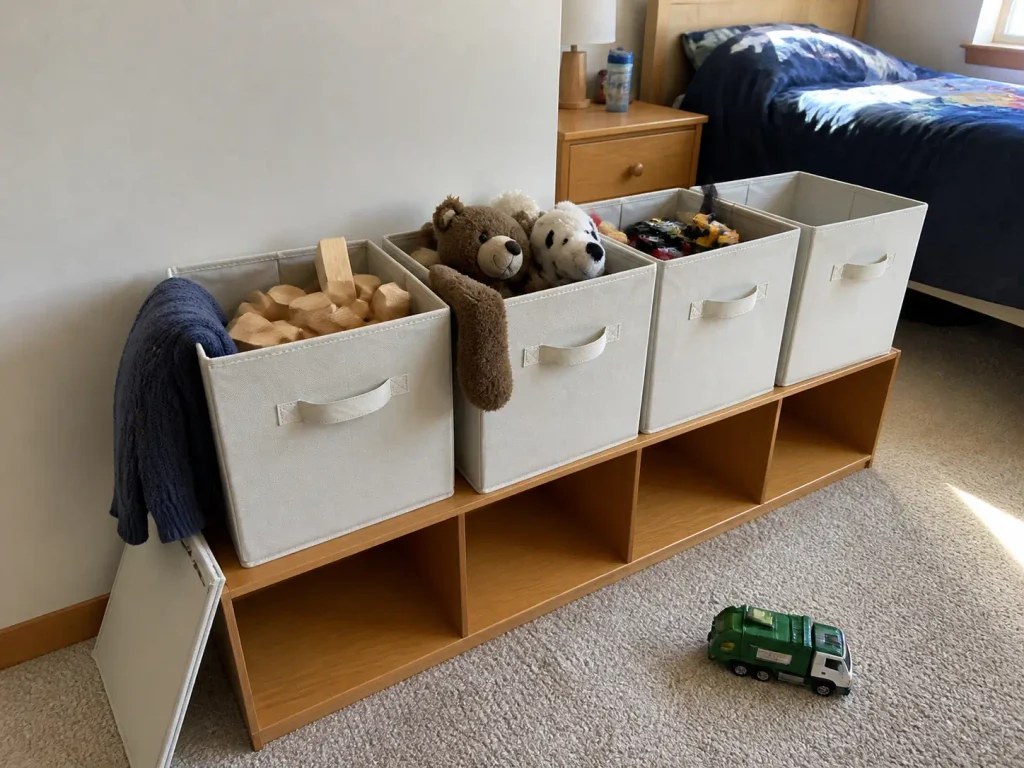
Most toy storage ideas you’ll find start from the same instinct: buy more bins and label them precisely. The fix runs the other direction. Fewer bins, bigger bins, nothing with a lid to fight.
How Many Bins Your Kid Can Actually Handle
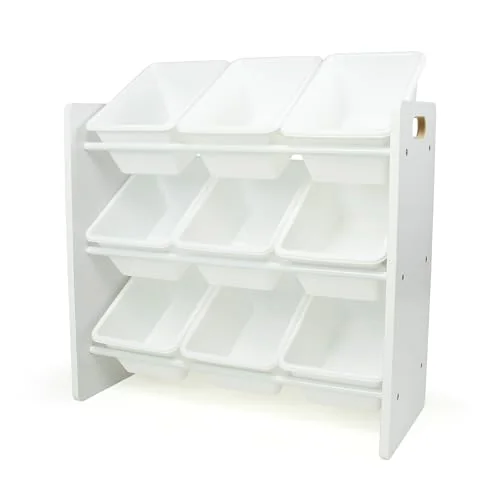
Two to four broad categories, one bin each, broad enough that a child never has to choose between two right answers. Something like “things with wheels,” “building stuff,” “everything soft” covers a startling amount of an average toy collection without asking a preschooler for a judgment call. This is the whole open bins vs lidded bins question settled in practice: fewer categories in containers a child can see into, every time.
Before you buy anything, check what you own. An existing bookshelf with labeled baskets on the bottom two shelves does this job completely, and reused dollar-store bins cost close to nothing. The case for buying furniture is when the room has no low open shelving at all and the toys live in a deep chest with a lid.
The Toy Rotation Formula (and Where the “Away” Half Lives)
A toy rotation system keeps the bin count low without the child owning fewer toys overall. The formula circulating through Montessori-influenced parenting groups is specific enough to be useful: keep out roughly one pretend-play item, one gross-motor item, one open-ended craft item, one puzzle, one vehicle, one stuffed animal, plus two or three small toys. Swap monthly. The rest, usually 60 or 70 percent of the collection, goes away.
Play gets deeper, because a child choosing among nine things engages longer than one standing in front of ninety. And the monthly swap gives you a “new toys” moment without spending anything.
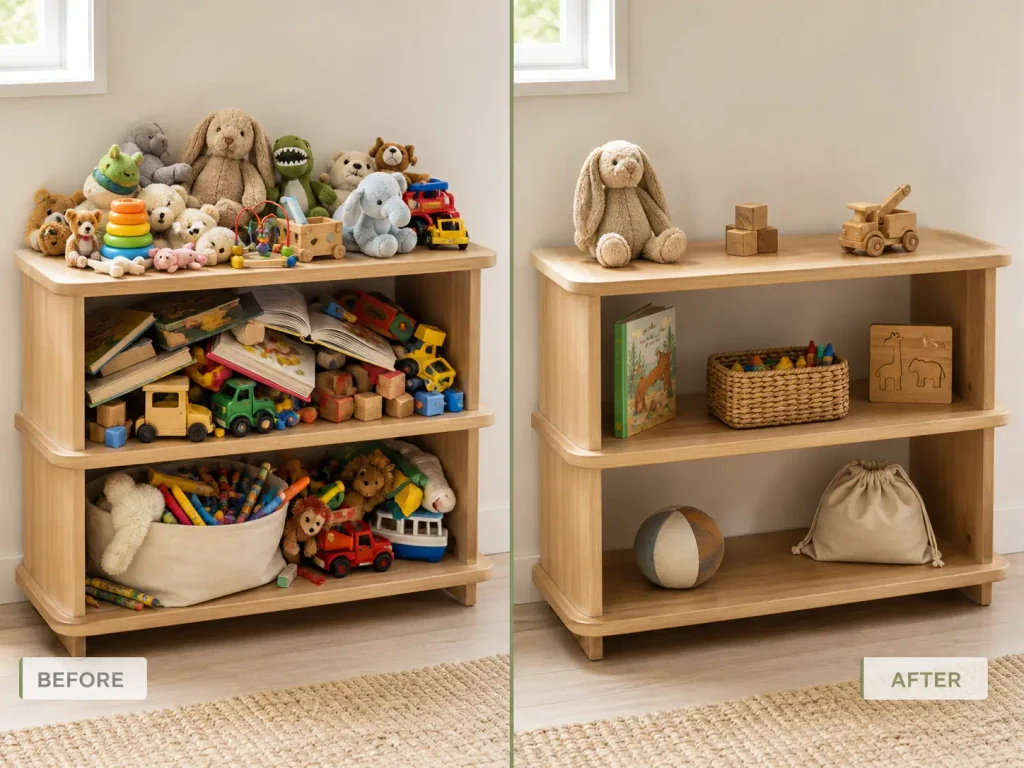
The “away” half needs somewhere that doesn’t create a second mess, usually a closet-top shelf or under-bed space, in something soft-sided. The Amazon Basics Collapsible Fabric Storage Cube Bins suit this at 10.5 inches square: no lids or hard edges near a toddler zone, and they fold flat when a rotation cycle empties one. Their weakness is their strength. Soft sides sag under wooden blocks or metal cars, so keep the heavy things low and rigid.
Bins That Survive a Four-Year-Old
Whatever you use, the bin passes three tests: open or clear so contents show, light enough to carry, low enough to put back without help. Everything else is preference. If the blocks live in a tub that used to hold laundry pods, that system is working.
With no existing shelf, cubby storage in a freestanding unit is the flexible option. The AWTATOS 6-Cube Storage Organizer needs no wall mounting, which keeps it renter-safe, and it earns its space twice because the same unit becomes a room divider later if a sibling moves in. Same pattern as cube units doing the job a dresser usually does in rooms that never had drawer furniture. One caution: a loaded six-cube unit clears the 30-pound line easily, so it gets a wall strap too.
Zone the Room Before You Place the Bins
Zone organization is what makes the bins land in the right places instead of wherever there was wall. Most kids’ rooms carry three or four: a play zone on the open floor, a sleep zone around the bed, a craft zone or homework station at a desk or table, and book storage wherever the reading actually happens, which is usually the bed rather than the shelf you bought for it.
Storage belongs to whichever zone it serves. Blocks near the floor space where building happens, stuffed animal storage within arm’s reach of the pillow, markers and paper by the table rather than across the room in a pretty basket nobody walks to.
A child returns something to a container near where they used it, and skips one that isn’t. Vertical storage covers the overflow: a wall shelf above the desk or a narrow bookcase takes what doesn’t need to be in reach daily.
The zones also tell you what to leave out. A room with no table doesn’t need a craft zone, and forcing one produces a bin of dried-out markers.
The Monthly Reset That Keeps It Working
Every system in this article needs a maintenance system or it drifts back within a season. The cadence that holds up is two-speed.
A monthly reset takes about fifteen minutes with the child present, and it’s the same three moves each time: swap the rotation bins, return the strays that migrated to other rooms, and pull anything broken. Keep it under fifteen minutes. Community shorthand for why is blunt: kids have the attention span of a hungry squirrel, so a cleanup routine with too many decisions gets abandoned mid-task, and an abandoned reset teaches the child the system is optional.
A quarterly reset is the bigger pass and the one where things actually leave. That’s when you declutter kids toys for real, declutter kids clothes down to what currently fits, and re-check the reach line, because a child who grew two inches has quietly moved their own ceiling. Add one extra pass after any birthday or gift-heavy holiday, whenever it falls, since that’s the single biggest volume event in a kids’ room all year.
Fifteen minutes a month beats three hours in April. That’s the whole maintenance argument.
Make the Closet and Dresser Work at Kid Height
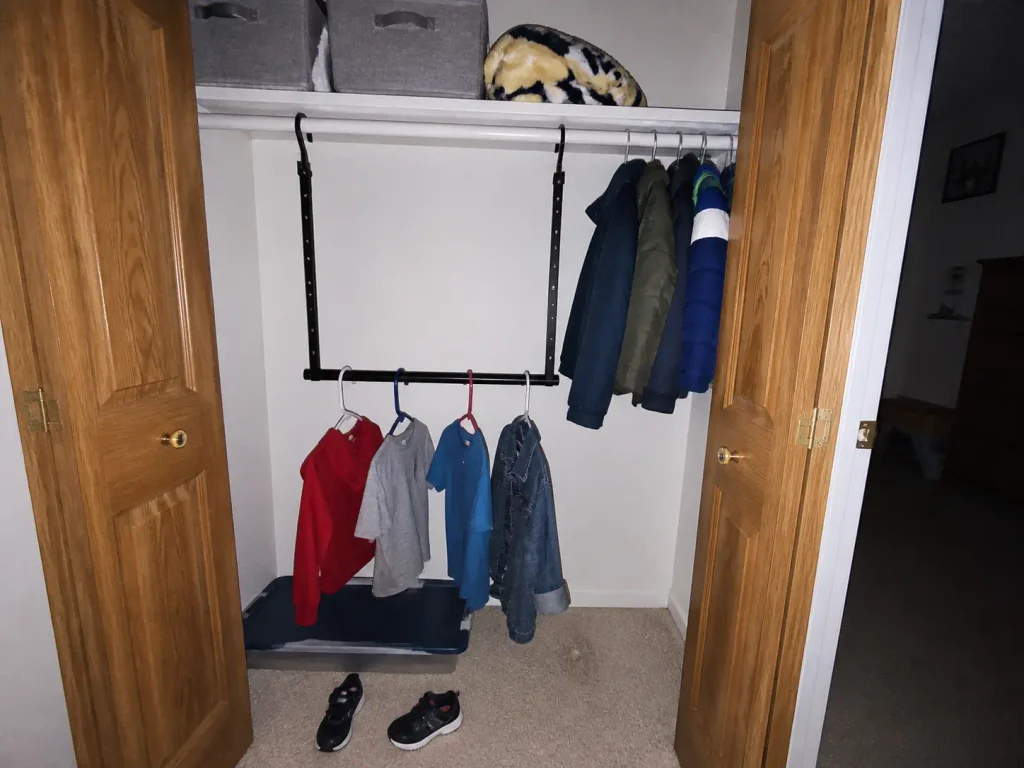
The closet is the biggest dead space in most kids’ rooms, and it’s dead for one reason: the rod sits roughly twenty inches above where the child can reach. Fix the height and a child dresses themselves from day one.
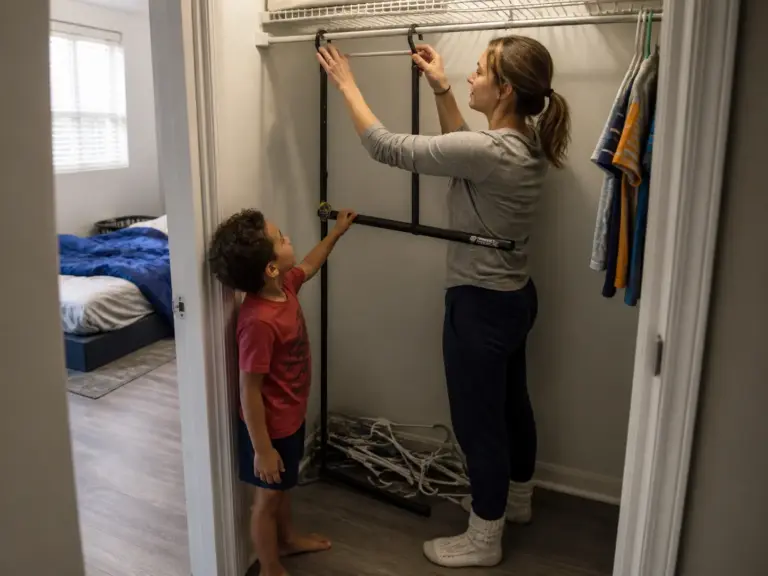
Add a Second Rod at the Child’s Reach Line
A rod doubler hangs from the existing 66-inch rod and creates a second hanging zone underneath at child height. Highest-value change in the room, reversible in about four minutes. Start cheap: a spring-tension rod wedged across the closet at 30 to 40 inches works fine for pocket change if the walls are true and the span is under about 36 inches.
Where tension rods struggle is weight and slippage in wider closets. The STORAGE MANIAC Adjustable Closet Double Rod gives you a second closet rod that hangs off the existing one instead of pressing against the walls, rated to 110 pounds per set, so nothing gets screwed into a rental closet and nothing slides down at 6 a.m. under winter coats. It does assume a secure factory rod: if yours wobbles in its brackets, tighten that first or you’ve doubled the load on a weak mount.
One doubler carries a child from about age three to ten. The high rod takes the long stuff now and becomes their main rod later.
Divide the Drawer So a Kid Can See What’s In It
A dresser drawer is a stack, and stacks are where kids’ clothes systems die. A child who wants the green shirt at the bottom pulls it out from underneath and eleven others come with it. Twice a week of that and the drawer is a permanent jumble no matter how nicely you folded on Sunday.
File folding fixes the mechanism: clothes stand vertically, spine-out like books, so every item is visible and any one comes out without moving its neighbors. It matters more in a kids’ drawer than an adult’s because a child’s grab technique is worse. The file-folding method in full is covered elsewhere on the site.
Filed clothes still need vertical walls or they slump back into a stack by Wednesday. Repurposed shoeboxes do this free and are worth trying first, though they wear out and never quite fit. The SpaceAid Bamboo Drawer Dividers adjust from about 17 to 22 inches to fit the drawer you have, and bamboo keeps its shape under small-hands use in a way cardboard doesn’t.
For a young child, divide by type: tops, bottoms, pajamas. Once they’re dressing themselves, switching to clothes by size helps in a house with siblings, since the outgrown shirts route themselves down the line. Skip tiny sections either way. A drawer with six zones is the twelve-bin problem in miniature.
Where Hand-Me-Downs Live Until They Fit
Clothes that don’t fit yet don’t belong in the daily drawer. They take space, get rejected every morning, and make the drawer look full when nothing in it is wearable. Move them to a labeled bin on the closet shelf, sorted by size rather than season, with the size in big numbers facing out. When something stops fitting, the routing is obvious both directions: outgrown goes to the donate bag, and the next size comes off the shelf.
Seasonal clothing rotation rides along with the same bins. Winter coats and snow pants go up when spring arrives, in the same size-labeled system, so the daily rod only ever holds what’s wearable this month. One caution on compression: vacuum storage bags save real space but flatten the loft out of down and wool if you leave them sealed for a year. A clothing rack in a corner is the better answer if the closet genuinely can’t hold the current season.
Keep one open basket on the closet floor labeled “too small.” Anything that comes off a struggling child goes straight in, no decision required in the moment. Empty it whenever it fills. This single basket removes the most common reason outgrown clothes stay in circulation for another six months.
Labels a Child Can Read Before They Can Read
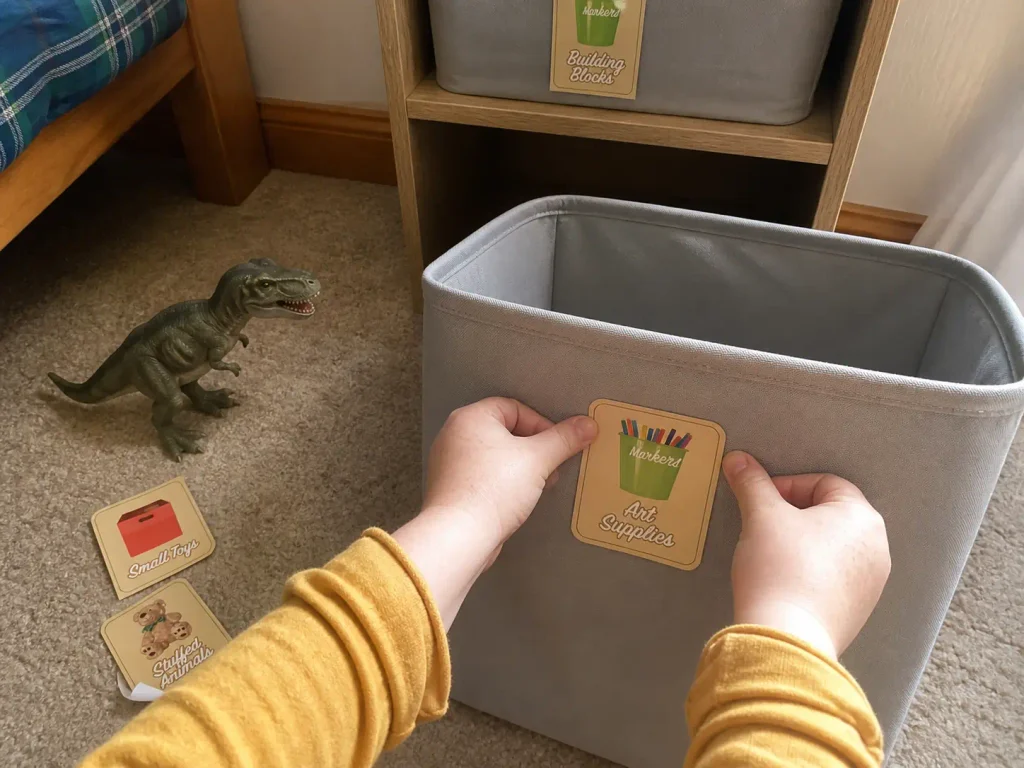
A bin labeled MISC in text is invisible to a four-year-old. So is a bin labeled “Legos,” if they can’t read yet. The label is supposed to be the instruction that lets a child put things away without an adult narrating, and a word does none of that work for a pre-reader. The label has to be a picture.
Picture Labels Beat Word Labels (and Photo Labels Beat Both)
Pair a picture with the word. The child sorts by image and the word teaches reading as a side effect over the next year. That pairing is what professional organizers who work with kids recommend as standard practice for pre-readers, and it’s the piece the idea-listicles skip when they tell you to “add labels.”
Go one better where you can: a photo of the actual toy beats a generic icon. A photo of their blocks, in their colors, is unambiguous in a way a clip-art brick isn’t, and it costs nothing. Take it on your phone, print four to a page, tape them on with clear packing tape over the top so they survive handling. Twenty minutes and a sheet of paper.
If photographing thirty toys isn’t happening this month, preprinted sets get the system running in an afternoon. The Talented Kitchen Playroom Organization Labels run 120 picture-plus-word labels at 1 to 1.5 inches, water-resistant, which matters on bins a child handles daily with whatever is on their hands. The tradeoff is accuracy: a generic “art supplies” icon covers a category your child thinks of as “the sparkly stuff,” so put the label on and check they can tell you what goes in it.
Color-coding gets recommended constantly and deserves a caveat. I used to think it was the obvious starting point for pre-readers, since a color needs no reading at all. But it only works once the child names colors reliably, and only if you still remember what green meant six months later. Picture labels work earlier and need no explanation from anybody.
Give Them the Reach — the Step Stool Rule
Labels don’t help if the shelf is out of reach. Independence is a reach problem before it’s a comprehension problem, and the fix is lowering the storage or raising the child.
Lowering is free and always the first move, and child-height hooks at 28 to 42 inches handle the coat and backpack without any tool at all. Some things can’t come down, though: the closet shelf where rotated toys live, the top of a wall shelf, the bathroom sink next door.
A stool converts those from parent-storage into kid-storage. The COOSEYA 2-Step Stool for Kids has two heights, so it survives several growth stages instead of being outgrown in a year, and the non-slip surface keeps a determined four-year-old off the dresser drawers as improvised stairs. Which is the real point. A child who wants something up high will climb something, and a stool is a much better answer than the anchored dresser.
Shared Rooms Need Boundaries, Not Just More Storage
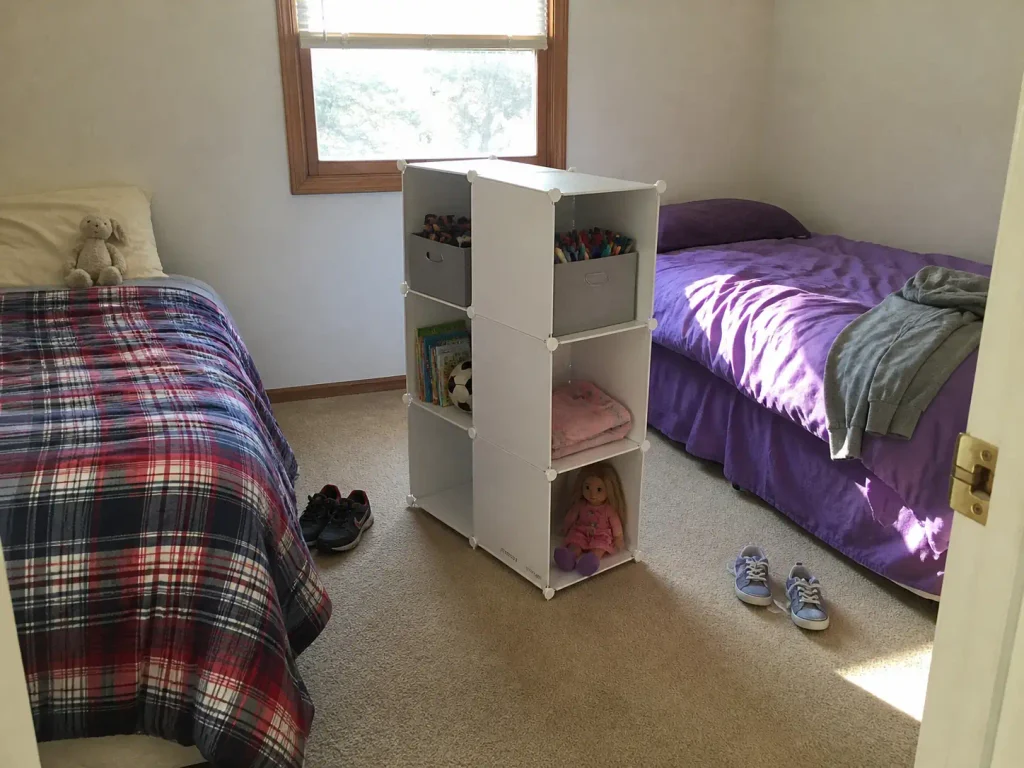
In a shared kids room, the fight is rarely about space. It’s about whose stuff is whose, and storage that doesn’t answer that question makes the room worse, because now there are more containers to disagree about. Settle ownership first and the layout mostly designs itself.
One Container Each, Before Anything Is Shared
Every child needs one container that is unambiguously theirs. A bin, a shelf, a drawer, and it doesn’t need to be big. What it needs is a clear boundary and a rule the sibling respects: nobody else’s hands in there. Put their photo on it if they can’t read their own name yet.
With that in place, shared storage works, but only for genuinely shared items: books, blocks, board games. Personal items in shared bins is where conflict starts and where tidying stalls, because neither child feels responsible for a bin that’s half someone else’s problem. If your “shared room” is the adult bedroom with a toy zone in the corner, the same logic applies at smaller scale, and there’s more on how families carving a kid zone out of a one-bedroom handle boundaries when one room has to be two.
Dividing a Shared Closet Down the Middle
Split the closet by rod section, not by hanger. Draw a hard line at the midpoint and give each child their own low rod on their side, so neither depends on the other moving to get dressed. Two short doublers beat one long one for that reason, and the full method for splitting one closet between two people covers the negotiation in its adult version.
The floor needs the same treatment: one bin each, on their own side, or it becomes a shared “misc bin” with all the failure modes that implies.
When There’s an Age Gap — Height as the Separator
An age gap turns the reach line from a convenience into a safety tool, and floor safety is the reason. Small parts on the floor of a room with a toddler in it is the one arrangement you can’t leave alone. The older child’s small-parts toys go above the younger child’s reach line and below the older child’s, a band usually between 30 and 48 inches. That’s real storage, not a compromise.
It also settles an argument before it starts. The older child keeps the Lego build intact, which matters enormously to them, and the younger one isn’t constantly being told no. The height does the enforcing so you don’t have to.
Renter-Friendly Storage That Leaves No Holes
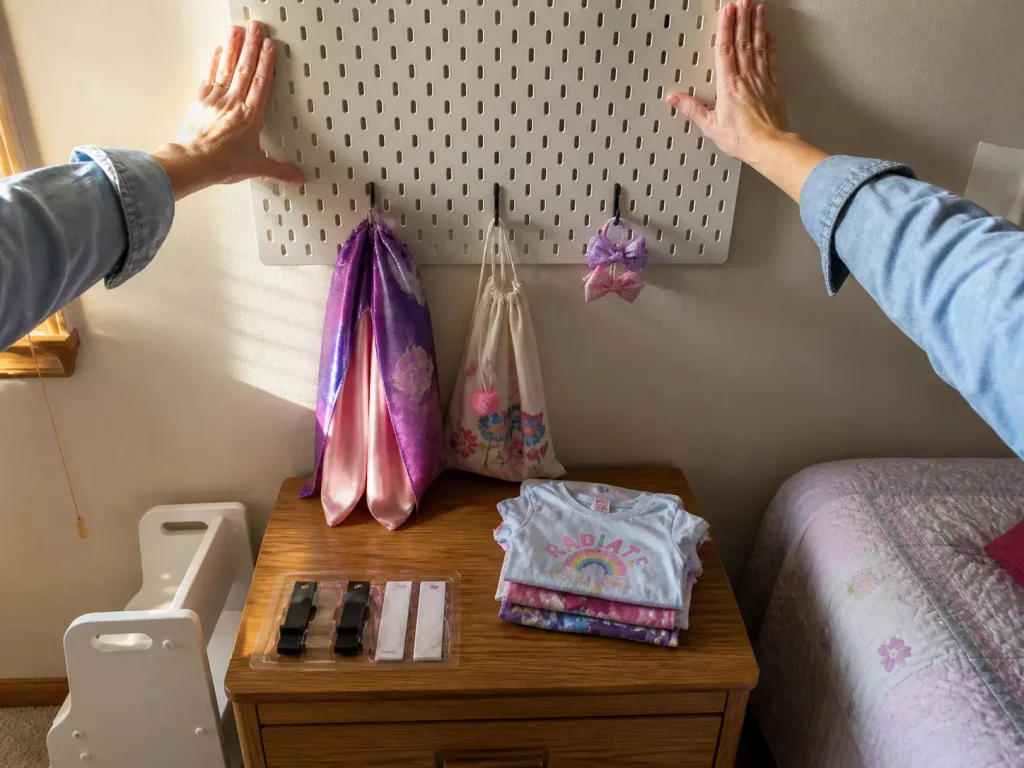
Half the advice in this category assumes you can put a screw wherever you like. If you’re renting, there’s a deposit riding on every hole. Nearly all of it has a no-drill equivalent, with one important exception.
What Adhesive Mounting Can and Can’t Hold
Weight budget is the whole game with adhesive. Command-strip pegboard hardware holds roughly 16 pounds per four-strip set, which sounds generous until you translate it. Sixteen pounds is dress-up accessories, hair bows, light craft supplies, a few stuffed animals. It is not a loaded backpack or anything a child might hang from, and kids test load limits with their whole weight.
Plain Command hooks at child height cover most of what a rental kids’ room needs and are the simpler starting point: the backpack, the coat, the tote of dress-up clothes. For wall-mounted storage that reconfigures rather than sitting at fixed points, the Just Hanging Pegboard Wall Mounting Hardware mounts a standard pegboard with no holes at all, and the pegs move as the child’s stuff changes. Keep the 16-pound budget in mind and mount it at the reach line so they can rearrange it themselves.
Skip the heavier wall ideas that circulate in this category, though. A magnetic board or a hanging toy hammock both want real fasteners, and no-drill storage in a rental means accepting a lower ceiling on weight.
Two failure conditions before you commit. Command strips do poorly on textured walls, the orange-peel and knockdown finishes common in rentals, because actual contact area is a fraction of what the rating assumes. They also fail on freshly painted walls, since paint needs weeks to cure and the strip peels the coating off with it.
Both turn up in renter threads after the fact, usually at 2 a.m. when the thing comes down.
The rod doubler is the other big renter win and the highest-value no-drill move in the room: child-height hanging with zero hardware in the wall. Same approach as the no-drill closet method this borrows from, set at a lower line. Beyond the closet, freestanding wins across the board. A cube unit, a rolling cart, and an under-bed bin cover most of what a wall system would.
The Anchoring Exception — the One Hole Worth Asking About
The thing you can’t solve without a drill is anchoring. A furniture strap needs a stud, and no adhesive product is a substitute for a tip-over restraint.
So this is where you ask the landlord, specifically. Two small screws into a stud for a child-safety anchor is a request most landlords approve immediately, because the alternative is a liability question they’d rather not think about.
Put it in writing, mention the CPSC standard by name, and offer to patch on move-out. Every other hole here is negotiable. That one isn’t.
Fewer, Lower, Simpler
Three things carry this whole system. Fewer, bigger, open bins, because the bin count is the system and the labels are just navigation. Everything used daily below the reach line, because anything above it is your storage and the floor is what’s left for them. And anchor before you organize, since that’s the one step here that isn’t about tidiness at all.
In three months, run the two-bin diagnosis again. Open the bin your child uses least and the one they use most. If the least-used one has quietly become a catch-all and the most-used one is always empty because its contents are on the floor, your categories are wrong, not your child. Adjust the categories, not the kid.
Start with the toy zone. Get the bin count right there, watch it for two weeks, then apply the same rule to the closet.
Frequently Asked Questions
01How do I organize my kid’s small bedroom when there’s no closet space?
Move everything the child uses daily below their reach line, 24 to 30 inches for a toddler and 40 to 48 for school age, and put a freestanding cube unit where a closet system would go. Under-bed containers pick up seasonal and rotated-out items. Measure the frame clearance first, since kids’ platform beds often leave only 4 to 7 inches.
02How many toy bins should a kid’s room actually have?
Two to four broad categories, one bin each. More bins means more decisions per toy, and a child under about six abandons the system at the point where two bins are both defensible answers for the same object.
03Why does my child dump every bin looking for one toy?
Because they can’t see inside. Opaque or lidded bins force a child to empty a bin to check its contents, and once that becomes the routine the floor becomes the sorting surface. Switch to open or clear bins with a picture label on the front.
04At what age can kids clean their own room?
Most children can return items to a labeled, reachable bin around age three, and handle a short multi-step reset by five or six. The limit is design, not age: the routine has to stay under about five minutes and require very few decisions.
05How often should you declutter a kids’ room?
Rotate toys monthly and do a real declutter quarterly, plus one pass after any birthday or gift-heavy holiday. The monthly rotation does most of the work; the quarterly pass is where outgrown clothes and broken toys leave the room for good.
Disclaimer: ClutterlessNest is a participant in the Amazon Services LLC Associates Program. As an Amazon Associate we earn from qualifying purchases. This article may contain affiliate links — if you buy through them, we may earn a small commission at no extra cost to you. We only recommend products we have tested or genuinely believe in.