Open the cabinet under your bathroom sink and something tips over. A half-empty bottle of face wash, probably, or the travel-size conditioner rolling around since a trip you took two years ago. And if there is a wicker basket in there, give it a sniff — it smells like a damp basement now, and that is not your fault.
Under a bathroom sink, systems almost never fail from a lack of discipline. They fail because of the pipe and the humidity, and nobody warns you about either. Good under sink bathroom organization starts with real vanity depth numbers, the separation rules Consumer Reports lays out for a shared cabinet, and the material rules that only matter in a wet room. Measure first, decide what earns the space, then pick organizers that work around the P-trap instead of pretending it isn’t there — including if you have no cabinet at all.
Quick Answer
Organize under a bathroom sink in five steps, in this order:
- Empty the cabinet and measure depth, width, and P-trap clearance.
- Keep daily-use items and one layer of backstock. The rest leaves.
- Lay a waterproof mat down before anything goes back in.
- Pick organizers that work around the pipe, never wicker.
- Zone by frequency, label the zones, reset once a month.
Measure Before You Buy a Single Organizer
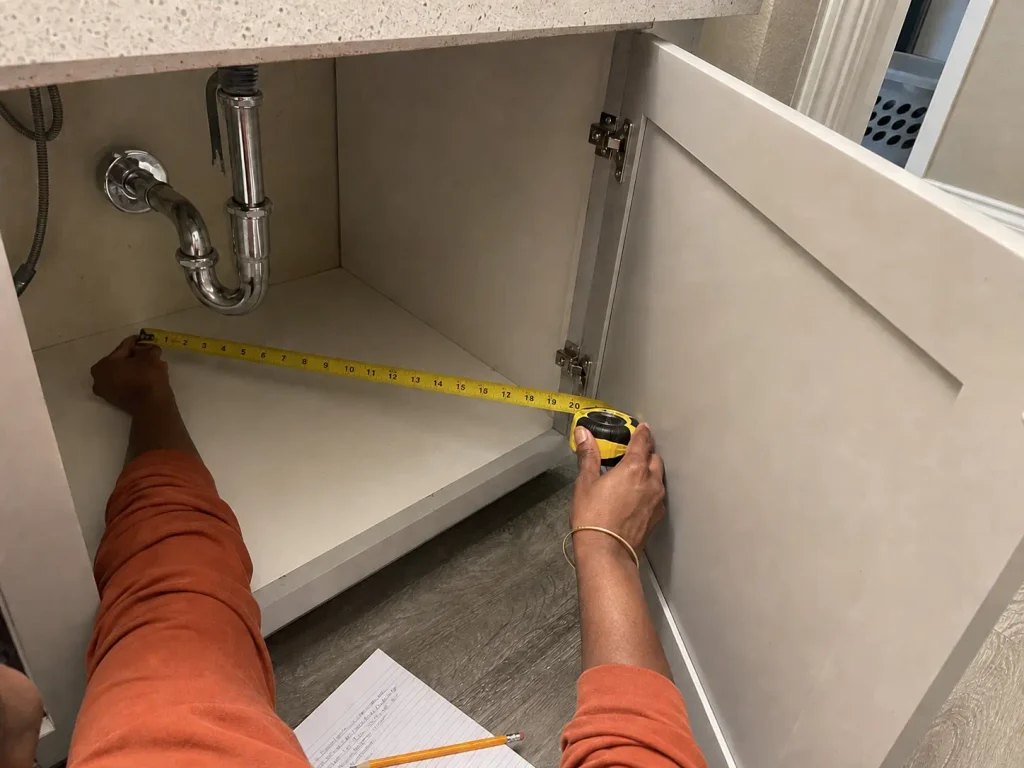
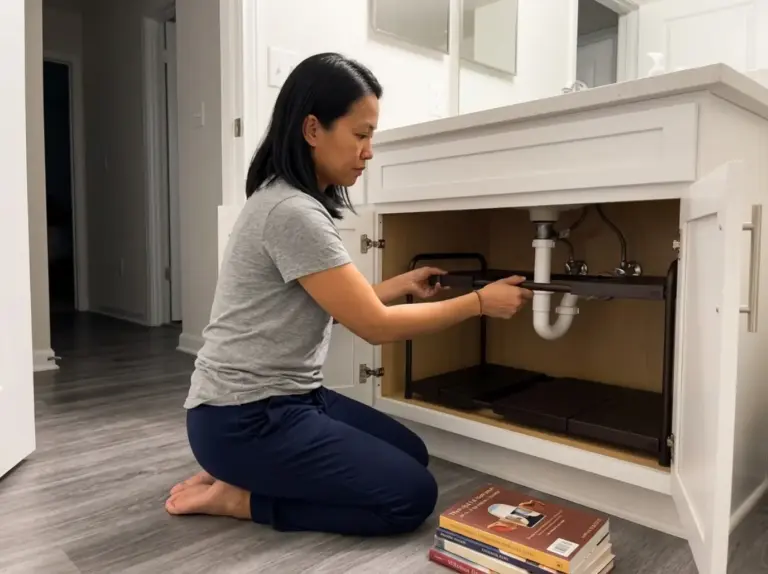
Almost everyone does this backwards. The two-tier expandable shelf gets ordered first, the tape measure comes out second, and then the box arrives and the P-trap sits exactly where the shelf’s center support wants to go. Back it goes.
So here are the numbers worth knowing before you shop. A standard bathroom vanity cabinet runs about 21 inches deep. Shallow models drop to 18 inches, extra-deep ones stretch to 24 or 25, and that gap matters: a shelf sized for a 21-inch cabinet will jam or hang past the door frame in an 18-inch one.
Widths cluster into predictable categories too, usually 18, 24, 30, 36, 42, 48, 60, or 72 inches. A 24-inch cabinet and a 36-inch cabinet are not the same organizing problem.
That 21-inch standard exists partly because the drain assembly, the supply lines, and the trap all need room behind your storage. Once a cabinet drops below roughly 16 inches, P-trap clearance becomes the main constraint, and no bin arrangement gets that space back.
So measure three things and write them down. Interior depth, from the back wall to the inside face of the door. Interior width at its narrowest point, usually where the hinges bite in. And the clear height on each side of the P-trap.
That last one is the number nobody records, and it decides everything, because the two sides of the pipe are almost never equal. One side usually has a few extra inches, and that is where your tallest bottles go.
Take your three measurements with the doors fully open, then subtract half an inch from the width. Hinge hardware steals that half inch, and a bin that scrapes past the hinge every morning is a bin you stop using by week three.
One more measurement lives outside the cabinet. The National Kitchen & Bath Association’s clearance guidelines call for at least 30 inches of open floor in front of a vanity, which is why pull-out and rolling organizers cause trouble in a tight half-bath even when they fit inside the cabinet. The organizer fits. Your knees do not.
Measure before buying is the whole rule, and it is not specific to this cabinet. If this is one of several problem zones, the same measure-first rule applies across every zone in a small bathroom.
What Actually Belongs Under a Bathroom Sink
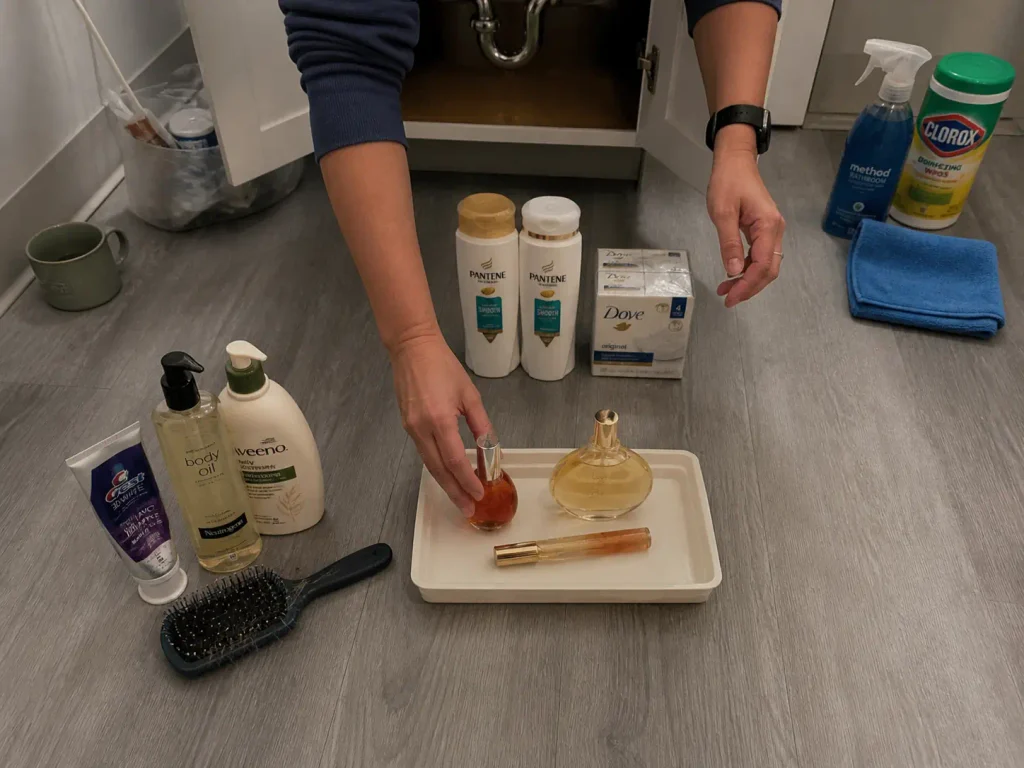
Your cabinet is not full because it is small. It is full because it became the default home for everything without a home.
The hotel shampoo collection. The hair tool nobody has used since a wedding in 2023. The specialty cleaner bought for a stain in an apartment you no longer live in.
None of that was a decision. It was the closest door.
Three categories genuinely earn the space: daily-use toiletry storage, one layer of backstock, and the cleaning supply organization specific to this bathroom. Everything else is a guest who overstayed. Bulk purchases belong in a linen closet or under a bed, because a bathroom cabinet is a humid box and cardboard multipacks do not enjoy living in one. The backstock rule is one spare of each thing, not four.
Then there is the split that bathroom cabinets force and kitchen cabinets do not. Most bathrooms hand you one cabinet and expect it to hold both cleaning chemicals and things that touch your face.
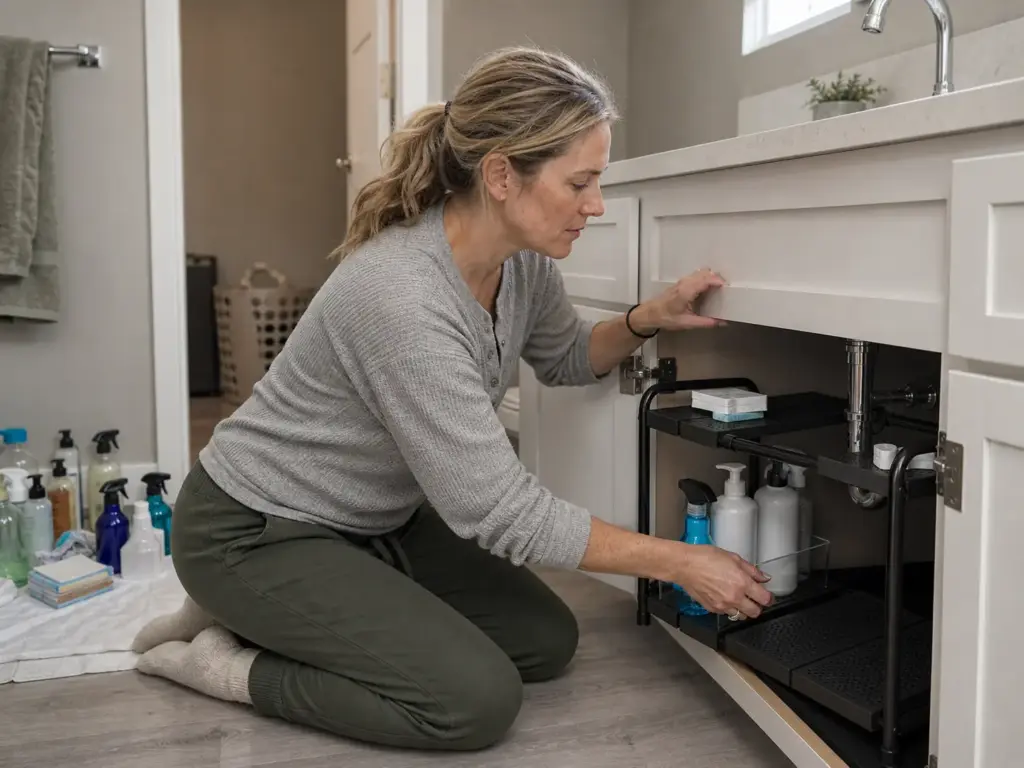
Consumer Reports’ guide to organizing the cabinet under a sink recommends physically separating the two: one side for chemicals and cloths, the other for personal items. Not two piles that drift into each other. An actual boundary, drawn with a divided bin or a turntable organizer, so a leaking bottle of cleaner is never resting against your toothbrush backstock.
Give the chemical side the pipe side. Cleaning bottles are tall, narrow, and reached for once a week, so they tolerate the awkward space around the P-trap far better than the toiletries you grab half-awake every morning.
That pile is two problems wearing one coat: a safety question and a daily friction question, because now finding toothpaste means moving three cleaner bottles first.
Once you know what stays, uniform containers do the rest. Decanting products into matching containers sounds fussy until you see what it fixes: loose backstock stops being a pile and becomes a unit you can lift out with one hand.
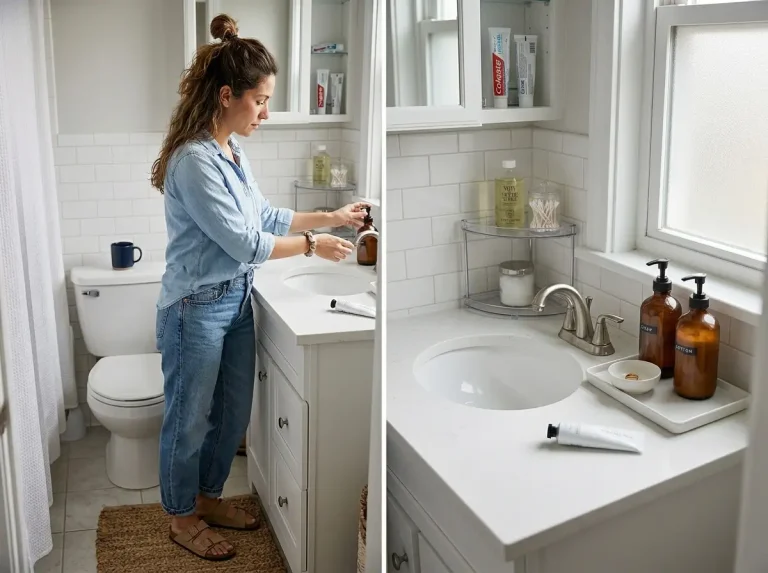
The mDesign Plastic Bathroom Counter Tray runs about 12 by 8 by 2 inches, slides into the clear side of most standard vanities, and turns a scatter of sample tubes and cotton rounds into one liftable block. It is shallow by design, so it corrals rather than contains, and tall bottles will still tip inside it. Same decanting logic that keeps a bathroom counter clear, one cabinet lower.
No Cabinet at All? Pedestal Sink Solutions
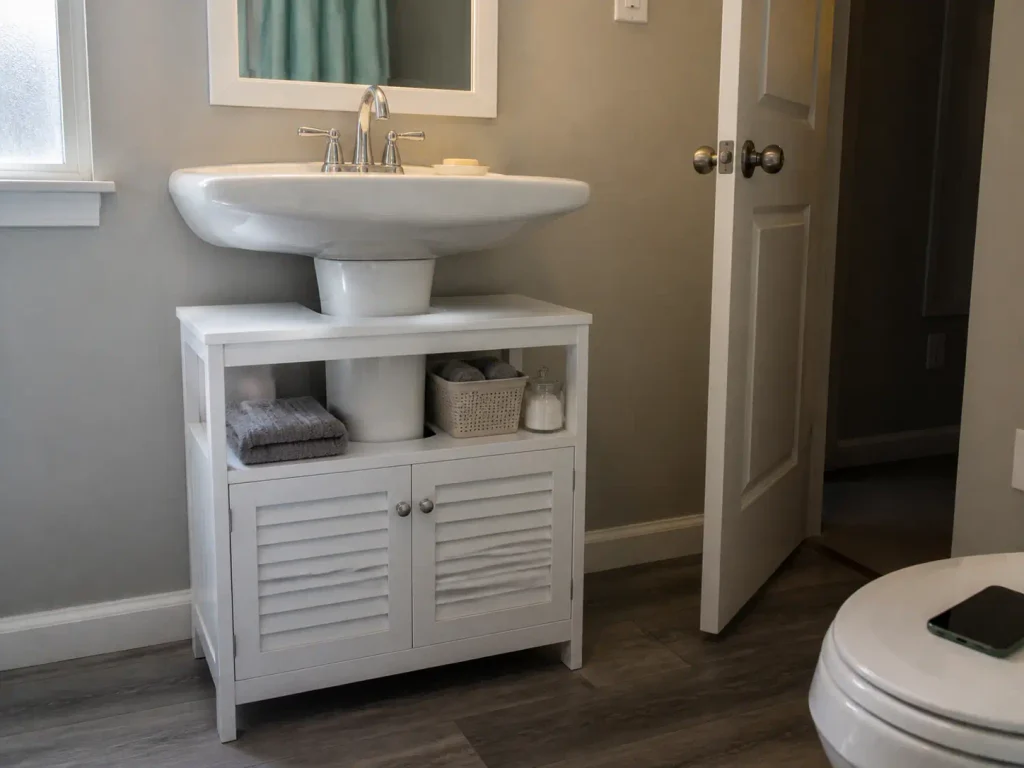
Search for pedestal sink storage and every result is useless to you. They all open with a photo of a two-door vanity, the advice assumes an enclosed box you do not have, and the pedestal reader gets handled as a footnote.
So name the gap before solving it. What most articles offer a pedestal owner is storage above or around the sink: wall shelves, over-sink glass shelves, a cart in the corner. Useful sometimes, but none of it replaces cabinet volume and none of it hides anything.
For the whole-room version of no cabinet bathroom storage, the whole-bathroom system for a place with no cabinets covers the towels, the counter, and the toilet zone. This section stays on the sink.
Start with what costs nothing, because for a lot of pedestal bathrooms it is enough. If the base has any usable footprint, a slim basket tucked behind the column handles overflow without a purchase. A shower caddy you already own does the same job, and it is the swap budget organizing threads suggest first: already designed to hold wet bottles upright, already in your house.
Try it for two weeks. If the basket is overflowing by then, the volume justifies a real cabinet, and now you know instead of guessing.
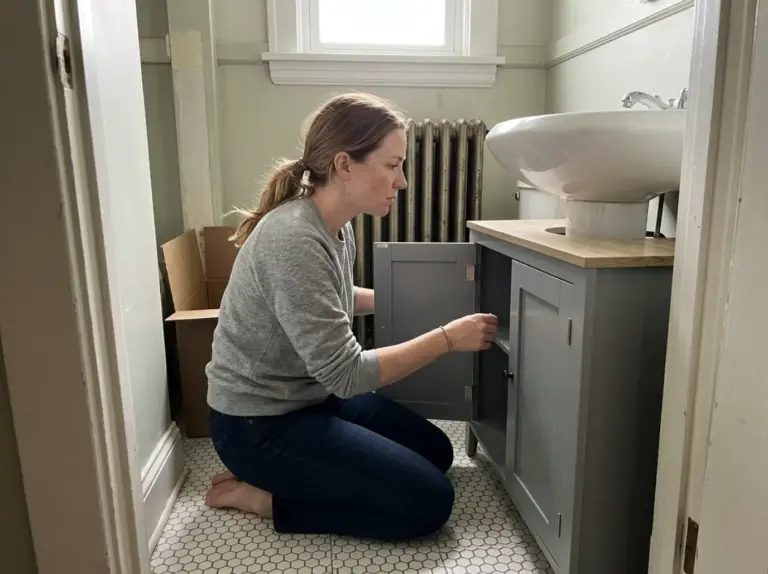
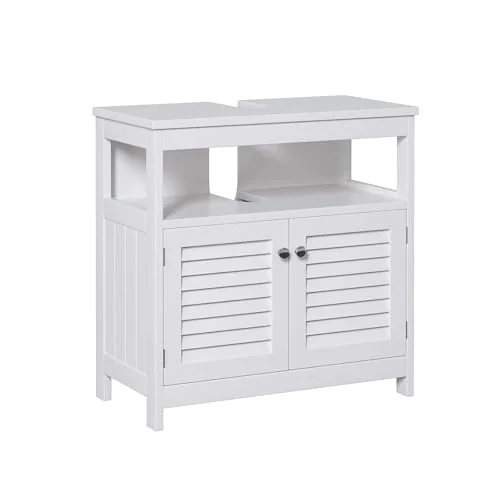
The real answer is the wrap-around cabinet, a product category most people have never seen. It is a U-shaped unit with a cutout in the back: it sits on the floor around the pedestal base, the column passes through the cutout, and what was exposed pipe becomes an enclosed two-door cabinet with an open shelf on top. Water-resistant MDF is the material that matters here, for the same humidity reason that governs every other material call in this article. Untreated particleboard in a bathroom is a countdown.
For renters, this is the strongest no-drill storage option in the article. A freestanding wrap-around unit needs zero mounting: no drilling, no wall anchors, not even adhesive. It sits on the floor and gravity does the rest, so there is nothing to patch and nothing to argue about at move-out.
Adhesive shelving still needs a wall, and a wall still raises a question when you peel the strips off. This does not. One warning about the category before you shop: the other format you will find is the rolling wrap-around organizer on casters, and availability there churns badly enough that one of the most-linked models is currently unavailable outright.
Organizer Types That Work Around Real Pipes
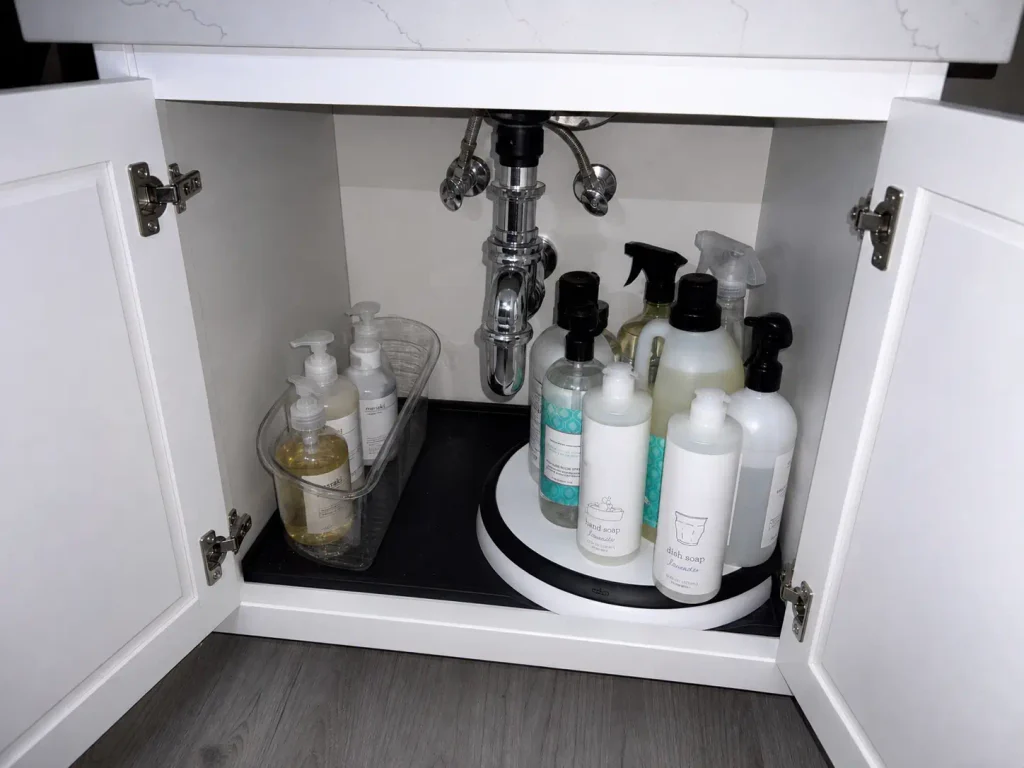
The P-trap is not an inconvenience you design around after the fact. It is the design constraint. Every product photo in this category shows an empty box with clean walls and no plumbing in it, which describes no bathroom cabinet that has ever existed, and that gap is why this category gets returned so often.
Where the pipe runs down the center, the two-tier expandable shelf organizer is the default answer and it earns the spot. The adjustable width lets it straddle the pipe instead of fighting it, so the shelf becomes two usable columns with the plumbing running between them.
The Simple Houseware Under Sink 2-Tier Heavy Duty Expandable Organizer adjusts across the 18 to 21 inch band where most readers are working. The caveat is height: in a shallow cabinet the top tier can sit close enough to the basin that tall bottles end up on the bottom tier anyway. Measure the vertical gap, not just the floor.
Turntables earn their footprint through the spin rather than through capacity. Consumer Reports’ picks for under-sink cabinet organizers call out lazy susans specifically for retrieval speed. A turntable does not hold more than a bin; it means you never move three things to reach the fourth, and during a 30-second morning routine that is the entire game. The OXO Good Grips Lazy Susan Turntable, 16-Inch fits standard cabinet depth with room to rotate, and the trade-off is honest: a 16-inch circle claims real floor space, so it belongs in the daily-use zone, never the backstock zone.
I used to recommend a turntable as the automatic first purchase here. Enough shallow-vanity failure reports in organizing threads changed my mind. If your cabinet is shallow or the pipe sits off-center, the tray catches every half rotation, and a turntable that cannot complete a circle is an expensive tray. The iDesign Clear Plastic 1/4 Wedge Bin, Corner Lazy Susan Cabinet Style does the corralling job for a fraction of the cost, and in a tight cabinet it is the better call regardless of budget.
Stacking drawers and stackable bins get a mention and a warning in the same breath. They work where the pipe runs to one side and leaves a clear vertical column. They fail where it crosses the center, because a drawer needs full extension to be a drawer. And drawer dividers belong in the vanity drawers above, not down here, where nothing sits level for long anyway.
Before ordering, cut a cardboard rectangle to the organizer’s footprint and set it in the cabinet. Two minutes with a box you were recycling tells you what no product listing will: whether the door closes, whether it clears the pipe, and whether you can reach behind it.
Ask people what they can’t stand about their cabinet and the same phrase comes back: digging through stacked bins. Finding one item means moving three others, every day, and that friction is what makes people give up and start leaving things on the counter instead. None of this is unique to bathrooms. The same pipe-clearance problem plays out under a kitchen sink, with a bigger cabinet and a garbage disposal joining the party.
Why Bathroom Cabinets Wreck Organizers Kitchens Don’t
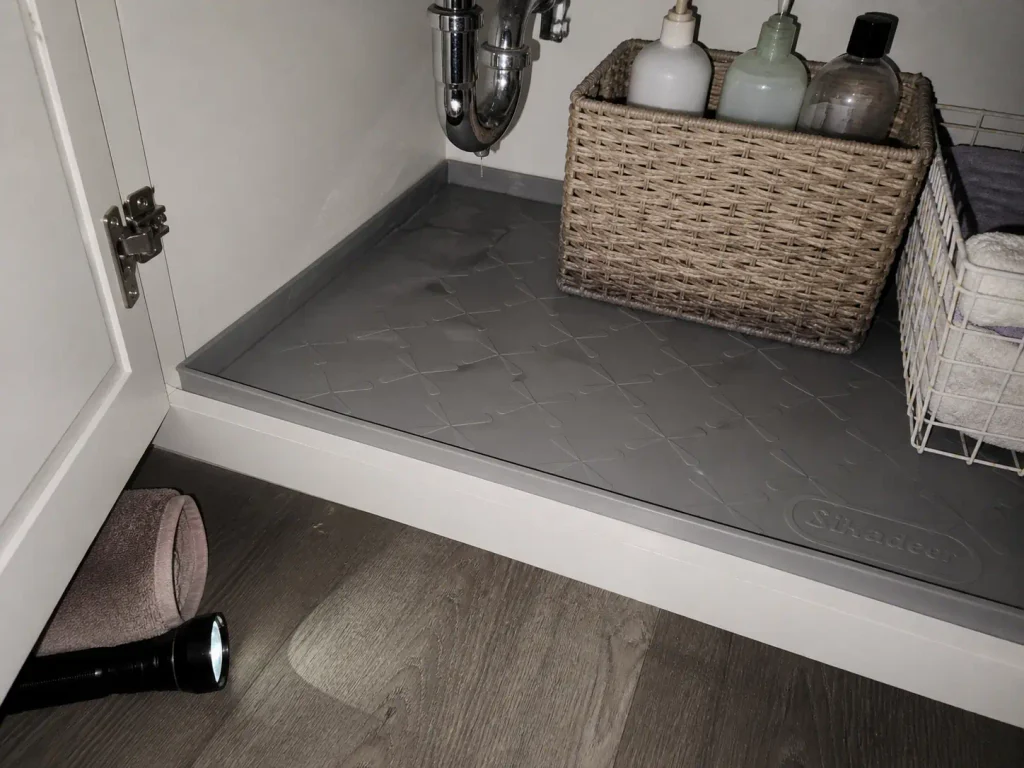
This is the section that answers the question people ask three months in: I organized it properly and it fell apart anyway, what did I do wrong? Usually nothing.
You bought a material that cannot survive a wet room, because every article you read while shopping was written as if a bathroom cabinet and a kitchen cabinet were the same environment. They are not. One of them gets steamed twice a day.
Wicker, rattan, and seagrass are porous. They absorb moisture and hold onto it, and in a high-humidity room they are especially prone to mold and mildew. So the cute basket did not fail because you neglected it.
The confession that shows up constantly in bathroom organizing threads is a version of the same story: the wicker basket that smelled by month two, followed by the assumption that better cleaning habits would have prevented it. They would not have. The basket was wrong for the room from day one.
The mildew-resistant swap list is short. Open-mesh wire shelving and wire baskets take the top spot because the mesh promotes air circulation, the exact property that resists mildew where closed containers trap moisture instead. An acrylic organizer or sealed clear bins are the other safe picks: nonporous, wipeable, indifferent to steam.
Wicker, cardboard, and untreated wood do not belong under a bathroom sink at any price. And the same material rules decide what survives above the toilet, where steam collects even faster.
Now the failure nobody sees coming, because it makes no noise. A P-trap connection can weep: not a burst, not a puddle, just a few drops at a time from a joint that loosened by a fraction of a turn. The first sign most people get is a cabinet floor gone soft and swollen at the seams, and by then the particleboard has been wicking moisture for months. A fifteen-minute wrench job became a cabinet replacement, and the only thing that changed in between was time.
A waterproof drip mat with raised edges fixes this two ways, and the second matters more. It handles cabinet floor protection, obviously. But the raised edge also makes a slow leak visible while it is still small, because drops that would have soaked invisibly into particleboard instead pool where you can see them.
The SIKADEER Waterproof Under Sink Mat covers 34 by 22 inches in flexible silicone with a raised lip, fitting common vanity widths and trimming down with scissors for narrow ones. As an under sink liner it does one job well. One limitation: silicone grabs dust and hair, so it wants a wipe during your monthly reset, not once a year.
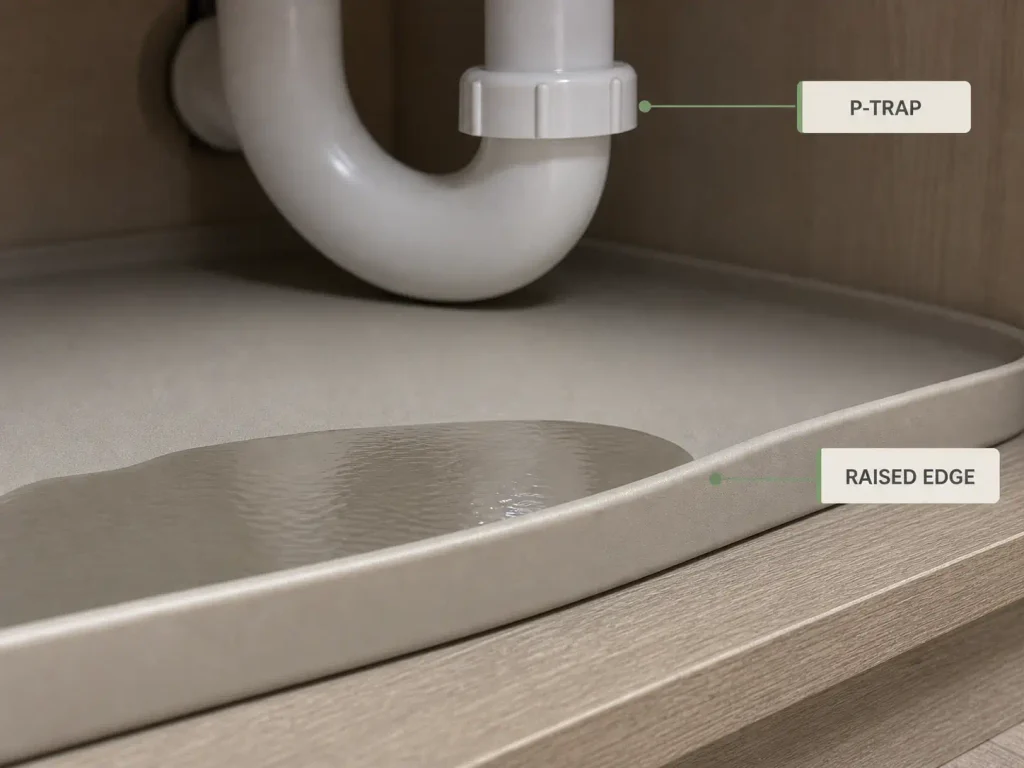
The sequencing is not optional. The mat goes down first, before the bins, before the shelf, before anything. Retrofitting one under a loaded cabinet means unloading the entire thing a second time, which is the kind of task that gets postponed until it is never done at all.
Using the Door and the Vertical Space Without Drilling
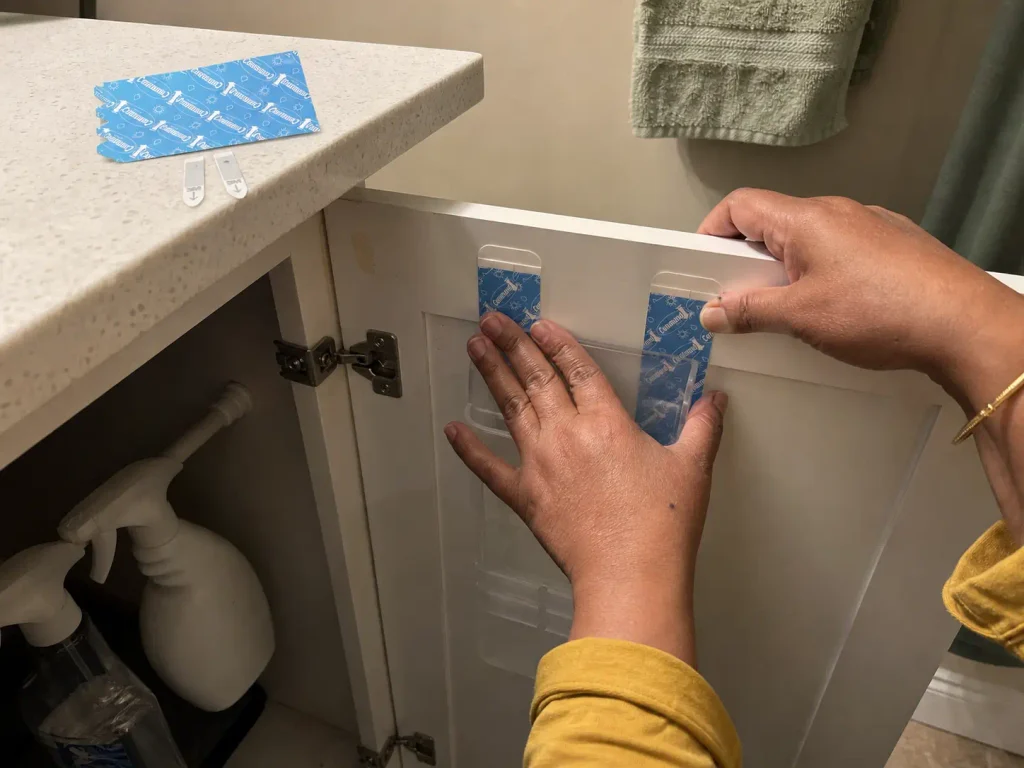
The inside of a cabinet door is the most-wasted flat surface in your bathroom. It is also where people hang the heaviest thing they own and then wonder why it is sitting on the cabinet floor by Thursday.
Consumer Reports is direct about this one: heavy items do not belong on cabinet-door racks, because they fall out every time the door opens, and that repeated swing finds the weak point in any mount eventually. So the door holds light things. Travel toiletries, small bottles, the nail clippers that vanish otherwise. Bulk cleaner jugs live on the cabinet floor where gravity is on your side.
Before you buy any mounting hardware, try the tension rod. A rod spanning the cabinet interior lets spray bottles hang by their trigger handles, clearing the entire floor beneath them for bins. It is the cheapest vertical storage you can add to this cabinet and the highest-return move in this section. Most cabinets that “need” a whole door system need one rod and ten minutes.
When you do mount a cabinet door organizer, the rating is the entire product. Standard indoor adhesive strips are not rated for a bathroom and the water-resistant line is, and that single distinction gets skipped every time an article says “just use command hooks and strips.”
Command Water-Resistant Adhesive Refill Strips, Large come in a 16-pack, enough to mount a door caddy with spares for the inevitable repositioning. Read the weight rating and load below it, because a rack that sits within spec on install day and gets topped up over a month is exactly how a door organizer ends up on the floor. The strips also need a clean, dry, smooth surface, so textured or painted-over doors are where adhesive quietly underperforms its rating.
Mount door hardware, then close the door slowly and watch what it hits. A caddy that clears the shelf by a quarter inch when the cabinet is empty will collide with the first tall bottle you put on that shelf, and you will discover it by sound rather than by sight.
Punch-free adhesive organizers exist because so many people searching for this are renters and dorm residents who cannot afford a deposit argument over four screw holes. If that is you, the rest of the no-drill bathroom playbook for renters carries the same logic into the shower, the counter, and the wall space you are not using yet.
The Monthly Reset That Keeps It From Reverting
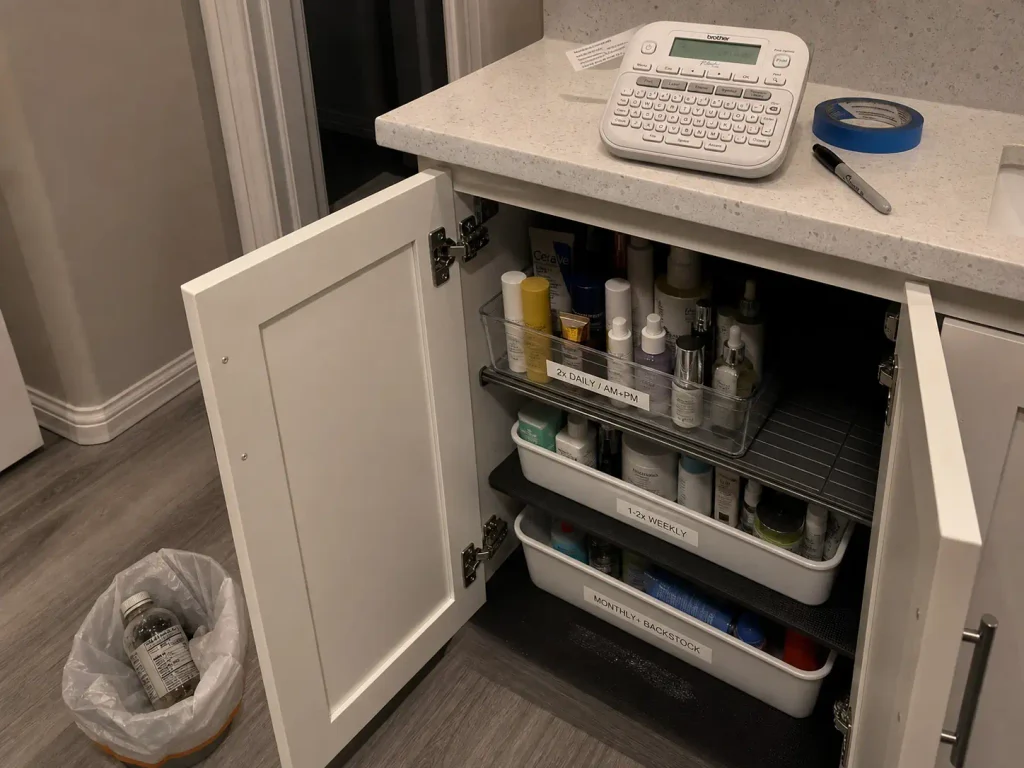
Every organized cabinet reverts if nothing catches the drift. And the drift is not dramatic. A new bottle set down in the wrong spot, an item returned to the nearest bin instead of its own, a sample tube that never got a home. Then one Tuesday the door will not close, and it feels sudden even though it took four months.
The structural fix is to categorize by frequency instead of by type. Daily-use items at the front and at eye level. Weekly items behind them. Backstock at the back and low, because you should only reach for it once a month.
This works for one reason: a rushed morning only ever touches the front of the cabinet. Category zoning ignores that and asks you to think. Frequency zoning matches what your hand already does at 7 a.m.
Then label the zones, not just the bins. A labeled bin tells you where something goes. A labeled zone tells the other person in your house where it goes, and in a shared bathroom that is the actual failure point, because nobody can follow a rule they were never shown.
Painter’s tape and a marker label a cabinet perfectly well and cost essentially nothing. Start there, because the first labeling pass is always wrong and tape is easy to redo.
If a labeling system becomes something you run across the whole house, the Brother P-Touch PTD220 Home/Office Everyday Label Maker prints laminated tape that survives a humid cabinet better than handwriting, which matters here since ink fades in a steamy room. For one cabinet, it is overkill. Buy it when the third room needs labels, not the first.
The reset itself is ten minutes, once a month. Pull everything out of the front zone, toss what is empty or expired, return the strays that migrated in, and wipe the mat.
That last step does double duty, because wiping the mat is also your leak check, and it is how you catch a weeping P-trap while it is still a wrench problem. That is the entire maintenance routine.
Attach the reset to a chore you already do monthly rather than a calendar reminder you will ignore by the third notification. Whichever day you swap the bath towels, the cabinet reset rides along. Ten minutes buried inside an existing habit sticks; ten minutes standing alone does not.
Here is the diagnostic that tells you whether your zones are right. Give it three weeks. If things are consistently landing in the wrong bin by then, the zones are wrong, not the household.
Watch where items get put down when nobody is thinking about the system, and redraw the zones around that instead of around where things logically belong. People do not adapt to storage. Storage adapts to people, or it gets abandoned. And if the push to declutter under the sink is what finally got you started on the rest of the house, the room-by-room method that starts with the bathroom for a reason picks up where this leaves off.
Final Thoughts
Three things carry most of the result. Measure the cabinet and the pipe clearance before buying anything, because that single step prevents most returns in this category. Choose materials built for a wet room, since wire, acrylic, and sealed plastic hold up while wicker and cardboard do not. And zone by frequency with the mat down first, because the front zone is the only one a rushed morning touches and the mat is what turns a slow leak into a small problem.
In three months, pull the front zone out and look at the mat. If items have drifted into the wrong bins, the zones need redrawing. If there is a ring on the silicone, the P-trap needs a wrench.
Empty the cabinet this weekend and measure it. Buy nothing until you have three numbers written down.
Frequently Asked Questions
01How do you organize under a bathroom sink with no cabinet?
With a pedestal sink, a U-shaped wrap-around cabinet is the only enclosed option: it sits on the floor around the pedestal base and turns exposed pipe into two doors plus a shelf. The free version is a slim basket or repurposed shower caddy tucked behind the column. Both are freestanding, so both are renter-safe.
02Why do baskets under the bathroom sink get moldy?
Wicker, rattan, and seagrass are porous, so they absorb and hold the moisture a bathroom produces daily, which makes mold and mildew likely rather than unlucky. It is a material problem, not a cleaning problem. Swap to open-mesh wire, acrylic, or sealed plastic, all of which either breathe or wipe clean.
03What should you not store under a bathroom sink?
Keep out bulk backstock beyond one spare, anything heavy on the cabinet door, and cleaning chemicals mixed loosely among personal-care items. Consumer Reports recommends physically separating chemicals from personal-care items within a shared cabinet. Bulk buys belong in a linen closet or under a bed, away from the humidity.
04How deep is a standard bathroom vanity cabinet?
A standard bathroom vanity is about 21 inches deep, with shallow models at 18 inches and extra-deep ones at 24 to 25 inches. Below roughly 16 inches, the P-trap starts eating usable shelf space directly, so measure the clear height on each side of the pipe before buying any organizer.
05Do lazy susans work under a bathroom sink?
Yes, in the daily-use zone, as long as the cabinet is deep enough for the tray to spin clear of the P-trap. The spin is what ends digging through stacked bins during a rushed morning. In a shallow cabinet where a full circle will not clear, a quarter-wedge bin does the same corralling job.
Disclaimer: ClutterlessNest is a participant in the Amazon Services LLC Associates Program. As an Amazon Associate we earn from qualifying purchases. This article may contain affiliate links — if you buy through them, we may earn a small commission at no extra cost to you. We only recommend products we have tested or genuinely believe in.