You’re running late on a Tuesday morning. You reach for your face wash and three other bottles slide into the sink. You catch them, set them back, grab the face wash — and your moisturizer gets knocked behind the faucet again. This is not a you problem. This is a systems problem.
After setting up and testing dozens of counter organization systems (including some that looked great for exactly eleven days), the ones that actually hold are built around one principle: the counter has rules, or it fills up again. This guide covers how to set those rules, which items actually belong on the counter, how a tray enforces the limits so willpower doesn’t have to, and what to do when two people share the same 10 inches of surface.
Quick Answer: Here’s how to organize your bathroom counter so it stays that way:
- Audit every item and keep only what you use every single morning or evening
- Place a tray sized to your usable counter space to enforce the item limit
- Move tall bottles to a 2-tier corner shelf to free flat surface area
- Replace individual bottles with two matching dispensers to cut clutter by 60%
- Assign one tray per person on shared counters with no cross-zone migration
- Reset for 2 minutes on Sunday and find a home for anything outside the tray
Why Your Bathroom Counter Gets Cluttered Again

Every time someone reorganizes their bathroom counter, it looks great for about two weeks. Then the drift starts. One product gets left out “just for today.” Then another. Then the whole surface resets to where it started. The failure isn’t laziness. It’s that the counter has no rules about what’s allowed on it.
The Counter Has No Rules
Your bathroom counter is the default parking spot for everything that doesn’t have an assigned home. Items don’t land there because they belong. They land there because the counter is the closest flat surface to where they get used.
A kitchen counter has appliances claiming territory. A bedroom dresser has a lamp and a clock. But a bathroom counter? It’s wide open. And every space without rules becomes storage.
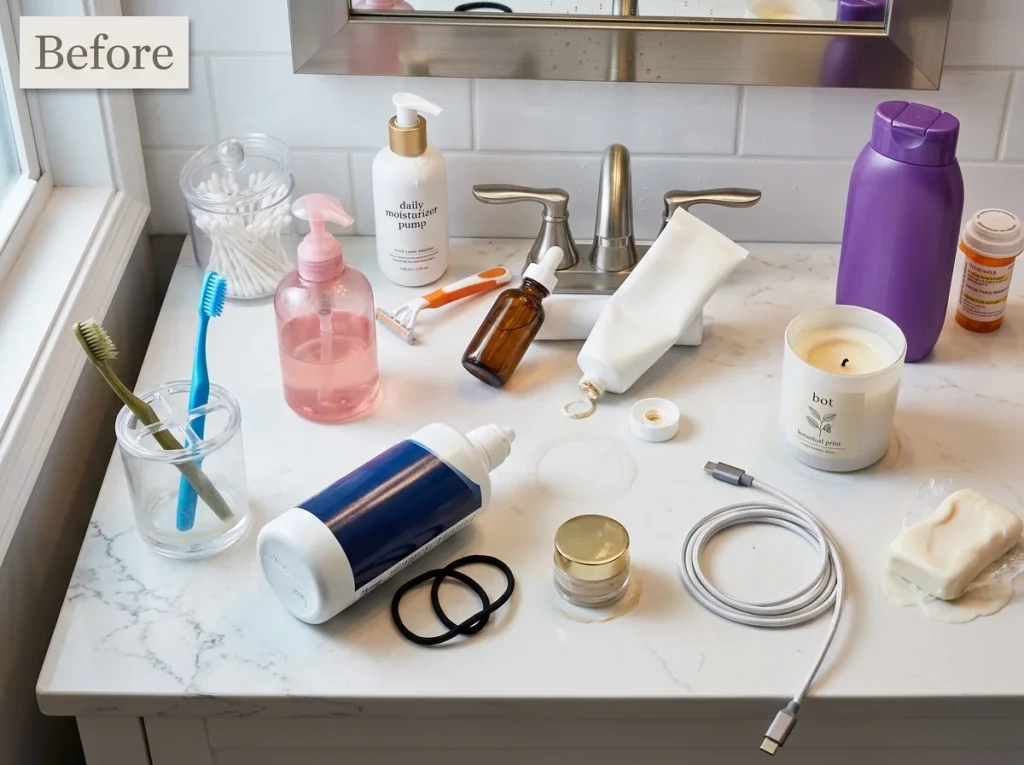
This is what organizers call counter drift: items migrate back to the counter not all at once, but one at a time. Each individual item seems harmless. A moisturizer left out after a rushed morning. A bottle of contact solution that didn’t get put away.
Six weeks later the counter is back to chaos, and nobody can point to the moment it happened. A counter system is only one part of a small bathroom storage system, but it’s the most visible one, which makes it the right place to start.
Why “Organizing” Without Editing Fails
The most common first mistake: buying organizers before removing items. A tray full of things that shouldn’t be on the counter is just organized clutter. It looks neater, sure. But the tray fills up, overflow starts piling outside it, and within a month the organizer itself becomes part of the mess.
The edit comes first. Always. Before you touch a single product or container, you need to decide what actually earns counter space. Everything else goes somewhere else: medicine cabinet, under-sink organizer, drawer. The audit is the highest-ROI step, and it costs nothing.
The Two-Week Cliff
Here’s why systems hold for two weeks and then fall apart: the first two weeks run on motivation. You just reorganized, it looks clean, you’re careful about where things go. After day fourteen, the system has to run itself, or it doesn’t run at all.
Behavioral research backs this up. Quarterly counter audits of about 20 minutes, four times a year, prevent reversion more effectively than annual overhauls. The short cadence catches drift before it compounds. One organizer put it this way: “Every time you walk by the sink, you need to put something away.” That’s the reality. The counter requires active, ongoing maintenance. Not a perfect initial setup that magically sustains itself.
Pro tip: The next time you clean the counter, count how many items go back on. If you can’t count them on one hand, the system needs an edit, not a reorganization.
The Counter Audit: What Actually Belongs There
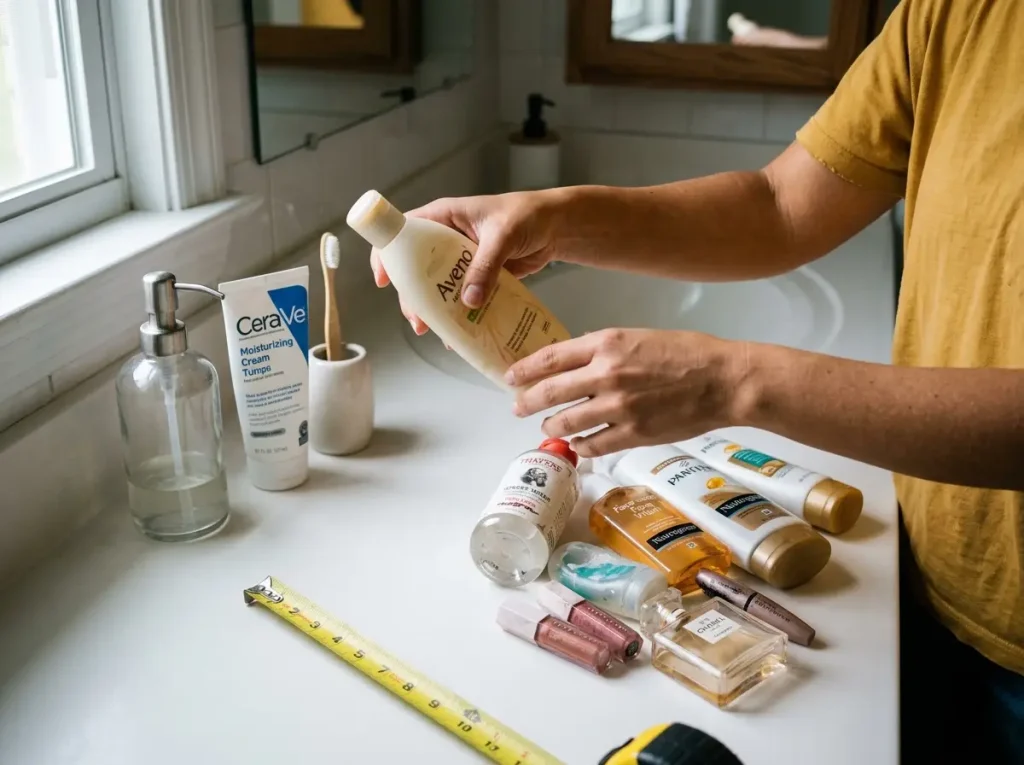
Most people have 8–15 items on their bathroom counter. Professional organizers say 3–4. The gap between those numbers isn’t a style preference. It’s the entire problem. Before buying a single organizer, you need a framework for deciding what’s allowed to stay.
The Daily Driver Test
Here’s the test: does this item get used every single morning OR every single evening? If the answer is no to both, it’s a candidate for removal from the counter. That’s it. No judgment about what you “should” use daily. Just a binary filter based on your actual routine.
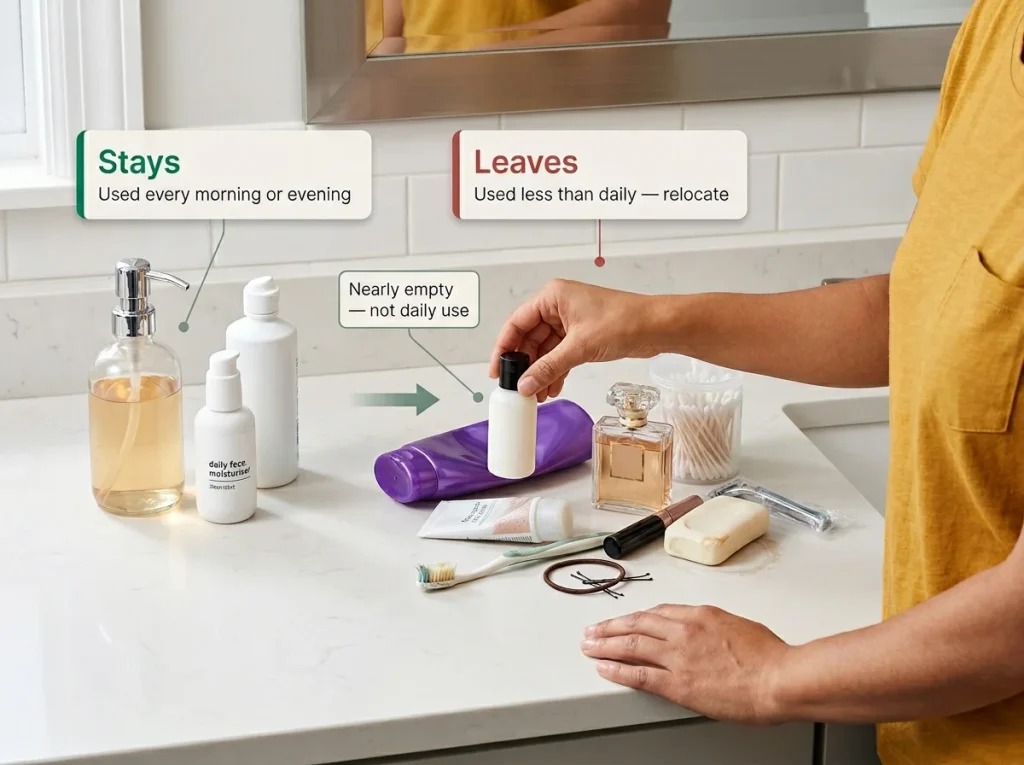
Items that pass the daily driver test for most people: hand soap dispenser, face moisturizer (if used after every wash), and that’s about it. Maybe a contact lens solution if you wear contacts. Everything else is a candidate for relocation. If the audit reveals more clutter than expected, a full bathroom declutter checklist handles the harder decisions about what to keep versus donate.
The Toothbrush Rule (and Why It Matters)
Toothbrushes stored on an open counter in a bathroom with a shower accumulate humidity and micro-droplets from flushing. The bristles degrade faster. The medicine cabinet is the better location because it’s drier and enclosed. If there’s no medicine cabinet, a suction-cup holder on the mirror counts as “off the counter.”
This one surprises people. The toothbrush feels like it belongs on the counter because that’s where everyone puts it. But it’s actually one of the easiest items to relocate, and it frees up space that something else needs more.
Where Everything Else Goes
The audit creates a relocation problem. All those bottles have to go somewhere. Medicine cabinet for daily meds and dental items. Under-sink organizer for backstock and products used less than daily. Drawer for makeup and tools. Bedside table for night creams used only before bed.
If your bathroom has no medicine cabinet or limited under-sink space, the counter ends up holding more than it should by default. Here’s how to organize a bathroom with no cabinets and build the off-counter storage the counter is missing. The free option that works right now: just do the audit. Take everything off and put back only what you used this morning. Removing the wrong items is the step with the highest return, and it doesn’t cost a thing.
The Base Tray System
A tray does something no organizer or willpower can: it enforces the item limit by making visible when the counter is “full.” When the tray is full, the next item doesn’t go on the counter. No decision required. No self-discipline needed. The tray’s physical boundary does the work.
How to Size Your Tray
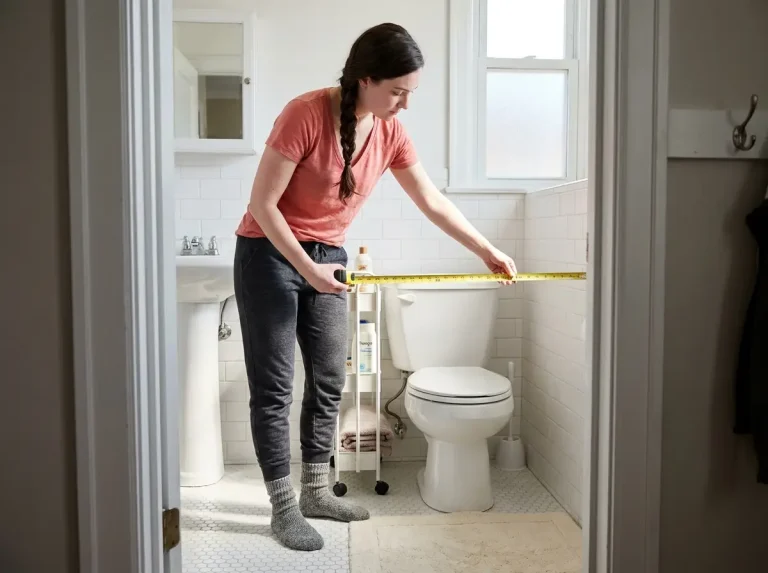
Measure the usable space on one side of your sink. On a standard 30-inch vanity (the most common single-sink size per NKBA bathroom planning guidelines), after accounting for an undermount sink (18–22 inches across), you have about 8–12 inches of usable surface on each side. Your tray should fill most of that space. That’s intentional. The tray IS the zone. If the tray is full and there’s no open counter left, there’s nothing to accumulate drift.
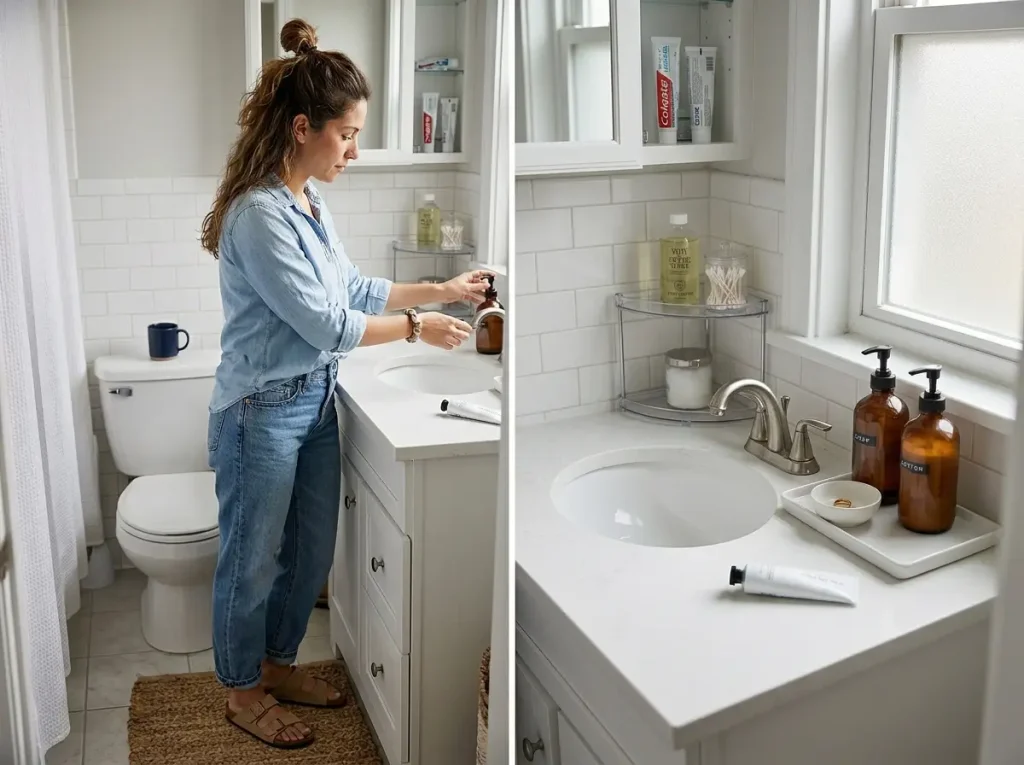
A tray in the 12-by-8-inch range fits that usable zone on most single-vanity counters. Any waterproof tray you already own works here: a baking dish, a drawer organizer, even a Dollar Tree tray. The function is the boundary, not the brand. If you want something purpose-built, the mDesign Plastic Bathroom Counter Tray hits that 12x8x2-inch footprint and the waterproof plastic wipes clean in seconds.
For vanities under 30 inches wide: one side may have only 5–6 inches of usable space. That’s a single-item zone. Soap dispenser, nothing else. No tray needed, because there’s physically no room for one.
Pro tip: If the tray feels too restrictive, that’s the point. The moment it limits what fits, it’s working. A tray that accommodates everything you want to put on the counter is just a bigger counter.
Why the Tray Works When Willpower Doesn’t
A tray that’s full is a physical cue. A “clean counter” with visible open space is an invitation. Your brain treats empty flat surfaces as available storage. That’s not a character flaw, it’s just how spatial reasoning works. The tray removes the decision by removing the space.
The Tray Wipe — The Only Maintenance This System Needs
Sunday night, before bed: lift the tray, wipe the counter under it with a damp cloth, put it back. That’s less than two minutes. If there are items sitting outside the tray, those are the items that need a home assignment. Each stray item is information. It’s telling you something doesn’t have a permanent spot yet.
For a full zone-by-zone breakdown of what goes where in the bathroom, the guide to best bathroom organizers covers the counter alongside under-sink, shower, and over-toilet zones.
Vertical Storage for Tall Bottles
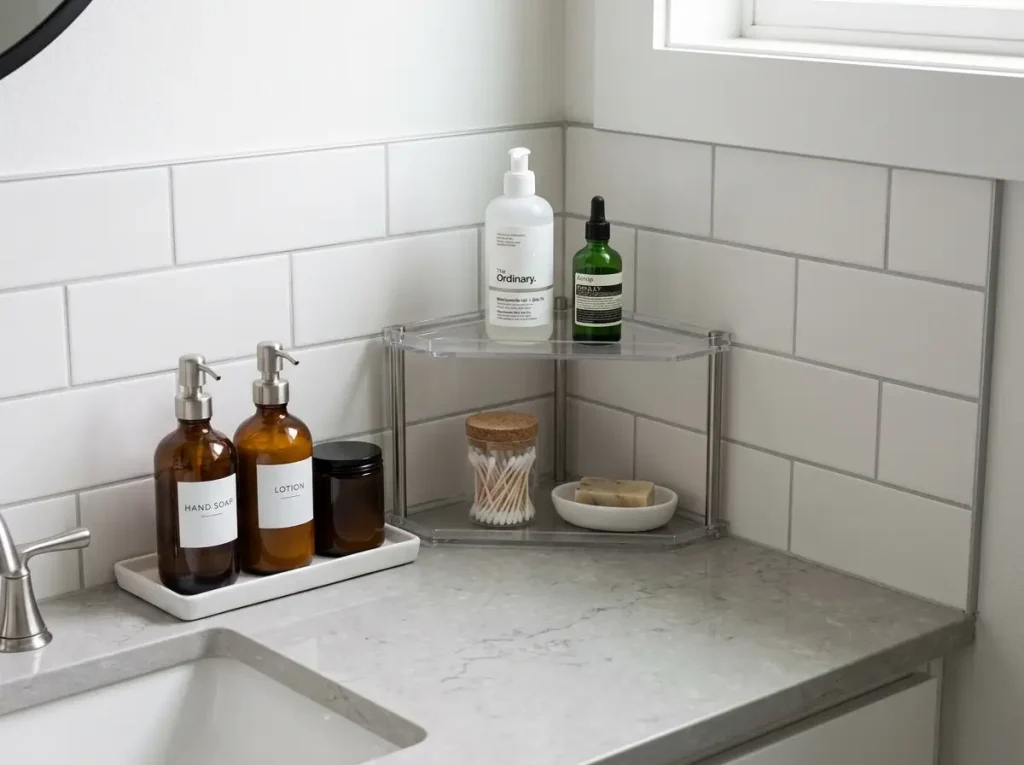
Even after the audit and the tray, some counters still feel crowded, because three tall bottles are dominating the whole surface. Face wash bottles run 8–10 inches tall. Toners sit around 7 inches. Serums are 4–6 inches. Lined up on a flat counter, they fall over, block each other, and make the entire surface feel chaotic even when there are only a few items.
Why Flat Counters Fail for Tall Bottles
A bottle standing on a flat counter takes up both vertical and horizontal space, because it can fall over. Lay it on its side and it rolls. Prop it against the wall and it slides. Tall bottles on flat surfaces are a geometry problem, not an organization problem. Moving them to a tiered shelf gives them vertical support and frees the flat surface for items that actually need to lie flat or stand short.
The Corner Shelf Solution
The back corners of bathroom counters are consistently the least-used space. That triangular zone where the backsplash meets the side wall collects dust and maybe a dried-out cotton pad. A freestanding 2-tier corner shelf reclaims that area without drilling and without modifying the counter.
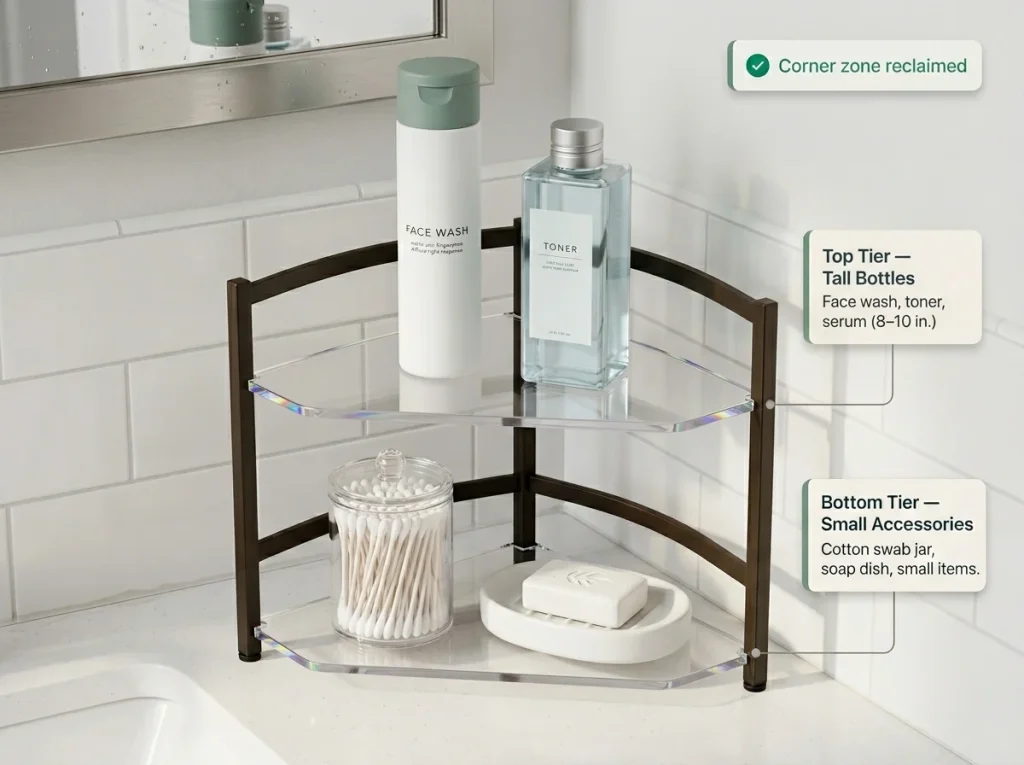
The mDesign 2-Tier Freestanding Countertop Corner Shelf Organizer fits that corner footprint with a steel frame and clear plastic tiers that hold up in humid environments without rusting or warping. That detail matters, because a bathroom shelf that starts corroding after six months isn’t a solution. Top tier holds the tall bottles where they’re visible and accessible. Bottom tier handles short items: cotton swab jar, soap dish, small skincare container. If you’d rather save the money, a dollar-store riser or stacked sturdy containers achieve similar vertical separation.
What Doesn’t Work on Narrow Counters
Here’s the constraint: a 2-tier corner shelf only works on vanities 36 inches or wider. On a 24–30 inch vanity, the footprint of the shelf eats into the limited flat surface you need for the tray system. If your vanity is on the narrow side, the answer isn’t a shelf. It’s dispensers. Going vertical with the liquid bottles themselves rather than adding a separate structure. That’s the next section.
Replacing Bottle Clutter with Dispensers

The average bathroom counter has 5–8 liquid products in their original packaging. Hand soap, face wash, moisturizer, lotion, maybe a toner. Each one has a different height, a different lid, and sits at a different level. Even after an audit, these bottles look cluttered because the varied packaging creates visual noise. That’s what original product packaging does. It’s designed to catch your eye on a store shelf, not to blend into a 10-inch bathroom counter.
How Many Bottles Are on Your Counter Right Now?
Count them. Six or more? Dispenser consolidation is worth the effort. Two or three? Dispensers are optional. You might already be at the right count. The threshold matters because dispensers solve a volume problem. If you only have two bottles, matching dispensers are an aesthetic upgrade, not a functional one.
The 2-Dispenser System
Dispenser one: hand soap or liquid face cleanser, whichever you use at the sink. Dispenser two: lotion or moisturizer. That’s your counter’s liquid zone. Everything else (shower products, extra skincare, half-finished bottles) lives in a drawer or under the sink until the dispenser needs a refill.
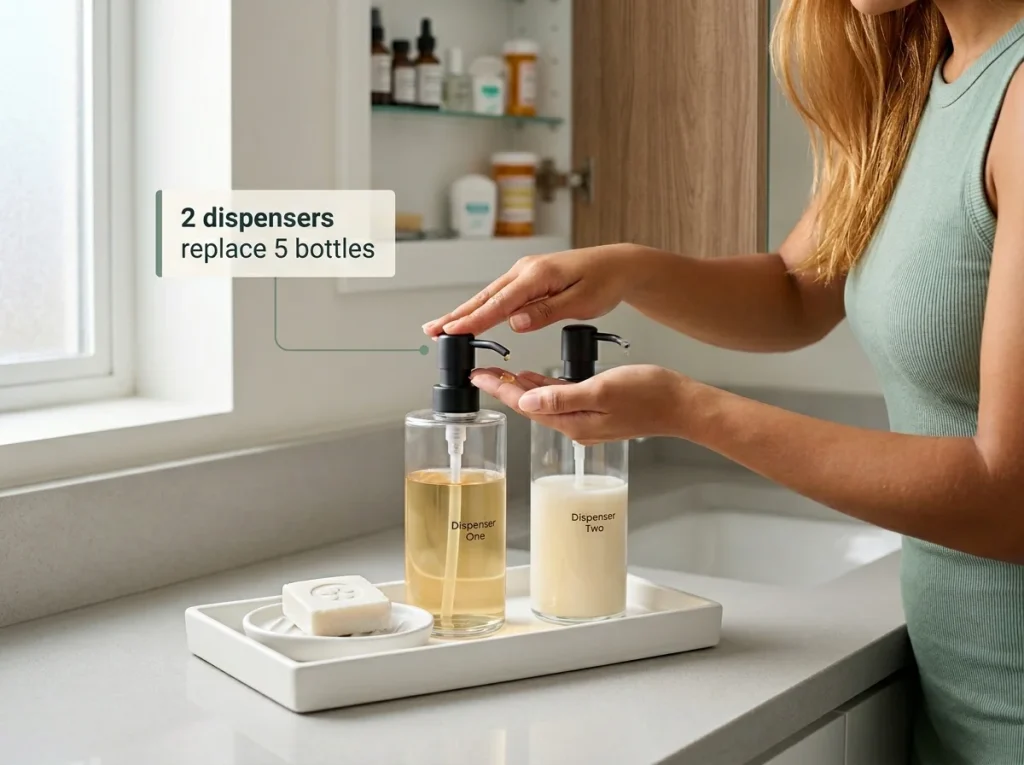
Two matching dispensers replace 3–5 individual bottles and cut the counter footprint for liquids by about 60–70%. The AmazerBath Glass Soap Dispenser 2-Pack runs 17 ounces per bottle with stainless steel pumps, and the pump material matters more than you’d think. Cheap plastic pumps corrode or seize up within a year in bathroom humidity. The lead-free glass doesn’t yellow or warp the way plastic does over time. If glass isn’t in the budget, refillable BPA-free plastic dispensers do the same job at a lower cost. Just plan to replace them every 12–18 months as the pump degrades.
What Material Holds Up in a Bathroom
Humidity is the variable that changes everything. Plastic pumps crack. Cheap metal rusts. Bamboo canisters look great for three months and then develop a water ring at the base that never comes off. For dispensers that sit on the counter every single day, glass with a stainless pump is the combination that holds up through the humidity cycles of daily showers. If glass isn’t in the budget, go with BPA-free plastic and accept the replacement cycle.
Pro tip: Label the bottom of each dispenser with a piece of tape that says what’s inside. When your partner refills one without checking, they’ll put lotion in the soap dispenser exactly once before the label saves everyone.
Shared Counters and the No-Drill Renter Fix

Two scenarios make bathroom counter organization harder than everything above: sharing the counter with another person, and renting a space where you can’t drill. Shared counters break because two sets of routines compete for the same surface with no agreed-on rules. Rental counters stay cluttered because the one fix that would help most, a small shelf above the counter, usually requires holes in the wall.
Both have fixes. And both cost less than you’d expect.
The Two-Zone Shared Counter Protocol
One tray per person. Side by side. Each person manages only their tray: their daily drivers, their reset, their responsibility. The left side and the right side of the sink are distinct zones. Items from one zone don’t migrate to the other.
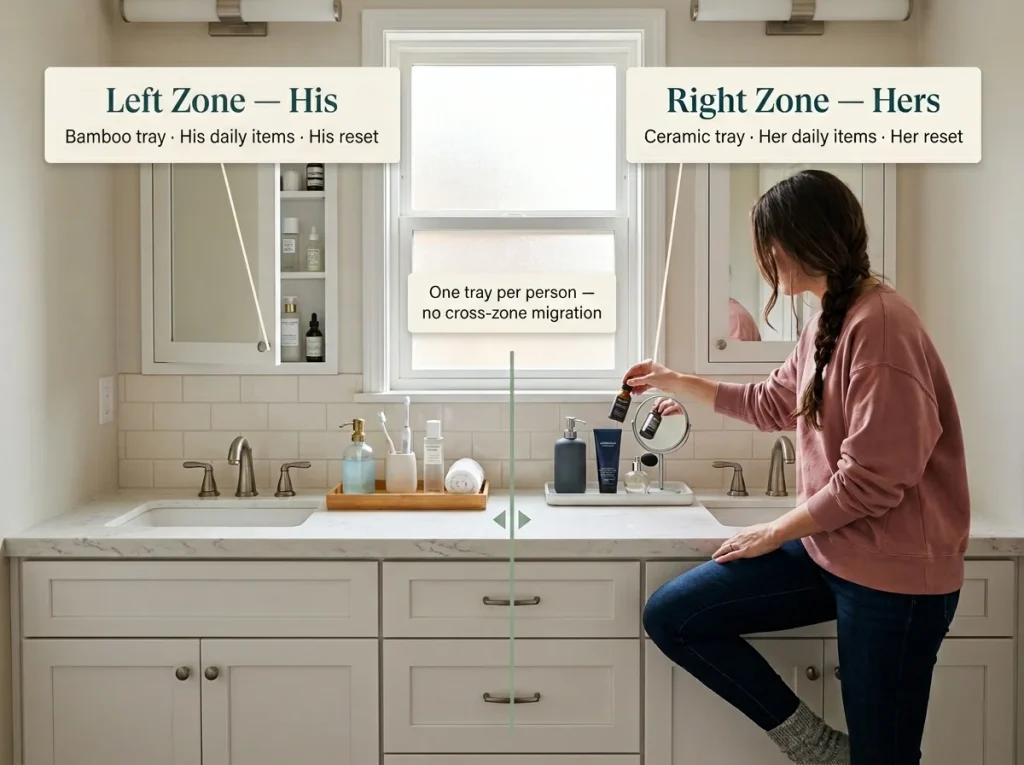
Visual differentiation helps more than you’d think. Different tray materials (bamboo versus white ceramic, light versus dark) make the zones instantly identifiable without labels. This is what some organizers call the bathroom divorce: separate zones in a shared space. It sounds dramatic, but the daily low-grade friction over “who left what where” disappears once each person has a defined boundary.
The same zone-separation approach works for the rest of the shared spaces in the home. The guide to organizing a shared closet shows how to apply the same logic to a shared bedroom closet.
For shared single-sink counters: each person gets half the surface. The dividing line is the center of the sink basin. One person owns the left side, one owns the right. If the counter is too narrow for two trays, each person gets one section of a divided tray.
Renter Solutions for Going Vertical Without Drilling
Three no-drill options for adding vertical storage above or around the counter.
First: a small floating shelf mounted above the counter using Command Bath Large Water-Resistant Adhesive Strips. These are specifically rated for humid bathroom environments. Standard Command strips fail from shower steam within weeks, but the bath-rated version holds shelves up to 5 pounds and removes cleanly from tile, painted drywall, and glass when you move out. That small shelf moves your daily items vertical and frees the flat surface below.
Second: a suction-cup toothbrush holder on the mirror. Gets toothbrushes off the counter without a single hole. Standard suction cups fail within months. Look for suction-plus-adhesive hybrids rated for glass.
Third: a 9–11 inch turntable in the corner. No installation at all. Rotate to access products without rearranging anything. Works for skincare bottles, perfume, small accessories. For renters dealing with the full bathroom and not just the counter, the guide to small bathroom storage ideas covers no-drill solutions for every zone in the room.
Combined, those three moves can free 40–60% of a counter surface without putting a single hole in anything.
The 2-Minute Sunday Reset
Whether shared or solo, the maintenance protocol is the same. Two minutes. Sunday night or Monday morning. Remove anything that drifted outside the tray during the week. If the same item keeps reappearing outside the tray week after week, it doesn’t have a permanent home yet. That’s not a failure. It’s information. Find it a home or remove it from the bathroom.
The quarterly audit is worth adding to a calendar reminder too. Every three months, spend 20 minutes reassessing what’s on the counter versus what’s actually getting used. That short cadence catches drift before it compounds back into the mess you started from.
Conclusion
Three things keep a bathroom counter organized long-term:
- The tray enforces the limit, not your intentions. When the tray is full, nothing else goes on the counter. That physical boundary is the entire system.
- The audit comes before the organizers. Removing what doesn’t belong is free and does more than any product you can buy.
- Two minutes on Sunday is the whole maintenance cycle. Anything sitting outside the tray is a signal about what still needs a permanent home.
In three months, check for items that keep appearing outside the tray. Those are the items that haven’t found their spot yet. Reassign them or remove them from the bathroom entirely.
Start with the audit. Take everything off the counter right now. Put back only what you used this morning. See how few items that is. That’s your counter’s real capacity, and it’s probably smaller than you thought.
Q1 How do you organize a cluttered bathroom counter?
Start by removing everything from the counter, then put back only the items you use every single morning or evening, usually just 3–4 items. Place them in a waterproof tray sized to the usable space beside your sink so the tray’s boundary prevents counter drift from returning.
Q2 What should I keep on my bathroom counter?
Keep only daily-use items: a hand soap dispenser, face moisturizer if used after washing, and one or two items you reach for every morning. Toothbrushes, makeup, and backup products belong in a medicine cabinet or drawer where humidity won’t degrade them.
Q3 How do I keep my bathroom counter clean and organized long-term?
A 2-minute weekly reset where you lift the tray, wipe the surface underneath, and check for items that drifted outside is the only maintenance required. Any item sitting outside the tray signals that it still needs a permanent home somewhere else in the bathroom.
Q4 What are the best bathroom counter organizers for small spaces?
A 12×8-inch waterproof tray for the base zone, a 2-tier corner shelf on vanities 36 inches or wider, and matching dispensers to replace multiple bottles. These three cover about 90% of counter clutter on standard single-sink vanities.
Q5 How do I organize a bathroom counter when sharing with someone?
Assign one tray per person, placed side by side on the counter, with each person managing only their own tray and resetting it independently each week. Use different tray materials like bamboo versus ceramic to make the zones visually distinct without labels or rules that need enforcing.
Disclaimer: ClutterlessNest is a participant in the Amazon Services LLC Associates Program. As an Amazon Associate we earn from qualifying purchases. This article may contain affiliate links — if you buy through them, we may earn a small commission at no extra cost to you. We only recommend products we have tested or genuinely believe in.