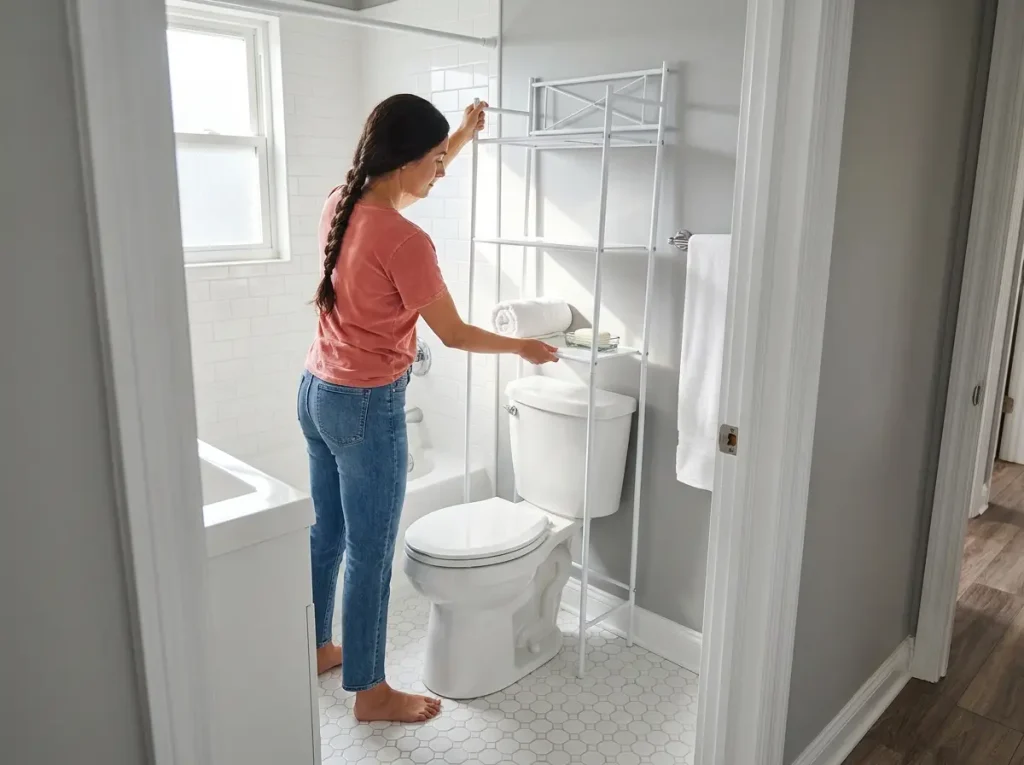
The first time I set up an over-toilet shelf, it lasted three weeks before I knocked it sideways reaching for a towel. The second one wobbled every time someone closed the bathroom door. By the sixth unit, I’d figured out what actually matters — and it’s not what the product photos suggest. This guide covers the three types of over-toilet storage that work in real bathrooms, the measurements you should take before ordering, and the specific products that held up in tight rental bathrooms.
Quick Answer: The best over-toilet storage depends on your bathroom type and lease.
- Freestanding shelves work for most bathrooms — measure tank width and floor-to-ceiling height first
- Wall-mounted floating shelves save the most floor space but need studs or adhesive rated for humidity
- Tank-area organizers fit bathrooms too small for a full shelf unit
- Always measure before ordering — most returns happen because the unit doesn’t clear the tank
- Renter-friendly options exist for every type — no drilling required
Why the Space Above Your Toilet Is Worth Using
The Dead Space You’re Ignoring
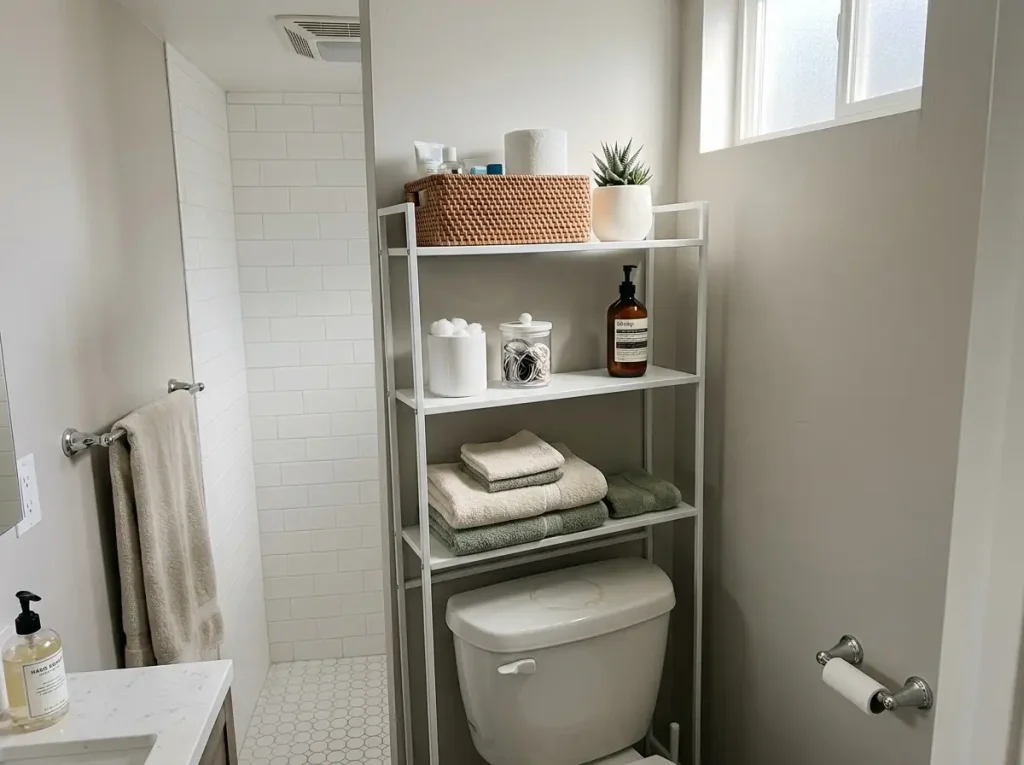
Look at the wall above your toilet right now. You’re probably staring at 4 to 5 feet of empty wall space — enough vertical room to store everything from extra toilet paper to hand towels to all the bottles cluttering your vanity. In a small bathroom under 50 square feet, that unused wall is your biggest storage opportunity.
Most small bathroom storage problems come down to one issue: you’re trying to use horizontal surfaces that don’t exist. You don’t have a linen closet. You probably don’t have deep vanity drawers. But you do have 15-plus square feet of vertical space above the toilet that’s doing nothing right now.
What Actually Fits Up There
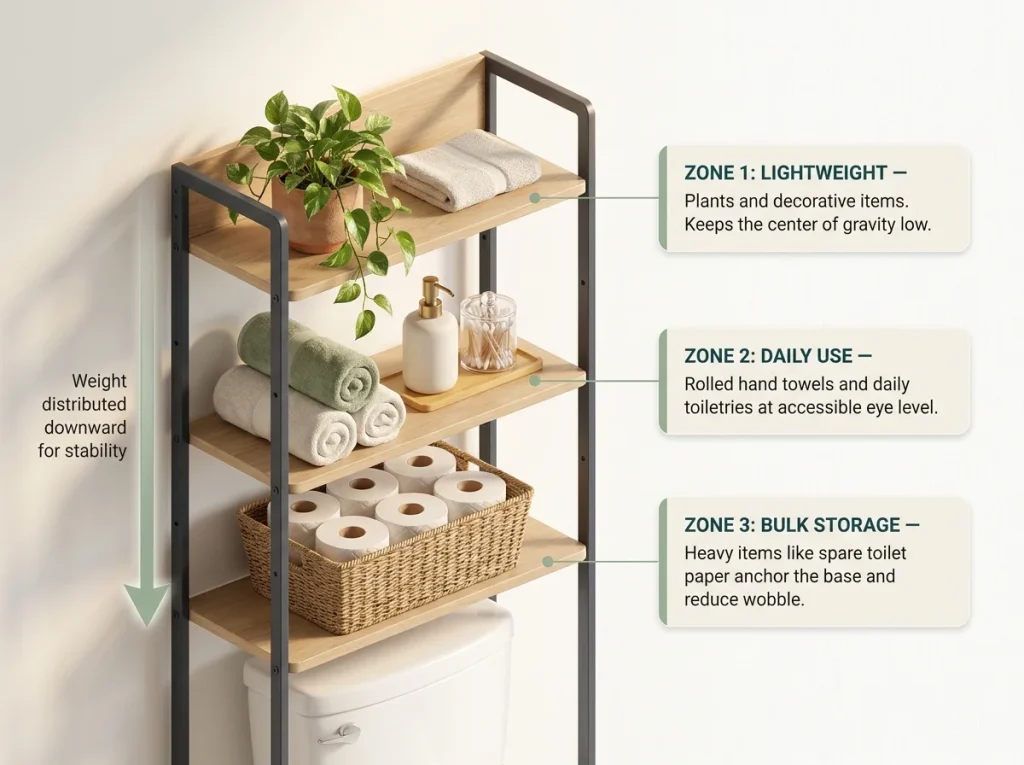
The toilet wall works for lightweight daily items: rolled hand towels, toilet paper reserves, small baskets of toiletries, a plant or two. It does not work for heavy bath towels, large shampoo bottles you use in the shower, or anything you need while standing at the sink across the room.
The rule: store things you use at or near the toilet, plus items that need a home but don’t require quick access. Extra TP, spare hand towels, cotton swabs, lotion — those belong here. Your daily face wash does not. I made that mistake in my first setup and spent two months walking back and forth across a 40-square-foot bathroom to grab moisturizer.
Three Types of Over-Toilet Storage (and Which One Fits Your Bathroom)
Every over-toilet storage solution falls into one of three categories: freestanding shelf units that straddle the toilet, wall-mounted shelves that float above it, and tank-area organizers that sit on or behind the tank itself.
Freestanding units give you the most storage but take up floor space. Wall-mounted shelves save floor space but require either studs or adhesive. Tank-area organizers use zero floor or wall space but hold the least. Your choice depends on your bathroom size, your lease, and how much you actually need to store. If you’re working with a bathroom that has broader storage problems, start with the full small bathroom storage system to see where the toilet wall fits in your overall plan.
The Three Measurements to Take Before You Order Anything
Tank Width and Depth
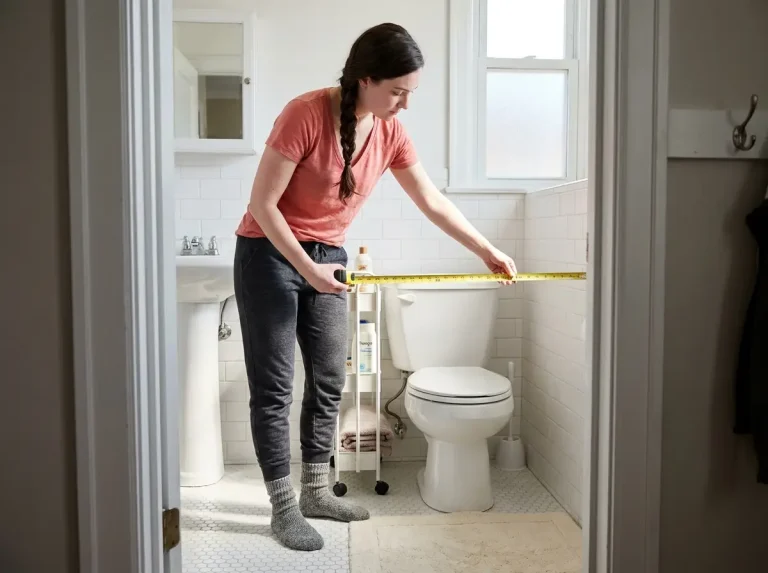
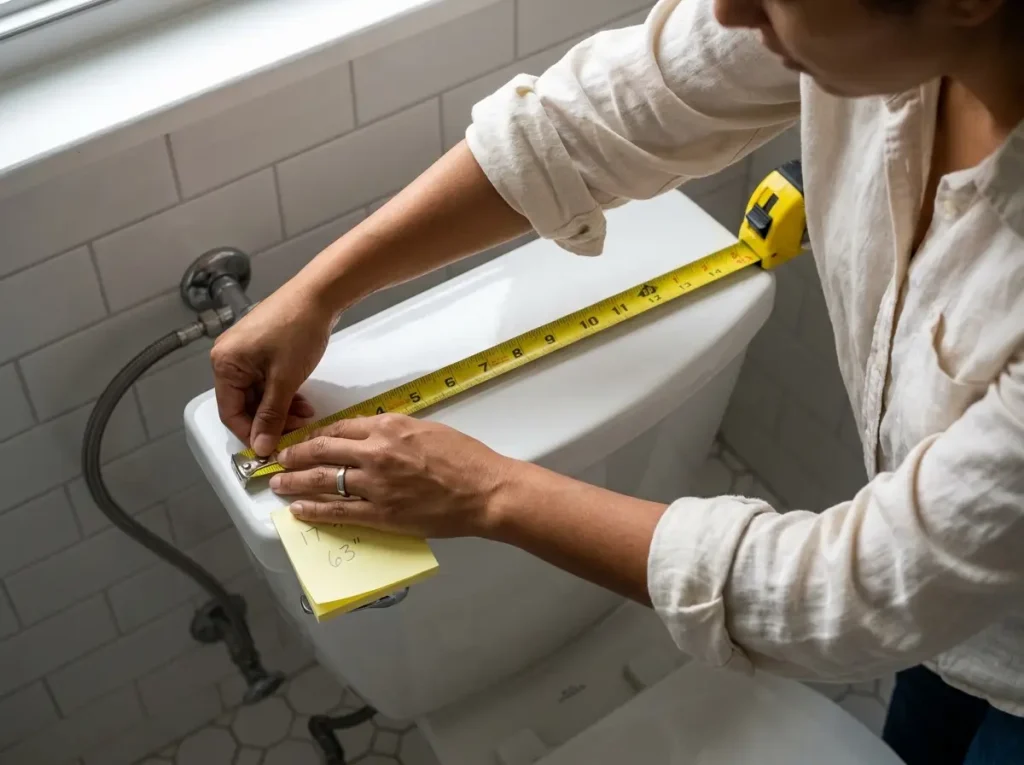
Grab a tape measure before you open Amazon. Most standard toilet tanks are 14 to 18 inches wide and 6 to 8 inches deep, but your toilet isn’t “most toilets” until you check. Elongated bowls, compact toilets, and older models vary enough to make the wrong shelf unit a frustrating return.
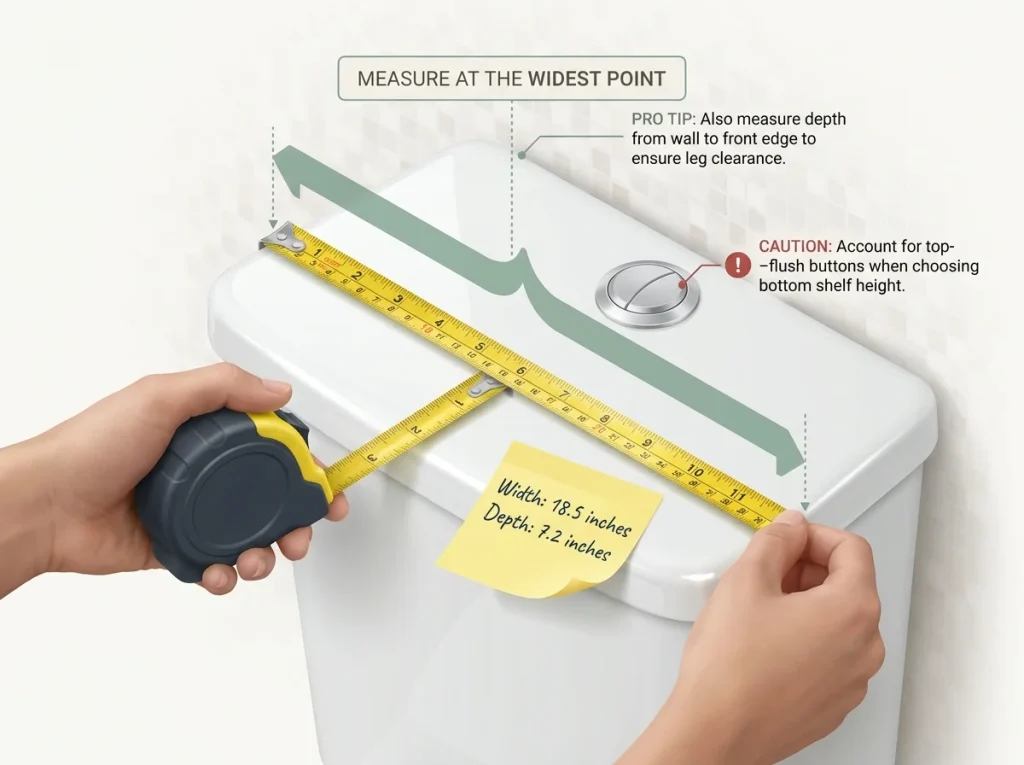
Measure the tank at its widest point. Then measure front-to-back depth at the tank top — this tells you if a freestanding unit’s back legs will clear the tank or collide with it. Write both numbers down. You’ll need them again when you’re sizing baskets and containers for the shelves.
Pro tip: Write down your measurements on a sticky note and photograph it with your phone. You’ll need those numbers at least twice — once for the shelf unit and once for the baskets or containers that go on it.
Floor to Ceiling (and Why It’s Not What You Think)
Measure from the floor directly behind the toilet to the ceiling. Most freestanding over-toilet shelves are 60 to 68 inches tall. If your ceiling is standard 96 inches, you’re fine. If you have a soffit, a sloped ceiling, or a bathroom exhaust fan vent directly above the toilet, that number changes fast.
The mistake everyone makes: measuring floor-to-ceiling in the middle of the room instead of against the wall where the unit actually sits. Baseboards, uneven floors, and wall-mounted exhaust fans eat into your usable height. I’ve seen freestanding units that fit perfectly in the store listing but hit a vent cover by half an inch once they were in place.
The Gap Between the Toilet and the Wall
This is the measurement nobody checks. The gap between the back of your toilet tank and the wall determines whether a freestanding unit’s back legs can actually touch the floor. Some toilets sit flush against the wall. Others have a 2- to 4-inch gap because of the supply line.
If your supply line comes out of the wall (instead of the floor), you need a freestanding unit with a bottom stabilizer bar that adjusts high enough to clear it. This one detail eliminates about half the options on Amazon before you even look at shelf capacity or style.
Freestanding Over-Toilet Shelves (and the Wobble Problem Nobody Mentions)
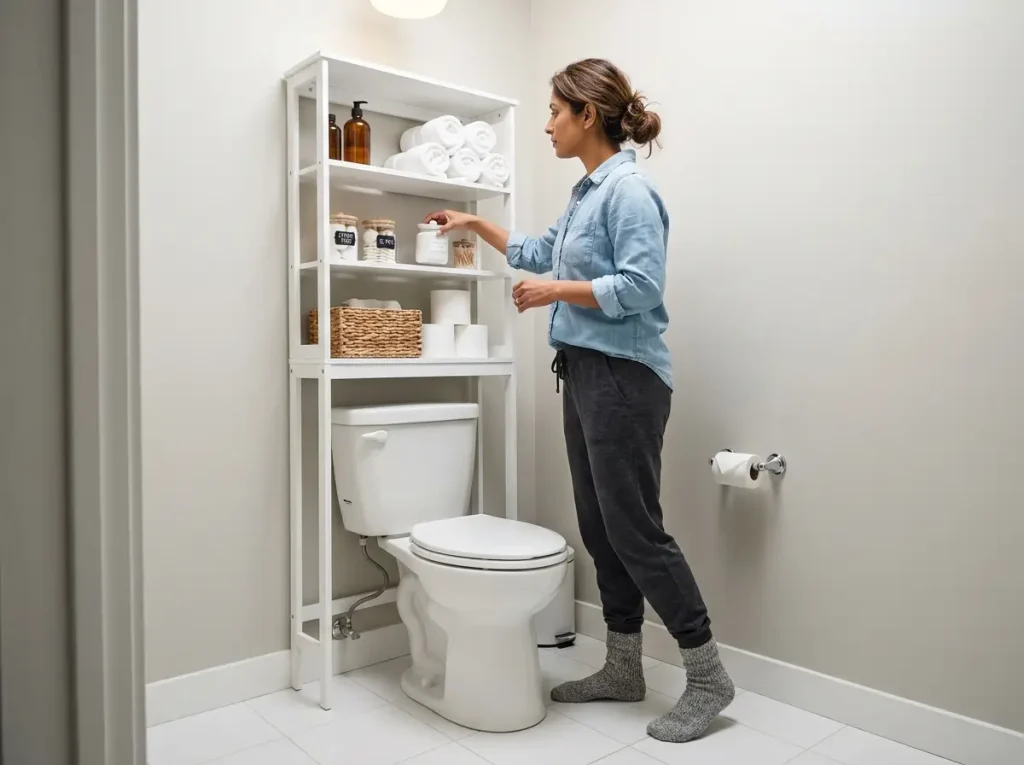
Why Freestanding Units Wobble (and the Fix)
Every freestanding over-toilet shelf wobbles. That’s not a defect — it’s physics. The unit is tall, narrow, and the base sits on either side of a toilet that prevents you from weighting the bottom properly. The wobble gets worse every time you reach for something on the top shelf because you’re pushing the center of gravity sideways.
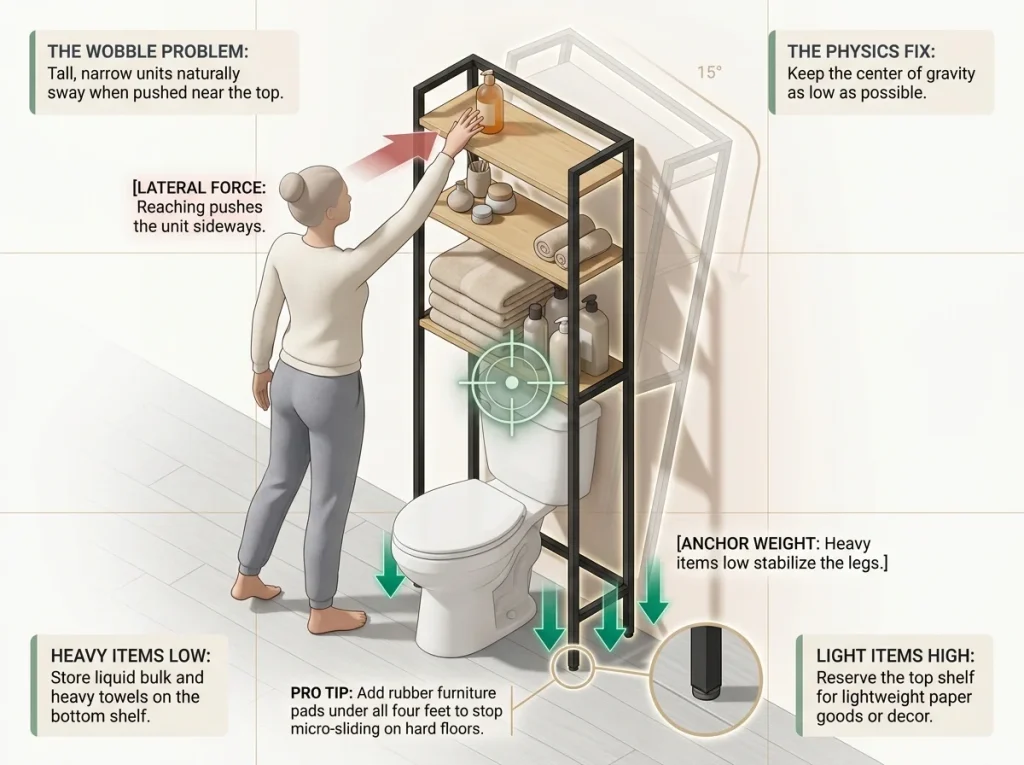
The fix is a combination of three things: rubber pads under all four feet (most hard floors are slightly uneven), a stabilizer bar that locks against the toilet tank base, and keeping the heaviest items on the lowest shelf. Load heavy items low and lightweight items high, and the wobble drops to almost nothing. You’ll know you got the balance right when reaching for the top shelf no longer makes the whole unit sway.
Pro tip: Stick small round rubber furniture pads under each leg of your freestanding unit. The kind you’d use under a dining chair cost almost nothing and they stop the micro-sliding that causes most wobble on tile and vinyl flooring.
The Adjustable Shelf Advantage
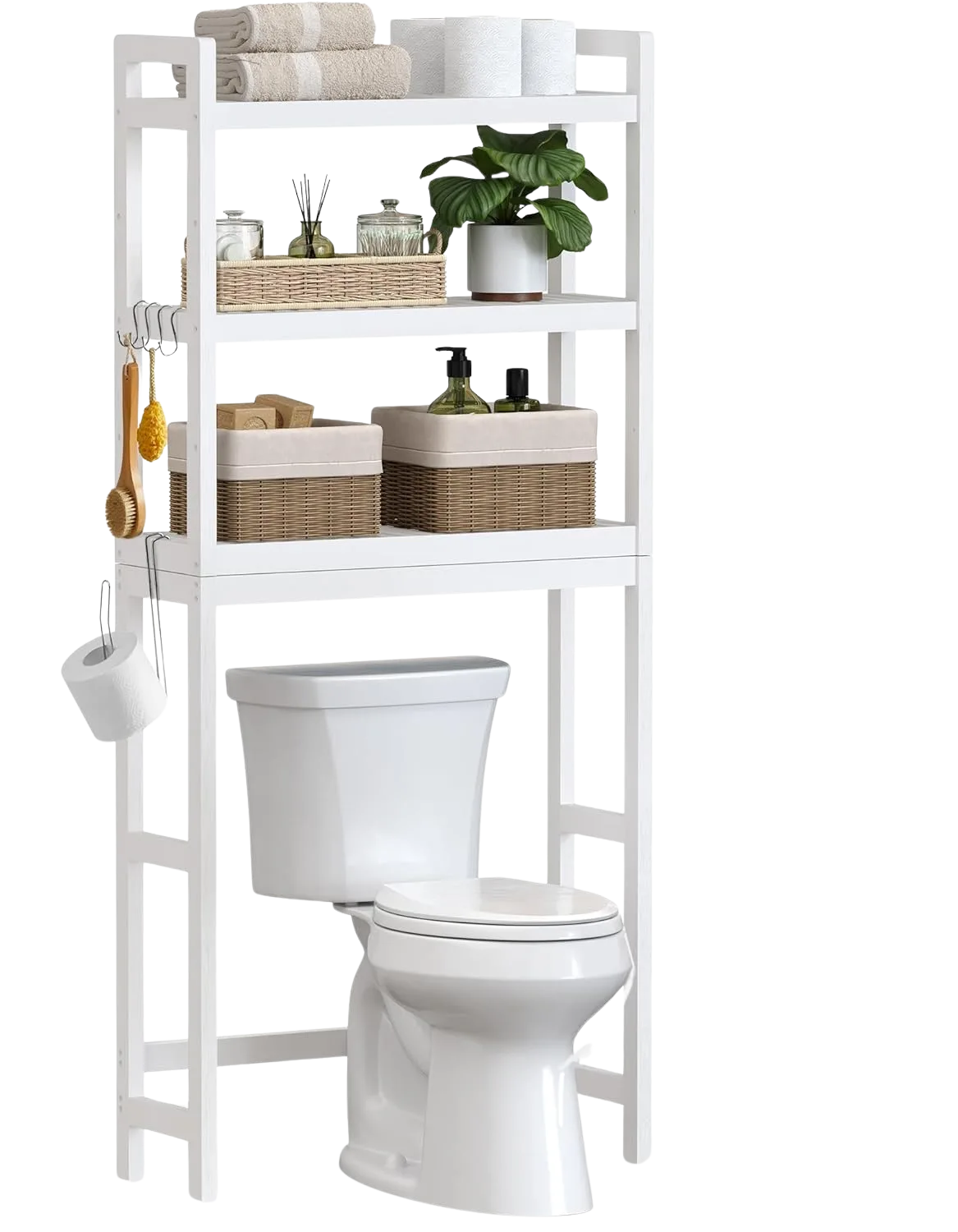
Not all freestanding units are equal. The ones that last have adjustable middle shelves — you can raise or lower them to fit taller bottles on one level and shorter containers on another. Fixed-shelf units force you to work around their spacing, which means wasted vertical inches between a short toiletry bag and the shelf above it.
When a Cabinet Door Beats an Open Shelf
Open shelves show everything. If your bathroom runs humid — no exhaust fan, small window, long showers — that exposed storage collects moisture and dust faster than you’d expect. After a few months, the bottom shelf items near the toilet tank develop a light film you’ll want to wipe down weekly.
If that bothers you, or if you’d rather hide the clutter, the UTEX Over The Toilet Storage Shelf, 3-Tier is a cabinet version with doors. It measures roughly 25 inches wide by 8 inches deep by 65 inches tall, which clears most standard tanks. The trade-off: you lose the open-shelf convenience of grabbing things quickly, and the 8-inch depth means bulkier items won’t fit. But for keeping toiletries hidden and dust-free in a humid bathroom, the enclosed version wins.
If you want more ideas for small rental bathrooms beyond just the toilet wall, the 11 small bathroom storage ideas guide covers every zone in the room.
Wall-Mounted Shelves Above the Toilet (The Stud Problem)
Finding the Stud (or Skipping It)
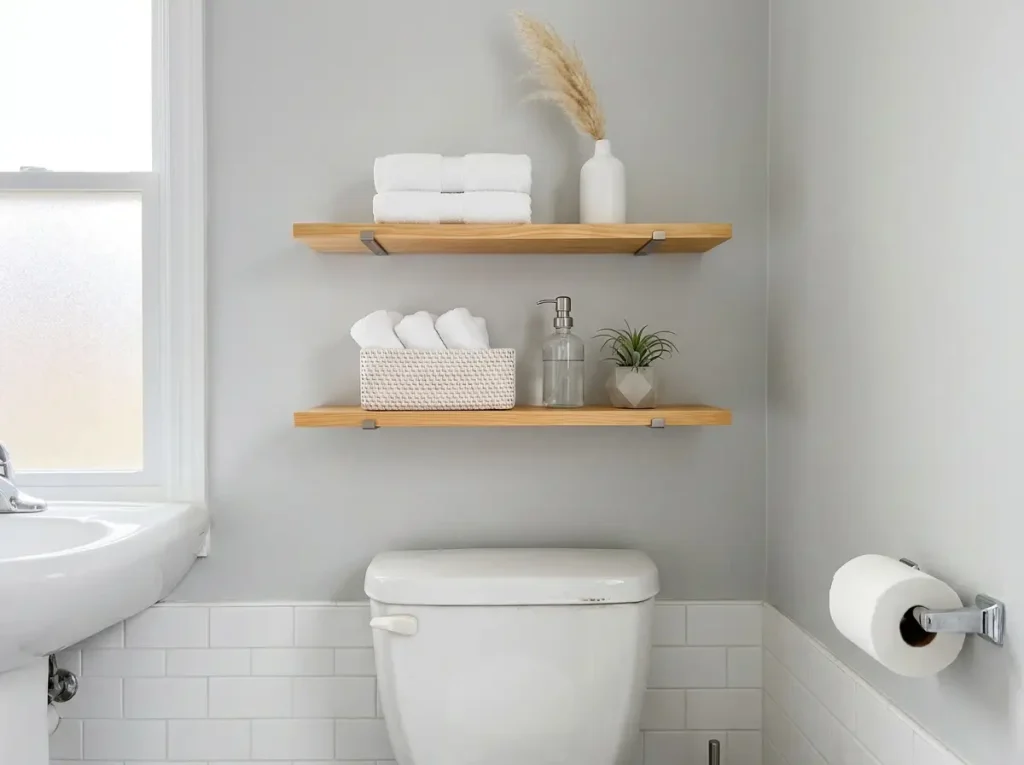
Wall-mounted shelves above the toilet look cleaner than freestanding units and take up zero floor space. The problem: the stud is almost never where you want the shelf to be. In most US homes, studs are 16 inches on center, so you get a stud at one edge of the toilet wall — maybe. The center of the wall above your toilet is probably hollow drywall.
You have two choices. Mount into the stud using a stud finder (which means your shelf might sit off-center), or use drywall anchors rated for the weight you’re hanging. For light toiletries and rolled towels, drywall anchors work fine. For anything heavier, find that stud. The CPSC recommends matching fastener type to wall material for any wall-mounted storage — the same principle that applies to anchoring furniture applies here.
No-Drill Adhesive Shelves for Renters
If you rent, drilling is either not allowed or not worth the deposit risk. Adhesive-mount floating shelves exist specifically for this situation. The Floating Wall Shelf No-Drill 16.5″ (2-Pack) uses adhesive strips rated for bathroom humidity, and each shelf is 16.5 inches wide — enough for a small basket, a soap dispenser, and a few rolled towels. The weight limit is lower than screw-mounted shelves, so skip the heavy items and stick to toiletries.
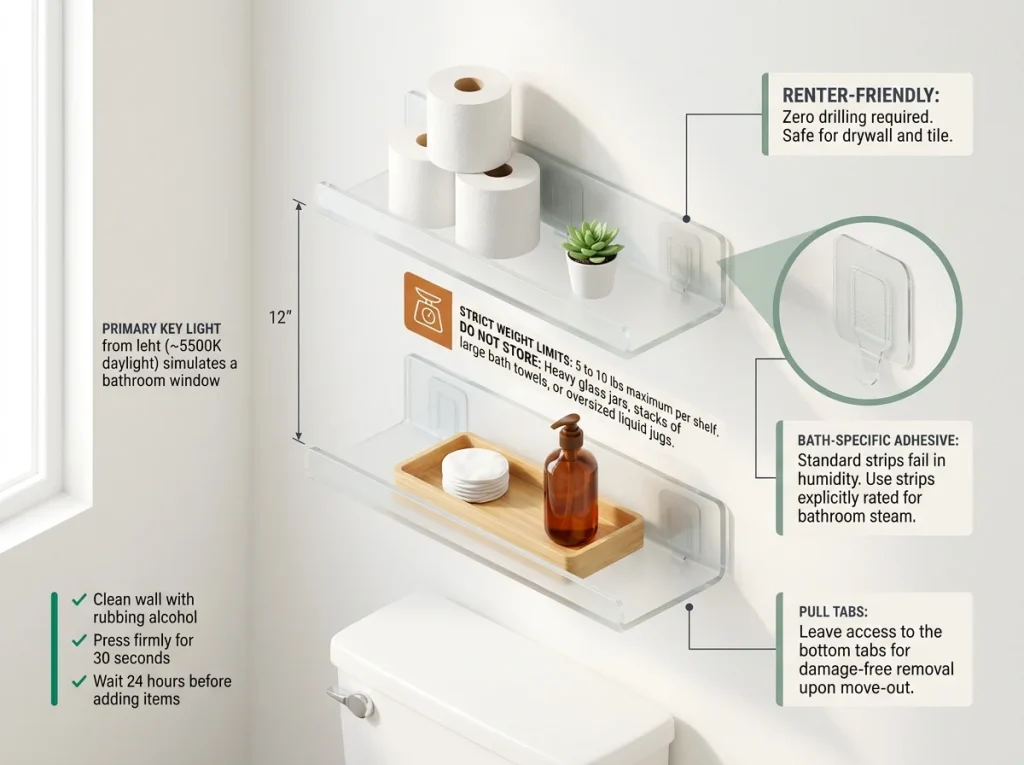
The adhesive holds if you follow one rule: clean the wall with rubbing alcohol before mounting and let the adhesive cure for a full 24 hours before loading anything on it. Skip this step and the shelf comes down in a week — usually at 2 AM, and usually onto the toilet tank lid.
Pro tip: Reinforce adhesive shelves with Command Bath Large Water-Resistant Adhesive Strips. Standard Command strips lose grip in humid environments, but the bath-specific version is rated for shower steam. Follow the per-strip weight limit exactly and add up the total — don’t eyeball it.
Weight Limits You Need to Know
Every wall shelf has a weight rating. Ignore it and you’ll find your shelf in the toilet bowl one morning. Adhesive shelves typically hold 5 to 10 pounds per shelf. That’s enough for toiletries and small items, but not for a full stack of heavy bath towels.
The same principle applies to no-drill organization in closets — adhesive and tension-based solutions work well when you respect the weight limits and fail spectacularly when you don’t.
Weigh what you plan to store before mounting. A roll of toilet paper weighs about half a pound. A bottle of lotion, roughly one pound. Three rolled hand towels, about two pounds total. Add it up, compare to the rated limit, and keep a 20% margin. The rating assumes ideal conditions — your bathroom doesn’t have ideal conditions.
Toilet Tank Caddies and Why Material Choice Matters in Your Specific Bathroom
Behind-the-Tank Shelf Units
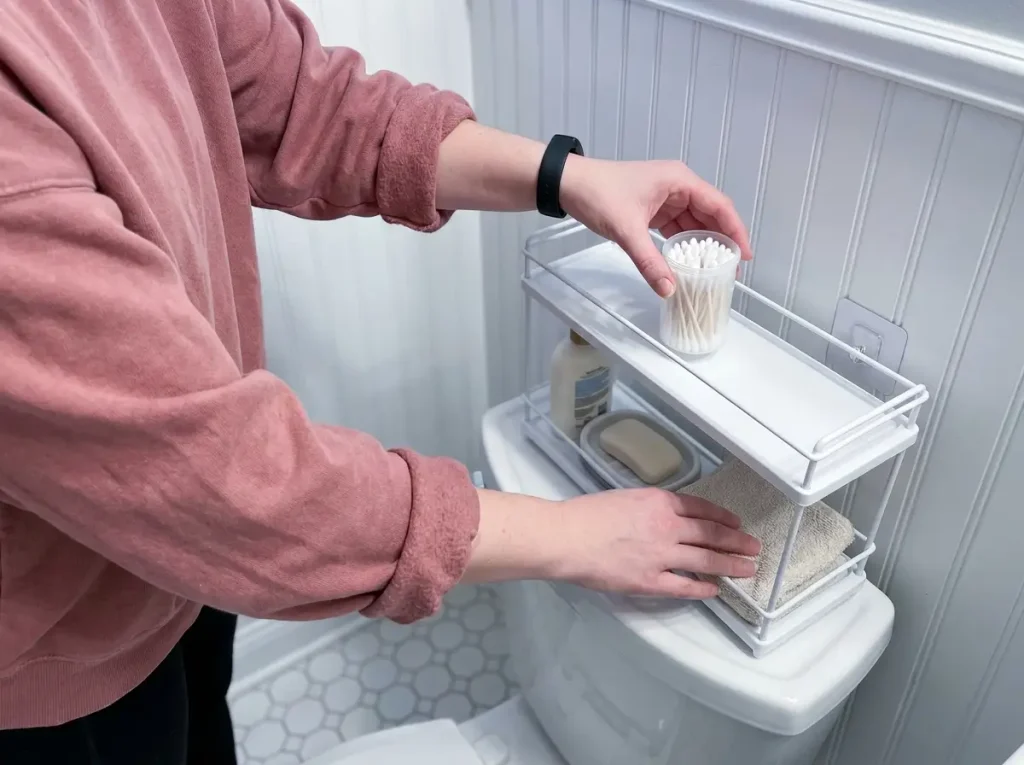
Tank-area organizers are the zero-floor-space option. They sit behind or above the toilet tank and hold a few essentials without requiring any floor footprint or wall mounting. This makes them the right fit for bathrooms too narrow for a freestanding unit — like half-baths with a pedestal sink where a freestanding shelf can’t straddle the plumbing.
The Godboat Bathroom Organizer is a wall-mounted shelf with two hooks that sits behind and above the tank. It’s a single-tier unit, so don’t expect the storage capacity of a full freestanding shelf. It holds a roll of TP, a small plant, and a bottle of hand soap without touching the floor. The trade-off: it requires wall mounting (adhesive or screws depending on your wall type), so it’s not purely installation-free. For a pedestal-sink bathroom where floor space is at a premium, the small footprint is worth the mounting step.
Why Material Matters More Than You Think
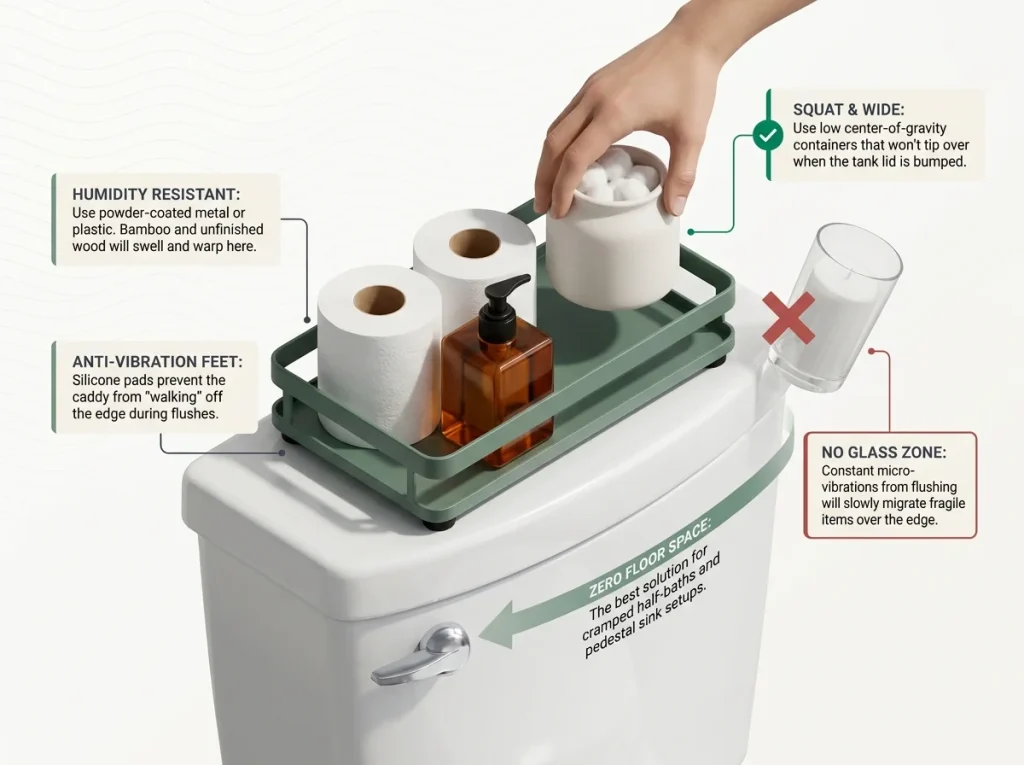
Bathrooms are humid environments, and the space directly above a toilet tank is one of the most humid spots in the room. Every time you flush, a fine mist rises. Every shower raises the ambient moisture. Material choice determines whether your organizer lasts a year or starts peeling in three months.
Metal with powder coating holds up best. Bamboo looks great for the first six months, then swells and cracks in bathrooms without an exhaust fan. Unfinished wood warps. Plastic doesn’t degrade but yellows over time if it gets direct sunlight through a bathroom window.
If your bathroom has good ventilation — an exhaust fan that actually vents outside, not just into the attic — bamboo and wood can work. If your bathroom has poor ventilation (no fan, small window, or a fan that vents into the attic space), stick with powder-coated metal or plastic. I’ve watched two bamboo organizers swell and split in the same bathroom over the course of a year before switching to metal.
Pro tip: Check where your exhaust fan vents. If you hold a tissue up to it while it’s running and the tissue doesn’t move, your fan either doesn’t work or vents into the attic — and your bathroom humidity is higher than you think. That changes which materials will survive above your toilet.
What to Store (and What Will Slide Off)
Tank-area organizers are flat surfaces with minimal lip or railing. Round items roll off. Tall narrow items like spray bottles tip over when someone bumps the tank lid shutting it. The organizers that work best on or near tanks hold: small baskets that corral loose items, squat wide containers (cotton ball jars, short soap dispensers), and toilet paper rolls standing upright.
Skip anything glass on a tank-level surface. The vibration from flushing is slight but constant, and glass items migrate toward the edge over weeks. If you’ve ever wondered how that candle ended up at the very edge of the tank — it walked there, flush by flush. The approach mirrors what works for under-sink cabinet organization: match the container shape to the surface, and assume everything will shift slightly over time.
Conclusion
Three things to take away from this:
- Measure the tank, the floor-to-ceiling height, and the wall gap before you order anything. Most returns happen because the unit physically doesn’t fit the toilet — not because the product is bad.
- Match the storage type to your bathroom. Freestanding for standard bathrooms with floor space, wall-mounted for renters who want a clean look, tank-area organizers for cramped half-baths and pedestal-sink setups.
- Respect the material. Humid bathrooms with poor ventilation need powder-coated metal or plastic. Bamboo and wood only survive with a working exhaust fan that vents outside.
Three-month check: After three months, check your shelf feet for sliding (add or replace rubber pads if they’ve shifted), press-test adhesive shelves for any loosening at the edges, and take a hard look at what you’re actually using versus what’s just sitting there collecting dust.
Start with the measurement step. Grab a tape measure, write down three numbers — tank width, floor-to-ceiling, wall gap — and then shop. The five minutes of measuring saves the two weeks of return shipping.
Q1 How much weight can an over-toilet shelf hold?
Most freestanding over-toilet shelves hold 10 to 15 pounds per shelf. Adhesive wall shelves hold 5 to 10 pounds each. Always check the manufacturer’s rated capacity and stay 20% below it — bathroom humidity weakens adhesive bonds over time, and tile floors let freestanding units slide under heavy loads.
Q2 Will an over-toilet shelf fit my toilet?
It depends on three measurements: tank width, tank depth, and floor-to-ceiling height. Standard tanks are 14 to 18 inches wide, but elongated bowls, compact toilets, and older models vary enough to make some shelf units incompatible. Measure first, then match to the product dimensions.
Q3 Can I use over-toilet storage in a rental?
Yes. Freestanding units need zero installation — they sit on the floor and lean against the wall. Adhesive wall shelves use removable strips that don’t damage walls when removed correctly. Both are fully renter-friendly with no drilling.
Q4 How do I stop an over-toilet shelf from wobbling?
Place rubber furniture pads under all four feet to prevent micro-sliding on tile or vinyl. Use the stabilizer bar (if your unit includes one) to lock against the toilet tank base. Load heavy items on the bottom shelf and light items up top to keep the center of gravity low.
Q5 What should I not store on an over-toilet shelf?
Avoid heavy bath towels on adhesive wall shelves — they exceed most weight limits. Skip glass containers on tank-level surfaces because flush vibration slowly migrates them toward the edge. And don’t store daily-use items you access at the sink — wrong location for the workflow.
Disclaimer: ClutterlessNest is a participant in the Amazon Services LLC Associates Program. As an Amazon Associate we earn from qualifying purchases. This article may contain affiliate links — if you buy through them, we may earn a small commission at no extra cost to you. We only recommend products we have tested or genuinely believe in.