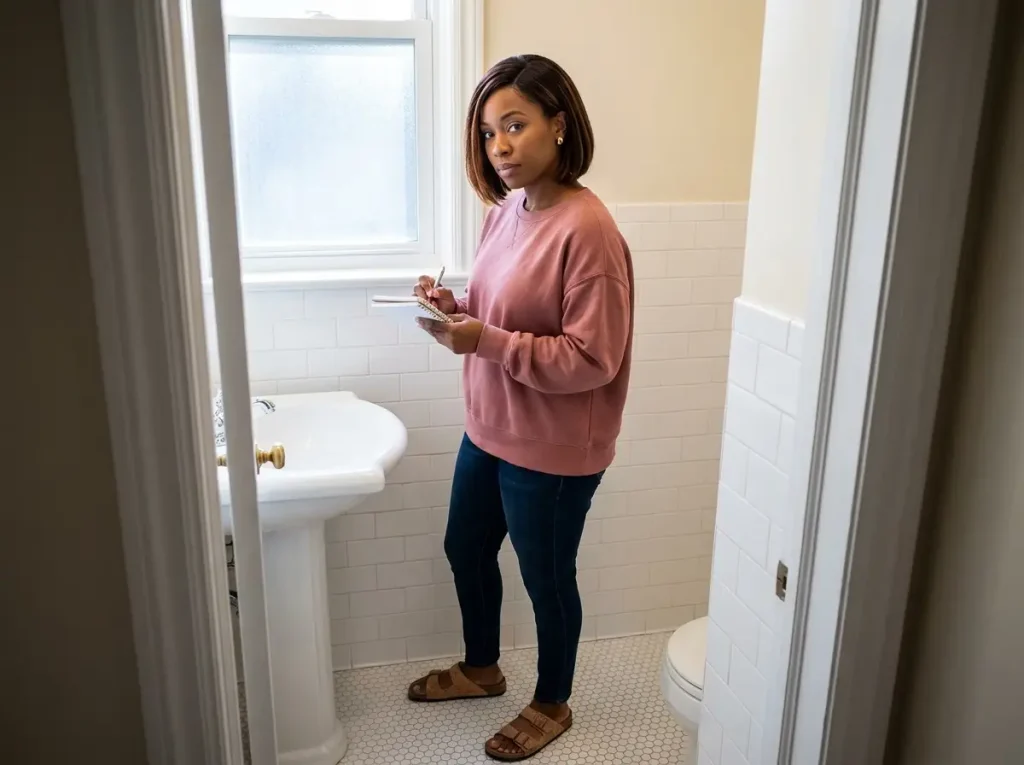
Your bathroom has a pedestal sink, no medicine cabinet, and possibly no counter space wider than a bar of soap. Every bottle you own is on the toilet tank lid, the tub rim holds three different shampoos and a razor that’s been there for months, and the floor next to the toilet has become a graveyard for backup toilet paper and whatever didn’t fit anywhere else. I’ve organized bathrooms like this — the ones where “storage” means whatever flat surface is closest — and the fix isn’t buying more stuff. It’s building a zone system that gives every item a fixed home, using spaces you’re probably not seeing yet.
Quick Answer: To organize a bathroom with no cabinets, build storage in six zones:
- Mount no-drill adhesive shelves on empty wall space
- Add a freestanding over-toilet shelf unit for tiered storage
- Slide a slim rolling cart into the toilet-to-wall gap
- Hang an over-the-door organizer on the bathroom door
- Wrap a pedestal sink organizer around the sink base
- Run a 10-minute monthly reset to prevent reversion
The Real Reason Your No-Cabinet Bathroom Keeps Getting Messy
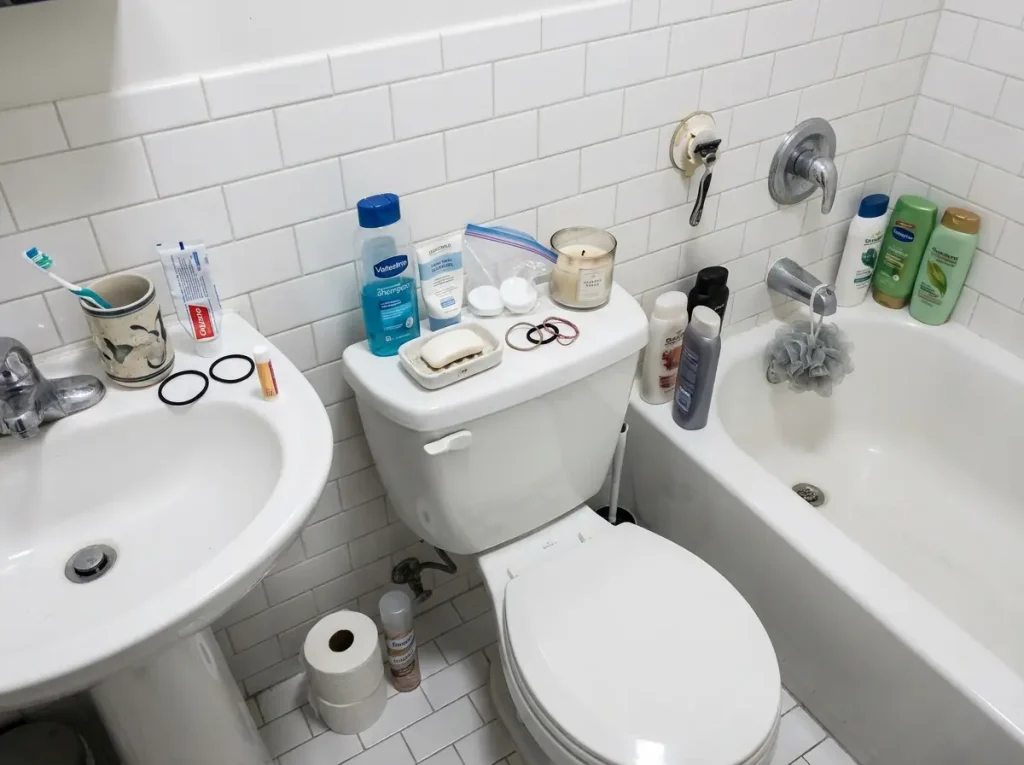
You’ve probably organized this bathroom before. Maybe twice. It looked good for about a week, then everything migrated back to where it started — the toilet tank, the tub rim, the floor. That’s not a discipline problem. It’s a system problem.
No Fixed Spots Means Everything Drifts
A bathroom with cabinets has invisible structure built in. Toothbrush goes in the medicine cabinet. Shampoo goes under the sink. Extra toilet paper goes in the vanity drawer. When none of those spots exist, every item has to compete for the same two or three flat surfaces. And flat surfaces with no rules become clutter magnets within days.
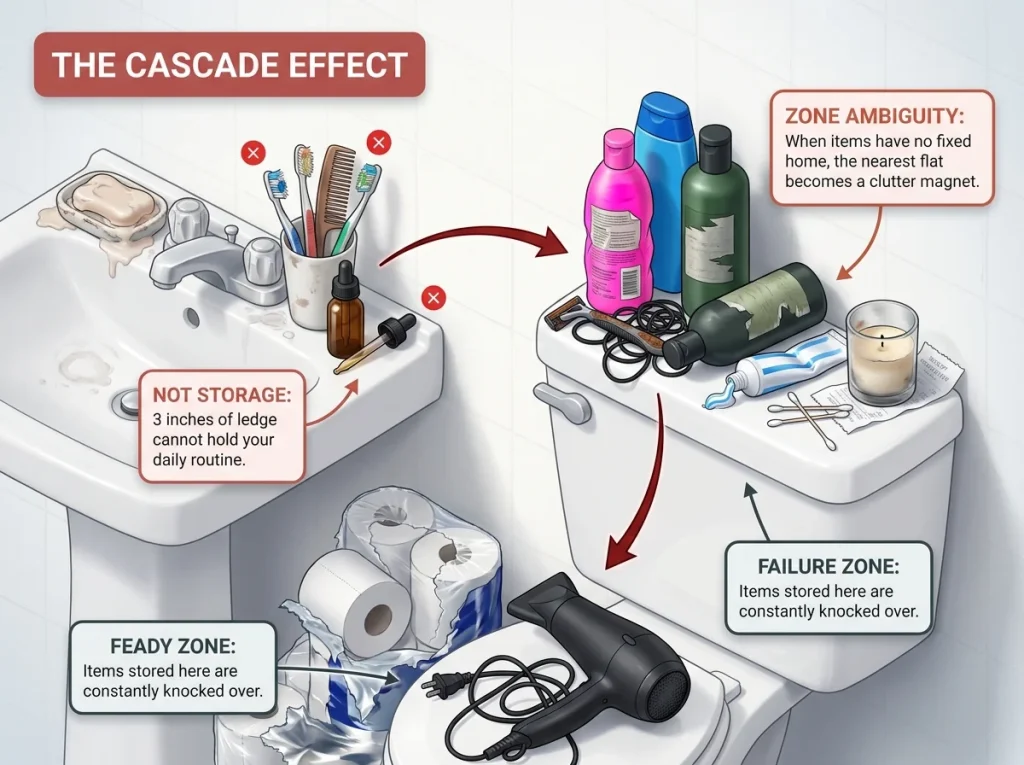
The real issue is zone ambiguity — when nothing has a designated spot, your brain defaults to “closest surface.” The toilet tank lid is the closest flat surface to most bathroom doors, so it becomes the landing pad for everything from hair ties to face wash.
The Cascade Effect
It starts with one bottle on the tub rim. That’s fine — it’s in use. Then a second bottle appears. Then the razor. Then a candle that someone moved from the windowsill.
Within two weeks, the tub rim holds eight items and you’re knocking a conditioner bottle into the tub every time you shower. This is the cascade: once a surface accepts one item, it accepts all of them. The same thing happens on the toilet tank, the counter (if you have one), and eventually the floor.
Map Your Zones Before Buying Anything
Before you open Amazon, grab a sticky note and list where each category of item will live. This is zone mapping, and it’s the single most important step. Skip it and you’ll buy organizers that don’t match the space — or worse, organizers that solve the wrong problem.
A no-cabinet bathroom has six potential storage zones: the walls, the space above the toilet, the gap beside the toilet, the back of the door, the pedestal sink area, and the shower. Each zone handles different items at different use frequencies. Once you assign categories to zones, the system holds because every item has a return address.
If you want the full picture of how the small bathroom storage system works zone by zone, start there — it covers the framework this article builds on.
Measure These Four Spots Before You Buy Anything
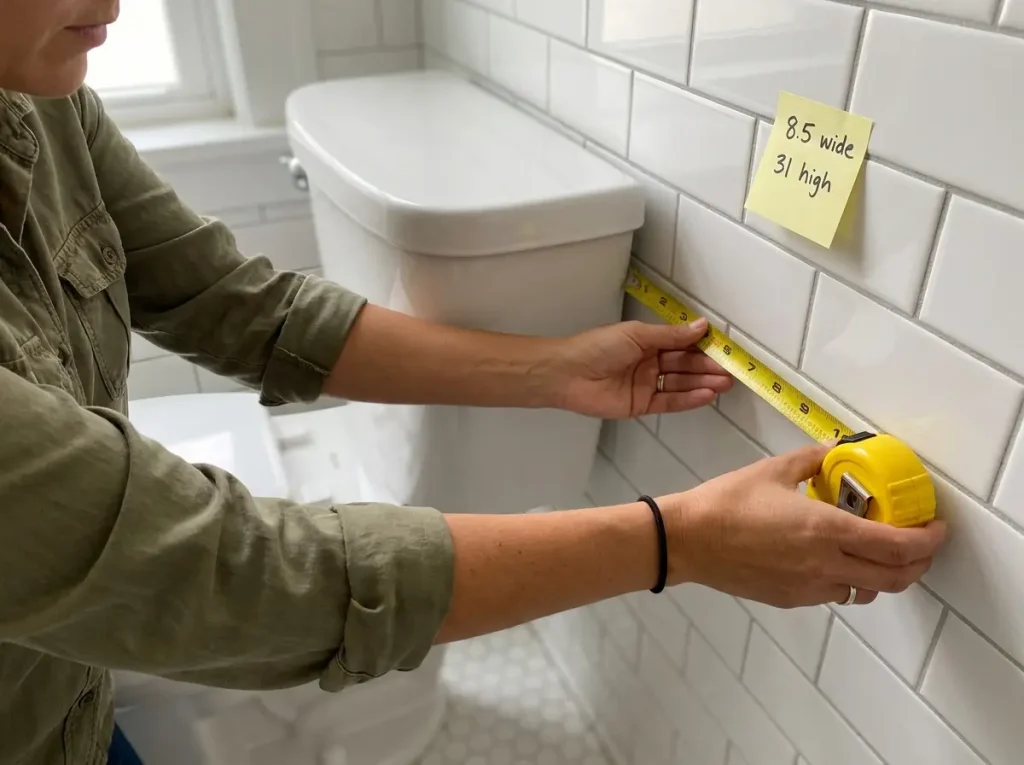
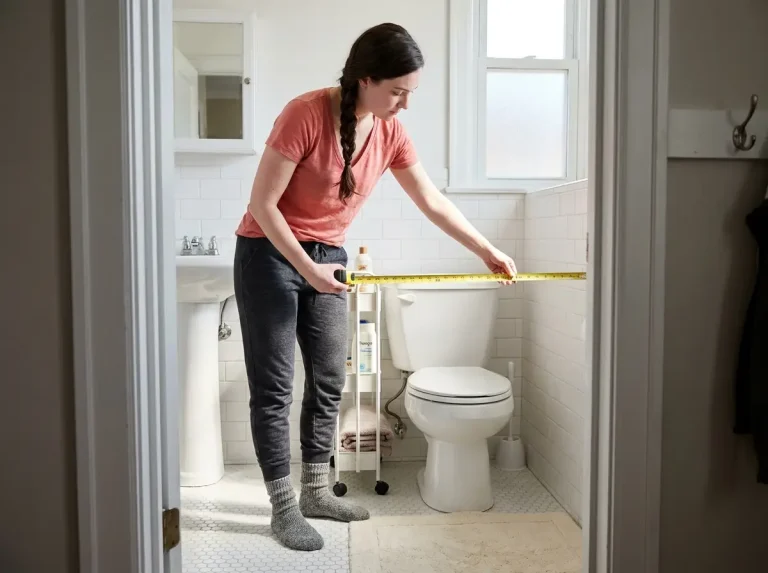
Every failed organizer purchase starts the same way: someone eyeballs a gap, guesses it’s “about eight inches,” and buys a cart that’s nine inches wide. It arrives, doesn’t fit, and sits in the hallway for three months before being donated. Measure first.
The Toilet Gap
The gap between the side of your toilet and the nearest wall or sink is the single most useful wasted space in a no-cabinet bathroom. Grab a tape measure and record the width. Standard toilet gaps range from 6 to 12 inches. Slim rolling carts are typically 5 to 7 inches wide — if your gap is under 6 inches, a cart won’t fit, and you should go vertical instead with wall shelves or hooks.
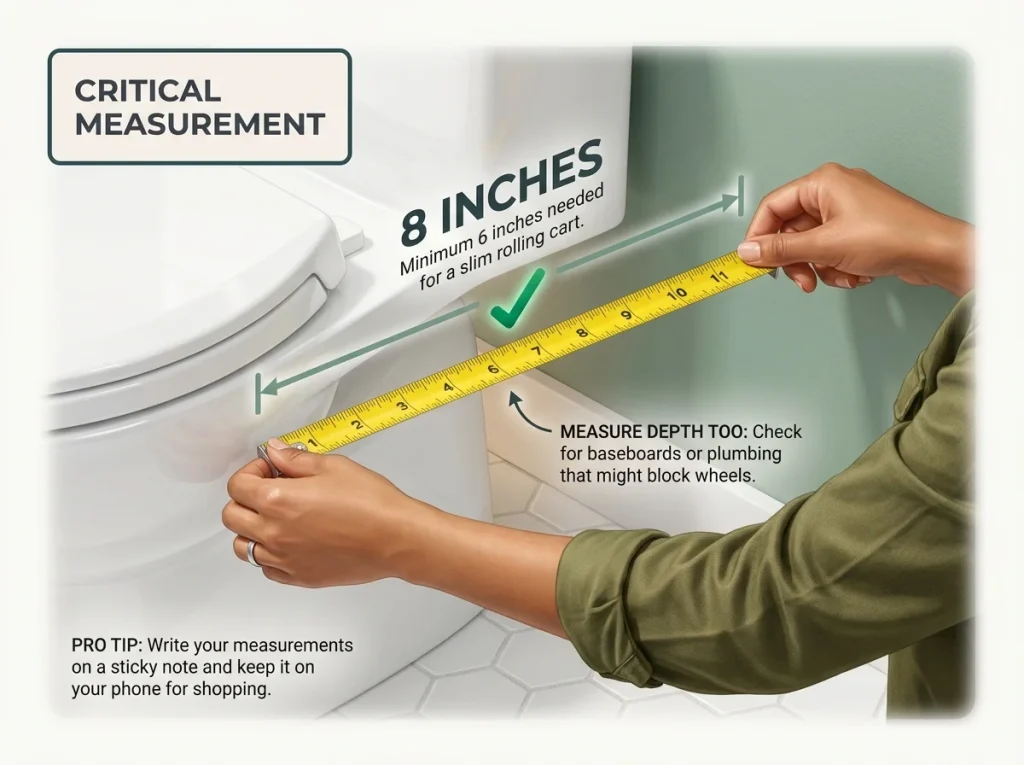
Also measure the height from the floor to any obstruction — towel bar, shelf, window sill. This determines whether a 3-tier or 4-tier cart fits the space.
Pro tip: Write your measurements on a sticky note and tape it inside the bathroom door. You’ll reference them every time you shop for organizers, and it saves you from measuring the same spots twice.
Door Clearance and Wall Width
Measure your bathroom door’s thickness — standard interior doors are 1.375 inches thick. Over-the-door organizers hook over the top edge and need at least 1.25 inches of door thickness to grip securely. Also check the door-to-frame clearance when the door is closed. If the organizer’s hook plate is thicker than the gap, the door won’t latch.
For wall space above the toilet, measure the width between the toilet tank sides and any adjacent walls or fixtures. Over-toilet shelf units need roughly 23 to 26 inches of width clearance. The height from the tank lid to the ceiling tells you whether a two-tier or three-tier unit fits without feeling cramped.
Counter and Tub Rim Reality
If you have any counter space at all — even the narrow ledge around a pedestal sink — note the usable width and depth. Most pedestal sink ledges are 2 to 4 inches at best. That’s enough for a toothbrush cup and nothing else.
The tub rim is typically 3 to 4 inches wide. It can hold items temporarily, but anything stored there permanently gets knocked into the tub every shower. The tub rim is not storage — it’s a failure zone. Your goal is to move everything off the tub rim and into proper zones.
Build Storage on Empty Walls
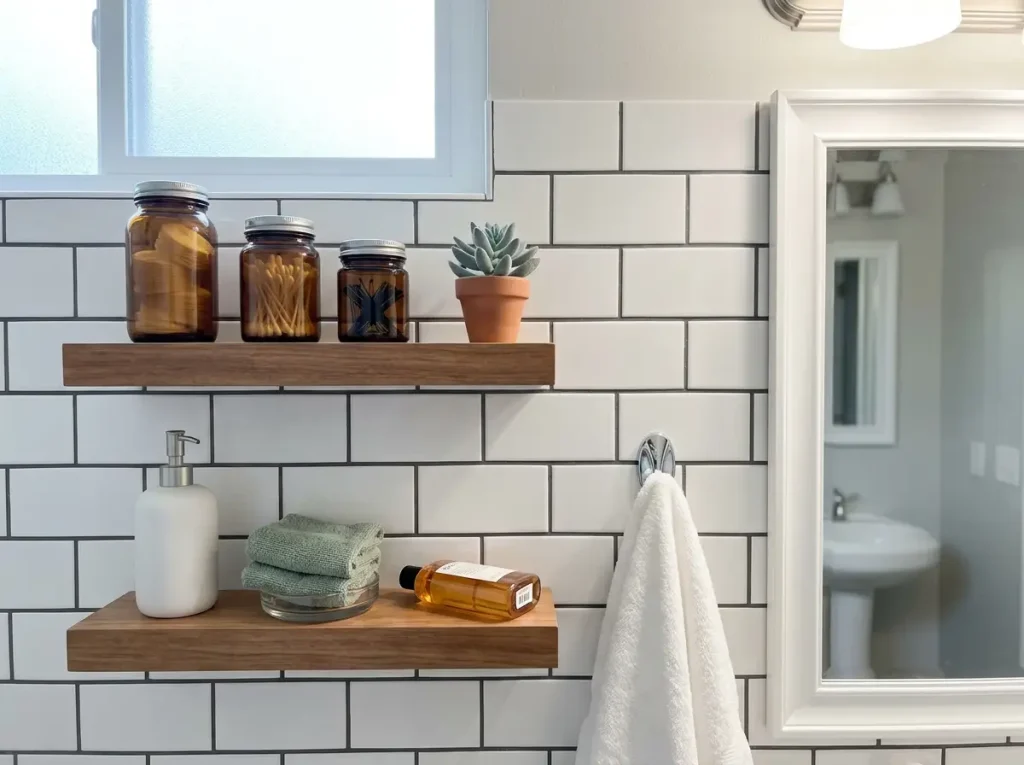
The walls in a no-cabinet bathroom are your biggest asset. Most people look at blank tile and see nothing. Look again — every 16-by-16-inch section of empty wall is a potential shelf, hook, or caddy location.
No-Drill Adhesive Shelves
Command Bath Large adhesive strips are rated for 5 pounds per pair in humid environments. For a shelf that will hold products weighing up to 10 pounds total, use two pairs of strips. The key detail most people miss: the surface must be completely dry and clean. One drop of water behind the strip and it releases within a week.
The Floating Wall Shelf No-Drill 16.5″ mounts with adhesive and gives you 4 inches of depth — enough for most toiletry bottles and jars. Two shelves stacked vertically add 33 inches of organized surface to a blank wall. The limitation: adhesive shelves hold less weight than drilled-in alternatives, so keep heavier bottles on the lower shelf and lighter items up top.
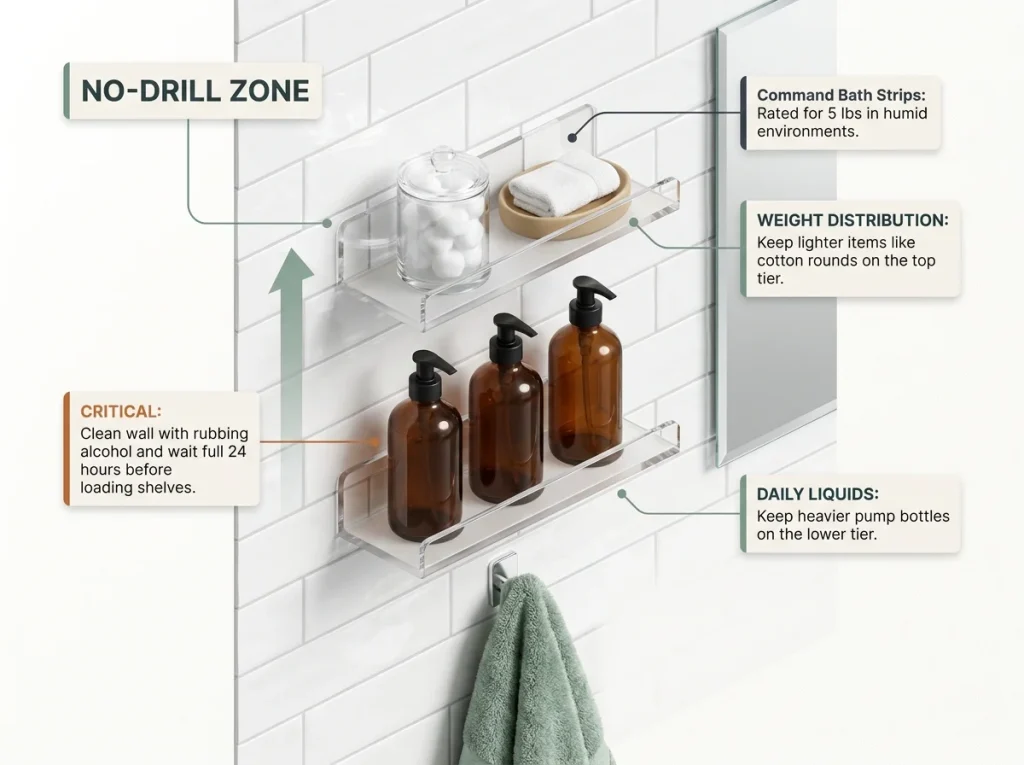
For renters, adhesive floating shelves are one of the best trades you can make — decent storage capacity for zero wall damage. Pull the strips straight down at a slow angle when removing and they leave nothing behind.
The Medicine Cabinet Option
If you own the home, a surface-mounted medicine cabinet is the single highest-ROI storage upgrade for a no-cabinet bathroom. It adds 30 to 60 cubic inches of closed storage — toothbrush, medications, face wash, contact lens case — all behind a mirror that doubles as decor.
If you’re renting, this isn’t on the table. Try a small magnetic strip mounted with adhesive behind your mirror or on the wall. It holds bobby pins, nail clippers, tweezers — the small metal items that otherwise disappear into the toilet-tank-lid pile.
Hooks and the Shower Wall
Command medium hooks hold 3 pounds each. Mount them on the back of the door, beside the mirror, or above the toilet for hand towels, robes, and loofahs. Two hooks behind the bathroom door hold a towel and a robe — items that would otherwise live on the floor or draped over the shower rod.
For the shower itself, a tension pole caddy gets every bottle off the tub rim. The simplehuman Tension Pole Shower Caddy adjusts from 6 to 9 feet, fits between the tub floor and ceiling, and holds four shelves of shower products — no drilling, no suction cups that pop off, no wall anchoring. Stainless steel handles the humidity without rusting. The limitation: you need a tub or shower enclosure with a flat floor to anchor the base, and the ceiling must be a hard surface — if there’s just a curtain rod with open space above, the pole has nothing to press against.
Pro tip: After installing adhesive hooks or shelves, wait a full 24 hours before hanging anything. The adhesive needs complete cure time to reach its rated weight capacity. Most “Command strip failures” are actually impatience — people hang a wet towel 10 minutes after pressing the strip to the wall.
For more small bathroom storage ideas that go beyond the no-cabinet scenario, that guide covers all seven zones with product picks for each.
The Toilet Zone, Door, and Cart Trio
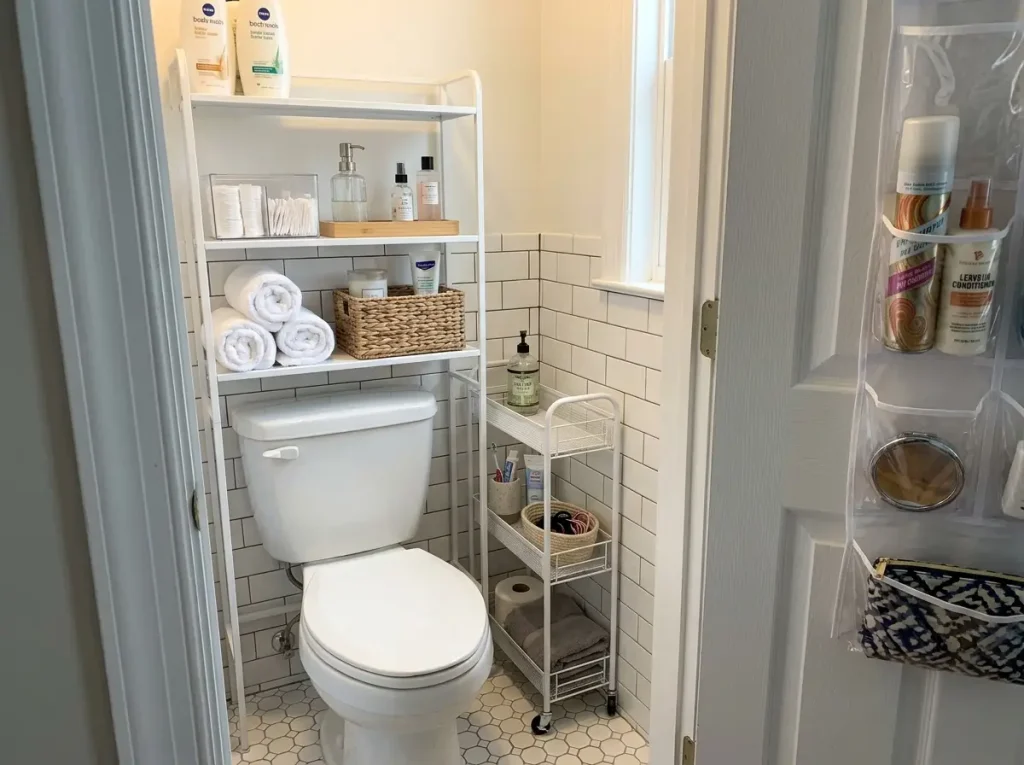
These three zones — above the toilet, behind the door, and the gap beside the toilet — solve roughly 60 percent of the storage problem in a no-cabinet bathroom. Get all three right and you’ve handled towels, daily toiletries, backup supplies, and most of the items currently living on the toilet tank.
The Over-Toilet Shelf Unit
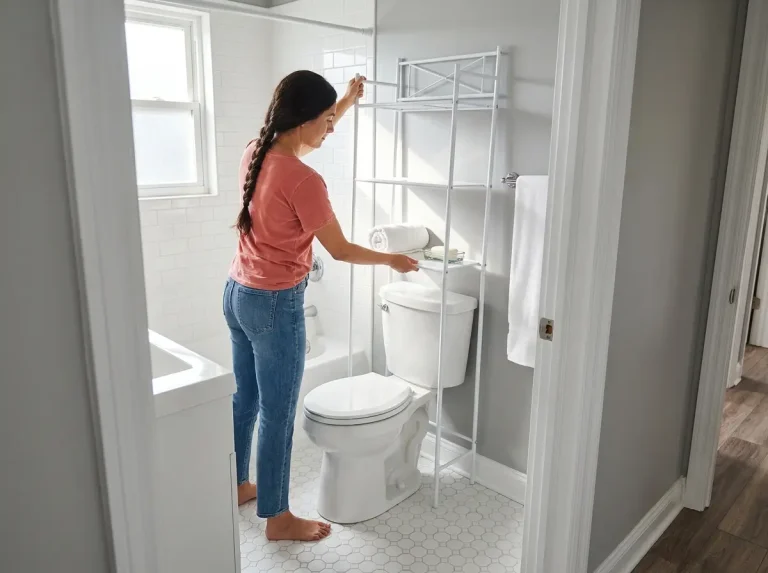
A freestanding over-toilet shelf straddles the toilet and creates three tiers of storage from thin air. The UTEX 3-Tier Over-Toilet Storage Shelf measures roughly 25 inches wide by 8 inches deep by 65 inches tall, fits standard toilet footprints, and requires no wall anchoring.
Organize the tiers by frequency: bottom tier holds what you grab daily (hand towels, a small bin with face products), middle tier holds what you use weekly (extra soap, cotton rounds, a candle), and top tier holds backstock (backup shampoo, extra toilet paper). This frequency zoning means the things you reach for most are at arm level, and the things you touch once a month are overhead.
The wobble problem is real — tile floors and uneven grout lines make freestanding shelf legs unstable. Fix it with self-adhesive rubber feet on the bottom of each leg. Takes two minutes and the wobble disappears. If you have young children, the CPSC recommends anchoring freestanding shelves to prevent tip-overs — their site covers no-tool options that work in rentals.
If you want the full breakdown on which units hold up and which wobble their way to the donation pile, we tested 6 over-toilet shelves and one stood out.
The Slim Rolling Cart for the Toilet Gap
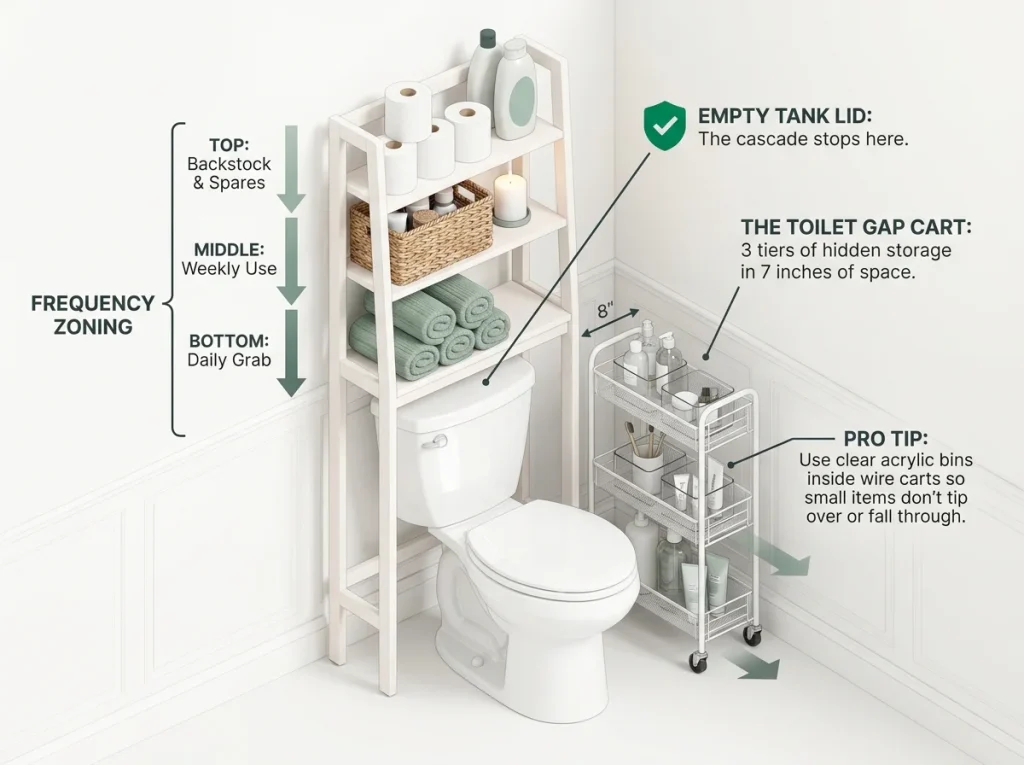
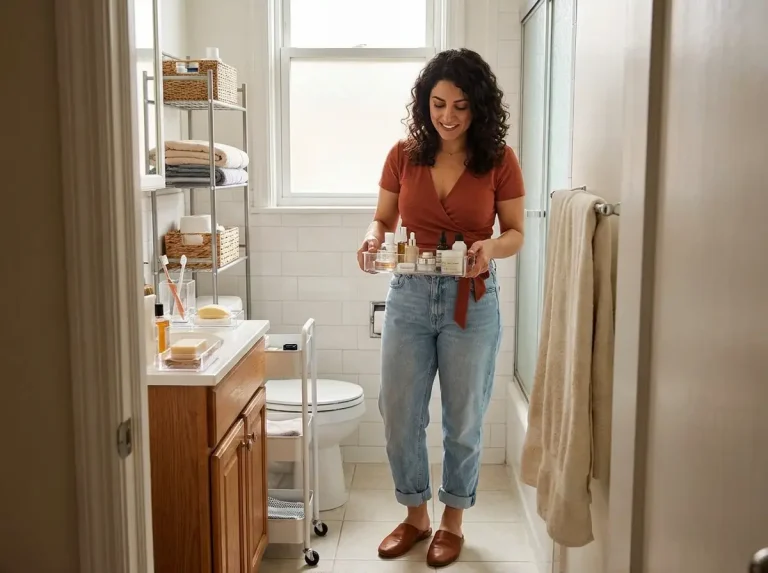
Load the cart by frequency too: bottom tier for a folded hand towel and a small basket with hair ties, middle tier for daily face wash and toothpaste, top tier for hand soap or whatever you moved off the counter. The cart rolls out for cleaning and rolls back in — no permanent installation, no damage, nothing to uninstall.
The one limitation: wire mesh tiers don’t hold tiny items well. A small bin or tray inside each tier corrals loose cotton swabs and hair clips. Without the bins, small things fall through or roll to the back where you forget about them.
The Back-of-Door Organizer
The bathroom door is vertical real estate most people ignore entirely. The SimpleHouseware Over-The-Door Organizer (5-tier) hangs over the door’s top edge — no screws, no holes — and adds five tiers of wire shelves for toiletries.
Critical fit detail: this organizer fits doors that are 1.25 to 1.75 inches thick. Before ordering, measure your door thickness and the clearance between the top of the door and the frame when closed. The hook plate adds about half an inch, and if your door barely clears the frame already, the organizer will prevent it from latching.
Use the tiers for overflow and weekly items: dry shampoo, hair products, extra deodorant, a small bag with travel toiletries, a compact mirror. The wire construction means you can see everything at a glance — nothing gets forgotten behind a fabric pocket.
Don’t Forget the Shower Wall
If you haven’t addressed the tub rim yet, the tension pole caddy from the walls section handles it. Every bottle currently sitting on the tub rim moves to the caddy shelves. The rim goes back to being what it is — a ledge for your hand while you step in, not a storage shelf.
For shower-only bathrooms (no tub), adhesive corner caddies hold individual bottles. Expect to re-press them every 3 to 6 months as humidity loosens the adhesive over time. That’s normal — it’s not a product failure, it’s bathroom physics.
The Pedestal Sink Fix
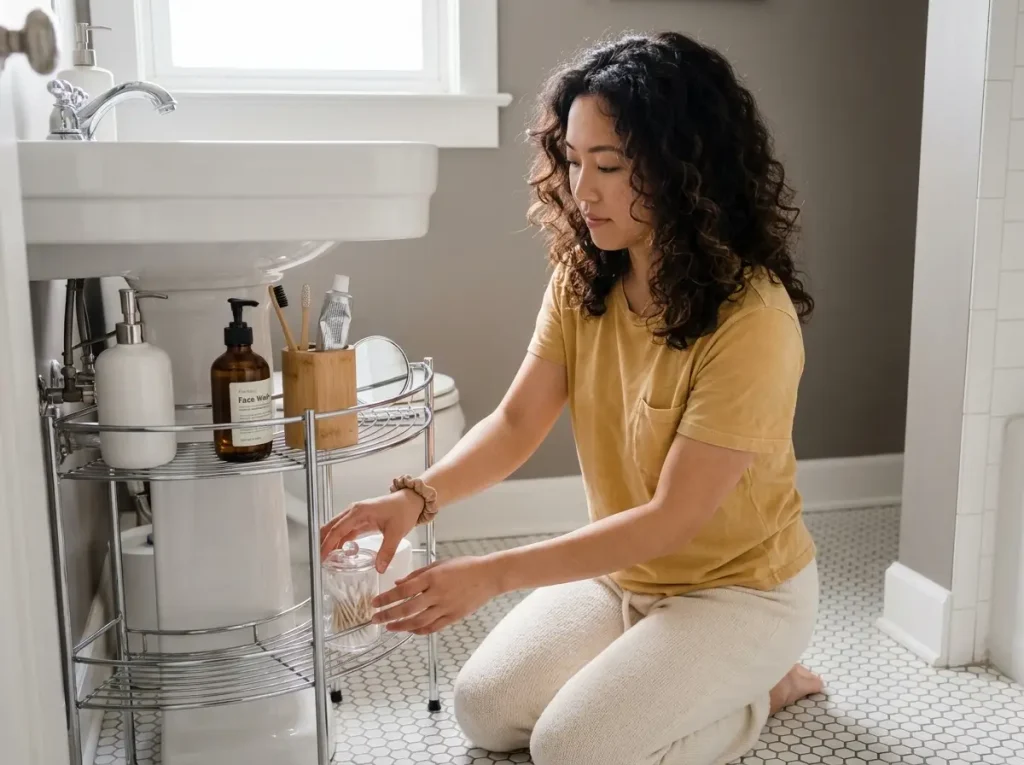
This is the section most organizing guides skip entirely. A pedestal sink — the freestanding kind with a decorative ceramic column — gives you zero under-sink storage, 2 to 4 inches of counter ledge, and a floor-level space that most organizers can’t reach because the column is in the way.
What a Wrap-Around Organizer Does
A pedestal sink wrap-around organizer is a two-tier storage unit with semi-circular cutouts designed to fit around the pedestal column. It slides around the ceramic base, adds two full shelves below the sink bowl, and rolls on casters so you can pull it away for cleaning.
The Lavish Home Pedestal Sink Organizer has chrome shelves that curve around a standard pedestal base and smooth-rolling casters on the bottom. It holds soap, face wash, cotton rounds, a toothbrush cup — the daily items that would otherwise crowd the sink ledge or end up on the toilet tank.
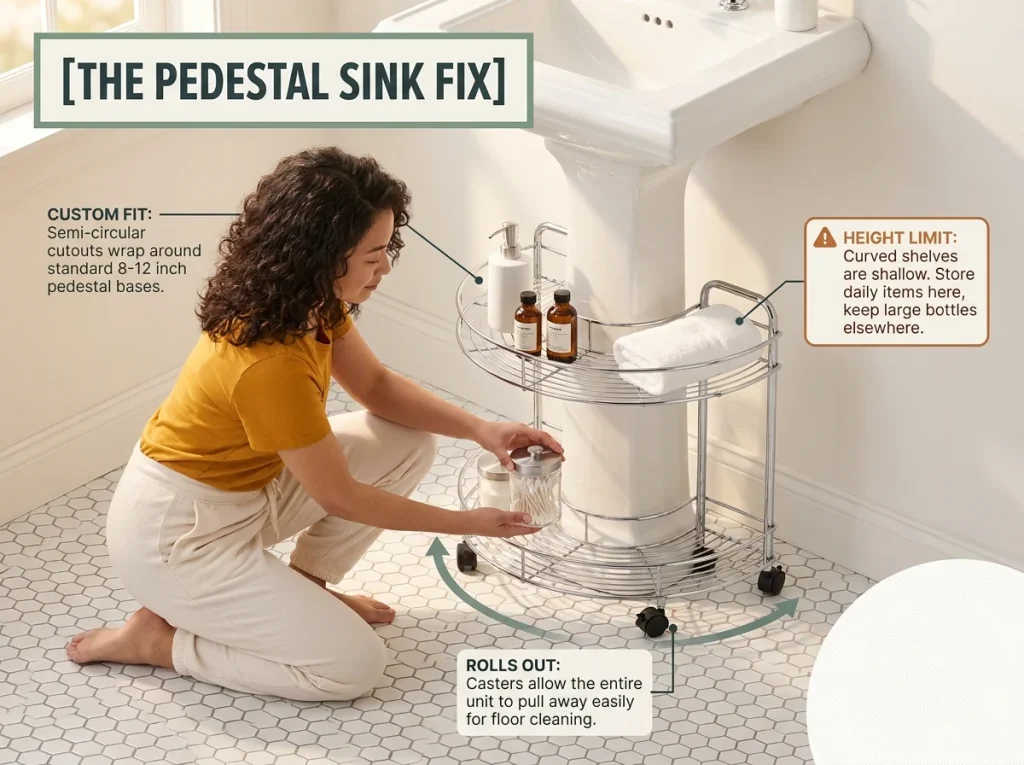
The limitation: the wrap-around’s shelves are shallow and curved. Full-size shampoo bottles won’t fit. Use this organizer for the small daily-use items and store bulkier products on the over-toilet shelf or in the rolling cart.
Dimensions Matter More Here Than Anywhere
Pedestal sink bases vary. Standard bases measure 8 to 12 inches across at the widest point. Measure yours before ordering a wrap-around organizer. If the column is wider than 12 inches — common in older or decorative sinks — the semi-circular cutout won’t clear it, and the unit will sit off-center or not fit at all.
Also measure the height from the floor to the underside of the sink bowl. You need at least 20 inches of clearance for most two-tier wrap-around organizers. If you have less, a single-tier organizer or a small basket on the floor is the better fit.
No Pedestal Sink? Use the Counter Tray System
If your bathroom has a wall-mounted sink with no pedestal base — common in older apartments — you have more open space under the sink but still no cabinet. A small freestanding shelf or set of stackable bins fits under the wall-mounted sink and reclaims that space without any installation.
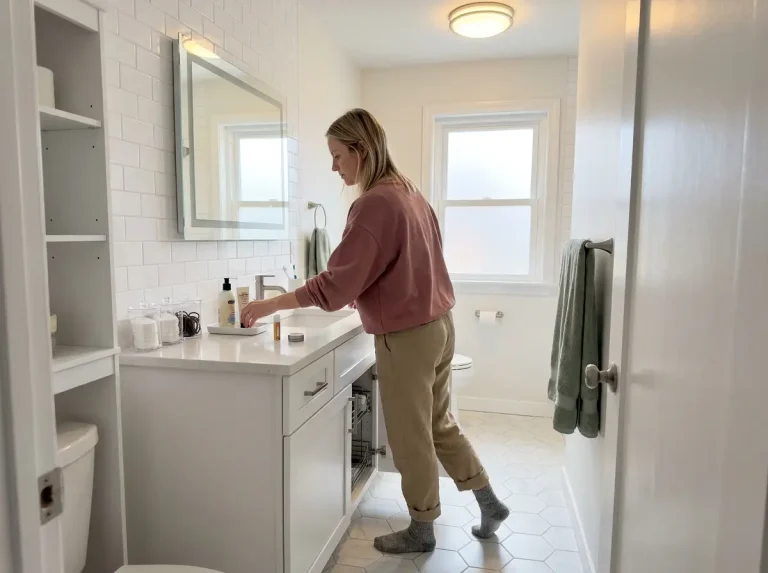
For bathrooms with a vanity-style countertop but no cabinets underneath (open space below), use the one-tray rule: one tray, roughly 12 by 8 inches, corrals daily items into a fixed spot on the counter. Anything that doesn’t fit in the tray doesn’t live on the counter. This works because it creates a boundary. Items stay inside the tray or they don’t stay on the counter at all.
For a full guide to picking the right organizers for your specific setup, our bathroom organizer roundup covers each zone with product picks and what to skip.
Pro tip: If your pedestal sink has a towel bar built into the column, use it. A small hanging basket clips onto the bar and holds a hand towel plus a few daily items — no floor space used, no counter space used, and you’d be surprised how many people forget this bar even exists.
Making It Last — The Monthly Reset
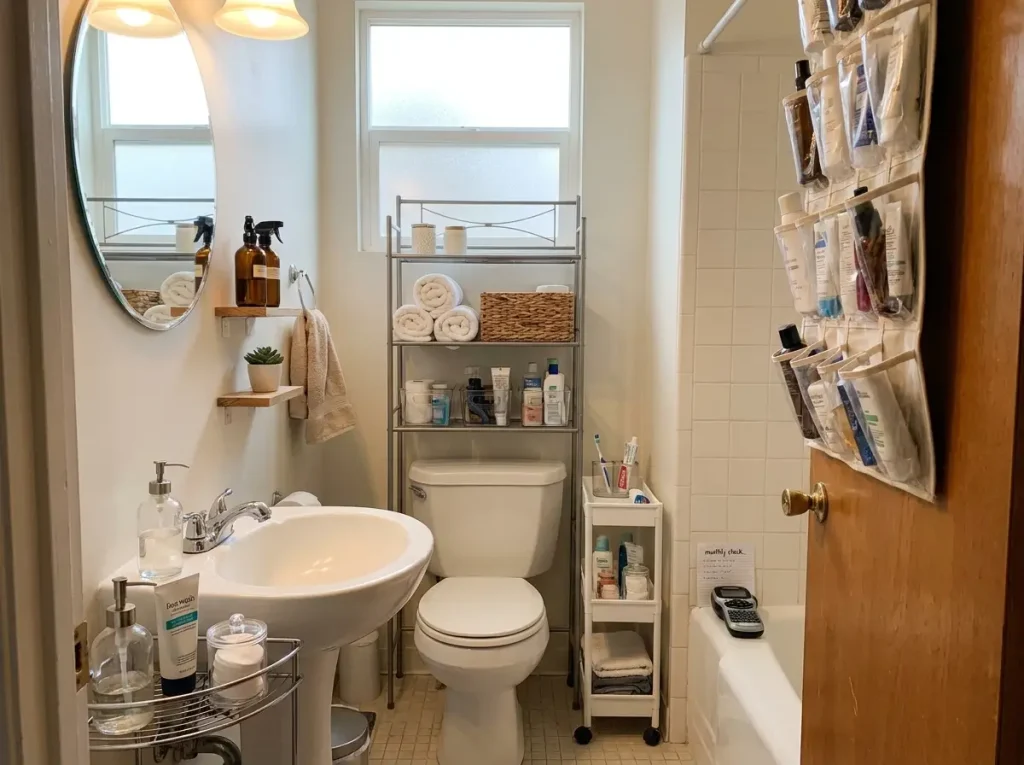
The system you just built will look great for about two weeks. After that, life starts testing it — someone leaves a product on the counter instead of in its zone, the tub rim picks up a stray bottle, the top tier of the over-toilet shelf accumulates items nobody remembers putting there. This is normal. The fix is a 10-minute monthly reset.
The 10-Minute Monthly Walk-Through
Once a month, walk through each zone and ask three questions:
- Is anything living somewhere it doesn’t belong? If a product migrated from the rolling cart to the toilet tank lid, put it back. Drift is normal — correction is the system.
- Is any zone at capacity? If the over-the-door organizer is overflowing, something in there hasn’t been used in a month. Remove it.
- Is anything expired, empty, or forgotten? Toss expired medications, empty product containers, and that sample-size lotion from a hotel three trips ago.
This takes 10 minutes, max. Most months it takes five. The point isn’t perfection — it’s catching the cascade before it starts.
The Three-Month Check
Every three months, do a deeper scan. Look at the toilet tank lid and tub rim specifically. If products are accumulating on either surface, a zone has run out of space and needs adjustment — maybe you added a new skincare routine and need another shelf tier, or maybe seasonal products (sunscreen in summer, extra lotion in winter) need to rotate into the top tier of the over-toilet shelf.
No-cabinet bathrooms have less buffer space than cabinet bathrooms. Overflow shows up faster. The three-month check catches it before the cascade fully restarts.
The single biggest thing that breaks no-cabinet systems: backstock. If you have four backup bottles of shampoo but only one spot for shampoo, three of those bottles will migrate. The rule: one backup per product, stored on the top tier of the over-toilet shelf. Everything else goes in a hall closet, bedroom shelf, or anywhere outside the bathroom.
For renters planning to move: Command strips peel off cleanly when pulled straight down at a slow angle. Remove adhesive hooks and shelves before your walkthrough inspection to avoid wall damage charges. Every freestanding piece in this system — the rolling cart, the over-toilet shelf, the wrap-around organizer — disassembles flat or rolls out the door as-is.
Conclusion
Three things make a no-cabinet bathroom system work:
- Zone mapping before buying — no system holds if items don’t have fixed spots assigned by use frequency
- Measuring before ordering — the toilet gap width, the door thickness, and the over-toilet clearance determine which products actually fit your space
- The monthly 10-minute reset — catch drift early before the cascade turns one bottle on the toilet tank back into eight
Three-month check: scan the toilet tank lid and tub rim. If products are sitting on either surface that shouldn’t be there, a zone has hit capacity and needs one adjustment — usually adding a small bin or moving backstock out of the bathroom entirely.
Start with one zone today. The toilet area — the over-toilet shelf plus the slim rolling cart — fixes more than half the problem in most no-cabinet bathrooms. Add the other zones as you go.
Q1 How do you store toiletries without a bathroom cabinet?
Use six no-drill zones: adhesive wall shelves, an over-toilet shelf unit, a slim rolling cart in the toilet gap, an over-the-door organizer, a pedestal sink wrap-around, and a tension pole shower caddy. Assign each product category to one zone by use frequency and everything stays put.
Q2 How do you organize a small bathroom with a pedestal sink?
A wrap-around pedestal sink organizer adds two shelves that curve around the ceramic column without blocking plumbing. Measure your pedestal base width first — standard bases are 8 to 12 inches across. Daily items go on the wrap-around; bulkier products go on the over-toilet shelf.
Q3 How do you add storage to a rental bathroom without drilling?
Every solution in this guide is renter-friendly. Adhesive shelves use Command Bath strips rated for 5 pounds in humid environments. The over-toilet shelf, rolling cart, over-door organizer, and pedestal sink wrap-around are all freestanding — zero wall modifications, zero deposit risk.
Q4 What’s the best way to organize a tiny bathroom?
Measure your available spaces first — the toilet gap, door clearance, wall space, and pedestal sink dimensions. Then build storage vertically: wall shelves go up, the over-toilet shelf adds three tiers, and the door’s back face holds five tiers of toiletries. Vertical storage beats floor storage in tiny bathrooms every time.
Disclaimer: ClutterlessNest is a participant in the Amazon Services LLC Associates Program. As an Amazon Associate we earn from qualifying purchases. This article may contain affiliate links — if you buy through them, we may earn a small commission at no extra cost to you. We only recommend products we have tested or genuinely believe in.