Open the door to your laundry closet and count what is actually in there. A pair of shoes on the dryer. A folded blanket nobody has used since March. A mop, a bucket, and one wire shelf holding all of it.
Somewhere underneath is the detergent.
Here is the reframe that changes what you buy: most small laundry room storage advice is photographed in rooms that are not small, in laundry spaces with windows and islands and four feet of walking room.
Every zone below has a no-drill storage version, because renter-friendly storage is the constraint this search actually has. This guide is built around the space most people actually have, a roughly 29-inch-wide closet with a stacked washer and dryer, using the manufacturer clearance numbers that decide what physically fits. Eight zones have to hold something in that closet, and every one of them has a version that works when you cannot drill a single hole.
Quick Answer
Six moves do almost all the work in a small laundry space:
- Go vertical above the appliances, where four feet of wall sits empty
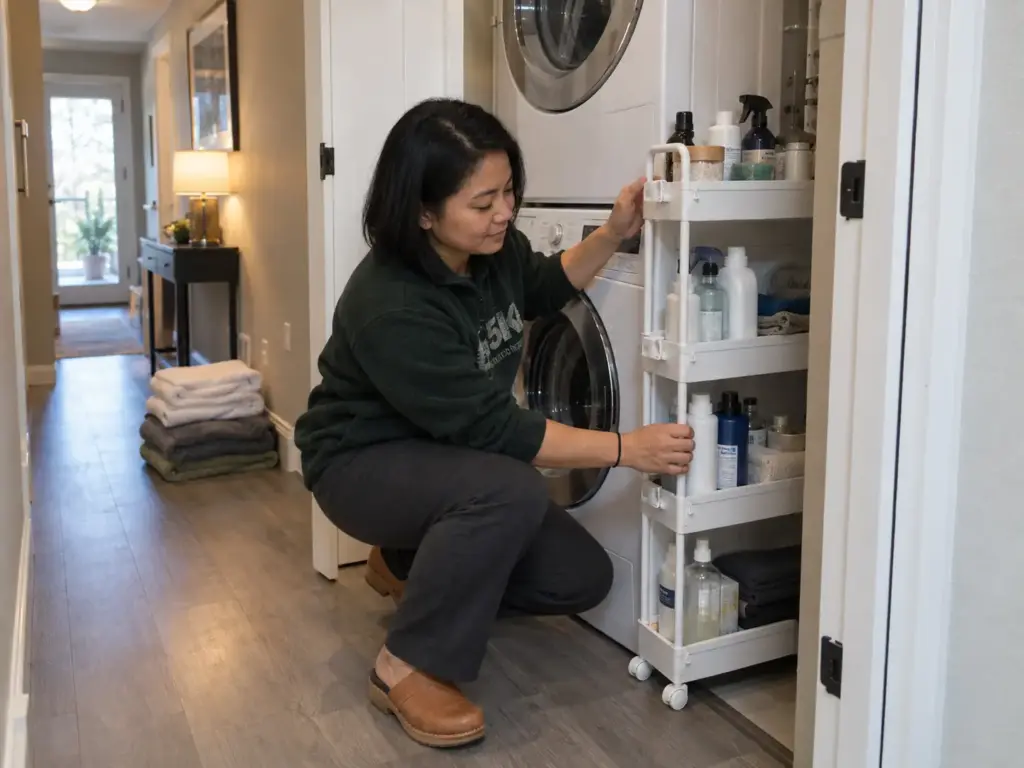
- Claim the gap beside the washer with something on wheels, around five inches wide
- Get drying off the floor and onto the wall, folded flat when unused
- Give the hamper a footprint under nine inches deep
- Containerize the small supplies so a shelf pulls out as one unit
- Remove everything that is not laundry, before buying a single bin
Why Small Laundry Rooms Turn Into Dumping Grounds
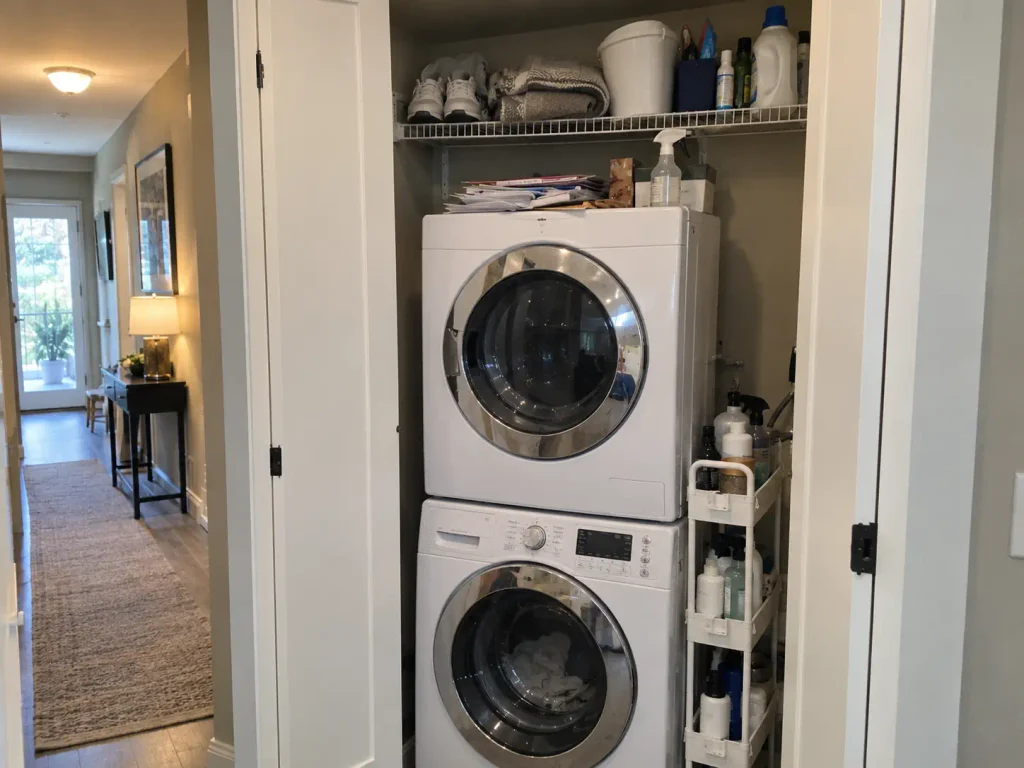
You have probably already bought storage for this room. A wire rack, maybe a set of bins. And two months later the rack is holding shoes and a bucket, which is exactly what it was holding before you organized anything.
That is not a discipline problem and it is not a capacity problem. It is an assignment problem, and no amount of shelving solves it.
The room that belongs to nobody
Every other room in a house has an owner. The kitchen belongs to cooking, the bedroom belongs to sleeping, and anything that shows up in either one gets challenged fast. A laundry space has no owner. It is a corridor with appliances in it, usually with a door that stays shut, which makes it the perfect destination for any object that has lost its address.
The mop belongs nowhere, so it goes here. The blanket is between seasons, so it goes here. Give it a year and the one shelf you have is full of things that have nothing to do with laundry.
The organizing community landed on this before the blogs did. A commenter in an r/organizing thread about exactly this problem put it flatly: small laundry areas require a commitment to keep only the essentials for that area, because they become dumping grounds otherwise. What makes that phrase worth naming is that professional-organizer content uses the identical language independently. When two separate worlds reach for the same words, the pattern is real.
The folding surface you are already losing
Here is the second failure, and it is the one that quietly breaks the entire laundry routine. In a closet-sized space, the top of the washer and dryer is the only flat surface in the room. It is not spare counter. It is the folding station, and it is the last step of the process.
Detergent bottles colonize it first, because setting the bottle down is easier than putting it away. Then a stain stick, then a stack of mismatched socks, then the dryer sheets. Once that surface is gone, folding has to happen somewhere else, which in practice means a bed.
And laundry that gets carried to a bed unfolded stays on that bed until night. The pile you resent has almost nothing to do with washing clothes. It is a storage failure three feet away.
Treat the top of the machines the way you would treat a stovetop: it is a work surface, not a shelf. If a bottle has to live somewhere and there is no shelf yet, put it on the floor beside the machine temporarily rather than on top. Floor clutter annoys you enough to get fixed. Counter clutter feels acceptable, which is why it never does.
Subtract before you store
There is a three-month pattern this room follows with almost boring reliability. A wire rack goes in. It works for two weeks. Then it becomes the shelf things get set down on, and by month three it is a taller version of the mess it replaced.
The rack was never the thing that failed. Nothing on it had an assigned spot, so the rack inherited the same job the floor had.
So the first move is subtraction, not a shopping list. Everything that is not detergent, a laundry tool, or a cleaning supply used in this specific room leaves before a single bin arrives. That includes the laundry basket that lives here because it has nowhere else to be. The shoes go to wherever shoes live.
The blanket goes to a linen closet or a bin under a bed. The ladder goes anywhere else.
Then you measure, and then you buy. Do it in the other order and you will spend money organizing objects that should not be in the room at all.
The Real Dimensions of a Small Laundry Space
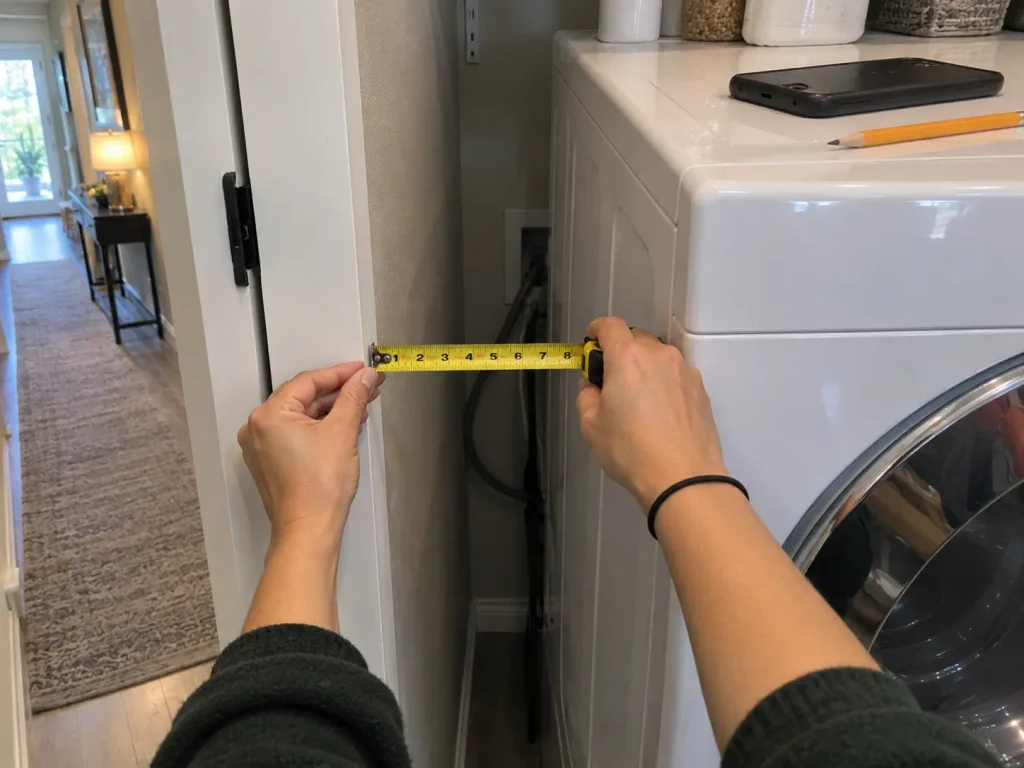
Not one article ranking for this keyword prints a single measurement. That is strange, because the entire problem is dimensional. You are standing in a closet with a tape measure trying to work out whether anything you have seen online will physically go in there, and every guide answers with a photo of a room twice the size of yours.
What “small” actually means in inches
A stacked front-load pair runs roughly 24 to 28 inches wide and about 78 inches tall, which means the planning footprint for the closet is about 29 inches wide by 80 inches tall (Whirlpool). That is the room this article is about. Full-size stacked units land in the 77 to 80 inch tall, 27 inch wide, 32 to 34 inch deep range (Maytag), which matters more than it sounds: any over-appliance shelf has to match that span, and a unit built for a side-by-side pair looks absurd hovering over a stacked one.
Side-by-side needs 56 inches or more of width. If your nook is narrower than that, the decision has already been made for you: stacked, compact, or an all-in-one washer dryer (Whirlpool). Worth saying plainly, because a lot of readers are planning storage around a layout their room cannot physically hold.
The clearances that decide what fits
Three numbers quietly sink most storage plans. Leave about 6 inches behind the appliances for hoses and venting, and roughly an inch on each side for a stacked install (Whirlpool). That side inch is why “just slide something into the gap” works brilliantly on one side of the room and not at all on the other, and it is the single most common reason a cart gets returned.
Depth is the constraint nobody plans for. A front-loader needs around four feet of clearance in front to load and unload, and a top-loader needs about two feet of lid swing above it (Whirlpool). A shelf that clears the top of the machine but sits in the arc of the open door is a shelf you will take down within a month, usually after cracking a knuckle on it. Measure the door arc, not the machine.
If any of this points you toward a freestanding shelving unit rather than a mounted one, anchor it. A tall unit with open shelves in a narrow closet is precisely the tip-over profile the CPSC’s Anchor It! campaign was built around.
According to the CPSC, “Anchoring all furniture with drawers, doors, and shelves to the wall prevents tip-over injuries and deaths.” Same standard as a bedroom dresser, same hardware, and a closet does not exempt you from it.
Once you have the numbers, it is worth knowing what to look for in shelving that holds up where you live before you spend anything.
The gap nobody measures
The most interesting moment in that whole r/organizing thread is not advice. It is a measurement. Someone suggests a slim rolling cart about five inches wide for the slot between the wall and the washer, and the original poster’s reaction is essentially disbelief that a cart that narrow exists at all.
That reaction is the whole section. Nobody measures the gap beside the washer, because nobody perceives it as space. It is where socks go to disappear. But it is frequently five or six inches of full-height, full-depth volume, which is more usable storage than most people get out of a shelf.
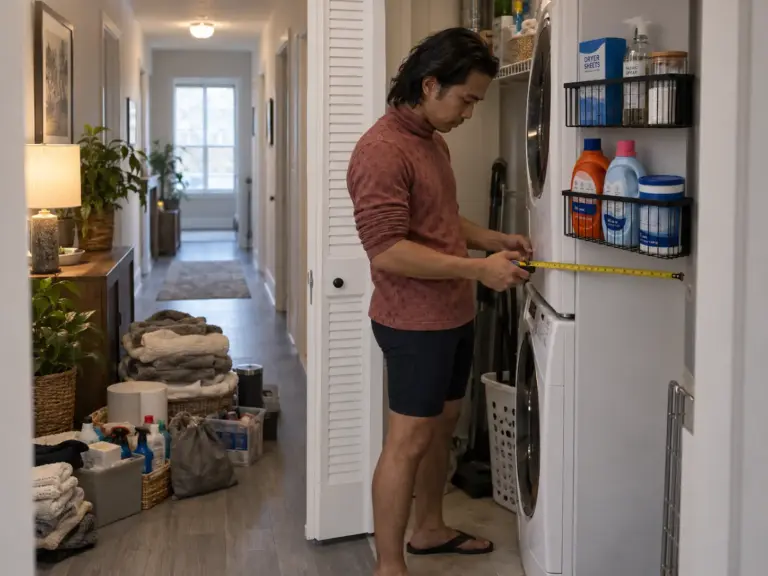
Write four numbers on a piece of tape and stick it inside the closet door: closet width, gap beside the washer, wall height above the machines, and door-swing depth. Every shopping decision in this room comes from those four. You will otherwise be standing in an aisle six weeks from now trying to remember whether it was five inches or seven.
Go Vertical Above the Appliances
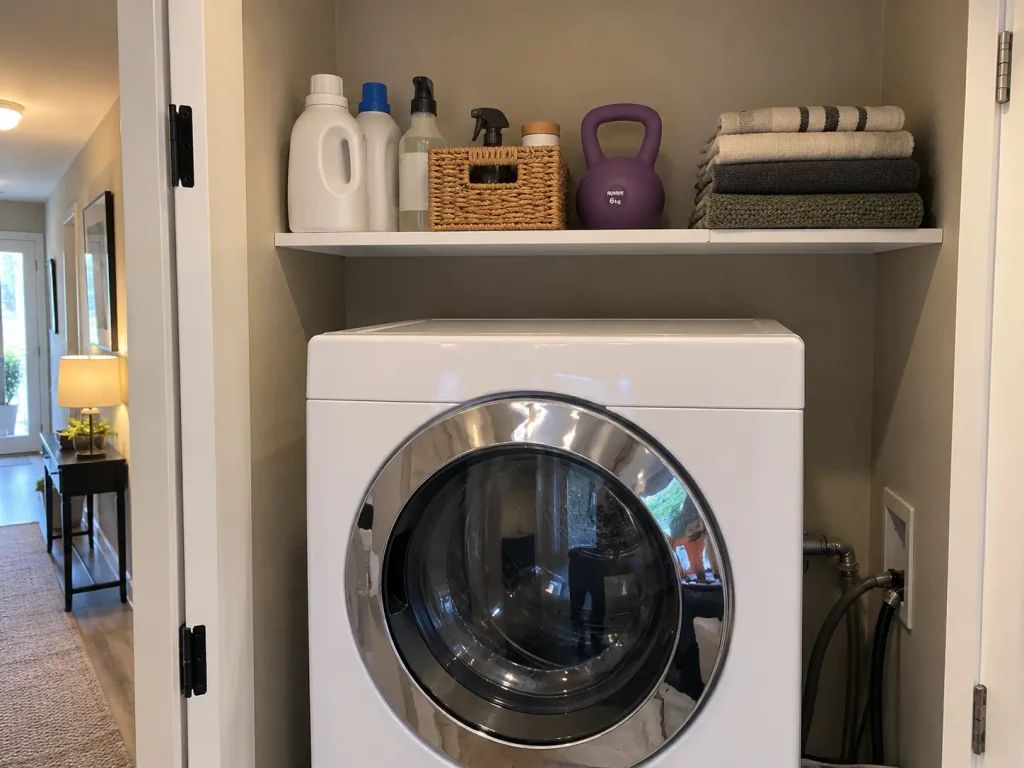
In a 29-inch closet there is exactly one direction left, and it is up. The wall above a stacked pair is usually four feet of nothing, and it is the only place in the room where adding storage costs you neither floor space nor door swing. It is also the place people get wrong most often, because they pick the shelf before they pick the depth.
Depth is set by the door, not by the wall
The rule that governs everything up here: shelf depth is limited by the door swing below it, not by how much wall you have. A front-loading door opens into the room in an arc, and anything sitting inside that arc becomes an obstacle you will resent twice a week. So take the door measurement from the last section, subtract a couple of inches for your own knuckles, and that is your maximum shelf depth. This is where those numbers get spent.
The no-drill shelf that holds
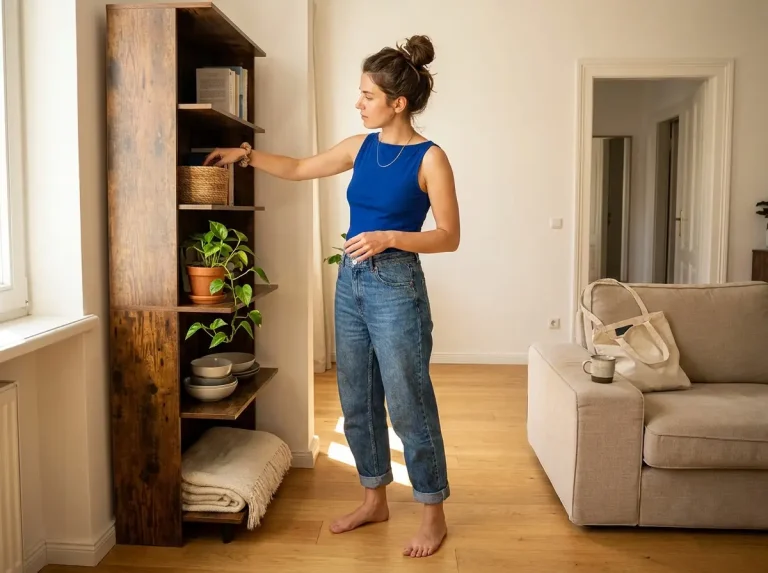
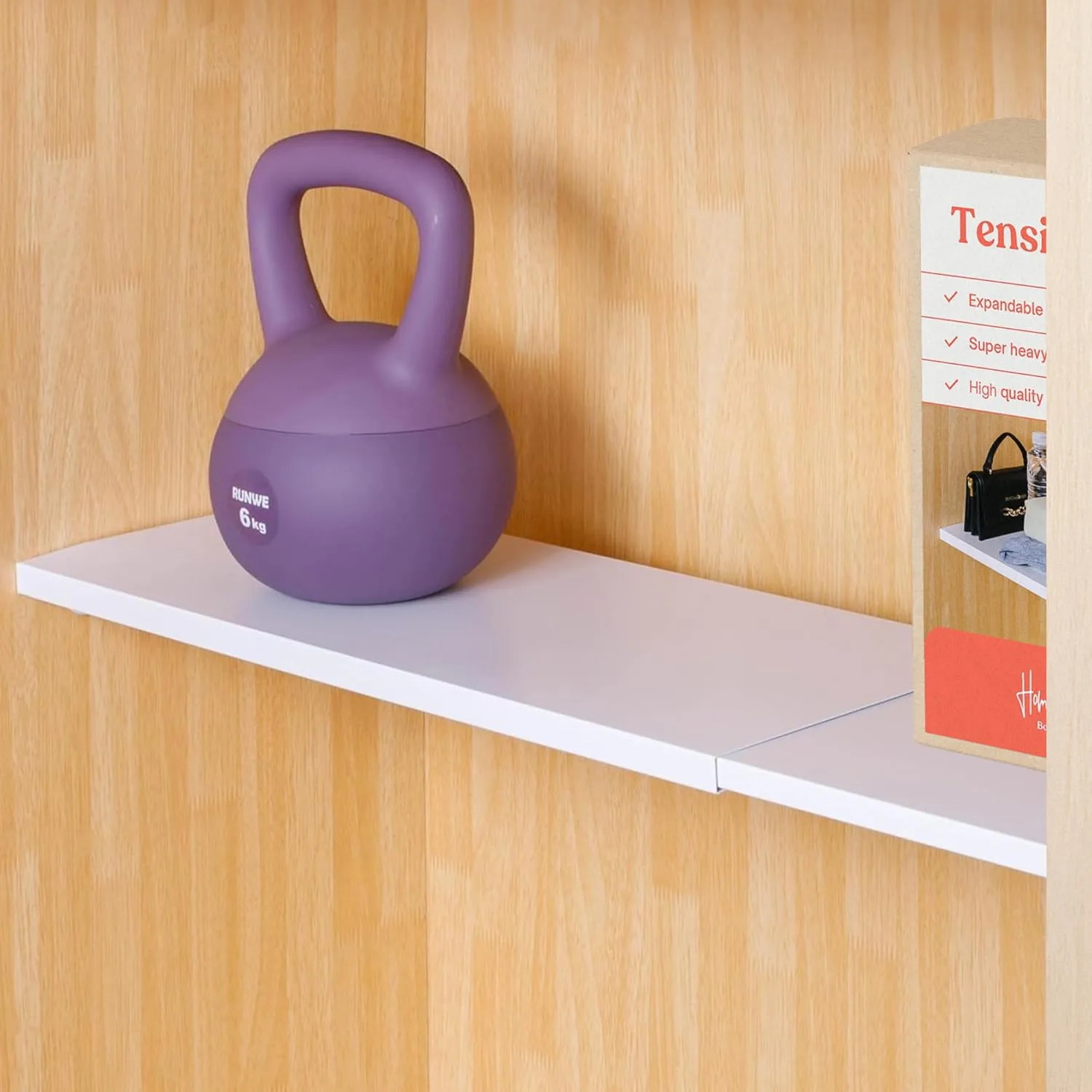
If you rent, or if the wall above your washer is tile, waterproofed, or otherwise off-limits, mounting is not the answer and you should stop looking at mounted shelving. Expandable tension-rod shelving stands on pressure between two surfaces, leaves nothing behind but a couple of pressure marks, and is the only category here that adds a full shelf above the appliances without touching a wall.
If you can drill, build to the wall
Owners have a better option than anything sold in a box, and it comes straight out of the same organizing thread. One commenter describes buying cut-to-size lumber from a home-improvement store, sanding and finishing it, and mounting it into the studs wall-to-wall above the machines. The cost is a fraction of a boxed unit, and the fit is exact.
That last part is the real argument. A laundry closet is almost never a standard width, so a boxed shelving unit leaves you two inches of dead air on one side, which promptly fills with something.
Cut lumber does not. Most big-box stores will make the cuts for you, so the whole project is a saw-free afternoon of sanding, a finish coat, and four brackets. The same logic rules out most floating shelves here: they look cleaner, but bracket-free wall-mounted shelving carries less and comes in fixed lengths, which is the wrong trade in a closet that is never a standard width.
Check the number on the package
Adhesive hooks and strips, along with the wall pegs and coat hooks people hang on the back of the door, are where confidence outruns physics. They carry a printed rating, and the range is wider than most people assume: Command’s own weight-rating guide lists hooks from 1 lb up to 7.5 lb depending on the model. A decorative 1 lb hook and a 7.5 lb clothes-hanger hook look roughly the same on the rack at the store.
A single wet towel comfortably exceeds the small ones. So does a loaded drying rack, which is the mistake this room invites specifically. Read the number on the package before you trust it with anything that holds water. And if you are going permanent instead, pick from shelves rated for real weight rather than from whatever matches the room.
One more renter note worth having, because it changes the calculation for a lot of people. The same thread makes a practical point about hardware: toggle bolts hold dramatically better than the plastic anchors that come in the box, and small anchor holes patched before move-out are routinely accepted without drama. That is not advice to ignore your lease. It is a data point on what the actual deposit exposure looks like, which nobody else will give you.
What this section deliberately does not cover is the full comparison of shelving types by material and load rating. That is its own guide, and trying to do it here would bury the part you came for.
The Over-Washer Zone Without a Renovation
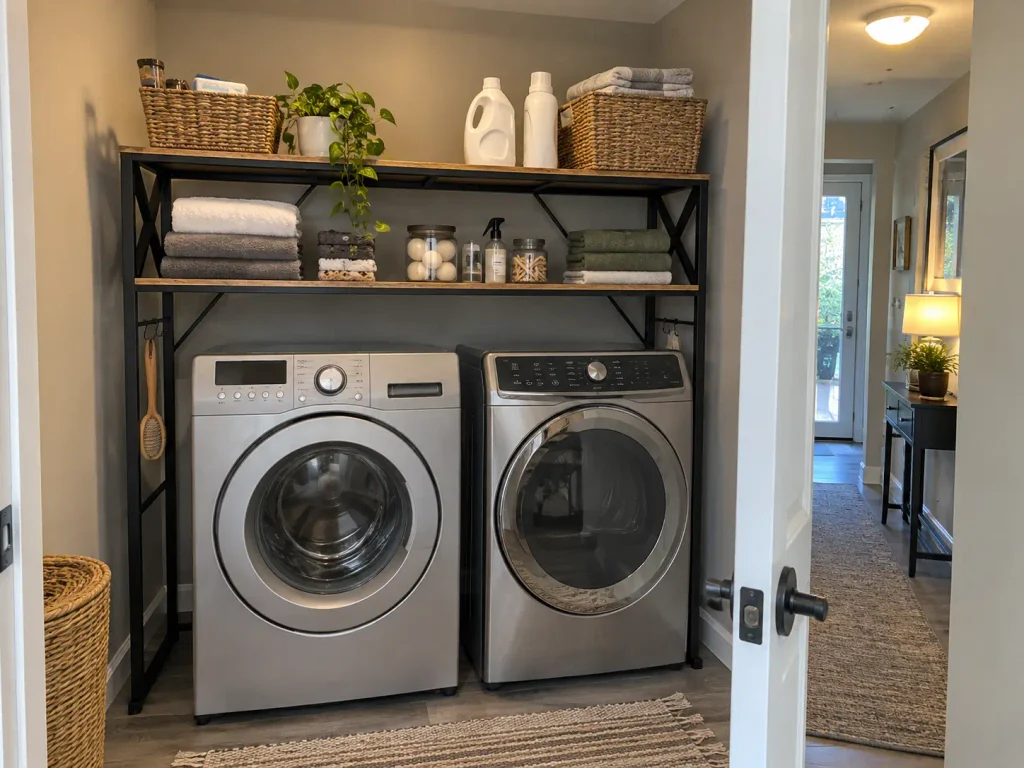
Every photo in the search results solves the space above the machines with custom cabinetry. That is a renovation, not a storage idea, and the gap between those two things is roughly the price of a used car. The freestanding version does the same job and comes out of the closet with you when the lease ends.
Cabinets, freestanding, or tension rod
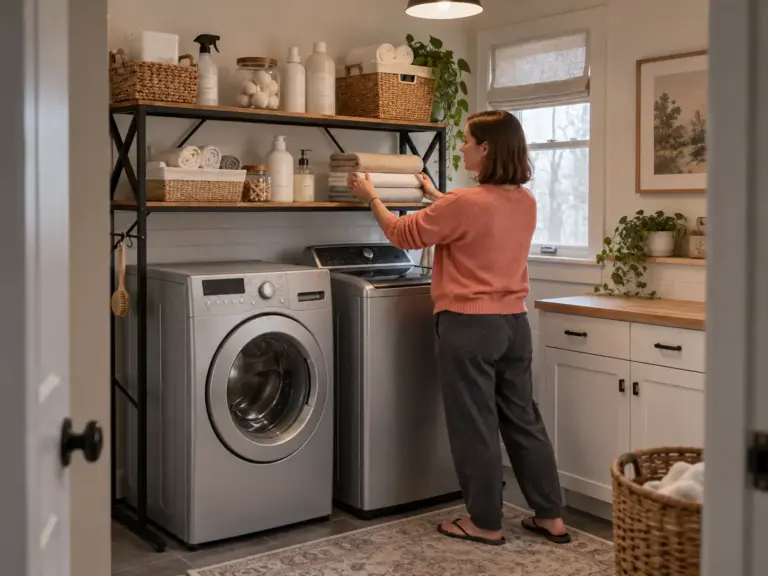
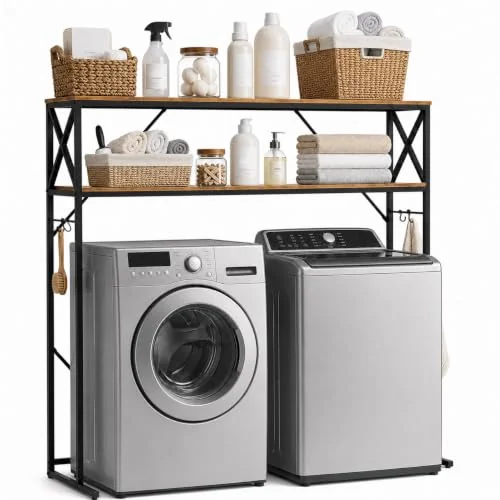
Three ways to fill this zone, ranked honestly by who they are actually for. Built-in cabinetry is best, and it is for owners with a budget and a contractor. A freestanding over-appliance shelf unit that straddles the machines is for everyone else, and it is the answer most readers of this article want. Tension-rod shelving, covered above, is for renters and tight budgets.
Freestanding wins for most people because it needs no wall contact, it adjusts to the height of your specific machines, and it leaves when you leave. The tradeoff is real though: its legs occupy floor, including that inch beside the machine you measured earlier. If your closet is tight to the walls on both sides, measure the leg spread before anything else. A unit that does not straddle cleanly is a unit that lives in the hallway.
The spec to check before you buy
Adjustability is the spec nobody checks and everybody regrets. Shelf spacing that moves in small increments is what lets a unit clear a top-loading lid or a front-load detergent drawer. A fixed-height shelf that misses your machine by an inch is not “close enough,” it is unusable, and you will find out after assembly.
Anchor it, even in a closet
Freestanding does not mean unanchored. A tall unit with open shelves and a high center of gravity, standing in a narrow space, is the exact shape the federal safety standard for clothing storage units (ASTM F2057, mandatory since September 2023) exists to address. Use the anti-tip kit that comes in the box. It takes about ten minutes and it is the only part of this article where skipping a step has consequences beyond annoyance.
People skip it because a closet feels inherently safe, as if the walls will catch the unit. They will not. A loaded shelf leans on the way out, not sideways. If you want the fuller version of this argument, it runs through our guide to freestanding units that won’t tip.
And if the wall behind your machines is tile, freshly waterproofed, or simply not yours, there is a third improvisation from the same community thread that deserves more attention than it gets: a floor-standing over-the-toilet-style shelf, the kind sold for bathrooms, whose legs straddle the machine instead of the toilet. Same geometry, different room, no wall contact at all. The full roundup of over-washer shelving units is a guide of its own; this section just names the zone and gets you out of it.
Drying Without Giving Up the Floor
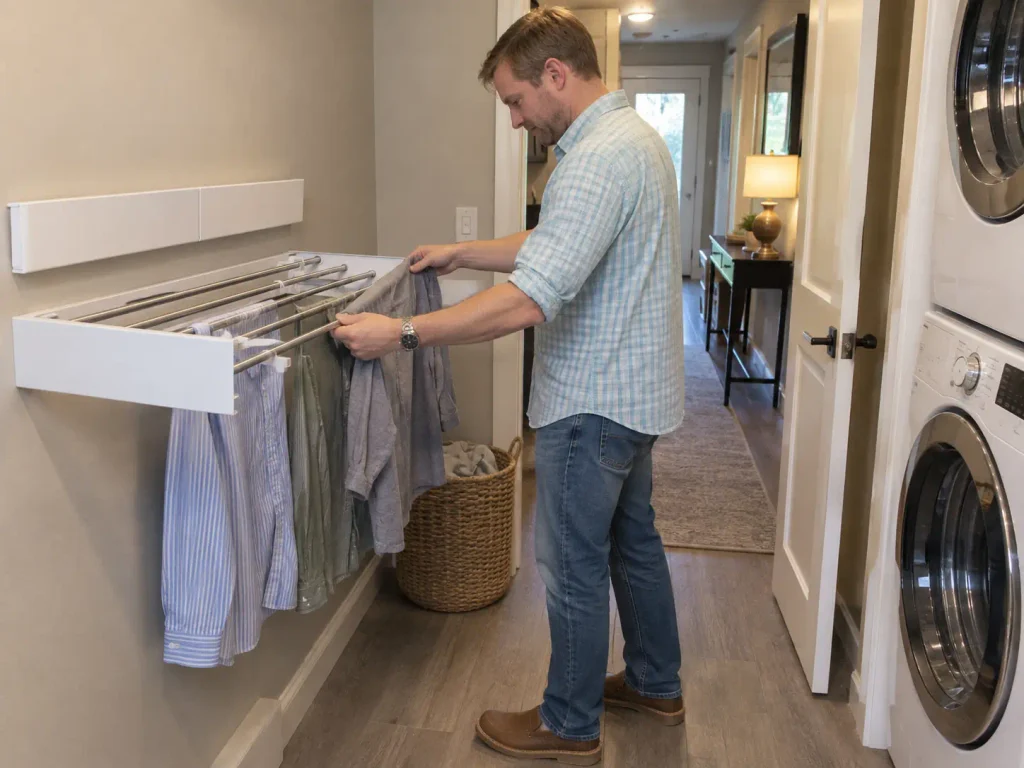
The folding floor rack is the most-owned and least-used object in small laundry rooms. It gets opened twice, blocks the only walking path, gets folded and leaned against the wall, and then takes up space anyway while doing nothing. It is storage that stores itself.
Why the floor rack loses
The failure is specific and it is geometric. A floor rack needs its own footprint plus the clearance to walk around it, in a room that has neither to give. In a 29-inch closet it is not just inconvenient, it is physically incompatible with opening the washer door, which is the one thing that room has to do.
So the fix is not a better rack. The fix is to get drying off the floor plane entirely, which turns out to be easy, because the resource this room has going spare is wall.
Mounted and folded flat
A wall-mounted drying rack that folds flat when it is not in use costs you wall, not floor. Three inches of wall depth, most of the time, and it disappears when the laundry is dry. That is the only version of a drying rack that survives long-term in a room this size. A ceiling-mounted pull-down drying rack does the same job overhead if your closet has the height for it.
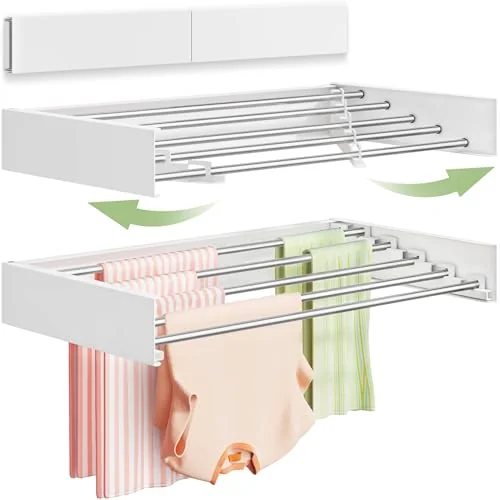
The no-drill drying line
If you cannot mount anything, the alternative is not a compromise. Run tension rods wall-to-wall at shoulder height or above and you have a clothing rod in all but name, a drying line that holds hangers and flat items, costs pocket change, and vanishes completely the day you take it down. The Small Tension Rod 2-Pack expands from about 5.25 to 7.5 inches, which makes it the right size for a narrow slot or an in-cabinet run rather than a full closet span, so match the rod length to your actual opening before ordering.
The limitation is load: a tension rod holds a few shirts on hangers gracefully and sags under a soaked bath sheet, which is the weight-rating point from the last section coming due. Worth reading what tension rods can and can’t hold before you trust one with a full load.
Placement matters more than the product, incidentally. Drying anything directly over the machines means drips land on the appliances and sit there, which is how you get a cloudy ring on a dryer lid. Position the line or the rack over floor you can wipe, or put a tray underneath and accept the extra step.
There is one more move here that I think is underrated, and it comes from the professional-organizer side rather than the product side: color-catcher sheets let lights and darks wash together, which removes the second sorting hamper from the room entirely. The best storage solution is occasionally the one that deletes the object.
Where the Ironing Board Actually Goes
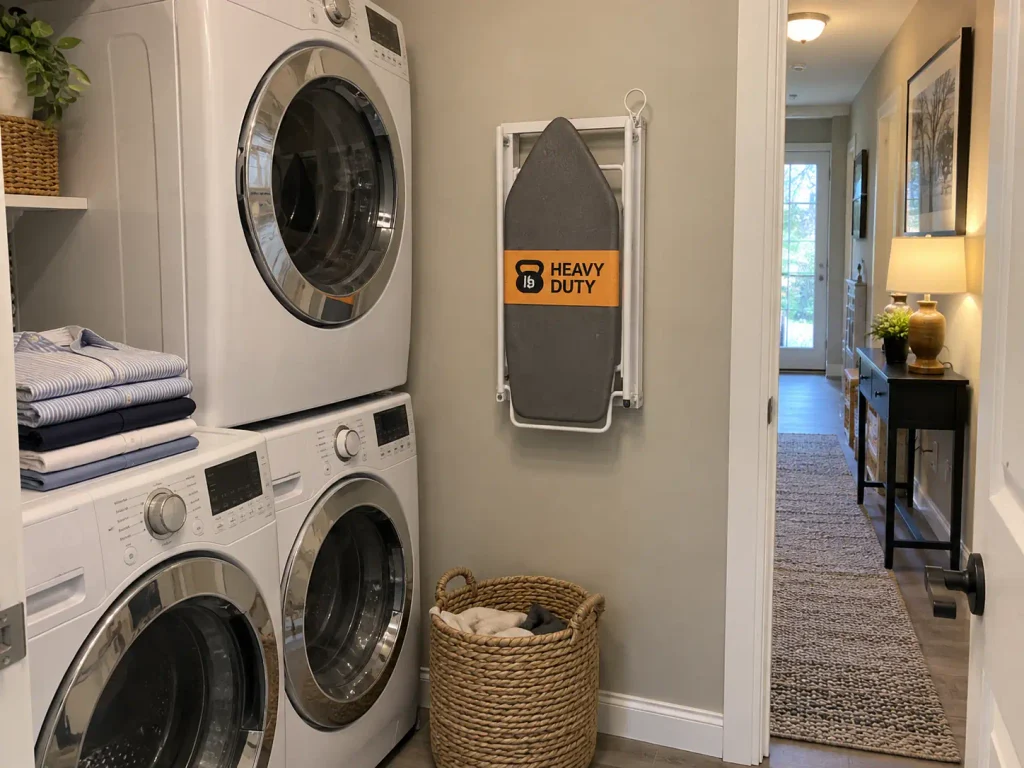
An ironing board is the wrong shape for every storage system ever designed. It is long, thin, rigid, and slightly wider at one end, which means it fits nothing and leans against everything.
The geometry problem
In a 29-inch closet this stops being a storage problem and becomes a geometry problem. Ironing board storage is where that geometry bites hardest: a standing board needs a footprint it cannot have.
A drawer-hidden ironing board or a drying rack drawer solves it beautifully if you are building cabinetry, and not at all if you are not. Laid flat on the floor it blocks the machine. Leaned in a corner it falls over the moment the door opens.
There is genuinely no orientation in which a full-size board coexists with a narrow closet and a working appliance door, which is why it usually ends up behind a bedroom door instead, quietly annoying someone. A built-out ironing station is a different article; here the question is only where the board sleeps.
So the only workable answer is flat against something, and in this room the only flat somethings available are a wall and the back of the door.
Before spending anything, the zero-cost version: a sturdy wall hook, or two, plus a padded cover on the back of the laundry door stores the board you already own. That is it. One hook, one afternoon. And for a renter, that is not a consolation prize, it is the answer, because the mounted alternative below needs a wall you are allowed to modify.
Mounted, or on the back of the door
If you can mount something, a fold-down board that lives flat against the wall and drops when needed collapses the board’s storage footprint to roughly the depth of a shelf. It is the single biggest space return of any product in this article relative to what it displaces. The professional organizers at NAPO-GPC recommend exactly this pairing, listing a wall-hanging ironing board alongside a narrow rolling cart and a folding table as the standard small-laundry moves, which is worth knowing because it means this is established practice rather than a blog idea. The back of that door is the most wasted surface in the room, and it takes more than a board: an over-the-door organizer hung on the same door holds the spray bottles and lint rollers that otherwise eat shelf space.
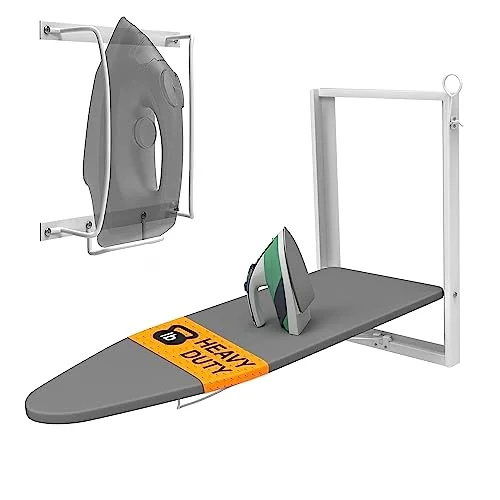
The wider ironing setup, where the spray and the starch and the actual routine live, is a separate subject and gets its own guide. This section is only about the board, because the board is the object that breaks the room.
Claiming the Dead Space Beside the Machines
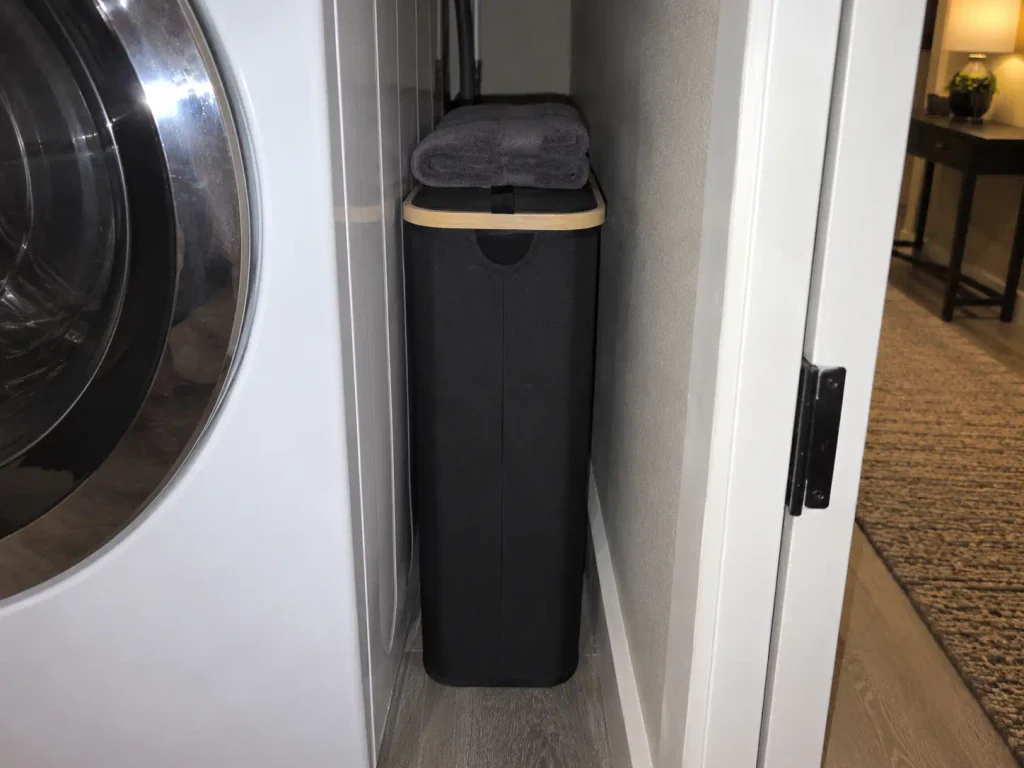
This is the section with the actual realization in it. There is a slot beside your washer that has been eating socks for years, and you have never once thought of it as storage.
The three gaps you are not seeing
There are three dead spaces in a laundry closet. The gap between the wall and the appliance. The gap between two side-by-side machines, if you have them. And the vertical slot beside a stacked unit, which runs the full 78 inches of appliance height.
All three are usable storage. None of them are perceived as storage, because they read as leftovers rather than space.
The distinction that matters is between a gap and a clearance. The 6 inches behind the machines belongs to the hoses and venting, and the inch at each side of a stacked install belongs to the install. Those are not yours. That awkward gap is clearance, not gap storage.
What you do with the slot once it is filled is a separate question, and the cheapest answer is a curtain for concealment on a tension rod across the closet opening, which turns a hidden hamper and a loaded cart into one clean line without costing an inch of depth. A pull-out cabinet or a hidden cleaning cupboard does the same job better and costs a renovation, which is the trade. The front-facing slot between wall and appliance is yours, and it is usually the widest of the three.
The same logic pays off elsewhere in a home, by the way: corner storage follows the same logic, which are the other category of space people write off without measuring.
Measure before you shop
Put the tape measure in the gap before you open a single shopping tab. Measure at the front, because baseboards and hoses often make the back narrower, and the front number is the one that has to let a cart pass. Write it on the tape inside your door with the other three.
This is also where you find out whether your gap is real or imaginary. If a stacked unit is installed tight, one side may genuinely give you nothing but the required inch. The other side is frequently five, six, sometimes eight inches, because closets are rarely built to the exact appliance width.
Why it has to be on wheels
A fixed shelf in a deep narrow slot is a trap. You can reach the front six inches of it and the rest becomes archaeology. Wheels are not a convenience here, they are the mechanism: the unit slides out fully, you use all of it, and it pushes back flush.
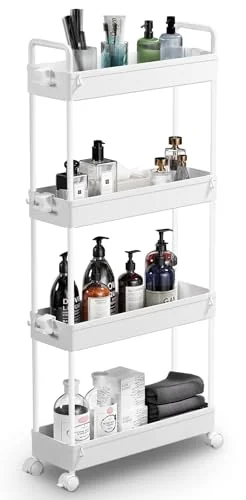
Matching the cart to the measured gap beats buying the narrowest one available. If your slot is seven inches and you buy a five-inch cart, you have just donated two inches back to the sock void.
The second thing that measured gap can hold is the hamper, and this is the one that changes how the room feels rather than how much it holds. A standard round basket eats a square of floor no small laundry closet can spare, which is why the hamper usually ends up in a bedroom and the dirty clothes end up on a chair. A hamper under nine inches deep goes in the slot instead.
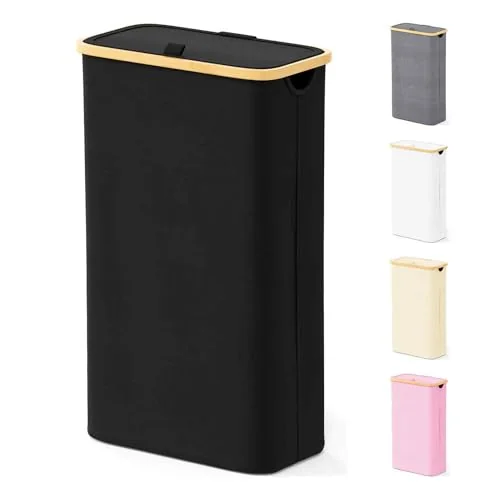
Before you buy either of these, the free version deserves its moment: a tall kitchen trash bin you already own, lid included, is roughly the same footprint as a slim hamper. It looks like what it is, but it costs nothing and it tells you within a week whether the gap-hamper idea works in your room.
Containerize the Supplies and Keep It Working
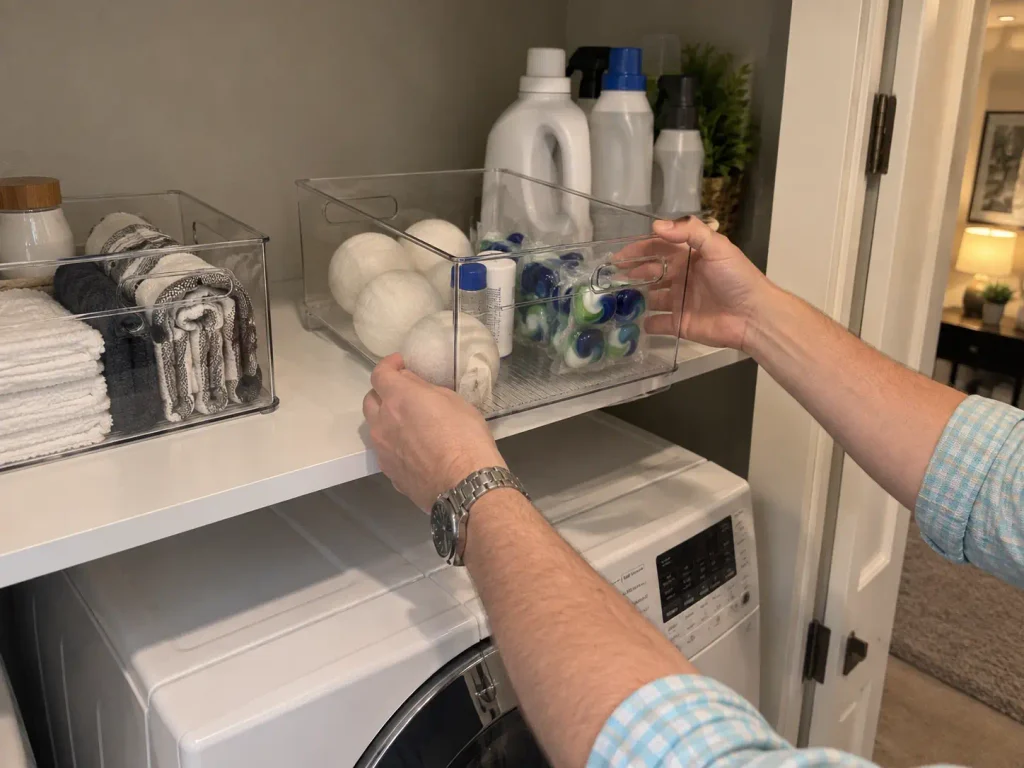
Here is the part every search result skips, because the finished photo is where their story ends and where yours begins. A laundry room reverts faster than any other room in a house, and the reason is mechanical rather than moral: it gets used mid-task, one-handed, usually in a hurry, often by someone who did not build the system.
Bins before jars
What is left after the big zones are solved is a category of small, odd-shaped, slippery objects. Pods, dryer balls, scent boosters, stain sticks, a lint brush.
Loose on a shelf they slide to the back, tip over, and scatter.
Within three weeks the shelf you organized looks like a shelf you did not.
That is what cleaning supply storage and detergent storage actually mean in a room this size: not more shelf, but fewer things to put back. Bins fix that by changing the unit of handling. Instead of eleven objects that each need putting back, you have one bin that pulls out and pushes in.
The zero-cost version is real and it works: dollar-store clear bins do roughly 80% of this job, and nobody needs anything fancier to organize a laundry closet.
I used to think the material was the decision here. It is not, or rather it is the last one you make.
Material matters less than most articles suggest — acrylic bins and acrylic dividers show what is inside while woven baskets hide it, and in a room this small the honest answer is that seeing the stock is worth more than hiding it. If you want the version that looks deliberate and holds a taller bottle, the mDesign Deep Plastic Storage Bin 4-Pack is the pantry-depth shape that suits a deep laundry shelf, since the extra height stops the tall items from going over. The caveat with any deep bin: do not let it become a second junk drawer. Deep plus opaque equals archaeology, so keep one category per bin.
The urge to decant detergent into a matching glass jar is the move everyone photographs, and it is entirely optional. I will say it plainly since nobody else does: the bin does the work and the jar does the styling. If you enjoy the jar, get the jar. It is not why the system holds.
Labels are for everyone else
Labeling is what makes a system survive other people. If you are the only person who does laundry in your home, an unlabeled bin system works fine, because the system lives in your head. Add a second person and it lasts exactly as long as your memory of what you decided, which turns out to be about a month.
Masking tape and a marker does this for free, and that is a genuinely complete answer. If the room is shared or you want the labels to still be legible in two years, the Brother P-Touch PTD220 Label Maker prints laminated strips that survive humidity and handling, which matters more in a laundry space than in a pantry. The honest caveat is that a label maker is a purchase you will use for one afternoon here and then need to find other uses for, so it only makes sense if the rest of the house is next.
The surface that has to stay clear
One maintenance rule keeps everything in this article alive: the top of the machines stays clear. That is the folding surface from the very first section, and it is the first thing to be recolonized, always by something small and reasonable.
There is one legitimate way to get that surface back rather than just defending it. A countertop over appliances spanning both machines gives you a folding surface that is not the machine lid, and for a side-by-side pair a removable countertop laid across the two does it without a single fixing. On a stacked unit there is no span to bridge, which is the honest limitation and the reason this article leans on defending the dryer top instead.
So use it as your indicator.
If the top of the washer is clear on a random Wednesday, the system is working.
If it has collected three objects, something in the room has no assigned home, and the answer is not another bin. And in three months, look at what has migrated back into the room. That item is telling you it has no address anywhere else in your home, which makes it the thing to solve. The rest of this approach generalizes further than you would think, and the same no-drill vertical thinking works across a whole apartment once you start seeing wall as storage and floor as circulation.
Keep one empty bin on the shelf and label it “not laundry.” Anything that shows up in the room and does not belong goes in it instead of on the machines. When it fills, you carry it out in one trip rather than making eleven small decisions you will keep postponing. It also makes the problem visible: a bin that fills every week is telling you something in your home is homeless.
Conclusion
Measure before you buy anything. The closet width, the door swing, and the gap beside the machine decide your entire shopping list, and every returned item in this category traces back to a measurement somebody skipped.
Every zone in this room has a no-drill version. Vertical storage, over-appliance shelving, drying, ironing, containers, dead space: all six have an answer that leaves no holes. Renting is a constraint, not a disqualification.
And the room only stays organized if nothing that is not laundry is allowed to live in it. Storage capacity was never the binding constraint here. Assignment was.
In three months, look at the top of the washer. If it is clear, the system is holding. If it has collected things again, the problem is not storage, it is that something in your home still has no address and this room is absorbing it.
Start with the gap beside the washer. Measure it this week. That one number tells you more about what this room can actually hold than any idea gallery will.
Frequently Asked Questions
01How can I organize my laundry room in a small space?
Work vertically above the appliances, claim the gap beside them with a slim rolling cart, move drying onto the wall, then remove anything that is not laundry. Removal comes first because a small laundry space fails from absorbing other rooms’ items, not from lacking shelves.
02What size storage cart fits between a wall and a washer?
Slim rolling carts start around five inches wide, which fits the typical wall-to-appliance gap in a laundry closet. Measure your gap at the front, where baseboards and hoses do not narrow it, and match the cart to that number instead of defaulting to the narrowest one sold.
03How can I create hidden storage in a small laundry room?
The back of the door, the wall above the machines, and the slot beside them are the three places storage disappears into. A tension-rod curtain or a cabinet front conceals open shelving without costing you any depth, which matters when every inch of the room is already spoken for.
04What is the best way to store an ironing board in a small space?
Flat against a wall or the back of a door, using either a fold-down mounted board or a wall hook with a padded cover. A standing full-size board cannot coexist with a narrow closet and an appliance door, so the only workable orientation is flat against a vertical surface.
05What is the best way to store clothes in a small space?
Hang what wrinkles, fold what stacks, and keep the laundry room out of it entirely. Clean clothes should not be stored in a small laundry space at all. Clothing that starts living in this room is the first sign it has become a dumping ground rather than a working room.
Disclaimer: ClutterlessNest is a participant in the Amazon Services LLC Associates Program. As an Amazon Associate we earn from qualifying purchases. This article may contain affiliate links — if you buy through them, we may earn a small commission at no extra cost to you. We only recommend products we have tested or genuinely believe in.