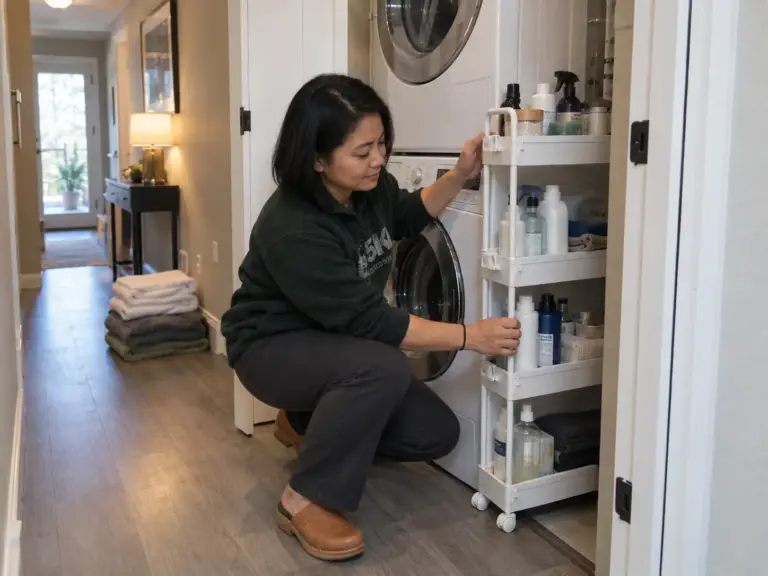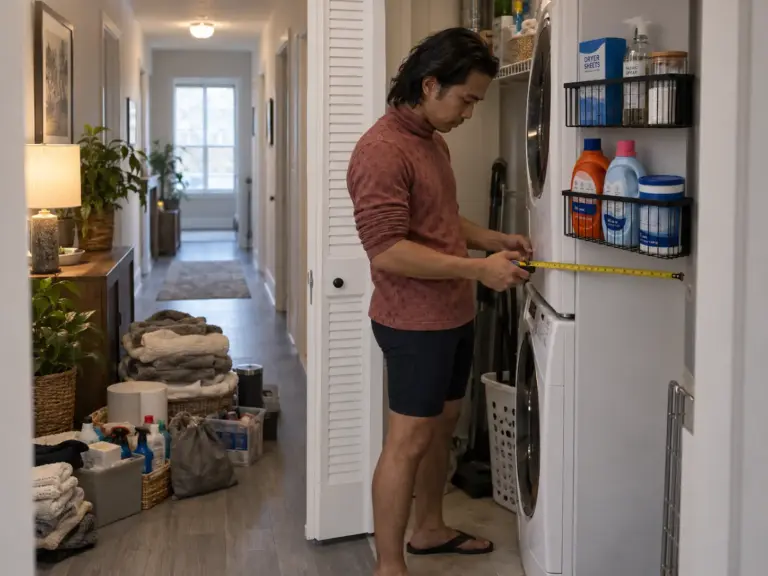

You already organized this room once. There was a shelf above the machines with three labeled bins on it, and for about two weeks it looked like the photo you saved. Now that same shelf is holding a dryer-vent brush, somebody’s phone charger, half a bag of clothespins, and a bottle of something blue that nobody in the house can identify.
Here’s the part nobody tells you: small laundry rooms don’t fail from a shortage of storage. They fail because every inch gets assigned to storage in general instead of to one specific job, and this room punishes guessing harder than any other room in the house. That gap you keep eyeing beside the washer is often an inch of required ventilation clearance, not a storage zone.
These small laundry room organization ideas work through the five zones this room actually has, in order of payoff, and the first step isn’t a purchase at all: it’s a purge, which is why this guide starts where decluttering methods that survive past the first week start. Every zone below carries a renter version and a budget version.
Quick Answer
A small laundry room has five zones worth working, and they pay off in this order:
- Declutter first: empty bottles and dead samples leave before anything gets bought
- The machine sides: free magnetic mounting surface, no drilling, no holes
- Vertical above the machines: two shallow tiers, never one deep shelf
- The back of the door: the most under-used surface in the room
- The gap beside the machines: only what survives the clearance subtraction
Why Your Small Laundry Room Fills Back Up
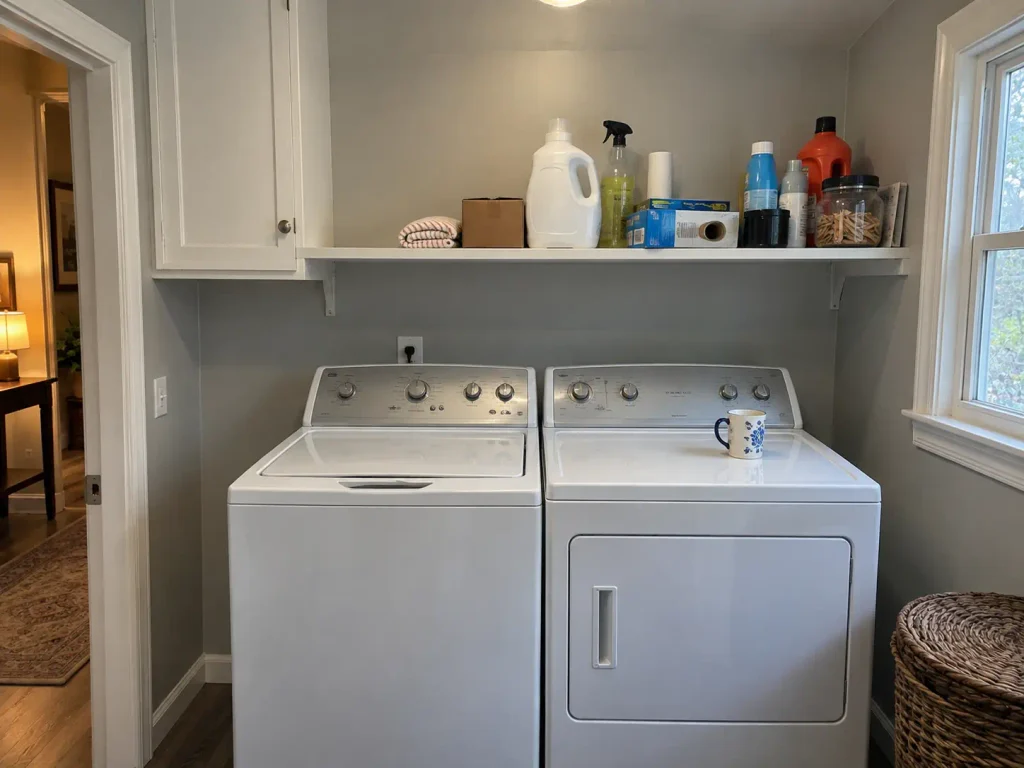
Every house has one. Organizing threads have a name for it: the everything shelf. It’s the single open shelf above the washer and dryer that started with good intentions and ended up as a landing strip. And the thing worth understanding before you buy a single bin is that it didn’t overflow because it was too small. It overflowed because nothing on it had a rule.
The everything shelf, and why it always wins
The mechanism is simple and it’s about frequency, not volume. Detergent gets grabbed three times a week. The stain remover comes out maybe once a month. The dryer-vent brush is a twice-a-year object at best, and the box of dryer sheets falls somewhere in between. Put all four on one open shelf and by week two the daily items have migrated to the front, the rare items have been shoved to the back, and something has been set on top of something else because that was the only flat spot left.
From there it compounds fast. When nobody can see what’s on the shelf, nobody can find what they need. When nobody can find what they need, they stop putting things back and start setting them down on the dryer, on the floor, on the windowsill. That’s the reversion, and it happens in about three weeks.
Your last attempt didn’t fail because you’re disorganized. It failed because it was missing a sorting step.
Zone by how often you reach for it, not by category
The fix that comes up over and over in r/organizing threads is a sequencing fix, not a shopping fix: put big and rarely-used items up top, and small, frequently-used items down low in bins that are easy to reach and easy to return things to. Read that last part again, because it’s the half everyone drops. Easy to return to. A bin you have to lift down to put a detergent pod back into is a bin that gets skipped, and a skipped bin is how the dryer top becomes the new shelf.
Sort your supplies into three tiers before you decide where anything lives. Daily reach: detergent, pods, dryer sheets, the stain stick. Monthly: extra cleaners, the lint brush, the mesh bags. Twice a year: the vent brush, the washer-drum cleaner tablets, the spare hoses.
The daily tier gets prime real estate at arm’s height. Skip detergent decanting while you’re at it, because pouring detergent into a prettier jar adds a chore and solves nothing. The twice-a-year tier can go somewhere genuinely inconvenient, because inconvenient twice a year costs you nothing.
Do the frequency sort standing in the room with everything pulled out, not from memory at the kitchen table. You will be wrong about at least two items, and almost everyone overestimates how often they use the stain remover and underestimates how often somebody in the house grabs a mesh bag.
Empty the room before you measure it
Purge before organizing. This is the single most-repeated piece of advice in every laundry thread I found while researching this, and not one of the five articles currently ranking for this keyword leads with it. They all open with idea lists. Buy the cart, mount the shelf, hang the rack. Purge first, organize second. That’s the community answer, and it is unanimous enough that ignoring it feels like a choice.
So name what actually leaves. The detergent bottles with an inch of residue that you’re keeping because pouring them out feels wasteful. The three sample-size detergents from a subscription box that nobody liked. The fabric softener you bought once and stopped using. The bin of unmatched socks that hasn’t been sorted since spring, which is not a storage problem, it’s a decision you’ve been postponing. The dried-out dryer sheets. The stain remover that expired.
In a genuinely small room, this step alone usually reclaims a third of your shelf space, and it costs nothing. If you want the wider version of this pass, the room-by-room order that keeps the purge from stalling is the method to run it through.
There’s a second failure mode in this room and it isn’t behavioral at all, it’s spatial. A freestanding shelving unit parked a little too close to a front-loading washer eats the door-swing clearance, so from day one you’re opening the door partway and angling laundry around the corner of the shelf. Within a month you’ve stopped using that shelf properly and started working around it. The system was fine. The placement broke it.
Which brings us to the reframe that carries this whole article: your laundry room has five specific dead zones, and each one has a job. “More storage” is not a plan. Knowing which zone handles detergent and which one handles the vent brush is.
Measure Before You Buy Anything
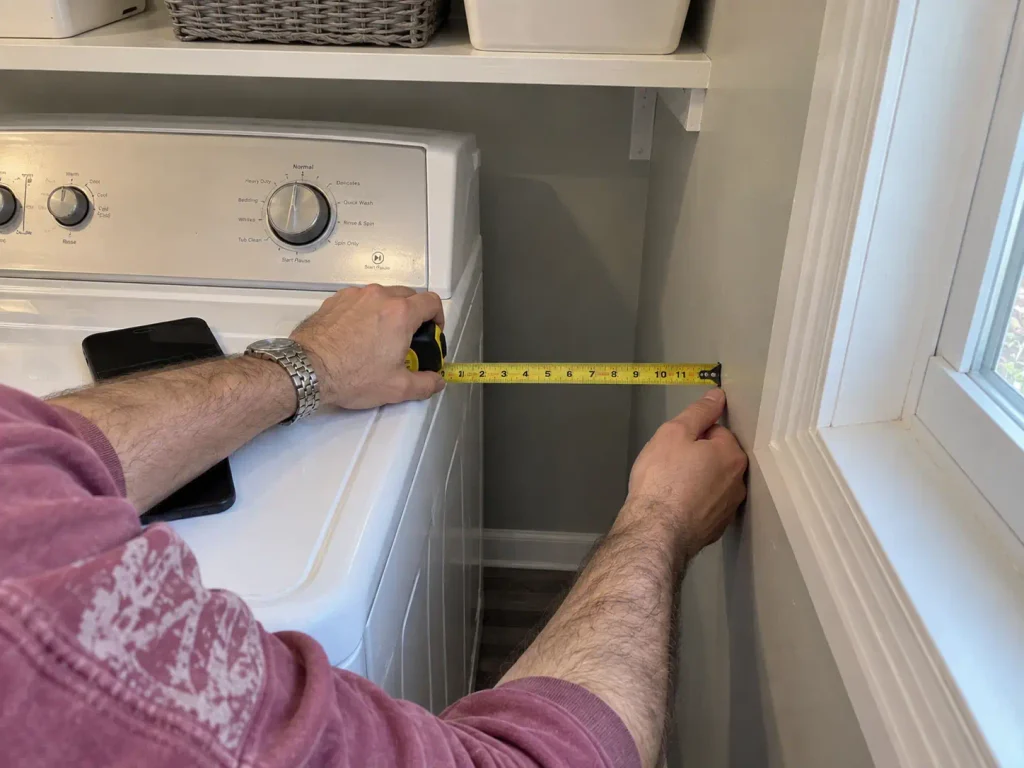
This is the section that saves you a return shipment. Everyone eyeballs the gap beside the washer, orders a slim rolling cart, and then discovers the gap they were measuring was structural clearance the machine needs to breathe. The tape measure is the cheapest organizer in this entire article and it’s the only one that prevents a mistake instead of fixing one.
The inch beside your washer is not storage
Here’s the clearance math that never makes it into an idea roundup. A standard side-by-side washer and dryer pair needs roughly one inch of open space on each side and about six inches behind for hoses and ventilation. According to Whirlpool’s standard washer and dryer clearance requirements, “Allow 1 inch of space on each side and 6 inches behind the appliances for proper ventilation and hose connections.”
That inch is not a bonus slot. It’s the machine’s breathing room, and filling it with a narrow organizer traps heat and stresses hose connections.
So before you shop, measure the total opening, subtract an inch per machine side, and work with what’s left.
Sometimes what’s left is four usable inches and a slim cart is genuinely the right call. Sometimes what’s left is nothing, and the honest answer is that this zone doesn’t exist in your room. Both results are useful. Only one of them costs you a return label.
Door swing and lid clearance
The second measurement everyone skips is the one that moves. Front-loading units need roughly four feet of clear floor in front of them to load and unload comfortably, and top-loaders need about two feet of clearance above for the lid to open fully. Shelving that intrudes on either one gets resented inside of a month, then ignored.
Measure the swing, not just the wall.
Open the washer door all the way and mark where the edge lands on the floor. That arc is off-limits for hampers, carts, drying racks, and anything else that lives at floor level. If you have a top-loader, stand at the machine, open the lid, and look at what’s directly above it. A floating shelf mounted eighteen inches up is a shelf you will bang the lid into, and you’ll only need to do that once before you start propping the lid with your shoulder.
The three numbers to write down before you shop
There’s one practical rule that comes out of these threads and it takes about four minutes. Write three numbers into your phone before you open a single shopping tab:
- Machine width. The actual width of your washer and dryer, not the width of the closet opening. These are two different numbers and confusing them is how “over washer and dryer” shelf kits end up overhanging.
- Usable gap. The space beside or between the machines after you subtract the clearance inch on each side.
- Vertical run. The height from the top of the machines to the ceiling, or to the underside of whatever is already mounted up there.
Every product decision in this article is one of those three numbers. That’s it.
One more warning on machine width specifically. Compact apartment-size stacks run about 24 inches wide, noticeably narrower than standard units, which means most over-the-machine shelf kits sized for standard 27-inch machines will overhang on them by a few inches on each side. It looks fine in the box and looks wrong on the wall. Measure the actual unit.
And if what you have is the stacked laundry closet specifically (machines one on top of the other, a bifold door, essentially no floor), your side gap is effectively gone and your only real expansion room is vertical. That configuration has its own math, and the full clearance math for a 29-inch stacked closet covers it properly rather than in the two paragraphs this broader guide can spare.
Use the Sides of Your Machines
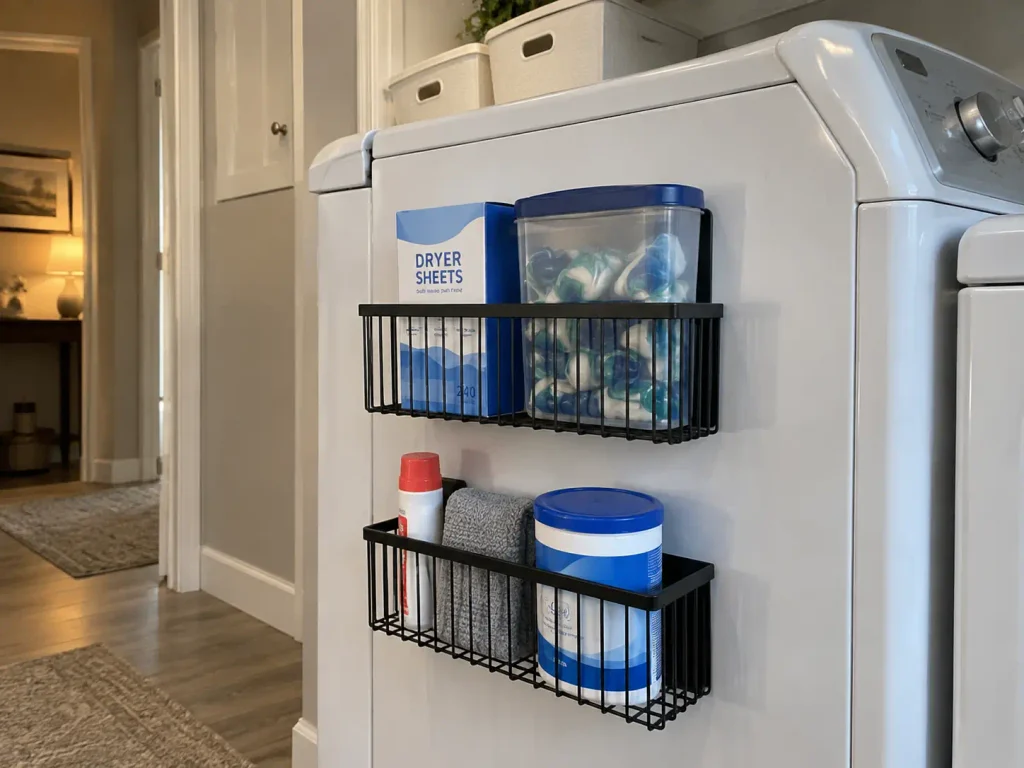
Your washer and dryer have two large flat steel panels doing absolutely nothing. They’re vertical, they’re at arm’s height, they’re exactly where you stand during a wash cycle, and they hold magnets. This is the only storage surface in the room you don’t have to drill into, ask a landlord about, patch at move-out, or measure twice for. It is also the zone the big idea roundups skip almost entirely, and the reason is not subtle: a magnet stuck to the side of an appliance does not photograph like a room tour.
Free mounting surface at arm’s height
The metal side panels on most washers and dryers take magnets, which turns roughly four square feet of dead space into mountable surface for zero structural cost. Not “cheap.” Zero. Nothing gets anchored, nothing gets adhered, nothing leaves a mark, and if you move, the storage comes with you in a box.
For renters this math is close to unbeatable. No holes, no anchors, no patching compound, no deposit conversation at move-out. If you can’t drill, and a huge share of people with small laundry rooms are in rentals precisely because laundry closets are a rental floor-plan signature, this is the single best zone in the room and it’s the one you should do first.
Test the panel with a fridge magnet before you order anything. Some machines have painted steel sides that hold beautifully, and some newer models have side panels with enough plastic trim or insulation backing that the grip is weak. Ten seconds, one magnet, no returns.
What belongs on the sides (and what doesn’t)
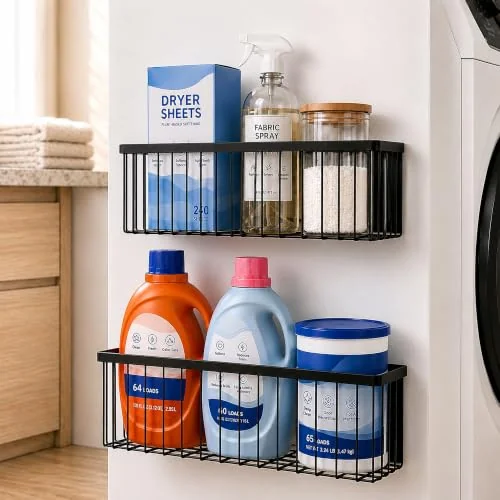
Apply the frequency rule from earlier and this zone answers itself. The machine sides are prime real estate because they’re at hand while you’re mid-load, which means they get the daily tier and only the daily tier: detergent or pods, dryer sheets, the stain stick, a small dish for pocket change and stray buttons.
What does not go here is anything from the twice-a-year tier. The vent brush, the spare hoses, the drum cleaner. Putting them on the machine sides feels productive because the space fills up, and it’s the exact move that turns a good zone into a small vertical version of the everything shelf. If you find yourself reaching past three things to get the detergent, the zoning has already drifted.
Now the capacity question, because most people assume “magnetic” means “holds a sponge.” It doesn’t. Magnetic organizer shelves in this category carry ratings around 17.6 lb for a large basket and 13.2 lb for a medium one. That’s a full detergent jug plus a box of dryer sheets, on a magnet, with room to spare. Worth stating plainly, because the assumption that magnets are decorative is the main reason this zone stays empty in most laundry rooms.
The no-drill version for renters
Before you spend anything, try the free version. A single magnetic hook from a junk drawer holds a mesh bag or a lint roller. A magnetic spice tin from the kitchen holds clothespins or the little scoop that came with the powder detergent. If your whole machine-side problem is “I have four small items with nowhere to live,” you may already own the solution and it’s currently on the fridge.
If you need actual shelf capacity rather than hooks, the purpose-built version of this zone is worth the small spend.
Go Vertical Above the Machines
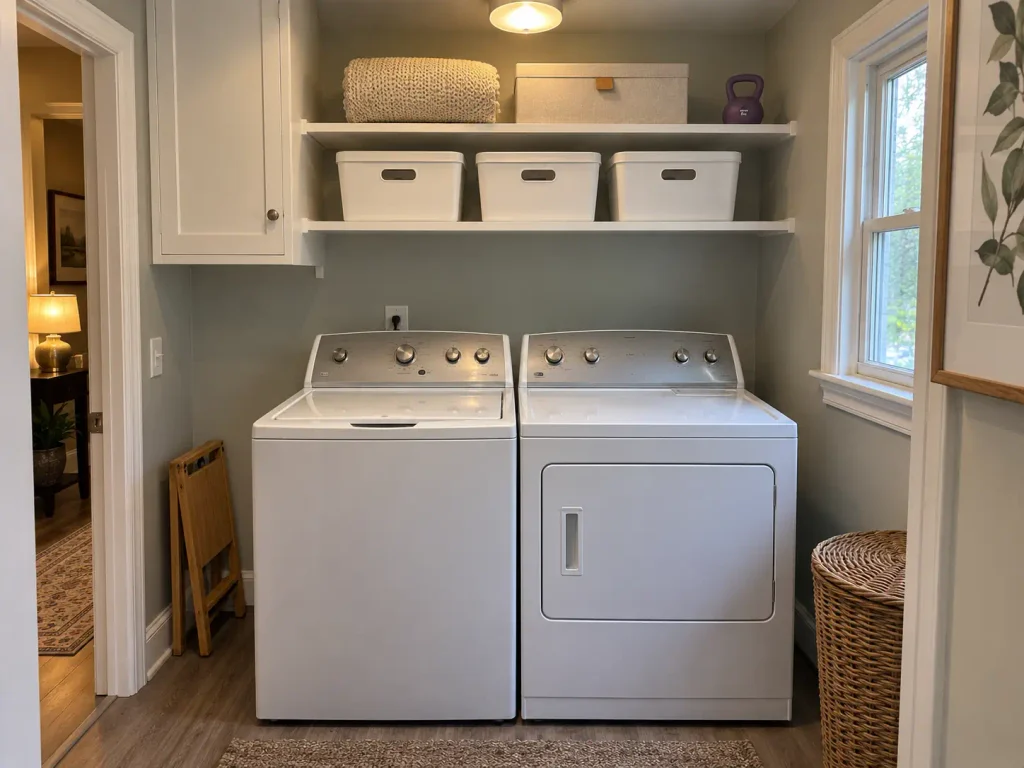
Here’s where the everything shelf lived, so you’ve already tried this zone and you’ve already been burned by it. That’s worth saying out loud, because the instinct now is to skip vertical storage entirely or to install a bigger version of the thing that failed. Neither works. The space between the top of your machines and the ceiling is the largest block of wasted vertical space in the room, usually by a wide margin, and over washer and dryer storage is the whole reason this zone is worth fighting for, and the job here is to give it back to you with a structure that survives contact with a Tuesday night.
Two shallow tiers beat one deep shelf
The fix is tiering, not a bigger shelf. In most small laundry rooms the vertical run above the machines is somewhere between three and five feet, and it’s typically holding exactly one shelf with twelve unrelated objects on it. Two shallow levels store more usable stuff than one deep level, every time.
The reason is the same failure that ruins deep pantries: a deep shelf stores things behind things. Whatever ends up in the back row goes invisible within a month, and invisible means you buy a second bottle of it.
A shelf you can see the entire depth of at a glance is a shelf that stays sorted. So if you’re choosing between one 12-inch-deep shelf and two 6-inch-deep shelves in the same vertical space, take the two shallow ones. The same logic applies whether you’re using wall-mounted shelves or stacking bins on a single existing shelf. You lose nothing but the ability to hide things from yourself.
I used to default to recommending the deepest shelf that would fit, on the logic that more cubic inches is more storage. After reading enough versions of the same back-row story in organizing threads, I stopped. Cubic inches you can’t see aren’t storage, they’re a holding pen.
The top tier is only real if you can reach it
Apply the frequency rule again: big and rarely used goes up top. That’s correct, and it comes with a condition almost everybody drops. It’s only correct if you can reach it.
The most useful tip in one r/HomeDecorating thread about making a small laundry room functional was almost thrown away as an aside: get a step stool or a small ladder. It sounds obvious right up until you picture the alternative, which is you, at eleven at night, with one foot braced on the front of the dryer, reaching for a bin of something you can’t see. That’s the move nobody wants to make twice. What actually happens is that by week three you stop going up there at all, the top tier quietly becomes decorative, and everything that was supposed to live on it migrates back down to the flat surfaces.
So the rule is simple, and it’s the step stool for high shelves rule: if there’s a top tier, there’s a stool, and the stool lives in the room. A slim folding one that hangs on a hook or slides beside the machines. Keep it anywhere else in the house and it may as well not exist.
Anchoring anything that stands on or beside the machines
One safety point, and it earns its sentence. Anything freestanding that sits on top of or beside your machines gets anchored to the wall. Not to the appliance, to the wall.
A spin cycle is a repeated shove, and repeated shoves are exactly what walks a tall unit forward over a period of months until it’s no longer where you put it. Since September 2023, clothing-storage furniture over a stability threshold ships with an anti-tip anchor kit for this reason. Use the kit. As the CPSC’s Anchor It furniture safety guidance puts it, “Preventing a death or injury from a furniture tip over tragedy by anchoring furniture, is easier than you may think.”
If you can’t put an anchor screw in the wall, that’s a real constraint and the answer isn’t to skip the anchor. It’s to skip the tall freestanding unit and use a no-drill system instead. Which is the next branch.
The no-drill and budget branch
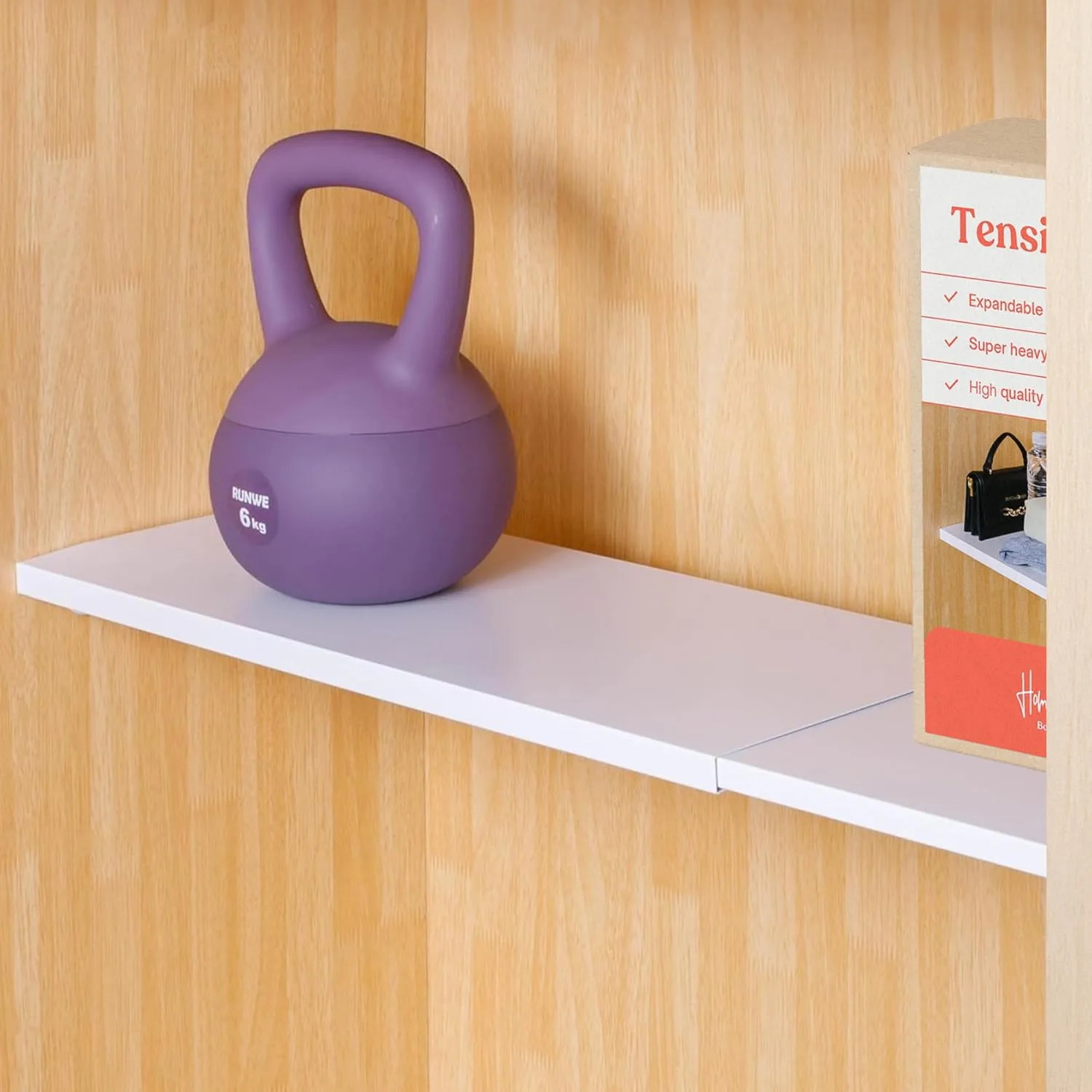
A no-drill expandable tension shelf gets you the same tiering with zero holes and lands comfortably at the budget end of the category. It’s the no-drill renter friendly route in its purest form: it expands to the width of your gap, holds itself in place by pressure, and comes down in about a minute when you move out. The trade-off is honest: a tension shelf carries less than a mounted system and it doesn’t love a load that swings, so it’s for bins and bottles, not for a cast-iron anything.
The Door, the Gap, and the Floor
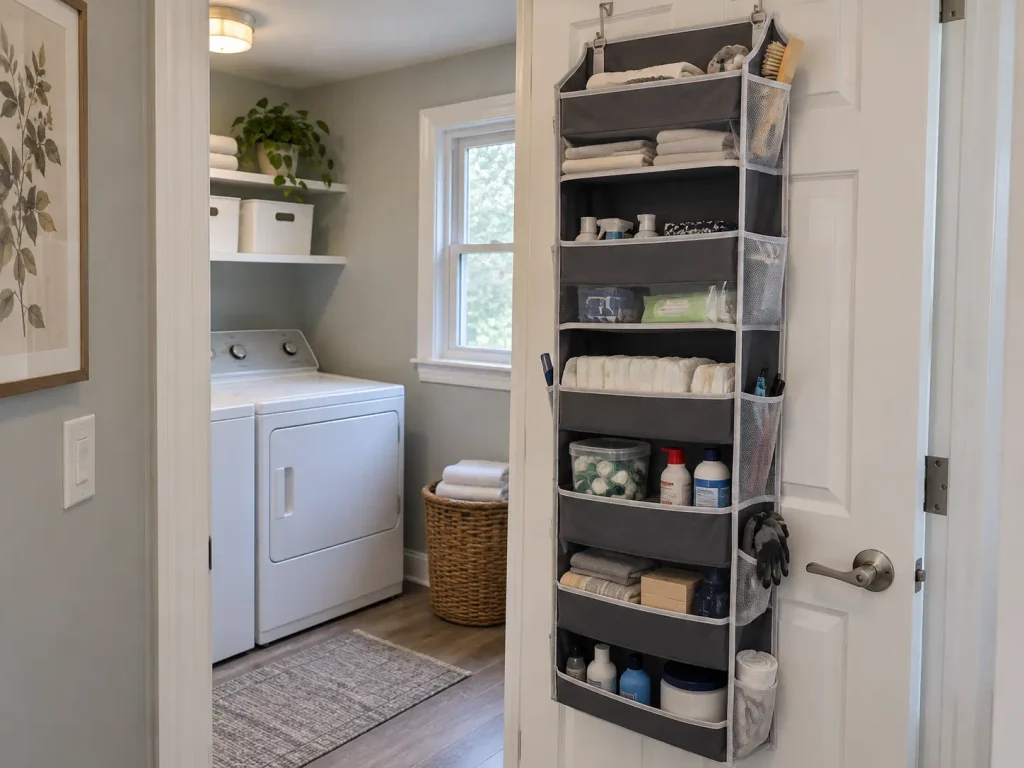
These are the leftovers everyone forgets: the back of the door, the slot beside the machines, and the floor space a drying rack eats on every single wash day.
None of the three deserves a section of its own. Together they’re probably a third of this room’s usable capacity. One thing deliberately not on that list: a folding station. If your machines are side-by-side, their tops already are your folding surface and your folding zone, and a countertop over washer dryer is a renovation, not an organizing move. A short clothing rod above machines is the cheaper version of the same idea, and it earns its space only if you actually hang things straight out of the dryer.
The back of the door
If your laundry room has a door, you have a free vertical surface that most people never touch. Over-door organizers in this class carry a total capacity around 44 lb spread across their pockets, which is enough for detergent pods, stain sticks, mesh bags and a full box of dryer sheets, provided you spread the load rather than loading two pockets and leaving the rest empty. Concentrated weight is what makes these sag and pull.
Two disqualifiers to check before you order, both of them cheap to check and expensive to ignore. First, door material: a hollow-core interior door and a heavily loaded over-door hook are a poor pairing, because the top rail is where the whole load transfers and hollow-core doors compress there over time. Second, clearance: measure the gap between the door and the frame when it’s closed, because an organizer that’s a half inch too thick means a door that no longer latches, and a laundry room door that won’t close is worse than a cluttered shelf.
For the door-back zone, the ULG Over Door Organizer is the version that matches the capacity this section is talking about: five large pockets plus ten mesh ones, sized for standard interior doors, with the mesh letting you actually see what’s in each pocket instead of reaching blind. The limitation is the shape of the product, not the build — pockets are great for bottles, pods and flat boxes, and useless for anything rigid and bulky like a vent brush.
The gap that may not exist
This is where the measuring section pays off. Go back to your second number, the usable gap after the clearance subtraction. If what’s left is a few genuine inches of gap between washer and dryer or between machine and wall, you’ve got a real zone and a narrow pull-out is the right tool for it. If what’s left is the one-inch ventilation clearance and nothing more, then this zone doesn’t exist in your room and the honest answer is to leave it empty and put your effort into the door instead.
Assuming you have the inches: a genuinely slim rolling cart turns a dead slot into pull-out storage, which matters because a narrow fixed shelf in a narrow gap is functionally unreachable. The SOLEJAZZ Slim Rolling Storage Cart runs about five inches wide across four tiers, which is the range that actually fits a real gap rather than an idealized one. Roll it out, take what you need, roll it back. The caveat is flooring — on thick vinyl or an uneven laundry-room floor, small casters drag, and a cart you have to wrestle out is a cart that stays put with everything behind the front tier forgotten.
Getting drying off the floor
A floor-standing drying rack is the single biggest floor thief in a small laundry room, and its worst quality is the timing: it gets deployed exactly when the room is busiest, so on wash day you lose half your standing space at precisely the moment you need to stand somewhere. Then it stays up for two days because taking it down and putting it up again is a chore, and by then it’s furniture.
A wall-mounted rack that folds flat solves this properly, and this is the one place in the article where mounting genuinely beats no-drill on merit. I’d rather say that than pretend every solution in this room is renter-friendly. The Vikaqi Wall Mounted Clothes Drying Rack runs 32 inches wide and folds flat against the wall, so the floor stays clear on the six days a week you’re not drying anything. A retractable clothesline is the other version of the same idea if your run is wall-to-wall rather than wall-out.
It does mean screws in a wall and it does mean finding studs or using proper anchors, so if you’re renting, this is the one item on the list worth an actual conversation with a landlord.
Before that conversation, a reality check for the no-drill crowd, because this is the section where people reach for adhesive hooks. A Command utility hook is rated to around 15 lb, which sounds like plenty. But the folding clothes-hanger line holds about 7.5 lb across five rungs, which works out to roughly a pound and a half per rung. A single mesh bag of wet laundry quietly clears that.
The figures are published in Command’s own weight-limit guide, and the takeaway is to match the hook to the job rather than assuming a hook is a hook. Command strips, S-hooks and coat hooks all have a place in this room, and none of them is interchangeable with the others. A small pegboard on the one free wall consolidates all three if you can mount it. Wet fabric weighs far more than dry fabric, and adhesive failures in this room almost always happen at 2 a.m. with a full load on the floor.
If you’ve got a stackable washer dryer rather than a side-by-side pair, the laundry closet vs laundry room distinction matters here: a stacked closet has almost no side gap, so laundry closet organization leans on the door and the machine sides for nearly everything, and cabinet storage above is the only other route. If you’re renting and stuck on drying, the ranking is clear: the door-back and machine-side zones will carry most of your load with zero holes, so do those first and completely. The folding wall rack is the single item worth asking a landlord about, and “it folds flat and I’ll patch the four holes” is a much easier ask than it sounds.
Contain and Label What’s Left

Bins are where most people start, and that’s exactly why most people fail. A bin without a rule is just a smaller shelf, and a shelf full of small shelves is still an everything shelf. This section is short and prescriptive on purpose, because in this room the rule matters more than the container.
Categories first, containers second
The most-upvoted fix in the research wasn’t a product at all. It was a taxonomy. In an r/organization laundry-room thread, the top comment with 57 votes was to sort loose supplies into separate labeled bins by category (laundry supplies in one, cleaning products in another, paper goods in a third, miscellaneous in a fourth) instead of leaving everything loose on one open shelf. No brand, no system, no purchase. Just four defined groups.
The rule that makes it survive is that every bin gets a definition, and the miscellaneous bin gets a hard size limit. An unbounded miscellaneous bin eats the system exactly the way a “misc” section eats a junk drawer: everything that doesn’t have an obvious home goes there, which means everything eventually goes there, which means you’re back to digging. One bin, and when it’s full, you sort it instead of getting a second one.
On shape, deep beats wide in this room specifically. The usable depth above your machines is generally there, since a laundry closet runs deep enough for the machines themselves and the shelf above follows the same run, while the width is whatever the closet gives you, which is rarely generous. Deep bins that pull out like drawers use that depth. Wide shallow trays waste it. Felt storage bins are the softer option if the shelf is at eye level and you’d rather not look at plastic, though they slump when half empty.
If you’re buying rather than repurposing, the mDesign Deep Plastic Storage Bin 4-Pack matches that depth-over-width constraint and stacks, which gives you a rough second tier if a real one isn’t happening. The honest caveat: deep plastic bins are easy to overfill, so the category rule has to come first, or you’ve just bought four smaller everything shelves.
And the anti-sell, stated flatly: bins you already own work. Shoeboxes work. A cut-down cereal box works and nobody who opens that door is going to file a complaint. The categories are the product here. Matching containers are optional and always have been. They photograph well and they solve nothing that four labeled shoeboxes don’t.
Label them for everyone else in the house
Label the bins. Yes, even though you know what’s in them.
The labels aren’t for you. They’re for whoever else in the household is putting things away: the partner who’s genuinely trying, the teenager doing their own laundry for the first time, the person watching your place while you’re gone. A system only one person can operate reverts the first week that person is busy, and that’s not a character flaw in anybody, it’s just what happens when the rules live in one head.
A label maker is nice. A piece of masking tape and a Sharpie is fine. What matters is that the label states the category in the words your household actually uses. “Detergent + pods,” not “laundry care,” because a label nobody understands is decoration.
Keep the Room from Refilling
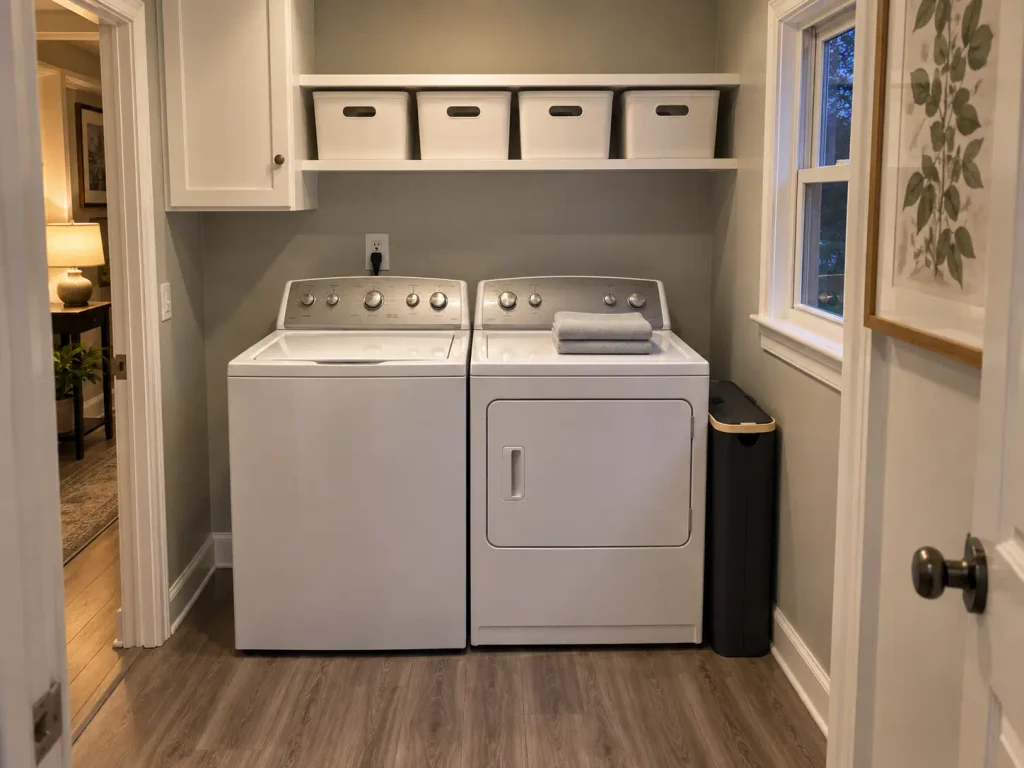
The “after” photo is not the finish line. Every article ranking for this keyword stops at the reveal: here’s the room, look how good, the end. None of them tell you what this system needs in three months, which is the only question that determines whether you’re back here next spring searching the same thing.
The three-month check
This is the three-month test the whole article has been building toward. The check takes about ninety seconds and you only need one data point: look at the flattest surface in the room. Usually the top of the dryer. Whatever has collected there is an item without a home, and that’s not a discipline failure, it’s the system telling you exactly which zone is under-built. Three bottles of something on the dryer top means your daily-reach tier is full. A pile of mesh bags means they never got assigned anywhere. Fix the zone, not the pile.
Watch for one specific drift pattern, because it’s the most common way this room comes apart. The daily-reach tier creeps upward. The magnetic caddy slowly fills with things that aren’t daily-reach items (a lint roller you used once, a bottle of spray you meant to return to the kitchen), so the detergent gets bumped to the shelf above, then to the top tier, then onto the dryer because the top tier needs the stool. When you catch the detergent somewhere other than arm’s height, the zoning has drifted and the reset takes five minutes.
That’s the whole maintenance routine. It’s a five-minute job, not a reorganization, and it works best attached to something you already do: the last load of the week, while the dryer’s running. Not scheduled. Attached.
The sock bin and other small rules
Then there’s the orphan sock, the most common unsolved micro-problem in this room, addressed by exactly one of the five articles currently ranking for this keyword. Every household has a drift of unmatched socks and most have no rule for them, so they accumulate on a shelf, in a basket, in the bottom of the hamper, forever.
One small bin, call it the lost-and-found bin. One rule: anything unmatched lives there until the next full wash cycle, then it goes. That’s it. The bin has to be small, because a big one just postpones the decision by six months, and the rule has to have an expiry date or you’ve built a sock museum.
The last small rule is the one that matters most and it’s about where the dirty clothes live. In an r/HomeDecorating thread about tiny laundry rooms, several commenters pushed back on the common instinct to use the laundry room itself as the hamper zone. One put it plainly: it doesn’t make sense to store dirty clothes in the laundry room. They’re right, and the logic is spatial. In a small room, a pile of dirty laundry is the single largest object in it, and once it’s there, everything else gets arranged around it. Sort before the room, not in it.
Sorting hampers are the fix, and if a second hamper won’t fit, laundry bags by category hung on a hook do the same job in less space. A slim lidded hamper where the clothes actually come off is what makes that work. The SpaceAid Slim Laundry Hamper with Lid runs 16 by 8.75 by 28 inches, which fits against a bedroom wall or inside a closet without claiming floor space, and the lid is the part that does the real work: an open basket becomes a pile, and a pile spreads. The caveat is that a lid only helps if the hamper is where people undress — put it in a hallway and it becomes a decorative box while the clothes go on the chair.
Conclusion
Three things to carry out of this, and none of them start with a purchase.
Empty the room before you measure it, and measure it before you buy anything. The clearance your machines need is not storage, and the inch beside the washer belongs to the washer.
Work the zones in order of payoff. Machine sides first, because they’re free, renter-safe and at arm’s height. Then vertical, in two shallow tiers rather than one deep one. Then the back of the door. Then whatever gap actually survives the clearance subtraction, which in a stacked closet is usually nothing at all.
Categories beat containers. A labeled bin with a definition outlasts a matching set without one, and the miscellaneous bin needs a size limit or it wins.
In three months, look at the flattest surface in the room — the top of the dryer, almost always. Whatever has collected there is an item that never got a zone, and assigning it one is the only repair the system needs.
Start with the sides of your machines. It costs nothing, it takes about ten minutes, and it’s the zone you’ll touch every single wash day.
Frequently Asked Questions
01How can I effectively organize a small laundry room?
Work the five dead zones in order of payoff rather than adding more shelving. Declutter first, then use the machine sides, the vertical space above, the back of the door, and whatever gap survives the manufacturer’s clearance requirement. Assign each zone one job and the room stops refilling.
02What are some ideas for a very small laundry room?
In a genuinely tiny space or a stacked closet, vertical and door-back storage are the only real expansion room, because the side gap is usually structural clearance rather than usable space. Lead with magnetic machine-side organizers and a tiered no-drill tension shelf above the machines.
03What are some good cabinet ideas for a small laundry room?
Shallow beats deep, and anything freestanding gets anchored to the wall. Two shallow tiers store more usable supplies than one deep cabinet, because a deep shelf hides its own back row within a month. Anchor for vibration, not just for weight.
04How do I organize a laundry room without drilling any holes?
Magnetic organizers on the machines’ steel sides, an over-the-door organizer, and expandable tension shelving cover most of it with zero wall damage. Match adhesive hooks to their rated weight, since a utility hook and a folding-hanger rung are not the same rating.
05Where should dirty clothes go in a small laundry room?
Sort before the room, not in it. A slim lidded hamper where the clothes actually come off keeps the laundry room from turning into the hamper, which is the fastest way a small one becomes unusable. In a small room, a laundry pile is the largest object in it.
Disclaimer: ClutterlessNest is a participant in the Amazon Services LLC Associates Program. As an Amazon Associate we earn from qualifying purchases. This article may contain affiliate links — if you buy through them, we may earn a small commission at no extra cost to you. We only recommend products we have tested or genuinely believe in.