The shelf went up on a Saturday and looked perfect by Sunday. Two years later the bottom edge has swelled into a lip you can catch a fingernail on, and there are rust freckles where the bracket meets the wall. Nothing on the box warned you, because the box was written for a hall closet. The best laundry room organizers are not the ones that photograph well on install day, they’re the ones still square after four hundred loads of hot, damp air.
That makes laundry room storage a different shopping list from every other room. Below, the picks are sorted by the constraint you actually have: the space above the machines, the gap beside them, whether your lease lets you drill, and how many people’s clothes land in that room.
Quick Answer
There is no single best organizer, only the best one for your constraint. Pick by the problem you actually have:
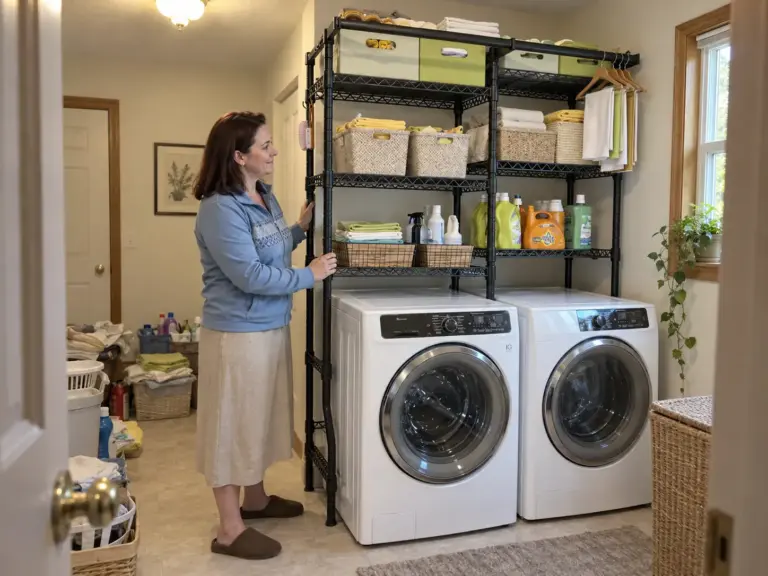
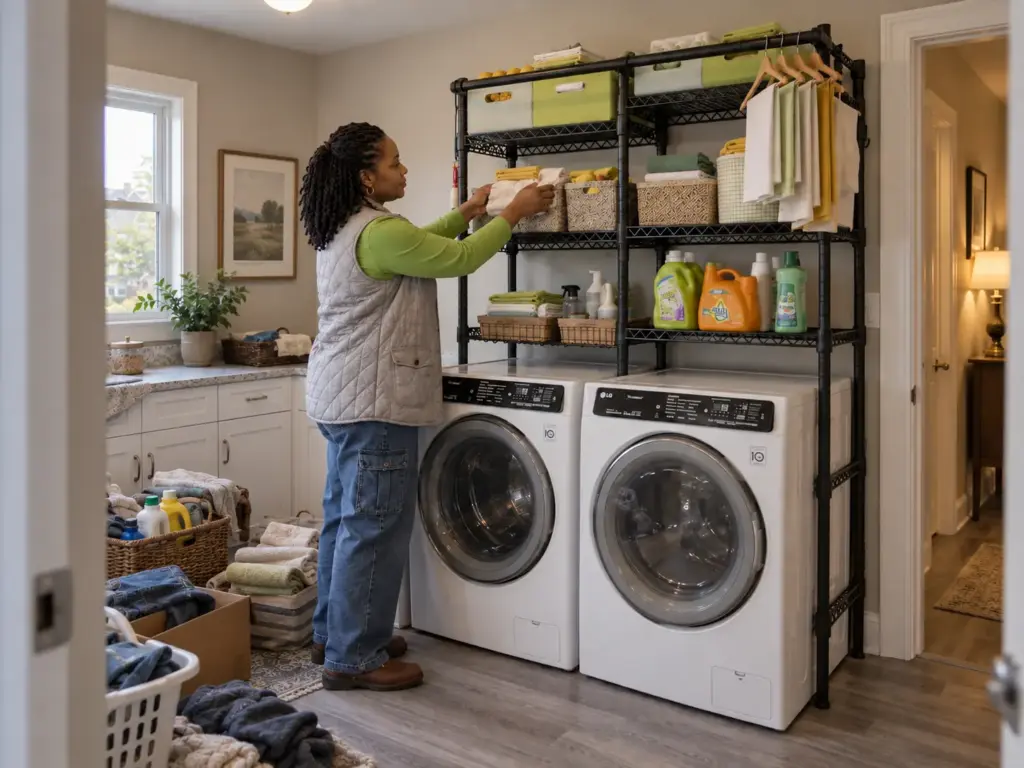
- Dead vertical space above the machines: a 6-tier standing over-appliance unit
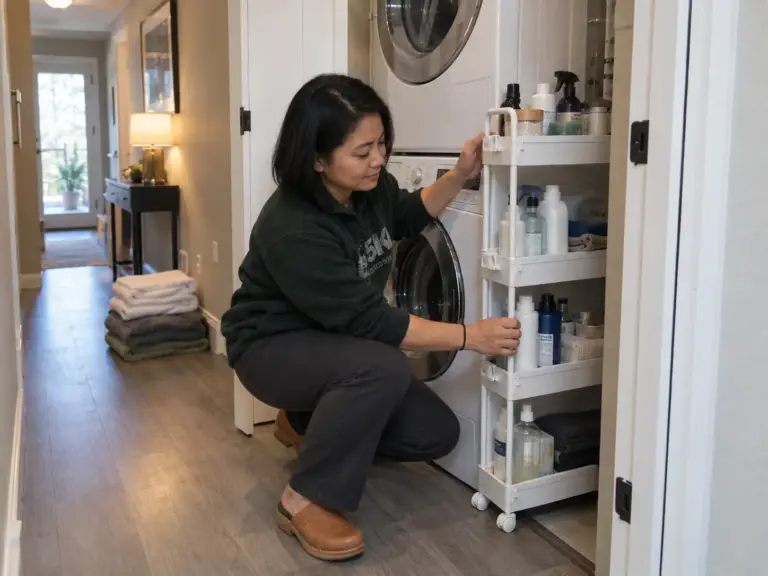
- The narrow slot beside the machines: a rolling cart about 5 inches wide
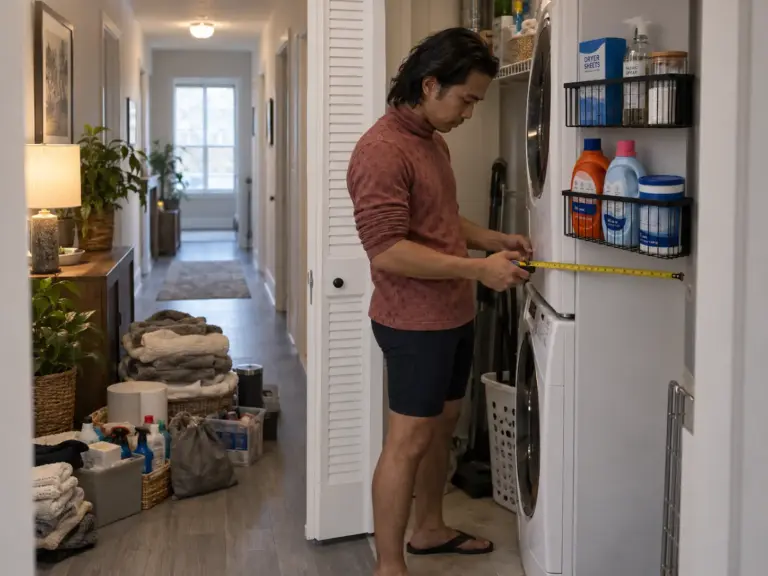
- No drilling allowed: a magnetic shelf on the appliance casing
- Wet clothes with nowhere to go: a fold-flat wall-mounted drying rack
- Detergent chaos: clear stackable bins sorted by how often you reach for them
- One person vs. a family: a slim single hamper, or a 3-section sorter on wheels
Why Laundry Room Organizers Fail Faster Than Closet Organizers
Everyone buys the organizer for the space they can see. Almost nobody buys for the air. A single load of wet laundry releases roughly 1.5 to 2.2 liters of water vapor as it dries, and in a room without real ventilation, relative humidity can climb past 80% and sometimes near 90%, according to data published by indoorhumidity.com. That number is the whole reason this article exists.
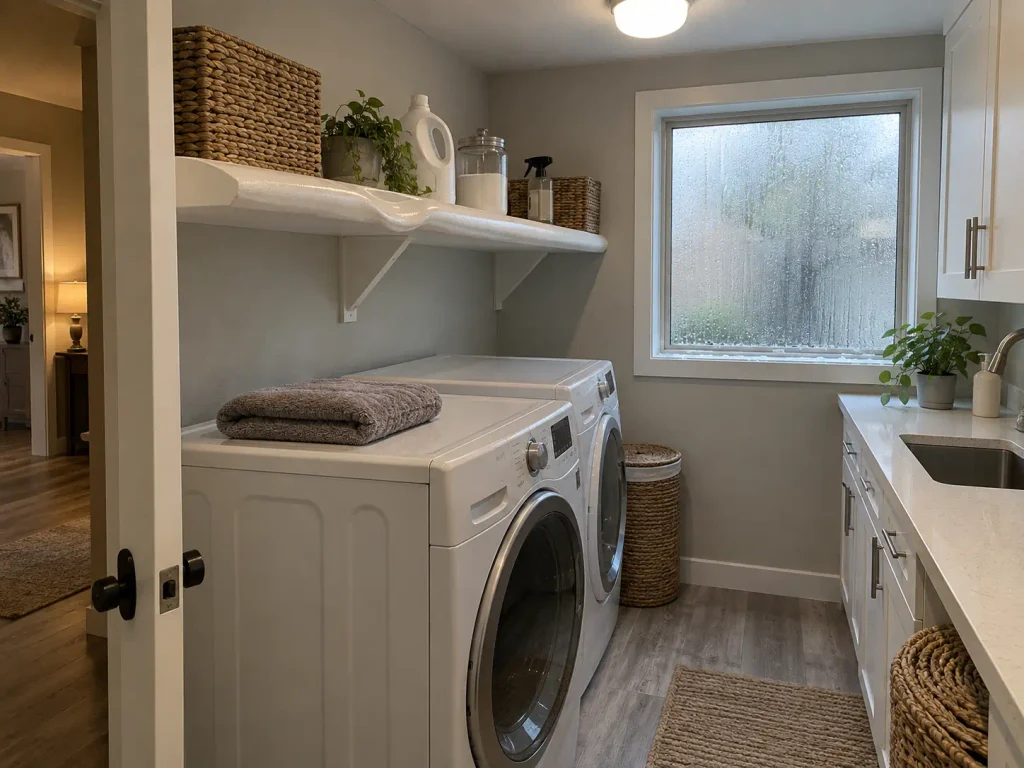
In a small laundry closet the effect concentrates. If your washer and dryer live in a laundry closet that’s barely wider than the machines, all that vapor gathers in maybe forty cubic feet of air with a door on it, and it settles into whatever you hung on the wall.
So when the wire rack you moved from the linen closet starts flaking two years in, the rack didn’t fail. The room won. Most people blame the product, buy the same product again, and run the same clock a second time. Here is what is actually happening to three common materials.
What a Single Drying Load Does to the Air in the Room
Think about the physical path that water takes. It goes into the drum wet, it comes out of the vent as heat and steam, and in a small closed room a meaningful share of it never makes it outside. It lands on cold surfaces, which in a laundry room means metal brackets, screw heads, and the raw cut edges of anything made of compressed board. Then the cycle ends, the room cools, and the moisture sits there until the next load reheats it.
That heat exposure followed by cooling, repeated a few hundred times a year, is the mechanism. It’s not one dramatic flood. It’s a slow, patient wetting and drying that no closet shelf was ever designed around. And it explains why the same organizer can last a decade in a bedroom and three seasons here.
Particle Board Swells Once and Never Comes Back
This is the one that surprises people, because it feels like a drying problem and it isn’t. Particle board has no long wood fibers to resist swelling, so once moisture works into the core, the swelling is permanent and does not flatten back out when the board dries, per woodworkingadvisor.com. You’ll see it first at the unfinished back edge and at the screw holes, where the laminate doesn’t seal anything.
That makes a cheap laminate shelf above the washer a countdown rather than a maintenance item. There is no sanding it, no clamping it, no waiting for a dry month to fix it. If a shelf in this room is going to be board, it needs to be sealed on every face and every edge, including the ones nobody sees. Otherwise choose plastic, resin, coated metal, or solid wood and skip the whole problem.
Wire Shelving and the Two-to-Three-Year Rust Clock
Laundry room shelving in bare painted wire is the default recommendation in almost every organizing article, and in almost every other room it’s a fine answer. Here it corrodes: rust spots typically show up within two to three years in a room that heats up every cycle, and metal fixings start showing early rust at sustained humidity above 70%. That wire rack corrosion starts at the joints, because that’s where the welds are and where a hanger scrapes.
Rust on a wire shelf almost always starts at the cut ends of the rods, where the factory coating is thinnest. Check those ends at the one-year mark. A rust spot there is not cosmetic, it is the shelf telling you the coating is gone and the rest is next.
You’ll notice competitor articles never show you any of this, and that’s not a conspiracy, it’s just how photo listicles work. The picture is taken the week the room is finished. The second year has no photographer in it. From here on, every pick in this article passes one filter: plastic and resin over bare painted wire, metal-on-metal mounting over adhesive, and sealed or solid surfaces over particle board.
Best Over-the-Washer-and-Dryer Shelving
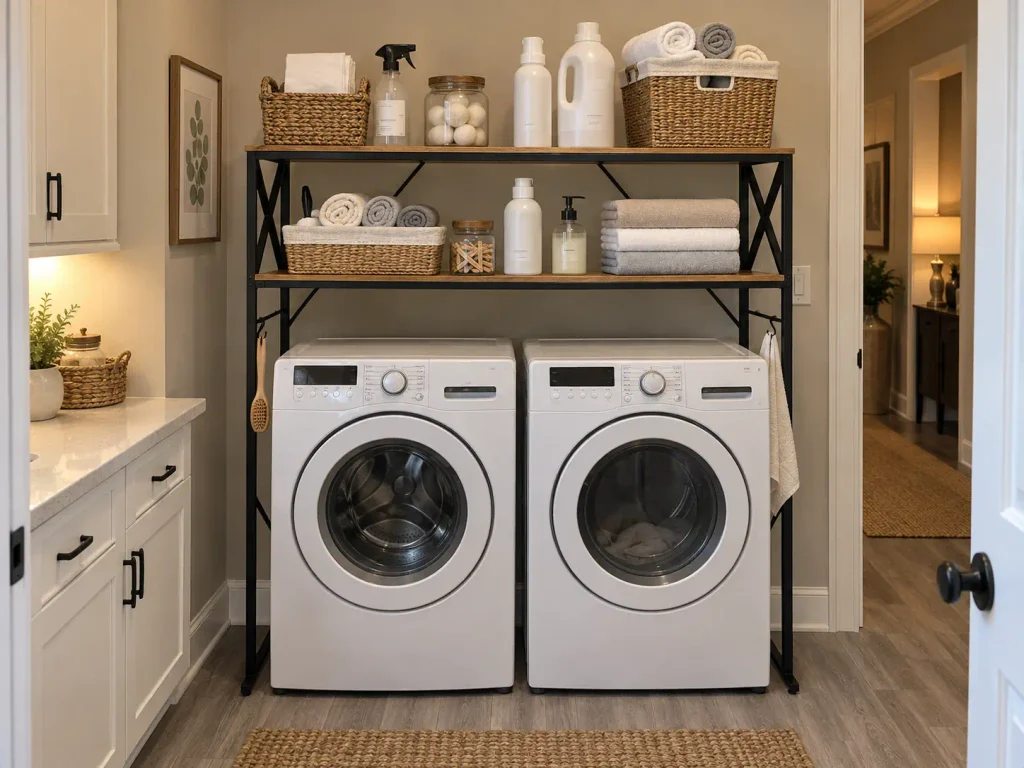
The space above a washer and dryer is the biggest piece of dead air in most homes, and the standard fix wastes most of it. A 2-tier floating shelf fills the bottom two feet of that wall and leaves everything above it empty. In a room with normal ceiling height, that’s more wall abandoned than used.
The Dead Space Nobody Fills Above the Machines
The gap above your machines is a vertical space, but people keep buying horizontal solutions for it. That’s the mistake in one sentence. A single shelf at eye level is shaped like a shelf, not like the room, and once you put the detergent on it you’re done thinking about the four feet of wall above. Upper cabinets and ceiling-height cabinets solve it properly, but both are a renovation, not a purchase.
Before buying anything, there’s a free version worth checking. The top-voted answer in an r/organization thread asking for help with a laundry closet was to put a counter over the washer and dryer for a cohesive folding surface. A countertop over washer dryer is the fix, and it doesn’t have to be a bought one.
If you already have a board, a butcher block countertop offcut, or an old tabletop, and the machines sit level, that’s the zero-cost move that solves folding in an afternoon. Do that first, then decide whether you still need shelving.
Standing Units vs Wall-Mounted Shelves in This Room
If you do, standing beats mounted here for a reason that has nothing to do with strength. Which is a reversal worth naming, because mounted is the usual recommendation and in most rooms it’s the right one.
A unit that stands over the machines doesn’t involve your walls at all, which means it doesn’t involve your lease, your stud placement, or your drywall anchors. It also means the humidity has no screw holes to work into. For a full framework on which fixes need a drill and which don’t, the sibling guide on laundry storage sorted by what you’re allowed to drill covers that split in detail.
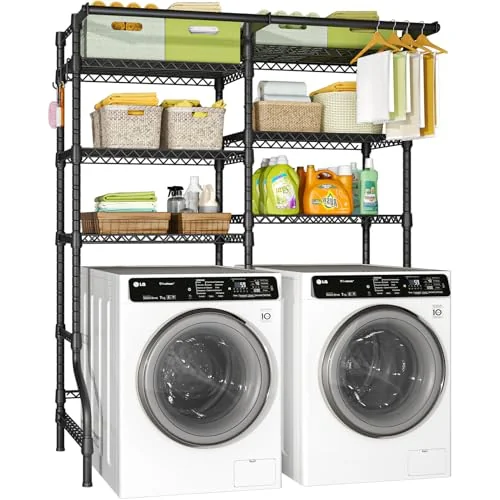
One safety note that belongs with any tall standing unit, especially in a room kids and pets wander into. According to CPSC’s Anchor It campaign, “Anchor TVs and furniture, such as bookcases and dressers, securely to the wall.” A tall shelving frame loaded with jugs of detergent is exactly that category of object, and a strap into one stud is a five-minute job.
The unit not needing the wall to stand is a convenience. It isn’t a reason to skip the anchor.
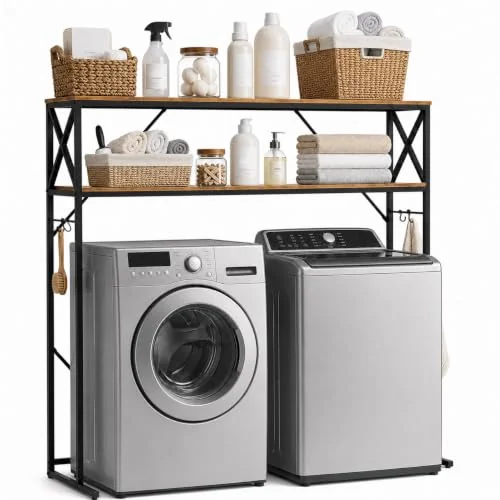
Not everyone needs six tiers. If you only want the bottom of that wall covered and the rest of it can stay empty, the budget-friendly organizer below does the same over-appliance job for less.
When a Counter Over the Machines Beats Both
Worth repeating, because it’s the answer more people should take. If your real complaint is that you have nowhere to fold, shelving doesn’t fix that. A flat surface does, whether that’s a counter across the machines or a small folding table against the opposite wall. Shelving adds storage above a problem that lives at waist height, and you can end up with a beautifully stocked wall and still be folding on the bed in the next room.
Best Organizers for the Narrow Gap Beside Your Machines
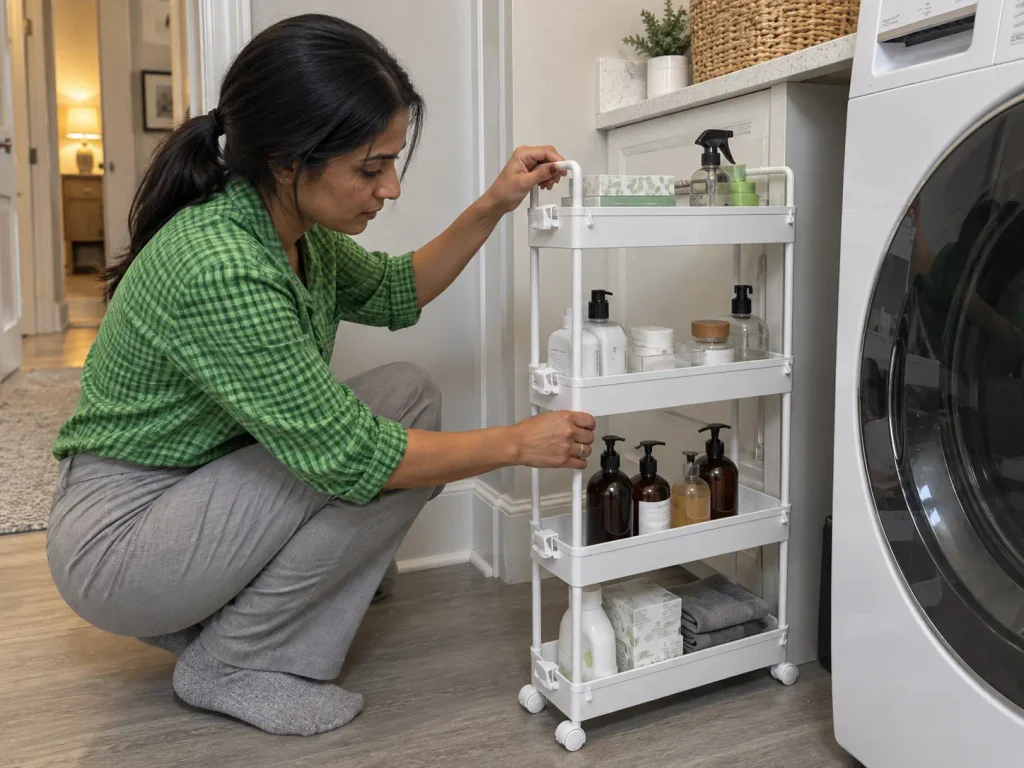
This is the slot where socks go to disappear and where nobody has ever put a tape measure. Narrow gap storage is also where the most returns happen, for a reason that’s easy to miss on a product page.
What “Slim” Actually Means on a Product Page
The gap beside or between a side-by-side washer and dryer typically runs about 4 to 7 inches. Meanwhile, a slim storage cart sold specifically for the space between washer and dryer comes in widths from roughly 4.7 inches to 9.8 inches. Read those two ranges next to each other and the problem is obvious: a cart can be honestly, sincerely advertised as slim and still be two inches too wide for your house. “Slim” is a marketing word, not a measurement.
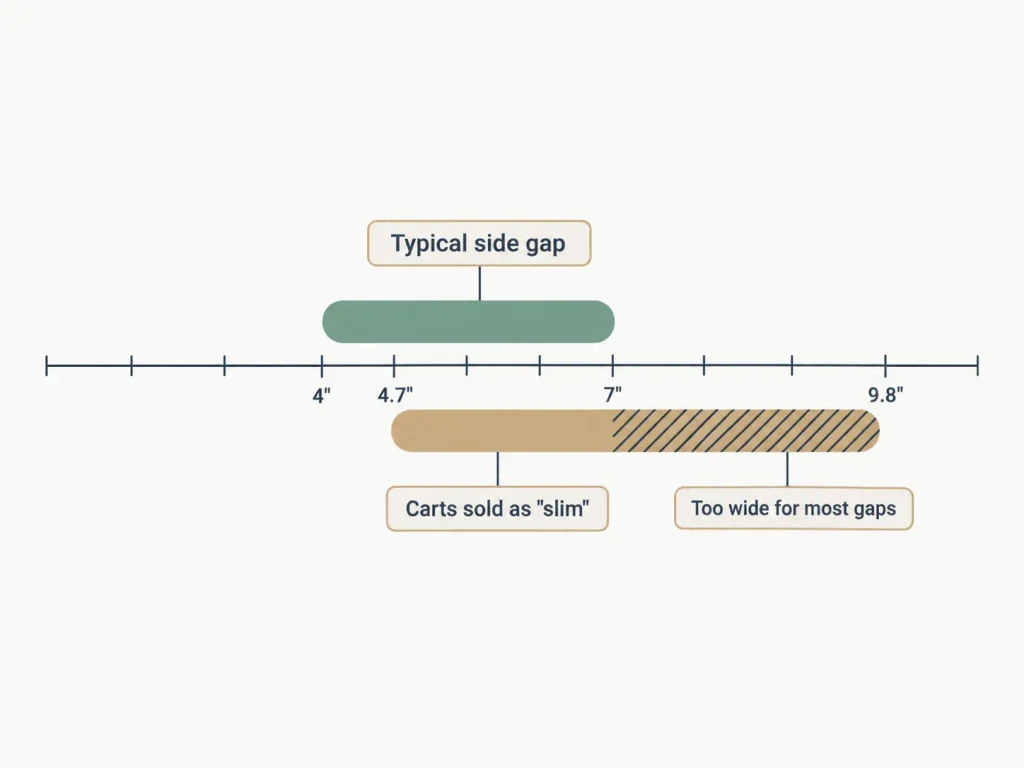
The fix is not to find a better brand. It’s to stop shopping by adjective. Get the number off your own floor, then filter by that number and ignore every word on the listing.
Measure at the Narrowest Point, Not the Front
Here’s the part that catches even careful people. The front of that gap is the widest part of it. Behind the machines you have hoses looping out, a drain standpipe, sometimes a dryer vent elbow, and a wall plate for the outlet. Any one of those can eat an inch or two of clearance at exactly the depth where the back wheel of your new cart needs to sit.
So measure at the tightest point along the full depth, not at the opening. Then subtract a quarter inch for the fact that machines vibrate and walk slightly over years of use. A cart that fits with zero tolerance today becomes a cart that scrapes by spring.
Cut a strip of cardboard to the exact width you measured and slide it all the way to the back wall before you order anything. If it goes in clean, your number is real. If it catches halfway, you just found the hose you forgot about, and you saved yourself a return.
Why Wheels Beat Extra Tiers in a Deep Gap
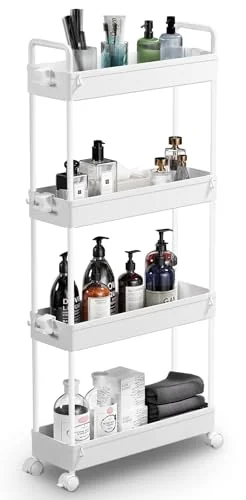
Tier count is the spec people compare, and in this specific slot it’s the wrong one. The gap beside a washer is often two feet deep, which is deeper than your arm is useful. A fixed shelf in there means the back half becomes a place things go and never return from. Wheels turn the whole column into a drawer you pull toward you.
If you’re choosing between a 5-tier cart with hard plastic feet and a 4-tier cart on casters, take the casters. A cart you can’t pull out is a cart you’ll stop using by the second month, and then it’s just a narrow object collecting lint.
Best No-Drill Organizers for Renters
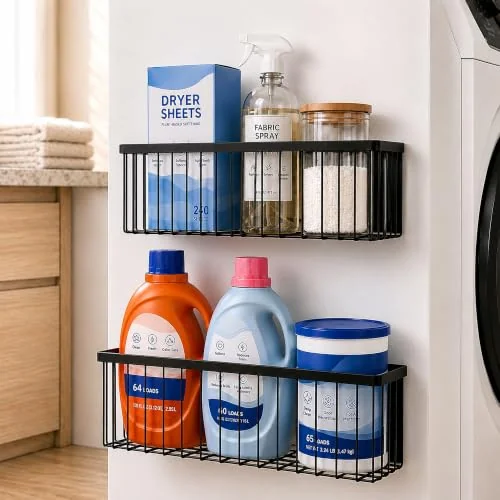
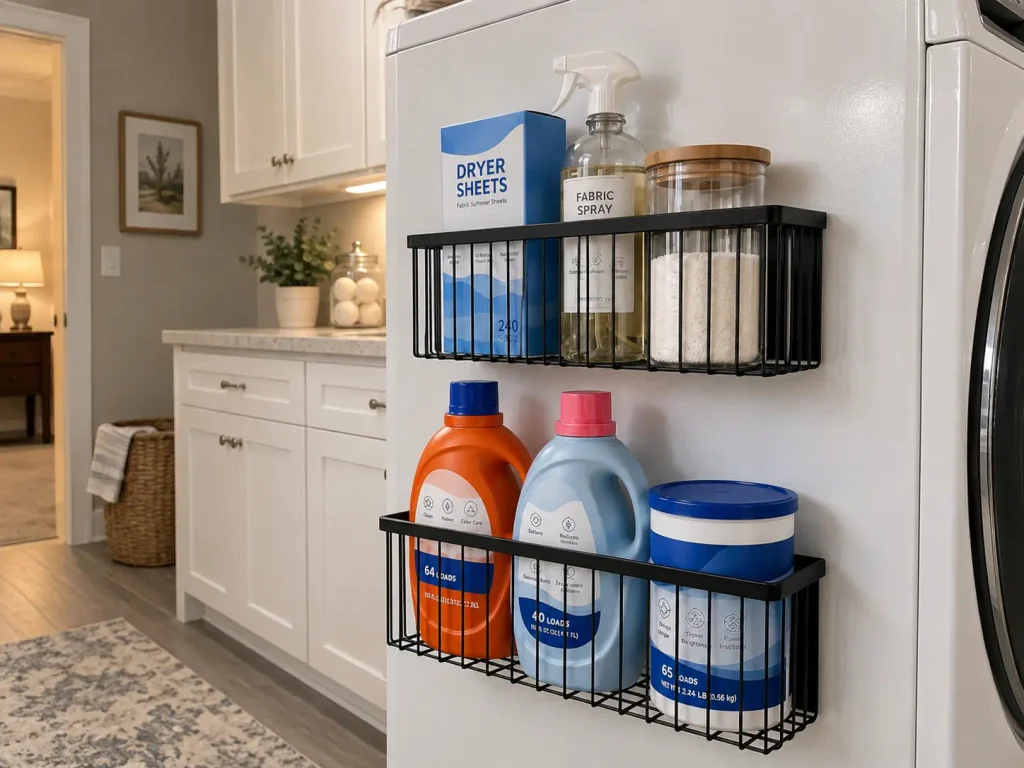
Ask a tiny-laundry-closet thread how to fix the room and the top answer comes back short and a little smug: magnetic organizers, and Amazon is your friend. It’s the single most-upvoted reply in those threads, and it points at something most organizing advice walks right past.
The Mounting Surface That Only Exists in This Room
Your washer and dryer are big steel boxes. That’s a mounting surface, and it belongs to you in exactly the way the wall doesn’t. No other room in the house hands a renter a free vertical panel that holds magnets, which is why this fix doesn’t show up in generic organizing guides. They’re writing about bedrooms.
The conventional advice for renters is command strips and tension rods, and both work fine for what they’re rated to do. But in this room they’re the second-best answer, because the first-best is sitting right there with a painted steel side panel doing nothing.
Where Adhesive Hooks Stop Being an Option
Adhesive hooks get recommended for every rental problem, so it’s worth reading the manufacturer’s own number instead of the aisle’s reputation. Command’s ratings top out at 7.5 pounds for its Jumbo Utility Hook. That’s the ceiling, from the company that makes them, in a dry room at room temperature.
A light garment bag fits under that. A drying rack full of wet jeans does not, and wet laundry is heavier than almost anyone estimates. Add a humid wall that the adhesive is slowly losing its grip on, and the failure isn’t a question of whether, only of what night. Anything with real weight needs the floor or the appliance, not a sticker on drywall.
What Renters Mean by “Renter Friendly”
The phrase gets used loosely by manufacturers and precisely by renters, and the gap between those two definitions costs people their deposits. In rental threads, renter friendly means one thing: it comes off without a trace at move-out. Easy to install is not the same claim. A giant adhesive strip is extremely easy to install and can take a sheet of paint with it eighteen months later.
Judge a product by what it looks like coming down, not going up. If you want the full walkthrough rather than a single pick, the sibling guide covers emptying the closet out first without drilling a single hole.
Best Drying Racks and Supply Storage That Hold Up
Two daily-use categories left: where wet clothes go, and where the detergent lives. Both have a default answer most people accept without noticing what it costs them.
Why a Floor Rack Costs You the Room Six Days a Week
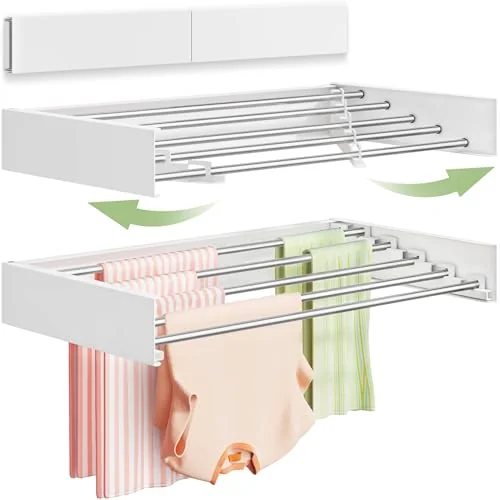
A floor drying rack is furniture you walk around all week for the two days you actually use it. In a room where the walking space is measured in single feet, that’s a real tax. Worse, the folded rack has to go somewhere, and “somewhere” is usually leaning against the wall in the corner where it stays permanently half-unfolded.
A wall-mounted rack that folds flat solves the footprint problem outright, because it reclaims its space the moment the clothes come down instead of when you remember to put it away. A clothes rod mounted across the room does the same for anything on hangers, and it beats a hanging dryer that has to be taken down every time.
The Cup-Holder Fix for a Sticky Shelf
Now the supply side, and it starts with the cheapest fix in this entire article. An open shelf above the machines turns into a sticky ring within about a month, because detergent bottles drip from the cap and the spout no matter how carefully you pour. One r/laundry reader keeps their Costco-size detergent and softener jugs on the open shelf with cup holders underneath to catch the drips.
Costs nothing. Solves the ring permanently. And unlike a liner, you can pull a cup holder out and rinse it in the sink.
That’s it. Steal it.
Clear and Stackable Beats Matching
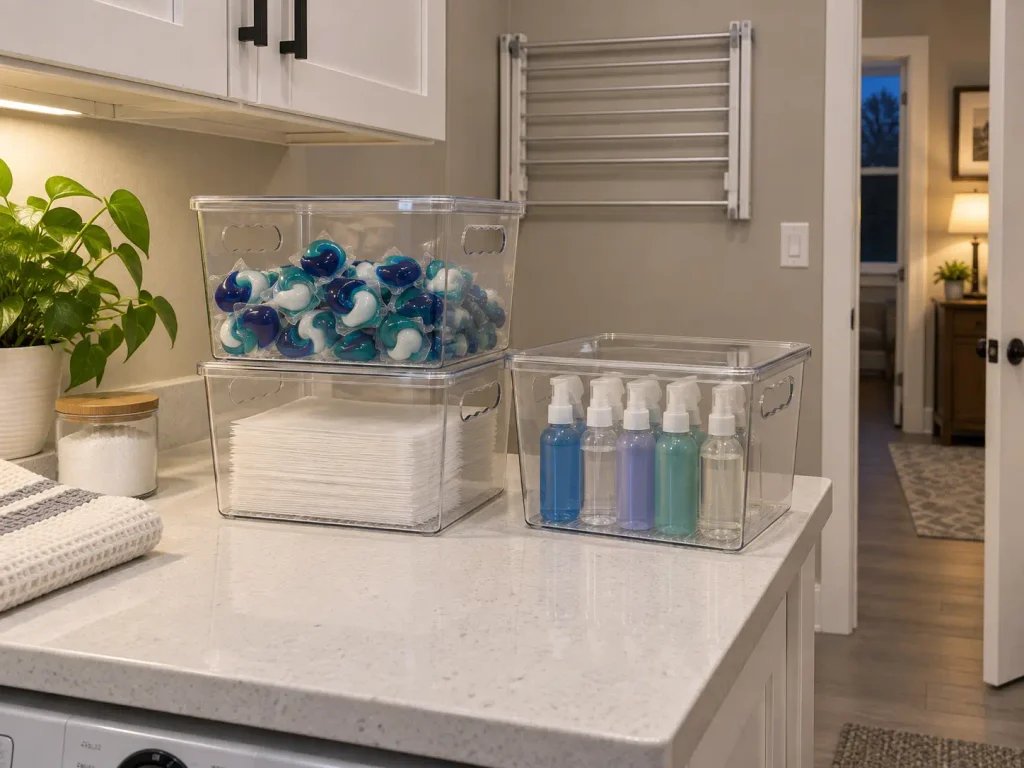
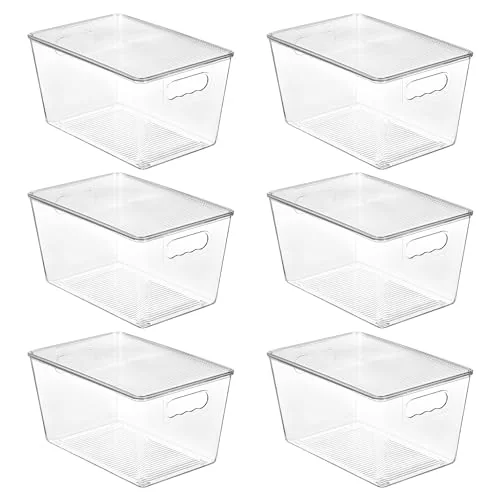
For everything smaller than a jug, the failure mode isn’t mess, it’s duplication. You buy a third bottle of stain remover because the first two are behind the dryer sheets where you can’t see them. Opaque bins are how that happens, and matching opaque bins are how it happens with better photos.
Clear containers fix it by making the inventory visible at a glance, which is the part labeled baskets only fake, and handles matter more than they sound like they do, because a bin you can hook two fingers into gets pulled down and put back. One you have to lift with both palms gets left where it is. Sort by frequency of use rather than by category: detergent storage and dryer sheets storage at the front where you reach daily, stain remover behind them, backstock storage and the seasonal stuff behind. The sibling guide rounding up the small-laundry-room ideas that were still working three months later carries that same durability test across the rest of the room.
Best Hampers and Sorting Systems by Household Size
A single hamper and a three-section sorter are not the same product in two sizes. They solve genuinely different problems, and buying the wrong one is how a sorter ends up as the place clean laundry lives for eleven days.
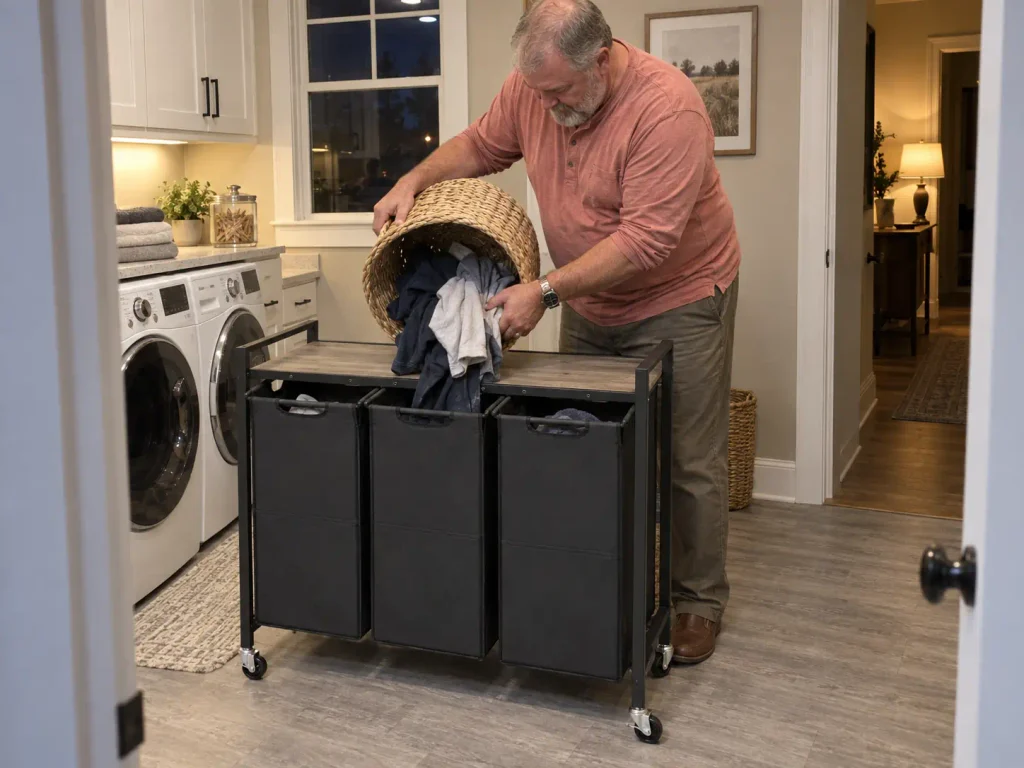
One Hamper or Three Compartments
The useful question isn’t capacity. It’s whether anyone besides you has to follow the system. One person doing laundry once a week sorts in their head while loading the machine, and three compartments just means three half-empty bins taking up floor space. A household of four cannot do that, because sorting in your head only works if there’s one head.
So the rule is simple: sort compartments to people, not to volume. If two or more people put clothes in, compartments earn their footprint. If it’s only you, sorting bins are three half-empty boxes and a single hamper wins.
If a compartment has no rule, it becomes the miscellaneous compartment, and the miscellaneous compartment always wins. Label all three by what goes in them (darks, lights, towels and sheets) rather than by whose they are. People follow a rule about fabric. They argue about a rule that sounds like chores assignment.
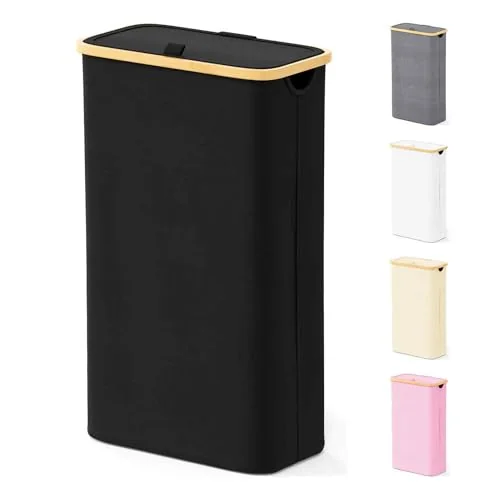
Narrow Enough for the Gap, Deep Enough for a Full Load
For one person or a genuinely tight room, the trick is finding narrow that hasn’t also given up capacity. Plenty of slim hampers are slim because they hold two-thirds of a load, which means you’re running the machine half-empty or leaving the overflow on the floor.
Why a Loaded Sorter Needs Wheels
For a household, the sorter only works if everyone uses the right compartment, which means it has to live where people undress, not where the machines are. That’s the constraint nobody plans for, and it’s why wheels stop being a nice extra.
A loaded three-section sorter is heavy in a way an empty one gives you no warning about. Drag it once across a tile threshold and you’ll leave it where it lands, and from that day it’s a piece of furniture rather than a system. A rolling hamper, or in this case a multi-compartment hamper on casters, stays mobile enough to live in the loop between bedroom and machine.
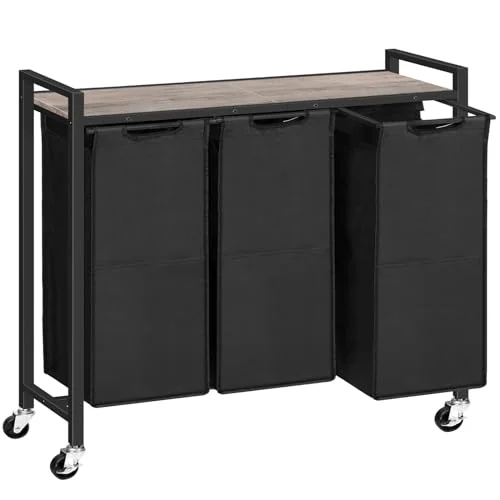
Whichever one you buy, the failure mode is identical. One compartment fills faster than the others, the overflow starts going into whichever bin has room, and within a season the sorting is gone and you’re back to one big pile with extra steps.
Buy for the Room, Not for the Photo
Three things to carry out of here. First, the room is the variable nobody accounts for: particle board and bare painted wire lose to heat and humidity in a laundry room in a way they simply don’t in a bedroom closet, so material comes before style in every one of these decisions. Second, measure the gap beside your machines at its narrowest point before you trust the word slim on any listing, because that word legitimately covers a five-inch spread. Third, if your lease rules out drilling, the appliance casing is a mounting surface you already own, and almost nobody uses it.
In three months, go look at three specific things: what’s showing rust at the cut ends, what’s swollen along an unsealed edge, and which hamper compartment filled first. Those three answers tell you whether you bought for the room or just for the install-day photo, and they tell you before the failure becomes permanent.
Start with whatever has already failed. Replace that one thing, give it a full season of loads, and see whether the replacement is still square. Then move to the next.
Frequently Asked Questions
01What is the best laundry organizer?
There isn’t one. The best laundry organizer depends on whether you can drill, how wide the gap beside your machines is, and how many people’s laundry lands in the room. Over-appliance shelving for dead vertical space, a slim rolling cart for the side gap, a magnetic shelf if your lease says no holes.
02What is a good organizer for laundry room supplies?
Clear, stackable bins with handles, so you can see what you already own instead of buying a third stain remover. Sort by frequency rather than category: pods and dryer sheets at the front, backstock behind. For jugs on an open shelf, set cup holders underneath to catch the drips.
03What is the best way to organize a laundry room?
Work in the order the room wastes space: the vertical space above the machines first, then the narrow gap beside them, then the wall. Most people start with the hamper because it’s the visible mess, which fills the floor and leaves the biggest empty surfaces untouched.
04Do laundry room organizers rust?
Bare painted wire shelving does, typically within two to three years in a room that heats up every cycle. Metal fixings show early rust at sustained humidity above 70%, which a laundry room reaches easily. Choose plastic, resin or coated metal instead, and check the cut rod ends at one year.
05What can renters use in a laundry room without drilling?
Magnetic organizers that mount to the machine’s own steel casing, plus anything floor-standing like a slim rolling cart or an over-appliance shelving unit. Adhesive isn’t the answer for anything heavy: Command’s own ratings top out at 7.5 lb for its largest utility hook, in a dry room.
Disclaimer: ClutterlessNest is a participant in the Amazon Services LLC Associates Program. As an Amazon Associate we earn from qualifying purchases. This article may contain affiliate links — if you buy through them, we may earn a small commission at no extra cost to you. We only recommend products we have tested or genuinely believe in.