You have already looked at laundry storage ideas. Dozens of them, probably, and most assumed something about your wall without telling you: that you could drill it, that there was a stud where you needed one, that your landlord wouldn’t mind a row of anchor holes over the dryer. The reason half those ideas were useless to you isn’t that they were bad ideas. It’s that nobody sorted them.
So here every solution is filed under one question first, can you put a hole in this wall, and then carries the thing it does badly, because in a laundry room the failure is usually the material and not the idea. Below are the six categories of laundry room storage solutions in the order you should actually work through them: why they fail in here, the three numbers to measure, what works without drilling, what earns a hole in the wall, what never touches the wall at all, and what keeps the whole thing alive past month three.
Quick Answer
Five storage types fit a real laundry room, and each one answers a different wall question:
- Freestanding over-appliance shelving: no drill, carries weight through the floor
- Tension-rod shelving: no drill, light loads only
- Slim rolling cart in the gap: touches no wall at all
- Wall-mounted rack or rod: drill required, clears the floor
- Fold-down work surface: drill required, disappears between uses
Why Laundry Room Storage Fails When the Same Idea Works Everywhere Else
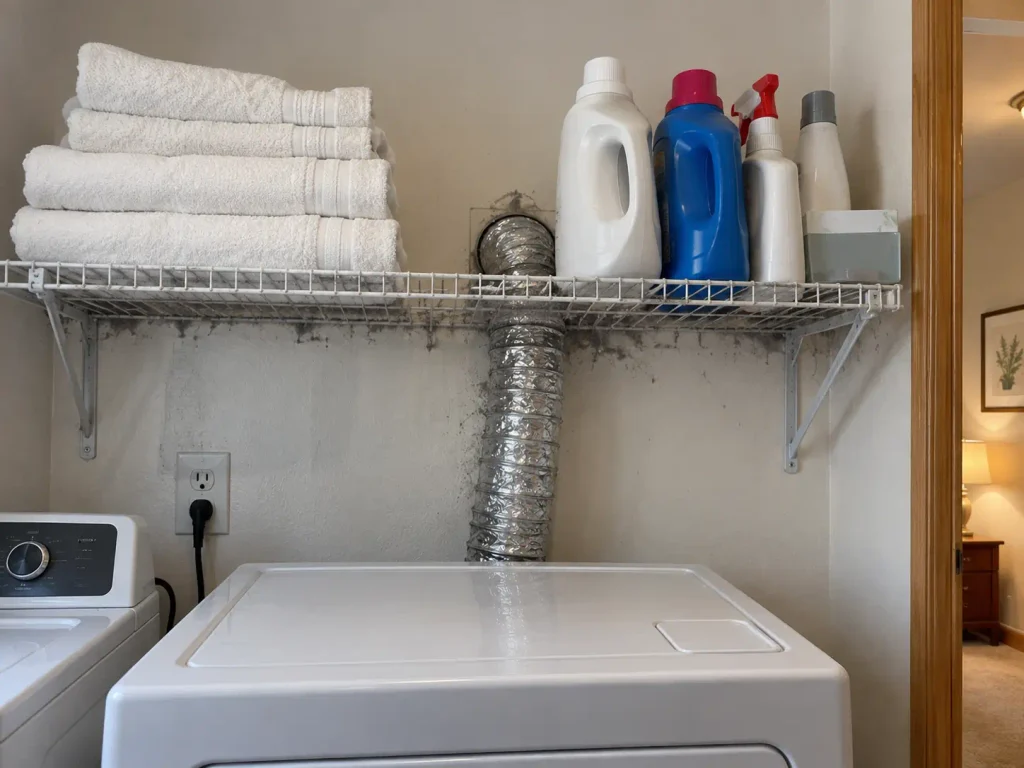
Everyone treats the laundry room like a small closet with machines in it. It isn’t. It’s the only space in the house that combines warm moist air, airborne lint and a machine that physically shakes, and each of those three goes after a different kind of storage. Humidity damage is the reason the wire basket that has lived happily in your linen closet for four years starts leaving orange marks in here, and why the shelf that felt generous on install day becomes the thing you duck around.
If your last attempt in this room went sideways, it almost certainly wasn’t a discipline problem. Something in the room ate it.
The Humidity Problem Nobody Accounts For
A dryer vents warm, wet air, and in a closet-sized room not all of it makes it outside. Prolonged humidity corrodes exposed metal and encourages lint buildup that traps still more moisture against it, which is the whole mechanism behind the single most common complaint in this room: bare wire shelving near the vent path develops rust, and that rust transfers onto whatever is stored on it. You find out when a white towel comes off the shelf with a faint orange line across it in the exact spacing of the wire. Look for epoxy-coated or powder-coated wire if a shelf sits within a couple of feet of the vent, not raw steel.
Wood has its own version of this. Sustained moisture swells and warps it, so raw particleboard or cheap MDF sags and delaminates in a laundry closet on a timeline it never would in a bedroom. Bamboo, which looks great in photos, behaves the same way in humid spaces.
None of this is a knock on the material in general. It’s a knock on the material here. Fabric bins are the quiet exception worth knowing about: they don’t rust and they don’t warp, they just hold damp, so they belong on the dry end of the room rather than near the vent.
Lint Changes What “Open Storage” Costs You
Open shelving gets recommended everywhere because it’s more accessible, and it is. But accessibility is the benefit you’re buying and lint is the price, and in this room lint settles faster than anywhere else in the house. Every load pushes fibers into the air; they land on the top of every open shelf, the rim of every open bin, and the shoulders of anything stored uncovered.
So “open storage is more accessible” quietly becomes “open storage is a weekly wipe.” That’s a fine trade if you make it on purpose. It’s a bad surprise if you made it because a photo looked good.
Vibration Moves Anything You Set on the Machines
This is the one nobody predicts. A front-loader on a spin cycle transmits real movement into everything touching it, and anything balanced on top of a machine migrates toward the edge over weeks. Not dramatically. A quarter inch a week, which is exactly slow enough that you never notice the drift and only notice the night the detergent bottle finally goes over the side.
There’s a second failure worth naming here because it comes up again and again: deep shelves. Somebody installs a 24-inch shelf over the machines to maximize storage, and then spends the next three months hitting it while loading and unloading. What actually happens is that people stop reaching, and the back foot of that shelf stores nothing but dust and an iron nobody has used since the install.
The consequence for everything below is simple. In this room, material and mounting matter more than capacity. A shelf that holds more but rusts is worse than a shelf that holds less and doesn’t. If your problem is less about what your storage is made of and more about where it went, the five spots in a small laundry room that go dead first is the better starting point.
Measure These Three Things Before You Buy Any Laundry Room Storage
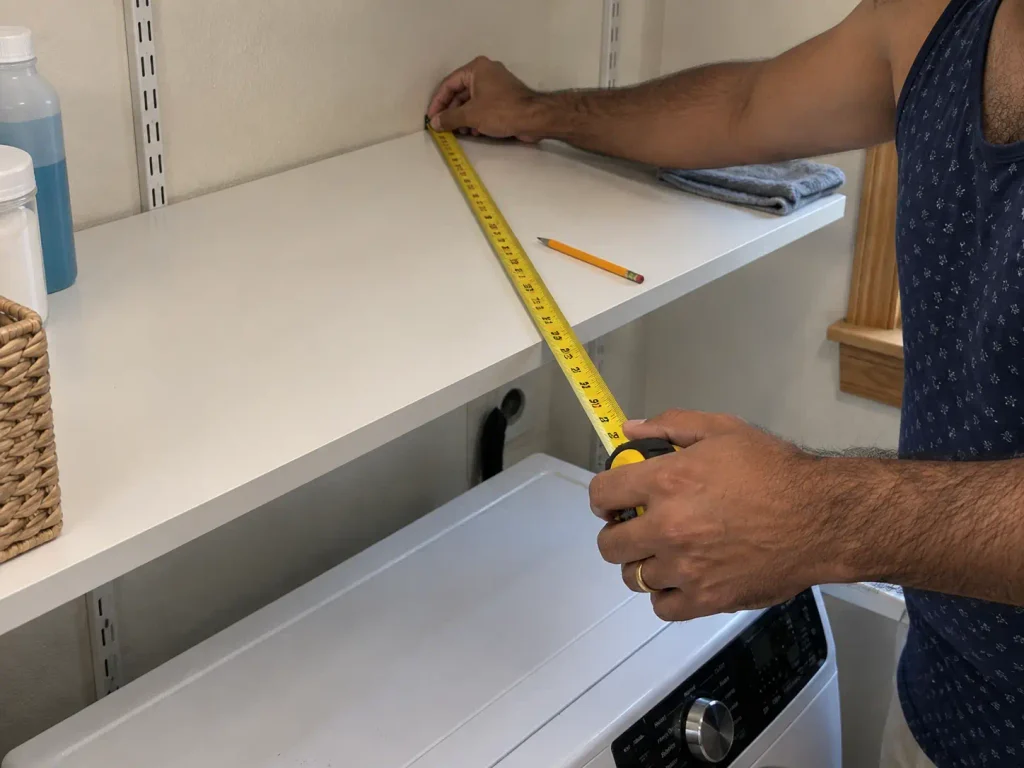
Almost every returned laundry organizer comes down to one of three numbers nobody measured. Not the room, which people do measure and which tells you less than you’d think. Three specific spans that decide whether a thing fits and still lets a door open.
Shelf depth is the first: 12 to 14 inches is the working range above machines. Deeper and you’re hitting it every load. Shallower and a detergent jug overhangs the front edge, which is its own slow problem once vibration gets involved. Second is appliance clearance, 16 to 18 inches from the machine top to the underside of the shelf, enough for a top-loader lid to clear and for you to lift a basket up there without turning it sideways.
Third is total room depth for the door swing, 42 to 48 inches, so a front-loader door opens fully and you can still stand beside it. That last number is the one that quietly rules out freestanding units in narrow closets, because the unit fits the wall perfectly and then the dryer door hits it. If the machines are a stacked washer dryer rather than side by side, measure the same three spans anyway, just from the top of the dryer instead.
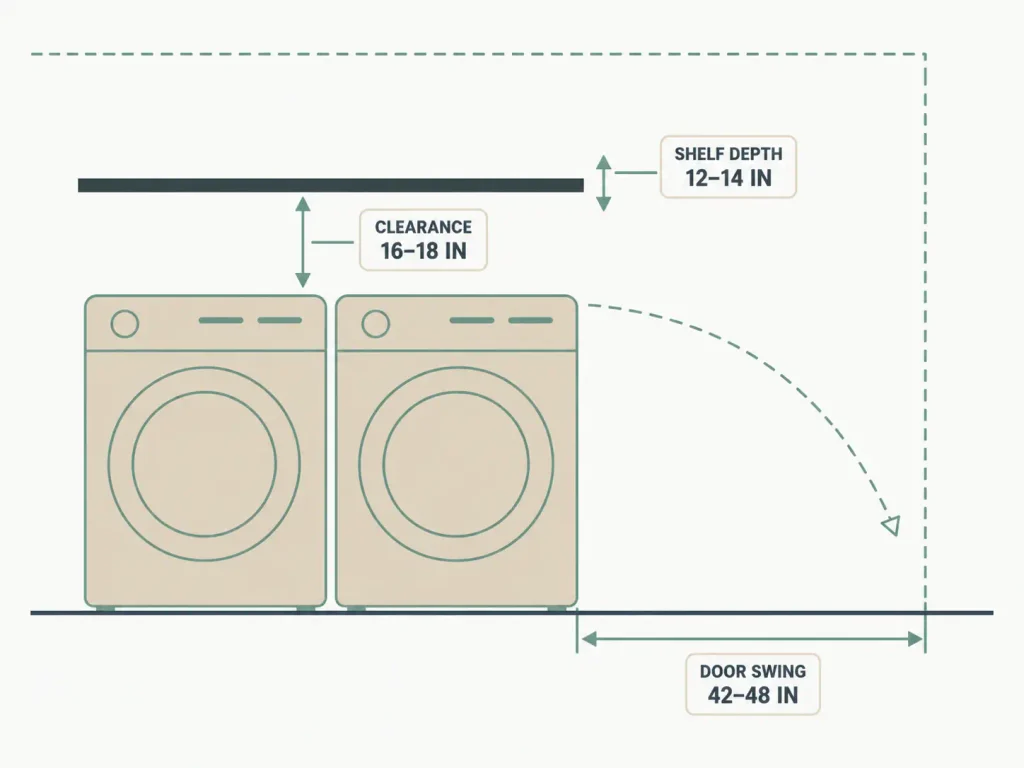
Write those three numbers on your phone before you shop. That’s it.
Depth, Clearance, Swing — the Three That Matter
Take the measurements with an actual tape, in the room, with the machine doors open. The door-swing number in particular changes with the machine, so a spec you read online for “a standard front-loader” is a starting point and not your number. If your laundry closet is the standard 29-inch kind, the 29-inch closet deep dive works through that exact configuration and the zone layout that fits it, so you can skip the generic advice entirely.
There’s a particular moment that teaches the clearance number faster than any chart: you lean in to pull the last sock out of the drum, and the shelf you installed for more storage is exactly where your head goes. It happens to everyone precisely once.
What Your Wall Is Made Of Decides the Rest
The fourth thing to check isn’t a measurement. Is the wall behind your machines drywall, plaster, tile, or the back panel of a closet? If you are working inside a closet rather than an open room, the closet depth is what you measure, front face of the door frame to back wall, and that number is usually smaller than the room it opens onto. Drywall with findable studs opens up everything in the drill section below.
Tile means a job most people would rather not start, and a closet back panel often means there’s nothing structural to hold an anchor at all.
Check this before you fall in love with a solution, because it decides which half of this article is actually about you.
No-Drill Laundry Room Storage Solutions That Hold Real Weight
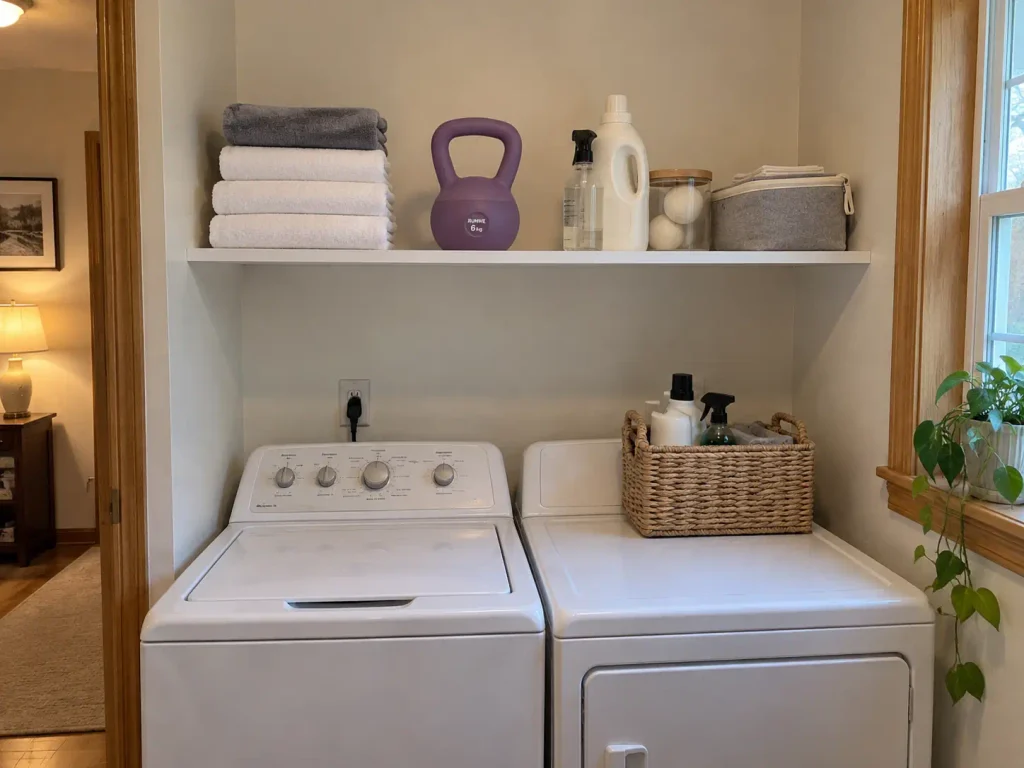
No-drill has a reputation as the compromise option, the thing you settle for because your lease says so. In a laundry room it’s frequently the better choice, and the reason is structural rather than legal: the two things that carry the most weight in this room, a freestanding frame and the floor, don’t care about your lease at all.
Before you buy anything, though, look at what’s already storage and isn’t being used as storage. The top of the machines is a surface. The space between the machine and the wall is a slot. A non-slip mat under a basket on top of the dryer solves the vibration migration from the last section for the cost of nothing, which is worth trying for a week before you spend money on a system that solves a problem you could have solved with a mat.
Freestanding Shelving That Straddles the Machines
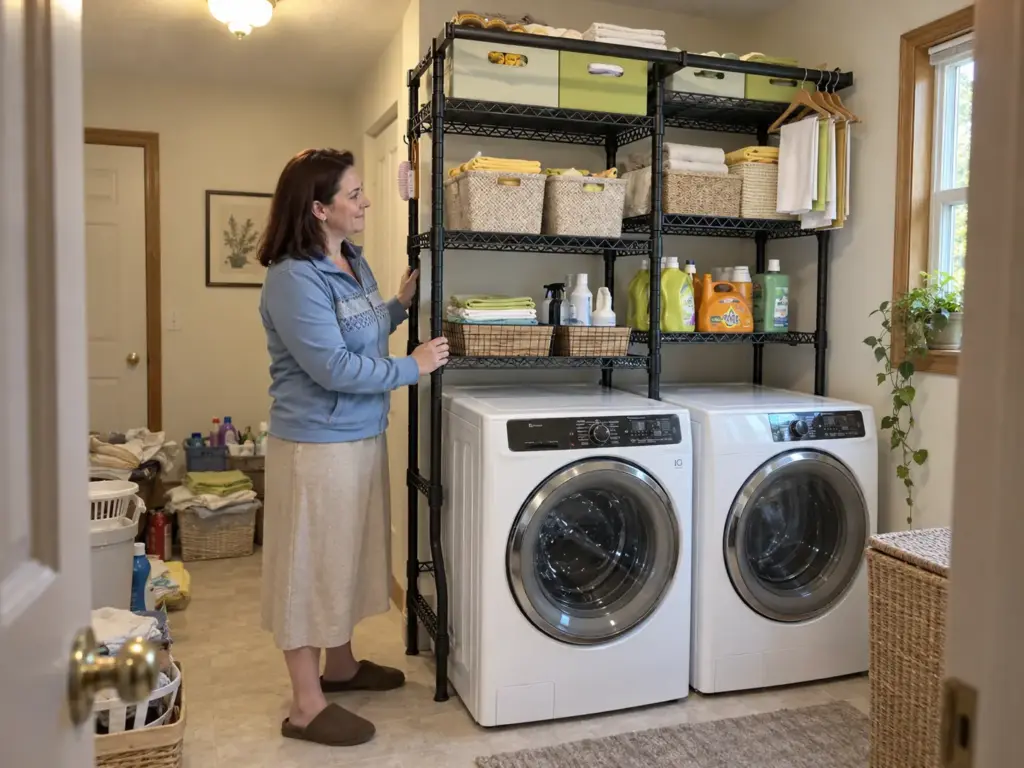
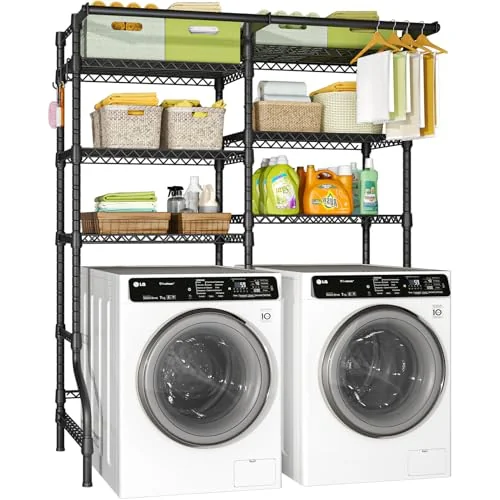
Freestanding over-appliance shelving is the category renters skip past without reading, which is a shame, because it’s the single strongest no-drill option in the room. The unit straddles both machines and stands on the floor, so the entire load path runs down through its own legs and never touches your wall. It needs the door-swing depth from the last section and a machine footprint under roughly 30 inches each, and if you have those two things it does more than any wall solution you’d be allowed to install anyway.
The Ulif U13 Over Washer and Dryer Storage Shelves is the concrete instance of that category: six tiers over both machines, sized for appliances up to about 29.9 inches each, rated for several hundred pounds spread across the tiers. It leaves with you at lease-end, which is the argument for it. The limitation is that it is the tallest thing in the room and it needs the full room depth to clear the machine doors, so measure before you commit.
One thing gets misread about no-drill storage, and it matters. No-drill means no shelf brackets in your wall. It does not mean never attach anything.
A tall shelving unit loaded with bins is exactly the tip-over category that the CPSC’s Anchor It guidance exists for, and the federal stability standard for clothing storage furniture, ASTM F2057-23, was adopted for that reason. The agency’s own framing is blunt: “Heavy and wide furniture can still tip over. And if it does tip, it can be a disaster.”
A laundry room adds vibration on top of that. Two anchor straps rated above the loaded weight of the unit, into the wall or the floor, is a pair of small holes that a landlord will not blink at and a tenant can patch in ten minutes.
Tension Rods and What They Can Honestly Hold
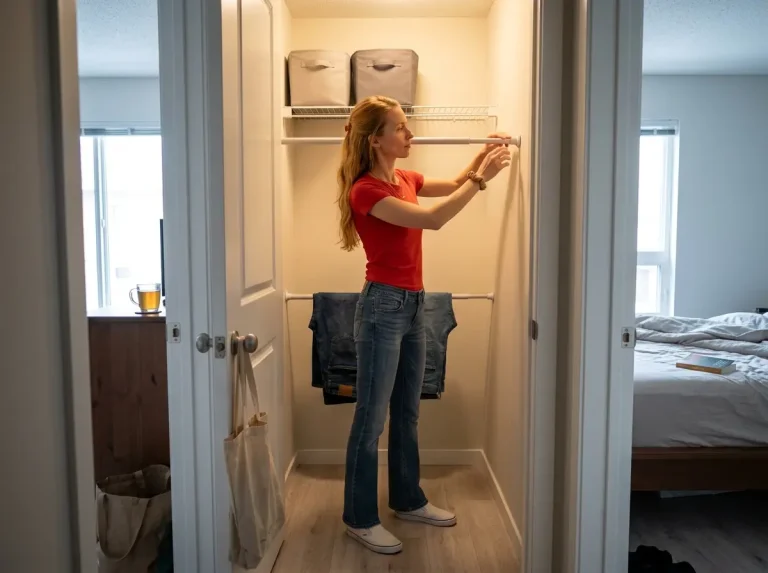
Tension rods are the light-duty tier, and the honest limit is the whole story. A heavy-duty tension rod tops out around 20 pounds, and prefabricated tension-rod shelf trays cap a little below that. The Home in Bold Tension Rod Shelving is the budget-friendly end of the no-drill category, an expandable unit that wedges between two surfaces and gives you vertical storage layers without hardware, and it’s the right call for folded linens, dryer sheets and a rotation of hang-dry items.
It is not where the full jug of liquid detergent, the fabric softener and the stain kit all live at once. Friction fits and humidity are not friends either, so check the tension every couple of months. Run the same rod horizontally and it becomes a hanging rod for shirts straight out of the washer, which is the cheapest drying solution in this article.
If you want the load question worked out properly, what tension rod shelving can and can’t hold goes deeper into where the rating comes from and which mounting surfaces quietly halve it.
Load a tension-rod shelf with the heaviest thing you plan to store, then push down on it hard once. If it shifts at all, it will shift on its own by month two, when the humidity has been working on the friction fit the whole time. Test it on install day, not on the day it lands in the machine.
What the No-Drill Route Costs You
Two things, and they’re worth stating flatly. You lose the floor, because every no-drill option except the rolling cart stands on it, and in a narrow room floor space is the one thing you can’t buy back. And you lose ceiling-height storage, because a freestanding unit’s top tier is only as high as the unit.
What you get back is portability. The freestanding unit moves with you at lease-end, which makes it the one piece of laundry storage worth real money while renting. Everything mounted stays behind for the next tenant.
Wall-Mounted Laundry Room Storage When You Can Drill
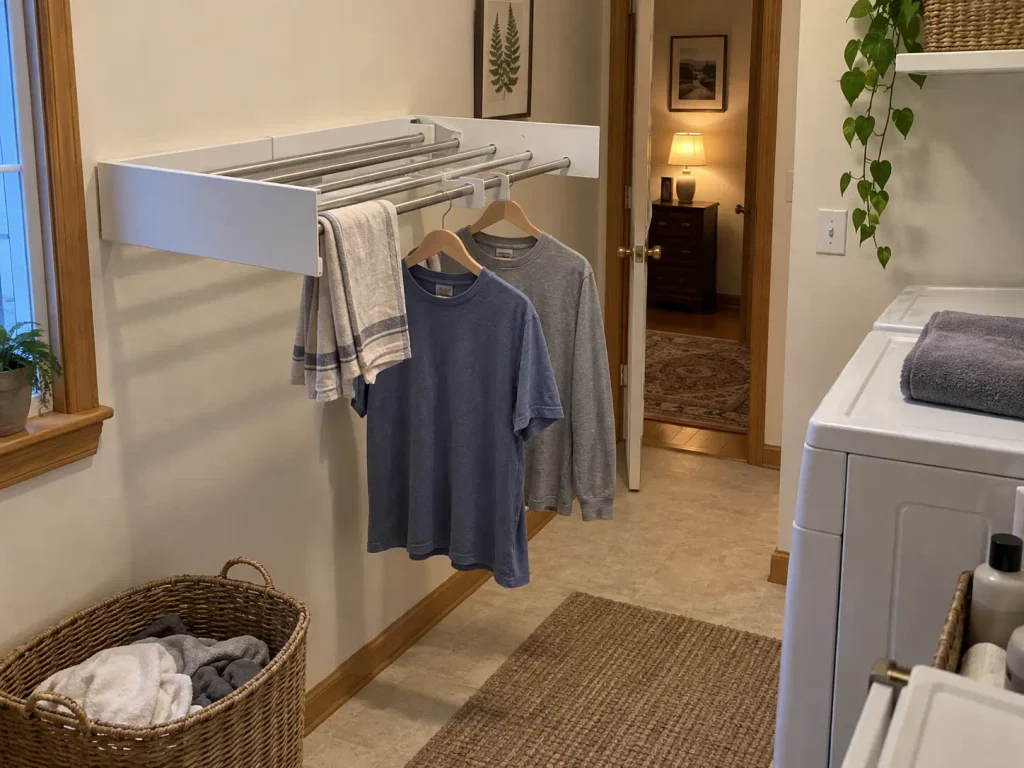
Owning the wall is not a reason to fill it. This is where I’ve changed my mind over time: the default advice is to run a line of open shelves above the machines and call the room organized, and I used to think that was the obvious move. Between the lint maintenance and the deep-shelf failure, the wall’s two genuinely best uses in a laundry room turn out to be the things nothing else can do — hold a drying rack that folds away, and give you a work surface that isn’t there when you don’t need it.
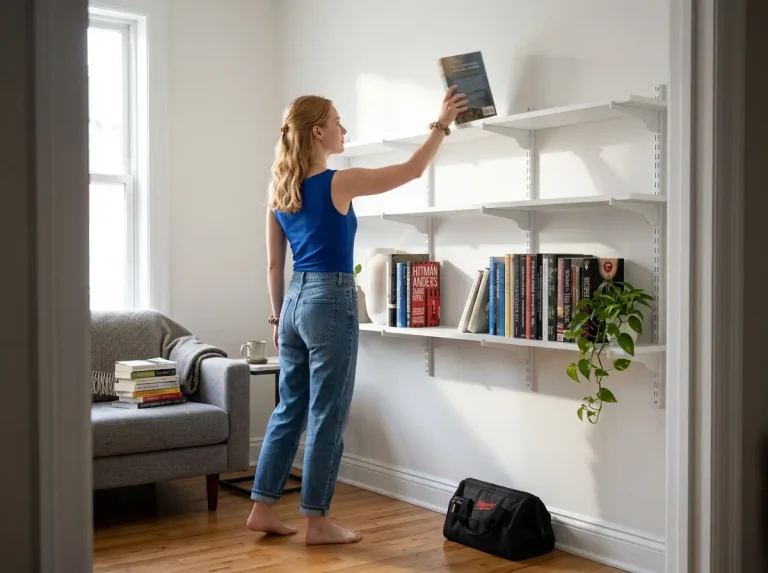
The wall’s real structural advantage over freestanding is that it clears the floor. In a narrow room that is not a small thing. The other genuinely good use of a drill in here is a countertop over appliances on a pair of mounted supports, which turns two machine tops into one continuous surface and ends the vibration migration problem permanently.
What Belongs on the Wall and What Doesn’t
A pegboard panel is the one open system that earns its place in here, because wall hooks on a board hold measuring cups, the lint brush and a small basket at eye level without eating shelf depth, and a board can be taken down and patched as one piece rather than a row of holes. Command strips are the renter version of the same idea, though they lose their grip in warm damp air faster than the packaging suggests, so keep them for the lightest things only.
Closed beats open in here, for the lint reason. A cabinet, or a lidded bin sitting on a mounted shelf, is less weekly maintenance than the same capacity out in the open, and the difference compounds over a year. Material choice matters more on a wall than anywhere else in the room too, because a mounted shelf sits higher and closer to the warm air: coated steel or sealed wood, not bare particleboard.
Depth rules still apply, and on a wall the deep-shelf failure gets worse rather than better, because now that extra depth is at head height directly over the machines. Twelve to fourteen inches.
A fold-down folding surface is the best answer to the “I have no counter” problem, and it doubles as ironing board storage, since the board stops living behind a door. The Xabitat Wall Mounted Ironing Board at 36.2 by 12.2 inches covers both folding and ironing while sitting flat against the wall the rest of the week. The catch is that it occupies a continuous run of wall even when folded, so it competes with cabinet storage and shelving for the same real estate rather than stacking with it. For the shelving side of that decision, which wall-mounted shelves hold weight and which don’t covers the stud-versus-anchor weight question in the detail this section deliberately stops short of.
Drying Space That Folds Away
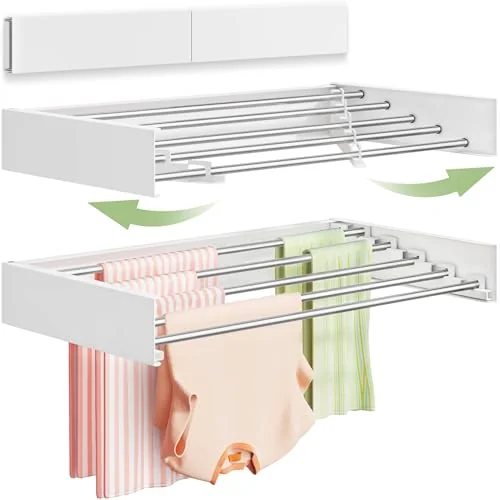
Line-drying is the one laundry task that needs space only intermittently, and that mismatch is why fixed drying rods are such a poor fit for small rooms. You use the rod twice a week, and it blocks the door swing or the walkway all seven days. That’s a bad trade that people accept because the rod was the cheapest thing at the hardware store. A retractable clothesline solves the same mismatch for less money than a rack, if you have two facing walls and don’t mind the line sagging under a full load of towels.
A folding wall-mounted rack fixes the mismatch directly. The Vikaqi Wall Mounted Clothes Drying Rack is 32 inches wide and folds flat against the wall, so it’s a drying surface on laundry day and a thin panel the rest of the time. It is a mounted item, so if you’re renting and can’t make holes, go back to the tension rod from the previous section and use it as a hanging bar instead. Same function, lower weight limit, no hardware.
Keeping the Lint Problem Out of Your Storage
If you do run open shelving, contain the contents rather than the shelf. Lidded bins, closed baskets, or a shallow cabinet turn a weekly wipe into a monthly one, and the items inside stop collecting a grey film. Clear acrylic bins are the compromise worth paying for here, since you keep the lid and still see what’s in there without pulling it down. A label maker is optional at this scale — with five or six containers, seeing the contents beats reading about them.
The one thing worth leaving open is what you reach for every single load. Dryer sheets, the scoop, the stain stick. Those earn their exposure because a lid you open forty times a month is a lid that ends up permanently off.
Storage That Never Touches the Wall at All
There’s a whole tier below no-drill that doesn’t get counted as storage, mostly because it isn’t a product you install. The gap between the machines. The dead space under a shelf you already own. The top of the machines, used deliberately instead of accidentally.
None of it requires permission from anyone, which makes this the most renter-friendly section of the article.
The Gap Between the Machines
The space between or beside side-by-side machines is usually a hand’s width of dead vertical volume, running the full depth and height of the appliances. Measure yours, because it decides everything that follows.
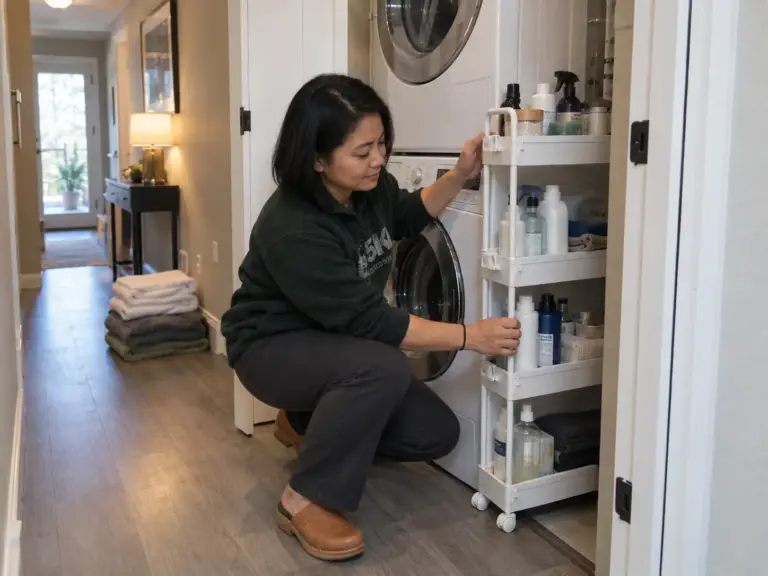
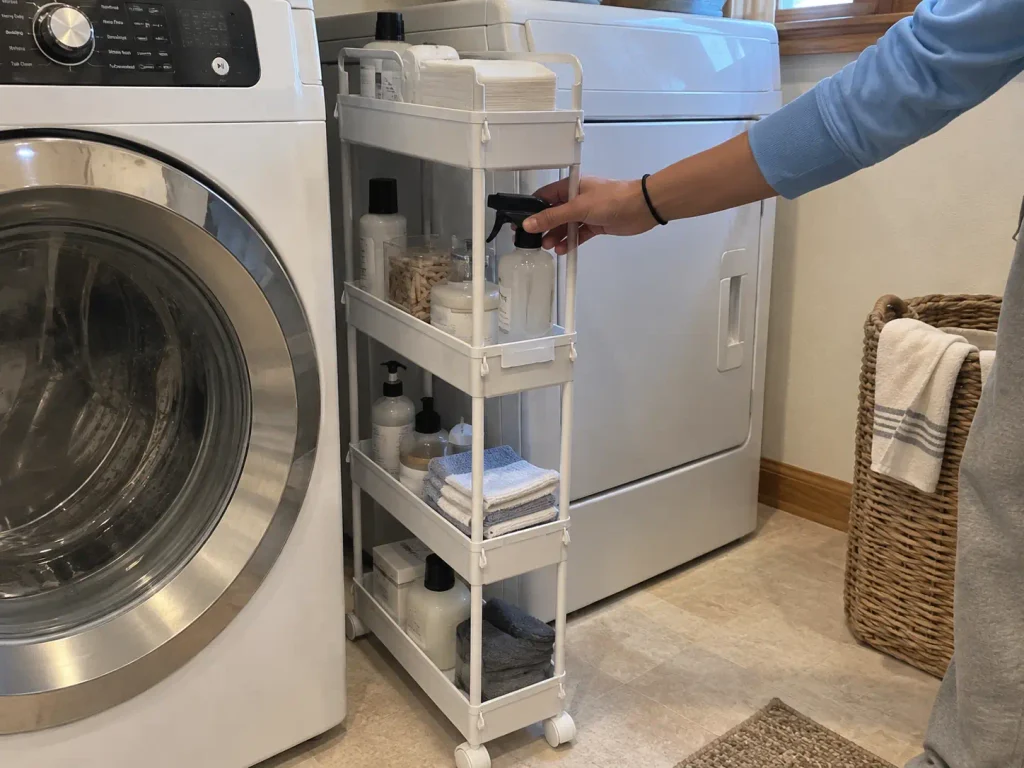
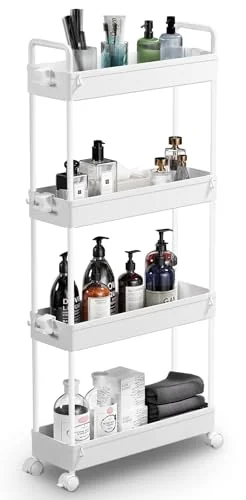
A gap shelf or narrow bridging shelf marketed for that slot exists, and it works when the gap is wide enough, but it only reaches what you can see from the front. Most people write the gap off because nothing fits, and nothing else does fit, with one exception: a slim rolling cart is the only format that converts it, because it slides out to be loaded and slides back to disappear. Crucially, it never eats the door swing, since it isn’t there when the door is open.
The SOLEJAZZ Slim Rolling Storage Cart is about five inches wide across four tiers, and that width is the entire point. The limitation follows from it: narrow means light and tall means top-heavy, so this is where dryer sheets, stain sticks and small bottles live, not where detergent jugs go.
While you’re looking at that gap, deal with the thing that falls into it. A magnetic or silicone gap guard closes the space between machine and counter or wall, and it is the cheapest fix in this entire article, which is worth saying before anyone talks you into a shelving system. It solves the complaint people actually have.
Socks stop disappearing. A whole storage overhaul does not fix that problem; a strip of silicone does.
A Second Layer Under a Shelf You Already Have
Under-shelf baskets are the cheapest capacity increase available in this room, because they add a layer to shelving that already exists and require no mounting whatsoever. They hook over the front lip of a shelf and hang in the airspace nobody was using. The HEMOTON Under Shelf Basket slides onto a standard shelf and takes small supplies, which keeps the shelf surface itself clear for the things that need to stand up.
One caveat carries forward from the humidity section: it’s wire, so keep it off the direct vent path. A basket that hangs in the warm wet stream is the first thing in the room to develop rust, and under a shelf you won’t see it until it marks something.
Before you hang an under-shelf basket, put your hand where it will sit and run the dryer for a minute. If the air there feels warm and damp, move it to the other end of the shelf. The vent stream is narrower than people assume, and six inches sideways is often the difference between rust and no rust.
Cleaning Supplies Belong in a Caddy, Not on a Shelf
Cleaning supply storage is the other half of this room’s job, because laundry rooms almost always double as the utility closet, which means cleaning bottles end up spread along a shelf in a loose row that migrates and topples. Before you buy a single container for them, declutter the row: half of it is usually duplicates and a product nobody in the house has used in a year. Shelf space is the wrong container for them, because the job those bottles do happens in other rooms. They need to travel.
A portable caddy handles this better than any amount of shelving. The Cleaning Caddy Organizer with Handle at 15 by 8 by 10.5 inches corrals the loose bottles, goes with you to the bathroom or the kitchen, and comes back as one object instead of seven. It also means the shelf it used to occupy is now free, which is usually where the detergent and the folded linens should have been all along.
Sort your cleaning bottles by where the job happens, not by what the label says. Everything used in another room goes in the caddy; only what you use standing in front of the machines earns a permanent spot on the shelf. That one split usually frees half a shelf on the first pass.
Making the System Survive Three Months of Real Laundry
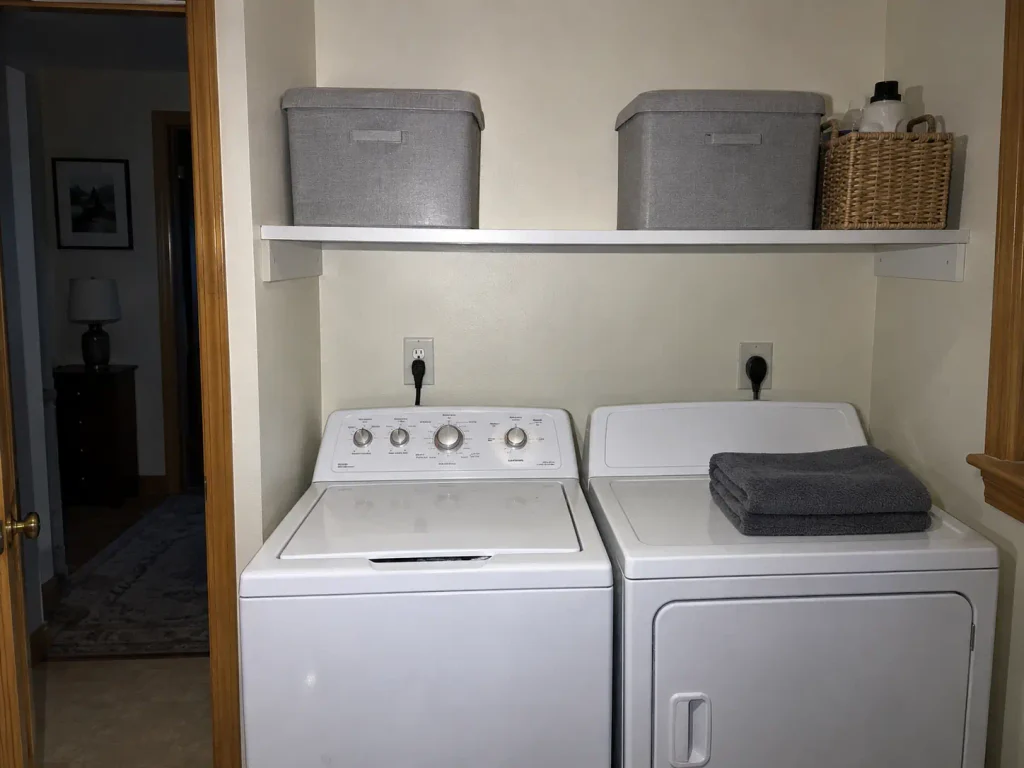
Laundry is the one chore that runs on somebody else’s schedule, namely the machine’s. That’s why laundry storage fails differently from closet storage. Nobody reorganizes mid-cycle. Whatever is easiest during the short window between loads is what this room becomes, regardless of what you intended on setup day.
The Four-Minute Rule
Every storage decision in here gets tested during the four minutes between the washer finishing and you wanting to be somewhere else. If putting something away in that window takes more than one motion, it doesn’t get put away. It goes on top of the dryer, and the top of the dryer becomes the room’s real storage system by default.
So audit your plan against that window. Lid on a bin that lives at shoulder height is two motions and a reach. An open basket at waist level is one.
This is also the argument for fewer categories rather than more. The system has to work for whoever does laundry when it isn’t you, and nobody else in the house has memorized your sorting logic, which is why three obvious laundry sorting bins beat seven precise ones every time.
Keep one shelf or bin deliberately unassigned, too. This room absorbs overflow from the entire house, and a system with zero slack pushes that overflow straight onto the machine tops.
What to Check at Three Months
The lint cadence is the easy part: open shelving in this room is a weekly wipe, closed storage is monthly. Pick the one you’ll actually do rather than the one that sounds more thorough, because a weekly wipe you skip is worse than a monthly one you keep.
At the three-month mark, do a short materials check in three specific places. The underside of any wire shelving near the vent path, which is where rust starts and where you can’t see it from below. The bottom edge of anything wooden, which is where swelling shows first. And the back corner where air doesn’t move, which is where anything soft starts to smell faintly of damp before it looks like anything at all.
Three months is roughly when this room tells you whether you chose the right materials, and it’s early enough to swap one shelf instead of rebuilding everything. It’s also the moment to check your dryer vent clearance behind the machines, since a duct crushed against the wall is what pushes humidity back into the room to begin with.
Conclusion
Sort every laundry storage idea you find by whether it touches the wall before you judge whether it’s any good. That single filter eliminates most of what was never going to apply to you and leaves a much shorter list worth thinking about.
In this room, material and mounting beat capacity. Humidity, lint and vibration decide what survives here, and none of them care how much a shelf holds. And the three numbers, 12 to 14 inches of depth, 16 to 18 inches of clearance, 42 to 48 inches of room depth, are what stop you from making the return trip to the store.
In three months, look at the underside of anything metal near the dryer vent path and the bottom edge of anything wooden. That’s where this room tells you whether you chose right, while the fix is still one shelf and not the whole wall.
Measure the three numbers today. Pick the one category that matches your wall. Buy nothing until then.
Frequently Asked Questions
01How can I maximize storage in a laundry room?
Work vertically above the machines first, then horizontally into the gap beside them. The space above a washer and dryer is the biggest unused volume in the room, and a shelf at 12 to 14 inches deep captures it without blocking the machines. The narrow side gap takes a slim rolling cart.
02What are some good storage options for a small laundry room?
Freestanding over-appliance shelving, tension-rod shelving, a slim rolling cart for the gap, a folding wall-mounted drying rack, and a fold-down work surface. Which of the five apply depends on whether you can drill: renters get the first three, owners get all five.
03What are the most common laundry room storage mistakes?
Installing shelves deeper than about 14 inches, siting bare wire shelving in the dryer’s vent path, and leaving anything loose on top of the machines. You find out about the first two in month three, when you’re hitting the shelf every load and rust is transferring onto towels.
04Can I put storage in a laundry room without drilling into the walls?
Yes, and it is often the better route. Freestanding shelving that straddles the machines carries its load through the floor, tension-rod shelving holds roughly 20 pounds per rod, a rolling cart needs no fixing at all, and under-shelf baskets hang off shelving already there.
05How much weight can tension rod shelving hold in a laundry room?
Around 20 pounds per rod, and treat that as a ceiling rather than a target. It covers folded linens, dryer sheets and a rotation of hang-dry items. It does not cover detergent jugs or a stack of full baskets, and this room’s humidity does nothing to help a friction fit hold.
Disclaimer: ClutterlessNest is a participant in the Amazon Services LLC Associates Program. As an Amazon Associate we earn from qualifying purchases. This article may contain affiliate links — if you buy through them, we may earn a small commission at no extra cost to you. We only recommend products we have tested or genuinely believe in.