























In this article
It’s 11pm, someone’s staying over, and you reach into the hallway closet for a clean bath towel. You get the towel.
You also get two sheet sets sliding off the shelf and a bottle of backup shampoo rolling across the floor behind you. Good linen closet organization isn’t about the reveal photo, and the fix is almost never a bigger bin. It’s about real shelf dimensions, one job per shelf, and a folding footprint that stops stacks from leaning. Here’s the order it has to happen in: empty the closet, decide what each shelf does, fold everything to one size, contain what’s actually loose, label the shelf, and build the five-minute reset that keeps it.
Quick Answer
A linen closet that holds up runs on five decisions, and only one of them costs money:
- Empty it completely and sort before buying anything
- Give every shelf one job: one category per shelf, no mixed shelves
- Fold every piece of a sheet set to the same rectangle, then nest the set inside one pillowcase
- Match the container to your shelf depth, not to a photo
- Label the shelf edge, not the bin, because the bin moves and the shelf doesn’t
Why Your Linen Closet Turns Into a Catch-All
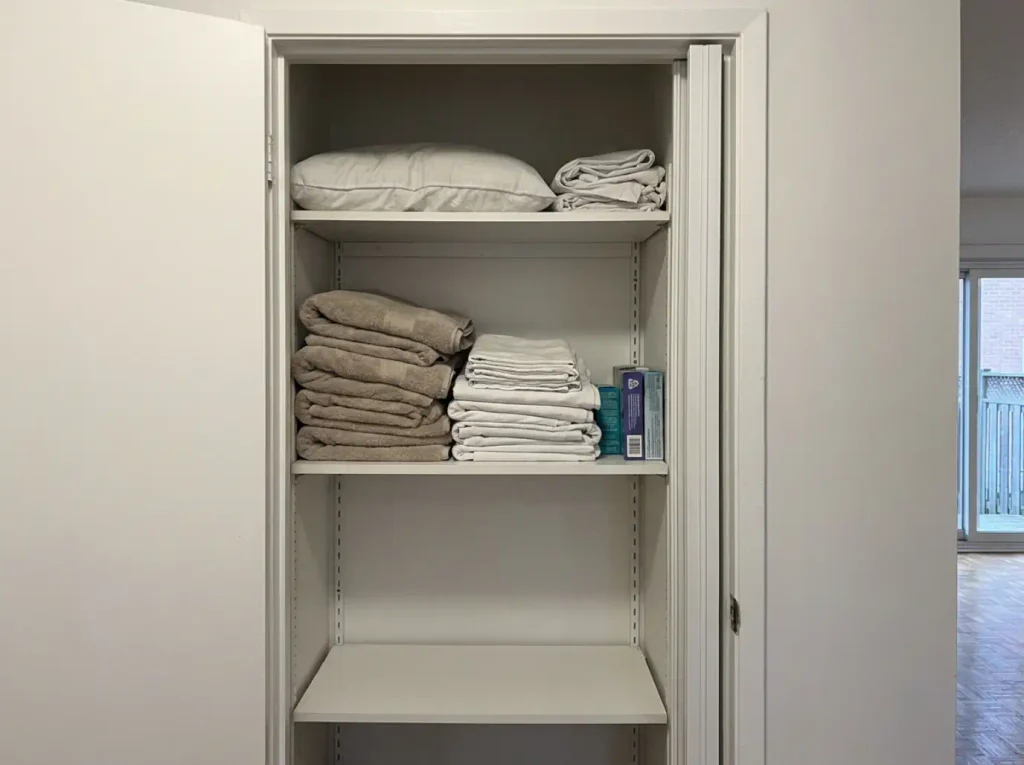
Nobody’s linen closet fails because they’re messy. It fails because of where it is. A hallway closet is usually the shortest walk from anywhere in the house, which makes it the path of least resistance for every homeless object you’re holding: the spare bulbs, the backup toothpaste, the beach towels that never went back to the garage. Nothing else was ever assigned those jobs, so the closet quietly took all five.
That accessibility is the root cause, not a lack of discipline. It’s the same reason the same thing happens to small bathroom storage: the surface closest to where you’re standing wins every time, whether or not it was designed for the job.
The second mechanism is category mixing. When towels, sheets and toiletry backstock share a shelf, they’re stacked in whatever order they arrived, so grabbing the first thing destabilizes everything under and beside it.
That’s the actual reason organizers keep repeating the one-shelf-one-category rule. Not tidiness. Physics.
The third is subtler and it’s the one that ruins the reveal. Sheets folded to different rectangle footprints don’t stack flush. The flat sheet ends up wider than the fitted sheet, the pillowcases narrower than both, and the pile is a wedge instead of a column.
A wedge leans. Not in three months. Within days of a restack.
Here’s the timing that gives it away. The stack doesn’t fall the day you organize it. It falls the third time someone in a hurry pulls from the middle instead of the top, and it makes a specific sound: soft, then a slap, then whatever sat on the shelf edge hitting the floor.
That’s not a discipline failure. It’s a design failure, which means it’s preventable.
Empty It and Sort Before You Buy Anything

The urge is to order bins first, because bins feel like progress and the decision to declutter feels like a Saturday you’d rather spend differently. But every bin bought before the sort is sized for the closet you have now, not the one you’ll have in an hour. Buy last.
Get everything out first
Everything comes out. Not shelf by shelf, and not “I’ll do the top two today.” The whole closet, onto a bed or the hallway floor.
Shelf-by-shelf feels efficient and isn’t, because the point of the emptying pass is grouping like with like and seeing duplicates side by side. This is the one place the KonMari method has it exactly right: Marie Kondo empties by category rather than by location for the same reason, and a linen closet is small enough that the whole thing counts as one category. You cannot know you own four twin flat sheets and no twin fitted sheets while three of them sit folded on different shelves.
How many sheets and towels you actually need
The keep-rule for bedding and towels is quantity-based, not sentiment-based, which makes it fast. Roughly two sheet sets per bed (one on, one in the wash), plus a guest set if you host. Towels get sized to the people who actually shower in this house, plus a couple of spares. Not the number who might theoretically visit.
Anything past that number goes into one of four piles: keep here, keep elsewhere, donate, or retire to rags. And the towels you’re hesitating over because “they’re still fine, just faded” have a destination that isn’t a thrift store. Animal shelters take old towels constantly, and that’s the answer that ends the hesitation.
Sort the sheets by bed size before you sort by condition. Half of what feels like “too many sheets” turns out to be sets for a bed you no longer own, and you’ll retire six pieces in ninety seconds without a single hard decision.
The “keep elsewhere” pile is the important one
Three of those piles are obvious. The fourth is the one people skip, and it’s the one doing all the work. Medicine backstock, cleaning supplies, spare bulbs, shoe polish: none of it is here because it belongs here. It’s here because it had nowhere else to go and this door was closest.
So the pile isn’t “throw it out.” It’s “give it an address.” Cleaning supplies and toiletry backstock usually belong with the backstock that belongs under the sink instead, near the point of use. Bulbs and batteries want a utility drawer.
If something genuinely has no other home, it stays, but as an assigned category with a container. What it doesn’t get to do anymore is float.
Measure Before You Buy: Real Linen Closet Dimensions

Every linen closet article tells you to measure your space. None tell you what the number should be, which makes the advice useless. You pull out a tape measure, get 17 inches, and have no idea whether 17 is generous, tight, or wrong. So here are the numbers.
How deep your shelves actually need to be
Folded towels and sheet sets need about 12 to 16 inches of shelf depth. That’s it. Most linen closets run 16 to 20 inches deep, so closet depth works against you by default: in a typical closet several inches at the back of every shelf are dead space.
Dead space isn’t neutral. It’s where things go to be forgotten, because anything pushed past the front stack stays invisible until you move. A deep shelf only works if the back holds one defined category that comes forward as a unit: a bin you pull out, a bundle you lift.
Without that, it isn’t extra storage. It’s a slow archive.
Shelf spacing by what’s going on the shelf
Shelf spacing doesn’t have to be a uniform grid, and it shouldn’t be. The even-grid instinct is understandable, since that’s how closets arrive from the builder, but I’d argue it’s the most expensive default in the room: it wastes close to a shelf’s worth of space in almost every closet it’s applied to. Towels and sheet sets sit comfortably in 12 to 15 inches of vertical clearance. Bulky blankets want 18 to 20. Washcloths and hand towels need far less, so a shelf dedicated to small linens can free up a whole extra shelf if your closet has adjustable shelves on bracket slots.
If the shelves are adjustable and you don’t know your stack heights yet, 15 inches is the standard installation spacing and a safe place to start. Set them at 15, live with it a week, then move the one that’s obviously wrong.
If you’re converting a small reach-in closet into linen storage rather than buying dedicated shelving, the depth requirement changes. Professional closet measurement guidelines recommend at least 24 inches of depth for that build, which gives folded stacks room to sit without compressing against the back wall. Compressed stacks are the ones that go creased and hard to grab.
Measure the opening, not just the shelf
Here’s the number that gets skipped and costs you a return trip. Measure the doorway opening, not only the interior. Linen closets are frequently narrower at the frame than inside, because the frame eats an inch or more per side. A bin that fits the shelf perfectly and doesn’t clear the opening is a bin you’re carrying back to the car.
Write your three numbers on a strip of painter’s tape and stick it inside the closet door: shelf depth, shelf spacing, door opening width. You will not remember them standing in an aisle three weeks from now, and that strip of tape is the difference between one shopping trip and two.
Give Every Shelf One Job (Including the Overflow)
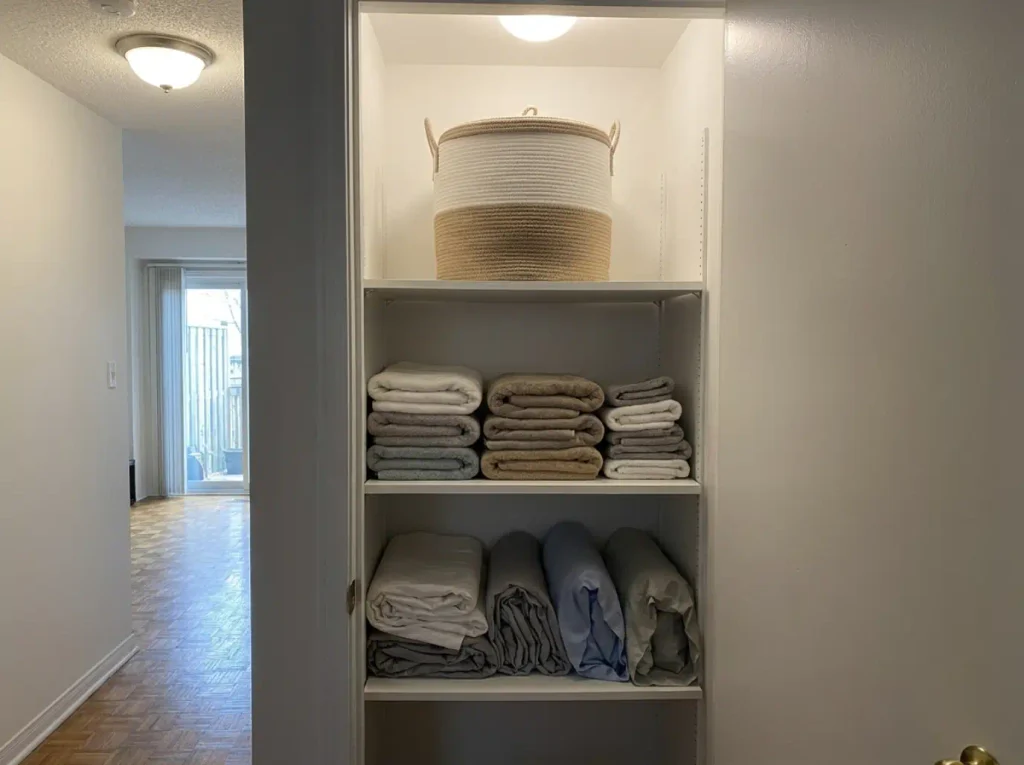
This is the single decision that separates a linen closet that holds from one that reverts, and it costs a decision rather than a purchase.
One category per shelf, no exceptions
One shelf, one category. Two only if a category is genuinely small, so washcloths and hand towels can share. Everything else gets its own shelf.
The reason is mechanical rather than aesthetic. When a shelf holds three unrelated things, each has a different height, footprint and grab frequency, so the shelf is permanently unstable in a way no amount of neat folding fixes.
It’s the same mechanism behind why shelf piles keep falling over in bedroom closets. Uniform contents, stable stack. Mixed contents, wedge.
Order the shelves by how often you reach for them
Frequency of use drives vertical placement, not category importance. Whatever gets grabbed weekly goes at eye level storage height and toward the front, usually bath towels. Guest linens and seasonal blankets go high, because you touch them a few times a year and a step stool once a season is no hardship. Heavy or rarely-used items go low.
The top shelf is where catch-all pressure goes if you don’t assign it. An unassigned top shelf isn’t neutral territory, it’s an invitation. Give it a defined job (the guest set, off-season blankets, extra pillows) or it becomes the new junk shelf inside a month, and you’ll have moved the problem eighteen inches up instead of solving it.
Give the overflow its own container and a full line
Here’s where most advice falls apart. “Only keep linens in the linen closet” has a shelf life of about a week, because the medicine backstock and spare cleaning supplies still have to live somewhere. Overflow isn’t a failure to be shamed out of existence. It’s a real category that needs a real zone, and giving it one is what turns a pile of rules into a category system anyone in the house can follow.
The rule is one container, not three. Spread across three shelves, backstock is invisible and unbounded. In a single basket, it’s one place to look and, more importantly, one hard boundary. When the basket is full, something in it goes.
That full line converts “don’t accumulate” from a resolution into a physical limit, which is what makes the purge hold. The HONCESTA Extra Large Woven Basket with Lid suits that job: it’s oversized on purpose, deep enough to swallow a real backstock without being so large that “full” never arrives. The lid works here because you open this monthly, not daily. On a bin you reach into every morning, a lid is a liability.
Which brings up humidity. Bathroom-adjacent closets get steam every day. Anything in that backstock that can’t take moisture (paper goods, cardboard refills, bar soap in its wrapper) belongs inside the closed basket rather than loose on a shelf sharing a wall with the shower. The same humidity-safe material guidance for bathroom storage that applies under a sink applies here.
Now the test for the whole system. Can someone who doesn’t live here find a bath towel in the dark, first try, without unstacking anything? That’s the pass condition. Not whether the closet photographs well.
One more thing about failure order. The shelf that breaks first is almost always the one at chest height, because that’s the shelf people reach into without looking. Eye level gets looked at. Chest height gets grabbed blind.
Fold So the Stacks Stop Falling Over
“Fold neater” is not advice. It’s what you say when you don’t know the mechanism. This one has a name, and the fix is free.
Fold every piece to the same rectangle
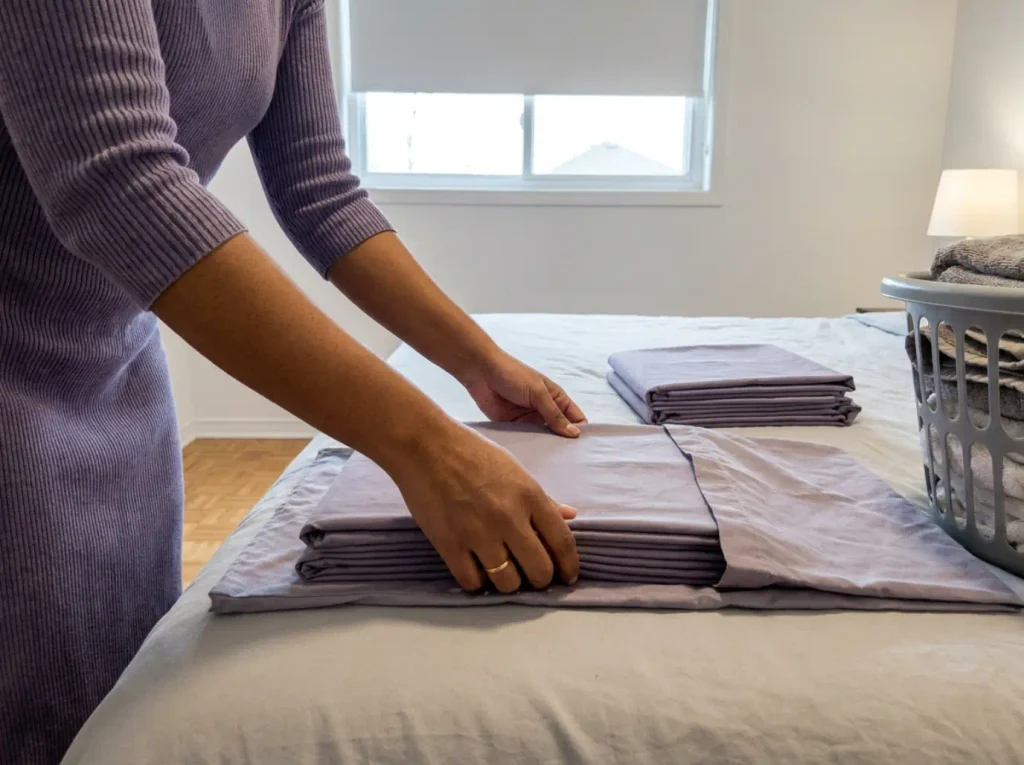
Match the footprint. Fold the flat sheet, the fitted sheet and the pillowcases to the same-size rectangle before stacking, so the bundle sits flush instead of stepping in and out at every layer. That’s the principle behind the folding method linen brands teach, and it’s the difference between a column and a wedge.
You don’t need a specific number of folds, you need a target size: usually your shelf depth minus an inch or two. The fitted sheet is the hard one, and it does not need to be beautiful. It needs to be the same size as the flat sheet. Nobody is inspecting your corners.
Here’s the tell that your footprints are off: the stack is fine the day you build it and leaning by the weekend. That’s not settling. That’s the bottom piece being a different size than the one above it, and gravity finding the overhang.
Nest the whole sheet set in a pillowcase
Nesting sheet sets inside a pillowcase, the bed-in-a-bag method, is the best free move in this article. Fold everything except one pillowcase into your matching rectangle, stack it, then slide the whole stack into the pillowcase you held back.
The set becomes one grabbable unit. Nothing migrates, and you never again find a lone fitted sheet at the back of a shelf wondering which bed it belongs to. This shows up independently across sheet-storage sources and organizing threads, which is what tells you it’s real practiced behavior rather than listicle filler.
And this is the free tier of the whole project. Before any bin, divider or label maker, the pillowcase bundle solves the sheet half of your closet for nothing. Do this first. If it’s all you ever do, the closet is still meaningfully better.
Roll or Stack Towels: It Depends on Your Shelf Depth
Rolling towels looks great and it’s the wrong call in a shallow closet. A roll’s diameter is fixed by the towel, so rolling burns vertical clearance you may not have. Stacked towels fit more per shelf, but past a certain height a stack needs something holding it upright, which is the next section’s job.
The rule is simpler than either option: fold to your shelf depth, not to a standard. If your shelves are 14 inches deep, fold towels to a rectangle a little under 14. A towel folded to a 16-inch footprint on a 14-inch shelf hangs over the edge, catches on the frame every time you open the door, and gets pulled down by a passing sleeve.
Contain and Label It Without Drilling a Single Hole
Every linen closet makeover you’ve seen assumes you can modify the closet: new shelving, mounted racks, a rail system on the door. Most people reading this can’t, or don’t want to explain the holes to a landlord in eleven months. The good news is that this is one of the few spaces where the no-drill version isn’t a compromise. It wants dividers and free-standing containers, not mounted hardware.
Dividers before bins
Get the order right. A shelf divider stops lateral collapse, which is the problem you actually have with folded towels. A bin contains loose items, a different problem. Buying bins to fix a toppling stack is the wrong tool.
Before you buy either, check what’s already in the house. A shoebox with the lid removed contains washcloths exactly as well as a fabric bin does. A magazine file on its side works as a divider.
Neither looks great, and you’re the only person who sees inside this closet. If free works and looks slightly worse, free wins.
That’s the reasoning behind why budget closet makeovers revert when people spend the whole budget on matching containers and none on the system underneath.
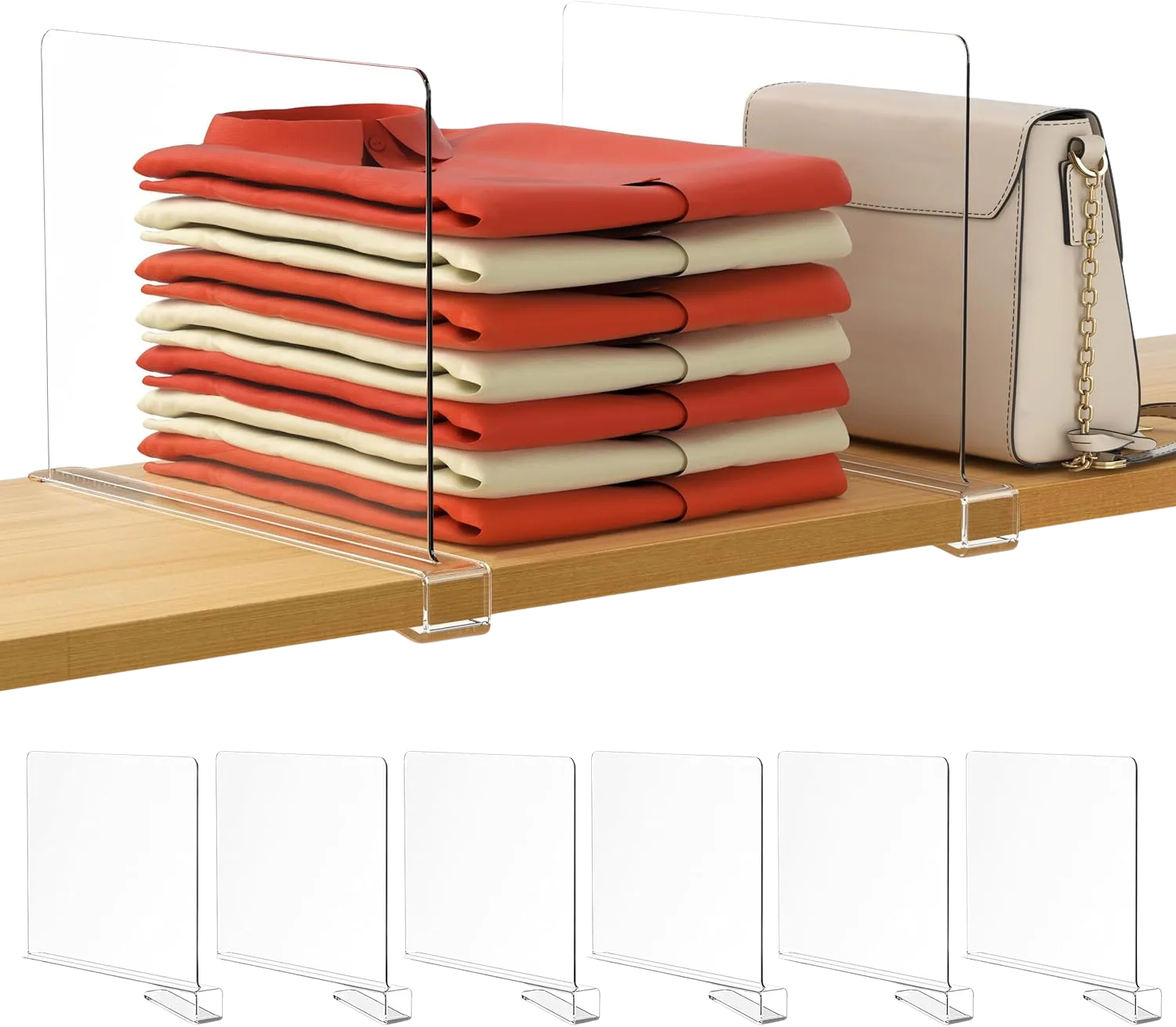
The clip-on wire version is the budget-friendly pick and the one to start with. If you want to splurge slightly so the closet reads calm, clear acrylic is worth the money. It disappears visually, so the shelf reads as linens rather than linens plus hardware.
The no-drill track is not the compromise track
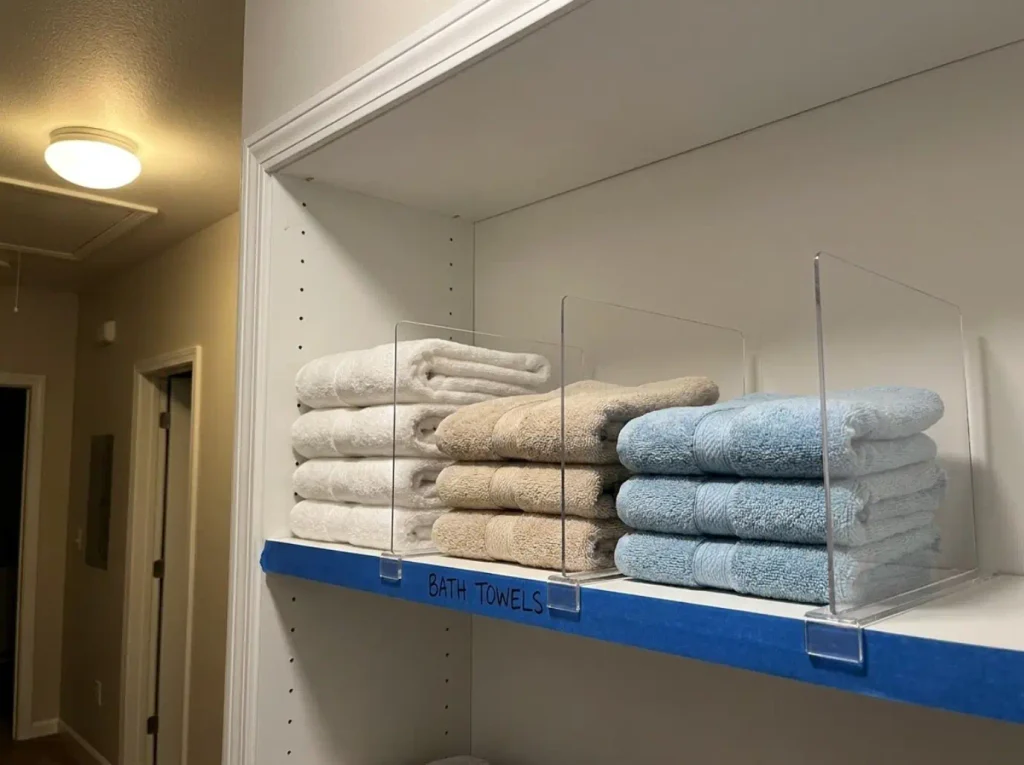
Clip-on vertical dividers clamp directly onto the shelf edge. They are fully removable: no tools, no anchors, no holes, nothing to patch at move-out. You slide them on, slide them along until the spacing matches your stacks, and you’re done. If the category changes size in six months, you move them again in four seconds.
The Evelots 8-Pack Wire Shelf Dividers are tall steel and install exactly that way, and eight is enough for three or four shelves. The limitation is honest: they clamp to a shelf edge, so a thick front lip or bullnose trim may not accept them, and they read as hardware in a way acrylic doesn’t.
That’s the same mechanism as the same no-drill approach applied to a bedroom closet, and it’s lease-safe by construction rather than by careful installation. Nothing adhesive to fail, nothing to patch. If you do want a hook or two on the inside of the door for a laundry bag, adhesive command strips rated for the weight are the lease-safe route, and hooks are about the only mounted thing this closet ever needs.
I used to push people toward bins as the default first purchase for linen closets. It’s the recommendation everywhere, and it’s wrong for this space specifically, because bins solve looseness and the dominant problem here is toppling. Dividers first.
Which categories genuinely need walls? Washcloths, travel-size toiletries, the spare pillowcases that escaped their bundle, hair tools. Anything that’s a pile of small objects rather than a stack of flat ones. Folded towels stack fine once a divider is holding the line.
Label the shelf, not the bin
Label the shelf edge. Not the bin.
This is what separates a system that survives other people from one that only works while you’re the one putting laundry away. The bin moves: borrowed for a road trip, swapped when a category grows, carried to the bedroom and left there. The shelf doesn’t.
A label on a bin tells you what’s inside it. A label on the shelf tells you what belongs there, which is the information that maintains the system.
Labels also enforce the one-shelf-one-job rule. Without them, that rule lives in your head, and a system that lives in one person’s head fails the first time anyone else does the laundry.
Use the words your household says out loud. “Guest” beats “Guest Linens.” Nobody ever failed to put something away because the label was too casual.
The free version is painter’s tape and a marker, and it works completely. Do that first. Live with it a month, watch which labels you peel off and rewrite because the category was wrong, then commit to something permanent.
If they survive unchanged, the Brother P-Touch PTD220 Label Maker is the upgrade path: handheld, standard TZe tape, prints at a size you can read from the hallway. It won’t fix a system that’s still shifting, and buying it on day one usually means printing labels you peel off in March.
Print or write your labels, then walk to where you actually stand when you put laundry away, usually the hallway, three or four feet back, with a basket on your hip. If you can’t read the label from there, it’s too small. That distance, not the distance from your nose, is the one that matters.
For the loose categories that do want a container, a fabric bin with a built-in label window covers both jobs at once.
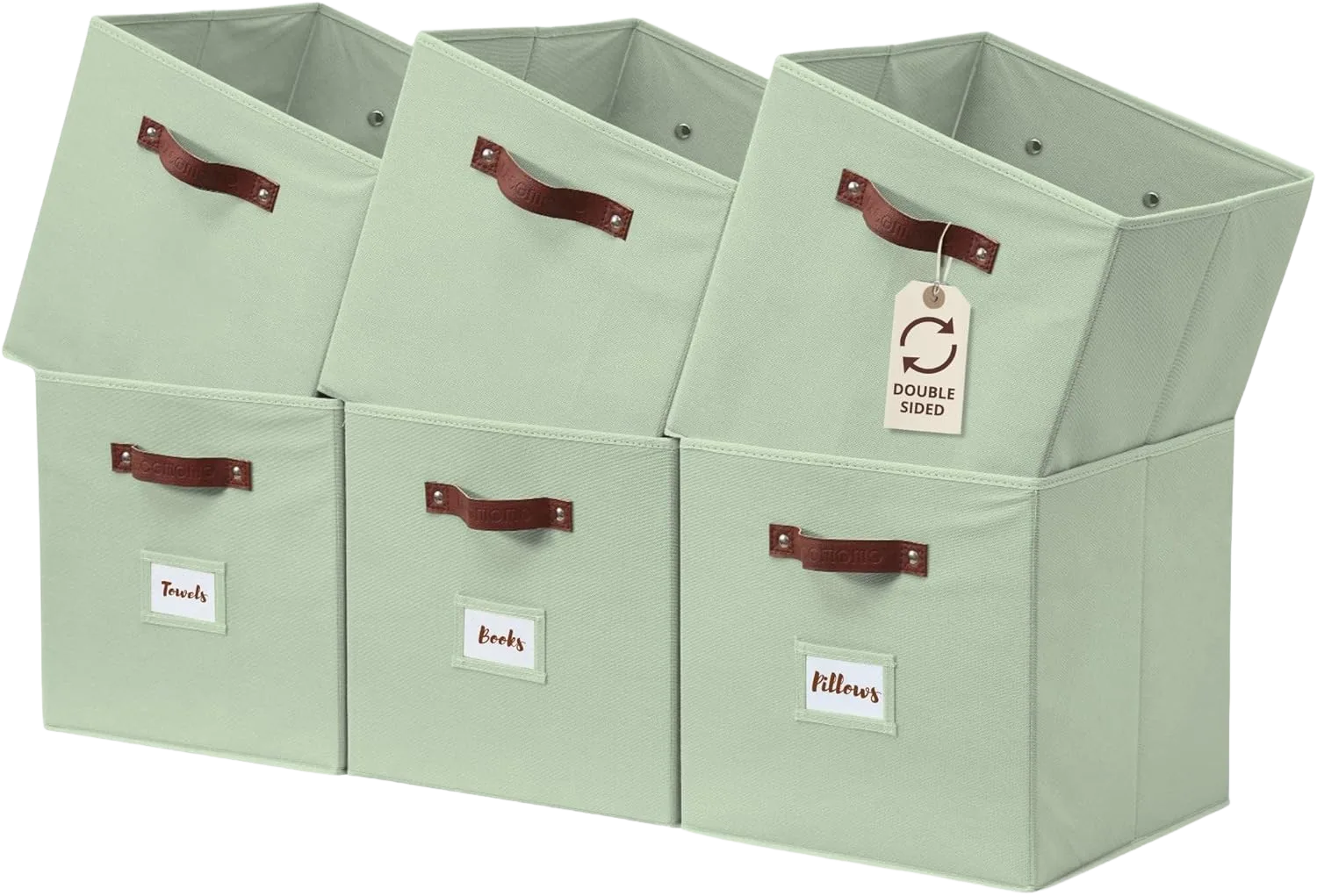
One last failure mode, because it applies to any bin you buy. The bin that fails is the one with a lid on a shelf you use daily. Anything you have to open one-handed while holding wet towels gets left open, and a bin left open is a shelf with walls. Lids belong on the monthly basket, not the washcloths.
Keep It Working Past the First Month
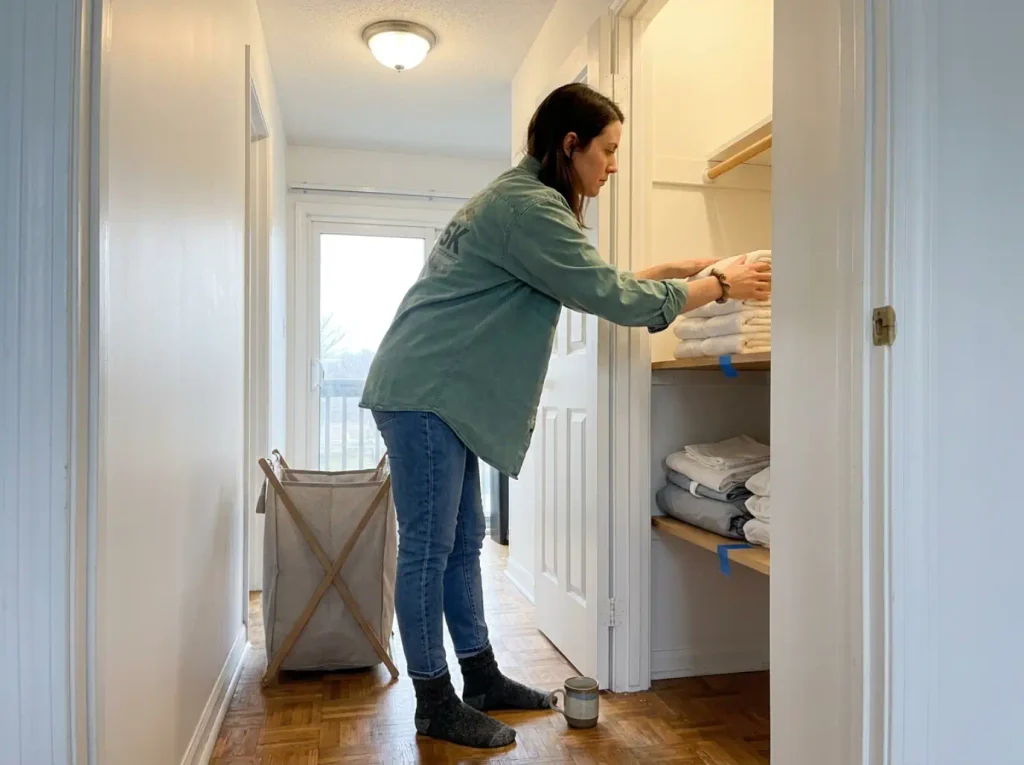
The reveal is the easy part. This is the part that decides whether you’re doing all of this again in April.
The whole maintenance load here is one reset system, and it’s a five-minute job rather than a project. It happens monthly. Restack anything leaning.
Return anything that migrated to the wrong shelf, mostly hand towels ending up with bath towels. Check the overflow basket against its full line.
That’s the whole routine. Attach it to something you already do, like the day you change the sheets, because you’re standing in the closet anyway.
The three-month test is a different job. Don’t look at whether the closet is tidy. Look at which shelf keeps breaking its rule. One always does.
That shelf’s category is wrong, not the person using it: either it’s wrong for that height, or too big for one shelf and spilling onto its neighbor since week two. Moving a category is a five-minute fix.
Re-deciding to be tidier is not a fix at all.
Restock triggers live in the same routine. When you’re down to the last spare set of anything, that’s the buy signal, not a calendar reminder. The closet tells you when it’s low, provided you can see the whole category at once, which is what the one-category-per-shelf rule bought you.
And then there’s the test this article is named after. Can a guest find a bath towel without asking? If they can, the system works. If they ask, don’t blame them.
Either the labels aren’t readable from where they’re standing, or the shelf order doesn’t match how a stranger would guess. Both are fixable in ten minutes, and both are information you’d never get from your own use.
Here’s the thing that decides everything. The closet that holds isn’t the one organized best. It’s the one where putting laundry away correctly is faster than putting it away wrong.
If the right shelf takes an extra second, if you have to move a bin or lift a stack to slide something underneath, the system loses to whoever’s in a hurry. Design for the tired version of yourself, not the Saturday version.
Once this closet holds, the system moves to the next space that fights you. Renter-friendly bathroom storage that doesn’t risk the deposit runs on the same three moves: measure first, assign one job per zone, build a reset short enough that you’ll do it.
Conclusion
Give every shelf one job. That single decision does more for this closet than any container you can buy, and it costs ten minutes of deciding.
Fold every piece of a sheet set to the same rectangle and slide the whole set into a pillowcase. It’s free, it takes one laundry cycle to adopt, and it fixes the sheet half of the closet for good.
Give the overflow a real container with a real full line. Backstock isn’t the problem, unbounded backstock is. One basket with a lid and a limit keeps the purge from undoing itself by February.
In three months, look at which shelf keeps breaking its rule. That category is either at the wrong height or too big for one shelf, and moving it is a five-minute correction rather than a reorganization.
Start with one shelf. The one at chest height, because that’s the one that fails first and the one you’ll feel the difference in tomorrow morning. Get it right, then work outward.
Frequently Asked Questions
01What is the best way to organize a linen closet?
Empty it completely, then give every shelf a single category ordered by how often you reach for it. Everything after that step, including folding, containers and labels, is enforcement of that one decision.
02What is the best way to organize a deep linen closet?
Folded towels and sheets need only about 12 to 16 inches of depth, so anything past that is dead space. Use bins or shelf dividers so the back of each shelf holds one defined category you can pull forward as a unit.
03How far apart should linen closet shelves be?
12 to 15 inches works for towels and sheet sets, while bulky blankets want 18 to 20. If your shelves are adjustable and you don’t know your stack heights yet, 15 inches is the standard installation spacing to start from.
04How do you organize a linen closet as a renter?
Use clip-on shelf dividers and free-standing bins, since both install with no tools and leave no wall damage. The linen closet is one of the few spaces where the no-drill version isn’t a compromise, because the space wants dividers and containers rather than mounted hardware.
05How many sheets and towels should you keep?
Roughly two sheet sets per bed, one on and one in the wash, plus a guest set. Size towels to the people who actually shower here plus a couple of spares, and send the ones that don’t make the cut to an animal shelter rather than a thrift store.