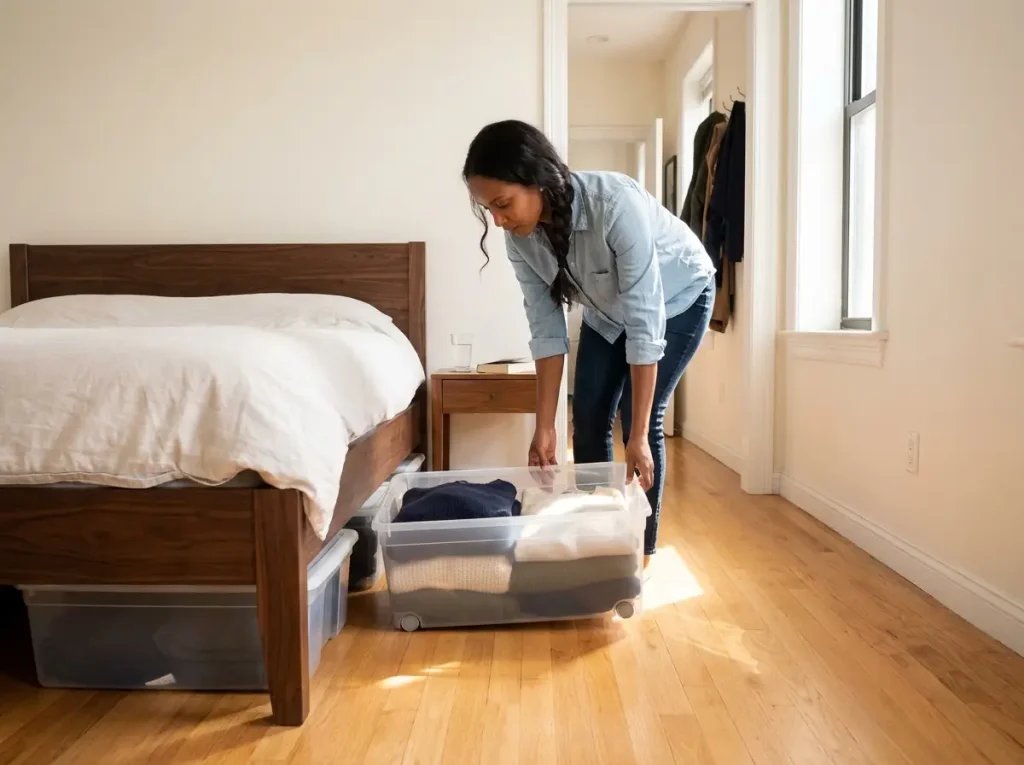
The bin you bought sits shoved against the wall, still in its plastic bag, because you measured the mattress height instead of the frame clearance. Or it fits under the bed but you can’t pull it out without hitting the bedpost. Or you stuffed it full of sweaters in October, and by February you can’t remember which bin they’re in because they all look identical from the outside. Under-bed storage either works really well or becomes the most expensive layer of dust in your bedroom — and the difference usually comes down to one measurement taken before you buy anything.
I’ve set this up in enough bedrooms — platform beds, metal frames, box springs, and everything in between — to know exactly where the system breaks down. Most of it breaks down in the first fifteen minutes, before a single container is purchased. This guide covers the full setup: what to measure, which container type fits your actual clearance, what belongs there, and how to run a reset so it doesn’t revert to a black hole in three months.
Quick Answer: How to set up under-bed storage that stays organized:
- Measure from the floor to the bottom of your bed frame (not the mattress or box spring) — write down that number.
- Choose a container type that fits your clearance: rolling clear bins for 7 inches or more, flat bins or fabric bags for 4–6 inches.
- Store only seasonal or infrequently used items — nothing you reach for more than once a month.
- Put frequently accessed bins at the perimeter within arm’s reach; archive items go in the center.
- Label every container with the short side facing out and readable from standing height.
- Pull and check every three months before the zone turns into a black hole.
Measure Your Clearance Before You Buy Anything
Every container listing on Amazon says “fits under most beds.” That phrase is useless. What it really means is “fits under beds with at least 7 inches of clearance,” which is not every bed — and definitely not every platform bed in every apartment built since 2015.
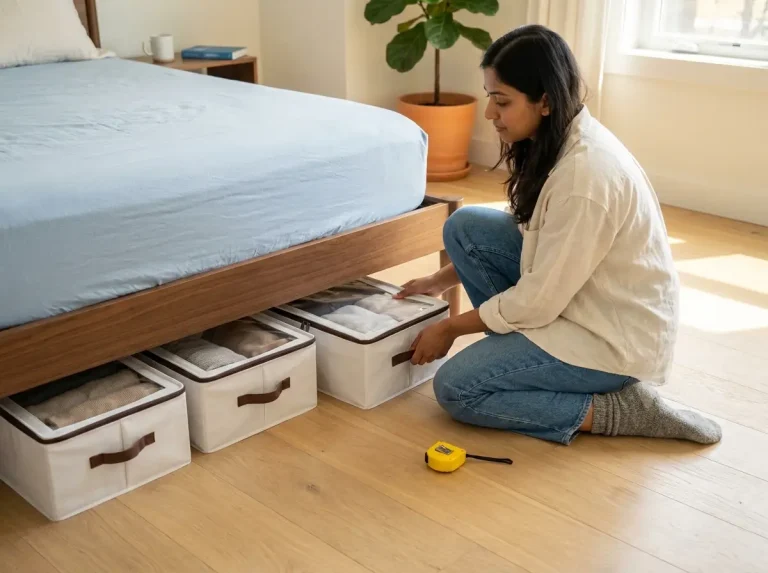
Bed frame clearance varies more than most people expect, and it varies by frame type in predictable ranges. Platform beds — the low-profile, no-box-spring style common in apartments and modern furniture — typically sit 4 to 7 inches off the floor. Many platform frames sit at exactly 5 or 6 inches, which is below the clearance most rolling bins need.
Standard metal frames (the kind with legs at the corners and a center support bar) run 7 to 9 inches. Box spring setups — a mattress sitting on a box spring on a frame — give you 9 to 13 inches, sometimes more. The frame type alone narrows your options before you measure anything.
How to measure correctly
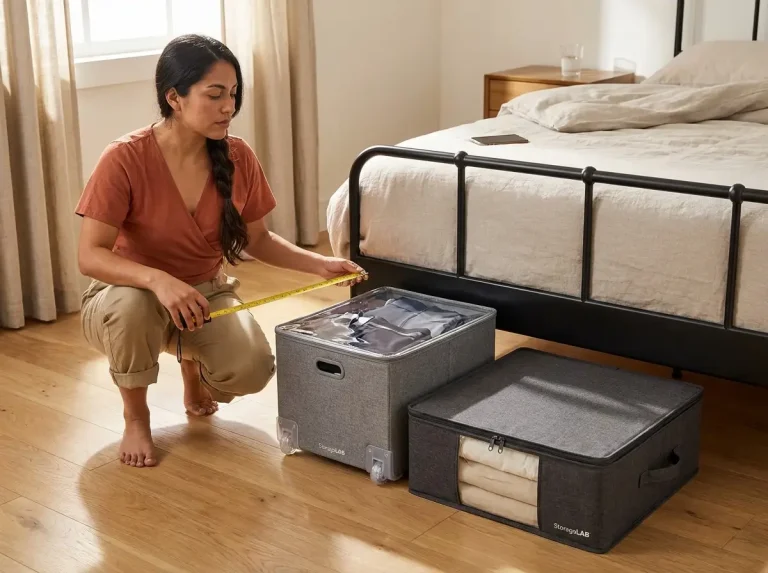
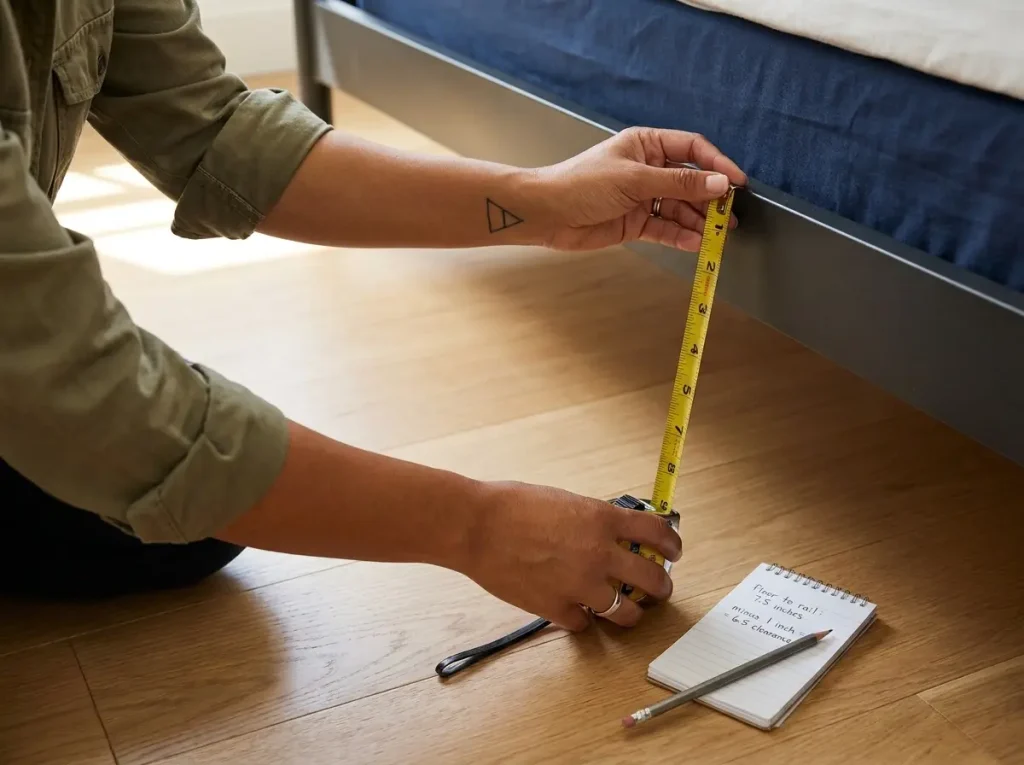
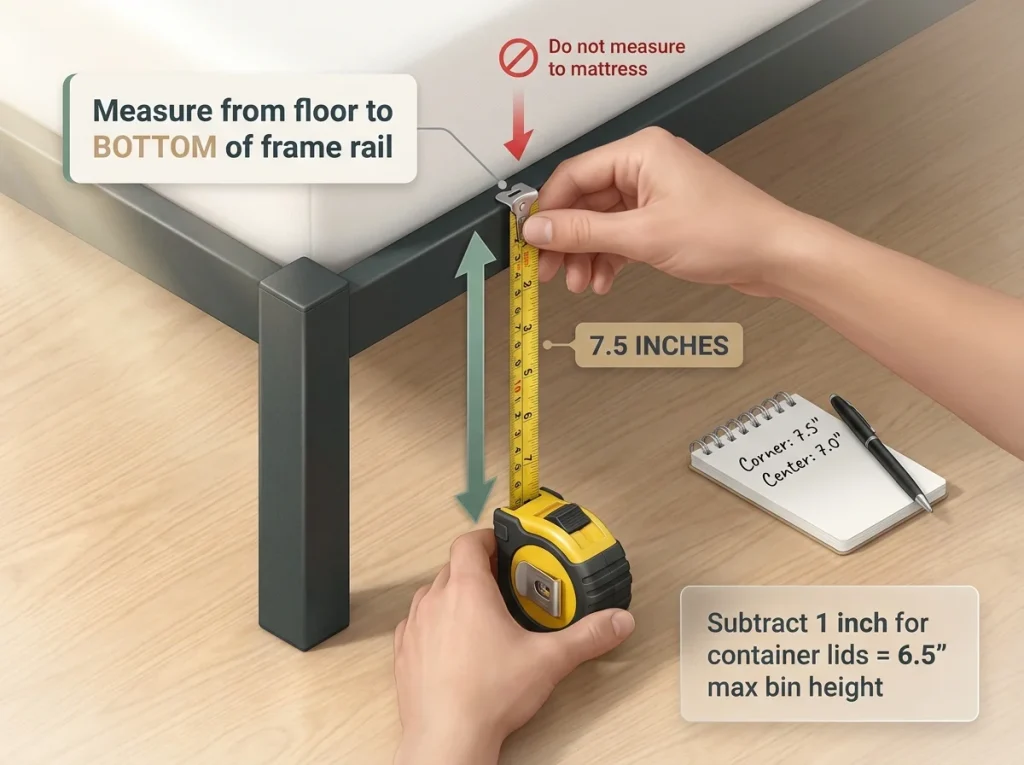
Measure from the floor to the bottom of the frame rail — not to the box spring, not to the mattress, and not to where you think the bottom is. Slide a tape measure flat along the floor until it hits the frame. Read the number where the tape meets the bottom edge of the metal or wood rail. That is your clearance number. Write it down.
Then subtract one inch to account for container lids and slight floor variations. That adjusted number is what you compare against container heights when shopping.
Why the 6-to-7-inch threshold matters
Most rolling under-bed bins are 6 inches tall. They need at least 7 inches of clearance to slide in and out without scraping. A frame at exactly 6.5 inches of clearance seems close enough — until you try to pull the bin out at an angle on carpet and the lid catches the rail and sticks.
This is the thing nobody mentions in any product listing. If your clearance is under 7 inches, skip rolling bins entirely and go straight to flat fabric bags or low-profile lidded bins. If your clearance is 7 inches or more, you have the full range of options.
Pro tip: Measure in two spots — under the corner of the bed and near the center support bar. Center support bars on metal frames sometimes hang lower than the side rails. The lower number is your real clearance.
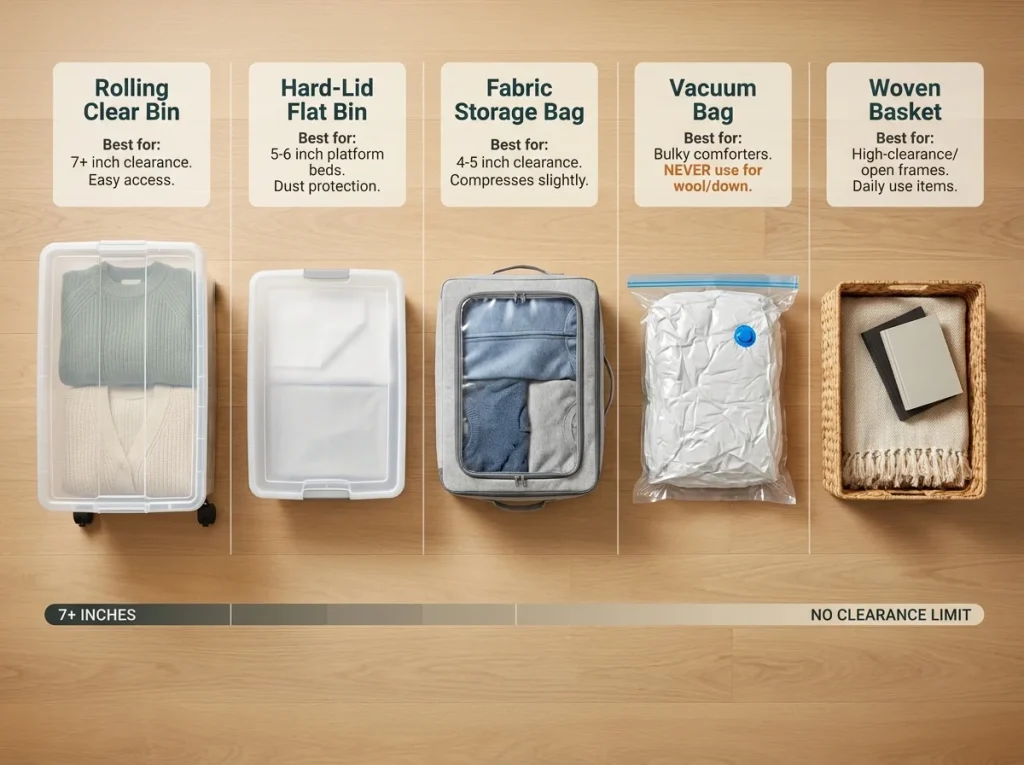
The Five Types of Under Bed Storage (What Works and When)
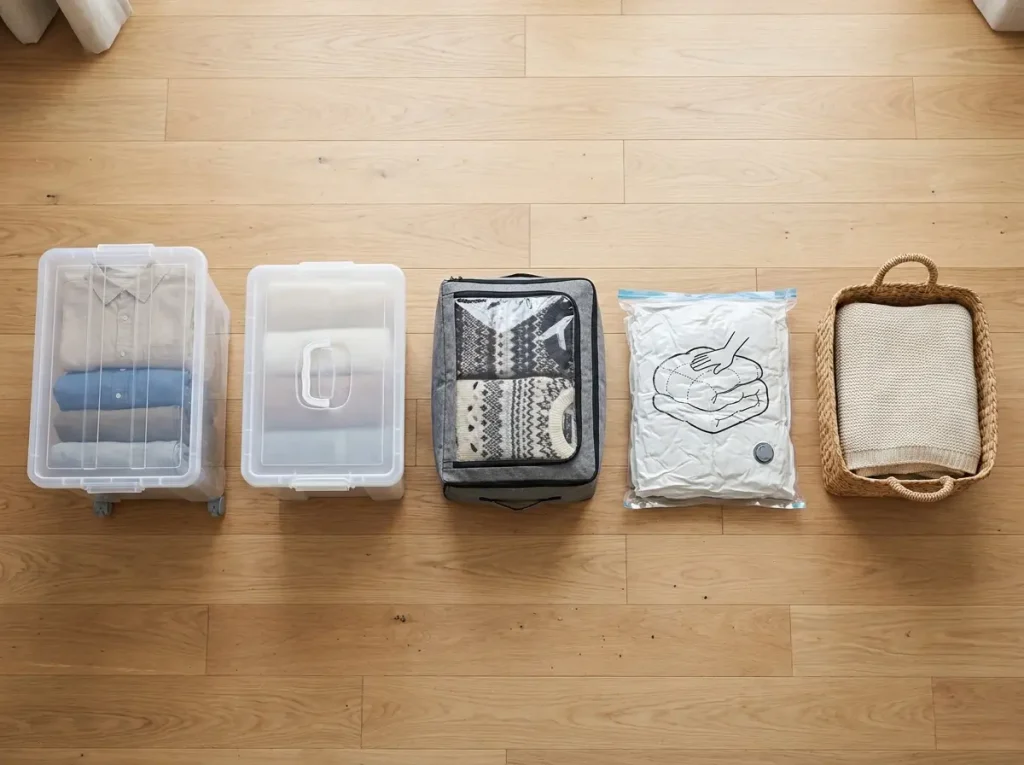
The under-bed storage market has a lot of variation, and most of it only makes sense once you know your clearance number. Buying based on reviews without knowing your clearance is how you end up with a rolling bin that technically fits but won’t slide out on carpet, or a set of vacuum bags that work fine until you realize you stored your wool sweaters in them.
Rolling clear bins (7 inches or more)
Rolling under-bed bins are the standard choice for standard clearance — and they work well for a reason. You can pull one out from the side of the bed, grab what you need, and slide it back without kneeling and reaching blind. The clear sides let you see contents without opening the lid.
The StorageLAB Under Bed Storage Containers with Wheels are 33 inches long by 17 inches wide by 6 inches tall — they fit standard queen and king frames with 7-plus inches of clearance, roll on both carpet and hardwood, and the clear sides actually show contents rather than just hinting at them. The limitation to know: if your clearance is under 7 inches, the lid won’t clear the frame rail when you pull at an angle.
Flat hard-lid bins and fabric bags (4 to 6 inches)
For frames with 4 to 6 inches of clearance — most platform beds — rolling bins are out. Flat hard-lid bins with snap-close lids work here, as long as you check the outer container height rather than the inner measurement listed in the specs. Fabric bags with top zippers and a mesh viewing panel are also good for this clearance range; they compress slightly and don’t have a rigid lid fighting the frame.
The drawback with both: you can’t roll them out. You’ll be reaching in from the side, which means anything stored in the center of the bed is harder to access. Plan for that when deciding what goes where.
Vacuum storage bags (for bulk seasonal compression)
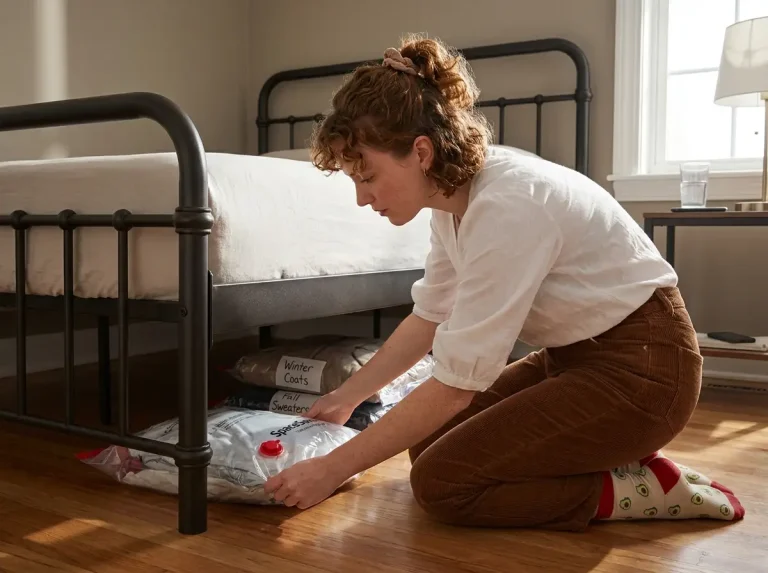
Vacuum storage bags compress bulky seasonal items — comforters, duvets, extra pillows — down to a fraction of their normal size. A king comforter that normally takes up a full bin can compress to two inches thick. The Spacesaver Premium Vacuum Storage Bags come in a mixed set of six (jumbo, large, and medium sizes) and work well for low-clearance frames where even flat bins don’t have room.
The critical caveat: do not use vacuum bags for wool or down. The American Wool Council is explicit: wool should be stored loosely, not under compression — the vacuum seal works against the fiber’s natural structure over months of storage. Down loses its loft under sustained compression and may not fully recover. This caveat is printed on most bag packaging and routinely ignored.
Cotton and synthetic fills are fine. For wool sweaters and down comforters, use a breathable fabric bag or a hard-lid bin instead. There’s more on this in Why Your Seasonal Closet Rotation Fails Every Time, which covers fabric-specific storage rules for seasonal rotation.
Woven baskets (open frames, frequently accessed items)
Woven baskets belong under open-frame or high-clearance beds where you want quick access without lifting a lid. They’re not sealed, so they’re not for long-term storage of anything that needs protection from dust. They work for items you reach for regularly — a throw blanket, yoga props, a book you’re in the middle of — because the open top means you grab and go.
If you have a platform bed, skip the basket entirely. The rigid sides need clearance, and low-clearance frames can’t accommodate them.
What Actually Belongs Under the Bed
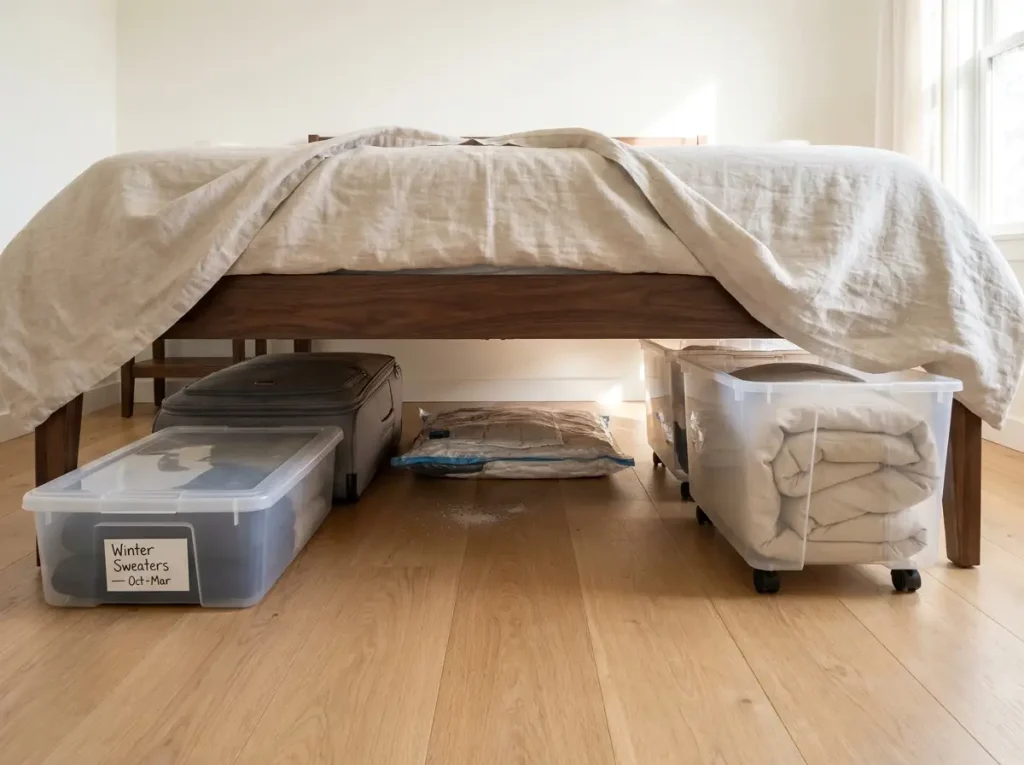
Under-bed storage works best as a seasonal or infrequent-access zone. The moment you start storing things you reach for weekly — or daily — the system starts to break down. Not because the storage is bad, but because frequent pulling-and-replacing creates the chaos you were trying to avoid.
Good candidates for this zone
The under-bed zone works well for seasonal clothing (winter sweaters in summer, summer dresses in winter), extra bedding (the spare comforter set, the guest room pillow stack), flat luggage stored lengthwise, and out-of-season shoes. These items share a characteristic: you access them a few times a year during an intentional rotation, not in a hurry on a random Tuesday. That makes them the right fit for a zone that takes some effort to access.
What to keep out
Anything you need regularly should not go under the bed. Once frequently used items move down there, they get pulled out without being put back properly, lids get left off, bins drift from their spots, and the system erodes within weeks.
Also keep out anything moisture-sensitive — books, electronics, leather goods — unless you’re in a consistently dry climate with hard flooring. The space under a bed on carpet can trap humidity, particularly in basements or first-floor units where air circulation is limited.
The one-month frequency test
If you’ve needed something more than once in the past month, it doesn’t belong under the bed. Find it a spot with better access. If you haven’t needed it in six months or more, it might not belong in your bedroom at all.
Under-bed storage is not a backup closet — it’s a seasonal depot with limited access points. Treat it that way and it stays manageable. Treat it as general overflow and it becomes the space you stop looking in after six months because you’ve forgotten what’s there.
How to Set It Up So You’ll Actually Use It
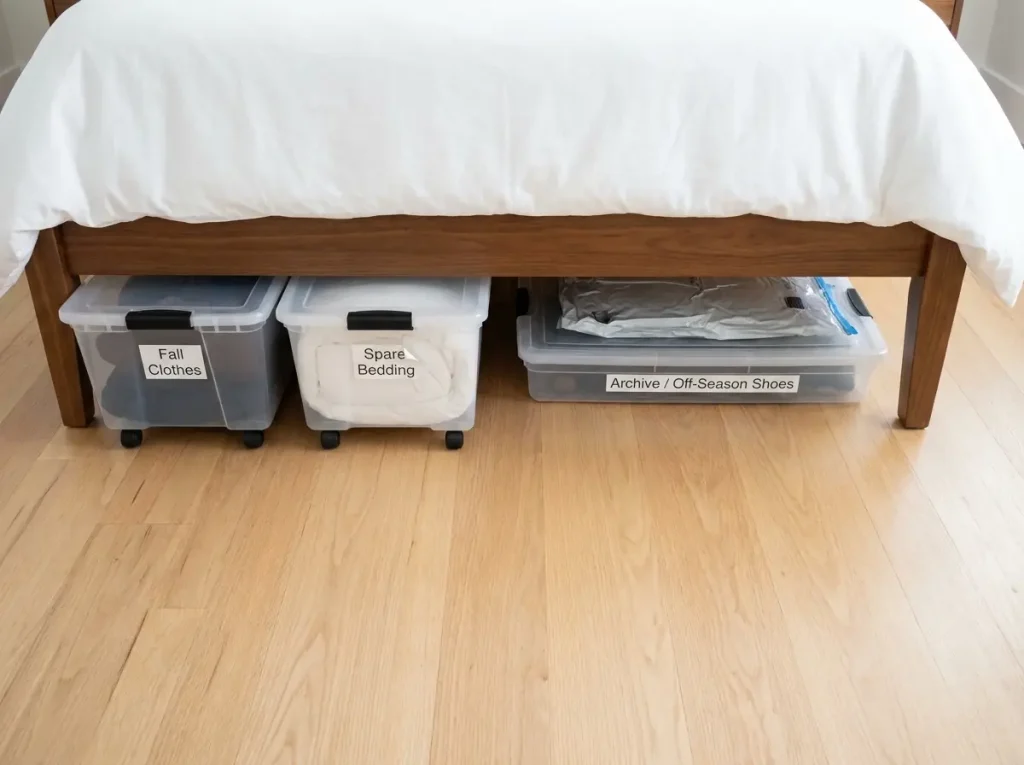
Getting the right bins is maybe 40% of the setup. The rest is placement, labeling, and one rule about the floor that most people skip — and whose absence explains why most under-bed systems stop working after three months.
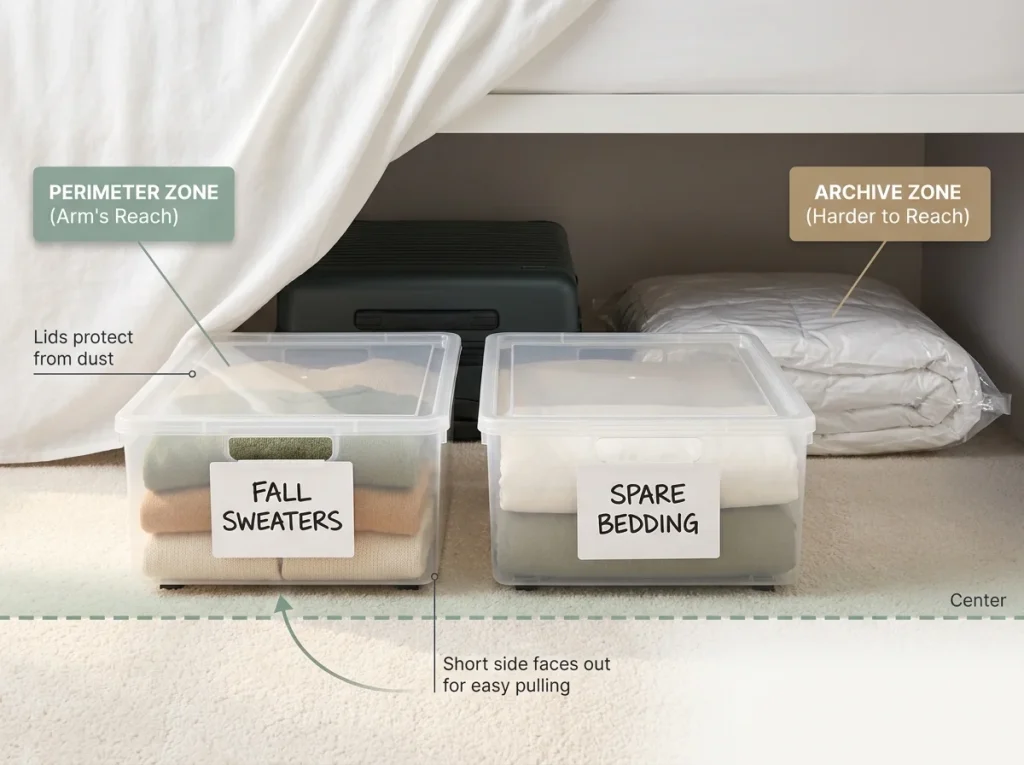
Perimeter vs. center placement
Think of the under-bed zone as two areas: the perimeter (the strip reachable by bending over the side of the bed, roughly 18 inches from the edge) and the center (everything past that, which requires pulling a bin out or reaching in blind). Perimeter slots are for rotation items — the seasonal clothing bins you’ll pull at the start of each season. Center slots are for true archive items — the vacuum-compressed comforter, the luggage, the spare bedding set you open once a year.
If you put your archive bins at the perimeter and your rotation bins in the center, you’ll be crawling under the bed constantly and the system falls apart within a month.
The labeling system that works
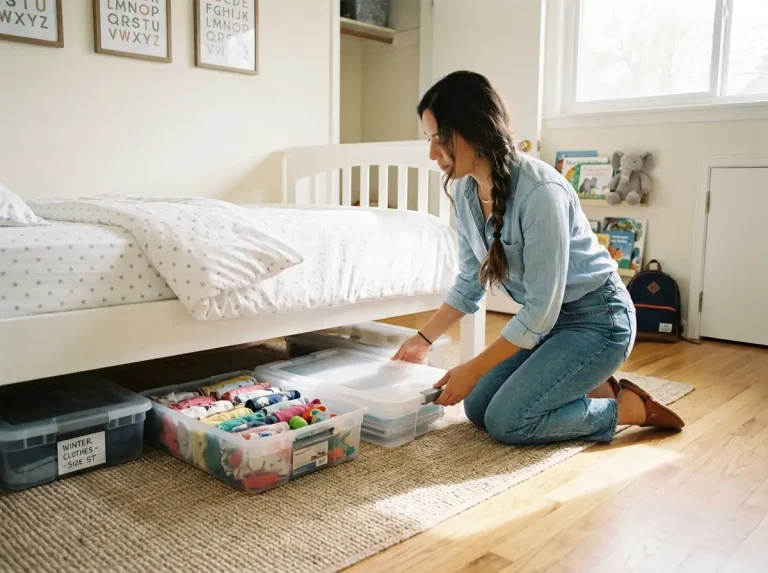
Labels need to be legible from standing height — which means the short side of the bin should face out toward the bed’s edge, and the text should be large enough to read without kneeling. White label tape with thick marker text works. A slip-in label holder on the bin’s handle works. What doesn’t work: labels on the lid (only visible after you’ve already committed to pulling the bin out), small font, or labels that say vague things like “misc” or “extra stuff.”
Label by season and approximate timeframe. “Winter Sweaters — Nov to Apr” tells you both what’s inside and when to touch it. That specificity is what makes the label worth having.
The floor rule
Nothing goes directly on the floor under the bed. Not a single loose item. If it doesn’t fit in a container, it doesn’t go in this zone. This is the rule most setups break first — one item without a container becomes three, then a pile, then the system stops functioning as a system.
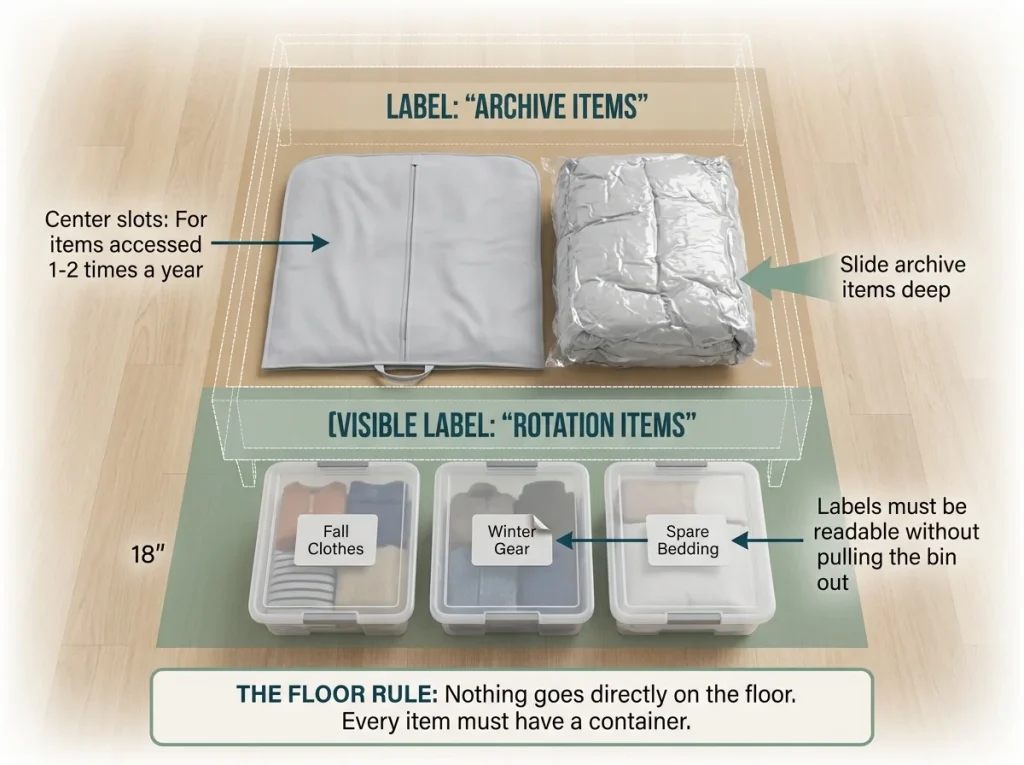
Every item under the bed has a container, a label, and a defined spot. That’s the whole rule. It sounds simple until you’ve unpacked a suitcase at midnight and can’t find the right bin lid.
Pro tip: When placing bins back after a rotation, snap a photo on your phone of the zone from the foot of the bed. Next time you pull something out and can’t remember where it goes, the photo is faster than guessing.
The Platform Bed Problem (What Renters Need to Know)
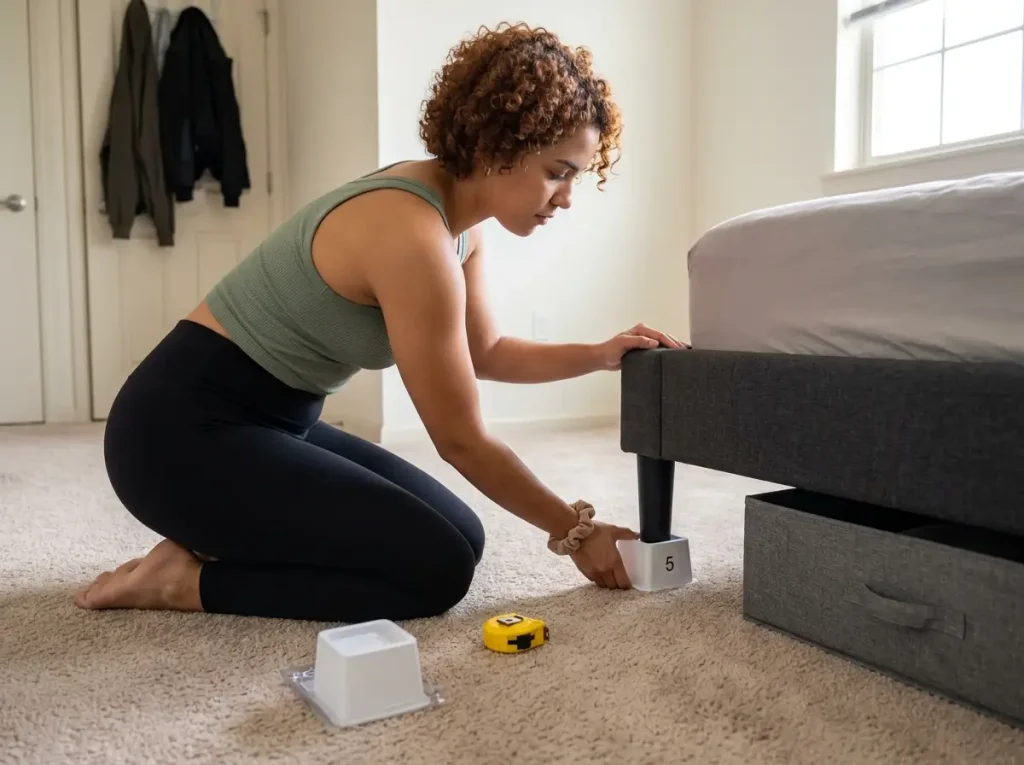
Platform beds look good. They’re in most furnished apartments, every IKEA bedroom setup, and most rentals with updated fixtures. They also sit 5 to 6 inches off the floor, which blocks out roughly 90% of rolling under-bed storage options. This is the specific problem most storage guides skip entirely.
Why low-profile beds are a storage trap
A standard platform bed frame with a slatted base sits about 5 to 6 inches off the floor. Most rolling bins need 7 inches of clearance. Most hard-lid bins need at least 6.5 inches just for the container itself, before accounting for the lid.
That half-inch to one-inch gap is the difference between a functional storage zone and a space that physically can’t hold what you need it to hold. And because renters can’t modify the frame, they’re often left buying containers that technically “fit” but can’t be pulled in and out without scraping the lid along the bottom of the rail.
The bed riser fix
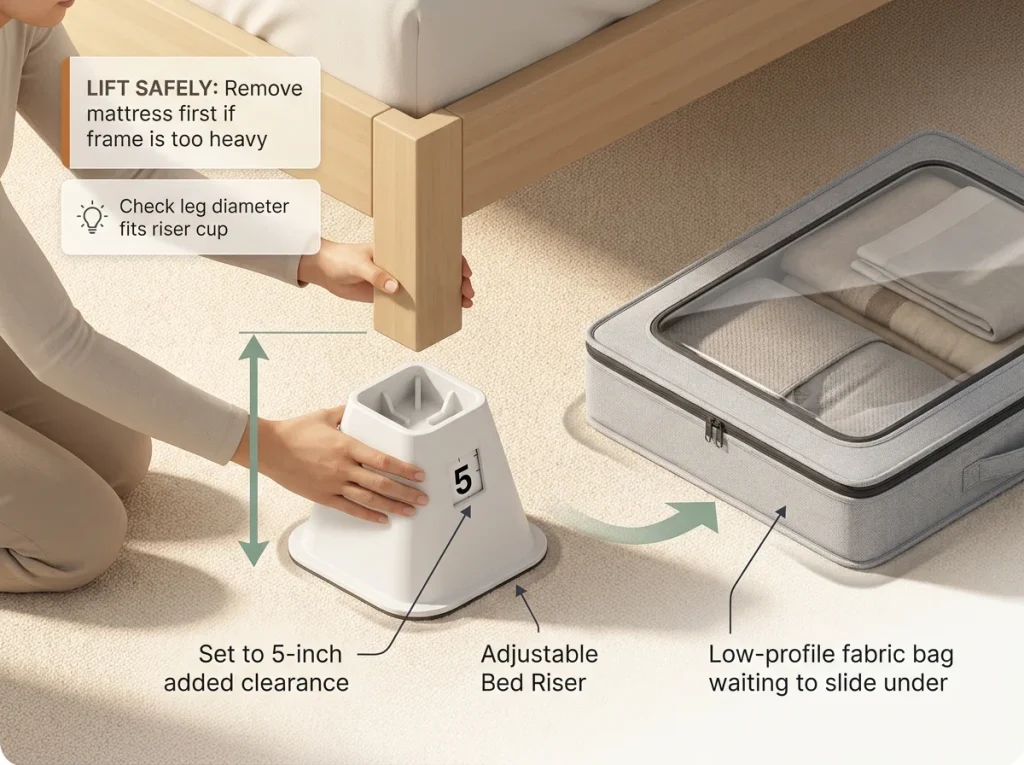
Bed risers raise the entire frame by inserting under each leg, adding 3 to 8 inches of clearance depending on the setting. The EclatBain Bed Risers are adjustable to 3, 5, or 8 inches — which means you can dial in the exact clearance you need for your target bin rather than buying risers, discovering the clearance is still wrong, and starting over. No tools required, and they’re removable when you move out.
If your frame currently sits at 5.5 inches and you need 7 inches of clearance for rolling bins, set the risers to 3 inches — you’ll end up with 8.5 inches of total clearance and the bins will slide freely. Check the riser’s weight rating before buying; a platform bed with a heavy mattress needs risers rated for the full mattress-plus-frame load, not just the frame. For renters navigating other no-drill bedroom storage situations, the same renter-friendly logic from No-Drill Closet Organization That Won’t Cost Your Deposit applies here too.
When the riser won’t work
Some platform beds have a solid continuous base rather than individual legs — a full-panel frame that sits flush to the floor with no leg contact points. Risers need a leg to insert under; they can’t attach to a solid-base frame. In this case, the only path is a low-profile container designed for the existing clearance.
The IRIS USA Under Bed Storage Box with Lid has an outer height of 6.5 inches — tight, but functional for frames with 7 inches or more of clearance. Its outer length of 32.5 inches means it slides under most queen frames without hitting the center support bar. If your clearance is under 6.5 inches and risers aren’t an option, flat fabric bags and vacuum-compressed bags are the only containers that will physically fit.
Pro tip: Measure your frame’s leg type before ordering risers. Square and round legs work with standard riser cups. Some platform frames have angled or wide-base legs that need specific riser designs — check the leg diameter against the riser cup opening in the listing before you add it to your cart.
Why It Stops Working (and the Reset That Fixes It)
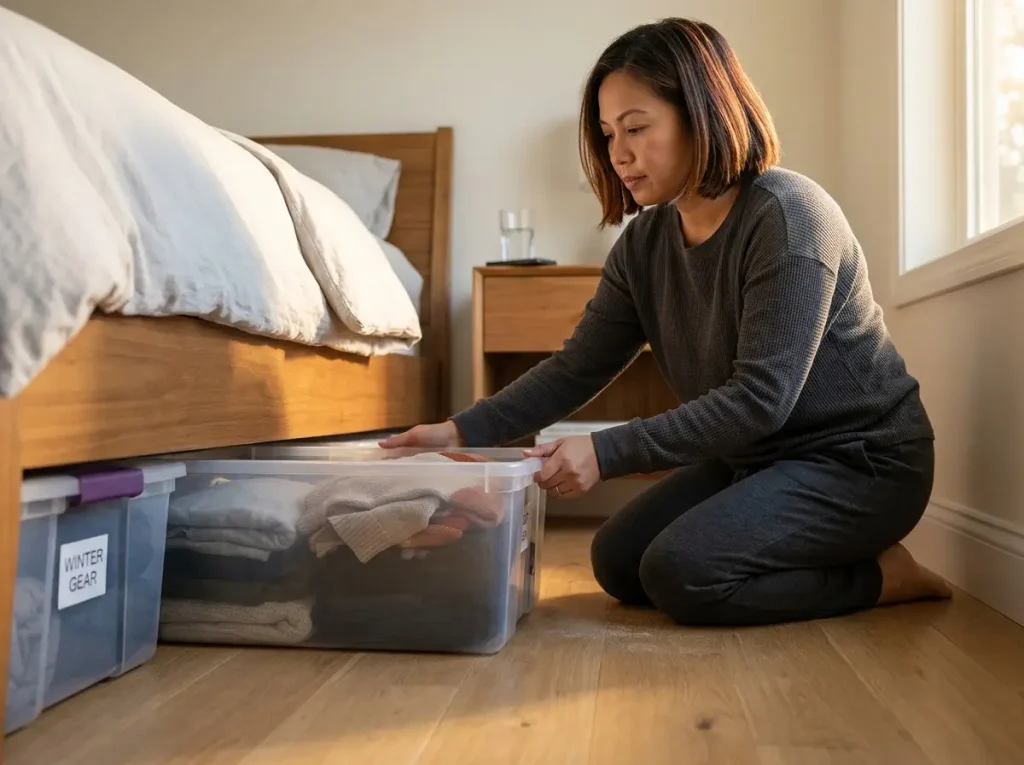
Under-bed storage fails for one consistent reason: you can’t see inside without pulling everything out. Out of sight means out of mind. A bin that was organized in October becomes a mystery box by February, and by the following October you’ve forgotten what’s in it and started a second bin rather than opening the first one.
How under-bed zones fail
The failure pattern is always the same sequence. First, the bins drift from their spots — slightly, then significantly. Then items get placed on top of bins rather than inside them, which breaks the floor rule. Then dust accumulates on the exposed items.
Then someone reaches under looking for something, pulls out the wrong bin, leaves it halfway out, and the space is now partially blocked. Within about six months of setup, the zone has reverted to somewhere between organized and chaos. This isn’t a discipline problem — it’s an access problem. The zone is inconvenient enough that maintenance gets skipped, which means the drift compounds until the whole thing is unusable.
The quarterly pull-and-check
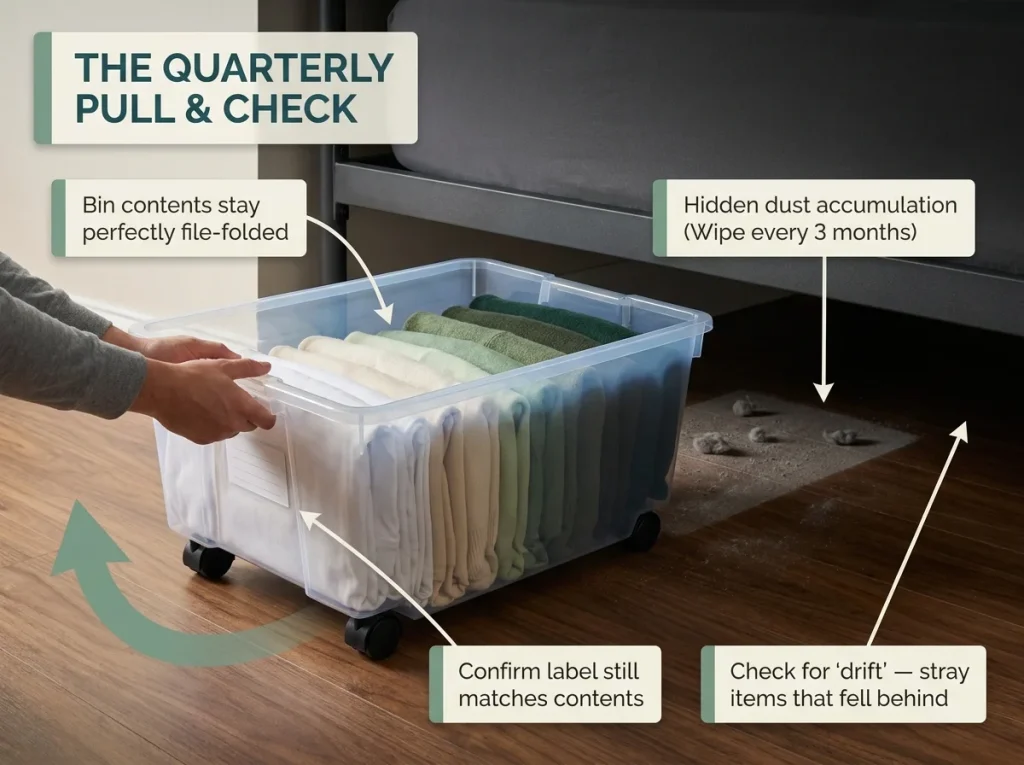
Four times a year, pull every bin out from under the bed. This takes about ten minutes. Wipe the floor — a long-handled duster works better than a cloth for this. Check that every bin label still matches its contents, because seasonal drift happens and a bin labeled “Winter Sweaters” sometimes ends up with miscellaneous items from a bedroom purge.
Push everything back with perimeter items returned to the perimeter and archive items returned to the center. This ten-minute reset is what keeps the system running. Skip it and you’ll be starting over from scratch in a year.
The biannual deep clean
Twice a year — timed with seasonal clothing rotation — do the full version. Pull everything out, open every container, inspect the contents, vacuum the floor properly, wipe down the bin exteriors, and re-label anything that’s shifted. This is when you catch the wool sweater that should never have gone into a vacuum bag, the luggage that’s been collecting under-bed debris on its base, and the mystery bin that turns out to hold items that belong in the hall closet.
When to Upgrade to a Storage Bed Frame
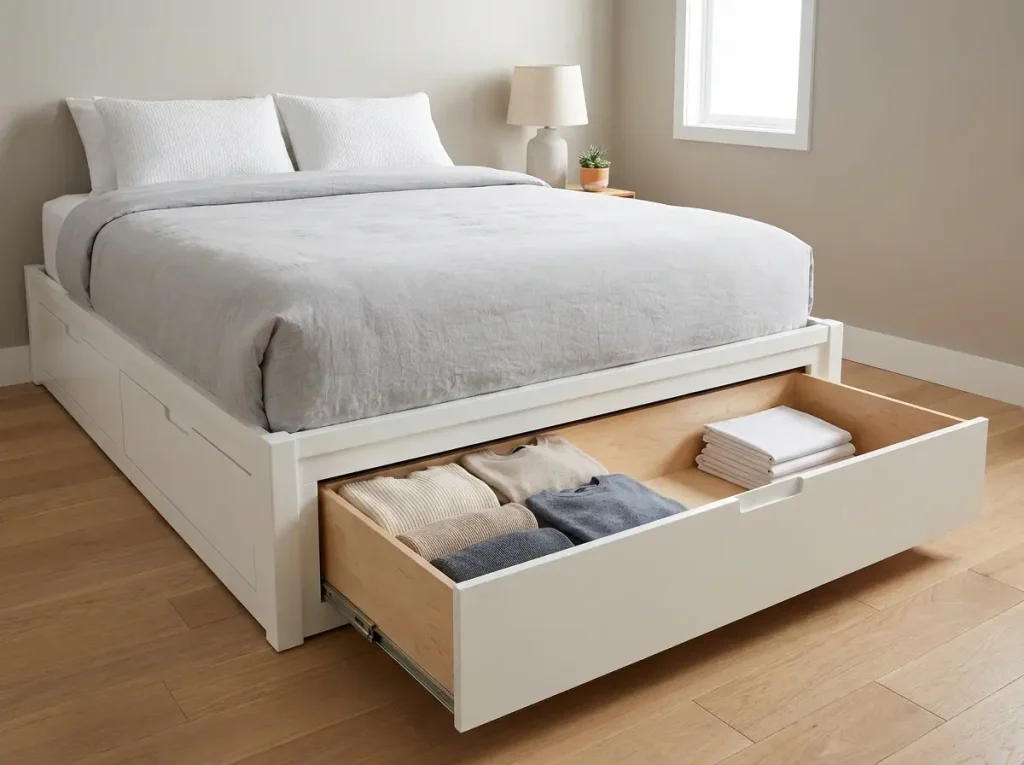
If under-bed storage is a genuine priority rather than a bonus, there’s a point where the external-container approach becomes less efficient than building storage into the frame itself.
What a storage bed actually gives you
Storage bed frames — often called captain’s beds — replace the under-bed zone with built-in drawers. A typical drawer runs 7 to 9 inches of interior height, 36 to 42 inches wide, the full side depth of the frame. You get the equivalent of two to four large dresser drawers per side, with direct access that doesn’t require bending to the floor and pulling a container.
The tradeoff: the drawers are fixed, you can’t reconfigure the system, and the frame costs significantly more than a standard platform. For a bedroom where under-bed storage is doing serious work — replacing a dresser, housing a full seasonal wardrobe — the built-in system wins on access and dust protection.
Who should think about this
Storage bed frames work best for two situations. Renters who can’t install permanent closet systems and need folded-clothing storage that moves with them. And owners furnishing a room with minimal closet space who want storage built in from the start rather than added around a standard frame later. For renters especially, the frame’s storage capacity doesn’t depend on what the next apartment’s closet looks like — it goes wherever the bed goes.
What to measure before buying
Drawer dimensions in a listing are internal. Measure your clothing first — a file-folded sweater needs about 4 to 5 inches of vertical clearance; jeans folded in thirds need 5 to 6 inches. A drawer interior listed at 7 inches gives you room for two layers of file-folded sweaters.
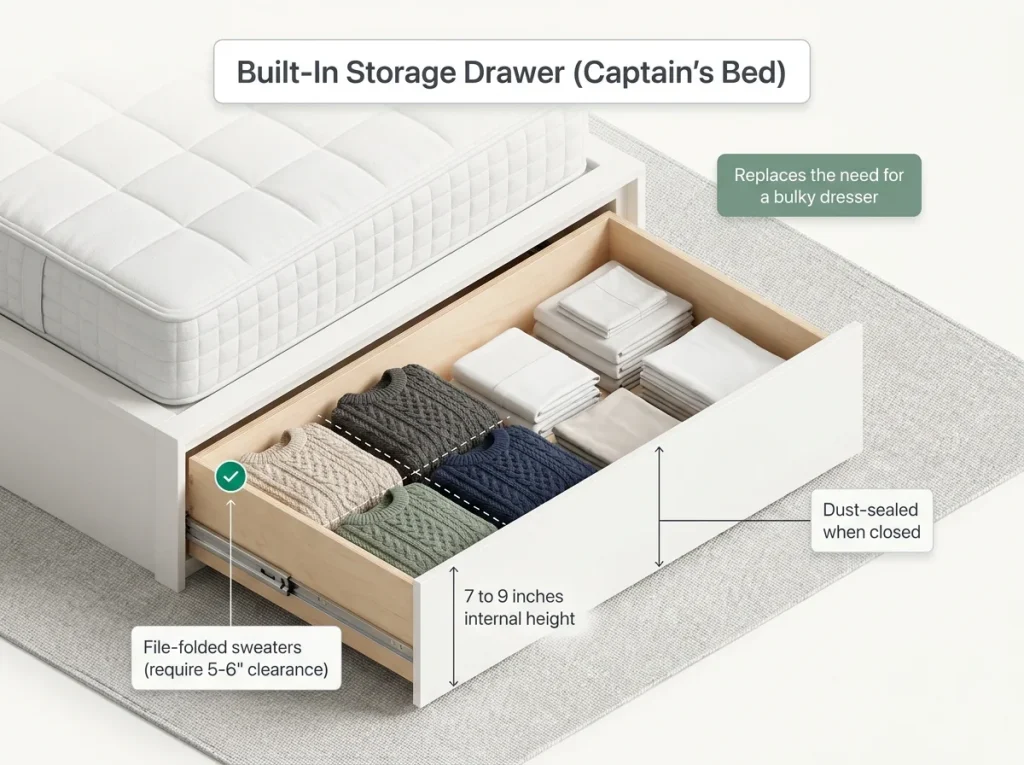
Also check your room layout: most storage frames open the drawers to one side only. If one side of your bed sits against a wall, that side’s drawer is blocked. Look at the product photos for opening direction before buying, not after the frame arrives.
Conclusion
Three things that make under-bed storage actually hold up: the clearance measurement taken before any purchase is made, the placement system that keeps rotation items at the perimeter and archive items in the center, and the quarterly pull-and-check that prevents the zone from reverting to a black hole.
Three-month checkpoint: pull every bin out, wipe the floor, confirm each label still matches the contents. If a bin has drifted items that don’t belong there, that’s your signal to revisit the frequency test — anything you’ve needed more than once in the past month needs a better home.
Start with the measurement. Everything else — the container choice, the placement, the labeling — follows from that one number.
Q1 How much clearance do I need under a bed for storage?
You need at least 7 inches of clearance — measured from the floor to the bottom of the frame rail — for most rolling under-bed bins. Platform beds typically sit at 5 to 6 inches, which is below that threshold. If your clearance is 4 to 6 inches, use flat hard-lid bins, fabric bags, or vacuum storage bags instead of rolling containers.
Q2 What is the best way to store clothes under a bed?
Seasonal clothing stores best in rolling clear bins for frames with 7 inches or more of clearance, or flat fabric bags for platform beds in the 4-to-6-inch range. File-fold everything before placing it in the bin so items stay visible without disrupting the whole stack. Label each bin by season and approximate date range so you know what’s inside without opening it.
Q3 How do you keep under-bed storage organized long-term?
Pull every bin out every three months, wipe the floor, and confirm each label still matches its contents. This ten-minute reset stops the drift that turns an organized zone into an inaccessible pile. The floor rule — nothing loose, everything in a labeled container — is the other piece. One item without a container always becomes many.
Q4 Can I use vacuum storage bags for all types of clothing?
No. Vacuum bags work well for cotton and synthetic fills — t-shirts, fleece, and polyester comforters. Do not use them for wool or down. Wool fibers compress permanently and don’t return to their original shape. Down loses its loft and may not recover. Use breathable fabric bags or lidded bins for wool sweaters and down comforters.
Q5 Are bed risers safe to use with a platform bed?
Bed risers work with platform beds that have individual legs — you insert one riser under each leg to add 3, 5, or 8 inches of clearance. They don’t work with solid-base frames that have no separate legs. Check your frame type before buying risers, and confirm the riser’s weight rating supports the combined weight of your frame and mattress.
Disclaimer: ClutterlessNest is a participant in the Amazon Services LLC Associates Program. As an Amazon Associate we earn from qualifying purchases. This article may contain affiliate links — if you buy through them, we may earn a small commission at no extra cost to you. We only recommend products we have tested or genuinely believe in.