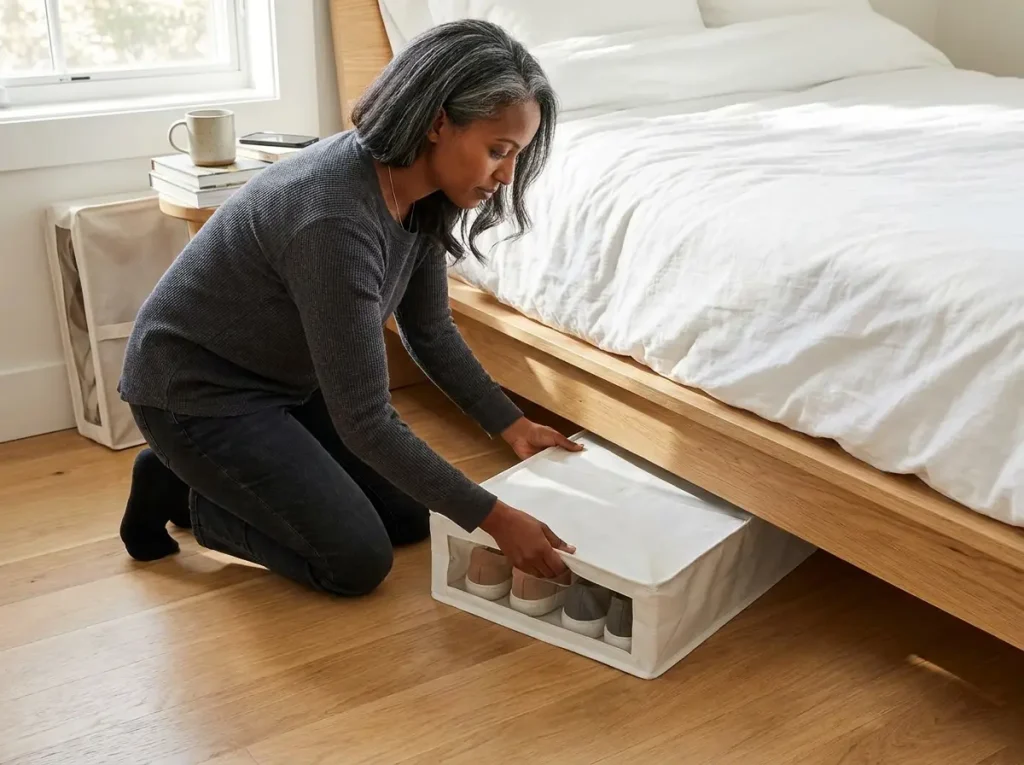
The wrong under-bed shoe organizer doesn’t just cost you money — it costs you a Sunday. You slide it in, it won’t fit, you force it halfway under anyway, and now there’s a beige fabric bag sticking out from under your bed frame for the next four months because you haven’t gotten around to returning it. That’s not bad luck — that’s a clearance problem, and it accounts for more failed under-bed storage purchases than any product defect. After testing storage solutions in rooms with platform beds, metal frames, and adjustable bases, the fix is always the same: measure first, buy second. This guide covers how to get that number and which organizer type fits each situation — fabric for daily shoes, rigid plastic for seasonal, ultra-thin for platform beds, and a boot-specific option for taller footwear.
Quick Answer: The best under bed shoe storage depends on your floor-to-frame clearance.
- Under 5 inches (platform beds): Ultra-thin containers like the storageLAB (4.5 in tall), or add bed risers to create clearance
- 5–7 inches: Low-profile fabric organizers — measure carefully before ordering
- 7 inches or more (metal frames, raised beds): Standard fabric organizers for daily shoes; snap-lid plastic boxes for seasonal storage
- Boots: Need 5.5″+ clearance plus a tube or boot shaper to prevent ankle creasing
- First step: Measure your clearance before buying anything
Measure Your Clearance Before You Buy Anything
How to Measure Under Bed Clearance the Right Way
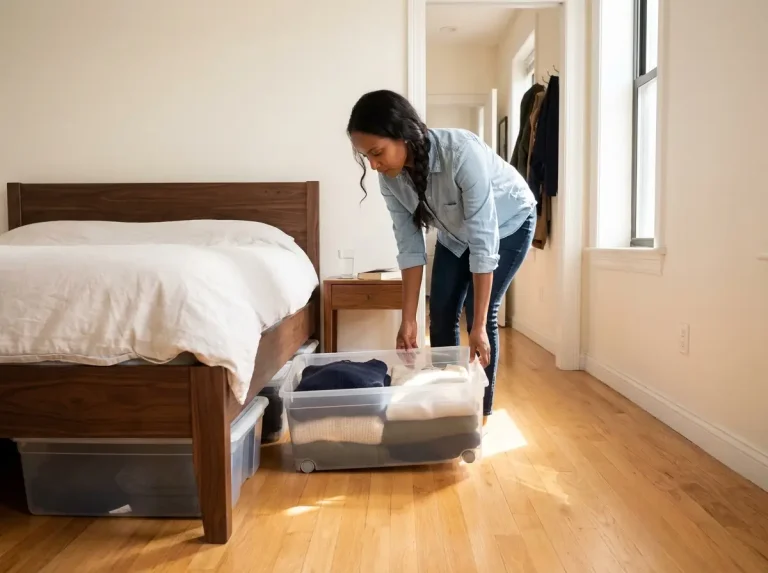
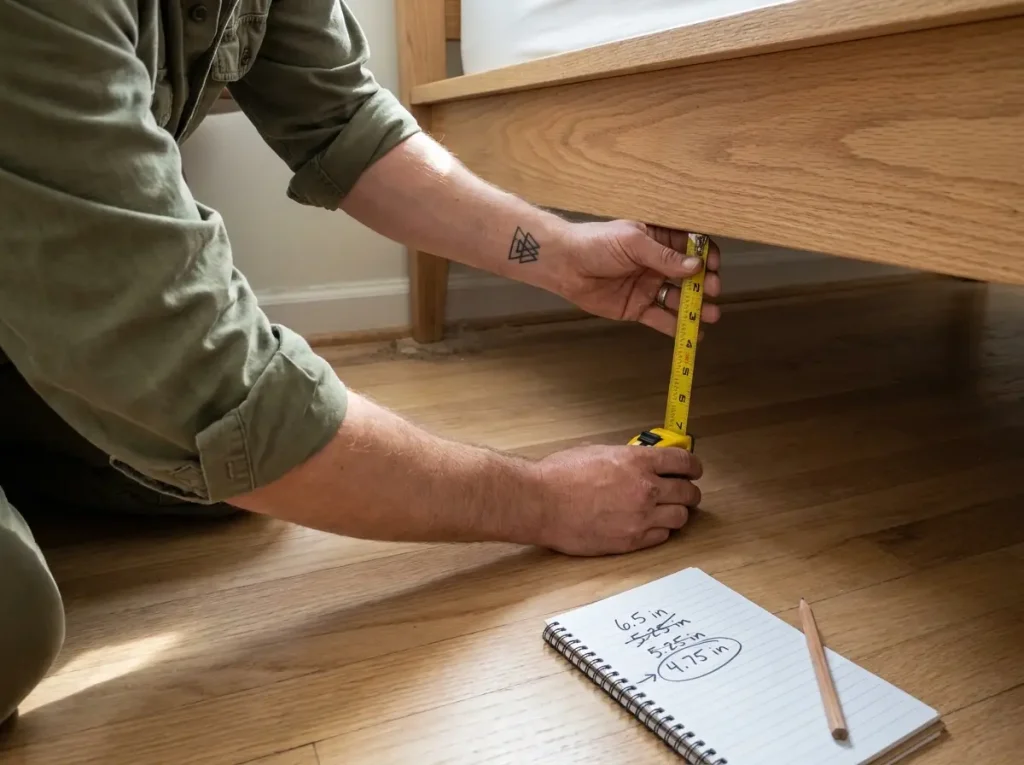
Pull out a retractable tape measure and slide the metal hook under your bed frame until it touches the floor, then extend it upward until it hits the underside of the platform or box spring. That number — in inches — is your clearance. Write it down. Every organizer you look at from this point has a listed height; your job is to buy one that’s at least half an inch shorter than your clearance so it slides in and out without binding. Take the measurement in two or three spots along the side of the bed, because beds aren’t always level and some frames have cross-supports that reduce clearance in the middle.
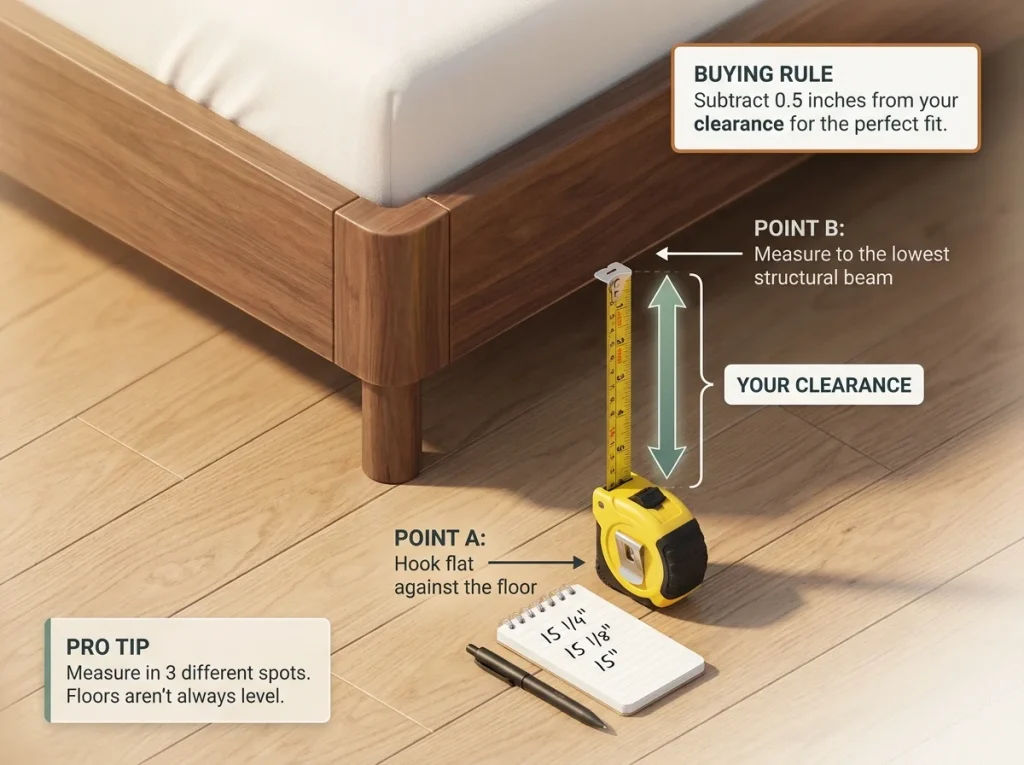
The measurement matters more for shoe storage than for general under-bed bins because shoes have a fixed height you can’t compress. A sweater goes in a vacuum bag and becomes flat. A sneaker is four to five inches tall whether it wants to be or not.
What Your Clearance Number Tells You
Five inches is the dividing line. Above five inches of clearance, you have access to most fabric organizers on the market. Below five inches — which is where most platform beds land — you’re in a narrower product category, and your options get specific fast. Metal-frame beds with legs typically give you seven to thirteen inches, which opens up the full range of containers, including the taller rigid plastic boxes used for seasonal shoe storage.
Getting this number before you shop eliminates the return cycle entirely. Most under-bed organizer roundups skip this step because they assume readers have standard frames. A lot of readers don’t — platform beds have been the most popular style sold in the US for several years running, and they’re the reason the clearance measurement step exists. For a broader look at setting up under-bed storage that lasts through normal use, see how to set up under bed storage that stays organized.
Clearance Ranges by Bed Type
Platform beds typically run 4–7 inches of clearance, depending on the frame height and whether there are wooden slats flush with the floor or elevated legs. Most come in at 4–6 inches — enough for ultra-low-profile containers but not enough for standard fabric organizers. Metal-frame beds with legs land at 7–13 inches, giving you the most flexibility. Adjustable bases vary widely: check the specs for your specific model, especially if the base has a zero-gravity or flat position, since those presets can change the frame height.
Pro tip: If your clearance reads exactly 5.5 or 6 inches, buy an organizer with a clear buffer below that number. A container listed at “fits 6-inch clearance” is often exactly 6 inches, and it will catch going in or out once the fabric compresses even slightly.
Fabric Shoe Organizers for Everyday Shoes
Why Fabric Breathes (and Why It Matters for Your Shoes)
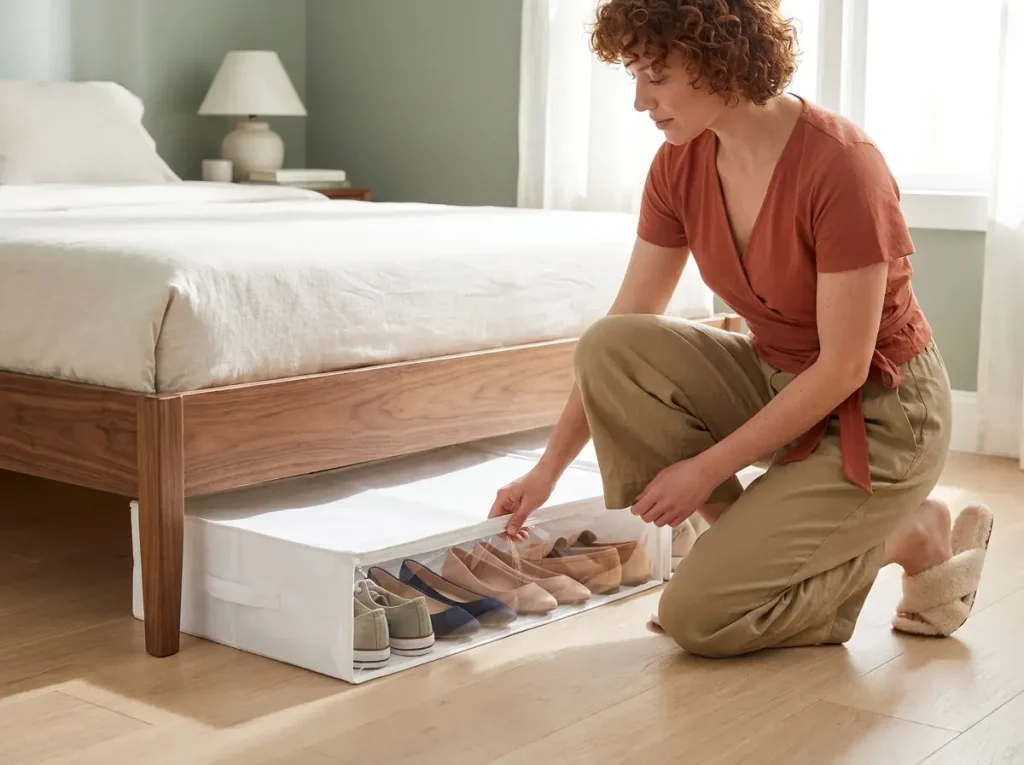
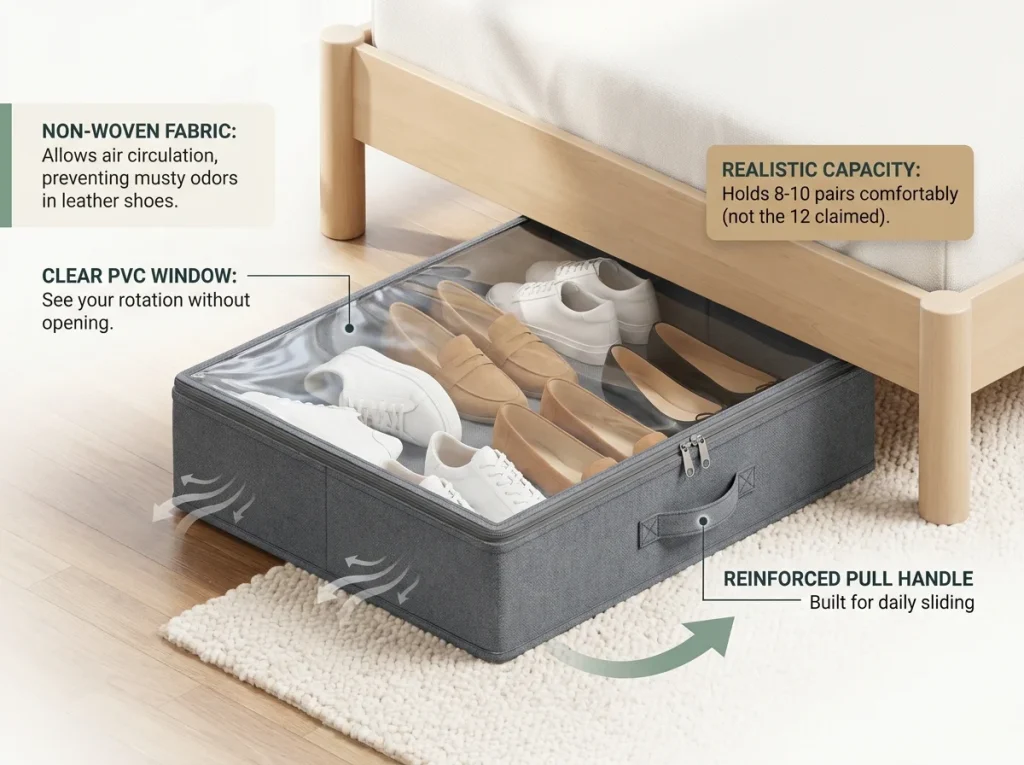
Under-bed space is not a breathable environment. It’s dark, it accumulates dust, and if you live somewhere with seasonal humidity, the air under your bed holds more moisture than the rest of the room. Fabric organizers — most are made from non-woven polypropylene with a clear PVC window on top — let air circulate enough to prevent the moisture buildup that causes leather shoes to develop a musty smell over time. For shoes you wear regularly, that breathability matters more than any other feature on the product listing.
The comparison to sealed plastic is relevant here. Rigid boxes with snap lids are excellent for seasonal storage but trap humidity against the shoe material for months at a time. Leather shoes, suede, and any natural-fiber shoe stored in sealed plastic through a humid summer will come out smelling like the box, not like footwear. Fabric handles the daily rotation; plastic handles the seasonal.
The Truth About “12-Pair” Capacity Claims
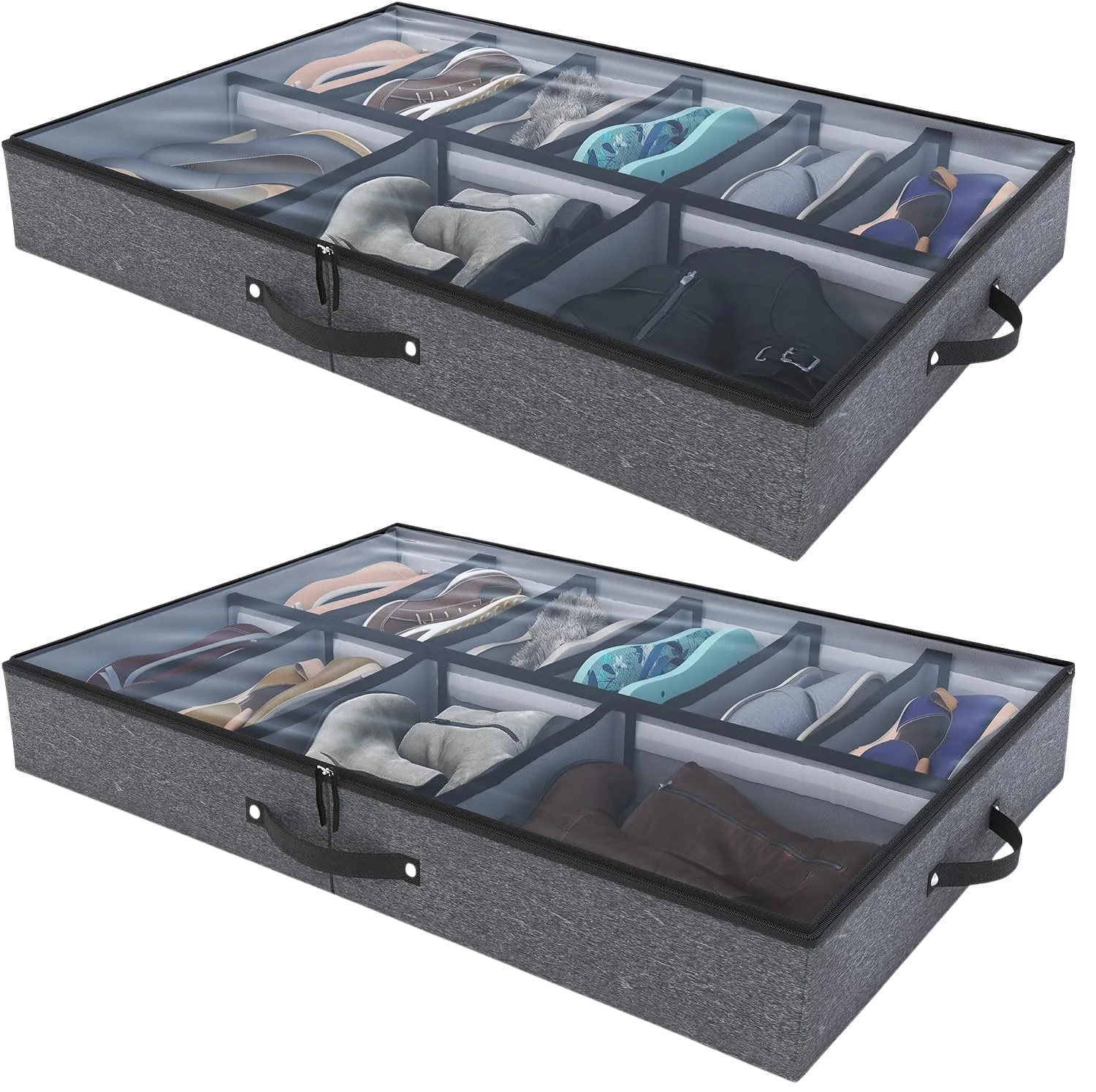
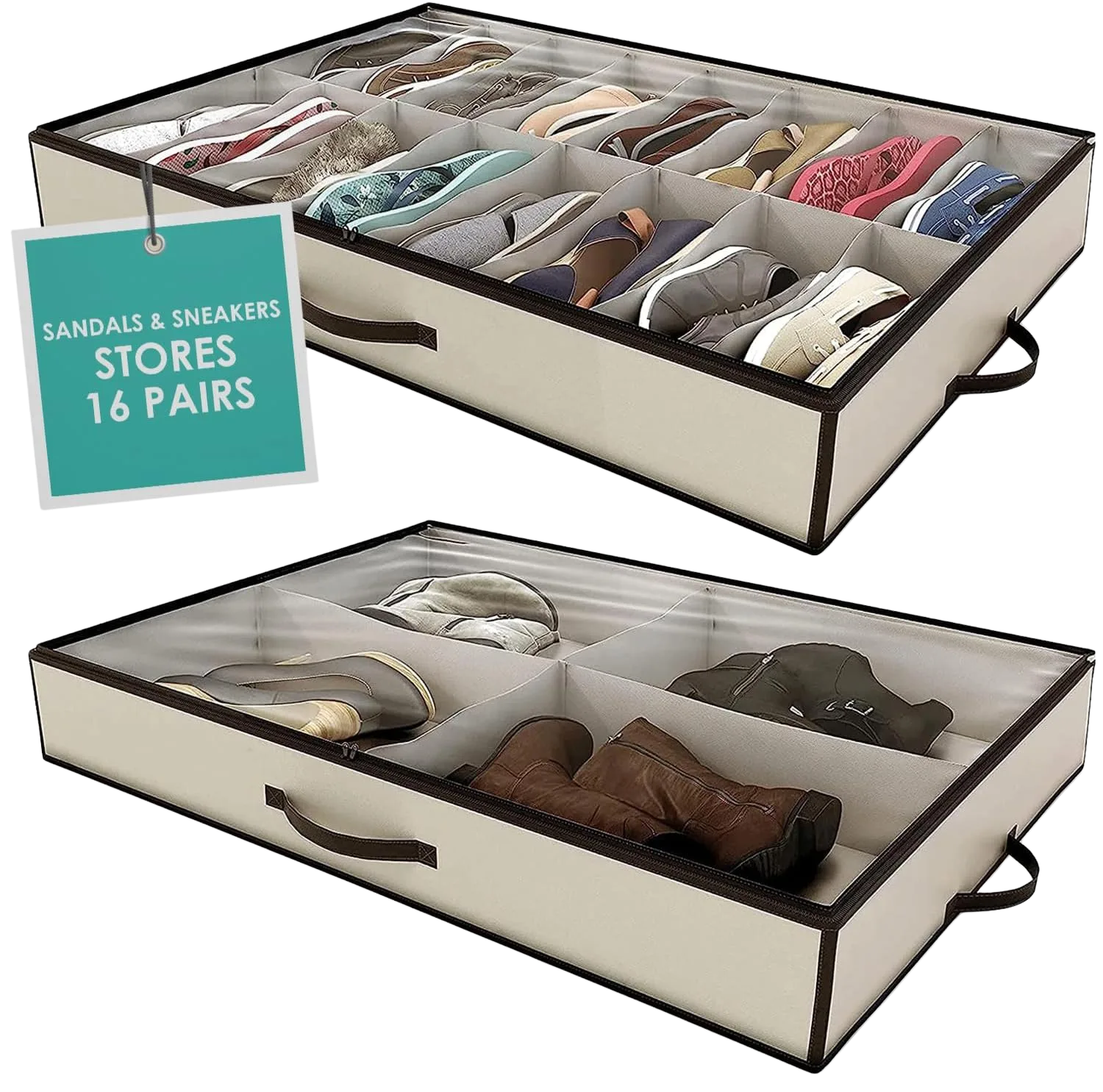
Almost every fabric under-bed organizer claims it holds 12 pairs of shoes. That number is accurate for women’s shoes in sizes 5–8 laid completely flat. For women’s sizes 9 and above, or any men’s shoes, the realistic count is 8–10 pairs. For couples sharing one organizer — one person with women’s shoes, one with men’s — expect 8 pairs, not 12.
That gap between claimed and actual capacity is why the set-of-two format is the practical default for a couple’s shoe storage. One organizer per person works better than two people splitting the space inside one bag.
How to Load a Fabric Organizer So It Stays Organized
Lay shoes in heel-to-toe pairs, with every pair going back into the same slot each time. The system breaks down — quickly — when shoes get tossed in randomly because there are no assigned spots. It’s the same reason a junk drawer reverts to chaos in two weeks: the container isn’t the system. The rule for each slot is.
The organizer should hold the shoes you reach for most. Seasonal shoes go in a different container; sealed plastic works fine there. If you’re working with a smaller bedroom where under-bed space is the primary storage, small bedroom shoe storage ideas covers how to decide which shoes live where when space is genuinely limited.
Rigid Plastic Boxes for Seasonal Shoe Storage
Sealed vs. Breathable: Matching the Container to the Shoe
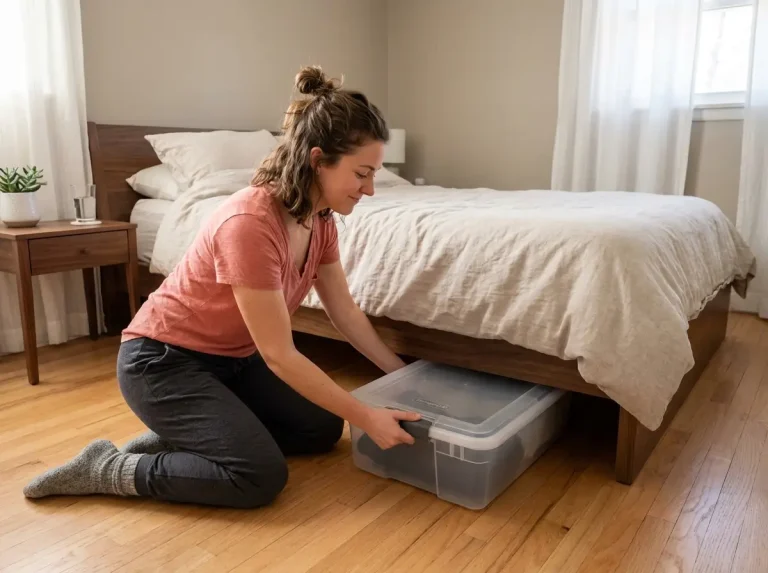
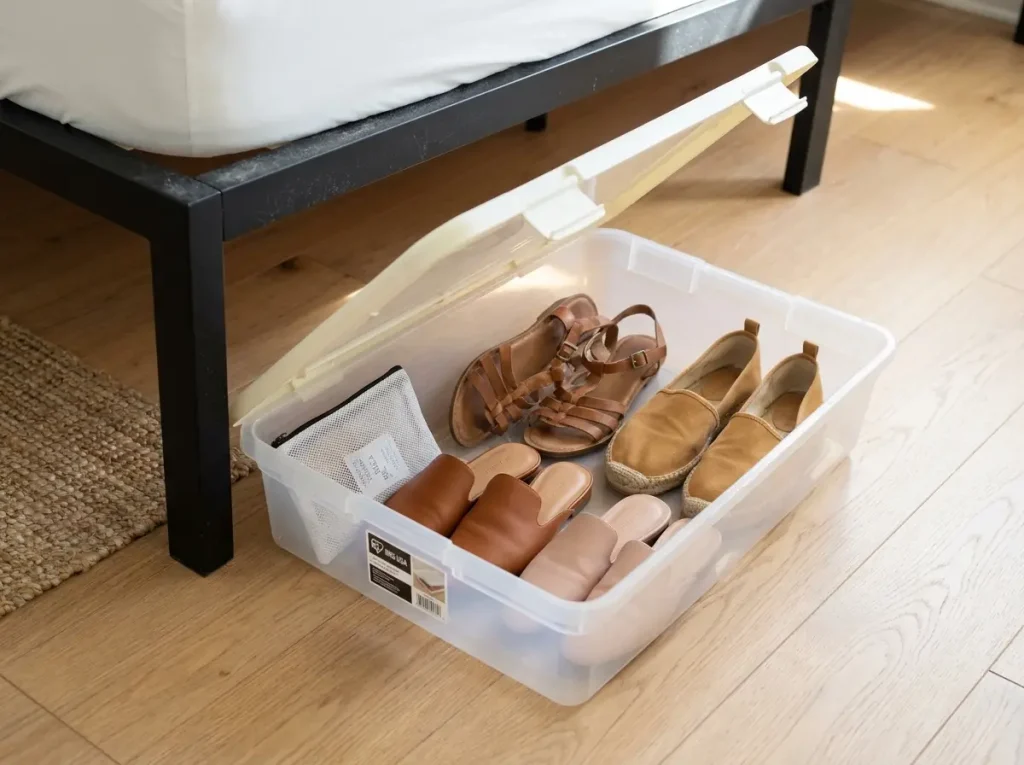
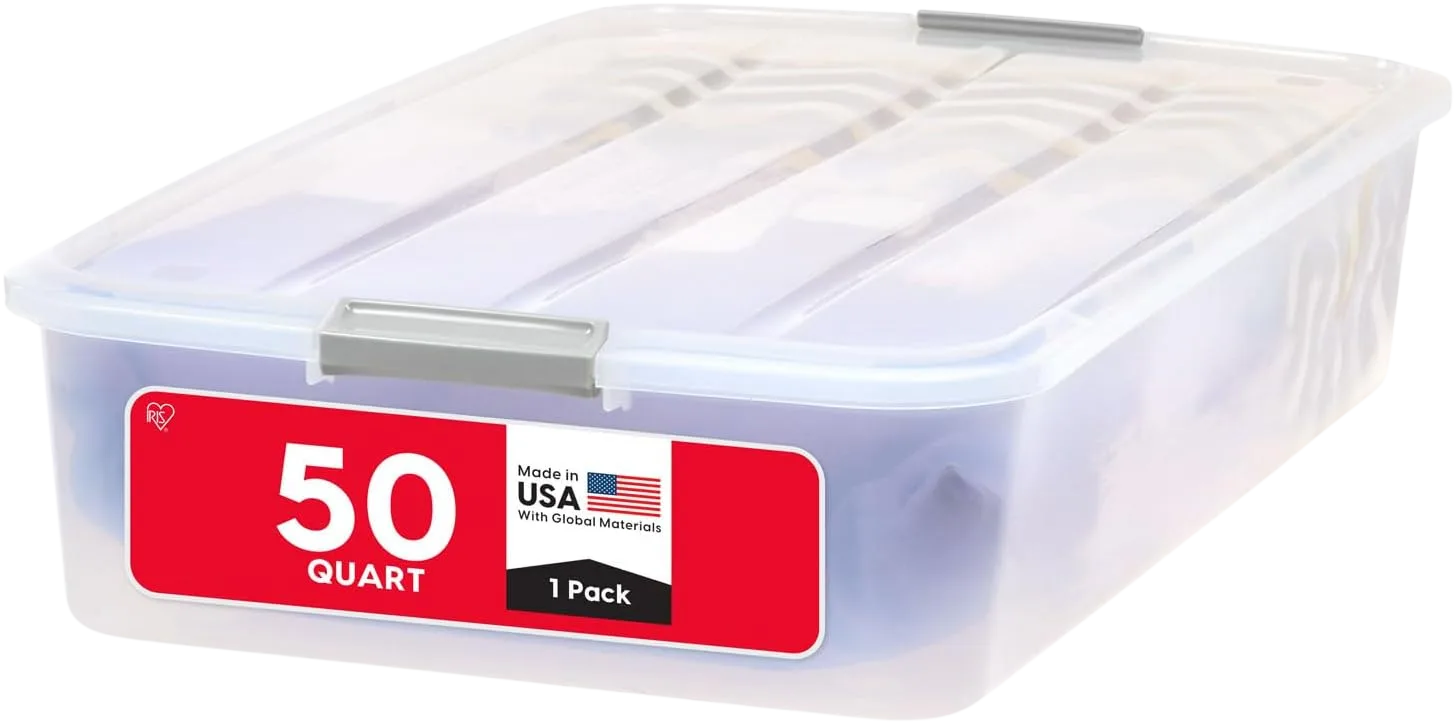
Sealed rigid plastic boxes do one thing very well: they keep dust out indefinitely. For sandals you pull out in May, dress shoes worn three times a year, or last season’s boots, a snap-lid box is better protection than a fabric bag. The shoe goes in clean, the lid snaps, and when you open it six months later nothing has gotten in.
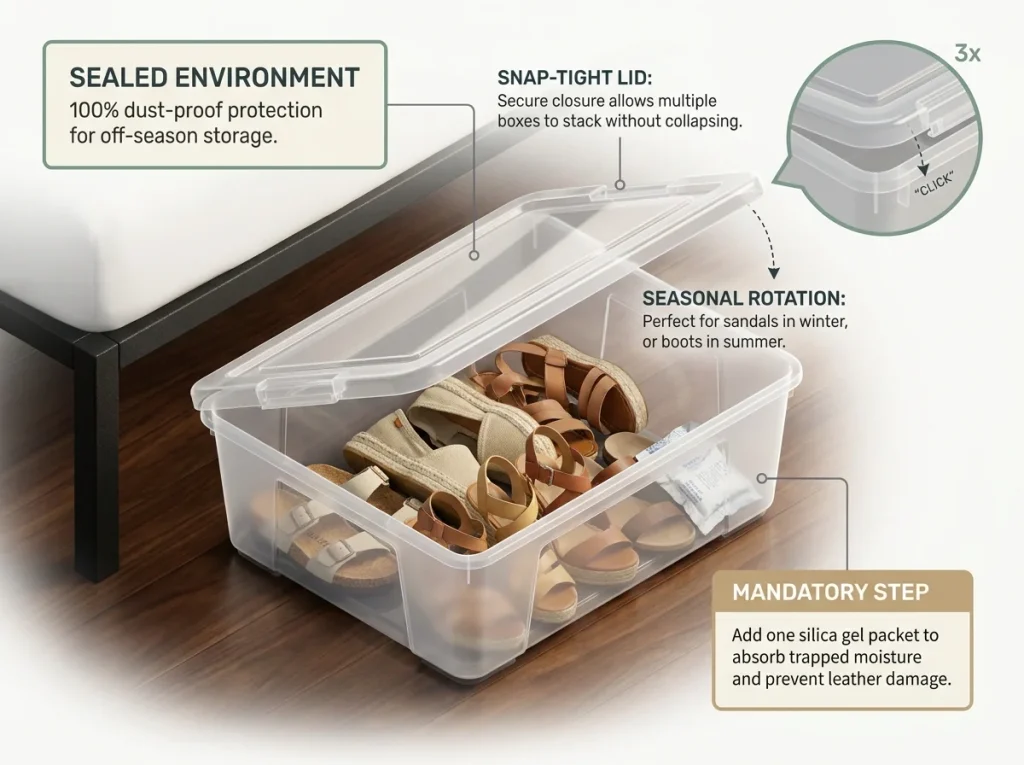
Where rigid plastic fails is with leather, suede, or any shoe material that needs to breathe. Moisture gets trapped inside the box along with the shoe — especially if you put the shoe away slightly damp from wear — and the enclosed environment holds it. Six months later, the shoe smells like the box because it’s been sitting in the same sealed air since April. For anything you wear regularly or anything made from natural materials, fabric is the better call for daily storage.
The Moisture Problem with Long-Term Plastic Storage
The most common complaint in rigid plastic shoe storage reviews isn’t the box — it’s what happens inside the box over several months. Leather shoes crack. Canvas shoes smell stale. The issue is that most people put shoes away without letting them fully dry first, and a sealed plastic environment has nowhere for that moisture to go. Three months later, the humidity that got in on day one is still in there.
Pro tip: Put shoes away completely dry — air them out for a day before boxing — and add one silica gel packet per box before closing the lid. The packets are reusable: spread them on a baking sheet and put them in a low oven for an hour, and they’re ready for the next season.
Stacking and Sliding: Getting More From Rigid Boxes
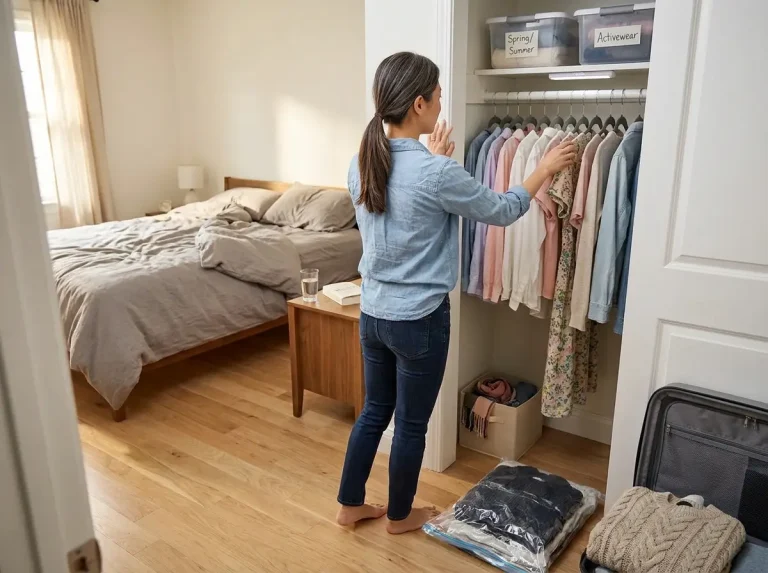
One box under the bed handles the current off-season. A second box, stacked and stored in a closet while you’re wearing those shoes, becomes a rotation system. The IRIS boxes stack stably when filled, which means you can store the season-in-storage box in a closet as part of a larger seasonal closet rotation — the shoes travel with the clothes when the season turns.
For a full comparison of rigid and fabric under-bed containers across different heights and sizes, best under bed storage containers covers the range with specific clearance requirements for each.
Low-Profile Options for Platform Beds
Why Most Organizers Won’t Fit Under a Platform Bed
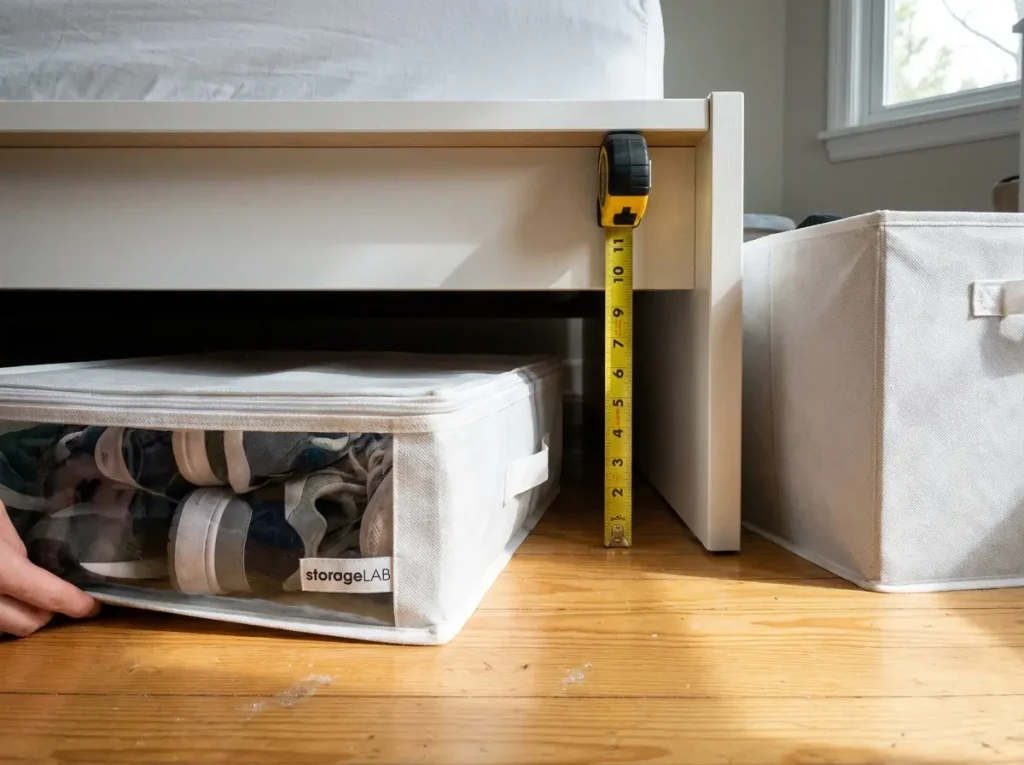
Platform beds solved a bedroom design problem — they look cleaner than a raised frame — and created a storage problem. Most platform frames sit 4 to 7 inches off the ground. Most fabric shoe organizers are 5.5 to 7 inches tall. The overlap between those two numbers is thin, which is why the clearance measurement step matters most for platform bed owners specifically.
Standard fabric bags that work fine under a metal-frame bed simply won’t slide under a typical platform frame. Even bags listed as “low profile” are often 5.5 inches, which catches on the underside of a 5-inch platform base going in. The two solutions are: go genuinely ultra-thin with a 4.5-inch container, or add clearance to the frame with bed risers.
The Ultra-Thin Solution for Tight Clearances
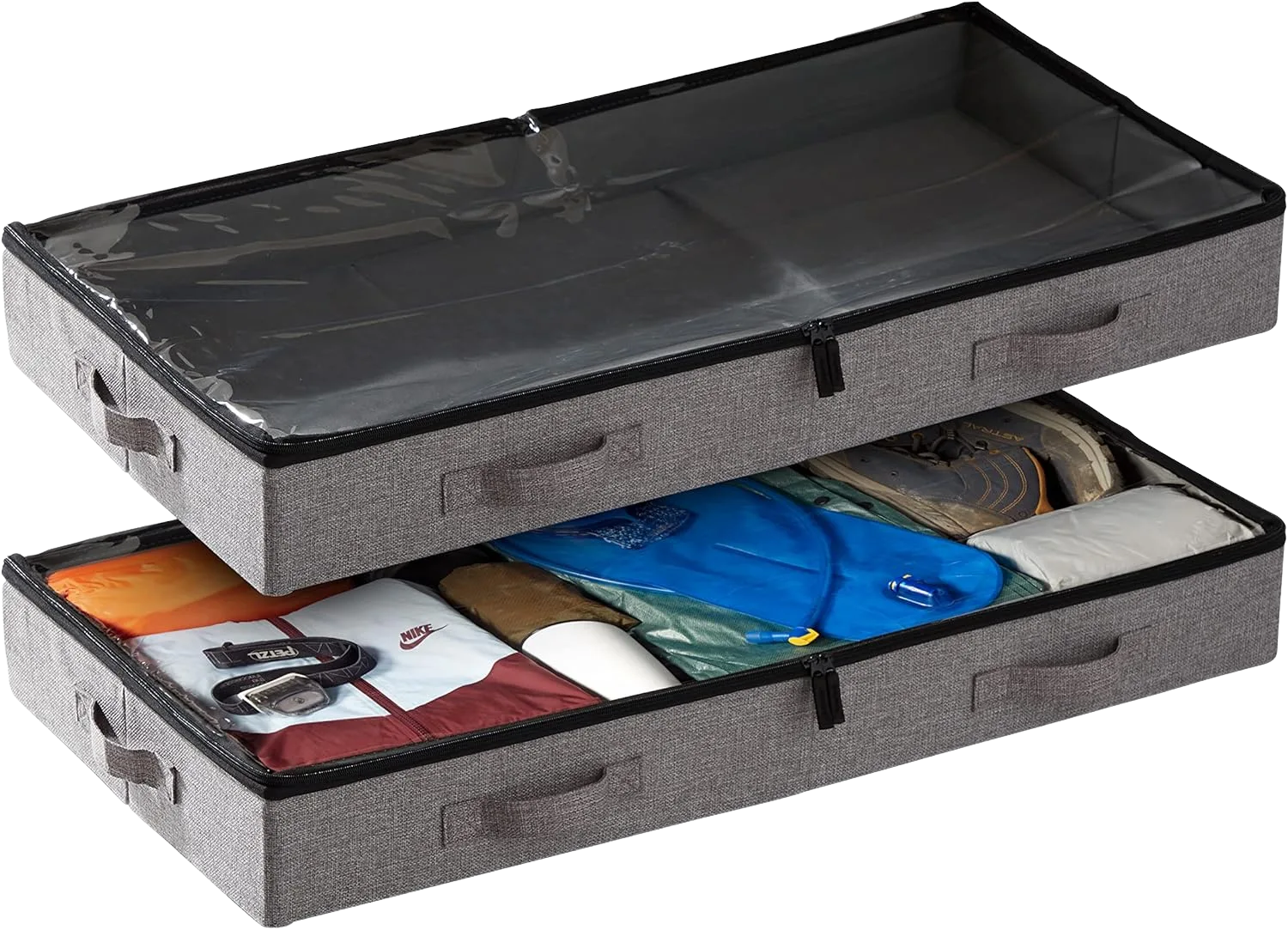
The storageLAB container comes up repeatedly in under-bed platform storage discussions because of one specific dimension: 4.5 inches tall. At that height it clears most platform frames, including ones with solid-base construction that sits very close to the floor. At 33 × 17 inches, it holds 8–10 pairs of women’s shoes or 6–8 pairs of men’s shoes depending on size.
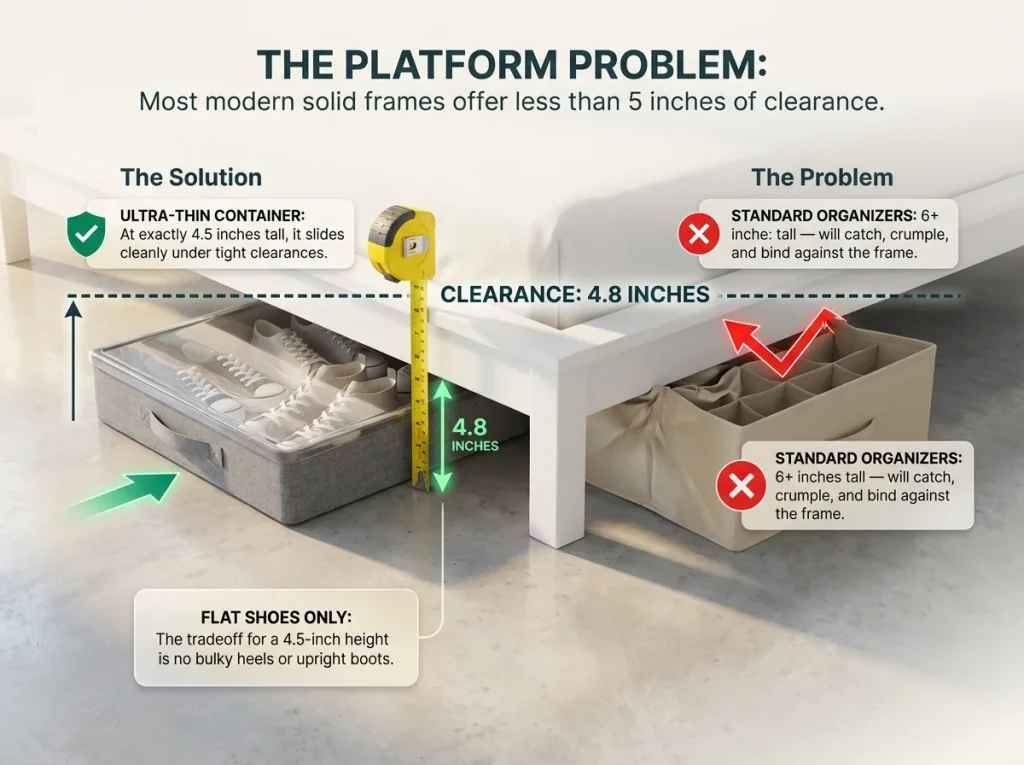
The tradeoff at 4.5 inches is that you’re storing flat shoes and sneakers only — not boots or any thick-soled shoe standing upright. Think of it as the container for the shoes you wear most often, all of which happen to be low-profile. Everything else either stays in the closet or waits for the riser solution below.
The Riser Workaround: Add Clearance Without Modifying Your Frame
If the ultra-thin container isn’t working for your shoe collection — maybe you have men’s shoes, or wide women’s shoes that don’t lie flat at 4.5 inches — the other fix is to add clearance to the bed frame with adjustable risers. The EclatBain Bed Risers (adjustable at 3, 5, or 8 inches) fit standard bed legs and lift the frame enough to accommodate most full-size organizers. Adding 3 inches gets a typical platform bed to roughly 7–9 inches of clearance, which opens up the full range of fabric and plastic options.
This is the renter’s workaround. No tools, no modification to the frame, nothing that needs to be repaired before you move out. The risers cup the existing legs and the bed sits higher. Before buying, verify the weight rating: a queen bed with mattress and occupants weighs upward of 1,000 pounds, and the risers need to handle that safely.
After adding risers, re-measure before ordering new organizers — adding 3-inch risers doesn’t always translate to exactly 3 inches of new clearance depending on where the riser sits. For more storage solutions that don’t require drilling or modifications, best closet organizers for apartment renters takes the same approach throughout.
Dedicated Boot Storage Under the Bed
Clearance Requirements for Boot Storage
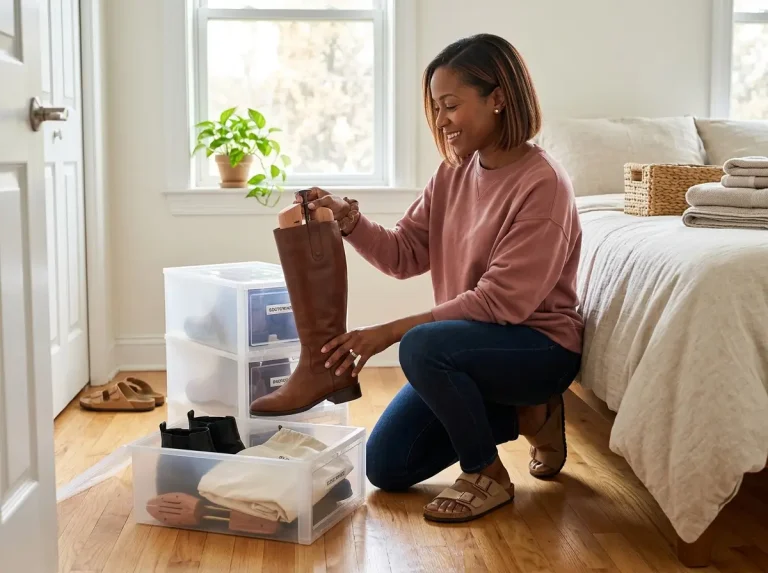
Boots are the outlier in under-bed shoe storage because they don’t lie flat the same way sneakers and flats do. A pair of ankle boots lying on their sides takes up roughly 5 to 5.5 inches of vertical space depending on sole thickness. Knee-high and riding boots fold over, and a folded tall boot lies at roughly the same height.
You need at least 5.5 inches of clearance for boot storage, and 7 inches makes the process much easier. For most platform beds without risers, boot storage under the bed isn’t practical with standard clearance.
Why Your Boots Lose Their Shape (and How to Stop It)
The ankle of a boot is its most vulnerable point. Without support, the weight of the upper collapses the shaft, and over one season, the crease becomes permanent. Anyone who’s pulled out knee-high boots from a plastic bag in October to find the ankle section folded flat knows exactly what this looks like.
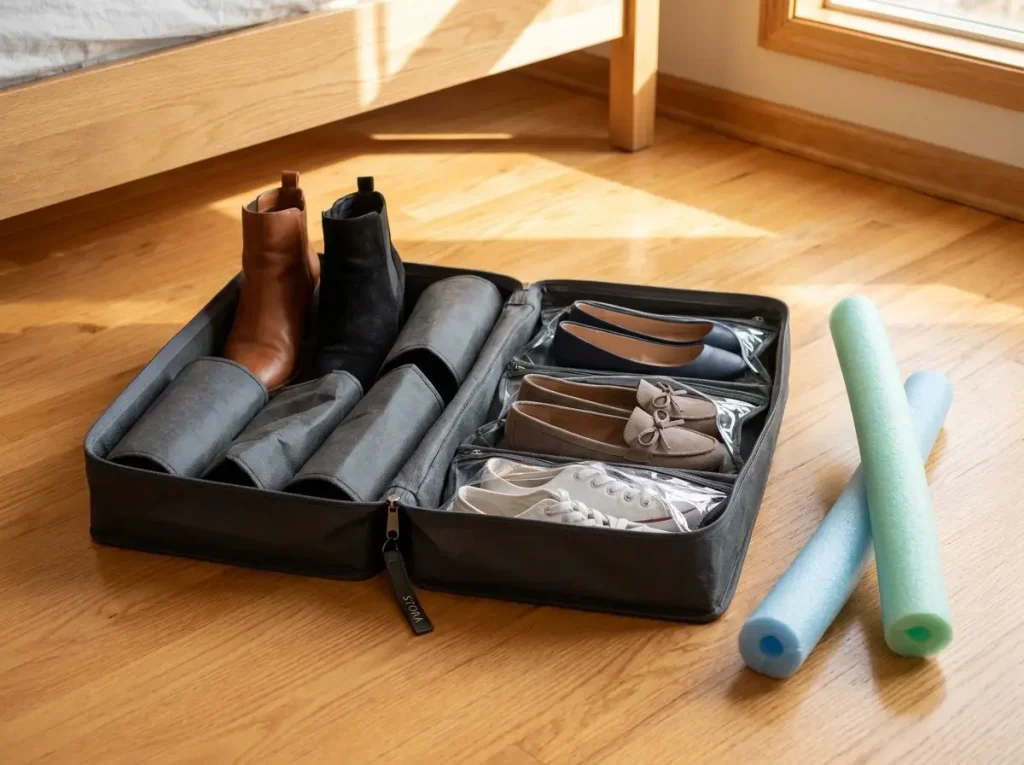
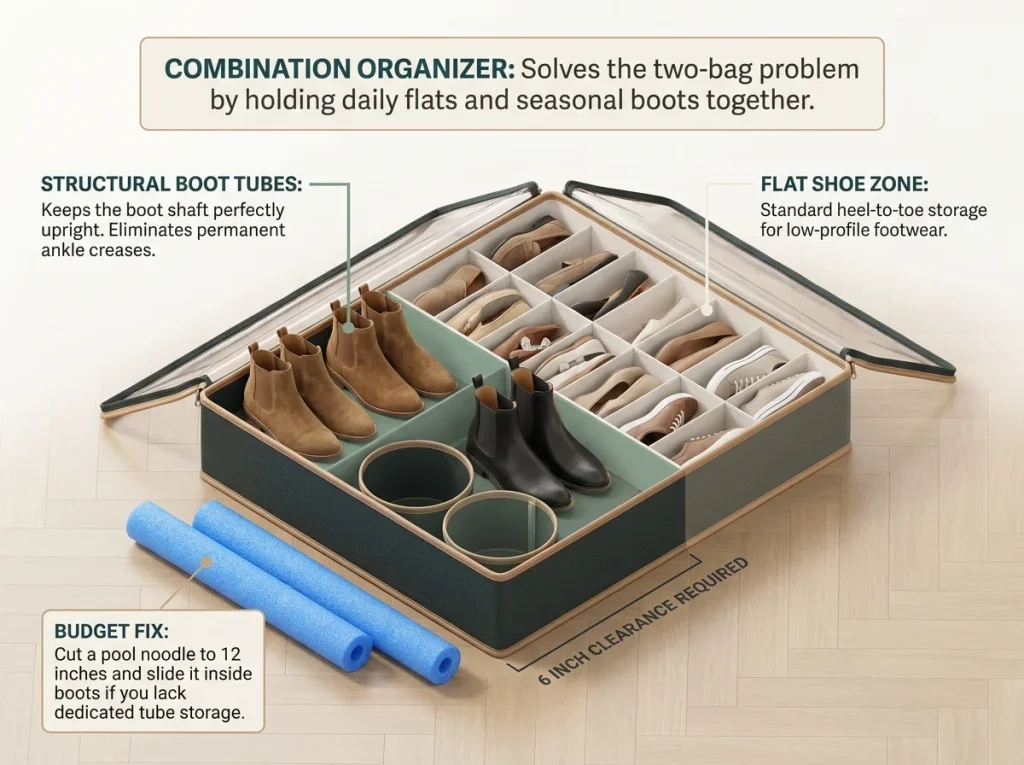
The fix is a boot shaper or a tube compartment that keeps the shaft upright. You don’t need expensive cedar shoe trees for all of them — pool noodles cut to the height of your boot shaft do the same job and cost close to nothing if you already have them. Cut them 12 to 14 inches long, slide one per boot, and the ankle stays upright regardless of how long the boot sits in storage. This is the budget solution; the product solution is an organizer with integrated boot tubes built in.
Pro tip: Even for short-term storage of a few weeks, ankle boots need shaft support. A rolled-up magazine or a piece of cardboard tubing from inside a wrapping-paper roll keeps the shaft upright until you track down a proper shaper. It’s not elegant, but the ankle won’t crease.
Organizers Built for Both Boots and Shoes
For a mixed collection — ankle boots, some heels, everyday sneakers — an organizer with dedicated boot compartments alongside regular shoe sections handles everything without splitting it across two separate bags. The integrated tubes keep the boot shafts upright while the flat-shoe pockets take care of everything else.
If your boots rotate out of active use seasonally, storing them under the bed in the off-season fits naturally into a seasonal closet rotation — the boots go under the bed when the closet needs the floor space back, and return when the season does.
Conclusion
Three things determine whether under-bed shoe storage works: your clearance number, the material of the shoes you’re storing, and whether every pair has an assigned spot. Get the clearance right and you buy the correct container once. Match the container type to the shoe — breathable fabric for daily shoes, sealed plastic for seasonal — and the shoes come out in good condition. Give every pair a fixed slot and the organizer stays organized past the first week.
Three months in, pull out the organizer and check two things: shoes that haven’t moved since you put them in (they belong in seasonal storage, not daily-access storage) and any musty smell in the fabric bag (time to air it out, or move leather shoes to a rigid box). The system works with maintenance; it doesn’t maintain itself.
Start with the tape measure. Pull it out right now, get your clearance number, and everything else — which type of organizer, which size, which bed — follows from that.
Q1 What is the minimum clearance needed for under bed shoe storage?
For most fabric shoe organizers, you need 6 inches of clearance to slide the organizer in and out without the fabric compressing or catching. Ultra-low-profile containers like the storageLAB go down to 4.5 inches and work specifically on platform beds. Boot storage needs 5.5 to 6 inches minimum depending on sole thickness when the boot lies flat.
Q2 How do you keep shoes dust-free under the bed?
A fabric organizer with a PVC window top keeps most dust off shoes used daily — the fabric blocks most particles while still allowing enough airflow to prevent moisture buildup. For long-term seasonal storage, a sealed rigid plastic box with a snap lid is more effective. Either way, pulling the organizer out every few months to wipe down the stored shoes prevents accumulation.
Q3 Can you store boots under a bed?
Yes, if you have 5.5 inches or more of clearance and the boots are stored with support inside the shaft. Without a tube or shaper, the ankle area of the boot creases over one season and can permanently lose its shape. Pool noodles cut to 12–14 inches are a functional, low-cost boot shaper — one per boot, slid inside before storage.
Q4 How many pairs of shoes actually fit in an under bed organizer?
The 12-pair capacity claim on most fabric organizers is based on women’s shoes in sizes 5–8. For women’s sizes 9 and above, or men’s shoes, count on 8–10 pairs. A couple sharing one organizer should expect 6–8 pairs realistically. The set-of-two format exists because one organizer per person works better than two people dividing one bag.
Q5 Are bed risers safe for adding under-bed clearance?
Adjustable risers rated for your bed’s weight are safe to use. A queen bed with mattress and two occupants weighs 600–1,000 pounds — look for risers rated at 250 lbs per riser (1,000 lbs for a set of four). Cheaper, unrated risers crack under sustained load. Verify the weight rating before you buy.
Disclaimer: ClutterlessNest is a participant in the Amazon Services LLC Associates Program. As an Amazon Associate we earn from qualifying purchases. This article may contain affiliate links — if you buy through them, we may earn a small commission at no extra cost to you. We only recommend products we have tested or genuinely believe in.