
You bought the caddy. You pressed the suction cups against the tile until your palms hurt, loaded it with shampoo and conditioner, and for two weeks it held beautifully. Then one night it let go, and you woke up to bottles rolling around the tub floor. That caddy was not defective, and you did not install it wrong.
The shower is the only zone in your house where water, gravity, and heat cycling all work against a storage solution at the same time, which makes it the fastest-reverting space you own. Real shower and bath organization starts with understanding why the last three attempts failed, and it turns out the same reset problem shows up across the whole bathroom once you know what to look for. Here is the full system: which caddy matches your shower, which no-drill mount actually holds on your surface, what materials survive humidity, where the backstock goes, how bath toys stop growing mildew, and how a shared shower stays functional.
Quick Answer
Organize a shower in this order, and the system holds:
- Cut the product count first — only daily-use items stay in the shower
- Match the mount to your surface, not to the finish you like
- Choose materials that survive humidity above 60 percent
- Move refills and backstock out of the wet zone entirely
- Give bath toys a container that drains from the base
- Reset it weekly, because showers fail by creep rather than collapse
Why Your Shower and Bath Organization Keeps Falling Apart

Everyone treats a failed shower caddy as a bad purchase. It usually is not. The caddy that fell was fine on day one. The surface it was stuck to changed underneath it, slowly, over weeks, while you kept using the shower exactly the way you always had.
Nobody sells you that part, because “your tile got slipperier” is a worse marketing line than “industrial-strength suction.”
The Three Forces Working on Every Shower Mount
Start with heat. Every shower session is a small heat cycle: the tile warms, the rubber cup warms, and the two materials expand at different rates. When everything cools back down they contract at different rates too, and each round trip shifts the seal just enough to let a little air in.
Nothing else in your house does this to its storage. Your closet shelf is not thermally cycled twice a day.
Then water and soap. Soap scum and body oil deposit an invisible film across shower tile, and that film is essentially a lubricant. A cup that is genuinely sealed but sitting on a lubricated surface will creep downward under its own weight, a millimeter at a time, until the geometry no longer works.
This is why grout defeats a suction cup’s seal too: grout is porous and textured, so if any edge of the cup overlaps a grout line, the vacuum never forms in the first place. You can press as hard as you want. Air keeps finding a way in through the grout.
And gravity handles the rest. Load is constant and one-directional, and it never takes a night off.
Before you remount anything with suction, clean the exact spot with rubbing alcohol and let it dry completely. Not shower cleaner — shower cleaner leaves its own film. You are trying to remove the invisible soap layer, and most bathroom sprays add to it rather than strip it.
Why It Always Fails at 2 A.M. and Not on Day One
The phrase that comes up over and over in caddy complaint threads is that it “might work for a week, until it suddenly crashes to the floor in the middle of the night.” The word people always reach for is suddenly. The failure is not sudden. It is the visible end of a slow slide you could not see, and the timing feels random because nothing changed that day.
There is a second mechanism running alongside the first, and it is the one almost nobody catches: capacity creep. The caddy went up holding shampoo, conditioner, and body wash.
Two weeks later somebody added a razor. Then a loofah. Then a hair mask, which is the heaviest thing in the entire shower and the item most likely to be sitting there half-used for a year. Each addition is trivial on its own.
Together they push a mount past what it was holding when you tested it by tugging on it, and the failure arrives weeks after the overload, which is exactly why nobody connects the two.
So when a caddy falls, you are usually looking at two failures stacked: a seal that degraded on its own schedule, carrying more weight than it started with. Replacing the caddy with an identical caddy restarts the same clock.
Start by Taking Things Out, Not by Buying a Caddy
Here is the move nobody wants to hear, because it does not involve a purchase. The product purge comes before the product search: empty the shower completely. Every bottle, every tool, every sample-size thing from a hotel. Put it all on a towel on the bathroom floor and then put back only what you touched in the last seven days.
Most people are shocked by the ratio. The daily rotation is usually four or five items per person. What comes out of the shower is a second shampoo you bought when the first one was still three-quarters full, a face scrub that turned out to be too harsh, and two conditioner bottles with an inch left in each. None of that is shower storage.
That is inventory, and inventory is why your caddy is overloaded.
Cutting the count first changes what you need to buy. A shower holding five items has completely different requirements from a shower holding fourteen, and the second version usually cannot be solved by any product at any price.
Shower Caddy Types and How to Pick the Right One
People choose a caddy by looking at it, then discover their bathroom cannot host it. The decision is actually made by three things you already have and cannot change: your ceiling height, your tile texture, and whether anyone else showers in there. Get those three straight and the category picks itself.
There are four families, and each one fails in its own specific way.
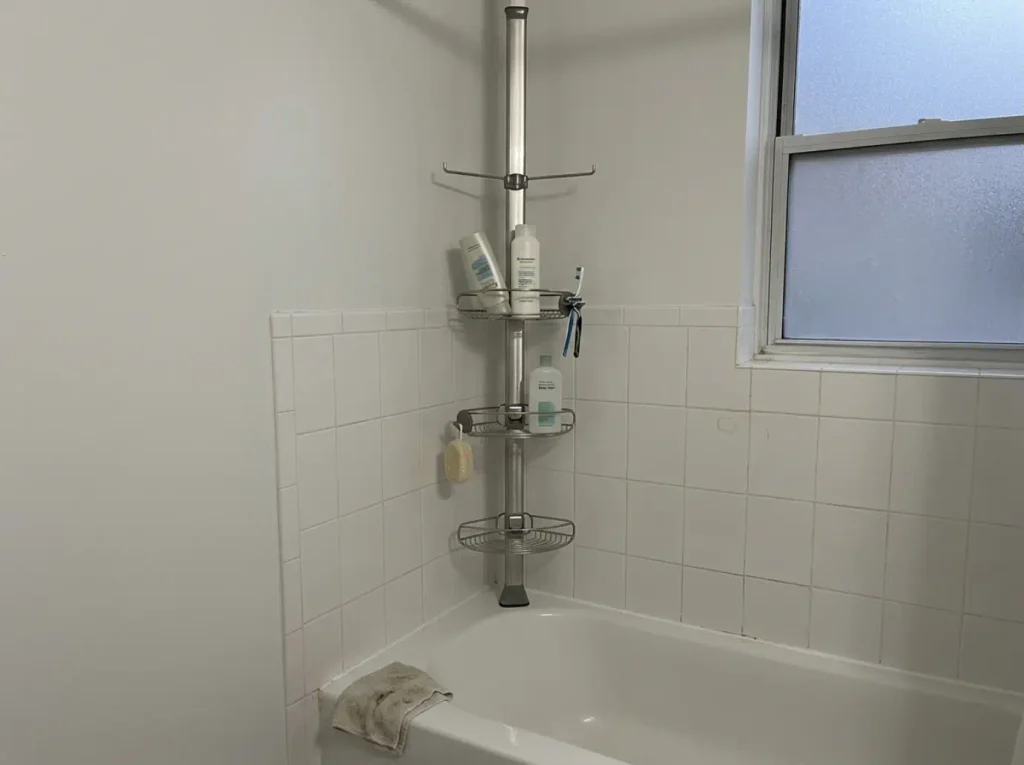
Tension pole caddies run floor to ceiling and touch no wall at all. Hanging caddies loop over the showerhead arm. Adhesive corner shelves bond to the tile. And freestanding carts live outside the wet zone entirely.
Nothing here is universally better. The right one is the one your surfaces and your household can actually support.
Before any of that, the free move: if your shower has a built-in shower niche or a tub ledge, use it properly first. A bathtub caddy that spans the rim covers the soak-and-read use case, but it is not daily-rotation storage and it comes off every time somebody showers. A niche holding four bottles standing upright, sorted by who uses them, does the job a caddy is being asked to do. Plenty of people buy a caddy to solve a problem their existing niche was already sized for and simply never zoned.
Tension Pole Caddies and the Ceiling-Height Math
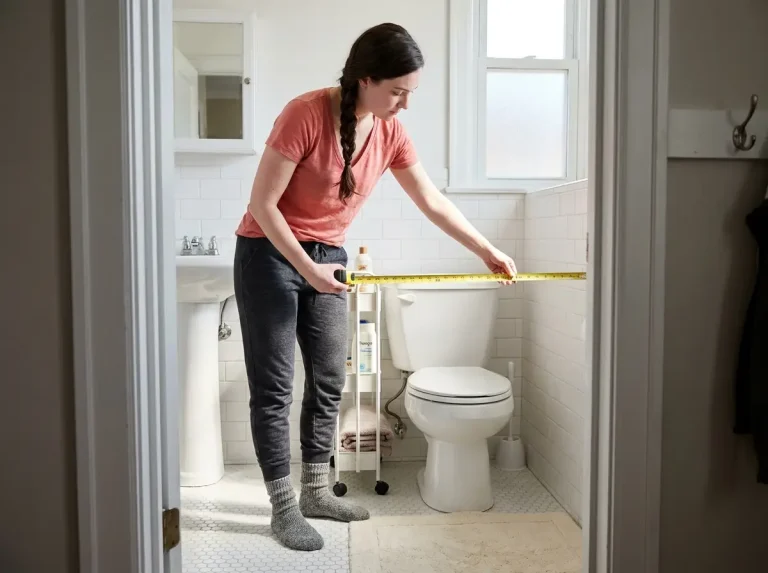
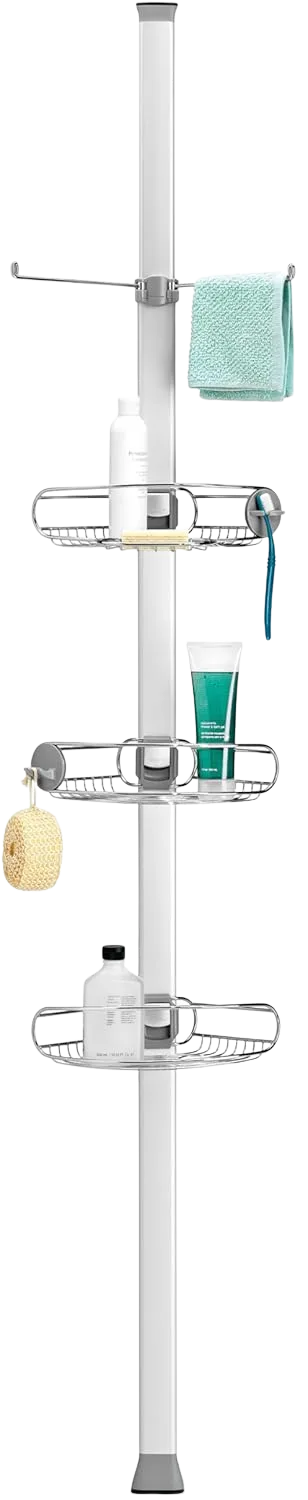
Tension poles work by pressing against your floor and ceiling instead of your wall, which means the entire grout-and-soap-film problem stops applying. That is their real advantage, not the shelf count. Most models extend somewhere in the 5 to 9 foot range on roughly one-inch-diameter poles, with a few going higher, and this is the number to check before anything else. Measure your actual ceiling height in the shower, not the ceiling height in your bedroom.
Bathrooms with dropped ceilings, sloped ceilings, or a bulkhead over the tub routinely come in lower than people assume.
The other number that matters is capacity. Most tension caddies cap out around 15 to 20 pounds total across every shelf combined, and that limit sneaks up faster than you would think. A family-size shampoo, a matching conditioner, and a body wash are already a meaningful chunk of that budget before anyone adds a razor or a bottle of shower gel that someone bought on sale.
I used to tell people the pole caddy was a compromise option, the thing you settle for when you cannot drill. After enough threads where the adhesive shelf came off the wall in month three and took a chunk of paint with it, I flipped. For renters, the pole is not the compromise. It is the default, and the wall-mounted options are the gamble.

Hanging and Corner Caddies, and What Each One Gives Up
The hanging caddy that loops over the showerhead arm is the cheapest way into this category and the most common rust casualty in it. Most of them are coated metal, and coated metal in a shower is on a clock. There is a second problem people discover after purchase: if you have a handheld showerhead on a slide bar, the hanging caddy fights the hose constantly, and if your showerhead arm is short, the caddy hangs directly in the water stream and every bottle stays permanently wet.
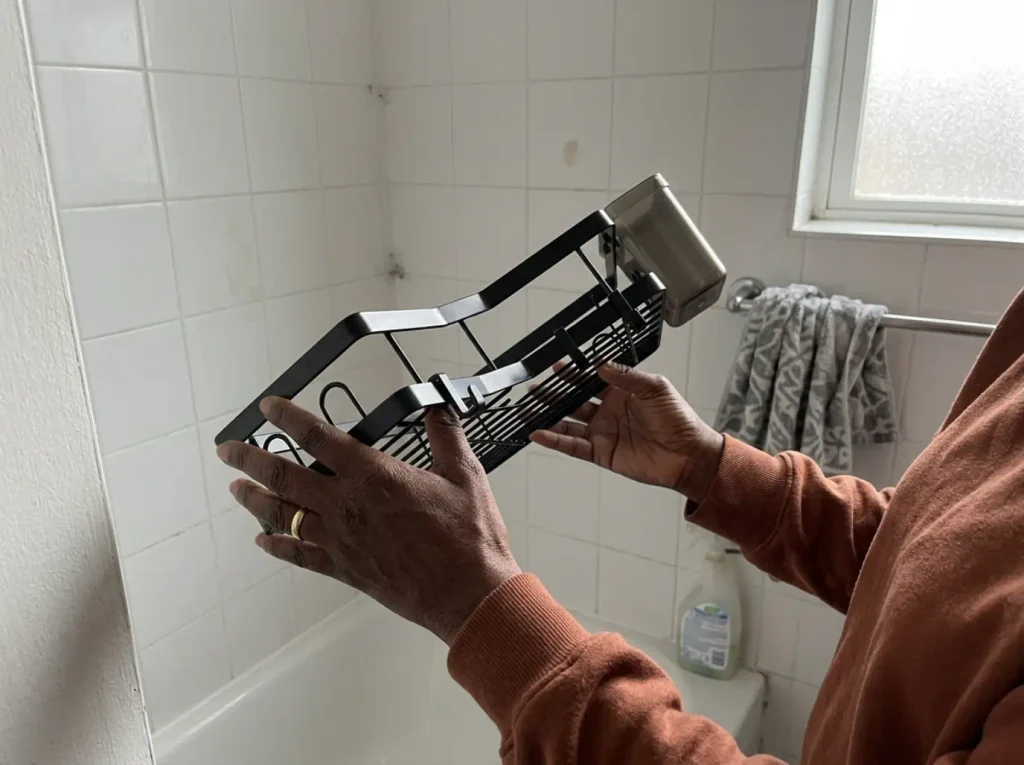
Adhesive corner shelves give up flexibility in exchange for putting storage in the one part of the shower nobody else uses. They can hold serious weight when they are installed correctly, and the phrase doing all the work in that sentence is installed correctly, which the next section takes apart in detail. The short version: your tile has to be smooth, and you have to wait.
For what it is worth, the corner is genuinely the best real estate in most showers. It is out of the spray path, it is out of the elbow path, and it is dead space otherwise. It is just also the spot with the strictest surface requirements. The same vertical-space logic behind the storage ideas that fit genuinely small bathrooms applies inside the shower too: the footage nobody uses is almost always above eye level or tucked into a corner nobody looks at.
When Nothing Can Touch the Tile: The Freestanding Option
Some showers have no ledge, no niche, glass on two sides, and a lease that gets specific about wall modifications. Walk-in showers with a single glass panel are the classic version of this: beautiful, and offering roughly zero places to set a bottle down.
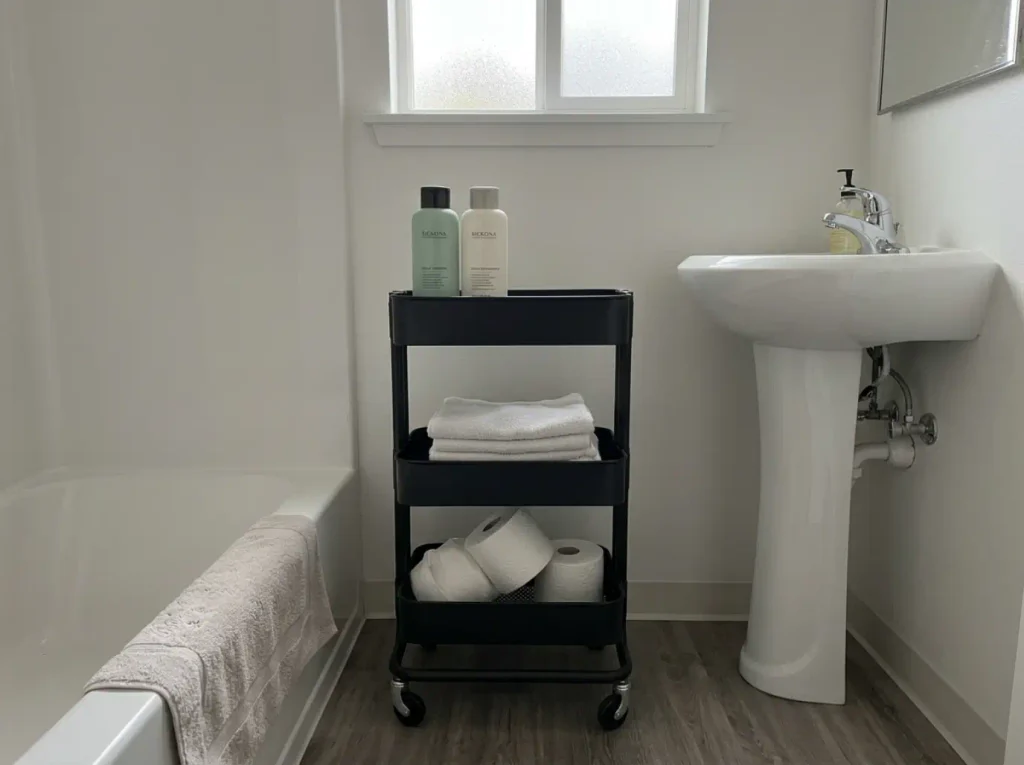
The answer here is to stop trying to store things inside the shower. A small rolling utility cart parked just outside the shower door holds the entire daily rotation on its top tier, and you reach out and grab what you need. The RASKOG Utility Cart is the standard pick for this at 13.75 by 17.75 by 30.75 inches, which fits beside most tubs and in the gap next to a walk-in shower, and it never touches your tile at all. The honest limitation is footprint: in a bathroom where the door swing already crowds the floor, a cart on casters can be one obstacle too many, and you will end up rolling it somewhere else every time someone needs the sink.
That relocation problem is worth thinking through before you buy, especially in a bathroom with no built-in storage at all, where the cart is being asked to solve more than the shower.
No-Drill Mounting That Survives Daily Water Exposure
“No-drill” is renter shorthand, and it lumps three completely different mechanisms into one phrase. Suction, adhesive, and tension have almost nothing in common except that none of them puts a hole in the wall. Inside a shower they fail for three unrelated reasons, and the failure modes are specific enough that you can predict which one will let you down just by looking at your tile.
This is the section that stops you from buying the one that physically cannot work in your bathroom.
What Suction Actually Holds, and Where It Stops
Suction needs three conditions at once: continuous, non-porous, and flat. Miss any one and the mechanism is not weak, it is absent. Continuous means no grout line under any part of the cup, which on a wall of small tiles is a genuinely hard requirement: the usable flat circle in the middle of each tile is often narrower than the cup you are trying to seat on it. Non-porous rules out unglazed tile and most natural stone.
Flat rules out anything with a bevel, a texture, or a pattern pressed into the surface.
Even when all three are satisfied, the heat cycling and soap-film problems from earlier are still running in the background. This is why suction degrades faster in a shower than the same cup would on a kitchen window.
So right-size what you ask of it. Reusable suction hooks typically rate somewhere around 11 to 18 pounds each, and that rating is honest for the load they were designed for. The LUXEAR Heavy Duty Waterproof Suction Shower Hooks come as a 2-pack rated to 11 pounds per hook, which is exactly right for a loofah, a razor, a squeegee, or a bathrobe hanging just outside the spray.
What it is not right for is a full caddy’s worth of bottles hanging off a single point. One hook, one item, flat tile. Within those limits suction is genuinely useful, and outside them it is the mechanism that produces the 2 a.m. crash.
Adhesive Shelves and the Two Conditions Nobody Reads
Adhesive corner shelves commonly rate somewhere between 22 and 40 pounds, and those numbers are real. They are also completely irrelevant if you break either of the two conditions printed on the back of the package in six-point type.
Condition one is cure time. The adhesive needs roughly 24 hours to bond fully before you put anything on it, and this is the single most ignored instruction in bathroom organizing. You install the shelf, it feels solid, you load it that evening because you needed a shower, and the bond that was still setting takes the weight before it was ready. It usually survives a few days on partial adhesion, which is worse than failing immediately, because now you trust it.
Condition two is surface. These bond reliably to smooth glazed ceramic, flat marble, and tempered glass. They do not bond reliably to textured tile, wallpaper, or painted drywall, and no amount of pressure changes that. This is the actual reason renters should be measuring tile texture and not just corner angle before buying, and it is a much better predictor of success than the weight rating on the box.
Once both conditions check out, the category becomes worth buying. The AKTECKE Corner Shower Caddy 2-Pack is a stainless steel adhesive set built for a 90-degree corner, which means it uses the dead space and stays out of both the spray path and your elbows.
The 2-pack matters more than it sounds: one shelf per person in a shared shower is a zoning decision, not a quantity decision. The caveat stands, though. If your tile is textured or your corner is not a true right angle, this is not your category, and the pole caddy above is where you should be looking instead.
If you are working through the deposit-safe versions of these mounts, the removal side deserves the same attention as the install. Adhesive that bonds well to glazed ceramic usually comes off cleanly with slow heat and steady tension. Adhesive that half-bonded to textured tile tends to come off in pieces and leave a residue ring, which is the worst of both outcomes.
Install adhesive shelves on a day nobody needs that shower — a Saturday morning works, since the 24-hour cure lands Sunday morning. Trying to squeeze a cure window around two people’s weekday showers is how the “I’ll just put one bottle on it” compromise happens, and one bottle on a half-cured bond is how it comes down in week three.
Why Tension Is the Renter Default
Tension asks nothing of your wall. No cure time, no surface texture requirement, no grout math, no residue conversation with a landlord. The only question it asks is whether your floor-to-ceiling span falls inside the pole’s extension range, and that is a question you answer with a tape measure in about forty seconds.
That single-variable simplicity is why tension wins for most renters. It is also why it is the honest recommendation for anyone with textured tile, natural stone, or a shower surround they cannot identify with confidence.
One safety note that applies across all three mechanisms. In a home with small kids, anything sizable mounted within reach of the tub gets treated seriously, because rated capacities assume evenly distributed load, not one heavy bottle at the outer edge and a toddler pulling down on the shelf. The safety standard that governs tip-over risk for mounted storage exists precisely because the sticker number and real-world loading are two different things. Anchor what can be anchored, and keep the heavy items on the lowest shelf.
Materials That Hold Up in a Humid Shower
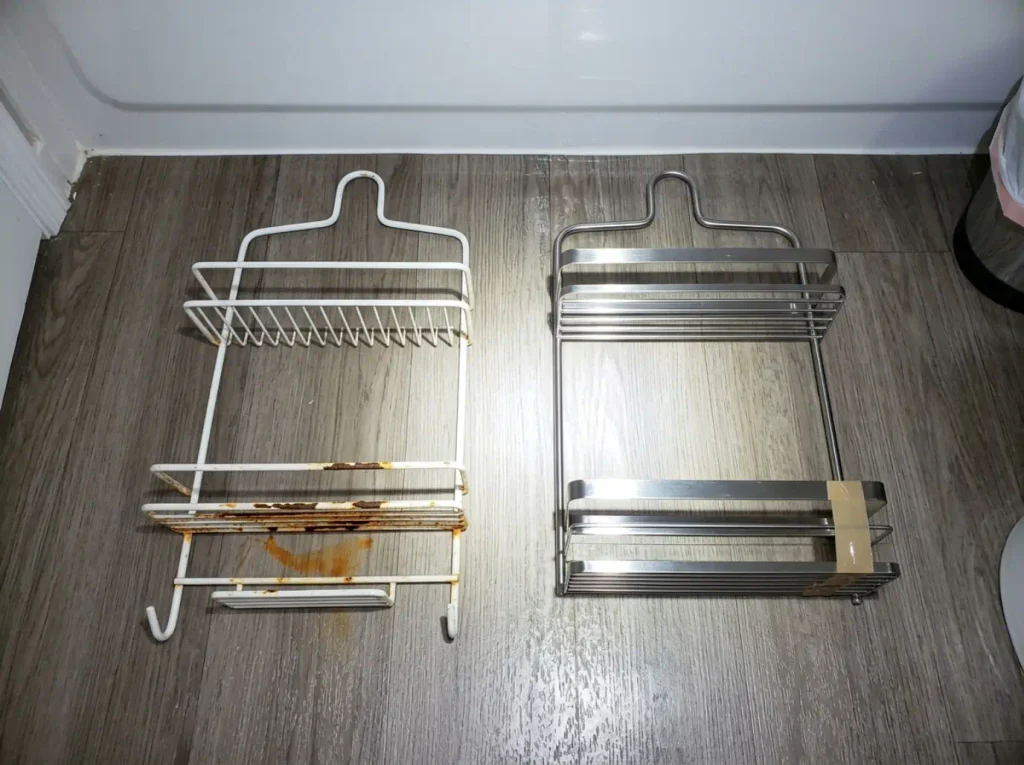
There is a specific moment most people misdiagnose. You notice a rust-orange streak on the tile below your caddy, you scrub it, you blame hard water, and you buy a stronger cleaner. It comes back within the week. It keeps coming back, and eventually you decide your water is the problem.
Your water is fine. That is the caddy dissolving.
Why Coated Metal Leaves Orange Streaks
A coated metal caddy, usually powder-coated steel, is a steel skeleton wearing a thin jacket. Steam and standing water break that jacket down over time, and the breakdown usually starts somewhere you cannot see: a scratch from a bottle cap, a chip at a weld point, the inside of a bend where the coating went on thinnest. Once water reaches the steel underneath, oxidation begins inside the coating and works outward. The orange you are seeing on your tile is the runoff.
But nothing you buy in the cleaning aisle addresses this, because the problem is under a layer of coating, not on top of it. The streak is not the failure. The streak is the notification that the failure happened a while ago.
This is why the cheapest hanging caddies have such a consistent lifespan. It is not that they are made badly, exactly. It is that they are made of a material with an expiration date in a room that runs the clock fast.
Bamboo, Wicker and the 60 Percent Humidity Line
Bamboo is the interesting case, because it is genuinely more moisture-resistant than most woods and people take that to mean it is moisture-proof. It is not. Bamboo is still porous, it absorbs steam, and mold grows above roughly 60 percent relative humidity regardless of what the surface is made of. A running shower clears 60 percent easily and stays there for a while after you turn the water off, especially in a bathroom with a weak fan or no window.
What that means practically is that bamboo in an actively used shower is a maintenance commitment. It works, but only if someone wipes it dry after use, every time, including the day everyone is running late. Give it a few weeks of nobody doing that and you get the dark speckling along the slat edges that never fully comes out. It is worth reading up on how bamboo, metal, and plastic hold up differently in a wet shower before you commit to a material you will be babysitting.
Wicker and rattan are the same story with less margin. That look belongs on the vanity or a shelf outside the wet zone, where it survives indefinitely and looks exactly as good. Inside the shower it is a short-term rental.
What to Buy If You Never Want to Think About It Again
Two materials pass the never-think-about-it test in an actively used shower: stainless steel and ABS plastic. Stainless has no coating to fail because the corrosion resistance is in the metal itself, and ABS plastic has nothing in it for water to attack. Both will pick up soap scum, which is a wiping problem rather than a structural one, and both will still be intact after the coated caddy would have been replaced twice.
Here is the way to frame the whole decision: material choice is not about looks. It is about how much upkeep you are signing up for.
Bamboo asks for a daily wipe. Coated metal asks for periodic replacement. Stainless and ABS ask for essentially nothing.
Pick your maintenance tax knowingly, and the answer stops being complicated.
Backstock and Overflow Storage Outside the Shower
Most shower clutter is not shower product. It is inventory that happens to be stored in a shower. That distinction sounds like semantics right up until you act on it, at which point the overload problem from the first section solves itself without anyone needing more discipline.
Daily Rotation Versus Inventory
Your daily rotation is what you reach for every single shower. For most people that is shampoo, conditioner, body wash, and one thing that is specific to them: a face cleanser, a shave gel, a specialty treatment. Four or five items. That is the whole list.
Everything else is inventory: the backup shampoo, the refill pouch, the bar soap multipack, the body wash you are saving for when the current one runs out. Inventory does not need to be near the water. It needs to be somewhere dry where you will remember it exists, which is a completely different storage problem with a completely different solution.
Once you draw that line, capacity creep stops being a willpower issue and becomes a routing issue. Bottles colonize the caddy shelf because the caddy shelf is the only place with an obvious home. Give the backstock its own address and the caddy stays at four items on its own, because there is nowhere else for a fifth to naturally land.
Where the Refills Go Instead
The natural destination is the vanity, and specifically the cabinet under the sink is where the backstock actually lives in most working bathrooms. One bin, labeled or not, holding every refill and every backup. When the shampoo in the shower runs out, you open the cabinet, take the next one, and the loop closes.
That cabinet comes with its own humidity constraint, and the material rules from the last section still apply down there. Under-sink cabinets in bathrooms run damp, sometimes because of a slow supply-line weep nobody has noticed. Bins in that space should be plastic, and choosing organizers built for a bathroom cabinet rather than a kitchen one matters more here than it does anywhere else in the house. Cardboard boxes and woven baskets under a bathroom sink are a slow-motion problem.
If that cabinet is currently unusable, the refills have nowhere to land and they will stay in the shower by default. Working through the five steps that make an under-sink cabinet hold its shape first is the unglamorous prerequisite, because backstock zoning only works when the destination is ready to receive it.
The counter is not a storage location, and this is where most bathrooms lose the thread. Everything that has no home migrates to the counter, and once four items are sitting there the fifth looks normal. One tray, holding only what genuinely lives out, is the whole rule, and keeping the counter from becoming overflow parking is easier to maintain than it sounds, because a tray gives you a visible boundary. Things outside the tray are obviously out of place, and obviously out of place is what makes a system self-correcting.
The best part of this entire section: it usually costs nothing. This is a relocation, not a purchase. You already own the bin, and you already own the cabinet.
Bath Toy Storage That Drains and Stays Clean
Parents blame the toys. It is not the toys. Squirt a stream of black flecks out of a rubber duck once and the instinct is to throw out the duck, but the duck is a symptom of where the duck was living between baths.
Why the Mesh Bag Was Never the Fix
The mesh bag is the near-miss solution, and it is near-miss in a specific way that makes it worth understanding. Mesh vents the sides beautifully. Air moves through it, water passes through the weave, and quick-drying mesh is exactly what the packaging promises.
Then look at the bottom seam. That is where the toys pile up under their own weight, that is where the water they carried out of the tub collects, and mesh at the bottom of a loaded bag is compressed flat against wet plastic with no airflow at all. So you end up with a container that ventilates the part that was never the problem and traps water in exactly the part that was. The puddle at the seam is where the mildew lives, and it is why a bag that hangs on a suction hook looking perfectly airy still produces gray-speckled toys in a month.
The mechanism is trapped water with no gravity path out. Not lack of ventilation. Once you name it that way, the fix is obvious and it is not a better bag.
Drainage in the Base, Not Ventilation on the Walls
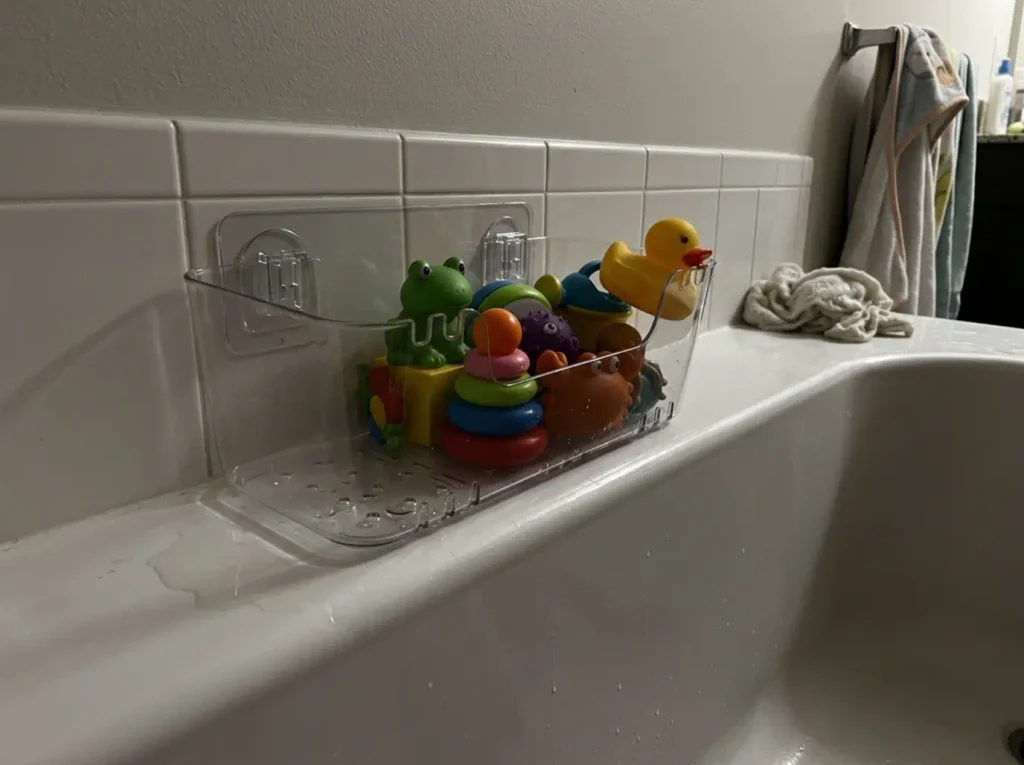
What works is a container with actual holes in the floor of it, so water leaves the way water wants to leave, downward, on its own, in the minutes after bath time while nobody is thinking about it. Some designs open up a large share of the base surface to drainage rather than adding a token few holes at the corners, and that difference shows up in how the toys smell three weeks later.
The YOPIKUU Bath Toy Storage Organizer 2-Pack is built around that base-drainage idea, with a no-drill wall mount so it does not sit in a puddle on the tub deck. Two units is usually the right count for a household with more than one kid, because separate bins prevent the pile-up-at-the-bottom problem better than one deeper bin does. The limitation is the mount: it is going on your tile, which means everything from the adhesive section applies here too: smooth glazed surface, full cure time, and a check that the corner is where you actually want it before you commit.
Placement is the part people get wrong even with the right container. It has to sit where it can drip freely without landing on the strip of tub floor someone steps onto. A draining bin positioned over the tub itself is fine. A draining bin positioned over the bath mat is a new problem wearing the old one’s clothes.
The squirt toys are the ones that mildew first, because they pull water in through the hole and hold it in a dark cavity that never dries. If you want to keep them, seal the hole with a dab of hot glue so they float without filling. If that sounds like too much work, that is useful information: those are the toys to let go of at the next swap.
How Many Toys Actually Belong in the Tub
Toy volume is a decision, not a given, and almost nobody treats it as one. The set grows because every toy that is technically waterproof gets classified as a bath toy, and nothing ever leaves.
A smaller in-rotation set drains faster, dries faster, and gets cleaned more often simply because cleaning six things is a task and cleaning thirty is a project you will postpone. Keep six to eight in the tub (a laundry basket in the linen closet is a fine holding pen for the rest), store the others dry, and swap the set when interest fades. This is the same rotation logic that keeps toy storage from overflowing in a playroom, and it works in the bath for the same reason: novelty comes from the swap, not from the total count.
Kids do not notice the reduction. They notice the swap.
Sharing a Shower Without the Daily Pileup

A three or four shelf caddy is sized for roughly one person’s daily rotation. Two adults and a teenager do not have a discipline problem. They have an arithmetic problem, and no amount of asking people to be tidier changes arithmetic.
One Caddy Is Sized for One Person
Run the numbers honestly. One person’s rotation is four or five bottles. A four-shelf caddy holds those comfortably with a little room. Add a second person and you are at eight to ten items on the same four shelves, which means bottles start doubling up per shelf and leaning against each other.
Add a teenager, who reliably owns more product than both adults combined, and you are past the physical capacity and probably near the weight cap too.
The end state is predictable and it is the same in every shared bathroom: the top shelf carries three bottles balanced on each other, someone knocks one off mid-shower, and eventually the load distribution goes lopsided enough that the mount lets go. An overloaded caddy does not just look bad. Its failure mode is a mount releasing under uneven weight, which brings us back to section one.
Zoning Beats Enforcement
The fix is per-person zoning, not a bigger unit. Two small mounts beat one overloaded one, and a divided shelf beats a shared one, because the constraint becomes visible. When you have your own shelf and it is full, that is information you can act on. When everyone shares four shelves, nobody owns the overflow and nobody addresses it.
This is the broader principle, and it holds well beyond showers. Systems that require other people to follow rules fail. Systems that give each person a defined space work without anyone enforcing anything, because the boundary does the enforcing.
In practice this looks like one corner shelf per adult, or a pole caddy where the top two shelves belong to one person and the bottom two to another, or simply a small caddy each. Kids’ shampoo and body wash go on the lowest shelf, which solves the reach problem and the weight-distribution problem in one move.
The Weekly Reset That Keeps It From Creeping
One pass, once a week, and it takes under three minutes. Put back whatever drifted onto the tub ledge or the shower floor. Pull out anything nobody used. Wipe the shelf that has been collecting a soap ring (thirty seconds, and it is the step everyone skips).
That is it.
The reset exists to catch capacity creep before it becomes a mount failure. The extra bottle that appeared on Wednesday leaves on Sunday, and the mount never learns what nine bottles feel like. That is the one-in-one-out rule applied to a space small enough that you can actually see it working. This is also where you catch the early warning on materials: an orange tinge starting at a weld, a bamboo edge going dark, a suction cup that has crept a quarter inch down the tile since last week.
And the honesty check that makes the whole system work: if a shelf has held the same untouched bottle since your last reset, that is not storage. That is inventory sitting in the wet zone, and it belongs in the cabinet with the rest of the backstock.
Conclusion
Match the mount to your surface, because grout lines, tile texture, and cure time decide what holds — not the weight rating printed on the box. Keep only the daily rotation in the wet zone and send the backstock somewhere dry, since a caddy carrying five items behaves completely differently from one carrying twelve. And pick materials by the upkeep you are actually willing to do, not by how they photograph on the tile.
In three months, look for the two early warnings before anything fails: an orange streak on the tile under a caddy, which means a coating is going, and a shelf carrying bottles nobody has touched since the last reset, which means capacity creep has restarted.
Start with one shelf. Take everything off it, put back only what you used this week, and look at what is left over on the floor. That leftover pile is the entire problem, and it is a much easier problem to solve out of the shower than in it.
Frequently Asked Questions
01What is the best way to organize a shower?
Remove everything that is not part of your daily rotation, then choose a mount that matches your surface: tension for renters and textured tile, adhesive only on smooth glazed tile, suction only for light items on flat, grout-free tile. Keep refills and backstock outside the wet zone entirely.
02What are some DIY ways to organize my shower?
The free moves come first: zone your built-in niche or tub ledge by person, relocate every refill to the vanity, and repurpose a rolling cart you already own as shower-adjacent storage. Most of what fixes a cluttered shower costs nothing, because it is a relocation rather than a purchase.
03What is the best shower organizer?
The mount decides it, not the brand. A tension pole caddy has the widest compatibility and zero wall contact, an adhesive corner shelf works when your tile is smooth glazed ceramic, and a freestanding rolling cart is the answer when nothing can touch the wall at all.
04Do suction cup shower caddies actually work?
They work on continuously flat, non-porous tile with no grout line under the cup, and they degrade faster in a shower than anywhere else because soap residue lubricates the seal and every hot shower is a heat cycle working it loose. Reusable suction hooks handle light items well; a full caddy of bottles is outside what suction reliably holds.
05How do you organize a shower for more than one person?
Give each person a defined zone instead of buying a bigger caddy, because a single three or four shelf caddy is sized for roughly one person’s daily rotation. Separate small mounts or a divided shelf work better, and a weekly reset catches capacity creep before a mount fails.
Disclaimer: ClutterlessNest is a participant in the Amazon Services LLC Associates Program. As an Amazon Associate we earn from qualifying purchases. This article may contain affiliate links — if you buy through them, we may earn a small commission at no extra cost to you. We only recommend products we have tested or genuinely believe in.