
Every time you reach for the shampoo, you knock over two bottles that belong to somebody else. The shower ledge has become the default storage for four people’s products, and it broke on a specific day: a new bottle came home, there was physically nowhere to put it, so it went on the floor of the shower. It’s still there. The fix is almost never a bigger caddy, and that’s the part nobody says out loud.
This is the most-asked version of this question online, and every answer treats it like a shopping problem instead of a boundary problem. Here’s the system instead: purge the pile, assign one zone per person, match the mount to the load you actually have, and keep it from drifting back.
Quick Answer
Organizing shower products is a five-step system, not a product purchase.
- Take everything out and sort it by who uses it and how often.
- Give every person one zone and every zone one container.
- Keep daily products at eye level; move refills out of the shower.
- Match the mount to the real load, not the packaging number.
- Pick shelves with drainage holes so water escapes instead of pooling.
Start by Taking Everything Out of the Shower

Nobody’s shower got crowded on purpose. It got crowded one bottle at a time, over a year or two, and the reason it feels unsolvable is that most people try to organize the pile instead of shrinking it first. Two-thirds of what’s in there right now is not in daily rotation. It’s a hotel sample, a nearly-empty backup, a mask somebody tried once, or a conditioner that was replaced before it was finished.
So empty it. All of it, onto a towel spread on the bathroom floor outside the shower. This feels excessive for about ninety seconds and then it stops feeling excessive, because the shower ledge is the one surface in the house that never gets fully cleared. You cannot assign zones to a pile you can’t see, and you can’t see this pile until it’s laid out flat.
Sort by Frequency, Not by Product Type
Here’s where most sorting advice goes wrong. Grouping shampoos with shampoos and body washes with body washes produces a tidy-looking pile that tells you nothing about what belongs in a wet space. Sort by frequency instead, into three piles: daily rotation, occasional, and backstock.
Daily rotation is what gets touched in a normal week. Occasional is the deep conditioner, the clay mask, the exfoliating scrub, the shave-day product that comes out twice a month. Backstock is every unopened bottle and every refill. That three-way split is the whole reason the zone system in the next section works, because it tells you how many products actually need to live at arm’s reach and how many are just taking up prime shelf space out of habit.
Do the purge right after someone showers, while the bottles are still wet and the labels are legible. Dry-time sorting is when people put the mildew-ringed bottle back because it “looks fine.” It doesn’t look fine when it’s wet.
The Backstock Leaves the Shower Entirely
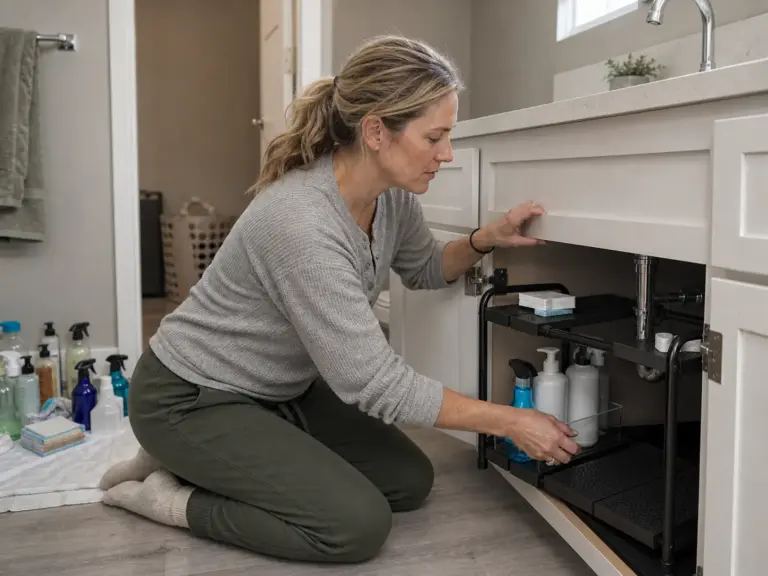
This step costs nothing and it buys back more shelf than any product will. Extra bottles and refills do not belong in a wet space. They sit there absorbing steam for weeks, the labels curl, and the base of every one of them grows a ring. Take the whole backstock pile and give it a home outside the shower, which is exactly why moving the backstock under the sink is the first real space win most showers have available.
For the purge itself, three criteria hold up in real life. This is the only place in the process where you actually declutter anything, and it does more for the shower than any product will.
Anything with a mildew ring baked into the base goes, because that ring is already colonized and you’re not scrubbing it off in a shower. Anything nobody in the house has touched since the season changed goes. And duplicate half-empty bottles of the same product get consolidated into one, right there on the towel.
There’s one more thing that shows up in every shared-shower pile, and it’s the honest diagnostic: at least one bottle nobody claims. The “whose shampoo is this” moment is a recurring confession in organizing threads about shared bathrooms, and it means the same thing every time. Products stopped having owners a while ago. That’s the actual failure, and no caddy fixes it.
Why Shower Storage Fails (and It’s Not Because You’re Messy)
People blame themselves for shower storage that collapses. The caddy fell, the pole leaned, the mildew came back, so clearly somebody isn’t keeping up. That’s not what’s happening. Three specific physics problems are happening, each with a different fix, and once you can name which one you have, the fix stops being a guess.
Suction Fails Because the Rating Is a Standing-Still Number
The weight number printed on a suction mount is a static load rating. It describes what the cup holds when nothing is moving. Real shower use is dynamic: the moment somebody presses down on a pump-top bottle, the momentary pull on that cup spikes well past the number on the box. A mount rated around 15 pounds can face over 20 in that instant, several times a day, for weeks.
Then one morning it pops off and it reads as random. It wasn’t random. The rating was never describing the thing you were doing to it.
For a sense of what honest ratings look like, a rated adhesive system like Command’s own bath-specific hooks, built and tested for wet, humid surfaces publishes a 7.5-pound limit for its bath caddy. That’s roughly two or three full-size bottles. It’s a one-person load, stated plainly, and it’s a useful yardstick for judging every unlabeled claim you’ll see next to it.
The practical rule that follows: suction cups and adhesive hooks are for light items, used as light-item mounts. The LUXEAR Heavy Duty Waterproof Suction Shower Hooks come as a 2-pack rated to 11 pounds, which is plenty for a loofah, a razor, a body brush, and a hanging bath toy bag.
Put a loaded pump bottle on one and you’re back inside the same problem, just with a better hook. The product illustrates the rule. It doesn’t repeal the physics.
Leverage Makes Everything Worse
Placement isn’t cosmetic. Every inch a heavy bottle sits away from the wall multiplies the force pulling against the top edge of the cup or bracket. The same conditioner bottle stresses a mount far harder parked on the outer lip of a shelf than pushed flush against the tile, and nothing on the packaging tells you this.
So heavy things go to the back, against the wall, on every shelf. Light things live on the outer edge. That’s it.
Tension Poles Lean Before They Fall
A tension pole doesn’t crash. It creeps. Compression grip on smooth wet tile loosens gradually as the pole gets bumped by elbows, shampoo bottles, and a kid grabbing at a low shelf, and each imperfect re-tension resets it a hair lower.
There’s no sound, no moment, no warning. You just notice one day that the whole thing is visibly crooked and has been for a while.
I used to treat this as a reason to steer people away from tension poles entirely. The failure stories in renter threads changed my mind about that, because the same threads are full of cracked tile from drilled mounts, which is a genuinely worse outcome. A pole that needs a ten-second push once a month is a maintenance item, not a defect. Knowing that going in is what makes it fine.
The Mildew Ring Is Trapped Water, Not Poor Cleaning
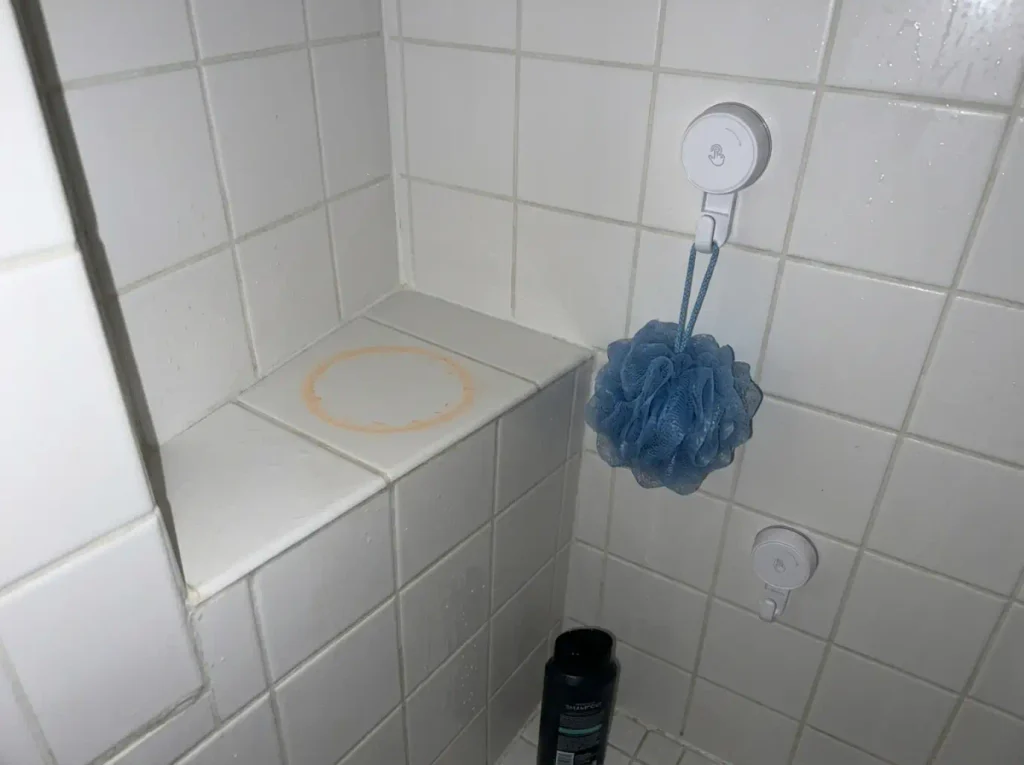
The pink or orange ring appears at the exact footprint of whatever sits there. That precision is the clue. A flat-bottomed dish or basket with no slope and no drainage leaves standing water pressed against the container base for days, and that thin trapped film is where the growth starts.
It’s structural. The same cleaning routine that keeps failing on a solid-bottom basket works fine on a slotted shelf, which is why “clean it more often” never solves it permanently.
This is the same drainage principle installers rely on to keep shower frames from trapping standing water. Water has to have somewhere to go or it sits. When you’re choosing containers later in this process, slots and drain holes are not a nice extra feature. They’re the whole difference between a shelf you scrub monthly and one you rinse in three seconds.
The Fourth Failure Is the Material Itself
The other three failures are about mounting and water. This one is about what the thing is made of, and it’s the one people discover last.
Chrome-plated steel is the usual offender. The plating is a skin over a steel core, and once it chips (a dropped bottle, a knock from a razor) water reaches the steel underneath and rust blooms outward from that one point. Aluminum doesn’t rust the way steel does, which is why it shows up in a lot of lighter caddies, though it dents more easily and can pit in hard water. Stainless and powder-coated steel are what actually survive the humidity, and it’s why “rustproof” is one of the two words shoppers search for in this category (the other is “no-drill”).
Plastic isn’t disqualified, but it ages differently. Cheap plastic in a hot, wet room goes brittle and yellows over a couple of years, and a mold-resistant rating on a plastic bin usually means an additive in the material, not a magic surface. Drainage still does more work than the additive does.
One anecdote surfaces over and over in these threads and it captures all three failures at once: the caddy that lets go at three in the morning with nobody in the shower. Humidity cycles quietly degrade the seal for weeks, and the next hot shower’s steam is what finally breaks it. Nothing happened at 3am. Everything that mattered happened in the six weeks before it.
Give Every Person a Zone and Every Zone a Container
This is the part everybody asks about and nobody answers with an actual rule. “Get a bigger caddy” isn’t a system, it’s a delay, and every shared shower proves it within a month. The system is zone-based storage applied to a wet box: every product has an owner, every owner has a boundary, and the boundary has to be physical. Agreed-upon boundaries don’t survive a rushed Tuesday morning.
If you want the full picture of how this connects to the tub, the ledge, and the towels, the wider shower and bath system this fits into covers the room around it. This section is strictly about the wet box itself.
One Container Per Person, No Shared Shelves
Shared shelves fail for a structural reason: nothing on them has an owner. When a shelf belongs to everybody, nobody consolidates the two half-empty body washes, nobody throws out the sample, and nobody notices it’s full because “full” isn’t anybody’s problem. Split the same total volume into two separate containers and the behavior changes immediately, because now the crowding is visible and personal.
Two separate corner shelves genuinely beat one wide shelf holding the same number of bottles. Same footprint, same capacity, completely different outcome. The split is what does the work.
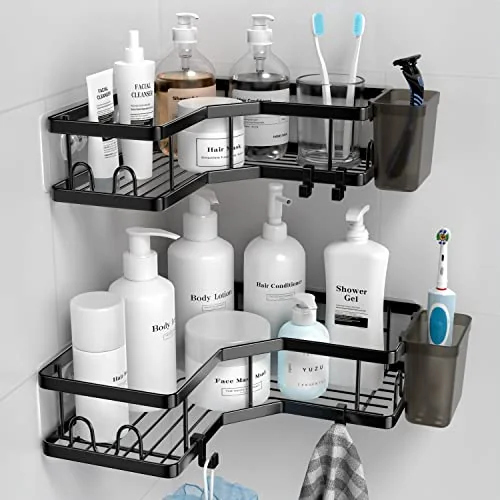
Height Assigns Itself by Use, Not by Hierarchy
Nobody needs to negotiate who gets the top shelf. Use decides it. Daily products go at chest-to-eye level, where your hand finds them with soap in your eyes and no looking involved. Occasional products go on the tier above or below, because reaching for a deep conditioner twice a month is a fine amount of reaching.
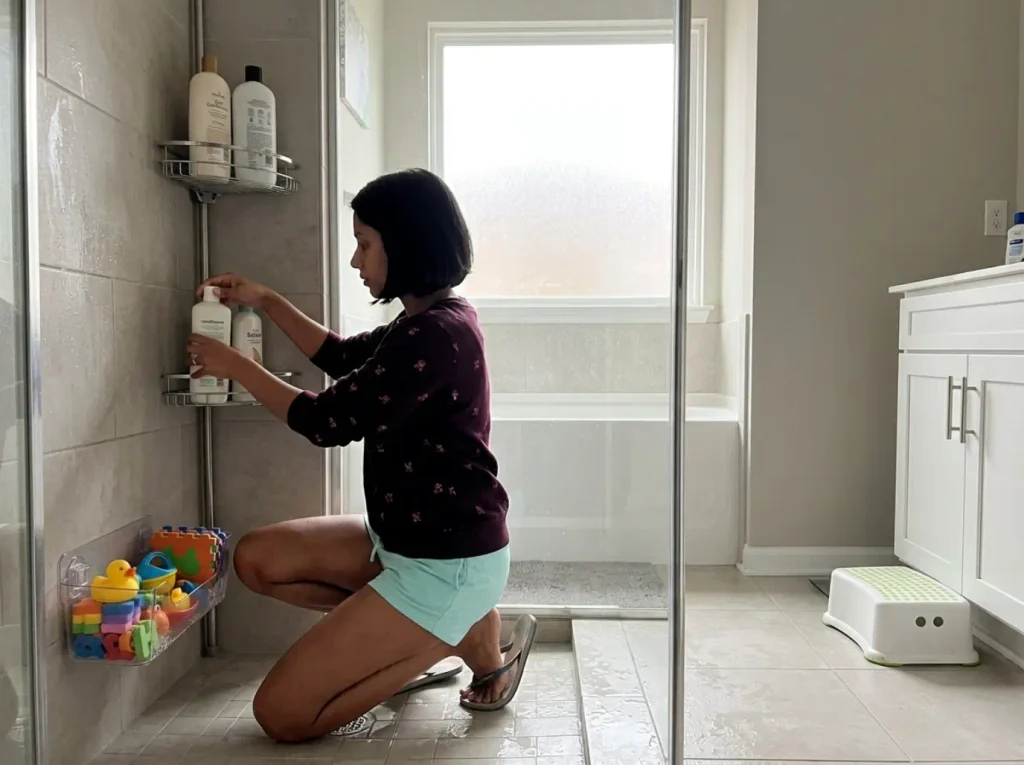
Kids’ products and bath toys go at the bottom. Reachable by them, out of the adult reach zone, and separated from the stuff you don’t want a four-year-old experimenting with. The low zone also needs drainage more than any other zone in the shower, because bath toys hold water internally and sit wet longer than anything else in there.
The YOPIKUU Bath Toy Storage Organizer 2-Pack mounts without drilling and has drain holes through the base, which ties straight back to the mildew mechanism above. Two of them lets you split toys from the kids’ actual products, though be honest about the wall space a low mount takes up in a narrow stall.
The Full-Caddy Rule Nobody States
Here’s the rule that makes all of this hold. When a person’s zone is full and a new bottle arrives, something in that zone leaves. Not “we’ll find room.” Not a shelf on the ledge as a temporary measure. The zone is the budget, and the budget doesn’t flex.
This is the one-in-one-out rule applied to a wet space, and it’s the only thing standing between a freshly organized shower and the exact same pile six weeks from now. The reason it works better here than anywhere else in the house is that the constraint is visible. A closet can absorb three more shirts invisibly. A full shower shelf cannot absorb a fourth bottle, so the decision gets forced the day the bottle arrives instead of six months later.
For a household of three or four, the split scales predictably. Two adults get two mounted zones. Kids share one low zone, toys included. If there are four adults sharing one shower, stop trying to mount four zones on the tile: personal caddies that leave the shower between uses beat any fixed system, and there’s a specific product answer for that coming in the next section.
One note on language, because it shapes how you think about this: people searching for help with this problem type “multiple users,” not “his and hers.” That’s not a small thing. “His and hers” assumes two adults and a symmetrical split. “Multiple users” is what an actual household looks like, with a teenager, a toddler, and somebody’s guest shampoo in the mix.
Match the Mount to the Load You Actually Have
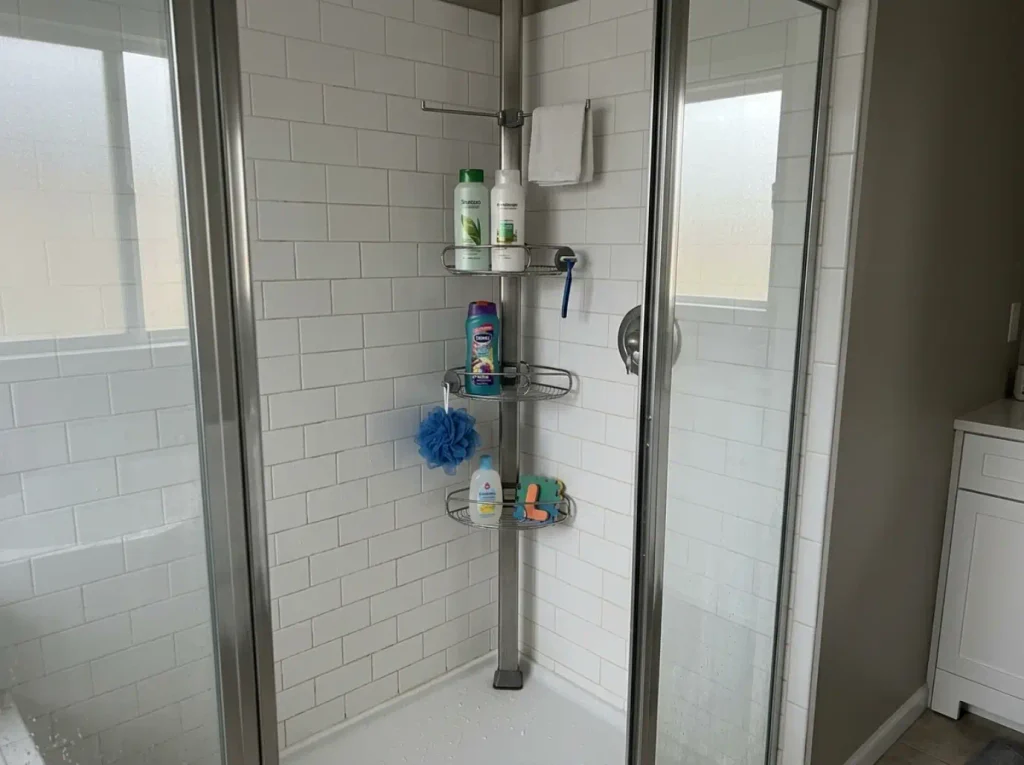
Every mount type works. Each one works for a specific load, and the failures in the section above aren’t product defects, they’re mismatches. A one-person minimalist load and a family-of-four load are different engineering problems, and the mount that’s ideal for one is the mount that fails for the other.
Light Load, Single User
If your shower holds a shampoo, a conditioner, a body wash, a razor and a loofah, you’re done thinking about hardware. Adhesive corner shelves or rated suction hooks carry that comfortably, and they take up no floor area.
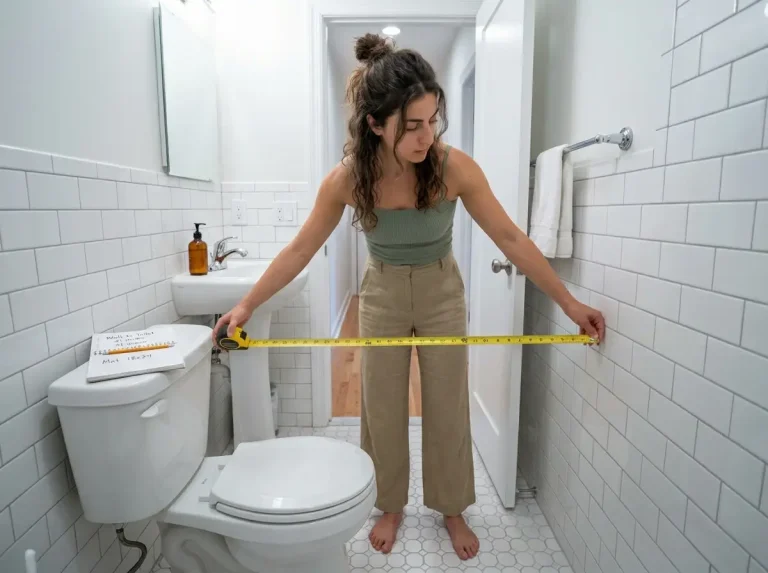
Don’t over-mount a small load. A full-height tension pole in a one-person shower is an obstacle you’ll bump with your elbow for the next three years. And in a narrow stall, a pole standing in the corner takes away exactly the space you’d have used to turn around.
Full Household Load
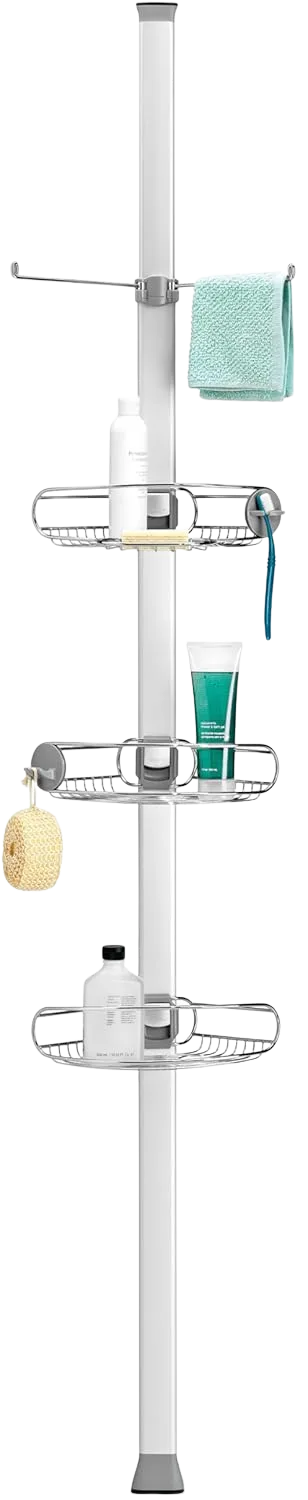
This is where a steel tension pole or an over-the-showerhead caddy stops being overkill and starts being the only thing that works. Some stainless multi-tier caddies carry substantially more total load than any adhesive or suction option can, which is the difference between a system that holds an entire household’s shampoo, conditioner, body wash, razors and kids’ products and a system that drops one of them on your foot. When the question shifts from “what system” to “which specific model,” which caddy actually holds up for renters and shared baths runs that comparison properly, so this section stays on the load-matching question.
There’s a second way to carry a household load with no hardware at all. The AKTECKE Hanging Shower Caddy Over Showerhead hangs off the showerhead arm with two tiers, eight hooks and two soap dishes, and eight hooks is a shared-shower product count by design. No tension, no adhesive, no suction to give out at 3am. The constraint is the arm: it needs a fixed showerhead with enough clearance behind it, and a handheld unit on a slide bar usually rules it out.
The Renter Constraint: No-Drill First, Always
For a rental, tension and adhesive are the default, not the compromise. They leave zero permanent marks, which is the entire point. State the trade-off plainly and it stops feeling like a downgrade: a tension pole needs occasional re-tensioning, adhesive needs a proper cure, and that’s the price of not risking your deposit. If you want the same constraint applied past the shower door, the no-drill approach applied to the rest of the bathroom walks through the towel, vanity and over-toilet zones on the same terms.
Worth understanding why the stakes are higher in a shower than anywhere else in the apartment. Drilling into tile is a different commitment than drilling into drywall. At high speed, without a proper tile bit and a masking-tape guide, the glaze cracks or the tile chips, and a chipped tile is a repair, not a patch you smooth over with spackle on move-out day. That’s the real reason renters default to tension, adhesive and suction, and it’s a good reason.
The zero-mount option is worth its own mention, especially for four adults sharing one bathroom. A Lifewit Shower Bag Mesh Shower Caddy is fabric mesh, so it drains instantly instead of holding a film of water the way a solid plastic tote does, and it leaves the shower completely between uses. That solves the boundary problem and the storage problem in one move, since each person’s zone travels with them.
If the stall has a recess that fits one, a spring-loaded tension rod across a short span gives you a hanging line for the bags without touching the tile. The obvious limitation is that somebody has to actually carry it in and out, every time, which works in a dorm-style setup and falls apart in a household where one person won’t play along.
Before you mount anything, run a hot shower for five minutes with the door shut, then dry the tile and wait an hour. Adhesive applied to tile that only feels dry is the most common reason a mount fails in week two. Grout lines count too: adhesive bridging a grout line has half the contact surface it looks like it has.
One safety point for family bathrooms. A tall freestanding or tension-pole unit in a house with small kids deserves the same anti-tip thinking you’d give a bookshelf, because a child grabbing for a toy on a low shelf can pull the whole unit toward them. This isn’t a blog opinion: the anti-tip anchoring standard the Consumer Product Safety Commission sets for tall freestanding units sets published thresholds for units above a certain height, and a full-height corner pole in a family bathroom is exactly that kind of unit. Keep the bottom tier light, keep the toys reachable without climbing, and check the tension more often than you would in an adults-only bathroom.
Keep It Working Past the First Month
The “after” photo is the easy part. A shower system doesn’t fail all at once, it fails on a schedule: the mount loosens, the drainage clogs, and one person quietly stops honoring the zone rule. All three are ten-second fixes if you know to look for them, and all three are a full reset if you don’t.
The Physical Upkeep
Once a month, push up on the tension pole and press each suction cup back flat against the tile. That’s the entire routine and it takes about fifteen seconds. A pole that’s just begun to lean re-tensions instantly; a pole that’s been leaning for three months has usually already slid down the tile and needs to come apart. This is the maintenance nobody writes about, because it doesn’t photograph and it doesn’t sell anything.
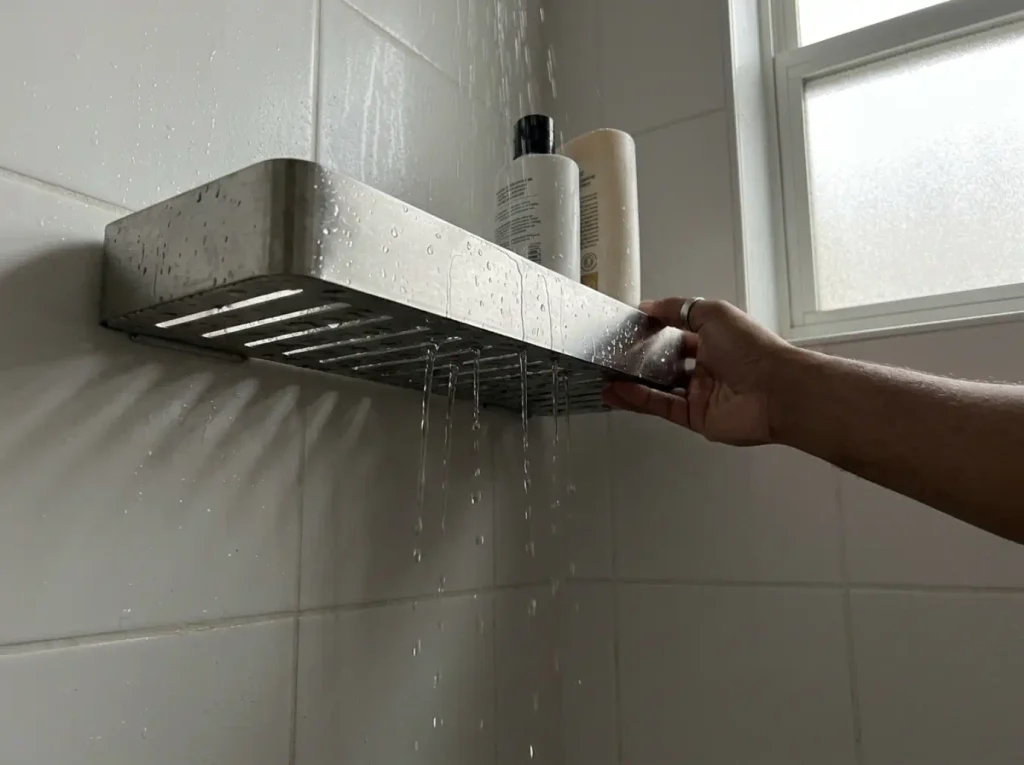
Drainage is the other half. Slots and drain holes clog with soap film and hair, and a clogged slot is functionally a solid bottom, which puts you right back at the mildew ring.
Fix it by rinsing the caddy shelves under the running water for a few seconds at the end of somebody’s shower. That’s it. It’s the difference between the structural fix working and the structural fix quietly reverting on you.
Attach the monthly mount check to something you already do in that room, like the day you swap the towels or replace the bath mat. A maintenance task with no trigger is a maintenance task that happens twice and then never again.
The System Upkeep
The zone rule is what erodes first, and it erodes quietly. One person’s bottle migrates onto the other’s shelf, nobody says anything because it’s one bottle, then a third bottle lands on the ledge because both shelves are now full. Within a few weeks the ledge is a pile again and everyone’s mildly annoyed at everyone else.
The fix isn’t a household conversation, which is good, because that conversation goes badly. The fix is that every zone stays visibly full to its limit, so overflow is obvious on day one instead of week four. When a shelf has an inch of empty space, migration is invisible. When it’s at capacity by design, the extra bottle has nowhere to hide.
Then there’s restocking, which is where most purges quietly undo themselves. When a bottle empties, the refill comes from under the sink, and only then. The shower’s product count stays flat forever, because a bottle only enters when a bottle leaves. This is the mechanism that turns the purge from a one-time weekend event into a system, and it’s the same logic behind matching the organizer to the zone across the rest of the bathroom rather than buying storage and hoping the contents behave.
The honest tell that things have drifted is one specific thing, and it shows up long before the shower looks messy. A bottle sitting on the shower floor. Not on a shelf, not in a caddy, not in somebody’s zone. That’s the signal, and by the time you can see it, one zone has already outgrown its container.
Conclusion
Shrink the pile before you organize it. Most of what’s in your shower right now isn’t in daily rotation, and every refill and backup belongs under the sink where it stays dry.
Then give every person a zone, give every zone a container, and hold the line: when a zone is full and a new bottle arrives, something leaves first. Finally, match the mount to the load you actually have. Suction and adhesive carry light items honestly; a tension pole or an over-the-showerhead caddy is what a real household load requires.
In three months, look for the bottle on the shower floor. If there’s one, a zone has outgrown its container, and you’re choosing between something leaving and that person getting a second tier. Either way it’s a five-minute decision at that stage instead of a full reset six months later.
Start with the purge tonight. Empty the shower onto a towel and sort by who uses it and how often. You’ll know exactly how many zones you need before you buy a single thing.
Frequently Asked Questions
01How do you organize a shower for multiple people?
Give each person one container and one zone, and keep shared shelves out of it entirely. The zone is the budget: when it is full and a new bottle arrives, something in that zone leaves. Kids get the bottom tier so their products and toys stay reachable and out of the adult reach zone.
02How do you keep a shower caddy from rusting?
Choose stainless or powder-coated steel over chrome-plated, and make sure water drains off instead of pooling. Chrome plating chips in humid conditions and rust starts at the chip. Drainage matters even more: a shelf with slots stays dry between showers and a solid-bottom one does not, whatever it is made of.
03Why does my suction shower caddy keep falling?
Because the rating on the package is a static number and real use is dynamic. Pressing down on a pump-top bottle spikes the actual force well past that rating, and every inch a heavy bottle sits away from the wall multiplies the pull on the cup. Move heavy bottles flush against the tile and keep only light items on suction.
04What is the best shower organizer for renters?
A tension pole or an over-the-showerhead caddy, since both hold a real household load with zero permanent marks. Adhesive corner shelves handle lighter loads, and a portable mesh caddy works when you want nothing mounted at all. Drilling into tile is a repair risk rather than a patch job, which is why no-drill is the default here.
05Where should I keep extra shampoo and refills?
Out of the shower entirely, under the sink or in a nearby cabinet. Backstock in a wet space is the single biggest space waster in most showers, and bottles stored wet grow the mildew ring at the base far faster than ones stored dry. Refill the shower as bottles empty so the product count never grows.
Disclaimer: ClutterlessNest is a participant in the Amazon Services LLC Associates Program. As an Amazon Associate we earn from qualifying purchases. This article may contain affiliate links — if you buy through them, we may earn a small commission at no extra cost to you. We only recommend products we have tested or genuinely believe in.