























In this article
You lower yourself into the water, reach for the wine glass, and the whole tray tilts. The candle goes first. Then the phone slides toward the low corner and you catch it with a wet hand about half a second before it becomes a very expensive bath toy. Most people learn the same lesson at that exact moment: the caddy was never the right size for the tub, and no amount of rubber feet was going to fix that.
The best bathtub caddy organization ideas all start from the same place, and it is not a shopping list. Not a self-care setup shopping list, anyway. It is a tape measure, a rim shape, and a rule about where the heavy things sit.
Quick Answer
A bathtub caddy stays put when it fits the tub, not when it has better grip pads. Five things decide it:
- Measure the outside width of your tub rim, edge to edge, before buying anything
- Match the caddy’s expansion range to that number, not to “fits most tubs”
- Check your rim shape — flat alcove rims and curved freestanding rims are not interchangeable
- Keep the weight near the feet, not stacked in the unsupported center span
- Stand the caddy on end to dry after every bath, or bamboo warps and grows mold
Why Your Bathtub Caddy Slides Into the Water

Everyone blames the feet. Search any bath tray listing and the one-star reviews follow the same script: the non-slip pads are useless, the rubber is too thin, the grips slide the second they get wet. And I understand the instinct, because the feet are the part you can see moving.
But the feet are almost never what went wrong. The tray was bought before the tub was measured, and physics took it from there.
The Feet Are Not the Problem, the Width Is
A bath tray has to be wider than your tub’s inner rim opening. That is the whole requirement. If it is not, one foot lands on flat rim and the other is hanging out over the basin with nothing under it, so the tray is resting on a single edge and a prayer. Add a hand pushing down on the far side as you reach for a book and it pivots exactly the way you would expect a lever to pivot.
The rubber never had a chance. Grip only matters once the caddy footing is actually sitting on something.
This is why an undersized caddy feels fine for a week and then dumps everything. Empty, it balances. Loaded and touched, it does not. The failure is baked in at purchase, which is genuinely good news: the fix is a measurement, not a better product.
Before you assume a caddy is defective, set it on the empty tub and press down hard on one corner with your palm. If it rocks or shifts, the feet are not both landing on flat rim. Return it and buy one that extends wider. No pad, mat or strip of grip tape fixes a footing problem.
Flat Alcove Rims vs Curved Freestanding Rims
Width is the first variable. Shape is the second, and it catches people who did measure. Most expandable caddy designs are built for the flat, roughly two-inch ledge of a standard alcove tub, the kind wedged between three walls in nearly every apartment bathroom. That is what an over-the-tub caddy assumes about your bathroom before you ever open the box.
Set that same tray on a freestanding soaking tub with a rounded lip and the feet make contact at a single point on a curve instead of flat across a ledge. It will rock. It will rock even though it fit perfectly, and even though the reviews were excellent, because those reviews were written by people with a different tub.
Bathroom fixture guides are blunt about this: matching a caddy to your tub’s actual rim shape matters as much as matching the width. If your tub has a rolled or curved edge, look for a tray with wide contact pads or a design that clamps rather than perches. And if you have a freestanding tub, treat five-star ratings on alcove-tub trays as information about somebody else’s bathroom.
Where You Put the Weight Matters More Than How Much
Here is the part that gets skipped everywhere. A caddy rated for a certain load can hold that load happily and still tip, because total weight is not the number that matters. Distribution is. Picture the classic setup: candle, hardback book, a full glass, a phone.
Stack all of that in the middle of the span and you have concentrated the entire load on the least-supported part of the tray. That is exactly where the slots usually are, because the wine glass holder and the candle holder get designed for symmetry rather than for load. The same items spread out toward the feet would sit there all night.
That is the mechanism behind the wobble-then-dump story that gets retold in every bath thread. Not overloading. Bad placement.
This is a small piece of the wider bath and shower storage picture, where nearly every failure traces back to something being asked to hold weight it was never positioned to hold.
Measure Your Tub Before You Buy Any Caddy

Two minutes with a tape measure. That is the entire cost of never dealing with any of the above. And yet the single most repeated confession in bath caddy threads is some version of the same thing: bought first, measured never. The tray arrives, sits at an angle, and either cannot extend far enough or wobbles because both feet are not landing on flat rim.
The One Measurement That Matters
Measure the tub width across the outside of the rim, edge to edge. Not the basin. Not the inside of the water well. The outside edge of the ledge on one side to the outside edge of the ledge on the other, because that is the surface the caddy’s feet have to reach across.
The distinction matters more than it sounds. Standard alcove tubs run roughly 27 to 43 inches at the rim, but the wet basin inside is typically only 22 to 25 inches. Measure the basin and you will confidently buy a tray that is six inches too short, then spend a week wondering why a product with thousands of good reviews does not work in your bathroom.
Write the number down. Take it shopping.
Take a second measurement while you are there: the depth of the flat rim ledge itself, front to back. Under two inches and you want a caddy with narrow feet or a bracket-style underside, because a wide foot on a skinny ledge overhangs the basin and puts you right back at the tipping problem.
What the Expansion Ranges Actually Cover
Once you have your number, the shopping gets easy, because expandable caddies publish theirs. The common ranges cover 27.5 to 40 inches or 29.5 to 43 inches, and a few models stretch to about 44.75 inches for oversized and whirlpool tubs. Compare your measured rim width against that stated range and either it lands inside or it does not. There is no interpretation involved.
For most readers, one expandable caddy covers the standard tub with room to spare. The place this breaks is the oversized soaking tub, where a rim can sit past the top of every mid-range caddy’s extension. If your number came in above 43 inches, filter for max extension before you filter for anything else. Material, slots, finish: all of it is irrelevant if the tray cannot physically reach.
The adjustment itself is nothing. The telescoping arms slide out by hand and lock at your chosen width, no screws and no tools, and it takes about thirty seconds once.
This is a fit, not an installation. A portable caddy with no installation at all is worth knowing about if you have been putting the purchase off because the bathroom already has enough projects in it. Same logic applies to sorting out which bathroom organizers earn their space and which don’t — the ones that need no setup tend to be the ones that survive.
Why “Fits Most Tubs” Is Not a Specification
“Fits most tubs” is the phrase that keeps this whole failure loop running. It is listing shorthand. It has no number behind it, no test, and no definition of “most,” and it appears on trays that span 30 inches and trays that span 44.
Treat it as an absence of information. If a listing tells you the minimum and maximum extension in inches, that is a specification and you can act on it. If it only tells you it fits most tubs, what it is actually telling you is that the seller does not know whether it fits yours. Scroll to the dimensions or move on.
Choosing a Caddy That Fits Your Tub and Your Routine

Before any of the buying advice: you might already own the solution.
Start With What You Already Own
A flat wooden cutting board laid across the tub rim does the core job of a bath caddy, which is spanning the width and holding things above the water. So does a metal cooling rack, and the rack has the bonus of draining. Neither costs anything, both are in a kitchen cabinet right now, and if what you want is a surface for a book and a mug, you are finished. Go take a bath.
What you give up is real, though, so be honest about whether it matters to you. No cutout to hold a wine glass by the stem, no angled book stand, no soap dish, no phone slot. A cutting board also gets slippery when wet and it is not expandable, so it either spans your tub or it does not.
But the budget-organizing threads bring this up first for a reason: it is the most budget-friendly answer there is, it genuinely works, it costs nothing, and a lot of people who buy the tray discover afterward that they mostly wanted a flat place to set a book.
What to Check on a Bamboo Listing
If you do buy, bamboo caddy trays dominate the category. You will also see the acrylic caddy and the plastic caddy versions, which are lighter and fully water-resistant but flex under a loaded glass, and the solid wood caddy, which looks better and costs more without behaving any differently in a humid bathroom.
Whichever you pick, there is one detail on the listing worth more than all the styling photos. Bamboo caddies normally ship with a lacquer or protective coating applied specifically to resist water absorption. That coating is the difference between a tray that lasts and a tray that swells.
So look for the words “lacquered,” “sealed,” or “waterproof finish” in the description. A listing that advertises “solid bamboo” and says nothing at all about a protective coat is the one likelier to warp fast, because untreated bamboo in a bathroom is doing daily battle with the one thing it is bad at.
And skip the fixed-width trays. Expandable costs slightly more and covers the tub you have now plus the tub in your next apartment, which is not a small thing if you move every couple of years.

If your tub measured past 40 inches, or if you just want to spend less, the Domax Bathtub Caddy Tray runs 29.4 to 44.2 inches and comes in at the budget tier while still being lacquered expandable bamboo with a book holder and soap dish. That top end is the reason to look at it: 44.2 inches covers oversized and whirlpool tubs the mid-range trays cannot reach. The trade-off is the bottom end, since it will not close down below 29.4 inches, so a narrow tub needs the other one. Stock on it has been running thin, which is worth a glance at the listing before you plan around it.
Renter-Safe by Default, With One Caveat
Bathtub caddies are one of the very few bathroom organizing purchases with no rental downside whatsoever. The tray rests on the rim.
Nothing gets drilled into tile, nothing gets taped to a wall, nothing tensions against a surface that might give up its grout. You can take it out of the box, use it for two years, and move out having left zero evidence. Fully removable, in the way almost nothing else in a bathroom is.
Compare that to a shower caddy conversation, which is almost entirely a conversation about what you are allowed to attach things to, and you can see why this category is quietly the easy one on any list of bathroom storage that leaves no marks behind.
The one caveat: hard or unpadded feet can scratch a fiberglass or acrylic tub. Not from resting there, but from being dragged across the rim to adjust the position, which is exactly what everyone does with wet hands rather than lifting it clear. Fiberglass and acrylic are soft surfaces and they mark.
Buy a caddy with rubber or silicone grip feet and the problem disappears on any tub material, enamel and cast iron included. Then lift instead of sliding it. That is the whole caveat.
What Actually Belongs on a Bathtub Caddy

The styled version of this answer is always the same photo: candle, hardback, glass of wine, a sprig of eucalyptus draped at an angle. It is a nice photo. It is also a photo of a tray that nobody is currently using to take a bath, which is why it is not a useful answer to what goes on a caddy.
The functional version asks a different question. What do you actually reach for while you are in the water? Everything else is being stored on the tray, not used from it, and a caddy is a work surface rather than a shelf.
Daily-Use Items vs Stored Items
The sort is quick. If you reach for it during a bath, it belongs on the caddy. If it just lives there because the tray is the nearest flat surface, it is in the way of the next bath and it belongs somewhere else. Shampoo bottles are the usual offender.
They migrate onto the caddy because it is convenient, then the caddy is permanently loaded, then it stops being a bath tray and starts being a shelf across your tub with a book balanced on top of a bottle of conditioner.
Soap, a razor, a washcloth: these earn their spot only if your caddy is the one that stays out. In a shared bathroom it usually is not, and that changes everything about the setup. Which is the next section.
Give the caddy a home that is not the tub. A hook on the back of the bathroom door, the gap beside the vanity, the space behind the toilet. Anywhere it can stand upright between baths. A tray with a designated off-tub parking spot gets dried and put away. A tray with nowhere to go stays on the rim, wet, forever.
The Spa-Night Setup, and Why It Gets Cleared
The “spa night” configuration is real and it is worth building. Candle, book or tablet, a drink, maybe the good bath salts within reach: a genuinely spa-like bath is one of the few splurge-worthy things you can set up for free with what is already in the house.
Set it up deliberately for one soak, enjoy it, then clear it afterward. That last part is what separates it from the styled photo, because a spa setup left standing for a week is no longer a spa setup. It is clutter on a tray that somebody now has to move before they can shower.
About the phone. The tablet holder or book stand slot will hold it at a readable angle, which is genuinely the nicest thing about these trays. But nothing about the tray is waterproof and nothing about the tray is attached to anything.
Propping a phone over a full tub is a calculated risk, and the only real advice is to make it deliberately rather than by habit. Some people put the phone in a zip bag first. Honestly, that is not a bad call.
Where the Heavy Things Go
Take the load rule from earlier and make it physical: heavy things go over the feet, light things go in the middle. The full glass, the hardback, the ceramic candle — those sit at the ends of the tray, as close to where it meets the rim as the slots allow. The washcloth and the phone can live in the center span, because they weigh nothing and gravity has no opinion about them.
This sounds fussy until you have watched a tray pivot. Then it becomes automatic, and it costs nothing to do it right the first time.
Running Two Systems When Kids Share the Tub

Here is the household reality that no bath caddy article addresses: one tray cannot serve both a kid’s bath routine and an adult’s. It is not a philosophical position. It is a scheduling problem.
The kid bath happens every single night and needs kids bath toys within arm’s reach of a wet three-year-old. The adult soak happens occasionally and needs a clear surface, a book, and no rubber ducks.
Ask one tray to do both jobs and the tray loses, because the nightly routine always wins over the occasional one. That is how a bamboo spa caddy ends up buried under bath toys by Thursday.
Why One Tray Cannot Serve Both Routines
Run two systems instead, with different rules. The spa tray gets stowed between uses: it comes out for a bath, goes back on its hook afterward. The toy storage stays permanently mounted, because it is used daily and anything that has to be set up nightly will be abandoned inside a month.
The moment this pays off is the switch-over: a rare solo bath night where you want the tub cleared. If the two systems are genuinely separate, that is a thirty-second reset. If you built one hybrid tray, it is an archaeology project. The same split logic runs through sharing one bathroom’s product storage, where two people’s routines collide on the same six inches of ledge.
Mesh Drains, Bins Do Not
Now the part that decides whether the kid system works: the container has to drain. A bucket or a lidded bin looks tidier and it is the wrong choice.
Toys go in wet, sit in a pool at the bottom, and cultivate the smell every parent of a bath-toy household eventually goes to war with. A mesh caddy or bath toy organizer is spaced the way it is on purpose. Open netting works the way drainage slats do on a good tray: water runs straight through and air moves around what is inside. That is the entire quick-drying mechanism, and it is the only thing separating working bath toy storage from a bucket.
I used to think this was overstated and that any container was fine if you dumped the water out. The volume of “why do my kid’s bath toys smell” posts in parenting threads changed my mind. It is not the toys. It is the container holding them in a puddle.
The Zero-Cost Version
Before buying: a dollar-store mesh laundry bag hung on a pair of suction hooks does the same drainage job. So does a mesh produce bag if you have one. It looks like what it is, and the suction hooks will need re-sticking every so often, but the physics are identical and the cost is pocket change. Budget threads suggest it first for a reason.
If you want the version that mounts properly and holds a real toy collection, this is the one worth buying.
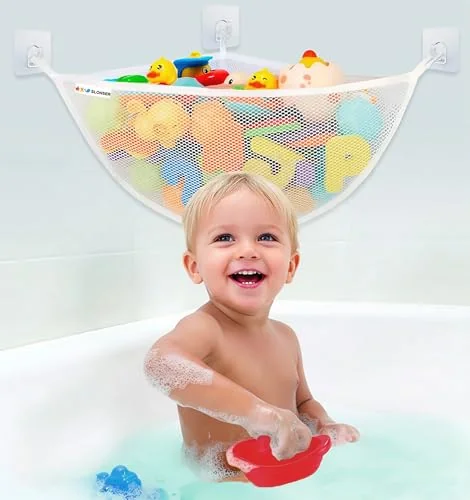
For a smaller toy collection or a tighter budget, the Bath Toy Net corner mesh bag covers 18 by 16 inches with the same two-suction-cup-plus-two-adhesive-hook mounting and the same no-drill drainage. It is the cheaper tier rather than a different idea, and the honest limit is capacity: a household with a serious duck situation will overfill it, and an overfilled mesh bag stops draining because the toys in the middle never see air.
One more thing for readers whose tub sits under a shower head. A tub tray does nothing for shampoo bottles, and stacking them on the rim is how they end up in the water.
That is a different problem with a different answer, covered properly in a hanging or tension shower caddy instead. If you want the renter-safe version of it, the simplehuman 9′ Tension Pole Shower Caddy braces floor to ceiling in stainless steel with nothing drilled, adjusting anywhere from 6 to 9 feet. It is the premium end of that category and the pole needs a genuinely flat ceiling to tension against, so a sloped or textured ceiling is a problem.
But it puts four shelves of bottle storage in a corner your tub tray was never going to reach.
Keeping a Bathtub Caddy From Warping or Growing Mold

Bamboo in a bathroom is fine. That needs saying, because half the reviews warning you off bamboo trays are describing a maintenance failure and blaming the material. Bamboo left lying flat in a puddle on the tub edge for eight hours a day is not fine. The difference between those two sentences is a five-second habit, not a different purchase.
Why Bamboo Warps, and the Habit That Stops It
The mechanism is worth understanding, because once you know it the habit makes obvious sense. Bamboo absorbs moisture on prolonged contact. Water sitting against one face of the tray soaks into those fibers while the top face stays comparatively dry, the wet fibers swell and the dry ones do not, and that uneven swelling is what pulls a flat tray into a curve and eventually opens cracks along the grain. Undried bamboo is also a fine surface for mold to establish on, which is the second half of the same problem.
Manufacturer care guidance on how to keep a bamboo caddy from warping or molding lands on the same instruction every time.
The instruction: wipe the tray down and stand it on end after every bath. Not lay it on the rim, not lean it against the tiles at a lazy angle where a puddle collects at the bottom edge. On end, where water runs off both faces and air moves around all of it. Five seconds.
This is the single most common way these trays die within a few months of daily use, and it is entirely preventable. Which is also why the parking-spot tip earlier matters more than it sounds — a tray with nowhere to stand ends up flat on the rim, and a tray that lives flat on the rim is a tray on a countdown.
The Vinegar Fix for Mold
If dark spotting has already started, you do not need a new tray. White vinegar handles it. The acidity removes the spores and breaks down the organic film the mold is feeding on, which is why it works where a rinse does not. Wipe it on, let it sit a few minutes, scrub gently along the grain with an old toothbrush for anything in the seams, rinse, dry, and stand it up.
Skip the bleach. This is a surface you rest a drink and a book on, and bleach on lacquered bamboo can lift the finish, which removes the coating that was protecting the wood in the first place. Vinegar costs less and does the job.
The same rule governs the mesh toy bag, and this is the part parents miss. A bag left hanging wet against the wall for hours after every bath is the direct cause of the mildew smell in a shared family bathroom, and everyone hunts for the source in the toys themselves. Give the bag a shake when the bath drains so the water runs out instead of pooling in the bottom seam, and once a month run the whole thing through a wash cycle. Toys included, if they are the solid kind.
What No Safety Standard Actually Covers
One honest note about weight, since caddy listings advertise weight capacity numbers with real confidence. There is no federal weight-capacity standard for a bathtub caddy. None. The CPSC’s federal safety standard for bath products covers infant bath tubs, where a mandatory static load test applies, and it does not extend to trays and caddies at all.
So when a listing says a tray holds a given number of pounds, that number is the manufacturer’s own claim, tested to the manufacturer’s own method, with nothing behind it. It is not a lie and it is not a certification either.
Treat it as a rough guide rather than a guarantee, keep the load near the feet where the tray is actually supported, and the number stops mattering much. The same goes for a rust-resistant claim on the metal extension rails: useful, unverified, and not a substitute for drying the thing. This matters more in a small bathroom where everything competes for the same ledge, because the temptation to load the tray past what it was built for is exactly proportional to how little other surface you have.
Bathtub Caddy Ideas That Hold Up
Three things carry the whole system. Measure the outside rim edge to edge before you shop, because a caddy fails at purchase and not in use. Load it over the feet rather than across the unsupported center span. Stand it on end to dry after every bath, since that habit and not the material decides whether the tray sees its second year.
Then give it the three-month test. Run a finger along the underside where the tray meets the rim. If it feels swollen, rough or spotted, the drying habit slipped somewhere, and a vinegar wipe now saves a tray that is still entirely salvageable.
Go measure your tub rim before you shop for anything. Two minutes with a tape measure decides every other choice in this article.
Frequently Asked Questions
01What to put on a bathtub caddy?
Whatever you actually reach for during the bath: a book or tablet, a drink, soap, with the heavy items sitting over the caddy’s feet rather than across the unsupported middle. Anything that lives there permanently just gets in the way of the next bath. Build the spa-night setup for one soak, then clear it.
02How do I organize a bathtub?
Split it by routine rather than by object. The rim carries one thing at a time, a caddy that goes up for a bath and comes down after, while the items your household uses every night belong in mounted mesh storage on the wall where they can drain.
03How wide should a bathtub caddy be?
Wider than your tub’s inner rim opening, so both feet land on flat rim instead of hanging over the basin. Standard alcove tubs run 27 to 43 inches at the rim and most expandable caddies cover somewhere in the 27.5 to 44.75 inch range. Measure yours edge to edge first.
04Will a bathtub caddy scratch my tub?
Only if it gets dragged across the rim instead of set down, and only with hard or unpadded feet. A caddy with rubber or silicone grip feet is safe on fiberglass, acrylic, enamel and cast iron alike, which is what makes this one of the few bathroom organizers a renter can use with no deposit risk.
05Does fits most tubs mean it will fit mine?
No. It is listing shorthand with no specification behind it. The number that matters is the caddy’s stated minimum and maximum extension, checked against the rim width you measured. If a listing does not publish that range, treat it as a seller who does not know whether it fits your tub.