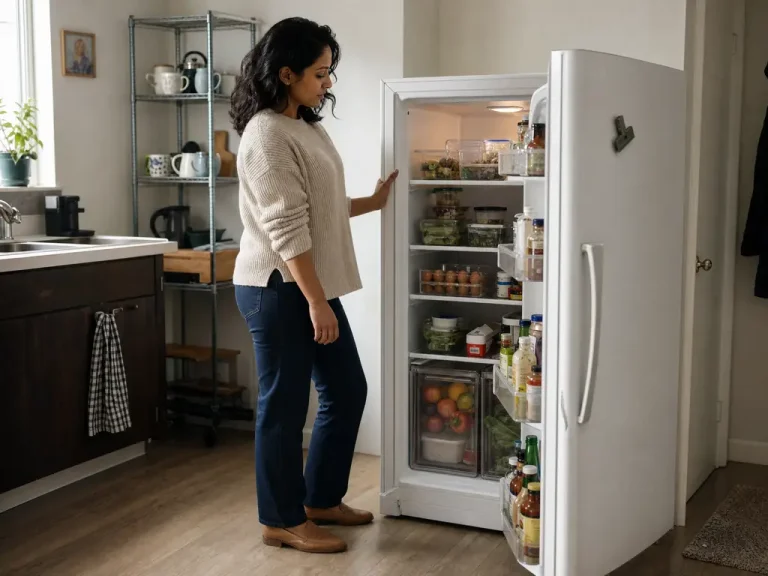
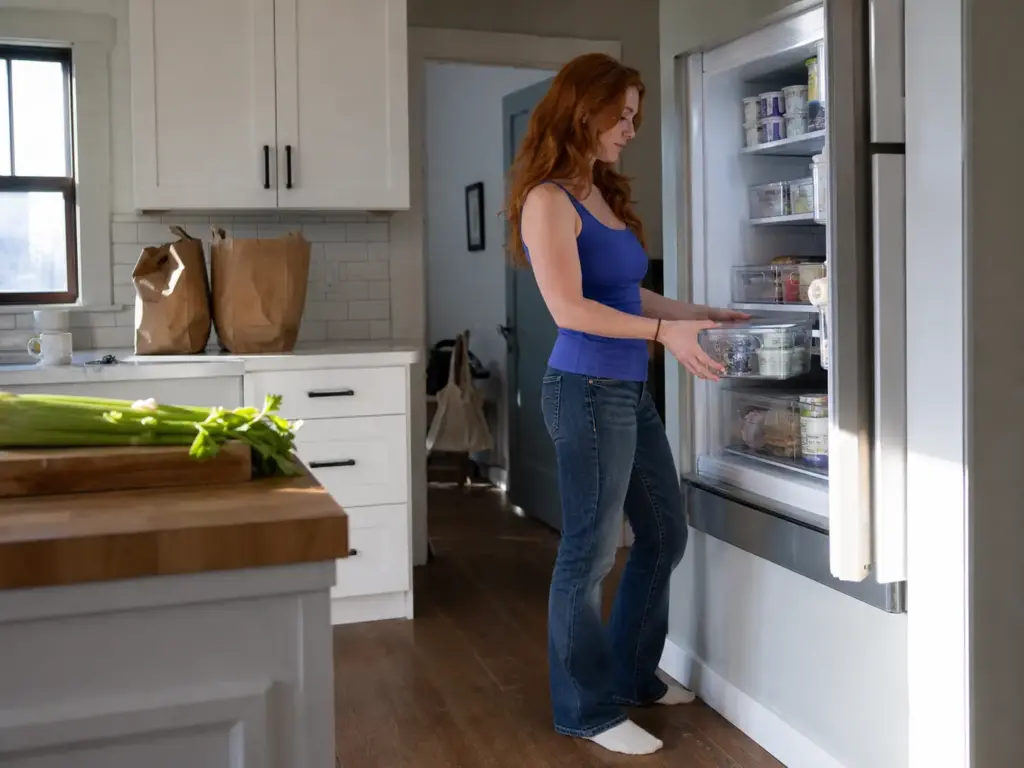
You bought the eight-piece set, spent a whole evening loading it, and then the glass shelf above wouldn’t slide back in. Half an inch short. The whole thing went back in the box it came out of, and the fridge went back to being a wall of yogurt cups. The fix is almost never a better bin, it’s a bin sized to the shelf you already own, and nobody selling fridge organizer bins tells you that. This guide covers what fails and why, the three measurements to take before you buy anything, the materials that survive a cold damp box, and then the bins themselves, zone by zone.
Here’s the short version of which bin type belongs where, and the one thing to check before you add any of them to a cart.
| Bin type | Best for | Check before you buy |
|---|---|---|
| Stackable clear shelf bin | Grouping snacks, deli and yogurt on a full-width shelf | Vertical clearance to the shelf above |
| Pull-out drawer bin | A deep shelf where the back row disappears | That the drawer clears the shelf lip fully extended |
| Turntable | The condiment cluster on a shelf or wide door bin | Diameter against your shelf depth |
| Can and drink organizer | Cans, the densest thing in the fridge | A flat lid, or it can’t actually be stacked |
| Vented produce container | The crisper drawer | Vented, low-walled, removable drain tray |
| Egg holder with lid | Moving eggs off the warm door shelf | That it fits the shelf you’re moving them to |
Why Most Fridge Organizer Bins Fail by Month Three
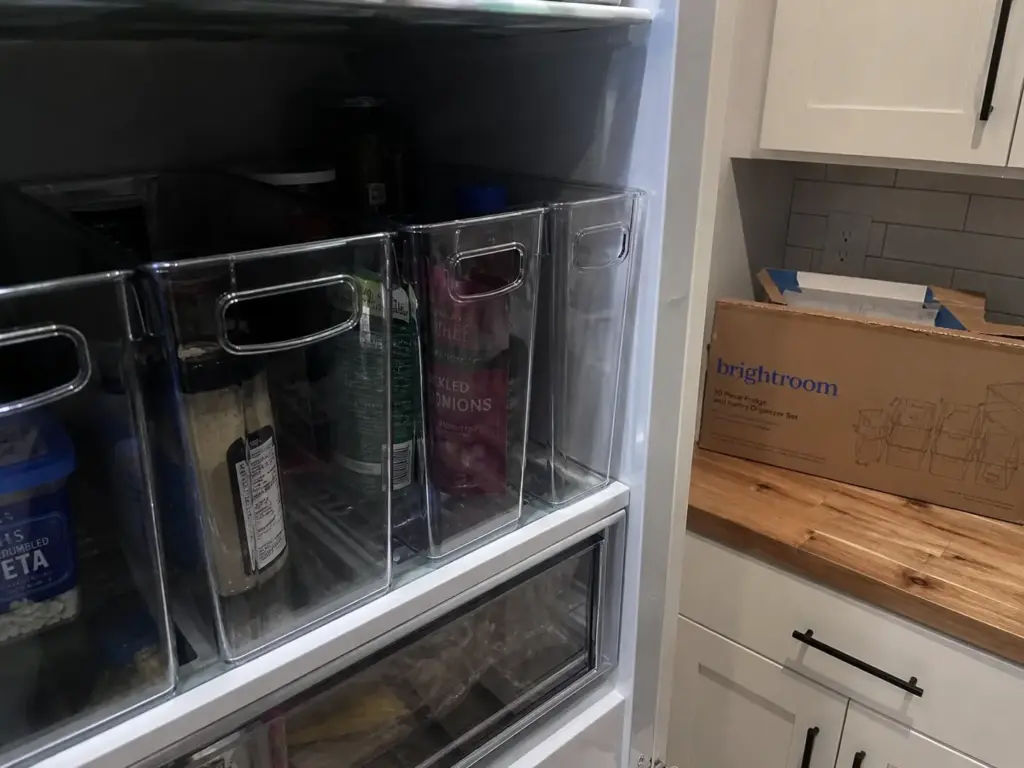
Every organized fridge looks incredible for about nine days. The interesting question is what it looks like in March. Refrigerator storage bins come apart in six predictable ways, and not one of them shows up in the product photo.
The half-inch problem
Height is what sends bin sets back, not footprint. A bin that’s even a half inch too tall stops the shelf above from seating properly, so you either lose that shelf or lose the bins. People measure the width of the shelf, feel confident, and never check the gap. That gap is the only number that decides whether the box gets opened or taped shut again.
The airflow failure
The second failure looks like success. You line bins wall to wall, the shelf finally looks finished, and the fridge starts cooling unevenly. Professional organizer Heather Aiello of The Organized You makes this point plainly: packing shelves solid obstructs circulation, and the food nearest the back pays for it.
The USDA’s refrigeration guidance treats holding food at 40 °F or below as the whole point of the appliance, and a wall of plastic makes that harder rather than easier. So leave a finger of air between bins and the sidewall. It looks less finished. It works better.
The deep-bin black hole
A bin you reach into instead of pull out just relocates the problem. Older items get pushed to the back and forgotten, which is exactly the behavior the bin was bought to fix. Same for lids: an opaque container or an item still in its original packaging means nobody sees it, and it gets rediscovered as garbage. Remove the packaging where you can (a cardboard sleeve of yogurt cups is six items pretending to be one) and the bin starts earning its shelf.
The cracked corner and the sticky bin
Two quieter failures finish the job. The first shows up around month two or three, as a hairline split starting at the cut-out handle of a full bin that’s been pulled one-handed all season. The second is the container that isn’t dishwasher safe: it gets hand-washed twice, then lives sticky. And when categories are drawn too narrowly, the system breaks at the first item that doesn’t fit one, because that item goes anywhere. If you’re still working out what goes where in the first place, start with the zone-by-zone process for organizing the whole fridge and come back for the containers.
The Three Measurements That Decide Which Bins Fit
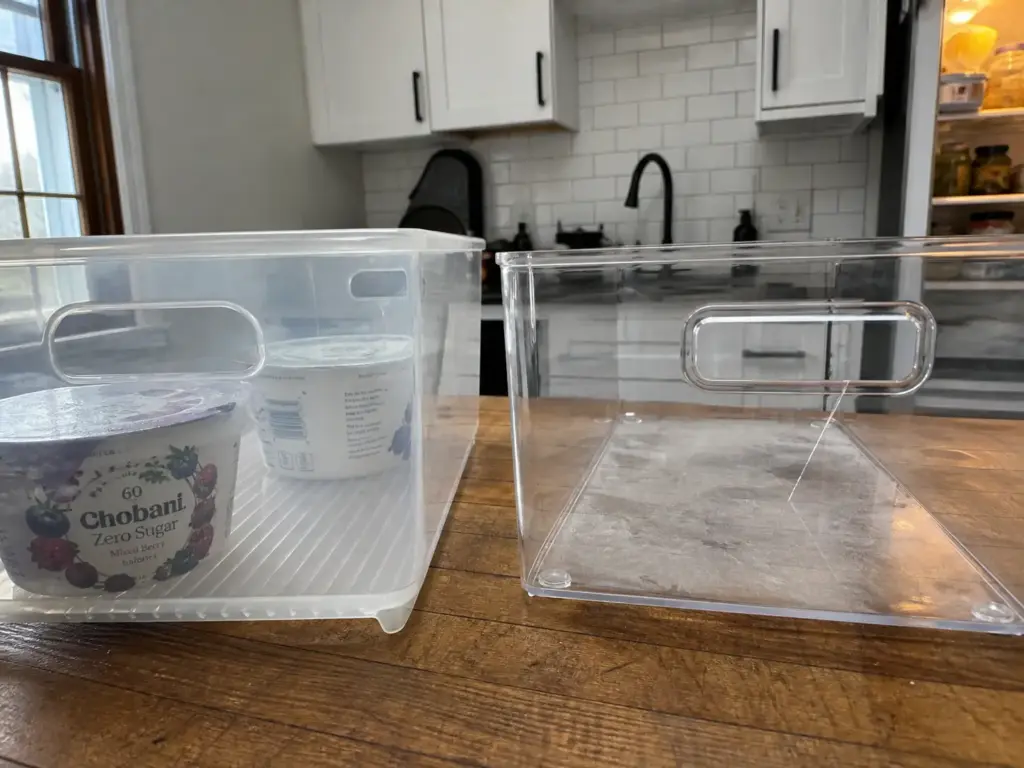
Every listing says it fits most refrigerators. No listing has seen your refrigerator. This is the part the entire first page of search results skips, and it’s the reason the seed guide tells you to measure before you buy a single bin.
Why the outside of your fridge tells you nothing
Standard refrigerators come in 30-, 33- and 36-inch widths with overall depths running from about 28 to 37 inches. Two fridges with identical exteriors can have completely different usable shelf runs, because the door thickness, the liner and the drawer housings eat different amounts.
A counter-depth GE, for example, has a full-width shelf around 28 inches wide by 13.5 deep, while its split shelves land nearer 13.75 by 11. One fridge measured for an earlier guide on this site came in close to 16 by 17 usable. All three are normal. None of them predicts yours.
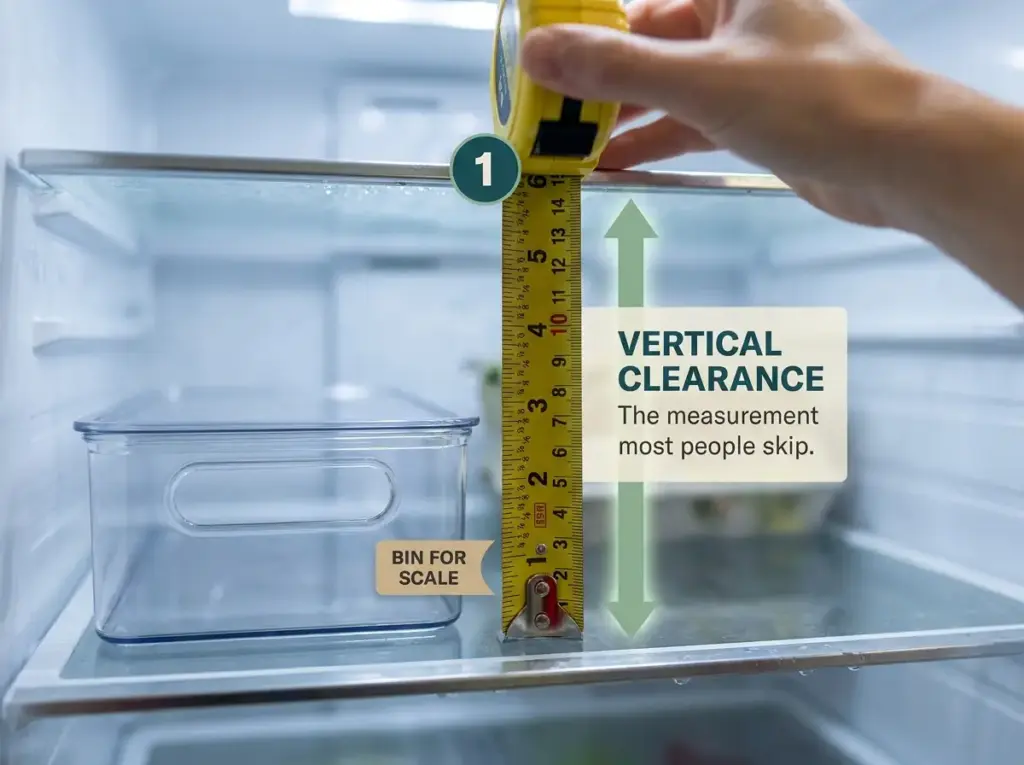
Take them in this order
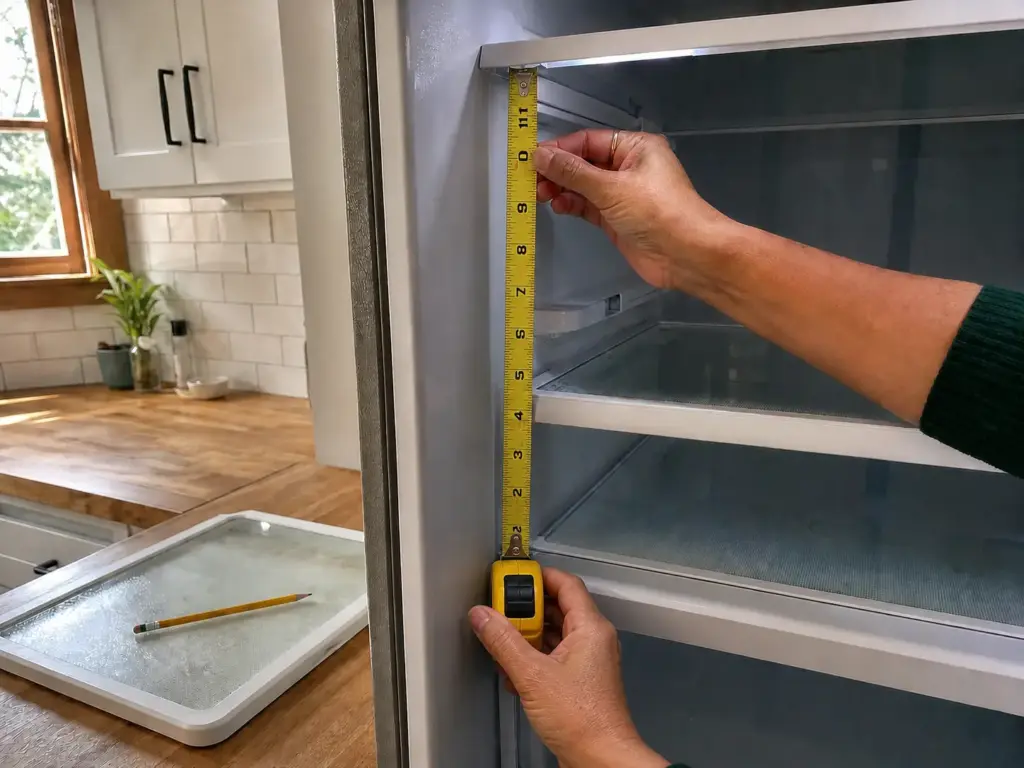
Shelf depth front to back. Shelf width wall to wall. Then vertical clearance from the glass you’re standing bins on to the underside of the shelf above. That third one is the one nobody takes and the one that ends purchases. Pull the shelf out before you measure it, because you can’t measure accurately around a jar of pickles. Door bins and the crisper get measured on their own, since a bin bought for a shelf almost never fits a door.
Write your three numbers on a piece of tape and stick it inside a kitchen cabinet door. You will shop for fridge bins more than once, usually months apart, and you will not remember them.
What those numbers actually buy you
Here’s the payoff. A 9-inch turntable spins freely on a 16-inch shelf with room left over. The 16-inch turntable every pantry guide recommends won’t go in at all. Same product category, same page of results, one fits and one is a return label. If you’re working with a dorm fridge or any small fridge, the split-shelf figures above are roughly your scale, so plan around the smaller numbers.
Which Bin Materials Actually Survive a Cold, Damp Fridge

The beautiful clear bin in the photo is often the wrong material for a box held near freezing that you yank things out of every morning. Clear bins are not one material. The listing usually tells you which one, if you scroll far enough past the lifestyle shots.
Acrylic is a pantry material
Acrylic goes brittle in the cold. Lower-grade acrylic warps or cracks at low temperature, and thin acrylic or cheap polystyrene splits under nothing more than normal handling. That’s the whole reason a fridge bin cracks at a cut-out handle in month two while an identical-looking bin in the pantry lasts for years. Acrylic isn’t a bad material, it’s just a room-temperature one, and there’s a real case for where acrylic bins actually earn their spot.
What to look for instead
PET is shatter-resistant, odorless and food-safe, which makes it the best balance of clarity and toughness for fridge use. Food-grade BPA-free polypropylene is the other correct answer, slightly less glassy and slightly more forgiving. Tempered glass handles rapid temperature swings without warping, which is why glass storage containers are the right call for leftovers headed to the microwave.
But the conventional wisdom that glass is always the upgrade falls apart in a door bin or a stack. Weight and breakage stop being theoretical the moment someone swings the door shut with a full shelf of it.
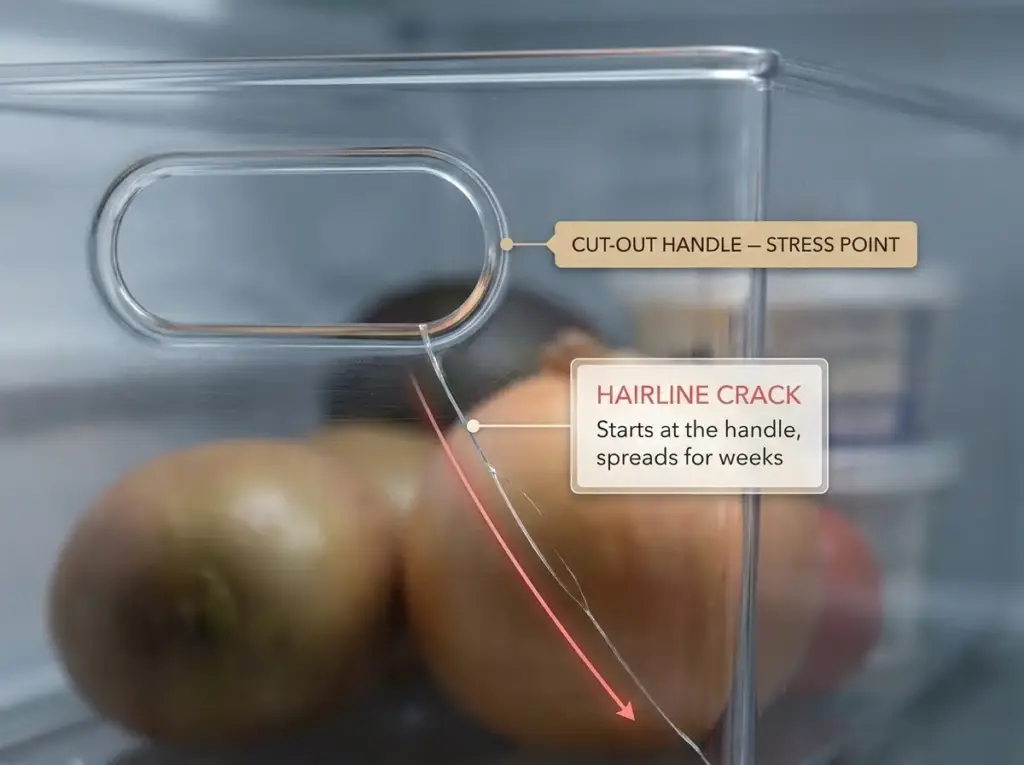
Read the listing in five seconds
If it says PET or food-grade PP, it’s a fridge bin. If it only says acrylic, it’s a pantry bin being marketed as a fridge bin. And treat dishwasher safe as a durability spec rather than a convenience one, because a container that has to be hand-washed will eventually stop being washed. Prefer molded or rolled handles over punched-out cut-outs, and a base with some grip so the bin doesn’t skate every time the door swings.
Stackable Shelf Bins, Splurge and Budget, Side by Side
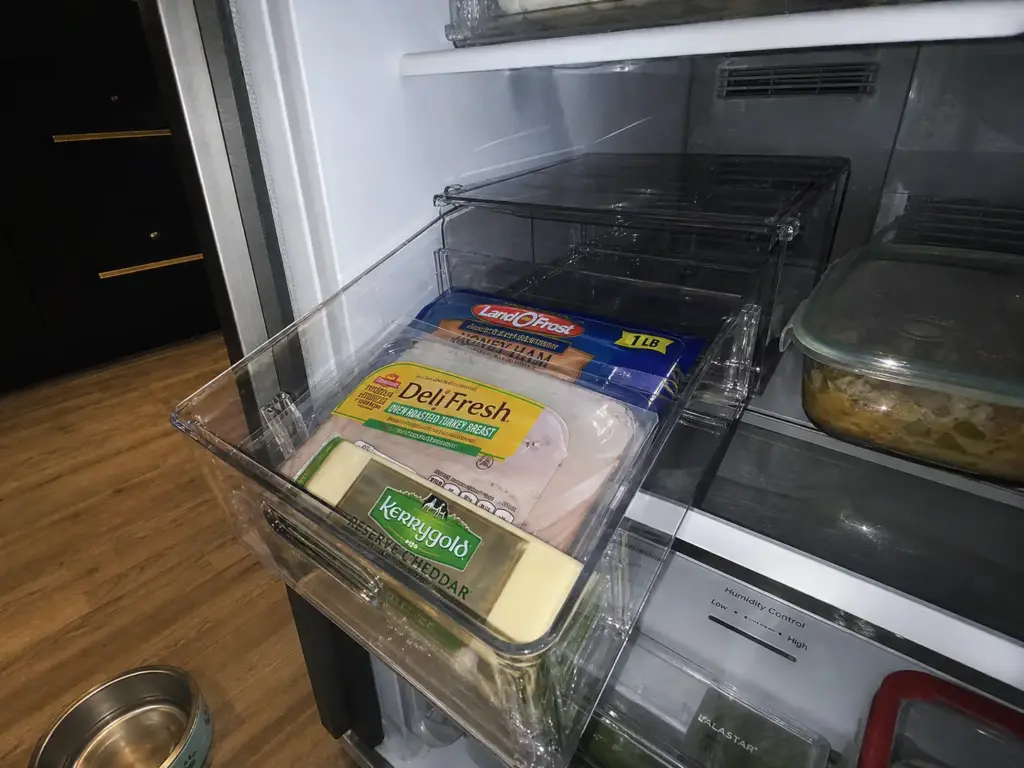
Every roundup prints a price ladder. Almost none of them says which rung is worth climbing. So here are both ends of that ladder doing the same job, with an honest account of what the extra money buys.
Try it for free first
Wide-mouth jars, takeout containers and a shoebox lid already do the pull-forward job for nothing. Group one shelf that way for two weeks and you’ll learn whether the zone needs bins or needs less food. I used to point people straight at the matching set. After enough return-trip stories in organizing threads, I switched: buy one bin, live with it, then buy the set that matches the bin that worked.
The splurge pick
If the shelf you’re organizing is one you open six times a day, the higher tier is defensible, because the failures it prevents are mechanical rather than cosmetic.
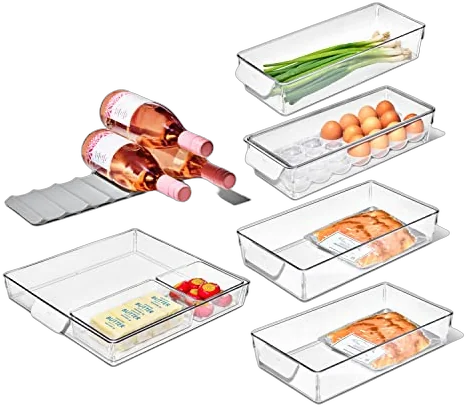
The budget pick, presented as an equal
The budget alternative does the same job with less engineering behind it, and for a zone you haven’t committed to yet, that’s the smarter first purchase rather than the compromise one.
Where the ceiling is
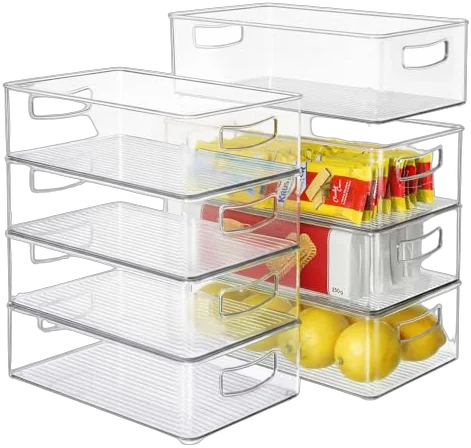
The extra money buys grip, handle strength and a stated material. It does not buy a working system, and it definitely doesn’t buy matching aesthetics that make the shelf above close. Here’s the part nobody says out loud: your spending ceiling is an airflow ceiling. Past a certain number of bins on one shelf, the fridge cools worse, so “more bins” stops being an upgrade no matter what you spend. Both sets sit loose, both move with you when the lease ends.
The Deep-Shelf Bin You Can Actually Reach Into
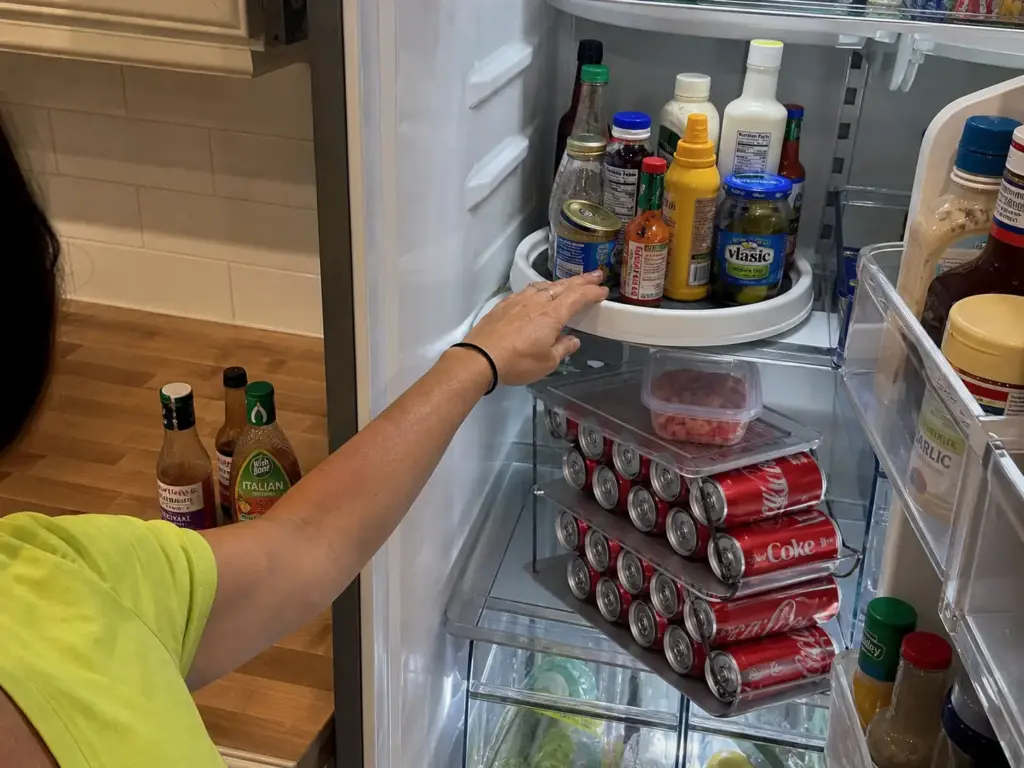
A deep shelf plus a deep bin equals a new place to lose food. If the bin doesn’t come all the way out, the back third quietly becomes storage for things you’ll throw away in a month, which is the same rotation failure Aiello describes: unrotated items get pushed to the back and stay there.
The free version of this fix
Before buying anything, put an open shoebox lid or a flat dish-rack tray on that shelf and use it as a deli tray for a week. Slide it out, take what you need, slide it back. If that motion alone fixes the zone, you’ve learned something. If the lid keeps tipping or the contents keep sliding off, you have a real case for a drawer.
The measurement this section needs
The drawer has to clear the shelf lip when it’s fully extended, not just fit the footprint sitting still. Plenty of pull-out bins fit a shelf perfectly and then jam against the front rail halfway out, which gives you the worst of both designs.
The LALASTAR Refrigerator Organizer Bin with Pull-out Drawer is the shape that answers this, sized for a standard full-depth shelf, because the drawer inside the bin means the back row comes to you instead of you excavating for it. It works as the deli keeper the fridge actually needs, since deli meat and cheese are flat, slippery and always the first casualties of a yogurt tower. The caveat is that a drawer bin takes more vertical space than a plain open bin of the same footprint, so this is a section where the clearance number decides for you. It’s the same pull-forward fix that rescues a deep kitchen cabinet, transplanted into a cold box.
The Door and the Drink Shelf, Condiments and Cans
The door is where condiments go to be forgotten. If you’ve never audited yours, there’s a decent chance something in there has outlived a lease. Cans, meanwhile, are the heaviest and least stackable thing in the whole fridge, and they usually just pile up.
Clear the graveyard before you organize it
Take everything off the door and check dates before you buy a single condiment organizer. Condiments are the fridge’s expired-item reservoir, and organizing expired food is just tidier waste. This is also the moment to remember that fridge doors run around 45 °F while the shelves hold 35 to 40 °F, which is why the door zone earns condiments and pickles rather than milk and eggs.
A plate is a turntable
Put a shallow dinner plate or a pie plate under the condiment cluster and spin it for a week. That’s a working turntable and it costs nothing. If the plate keeps sliding, then buy the real thing. A lazy susan gets recommended for every cluttered shelf, and it does work, unless you buy the pantry size.
The Copco Non-Skid Turntable is the 9-inch diameter that actually spins inside a fridge with room around it, and the non-skid base matters more here than in a cabinet because the door swing pushes everything sideways twenty times a day. Skip it if your condiments live in the door bins and the door bins already fit them; you’d be buying a solution to a solved problem. For the contrast, look at how turntable sizing works in a pantry, where the big diameters make sense.
Put the condiments you use weekly on the turntable and the ones you use twice a year behind it. A turntable that has to be spun twice to find mustard is just a round shelf.
Cans need a flat lid or they need nothing
A can organizer earns its shelf space one way only: by giving vertical space back. The Sorbus Soda Can Organizer for Refrigerator ships as a 2-pack with the flat stackable lid that lets you set something on top, which is what turns a footprint into a two-level shelf. Without that lid, a can rack costs you space rather than saving it. If you want the same function for less, the Utopia Kitchen Soda Can Organizer 4 Pack does the dispensing job at a lower tier. Either way, load them from the back so the cold ones come forward.
Produce, Eggs and Dairy, the Bins That Have to Match the Zone
These are the containers where the wrong choice costs groceries rather than looks. The crisper is a humidity chamber and the door is the warmest real estate in the appliance, so the bins have to answer the zone, not the shelf.
The crisper is a vent, not a humidifier
This is the mechanism almost nobody explains. Michigan State University Extension explains that less airflow means higher humidity: the slider restricts the vent, moisture from the produce stays trapped, and the drawer climbs to roughly 90 to 95 percent relative humidity for vegetables, versus about 65 to 75 percent on the low setting for fruit. Nothing is being added. Crisper humidity is moisture being held in, not moisture being supplied.
Two things follow. Crisper containers should be vented and low-walled rather than sealed airtight, and a tall solid bin parked in front of the vent slider does the same thing as closing the vent, except by accident. Keep the crisper for produce only, and use drawer dividers or a second container to hold vegetables apart from fruit rather than splitting snacks from yogurt.
Drainage saves produce, cold doesn’t
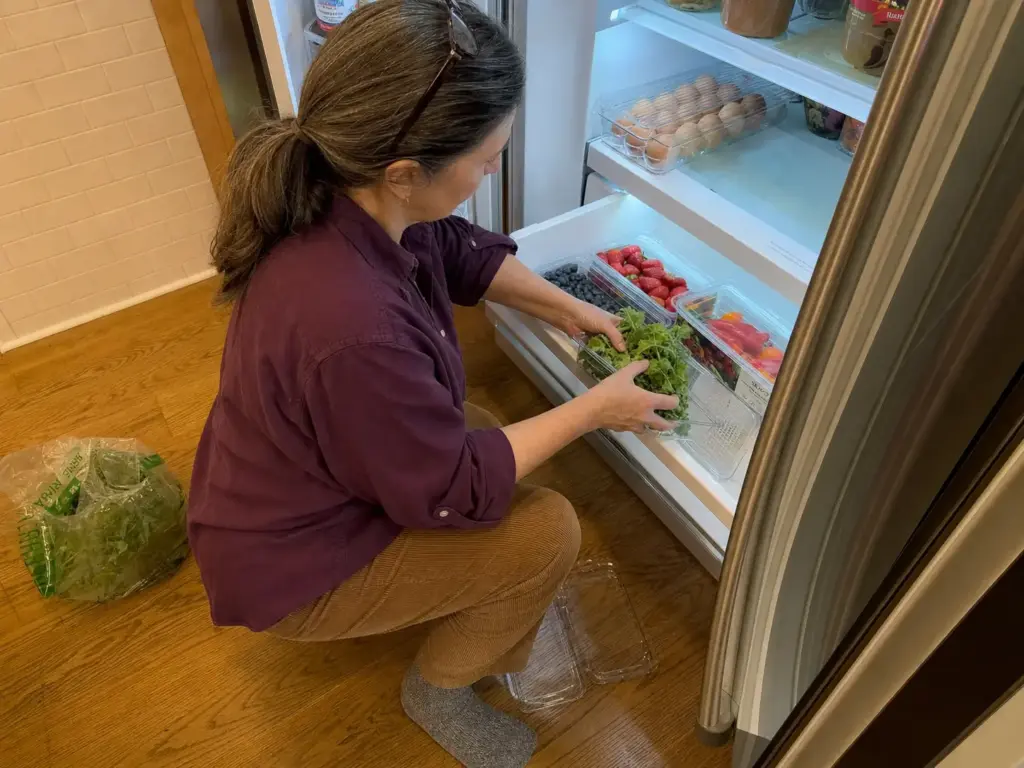
Greens don’t rot because the fridge is too warm, they rot sitting in their own condensation. That’s why a removable drain tray is the feature worth paying for. Before you do, the perforated clamshell your berries arrived in is already a vented produce container, and a small colander set inside a bowl does the drain-tray job for free.
The SILIVO Produce Saver Containers are the produce bins built around that mechanism: a 6-pack of 1.5-liter containers with a removable tray that lifts the produce off the water it sheds, in food-grade BPA-free polypropylene rather than the acrylic that would fail in there. One honest limitation: they aren’t dishwasher safe, and per the rule two sections up, that’s a durability question. If your household won’t hand-wash a produce container, buy fewer of them and use the clamshell trick for the rest.
A folded dish towel is the cheapest crisper liner there is. Put it under your produce containers, let it catch the condensation the drawer collects on its own, and swap it out on laundry day.
Eggs belong on a shelf
The molded egg tray in your door sits in the warmest zone of the fridge, which is the single most counterintuitive thing in this article. The free fix is the carton the eggs came in, which is already an egg crate and already sized correctly. Move it to a shelf and you’re done.
The upgrade only earns its keep if you want something that stacks and closes, and the iDesign Clear Plastic Egg Holder does that, holding 21 eggs with a lid so you can set a small container on top rather than losing the vertical space. It’s a genuinely optional purchase, and the carton works.
Labels, Shared Fridges and Keeping It Working Past Month Three
Bins are the easy part. What breaks a fridge system is the second person using it, and the week everyone stops rotating.
Label the bin, never the fridge
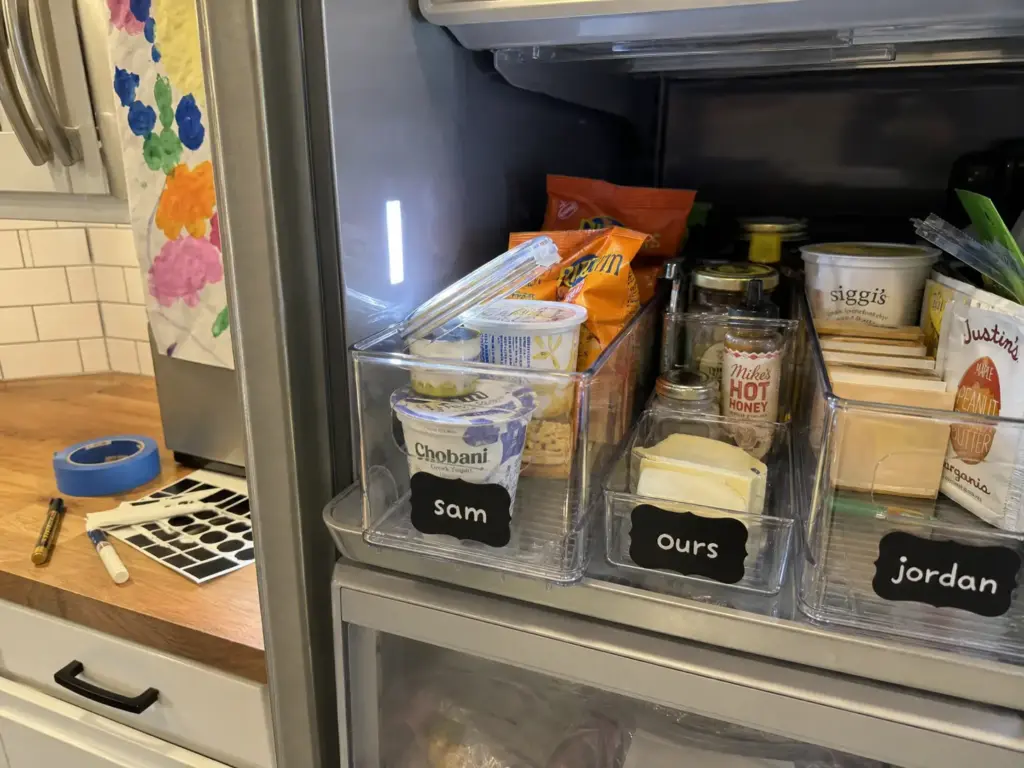
Nothing adhesive goes on an appliance you don’t own. That’s a security-deposit line item, and it’s the reason every product in this guide sits loose. Start with painter’s tape and a marker. It’s a complete removable labeling system: bin labels that cost almost nothing, come off clean, and survive being rewritten weekly.
If you want something that holds up better, rewritable beats permanent in a fridge, because contents rotate and roommates change. I used to recommend printed permanent labels for their looks. Condensation, a wipe-down and one category change later, they’re peeling. Chalkboard Vinyl Labels go on the bin rather than the fridge wall, come off cleanly at the end of a lease, and can be rewritten as often as the shelf changes. The caveat is that adhesive vinyl doesn’t love a wet surface, so dry the bin before applying. It’s the same failure pattern behind why labels peel off in a month in a humid pantry.
Keep categories broad
Label a bin too specifically and the first item that doesn’t belong to any category gets shoved anywhere. Systems break at the exception, not at the plan. “Snacks” survives a year. “Granola bars” survives until someone buys crackers.
Shared fridges need a physical boundary
Zoning a shared fridge is less complicated than it sounds. Assign a shelf or a side per person and let the bin draw the line, because a bin is a boundary nobody has to negotiate out loud. Add one communal bin for genuinely shared items, milk and butter and condiments, so nobody stands in front of an open door doing ownership math.
And date what you open. That’s FIFO, first in, first out, applied to a fridge, and it’s the fix for the rotation problem that put those jars at the back to begin with.
And clear beats opaque in a fridge specifically. In a closet, a fabric bin with a label is fine. In a fridge, if you have to open it to know what’s in there, you won’t. That’s also the renter’s whole argument for spending anything on this: a loose bin needs no drill, no adhesive and no permission, and it goes in the moving box when the lease ends.
In a shared fridge, give the communal bin the best spot at eye level and put the personal bins above and below it. People raid what’s convenient, and convenience is cheaper than a house meeting.
What to Do First
Three things carry most of the result. Measure vertical clearance before anything else, because it’s the dimension that sends bin sets back. Read the material line instead of the photo, since PET and food-grade PP survive the cold while acrylic gets brittle. And buy one bin, live with it for two weeks, then buy the set, stopping well before the shelf goes wall to wall.
In three months, pull every bin out and check two things: whether any handle has started to split, and whether one bin has quietly become the miscellaneous bin. Both are early signs the system is about to revert, and both are fixable in ten minutes if you catch them.
Start with the shelf that annoys you most. Measure it, buy one bin for it, and see whether it still works in two weeks. Then expand.
Frequently Asked Questions
01What is the best organizer for a fridge?
The best fridge organizer is a clear stackable bin in food-grade PP or PET that clears the vertical gap to the shelf above with room to spare. There is no single best product, because the constraint is your fridge rather than the bin. Measure shelf depth, width and clearance before choosing anything.
02What are the best containers for fridge storage?
Match the container to the zone. Vented, low-walled containers with a drain tray belong in the crisper drawer, clear stackable bins with a non-slip base belong on the shelves, a shallow turntable handles the condiment cluster, and tempered glass suits leftovers you plan to reheat.
03What is the most efficient way to organize a refrigerator?
Work by temperature zones, not by bin. Group food by how you reach for it, keep eggs and dairy off the door because doors run warmer, and leave a finger of air between bins so the shelf cools evenly. Bins come last, once you know what lives where.
04Which container is best for storing food in the fridge?
For most food, a clear food-safe PP or PET container with a fitted lid is the right call: it stays tough in the cold, holds no odors, and lets everyone see what is inside. Use tempered glass for leftovers headed to the microwave, and skip acrylic.
05Are acrylic bins safe to use in the fridge?
Acrylic is food-safe but wrong for a refrigerator, because it becomes brittle at low temperatures and splits under a normal one-handed pull, usually starting at a cut-out handle. If a listing only says acrylic, it is a pantry bin marketed as a fridge bin. Look for PET or BPA-free PP.
Disclaimer: ClutterlessNest is a participant in the Amazon Services LLC Associates Program. As an Amazon Associate we earn from qualifying purchases. This article may contain affiliate links — if you buy through them, we may earn a small commission at no extra cost to you. We only recommend products we have tested or genuinely believe in.