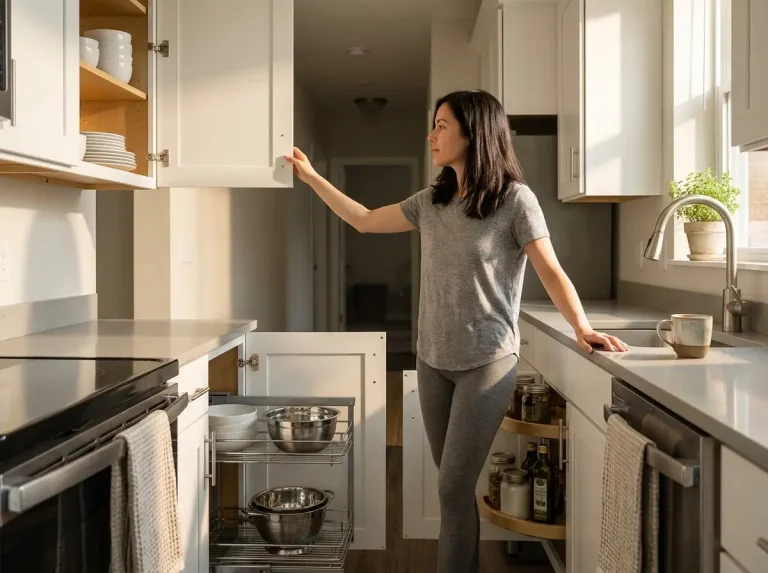
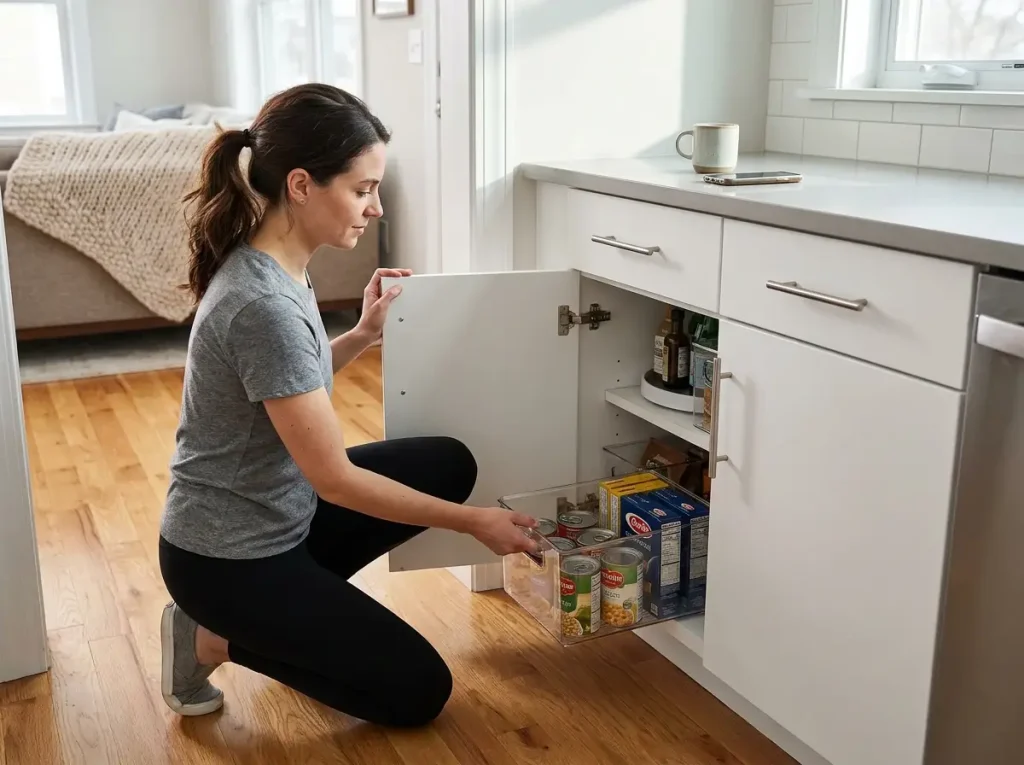
You cleaned out your deep kitchen cabinets last month. Pulled everything out, wiped the shelves, grouped by category, put it all back in neat rows. And right now, three weeks later, there’s a dented can of chickpeas behind a mixing bowl you forgot you owned. The back half of your cabinet is a black hole again.
This isn’t a discipline problem. It’s a design problem. Your base cabinets are 24 inches deep, but your arm only reaches about 12 inches comfortably. That leaves 11 inches of dead space where things go to be forgotten.
Once you fix the reach problem with a front-back zone system and the right pull-forward tools, your deep cabinets stay organized with almost no effort.
Quick Answer: Deep kitchen cabinets get messy because standard 24-inch cabinet depth exceeds your natural 12-inch reach, creating a dead zone in the back half. Fix this by dividing each cabinet into a front zone (daily items) and a back zone (bins you pull forward), then doing a 5-minute monthly reset to catch expiring items and zone drift.
Why Deep Cabinets Become a Black Hole
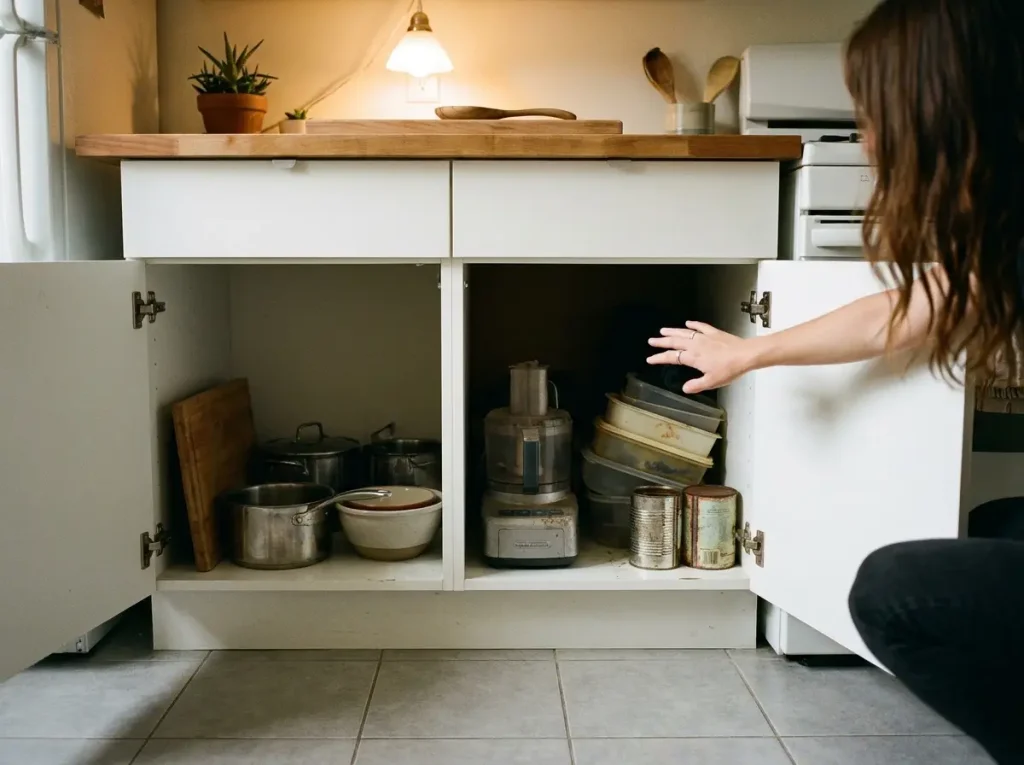
Every kitchen cabinet looks organized on the day you finish sorting it. Deep cabinets lose that organization faster than any other storage space in your kitchen, and the reason is pure geometry.
The 12-Inch Reach Problem
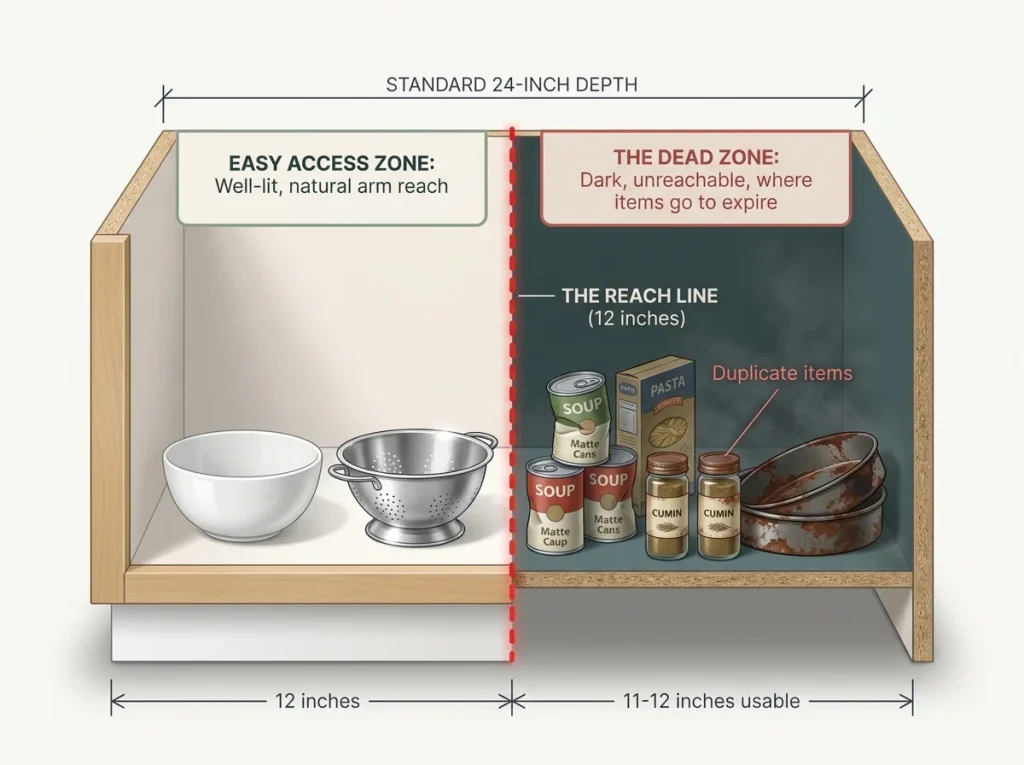
Stand in front of your open base cabinet and reach in without bending or crouching. Your fingertips stop at roughly 12 inches. That’s your comfortable reach — the zone where you can grab and replace items without thinking about it.
Now look at your cabinet. According to NKBA kitchen planning guidelines, standard base cabinets are 24 inches deep. Some are 23, some are 25, but the math works the same way.
You have 24 inches of shelf and 12 inches of reach. Half your cabinet exists behind an invisible wall your arm can’t easily cross.
What Happens Past the Reach Line
The back 11-12 inches of your deep cabinet become a one-way street. Items go in but rarely come out. You push a can of tomato paste to the back when you need room up front.
A month later you buy another one because you can’t see the first. This is how people end up with four jars of cumin and zero counter space.
The problem compounds because the back zone is also the dark zone. Even with the cabinet door fully open, overhead kitchen lighting barely reaches past the midpoint. You’re storing things you can’t reach in a space you can’t see. That’s not clutter — that’s a design flaw you’re supposed to work around.
The Stacking Trap
When reach fails, people stack. A pot goes on top of a cutting board on top of a bin. Now you need to remove two things to access one thing. Stacking in deep cabinets turns a 3-second grab into a 30-second excavation, and it gets worse every time someone puts something back in a slightly different spot.
This is why your deep cabinets don’t stay organized. The system you set up assumed you’d reach to the back every time. You won’t. Nobody does.
Measure Before You Organize
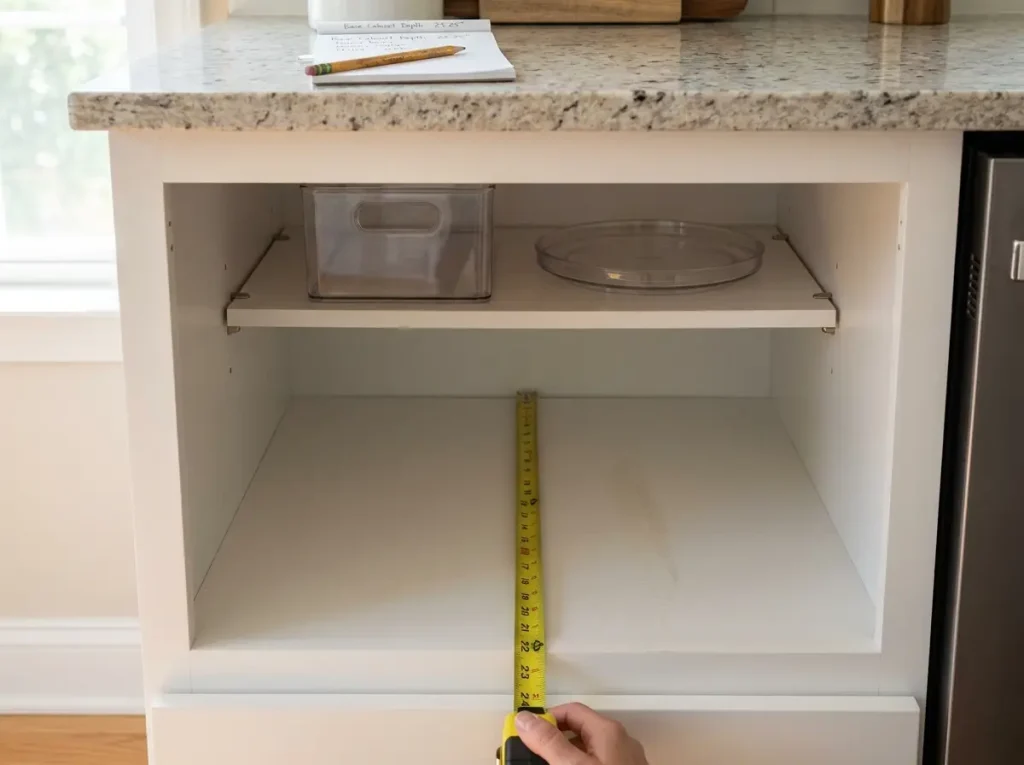
Before you buy a single bin or pull-out shelf, you need three numbers from your cabinet. Skipping this step is why half of Amazon’s “deep cabinet organizers” end up returned — they don’t fit.
Three Numbers That Matter
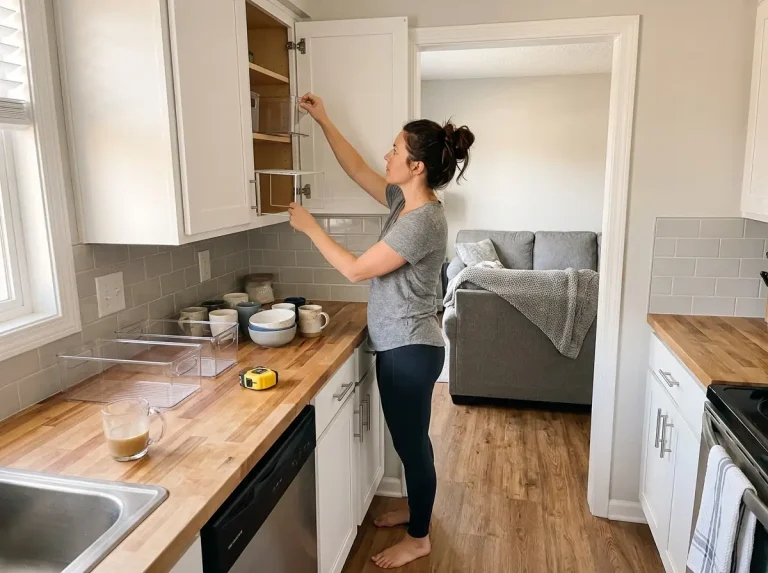
Grab a tape measure and record these for each deep cabinet you plan to organize:
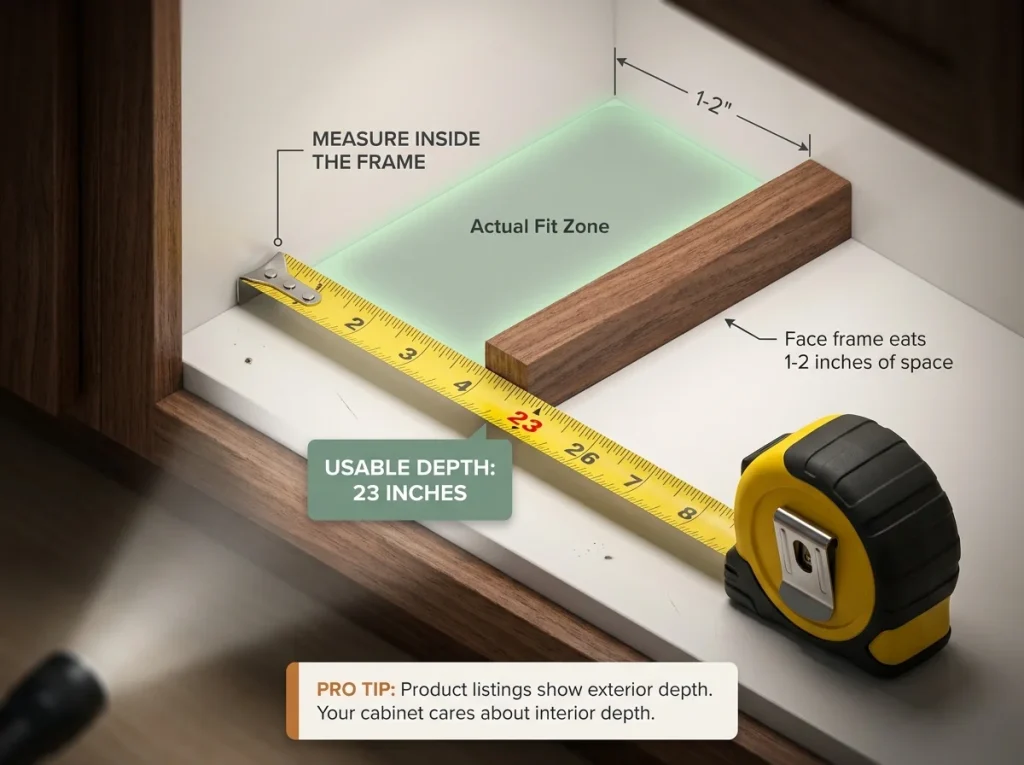
- Interior depth — measure from the inside of the face frame to the back panel. Not the outside of the cabinet, not the spec sheet from the manufacturer. The usable interior. Most standard base cabinets measure 22-23 inches inside, even though they’re sold as “24-inch.”
- Interior width — measure between the side panels at the narrowest point. If there’s a center stile (the vertical piece between double doors), measure each side separately. This number determines which pull-out shelves and bins actually fit.
- Shelf height — measure from the existing shelf to the bottom of the shelf above it, or to the underside of the countertop if it’s the top shelf. This tells you whether you can stack bins or use risers.
Write these down. You’ll reference them every time you shop for organizers.
Why Most Organizers Don’t Fit
Product listings on Amazon show exterior dimensions. Your cabinet cares about interior dimensions. A “24-inch deep” pull-out shelf needs 24 inches of clear depth to extend fully — but your face frame eats 1-2 inches, so you actually have 22. That pull-out either won’t extend all the way or won’t fit at all.
The same goes for width. A cabinet organizer that says “fits 15-inch cabinets” probably needs 15.5 inches with the slide rails.
If your cabinet is 14.75 inches between the panels, you’re returning it. Measure the real interior, not what the spec sheet promises.
Pro tip: Take a photo of your tape measure inside each cabinet. When you’re shopping online at midnight, you’ll have the exact numbers on your phone instead of guessing.
The Zone Fix for Deep Cabinets
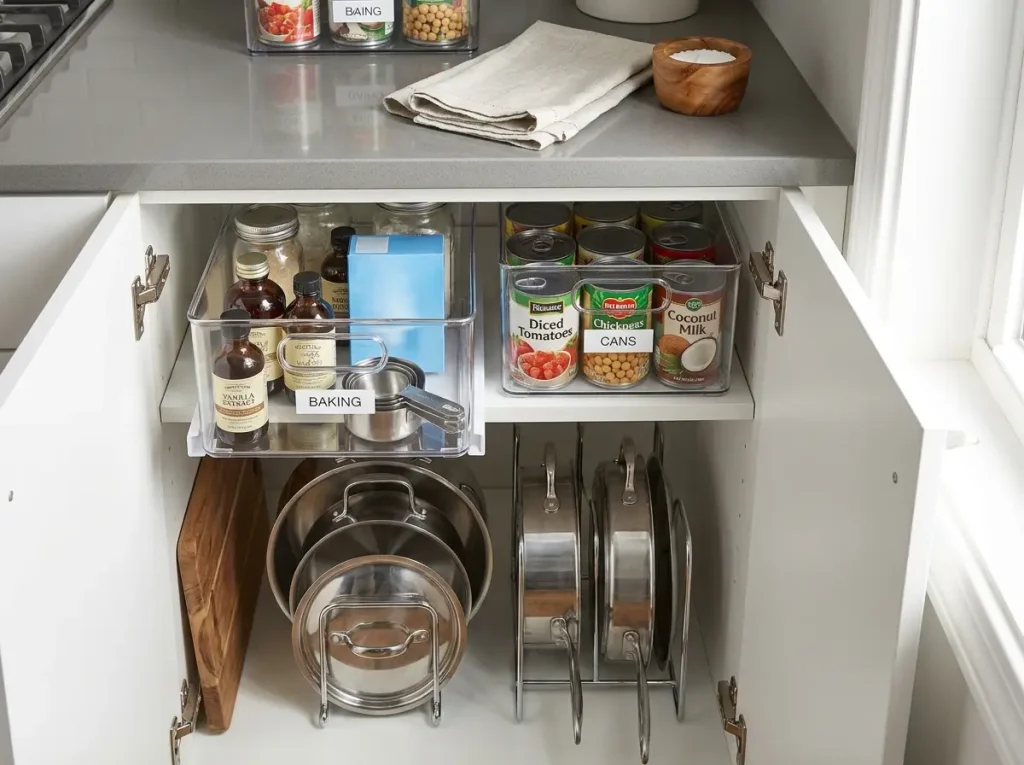
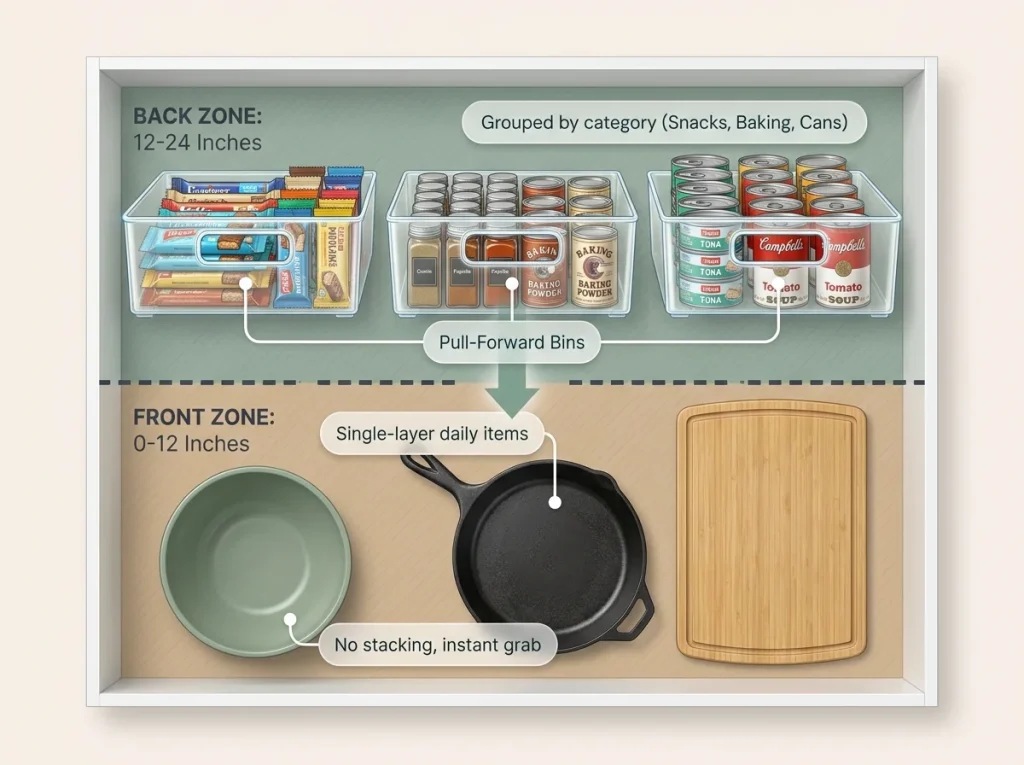
The fix isn’t buying a better organizer. It’s stopping the pretend that every inch of your cabinet is equally accessible. Split each deep kitchen cabinet into two zones with a boundary at the 12-inch mark, and organize differently for each one.
Front Zone: Daily Access
The front 12 inches hold everything you reach for daily or weekly. Pots, pans, cutting boards, mixing bowls, the colander you use three times a week. These items stand upright or sit single-layer — no stacking, no hiding behind each other.
The rule is simple: if you use it more than once a week, it lives in the front zone. If you have to move something else to reach it, it’s in the wrong zone.
For most kitchens, this means your front zone has 4-6 items per cabinet. That feels sparse. It’s supposed to. The front zone works because it’s not crowded.
Back Zone: Pull-Forward Storage
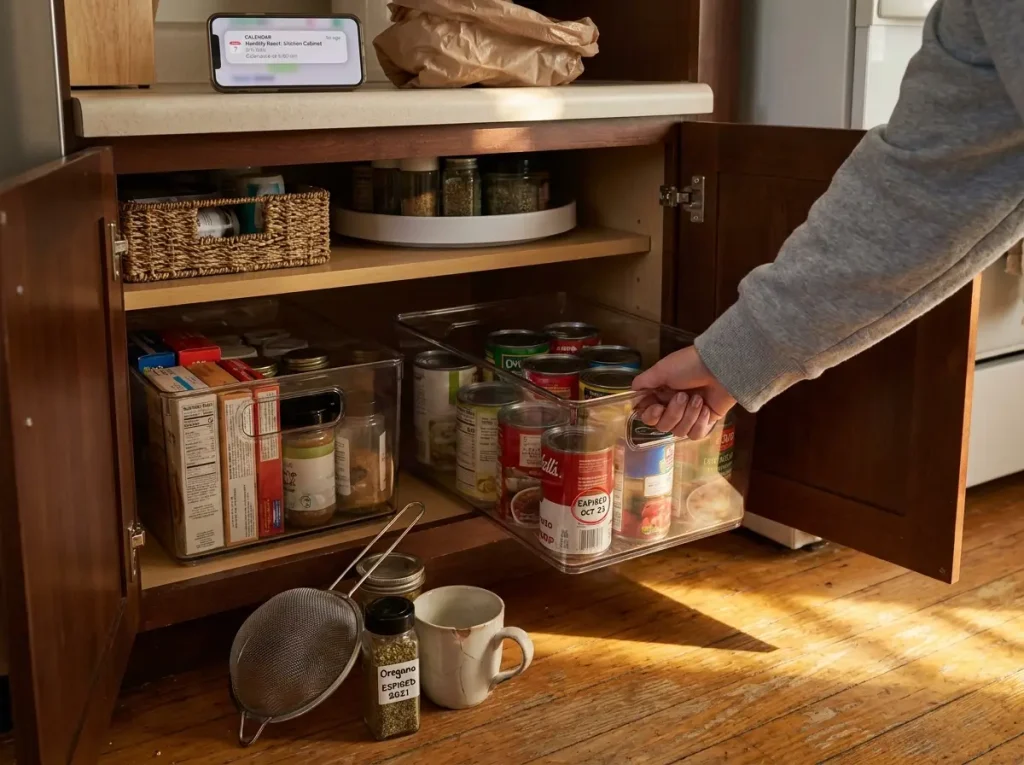
Everything behind the 12-inch line goes into bins you pull forward as a group. Not individual items sitting loose on the shelf — grouped items in a container with handles.
The mDesign Stackable Plastic Storage Bins work well here because the integrated handles let you pull the whole bin forward instead of reaching to the back. Group by category: one bin for baking supplies, one for canned goods, one for snack packets. When you need baking soda, you pull the baking bin forward, grab what you need, and push it back.
If $22 is more than you want to spend, Dollar Tree sells clear bins for $1.25 each (7.75 x 5.5 x 3 inches). They’re shorter, but they do the same job.
Any bin with a handle and a clear side works. The container isn’t the point — the pull-forward habit is.
Pro tip: Label the front of each bin with a strip of painter’s tape and a marker. It costs nothing, it peels off clean when you change categories, and it stops the “just toss it in whatever bin” drift that kills organization in about six weeks.
What to Keep Out of Deep Cabinets
Some items don’t belong in deep cabinets at all, no matter how you zone them. Heavy appliances like food processors and stand mixer bowls are miserable to pull from a low deep cabinet — that’s how you strain your back. If your kitchen cabinets have an upper shelf or a countertop appliance garage, heavy items belong there.
Items you use daily — your go-to skillet, your morning coffee mug — shouldn’t live in any zone of a deep base cabinet. They belong on open shelves, hooks, or the countertop. Deep cabinets are for weekly and monthly items, not the things you grab before coffee.
Renter vs Owner: Pick the Right Pull-Forward System
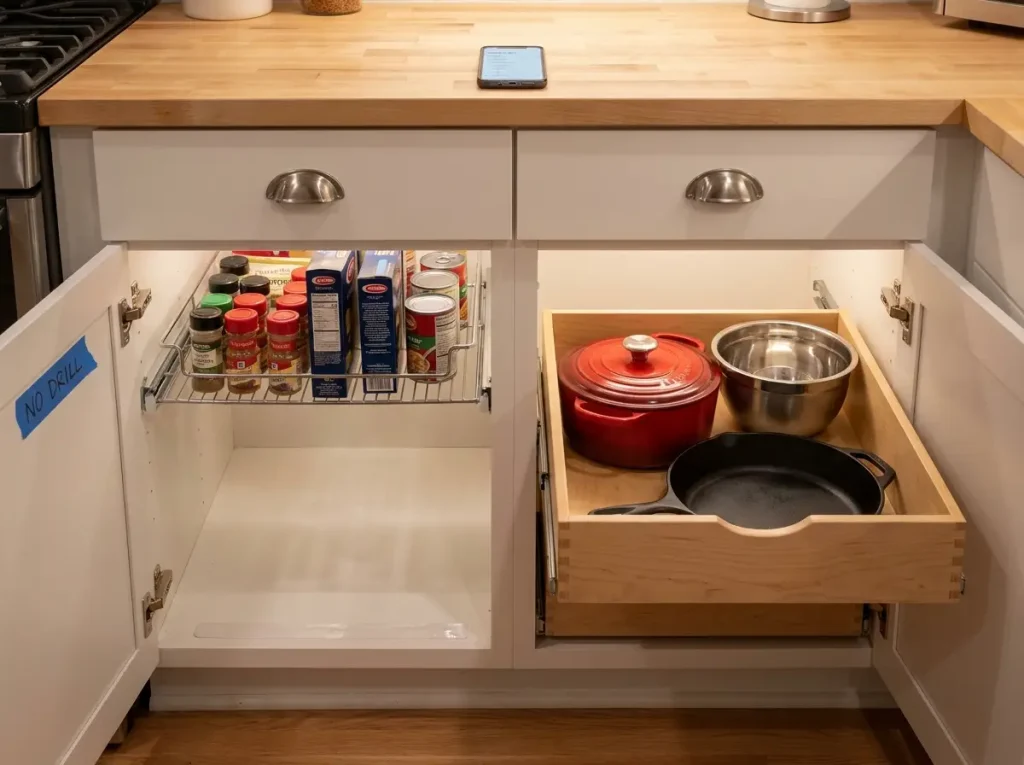
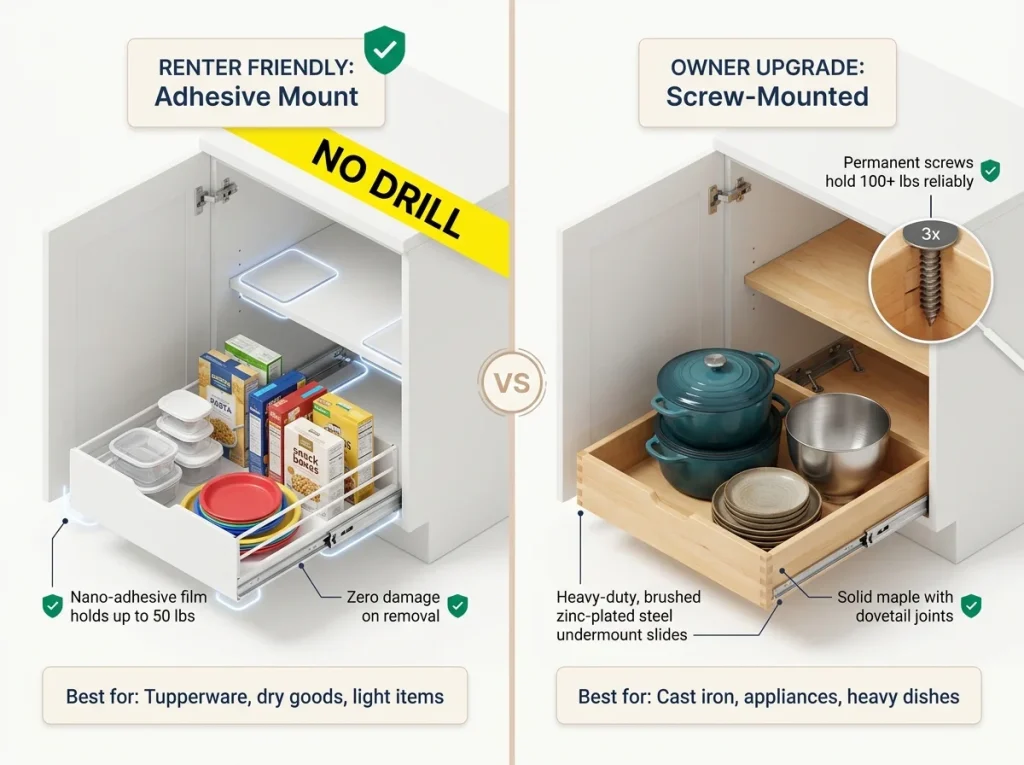
The zone system works with any pull-forward tool, but which tool you pick depends on one question: can you drill into the cabinet frame? If you’re renting, probably not. If you own, you have better options.
No-Drill Options
If your lease says no modifications, you have two solid paths.
The first is the bin system from the back zone section above — no hardware, no adhesive, just bins with handles you pull forward manually. It’s free if you already have containers, or under $25 for a set of four. This works for lighter items like dry goods, canned food, and cleaning supplies.
For a more automated pull-forward, the Adhesive Pull-Out Cabinet Organizer mounts with a nano adhesive film that holds up to 50 lbs on smooth surfaces. It slides out on ball-bearing glides, so you get the full pull-out shelf experience without drilling a single hole.
The adhesive peels clean when you move out. It fits cabinets 17-24 inches deep, which covers almost every standard base cabinet.
One thing to know: adhesive pull-outs work best on smooth melamine or laminate surfaces. If your cabinet interior is raw wood or has a textured finish, the adhesive won’t grip well. Test a small piece first.
The SpaceAid No-Drill Pull-Out Cabinet Shelf is a heavier-duty alternative with steel construction. Same adhesive installation, but the wider adjustment range fits more cabinet sizes.
If your cabinets are on the narrower side, this one covers you down to 11.8 inches.
Screw-Mounted Pull-Outs
If you own your home, the Rev-A-Shelf Single-Tier Pull-Out Wood Shelf is the permanent solution. Solid maple construction, full-extension ball-bearing slides rated for 100 lbs, and a 22-inch depth that brings everything to the front in one pull.
This is the option for heavy items — cast iron skillets, Dutch ovens, stacks of plates. No adhesive holds 100 lbs reliably over years of daily use. Screws into the cabinet frame do.
Installation takes about 30 minutes with a drill and a level. If you’re not comfortable with that, any handyperson can install one for $50-75 in labor.
The tradeoff is obvious: you’re drilling four holes into your cabinet frame. That’s permanent. If you might sell the place and want unmarked cabinets, stick with the adhesive options.
Budget Third Option
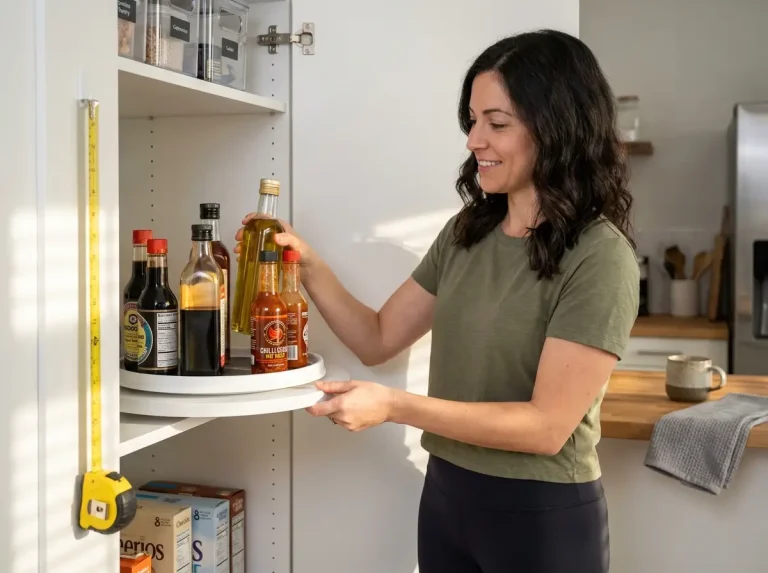
If pull-out shelves feel like overkill for what you’re storing, a turntable handles the back zone at a fraction of the cost. The Copco Non-Skid Turntable 12-inch fits standard 23-inch deep cabinets with clearance and spins items to the front instead of making you reach.
Turntables work best for small, uniform items: condiment bottles, spice jars, canned goods. They don’t work well for heavy items or anything tall enough to hit the shelf above. And they lose effectiveness fast if you overload them — a turntable with 15 bottles on it just becomes a spinning pile of chaos.
If your deep shelf organization is also a budget constraint, a turntable plus two Dollar Tree bins covers one full cabinet for under $15.
Pro tip: For corner deep cabinets where nothing is reachable, a turntable does more than any pull-out shelf. The spinning access works with the corner geometry instead of against it.
The Monthly Reset That Keeps It Working
Every organization system works on day one. The ones that still work on day 90 have a maintenance step built in — this is the part most kitchen cabinet organization guides skip. For deep cabinets, that step takes 5 minutes once a month.
The 5-Minute Monthly Check
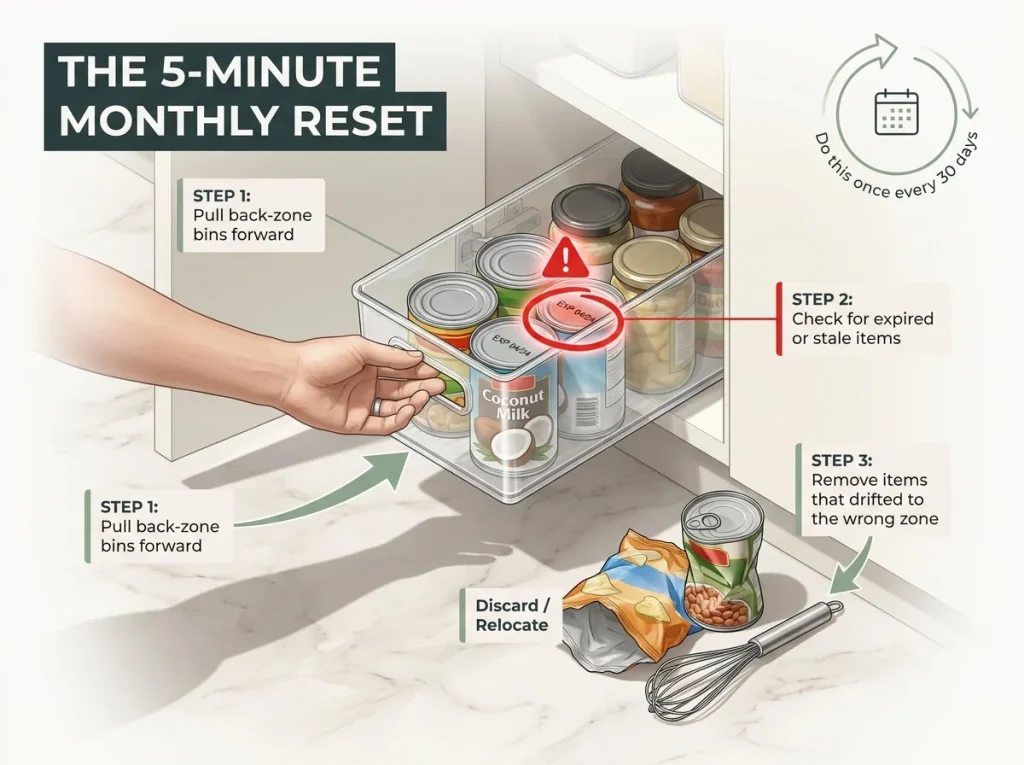
Set a recurring reminder on your phone. Once a month, open each deep cabinet and do three things:
- Pull every back-zone bin forward. Check for items that expired, migrated from another bin, or shouldn’t be there at all.
- Look at your front zone. If more than 6 items are crammed into any front zone, something drifted forward that belongs in a bin or doesn’t belong in that cabinet.
- Wipe the shelf. It takes 10 seconds and it’s the only time you can reach the back of a deep cabinet without removing everything.
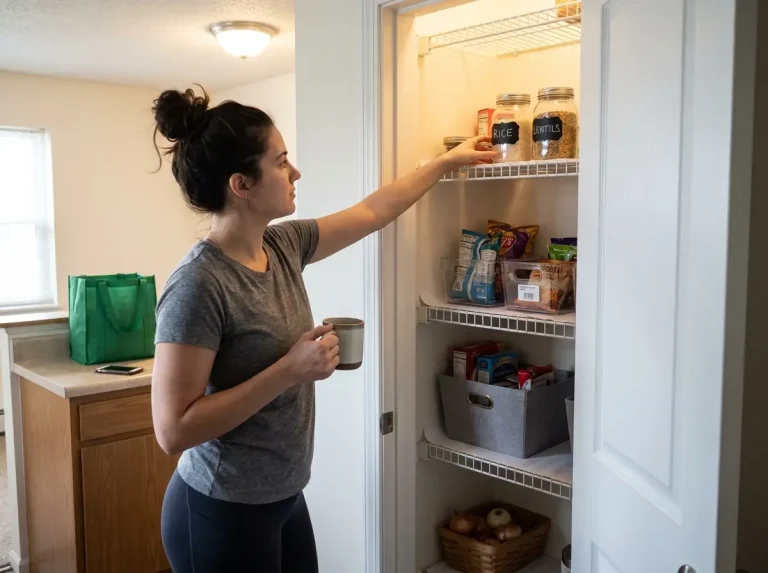
This isn’t deep cleaning. It’s a quick audit that catches drift before it becomes a full reorganization project. The same logic applies to deep pantry shelves — monthly pull-forward checks are what separate systems that last from systems that look good for a week.
The One-In-One-Out Rule
When you buy a new item that goes in a deep cabinet, something comes out. Not “sometime later” — right then. If you bought a new set of mixing bowls, the old ones leave the cabinet before the new ones go in.
This rule is harder than it sounds. People stack the new bowls on top of the old ones “just for now,” and two months later both sets are in there plus a bread pan that migrated from another cabinet. The one-in-one-out rule only works if it’s immediate.
For canned goods and dry goods in back-zone bins, this translates to a rotation rule: new items go behind old items in the same bin. First in, first out. This is how grocery stores stock shelves, and it’s how you avoid finding expired tomato paste behind a year-old can of coconut milk.
Conclusion
Three things fix deep kitchen cabinets for good: knowing that the back 11 inches of a 24-inch cabinet are the problem, splitting each shelf into a front zone and a pull-forward back zone, and running a 5-minute monthly check to catch drift before it spreads.
Three-Month Check: Revisit your zone boundaries after three months of actual use. If you keep pulling the same bin forward multiple times a week, those items should move to the front zone. The zones should adapt to how you actually cook, not how you thought you’d cook.
Start with one cabinet — the one that annoys you most. Get the zones right, pick the pull-forward method that fits your budget and your lease, and live with it for a month before you do the next one. One working cabinet teaches you more than five planned ones.
Q1 How do I organize deep kitchen cabinets without pull-out shelves?
Use bins with handles as manual pull-forward drawers in the back zone. Group items by category, label each bin, and pull the whole bin to the front when you need something. This costs under $10 with Dollar Tree bins and works in any cabinet depth without hardware or installation.
Q2 What is the best way to use the back of deep cabinets?
Divide the cabinet at the 12-inch mark into front and back zones. Store daily items up front single-layer, and group everything behind that line into labeled pull-forward bins or on a turntable. The back zone stays organized because you access it by container, not by individual item.
Q3 Are pull-out shelves worth it for deep kitchen cabinets?
Pull-out shelves are worth it for heavy items like cast iron or Dutch ovens where bins can’t handle the weight. For lighter items like canned goods or baking supplies, bins with handles do the same job for a fraction of the price. Match the solution to what you’re actually storing.
Q4 How deep are standard kitchen base cabinets?
Standard kitchen base cabinets are 24 inches deep on the outside, but interior depth measures 22-23 inches after accounting for the face frame and back panel. Always measure the actual interior before buying organizers — product listings show exterior dimensions that won’t match your usable space.
Q5 How often should I reorganize deep kitchen cabinets?
A full reorganization shouldn’t be needed if you do a 5-minute monthly reset: pull bins forward, check for expired items, and move anything that drifted out of its zone. The monthly check catches small problems before they compound into the full-cabinet chaos that triggers a complete redo.
Disclaimer: ClutterlessNest is a participant in the Amazon Services LLC Associates Program. As an Amazon Associate we earn from qualifying purchases. This article may contain affiliate links — if you buy through them, we may earn a small commission at no extra cost to you. We only recommend products we have tested or genuinely believe in.