You organized the space under your kid’s bed on a Saturday, and I’ve seen the same result in rooms for kids aged two through twelve: by the following Friday, a stuffed elephant was jammed against the back wall, one bin was halfway out and empty, and another had been repurposed as a step stool. Six days. Under-bed storage fails in kids’ rooms for reasons that repeat in every house — bins that don’t fit the frame, lids kids won’t deal with, and labels they can’t read. All three are fixable, and all three start with one step most guides tell you to skip.
Quick Answer: Kids’ under-bed storage fails when bins don’t fit the clearance, lids are too hard to deal with, and labels mean nothing to a pre-reader. Measure clearance first — platform frames 4–7 inches, standard metal frames 7–11. Then choose rolling bins for daily items, soft bags for seasonal storage, and picture labels instead of text.
Step One Is Measuring, Not Shopping
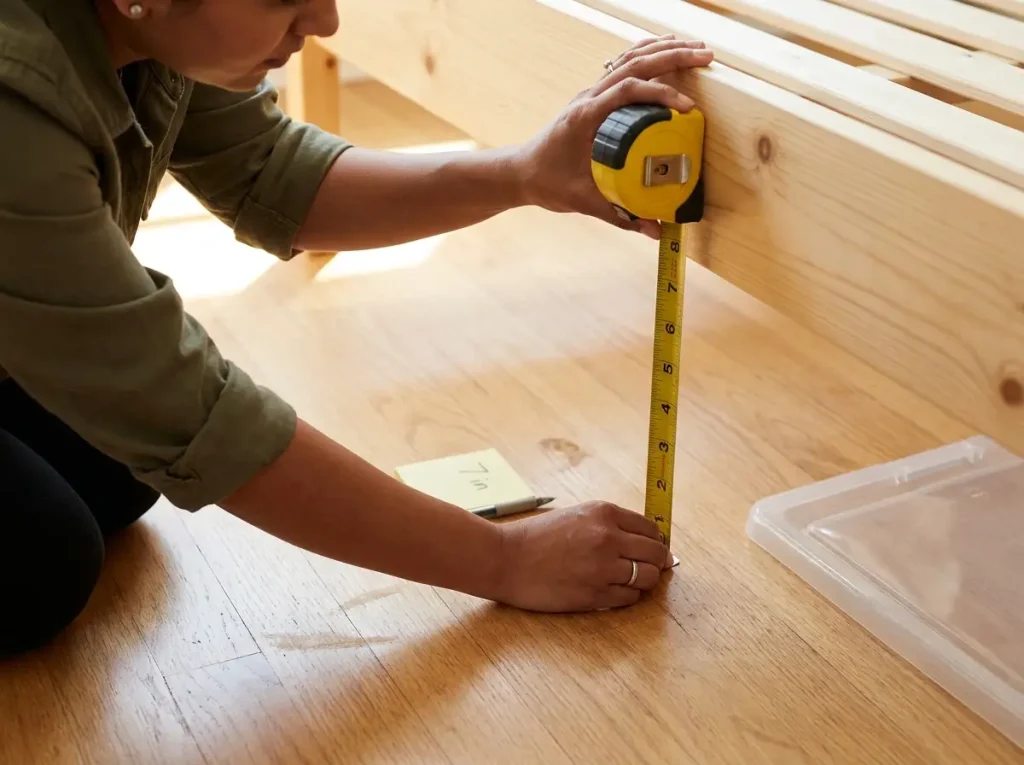
How Clearance Varies by Bed Frame Type
The most common under-bed storage mistake is buying a bin before checking how much space exists between the floor and the frame. Clearance isn’t one universal number — it changes completely depending on the type of bed frame, and the difference is enough to determine which products you can use at all.
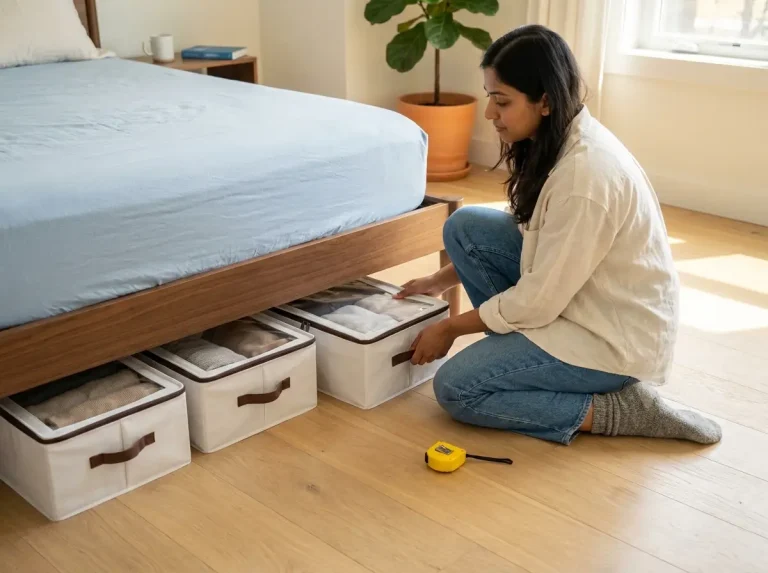
Platform bed frames, which have a solid base instead of separate legs, sit much closer to the ground and typically leave 4–7 inches of clearance. Standard metal frames with exposed legs generally leave 7–11 inches. Bunk bed frames, raised to create the sleeping level, give 12 inches or more beneath. Measure before anything else — tape measure from the floor straight up to the lowest point of the frame, write the number down.
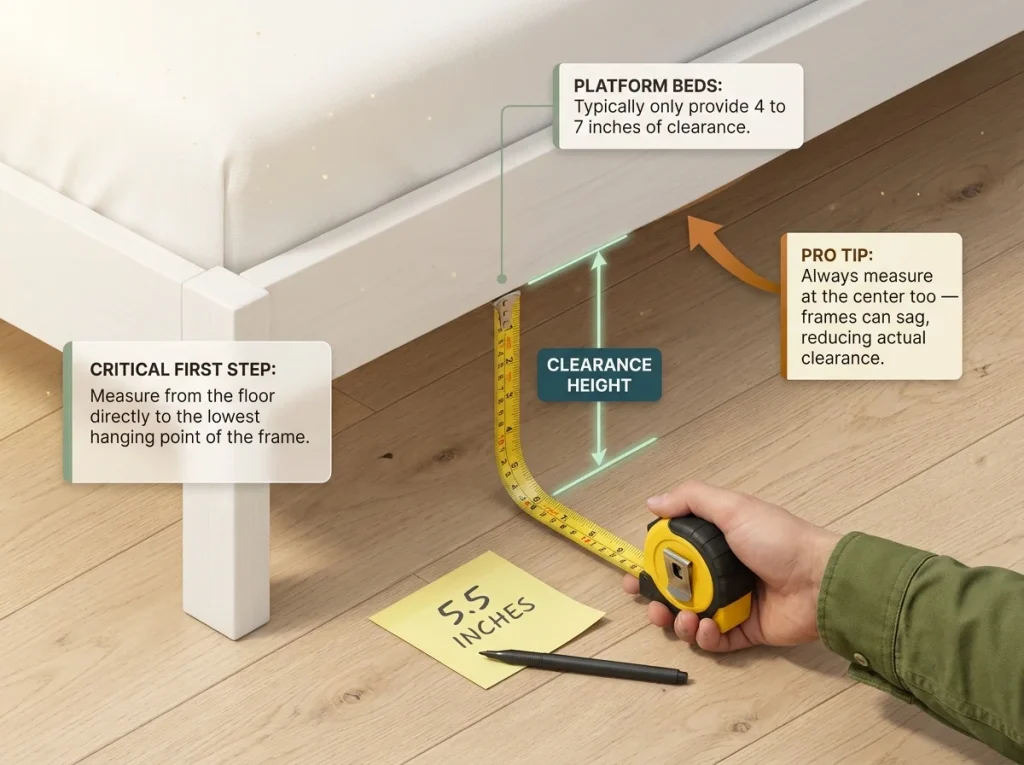
The reason this number matters is that a bin marketed as “under-bed storage” doesn’t automatically fit your bed — it fits the clearance type it was built for. A bin with a 7-inch profile slides under most standard metal frames without issue but won’t clear a platform frame with 5 inches of space. Buy without measuring and you’re either living with bins that stick out permanently or returning everything and starting over.
Pro tip: Measure clearance in two spots — near the legs and at the center of the frame. Some beds sag slightly at the middle under weight after a few years. The narrower measurement is the one that decides what fits.
What to Do When Your Clearance Is Too Low
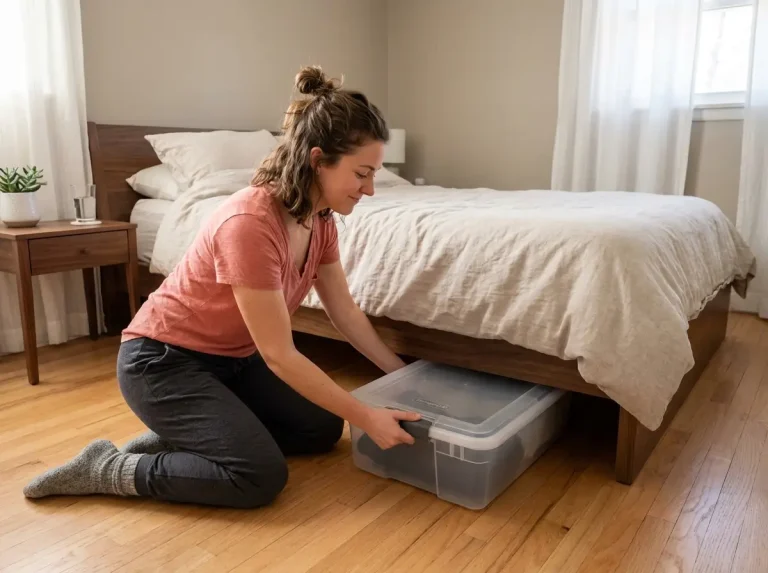
Platform frames are common in kids’ rooms because they sit lower — safer for young kids who fall out of bed — and they look cleaner than frames with visible legs. But 4–6 inches of clearance eliminates most rolling bins and hard-side containers. The storageLAB Under Bed Storage Container with Lid was designed for exactly this situation: its 4.5-inch profile fits frames with as little as 5 inches of clearance, and the side handles let you pull it out flat without bending the lid. One real limitation: at that height, you’re working with a single-layer flat container — no stacking possible, so each bin is its own storage unit.
If your clearance is under 5 inches and you want more flexibility, bed risers are the fix almost nobody mentions. The EclatBain Bed Risers are adjustable to 3, 5, or 8 inches and go under each leg — converting a 5-inch clearance platform into 8–10 inches of usable space. That opens up most rolling bins, including the ones kids can operate themselves. Check that your frame has legs or feet the riser can sit under; solid-base platforms without exposed legs won’t work with risers. For the full breakdown by frame type, the best under bed storage containers guide lists options with exact dimensions for each clearance category.
Hard Bins vs. Soft Bags (and Why Kids Need Both)
When Rolling Bins Beat Flat Bins in Kids’ Rooms
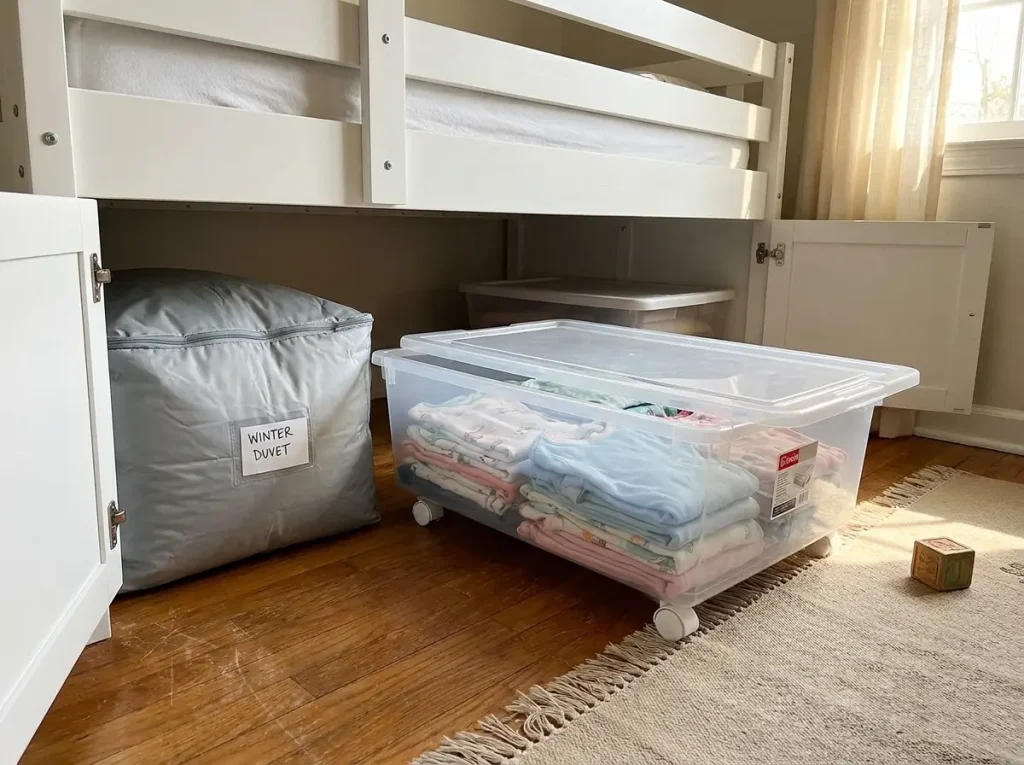
Adults can crouch down, pull out a heavy bin by its handle, use what’s inside, and push it back. Kids don’t do that. They grab the nearest corner of the nearest thing, yank it out, dump the contents where they’re standing, and leave everything on the floor. This isn’t laziness — it’s age-appropriate behavior, and no amount of explaining will change the physics of a six-year-old in a hurry.
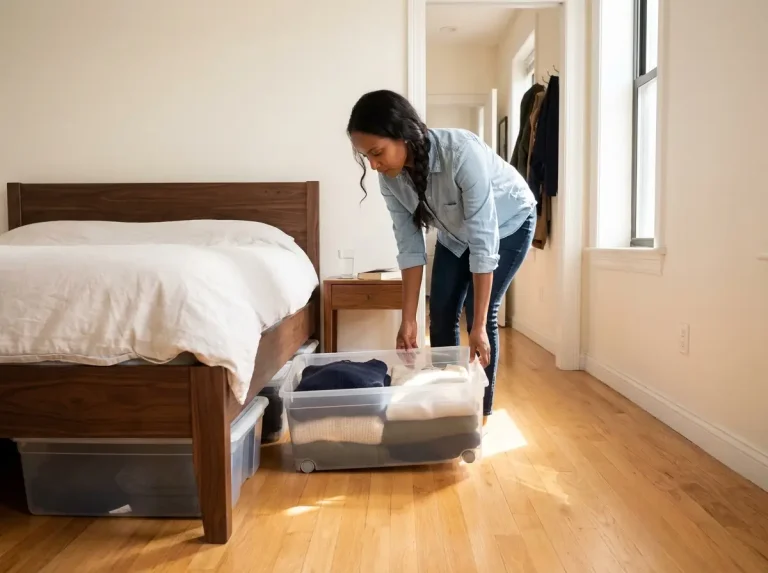
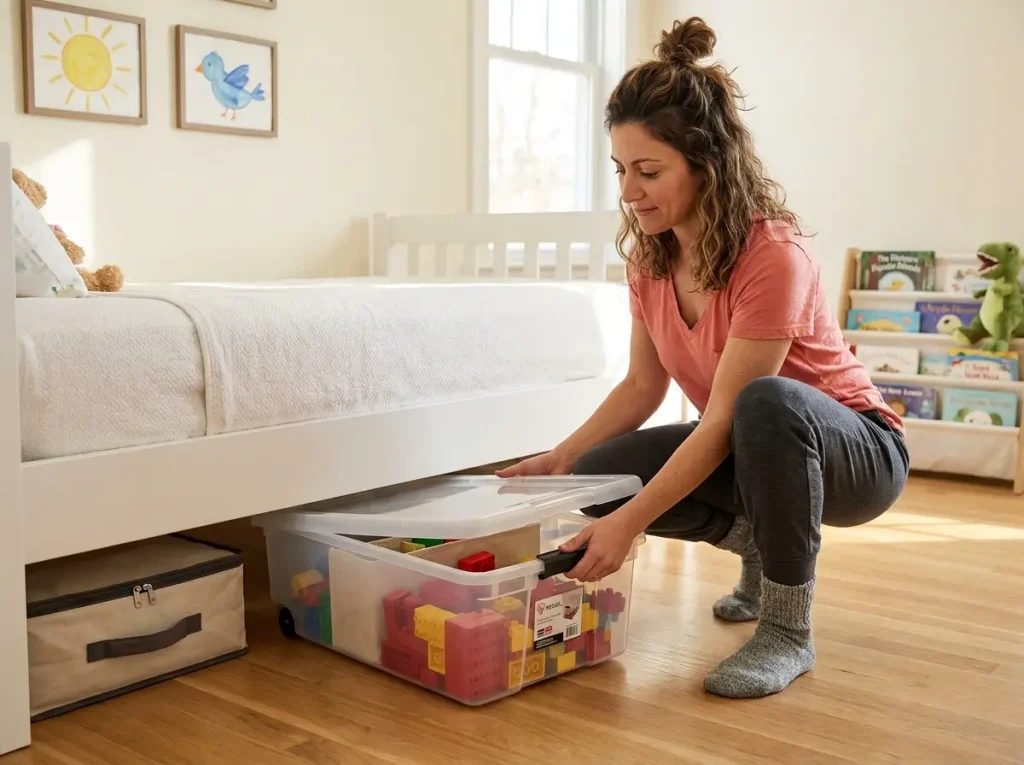
The storage system has to work with that reality, not against it. Rolling bins solve the access problem: a child who can’t drag a flat bin by its handle can push a wheeled bin by its side. The movement is intuitive, it doesn’t require adult grip strength, and the bin comes fully out instead of getting stuck halfway.
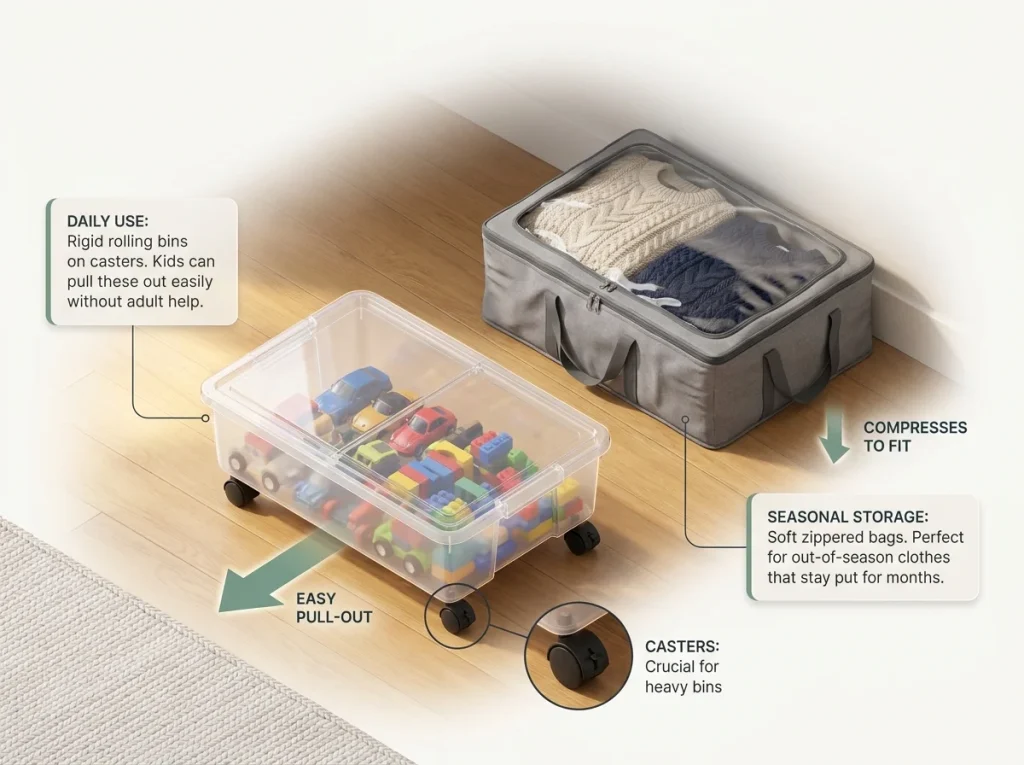
The rolling bin goes under the bed for items your kid accesses regularly — active toys, clothes cycling in and out, books that rotate. Keep the category count to one per bin and keep the lid clear. A child who can’t see what’s inside will either pull out everything looking for one thing or stop using the bin altogether.
When Soft Bags Make Sense (and When They Don’t)
Soft-sided storage bags are the right choice for a specific use case: seasonal items that go in and stay put for months. Winter bedding stored in summer, off-season clothes that are already purchased but too large, holiday pajamas — these work in soft bags because the bags conform to irregular shapes, compress slightly to fit, and sit flat without wasted air space. For taller clearance situations, the Aethel Under Bed Storage Bags with Wheels 2-Pack give you 7.5 inches of height and still roll out easily — the wheels make seasonal access far less of a project than dragging a bag from under the bed twice a year.
What never belongs in soft bags — especially vacuum bags — is stuffed animals. The instinct to compress plush toys to save space makes sense in theory. In practice, synthetic polyfill clumps and mats permanently when compressed, and any moisture in the bag produces a smell that doesn’t wash out. Stuffed animals not in active rotation go in open-top fabric bins, not compressed bags. For how these storage decisions apply to smaller rooms, under-bed storage ideas for small bedrooms covers the soft-versus-hard trade-off in more constrained spaces.
Matching Container to Content in a Kids’ Room
Toys and Small Parts
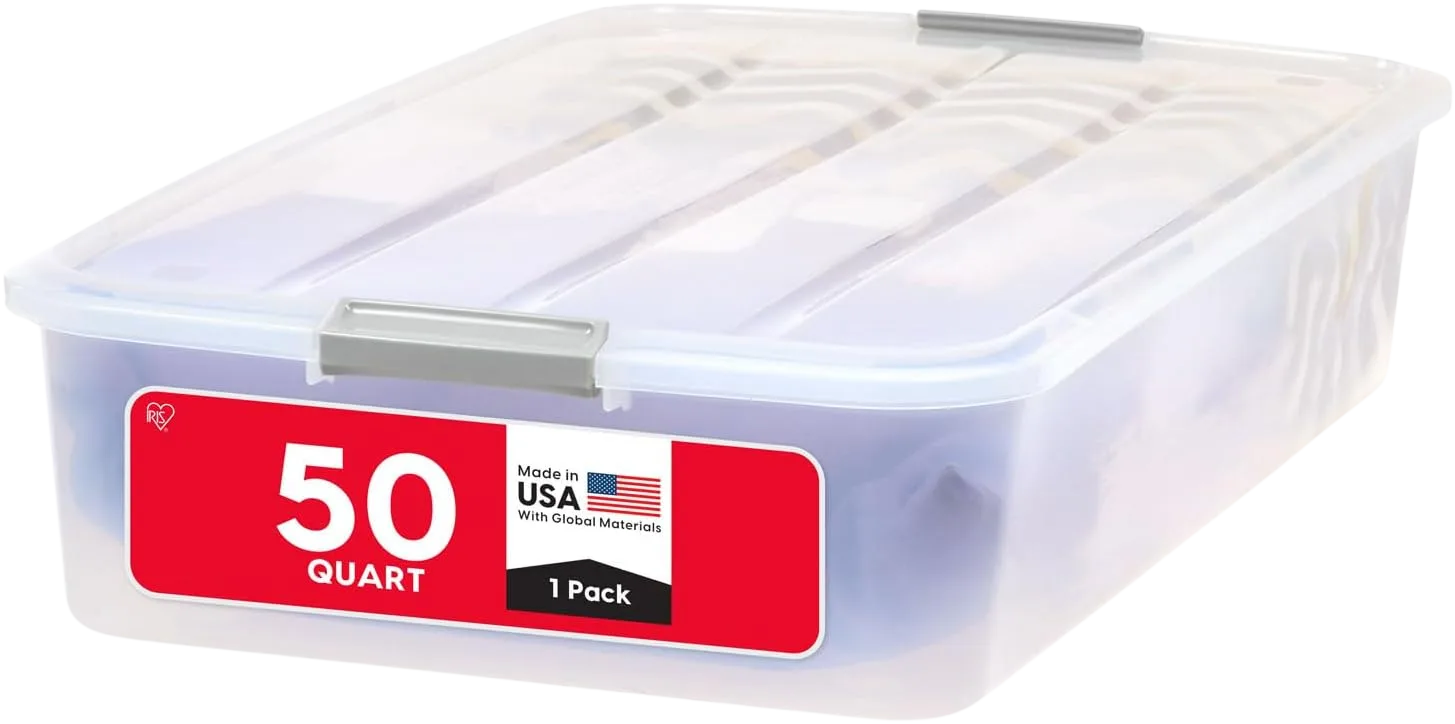
LEGO, art supplies, small figurines, puzzle pieces — all of these share the same failure pattern when stored in a rolling bin without internal organization. Everything migrates to the corners during transport, pieces get mixed between categories, and the bin becomes a sorted-nothing mess that nobody wants to dig through. The fix isn’t a bigger bin. It’s a flat, clear bin shallow enough to see and reach the bottom without tipping it. The IRIS USA 40 Qt Nestable Clear Storage Box 3-Pack, at 23.5 × 16.25 × 6.25 inches each, fits under most standard frames and gives you three separate flat bins out of the box — one for LEGO, one for art supplies, one for small figures. They nest when empty so you’re not creating clutter when the contents are outgrown.
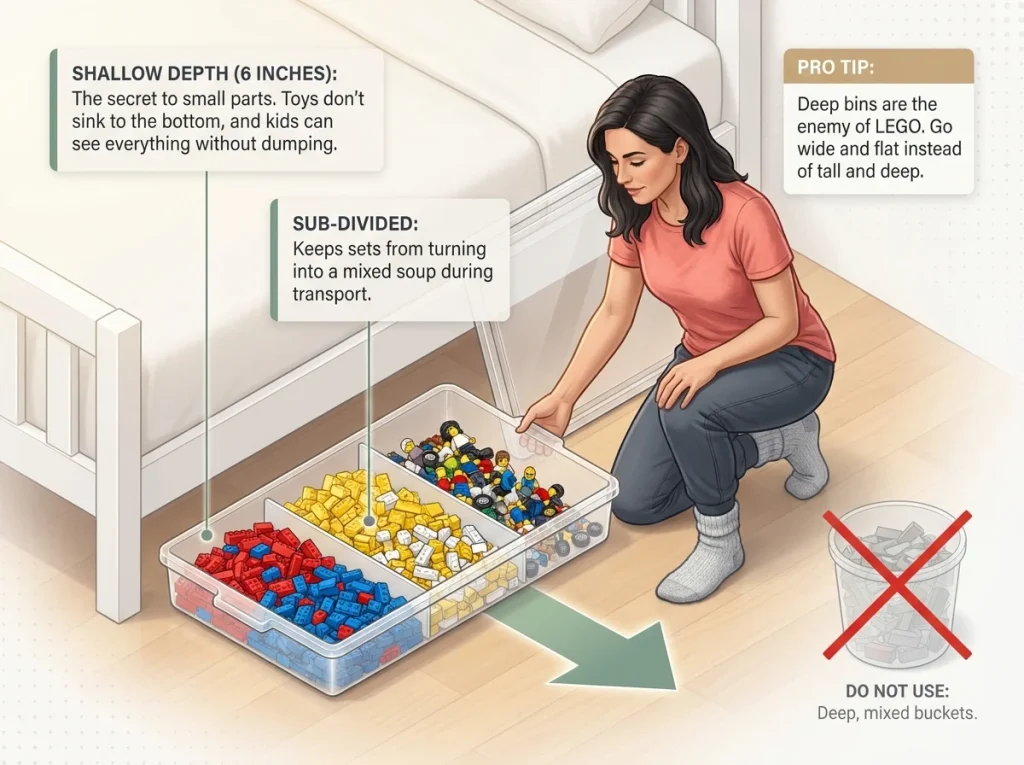
Pro tip: Deep bins are the enemy of small-part storage. A six-inch-deep bin holds 40% less than it looks like it should — everything sinks and nothing stays sorted. Flat and wide beats tall and deep for any toy with small pieces.
Clothes and Bedding
Seasonal clothes and bedding follow different rules than toys. These items go under the bed for weeks or months and need protection from dust. The rolling bin your kid uses for daily toy access is the wrong container for the winter coat that won’t come out until November. For clothes, use zippered soft bags or lidded flat bins that seal properly. One rule specific to kids: label stored clothes by size, not by season. Kids grow unpredictably. “Next size up — 6T” is more useful than “winter clothes” when you’re pulling a bag in March wondering if last year’s snow pants still fit.
Vacuum storage bags work well for synthetic-fill bedding — polyester duvet inserts, microfiber comforters — because compression doesn’t damage the fill permanently. Natural fill, meaning down or wool, should not go in vacuum bags. Compression breaks down the loft in natural fibers over time, and you get a comforter that no longer insulates the way it should.
Why the Label System Is the Whole System
Picture Labels Over Text Labels
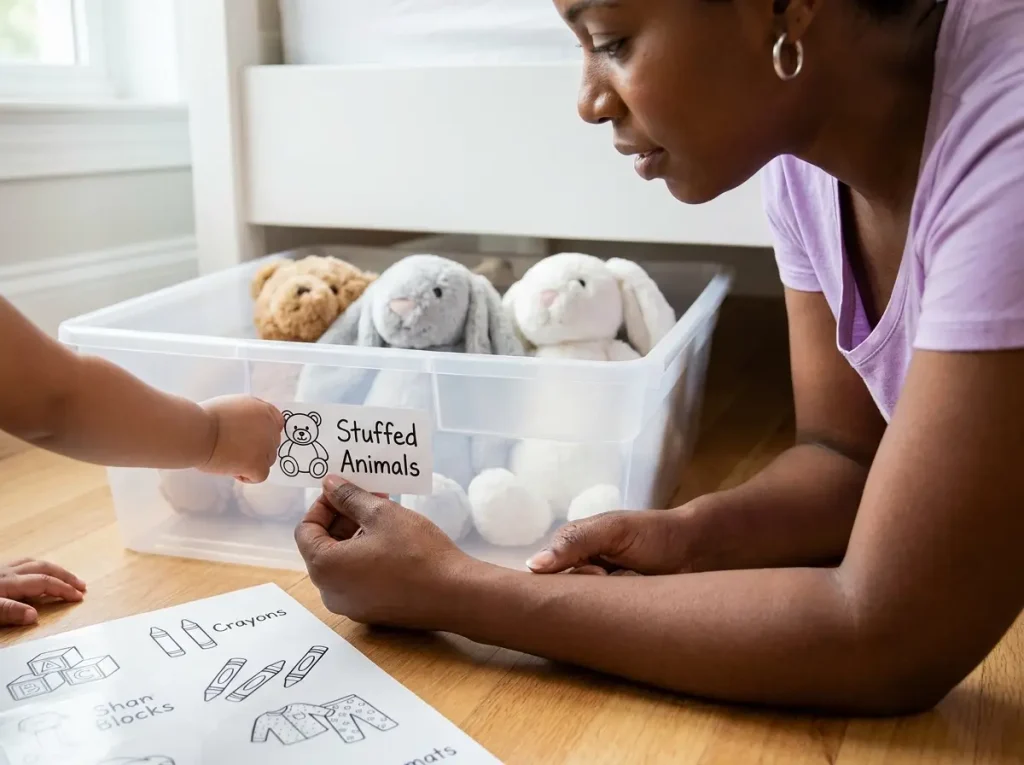
A text label on a bin means nothing to a four-year-old. It means something to you, so you’ll put things in the right place — but the actual primary user of under-bed storage in a kids’ room is a child who cannot read yet, or who can read but won’t check the label when they’re in a hurry.
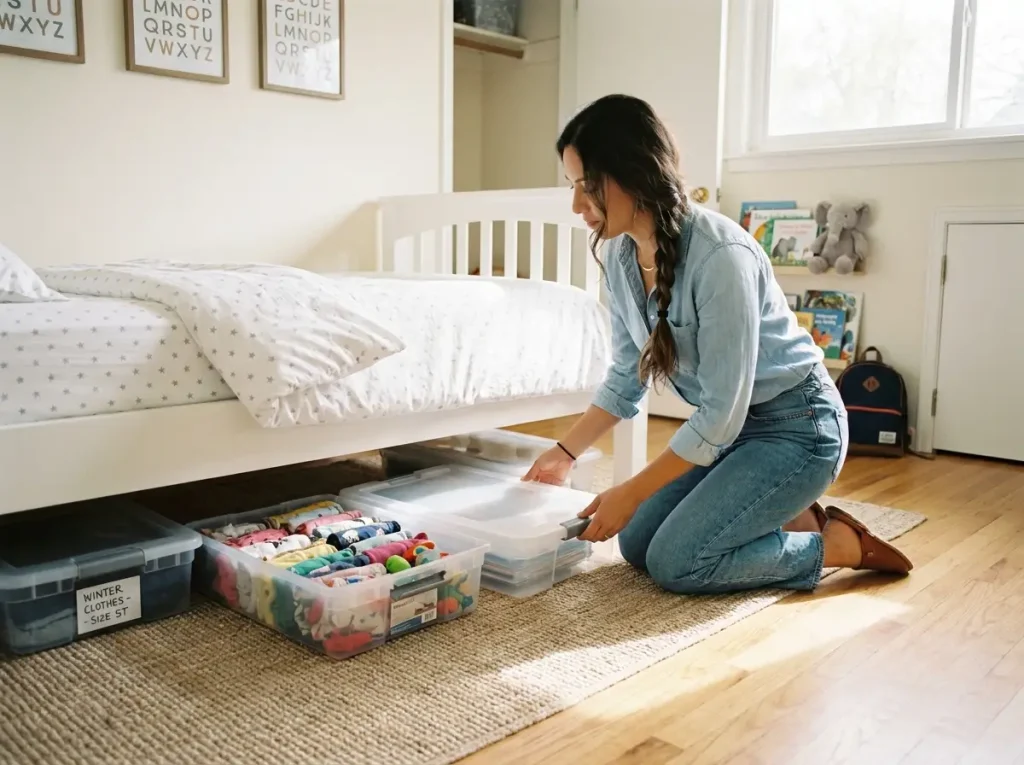
Picture labels fix both problems. A drawing of a stuffed bear signals stuffed animals to a two-year-old without a word. A photo of LEGO bricks works for a three-year-old who has never seen the word “LEGO” written down. You don’t need anything elaborate — a printed photo of the bin’s contents laminated and taped to the front face works as well as any commercial label system.
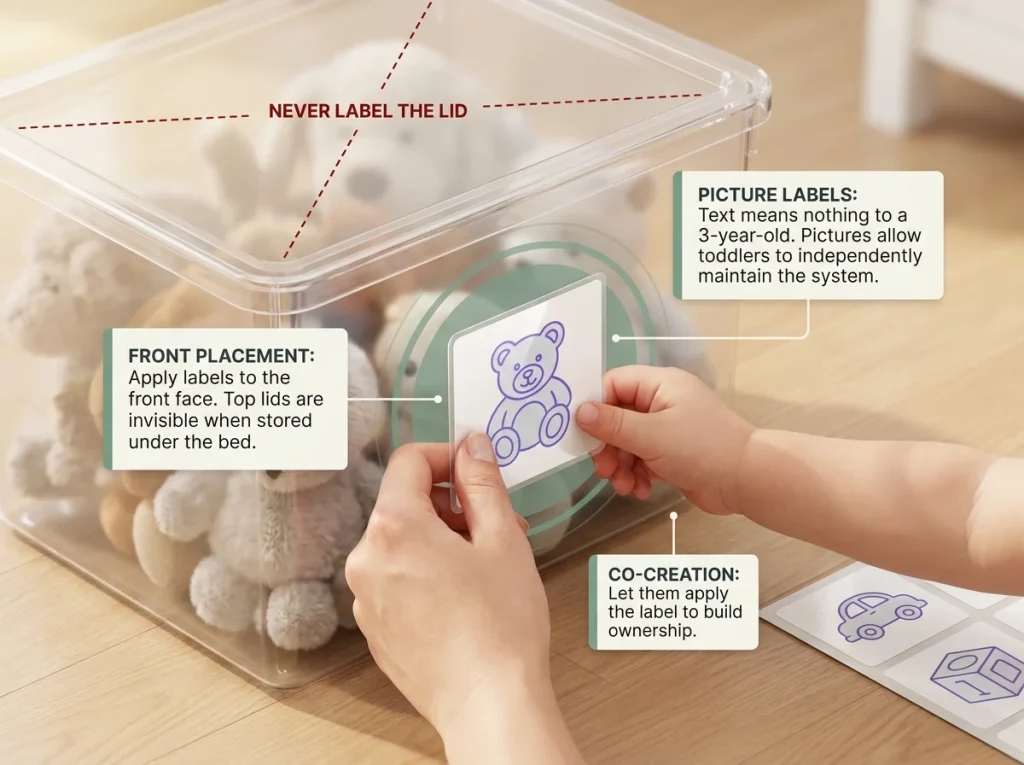
The label goes on the front face of the bin, not on the lid. When bins are under the bed, you see the front — the lid is flat and invisible from a standing or kneeling position. A label on the lid tells nobody anything while the bin is in use.
Getting Kids to Put Things Back
The reason systems collapse is rarely that the system is wrong. It’s that one person in the household built and understands it while everyone else ignores it. In kids’ rooms, the fix is involving your child in the setup rather than presenting them with a finished system. When a child helps decide which bin holds which category, they build the mental map of where things go — and they’re more likely to use it because they made the decisions.
For toddlers, that means you choose the categories and they put the first item in each bin. For school-age kids, give them two options per category and let them pick. For tweens, they can set up the whole thing with you checking dimensions and clearance. The system they helped build is the system they’ll maintain.
Pro tip: One category per bin, with no exceptions. The moment a bin becomes the “miscellaneous” bin, everything ends up in it. When a child doesn’t know where something goes, the answer is never to add it to an existing bin — it’s a sign that category either needs its own bin or the item doesn’t belong in the room.
The Quarterly Reset That Actually Keeps the System Working
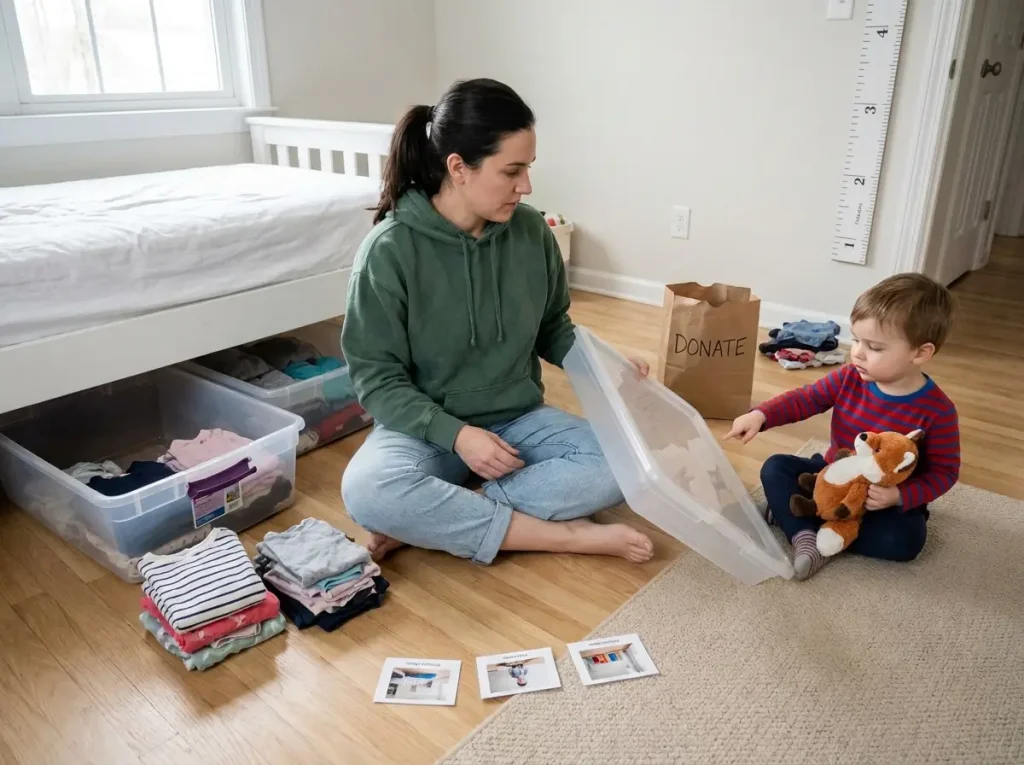
Most organizing guides say revisit your systems every six months. In a kids’ room, six months is too slow. Kids outgrow toys in weeks, shift interests in a month, and change clothing sizes mid-season.
A system set up in September can be functionally wrong by December — the bin labeled “current LEGO” now holds two birthday present sets and a bag of magnetic tiles, and the original set hasn’t been touched since October. Three months is the right cadence for a kids’ room, and it’s faster than an adult reset because a child can make decisions about their own things that you can’t make for them.
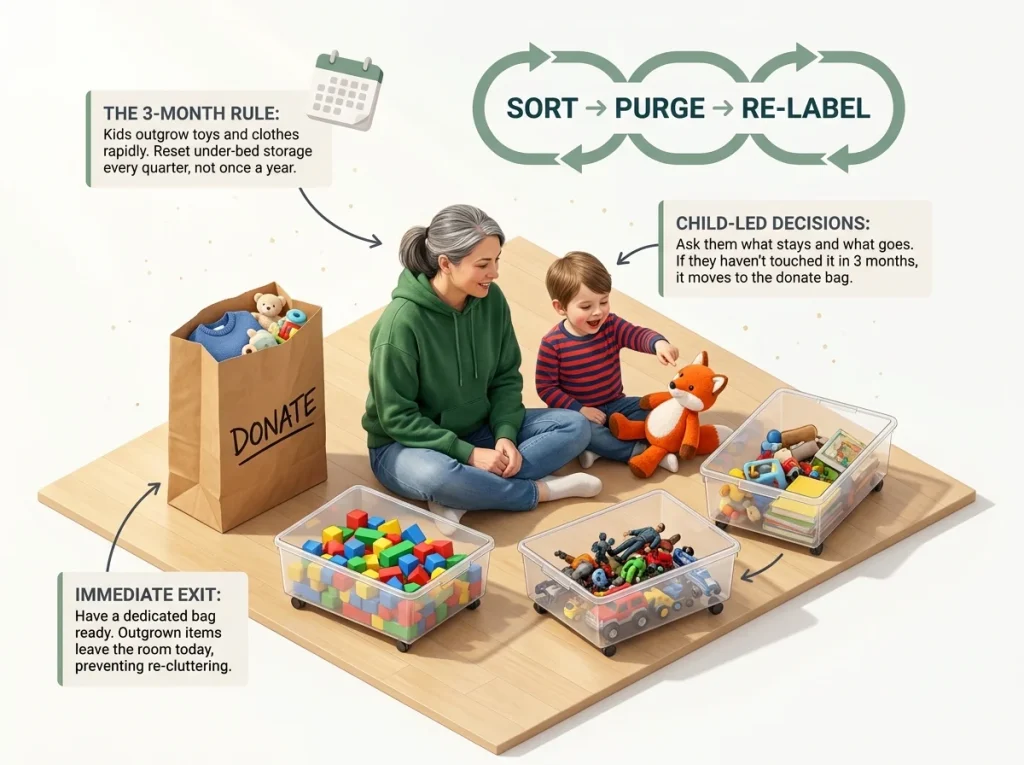
The three-month check has four questions: Does everything still fit in the bins? Have any categories gone completely unused? Did your child grow out of anything stored here? Do the labels still match what’s actually in each bin? Tie it to a school calendar moment — the start of a new term is when interests shift, clothes change size, and the storage needs to catch up.
The National Association of Productivity & Organizing Professionals consistently finds that systems maintained on a predictable schedule hold up far longer than those rebuilt only after they’ve fully broken down. The full under-bed storage guide covers the adult bedroom version in more detail, but in a kids’ room the reset takes 20 minutes when done on schedule rather than a Saturday afternoon when it’s been ignored for a year.
Measure clearance before anything else — that number eliminates half the wrong products before you spend anything. Set up one rolling bin for daily-access items and one soft bag for seasonal storage. Put picture labels on the front face of every bin, not the top. That’s a system that can survive the way kids actually use space.
Three-Month Check: Pull everything out in three months and ask your child what still belongs — their answer is the system update. Start with one bin, one category. Get that working before you add anything else.
Q1 What is the best under-bed storage for a kids’ room?
Rolling clear bins work best in kids’ rooms because children can pull them out without help. Look for bins under 6.5 inches tall for standard frames, or under 5 inches for platform beds. Clear sides let kids see contents before opening, which reduces dumping everything to find one thing. Lidless or easy-lid designs work better than bins with tight-fitting lids.
Q2 How do I keep my child from making a mess of under-bed storage?
Use one category per bin and picture labels instead of text. A child who can identify a bin’s contents without reading is more likely to put things back correctly. Rolling bins also help — kids return bins they can move without effort more reliably than bins they have to drag by a handle.
Q3 Can you use vacuum storage bags under a kids’ bed?
Vacuum bags work for synthetic-fill bedding and out-of-season clothes. Do not use them for stuffed animals or natural-fill items like down or wool. Compression permanently mats synthetic plush filling and breaks down the loft in natural fibers over time. Use open fabric bins or loosely closed bags for stuffed animals.
Q4 How much clearance do I need for under-bed storage bins?
You need at least 5 inches of clearance for the flattest bins available. Platform bed frames typically leave 4–7 inches; standard metal frames with legs give 7–11 inches; bunk beds give 12 or more. Measure before buying — the number determines which products can physically fit under your specific frame.
Q5 How often should you reorganize under-bed storage in a kids’ room?
Every three months, not six. Kids outgrow toys and clothes faster than adults, and a system that was correct in September may be functionally wrong by December. Tie each reset to a school calendar moment — the start of a new term, a school break, or the end of the year — so it becomes routine rather than a reaction to chaos.
Disclaimer: ClutterlessNest is a participant in the Amazon Services LLC Associates Program. As an Amazon Associate we earn from qualifying purchases. This article may contain affiliate links — if you buy through them, we may earn a small commission at no extra cost to you. We only recommend products we have tested or genuinely believe in.