You reorganized the bathroom last month. New bins under the sink, everything off the counter, and for about two weeks it looked great. Then the shampoo bottles migrated back to the tub ledge, the under-sink cabinet became a black hole again, and that over-door organizer started sagging from weight it was never built to hold.
The problem isn’t you — it’s that most bathroom storage advice skips the part that actually matters: why the system broke in the first place. After working through dozens of bathrooms under 40 square feet, the pattern is always the same: people buy organizers before measuring, ignore humidity, and never set up a maintenance routine. This guide covers the seven storage zones in a small bathroom, what actually works in each one, and how to keep it working past the first month.
Quick Answer: Small bathroom storage fails because of three root causes:
- You’re buying organizers before measuring the spaces they need to fit
- Humidity weakens adhesives, suction cups, and Command strips not rated for bathrooms
- There’s no frequency system — daily items mix with backstock and everything reverts
- Fix starts with zoning (over-toilet, under-sink, walls, counter, shower, door), measuring first, and scheduling a monthly reset
What You’re Actually Storing (Before You Buy Anything)
The Three Bathroom Storage Zones
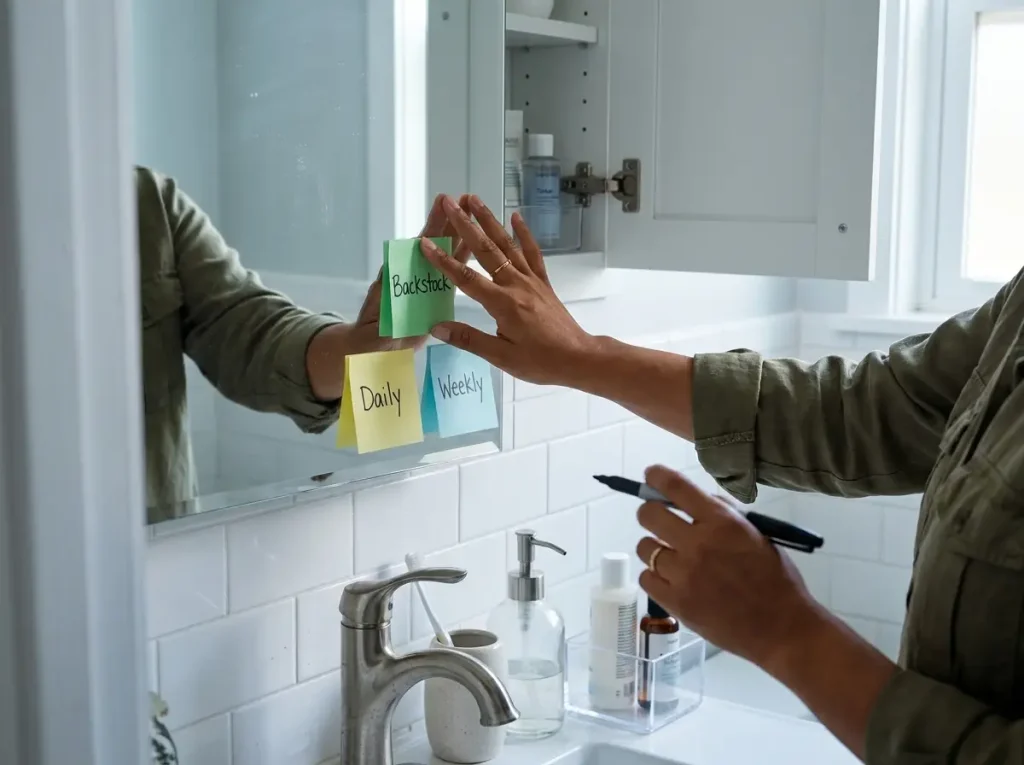
Before you add a single bin or shelf, figure out what you’re storing and how often you touch it. Most bathroom organization advice jumps straight to products, which is why most bathroom systems fall apart within a month. Your small bathroom has three distinct frequency zones, and each one needs a different kind of storage.
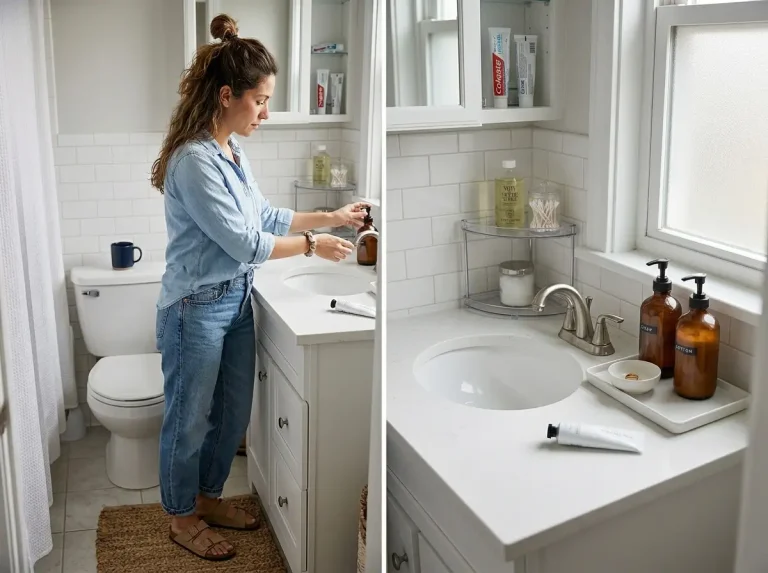
Zone 1 is daily access — the items you grab every single morning and night. Toothbrush, face wash, daily moisturizer, deodorant. These need to be at arm’s reach, between 15 and 48 inches above the floor (the NKBA bathroom planning guideline for frequently used items). Your countertop, medicine cabinet, and the top shelf of your over-toilet unit belong to this zone.
Zone 2 is weekly access — backup products, styling tools, razors, nail clippers, shaving cream. These go in the top shelf of your under-sink cabinet, a shower caddy, or the middle tier of your over-toilet storage. You reach for them regularly but not daily.
Zone 3 is backstock — extra toilet paper, bulk soap, first aid supplies, spare towels. These belong in the back of the under-sink cabinet, the bottom of the over-toilet unit, or ideally in a linen closet outside the bathroom entirely. If your backstock is mixing with your daily items, that’s the first thing making your bathroom feel cluttered.
Measure Before You Shop
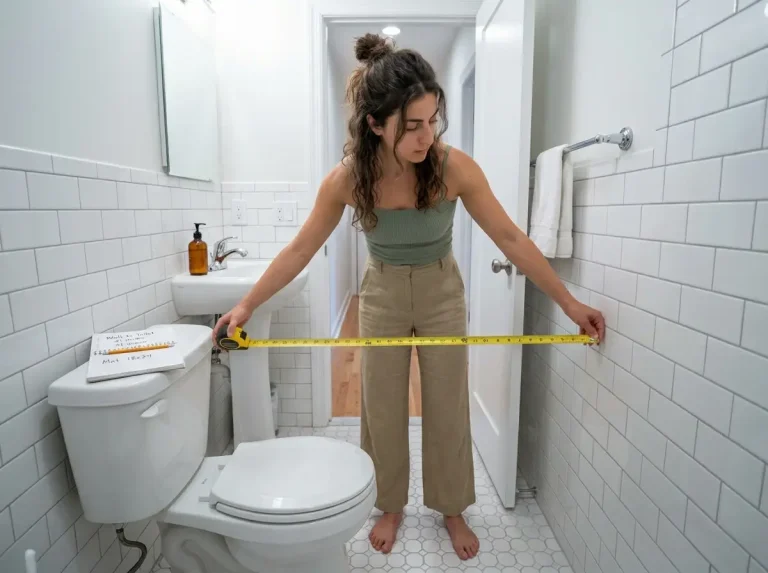
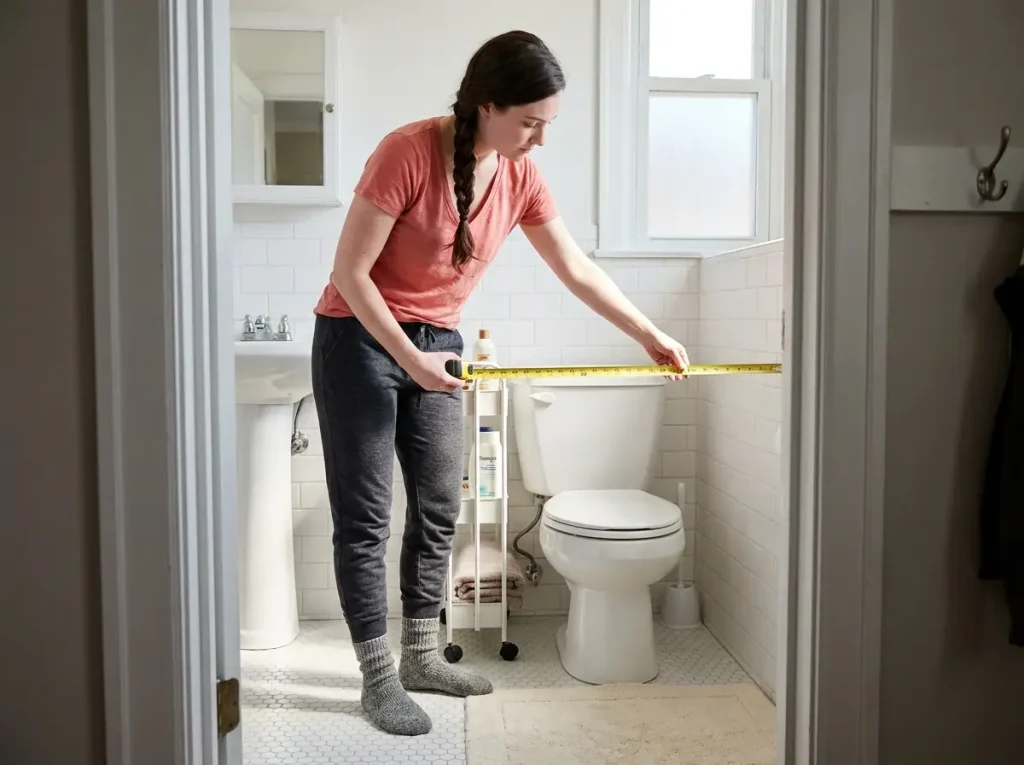
Grab a tape measure and write down four numbers before opening Amazon. First: the gap between your toilet and the nearest wall — most standard bathrooms give you 12 to 18 inches here, and a slim rolling cart at roughly 7 inches wide fits this space without touching either surface. Second: the width of your toilet tank — usually 17 to 18 inches — because over-toilet shelves need to clear both sides of the bowl.
Third: the interior width of your vanity cabinet and where the pipe sits, since this determines which under-sink organizer will actually fit around the plumbing. Fourth: the depth of available wall space above the toilet — your tank is about 7 inches deep, so any shelf deeper than 8 inches will stick out past the tank and hit you when you lean forward.
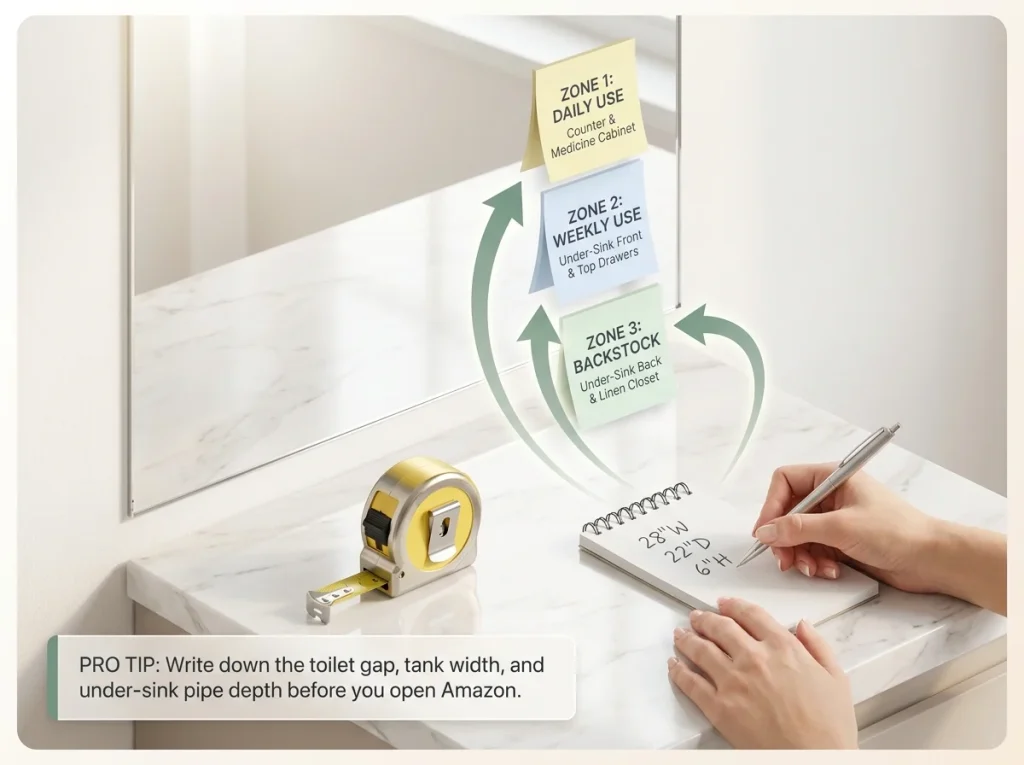
Pro tip: Write the measurements on a sticky note and stick it to your phone case before you shop. You’ll need them for every product listing — and you won’t remember a 14-inch gap from memory when you’re scrolling through Amazon at midnight.
Over-Toilet Storage (The Most Valuable Wall Space)
Freestanding Etageres vs. Wall-Mounted Shelves
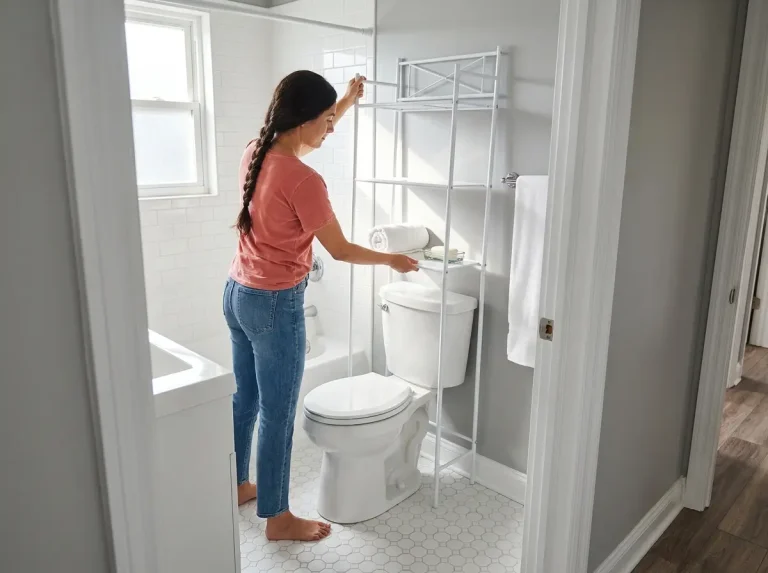
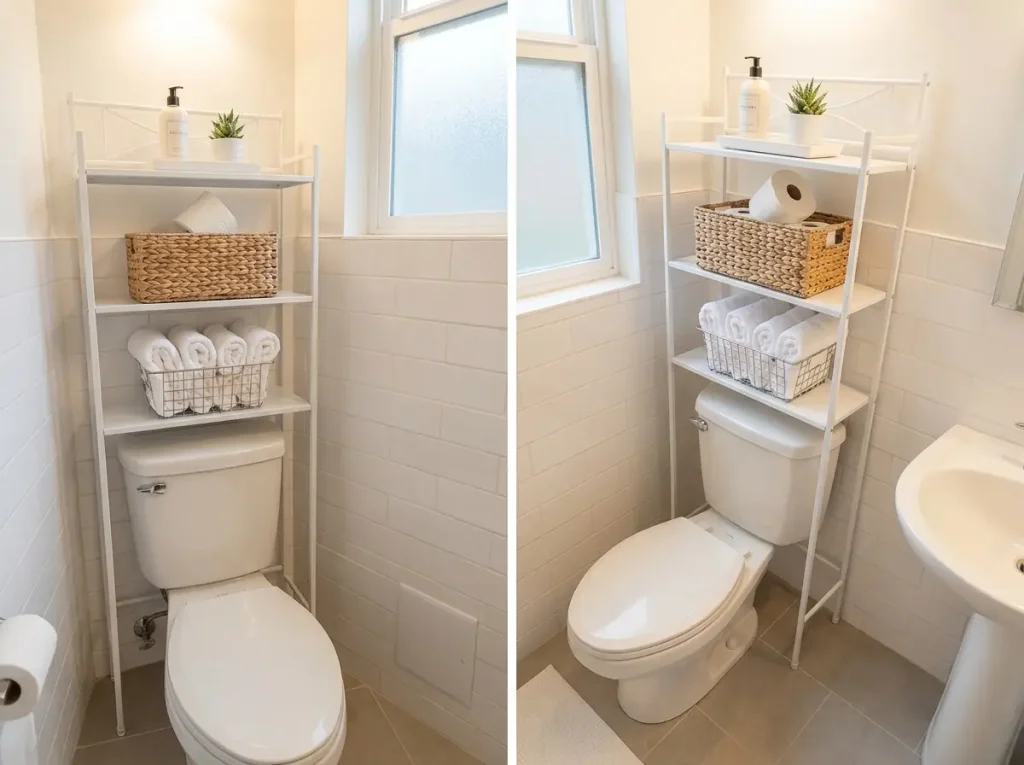
The 18 inches of wall above your toilet tank is the most underused storage space in most small bathrooms. Two options compete for it: freestanding etageres that straddle the toilet with no installation, and wall-mounted floating shelves that need drilling or heavy-duty anchors.
For renters, freestanding units win by default. They sit behind the toilet with legs on either side — nothing touches the wall, nothing requires drilling, and they leave with you when your lease is up. The UTEX 3-Tier Over The Toilet Storage Shelf fits standard toilets with tanks up to about 7 inches deep and gives you three open shelves at roughly 25 inches wide. The bottom shelf should clear the tank lid by at least 10 inches — if it doesn’t, you can’t remove the lid when you need to fix a running toilet or replace the flapper valve.
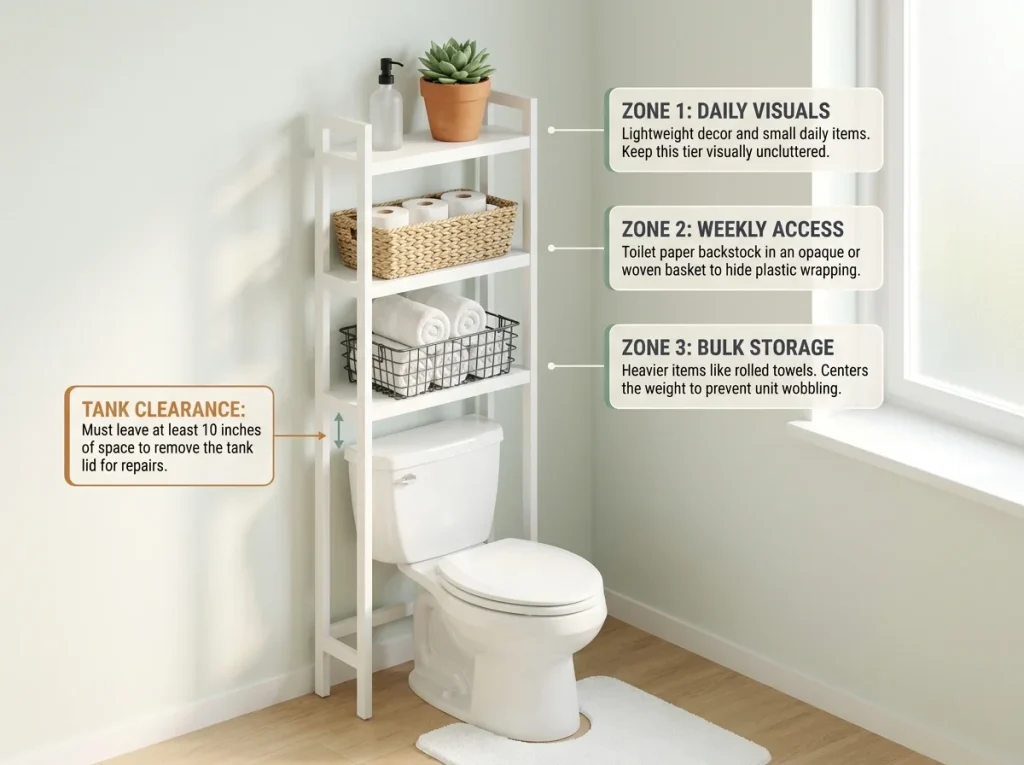
If you own the place, wall-mounted floating shelves at 4 to 6 inches deep look cleaner and free up the floor space around the toilet base. But you’ll need to find a stud or use heavy-duty wall anchors — most bathroom walls are drywall, and a shelf loaded with toiletries can easily exceed 15 pounds.
What to Store Here and Why It Matters
This zone covers Zone 1 and Zone 3 items — things you see daily but don’t necessarily grab every hour. Rolled hand towels, a small basket of backup toilet paper, a decorative container for cotton balls, and maybe a candle or plant. Keep this zone visually light.
If you load all three shelves with heavy bottles, the visual clutter defeats the purpose — and freestanding units wobble under uneven weight distribution. One person I helped had six large shampoo bottles on the top shelf of an etagere. The unit leaned forward so far it touched the back of their head every time they sat down.
Under-Sink Organization (Stop Losing Things to the Pipe)
Measure Around the Pipe First
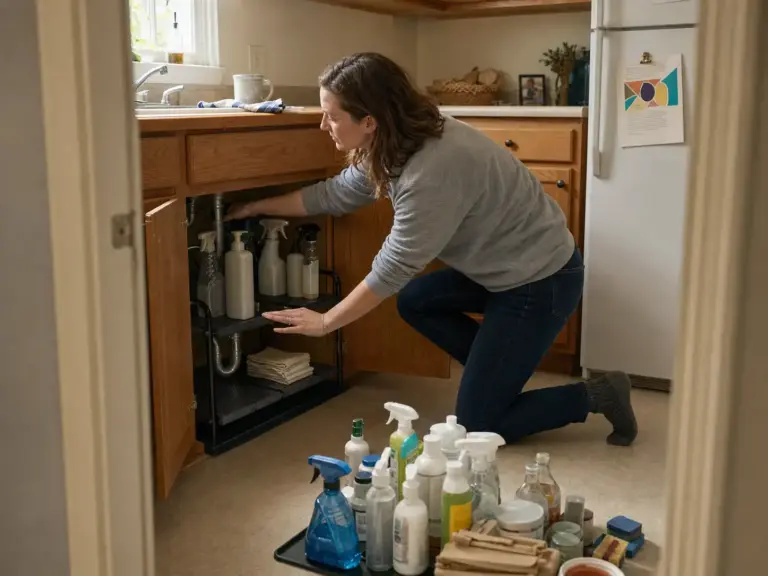
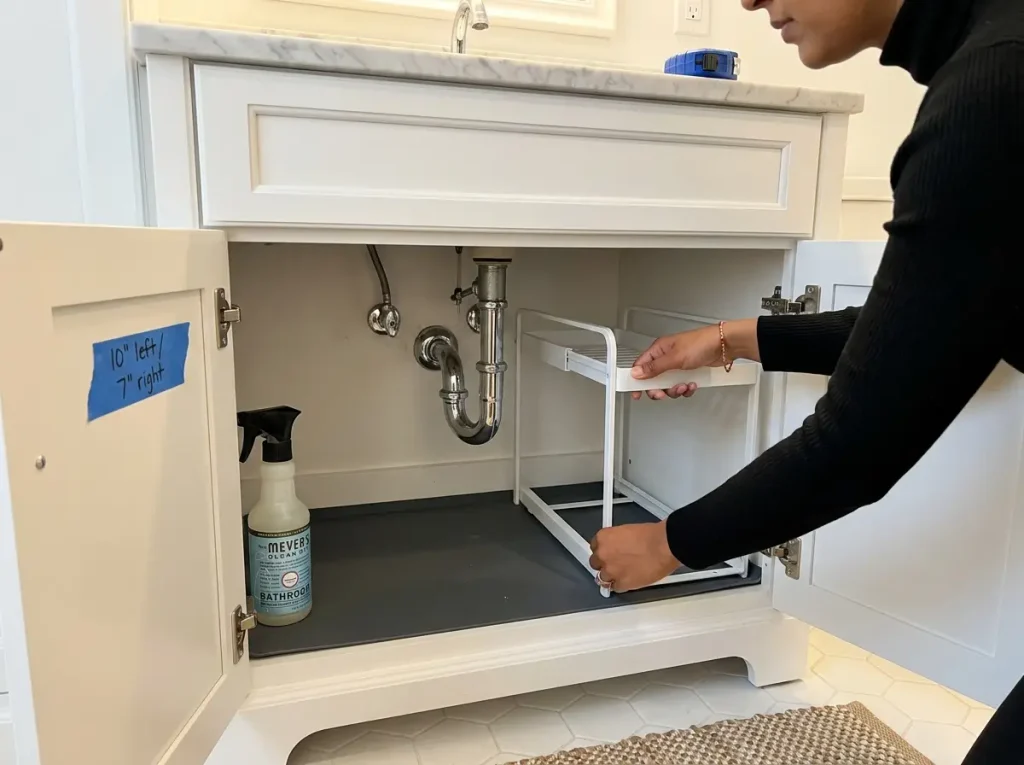
The cabinet under your bathroom sink has a design flaw built into it: a pipe running right through the middle. That P-trap steals 30 to 40 percent of your usable space before you put anything inside. Worse, everything you store in there slides behind the pipe into a zone you can’t see or reach — that’s why it becomes a black hole within weeks.
Before buying any organizer, open the cabinet and measure three things: the width on each side of the pipe (most small vanities give you two usable sections of 10 to 12 inches each), the height clearance from the cabinet floor to the lowest pipe joint, and the depth from front to back. The SimpleHouseware Under Sink 2-Tier Expandable Shelf Organizer works here because the expandable width lets you position each tier around the pipe rather than fighting a fixed-width shelf that doesn’t fit.
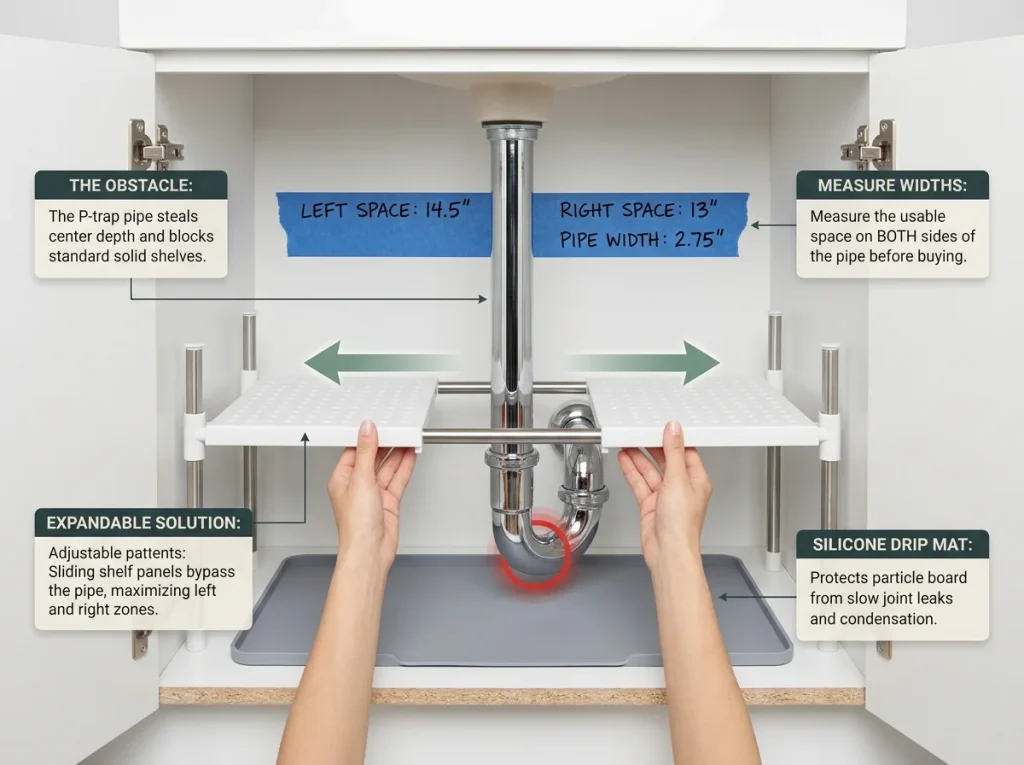
If you’ve lived in this apartment for more than a year, you’ve probably noticed condensation or a slow drip at the pipe joint. A silicone drip mat with raised edges on the cabinet floor catches that moisture before it warps the particle board underneath. It’s a small thing that prevents a much bigger problem later — and it wipes clean in seconds if you ever need to pull it out.
What to Put on Each Side
The side with more clearance gets your weekly-access items — a small caddy of styling tools, backup face wash, a container of hair ties and bobby pins. The narrower side or the back section gets cleaning supplies you only grab once a week. The same pipe-first approach works for kitchen under-sink cabinets — measure the pipe, zone around it, and put daily items at the front.
One trick that costs nothing: stretch a tension rod across the interior of the cabinet, about two-thirds of the way up. Hang spray bottles by their triggers from the rod. They’re off the cabinet floor, easy to grab, and you just freed up the entire bottom surface for bins and backup supplies.
Pro tip: Put your most-used under-sink items in the front two inches of the cabinet. If you have to reach past the pipe to grab something you use every day, it’s in the wrong spot — and it’ll migrate to the counter by the end of the week.
Wall Storage and Vertical Solutions
Floating Shelves Above the Sink and Mirror
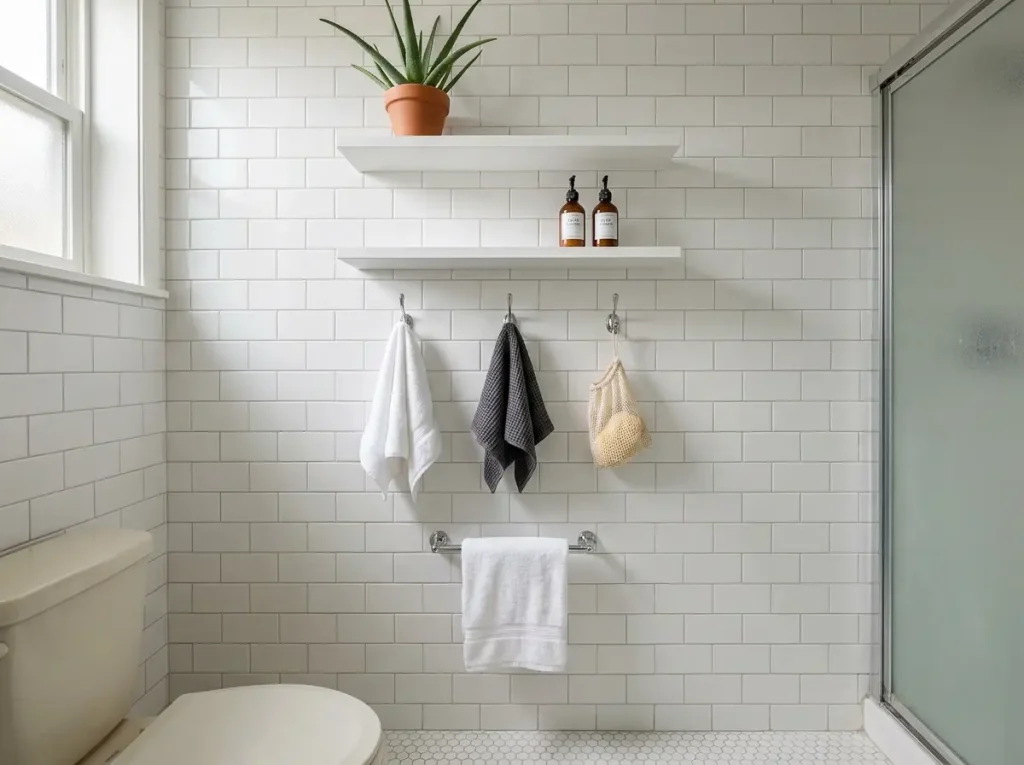
In a 36-to-40-square-foot bathroom, the walls are your best storage upgrade. Most small bathrooms use two surfaces — the floor and the counter — when there are four walls of vertical space going to waste.
Floating shelves work above the toilet, beside the mirror, or on the wall opposite the shower. Standard bathroom shelf depth is 4 to 6 inches — enough to hold bottles, small containers, and a candle without making the room feel cramped. If you’re mounting them, 24-inch-wide shelves fit most bathroom wall sections without hitting light fixtures or mirrors. For renters, adhesive-mounted shelves work on smooth painted drywall, but check the weight rating — most adhesive shelf mounts max out at 5 to 8 pounds, which is one loaded shelf, not two.
Towel Bars vs. Hooks — Which One Actually Works
This is a question every small bathroom owner eventually faces. Towel bars take up 18 to 24 inches of horizontal wall space and hold one or two towels. Hooks take up 2 inches and hold one towel each. In a bathroom under 40 square feet, hooks almost always win.
Install one hook per person who uses the bathroom. Place them at eye level for adults — 55 to 65 inches from the floor — and lower for kids at around 36 to 48 inches. Command Bath hooks (not regular Command hooks) hold 3 to 5 pounds per hook on smooth, non-porous surfaces.
Regular Command adhesive softens in bathroom steam and humidity within a few months. The Bath-rated version is engineered specifically for temperature swings and moisture.
One thing nobody warns you about: suction cup hooks fail on textured tile. If your bathroom tile has any surface texture, bumps, or heavy grout lines, suction cups won’t hold. They need smooth, glazed, non-porous surfaces to create a proper seal. Check the tile before you buy a suction-mount anything — run your fingernail across it, and if you feel ridges, skip suction entirely.
Counter and Vanity Organization (Keep Only What You Use Daily)
The Daily-Use Audit (What Actually Lives on the Counter)
The counter is the fastest surface in your bathroom to revert. One week after organizing, bottles start accumulating again because there was never a rule about what belongs there and what doesn’t.
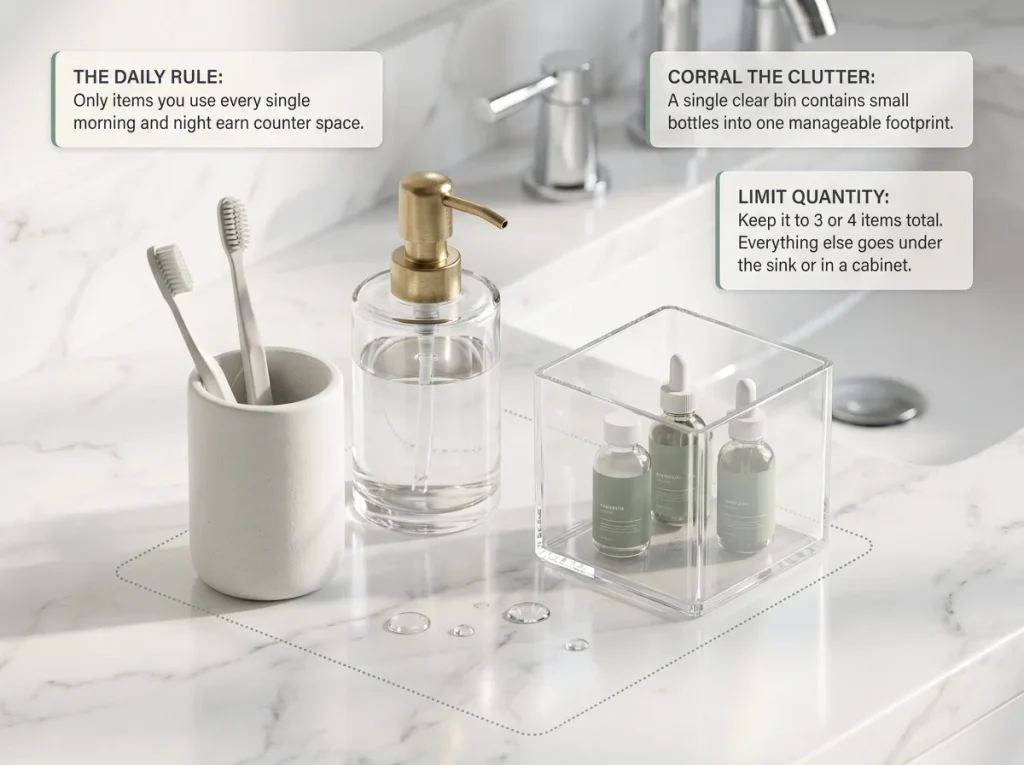
Here’s a rule that works: only items you use every single day earn counter space. Toothbrush and paste. Face wash. One moisturizer. That’s probably the entire list.
Everything else — the hair serum you use twice a week, the contact solution, the cologne — belongs in a different zone. When you reduce the counter to three or four daily items, the space stays manageable without any organizing product at all.
Contain What Stays
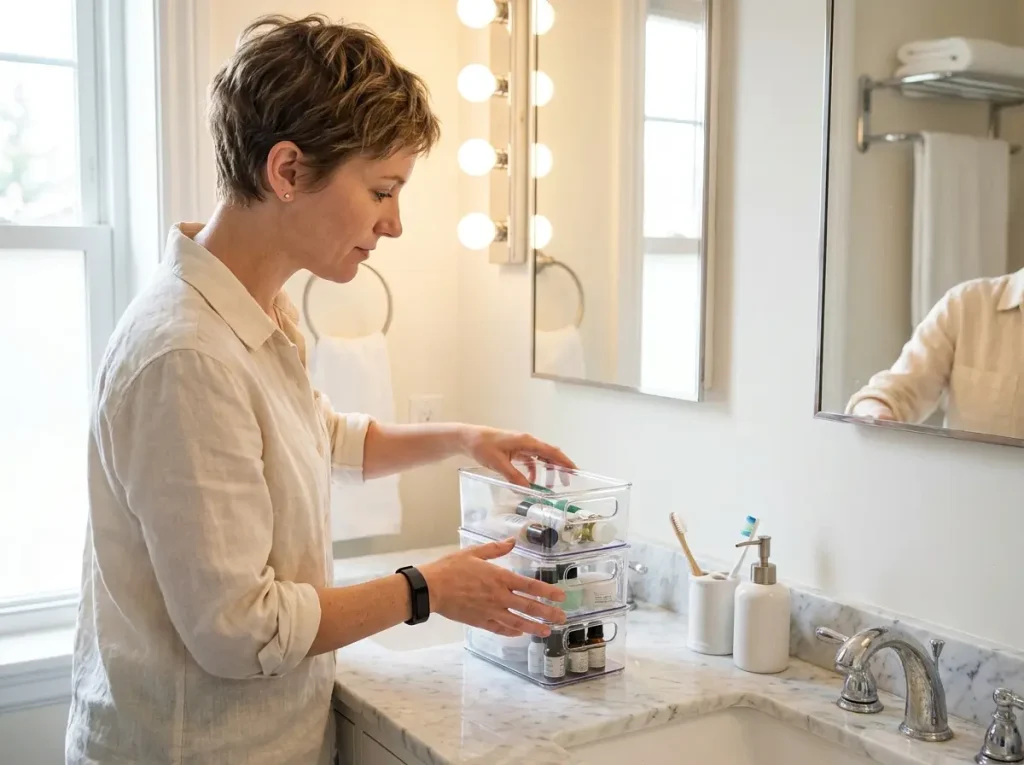
For the items that do stay on the counter, contain them in one footprint so they don’t spread. A single mDesign stackable bin corrals your remaining daily items into one spot instead of letting them drift across the entire counter surface. Clear sides mean you can see what’s inside without opening anything, and the stackable design lets you build a second tier if you share the bathroom and each person needs a dedicated container.
A small turntable in the corner of the counter works if you have more than four daily items but fewer than eight. Anything beyond eight means you need to move things to a different zone entirely. The counter isn’t a storage solution — it’s a staging area for what you’re using right now.
Shower and Bath Organization
Choosing the Right Shower Caddy for Your Walls
The shower is where most bathroom organization systems fail first. Humidity, weight, and the wrong mounting method all converge to produce the 2 AM crash — every bottle on the floor because the suction cup finally let go.
Here’s what you need to know about mounting: suction cups only stick to smooth, non-porous surfaces. If your shower tile is textured, patterned, or has wide grout lines, suction cups will not work — regardless of what the product listing promises.
Adhesive-mounted caddies (the kind with a foam tape strip) work on smooth tile but need a full 24 hours to cure before you load them with anything. The product instructions say this, and almost nobody follows it. Then they leave a one-star review when the caddy falls.
Tension pole caddies need at least 7 feet of floor-to-ceiling clearance and can leave marks on the ceiling if you over-tension them. If you’re renting, check the ceiling material before cranking the pole tight — popcorn ceilings chip, and painted drywall dents.
The Product Inventory Problem
Before you buy a bigger shower caddy, count how many products are actually in your shower right now. Most showers accumulate 8 to 12 bottles when you really only need 3 or 4: shampoo, conditioner, body wash, and maybe a shaving product. Half the bottles in your shower are probably less than a quarter full and have been sitting there for months collecting a film of soap residue.
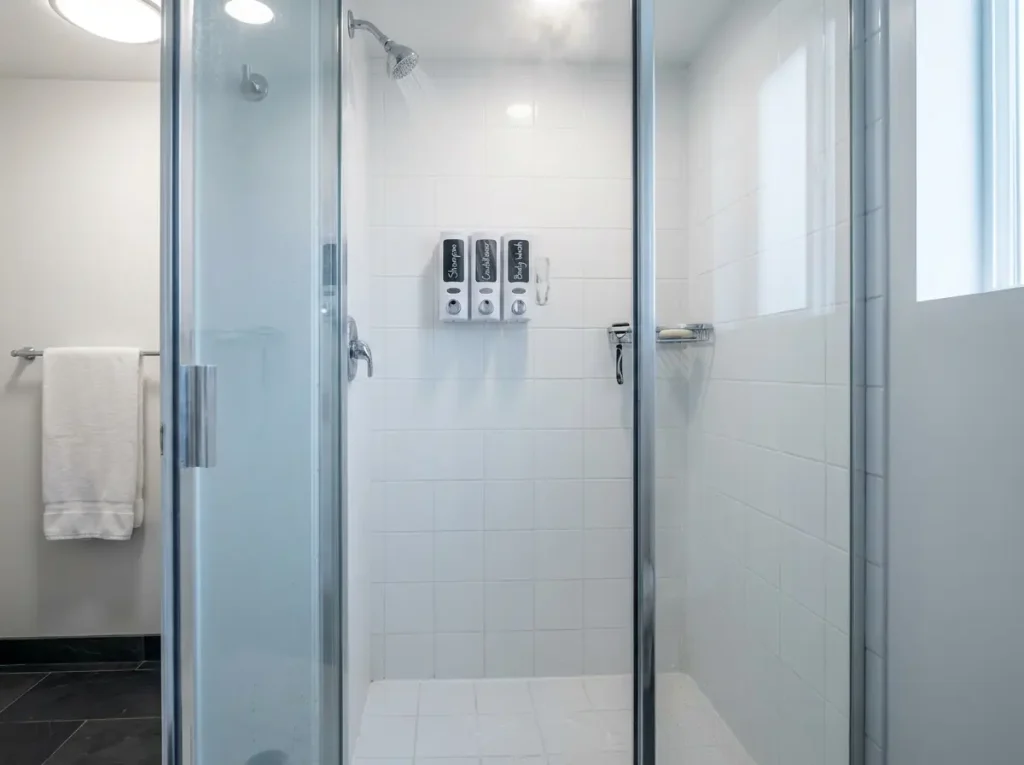
Declutter the shower before you organize it. Consolidate duplicates, toss anything expired or nearly empty, and get your count down to 4 to 6 products. At that point, a single wall-mounted corner shelf or a slim caddy handles everything without straining its mount. Refillable wall-mounted pump dispensers eliminate individual bottle clutter entirely — the dispensers stay on the wall, and you refill them from a bulk bottle stored under the sink.
Pro tip: The less weight on your shower mount, the longer it lasts. Every shower caddy has a weight limit printed on the packaging. A caddy loaded with 8 full shampoo bottles blows past most limits within a week. Reduce the bottle count first, then mount.
Renter-Friendly Storage Without Drilling
What Actually Holds in a Humid Bathroom (And What Fails)
“No-drill” shows up as a feature on almost every bathroom organizer sold online. But in a humid bathroom, not all no-drill methods are equal — and the ones that fail tend to fail dramatically.
Command Bath products are rated for humid environments — the adhesive doesn’t soften from steam like regular Command strips do. Each hook holds up to 3 to 5 pounds on smooth, non-porous surfaces. That’s enough for a towel or a lightweight organizer, not enough for a loaded shelf of bottles.
They also don’t work on textured tile, wallpaper, or unfinished surfaces — if you’re not sure about your walls, stick a test hook up for 48 hours before hanging anything you’d miss at 3 AM. The same principles you’d apply for no-drill closet organization in an apartment work here — test before you trust, and never exceed the rated weight.
Freestanding Solutions That Move When You Do
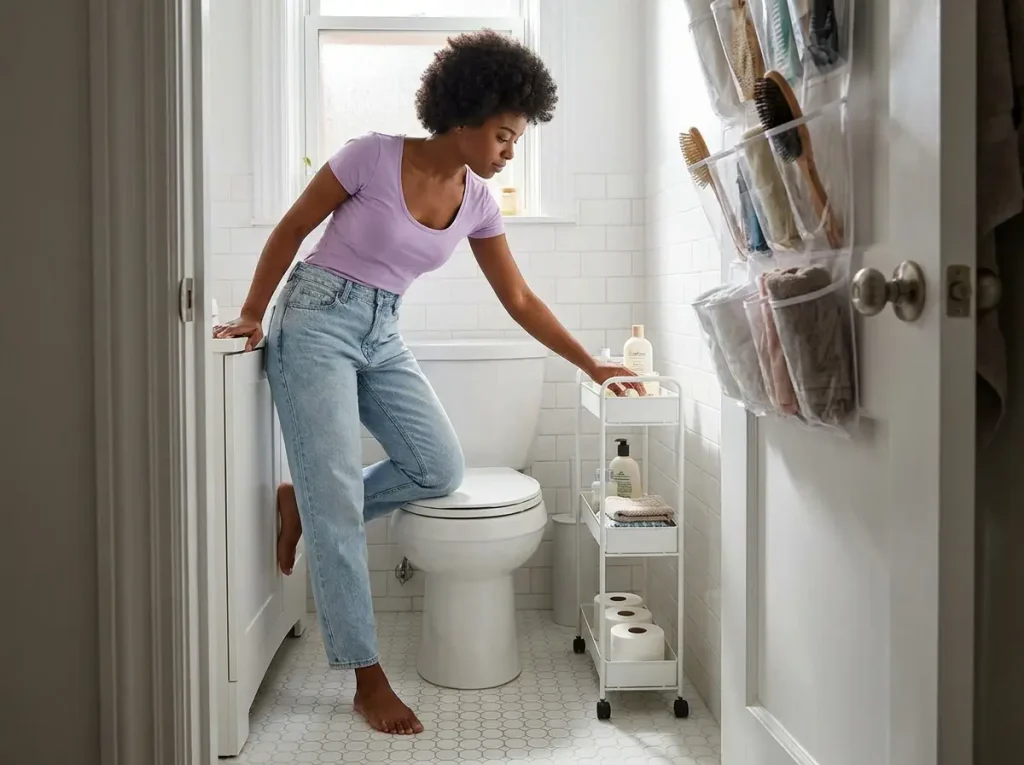
The most reliable renter solutions don’t touch the walls at all. A slim 3-tier rolling storage cart at roughly 7 inches wide fits the gap between most toilets and the adjacent wall — that 12-to-18-inch space you measured earlier. It rolls out for access, slides back flush against the wall, needs zero installation, and goes with you to the next apartment. The same slim cart profile shows up in apartment pantry setups because it works in any narrow gap, bathroom or kitchen.
The inside of your bathroom door is another surface that almost nobody uses. A SimpleHouseware Over-The-Door Organizer hangs on metal hooks over the door and gives you five tiers for toiletries, a hair dryer, brushes, travel-size bottles, and small accessories — all without touching a wall. Two things to watch: most over-door organizers top out at 10 to 15 pounds total weight capacity (a full-size shampoo bottle weighs about 1.5 pounds, so do the math before loading all five tiers), and the door needs at least an inch of clearance at the top for the hooks to fit without scraping the frame.
Conclusion
Three things separate a bathroom that stays organized from one that reverts within a month.
Zone first. Sort everything in your bathroom by how often you use it — daily, weekly, or backstock. Each frequency zone gets a different storage location and a different type of organizer. When daily items mix with backstock, clutter wins every time.
Measure first. The four numbers — toilet-to-wall gap, tank width, under-sink pipe clearance, and over-toilet shelf depth — determine which products will actually fit your space. Buy after you measure, not before. A tape measure saves you more money than any coupon code.
Humidity is the real opponent. Renter or owner, regular adhesives, suction cups, and standard Command strips all soften in a bathroom over time. Use bath-rated products, freestanding units, or over-door organizers that bypass the wall entirely.
Three-Month Check: In 90 days, press every adhesive hook and test every suction cup in the bathroom. Replace anything that gives even slightly before it lets go and sends your bottles crashing onto tile at 2 AM.
Start with the counter. Get it down to three items. That single change makes the whole bathroom feel bigger — because it is.
Q1 What is the best storage for a small bathroom without a cabinet?
A freestanding over-toilet shelf creates 3 tiers of storage without touching the walls. Pair it with an over-door organizer and a slim rolling cart beside the toilet, and you have a complete system in a bathroom with zero built-in cabinets — all renter-friendly, all portable.
Q2 How do you organize a small bathroom with no storage?
Create storage in the space you already have: the wall above the toilet, the back of the bathroom door, and the gap beside the toilet. A 3-tier freestanding shelf, an over-door organizer, and a 7-inch-wide rolling cart give you functional storage without any drilling or permanent modification.
Q3 What should I put in a small bathroom for storage?
Sort by frequency. Daily items (toothbrush, face wash, moisturizer) go on the counter or in a medicine cabinet. Weekly items go under the sink or in a shower caddy. Backstock like extra toilet paper and towels goes on the bottom tier of over-toilet storage or in a linen closet.
Q4 How do you maximize storage in a tiny bathroom?
Use vertical space and behind-the-door space first — these are the two surfaces most people ignore. Floating shelves or a freestanding unit above the toilet, hooks on the door, and a slim cart beside the toilet are the three highest-impact moves. Once those are set up, your floor and counter stay clear.
Q5 Do Command strips work in bathrooms?
Standard Command strips soften in bathroom humidity and fail within a few months. Command Bath strips are rated for humid environments and hold 3 to 5 pounds per hook on smooth, non-porous surfaces. Regular Command strips belong in bedrooms and hallways, not bathrooms.
Disclaimer: ClutterlessNest is a participant in the Amazon Services LLC Associates Program. As an Amazon Associate we earn from qualifying purchases. This article may contain affiliate links — if you buy through them, we may earn a small commission at no extra cost to you. We only recommend products we have tested or genuinely believe in.