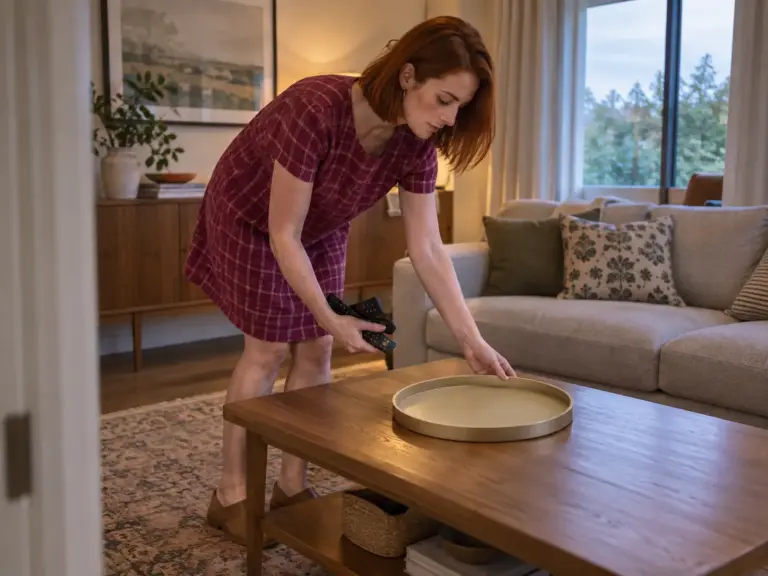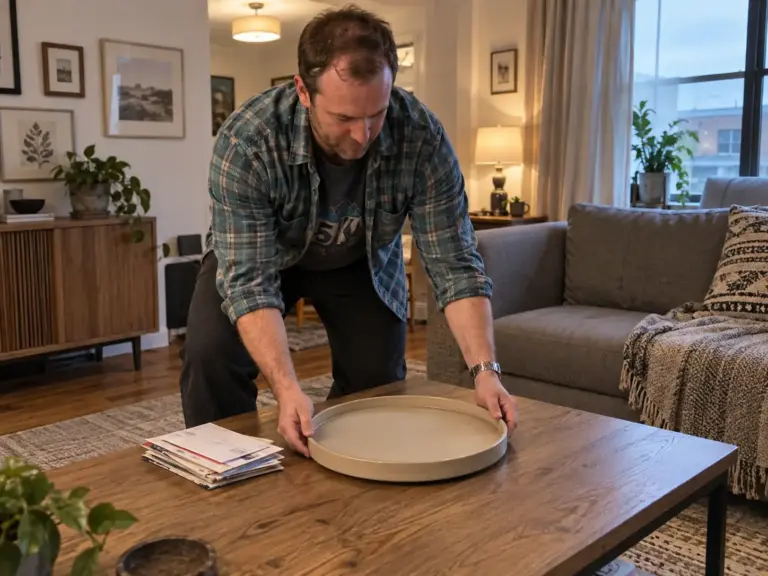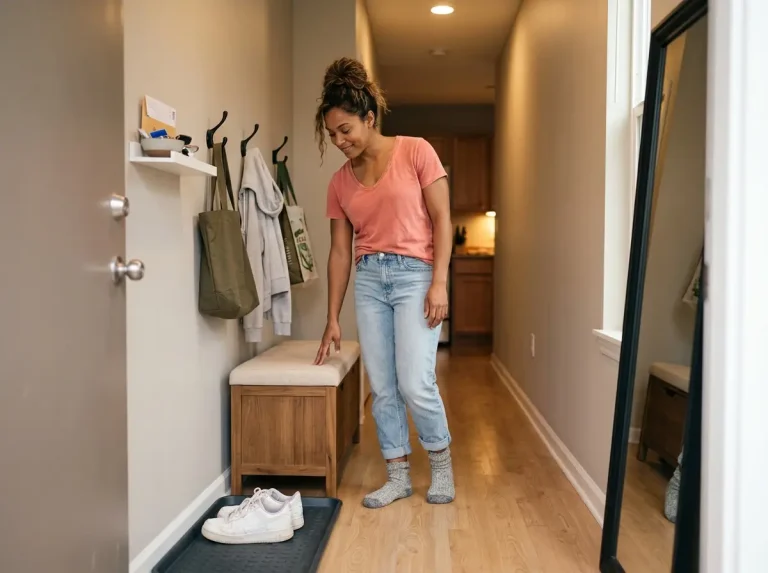
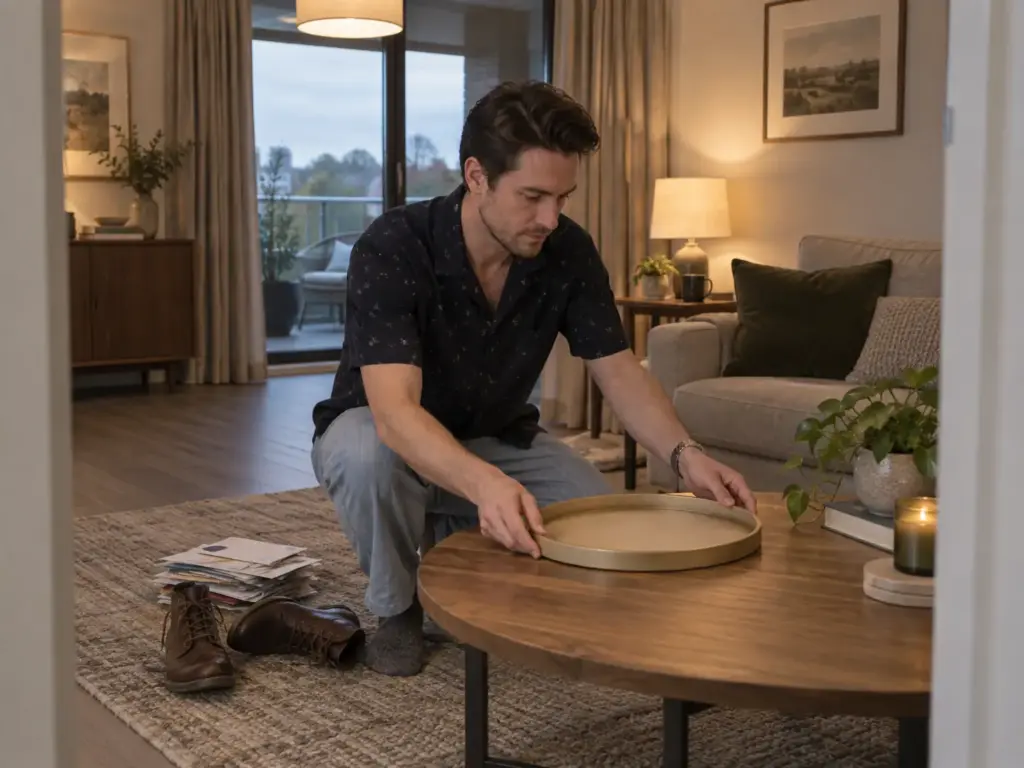
You cleared the coffee table on Sunday. It looked good. By Wednesday there’s mail, two remotes, a charger, and a mug ring on it again, and you didn’t do anything wrong. Here’s the part almost nobody says out loud: your coffee table re-clutters because of where it sits, not because of who you are.
It’s the first flat surface at hand height between your front door and your couch, which makes it a magnet no amount of discipline can switch off.
So this is the tray-to-table math nobody gives you, how to hide the everyday items without making them annoying to reach, how the same coffee table organization system extends to every other flat surface in the room, and the reset that keeps it working past week one.
Quick Answer
Organizing a coffee table so it stays organized takes five steps, in this order:
- Clear the surface completely, down to bare wood.
- Set down one tray covering a third to half the table.
- Give each floating category one container: remotes, mail, chargers.
- Leave the outer four to six inches of the table bare.
- Run a two-minute reset every evening before bed.
Why Your Coffee Table Gets Cluttered Again in Three Days
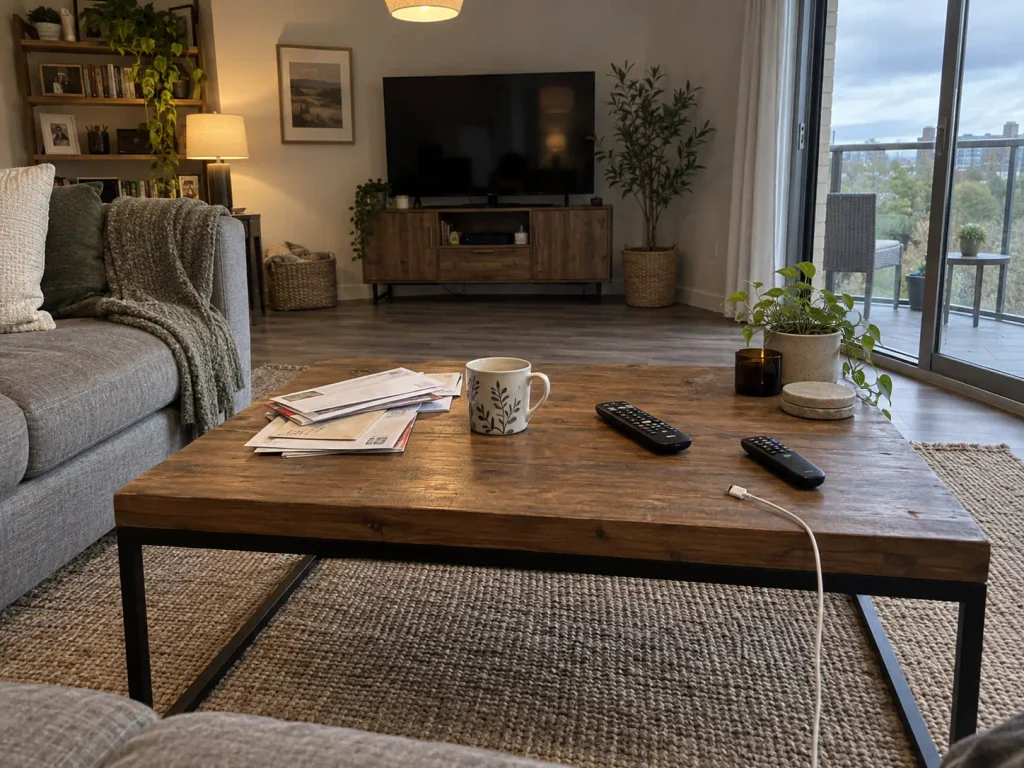
The Sunday reset is a ritual almost everyone here has performed. You stack, you wipe, you stand back. And by Wednesday it’s gone. The useful question isn’t how to style it better, it’s why the styling never holds.
The Landing-Pad Problem (Why Position Beats Discipline)
Certain spots function as transition zones: the entryway console, the kitchen counter nearest the door, and the coffee table. These are landing pads, the first flat surface an item touches when it enters the house. You walk in holding mail, keys, a phone. You sit down.
Whatever is still in your hands goes on the nearest surface at hand height, and with a couch behind it, a 16 to 18 inch coffee table is exactly that.
So the table collects by position. It would collect for a different person with different habits in the same apartment. Rearranging the objects on top does nothing to the traffic feeding it, which is why a styled arrangement is really a countdown with nice ceramics on it.
Floating Items: The Things That Have No Home
A second mechanism decides how fast the pile regrows. An item becomes a floating item when it has no assigned container anywhere in the house. Not messy, not unsorted. Homeless.
Mail, remotes and charging cables are the classic three, and they share a trait: nobody ever decided where they live, so they live wherever they land. There’s an interior therapist’s explanation of why clutter keeps returning to the same surfaces that goes deeper into the psychology, but the practical version is short: an item with a home gets put away in two seconds, and an item without one requires a decision. Decisions made while holding groceries always resolve to “here, for now.”
Why a Sunday Reset Alone Never Holds
Put both mechanisms together and the failure is obvious. Your table is a landing pad receiving floating items, and a reset removes the items without touching either mechanism. Wednesday’s mail has no more of a home than Sunday’s did.
“Every surface gets filled with clutter” is a real thread title in r/organization, and it pulled 736 upvotes and 136 comments in a community where most posts get a handful. That’s not a niche confession, it’s the default state of a living room with people in it.
So the reframe for everything below: you are not organizing a table, you are building a landing pad that has somewhere to put things, which is the only version of clutter-free surfaces that lasts. Some of that landing pad clutter shouldn’t reach the living room at all, which is what a real drop zone by the door is for. Intercept keys and mail at the entryway and the coffee table’s job gets much smaller.
The Tray Rule That Makes a Coffee Table Look Intentional
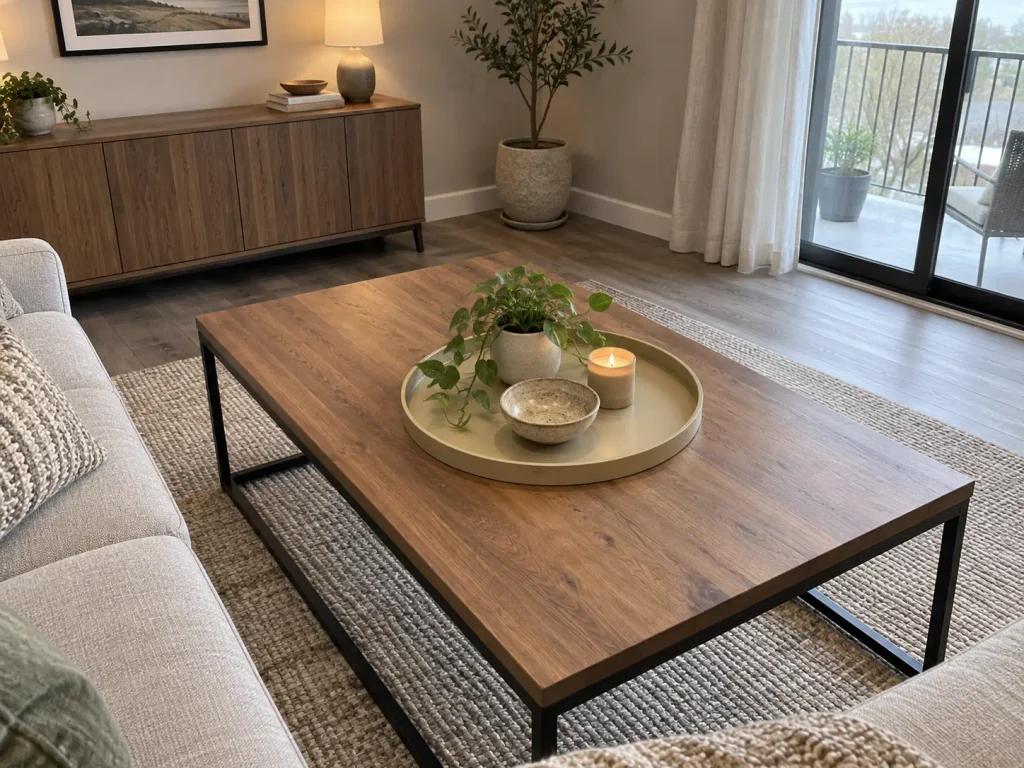
Every guide on this subject says “use a tray.” Not one says what size, and that omission is why so many trays fail. Too small and it floats on the table like a coaster with ambitions. Too big and you’ve moved the clutter onto a raised platform.
How Big the Tray Should Actually Be
The proportion that works: a tray should cover roughly one-third to one-half of the table’s surface, or about two-thirds of its length. On a standard 48-inch coffee table, that’s the 28 to 32 inch range for a rectangular tray. On a 36-inch table, a round tray of 11 to 14 inches does the same job.
Height is the part people skip. Since standard coffee table height typically runs 16 to 18 inches, the surface already sits below eye level when you’re seated. Stack a deep tray plus a tall candle on it and you’ve built a wall across the middle of the seating area. Keep the tray under an inch tall and let the objects inside carry the height.
And before buying anything: if you own a flat woven basket, a serving tray or an unused baking sheet, that’s your tray. The proportion does the work here. The price tag doesn’t.
Measure your table before you shop, then subtract two inches from the tray size you calculated. A tray that lands exactly at one-half looks correct in a photo and feels tight in person, because nobody accounts for the mug that has to sit next to it.
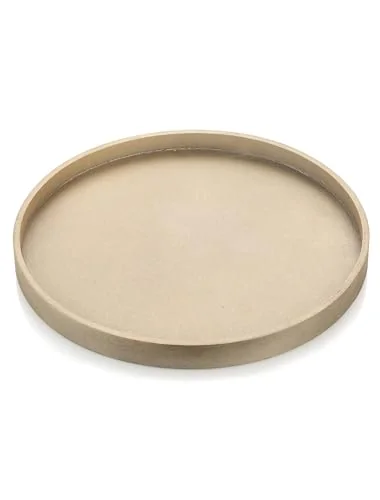
If you’d rather buy for the role than improvise, the Hanobe Round Decorative Tray runs 11.8 inches with a profile under an inch tall, landing inside the one-third rule on a 36 to 48 inch table without touching the sightline. Anti-slip pads keep it put on a smooth tabletop. The caveat is the material: MDF handles dust and a wipe, not a spilled glass left sitting, so it wants a coaster under anything wet.
The Bare Rim Nobody Talks About
Here’s the rule the entire internet skipped: leave the outer four to six inches of the table completely bare. All the way around. Nothing in that band, ever.
That rim does two jobs. Visually it’s the margin that makes the arrangement read as chosen rather than accumulated. Functionally it’s the working surface, where the mug goes, where the plate goes, where the laptop corner rests.
Without it, every drink you set down displaces something, and the displaced thing never goes back. Most guides call this “breathing room” and stop there. Breathing room, or negative space if you want the designer’s word for it, is only a suggestion until somebody attaches a number to it.
What Goes In the Tray (and What Doesn’t)
The tray holds things you want visible and occasionally use: a candle, a natural element like a small plant or a sprig of greenery, a coaster stack, one remote if you insist. A decorative bowl works here too. It does not hold mail or paperwork. The moment an item with a pending decision enters the tray, the tray becomes a pile with a border around it.
Why it works is almost embarrassingly simple. A tray converts “seven things scattered on a table” into “one object on a table.” Nothing has to be put away, it has to be put inside.
Layering and Grouping That Survives a Real Room
The styling rules are not wrong. Varied heights genuinely look better than a flat field of objects, and groups of three read better than groups of six. The problem is they were written for a table nobody touches. Here’s the version that survives real-life mess and someone setting down a drink.
Vary the Heights, But Keep the Sightline
The standard approach is layering heights: one tall element, one mid, one low: a vase or candle, a small bowl or plant, a stack of books. Varied heights give the eye somewhere to travel instead of reading the surface as one cluttered plane.
The modification real rooms need is to keep the tall element off the center line. A 12-inch vase in the middle of a coffee table sits right at the eye level of two people talking across it from opposite couches. Push it to a corner of the tray and it stops being a wall.
Stacking Books So the Pile Stops Growing
Stack books largest to smallest, three or four maximum, coffee table books included. That part is easy. The hard part is that magazine piles regrow weekly because magazines keep arriving, which makes the unedited pile the one styling failure with a built-in resupply.
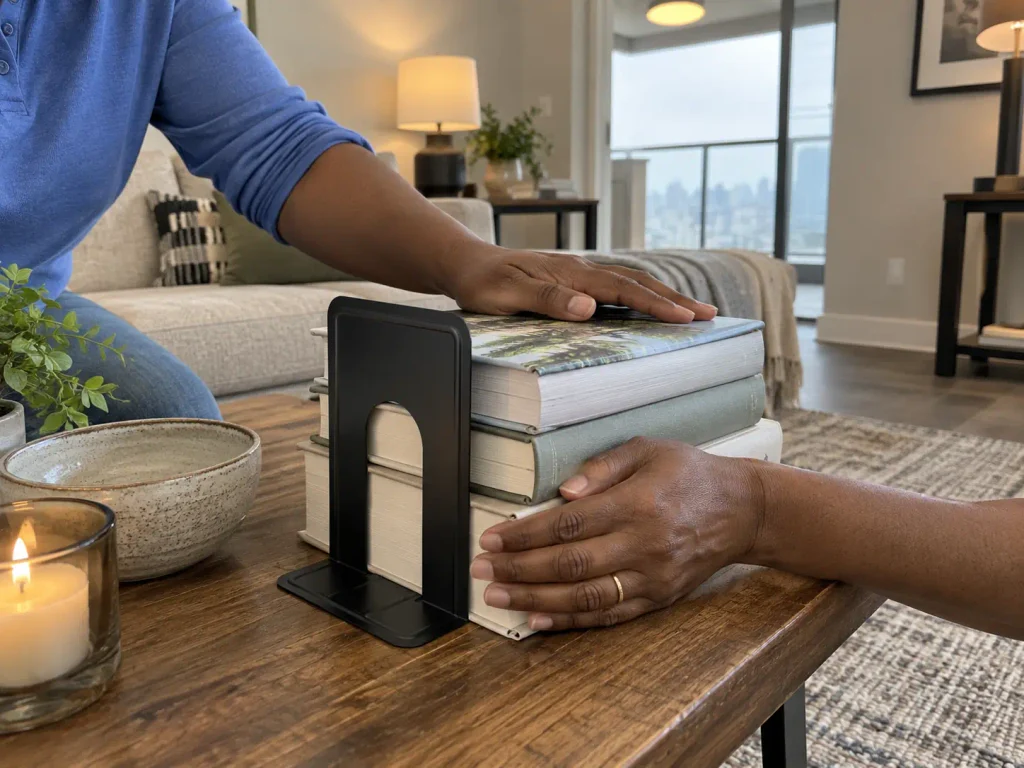
A stack with a physical stopping point behaves differently than one that just sits there. Two heavy books turned on their sides work, and so does a brick wrapped in fabric, which costs nothing and is the budget-friendly answer.
For the tidier version, the MaxGear 8.5 in Heavy Duty Metal Book Ends have enough mass at 8.5 inches of heavy gauge metal to hold a short horizontal stack without sliding. They’re designed for upright shelving, so on a low table it’s a slightly improvised job. If your stack is three books, skip them.
Mixing Textures and Materials Instead of Matching Them
Odd number grouping gets recommended everywhere, and it works. But the reason usually given (visual balance) isn’t the useful one. The useful reason is that odd groups are easier to rebuild from memory. A group of three has an obvious shape. A group of six has a layout, and a layout requires someone to remember it.
That’s the whole test, honestly. The arrangement that survives is the one anyone in the house can put back. If restoring your coffee table requires knowing which candle goes where, it will be wrong by Thursday and stay wrong until you fix it, which means you now own a chore you invented.
Texture mixing does more work than color here: wood against ceramic against a woven tray against one metal object. Four different textures and materials in one group is the target. Four materials look chosen; four matching pieces look like a set someone bought. The logic scales up to the same one-surface rule applied to a media console, where the object count is higher but the principle holds.
Photograph the finished arrangement once with your phone and keep it in a favorites album. Anyone in the house can rebuild it in ten seconds from a photo, including the person who genuinely cannot see the difference between the candle on the left and the candle on the right.
Where the Remotes, Mail and Chargers Actually Go
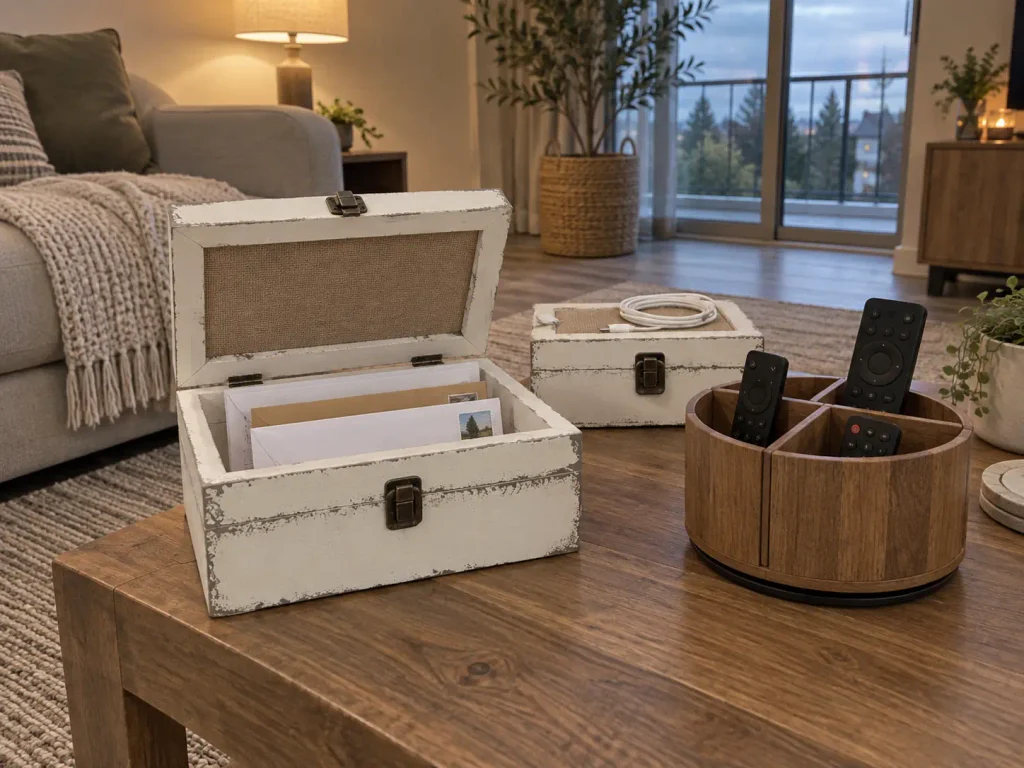
This is the section that decides whether the whole thing holds. Every styling guide tells you to hide everyday items in a decorative box. None mention that if the box is annoying to open, everyone stops using it by day four and it becomes a decoration sitting next to the pile it was meant to absorb.
One Container Per Category, Named Out Loud
One container per category, and the category has to be named.
A box for mail, which is all mail organization really needs at this scale. A dish by the door for key organization. A lidded decorative box for the batch items, a caddy for remotes. One shallow dish for cables.
No catch-all box. That one-category rule is the whole mechanism, because an unnamed container becomes a “miscellaneous” container, and the miscellaneous section always wins. Give a drawer one undefined compartment and within a week it has eaten the other four.
Before buying anything, look around the house. A shoebox works, and so does a decorative box currently holding nothing in the bedroom. Find out whether your categories are right before spending on matching containers.
The Lid Friction Rule
Here’s what separates a system that lasts from one that doesn’t: a lid is a barrier, and barriers are priced per use.
Anything you grab several times an evening belongs in something open or rotating. Every time someone lifts a lid, puts a remote in and closes it, they pay a small tax, and by the fourth night they stop paying. An open lidded box is worse than no box: now it’s a bin with a flap in the way.
Items that arrive in batches and then sit are the opposite. Mail comes once a day and gets handled later, so it goes behind a lid happily, because you pay the tax once rather than eight times. Get this backwards and you’ve built a system that fights its own users.
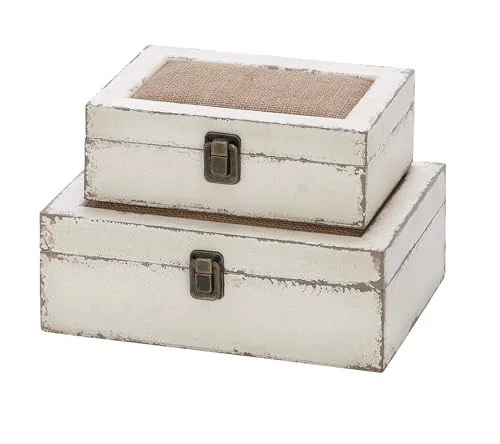
Worth saying plainly: a hinged lid is the right call for mail and cables and the wrong call for remotes. Use these two boxes for the batch items and keep remotes out of both.
When the Household Won’t Use Your System
I used to think the answer here was better labeling. Reading enough shared-household threads changed my mind, because the pattern is consistent: labels don’t fail, friction does.
The system that survives in a shared living room with a partner and kids and pets is the one with the lowest friction for the person least invested in it. Design for them, not for you. You’ll use any system because you built it. They will use exactly the systems that are faster than the floor.
For remote storage that means open access. The Coideal Wood Remote Control Holder is a six-compartment wooden caddy that spins 360 degrees, so anyone on any side of the table can grab one without standing up or opening anything. Six slots covers the real household count: TV, soundbar, streaming stick, and whatever came with the fan. The downside is footprint, since it takes real tray space, so on a small table it may need to live on a side table.
Mail needs one more thing a container can’t give it: an exit. A box that’s never emptied is a slower pile with a lid on it. Pair it with the weekly pass below or it overflows back onto the surface within a month.
Extending the System to Every Other Surface in the Room
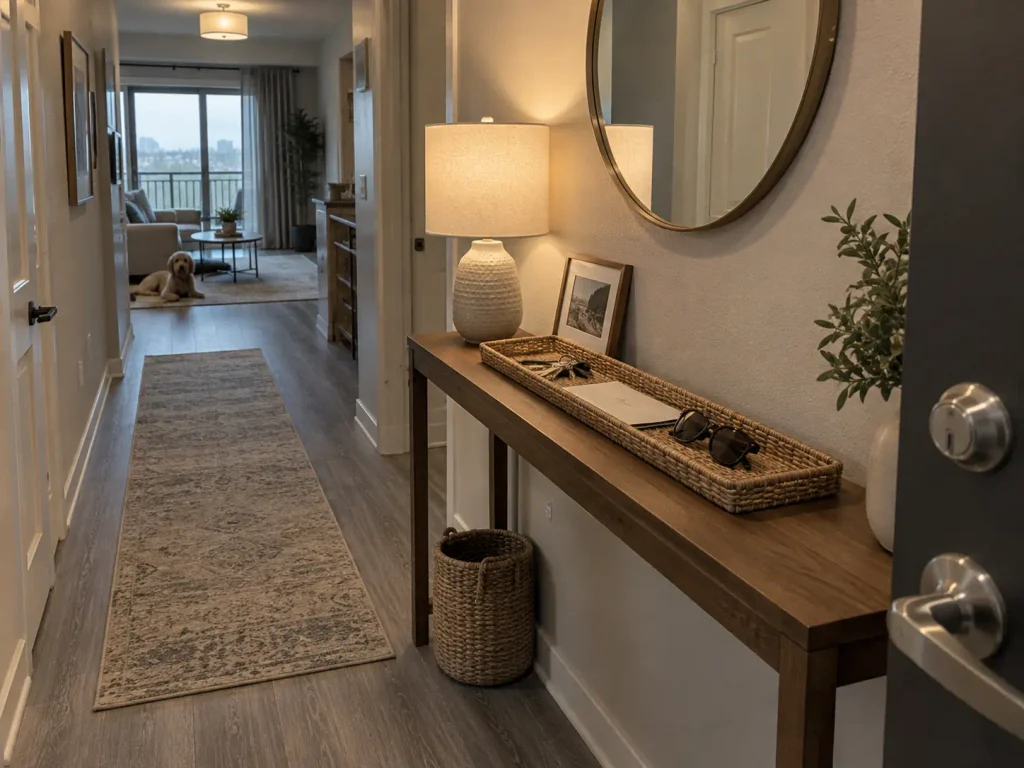
The coffee table gets all the attention because it sits in the middle of the room. Meanwhile the console by the door and the side table next to the couch collect the same things, usually worse, because nobody has ever tried to fix them. Two rules transfer intact: one corral, and a bare band around the edge. What changes is the arithmetic.
Console Table Organization Needs a Different Shape of Tray
A console is the opposite of a coffee table in every dimension that matters. Consoles run 28 to 32 inches tall against a coffee table’s 16 to 18, and a console table’s usual footprint of 36 to 48 inches wide and 12 to 18 inches deep makes it long and narrow where a coffee table is broad.
Two consequences. A square tray is wrong here, so you want something long and shallow, and after subtracting the bare band from a 14-inch depth you have maybe six usable inches front to back. More important: the console sits at hand height by the door, which makes it the actual first landing pad in most homes. Fix the console and the coffee table’s volume drops on its own.
Side Table and End Table Organization Where Empty Space Is the Point
Side table organization is the hardest case in the room, and end tables are the same problem. Small, at arm’s reach from wherever you sit, and holding exactly one non-negotiable job: a drink.
So the ratio inverts. On a side table the corral takes less than a third of the surface rather than half, because the usable space is the point, not the leftover. One small dish, one coaster, a lamp base. The classic failure is treating it as a miniature coffee table and styling it until there’s nowhere to set a glass, at which point the glass goes on the floor and stays there.
Ottoman Top Storage and Why the Tray Has to Be Rigid
Ottoman tops need a rigid tray, not a decorative one. A soft upholstered top has no flat plane, so anything set directly on it tilts, and after a drink tips over once people stop putting anything there permanently. A firm tray with a flat underside creates the surface the furniture doesn’t have.
The upshot across all three: one tray can migrate. The same round tray that corrals a coffee table works on an ottoman top and a designated drop zone on the entryway console, so you can test the system on one surface before buying for three. Start with whichever annoys you most. The logic runs outside this room too, and the same catch-all tray logic on a dresser top solves the bedroom version of it.
Do the surfaces in traffic order, not in size order: console first, then coffee table, then side tables. Every surface you fix upstream reduces what lands on the ones downstream, so the last one is usually half the work you expected.
When the Table Has Three Jobs (Renters and Small Apartments)
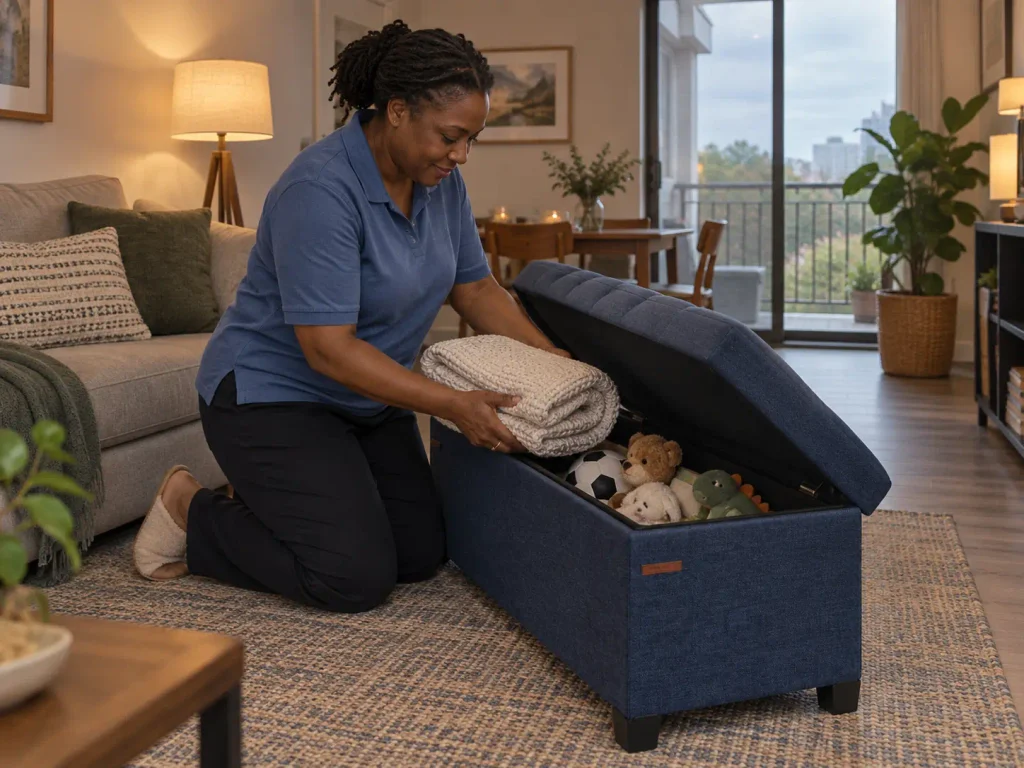
“Leave seventy percent of the surface empty for styling” is advice written for a table that does one job. If yours is where you eat dinner on a Tuesday, where the laptop goes on Thursday, and where a four-year-old builds things on Saturday, none of that applies. That’s not a failure to organize. That’s a piece of furniture doing the work of three.
When the Surface Is Working Space, Not Display Space
In a multi-use room every square inch on top of the table is working space, which means storage has to live inside the furniture rather than on it. A tray with a candle and three books is a luxury a table that hosts dinner can’t afford, because all of it has to move before the plates go down, and anything that moves nightly eventually moves to the floor and stays there.
Storage That Lives Inside the Furniture
The clear-down rule for a multi-use table isn’t about where things sit, it’s about how fast the surface empties. Aim for a table you can clear in under a minute, which only works when everything on it has one destination rather than four. Four destinations is a sorting task, and sorting tasks get postponed.
Which points at the highest-leverage change available in a small living room: reclaim the dead space under the table surface, the one piece of volume every room already owns and replace the coffee table with a piece that opens. A lift-top table or a storage ottoman is multi-functional furniture in the most literal sense: it converts decorative surface into real interior volume, and volume is what small space living rooms are short of. There’s more on furniture that does more than one job if you’re weighing specific pieces.
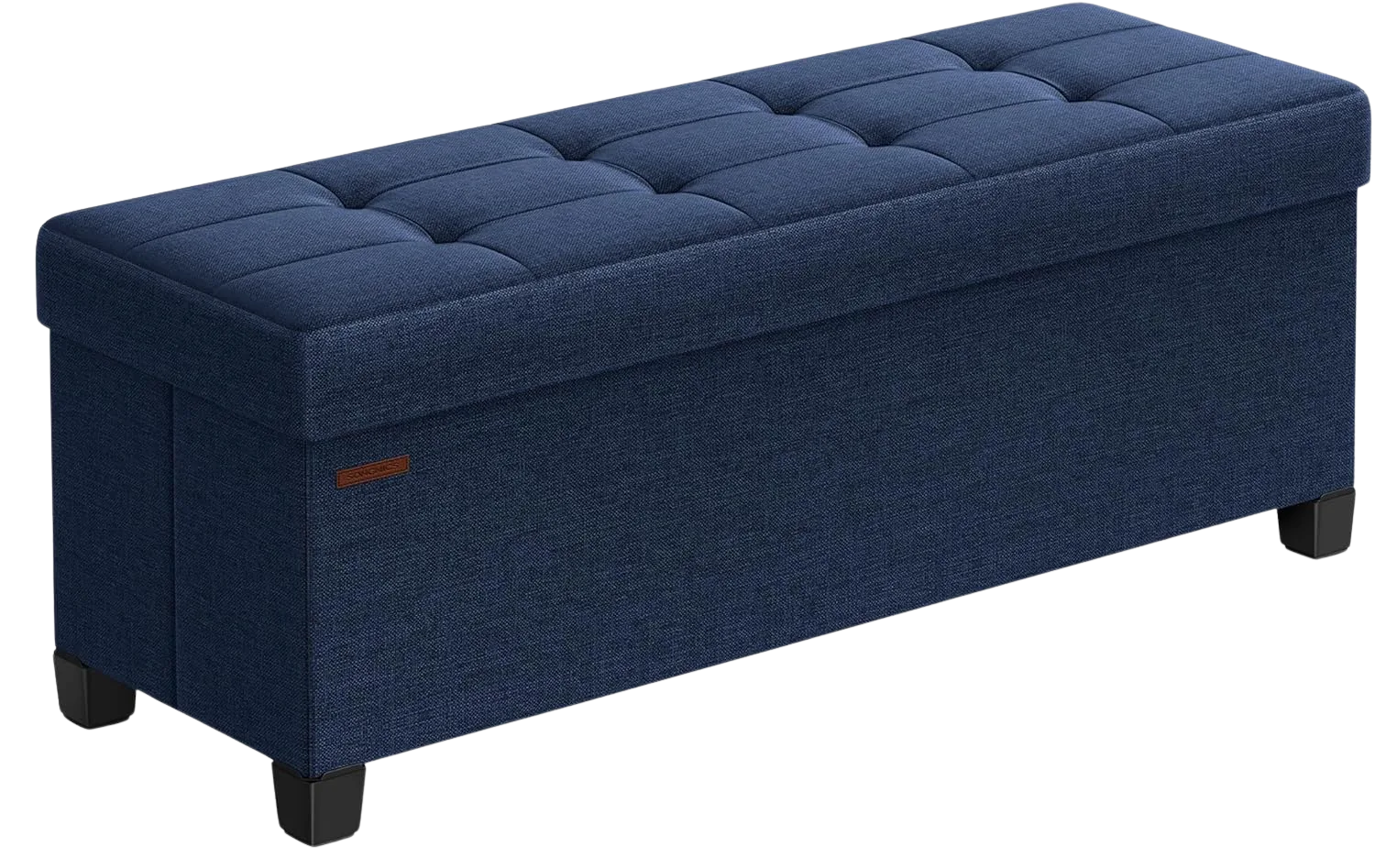
The honest caveat: an upholstered top is a poor drink surface, which brings back the rigid tray from the last section. Ottoman plus firm tray is the combination that works. Ottoman alone means a permanent search for somewhere to put a glass.
Renter Constraints That Change Nothing Here
Every solution here is renter-friendly and freestanding. No-drill throughout: no adhesive strips, no wall anchors, nothing needing patched in eighteen months. That’s not an accident, and it matters most in this section, because renters are disproportionately the people with one table doing three jobs.
If you’re renting, this is the rare organizing problem where you give up nothing. The tray, the boxes, the caddy and the ottoman all leave with you and work in the next place, which is more than a wall-mounted anything can offer. For the furniture arrangement around all this, how the rest of a small living room should be laid out covers the layout side.
The Reset That Keeps It Working Past Week One

Every article on this subject stops at the after photo, and the after photo is the easy part. What decides whether your coffee table looks like this in March is a two-minute habit, and it’s genuinely two minutes, not the aspirational kind that turns out to be forty.
The Two-Minute Nightly Reset
Everything on the surface goes back to its container or leaves the room. That’s the entire instruction. Not sorted, not evaluated, not decided on. Returned.
That word is load-bearing. Decisions are what make resets get skipped, and a nightly routine that involves opening the mail isn’t a reset, it’s an admin session, and admin sessions get postponed until Sunday. Mail goes in the mail box unopened, four seconds, surface clear.
It also has to happen at a fixed moment attached to something you already do without thinking: the last lamp you switch off, the end of the second episode. A reset scheduled for “when I notice” never happens, because by the time a surface is bad enough to notice it isn’t a two-minute job anymore. It’s a project, and projects need a free Saturday.
The Weekly Mail Pass
Once a week, empty the mail box completely. Shred, file, act, recycle.
This is the one container that fills invisibly, since a closed lid hides its own contents, and when it finally overflows the excess lands back on the table and the whole system looks like it failed. Pick a recurring day for it. Trash night is the obvious one, because the recycling is already going out.
The Monthly Tray Audit
Once a month, look at what’s in the tray and ask what you’ve actually touched. Anything sitting there four weeks untouched isn’t active, and the tray is for active items.
This is the three-month test applied to a surface, and it catches the slow failure nobody notices while it’s happening: trays silently become storage. A tray of dormant objects has stopped being a corral and become a small decorative shelf, with no room left for what actually lands on the table each day. Clear it back to active items and the corral works again. It’s the same one-category bin rule and the monthly reset that keeps living-room bins from turning into archaeology.
Surface decluttering that only moves items into a drawer without a repeating action regresses every time. Removal has to be ongoing, which is what turns it into a maintenance routine rather than a project you complete. The same thinking next door, in the same maintenance logic applied to the TV setup, handles the cable and remote side of it.
If the nightly reset keeps taking longer than two minutes, you don’t have a discipline problem, you have a missing container. Whatever is slowing you down is a category with no home yet. Name it, give it a container, and the reset drops back to two minutes.
The Short Version
Three things carry the whole system. Your coffee table re-clutters because of where it sits, not because of how disciplined you are, so fix the landing spot instead of trying harder. One corral covering a third to a half of the surface, one container per category of floating item, and a bare rim of four to six inches is the complete arrangement, and it transfers to the console, the side tables and the ottoman without modification. The reset is what makes any of it last, and two minutes a night beats two hours in March.
In three months, look at what’s living in the tray that you haven’t touched. If more than a couple of items have gone dormant, the tray has quietly turned into storage, and clearing it back down to active items resets the whole system in about five minutes.
Start with the coffee table alone. One tray, one container, two weeks. Then do the console.
Frequently Asked Questions
01How do I stop things piling up on my coffee table?
Give every category of item that lands there its own container, then reset the surface once a night. Piles form because items have nowhere to go, not because the table attracts them. Once mail, remotes and chargers each have a named home, the surface stops being the default.
02What is the 3-3-3 rule for decluttering?
It is a quick-start method: pick three items to throw away, three to donate, and three to put back where they belong. On a coffee table it works well as a first pass, but it is a decluttering prompt rather than a maintenance system. The containers and the nightly reset are what keep the surface clear afterward.
03What is the root cause of clutter?
Most surface clutter comes from items that have no assigned home, landing on the first flat surface they reach. That is why the same three things reappear on the coffee table days after you cleared it. The missing piece is a container, not more tidying.
04What is the hardest thing to get rid of when decluttering?
Anything with a decision attached: unopened mail, paperwork, and items belonging to someone else in the house. That is exactly why the nightly reset is a returning action rather than a sorting one. Decisions are what make people skip it.
05How much of a coffee table should be left empty?
Keep the outer four to six inches of the surface completely bare and let a tray cover roughly a third to a half of the rest. The bare band is what makes the arrangement look intentional, and it is the space you actually put a mug or a plate on.
Disclaimer: ClutterlessNest is a participant in the Amazon Services LLC Associates Program. As an Amazon Associate we earn from qualifying purchases. This article may contain affiliate links — if you buy through them, we may earn a small commission at no extra cost to you. We only recommend products we have tested or genuinely believe in.