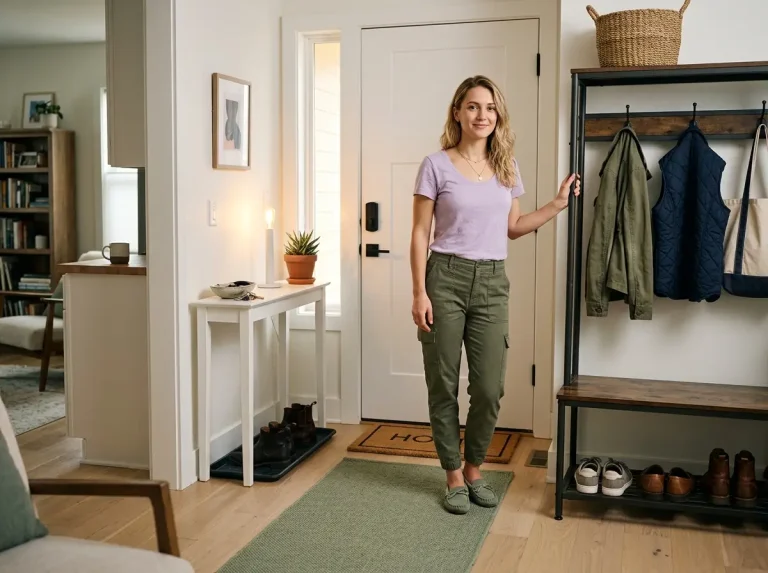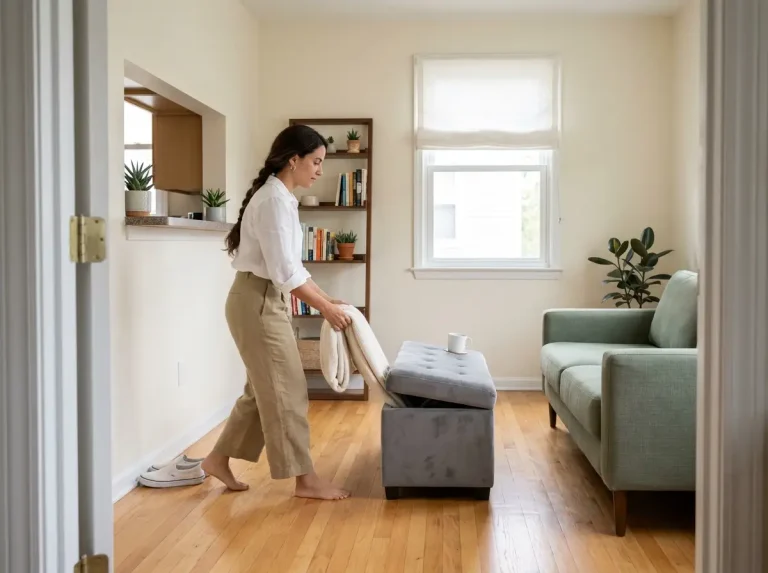
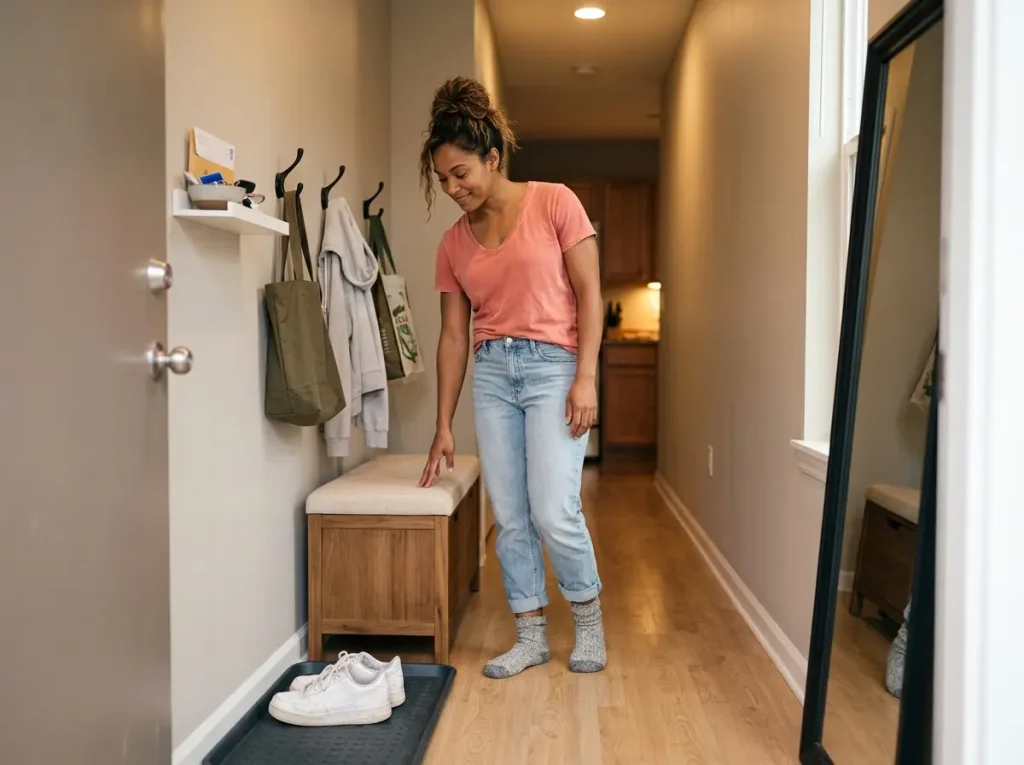
The entryway is the first thing you see when you walk in and the last thing anyone bothers to fix. Shoes pile up at the door. Coats end up on the back of a chair. Keys vanish into whatever pocket or counter they land on first. This isn’t a discipline problem — it’s a design problem. After organizing dozens of small apartment entryways with these exact constraints, the pattern is always the same: nothing has a designated spot, so everything defaults to the floor.
These nine ideas build a small entryway organization system zone by zone — from measuring the space correctly to building the shoe, coat, and key stations that actually hold up past the first week.
Quick Answer: The best small entryway organization ideas work because they create dedicated zones instead of generic “storage.”
- Measure walkway width and door swing before buying any furniture
- Set down a boot tray to anchor your shoe zone at the door
- Use adhesive wall hooks rated for 20 lbs to handle coats and bags
- Create a landing pad for keys and mail at eye level
- Go vertical with shelves and rails above your furniture line
- Build a 10-minute weekly reset into your routine so the system holds
Measure Your Entryway Before You Buy Anything
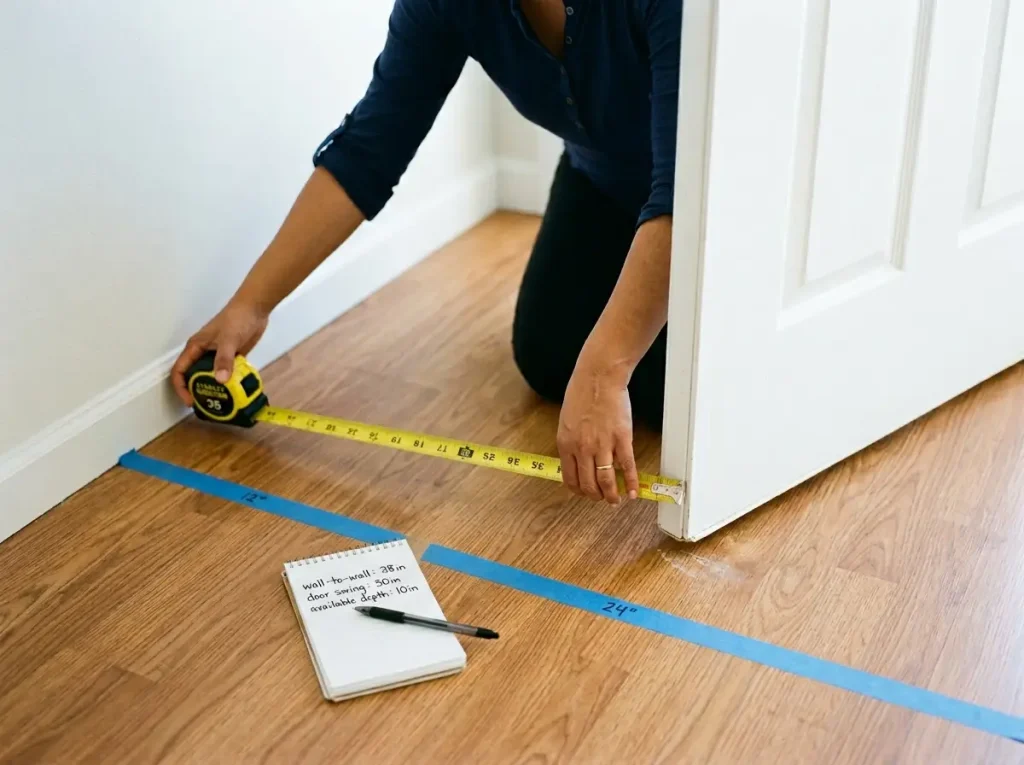
You’ve seen the bench on Amazon. It looked perfect in the listing photos. It showed up, you set it in the hallway, and now you turn sideways every morning wearing a coat to get past it. This is the most common entryway furniture mistake, and it happens because people buy before they measure two numbers.
The Two Numbers That Decide Everything
The first number is your walkway width — the distance from wall to wall at the narrowest point. The International Residential Code sets the minimum residential hallway width at 36 inches, and most apartment entryways barely clear it. The second number is your door swing depth — how far your front door sweeps inward when it opens fully.
Here’s the math that matters. A 36-inch hallway with a 12-inch-deep bench leaves you 24 inches to walk through. Comfortable passage with a winter coat on requires 42 to 48 inches. So if your entry is under 42 inches wide, every inch of furniture depth directly cuts into your daily life. You’ll know this matters the first time you try to squeeze past that bench while carrying groceries — it only takes one trip to regret a piece of furniture that’s two inches too deep.
Measure your door swing separately. Front doors swing 30 to 36 inches inward, and nothing can live inside that arc without blocking your way in.
What “Narrow” Means for Furniture Depth
Standard console tables run 12 to 14 inches deep. In a 36-inch hallway, a 14-inch table narrows your passage to 22 inches. Someone carrying a bag will turn sideways every single day. For hallways under 42 inches, you need furniture specifically labeled “narrow” or “shallow” — anything under 10 to 12 inches deep. This is the entryway depth rule that competitors never mention before recommending furniture, and it’s the single measurement that prevents the most expensive organizing mistake you can make in a small space.
How to Map Your Zones Before You Buy
Before you order anything, grab a roll of painter’s tape and mark your zones on the floor. One strip at 12 inches from the wall marks your furniture depth limit. One strip at the edge of your door swing arc marks the no-furniture zone. The gap between those lines is what you actually have to work with — and it’s almost always smaller than you pictured.
Pro tip: Take three measurements before you shop: wall-to-wall width, door swing clearance to the back wall, and available depth on each side of the door swing. Write them on a sticky note and tape it inside your phone case so you have them at the store.
Build the Shoe Zone First
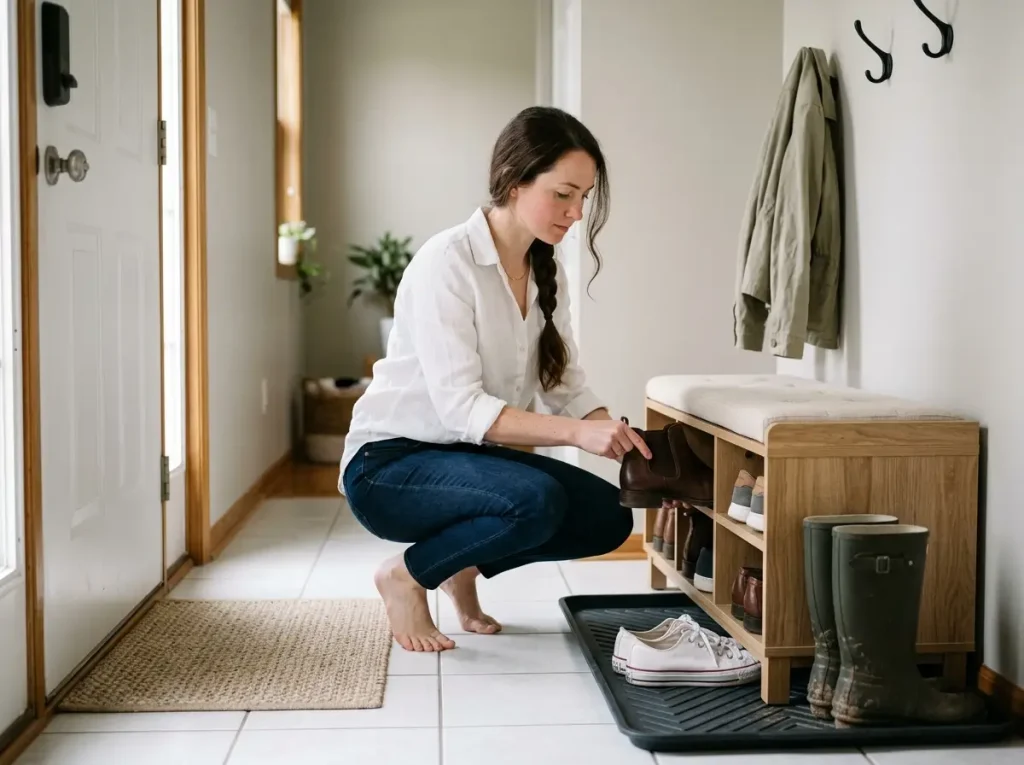
The shoes are always the loudest signal of entryway chaos. Not because anyone is lazy, but because there’s nowhere specific for them to go that doesn’t involve taking extra steps. A boot tray and a bench — two things — fix 80% of the visible mess at your front door.
The Boot Tray: The First Thing to Set Down
A boot tray is the simplest tool that actually works in an entryway shoe zone. It creates a visible boundary that signals “shoes go here,” and the raised edges contain mud and water instead of letting them spread across your floor. The tray works not because it stores shoes — it works because it gives the shoe pile a visible edge. Without that edge, shoes drift outward from the wall an inch per day until they’re blocking the walkway.
The Matace Rubber Boot Tray (27.95″ x 15.74″) fits in front of the door without blocking the path, and the non-slip rubber backing stays put on hardwood or tile. The raised ridges lift shoes off direct contact with water and mud. One limitation: at nearly 28 inches wide, it won’t fit entryways where the door opens directly into a wall with less than 30 inches of clearance. If your door swing leaves no room for a full-width tray, a pair-sized boot tray (13.7″ x 10.6″, 2-pack) slides into the gap where a standard tray can’t.
Bench vs. Shoe Rack: How to Choose for Your Footprint
A shoe storage bench earns its floor space because it serves two functions: seating for putting on shoes and storage underneath. A shoe rack does one thing. In a small entryway, every piece of furniture needs to pull double duty — that’s the core principle behind multi-functional furniture that earns its footprint.
The HOMEFORT 30″ Shoe Bench with Lift Top Storage fits the 30-inch width that most small entryways can handle when a full 36-inch bench is too wide. It holds four pairs in the open cubby underneath and has a lift-top compartment for hats, gloves, and umbrellas. At 14.9 inches deep, it works in hallways 42 inches or wider — but check your measurements first, because in anything narrower, it crosses the depth rule from the section above.
The budget reality: a boot tray alone does most of the work. The bench is an upgrade, not a requirement, and you should skip it entirely if your hallway can’t give up the floor space.
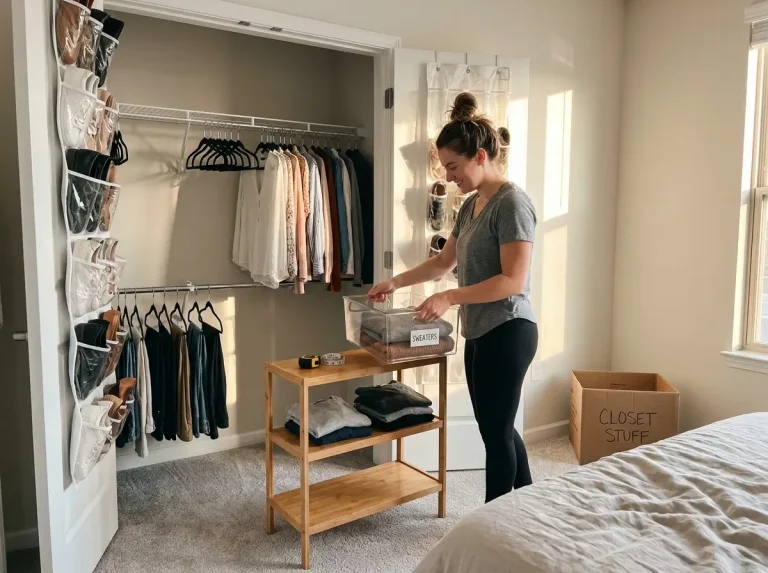
The Door-Back Shortcut When Floor Space Is Gone
When floor space is truly gone, move the shoe storage vertical. The SimpleHouseware Over-the-Door Shoe Organizer (24 pockets) hangs on your entry closet door and holds 12 pairs using zero floor space. It needs about 2 inches of door clearance behind the door to hang properly — check this before ordering. If the door hits the closet rod when it closes, the organizer won’t fit and you’ll be returning it.
Pro tip: Hang the over-door shoe organizer on the closet door, not the front door. Front doors are heavier, open outward, and the weight swings with every entry and exit. A lighter closet door handles the load without rattling or pulling at the hinges.
Coat and Bag Zone: Hooks That Actually Hold
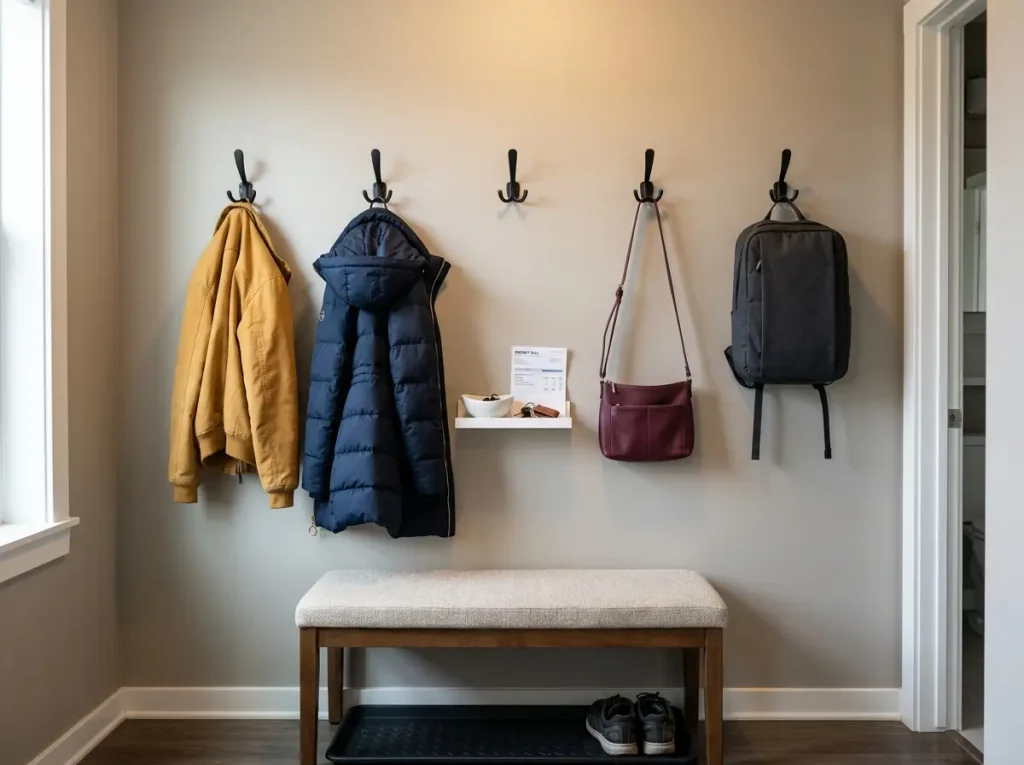
You install hooks, hang a coat and a bag, and two weeks later something is on the floor with a mark on the wall where the hook used to be. This is rarely a product quality problem. It’s a load rating problem and a cure-time problem — and both are fixable before you put a single coat up.
The Weight Rule for Entryway Hooks
A thick winter coat with a scarf and hat weighs 3 to 5 pounds. A loaded school backpack hits 5 to 10 pounds. Most people grab whatever hook looks good on the listing page without checking the weight rating, and that’s why adhesive hooks fail at the entryway — they’re overloaded from day one.
Per Command’s official weight limits, the Large hooks most people grab are rated for 5 pounds. That handles a light jacket, not a winter coat with a bag on top. For entryway coat hooks pulling double duty with bags and coats, you need hooks rated at 10 pounds minimum — 20 if the household carries heavy bags.
No-Drill Adhesive Hooks That Don’t Fall Off the Wall
The 72-hour cure rule is the most-ignored instruction in the adhesive hook category. Every adhesive hook — every single one — needs a full 72-hour cure before you load any weight on it. Mount the hooks, walk away for three days, then start hanging coats. Loading them the same afternoon is why they peel off the wall in two weeks. You’ll hear it before you see it — that slow scraping sound when an overloaded hook finally gives up, usually at night when humidity spikes.
The ChDING No Drill Wall Hooks (6-pack, black metal with wood base) are rated at 20 pounds per hook. That’s enough for a loaded backpack and a heavy coat at the same time. The wood backplate distributes the adhesive load across a wider surface than bare metal hooks, which reduces peel risk on painted drywall. The limitation: adhesive hooks fail on plaster, cement, and textured wallpaper. Most apartments have smooth painted drywall, which works well. Older buildings with plaster walls need screw-mounted hooks or a freestanding coat rack instead.
For lighter loads — a single jacket, a hat, or a reusable shopping bag — Command Large Wire Hooks at 5 pounds per hook are the budget alternative. One coat per hook, no stacking a bag on top. For more on deposit-safe mounting strategies that protect your security deposit, the same adhesive principles apply across every wall-mounted organizer in your apartment.
Pro tip: Before committing all your hooks to the wall, test one in an inconspicuous corner first. Wait the full 72 hours, hang your heaviest item for a week. If it holds, install the rest. If it peels, your wall surface isn’t compatible — switch to screw-mounted or freestanding options before you put six marks on the wall.
One Hook Per Person
This sounds counterintuitive, but installing more hooks than people makes the entryway worse. If you have a household of three and put up five hooks, those two empty hooks become the overflow pile within a week. They collect yesterday’s jacket, tomorrow’s bag, and last month’s scarf. Cap the hooks at the number of people living there. If every hook is full, something moves to the closet or out the door. No overflow capacity means no overflow pile.
Key and Mail Station: The Landing Pad Method
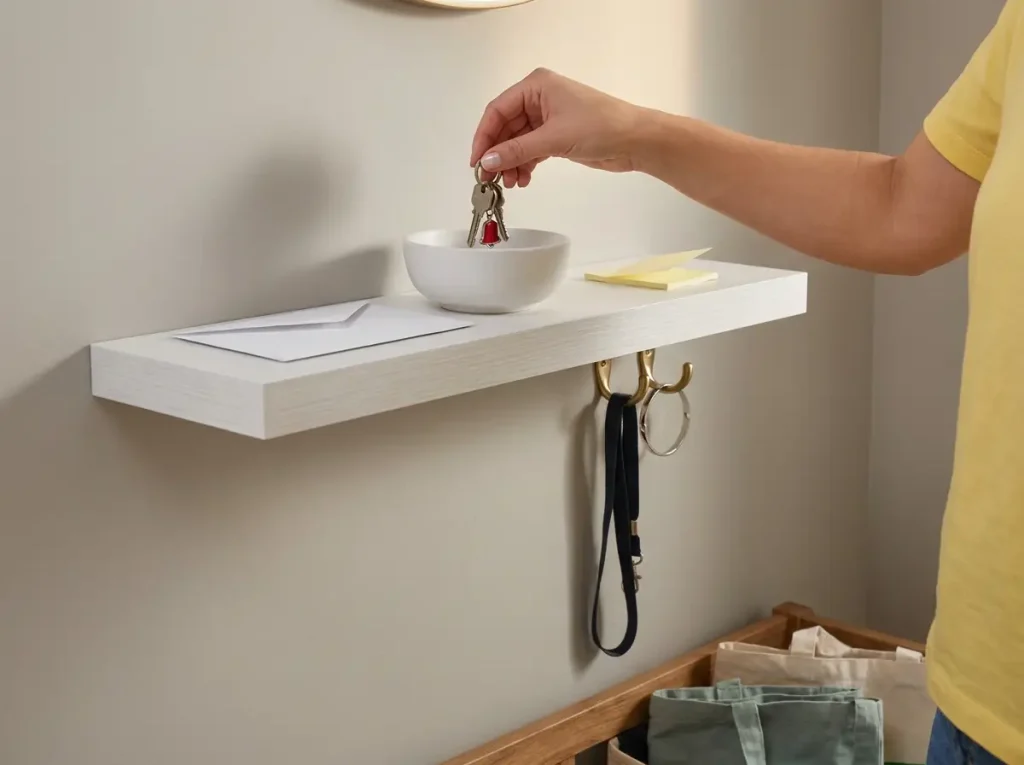
The key black hole is not a memory problem. It’s an absence of destination. Your keys go wherever your hands put them down first — the kitchen counter, the coffee table, inside the coat pocket you wore two days ago. The fix isn’t a better memory. It’s a surface within arm’s reach of the door that intercepts your keys before they scatter.
The Landing Pad Surface: Shelf, Table, or Tray
The landing pad needs exactly two things: a surface and a key anchor. The surface catches what comes out of your pockets when you walk in. The key anchor — a bowl, a hook, or a small tray — gives keys a specific resting spot so they don’t get buried under mail and receipts.
When there’s no floor space for a table, a wall-mounted shelf at eye level does the job. The Floating Wall Shelf No-Drill 16.5″ (2-pack) mounts with adhesive at 60 to 62 inches from the floor and creates a dedicated entryway key organizer surface. It’s renter-safe and removes cleanly with heat. The 2-pack gives you one for the entry and one wherever else you need a surface without furniture underneath.
The anti-sell: an old bowl from your kitchen does the exact same job as a branded entryway key organizer. The landing pad doesn’t need to be purchased. It needs to be designated. You’ll stop losing your keys the morning after you set the bowl out — not because the bowl is special, but because your hand learns the motion within 48 hours.
Key Organization That Survives Mornings
In shared entryways, the “where are my keys” problem compounds. One set of keys on the shelf works fine. Three sets on the same surface turns into a pile-and-sort situation every morning at 8 AM. The fix: per-person zones. Each person gets a designated hook or small container for their keys, wallet, and transit card. Shared keys — building entry, mailbox — go in a common bowl. Clear labels prevent the argument nobody wants to have before coffee.
Mail Triage: Not Mail Storage
The landing pad is not a mail archive. Mail belongs in exactly two places: action or recycling. If your landing pad shelf has a growing pile of flyers, coupons, and catalogs, the problem isn’t organization — it’s that you’re storing mail instead of processing it. Sort it the moment you walk in: keep what needs a response, recycle everything else immediately. One small tray or vertical sorter with two slots — “to handle” and “recycle” — is the maximum. Anything beyond that turns into a paper pile with extra steps.
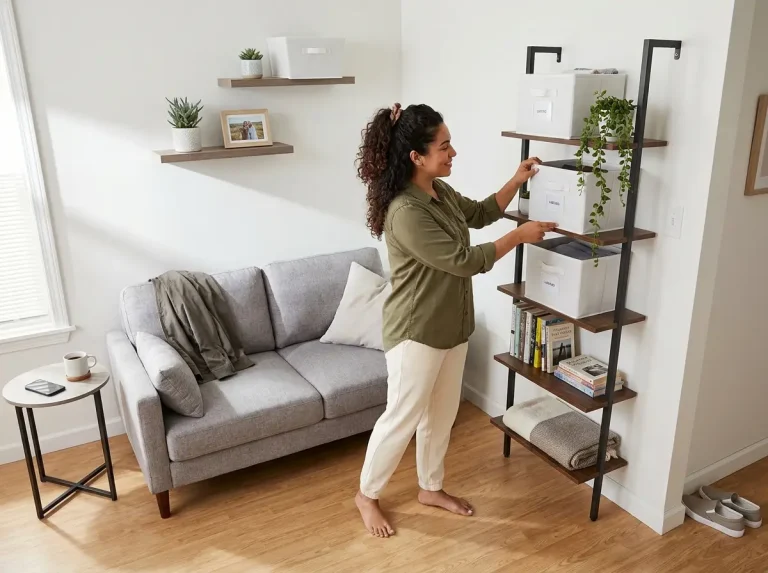
Go Vertical: Storage Above the Furniture Line
The wall above your bench or hooks is blank in most entryways. That’s 12 to 18 inches of usable space that costs nothing to access and doesn’t eat any floor area. If you’ve already been applying vertical storage rules for small apartments in other rooms, the entryway follows the same principle — the unused space above furniture height is free storage you’re ignoring.
The Zone Above the Bench: What Goes There
The zone between 5 feet and the ceiling is where seasonal and occasional items belong. Umbrellas, extra tote bags, reusable shopping bags, dog leashes, light rain gear — items you don’t need every day but want within reach near the door. A narrow shelf mounted above hook height keeps these items out of the daily traffic layer but accessible when you need them.
The rule for this zone: nothing heavy, nothing you need two hands to retrieve safely, and nothing you reach for every single day. This is where the tote bags go to live — you’ll put four up there and never touch three of them again, which is exactly the point. They’re stored, not lost.
Rail and S-Hook Systems for Flexible Vertical Storage
A horizontal wall rail with S-hooks gives you adjustable storage that adapts as your needs change. Mount a 24-inch rail above your hook line and hang canvas totes, dry bags, or mesh grocery bags from S-hooks. The positions aren’t fixed — rearrange them as items rotate with the season. This is the same principle behind kitchen pot rails, applied to the dead zone above your entryway hooks. For more ways to maximize space in a small apartment, the vertical approach works in every room.
Mirrors as Entryway Strategy (Not Just Decoration)
A full-length mirror leaned against the wall at the end of your entryway does two things at once. It gives you a quick check before leaving, and it visually doubles the perceived depth of a narrow hallway. For renters, leaning beats mounting — zero holes, moves with you on your next lease, and works in entryways where the wall can’t support a heavy mirror without anchor bolts.
A tall, thin-framed mirror propped at a slight angle reflects the opposite wall, making a 36-inch hallway feel wider than its actual dimensions. It’s one object doing two jobs — function and spatial illusion — without costing a single inch of floor space.
Why Your Entryway Gets Messy Again (and the Reset That Prevents It)
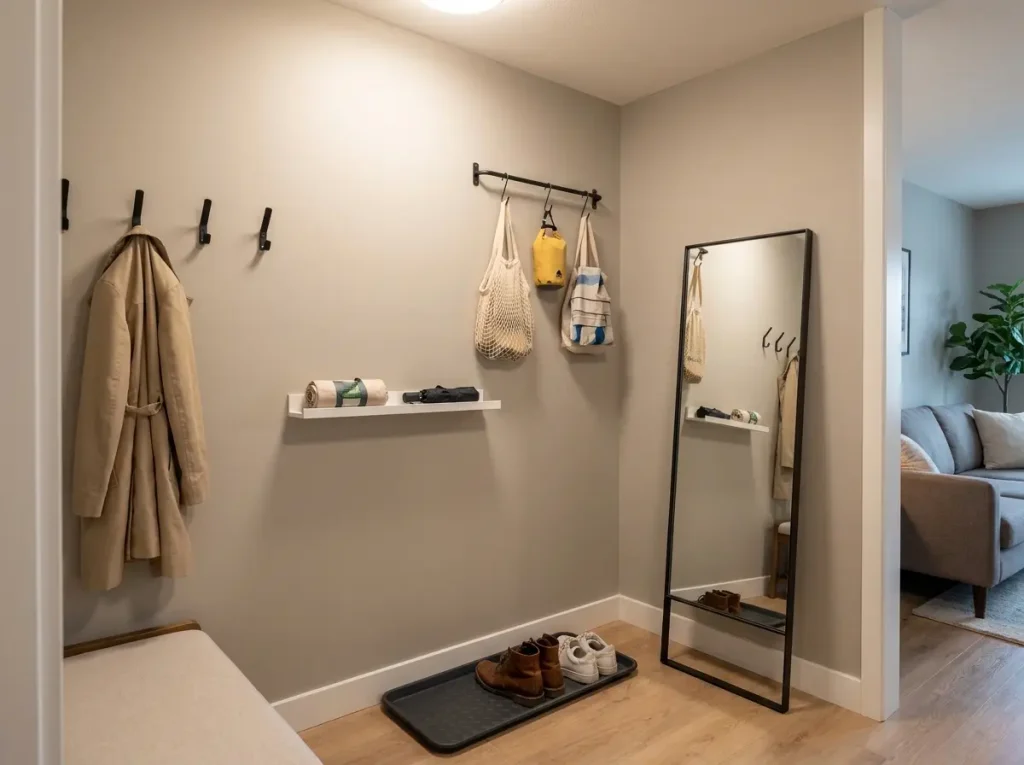
You set up the hooks. You placed the boot tray. The bench went in. It looked good for three weeks. Then your partner left a bag on the floor one evening because the hooks were full. Then you did the same the next morning. Now the entryway looks exactly the way it did before you started. This isn’t a discipline failure. It’s a design gap, and it has a specific mechanism you can interrupt.
The One-Hook-Per-Person Rule
The mechanism of entryway reversion works like this: zones without rules collapse. “Coats go on the hooks” sounds like a rule, but it’s not — not when there are four people and five hooks with no assignment. The unassigned hook fills first. It becomes the overflow point. Within a week there’s a pile. Within a month, the hooks are full of items nobody has worn in weeks, and fresh coats land on the bench or the floor because there’s nowhere else.
The fix is simple but feels uncomfortable: install exactly as many hooks as people in the household. Three people, three hooks. When all hooks are full, something moves to the closet. No overflow capacity means no overflow pile. The system self-regulates because the cap matches the household.
The Seasonal Entryway Edit
The entryway breaks in November, not August. That’s when winter coats arrive and the hooks are already full of summer jackets nobody moved. The system didn’t fail — it never got updated. Every season — four times a year — take 10 minutes to pull everything off the hooks, pull shoes out from under the bench, and empty the landing pad shelf. Decide what still belongs in the entry and what crept in over the last 90 days.
This is the same three-month audit principle that keeps every organized zone in your home working long-term. Without it, even a well-designed system slowly fills with items that don’t belong there, until one day you’re looking at the same mess you started with and wondering what went wrong.
The 10-Minute Weekly Reset That Keeps It Working
One person, one time per week, runs the entry: shoes back on the boot tray, coats on their assigned hooks, landing pad cleared of accumulated paper and pocket clutter, boot tray wiped down. If the system exists — designated zones with clear destinations — this takes under 10 minutes. Without the system, it’s a full hour-long cleanup that frustrates everyone involved. The difference between the two is whether the destinations exist, not whether the people are organized.
The entryway is the first space you walk into when you come home and the last one you pass through on the way out. A messy entry sets the tone in both directions. Connecting your entryway system to whole-apartment organization that actually lasts turns the entry into the anchor point rather than the afterthought — and once the entry works, every other room gets a little easier to maintain.
Three things matter more than everything else: measure before you buy anything, assign one hook per person with no extras, and build the weekly reset into your routine instead of waiting for the mess to force a cleanup. The rest is refinement.
In three months, pull everything off the hooks and out from under the bench. Do a 10-minute audit. Anything that doesn’t belong in the entryway has been living there rent-free — move it or toss it.
Start with the boot tray. Set it down inside the door today. One object, one decision, one zone established. Everything else builds from there.
Q1 How do I organize a small entryway without a closet?
Use wall hooks, a narrow bench, and a floating shelf to build three entryway zones — shoe, coat, and landing pad — without a closet. Adhesive-mount and freestanding solutions handle all of it with no permanent modifications, making this fully renter-friendly.
Q2 What should I put in a small entryway?
A boot tray, coat hooks, and a surface for keys. Those three items cover 90% of daily entryway traffic. Add a shoe bench and a vertical shelf once the basics are working and you know your available dimensions.
Q3 How do I create a functional entryway in a small apartment?
Measure your hallway width first, then choose shallow furniture under 12 inches deep, adhesive hooks rated for your actual load, and a boot tray at the door. All renter-friendly solutions exist without drilling or permanent installation.
Q4 What is the best shoe storage for a small entryway?
A 30-inch bench with shoe cubbies underneath works for entryways 42 inches or wider. For narrower spaces, an over-door shoe organizer on the entry closet door holds 12 pairs off the floor without using any floor space at all.
Q5 How do I keep my entryway from getting messy again?
Assign one hook per person with no extras, and run a 10-minute weekly reset: shoes to their tray, coats on their hooks, landing pad cleared. Add a seasonal edit four times per year to remove items that crept in over the past three months.
Disclaimer: ClutterlessNest is a participant in the Amazon Services LLC Associates Program. As an Amazon Associate we earn from qualifying purchases. This article may contain affiliate links — if you buy through them, we may earn a small commission at no extra cost to you. We only recommend products we have tested or genuinely believe in.