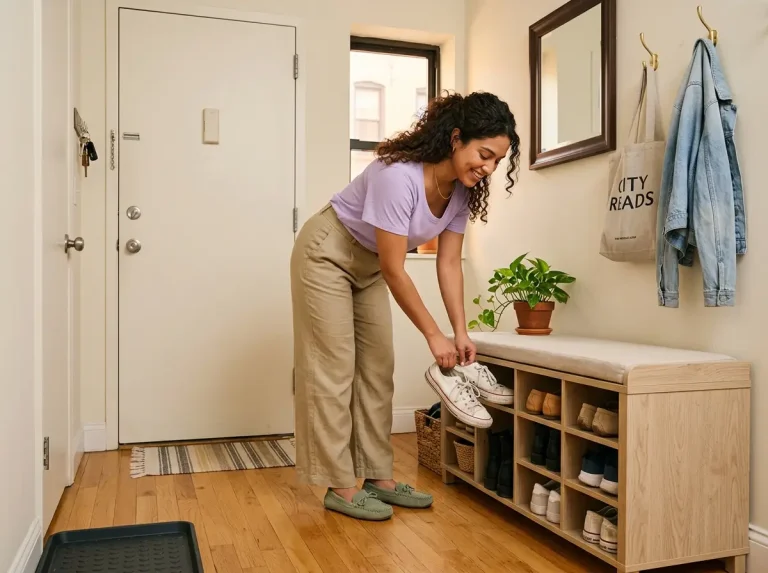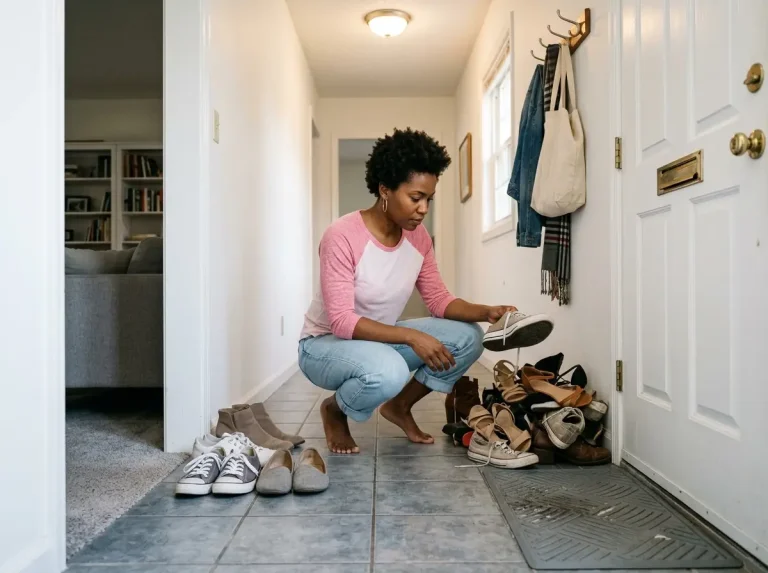
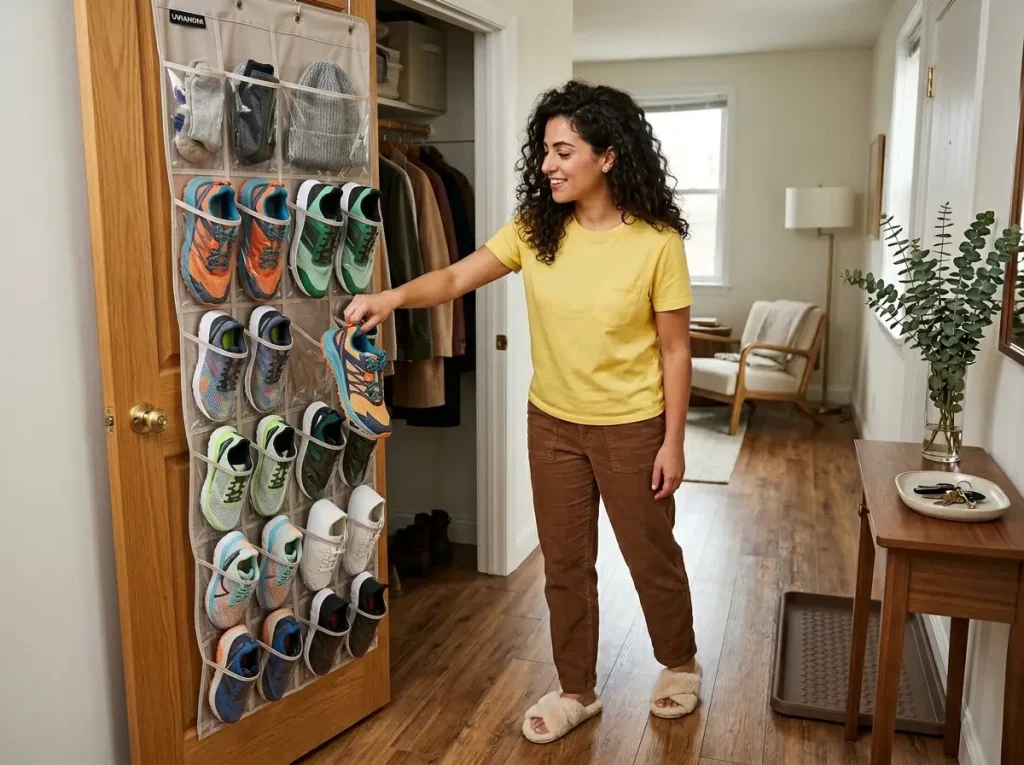
You hung the over-door organizer, loaded it with shoes, and felt like you’d finally beaten the pile by the front door. Three months later the top pockets sag, the door catches when you swing it shut, and there’s a faint gray scuff on the paint near the top corner. I’ve set these up on more than a dozen apartment doors — my own and friends’ — and the breakdown is almost always the same. It’s not the organizer. It’s the door you hung it on, and the way you loaded it. Here’s how to pick the right door, the right organizer, and the loading pattern that keeps the whole thing working past the first season.
Quick Answer
A good over-door shoe organizer comes down to five decisions, in this order:
- Check your door type first — hollow-core doors scratch and dent
- Match the format to your shoes — pockets for flats, shelves for boots
- Go wide-pocket if anyone wears a men’s size 10 or up
- Load the middle rows heavy, keep the top rows light
- Hang it on a closet door, not the entryway door, when you can
The Door Question You Need to Answer First
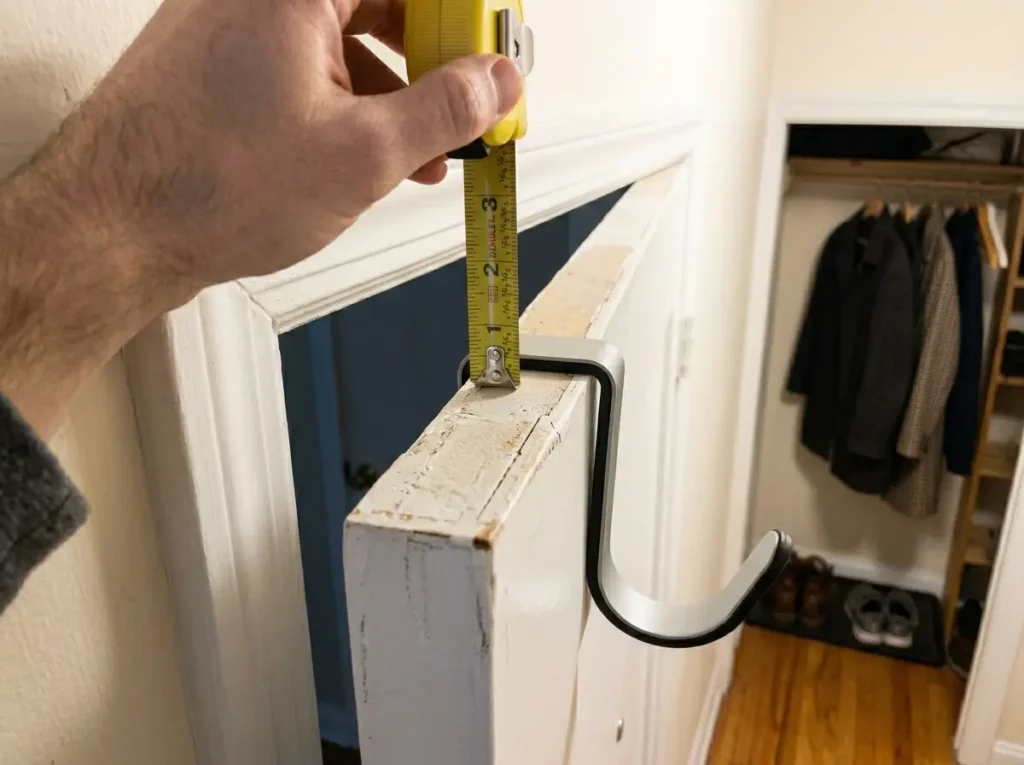
Almost everyone picks an over-door organizer the same way — by pocket count and color. Then they hang it on whatever door is closest to the shoe pile and call it done. And three months later they’re looking at a scuffed door wondering if they’ll lose part of the deposit over it. The organizer did its job. The door took the damage. So before you spend a dollar, you need to answer one question that no product listing asks you: what kind of door are you actually working with?
This matters more in apartments than anywhere else, because the doors are usually the cheapest part of the build. Most rental interior doors are hollow-core, which means the face you’re hanging weight against is barely thicker than a cereal box. The hook itself rests on the solid top edge, so it holds fine. The problem is everything below that — the loaded organizer leans forward and presses its back panel into that thin door skin every time the door moves. Over weeks, that pressure leaves a mark. Over months, it can dent.
The community has a name for the thing renters fear most here — the “door scratch problem.” It’s real, it’s predictable, and it’s almost entirely avoidable once you know what causes it. An over-door organizer is one of the best small-space, no-drill solutions there is. It belongs in the bigger picture of over-door organizers as part of a complete entryway shoe system, and it works in apartments where almost nothing else can be mounted. You just have to set it up on the right door, the right way.
Stick a few adhesive felt furniture pads on the underside of the hooks and on the back panel where it touches the door face. It costs about as much as nothing, and it’s the single difference between a door that’s fine at move-out and a door that isn’t. I do this before I hang any over-door anything now.
Hollow-Core vs. Solid-Core — What Most Apartment Doors Actually Are
Here’s the fast test: knock on your door the way you’d knock to come in. A hollow, drum-like sound means hollow-core. A dull, solid thud means solid-core. Most apartment interior doors — bedroom, bathroom, closet — give you that hollow sound.
A hollow-core door is a thin hardboard skin, about an eighth of an inch thick, wrapped around a cardboard honeycomb core. The only real wood is the frame running around the perimeter, including the top edge where your hook sits. So the hook has solid wood to grip. Good. But the weight of a loaded organizer hangs forward and down, and the back panel pushes against the face of the door — against that thin skin, not the frame. That’s the contact point that scratches and compresses. Knowing this changes nothing about whether you can use an over-door organizer, and everything about how you protect the door while you do.
The One Measurement That Decides Whether Any Organizer Will Close Your Door
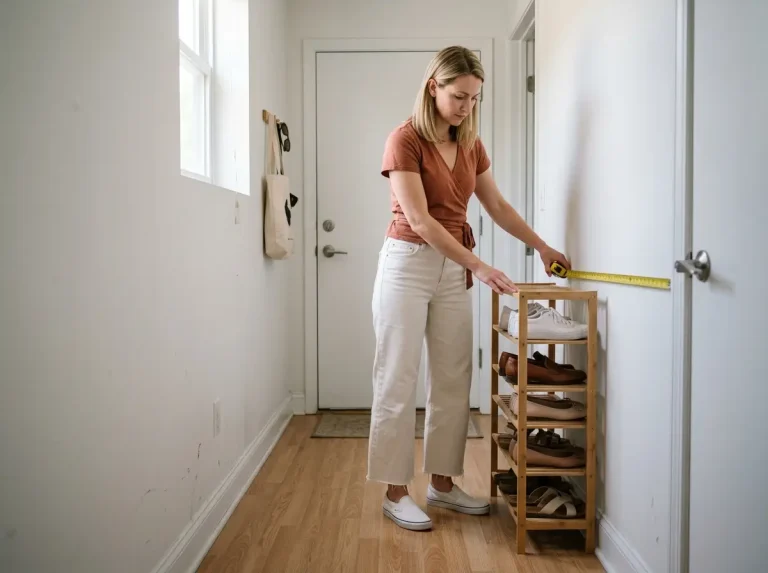
Before you buy, measure the gap. Close the door, then look at the space between the top edge of the door and the casing or door stop molding above it. That gap — minus about a quarter inch for safety — is the maximum hook height your door can take. Most standard over-door hooks run about an inch to an inch and a half at their thickest point (the listing almost never tells you, so you may have to measure the one you already own or ask before ordering).
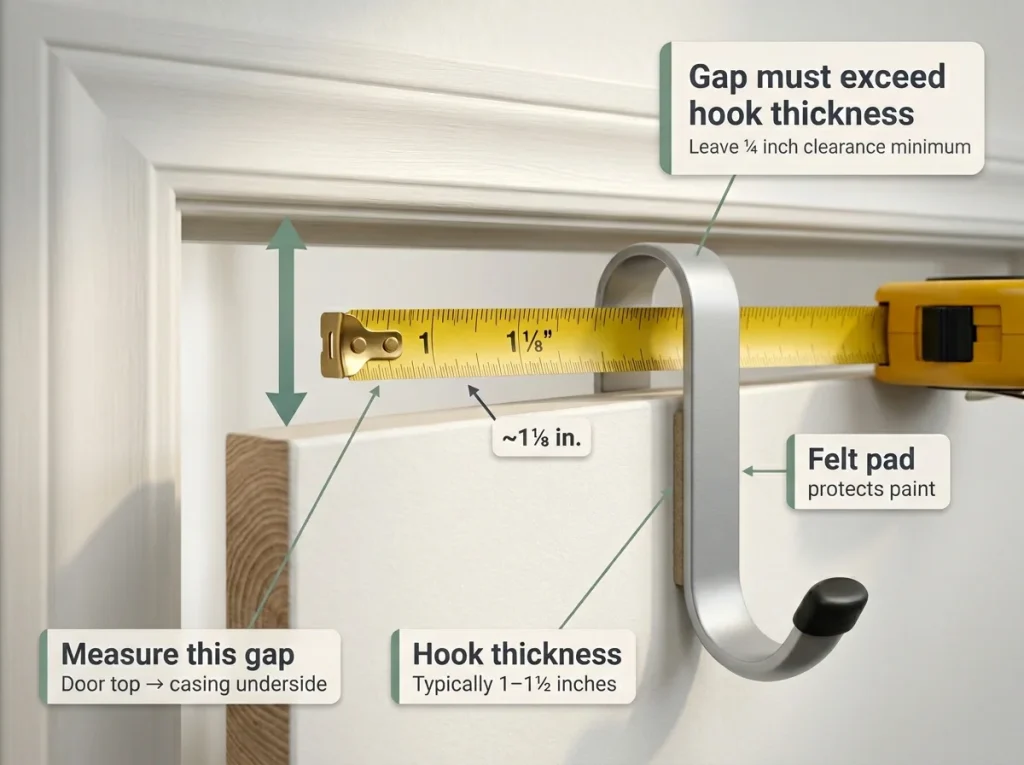
This trips people up more than you’d think, especially on tight-fitting interior doors. I once helped a friend who’d ordered a sturdy metal organizer for her bedroom door, only to find the hooks held the door open by half an inch — it wouldn’t latch. The door fit its frame too snugly to take the hook. We moved it to the coat closet door, which had a looser fit and a bigger gap, and it closed fine. Measure first. It’s a thirty-second check that saves a return.
Entryway Door vs. Closet Door — Where You Should Actually Hang It
Conventional advice says to put the shoe organizer on the door nearest your shoes, which usually means the entryway or front door. In practice, that’s the door you should avoid if you have a choice. An entryway door gets opened five to ten times a day. A closet door gets opened once or twice. Over a few years, that’s the difference between a few thousand swings and tens of thousands — and every swing is a small impact that slowly bends the hooks and works the back panel against the paint.
The closet door wins on longevity, and you barely lose anything. The organizer is still right there by the door, still holding your daily shoes, just on a surface that isn’t taking a beating. But honestly — if the only door near your entry is the front door and you wear those shoes every single day, use it. Just add the felt pads and check it more often. A system you’ll actually use beats the theoretically perfect one you won’t.
Which Type of Over-Door Organizer Actually Fits Your Space
“Over-door shoe organizer” sounds like one product. It’s really four, and they work for completely different situations. You’d never store ballet flats and work boots the same way, so it follows that the format matters at least as much as the brand. Pick the wrong format and no amount of careful loading saves you — the shoes simply won’t fit, or the thing won’t hold up.
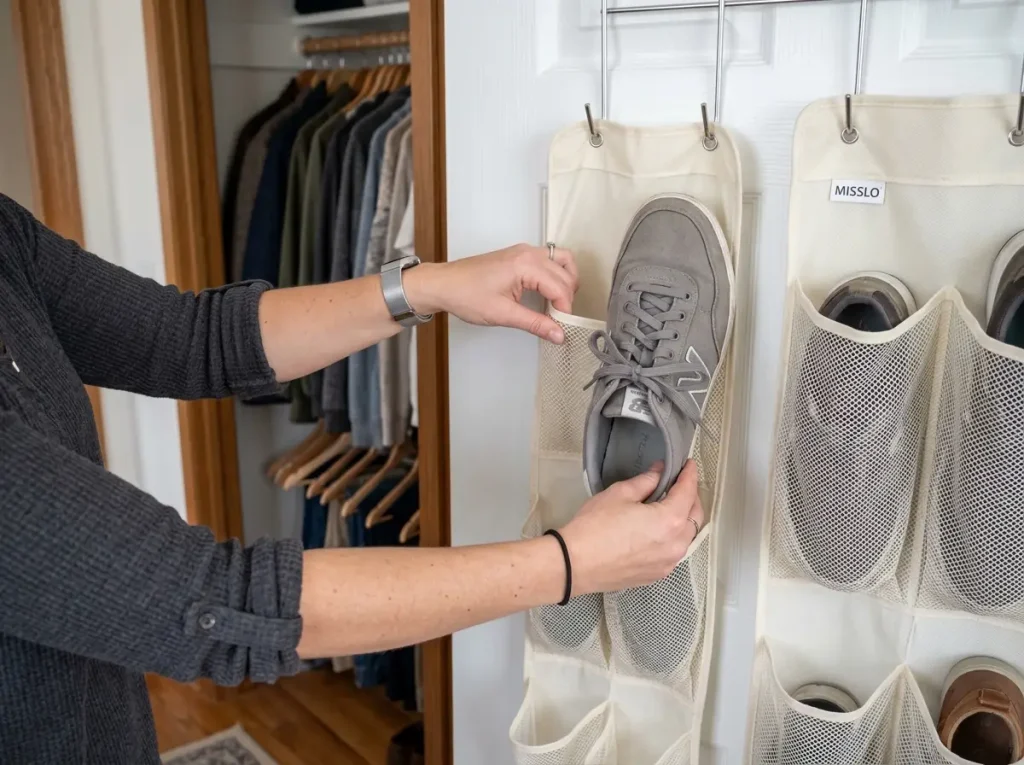
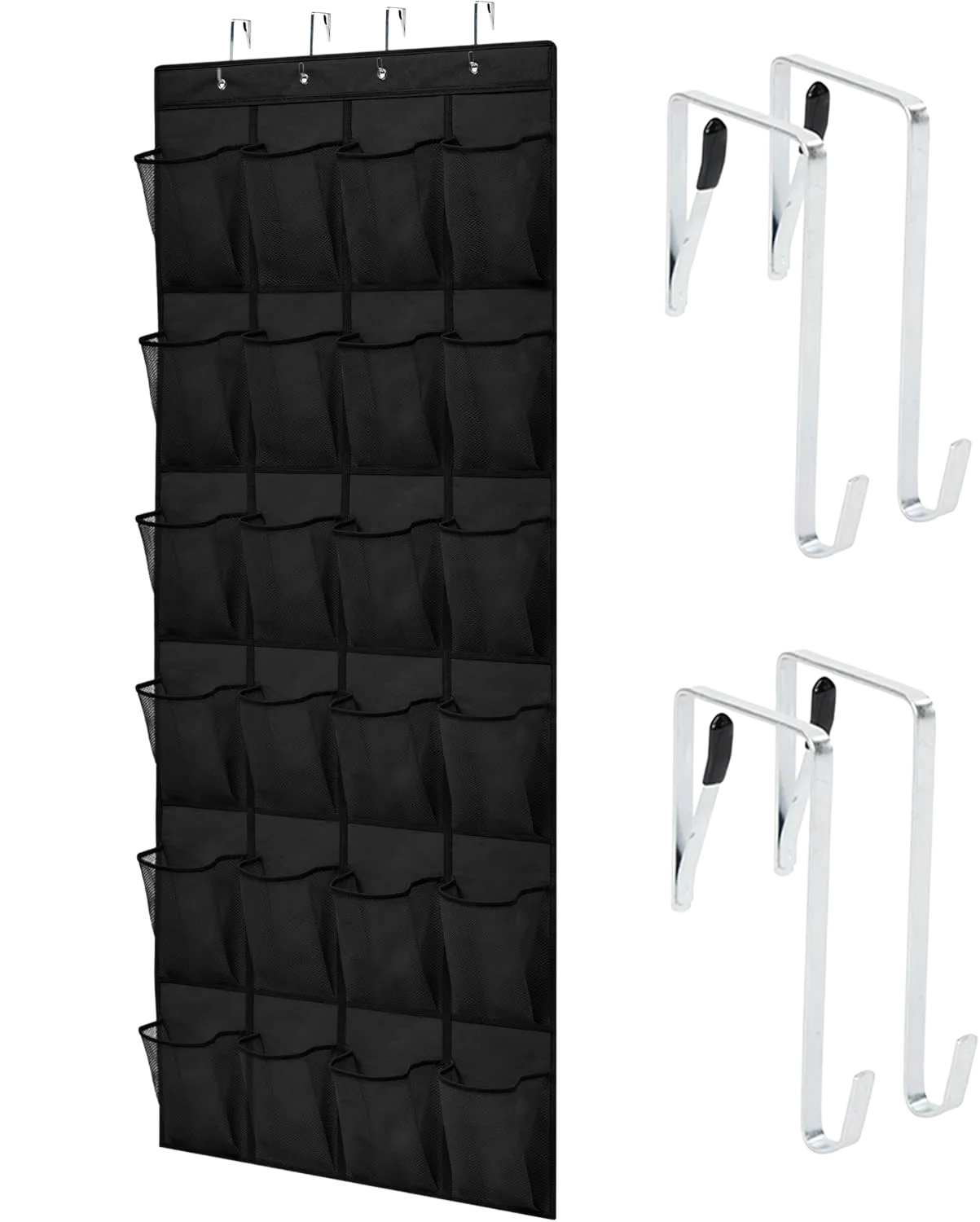
The most common type is the pocket organizer — rows of fabric or clear-plastic pockets, usually canvas, breathable mesh, or see-through vinyl. These are built for lightweight footwear: flats, sandals, slippers, kids’ shoes. They take up almost no depth behind the door, which is exactly why they’re the renter favorite. A standard one runs about 24 pockets in roughly the footprint of a bath towel hung lengthwise. The budget-friendly SimpleHouseware Over-the-Door Shoe Organizer is the clear-pocket version of this — you can see every pair at a glance, which matters more in a shared household than people expect, and it fits standard doors without any fuss. The one limitation: clear vinyl traps a little more odor than mesh, so it’s better for clean everyday shoes than gym sneakers.
For my money, the best all-around pocket organizer is the mesh version, because the breathability genuinely makes a difference over months. Here’s the one I keep coming back to.
The second type is the tiered-shelf organizer — open shelves instead of pockets, where shoes sit flat. This is the only format that actually works for boots, tall sneakers, and anything heavier. No pocket to overflow, no width limit. The tradeoff is depth: shelves stick out farther behind the door, so your clearance check matters even more here.
Then there are clear-pocket versus mesh versus canvas as a material choice within the pocket category. Clear pockets let you see everything, which is the move for a shared household or a kid’s room. Mesh breathes best and fights odor. Canvas lasts longest but you can’t see in. None is “best” — they match different priorities. And if you’d rather not give up door space at all, floor-standing shoe racks cover the same job a different way.
One last thing, in the spirit of not selling you something you don’t need: if you’ve got one person’s daily shoes to corral, a simple 24-pocket mesh organizer is the whole answer. The heavy-duty and tiered versions only earn their keep once you’re storing boots or a real collection.
The Pocket Size Problem (and How to Solve It)
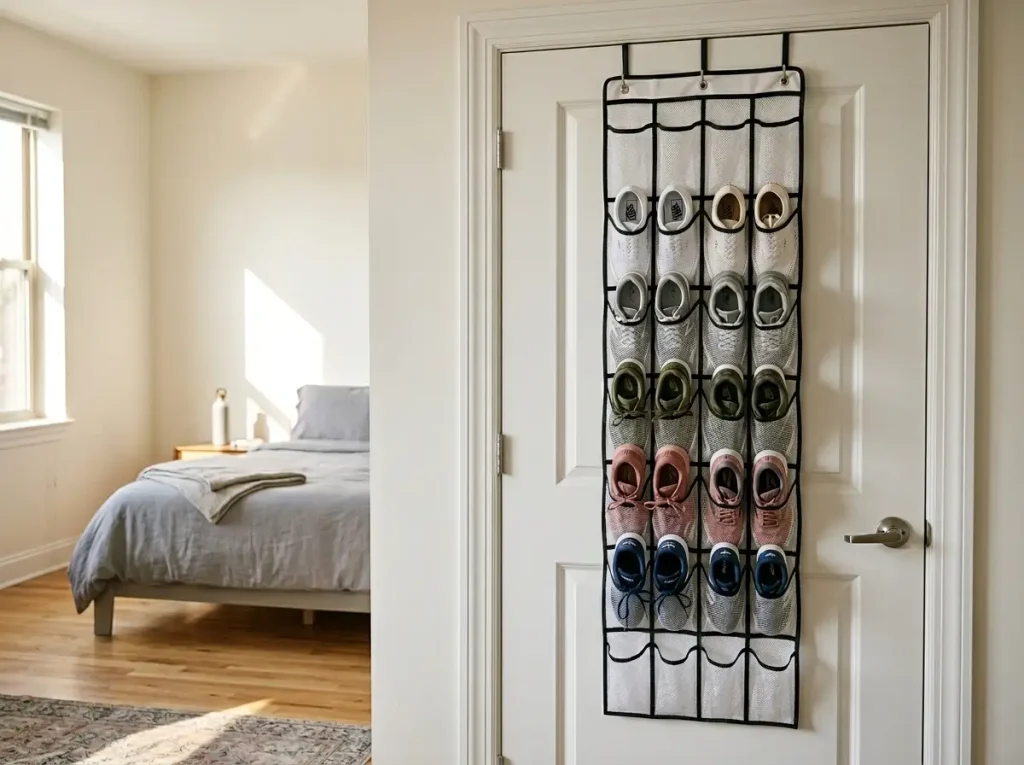
If you read the reviews on any over-door shoe organizer, the same complaint shows up again and again — “my shoes don’t fit.” It reads like a product flaw. It isn’t. It’s a sizing mismatch that’s completely predictable once you know one thing: standard pockets are sized for women’s footwear, not men’s. Nobody puts that in the product title, so people find out after the box arrives.
Standard pockets run about five to six inches wide. That comfortably fits women’s flats and sandals in sizes 5 through 9, slippers, and slim low-profile sneakers up to about a women’s size 8. A women’s sneaker around size 8 — roughly ten inches long, three and a half wide — slides right in. A men’s size 10, which is closer to twelve inches long and four and a half wide at the ball of the foot, overhangs the pocket front and looks like it’s spilling out. Same organizer, totally different result, and it’s purely about the math of the pocket.
The fix is the wide-pocket organizer, with pockets running about eight and a half to nine and a half inches across. These fit adult sneakers up to a men’s size 13 or 14 with room to spare. The MISSLO 10-Tier Wide Pocket organizer is the one I point people to when the household has anyone with bigger feet — the wide mesh pockets actually hold a men’s running shoe without the overflow, and it carries about 30 pairs. The tradeoff worth naming: you get fewer total pockets per organizer than a standard 24-pocket model, at a similar price. You’re paying in pocket count for the width.
Before you order anything, trace your largest pair of shoes against a ruler — length and width at the widest point. If the width clears six inches, skip standard models entirely and go straight to wide-pocket. Buying for the shoes you actually own beats buying for the pocket count on the label.
Standard Pockets — What Fits and What Won’t
Women’s flats in sizes 5 through 9, sandals, slippers, and most kids’ shoes drop into standard pockets without a fight. Women’s sneakers in sizes 6 to 8 fit if the sole isn’t chunky. Men’s shoes of any kind are a tight squeeze at best — the toe rides up over the pocket lip and the whole row starts to look messy. If your collection is mostly flats and sandals, standard pockets are perfect and you can stop here. Whatever format you land on, it works best once you’ve already sorted which shoes earn a spot by how often you actually wear them — an organizer full of pairs you never touch is just a vertical pile.
Wide-Pocket Models — When You Need Them
Wide-pocket organizers earn their place the moment anyone in the house wears a men’s size 10 or above. The pockets run wide enough to swallow an adult sneaker whole, and they handle women’s athletic shoes that defeat the standard pockets too. You give up some total capacity for the extra width — typically ten roomy tiers instead of twenty-four small pockets — but a pocket that fits is worth two that don’t.
The Two-Shoes-Per-Pocket Trick for Small Shoes
Here’s the upside nobody mentions. For flats, sandals, and kids’ shoes, one standard pocket holds two pairs, stacked heel-to-toe. A 24-pocket organizer quietly becomes a 48-pair organizer for the right footwear. It works because small shoes are short enough that doubling them up doesn’t max out the pocket depth. So if your problem is a pile of the kids’ sandals and your own flats, the cheapest standard organizer might out-store a pricier one — you just load it smarter.
How to Load It So It Doesn’t Fail in Three Months
This is the section that separates an organizer that lasts from one you’re rehanging by spring. When an over-door organizer sags, bends its hooks, or starts making a new creak every time the door shuts, it almost never means you bought junk. It means you loaded it top-heavy. The physics are simple and they’re working against you the whole time, so it’s worth understanding what’s actually hanging on that door.
Start with the weight math, because it’s more than people guess. A pair of men’s size 10 sneakers runs around a pound and a half to two pounds. Fill all 24 pockets of a standard organizer with sneakers and you’re at 36 to 48 pounds — and most standard organizers are rated for 40. So you hit the ceiling somewhere around 20 to 22 pairs, well before every pocket is full. The rated capacity is a maximum, not a target, and treating it like a target is how the failures start.
Once a month, open the door and look straight at the hooks. Any forward bend in the metal, or the organizer tilting away from the door at the top, is an early warning — not a wait-and-see. Redistribute the weight toward the lower rows that day and you’ll never get to the catastrophic version.
If your collection genuinely needs the capacity — multiple adults’ sneakers, or boots in the mix — don’t fight a standard organizer past its limit. Step up to a heavy-duty model. The UVIAHOMI Over-Door Organizer is built for this, with an 80-pound capacity that’s roughly double the standard, and it fits doors from about 1.37 to 1.98 inches thick, which covers most apartment doors. It’s the sensible choice for a family’s worth of shoes, and it slots neatly into a full no-drill closet system that won’t cost your deposit if you’re kitting out a rental from scratch. For one person’s everyday rotation, though, it’s more than you need — match the organizer to the actual load, not the worst case.
The Weight Math — What’s Actually Hanging on Your Door
Count your pairs, multiply by roughly a pound and a half for casual shoes or two-plus for sneakers, and compare that number to the organizer’s rated capacity. If you land within ten pounds of the limit, you’ve got two honest options: leave some pockets empty, or move up to a heavier-duty model. There’s no third option where you cram it full and it holds. The door and the hooks don’t read the marketing.
Top-Heavy Loading — The Most Common Mistake
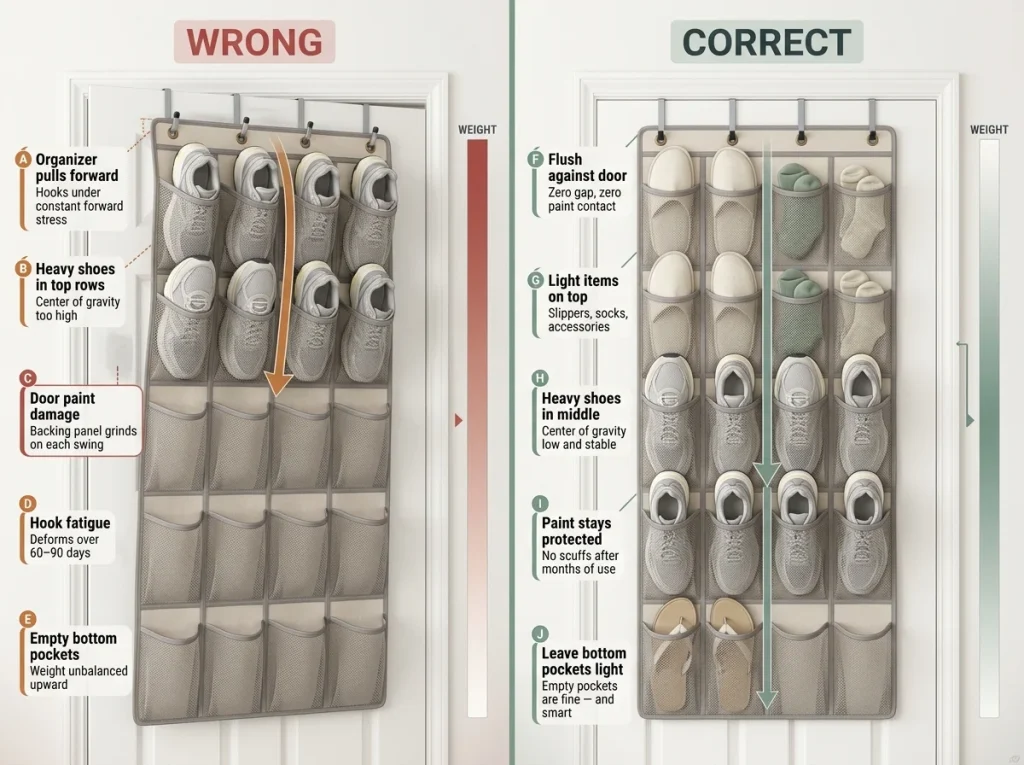
Picture the top three rows packed with shoes and the bottom six sitting empty. The whole organizer’s center of gravity is now above where the hooks attach. Every time the door swings shut, that concentrated weight up high creates leverage — a small forward pull on the hooks. You won’t see it on day one. But over ninety days that pull bends the hooks a hair at a time, and by six months the organizer rocks away from the door and the back panel grinds the paint.
I learned this on my own organizer, embarrassingly. I’d loaded the top rows first because they were at eye level and easiest to reach, and within two weeks the top edge had pulled forward enough that I could see daylight behind it. Took everything out, reloaded from the middle, and it’s sat flat ever since.
The Loading Pattern That Works Past Month Three
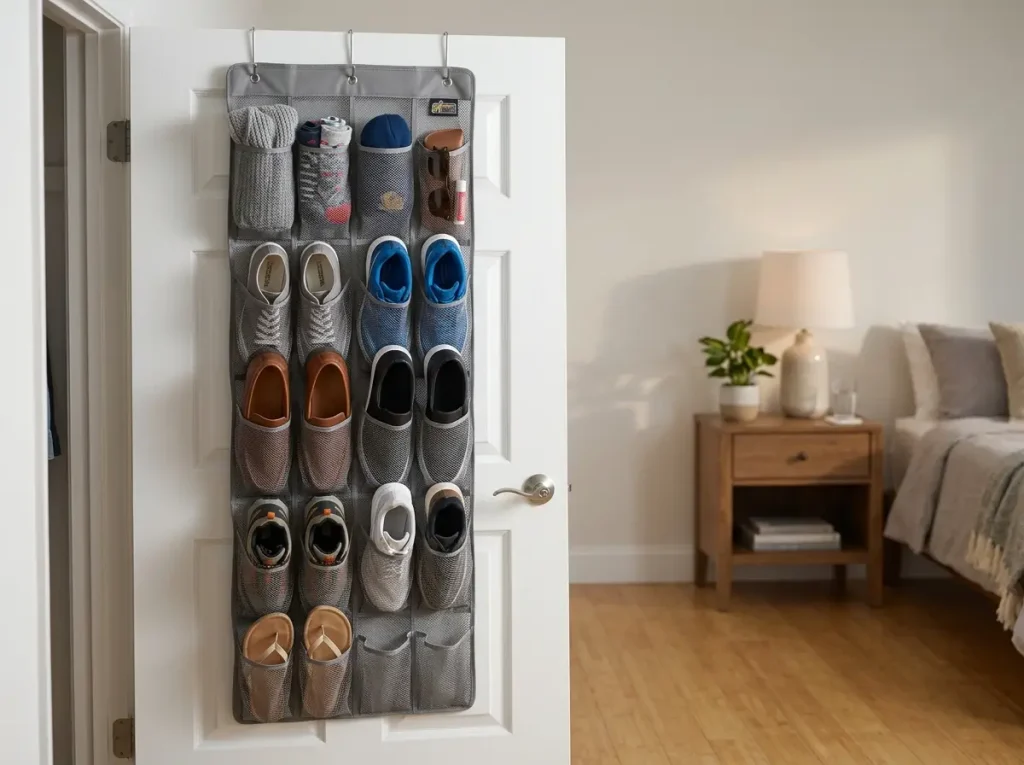
Put the lightest things in the top two rows — socks, slippers, soft accessories. Put the heaviest shoes in the middle rows, three through six or so. Lighter items go in the bottom rows, and any empty pockets you have should live at the bottom, never the top. This spreads the weight along the full hanging length and keeps the center of gravity close to where the hooks grip. It’s the same logic as packing a backpack — heavy stuff low and centered, not riding up high where it pulls you backward.
5 More Things Over-Door Organizers Do Better Than You’d Expect
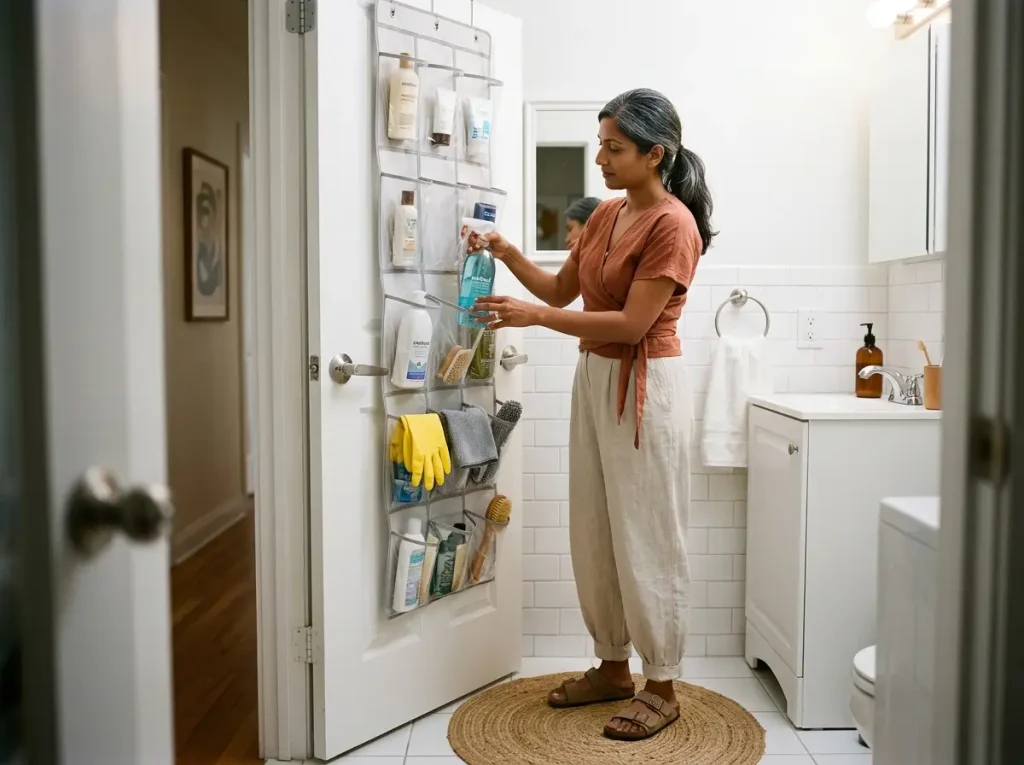
An over-door organizer costs about what a decent lunch does, and once you understand the professional organizer-endorsed approach to maximizing back-of-door space, it’s worth having one on every door that can take one. The shoe one might not even be the most useful in the end. Here are five jobs they quietly do better than the dedicated products people usually buy for them.
First, the entryway closet door becomes a winter gear station — hats, gloves, scarves, hand warmers, the dog leash. Everything you grab on the way out, in pockets, at the door, with nothing on the floor. It slots right into building a complete entryway system with hooks, a landing pad, and the organizer working together instead of competing for the same square footage.
Second — and this is the one that surprised me — the bathroom door might be the best home for an over-door organizer in the whole apartment. Not for shoes. For cleaning supplies or shared toiletries. The bathroom door is opened relatively gently and it’s out of sight when shut, so the organizer takes almost no wear there (mine’s been on the same bathroom door for a couple of years without a mark on the paint). In a shared bathroom, give each person a row for their toiletries and the counter pile-up just ends.
Entryway Closet — The Winter Gear Station
Hats, gloves, scarves, and leashes never have a natural home in an apartment entryway — they end up in a basket that becomes a tangle, or on the floor. A pocket organizer on the inside of the coat closet door gives each grab-and-go item its own slot, no hooks, no drilling, no floor space. Clear pockets help here so you’re not fishing for the second glove in the dark.
Bathroom Door — The Cleaning Supply Station
A clear-pocket organizer on the back of the bathroom door turns dead space into a home for spray bottles, sponges, and cloths — visible, reachable, and hidden when the door’s shut. In a shared bathroom, one row per person for toiletries does more for the daily peace than any counter caddy I’ve tried. And the bathroom door’s gentle, occasional use means the organizer essentially never wears the paint.
Kids’ Room or Shared Space — The Toy Zone
Small toys, art supplies, fidgets, sticker books — all of it fits pocket organizers, and the door becomes vertical toy storage a kid can actually reach. The trick that makes it stick is one category per row: markers in one, stickers in the next, small cars below that. When everything has a row, it has a home, and “clean up” becomes a thing a four-year-old can finish without you.
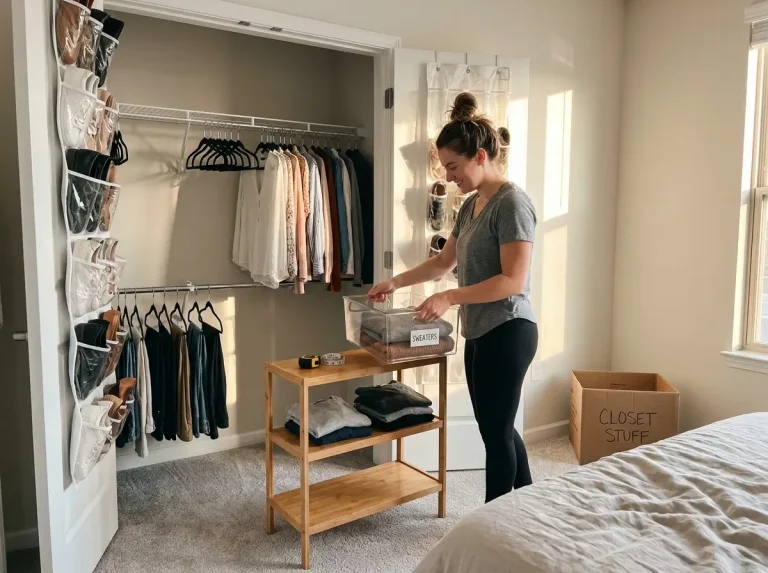
Bedroom Closet — Accessories and Small Items
Socks, folded belts, sunglasses, and small accessories rarely get dedicated storage in an apartment closet. A pocket organizer on the inside of the closet door handles them without eating a shelf or a drawer. One pocket per category keeps it from sliding into a single chaos pocket — which is what happens the moment you let “miscellaneous” become a slot.
Near the Kitchen or Pantry — Snacks and Small Items
Clear-pocket organizers near the kitchen work for single-serve snacks, lunchbox add-ons, vitamins, or any small item that vanishes into the back of a cabinet. Seeing everything at once means less forgotten food and fewer duplicate buys. Worth saying plainly, though — if you’ve got a free drawer or a basket that already does this, use that first. The over-door organizer shines when the zone has no other storage at all, not as a replacement for storage you already own.
Conclusion
Get three things right and an over-door organizer will outlast most of the furniture in a rental. Evaluate the door first — hollow-core apartment doors want felt pads on the hooks and a load kept well under the rating, and a closet door will outlast an entryway door by years. Match the format to your actual shoes — pockets for flats and sandals, tiered shelves for boots and sneakers, wide pockets if anyone in the house wears a men’s size 10 or up. And load from the middle out, heaviest shoes centered, some pockets left empty at the bottom, hooks checked once a month for any bend.
In three months, open the door, pull the organizer away from the face, and look at the paint where the back panel rests. If you see scratches or a compressed mark, add felt pads at the contact points and shift more weight to the lower rows before it gets worse. Catching it then is a two-minute fix; ignoring it is a deposit conversation.
Start with one door. Measure the clearance. If it passes, order the organizer that matches your shoe collection — not the one with the highest pocket count. You can always add a second door later, but getting the first one right is the setup that actually sticks.
Frequently Asked Questions
01Will an over-the-door shoe organizer scratch or damage my door?
It can, especially on hollow-core apartment doors with soft paint. Adhesive felt pads on the hook contact points and the back panel prevent almost all of it. Avoid overloading, which presses the back panel into the door face on every swing.
02How many pairs of shoes can an over-the-door organizer hold?
A standard 24-pocket organizer fits 12 to 24 pairs depending on shoe size — one pair per pocket for adult shoes, two for flats or kids’ shoes. Wide-pocket 10-tier models hold 20 to 30 pairs. The weight rating, usually 40 to 80 pounds, is the real limit for heavier shoes.
03What shoe sizes fit in over-door organizer pockets?
Standard pockets, around five to six inches wide, fit women’s sizes 5 to 9 in flats and sandals, plus slim sneakers up to a women’s size 8. For men’s shoes or anything above a women’s size 9, choose wide-pocket models with roughly nine-inch pockets.
04Can I use an over-the-door shoe organizer in an apartment without drilling?
Yes — the hooks hang over the door’s top edge with no drilling at all. The one catch is clearance. Measure the gap between the top of your closed door and the casing above it before buying, since not every door leaves enough room for the hook to clear.
05Where is the best place to hang an over-the-door shoe organizer?
A closet door beats an entryway door for longevity, because it’s opened far less and the hooks last longer. Inside a coat closet door is the most popular spot — hidden and accessible. Avoid the door that gets the heaviest daily use whenever you have a choice.
Disclaimer: ClutterlessNest is a participant in the Amazon Services LLC Associates Program. As an Amazon Associate we earn from qualifying purchases. This article may contain affiliate links — if you buy through them, we may earn a small commission at no extra cost to you. We only recommend products we have tested or genuinely believe in.