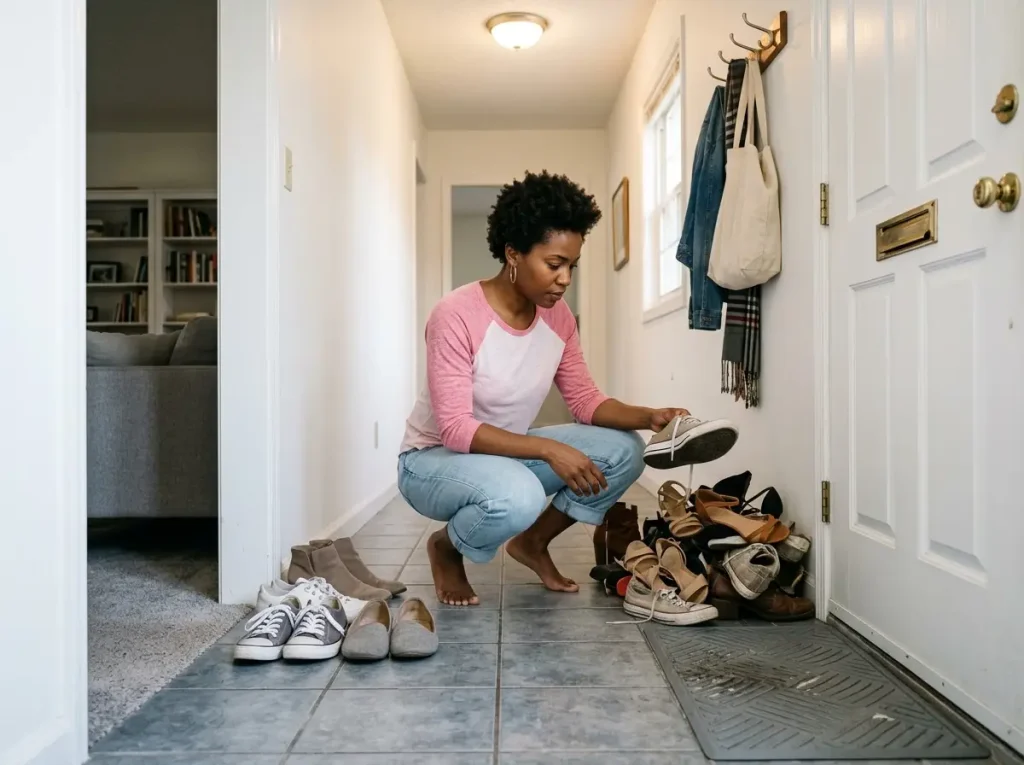
You organized your shoes in October. The rack looked great for about three weeks. Then boot season showed up, the boots wouldn’t fit, they landed on the floor “just for now,” and by December there was a full shoe avalanche by the door and the rack you bought sat half-empty behind it. I’ve reset enough small-space entryways to tell you the rack is almost never the problem. The problem is that nobody measured the space, nobody split the shoes by how often they get worn, and nobody built a habit to catch the drift before it became a pile. Here’s the sequence that actually keeps shoes organized in a small space, and why the order matters more than the product.
Quick Answer
Organize shoes in a small space in five steps:
- Edit first — pull every pair out and cut what you haven’t worn in a year.
- Measure your hallway width before buying any storage.
- Split shoes into daily, weekly, and seasonal zones.
- Match the storage type to your space, not the other way around.
- Run a five-minute weekly scan and a twice-yearly seasonal swap.
Start with a Shoe Edit — Not Because It’s Fun, but Because Nothing Else Works Without It
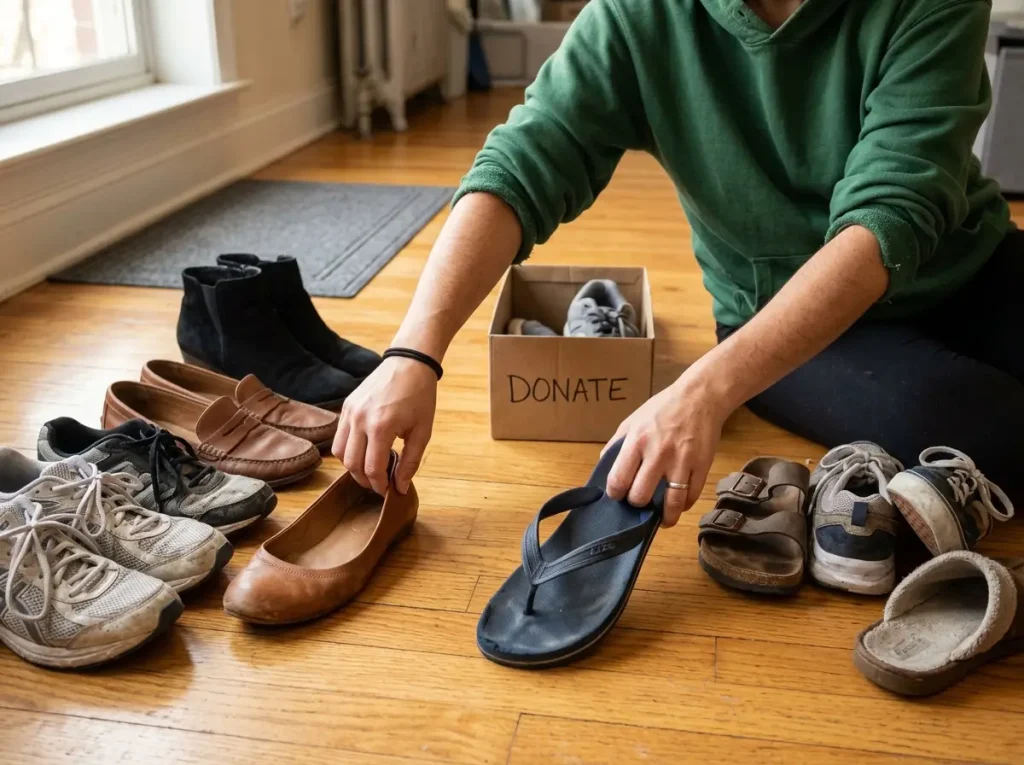
Most people skip straight to buying a rack. Then they fill it with every pair they own, the rack hits capacity before their daily sneakers have a home, and the overflow starts on the floor the same week. The edit isn’t about becoming a minimalist or owning fewer shoes as some moral goal. It’s about finding out how many pairs you actually need to store at the door, so you buy the right size storage instead of guessing.
Pull Everything Out First (Yes, Everything)
Gather every pair from wherever they’ve scattered — the entryway floor, the closet shelf, under the bed, the coat closet, that one pile in the bedroom corner. Put them all in one place. This step is always a little startling, because most people underestimate their collection by half. You’ll find pairs you forgot you owned, which makes the next part much easier.
This is also where the full entryway shoe organization system starts to make sense, because you can’t zone what you haven’t counted.
The One-Year Rule (and Why “Maybe Someday” Is a Lie)
If you haven’t worn a pair in twelve months, it goes. Donate it, sell it, or toss it if it’s worn out. There’s exactly one exception worth keeping: a shoe you genuinely wear once a year for a specific annual event — snow boots for the trip you actually take every winter, one pair of dress heels for the holidays. If the event is real and recurring and the shoe is in good shape, it earns a spot in the seasonal zone. Everything else that hasn’t moved in a year is just charging rent on space your daily shoes need.
Those forgotten pairs at the back have a name in organizing circles — graveyard shoes. They’re the ones that quietly eat your capacity while you’re tripping over the pairs you actually wear.
Do the edit with your shoes on your feet, not in your hands. Try on anything you’re unsure about and walk across the room. The pairs you keep “because they’re cute” but that pinch after ten steps reveal themselves fast. They’re usually your graveyard shoes.
The Two-Pile Split
Once the discards are gone, sort what’s left into two piles. Pile A is your daily and weekly rotation — pairs you’ve worn in the last 30 days or plan to wear in the next 30. These live at the entry or on the closet floor. Pile B is everything occasional and seasonal: dress shoes, sandals in winter, boots in summer, the special-occasion pairs.
Count Pile A. That number is how much entry-zone storage you actually need. In my experience it lands between six and ten pairs for most people, which a two- or three-tier setup handles easily. The mistake is buying storage sized for all 30 pairs and then wondering why the door area still feels cramped.
Measure Before You Buy Anything
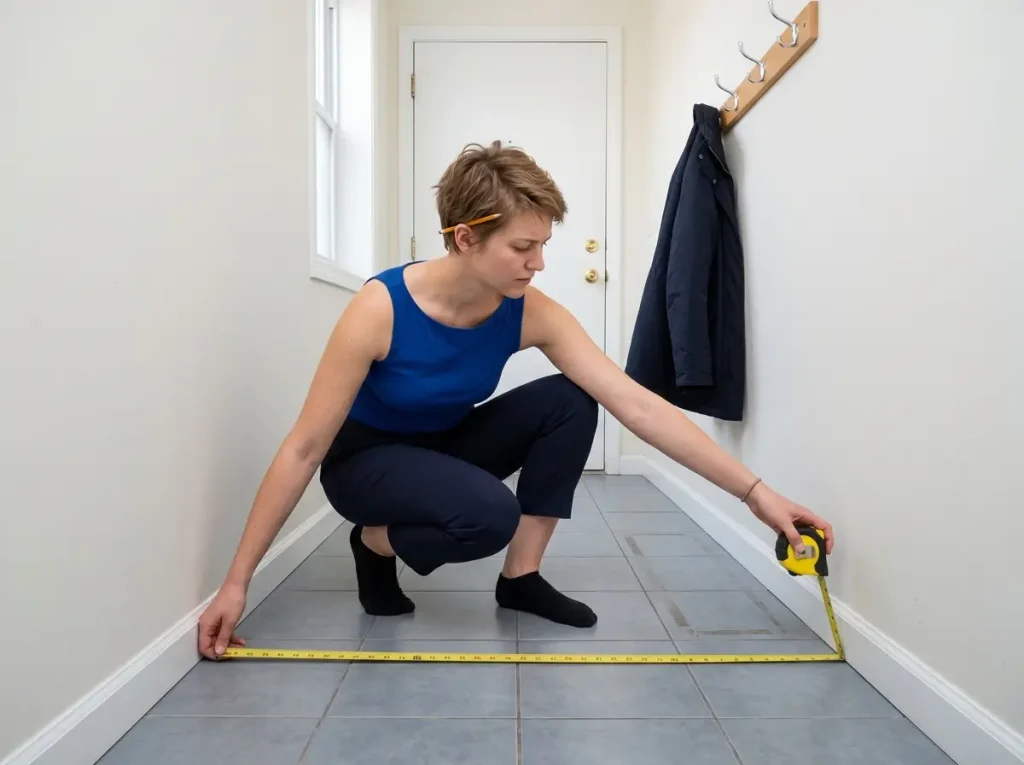
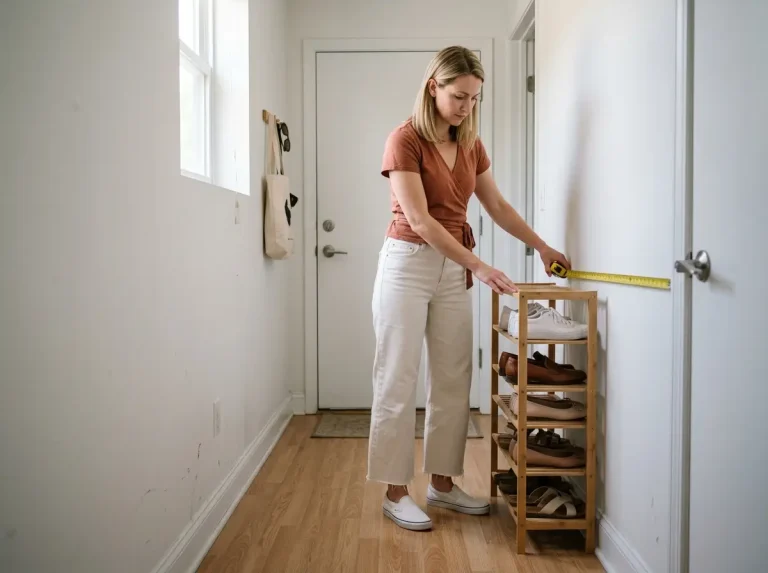
Here’s the story I see most often. Someone orders a shoe rack, assembles it by the door, and then spends three weeks kicking it every single time they walk through. They return it, order a slightly different one, and get the same result. The rack was never the issue. They never measured the hallway, and a standard rack is simply too deep for the space most apartments give you at the entry.
The Clearance Math in Practice
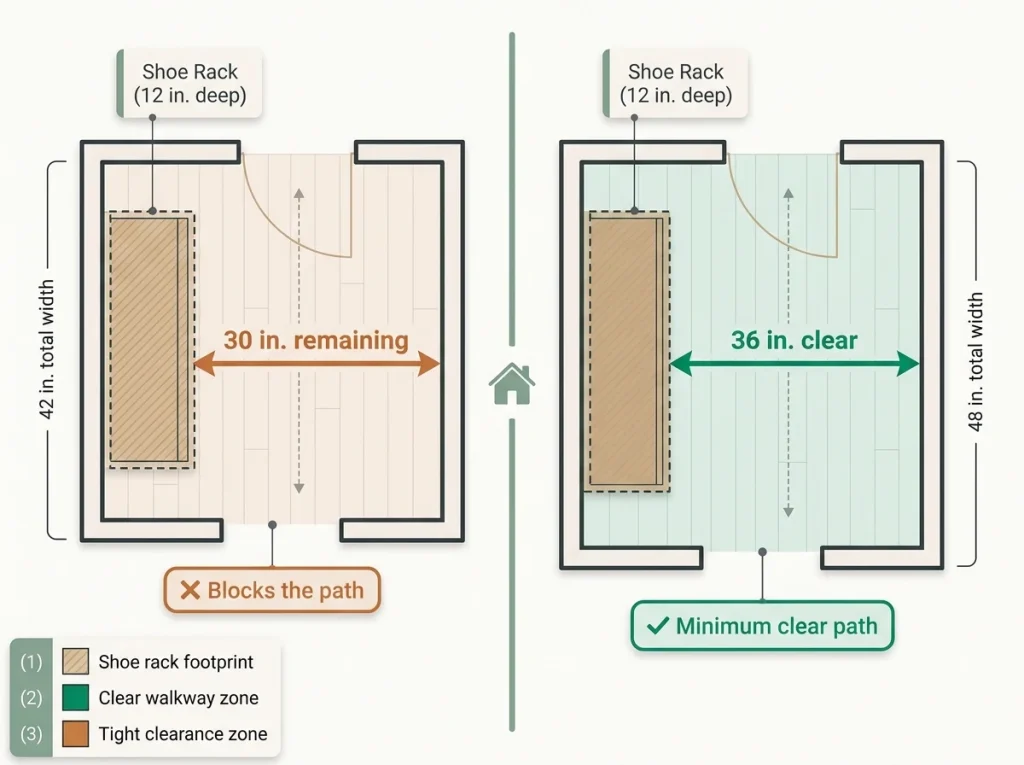
The International Residential Code sets a minimum hallway width of 36 inches for a reason — that’s the clearance a person needs to move through comfortably. Any shoe storage you put in a hallway has to leave those 36 inches clear. So the math is simple: measure your hallway at its narrowest point, subtract 36, and what’s left is your maximum storage depth.
A standard shoe rack runs 12 to 15 inches deep. Drop one of those into a 42-inch hallway and you’ve got 27 to 30 inches of clearance left — below the comfortable minimum, which is exactly why it feels like an obstacle. Run the numbers for your space: a 42-inch hallway gives you about 6 inches of depth to work with, a 44-inch hallway gives you 8, and you need 48 inches before a full 12-inch rack fits without crowding the path. The standard shoe rack depth of about 13 inches fits nearly all footwear, which is great in a closet and a problem in a narrow hall.
Door Clearance for Over-the-Door Organizers
Over-the-door organizers dodge the depth problem entirely, but they have their own measurement to check. The organizer hangs on a hook that drops behind the door frame, and that hook needs at least 2 inches of gap between the frame and the door edge when the door is fully shut. Most standard hollow-core apartment doors give you 2 to 3 inches, so you’re usually fine. But doors that swing against a wall or sit close to a baseboard sometimes have less, and then the hook won’t seat properly. Test it before you buy: open the door halfway, put your hand in the gap at the top, and judge whether something an inch and a half thick would clear.
Measuring for Shelf Spacing Inside a Closet
If you’re putting a rack inside an existing closet instead, measure the vertical clearance from the floor to the first shelf or rod. Most closets give you 12 to 14 inches under the rod, which fits a three- or four-tier rack for flats and sneakers. Boots are the exception. They need 12 to 18 inches of vertical room, so measure your tallest boot shaft, add 2 inches, and that’s your minimum shelf spacing for the boot section.
Measure with the door open and trace its swing. A rack that fits the wall space perfectly is useless if it sits inside the door’s arc. You’ll catch it every time you come home with full hands. Mark the door’s path on the floor with painter’s tape before you commit to a spot.
Zone Your Shoes by How Often You Actually Wear Them
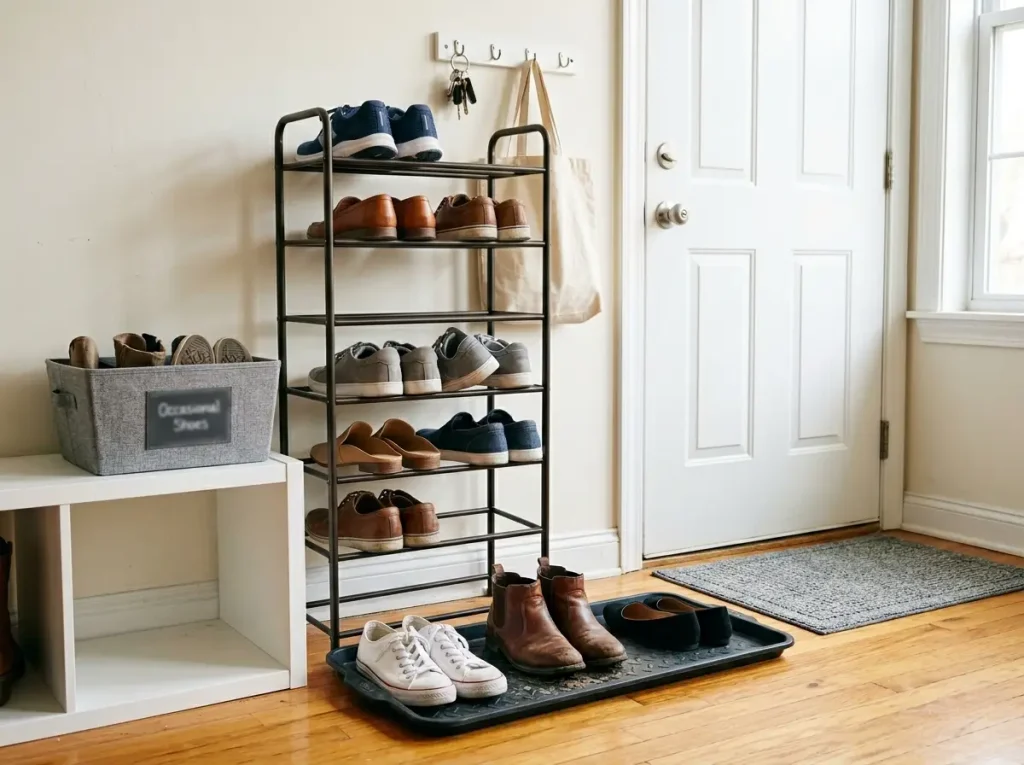
This is the step almost nobody takes, and it’s the one that makes everything else hold. People try to keep all 25 pairs accessible right at the front door. No storage product survives that. The rack overflows because there was never a rule about what belongs at the entry and what belongs elsewhere — every season, every “maybe,” every pair fighting for the same prime real estate.
The Daily Zone (3–7 Pairs at the Door)
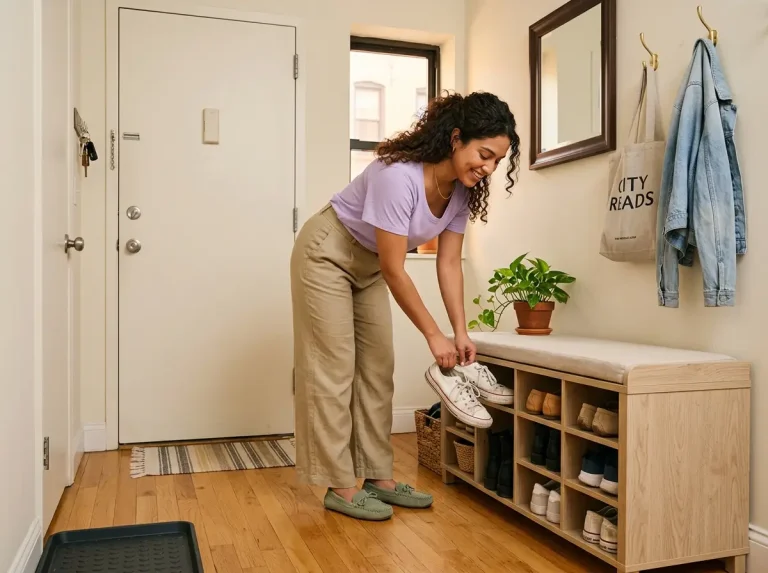
Your daily zone is whatever you can grab without thinking — the shoes you reach for on autopilot. Keep it to seven pairs at the very most. If it’s more than that, you’ve smuggled weekly shoes into the daily zone, and you’ll fight your own setup every morning.
A boot tray is the simplest way to enforce this. Its physical size sets the limit for you, and that’s the whole point. The SUPENUIN Boot Tray holds three to four pairs flat and sits flush against the wall without touching it, so renters can place it anywhere without worrying about scuffs or deposit risk.
When the tray is full, the rule writes itself: something has to move back before a new pair lands. And when shoes start piling up next to the tray instead of on it, that’s not a tray that’s too small — that’s the system telling you it’s over capacity.
The Weekly and Occasional Zones
Weekly shoes, the ones you wear one to three times a week, go on the back tier of the entry rack or the first row of the closet floor. Close, but not front and center. Occasional shoes you reach for monthly or less go into labeled boxes on a closet shelf. The label matters more than people expect. If you can’t identify a pair in under ten seconds, the box stops being storage and becomes a mystery container you never open again.
I used to tell people to use clear boxes so labels weren’t necessary. Then I watched a friend stack twelve “clear” boxes that fogged and scuffed within a year until you couldn’t tell black flats from navy. Now I say label them regardless, clear or not.
The Seasonal Zone (and the Swap You Keep Forgetting)
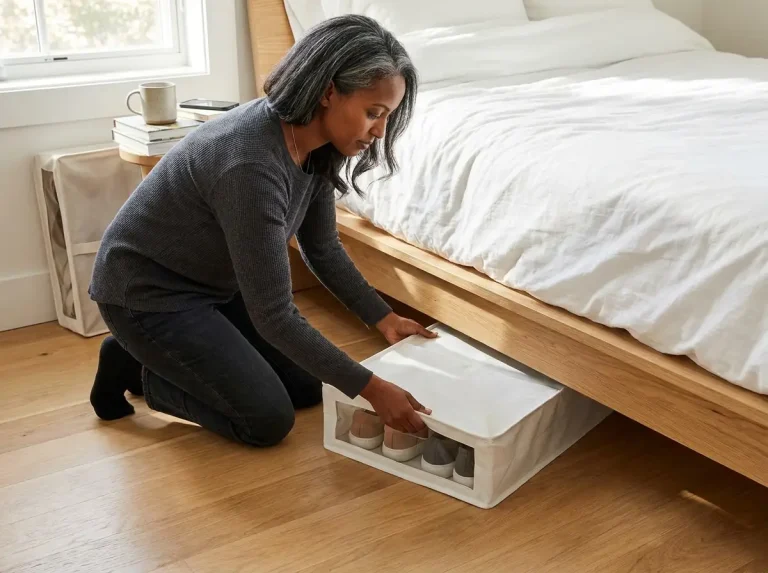
Boots that only appear in winter, sandals that only appear in summer, dress shoes for three events a year — these belong in flat storage out of the daily path, usually under the bed. The Woffit Under Bed Shoe Organizer Set of 2 (28 by 11 by 5.5 inches) slides under a metal-frame bed and holds about a dozen pairs flat, keeping them shaped and dust-free. The one caveat: at 5.5 inches tall it needs a frame with at least 7 inches of clearance, so it won’t fit a low platform bed. For those, you’ll want something flatter. There’s a full breakdown of under-bed shoe storage options by bed clearance if your frame sits low.
Set two calendar reminders right now. First week of October, boots come forward and sandals go under. First week of April, reverse it. The swap takes 15 minutes and it’s the single thing that prevents boot season from detonating your whole setup.
Match Your Storage Solution to Your Space Type
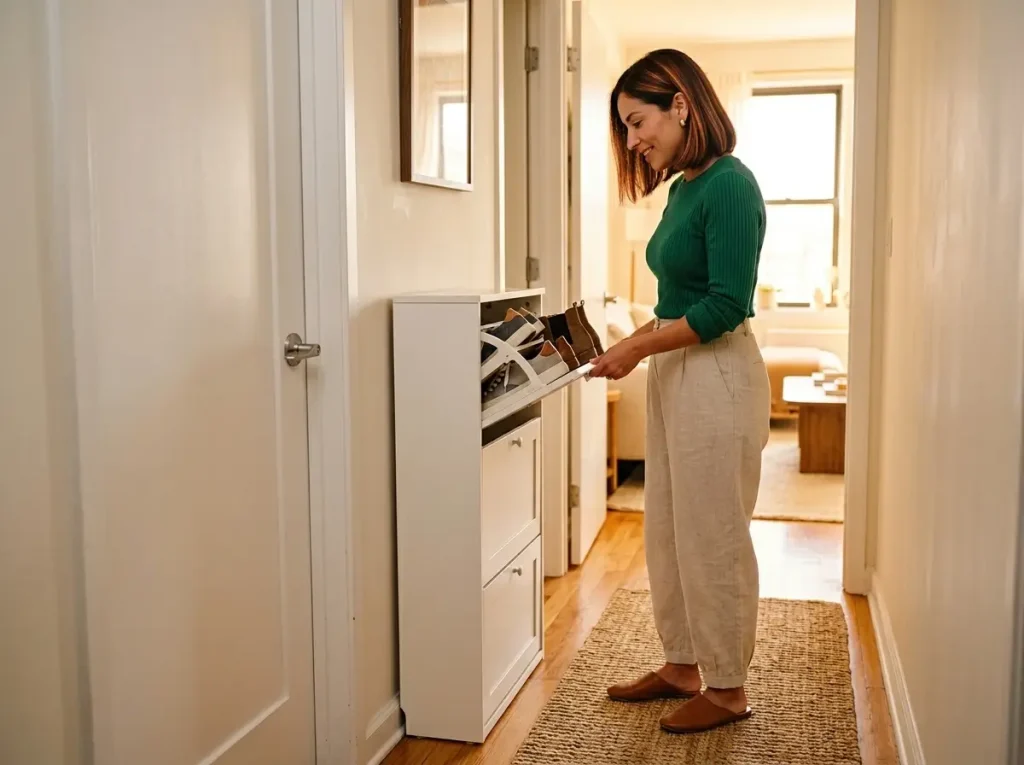
This is where the third shoe rack gets bought — the one purchased because the first two “didn’t work.” In almost every case I’ve seen, the product category was wrong for the space, not the product itself. An open wire rack in a studio where the front door opens straight into the living room will always look messy, because one pair sitting sideways reads as chaos across the whole room. That’s not a defective rack. That’s a category mismatch.
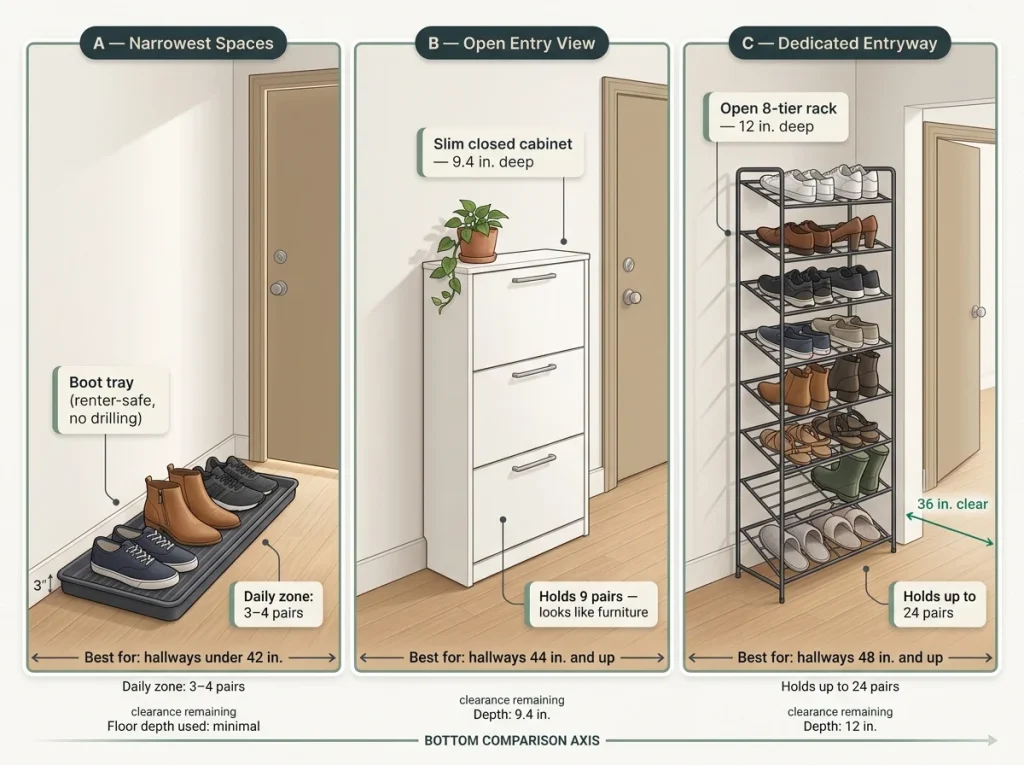
Three things decide which category is right, in this order: how much floor depth you have (the clearance math from above), whether your entry is visible from the main living area, and how many pairs landed in Pile A.
The Boot Tray–Only Setup (For the Narrowest Spaces and Studios)
When the hallway is under 42 inches, or the entry sits in plain view of the couch with no wall to break it up, a single boot tray is often the cleanest answer. One tray. Three or four daily pairs. Everything else lives in the closet or under the bed. It sounds almost too simple, but in a studio the visual quiet is worth more than the extra capacity an open rack would give you.
The psychology is the part people miss. The tray defines the zone. Shoes on the tray means organized; shoes creeping onto the floor beside it means it’s time for a quick reset. That’s a far cleaner signal than a rack that just keeps absorbing pairs until it’s a teetering mess. If your place has no defined entry at all, the apartment entryway organization zone system covers how to carve one out from nothing.
The Slim Closed Cabinet (For Visual Order Without Drilling)
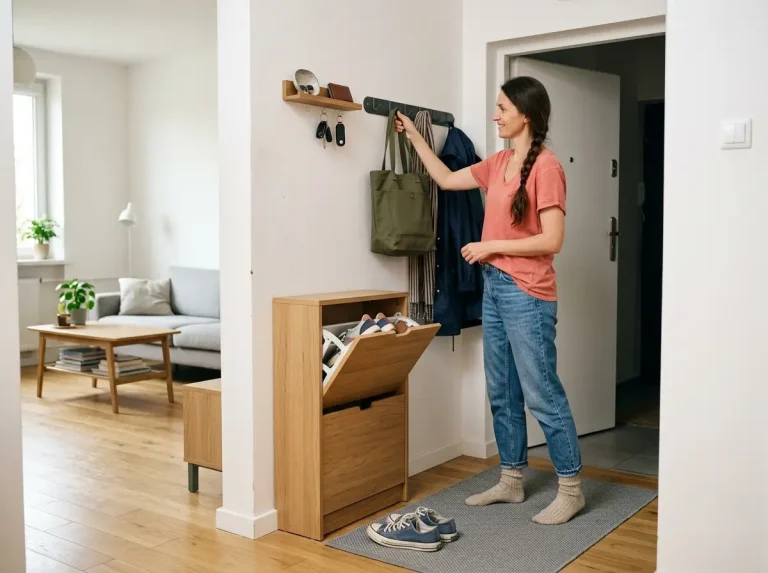
If your entry is visible from where you sit, eat, or take video calls, open storage will quietly wear you down. One pair knocked sideways and the whole room looks untidy. The fix is closed storage, and for renters that means freestanding with no drilling. The VASAGLE Slim Shoe Cabinet with 3 Flip Drawers is the one I keep coming back to for this exact situation.
At 9.4 inches deep it’s the shallowest enclosed cabinet I’ve found, so it fits a 44-inch hallway without eating the clearance, and the flip drawers shut completely — you see a piece of furniture, not your shoes. It holds nine pairs across three drawers, which covers the whole primary zone for a one-person household.
Honestly, I resisted closed cabinets for years because they hold fewer pairs than an open rack of the same footprint. Then I lived in a studio where the door opened three feet from the sofa, and I understood. In a space where the entry is always on display, fewer pairs you never have to think about beats more pairs you’re constantly tidying.
The Open Narrow Rack (For Dedicated Entryways With Clearance)
If your hallway is 48 inches or wider and there’s a wall, a coat closet, or even a turn that separates the entry from the living space, an open rack earns its keep. The SONGMICS 8-Tier Narrow Shoe Rack (12 inches deep, 17.6 inches wide) holds up to 24 pairs in a slim vertical column and leaves exactly 36 inches of clearance in a 48-inch hall. Each shelf takes about 30 pounds, and the open wire keeps dust from settling the way it does in closed boxes.
But the rack only holds up long-term if you’ve already done the frequency zoning. Without it, all 25 pairs pour onto eight tiers, the rack hits capacity in a week, and the overflow starts on the floor beside it. That’s not the rack failing. That’s too many pairs assigned to the primary zone. For specific picks by hallway depth, there’s a detailed breakdown of apartment shoe rack dimensions by hallway width.
The Over-the-Door Organizer (Zero Floor Space Required)
When there’s no floor to give up at all (a true studio, a closet with no floor clearance, a shared bedroom), the back of a door is the one surface left. The SimpleHouseware Over-the-Door Shoe Organizer (24 pockets) holds two dozen pairs on the back of any door and hangs on a hook with no tools and no damage. Just run the 2-inch door clearance check first. Over-the-door organizers get recommended everywhere, and they do work — unless your door swings against a wall and the hook can’t seat, which is the failure nobody warns you about until you’re standing there holding a full organizer and a door that won’t close.
The Reset Cadence That Prevents the Month-Two Collapse
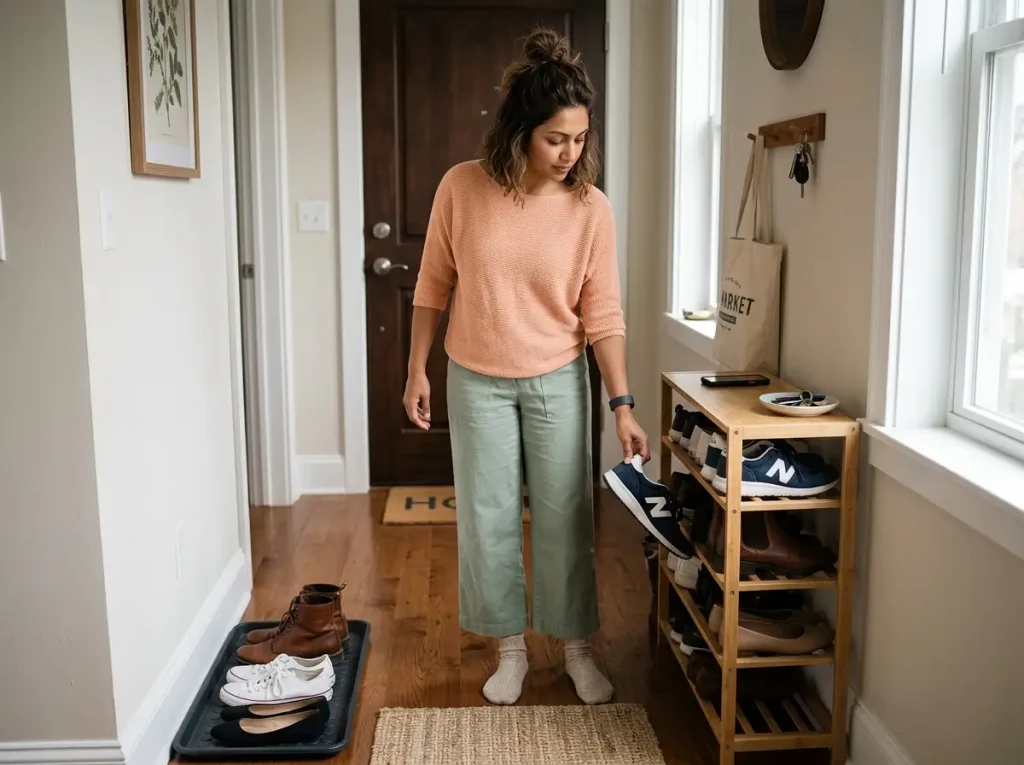
Here’s what separates a setup that lasts from one you’ll redo every six months: a maintenance habit. Most people reorganize their shoes twice a year and never ask why it keeps falling apart. The answer is almost always the same — no weekly scan, no plan for boot season, and no rule about new shoes entering the house.
The Five-Minute Weekly Scan
Pick one day. Sunday evening, Saturday morning, whenever you’ll actually do it. Walk to the entry zone and reset three things. Any shoe out of its spot goes back. Any pair that hasn’t moved in two weeks gets demoted to the weekly zone — it’s not a daily shoe anymore, no matter what you tell yourself. Any pair that hasn’t moved in a month drops to the occasional box on the shelf.
If this takes five minutes, your system is working. If it takes twenty, the zone sizing is off — usually the daily zone is too small for how many pairs you really wear, or too many pairs are competing for too few spots. That’s useful information, not a failure.
Anchor the scan to something you already do. I run mine while the Sunday coffee brews, and by the time the pot’s done, the entry’s reset. Habits that hitch onto an existing routine survive; the ones that need their own calendar slot rarely do.
The October/April Seasonal Swap
Those two calendar reminders earn their place here. First week of October, pull the boots from under-bed storage and send the sandals down. First week of April, reverse. This is the swap that quietly breaks most setups when it doesn’t happen, because boot season arrives in November whether you prepared or not. Skip the swap and the boots go on the floor “temporarily,” the sandals never leave the rack, and the door pile reforms — this time for good.
The whole thing takes 15 minutes twice a year. If you want a structured version, the seasonal rotation system that handles all clothing and footwear walks through the full process.
The One-In-One-Out Rule at the Door
Every new pair that comes home triggers one decision: which existing pair gets demoted? A new sneaker means an old sneaker drops to the weekly zone or out the door entirely. Not as a minimalist principle, but because your primary zone has a fixed capacity, and when it fills, the overflow lands on the floor. The floor pile is the failure state. One-in-one-out catches it before it ever starts.
Conclusion
Three things keep shoes organized in a small space, and none of them is the rack. Measure your hallway before you buy, because clearance decides everything downstream. Split your shoes into daily, weekly, and seasonal before you organize, because the primary zone is built for six to ten pairs, not thirty. And run the five-minute weekly scan plus the twice-yearly swap, because that’s the difference between a system that lasts and one you redo every season.
In three months, check whether seasonal pairs have crept back into the daily zone. If they have, your primary zone is undersized or you skipped the swap — both fixable in 15 minutes.
Start with the edit. Pull everything out, make the two-pile split, and count Pile A. Once you know how many pairs actually belong at the door, the right storage becomes obvious, and your shopping list gets a lot shorter.
Frequently Asked Questions
01How do you store a lot of shoes in a small space?
Split the collection by frequency: keep six to ten daily pairs at the entry and move everything occasional or seasonal into under-bed storage or labeled closet boxes. A small space can’t hold every pair at the door, so the trick is storing most of them somewhere else.
02What is the best shoe storage for a small entryway?
Measure your hallway width first, then choose by clearance. A slim flip-drawer cabinet around 9 inches deep works for hallways 44 inches and wider, and an over-the-door organizer works for anything narrower. The right pick depends on your depth, not on the product’s looks.
03How do you keep shoes organized in a small closet?
Use the closet’s three surfaces: a boot tray or floor mat at the base for daily pairs, a slim rack on one side for weekly shoes, and an over-the-door organizer on the door back for the rest. Measure the floor-to-rod clearance before adding a rack so it actually fits underneath.
04How many pairs of shoes fit on a standard shoe rack?
A standard narrow rack about 17 inches wide holds roughly two pairs per shelf side by side, so an 8-tier model fits around 16 pairs. Arranging shoes toe-to-heel instead of side by side adds about 30 percent more capacity per shelf.
05How do you organize shoes when you have no closet?
Use vertical and hidden space: an over-the-door organizer on a bedroom door, a slim closed cabinet at the entry, and under-bed flat containers for the bulk of the collection. With no closet, the goal is keeping daily pairs reachable while the rest stays out of sight.
Disclaimer: ClutterlessNest is a participant in the Amazon Services LLC Associates Program. As an Amazon Associate we earn from qualifying purchases. This article may contain affiliate links — if you buy through them, we may earn a small commission at no extra cost to you. We only recommend products we have tested or genuinely believe in.