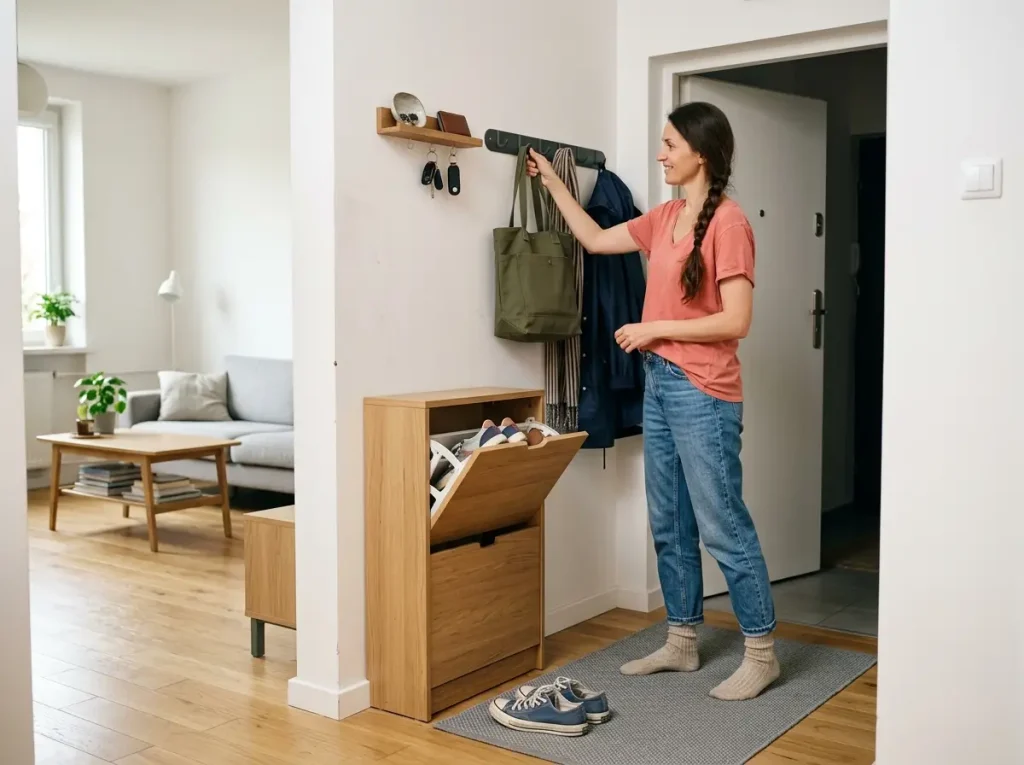
The front door of most apartments doesn’t open into a foyer. It opens into the living room, the kitchen, or a three-foot hallway that barely qualifies as a space. There’s no natural place to stop, so everything ends up on the floor — keys on the counter, shoes by the couch, coat draped over a chair two rooms away.
After organizing dozens of small apartment entryways, I can tell you what stops the pile isn’t more storage — it’s a defined zone. This guide walks you through defining that zone first, then building a system — drop zone, shoe storage, coat hooks — that actually holds up after three months of real use.
Quick Answer: Here’s how to organize an apartment entryway with no foyer:
- Define the zone with a floor mat and one vertical anchor
- Set up a drop zone for keys, wallet, and daily carry items
- Choose shoe storage that matches your actual floor space
- Mount coat and bag hooks using renter-safe methods
- Build a 3-minute weekly reset to prevent the system from reverting
Why Your Apartment Entryway Keeps Getting Messy
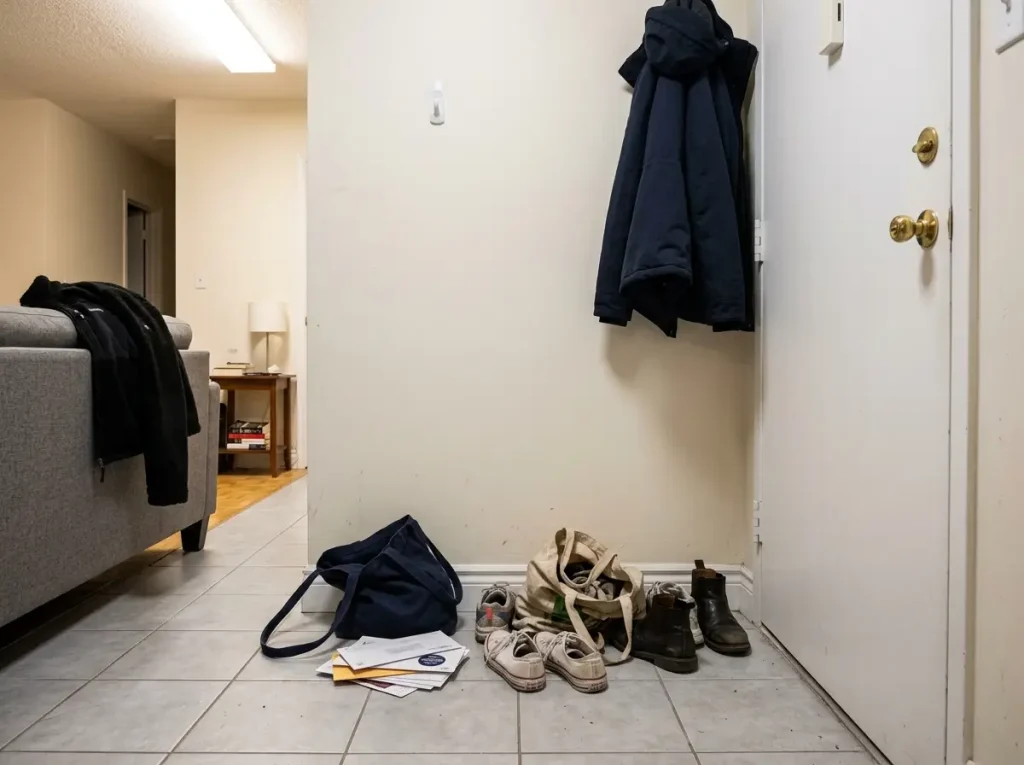
You’ve tried the basket by the door. You’ve hung a hook. The pile is still there. The problem isn’t that you haven’t found the right product — it’s that your apartment doesn’t have a room signal telling your brain where to stop and put things down.
In a house with a foyer, the walls and doorframe create a natural transition zone. You walk in, you’re in the foyer, your brain registers “I’ve arrived — drop my stuff here.” In an open-plan apartment, the front door opens to infinite space.
There’s no automatic stop point. Your brain never gets the signal, so your coat goes wherever your hands release it — the nearest chair, the couch arm, the kitchen counter.
There’s No Room Signal at Your Front Door
The reason apartment entryways fail is architectural, not behavioral. A foyer tells you to stop. A three-foot hallway that opens into the living room doesn’t. Without that physical room boundary, “the entryway” is just floor near the door — and the pile has no edge.
It starts with shoes by the door. Then a bag joins them on the floor. Then mail lands on the nearest flat surface. Within two weeks, the pile has migrated to the coffee table and the couch cushions.
The entryway pile and the living room pile merge into one, and at that point the entire front half of your apartment feels cluttered. This is why buying products first doesn’t work — you buy a shoe rack, but it ends up in the wrong spot because you never defined where the entryway begins and ends. The rack collects shoes for a week, then new pairs start landing beside it because the rack was placed too far from the door. You’ve watched this happen.
The Complexity Tax on Every System You’ve Tried
Every additional step in a put-away process reduces the odds you’ll actually do it. A hook requires one action: hang. A lidded basket requires three: lift the lid, place the item, close the lid. On a Tuesday night after a long day, the hook wins every single time.
The same logic applies to shoe storage. A boot tray asks you to place shoes on it — one step. A shoe cabinet with flip drawers asks you to open the drawer, position shoes inside, and close it — three steps. The tray won’t look as clean in a photo, but the tray is the one you’ll still use in three months.
“I put a basket by the door and for three weeks everything landed next to the basket — because grabbing the basket lid was one step too many.” That’s the pattern. If your last system required more than two steps to put something away, that’s why it stopped working.
Pro tip: Before buying any new entryway organizer, count the steps it takes to put one item away. If it’s more than two steps, swap it for the one-step version. A hook beats a cabinet every time in the highest-traffic zone of your apartment.
Step 1: Define the Zone Before You Buy Anything
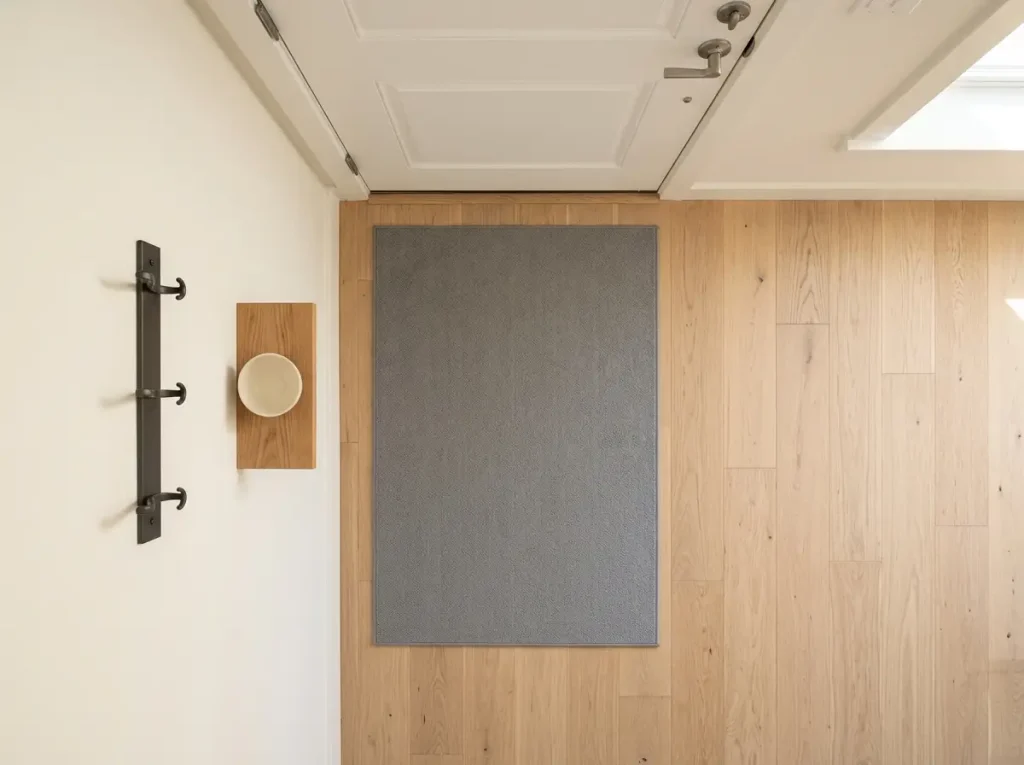
The one thing you can do before spending anything — and the thing that makes every other step in this guide work — is to define where your entryway starts and ends. In an open-plan apartment, nobody else will define this for you. You have to create the boundary yourself.
According to professional organizers, the entryway is one of the highest-friction zones in any home. And in apartments without a foyer, that friction has no container.
A floor mat fixes this. It creates a visual boundary that signals — even without walls — that this patch of floor is a transition zone. People step onto it, look down, and register that they’ve arrived.
The Mat-and-Vertical-Anchor Method
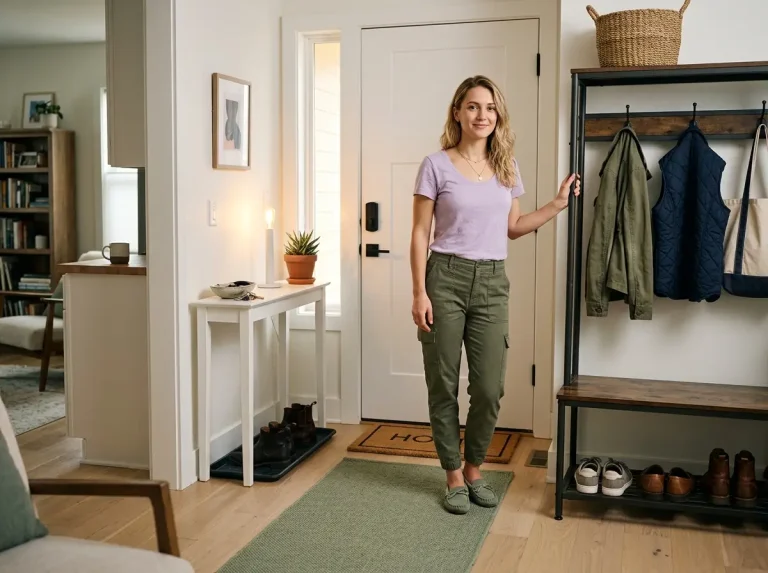
The minimum viable entryway requires exactly two things: one floor mat and one vertical element. The mat defines the horizontal boundary — everything on the mat belongs to the entryway system, everything past the mat edge is living space. The vertical element — a wall hook, a shelf, or a slim cabinet — anchors the zone and gives items a destination above or beside the mat.
For open-plan apartments where the front door opens directly into the living room, place the mat 24 to 30 inches from the door. That’s about the depth of two adult shoe lengths — just enough to create a visual stop signal without eating into your living space.
The mat edge becomes the line. Everything inside it is entryway. Everything outside it is apartment.
Here’s why the mat works even though it’s just fabric on a floor: in an open-plan apartment, your brain has no architectural cue to shift from “outside mode” to “inside mode.” A foyer does this with walls. A mat does it with texture underfoot and a visible color change. You feel the shift when you step on it. That sensory feedback is enough to trigger the habit loop — step on mat, hang bag, drop keys. Without it, you walk past the door and your hands never get the signal to let go of what they’re holding.
Even a floating shelf and a single wall hook are enough to complete the vertical anchor — the point isn’t to build furniture, it’s to give your arriving brain exactly one obvious place to put things.
Measuring Before You Buy Anything
Two measurements determine every product choice you’ll make in this guide. First: how much wall width do you have? That’s the horizontal space between the door frame and the nearest obstacle — a corner, a light switch, a neighboring door.
Second: how much floor depth do you have? That’s the distance from the closed door to the nearest piece of furniture or the start of your living space.
With 8 to 12 inches of wall width, you have room for a single hook rail or a small wall shelf. With 10 or more inches of floor depth, you can fit a slim shoe cabinet. With only 7 to 9 inches of floor depth, you’re in IKEA TRONES territory — nothing else fits at that depth.
Write these two numbers down before you open a single product page. Every product recommendation in this guide is sized to one of these ranges — if you skip measuring, you’ll buy something that doesn’t fit and end up returning it or, worse, keeping it in the wrong spot where it blocks foot traffic.
For a deeper breakdown of small entryway setups beyond apartments, see our full small entryway organization guide.
Build Your Drop Zone: Keys, Mail, and Daily Carry
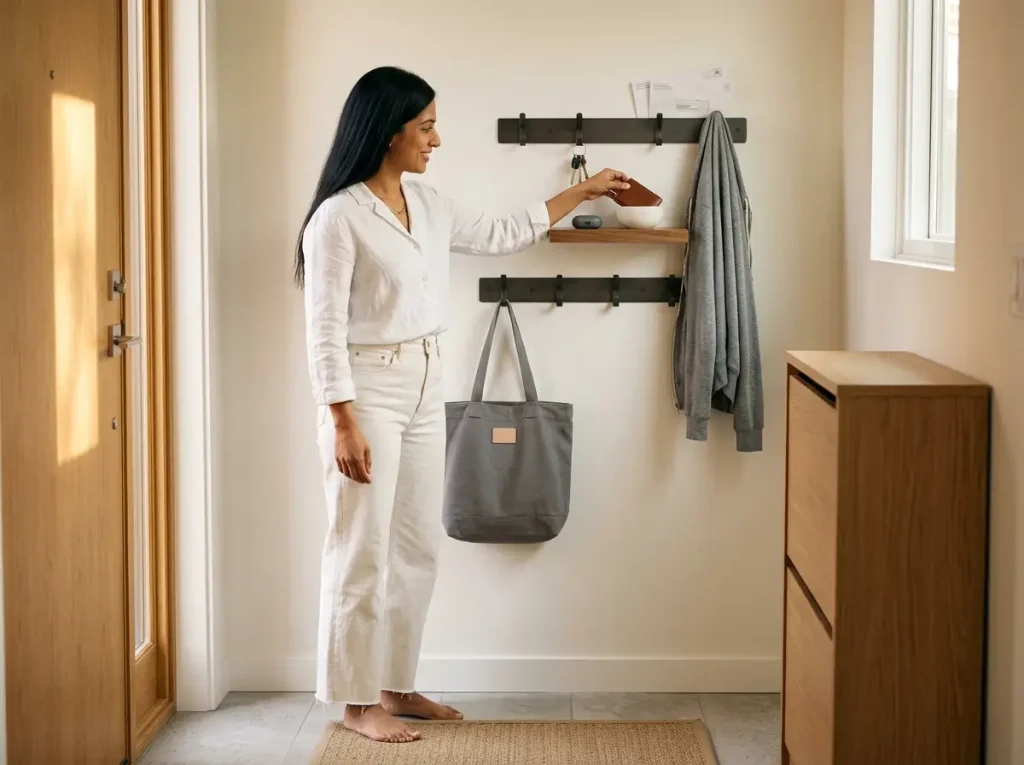
The reason your keys end up in three different spots isn’t forgetfulness — it’s that your apartment doesn’t have one designated place for them to live. A drop zone solves this. It’s the single surface where your daily carry items land the moment you walk in the door.
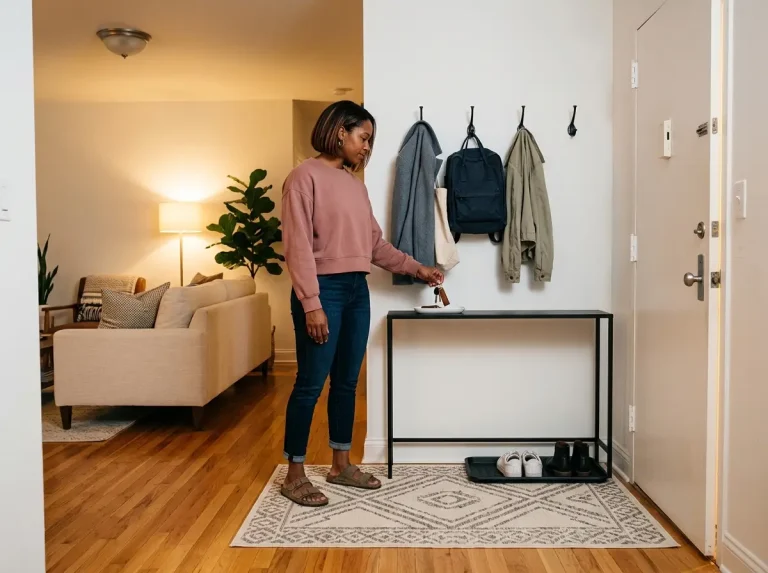
The drop zone needs three slots: a hook for your bag, a small surface for pocket items (keys, wallet, sunglasses), and optionally a mail tray. If you try to combine all three onto one crowded surface, it becomes a shelf — and shelves attract clutter faster than any other horizontal surface in your apartment.
The One-Surface Rule
One tray, one hook, one category each. The surface holds keys in a bowl, your wallet flat, and one item charging. That’s it.
If you add mail, use a slim vertical file holder — not a flat tray. A flat tray fills up in four days. A vertical file forces you to sort because you can see every piece of mail standing upright.
If the file overflows, the problem isn’t the container — it’s the mail habit. Fix the habit, not the tray size. Every additional surface you add to the entryway is a future pile waiting to happen. You’ll know you’ve crossed the line when you find yourself “cleaning the entryway” weekly instead of just using it.
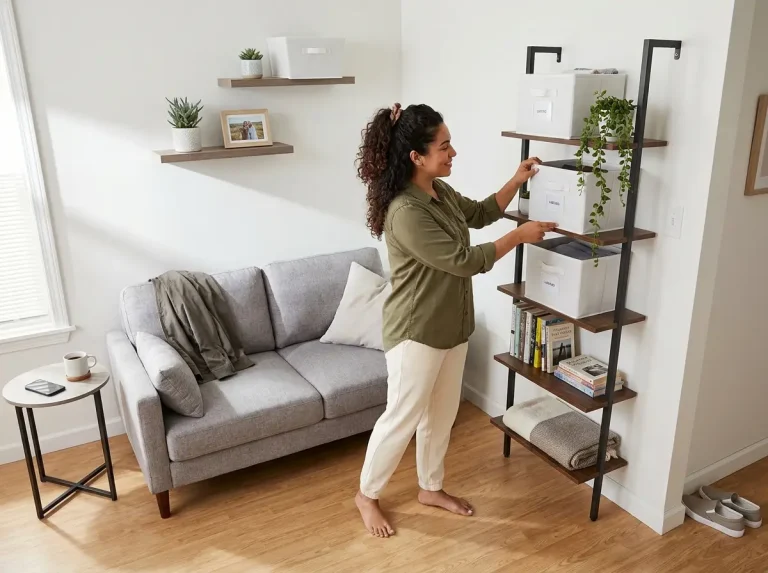
If you need vertical storage beyond the entryway, look into a vertical storage system for the rest of your apartment.
Wall Hooks That Actually Hold a Bag
Most apartment entryway hooks fail because they’re rated for a towel, not a work bag. The Homode Wall Hooks with Shelf mounts on the wall with screws and combines a small floating shelf (approximately 16 by 8 inches) with hooks below. The shelf holds your key tray or ceramic bowl; the hooks hold a bag and a jacket. It solves the entire drop zone in one install with zero floor footprint.
If you can’t use screws — or don’t want to deal with patching holes when you move — the Command Large Wire Hooks are the no-drill alternative. They handle up to 7 pounds each on smooth painted drywall, which covers a canvas tote or a light jacket. They won’t hold a loaded laptop bag. For heavy everyday bags — laptop plus gym gear can hit 12 pounds together — you need either the Command XL Heavyweight hooks rated for 15 pounds, or a screw-mount solution.
Pro tip: Mount hooks at 63 inches from the floor — that’s shoulder height for most adults, so you can grab bags and coats without bending or stretching. Keep at least 3 inches of clearance from the door frame molding, or the door will hit the hook every time you open it fully.
Shoe Storage for Apartments: Match the Solution to Your Floor Space
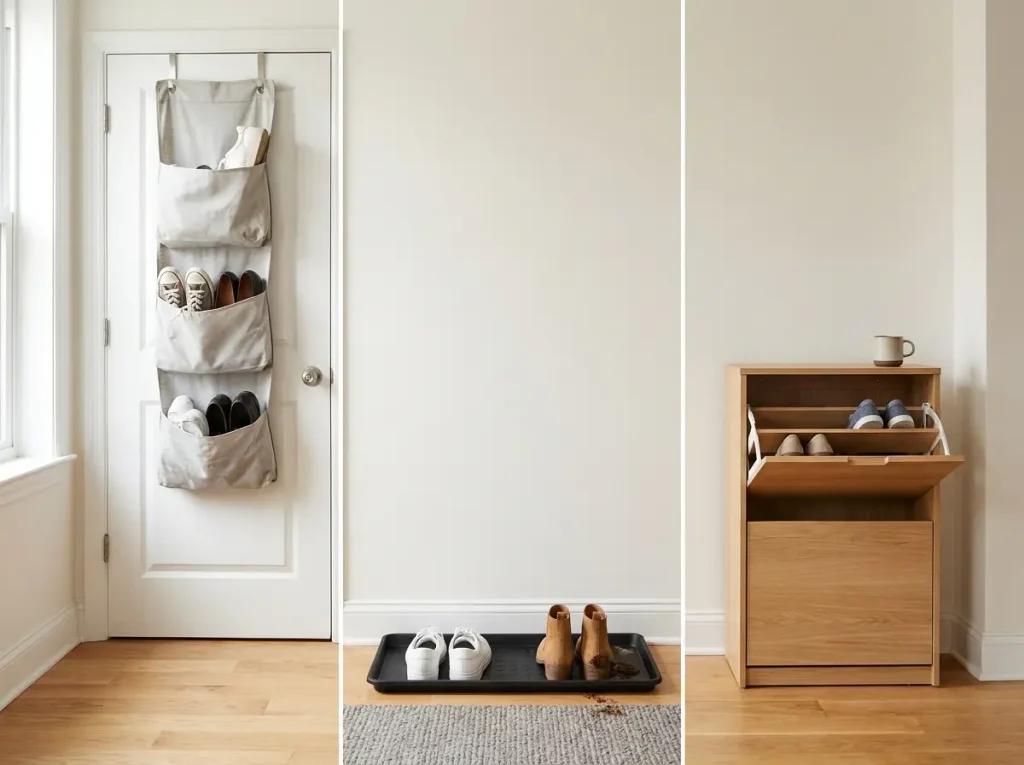
The shoe pile at your door exists because you’re trying to store shoes in a space that wasn’t designed for shoes. Apartment entryways rarely give you 12 inches of floor space and a dedicated closet at the same time. The right shoe storage depends entirely on how much floor you actually have — not on what looked good in someone else’s apartment photo.
Zero Floor Space: The Over-Door Option
If the floor immediately inside your front door is consumed by foot traffic — common in studio apartments where the door opens into the kitchen or a narrow pass-through — use the back of the door itself. The UVIAHOMI Over-Door Shoe Organizer hangs over the door top with no drilling and keeps shoes entirely off the floor.
Before you buy, open your front door fully against the wall and check the clearance between the door back and the wall. Less than 1 inch: the organizer scrapes the wall. More than 2 inches: items fall out of the pockets when the door swings. Most apartment front doors have 1 to 2 inches of clearance — but check yours, because a 30-second measurement saves a return trip.
A Little Floor Space: The Boot Tray Method
A boot tray is the lowest-friction shoe storage solution you can get. Place it, put shoes on it, done. No assembly, no drilling, no instructions to read.
The SUPENUIN Boot Tray catches mud and water and creates a visual boundary that signals “shoes go here.” That visual distinction matters more than you’d expect — shoes on the tray read as “put away,” shoes beside the tray read as clutter. Your brain knows the difference instantly.
Use the tray for 2 to 4 pairs of current-rotation shoes only. If your winter boots and rarely-worn dress shoes are sitting on the tray, they don’t belong there — they belong under the bed or in a closet. The entryway holds what you’re wearing this week. Nothing else.
Real Floor Space (10+ Inches): The Slim Cabinet
If you have 10 or more inches of floor depth along your entry wall, you have room for a real shoe cabinet. The VASAGLE Slim Shoe Cabinet with 3 Flip Drawers is 9.4 inches deep — the narrowest freestanding cabinet that actually holds adult-sized shoes, not the child-size ones that look slim in product photos but can’t fit a men’s size 10.
It’s 23.6 inches wide and 42.5 inches tall, roughly the footprint of a nightstand. The flip-drawer design opens downward, not outward, so you need zero clearance in front of it. Holds up to 18 pairs, which covers two adults rotating 2 to 3 pairs each with room for guest shoes. No drilling, no wall mounting — it stands on its own.
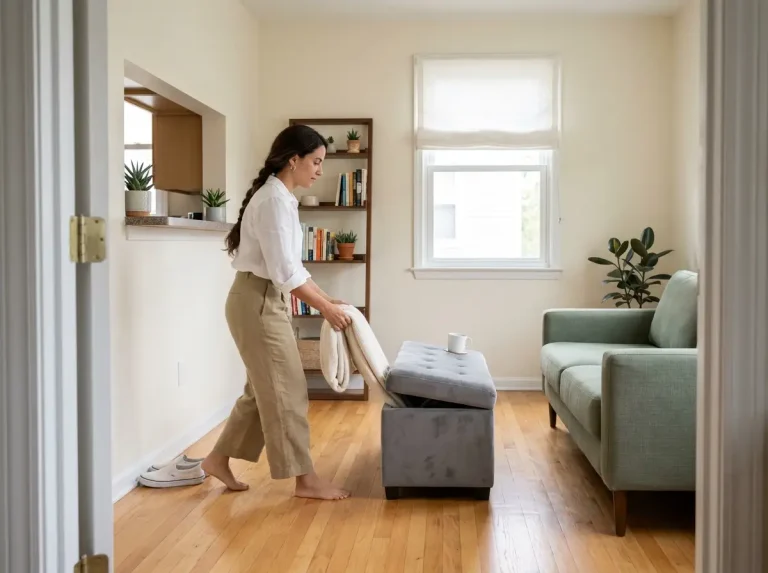
If you’re building out the rest of your small apartment, pair this with multi-functional furniture for small apartments to get double duty from every piece you bring in.
Coat and Bag Hooks: The Renter-Safe Approach
Hooks sound simple until you’re standing in a rental apartment where the wall is textured and your security deposit is on the line. Most hook failures in apartments aren’t about weight — they’re about surface. A hook rated for 15 pounds will hold 15 pounds on smooth painted drywall. On textured paint, it holds fine for two weeks and then pulls off the wall at 2 AM, taking a chunk of paint with it.
When Adhesive Hooks Actually Work (and When They Don’t)
Adhesive hooks like the Command XL Heavyweight (rated for 15 pounds) work on one surface: smooth painted drywall. Not orange-peel texture. Not stippled ceilings turned walls. Not wallpaper. Not tile. Not near HVAC vents where humidity fluctuates and weakens the bond over time.
Here’s the test: press a Command hook firmly against your wall for 30 seconds, wait one hour, then pull straight down with about 2 pounds of force. If it shifts at all, the surface is too rough for adhesive.
For weight reference: one heavy winter coat weighs about 3 pounds, one loaded laptop bag about 8 pounds — that’s 11 pounds total, within spec for the XL model. But a packed hiking backpack can hit 20 pounds. For anything that heavy, use screws or a freestanding rack.
If screws feel permanent, they’re not — patching screw holes with spackle and touch-up paint takes less than ten minutes and costs almost nothing. Most landlords expect minor patching at move-out. Command’s weight limit guide covers the full specs for each hook type if you want to check before mounting. For more adhesive and no-drill mounting strategies throughout your rental, check out no-drill organization throughout your rental.
The Freestanding Alternative (No Wall Involved)
If your wall surface is a lost cause — or you’d rather not touch the walls at all — a freestanding coat rack removes the problem entirely. No adhesive, no screws, no deposit risk. The main failure mode is wobble, which you fix by placing the rack base on a rubber mat or your entry rug. The weight of the mat pins the base in place.
Freestanding racks work especially well in open-plan apartments where there’s no usable wall within arm’s reach of the door. Pair a coat rack with a boot tray below it and you have a complete two-piece entryway system — no tools, no installation, and it moves with you to your next apartment.
Pro tip: If you go freestanding, pick a rack with a wide base — at least 15 inches across — and a heavy bottom. The narrow tall ones tip the moment you hang a heavy bag on one side. You’ll learn this the hard way or you can just skip to the wide-base model now.
The 3-Minute Reset That Keeps It All Working
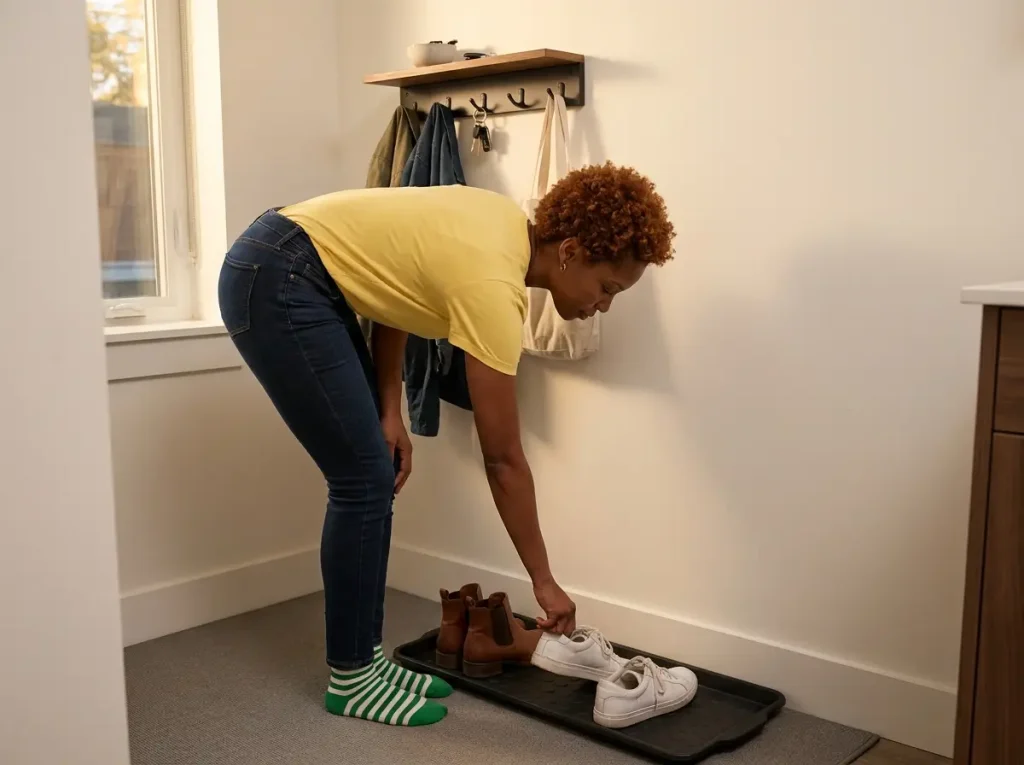
The entryway system you just built will fail within a month if you don’t maintain it. Not because the products are wrong — because the entryway is the highest-traffic zone in your apartment. Every person and every bag that enters crosses this space daily. Without a reset, drift happens fast.
Here’s what drift looks like: week one, the system works perfectly. Week two, a pair of shoes lands next to the boot tray instead of on it. Week three, a bag migrates from the hook to the floor because the hook was already holding two jackets.
By week four, the entryway looks the way it did before you started. You’ve watched this cycle play out — maybe more than once.
The way to break it isn’t a major cleanup. It’s a scheduled micro-reset — three minutes, three moves, once a week.
The 3-Minute Weekly Reset
Pick one evening a week — Sunday works, but any consistent night will do. Set a timer for three minutes and do three moves.
Move 1: Anything on the floor that doesn’t belong in the zone gets walked to its actual room. This includes shoes that migrated off the tray, bags that slid off hooks, and whatever random item someone set down “just for a second” four days ago.
Move 2: Reset shoes to the tray or cabinet. Straighten pairs, align them so the tray edges are visible. If shoes have drifted outside the tray boundary, the tray might be too small or positioned too far from where you actually take your shoes off.
Move 3: Clear the drop zone surface. Anything that’s not keys, wallet, or a current daily item gets a new home right now. Not back on the surface “for now.” An actual home somewhere else in the apartment.
That’s it. Three moves, three minutes, once a week. This ritual is the difference between a system that holds for a year and one that reverts in a month. The entryway forgives a lot of lazy weekday behavior as long as you reset it regularly.
The Three-Month Reassessment
At the three-month mark, audit the system. Are you actually using every part of it?
The shoes tell the truth first. If pairs keep ending up on the floor beside the tray, the tray is in the wrong spot — move it closer to where you actually kick your shoes off, which is usually within arm’s reach of the door, not where it looked best. If the shoe cabinet is full of non-shoe items — sunglasses, gloves, random chargers — the cabinet has become a junk drawer, which means the rest of your apartment doesn’t have enough storage. Fix the apartment storage, not the entryway.
If coats pile up on the floor beside the hooks, either you don’t have enough hooks for your household size or off-season coats are taking hook space from daily ones. Swap seasonal gear at the start of each season — a hook rail overloaded with four coats is a hook rail nobody uses.
The number one predictor of whether your entryway is still working at three months is whether the zone itself is intact. If the mat is still there and the hooks are still there, the system can recover from any amount of weekly drift. If the mat got pulled up because it was “in the way,” the system is gone.
Keep the zone. For a full system that applies this same reset approach across your entire apartment, see a room-by-room system for your whole apartment.
The Entryway That Works Three Months Later
Three things separate an apartment entryway that holds up from one that reverts within a month:
- The zone comes first. One mat, one vertical anchor — the system only works if there’s a physical boundary that your brain recognizes as the place where things go.
- Products match your measurements, not your mood board. Measure your wall width and floor depth before opening a single product page. A 9.4-inch cabinet won’t fit a 9-inch floor strip, and no amount of optimism changes that.
- The 3-minute reset is non-negotiable. Build it into your week from day one. The system needs maintenance or it reverts — every apartment entryway that stays organized runs on this cycle.
Three-Month Check: At 90 days, check whether the boot tray or shoe cabinet is still in the right spot and whether off-season gear has taken over the coat hooks. Move things. Swap things. A system that adjusts to your habits is a system that lasts.
Pick the one thing your apartment entryway is missing most right now — a hook, a mat, or a tray — and put it in place today. One piece installed correctly beats a full system that overwhelms you into doing nothing.
Q1 How do you create an entryway in an apartment with no foyer?
Place a mat 24 to 30 inches from the door to define the zone, then add one vertical element — a hook rail, shelf, or slim cabinet — as the anchor. You don’t need a physical room. You need a visual boundary that signals where to stop and drop your things.
Q2 What is the best shoe storage for a small apartment entryway?
It depends on your floor space. Zero floor space: an over-door shoe organizer on the front door. Some floor space: a boot tray for daily-rotation shoes. Ten or more inches of floor depth: a slim shoe cabinet like the VASAGLE 3-drawer at 9.4 inches deep, which holds up to 18 pairs.
Q3 How do you organize an entryway without a closet?
A wall-mounted hook rail for coats and bags, a boot tray or slim shoe cabinet for shoes, and a small tray for daily carry items covers the same function a closet would serve — without a single door or any built-in storage required.
Q4 What should go in an apartment entryway?
Only what you use daily: the coat you’re wearing this week, shoes in current rotation, keys, wallet, and phone. Off-season coats, extra shoes, and anything you use less than weekly belongs somewhere else in the apartment.
Q5 How do I keep my apartment entryway from getting cluttered again?
A 3-minute weekly reset: move anything off the floor that doesn’t belong, straighten shoes, clear the drop zone surface. Do it the same evening every week. The entryway is the highest-traffic zone — it needs regular maintenance or it reverts within a month.
Disclaimer: ClutterlessNest is a participant in the Amazon Services LLC Associates Program. As an Amazon Associate we earn from qualifying purchases. This article may contain affiliate links — if you buy through them, we may earn a small commission at no extra cost to you. We only recommend products we have tested or genuinely believe in.