You bought a hall tree. You used it for ten days. Now the hooks have two coats each, the bench has a bag that’s lived there since Tuesday, and you squeeze past the whole thing sideways because it’s blocking half your hallway. The organizer didn’t fail — it was the wrong size for your space, had too few hooks for your household, and nobody built a reset habit into the routine. I’ve measured more entryways than I can count, and the pattern is always the same: the organizer that fails wasn’t a bad product. It was the wrong fit for the specific hallway. This guide starts with three measurements you take before buying anything, then covers the best organizers by type — with specific dimensions and the honest drawbacks of each — plus the one-habit maintenance system that keeps them working past the first month.
Quick Answer: The best entryway organizers for small spaces depend on your hallway width, wall type, and household size.
- Narrowest hallways (48″+): A slim hall tree under 12 inches deep, like the VASAGLE UHSR087B01 at 11.8″ depth
- Families needing more hooks: A narrow-frame hall tree with 9+ hooks, like the VASAGLE UHSR40B at 28.3″ wide
- No floor space: Wall-mounted hook rails (screw-mount tri-hooks or an 8-hook rectangular rail)
- Renters with concrete walls: Freestanding hall trees or over-door hooks — adhesive strips won’t hold
- Shoe chaos at the door: A rubber boot tray to define the shoe zone, plus a freestanding rack if you need tiers
Before You Buy: The 3 Numbers That Matter
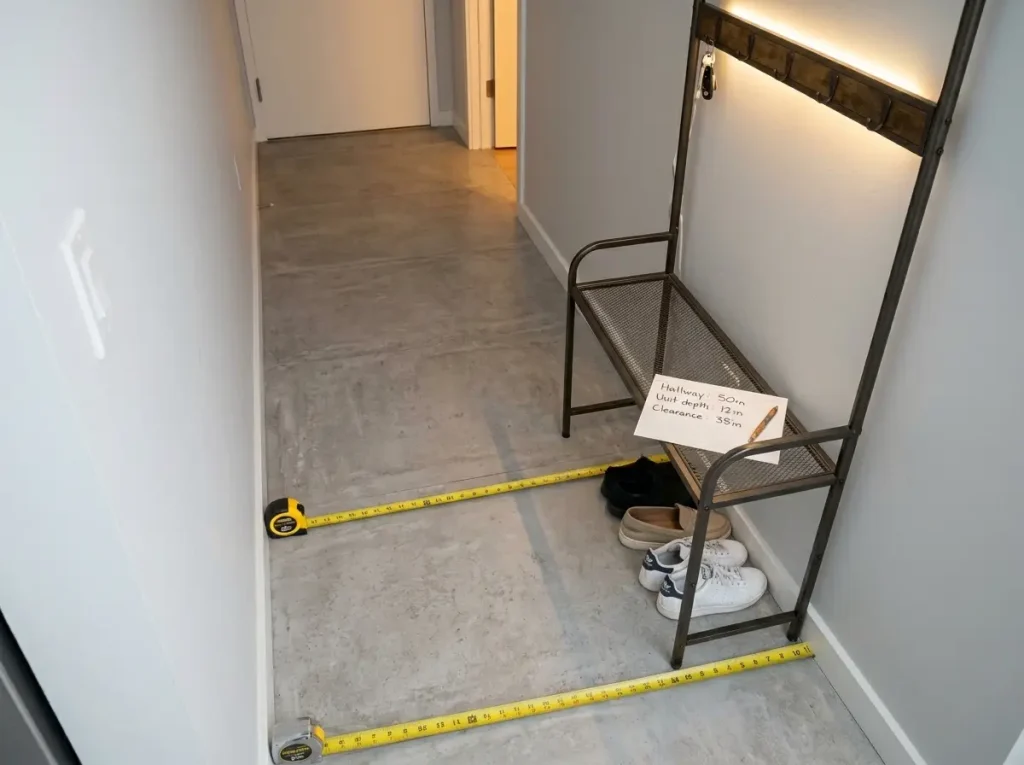
Most people buy entryway organizers based on how they look online. Then they discover the bench blocks the door from fully opening, or there’s barely room to walk past it with a grocery bag. The measurement step takes three minutes and saves you the return trip.
Your entryway has a depth budget, and most organizers blow right through it. Here’s the math that prevents that.
How Wide Is Your Walkway?
Grab a tape measure and stretch it across your hallway at the narrowest point. Now subtract the depth of the organizer you’re eyeing. The number left over is your walkway clearance — and it needs to be at least 36 inches. That’s the 36-inch minimum clearance standard from the U.S. Access Board, and it applies whether you’re thinking about accessibility or just wanting to carry a laundry basket past your hall tree without turning sideways.
Here’s how it plays out: a 50-inch wide hallway with an 11.8-inch deep hall tree leaves you 38.2 inches of clearance. That works. The same hallway with a 16-inch deep unit leaves you 34 inches — under the standard and noticeably cramped with a coat on. The difference between those two units is four inches of depth. Four inches sounds like nothing until you’re living with it every day.
Check your front door swing while you’re at it. A hall tree placed within six inches of the door’s arc will prevent the door from opening fully. You’ll bump into your own organizer every time you come home with bags.
Pro tip: Measure at the narrowest point of your entryway, not the widest. That narrow spot is where you’ll feel the squeeze, and it’s the number that actually matters for clearance.
If you want the full breakdown of how to set up a small entryway as a complete system — not just the organizer, but the hooks, the shoe zone, and the landing pad — our guide to small entryway organization covers all of it.
How Many Hooks Do You Actually Need?
This is where most people get it wrong. A 4-hook hall tree is the most common entry-level option, and it’s sized for one person. Two people routinely using a 4-hook tree means every hook has two items on it within a week. That’s not a messy household — that’s insufficient hook count for the number of people using the space.
The math: each adult needs a minimum of 3 hook-spaces. One for an everyday jacket. One for a heavy coat or bag. One buffer hook for a guest coat or a scarf you grabbed on the way out. A household of two adults needs at least 6 hooks. Two adults and a child need 9 or 10. Round up, not down — you’ll fill every hook you have, and the buffer is what prevents the pile-up.
What Your Wall Type Decides for You
Walk to your entryway wall and knock on it. If it sounds hollow, that’s drywall — and adhesive hooks like Command strips will work on it as long as the surface is smooth and painted. If it sounds solid, that’s concrete or masonry. Adhesive hooks will not hold on concrete regardless of brand, weight rating, or how carefully you install them. That’s not an opinion — it’s a material limitation.
This one test determines which section of this article applies to you. Drywall opens up adhesive hooks as an option. Concrete means you’re looking at freestanding units or over-door hooks — and that’s it.
Best All-in-One Entryway Organizers
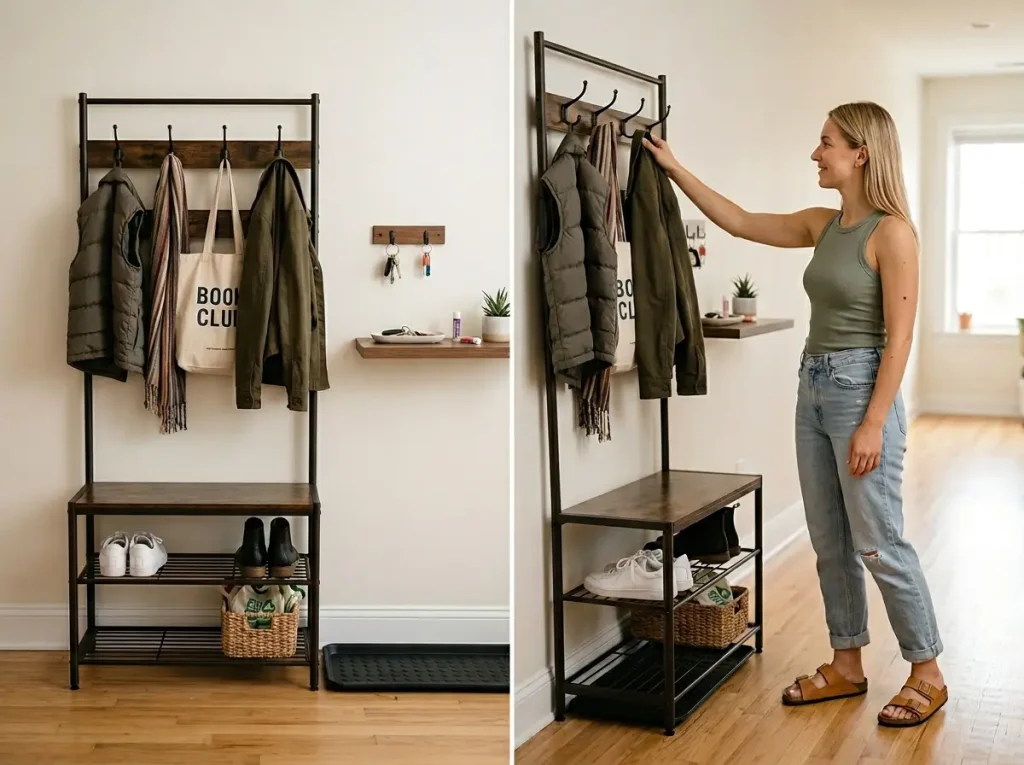
Hall trees work best when they’re narrow, have more hooks than you think you need, and are treated as a piece of furniture you maintain — not a coat closet replacement. The ones that fail are always the ones that someone treated as unlimited storage. Buy the shallowest unit that meets your hook count. Extra depth doesn’t add usable storage in an entryway — it just eats floor space that you actually need for walking through. If you’re working with a small apartment, a slim hall tree functions as multi-functional furniture for small apartments — hooks, shoe storage, and sometimes seating in a single footprint.
The Slim Pick for Narrow Hallways
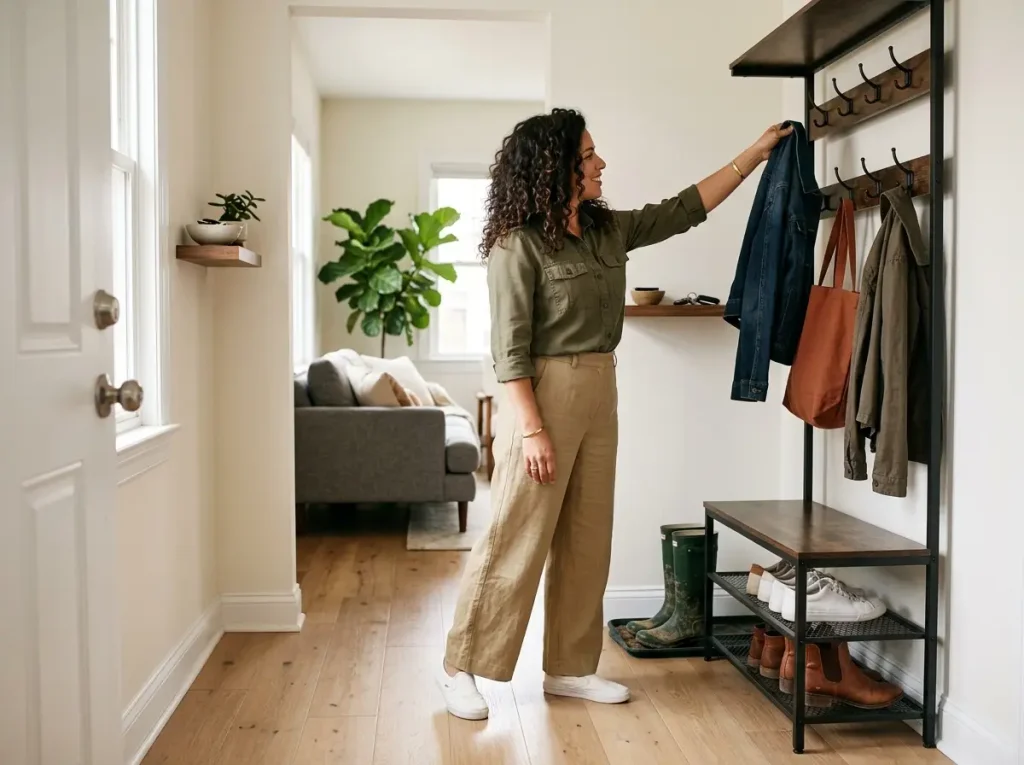
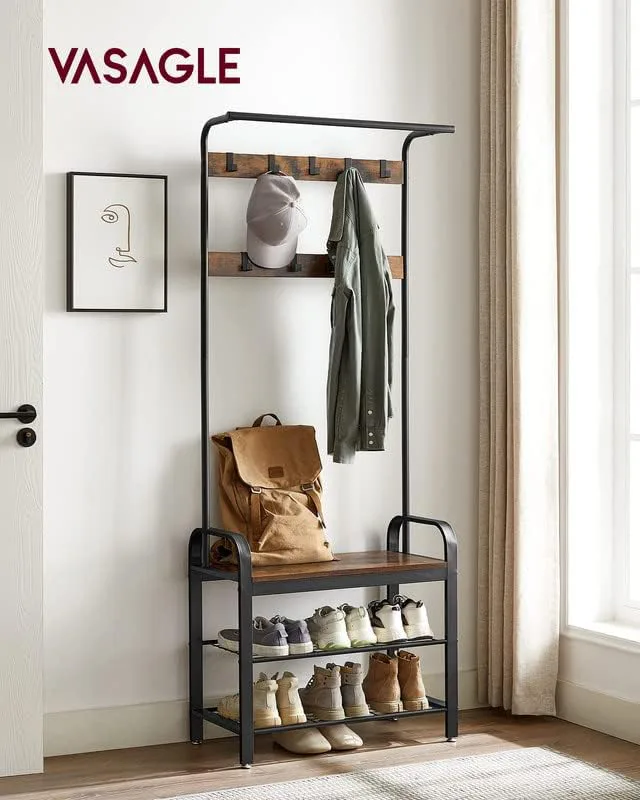
If your entryway is tight, depth is the number that matters most. The VASAGLE Hall Tree UHSR087B01 is 11.8 inches deep — the shallowest freestanding hall tree I’ve found in this category. In a 48-inch wide hallway, it leaves you 36.2 inches of clearance. Tight, but it works. It has 8 double hooks arranged in two rows, giving you 16 hook points total. That’s enough for a two-person household with room to spare for guest coats.
The lower section uses open mesh shelves instead of a bench, which means more shoe capacity and — more importantly — no flat surface for dumping. A bench seat invites piling. Open shelves don’t. If you live alone or with one other person and you don’t need to sit down to put on shoes, this design removes the most common failure point before it even starts.
The Multi-Hook Pick for Families
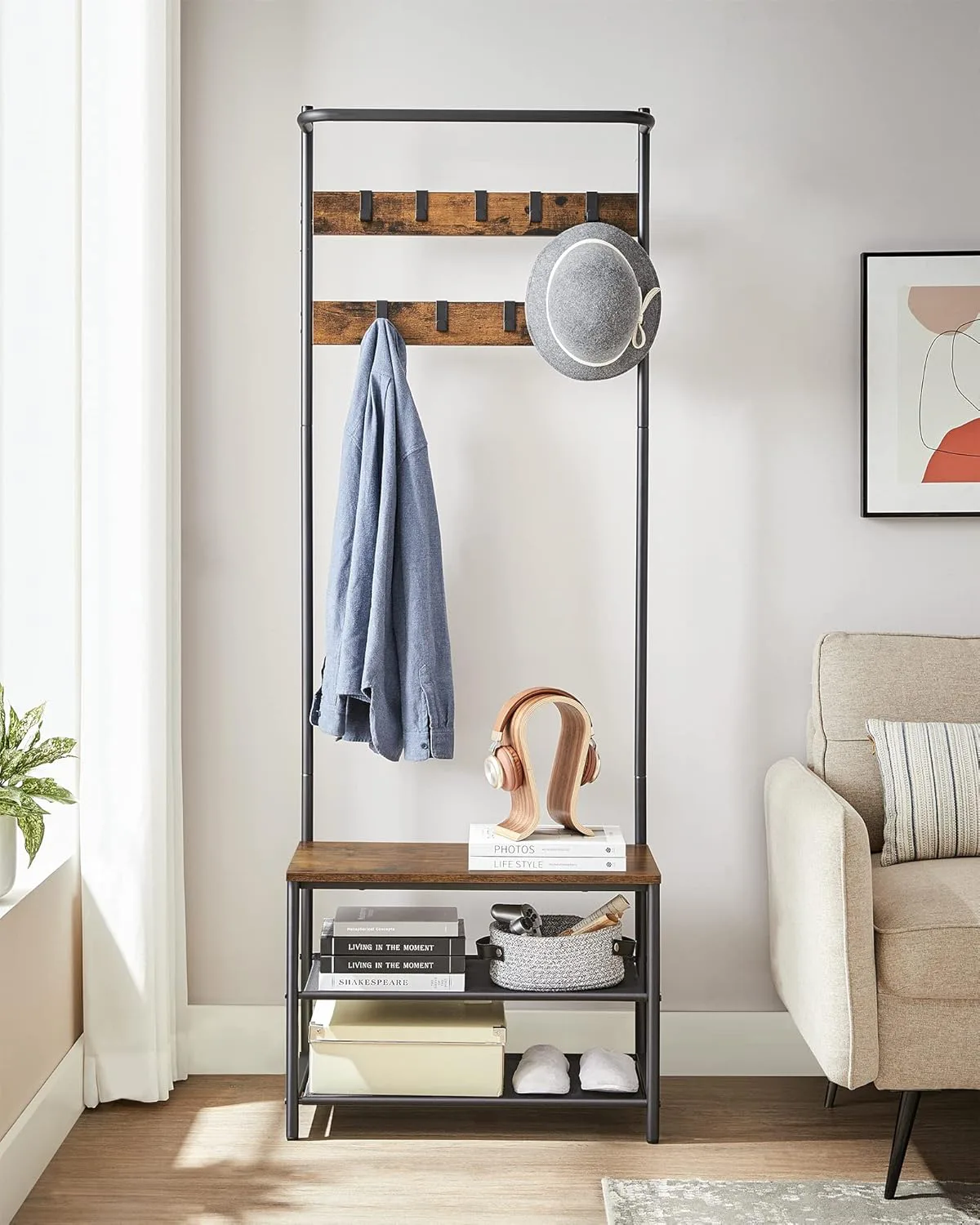
If you have three people using the entryway daily, you need at least 9 hooks — and most hall trees in this price range top out at 4 or 5. The VASAGLE Hall Tree UHSR40B has 9 removable hooks arranged across two rows, with a bench seat and shoe storage shelf below. At 28.3 inches wide and 13.3 inches deep, it fits narrower wall sections than most competitors while giving you the hook count a family actually needs.
The removable hooks are the detail worth noticing. You can reconfigure the layout as your household needs shift — move hooks to the lower row for a child’s reach, or remove two hooks when summer means fewer coats. Most fixed-hook designs lock you into the arrangement the factory chose. This one doesn’t.
When to Skip the Bench Entirely
If you wear slip-ons or loafers, you don’t need to sit down to put on shoes. And if you don’t need to sit, that bench seat is just a flat surface waiting to collect bags, mail, and whatever else gets set down “just for now.” A hall tree with open shelves — or just wall hooks plus a boot tray on the floor — does the same functional work without the clutter invitation.
Bench cushions make this worse, not better. A soft surface catches items; a hard wood surface at least feels like something you should keep clear. If your current bench already has items permanently living on it, the bench isn’t earning its footprint.
Best Wall-Mounted Entryway Hook Systems
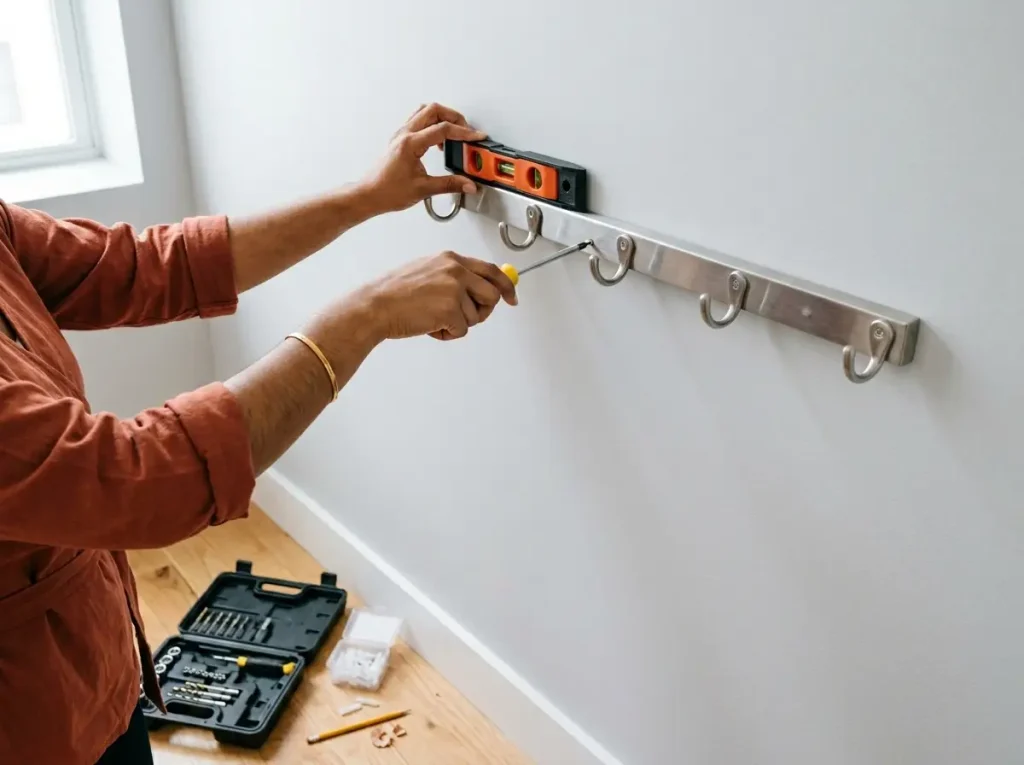
Wall hooks are the right choice when you have zero floor space for furniture — but they require knowing your wall type first. A screw-mount hook rail on drywall will outlast most hall trees. The same rail on concrete won’t go in without a hammer drill. And adhesive hooks work brilliantly on smooth drywall right up until you put a winter parka on them — or try them on a concrete wall. Wall-mounted hooks are a form of vertical storage for apartments that uses zero floor space while handling coats, bags, and scarves at the door.
Screw-Mount Rails: The Deposit-Safe Option
Two small screw holes per bracket is all a screw-mount hook rail needs. Most residential leases allow 2–3 small mounting holes per room — you patch them with spackle when you move out, and the deposit stays intact. For the holding power you get, those two holes are the best investment of wall space in any entryway.
The Dseap Coat Rack Wall Mounted with 5 Tri Hooks (2-pack) uses a tri-hook design — three hook points per position — so each hook slot holds more weight and more items than a single-prong alternative. Two packs give you 10 hook positions, which covers a family of four with buffer hooks to spare. Stainless steel construction means these won’t rust in a humid entryway.
If you need a budget option, the Amazon Basics Wall Mounted Coat Rack (8 hooks) is a clean rectangular rail that handles a two-person household on a single mount. The hooks are smaller than the Dseap tri-hooks, so heavy parkas may feel crowded — but for everyday jackets and bags, it works.
Mount your hook rail at 63 inches from the floor — that’s the standard coat-hook height that works for adults 5’4″ and taller. If you have children under 10, add a second row at 42 inches so they can reach their own hooks. Building independence into the system means fewer coats on the floor.
Adhesive Hooks: When They Work and When They Don’t
The Command 7.5 lb Jumbo Utility Hook works on smooth painted drywall. That’s worth repeating: smooth, painted, drywall. A standard winter coat weighs 2–4 lbs, so a single 7.5 lb hook handles one coat or one bag reliably. Not both on the same hook — that exceeds the rating, and exceeded ratings are how you wake up at 2 AM to the sound of your coat rack hitting the floor.
Pro tip: Before buying adhesive hooks, press a test strip to your entryway wall for 30 seconds and release. On drywall, it feels tacky and secure. On concrete, it barely holds tension. That ten-second test saves you a failed installation and a set of hooks you can’t return.
On concrete, textured plaster, or unpainted walls, adhesive hooks will fail regardless of brand. This isn’t a quality issue — the adhesive needs a smooth bonding surface that these materials don’t provide. If your walls are concrete (and if you’re in a pre-1970 building, they probably are), skip adhesive entirely and go freestanding or over-door.
Over-Door Hooks for Concrete-Wall Apartments
When your walls won’t take adhesive and you can’t (or won’t) drill, over-door hooks are what’s left — and they work well on the right door. The key word is “right.” Over-door organizers rated for 20+ lbs rely on the door edge being solid wood. Most apartment interior doors are hollow-core, and a loaded over-door hook can crack or bend the top edge over time.
Test before you hang anything heavy: press firmly on the top edge of the door at the hook point. If it flexes, it’s hollow-core. If it feels solid all the way through, you’re good. Interior bedroom or bathroom doors near the entryway tend to be more solid than the front door itself — and they’re close enough to the entry zone to function as part of the system.
Best Shoe Storage for Entryways That Actually Stay Organized
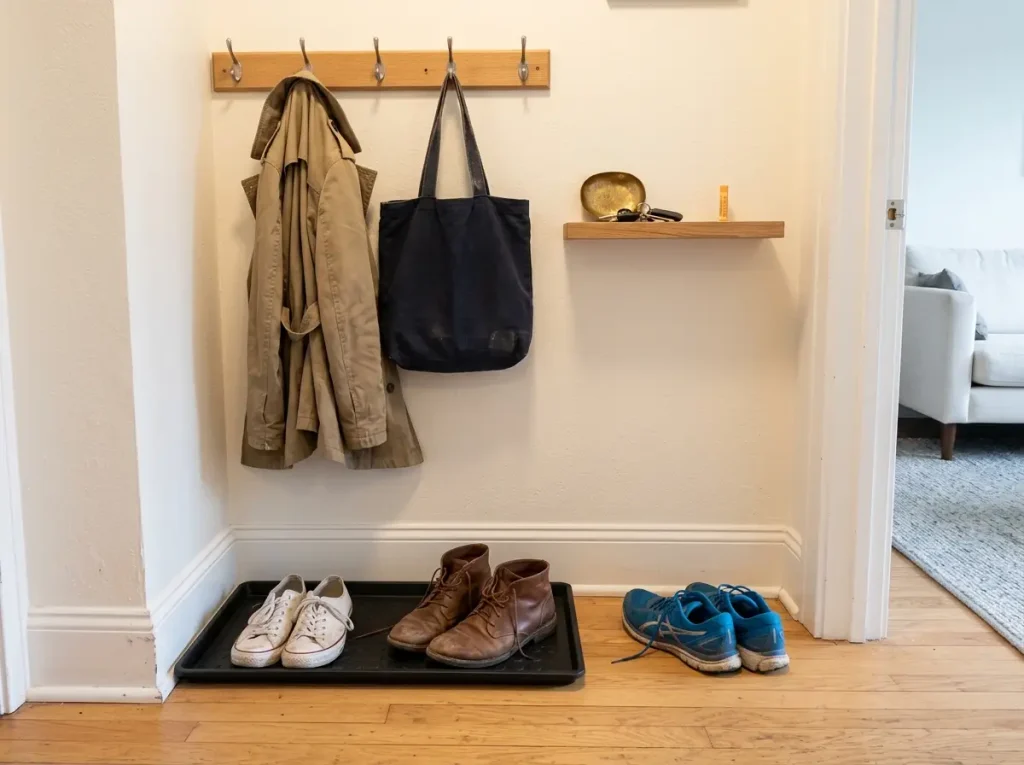
Shoe storage in a small entryway doesn’t need to be fancy. It needs to answer one question: where do shoes go when they come off at the door? If there’s no clear answer, they end up in a pile that everyone kicks aside on their way out. The system can be minimal — but it needs to exist.
The Boot Tray Baseline (Free or Near-Free)
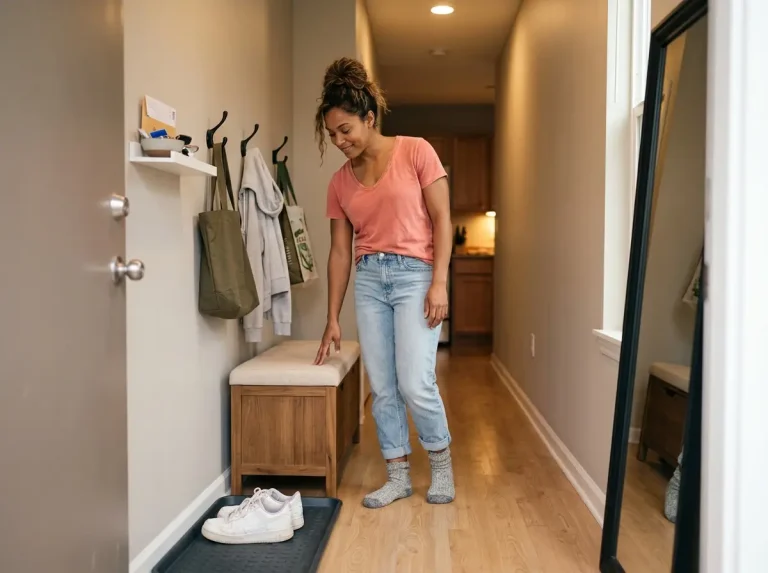
Before you buy any shoe furniture, start with a rubber boot tray. It costs almost nothing, takes no wall or vertical space, and does three things at once: contains mud and water from wet shoes, creates a visual boundary that signals “shoes go here,” and defines the shoe zone without any installation.
That visual boundary matters more than it sounds. Household members who would otherwise kick shoes anywhere will unconsciously aim for the tray — the border creates a rule without anyone having to say it. If a boot tray is all you add to your entryway, you’ll still notice a difference within a week.
When You Need a Rack vs. a Bench
If nobody in your household needs to sit down to put on shoes, you don’t need a bench. A bench with shoe storage earns its footprint only when someone has knee or back issues that make standing on one foot uncomfortable — or when you have young children who need a seated spot to get boots on.
For everyone else, the UDEAR 4-Tier Coat and Shoe Rack combines coat hooks with four shoe tiers in a freestanding frame. No bench, no flat surface for dumping, no wall damage. Each tier holds 2–4 pairs depending on shoe size, so a two-adult household keeping 3 pairs each at the entryway (daily, athletic, casual) fits comfortably on three tiers with a tier to spare.
For more small entryway organization ideas beyond just the shoe zone, the sibling guide covers broader approaches.
The Seasonal Shoe Edit
Most entryway shoe disasters happen in winter. Winter boots, everyday shoes, and guest slippers all compete for the same two-shelf rack that handled three pairs just fine in July. The fix isn’t more storage — it’s a rule.
Keep only the current season’s 2–3 pairs per person at the entryway. Everything else goes to the bedroom closet or under-bed storage. In October, swap summer sandals for winter boots. In April, swap back. The entryway never overflows if winter gear doesn’t accumulate past what you’re actually wearing this week.
Best Entryway Organizers for Renters
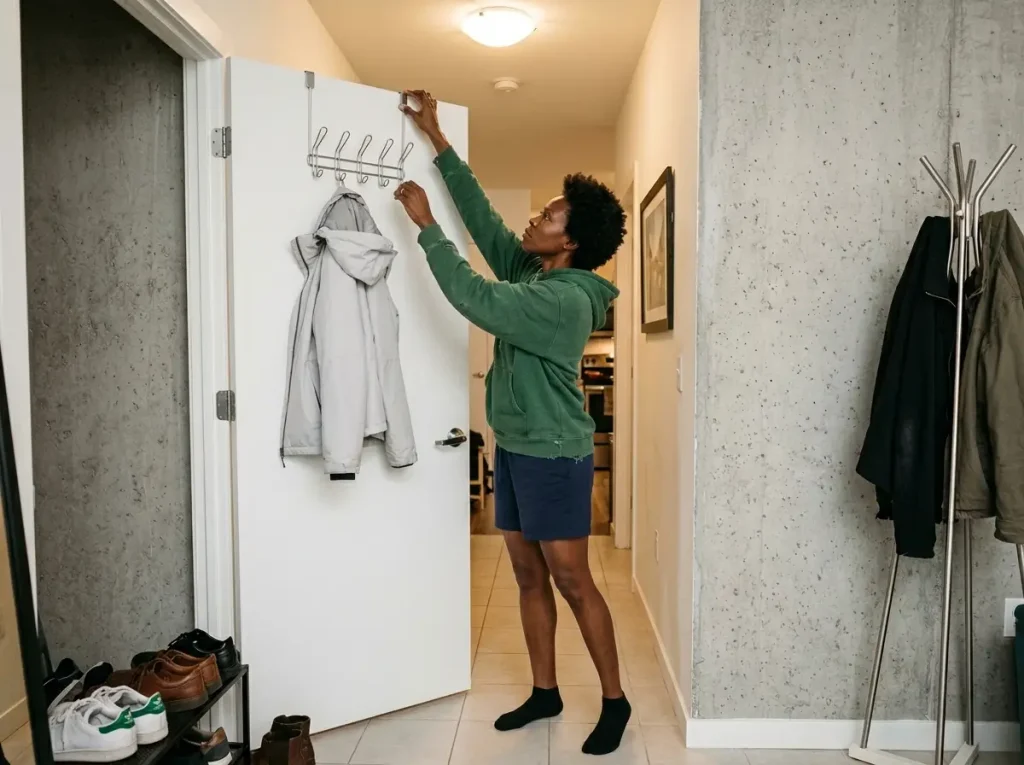
“No-drill” means different things depending on your wall type, and most advice out there forgets to mention that. Adhesive hooks on smooth drywall? Reliable. Adhesive hooks on the concrete wall of your 1960s walk-up? They’ll pull off within a week, and you’ll be left with a coat on the floor and adhesive residue you can’t get off.
This section sorts out what actually works for renters — including the apartments where the typical no-drill advice doesn’t apply.
Freestanding First: The Safest Renter Choice
A freestanding hall tree requires zero wall contact. No screws, no adhesive, no holes. It moves with you when you leave. If you’re renting year-to-year and your next apartment might have a completely different entryway layout, freestanding is the safest choice even if your current walls could handle screws.
The VASAGLE UHSR087B01 mentioned above works well here — at 11.8 inches deep, it fits in tight rental entryways without touching the walls. You set it up in ten minutes and take it with you when your lease is up. No spackle, no paint touch-ups, no deposit conversations.
Adhesive Hooks: What They Work On (and What They Don’t)
The Command 7.5 lb hook bonds to smooth painted drywall and holds one coat or one bag per hook. That’s the full range of what it does well. One item per hook, smooth wall, done.
The failure list is longer: concrete block, heavily textured plaster (common in 1950s–1970s buildings), wallpaper, unpainted surfaces, and any wall with visible aggregate texture. On these surfaces, the adhesive can’t form a lasting bond. It might hold for a day, maybe a week if you’re lucky, but loaded adhesive on a surface it can’t grip always ends the same way.
Pro tip: If you’re not sure about your wall type and you’re renting, ask your landlord or building manager before buying adhesive hooks. A quick “what are the entryway walls made of?” can save you a failed installation and a cleaning project.
As professional organizers at NAPO recommend, giving every item a fixed home is the foundation of any organizing system — but the method has to match the space. For more renter-specific approaches beyond the entryway, no-drill organization for renters covers the same deposit-safe principles applied to closets and bedrooms.
Over-Door Hooks: When Adhesive Isn’t an Option
If your walls are concrete and your lease prohibits drilling, over-door hooks are the workaround. Place them on an interior door near the entryway — a bathroom or bedroom door within a few steps of the front door. These doors tend to be more solid than the front door itself, and they’re close enough to function as part of your entry zone.
The hollow-core warning applies here too. Test the door before loading it up. And skip the front door — opening and closing it dozens of times a week while hooks are hanging on the edge accelerates wear on both the door and the hooks.
How to Keep Your Entryway Organizer from Becoming a Pile
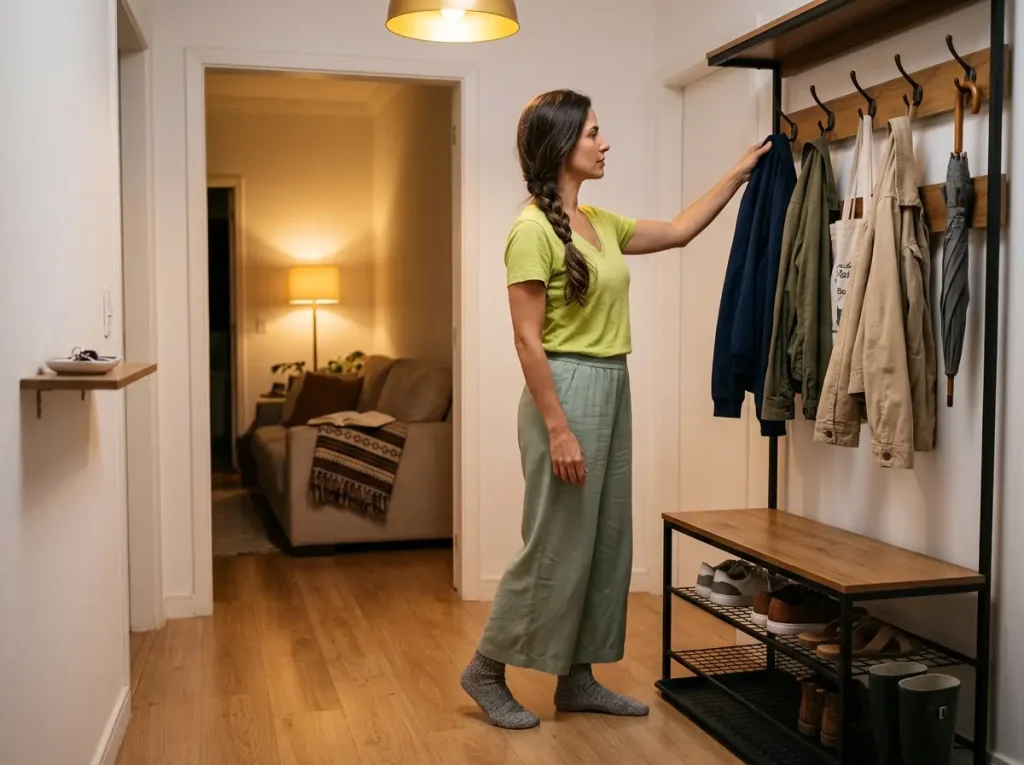
Every entryway organizer becomes a dumping zone if there’s no maintenance habit. Not because the product failed — because every flat surface and every hook becomes a “just for now” spot. “Just for now” becomes permanent within two weeks. The organizer you carefully selected, measured for, and assembled will look exactly like the pile it replaced unless you build one small habit into your routine.
The Hook Maximum Rule
One item per hook. Always. The moment you hang a second coat on the same hook, you’ve started a pattern that ends with the hall tree looking like a coat closet exploded. This is the rule that feels obvious but gets broken first — usually on a busy morning when you’re running late and the “right” hook already has something on it.
The same rule applies to shoe tiers: one layer per shelf. Stacking shoes on top of each other in an “organized” rack defeats the point of having a rack. If you’re running out of hook or shelf space, the answer isn’t stacking — it’s rotating items to another location or reducing what lives at the entryway.
The 15-Second Nightly Scan
One person walks through the entryway before bed. Returns 2–3 misplaced items to their rooms. Checks that no hook is double-loaded. Confirms the bench (if you have one) is clear. The whole thing takes 15 seconds — not a deep clean, just a scan.
Do this 30 nights in a row and it stops being a task. It becomes automatic, like locking the front door. Skip it, and within two weeks you’ll notice items starting to accumulate on surfaces again. The scan is what separates an entryway that works from an entryway that worked for the first week.
If you’re thinking about organizing a small apartment as a complete system, the entryway scan is the first zone to establish. Once the nightly reset is automatic here, expanding it to other areas of the apartment is straightforward.
Seasonal Rotation and the “One In, One Out” Rule
In October, move all coats except one per person to the bedroom closet. Put each person’s cold-weather coat on the entryway hooks. In April, swap back. The entryway never overflows in winter if you prevent winter gear from accumulating past what’s actively being worn.
Apply the “one in, one out” rule to the entryway zone specifically. Before you add a new bag to a hook, something else has to be removed or relocated. This works the same way it works in a closet — the constraint is what keeps the system from expanding past its capacity. Without it, entropy wins every time.
The three-month check tells you whether the whole system is working. At the three-month mark, look at the bench seat and shoe zone. If either has items that “permanently” live there when they shouldn’t, the system needs one reconfiguration — either the bench needs to go, the storage elsewhere needs to expand, or one habit needs to be enforced that’s currently being skipped.
Conclusion
Three things separate an entryway organizer that works from one that becomes a coat pile within a month:
- Measure your hallway clearance first. Organizer depth plus 36 inches of walkway is the minimum — and most people skip the measurement entirely.
- Count hooks by person and item, not by what the product includes. A 4-hook tree for a two-person household fails immediately. Three hook-spaces per adult, rounded up.
- Build the 15-second nightly scan from week one. Every entryway organizer reverts to a dumping zone without a reset habit. The habit is what makes the product work.
At the three-month mark, check the bench seat and shoe zone. If either has items that permanently live there when they shouldn’t, adjust: relocate those items or add targeted storage. The organizer didn’t fail — the system needs one reconfiguration.
Start with the clearance measurement. Take three minutes right now and write down: hallway width, wall type, and hook count needed. That number tells you which section of this article applies to your space — and which organizer will actually last past the first month.
Q1 What is the best entryway organizer for a small apartment?
A freestanding hall tree under 14 inches deep with at least 6 hook points fits most apartment entryways while maintaining 36-inch walkway clearance. Match the hook count to your household — minimum 3 hooks per adult — and check that the unit’s depth leaves enough room to walk past without turning sideways.
Q2 How do you organize a small entryway with no closet?
Wall-mounted hooks plus a boot tray covers the essentials without any floor furniture. If you have floor space, a slim hall tree adds shoe storage and seating in one piece. Know your wall type before buying anything — concrete walls can’t use adhesive hooks, which limits your options to freestanding or over-door solutions.
Q3 What size entryway organizer do I need for a narrow hallway?
Measure your hallway width and subtract 36 inches — that’s the maximum depth organizer that fits. For most apartment entryways (42–54 inches wide), you need a unit 6–18 inches deep. The VASAGLE UHSR087B01 at 11.8 inches is the shallowest hall tree option currently available.
Q4 Are hall trees worth it for apartments?
Yes, if you pick the right size. A slim hall tree under 14 inches deep in a 48-inch or wider entryway gives you hooks, shoe storage, and a seating surface in a single footprint. The mistake is buying standard-depth furniture (16–18 inches) that blocks the walkway in a rental-sized entry.
Q5 How do you keep an entryway from becoming cluttered?
One item per hook, always. The 15-second nightly scan — straighten hooks, return 2–3 misplaced items, clear the bench — keeps any entryway system working past the first month. Without a reset habit, every organizer reverts to a dumping zone regardless of how well it’s built.
Disclaimer: ClutterlessNest is a participant in the Amazon Services LLC Associates Program. As an Amazon Associate we earn from qualifying purchases. This article may contain affiliate links — if you buy through them, we may earn a small commission at no extra cost to you. We only recommend products we have tested or genuinely believe in.