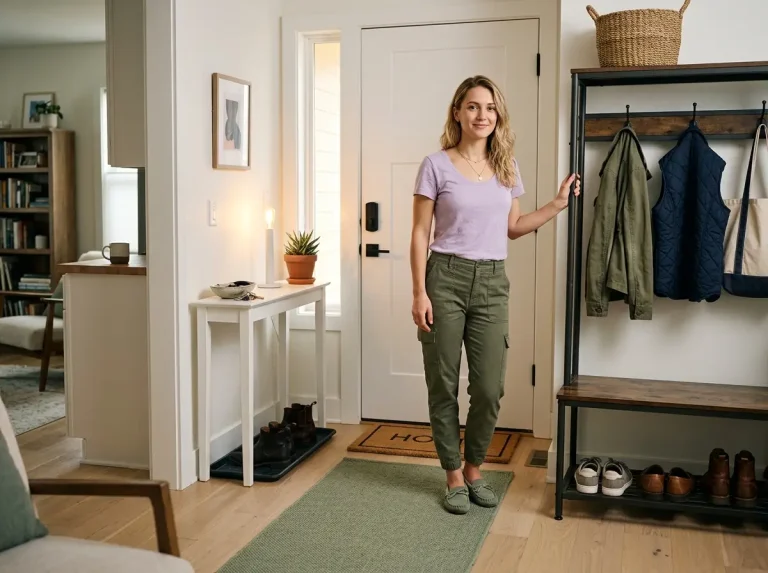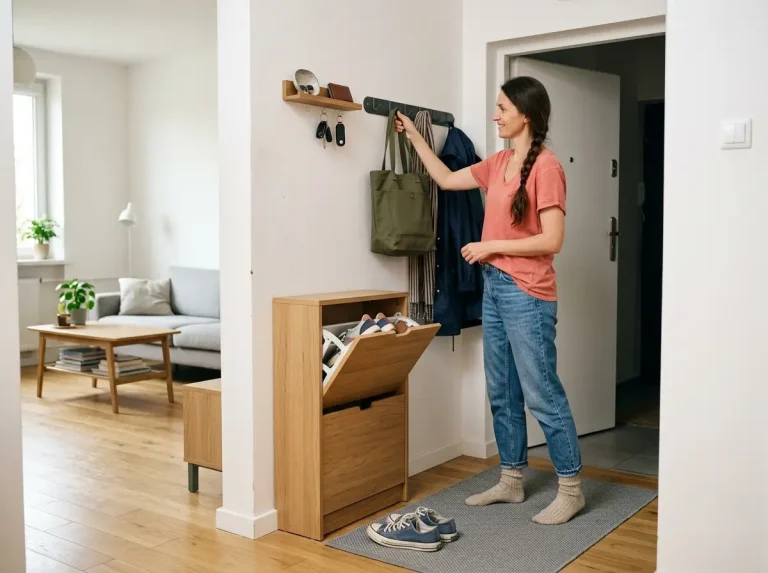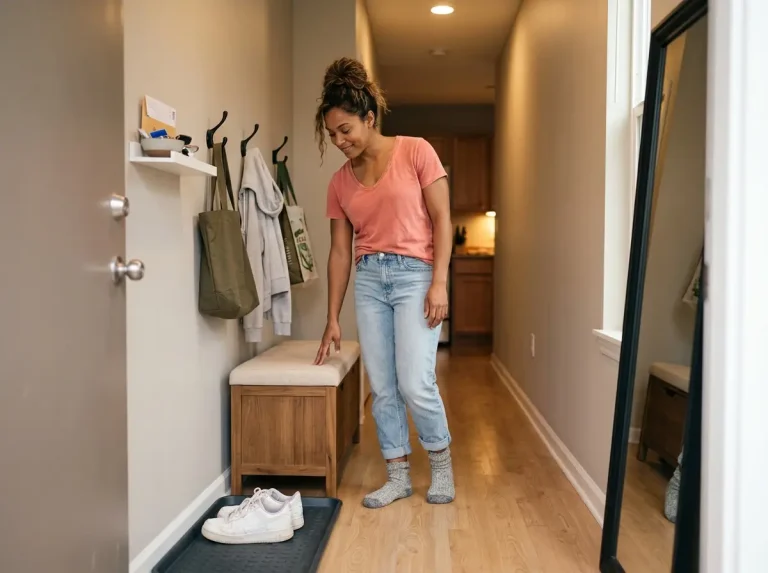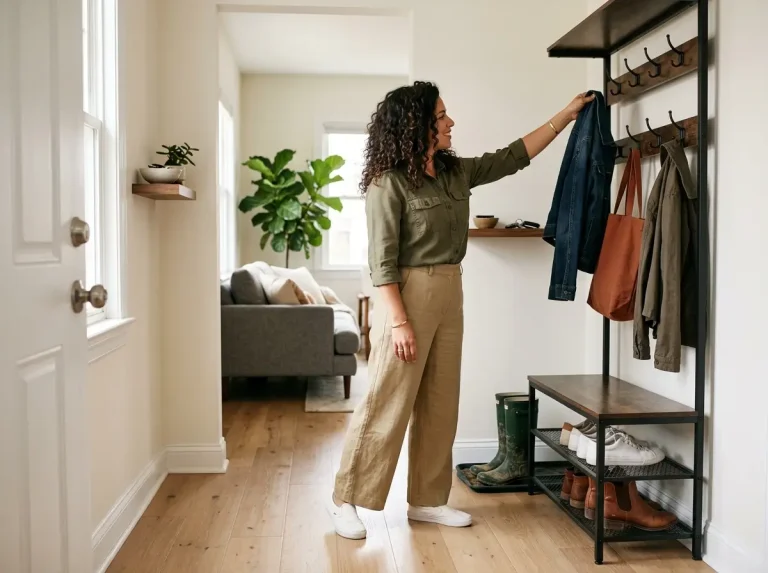
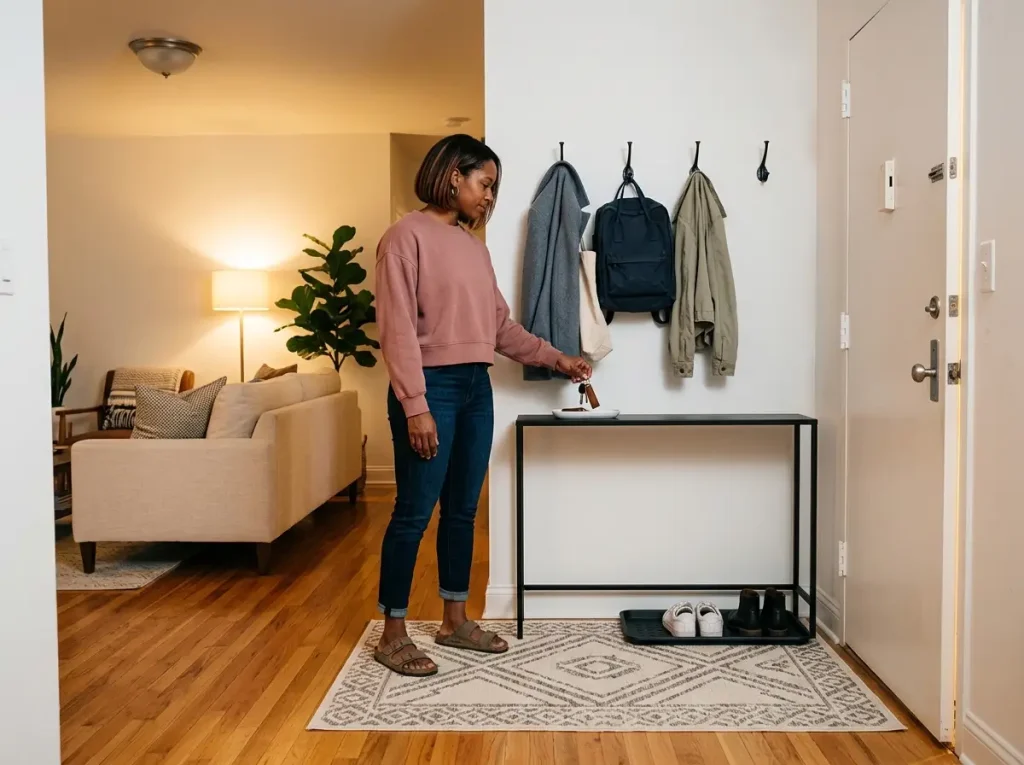
You walk in with groceries, set your keys on the nearest flat surface, and spend eight minutes retracing your steps the next morning. This has nothing to do with being disorganized. There’s no dedicated spot near the door, so the counter wins by default. After setting up entryway key and mail systems in multiple apartments, the fix is always the same: put the right hook in the right place, give mail a slot before it reaches any other surface, and use products that come off the wall without taking the security deposit with them.
Quick Answer: Here’s how to set up a renter-friendly key and mail organizer by the door:
- Mount your key hook on the latch side (handle side) of the door
- Use adhesive hooks or rails so you never drill into the wall
- Place a three-slot mail sorter within arm’s reach of the entrance
- Put a small recycling bin directly under the mail organizer
- Assign one hook per person — shared hooks stop working fast
- Sweep the mail slots weekly so the pile never forms
Why Keys and Mail End Up on Every Surface Except the Right One
Keys land on whatever flat surface is closest to the door. In most apartments, that’s a kitchen counter ten to fifteen feet from the entrance. By the time you’ve walked that far, the keys are already out of your hand and onto the counter, mixed in with everything else you set down.
The hook by the door isn’t a convenience upgrade. It’s a geometry fix.
Mail does the same thing, but with an extra layer of procrastination built in. Every piece of unopened mail represents a decision you haven’t made yet: pay this bill, respond to this invitation, toss this catalog.
Once mail mixes with keys, sunglasses, and a phone on the counter, the whole stack becomes mentally undifferentiated. It stops being “mail” and starts being “a pile.” And once a pile forms, it only grows.
The Distance Problem (Why the Counter Always Wins)
If there’s no hook within three to four feet of the door, the counter will always win. This isn’t a willpower issue. It’s spatial design.
Your arm reaches for the nearest surface the moment you cross the threshold. Put a hook there, and the keys go on it without you thinking about it. Move that hook six feet farther into the apartment, and most people skip it within a week — not because they forgot, but because the counter was closer.
The same math applies to mail. A mail sorter across the room is a mail sorter that never gets used. The sorting has to happen at the door, in the first three seconds after you pick up the stack. If the sorter isn’t right there, the mail goes on the counter with everything else.
Why Mail Turns Into a Pile Overnight
A stack of eight to ten pieces of mail crosses a psychological threshold. Below that count, dealing with it feels like a quick task. Above it, the pile starts to feel like a project, and most people avoid projects that don’t have deadlines.
The catalog from last week, the bill from three days ago, and the expired pizza coupon all merge into one undifferentiated block. Organizers call this “pile rot” — the point where the avoidance outweighs the effort of sorting.
The fix isn’t a bigger pile or a prettier tray. It’s intercepting mail at the door, before it reaches any other surface, and separating it into categories the moment you hold it in your hand.
The Tray Trap: Why Key Bowls Stop Working After Two Weeks
A flat bowl near the door becomes a deposit point for everything you pull from your pockets. Within two weeks: receipts, a single AirPod, a parking stub, lip balm, and someone’s loose change. The keys are technically still in the bowl, buried under a layer of pocket debris.
The bowl didn’t fail as a key holder. It succeeded too well as a catch-all, and that’s why it stopped working.
Hooks solve this because hooks are specific. Only key rings go on a hook. There’s no flat surface to attract everything else.
If your current entryway feels chaotic despite having some kind of system, you’re probably dealing with a geometry problem, not a habit problem. A complete small entryway organization system starts with understanding why surfaces collect clutter in the first place.
Where to Mount Your Key and Mail System (The Wall Geometry Rule)
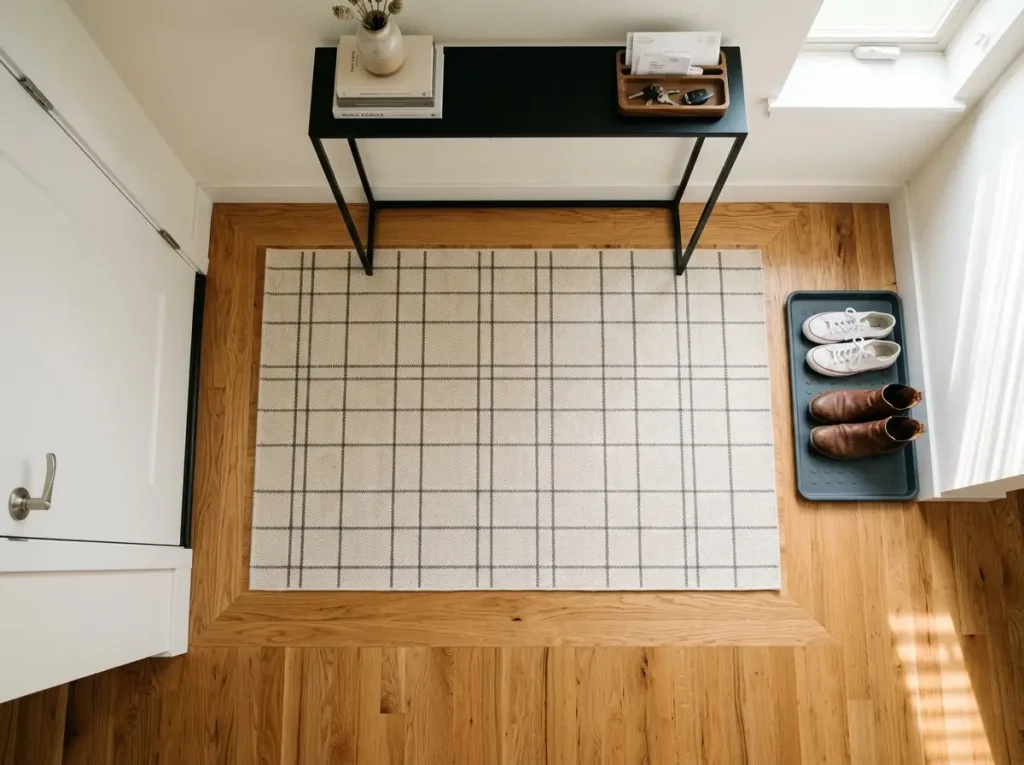
The most common mistake with entryway organizers isn’t buying the wrong product. It’s mounting it on the wrong wall.
Every apartment has two possible walls near the front door: the hinge side and the latch side. One of them works. The other guarantees the organizer gets ignored within a week.
Latch Side vs. Hinge Side: Which Wall to Use
The latch side (the wall where the door handle is) is the correct placement. When you walk through a door, your dominant hand naturally reaches toward the handle side. A hook mounted on that wall sits in the path of your hand’s natural arc. Using it becomes the default behavior, not an extra step you have to remember.
The hinge side is where the door swings open. Any organizer on that wall gets hidden behind the door every time it opens. In apartments where the front door stays open while you bring in bags, that wall is blocked for the entire arrival process.
The organizer becomes invisible, and invisible organizers don’t get used. You’ll walk past it for weeks without registering that it’s there.
How to Measure Before You Buy
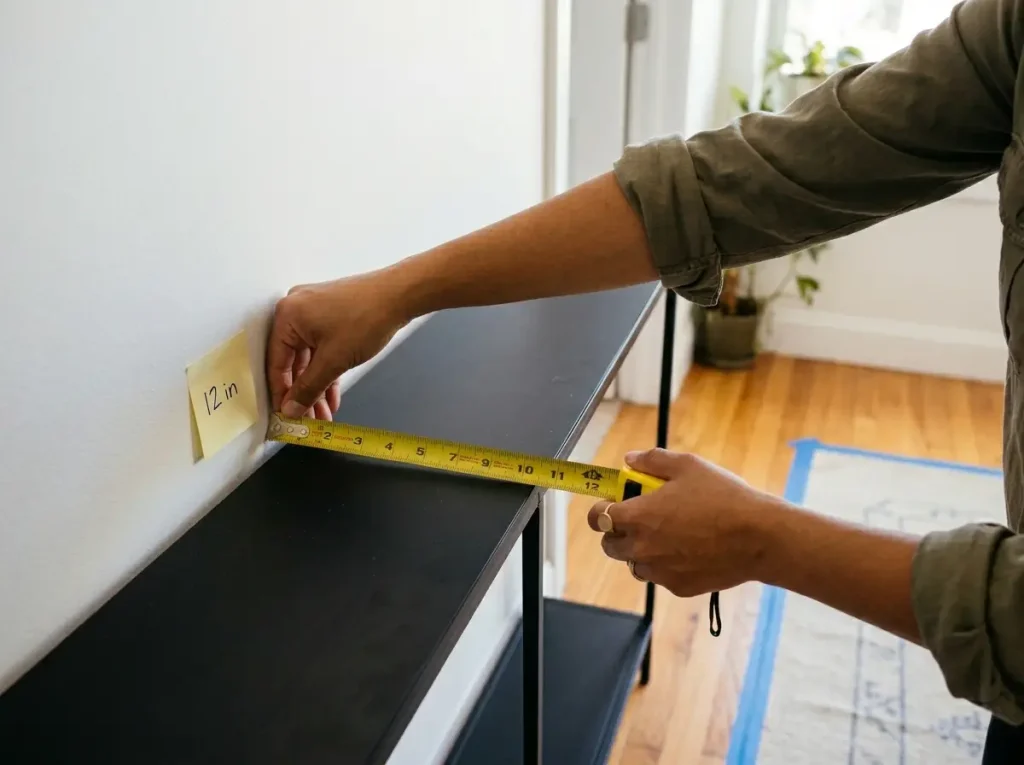
Two measurements before you shop: the width of usable wall space between the door frame and the nearest corner (this determines max organizer width), and how far the organizer can protrude without blocking hallway traffic (this determines max depth). Standard apartment entryways have 12 to 24 inches of wall on the latch side. If your wall segment is under 8 inches, mount on the wall directly across from the door instead.
Pro tip: Write your two measurements on a sticky note and keep it in your pocket when you shop. You’ll check it ten times before checkout, and it will save you a return trip.
Depth matters more than most people realize. A wall organizer that sticks out more than four inches will catch your shoulder every time you walk past in a 36-inch-wide hallway. Most good entryway organizers sit 2 to 3.2 inches from the wall. Check the depth spec before buying — the width is obvious, but the depth is what you’ll bump into daily.
Once you’ve picked the wall, the rest of the setup follows the same logic covered in our guide to setting up an apartment entryway zone.
What to Do When There’s No Usable Wall Space
Three workarounds if the latch-side wall is too narrow or doesn’t exist. First: the wall directly across from the door. You see it the moment you walk in, and it’s usually within arm’s reach in a small entryway.
Second: the back of the door for key hooks only, but check the door first. Tap it — a solid thud means solid core, safe for adhesive hooks. A hollow echo means hollow core, and adhesive hooks will fail within weeks from the vibration of repeated opening and closing.
Third: a floating shelf mounted nearby with key hooks on the wall above it. This creates a small drop zone without needing one ideal wall position. The shelf handles mail; the hooks handle keys. Two adhesive products, zero holes.
Key Storage That Works: Hooks, Rails, and Trays
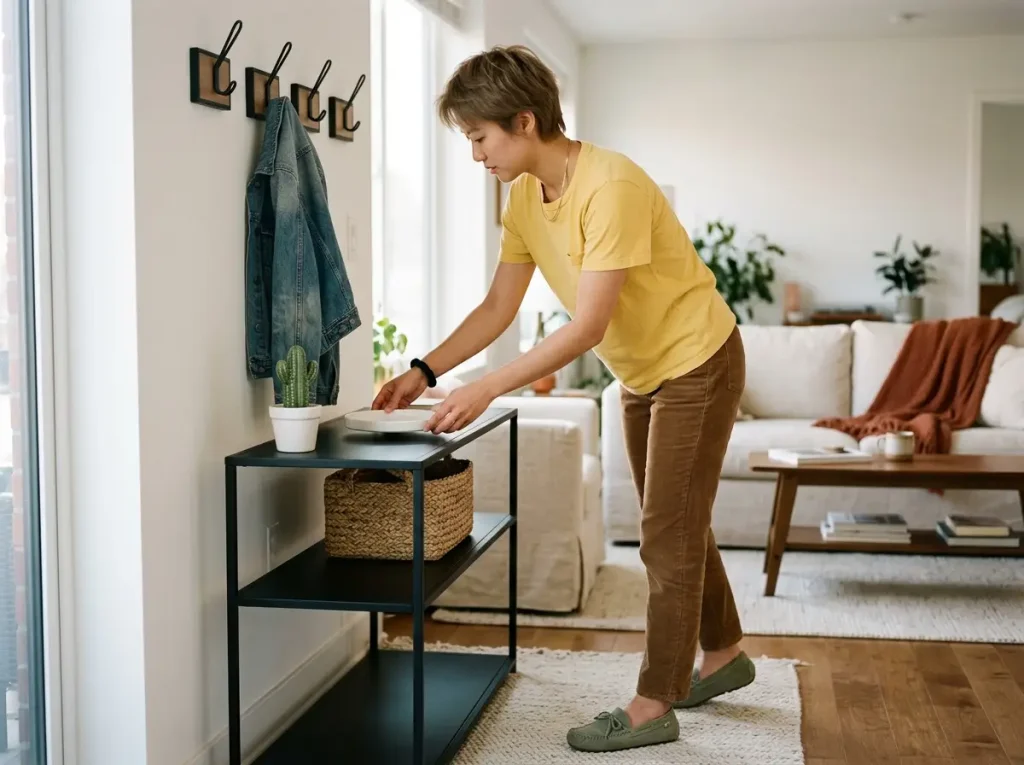
There are four common key storage methods, and only one of them reliably holds the habit past the first week. Hooks on the wall work because they’re specific — only key rings go there. Bowls, trays, magnetic strips, and over-door options all have failure modes that show up within a month of real use.
Why Hooks Beat Bowls (The Habit Science)
Hooks are single-purpose: one key ring per hook. There’s no flat surface to collect other items, and the visual of a hanging key ring is unmistakable. You can see at a glance whether your keys are home.
A bowl, by contrast, looks empty for about a day before it starts collecting receipts, and then it becomes another surface clutter problem. The 21-day habit formation rule applies here: you need roughly three weeks of consistent use before hanging keys becomes automatic.
A hook makes that consistency easy because the action is binary — hang or don’t hang. A bowl lets you “sort of” put keys down, which is exactly how the tray trap starts.
The Command Key Rail: The Renter’s Best Option
For renters on smooth painted drywall, the Command Key Rail 8″ with 4 Key Hooks is the simplest no-drill key organizer. Four hooks at 8 inches wide, rated at 2 lbs total — plenty for key rings but not for bags or heavy accessories. It adheres to smooth painted surfaces and removes without wall damage when you move out.
The constraint: it works on walls, not on hollow-core doors. Adhesive on a door that flexes every time it opens will lose grip within a couple of months.
For households that also need to hang a light bag or umbrella alongside keys, the ChDING No Drill Wall Hooks 6-Pack offers a heavier-duty adhesive option with a metal and wood base. They handle more weight than Command strips, and the six-pack gives you hooks for keys, a bag, and a leash without drilling a single hole. If your needs are lighter — just keys and nothing else — the Command Large Wire Hooks are the budget fallback at a fraction of the cost.
Pro tip: Let adhesive hooks cure for a full 24 hours before hanging anything on them. Most adhesive failures happen because people loaded the hook five minutes after mounting it. The adhesive needs time to bond properly with the wall surface.
Hook Capacity Math for Multi-Person Households
One double hook holds two to three key rings comfortably. Two adults with separate key sets (house keys plus car keys each) need a minimum of four hooks. Add one extra for a spare set.
If the organizer has fewer hooks than your household needs, the system breaks down within a week. Someone’s keys end up on the counter because “all the hooks were full,” and once one person stops using the system, the other follows. More on the one-hook-per-person principle in our entryway hook setup ideas guide.
Mail Organization by the Door: The Three-Slot System
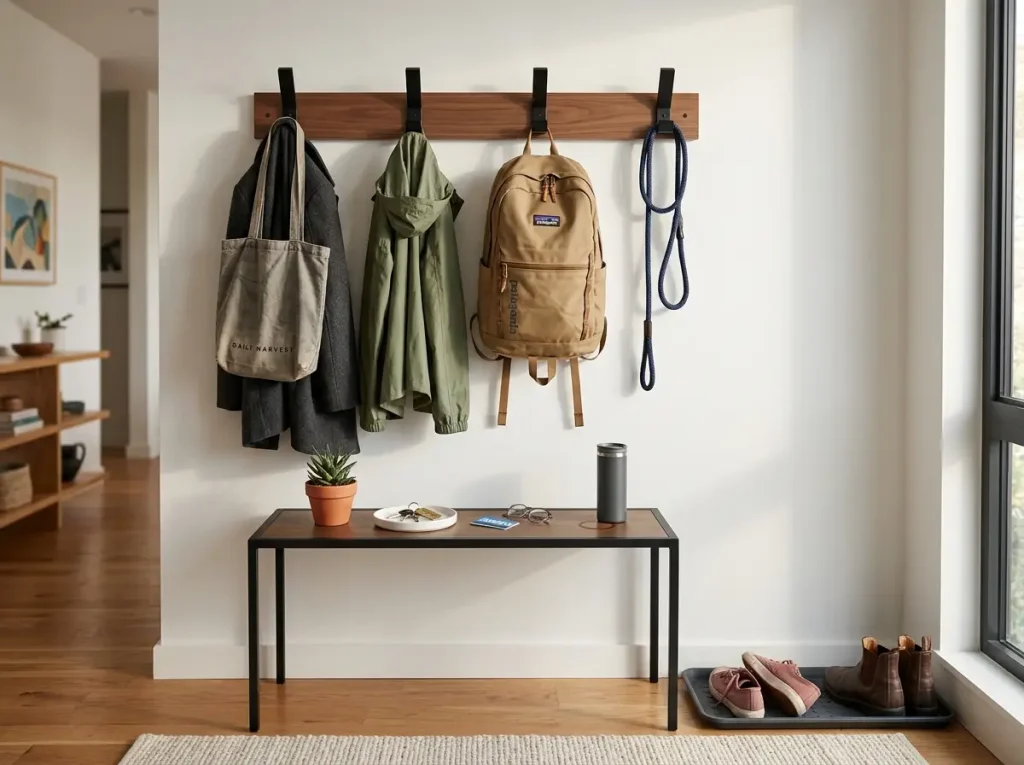
The mail pile by the front door isn’t a mail problem. It’s a decision problem. Every envelope sitting there is a small task you’re postponing.
The pile grows because the avoidance grows, not because you’re getting more mail than you can handle. The fix is a system that forces the decision at the door, before the mail reaches any other surface.
Three Slots, Not Two (the Recycle Slot Changes Everything)
Most mail organizers come with two slots (in/out). The missing third slot is the one that matters most: Recycle. The three categories are Recycle (junk mail, catalogs — goes straight in without opening), Act (bills, invitations, forms — maximum 7 days in this slot), and File (statements, records — handle in a weekly sit-down).
According to NAPO-certified professional organizers, the entryway functions as the household’s command center — the single choke point where a two-minute sort at arrival prevents clutter from spreading to every other room. The Recycle slot needs to be the first slot you see when you hold a handful of mail. Junk goes there before it ever enters the apartment.
Wall-mounted mail sorters outperform tabletop trays for the same reason hooks outperform bowls: the surface matters. A tabletop tray sits on a surface that attracts other objects. Once the table fills up, the tray gets buried under a pile of its own.
Wall-mounted keeps the mail visible and separated from everything else. For a broader comparison of wall-mounted vs. freestanding setups, see our roundup of entryway organizer options.
Where to Position the Recycling Bin (The Proximity Rule)
The recycling bin needs to be within arm’s reach of the mail organizer. Not across the room, not in a closet under the sink, not “somewhere near the kitchen.” Right there, directly below the mail sorter. A small woven waste basket at the base of the wall works fine.
When the bin is within arm’s reach, junk mail goes directly in without entering the apartment. This single repositioning cuts mail accumulation by roughly half, because about half of all physical mail is junk that should never have made it past the front door.
Pro tip: The first thing you do when you pick up mail isn’t open it — it’s sort it. Stand at your organizer and do a five-second triage: junk goes in the bin, everything else goes in Act or File. Do this for three weeks straight and it becomes automatic. Skip even one day and you’ll feel the pile start to form again.
The Weekly Act-Slot Sweep
The Act slot has a hard limit: nothing older than seven days. Once a week — same day, same time — clear it out. Bills get paid, forms get filled, invitations get replied to.
Anything that sat there for seven days without action either gets done right then or gets recycled. Set a phone reminder for Sunday evening until the habit sticks on its own. If the Act slot is empty on Sunday night, the system is working.
Combination Key + Mail Systems: When One Organizer Does Both
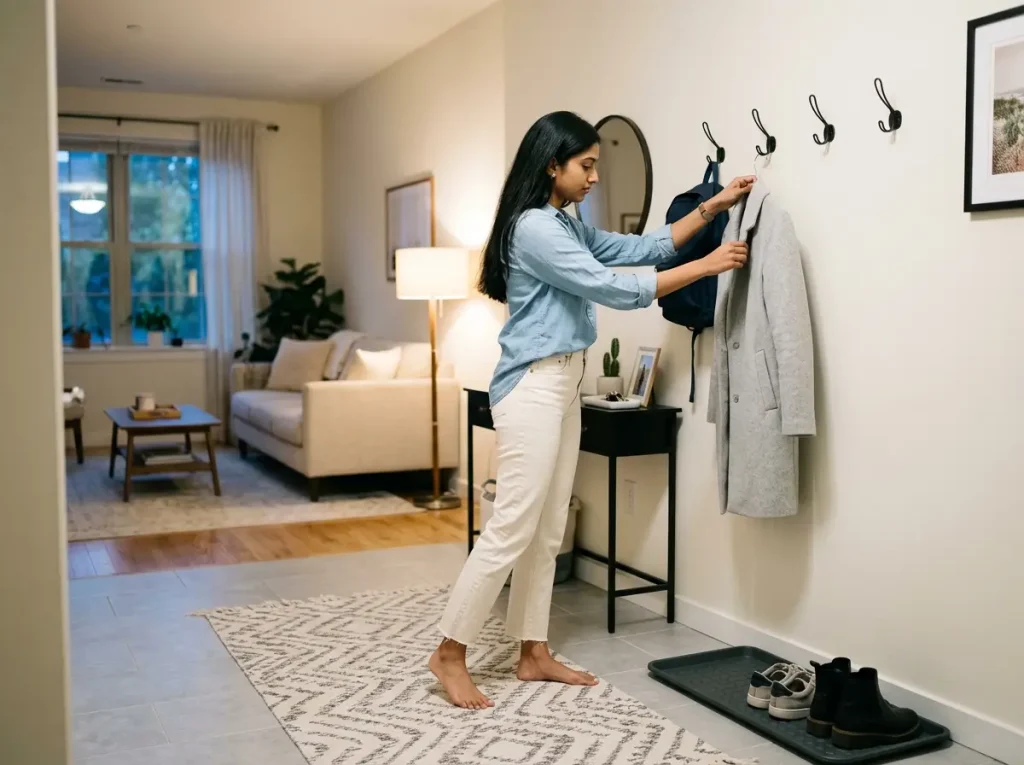
The cleanest entryway setups usually have one wall organizer handling both keys and mail. Less hardware on the wall, fewer decisions about where things go, and one piece to maintain instead of two. But combo organizers only work when the proportions match your household’s actual use.
What Makes a Combo Organizer Actually Work
Three requirements: enough hooks for your household (minimum three for two people), a mail slot deep enough to hold standard envelopes vertically without them tipping out (a standard letter is 9.5 × 4.125 inches), and an overall depth under 4 inches so the organizer doesn’t block hallway traffic. Most combo key and mail organizers that look great in product photos fail on one of these three points. Usually, it’s the hook count — two hooks looks clean in the photo, but two hooks in a two-person household means someone’s keys end up on the counter by day three.
The Best Combo Organizer for Most Entryways
For most apartment entryways, the all-in-one option that checks every box is a wall-mounted wood and metal organizer with enough hooks for two people and a built-in mail compartment.
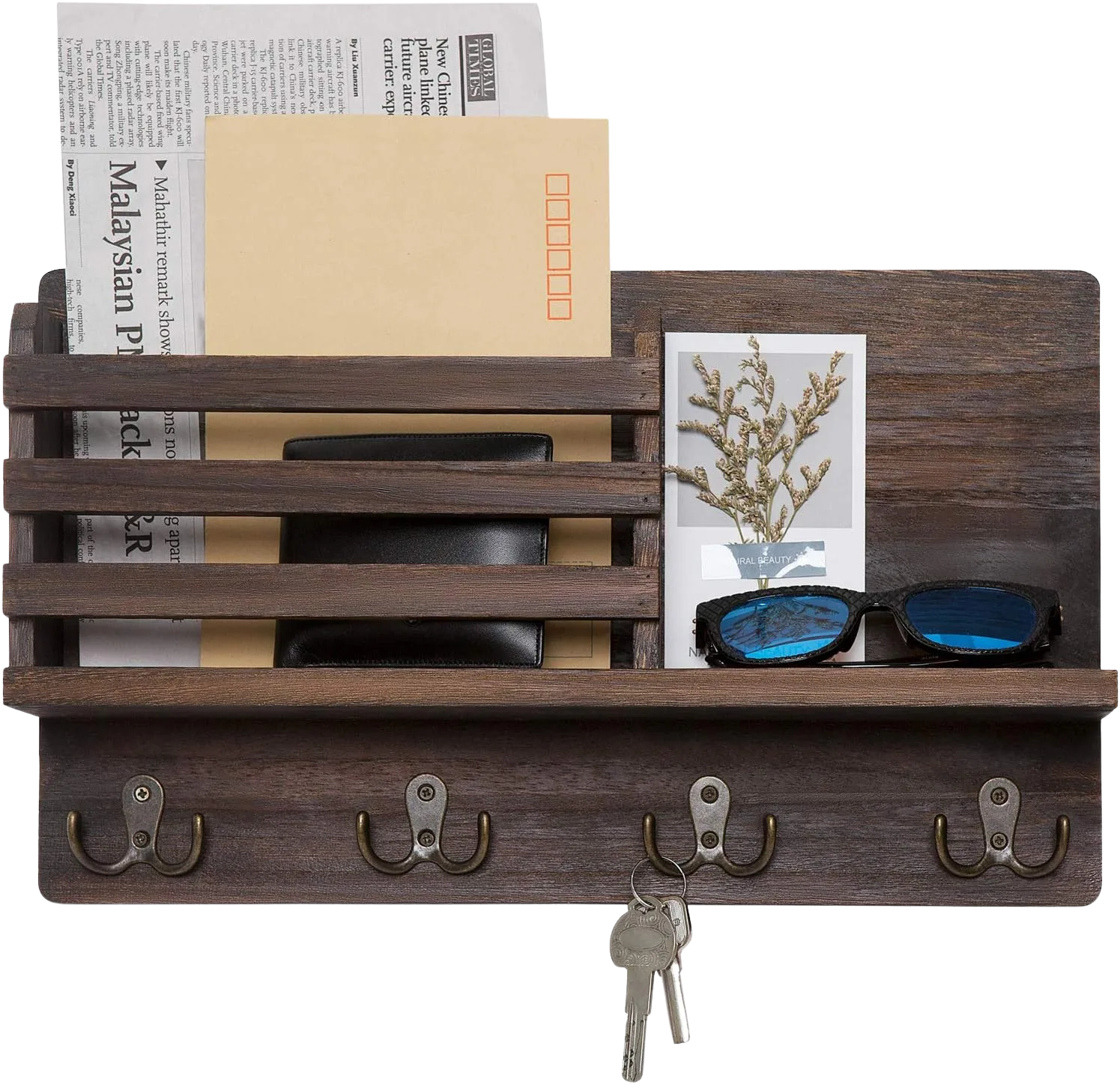
If the wood aesthetic isn’t your style, the mDesign Wall Mount Metal Entryway Storage Organizer with 5 Hooks is the metal/modern alternative. At approximately 10 × 11.5 × 4 inches, it has five hooks and one mail basket that holds standard envelopes. The industrial look works well in more modern apartments. Like the Dahey, it requires wall screws.
When You Truly Cannot Drill: The DIY No-Screw Combo
If the lease says no holes, or if the wall is textured in a way that won’t hold adhesive, there’s a zero-drill combo that works. A Command Key Rail (4 hooks, adhesive mount) plus a no-drill floating shelf directly below creates a functional key and mail zone without a single screw. The shelf holds a small basket or tray for mail that hasn’t been sorted yet. It’s the same principle used in our guide to building a no-drill system for renters — adhesive-mounted components combined to replicate what a single screw-mount organizer does.
Pro tip: If you go the two-screw route with a combo organizer like the Dahey, keep a small tube of spackle for move-out day. A pea-sized amount per hole, smooth it flat with a finger, let it dry, and touch up with the wall paint color. Most landlords won’t notice, and the organizer you got to use for the entire lease was worth the two minutes of repair.
The difference between an organized entryway and a messy one usually comes down to about six square inches of wall space and one habit. The wall space holds the hook. The habit is using it.
Three takeaways:
- Put the system within three to four feet of the door, on the latch side — if it’s not within reach as you walk in, it won’t get used
- Use hooks for keys, not bowls or trays — hooks stay specific; trays collect everything else within two weeks
- The recycling bin next to the mail sorter is the single change that prevents pile-up — junk mail gets recycled on entry, not after it’s been sitting there for a week
Three-Month Check: Look at your key hook and count how many non-key items are hanging there. If you see a tote bag, a lanyard, and a face mask, the hook has started to drift. Remove everything that isn’t a key ring.
Pick the wall. Measure it. Mount one hook today. The full system can wait, but the habit needs a home before it can start.
Q1 Where should I put keys and mail in a small entryway?
Mount them on the latch side of the door (the wall where the handle is), within arm’s reach as you walk in. The latch side stays visible when the door is open, while the hinge side gets blocked. If there’s no latch-side wall space, use the wall directly across from the door instead.
Q2 Can I organize keys and mail without drilling into the wall?
Yes. A Command Key Rail holds four key rings on adhesive and removes cleanly from smooth painted walls. Pair it with a no-drill floating shelf for mail. Adhesive products fail on textured walls, rough brick, and hollow-core doors, so check your surface type before mounting.
Q3 What height should a key hook be mounted at the door?
Shoulder height — approximately 60 to 66 inches from the floor — is the best mounting height for adult key hooks. This is where your hand reaches without looking, which makes using the hook reflexive. For households with children, add a second lower hook at 36 to 42 inches for backpacks and lunch bags.
Q4 How do I stop mail from piling up by the front door?
Use a three-slot sorter (Recycle, Act, File) with a small recycling bin within arm’s reach of the organizer. Junk mail goes directly in the bin before entering the apartment. Clear the Act slot every week, and enforce a hard rule: nothing older than seven days stays in it.
Q5 What is the best wall organizer for keys and mail?
The Dahey Wall Mounted Mail Holder fits most apartment entryways with 8 hook positions, a floating shelf, and a mail slot at 15.7 inches wide. It requires two wall screws. For fully no-drill setups, pair a Command Key Rail with a no-drill floating shelf for the same function with zero holes.
Disclaimer: ClutterlessNest is a participant in the Amazon Services LLC Associates Program. As an Amazon Associate we earn from qualifying purchases. This article may contain affiliate links — if you buy through them, we may earn a small commission at no extra cost to you. We only recommend products we have tested or genuinely believe in.