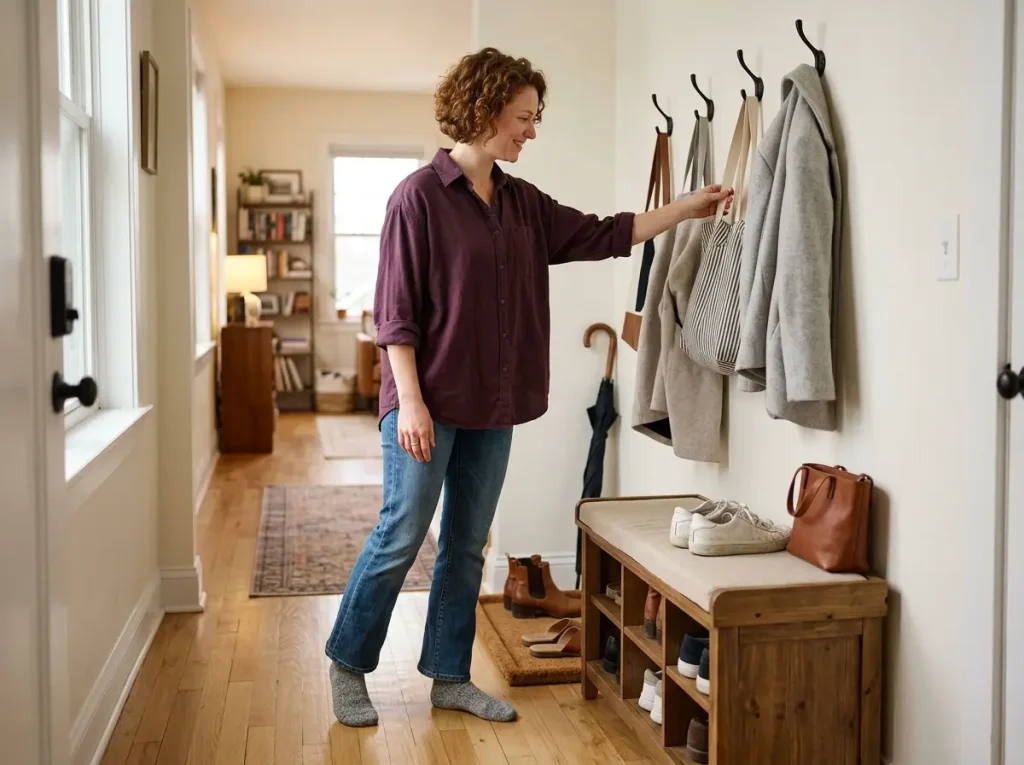
The bench you ordered “for small entryways” was 18 inches deep. Your hallway is 44 inches wide. You walked sideways past it for two weeks before sending it back. That is how most entryway bench purchases end — not because the bench was bad, but because nobody mentioned the one number that determines whether a bench works in your space.
After setting up these configurations in apartments where the front door practically touches the opposite wall, there is a repeatable approach that prevents the wrong buy. This guide covers the measurement that filters out 80 percent of wrong-fit benches, the five bench types that work in real entryways, and the three-piece system that keeps the whole setup from reverting to chaos within two months.
Quick Answer: Five entryway bench storage ideas that fit real hallways:
- Measure hallway width, subtract 36 inches — that is your maximum bench depth
- Hall tree benches combine seating, cubbies, and hooks in one freestanding unit
- Lift-top and flip-top benches hide storage inside a clean-looking seat
- Every bench needs hooks above it and a boot tray in front — the bench alone fails
- Freestanding benches and adhesive hooks keep the system deposit-safe for renters
The One Measurement That Makes or Breaks Your Bench
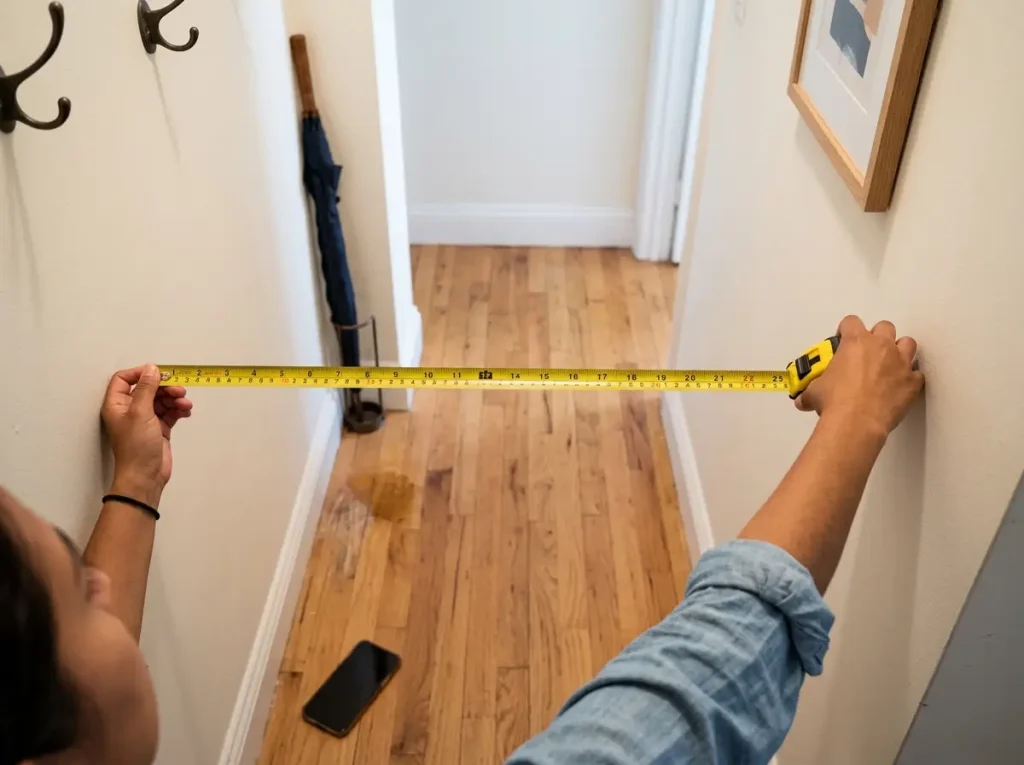
Every entryway article tells you to “measure your space.” None of them give you the actual formula. Here it is: your hallway width minus 36 inches equals your maximum bench depth. The 36 inches is the clear walkway you need to pass comfortably without turning sideways — it comes from standard ergonomic guidelines, not an arbitrary round number.
Run the math for your space. A 48-inch wide hallway can hold a 12-inch deep bench. A 60-inch hallway handles 24 inches. Standard apartment hallways run 42 to 48 inches, which limits you to 6 to 12 inches of bench depth. If that sounds restrictive, it is — and knowing this before you shop saves you from the return-and-reorder cycle that most people go through at least once.
For a broader framework on organizing your entire entry area — not just the bench — see the complete small entryway organization system.
How to calculate max bench depth for your hallway
Grab a tape measure and get the width of your hallway at the spot where the bench will sit. Measure at floor level and again at hip height — walls in older buildings are not always parallel, and you want the narrower number. Subtract 36 from that measurement. The result is the deepest bench you can buy without blocking the walkway.
If the math gives you 6 inches or less, a traditional bench will not work. Skip to the “when there is no room for a bench” section below — there are alternatives that do not eat your walkway.
Pro tip: Write the number on a piece of tape and stick it inside your phone case before you shop. Every bench listing on Amazon shows depth in the specs — compare against your number and you will never order the wrong size.
The door swing check (which wall gets the bench)
Stand at your front door and open it fully. Note which wall it swings toward. Your bench goes on the opposite wall. A bench placed on the hinge side gets hit by the door every time someone walks in — it dents the wood, blocks the entry, and creates exactly the kind of daily friction that makes people give up on the setup entirely.
In most apartments, the door opens inward against the left wall. That puts the bench on the right wall. Confirm this before you measure for depth — you are measuring the wall that is clear of the door arc.
Hook height math (above the bench)
The bench is only the bottom layer of the system. Above it, you need hooks for coats and bags. The standard adult hook height is 60 to 66 inches from the floor. At that height, a coat hangs free of the bench seat below without dragging on it.
Here is the vertical math: a standard bench seat sits at 17 to 19 inches. You need 12 to 18 inches of clearance between the seat and the bottom of a hanging coat. Hooks at 60 to 66 inches satisfy both requirements. If you have kids, add a second row of hooks at 36 to 48 inches — low enough for a child under 8 to reach on their own.
5 Types of Entryway Bench With Storage (and When to Use Each)
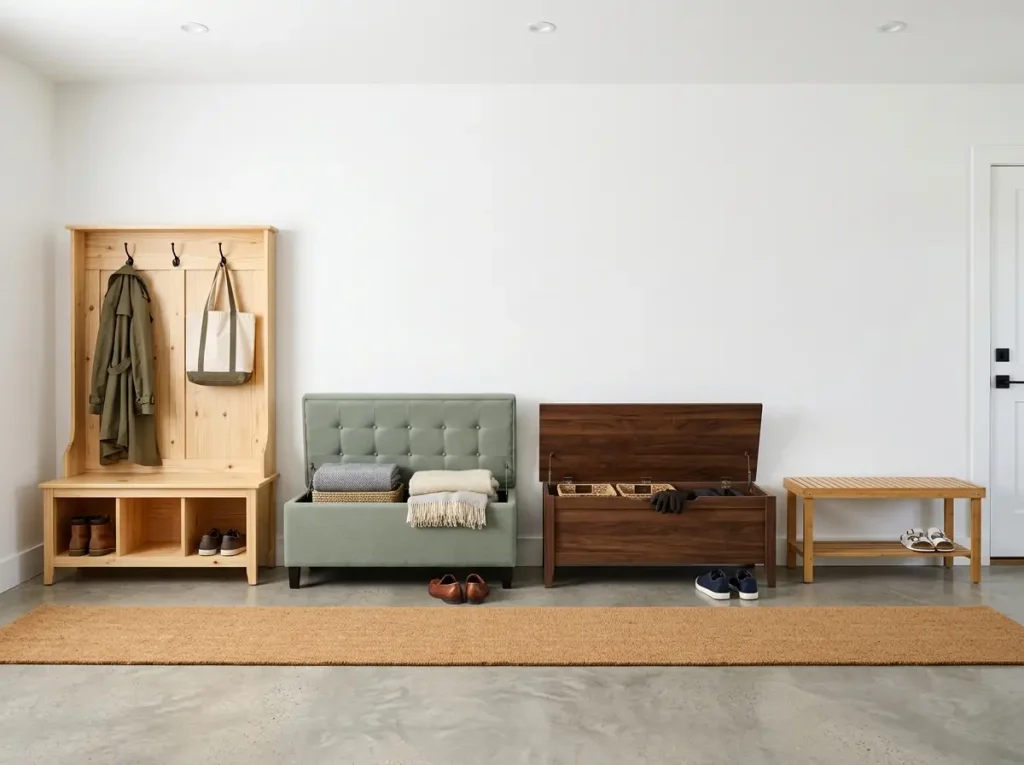
Not every storage bench belongs in an entryway. Some are designed for mudrooms with 8-foot ceilings and floor drains. The five types below are the ones that work in actual apartment entries — and the depth numbers from the clearance formula tell you which ones fit your hallway.
Hall tree bench: the all-in-one option
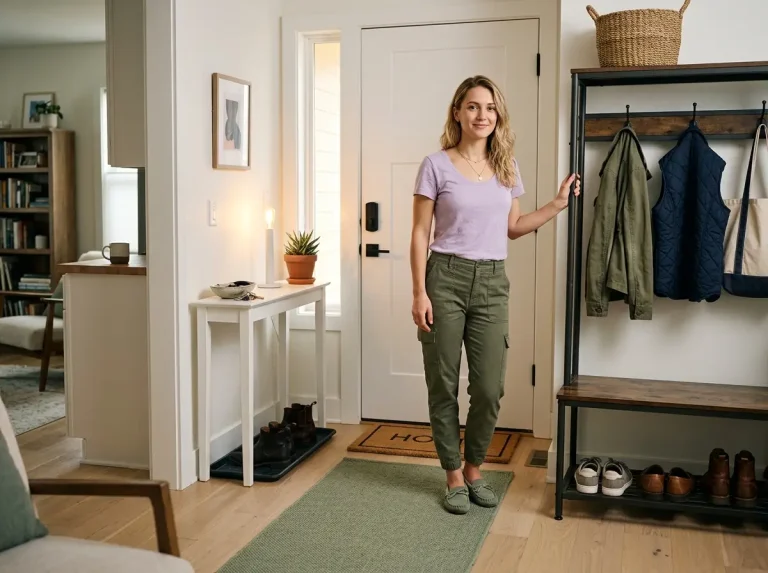
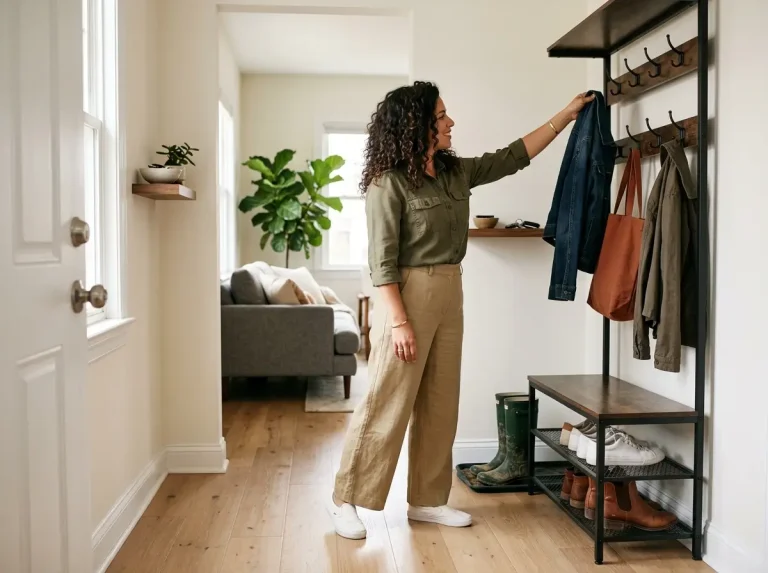
The hall tree bench is the “I do not want to think about this twice” option. It combines a bench seat, shoe cubbies below, and a coat rack extending upward — all in one freestanding unit. No separate hook installation, no second trip to the hardware store, no forgetting to add the vertical layer that keeps coats off the seat.
The HOOBRO Shoe Storage Bench with 12 Cubbies and Coat Rack runs 39.4 inches long by 14 inches deep, with the coat rack extending to 42.5 inches tall. It fits standard apartment entryways where the hallway is at least 50 inches wide (14 plus 36 inches of clearance). The 330-pound seat capacity handles daily use without flexing. One limitation: the coat rack adds height, so check your ceiling clearance — in apartments with low-hanging light fixtures near the door, the top hooks may sit too close to the fixture.
Lift-top and flip-top benches: hidden storage, lower profile
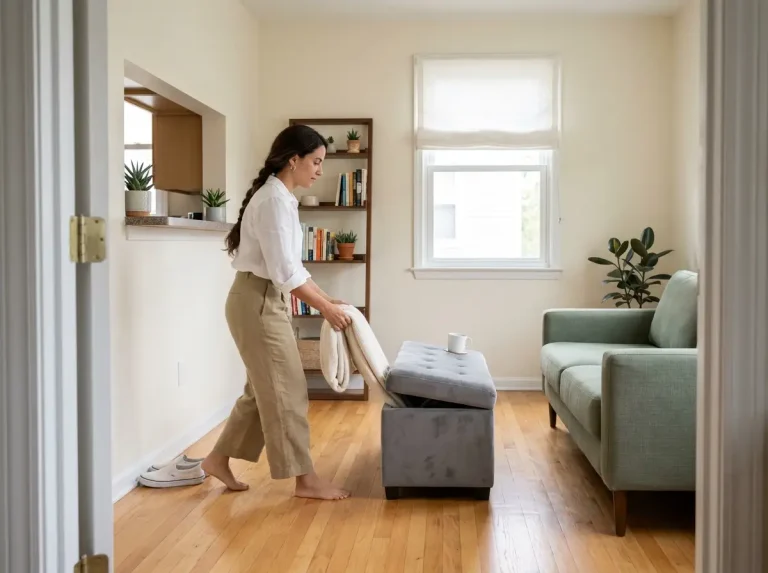
Lift-top and flip-top benches store items inside a hinged seat. The lid lifts or flips to reveal a compartment for seasonal accessories — scarves, gloves, umbrellas, whatever you need access to but not every day. The profile is lower than a hall tree, which makes these work in spaces where vertical furniture feels imposing.
Lift-top benches typically run 15 to 16 inches deep. The HOOBRO Flip-Top Bench is shallower at 32.3 by 12.4 inches — the shallowest storage bench in this guide with an adjustable interior shelf. It works in hallways as narrow as 48 inches because 12.4 plus 36 equals 48.4 inches of total width needed. The adjustable shelf inside fits boots standing upright or standard shoe stacks lying flat.
If your bench needs to do double duty — entryway storage on weekdays, extra seating when guests come over — that is where multi-functional furniture that earns its floor space becomes the deciding filter.
Open cubby and narrow benches: shoe-first solutions
Open cubby benches skip the lid entirely. Cubbies face outward so you can see and grab shoes without bending or lifting anything. They work when shoe storage is the main goal and you plan to handle coats separately with wall hooks above.
The catch with cubbies: openings need to face you, not the wall. Benches with cubbies facing backward — toward the wall — look cleaner from the hallway, but nobody actually uses them. Kicking shoes into a hole you cannot see gets old in about a week. Forward-facing cubbies are the only configuration that holds up past the first month.
If you are equipping the full entry zone beyond the bench itself, the best entryway organizers for small spaces covers hooks, trays, and wall-mounted options that pair with any bench type.
When there’s no room for a bench at all
Some entryways are too narrow for any bench. If your hallway is under 44 inches wide and a 6 to 8-inch deep bench is just a glorified shelf, skip the bench entirely. Two wooden crates stacked sideways give you 18 inches of bench height, a shelf for shoes, and a surface for bags — the whole setup costs almost nothing and takes up under 10 inches of depth. Add four adhesive hooks above the crates and a boot tray in front, and you have a functional entry system without a bench at all.
Building the Complete Entryway System (Bench + Hooks + Boot Tray)
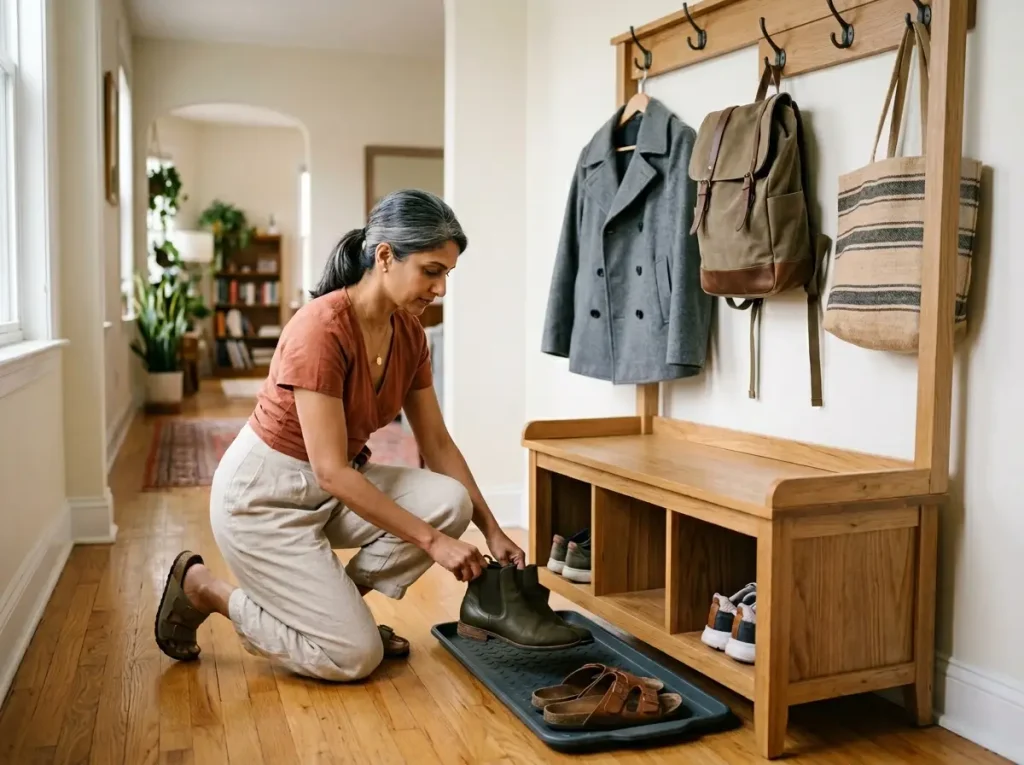
Here is the pattern that repeats in every failed entryway setup: someone buys a bench, sets it up, and it looks great for about a week. By month two, coats are piled on the bench seat, shoes are scattered on the floor, and the surface has become a landing pad for everything from mail to grocery bags.
The bench did not fail. The system around it did. A bench is only one piece of a three-part setup, and without the other two pieces, it reverts to a horizontal dumping surface.
The bench: your anchor piece (and what it actually does)
The bench provides two things: a place to sit while putting on shoes, and storage below or inside the seat for items that need a home. That is it. The bench is not where coats go — those belong on hooks. It is not where wet shoes go — those belong on the boot tray. When the bench surface stays clear, the whole system works. When it becomes a catch-all, everything around it collapses too.
Hooks above the bench: where coats actually go
Without hooks, coats end up on the bench. This is the single most predictable failure in entryway organization — the bench invites dropping but provides no vertical system to redirect coats elsewhere.
Install hooks at 60 to 66 inches from the floor, directly above the bench. One hook per household member is the minimum — professional organizers recommend giving each family member their own hook so coats, bags, and backpacks each have a designated spot rather than piling up on whoever is closest to the door. Space hooks 6 to 9 inches apart to prevent crowding. Three hooks per adult is the practical target: one for the daily coat, one for a bag, one spare.
For renters who cannot drill into walls, Command Large Wire Hooks rated at 5 pounds each are a legitimate substitute. Four hooks in a row give you 20 pounds of capacity — enough for two adult coats and two bags. Wipe the wall with isopropyl alcohol before applying, follow the cure time on the package, and they hold. Using hooks and other wall-mounted options without drilling is the core strategy behind vertical storage on apartment walls.
Pro tip: Put a small bowl or flat tray on one end of the bench surface for keys, wallet, and phone. When the tray fills up, you have a problem to address — but the rest of the bench surface stays clear.
The boot tray: the boundary that keeps shoes organized
Without a tray, shoes scatter around the bench legs within days. The boot tray defines the shoe zone visually — shoes go on it, not next to it, not under the bench, not kicked vaguely toward the wall. A rubber or coir tray 20 to 24 inches wide fits the front of most benches and catches mud, rain, and grit before any of it hits your floor.
Most of the budget goes toward the bench itself. The hooks plus tray add a fraction of that cost. That small addition is what makes the bench investment actually function — without it, you have an expensive seat with clutter growing around it.
Renter Bench Rules: Door Swing, Deposits, and Size
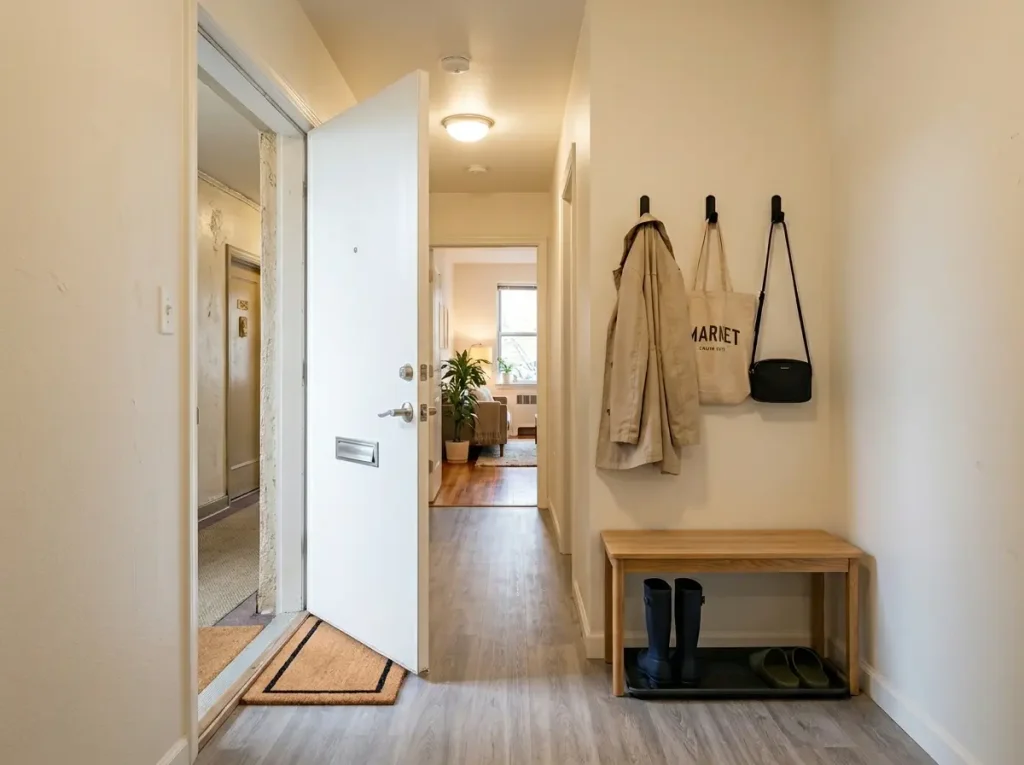
If you are setting up a functional entryway in an apartment without a foyer, two constraints change everything: you cannot mount anything permanently, and your front door probably opens into a narrow hall at an awkward angle. Both are solvable before you buy anything.
Freestanding is the only category that matters for renters
Every bench in this guide is freestanding — no wall anchoring required. The hall tree, lift-top, flip-top, and cubby styles all stand on their own weight. Any bench that requires wall mounting for stability goes back immediately. A freestanding bench plus adhesive hooks plus a loose boot tray gives you the complete three-part system with zero holes in any wall. Your deposit stays intact.
Door swing first: which wall gets the bench
This is the renter-specific version of the door check from the measurement section. In apartments, the front door opening inward is almost universal. Open the door fully, see where it rests, and put the bench on the opposite wall. A bench on the door side gets hit every time someone enters — it dents the finish, rattles whatever sits on the bench, and eventually becomes the thing you shove aside instead of using.
For hooks, start with Command strips by weight rating. Match your hook to the coat weight — not to the hook’s maximum rating. A 7.5-pound-rated hook holding a 7-pound winter coat is running at capacity, and the humidity near an exterior door weakens adhesive faster than a dry bedroom wall.
Pro tip: Apply adhesive hooks in the evening and let them cure overnight before hanging anything. The one-hour minimum on the package assumes a climate-controlled room — an entryway near an exterior door with temperature swings needs longer cure time.
Material matters in humid entryways
Entryways are not like the rest of your home. Wet coats drip. Damp boots sit on and near furniture. The door opens and closes, bringing outside air, rain splash, and humidity shifts.
MDF and particleboard swell at the joints under these conditions. Within two to three years in a high-traffic entry, a budget MDF bench starts to warp at the corners and delaminate where water sits.
The PETKABOO Bamboo Shoe Bench with Hidden Drawer at 39.4 by 11.8 inches deep handles humid entries better than MDF at a similar price point. It is the shallowest bench in this guide — 11.8-inch depth clears a 36-inch walkway in any hallway 48 inches or wider. The two-tier design stores shoes on the lower shelf and accessories in a hidden drawer. Bamboo naturally resists the moisture that breaks down engineered wood, and it will not swell at the joints after two winters of wet boots on the lower shelf.
Solid pine and metal frames are the other humidity-resistant options. If budget allows, these outlast MDF by a decade in an active entryway. If budget is tighter, bamboo gives you the best durability per dollar in this depth range.
Why Your Bench System Stops Working After 3 Months

The entryway looks great on day one. By month three, there is a coat draped on the seat, three shoes on the floor in front of the bench, and a tote bag slumped against the bench leg. This is not a product failure — it is a system design failure with predictable causes and straightforward fixes.
The coats-on-the-bench failure (and the fix)
Root cause: no hooks above the bench. The bench surface is the most convenient horizontal surface near the door. Without hooks, coats land there because there is nowhere else they can go. Adding hooks after the fact always feels like a separate project, which is why it gets postponed until the bench is already buried.
The fix: install hooks the same day you set up the bench. Treat them as part of the bench purchase, not a follow-up task. One hook per household member, minimum. If coats are still landing on the bench after hooks are installed, the hooks are probably too high or too far from the door — move them to 60 to 66 inches directly above the bench where reaching up feels natural, not like putting something away on a high shelf.
The shoes-everywhere failure (and the fix)
Root cause: no defined shoe zone. Without a boot tray or forward-facing cubbies, shoes scatter because the floor around the bench has no boundary. People kick off shoes and they end up wherever momentum takes them — next to the bench, behind it, one under it and one near the door.
The fix depends on your bench type. If you have cubbies, make sure openings face forward — toward you when you walk in. If you have a lift-top or ottoman style, place a boot tray directly in front of the bench. The tray is not decorative. It is a boundary. Shoes go on the tray. Shoes not on the tray are shoes that need to be moved onto the tray. That binary rule is what keeps the floor clear.
The quarterly reset: 5 minutes, twice a year
Seasonal items drift. Winter gloves stay in the bench through April. A sun hat migrates to the boot tray in November. The system that worked in January is carrying dead weight by May — and that dead weight pushes active items out of their spots, which restarts the clutter cycle.
Pull everything out from under and inside the bench twice a year. Wipe down the interior. Swap seasonal gear — winter boots under the bench in October, sandals in April. Reassess what is actually living in the space versus what is just sitting there waiting for you to notice it. This takes five minutes and is the difference between a system that works for years and one that slowly fills with items nobody touches.
For a weekly version of this habit — less thorough but more frequent — the 10-minute weekly entryway reset covers the quick sweep that keeps everything in its zone between seasonal resets.
Conclusion
Three things determine whether your entryway bench with storage actually works:
- The measurement. Hallway width minus 36 inches equals your maximum bench depth. Buy inside that number or you will spend two weeks walking sideways before returning it.
- The three-part system. Bench plus hooks at 60 to 66 inches plus boot tray. Without the hooks, coats pile on the bench within a month. Without the tray, shoes scatter in two weeks. The bench alone is not a solution — it is one third of one.
- The reset habit. Twice a year, pull everything out, swap seasonal items, wipe it down. Five minutes keeps the system functional past the first month of enthusiasm.
Three-Month Check: Three months in, pull everything out from under and inside the bench. If coats are on the seat, the hooks are missing or positioned wrong. If shoes are scattered, the boot tray needs to move closer to the bench. These are system problems, not bench problems — and both are fixable in an afternoon.
Start with the measurement. Grab a tape measure right now, get your hallway width, and subtract 36. Everything else follows from that number.
Q1 What size should an entryway bench with storage be?
Standard entryway bench height is 17 to 20 inches. For depth, subtract 36 inches from your hallway width — that is your maximum. A 48-inch hallway fits a 12-inch deep bench. A 60-inch hallway handles up to 24 inches of depth.
Q2 What is the best depth for a narrow hallway bench?
For hallways under 48 inches wide, look for benches 11 to 12 inches deep. The HOOBRO flip-top (12.4 inches) and PETKABOO bamboo bench (11.8 inches) are the two practical options at that depth. Under 11 inches and you lose useful under-seat storage.
Q3 How do you set up an entryway bench with hooks?
Install hooks at 60 to 66 inches from the floor so coats hang clear of the bench seat. Space hooks 6 to 9 inches apart. Renters can use four Command Large Wire Hooks in a row for 20 pounds of capacity — enough for coats and bags without drilling.
Q4 What should you put under an entryway bench?
Shoes go on a boot tray placed in front of the bench, not underneath it — under-bench clearance is usually only 8 to 10 inches, not enough for most shoes upright. Inside the bench or under lower shelves works for flat items: seasonal accessories, a spare umbrella, folded bags.
Q5 Can a storage bench work in a small apartment entryway?
Yes, with the right depth. Standard benches at 16 to 18 inches deep work in hallways 52 inches or wider. For narrower apartments, go with 12 to 13 inches deep. If your hallway is under 44 inches, skip the bench and use a folding wall seat with adhesive hooks above instead.
Disclaimer: ClutterlessNest is a participant in the Amazon Services LLC Associates Program. As an Amazon Associate we earn from qualifying purchases. This article may contain affiliate links — if you buy through them, we may earn a small commission at no extra cost to you. We only recommend products we have tested or genuinely believe in.