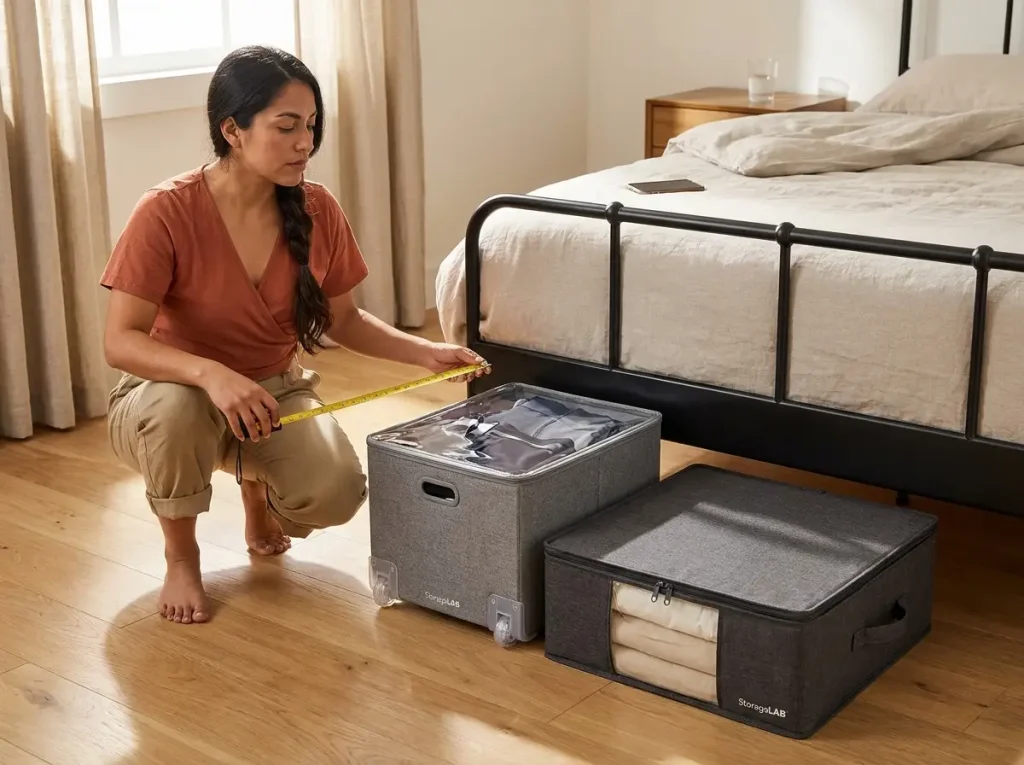
You bought the rolling bins because they seemed smarter. Then you pushed one under your bed and the wheels caught on the rug, the handle jammed against the frame, and you ended up dragging it out by hand anyway. The “rolling” part of rolling under bed storage only works under conditions most bedrooms don’t meet — and nobody warns you about that before you buy.
This guide breaks down the real decision between rolling and flat under bed storage using four variables: clearance height, floor type, access frequency, and item weight. One of these alone can eliminate an entire category. By the end, you’ll know exactly which type fits your bed, your floor, and the way you actually use storage.
Here’s how rolling and flat under-bed storage compare across the factors that matter most.
| Factor | Rolling | Flat |
|---|---|---|
| Minimum clearance | 8″+ (with wheels + hand room) | 5″+ (low-profile models) |
| Best floor type | Hard floors (hardwood, tile, vinyl) | Any floor type |
| Carpet performance | Poor — wheels dig into pile | Manageable — slides with handles |
| Access frequency sweet spot | Weekly or more | Monthly or less |
| Stackable | No | Yes — 2-3 high in tall frames |
| Floor scratch risk | High (hard plastic casters) | Low (with felt pads) |
| Best for | Gym gear, rotating shoes, weekly-use items | Seasonal clothes, bedding, heavy items |
The Clearance Test: Measure Before You Choose
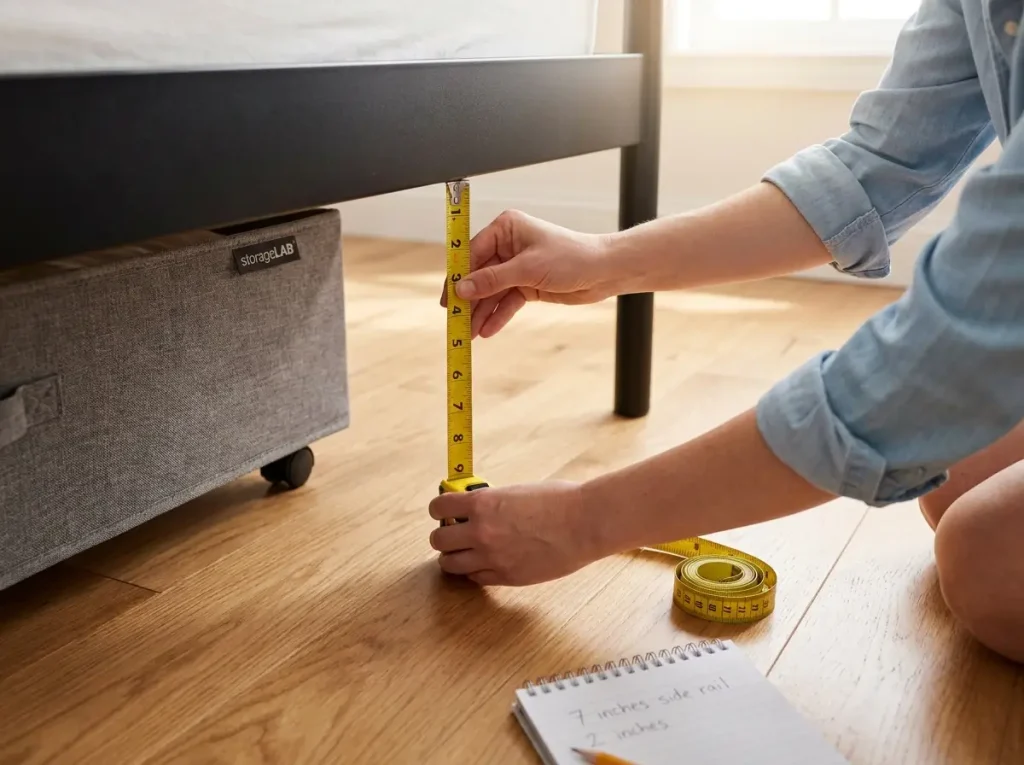
How to Measure Your Bed Clearance (Don’t Guess)
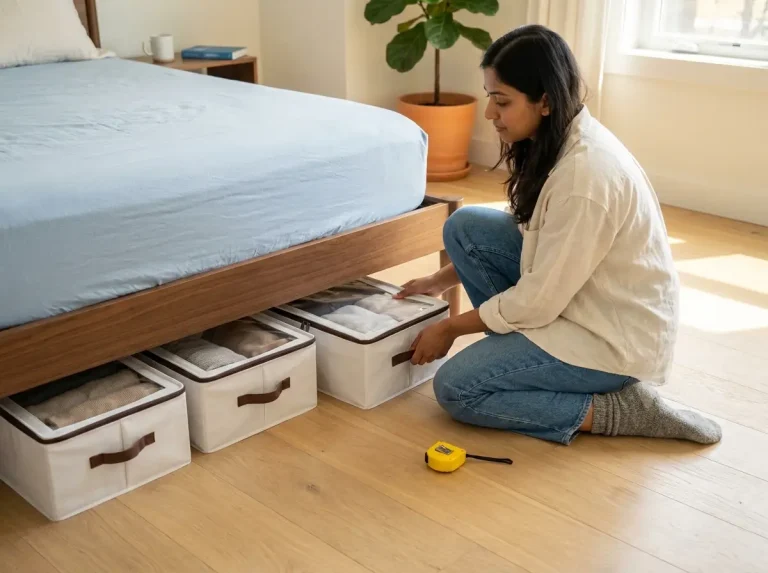
Grab a tape measure and get on the floor. Measure from the floor surface — the actual carpet or hardwood you’re standing on, not the subfloor beneath it — to the lowest point of the bed frame rail. Not the center of the bed. Not the box spring. The frame rail, which is the rigid bar that runs along the side and foot of the bed. That number is your clearance, and it decides everything.
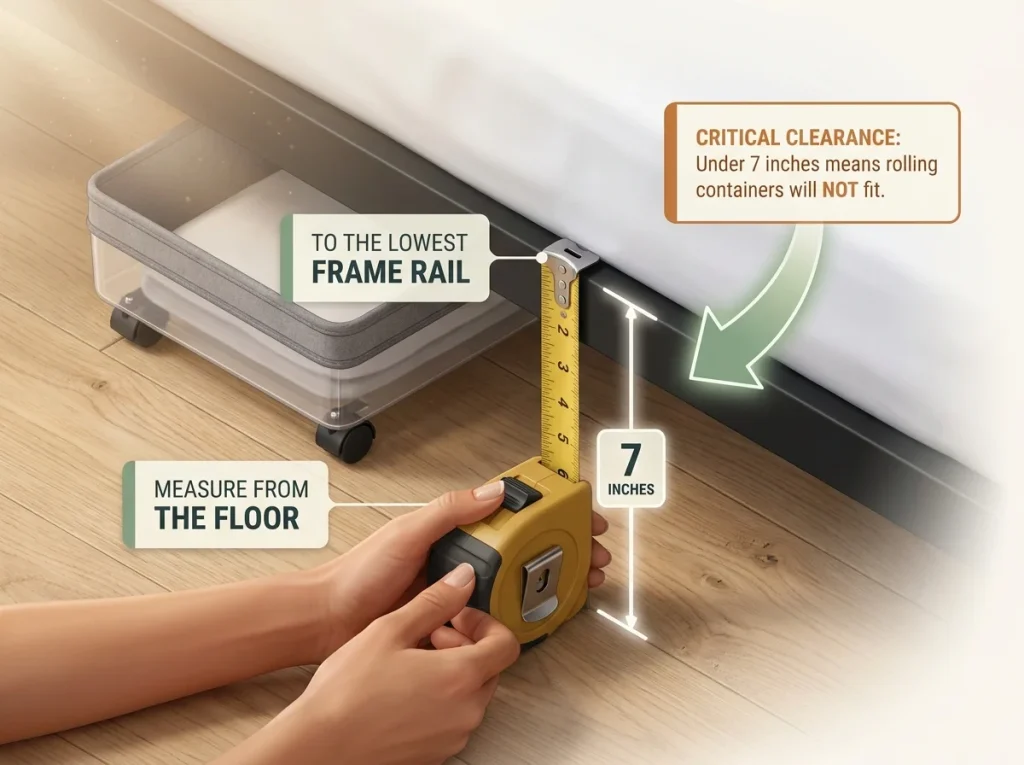
Measure at the foot of the bed and at the side. Frame rails sometimes dip lower at the corners where legs connect, and that dip can steal half an inch you were counting on.
What Your Clearance Actually Tells You
Here’s what each clearance range means for your options:
- 4–5 inches: Flat containers only. Most flat options need at least 5 inches. The storageLAB low-profile at 4.5 inches is one of the few that fits here.
- 5–7 inches: Still flat territory. Rolling containers with wheels added won’t fit, or won’t leave you enough room to grip and pull.
- 7–9 inches: Rolling becomes possible — but your floor type still has veto power. More on that below.
- 9 inches or more: Either type works. Your decision shifts to access frequency and what you’re storing.
If your number falls below 7 inches, you can stop reading about rolling containers. Flat is not a consolation prize — it’s the only option that works, and if you check clearance before buying any under-bed container, you’ll avoid the return trip.
Pro tip: If your clearance is borderline (6.5–7 inches), measure with a book or box that height and slide it under the bed. If it catches or scrapes, nothing at that height will glide.
The Rolling Container Math Nobody Shows You
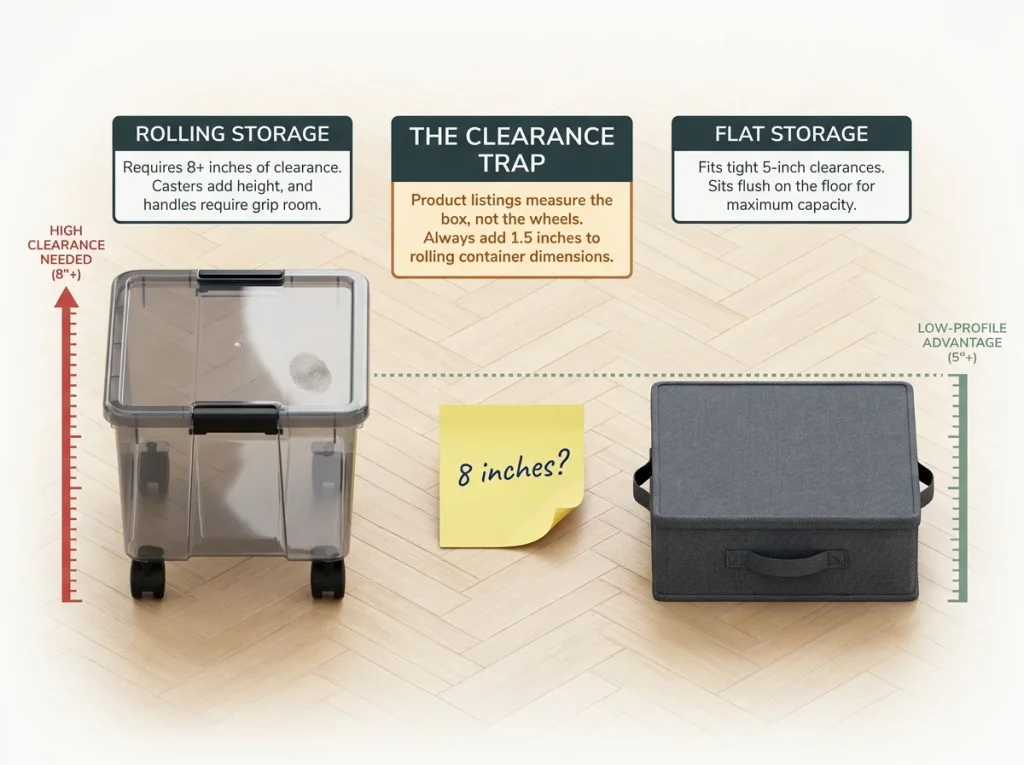
A rolling container listed at 6 inches tall doesn’t need 6 inches of clearance. It needs more. The wheels add 0.5 to 0.75 inches depending on the caster design. That turns your “6-inch” container into a 6.5- to 6.75-inch unit.
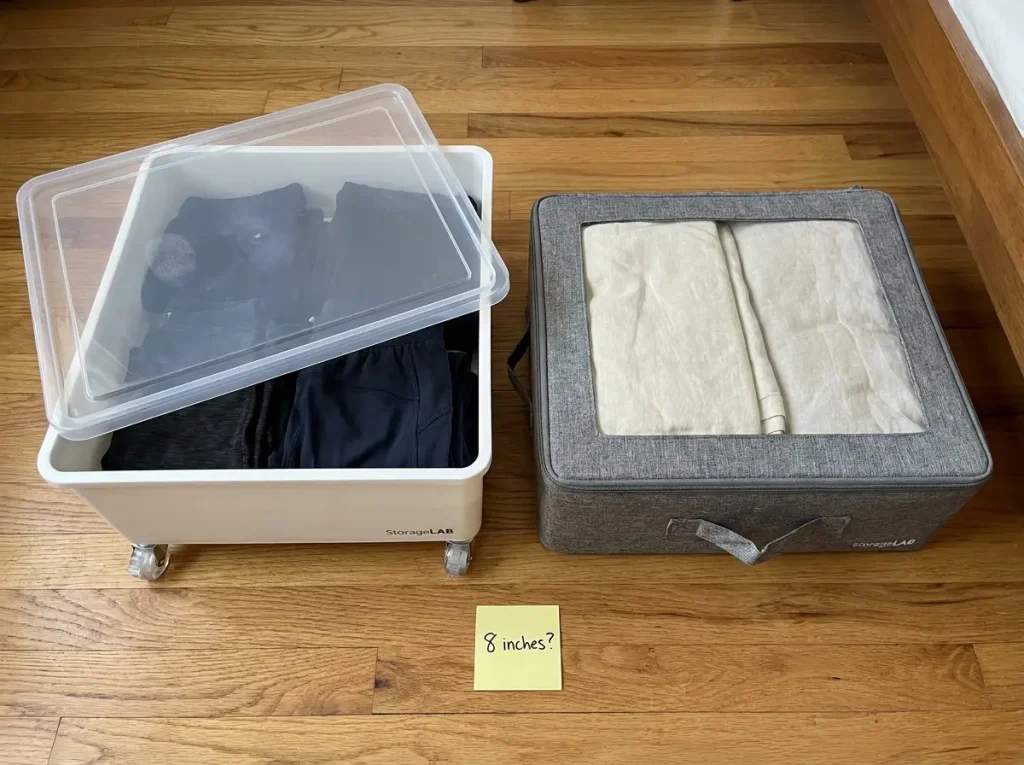
But that’s still not the real number. You also need room above the container to grip the handle and pull. That’s another inch at minimum. The practical clearance for rolling under bed storage to function without frustration is 8 inches. Not 6. Not 7. Eight.
Nobody puts that on the product listing. But it’s the number that separates “this works” from “I’m returning this.”
Rolling Under Bed Storage — What It’s Actually Good For
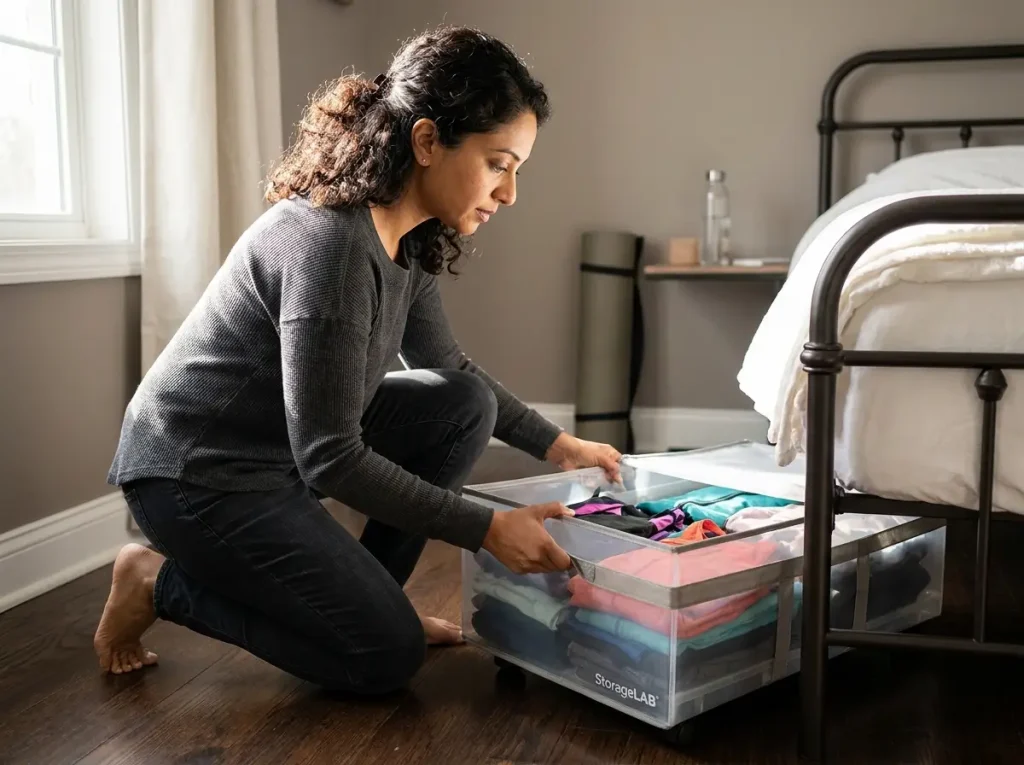
The Access Frequency Rule
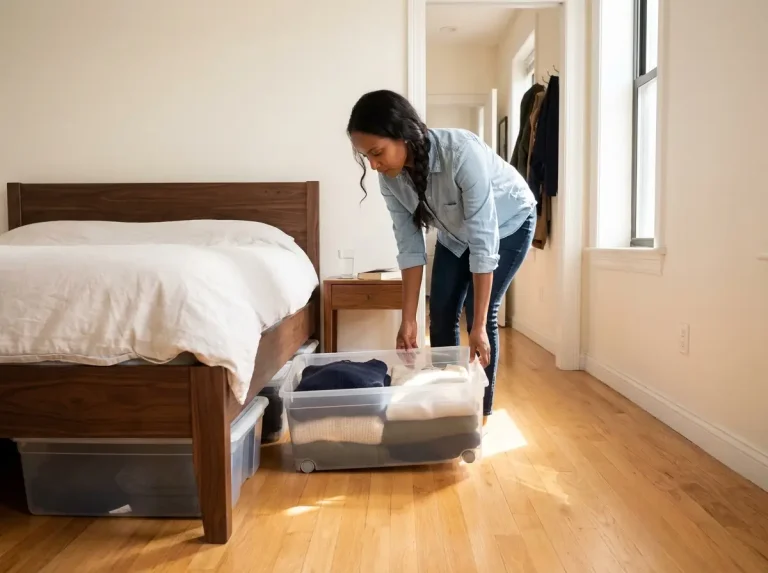
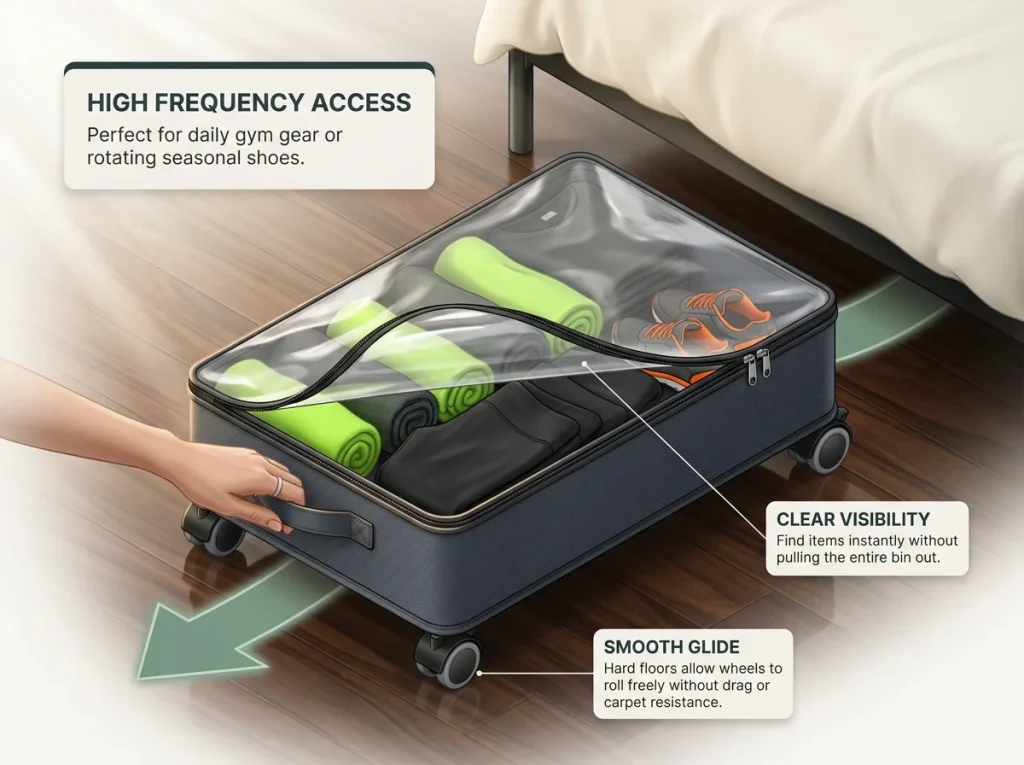
Rolling storage earns its keep when you’re opening the container once a week or more. If you reach for gym clothes every morning, or rotate shoes every few days, the ability to grab a handle and pull the entire bin out on wheels saves you from the crawl-and-drag routine.
For monthly access? Flat handles that just fine. If you’re reaching under the bed once every few weeks, you won’t notice the difference between pulling a handle on a flat container and rolling out a wheeled one. The convenience gap between the two only shows up at high frequency. For a broader view of how under-bed storage fits into your bedroom setup, our full under-bed storage system guide covers placement, zoning, and resets.
The Floor Type Reality
Here’s the factor that makes or breaks rolling storage, and most articles skip right past it.
Hard floors — hardwood, tile, vinyl plank, laminate — are where rolling actually works. The wheels roll. The container glides. But there’s a trade-off: hard plastic casters will mark hardwood finishes over time. If you’re renting and your deposit depends on unmarked floors, add soft silicone caster cups or adhesive felt pads to the wheel bottoms before the first use.
Low-pile carpet (Berber, flatweave, commercial loop) gives you partial rolling function. The wheels move, but with resistance. You’re working for it.
Medium-to-deep pile carpet is where rolling dies. The wheels sink into the carpet fibers and create drag equivalent to dragging a box with no wheels at all. You bought rolling storage and got a flat container that’s taller and harder to maneuver. If your bedroom has thick carpet, save yourself the frustration and go flat from the start.
Pro tip: Test your carpet with a desk chair caster. If a standard office chair wheel moves easily on your bedroom carpet, rolling under-bed bins will too. If the chair wheel sinks or drags, rolling storage will do the same.
What to Store in Rolling Containers
Rolling works best for items you access on a regular cycle:
- Workout clothes and gym bags you grab several times a week
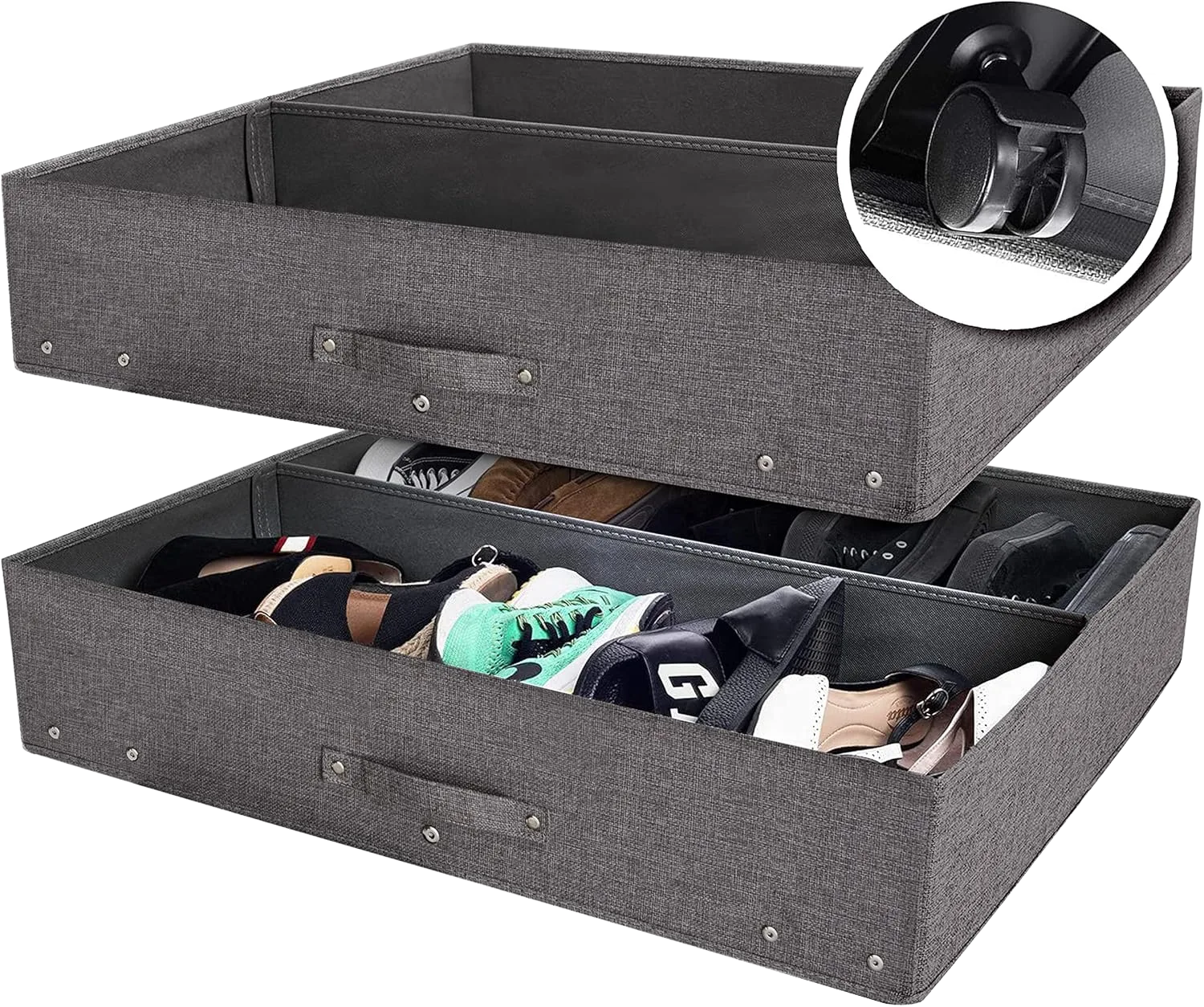
- Shoes you rotate — seasonal pairs you swap every few weeks
- Items you pull out and return without removing the container from under the bed entirely
Anything you’re storing for months at a time doesn’t benefit from rolling. You’re paying for a feature — the wheels — that sits unused for 90 days between access.
Flat Under Bed Storage — More Versatile Than You Think
Where Flat Wins Without Argument
Flat under bed storage works in every scenario where rolling fails — and a few where rolling never had a chance.
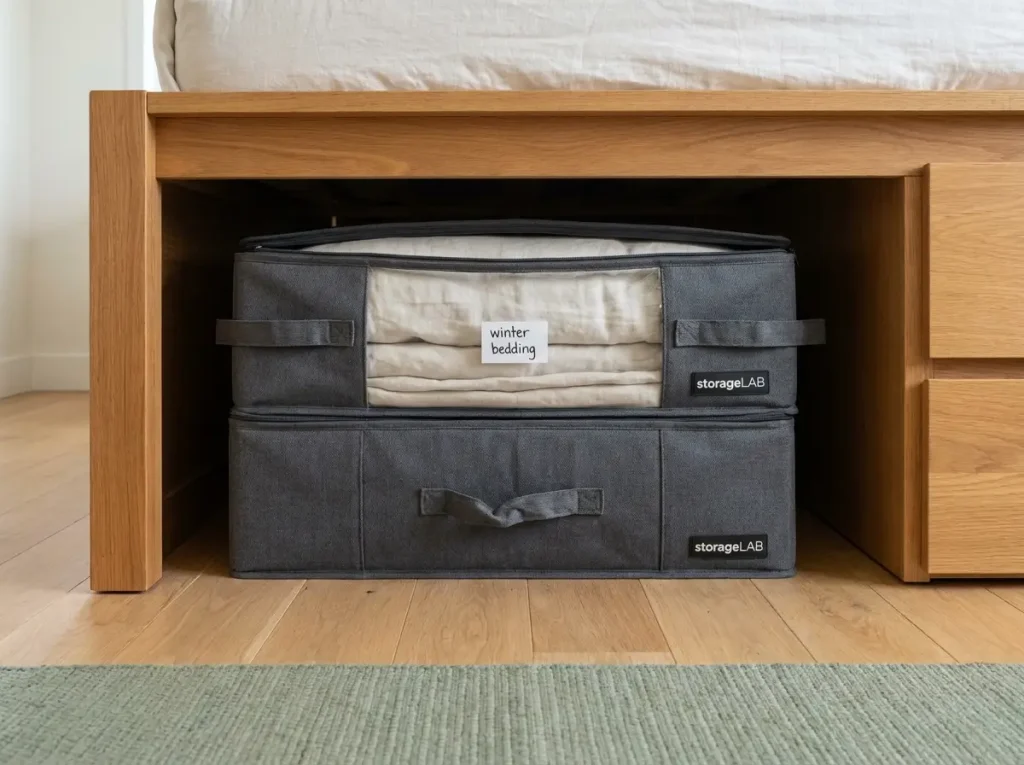
Platform beds with 4–7 inches of clearance: This is flat-only territory. The storageLAB low-profile container at 4.5 inches is the thinnest worthwhile option, and it’s one of the few that actually fits under platform frames that sit close to the ground. If you’re working with a platform bed, our under-bed storage ideas for small bedrooms guide breaks down which specific containers work at each clearance height.
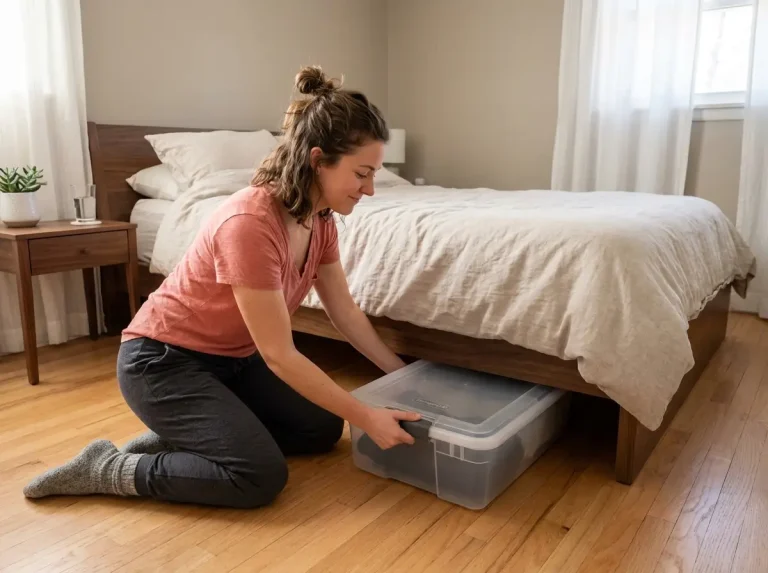
Carpeted bedrooms: Flat containers slide with manageable resistance using side handles. You’re not fighting wheel friction — you’re pulling a smooth-bottomed box across fiber, which works fine with a firm grip and a straight pull.
Rental apartments: Stick adhesive felt furniture pads to the bottom of a flat container and you get zero floor damage. No marks, no scratches, no conversation with your landlord. Rolling containers with hard plastic casters? That’s a deposit conversation waiting to happen.
The Stackability Advantage Rolling Can’t Match
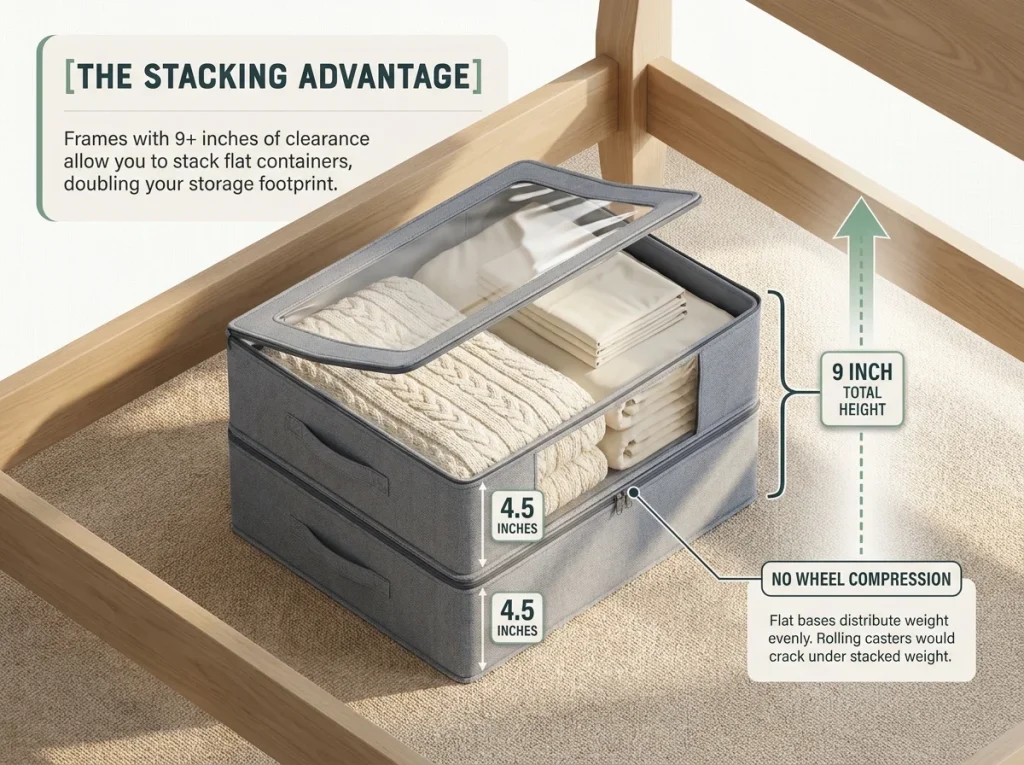
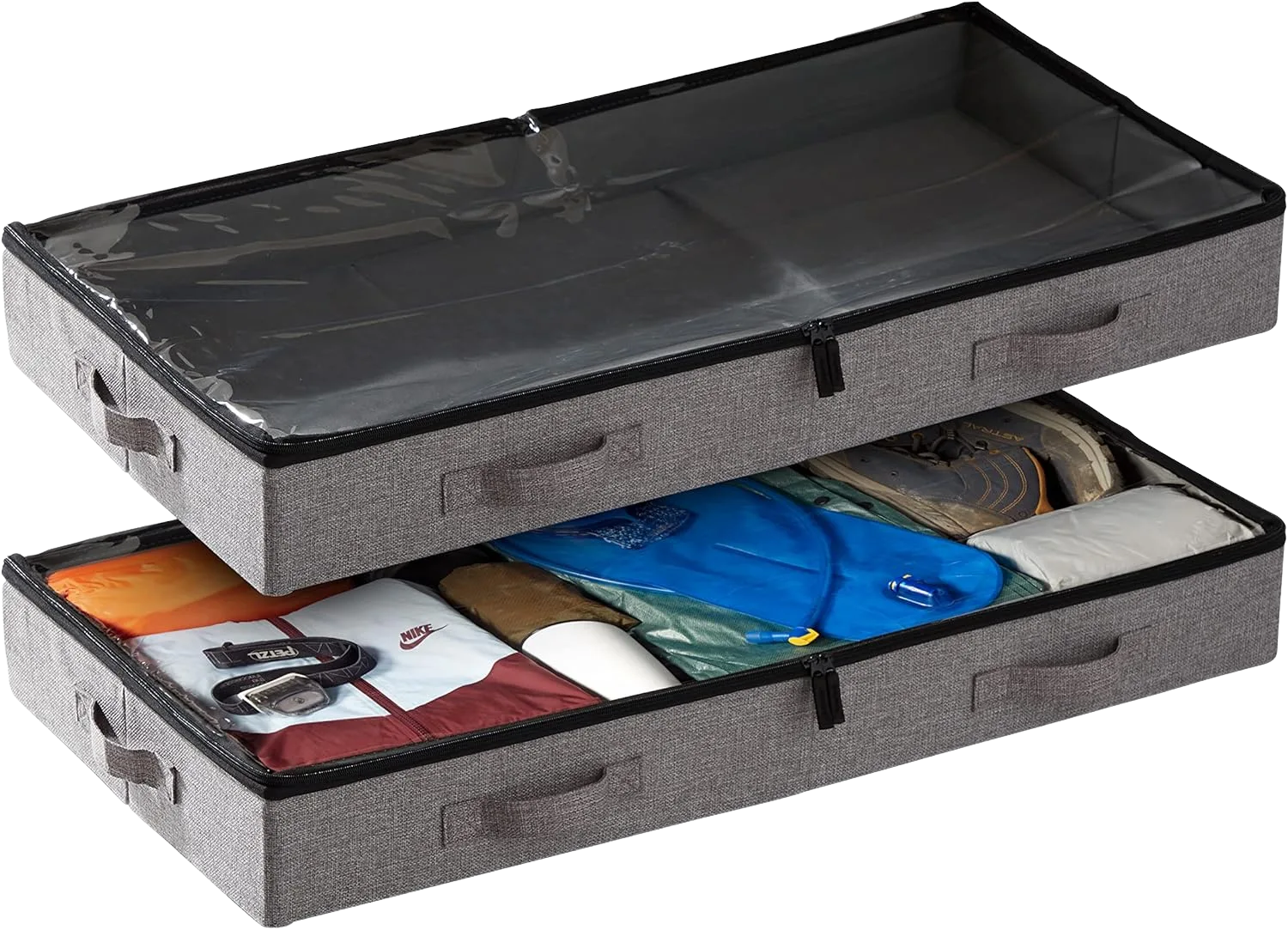
If your bed frame has high clearance — 12 inches or more, which is common with standard metal frames on risers or storage beds — flat containers stack. Two storageLAB units at 4.5 inches each give you a 9-inch stack that doubles your usable capacity in the same footprint. Three standard 6-inch flat containers fit in an 18-inch storage bed compartment.
Rolling containers can’t do this. The wheel mechanism sits on top and bottom of the shell, and stacking puts compression load on casters that weren’t designed for it. One rolling bin per clearance zone is the maximum.
What to Store in Flat Containers
Flat works best for items you check once a season or less:
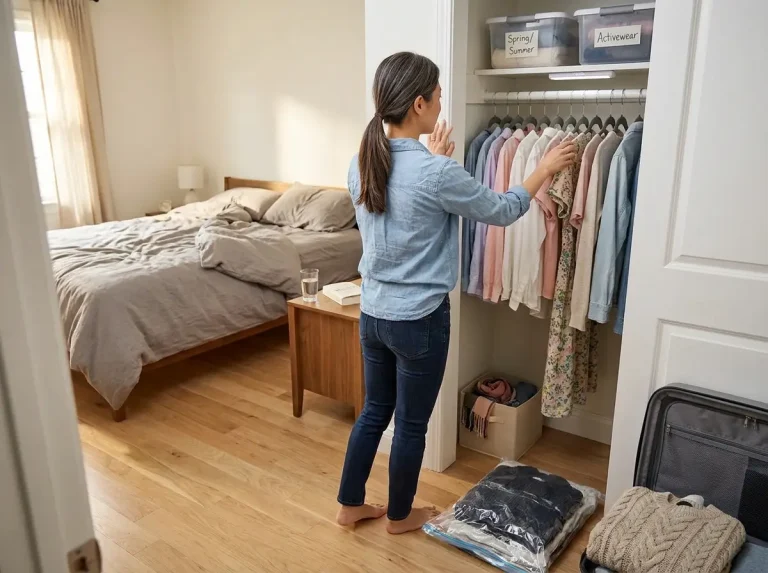
- Seasonal clothing — winter sweaters in summer, swim gear in winter
- Extra bedding — spare comforters, guest sheets, pillow protectors
- Heavy items — a stack of folded blankets weighs more than most rolling caster wheels can handle; flat containers spread that weight across the floor instead of concentrating it through four small wheels
Pro tip: Don’t vacuum-seal wool, down, or cashmere in flat containers. The compression damages natural fibers permanently. Synthetic fills (polyester, microfiber) handle vacuum bags fine. Stick to breathable fabric containers for natural-fiber items.
Four Questions That Pick the Right One for You
Instead of the usual “it depends,” here are four questions that give you a specific answer.
Question 1 + 2 — The Physical Constraints
Start here because these two questions have veto power.
What’s your clearance?
- Under 7 inches → flat. Full stop. Rolling won’t fit with wheels and hand room.
- 7–9 inches → rolling is possible, but Question 2 decides.
- 9 inches or more → either works. Move to Question 3.
What floor are you sliding over?
- Hard floor (hardwood, tile, vinyl, laminate) → rolling is viable. The IRIS USA Under Bed Chest with Casters (32.5 × 17.88 × 6.5 in) is a good rigid-shell rolling option for hard floors when your clearance qualifies.
- Low-pile carpet → rolling is marginal. Expect resistance.
- Medium-to-deep pile carpet → flat. Rolling wheels will plow through carpet fibers, not roll over them.
If either question eliminates rolling, don’t second-guess it. Flat containers with handles work on every surface.
Question 3 — Access Frequency Test
How often will you reach for this?
- Weekly or more → rolling earns its place. The glide-out convenience adds up over 50+ uses a year.
- Every 2–4 weeks → flat with handles works fine. The difference between pulling handles and pulling a rolling bin is negligible at this frequency.
- Monthly or less → flat. If the container sits untouched for weeks at a time, wheels are a feature you’re paying for but never using. Quarterly access — like a seasonal closet rotation system — works perfectly with flat containers.
Question 4 — Weight and Load Type
How heavy is what you’re storing?
- Under 20 lbs → either type handles it.
- 20–35 lbs → rolling still works if the wheels are rated for it (check the product specs). Flat is safer — no wheel failure risk.
- Over 35 lbs (multiple blankets, a full spare bedding set, heavy winter coats) → flat. The IRIS USA Under Bed Storage Box with Lid (32.5 × 17.88 × 6.5 in) distributes that weight across its rigid shell base. Rolling the same load stresses four small plastic casters, and cheap casters crack under sustained weight.
Heavy items in a rolling container also shift during retrieval. You pull the handle, the weight slides to one side, and the container tips or jams against the frame. Flat containers stay level because they sit directly on the floor.
Rolling vs Flat Under Bed Storage — Best Picks for Each
Best Rolling Under Bed Storage Containers
The StorageLAB with Wheels (featured above) is the benchmark if your clearance and floor qualify. For higher metal frame beds with 9 inches or more, the Aethel Rolling 2-Pack (30 × 17 × 7.5 in) adds more vertical capacity — enough for bulkier items like folded sweaters, spare pillows, or boot boxes. The extra height means it won’t fit under most platform frames, but that’s the trade-off for capacity.
If you’re storing shoes, the rolling format works for pairs you rotate frequently — for a deeper look at shoe-specific under-bed options, check our under-bed shoe storage guide.
Best Flat Under Bed Storage Containers
The storageLAB 4.5-inch low profile (featured above) is the pick for platform beds and tight clearance. For standard 6-inch clearance zones, the StorageRight Set of 4 (29 × 17.7 × 6.1 in) is the best value flat option — four containers fill the full perimeter of a queen bed and each has buckle lids that stay shut during sliding.
The One Thing Both Types Get Wrong
People buy rolling containers “just in case” for items they end up checking twice a year. That’s paying a premium for wheels that never turn.
And on the flat side: people skip felt pads. A flat container without pads on hardwood drags and marks the floor the same way rolling with hard casters does. Stick adhesive felt furniture pads to the bottom of every flat container on hard floors. They cost almost nothing and they turn every pull into a smooth glide.
Conclusion
Clearance is the first filter. Measure from the floor to the frame rail — if you’re under 7 inches, rolling doesn’t work and flat is your answer.
Floor type decides the rolling question. Carpet makes rolling a bad buy for most bedrooms. Hard floors with soft casters or felt protection are the only surface where rolling delivers on its promise.
Flat is the more versatile option for most people. It works on every floor type, fits every clearance height, stacks when space allows, and costs less. Rolling earns its spot only when you need weekly access on a hard floor with 8-plus inches of clearance. That’s a narrower set of bedrooms than most people assume.
Three-Month Check: In three months, ask yourself whether you’ve actually pulled the container out. If it hasn’t moved since the day you set it up, you’re over-storing — declutter the contents. If you’re reaching for it regularly, you’ve proved the type right.
Start with one thing: measure your clearance today. Write it on a sticky note and put it in your wallet. That one number decides everything else.
Q1 Can rolling under bed storage work on carpet?
Rolling under-bed storage works on low-pile carpet (Berber, flatweave) with some resistance, but it fails on medium-to-deep pile carpet. The wheels sink into thicker carpet fibers instead of rolling over them, turning the container into a draggable box. If your bedroom has plush or shag carpet, flat containers with handles will save you frustration.
Q2 What is the minimum clearance needed for rolling under bed storage?
You need a minimum of 8 inches of clearance for rolling under-bed storage to function. A 6-inch rolling container adds 0.5–0.75 inches for wheels, bringing the actual height to about 6.75 inches. You also need at least 1 inch above the container to grip the handle. Seven inches is technically possible but tight enough to cause jams.
Q3 Is rolling or flat under bed storage better for shoes?
Rolling is better for shoes you rotate frequently — the ability to pull the entire bin out and see all pairs at once saves time. Flat works better for seasonal shoes you store for months. For daily-wear shoes, rolling on a hard floor is the most practical. For off-season shoes and boots, flat containers with clear windows give you enough visibility without the clearance requirement.
Q4 Can flat under bed storage containers be stacked?
Yes — flat under-bed containers are stackable, which is one of their biggest advantages over rolling options. Two 4.5-inch flat containers stack to about 9 inches, doubling your capacity in the same floor footprint. This works in storage beds, high-clearance metal frames, and any space with 10 inches or more of clearance. Rolling containers cannot be stacked because the wheel mechanism doesn’t support compression from above.
Q5 Do rolling storage wheels scratch hardwood floors?
Hard plastic casters on rolling under-bed storage will scratch hardwood over time, especially when pulled across the grain. Soft rubber or silicone casters are safer but uncommon on budget containers. The fix: apply adhesive felt caster cups to the bottom of each wheel, or place a thin felt pad strip under the wheel path. If you’re renting, this is a non-negotiable step before the first use.
Disclaimer: ClutterlessNest is a participant in the Amazon Services LLC Associates Program. As an Amazon Associate we earn from qualifying purchases. This article may contain affiliate links — if you buy through them, we may earn a small commission at no extra cost to you. We only recommend products we have tested or genuinely believe in.