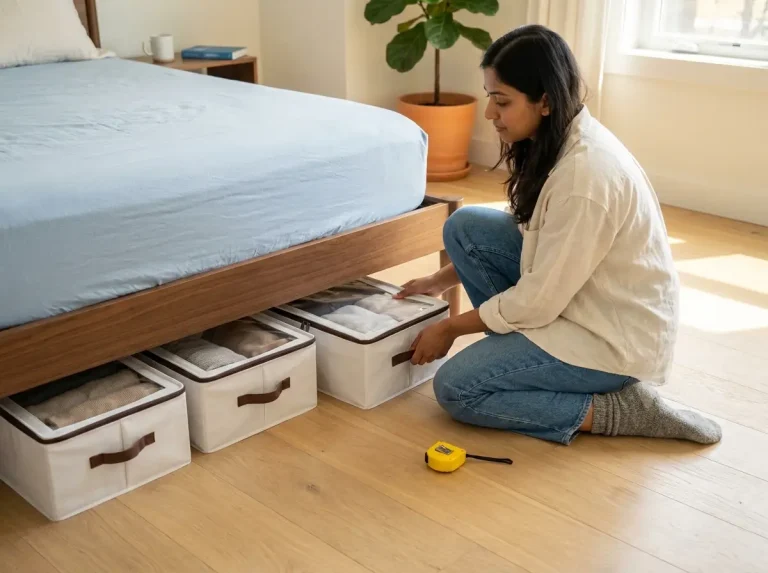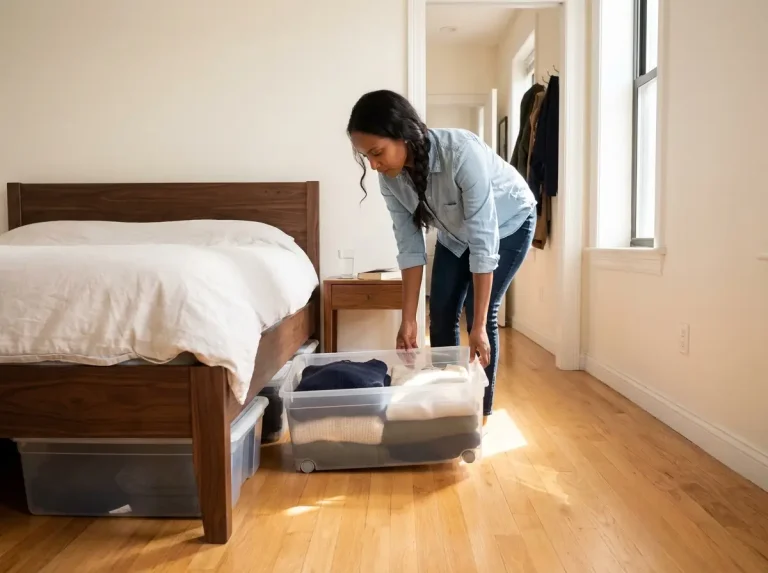
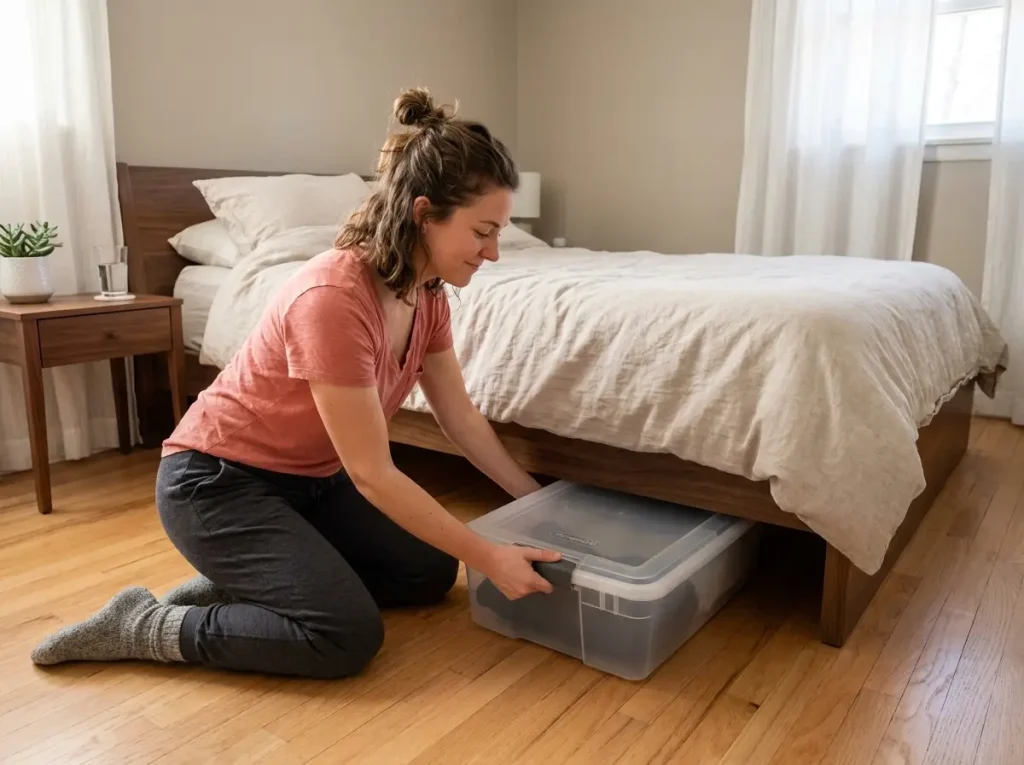
You found the perfect under-bed storage containers, brought them home, slid the first one toward the frame — and it stopped cold at the edge. That specific frustration is the most common under-bed storage failure there is, and it’s completely preventable. I’ve watched it happen to well-intentioned organizers a dozen times because the entire under-bed storage market is built around a measurement most articles never tell you to take. This guide starts with that measurement, then matches every decision to what your specific bed actually has.
Before buying any container, measure your clearance. Then use this table to match container type to your number.
| Bed Type | Typical Clearance | Container Type That Fits |
|---|---|---|
| Platform bed, solid slab base | 4–7 in | Flat hard-sided container, 4.5 in height max |
| Platform bed with small legs | 6–10 in | Standard under-bed chest, 6.5 in height |
| Metal tube frame or box spring | 7–13 in | Most bins, fabric bags, wheeled chests |
| Any bed frame with risers added | Clearance + 3–8 in | Recalculate after installing risers |
The Measurement Step That Changes Everything
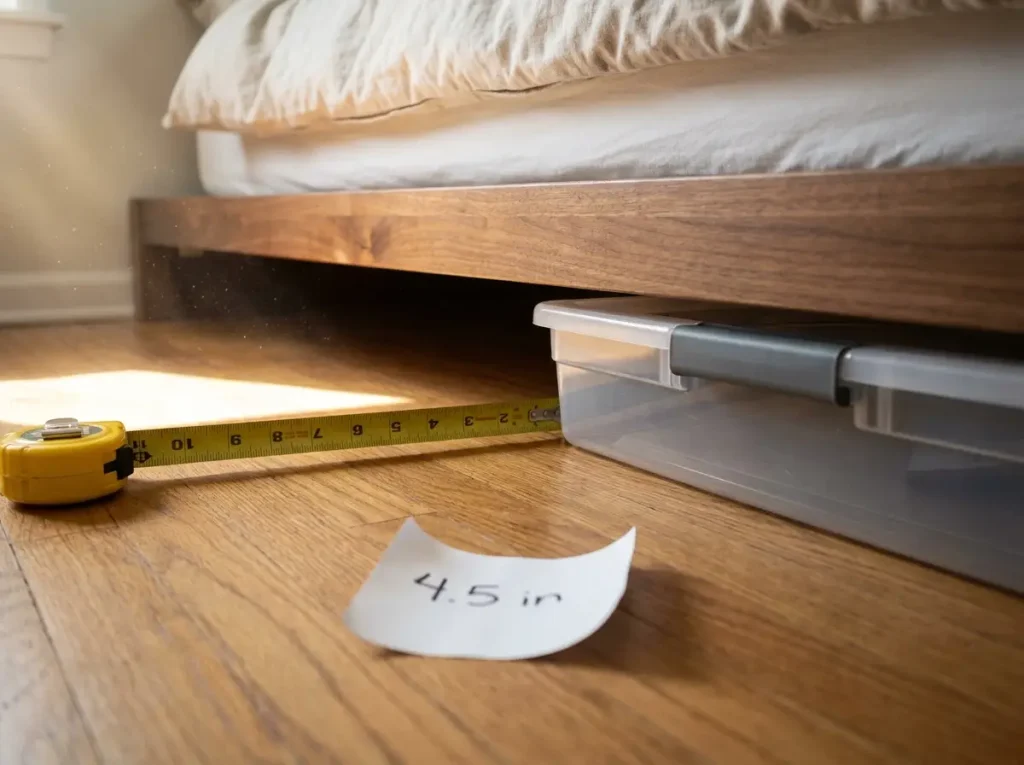
Most under-bed storage containers on the market are 6 to 6.5 inches tall. Most platform beds have 4 to 7 inches of clearance. If you pick the most-reviewed container on Amazon without measuring first, there is a reasonable chance you are returning it within a week — and the return is not your fault. It is a product category that solved the wrong problem.
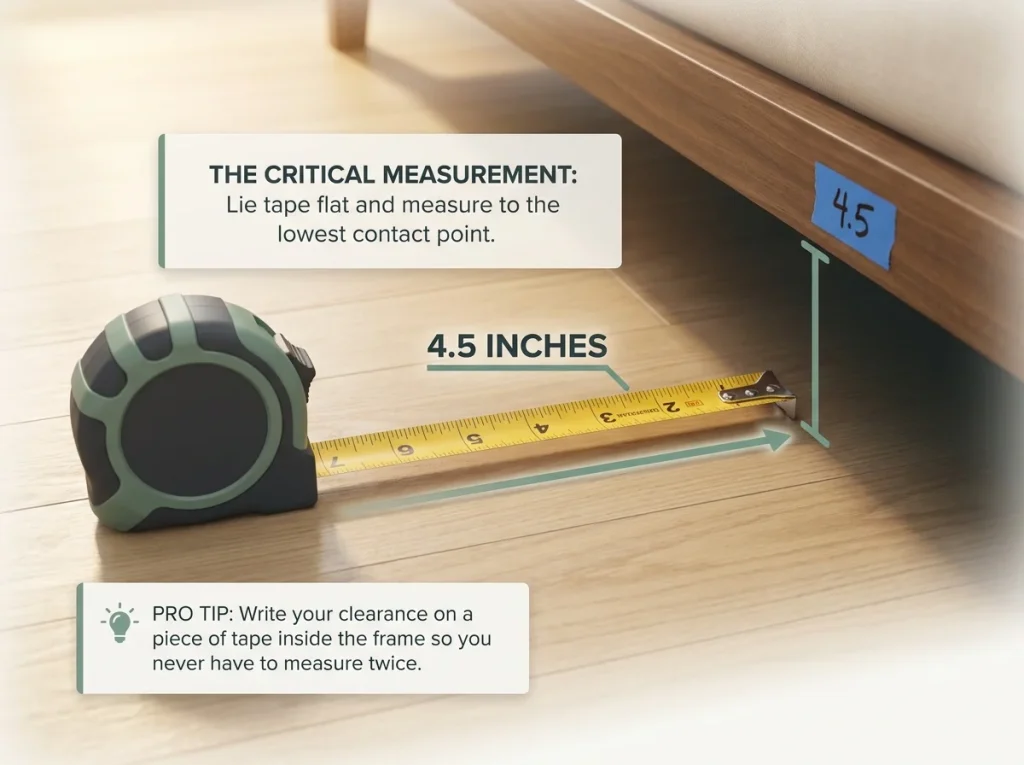
Here’s how to measure in thirty seconds. Lie a tape measure flat on the floor and push it toward the bed until it touches the underside of the base or frame. The reading at the point of contact is your usable clearance. That single number determines every product decision in this article.
Platform beds with a solid base typically give you 4 to 7 inches. Beds on a traditional metal tube frame run 7 to 13 inches. Box springs with separate frames usually land in the middle. If your clearance is under 4 inches, the riser section below is where you should go first.
Pro tip: Write your clearance measurement in permanent marker on a strip of tape and stick it to the inside of the bed frame near the floor. You will want that number again when you buy a second container, and you will not want to crawl under there to measure again.
Platform Bed Storage: What Actually Fits at 4–7 Inches
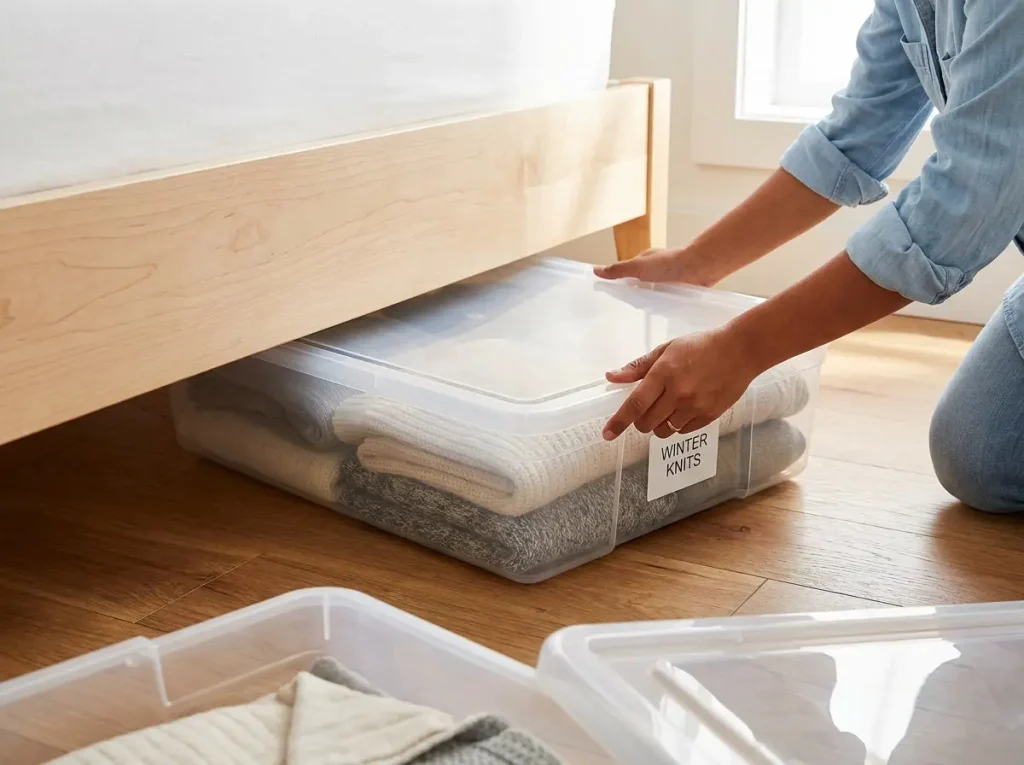
The platform bed is where the under-bed storage market fails people most consistently. The solid base looks good and avoids the box-spring expense, but it also cuts clearance in a way that leg-based frames do not. If your platform sits 5 inches off the ground, a standard 6.5-inch container will not slide under it. It will stop at the edge while you try to figure out what you are doing wrong. You are not doing anything wrong.
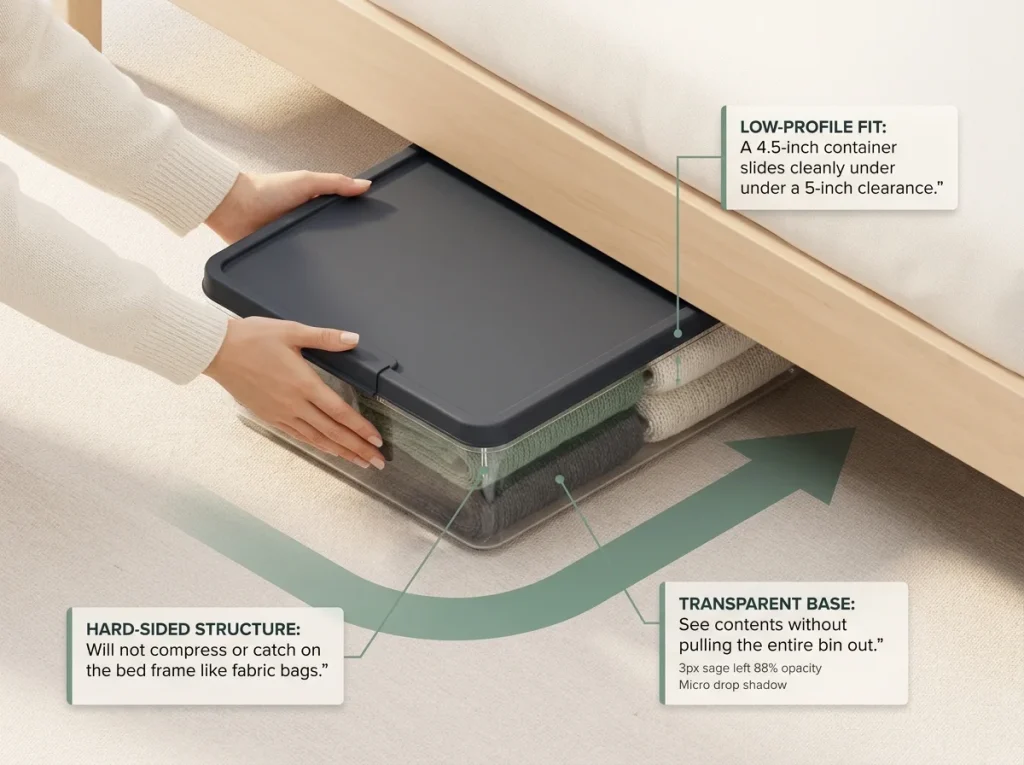
The container designed for exactly this constraint is the storageLAB Under Bed Storage Container with Lid. At 4.5 inches tall — about an inch and a half shorter than most competitors — it fits under platform beds with as little as 5 inches of clearance. The 33-inch width holds a full season of folded clothing or a complete set of extra sheets and pillowcases. The transparent polypropylene shell means you can see what is inside without pulling the whole thing out. One honest limitation: it is hard-sided, so it will not flex or compress at all. If your clearance is exactly 4.5 to 5 inches, verify with a tape measure before ordering — you need at least a half-inch of margin to slide it cleanly without catching on the floor or the base rail.
If your platform bed has clearance closer to 7 inches — common in platforms that sit on small feet rather than a solid slab — the IRIS USA Under Bed Chest with Casters adds one feature that matters more in practice than it sounds: a pull-out front drawer. At 6.5 inches tall, you need at least 7 inches of clearance to slide it in. Once it is in, you access it by opening the drawer without moving the whole container. If your bed is against a wall, that distinction matters every single time you want to check what’s in it.
Pro tip: If you have a solid-base platform bed and want to cover the full width, get two containers rather than one larger one. Two 33-inch containers side by side cover a standard queen and are far easier to pull out than a single 66-inch unit would be — if one even existed.
Metal Frames and Box Springs: Storage at 7–13 Inches
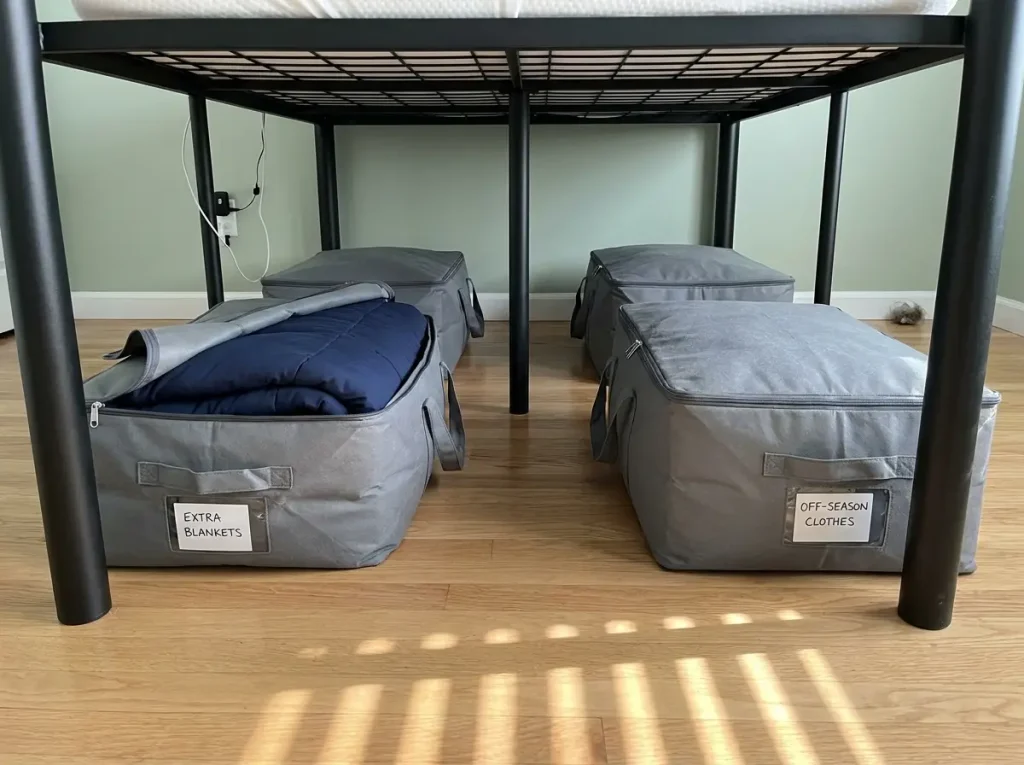
A metal tube frame is generous with storage space. Seven to thirteen inches of clearance means nearly every under-bed product on the market fits easily, and if you have 12 inches or more, you can run two rows of containers and access the back row from the foot of the bed.
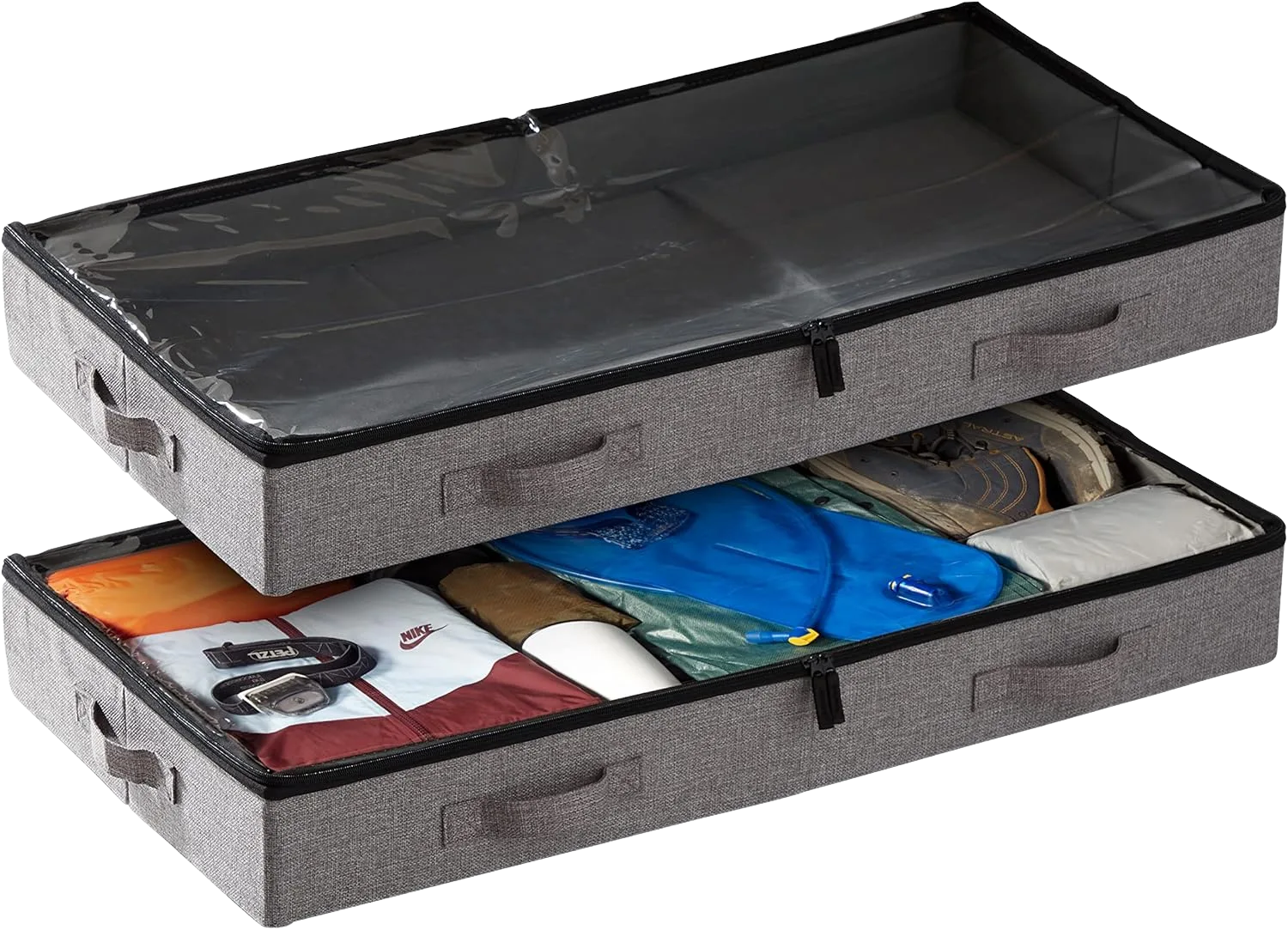
The extra clearance is where fabric storage makes sense. The Amazon Basics Collapsible Fabric Storage Bag — 18 by 42 inches with a 6-inch profile — collapses flat when empty, which makes it particularly good for seasonal rotation. In summer, the winter comforter goes in the bag and under the bed; in winter, the process reverses. The zipper closure keeps dust out better than drawstring or open-top fabric bags. Its honest limitation: no structure. Do not stack heavy boxes on top of fabric bags, and do not pack them so full they bow out on the sides — they will not slide as cleanly.
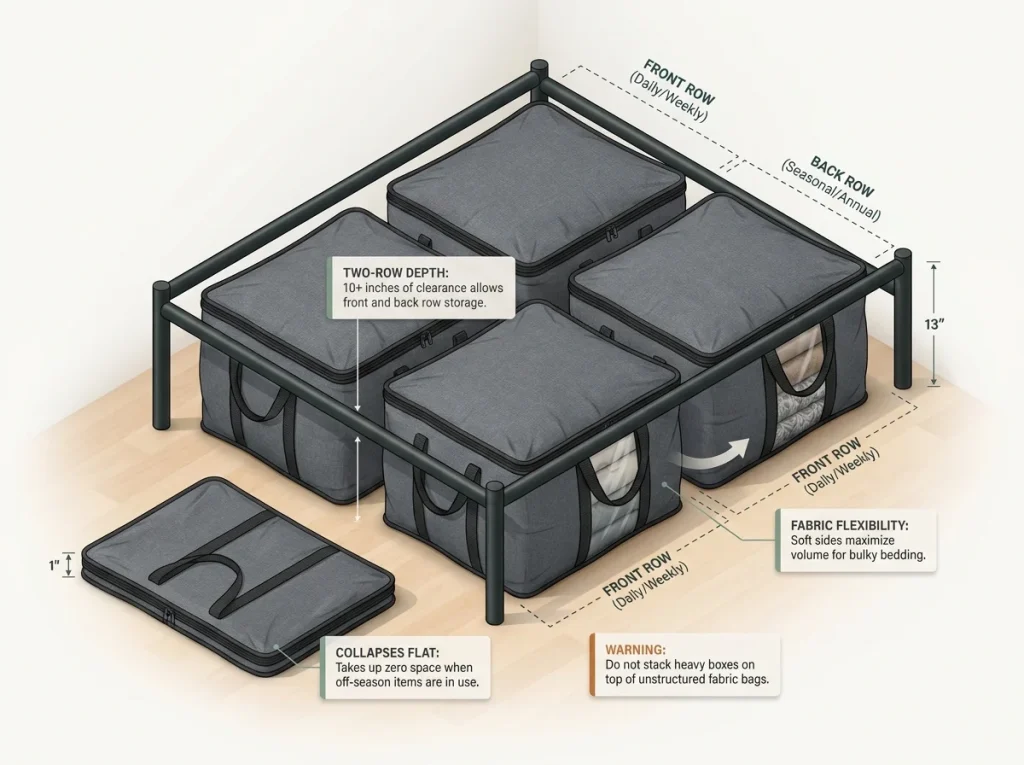
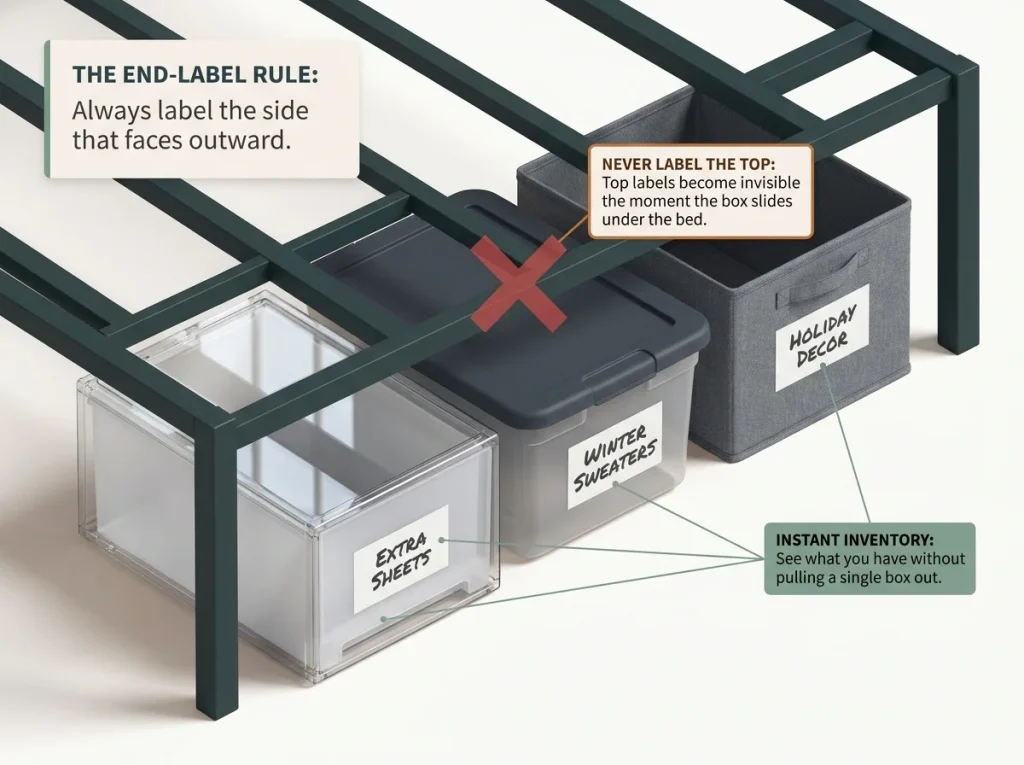
With 10 or more inches of clearance under a metal frame, two-row storage works well. The front row should hold items you access a few times a season — extra bedding sets, spare blankets. The back row is for items that come out once a year: holiday bedding, off-season clothing you are done with for the next six months. Label both rows on the end that faces you when you pull them out, not on top where you will not see it without lifting the lid.
Bed Risers: The Renter Fix That Adds Up to 8 Inches of Clearance
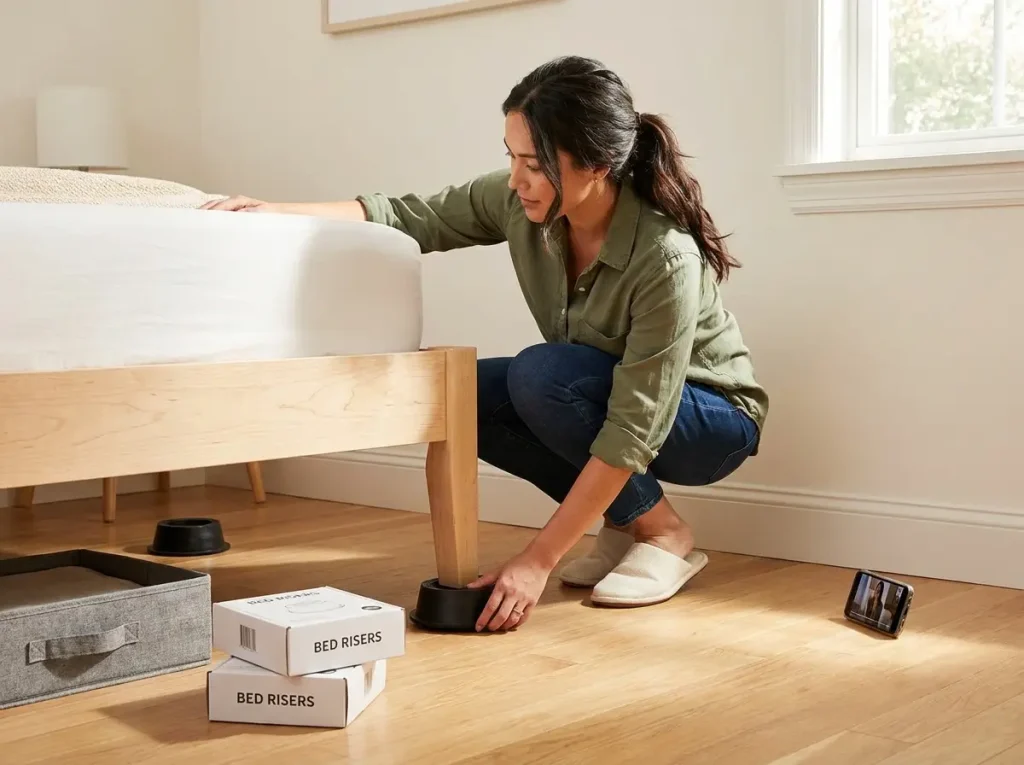
If your bed has a clearance problem, you do not have to live with it. Bed risers are cups — usually plastic or rubber — that sit under the existing legs of your bed frame and raise the whole frame by 3 to 8 inches. No tools, no wall modifications, no lease violations. They come out the same way they went in.
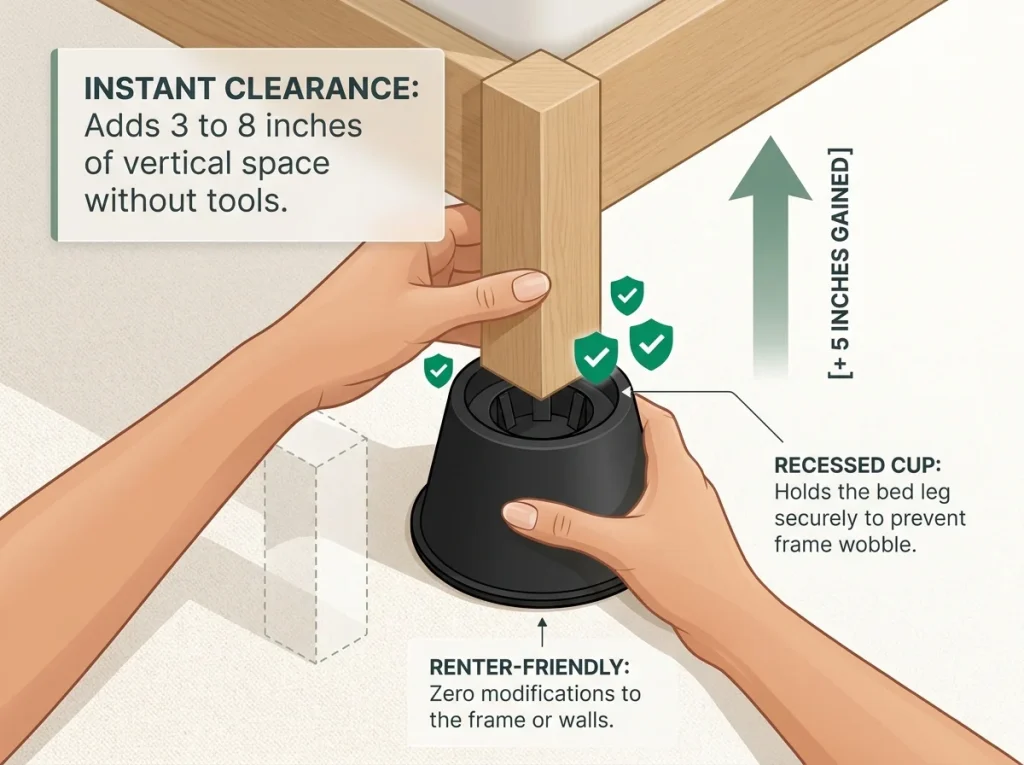
Before buying, measure your current clearance and identify a riser height that brings your total to at least 7 inches. That threshold opens up nearly every standard under-bed container. Most heavy-duty bed riser sets come in 3-inch and 5-inch variants with multiple cup sizes to fit different leg diameters. If your platform sits at 5 inches, a set of 3-inch risers gets you to 8 — enough for the IRIS USA chest, the Amazon Basics bags, or most wheeled containers.
After installing risers, do a stability check before loading anything under the bed: push the frame side to side and check for wobble. If the cups are properly sized for your leg diameter and sitting flat on the floor, the frame will feel solid. If there is movement, check that the cup mouth is fully seated around the leg — a cup that is too large will rock. Also check the weight rating for the set: for a queen mattress and two adults, 1,000 pounds per set is a reasonable minimum, and most heavy-duty sets clear that comfortably.
One limitation worth naming: risers only work on frames that have individual legs. A solid-slab platform bed that rests on a continuous structural rail around the perimeter has no legs for the cups to grip. If that describes your bed, risers are not an option without a different bed frame.
What to Store Under Your Bed (and What to Move Elsewhere)
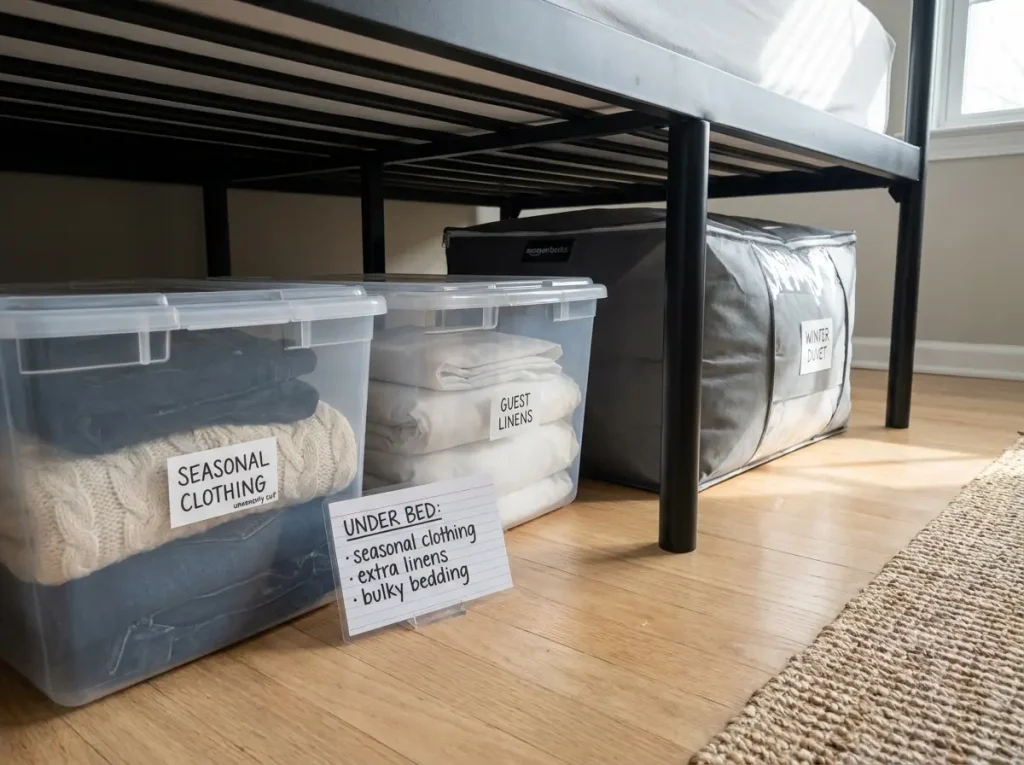
The space under your bed has three natural advantages: it is consistently dry, protected from light, and stays at a stable room temperature. That makes it well-suited for seasonal clothing, extra bedding, books, spare linens, and items you rotate a few times a year. It is not suited for everything.
For bulky seasonal items, vacuum storage bags compress volume by up to 80 percent. A down comforter that normally needs its own container compresses to a package a few inches thick, clearing room for a second container in the same space. One critical caveat that most vacuum bag listings do not make prominent enough: compression permanently damages the loft structure of natural-fill items. Down, wool, and cashmere should never go into vacuum storage bags. The compression collapses the fibers in ways they do not fully recover from, and you will pull out a flat, clumped version of the sweater or duvet you stored. For synthetic fills and cotton or polyester clothing, vacuum bags work without issue.
What does not belong under the bed at all: food of any kind, electronics (poor airflow, heat accumulates), anything that went in slightly damp (gym gear, towels, anything from outdoor storage). These attract pests and promote mold growth in a space you will not notice until the problem is already established.
For the full framework on which items to keep accessible versus store deep — and how to set up zones that hold up past the first month — the guide to setting up under-bed storage that stays organized covers the complete system.
Pro tip: Whatever goes under the bed should be labeled on the end that faces outward, not on the top. You will never see a top label without pulling the container completely out. End labels are visible the moment you look under the bed.
The Quarterly Reset: Keeping Under-Bed Storage Working
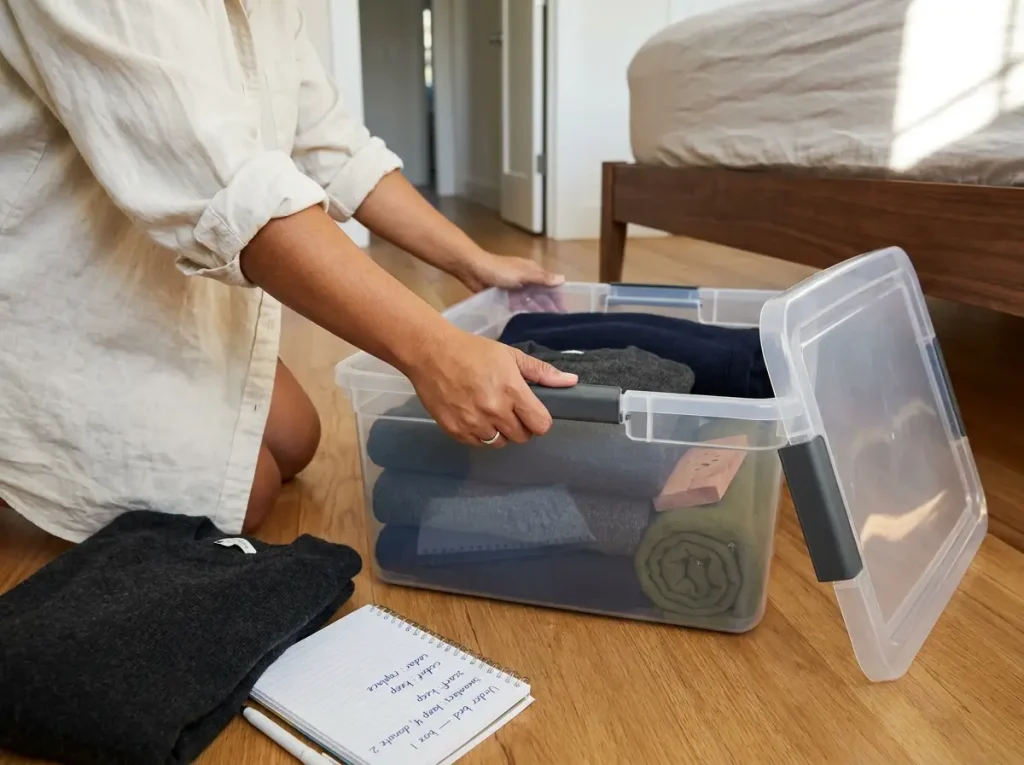
Here is what actually happens with under-bed storage after the initial setup: the system works well for the first six to eight weeks. Then someone slides something under the bed without a label. Then a box gets tucked in “just temporarily.” By month three, you have a mixed pile of unidentified items and the system has quietly collapsed while looking fine from the outside.
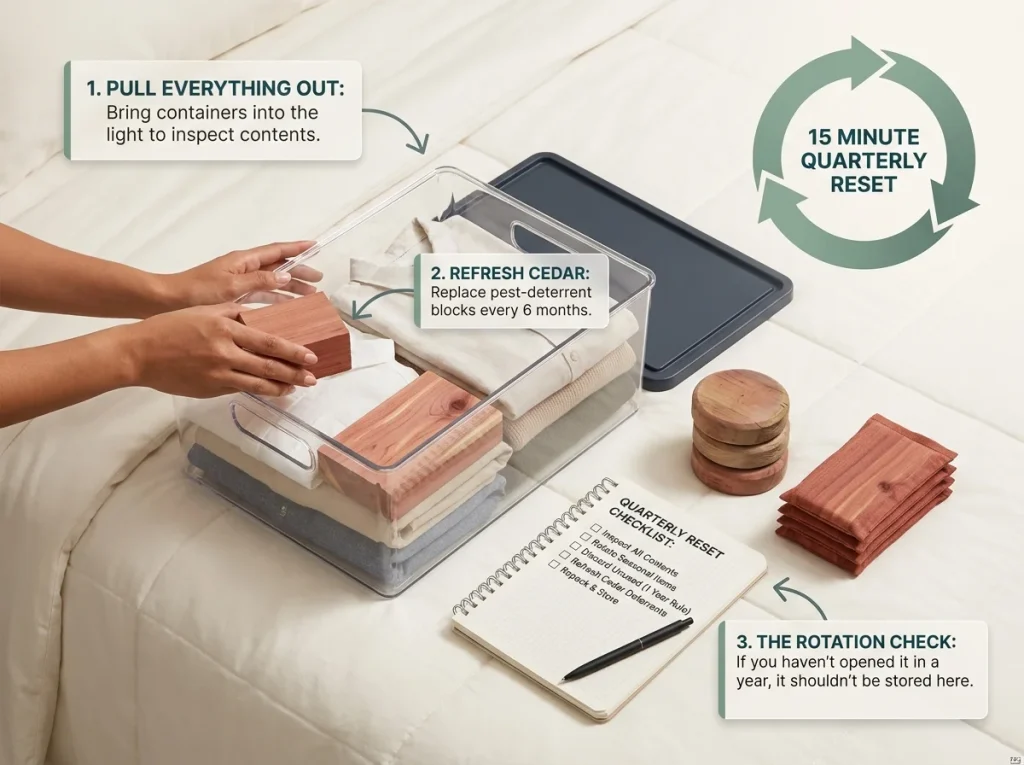
The quarterly reset takes fifteen minutes and prevents this from happening. Professional organizers — including those certified by the National Association of Productivity and Organizing Professionals — consistently point out that maintenance systems, not initial setups, determine whether storage stays functional past the first month. Pull everything out. Put it on the bed or floor in front of you. Check that every container still has a readable label. Remove anything that does not belong in under-bed storage — it should have a designated home elsewhere, and “temporarily under the bed” has a way of becoming permanent. Check for any signs of moisture or pests inside the containers. Then rotate: what you will need in the coming season goes in the accessible front row, what you will not touch for three months goes to the back.
If you are storing wool or linen items, check your cedar sachets while you are in there. Cedar is effective at deterring pests for roughly six months, after which it is just a decorative block. Fresh sachets are inexpensive and swapping them takes ten seconds.
The quarterly reset is also the moment to ask whether the system is actually working for you. If a container has not been opened since you put it in, you are not rotating — you are storing. Under-bed storage works best as active seasonal rotation, not as a permanent archive. Items you have not touched in over a year are worth reconsidering before the next reset.
What to Take From This
Measure your clearance before buying anything. That one step prevents the single most common under-bed storage failure — containers that do not fit — and it takes thirty seconds. Once you have your number, match container height to your specific frame type, and if your clearance is under 7 inches and you want more options, risers are a renter-friendly path to getting there.
Your three-month check: pull out one container, confirm you know what is in it and still need what is there, replace any cedar sachets past their effective window, and relabel anything that has drifted. If a container has not been opened since you stored it, decide whether its contents need to stay.
Start with the measurement. Write it down somewhere you will find it. Everything after that follows from that number.
Q1 How do I measure clearance under my bed?
Lay a tape measure flat on the floor and push it toward the bed until the blade touches the underside of the frame or base. The measurement at that contact point is your usable clearance. For most accurate results, measure in the center of the bed where clearance is often slightly lower than at the sides.
Q2 What is the best under-bed storage for platform beds?
For platform beds with solid bases and 4 to 7 inches of clearance, flat hard-sided containers around 4.5 inches tall are the right choice — they are the only category designed for that specific constraint. Standard under-bed chests (6.5 inches tall) require 7 or more inches and will not fit most solid-base platforms.
Q3 Can bed risers hold a heavy mattress safely?
Yes, if you choose a set with an appropriate weight rating. For a queen or king mattress with two adults, look for a set rated at 1,000 pounds or more total. After installation, push the frame from multiple angles — if it wobbles, check that the cup size matches your leg diameter. Most heavy-duty riser sets include multiple cup sizes to accommodate different frame legs.
Q4 Should I use vacuum storage bags under my bed?
For synthetic-fill items and cotton or polyester clothing, yes — vacuum bags are an efficient use of under-bed space. For down, wool, or cashmere, no. Compression permanently damages the loft structure of natural fibers, and the item will not fully recover its original feel or warmth. Store natural-fill items in breathable fabric bags or hard-sided containers instead.
Q5 How often should I go through under-bed storage?
Four times a year — once per season — is the interval that keeps under-bed storage functional rather than becoming invisible long-term storage. Each session takes about fifteen minutes: pull everything out, check labels, rotate for the coming season, and remove items that have been untouched for more than a year.
Disclaimer: ClutterlessNest is a participant in the Amazon Services LLC Associates Program. As an Amazon Associate we earn from qualifying purchases. This article may contain affiliate links — if you buy through them, we may earn a small commission at no extra cost to you. We only recommend products we have tested or genuinely believe in.