You come home, flip on the light, and step directly into a pile of shoes that three different people left on the floor — right next to the perfectly empty shoe rack six inches away. That’s not a storage problem. That’s a placement and friction problem, and buying another organizer won’t fix it until you address what’s actually going wrong.
I’ve organized dozens of real entryways in apartments, condos, and small homes, and the same pattern shows up every time: the storage is fine, but the system around it is broken. This guide covers how to measure your space first, the six main shoe storage approaches that work in real entryways, and the one behavioral fix that determines whether any of them last past the first week.
Quick Answer: The best way to organize shoes at your entryway depends on your space and habits:
- Measure walkway clearance first — subtract 36 inches from your hallway width to find your maximum furniture depth
- Start with a boot tray where shoes actually come off — it costs almost nothing and proves whether you’ll maintain a system
- Freestanding shoe racks fit tight spaces without installation or deposit risk
- Cubby benches solve the balance problem and store 10+ pairs underneath the seat
- Over-the-door organizers work on solid-core closet doors — never on hollow-core apartment front doors
- Keep only 2-3 pairs per person at the entry and rotate seasonal shoes to the closet
Measure Your Entryway Before You Buy Anything
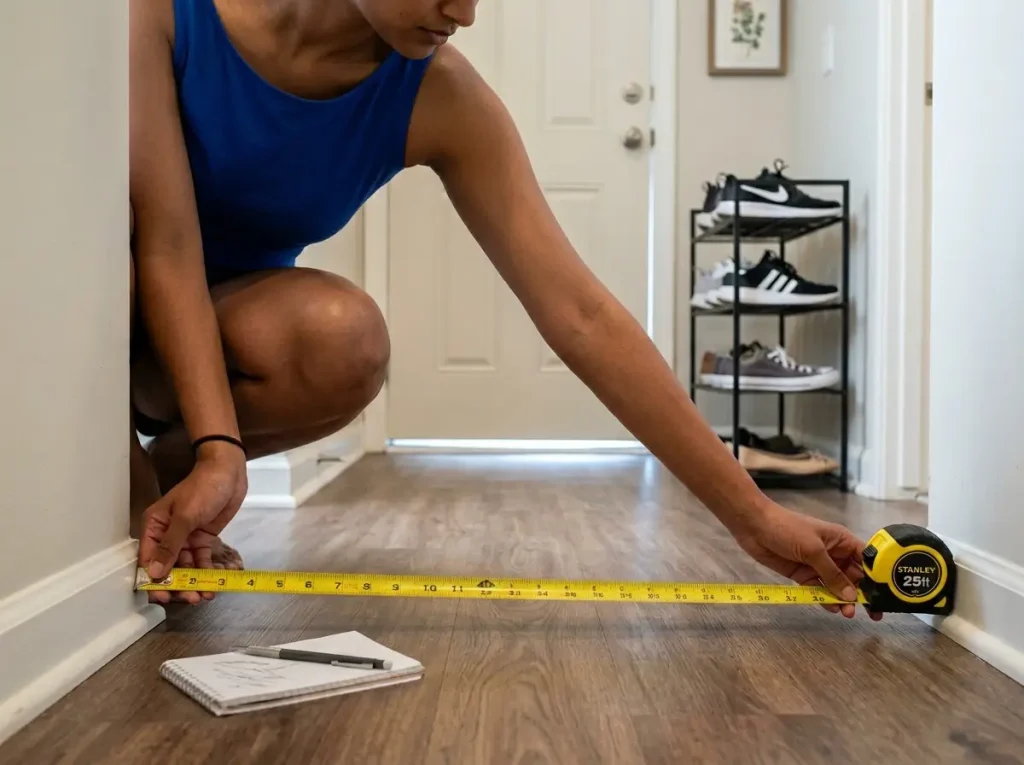
Every entryway shoe system failure I’ve seen starts the same way: someone buys a shoe rack that looked perfect in the product photos, brings it home, and discovers it turns the hallway into an obstacle course. The rack wasn’t wrong. They just didn’t measure first.
The 36-Inch Walkway Rule
Your hallway needs a minimum of 36 inches of clear walking space for comfortable movement. That number comes from standard passageway clearance guidelines — anything narrower and people start turning sideways to get by, which means they’ll resent whatever furniture is causing the squeeze.
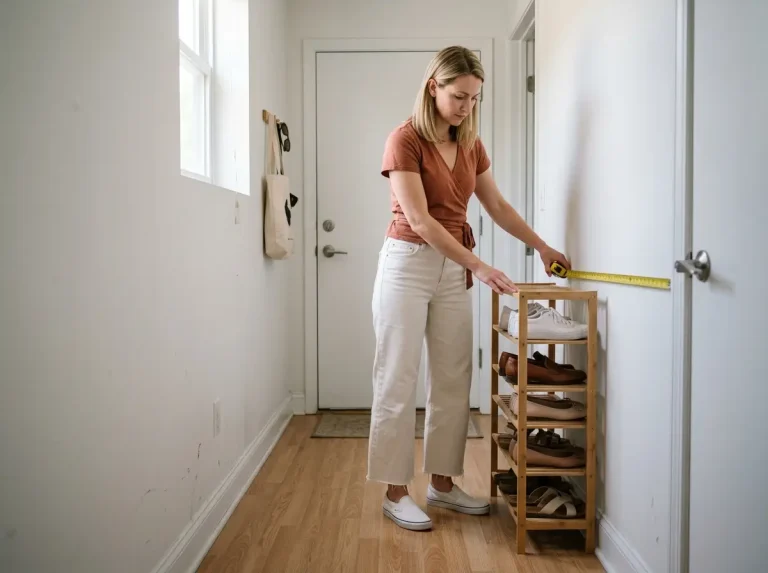
Here’s the formula: measure your hallway wall-to-wall, then subtract 36 inches. Whatever’s left is the maximum depth of any shoe furniture you can place there. A 48-inch-wide hallway gives you 12 inches of furniture depth. A 54-inch hallway gives you 18 inches. A 42-inch hallway — common in older apartments — gives you only 6 inches. That’s barely enough for a boot tray, let alone a shoe rack.
Pro tip: Do this measurement at your front door AND at the narrowest point of your hallway. The narrowest point is the bottleneck that determines what fits — not the wider area right at the door.
Finding Your Maximum Furniture Depth
The sweet spot for entryway shoe furniture is 10 to 14 inches deep. Shallower than 10 inches and adult shoes hang off the edge. Deeper than 14 inches and the furniture starts to feel like a roadblock, even in wider hallways. If your clearance math gives you less than 10 inches of usable depth, you’re looking at wall-mounted solutions, over-the-door organizers, or a simple boot tray — freestanding furniture won’t work in your space.
Height matters too. Shoe storage below waist height (34 to 36 inches) gets used because it’s within arm’s reach without bending or crouching. Anything taller becomes a display shelf by month two — you’ll use the lower tiers and ignore the top ones.
This same depth rule applies to benches too. If you’re thinking about choosing a bench that actually fits your hallway, most run 11 to 14 inches deep, which means they need a hallway at least 47 inches wide.
Locating the Drop Zone
Here’s the part everyone gets wrong: your shoe storage needs to sit at the exact spot where shoes come off. Not two feet to the left where it looks better. Not across the hallway near the console table. Right where your shoes actually land when you walk in the door.
Watch your household for three days. Where do shoes pile up? That pile is your drop zone, and your storage goes there. I’ve watched this pattern in every single entryway where the furniture was placed for appearance instead of behavior — the pile always forms where shoes come off, not where the rack sits. If the storage is more than one step away from where shoes naturally land, it won’t get used. Placement beats product every time.
This clearance-first approach applies to everything in your entryway, not just shoes. If you’re building a complete entryway organization system, start with the tape measure before the shopping cart.
Start With a Boot Tray (The Zero-Commitment Zone)
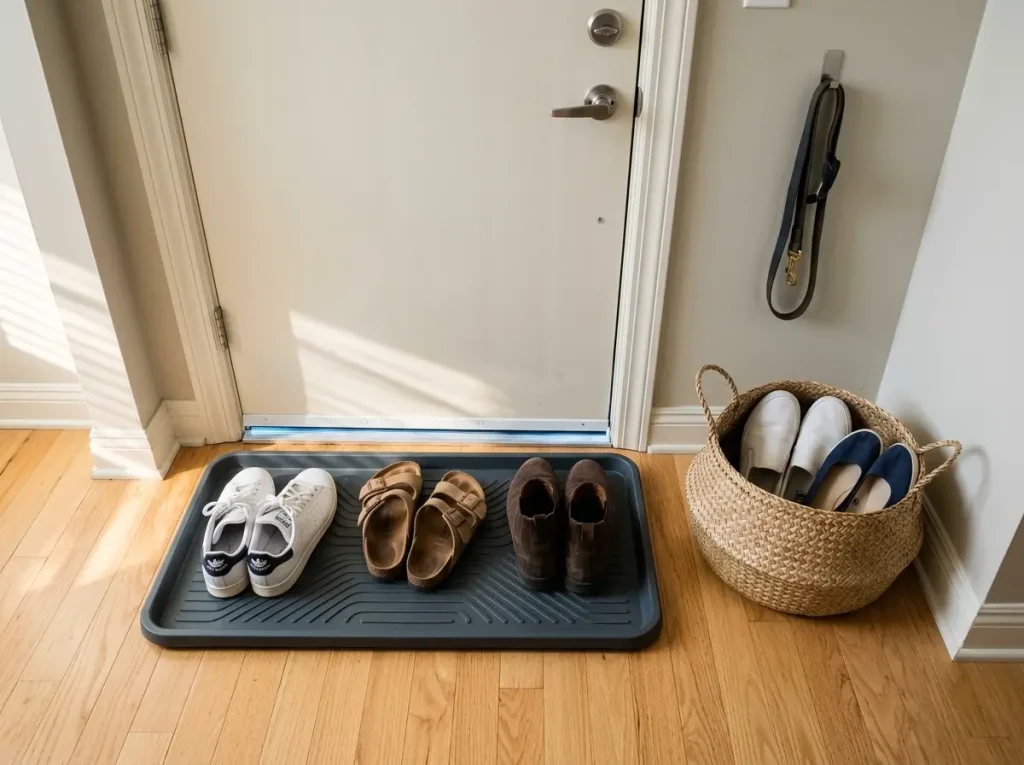
Before you spend money on furniture, try a boot tray for a week. Place it exactly where shoes tend to pile up. If your household uses it consistently, you’ve confirmed two things: the right location for storage and proof that the habit will stick. If nobody uses it, the problem isn’t storage — it’s habit, and no amount of furniture will change that.
How to Use a Boot Tray (Beyond the Obvious)
A boot tray catches mud, snow, and water before they hit your floor. But it also works as a spatial anchor — a defined zone that trains your household to put shoes in one place instead of scattering them across the entryway. Small trays (roughly 13 by 10 inches) hold two pairs. Larger trays (28 to 34 inches wide) hold four or five pairs and cover enough ground to catch the mess from winter boots.
The SUPENUIN Boot Tray handles this well for one or two people — rubber construction, catches water, rinses clean in 30 seconds. It’s the “pilot test” product: confirm the right location before buying any furniture. For families or households with more daily shoe traffic, the Matace Rubber Boot Tray runs 27.95 by 15.74 inches and holds four to five pairs with room for boots. Neither costs much, both move with you on lease day.
Baskets and Open Bins as Flexible Storage
A woven basket or open bin next to the boot tray adds overflow capacity without any installation. The goal isn’t perfect organization — it’s corralling. A seagrass basket near the door holds four to six pairs and reads as intentional decor rather than mess. Fabric bins work the same way and can slide under a console table when not in use.
Pro tip: Use the basket for shoes that rotate daily and the tray for whatever pair you’re currently wearing. The basket is a corral, not a closet — nothing should live in there permanently.
When This Is Enough (and When It Isn’t)
For one- or two-person households, a boot tray and a basket might be the whole system. I’ve set up entryways that stayed functional for over a year with nothing else — just a tray, a basket, and the habit to use them. No furniture, no installation, no regrets when the lease ended.
You need to upgrade when shoes consistently overflow both containers, when boots won’t stand upright on the tray, or when three or more people share the entryway and daily rotation outpaces the storage. Check out the full range of small entryway storage ideas if you’ve outgrown the tray-and-basket setup.
Freestanding Shoe Racks (Compact, No-Installation Required)
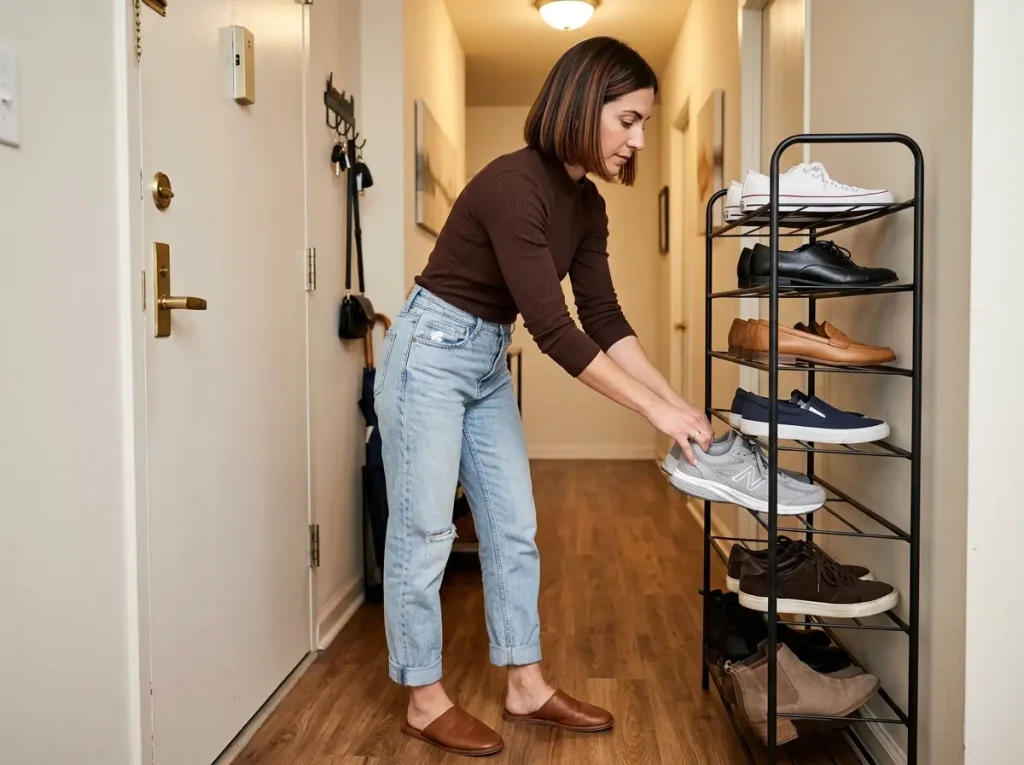
Freestanding shoe racks are the workhorses of small entryway organization. No anchoring, no tools, no deposit risk. The real decision isn’t which rack looks best — it’s finding one narrow enough to fit without eating your walkway clearance.
How to Size a Freestanding Rack for Your Space
Width matters more than capacity. A rack that holds 24 pairs but takes up 30 inches of wall space won’t work in a hallway that only has 18 inches to spare. Look for narrow shoe racks in the 12- to 18-inch width range — these fit beside front doors, in hallway corners, and alongside console tables without stealing walkway space.
The SONGMICS 8-Tier Narrow Shoe Rack measures 12 inches deep by 17.6 inches wide by 50.6 inches tall — it holds 16 to 24 pairs in less than 18 inches of wall space. That’s narrow enough to fit in the dead zone beside most door frames, the gap between the door and the adjacent wall that most people forget exists. The open wire shelves don’t trap dust the way solid shelves do, though they also won’t contain dripping wet boots — pair it with a boot tray for that.
Tier Spacing and What It Actually Holds
Standard tier spacing on most shoe racks runs 5 to 6 inches per shelf. That’s enough for flats, sneakers, low sandals, and canvas shoes. It is not enough for ankle boots — the shaft bends, deforms, and eventually the boots slide off the shelf entirely.
Ankle boots need at least 10 inches of tier clearance. Knee-high boots need 14 inches or more. If you own boots and a standard shoe rack, you’ll discover this problem the first week — the boots won’t fit upright, so they end up on the floor next to the rack, which defeats the entire point. Look for racks with adjustable tiers, or plan to lay boots on their sides on the lowest shelf with the shaft supported against the wall.
If you want to compare racks against other entryway organizer options matched to your space, the dimension check is the same for all of them: match the width to your available wall space first, capacity second.
When Racks Work Best (and Their Limits)
Freestanding racks work best in one- to three-person households with daily rotation shoes. They’re completely renter-friendly — no holes, no hardware, pick it up and move it on lease day. The trade-off is visibility: shoes are fully exposed. If that bothers you, an enclosed cabinet is the next step up. But for most people, a visible rack that gets used every day beats a cabinet with a door that adds friction and eventually gets ignored.
Shoe Storage Benches (Sit Down, Put Your Shoes On, Done)
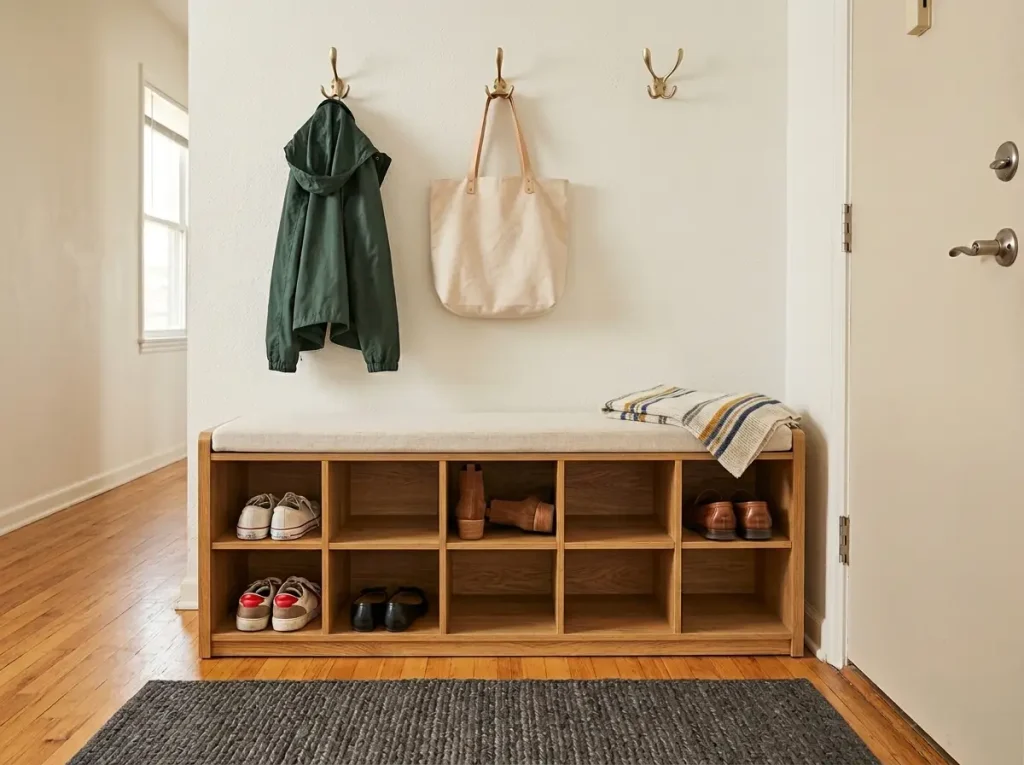
The real reason entryway shoe systems fail isn’t storage — it’s balance. People stand on one foot, hop around, and toss shoes wherever because taking them off while standing is awkward. A shoe storage bench fixes the balance problem first. The storage underneath is secondary.
The Behavioral Case for a Bench
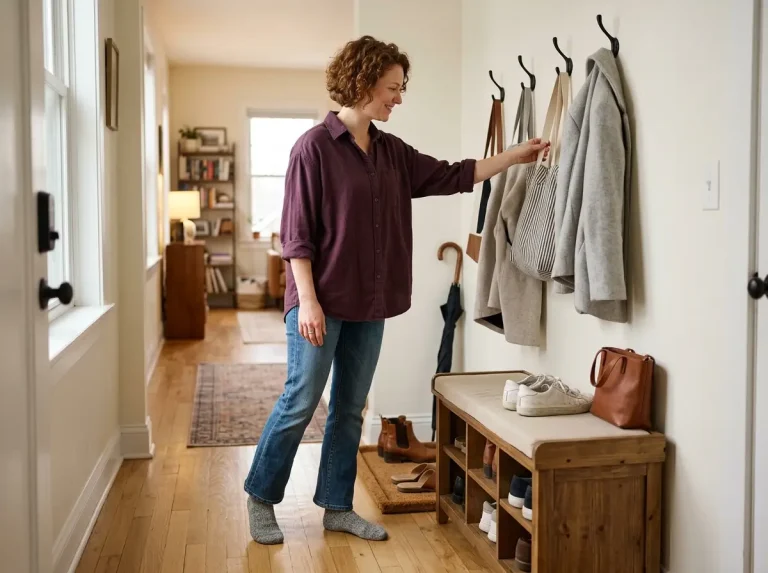
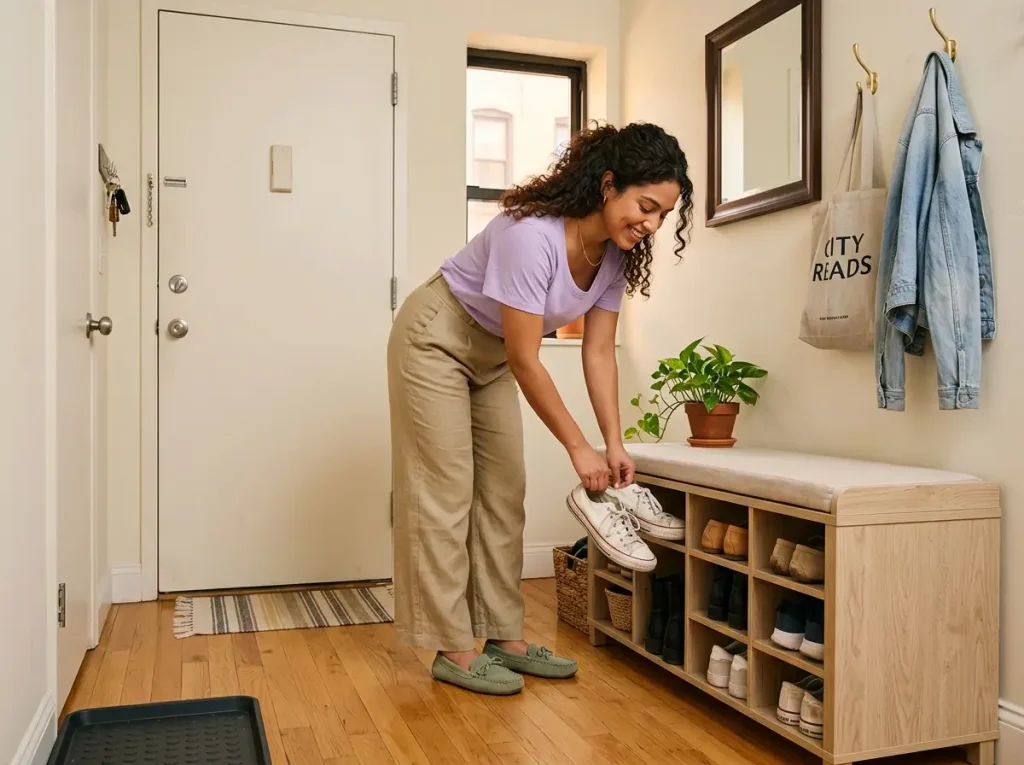
An entryway bench at 18 to 20 inches tall puts your knees at a natural sitting height. You sit down, take off shoes, and the storage is right there below you — zero extra steps. This behavioral shortcut is the reason benches outperform standalone racks in families. Kids sit, shoes go in the cubby. Adults sit, shoes go in the cubby. Nobody is hopping on one foot and flinging a sneaker toward the general vicinity of the storage.
The flip-top bench sounds like the clean solution — shoes hidden under a lid, neat surface on top. In practice, it’s one of the most common entryway storage failures. The lid adds one step (lift, store, close) that daily fatigue wipes out within weeks. People pile shoes on the closed lid instead of lifting it to put them inside. Every single flip-top bench I’ve set up in a family entryway reverted to a shoe platform within a month.
Cubby Benches vs. Flip-Top Benches
Open cubbies win. No lid means no friction. You sit down, slide shoes into a visible open slot, and stand up. Done.
The VASAGLE CUSTOS Shoe Bench has 10 open cubbies and measures 11.8 inches deep by 40.9 inches wide by 18.9 inches tall — under 12 inches deep for narrow hallways, with a padded seat on top. The cubbies hold sneakers facing forward, flats stacked, and ankle boots on their sides. At 11.8 inches deep, this bench fits hallways as narrow as 48 inches while still leaving the 36 inches of clearance you need. Most benches run 14 to 16 inches deep, which limits them to wider entries.
For more detail on matching a bench to your exact hallway clearance, the depth math follows the same formula — measure your hallway, subtract 36 inches, and the remainder is your maximum bench depth.
Sizing the Bench to Your Household
Match bench width to household size. A solo or couple setup needs 32 to 40 inches wide with 6 to 10 cubbies. A family of four needs 40 to 48 inches with 12 to 15 cubbies. Always check weight capacity — the bench needs to support adults sitting on it, and most rate for 250 to 300 pounds.
For households that want to combine coat storage, shoe cubbies, and a bench seat in one unit, the VASAGLE Hall Tree with Bench and Shoe Storage replaces three separate pieces of furniture with a single freestanding frame. The trade-off is footprint: hall trees need more floor space and a wider wall section, so they work best in entryways with room to spare rather than tight apartment hallways.
Shoe Cabinets (Enclosed Storage, Cleaner Look)
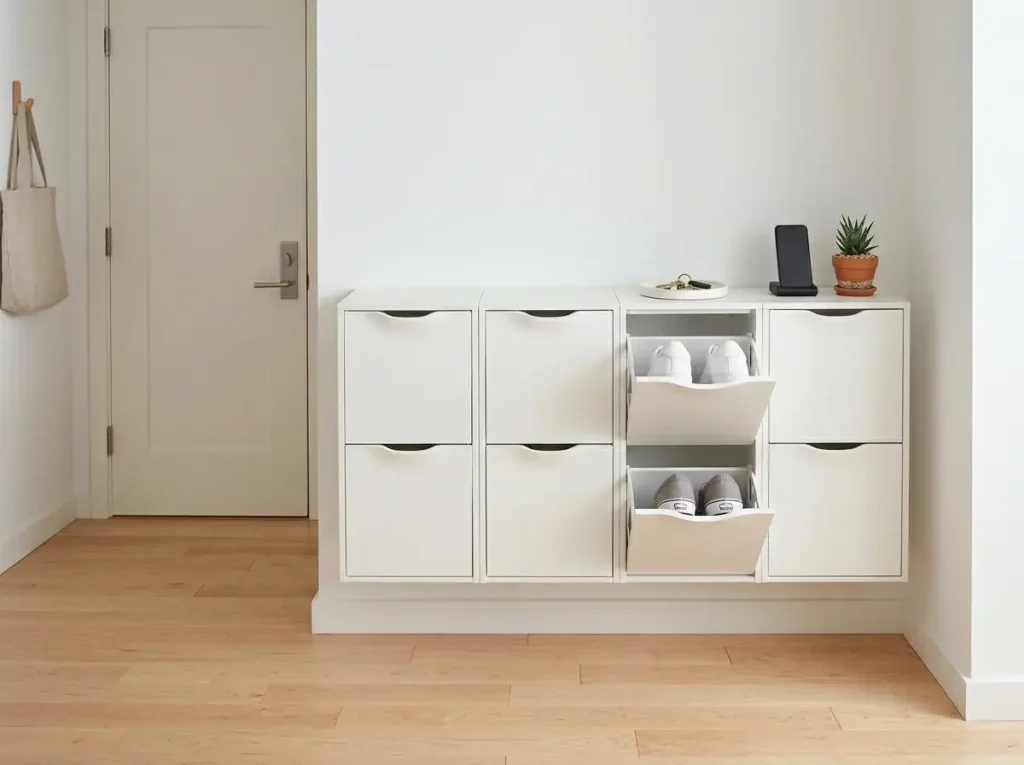
Some people can’t relax when shoes are visible in the entryway. If open racks or cubbies make the space feel cluttered, an enclosed shoe cabinet hides everything behind a door while keeping shoes organized and accessible. The trade-off is friction — you’re adding a door-opening step to every use, and daily fatigue erodes that habit the same way it erodes flip-top bench lids.
The Case for Enclosed Storage
Enclosed shoe cabinets make the most sense in two scenarios: open-floor-plan apartments where the entryway is visible from the living room, and households where the visual noise of shoes on display creates genuine stress. If you don’t fall into either category, an open rack or cubby bench stores the same number of shoes with less friction per use.
The advantage of a cabinet is that the top surface doubles as a narrow console — space for keys, a tray, a small plant. The first time you put shoes in a tilt-out cabinet, the angle feels strange — shoes lean against the inside of the door panel rather than sitting flat. After a few days you stop noticing, but the initial feel is different from what product photos suggest.
What to Look For in a Shoe Cabinet
The shallowest wall-mounted shoe cabinets sit under 8 inches deep and barely project from the wall — but those models tend to be retailer-exclusive and harder to find online. The freestanding tilt-out shoe cabinets in the 12- to 14-inch depth range are the most accessible option. Look for a unit with tilt-out doors (not swinging doors, which block the hallway when open), at least three compartments, and a flat top surface deep enough to function as a console.
Freestanding cabinets have one advantage over wall-mounted models: zero installation. No screws, no anchors, no holes to patch at move-out. The trade-off is depth — freestanding units need 12 to 14 inches of floor depth to stay stable, while wall-mounted options can get away with less because the wall supports the weight.
Pro tip: If you’re deciding between a shoe cabinet and a cubby bench, the bench wins on daily-use friction almost every time. Cabinets look cleaner, but the door adds a step. Pick based on which matters more to your household: visual tidiness or zero-friction access.
For renter-specific entryway solutions that skip the drill entirely, freestanding cabinets are the safest choice — no wall contact, no deposit risk.
Over-the-Door Organizers (The Renter’s Best-Kept Secret)
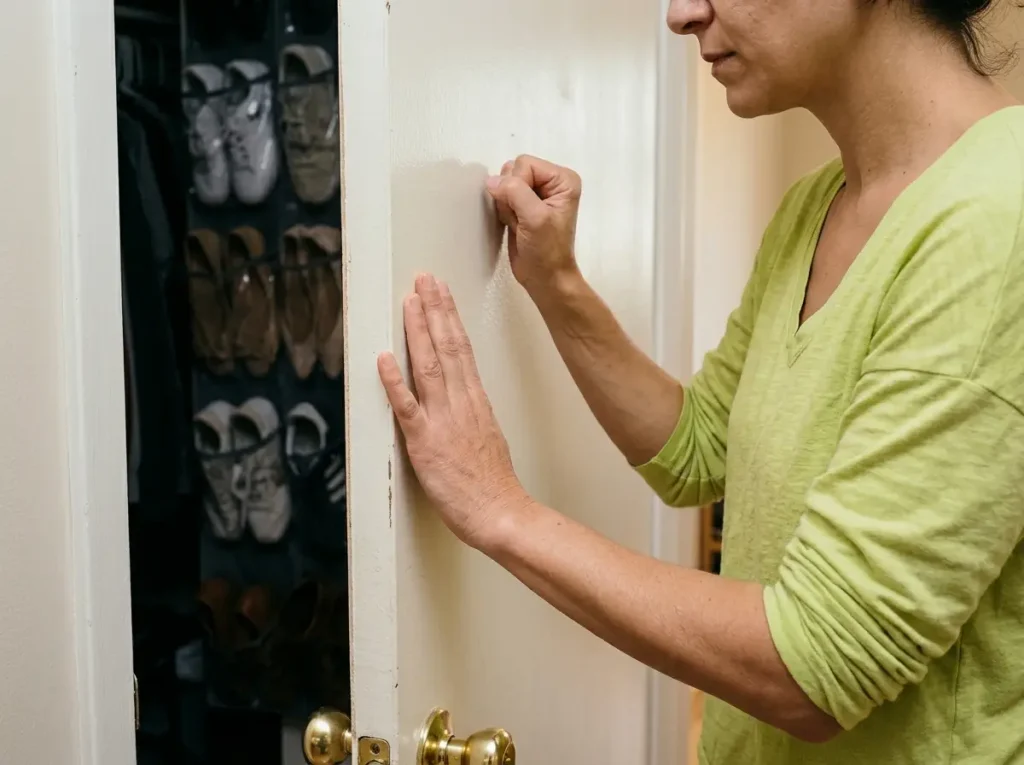
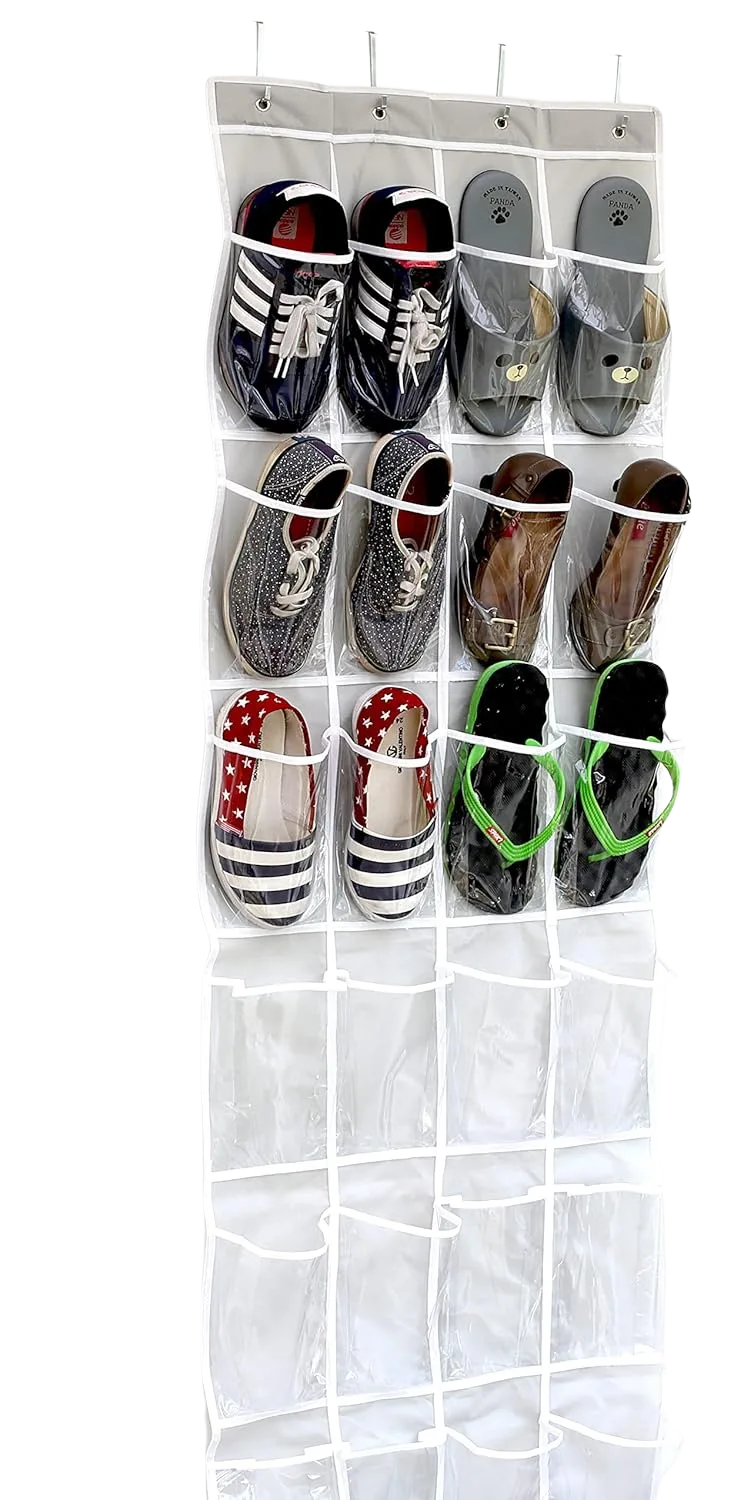
Over-the-door shoe organizers are the most-recommended renter solution. They’re also the one most likely to fail without warning — because nobody talks about the hollow-door problem.
The Hollow Door Warning (Read This Before Buying)
Most apartment front doors are hollow-core — a wood frame with a cardboard honeycomb interior. According to professional organizing standards, matching storage to the structural capacity of your space is a baseline requirement. Here’s what that means for over-the-door organizers: hollow-core doors handle 20 to 30 pounds maximum. A 24-pocket shoe organizer loaded with shoes can weigh 15 to 20 pounds or more. Add the daily stress of opening and closing the door under that load, and the hooks bend or the door frame warps within months.
I’ve seen this play out in apartment after apartment — the organizer goes up, looks great for a few weeks, and then the hooks permanently deform from the swinging weight. Once they bend, they don’t come off cleanly. The fix is simple: don’t hang heavy organizers on your apartment front door.
Use a solid-core closet door near the entryway instead. The tap test takes five seconds — knock on the door surface. A hollow thud means hollow-core. A dense, solid thunk means solid-core. Every closet door I’ve tested in apartments has been solid-core, while most entry doors are not.
Finding the Right Door in Your Apartment
The hall closet door is your primary target — it’s near the entry, typically solid-core, and the back of the door is unused vertical space. A bathroom door near the entrance works as a secondary option. If you have no closet or interior door near the entry at all, this solution doesn’t work for your layout — move to a freestanding rack or boot tray instead of forcing an organizer onto the wrong door.
Wall-Mounted Shoe Shelves (for Owners)
If you own your space, floating wall shelves hold more weight than any over-the-door organizer and don’t stress door hardware at all. A row of two or three shelves at waist height near the front door holds 8 to 12 pairs with zero floor footprint. The shelf brackets leave small holes that are easy to patch if you ever reconfigure. For renters, this isn’t an option without landlord approval — stick with the freestanding or over-door methods and check out the full no-drill toolkit for renters for more deposit-safe options.
Why Shoe Systems Fail (and the Drop Ritual That Fixes It)
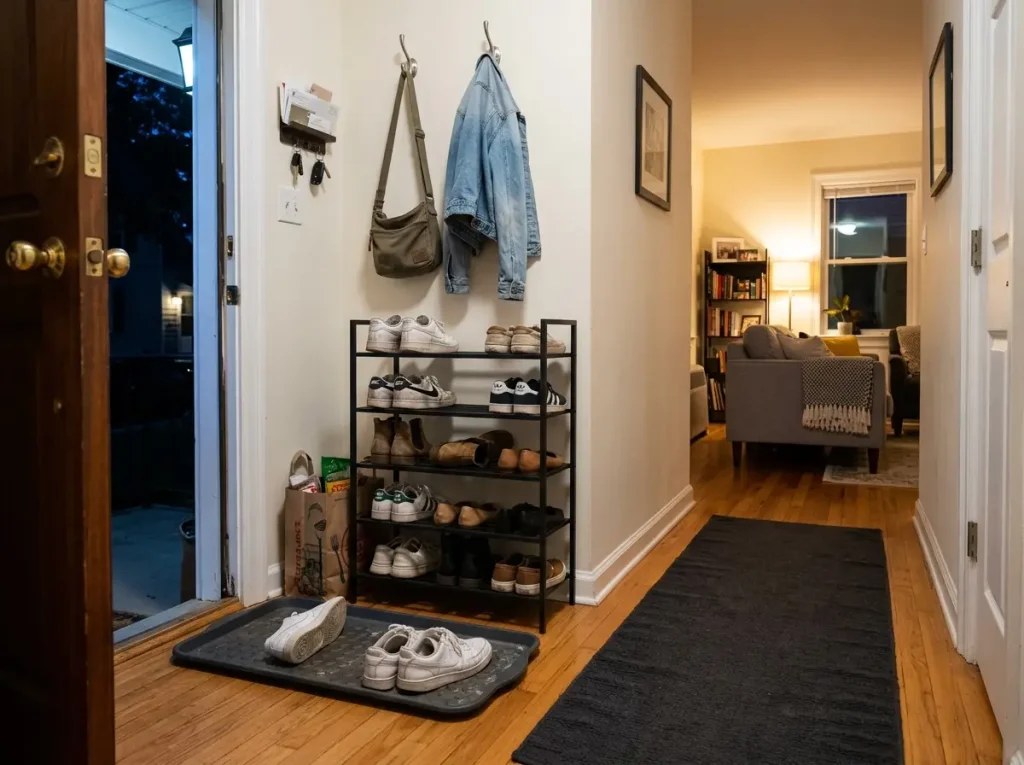
I’ve set up shoe storage in dozens of entryways. I’ve watched all of them fail in the same three ways. The storage wasn’t wrong — the placement was, or the ritual was missing, or the capacity was off. None of this is about finding the right product. It’s about understanding why people drop shoes on the floor instead of using the perfectly good rack six inches away.
The Three Failure Modes
Wrong placement. The shoe rack looked good near the hall table, but shoes come off at the door. The pile forms where shoes actually land, not where the storage is. If your rack is more than one step from the front door, it won’t get used consistently. You’ll know this has happened when the floor between the door and the rack has three pairs sitting on it while the rack has empty slots.
Lid and door friction. Any storage that requires opening something — a flip-top bench, a cabinet door, a lid on a bin — adds one step. One step doesn’t sound like much. But after a long day, after carrying groceries, after wrangling a toddler through the door, that single extra motion is enough for your brain to choose “floor” over “inside.” Open storage always outlasts enclosed storage for daily-use shoes.
Capacity exceeded. You bought storage for the shoes you had, filled it completely on setup day, and overflow resumed within a week. Entryway storage is a symptom management tool — if every shoe you own lives at the door, no rack on earth keeps up. This one feels personal because you did everything right and it still collapsed, but the fix is straightforward.
The Drop Ritual (10 Seconds, Every Time)
The fix is a three-step drop ritual that takes 10 seconds: take shoes off, place them directly into the storage at that spot, confirm the storage is within arm’s reach. If any step takes more than five seconds or requires walking more than one step, the system will revert. This isn’t about discipline — it’s about removing every possible excuse not to use the storage.
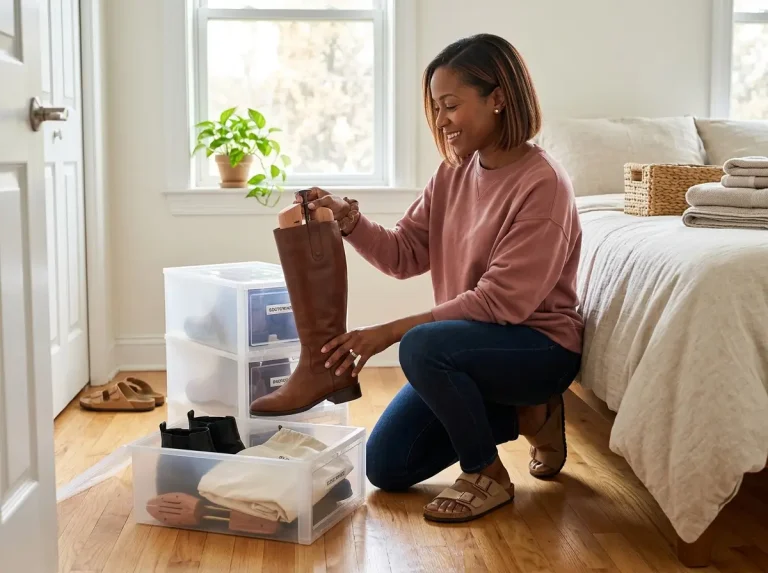
The daily shoes only rule is the capacity side of this equation: your entryway holds the two to three pairs per person currently in rotation. Seasonal shoes, formal shoes, and anything you haven’t worn in two weeks belongs in the closet, in under-bed shoe storage for seasonal and overflow pairs, or in a seasonal closet rotation system that moves shoes in and out as the weather changes. The entryway is for this week’s shoes. Everything else is overflow.
The Weekly Reset (2 Minutes)
Pick one day a week — Sunday works, or whenever you do laundry. Spend two minutes returning every shoe to its designated spot, pulling out any pairs that don’t belong in the entry rotation, and checking whether the system is still accessible. Two minutes prevents the month-long accumulation that eventually becomes the shoe avalanche you started with.
If your storage consistently overflows between resets, the problem is either too few slots (upgrade the storage) or too many shoes in rotation (move the extras to the closet). Both are fixable. But “buy more storage” is almost never the right first move — count your pairs and your slots before you spend anything.
Conclusion
Three takeaways to keep your entryway shoe system working:
- Measure your walkway clearance before buying anything — the furniture has to fit the hallway, not just look good on the product page
- The behavioral layer matters as much as the product — place storage at the exact drop zone, keep it open-access, and do the 2-minute weekly reset
- Overflow shoes belong in the closet or under the bed, not the entryway — any system overwhelmed by too many shoes is a rotation problem, not a storage problem
Three-Month Check: In three months, test two things — are shoes ending up on the floor next to the storage? Move the storage one step closer to where they come off. Is the storage overflowing? Move seasonal pairs out.
Start with the clearance measurement today. Three minutes with a tape measure tells you exactly what will fit — and saves you a return trip.
Q1 What is the best shoe storage for a small entryway?
A narrow freestanding shoe rack in the 12- to 18-inch width range fits beside most doors and handles 15 or more pairs without eating floor space. If your hallway allows 10 to 14 inches of furniture depth, a cubby bench or tilt-out cabinet works too. Measure walkway width first — you need at least 36 inches of clearance to move comfortably.
Q2 How do you organize shoes at the front door?
Place storage at the exact spot where shoes come off — not across the room where it looks better. Follow the daily shoes only rule: keep two to three pairs per person at the entry, everything else in the closet. Open-access storage like racks, trays, and cubbies outlasts enclosed options because there’s no lid-friction step each time.
Q3 What shoe storage works without drilling?
Freestanding racks, boot trays, open baskets, and cubby benches all require zero drilling. Over-the-door organizers also skip the drill but belong on a solid-core closet door — not on hollow-core apartment front doors, which max out at 20 to 30 pounds. A boot tray plus a narrow freestanding rack is a fully deposit-safe system.
Q4 Why does my entryway shoe rack always get messy again?
Three reasons: the storage isn’t placed where shoes actually come off, the capacity filled up on day one and overflow took over, or there’s no weekly reset habit. Move the storage closer to the door, do a 2-minute weekly shoe-to-slot reset, and move seasonal pairs to the closet to free up entryway slots.
Disclaimer: ClutterlessNest is a participant in the Amazon Services LLC Associates Program. As an Amazon Associate we earn from qualifying purchases. This article may contain affiliate links — if you buy through them, we may earn a small commission at no extra cost to you. We only recommend products we have tested or genuinely believe in.