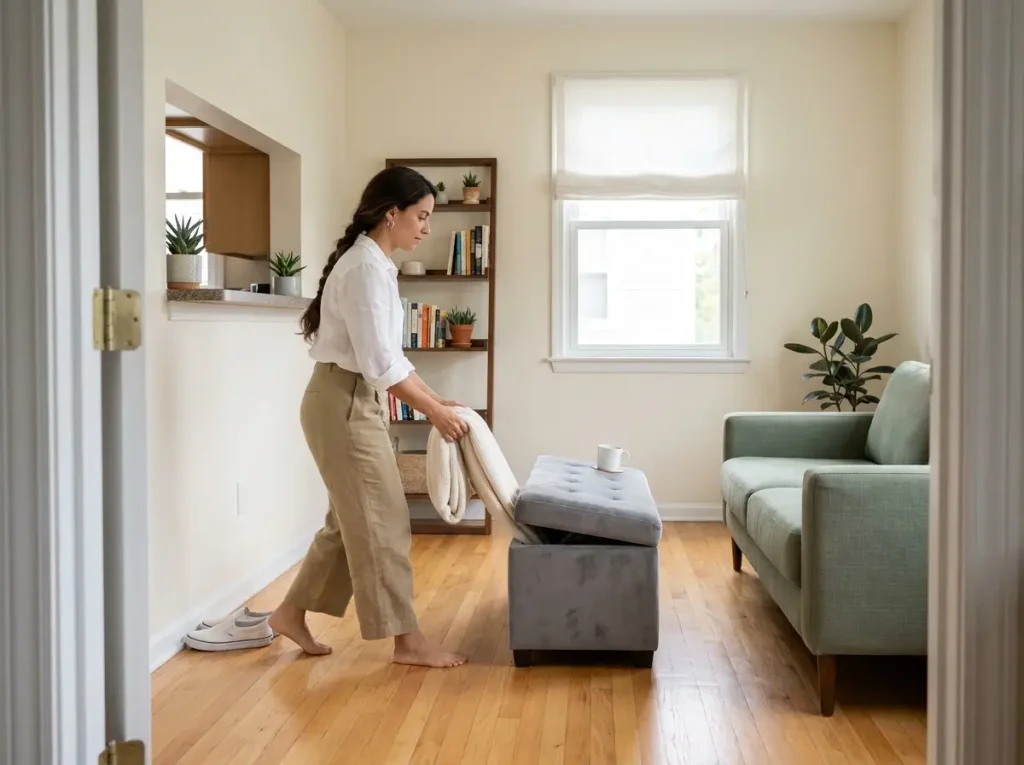
You bought a sofa that was supposed to seat three and store blankets. Six months later, the cushions sag, the storage lid jams, and you’re sitting on the floor. Multi-functional furniture promises to solve small apartment problems, but most of it creates new ones because the piece wasn’t sized for your actual space, your actual routine, or the specific job you needed it to do. I’ve tested enough dual-purpose pieces in apartments under 700 square feet to know which ones earn their footprint and which ones just sound good on the product page.
Quick Answer: The multi-functional furniture that actually works in small apartments:
- Storage ottomans (40-43 inches long) that double as seating, coffee table surfaces, and hidden blanket storage
- Lift-top coffee tables that raise to laptop-comfortable working height without needing a separate desk
- Drop-leaf dining tables that collapse to 15 inches against a wall when you’re done eating
- Platform beds with built-in drawers that replace a full dresser with 9+ cubic feet of hidden storage
- Narrow freestanding bookshelves (under 14 inches wide) that store, organize, and define zones in studios
Sleeping Solutions for Small Apartments Without a Guest Room
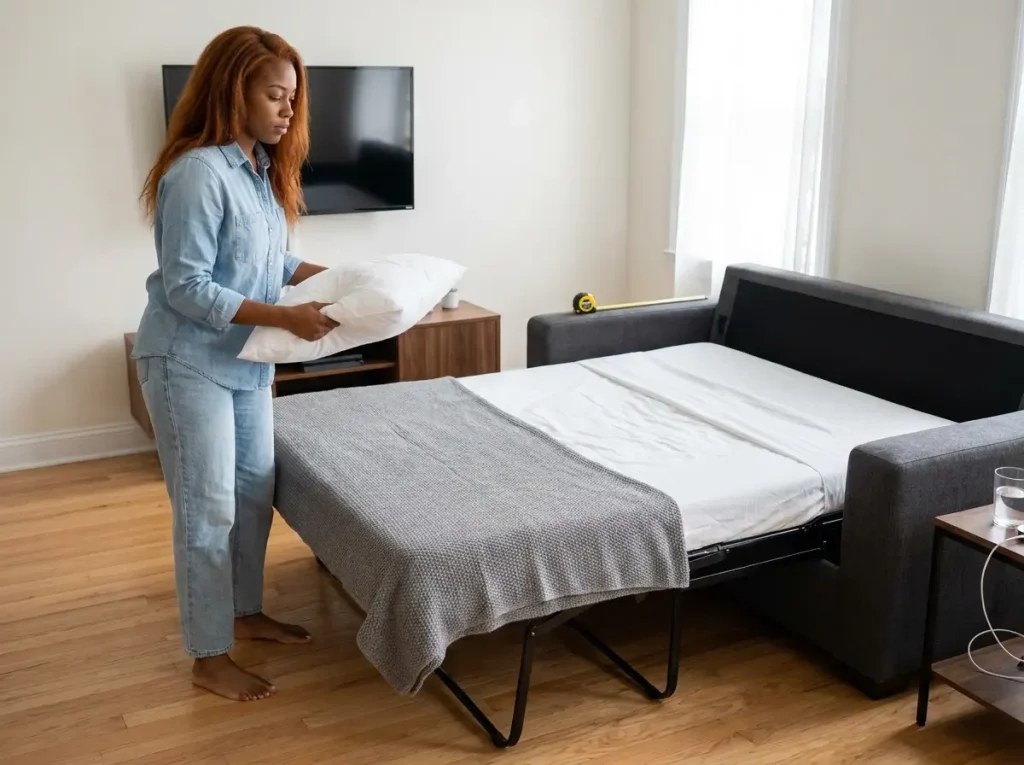
Your spare bedroom is also your office, your gym, and your storage room. Or you don’t have a spare bedroom at all. Either way, guest sleeping is a space problem that multi-functional furniture tries to solve and often fails at, because nobody talks about the floor space math.
Sofa Beds — The Floor Space Math Nobody Tells You
A full-size sofa bed takes up about 70-80 inches of wall space when closed. That’s manageable. The problem shows up the moment you pull it out: the mattress extends 85-90 inches from the back of the sofa, and the sleeping surface is 54 inches wide by 75 inches long. In a living room that’s 12 by 14 feet, that open mattress leaves you about 18 inches of walkable space between the bed edge and whatever’s on the opposite wall.
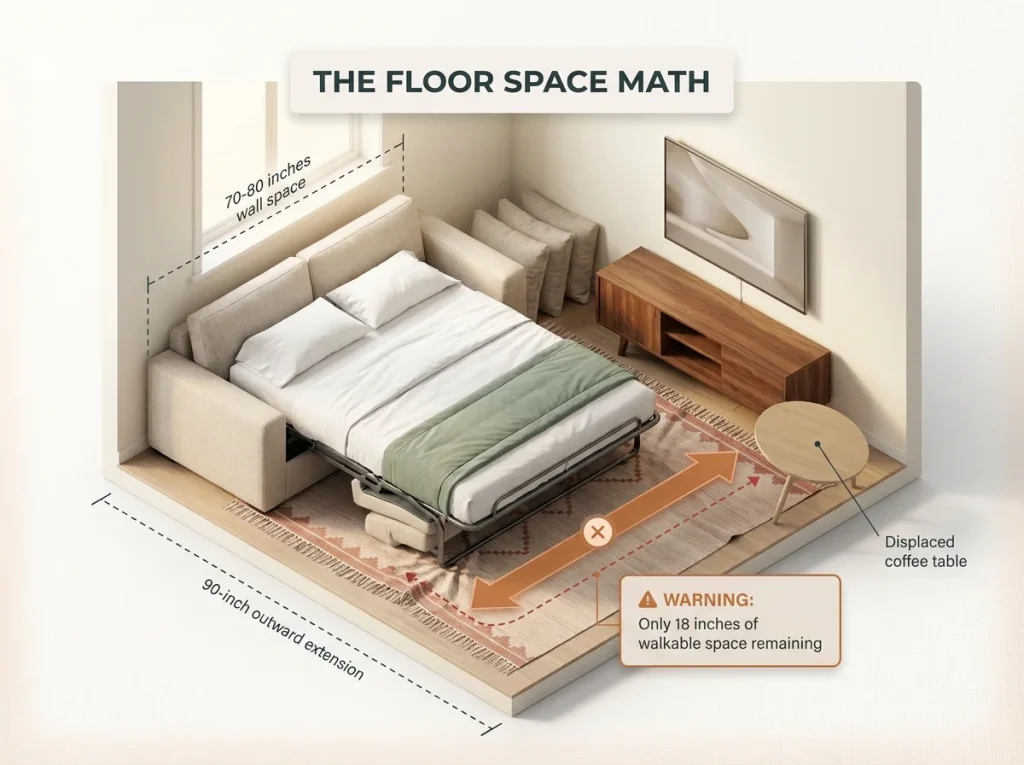
That gap matters. If you have a coffee table, it needs to move somewhere every time you open the bed. If you have a rug, the pull-out mechanism drags over it.
After a dozen setups and teardowns, you’ll start skipping the conversion and offering guests the couch cushions instead. The mechanism that makes a sofa bed multi-functional is the same mechanism that makes it inconvenient enough that you stop using one of its functions.
Pro tip: Before buying a sofa bed, measure your living room and subtract 90 inches from the wall-to-opposite-wall distance. If you have less than 24 inches left, the bed function will be usable but miserable. Every setup will involve moving furniture out of the way.
Daybeds — The Honest Assessment
A daybed sidesteps the pull-out problem entirely. It looks like a sofa during the day, functions as a twin bed at night, and never requires a transition. The trade-off: you’re sleeping on a twin mattress (38 inches wide), which works for one adult guest but not two. Some daybeds include a pop-up trundle that raises to meet the main mattress, creating a king-size surface, but the trundle adds another 38 inches of floor projection when opened.
For one-bedroom apartments where the living room occasionally sleeps a guest, a daybed with a quality mattress beats a sofa bed. You lose the deep sofa seating depth, but you gain reliability. There’s no mechanism to break because there’s no mechanism at all.
Murphy Beds and the Rental Reality
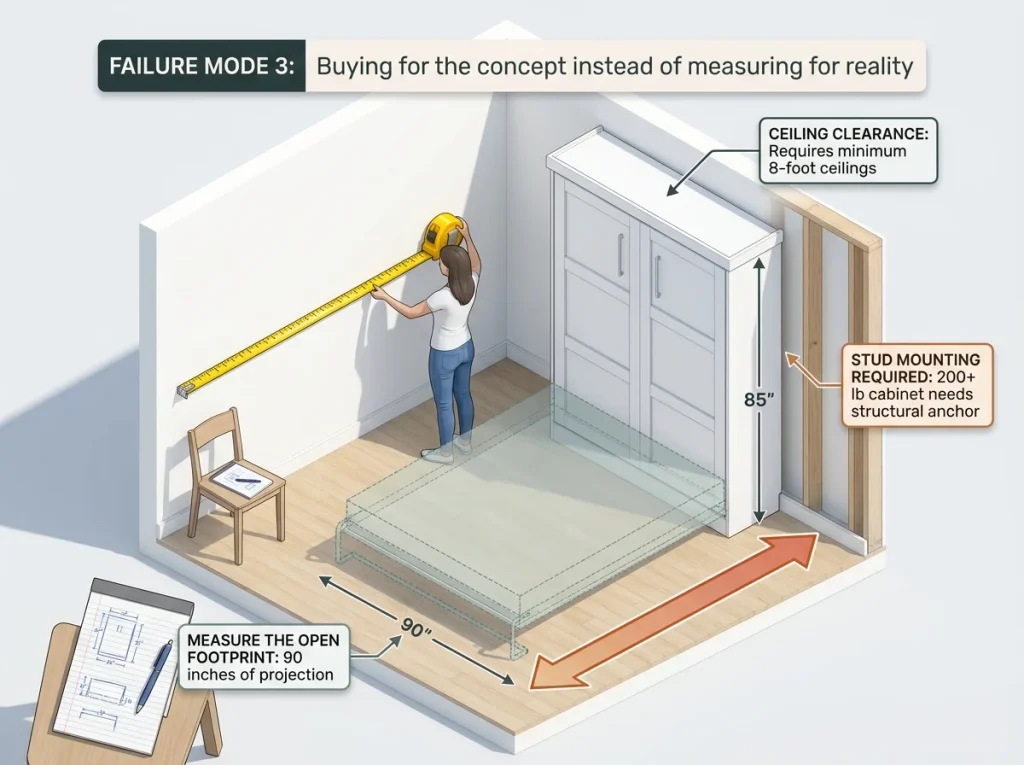
A Murphy bed folds against the wall into a cabinet that’s about 16 inches deep, 64-68 inches wide, and 85-90 inches tall. When open, it projects 85-90 inches into the room. On paper, it’s the perfect multi-functional piece: your bedroom disappears during the day and reappears at night.
The rental reality: a vertical Murphy bed requires attachment to wall studs. The cabinet weighs 200-400 pounds fully loaded. Your ceiling needs to be at least 8 feet for a standard queen mechanism.
And most landlords will not approve the installation. It leaves screw holes in studs, limits future furniture placement, and some models require professional installation that classifies as a modification rather than a decoration.
If you own your apartment or your lease explicitly allows modifications, a Murphy bed can reclaim 40-50 square feet of floor space during the day. If you rent with standard lease restrictions, this is probably not your solution.
Double-Duty Seating — The Furniture That Earns Every Square Foot
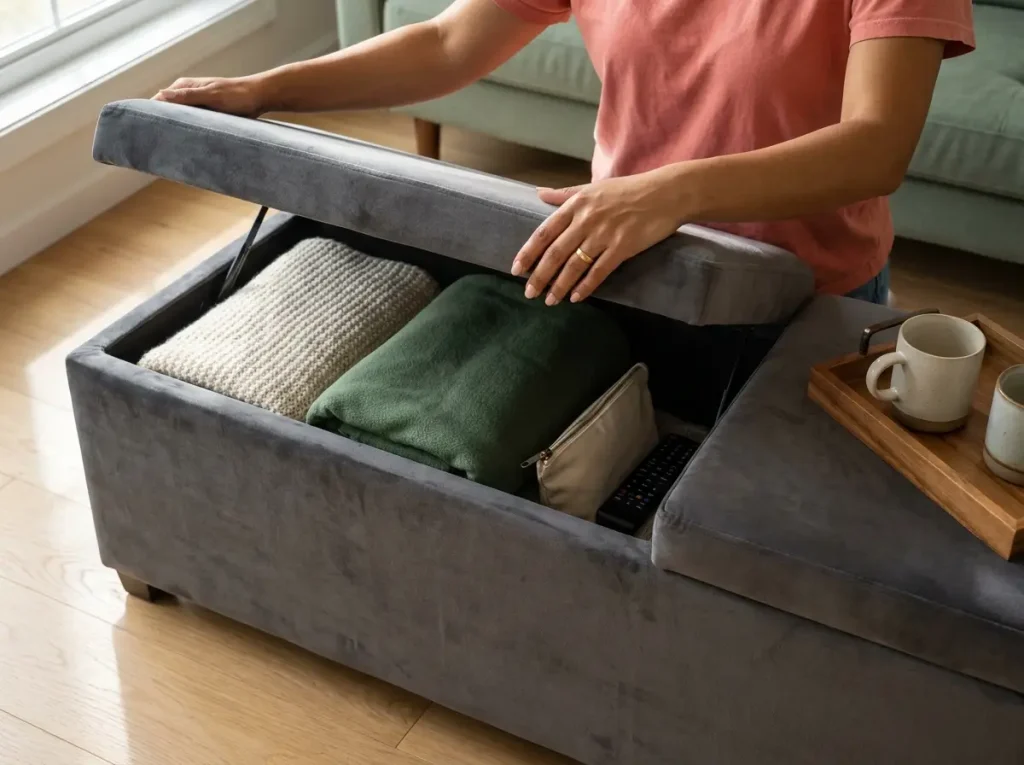
In a small apartment, every piece of furniture that does only one job is a piece of furniture you might not have room for. Seating is where dual-function works best because the transition between sitting and storage takes zero effort.
Storage Ottomans — What Size Actually Works
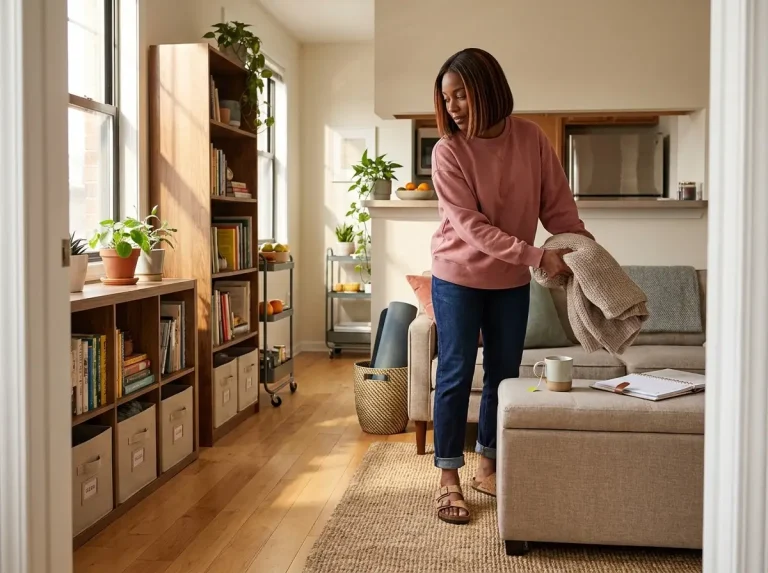
Round storage ottomans (20-22 inches in diameter) are everywhere because they’re cheap and fit anywhere. They’re also too small to sit on comfortably and too shallow to store much beyond a couple of throw blankets. The size that actually earns its place is 40-43 inches long and at least 15 inches wide. Big enough to sit on, stable enough to hold a serving tray on top, and deep enough inside (11+ inches) to store blankets, remotes, and seasonal items.
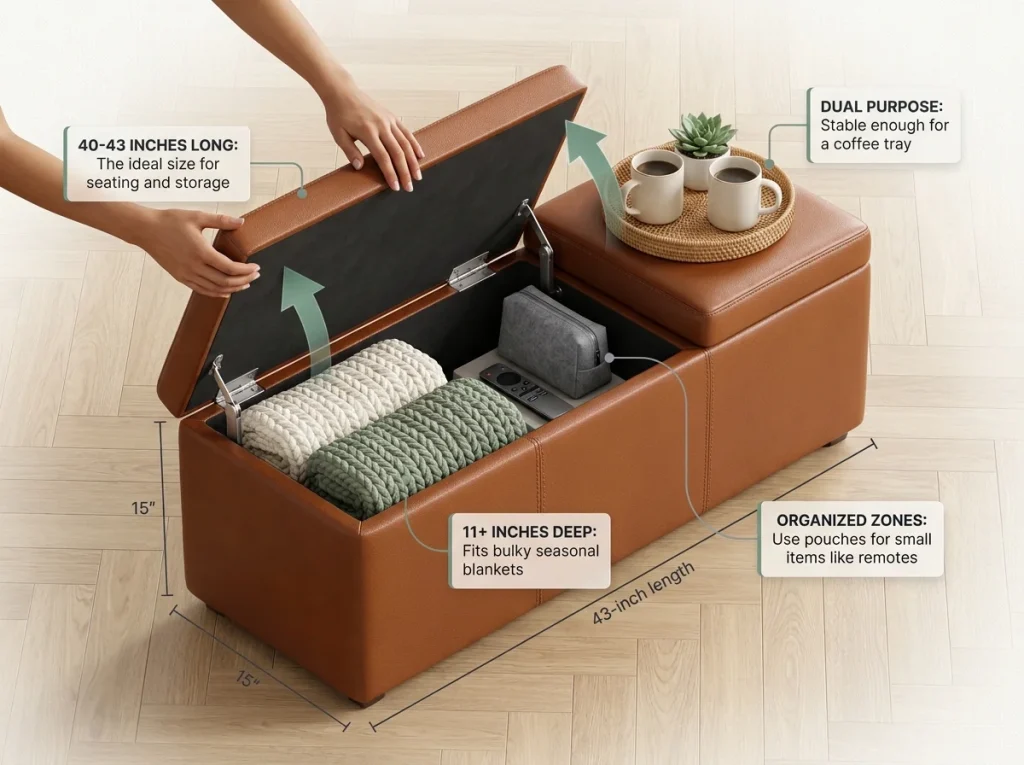
The SONGMICS Storage Ottoman Bench (43 x 15 x 15.7 inches) fits at the foot of a bed, along a hallway wall, or in front of a sofa as a coffee table replacement. It’s freestanding with no installation and no wall attachment, fully renter-friendly. The limitation: velvet or linen fabric shows wear faster than faux leather if you use it as daily seating, so it works best as a secondary seat that doubles as storage rather than your primary sitting spot.
Storage Benches at the Foot of the Bed
A bench at the foot of the bed works in bedrooms 10 feet wide or wider. You need at least 24 inches of clearance between the bench front and the nearest wall or furniture for it to not feel cramped. In narrower bedrooms, it blocks the natural walking path and you’ll end up stepping over it or pushing it against the wall, where it becomes a shelf you never open.
If your bedroom has the clearance, a storage bench holds off-season clothes, extra bedding, or shoes. Items you access weekly or less. That’s enough to replace one or two dresser drawers without the dresser taking up wall space.
Nesting Tables — The Low-Commitment Win
Nesting tables are the multi-functional piece with the lowest risk: two or three tables that stack into the footprint of one. You pull out the smaller table when you have guests, when you need a side surface next to the sofa, or when you’re eating on the couch and need a stable platform for a plate.
No mechanism to fail, no assembly required, no storage function to organize. They’re just tables that take up less space when you don’t need all of them. For studios and small living rooms where you can’t commit to a full coffee table, nesting tables give you flexibility without the furniture equivalent of a Swiss Army knife.
Workspace Furniture That Disappears When You’re Done
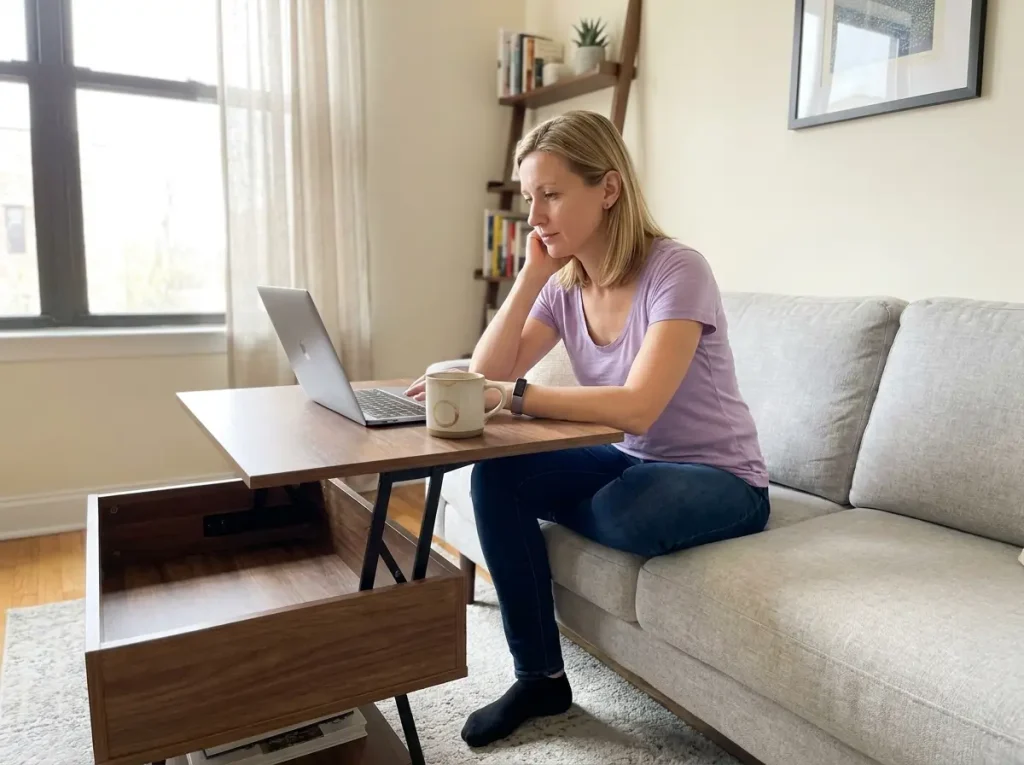
Working from home in a small apartment usually means working from the couch, the bed, or a tiny desk crammed into a corner you hate looking at. The right multi-functional piece lets you work at a comfortable height and then removes the office from your living room when you close the laptop.
Fold-Down Wall Desks — The Dimensions That Matter
A fold-down wall desk protrudes 2-4 inches when folded and extends to a usable work surface when opened. The ideal width is 32-47 inches, wide enough for a laptop and a notebook, narrow enough to fit between furniture on a standard apartment wall. You need 36 inches of clear floor space in front for a chair.
The catch: wall desks require mounting into studs. In a rental, that means two to four screw holes that you’ll need to patch when you move out. Some landlords treat this as acceptable wear. Others don’t. If your lease says no holes, this piece doesn’t work for you regardless of how well it solves the space problem.
Lift-Top Coffee Tables as a WFH Surface
This is where multi-functional furniture genuinely earns its place in a small apartment. A lift-top coffee table sits at normal coffee table height (16-18 inches) and raises to 28-30 inches, which is comfortable working height for a laptop when you’re seated on the sofa. No installation. No wall attachment. Completely renter-friendly.
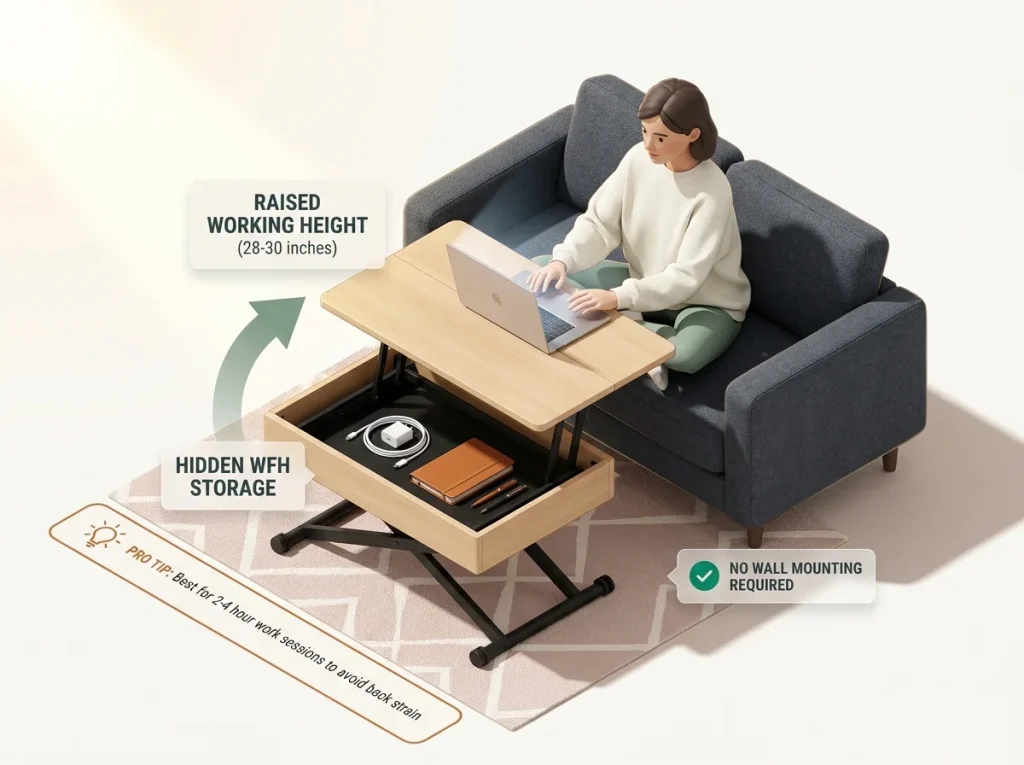
The HOMCOM Lift Top Coffee Table with Hidden Storage Compartment is approximately 40 inches long by 22 inches wide and includes a storage compartment under the lifting surface for a laptop charger, notebooks, and pens. After the workday, you lower the top and the table is a coffee table again. The one caveat: lift-top mechanisms have a weight limit (usually 30-40 pounds), so this is a laptop and notebook surface, not a dual-monitor command center.
Pro tip: If you work from home more than four hours a day, a lift-top coffee table won’t replace a real desk. Your neck and back will notice the sofa posture over time. It works well for 2-4 hour daily sessions. Beyond that, look into a fold-down desk or a dedicated workspace, even a small one.
When the Dining Table IS the Desk
If you already have a dining table in your apartment, you already have a desk. The issue isn’t finding workspace furniture. It’s managing the transition. A dining table covered in laptop, papers, and chargers at 6 PM when dinner should be happening creates friction in a shared household.
The fix is a portable desk setup: laptop stand, wireless keyboard, and a small tray or bin that holds everything. When work ends, the whole setup goes into the bin, the bin goes onto a shelf, and the table is clear for dinner in two minutes. No extra furniture needed. If your apartment already has a dining table, try this before buying a separate workspace piece. Maximizing the space you have starts with using what’s already there.
Dining Without a Dedicated Dining Room
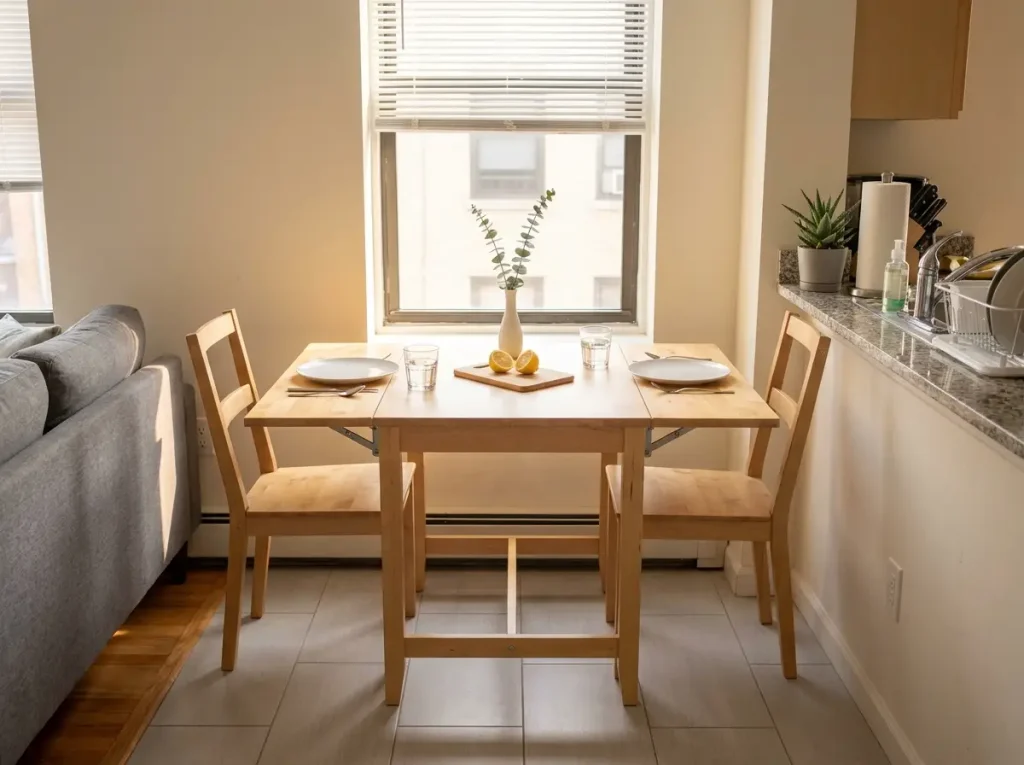
Most apartments under 700 square feet don’t have a dining room. They have a gap between the kitchen counter and the living room sofa that might fit a small table if you measure carefully.
Drop-Leaf Tables — The Three Formats
Your drop-leaf table options come down to three formats for small apartments: wall-mounted (folds flat against the wall), freestanding with two folding leaves, and freestanding with wheels. Wall-mounted versions save the most space but need stud mounting, which rules them out for most renters. Freestanding versions trade a slightly larger footprint for zero installation.
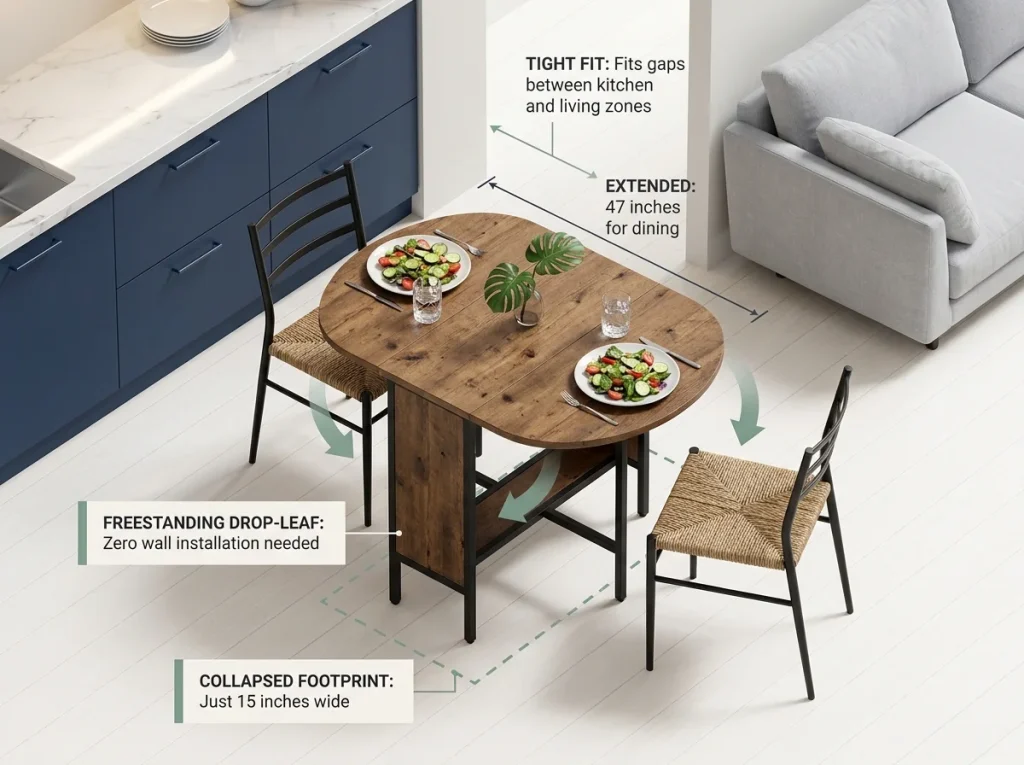
The VASAGLE Drop Leaf Folding Dining Table is the freestanding budget option: 33.3 inches long with both leaves up, seating two to four people. It collapses when the leaves fold, freeing floor space between meals. No wall mounting needed, so it’s fully renter-safe. The rustic brown and black metal finish blends into most apartment aesthetics without standing out.
If you want mobility, the COMUHOME Extendable Drop Leaf Folding Table with Drawer and Wheels collapses to just 15 inches wide and rolls on four lockable wheels. Extended, it reaches about 47 inches, enough for a full dinner with two. The built-in drawer holds placemats, napkins, or utensils.
Push it against a wall after dinner and it takes up less space than a nightstand. The drawer and wheel mechanisms are the weak points over time. If anything wears out on this table, it’s those moving parts after a year or two of daily rolling.
What to Do When You Have No Dining Area
Some apartments genuinely have zero space for a table. The kitchen is a galley, the living room barely fits a sofa, and the “dining area” on the floor plan is a polite fiction. In that situation, multi-functional furniture isn’t the answer. A routine is.
A lap tray on the sofa works for solo meals. A TV tray that folds flat works for guests. A kitchen counter with two bar stools works if you have 10 inches of overhang.
None of these require a furniture purchase. They’re acceptance that your apartment layout doesn’t support a dining table, and working with that constraint instead of fighting it. Sometimes the best multi-functional furniture decision is not buying furniture at all.
Convertible Coffee-to-Dining Tables
Convertible coffee-to-dining tables look like the ideal small apartment solution: coffee table height for daily use, adjustable to dining height when you eat. In practice, the transition usually involves a hydraulic or manual mechanism that requires lifting the table surface (often with items on it) and clicking it into a higher position.
If you entertain regularly and genuinely need both a coffee table and a dining table, a convertible model might justify the higher cost and the mechanism complexity. For most apartment dwellers, a dedicated drop-leaf table that folds flat solves the problem more reliably and with fewer moving parts that can fail.
The Bedroom Storage Problem — Replacing Your Dresser Without Knowing It
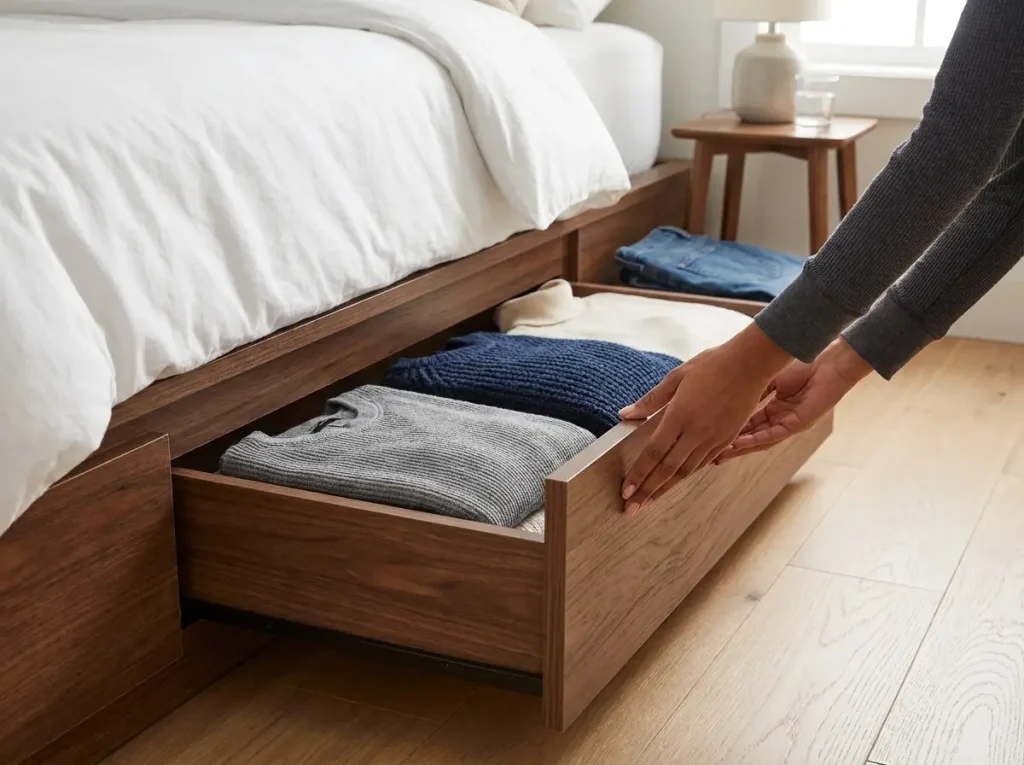
Your bedroom doesn’t have room for a dresser and a desk. Or a dresser and a reading chair. Or a dresser and walking space. A standard dresser is 54-60 inches wide, 16-18 inches deep, and 30-34 inches tall. In a bedroom that’s 10 by 11 feet (common in one-bedroom apartments), that dresser consumes wall space you need for other things.
Platform Beds with Drawers — Dimensions and What Actually Fits
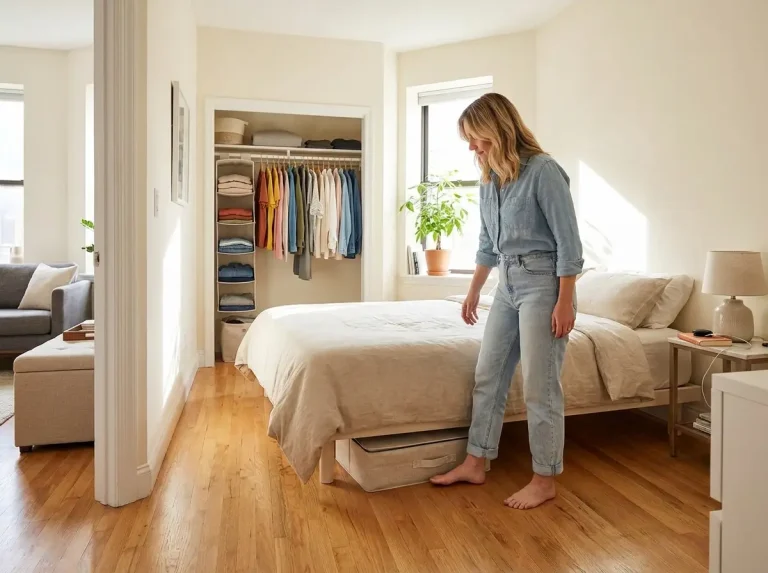
A platform bed with built-in storage drawers replaces the dresser by hiding the storage under the mattress. Most queen-size platform storage beds have four to six drawers, each about 18 inches wide, 15 inches deep, and 8 inches tall. That’s roughly 1.5 cubic feet per drawer, or 9 cubic feet total for six drawers, about equal to a medium dresser.
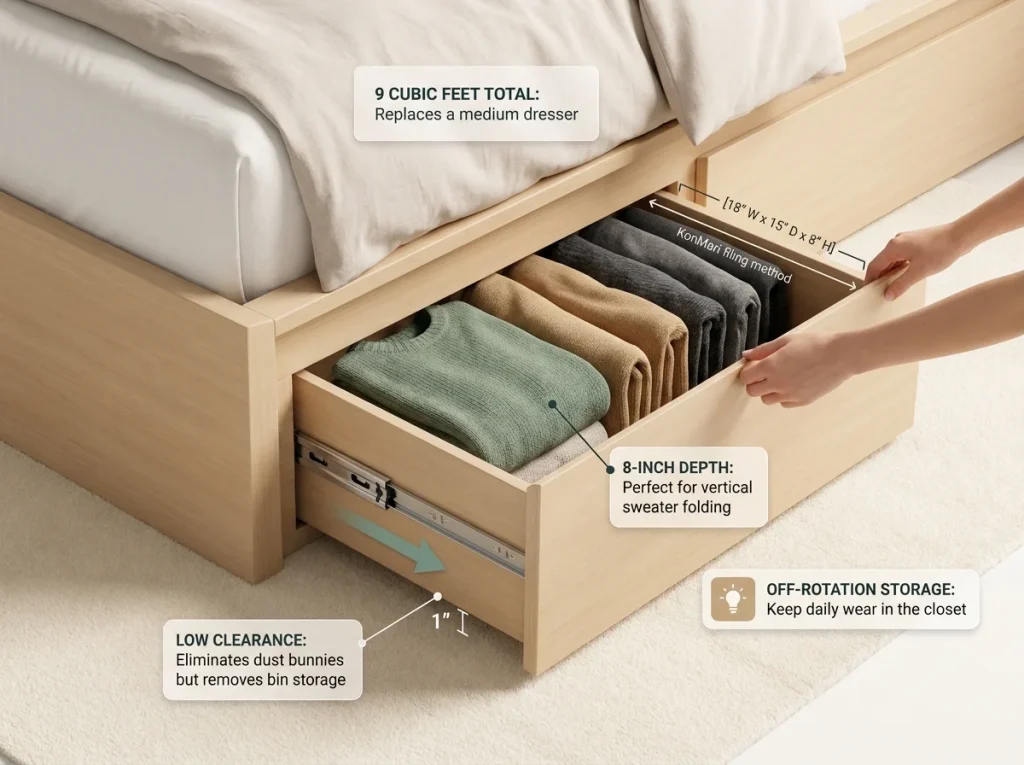
What actually fits: folded sweaters (stack 4-5 per drawer), t-shirts (6-8 rolled), jeans (3-4 folded), underwear and socks (one entire drawer handles a two-week supply). What doesn’t fit well: hanging clothes (those still need the closet), bulky winter coats (too thick for 8-inch drawer depth), and shoes (most shoe boxes are taller than 8 inches unless you remove the shoes from the box and stack them flat).
The trade-off: platform beds sit lower than standard bed frames, typically 12-14 inches from floor to mattress base versus 18-22 inches for a frame with legs. You lose under-bed storage clearance entirely because the drawers occupy that space. If you already use under-bed bins, switching to a platform storage bed trades bin-style storage (accessed from the sides) for drawer-style storage (organized but fixed compartments).
Storage Bed vs. Bed Risers + Flat Containers
Before spending on a new bed frame, check what your current frame allows. Standard metal bed frames give you 7-9 inches of clearance. Bed risers add another 3-8 inches. Flat storage containers (4.5-6 inches tall) slide under most frames without risers.
The bed-riser-plus-container approach costs a fraction of a storage bed and works with your existing frame. The disadvantage: bins slide around, there’s no drawer mechanism to keep things organized, and pulling a bin out from under the bed requires kneeling on the floor. If you access that storage weekly, the inconvenience adds up fast. If you access it seasonally, bins work fine and the bed frame money is better spent elsewhere.
The Dresser-Free Bedroom Setup
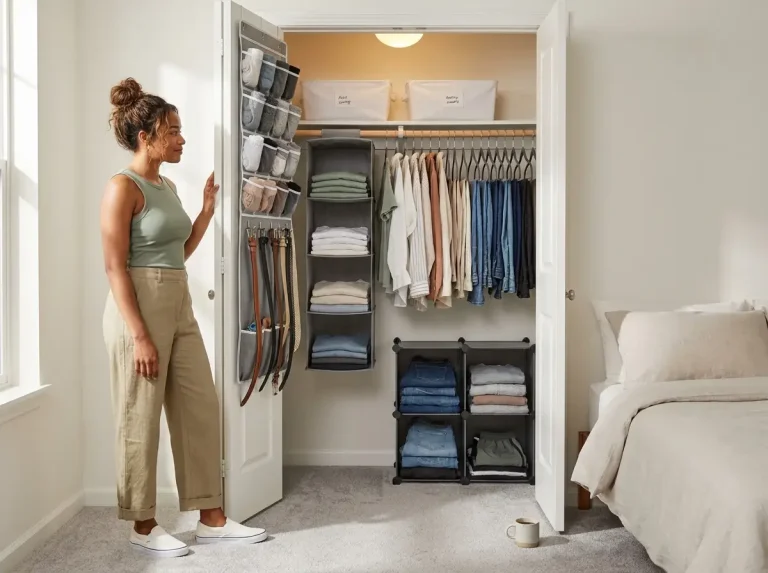
A dresser-free bedroom combines a platform storage bed, closet organization, and one or two vertical storage pieces to replace all dresser functions. The closet handles hanging items and daily-access folded clothes. Use a hanging shelf organizer if your closet has only one rod and one shelf. The bed drawers handle off-rotation items: seasonal clothes, extra linens, workout gear you wear twice a week.
The key is splitting your clothes by access frequency, not by type. Items you wear three or more times per week go in the closet. Everything else goes in the bed drawers. That one sorting rule prevents the dresser-free setup from becoming a treasure hunt every morning.
Vertical Storage Furniture That Organizes and Defines Zones
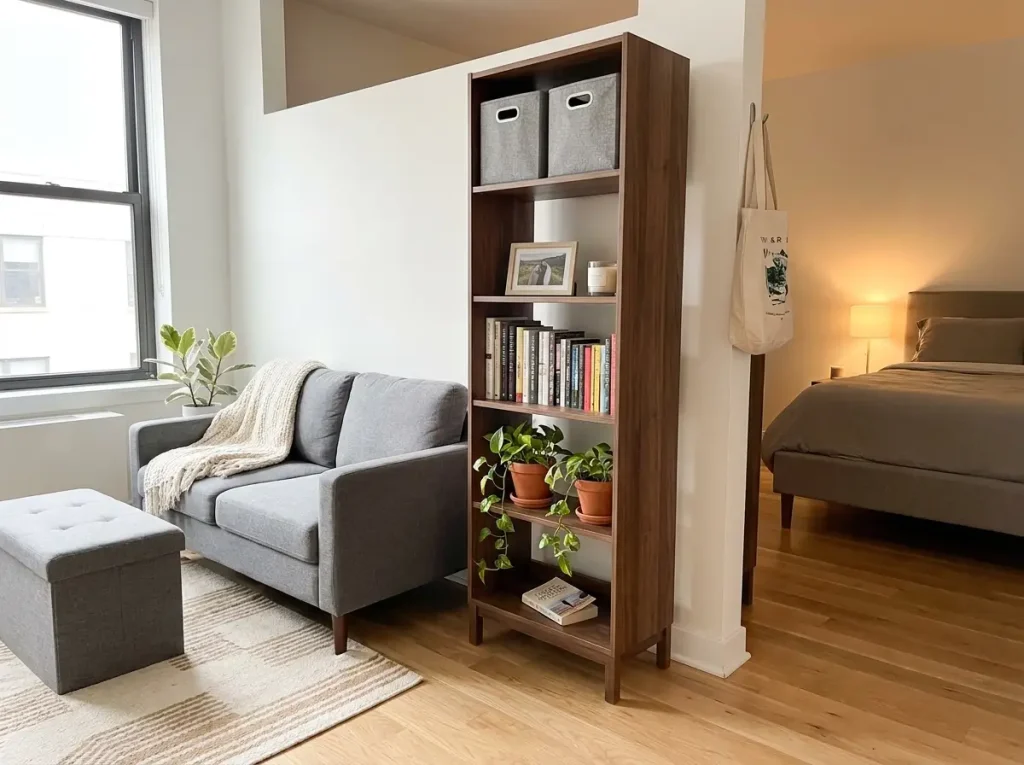
Floor space is finite in a small apartment. Vertical storage furniture exploits the 5-7 feet of wall height above your furniture that’s doing nothing. The right freestanding piece adds storage without any installation, and in studios, it can also create visual boundaries between living zones.
Leaning Ladder Shelves — Renter-Friendly Vertical Storage
A leaning ladder shelf rests against the wall at an angle, holds 4-5 tiers of items, and takes up a footprint of about 18 inches deep by 24 inches wide. No mounting required. The shelves get narrower as they go up, which naturally encourages lighter, smaller items on top and heavier items at the bottom.
The limitation: they’re not as stable as bookshelves or cube storage. Heavy books on upper shelves create a tipping risk, especially on hardwood floors where the base can slide. A non-slip furniture pad under the feet fixes the sliding problem. You’ll figure this out the first time the base shifts two inches while you’re reaching for the top shelf. For vertical storage in apartments, leaning shelves work best for decorative and lightweight items: plants, framed photos, small baskets. For heavy books and full storage bins, go with a freestanding bookshelf instead.
Narrow Bookshelves as Space Definers
In a studio apartment, the tallest piece of furniture in the room defines the visual boundary between zones. A narrow bookshelf placed perpendicular to a wall, between the living area and the sleeping area for example, creates a visual divider without blocking light or making the room feel smaller.
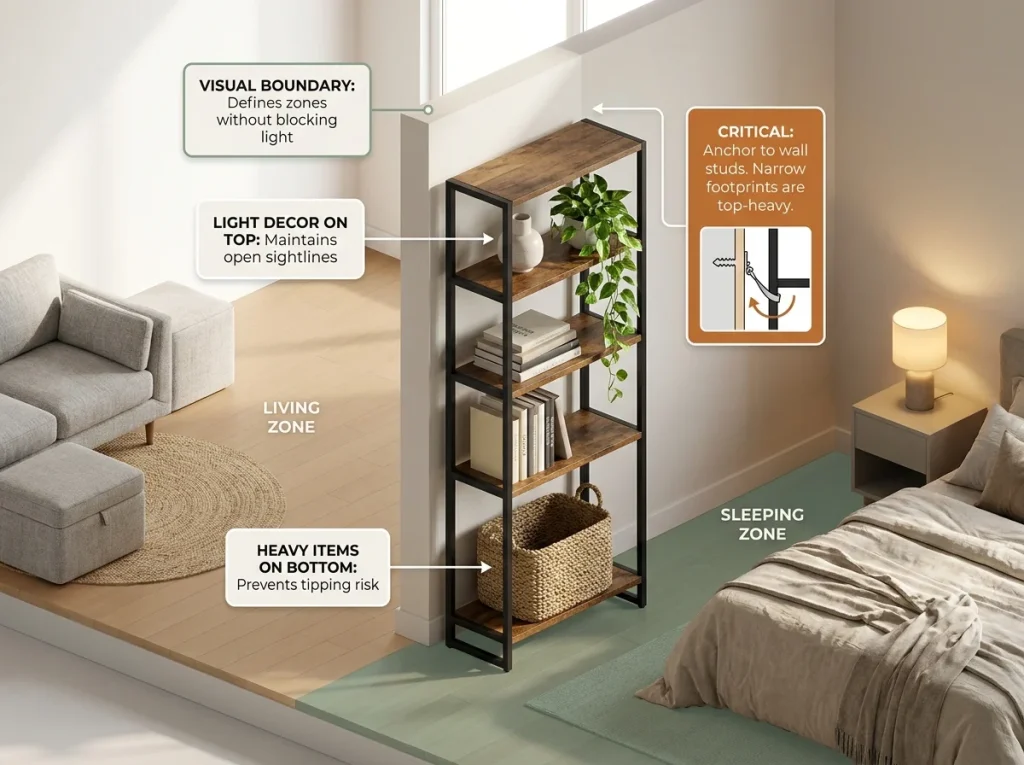
The VASAGLE 5-Tier Narrow Bookshelf (11.8 x 13.3 x 66.9 inches) is 13.3 inches wide, slim enough to fit in hallways, beside doorways, and in the gap between a sofa and a wall. At 66.9 inches tall, it defines a zone boundary in a studio without overwhelming the sightlines. The CPSC’s Anchor It! program recommends anchoring any tall, narrow furniture to the wall with an anti-tip strap. If you have kids or pets, this is non-negotiable. The narrow footprint makes it top-heavy when fully loaded, and you don’t want to learn this the hard way.
Modular Cube Storage — The Flexible Foundation
Modular cube storage (the 13-inch cube units that stack and arrange in grids) works in small apartments because you can configure it to your space. A 2×2 grid functions as a nightstand. A 2×4 grid becomes a TV console. A 1×5 tower works as a room divider. Fabric bins in the cubes add hidden storage.
The advantage over purpose-built furniture: when you move to a different apartment with different dimensions, the cubes rearrange instead of becoming obsolete. The disadvantage: cube storage is shallow (usually 11-13 inches deep) and each cube holds about 1 cubic foot, less than a single dresser drawer. For the small apartment organization system to work long-term, cube storage supplements a closet and bed storage rather than replacing them.
Why Multi-Functional Furniture Fails — and How to Choose Right
This is where most articles about multi-functional furniture stop. They list the products and assume the rest takes care of itself. It doesn’t. Half the dual-purpose pieces that end up on resale sites six months after purchase didn’t fail because they were bad products. They failed because the buyer chose wrong.
The Three Failure Modes of Multi-Functional Furniture
Every multi-functional furniture failure falls into one of three patterns. Understanding which one you’re at risk for prevents the wrong purchase.
Failure Mode 1: Mechanism fatigue. Any furniture with a hinge, spring, hydraulic lift, or sliding track has a lifespan measured in cycles. A sofa bed opened and closed three times a week wears its mechanism faster than one used monthly for guests. Soft-close hinges on storage ottomans stiffen after a year of daily use.
Lift-top mechanisms develop play in the joints after thousands of raises and lowers. Before buying, look at one-year and two-year reviews, not the just-unboxed five-star ratings. The three-month mark is when mechanisms reveal their real quality.
Failure Mode 2: The convenience tax. If converting a piece from one function to another takes more than two steps, you’ll eventually stop converting it. A sofa bed that requires clearing the coffee table, removing cushions, and pulling out the frame has a three-step conversion. A lift-top coffee table that raises with one hand has a one-step conversion.
The fewer steps, the longer you’ll actually use both functions. This is exactly why most Murphy beds end up permanently in one position. The conversion isn’t physically hard, but it’s just enough friction that daily switching stops after the first month.
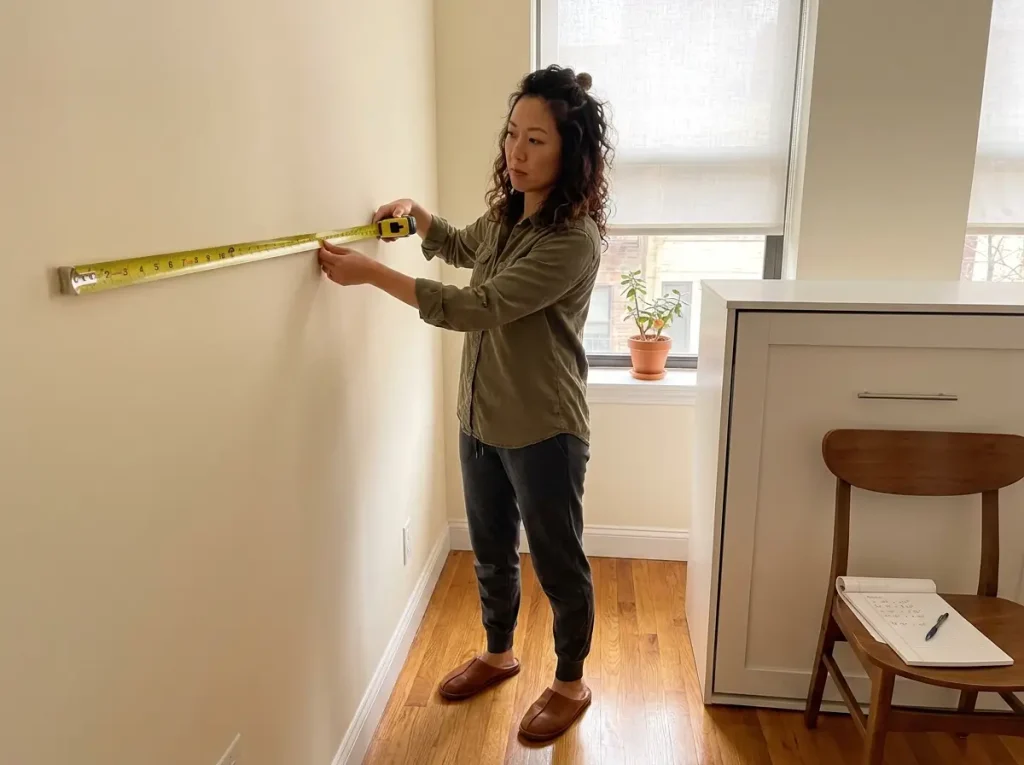
Failure Mode 3: Wrong piece, wrong space. A drop-leaf table bought for a kitchen that has 28 inches between the counter and the wall won’t open its leaves without hitting the counter. A storage ottoman bought as the only coffee table surface wobbles when you set a laptop on it because the lid isn’t rigid enough. This failure mode happens when you buy for the concept instead of measuring for the reality. Every dimension listed above exists to prevent exactly this.
Pro tip: When evaluating any multi-functional furniture piece, count the conversion steps. One step (lift, open, fold) means you’ll use both functions for years. Two steps is workable. Three or more steps means the second function will be abandoned within six months.
Choosing by Apartment Size and Lifestyle
In a studio under 400 square feet, prioritize pieces that combine storage with daily-use functions: a storage ottoman that doubles as your coffee table, a platform bed with drawers that eliminates the dresser, a narrow bookshelf that defines your sleeping zone. Every piece needs to do two jobs because you don’t have space for single-purpose furniture.
In a one-bedroom apartment (500-700 square feet), you have more flexibility. The bedroom can handle a dedicated bed and closet system, so the multi-functional pieces belong in the living area: a lift-top coffee table for WFH sessions, a drop-leaf dining table, a storage bench by the door. The bedroom stays purpose-built; the shared spaces do double duty.
In a shared apartment, multi-functional furniture needs to work for all roommates, not just you. Pieces in shared spaces should have simple or no conversions. If your roommate has to learn a mechanism to use the dining table, that mechanism won’t get used. Stick to freestanding pieces with one-step or zero-step transitions in common areas.
The Renter’s Non-Negotiable List
Before you buy any multi-functional furniture piece for a rental apartment, check these four things.
Does it require wall attachment? Murphy beds, fold-down desks, and wall-mounted drop-leaf tables all need screws into studs. If your lease says no modifications, skip these no matter how well they solve your space problem. Freestanding alternatives exist for every wall-mounted piece covered above.
Does it fit through your door? Measure your apartment’s entry door (standard interior doors are 28-32 inches wide) and every hallway turn between the front door and the room where the furniture will live. A 43-inch storage ottoman fits through most doors when tilted. A queen platform bed frame usually ships in flat-pack boxes. A fully assembled Murphy bed cabinet does not fit through a 32-inch doorway.
Can you move it alone or with one person? In rental apartments, you move. Sometimes often. A 200-pound platform storage bed requires at least two people and partial disassembly. A drop-leaf table on wheels rolls out the door in seconds.
Will it survive one or two moves? Particle board and cam-lock joints loosen with every disassembly-reassembly cycle. Solid wood and metal hardware hold up through three or four moves. If you’re in a rental and plan to move within two years, furniture durability includes move-ability.
How to Start
Multi-functional furniture works in small apartments when you choose by measurements, not by concept. Measure the space first. Count the conversion steps. Verify that the piece is renter-friendly before you order it.
Three-Month Check: Revisit your multi-functional pieces after 90 days of use. Are you actually using both functions? If a piece has settled into single-duty mode, the second function wasn’t practical for your routine, and that’s useful information for your next furniture decision.
Start with one piece that solves your biggest space problem. Get it right. Then add the next one only when you’ve lived with the first long enough to know what actually works in your apartment.
Q1 What is the best multi-functional furniture for a studio apartment?
A storage ottoman that doubles as a coffee table and a platform bed with drawers that eliminates the dresser. These two pieces address the biggest studio constraint: not enough storage without enough floor space for dedicated storage furniture.
Q2 Is multi-functional furniture worth it for renters?
Freestanding multi-functional furniture is worth it. Storage ottomans, lift-top coffee tables, drop-leaf tables, and platform beds all work without wall modifications. Avoid wall-mounted pieces like Murphy beds and fold-down desks unless your lease allows screw holes in studs.
Q3 How long does multi-functional furniture last?
Pieces with no mechanisms (nesting tables, storage ottomans, platform beds) last as long as their materials, typically 5-10 years for engineered wood. Pieces with mechanisms (lift-tops, sofa beds, fold-downs) depend on usage frequency. Check two-year reviews before buying.
Q4 Can multi-functional furniture replace a dresser?
A queen platform bed with six drawers holds approximately 9 cubic feet of storage, equivalent to a medium dresser. Combined with a closet organizer system, you can go fully dresser-free in a small bedroom and reclaim 8-10 square feet of floor space.
Q5 What multi-functional furniture should I avoid?
Avoid any piece with a conversion that takes more than two steps, any wall-mounted piece in a rental without landlord approval, and any convertible furniture where the secondary function compromises the primary one, like a sofa bed with a mattress too thin for comfortable sleeping.
Disclaimer: ClutterlessNest is a participant in the Amazon Services LLC Associates Program. As an Amazon Associate we earn from qualifying purchases. This article may contain affiliate links — if you buy through them, we may earn a small commission at no extra cost to you. We only recommend products we have tested or genuinely believe in.