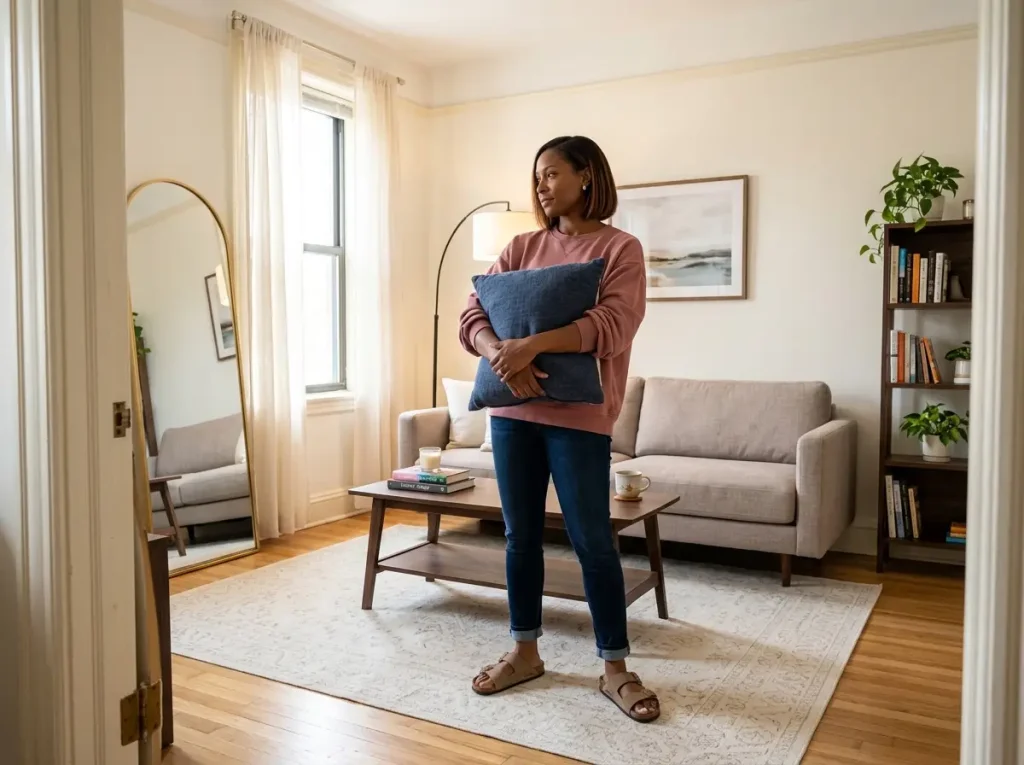
You’ve rearranged the furniture three times this year. Pushed the sofa tighter against the wall. Swapped in a smaller coffee table. Kept everything low-profile and out of the way. The room still feels like it’s closing in on you — and you can’t figure out why, because you’ve already done everything you’re supposed to do.
In the living room layouts I’ve put together, the pattern repeats: people apply the instinctive fixes (smaller furniture, everything against the walls, a small rug to “not overwhelm” the space) and get the opposite result. The visual expansion of a small living room has almost nothing to do with those instincts — and everything to do with five specific mistakes you can reverse. These fixes work best when your baseline layout is already solid — if you haven’t set the layout foundation yet, start with small living room layout rules first.
Here are the five things that actually shrink a small living room, and the exact fix for each — including the renter-friendly version of all of them.
Quick Answer: Here’s what actually makes a small living room look bigger:
- Use a rug that’s at least 8×10 — too-small rugs fragment the room and make it feel cramped
- Place a large mirror across from a window, not across from a wall
- Light every dark corner with a warm-toned floor lamp (2700K)
- Hang curtains at ceiling height, not window height — and extend the rod 6–12 inches past the frame
- Pull furniture 2–4 inches off the walls instead of pushing it against them
- Keep walls, trim, and soft furnishings in the same color family to eliminate visual stop points
The Rug Mistake That’s Making Your Living Room Look Smaller
Why a Small Rug Makes the Room Look Smaller
Your first instinct for a small room is a small rug. Makes sense — until you see it on the floor. A 5×7 rug in a 12×14 living room creates 3–5 feet of bare floor on every side. The furniture floats around this little island in the center of the room, disconnected from each other and from the rug itself. The bare floor doesn’t disappear — it becomes more visible than before, because now there’s a clear boundary showing you exactly how much empty floor surrounds the seating area.
This is what designers call a rug island — and it visually fragments the room into disconnected zones. Your sofa sits in one zone. The chair drifts into another. The space between them reads as wasted rather than open. The rug was supposed to tie the room together. Instead, it divided it.
You’ll know this is your problem when you stand in the doorway and your eye keeps stopping at the rug’s edge instead of traveling across the room. That stop-and-restart pattern is what makes the room feel smaller than its actual square footage.
The Size Formula and the Perimeter Rule
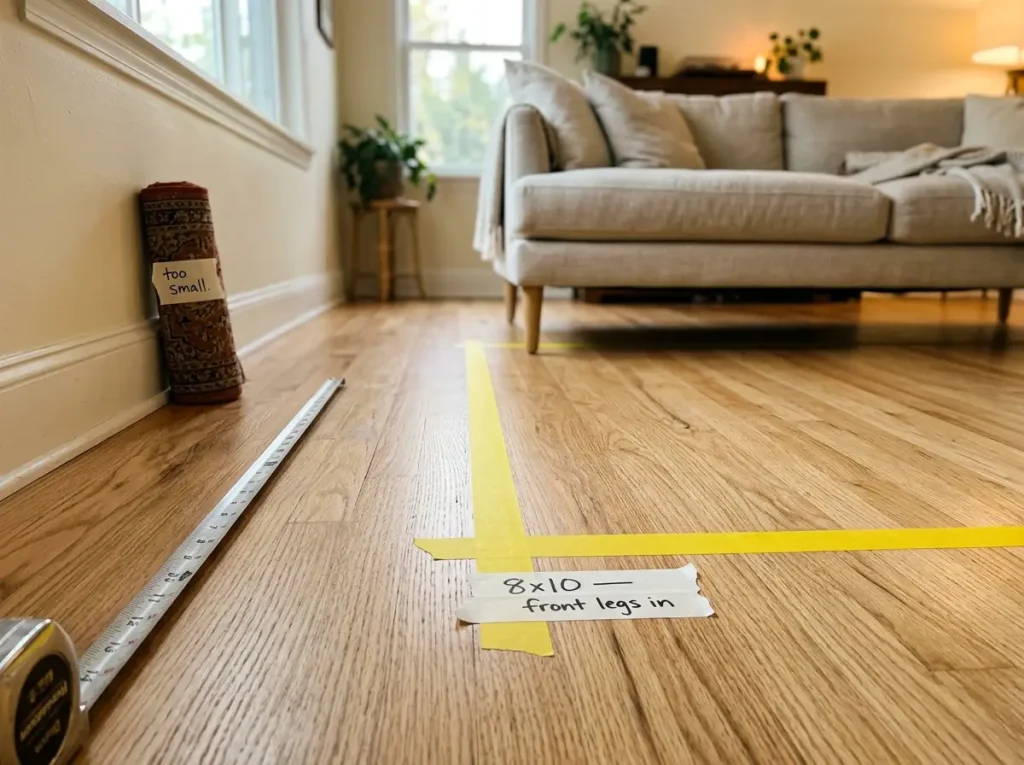
Here’s the formula that actually works. For rooms 10×12 to 12×14 feet — the size of most apartment living rooms — the minimum rug size is 8×10. For rooms 12×14 or larger, step up to a 9×12. Leave 12–18 inches of bare floor between the rug edge and the wall on all four sides, per standard living room furniture clearance measurements. That perimeter of exposed floor frames the rug without creating the massive bare-floor desert that makes the rug island problem worse.
The front-legs-on rule is the minimum: every sofa and chair should have at least its front two legs sitting on the rug. In a small room, ideally all four legs of every seating piece sit on the rug. This anchors the furniture group to the rug and reads as one cohesive arrangement instead of separate pieces drifting in different zones.
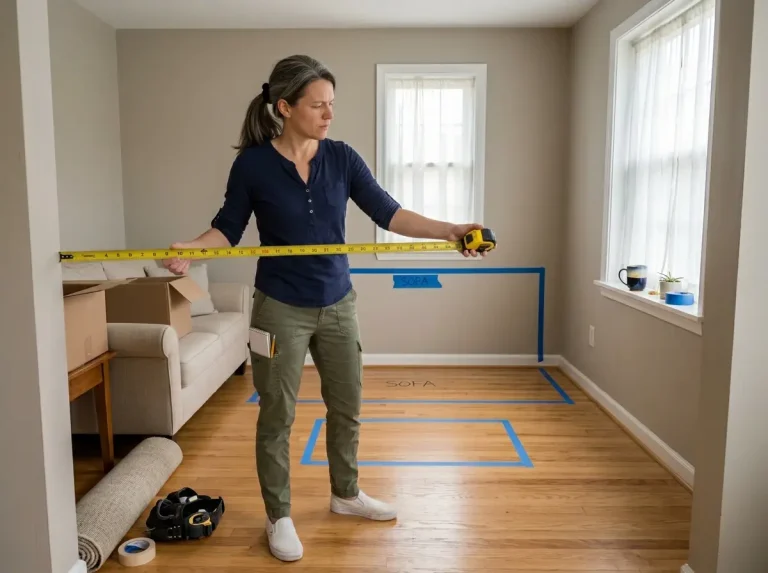
Before you buy anything, try the painter’s tape test. Mark the rug dimensions on your floor with painter’s tape — 8 feet by 10 feet, or whatever size you’re considering. Then sit on the sofa and look around. Does the tape frame the seating area? Can you see that 12–18 inch gap between the tape and the walls? This takes ten minutes and saves you the cost and hassle of returning an 8×10 rug that turned out to be the wrong fit.
The AMADA HOMEFURNISHING 8×10 Washable Area Rug is a solid starting point — 8×10, low-pile, non-slip backing, and washable (which matters in a high-traffic living room). But honestly, the size matters more than the brand here. Any 8×10 flat-weave rug at a budget price point anchors a room the same way — what you’re paying for is the square footage, not the logo.
Pro tip: If you already own a rug that’s too small, layer it on top of a larger, inexpensive jute rug in a neutral tone. The jute extends the visual plane and the accent rug adds texture on top — no returns required.
Choosing the Right Rug for a Small Space
Not all 8×10 rugs create the same visual effect. Low-pile, flat-weave rugs in light or neutral tones — ivory, beige, soft gray — reflect light and make the floor feel continuous with the room. High-pile rugs and dark-colored rugs absorb light and visually compress the floor area, which is the opposite of what you need in a small space.
A subtle pattern works. A busy, high-contrast pattern creates visual noise that makes the space feel cluttered even when it’s clean. One geometric or vintage-style pattern in neutral tones adds texture without competing with the rest of the room for your attention.
People buy a rug that “looked big at the store” and get home to find it looks like a postage stamp on the living room floor. That’s because you judge rugs relative to the store’s warehouse ceiling and open floor plan. Your apartment is a different frame of reference entirely — which is why the painter’s tape test matters more than any in-store impression.
The rug change makes the single biggest visual difference in a small living room. And pairing it with reducing visual clutter in the rest of the room compounds the effect.
Mirrors and Light: The Fastest Visual Expansion Moves
Where to Place a Mirror So It Actually Expands the Room
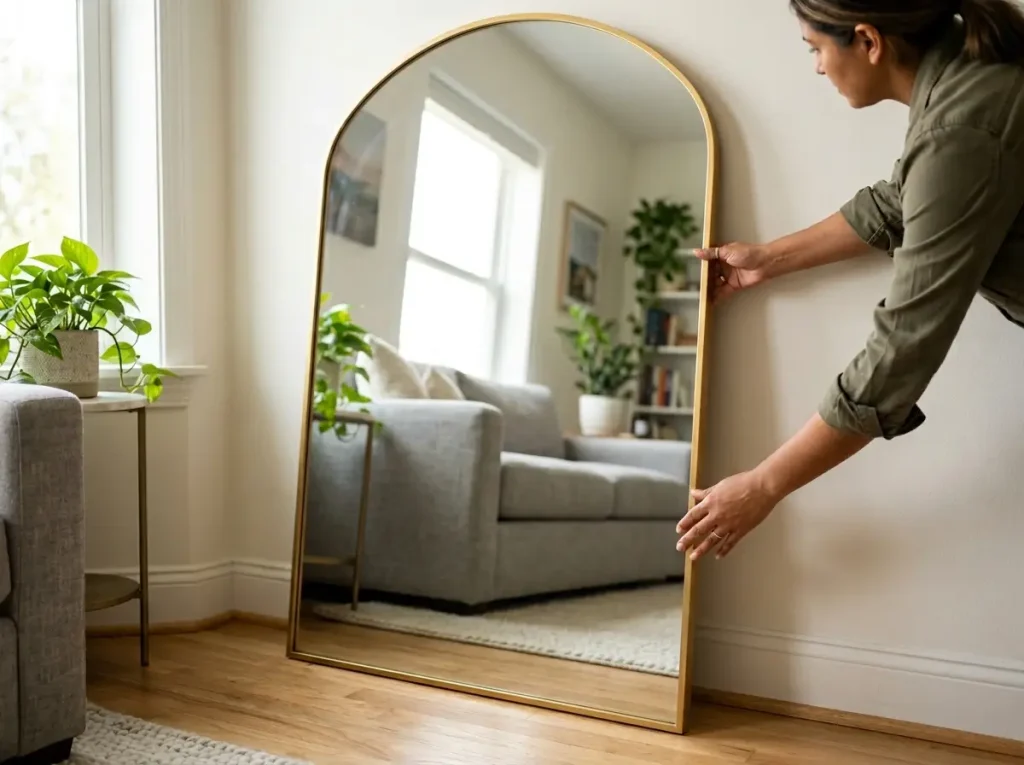
Mirrors get recommended for small rooms everywhere. What rarely gets explained is that placement determines whether a mirror actually works or just reflects your furniture back at you. The rule is straightforward: position a mirror across from a light source — a window, a lamp, an open doorway that gets natural light. A mirror facing a blank wall doubles the wall. A mirror facing a window doubles the light and the perceived depth of the room.
Size determines whether a mirror expands or just decorates. A small round decorative mirror on the wall doesn’t expand anything — it looks nice. For real visual expansion, you need a floor-length mirror large enough to reflect a meaningful section of the room. The Dewfig Arched Full Length Mirror (76″x34″) is the format that works — 76 inches tall, wide enough to reflect actual room depth, and it leans against the wall with zero hardware. Gold or black frame, lightweight aluminum alloy. The tradeoff: at 34 inches wide, it takes up real wall space, so it fits best in a corner or beside a window rather than centered on a narrow wall.
A 76-inch mirror leaning against the corner wall near your window creates the perception of a second window where there isn’t one. You feel the difference the first afternoon — the room reads as though it extends past the wall.
The Dark Corner Fix
Every living room has at least one corner that doesn’t get direct light. That dark corner isn’t just dim — it visually pulls the wall inward and shrinks the perceived size of the room. Your eye reads the lit areas as “the room” and the dark areas as “the boundary.” Push that boundary back with light and the room feels larger without moving a single piece of furniture.
The fix is a floor lamp aimed upward into the problem corner, set to warm light between 2700K and 3000K. Cool white bulbs (4000K and above) make small rooms feel clinical and flat. Warm light adds depth and makes the corner feel intentional rather than forgotten.
The SUNMORY Arc Floor Lamp handles this well — the arc head positions light over your seating area and into the corner from a single lamp, and it has three color temperature settings including the warm 2700K you want for a living room. It plugs in and takes up about one square foot of floor space. The downside: the arc head extends roughly 24 inches from the base, so measure your corner before committing. If you don’t need the arc reach, any basic torchiere-style floor lamp with a warm-toned bulb fixes the same problem at a lower price.
Pro tip: Walk to your doorway and scan the room. If one corner reads as noticeably darker than the rest, that’s the one stealing your visual square footage. One warm lamp there changes the entire room’s feel.
The same principle that makes lights in corners work applies to storage — using vertical space without drilling keeps the floor clear and makes the room feel taller at the same time.
Layering Light Sources
A single overhead light — the ceiling fixture that came with the apartment — flattens the room. It casts even light across every surface and wipes out the depth cues your eye uses to judge space. Flat light makes small rooms look smaller because there’s no visual dimension to read.
The minimum for a small living room is three light sources: the overhead fixture (or a replacement), one floor lamp per dark corner, and at least one table lamp at a different height. This creates overlapping pools of warm light with soft shadows between them — and those shadows are what give the room depth. You’re not just illuminating the space. You’re adding dimension.
Most apartments come with one ceiling light and zero floor lamps. Adding two plug-in lamps — one in each dark corner — takes ten minutes and changes the room more than you’d expect from something that doesn’t involve moving furniture.
Color Without Paint: The Approach That Actually Works
Why High Contrast Shrinks the Room
“Just paint it white” is the standard advice for small rooms. It’s not wrong — but it’s incomplete. Wall color helps, but the contrast between the wall and the trim is what creates the visual stopping points that chop up a room. Paint the walls white and keep the trim in a different sheen of bright white, and you’ve created a visible line where the wall meets the molding. That line tells your eye: stop here. And every stop point reduces how far your eye travels, which reduces the perceived size.
The fix is a monochromatic approach — walls and trim in the same color or the same undertone family. When the wall flows into the molding without a visible contrast line, your eye travels uninterrupted from floor to ceiling. The room reads as one continuous surface instead of segmented panels.
Soft warm off-whites, light greiges, and even muted sage greens work — as long as the whole room is coordinated. High contrast between light walls and dark trim does the opposite. If you’re choosing a color, pick one that works for both the wall and the trim, and paint both.
Coordinating Soft Furnishings Instead of Paint
If you can’t paint — and most renters can’t — you can get a similar effect through your soft furnishings. Keep the sofa, curtains, rug, and throw pillows in the same color family. All warm neutrals. Or all cool neutrals. The specific shade matters less than the consistency across pieces.
When everything reads as one cohesive palette, the room feels unified and open. When your sofa is gray, your curtains are beige, your rug is navy, and your pillows are terracotta, your eye bounces between four separate color zones and the room fragments visually. You don’t need matching — you need a family.
People buy neutrals thinking they’ll automatically coordinate. They don’t. A warm beige sofa next to cool gray curtains looks off — not wrong enough to notice during the purchase, but wrong enough to make the room feel disconnected after you’ve lived with it for a few weeks. Hold fabric swatches next to each other in natural light before committing. If one reads warm and the other reads cool, they’re fighting each other.
Removable peel-and-stick wallpaper on one wall creates a focal point that draws the eye to a specific spot rather than bouncing between four plain walls. This works for renters — the adhesive comes off clean when you move.
The same principle applies to choosing furniture colors for a small apartment living room — consistency across the color family matters more than any individual piece.
The Vertical Illusion: Curtains, Height, and the Eye Trick That Works
The Curtain Height Rule (With Specific Numbers)
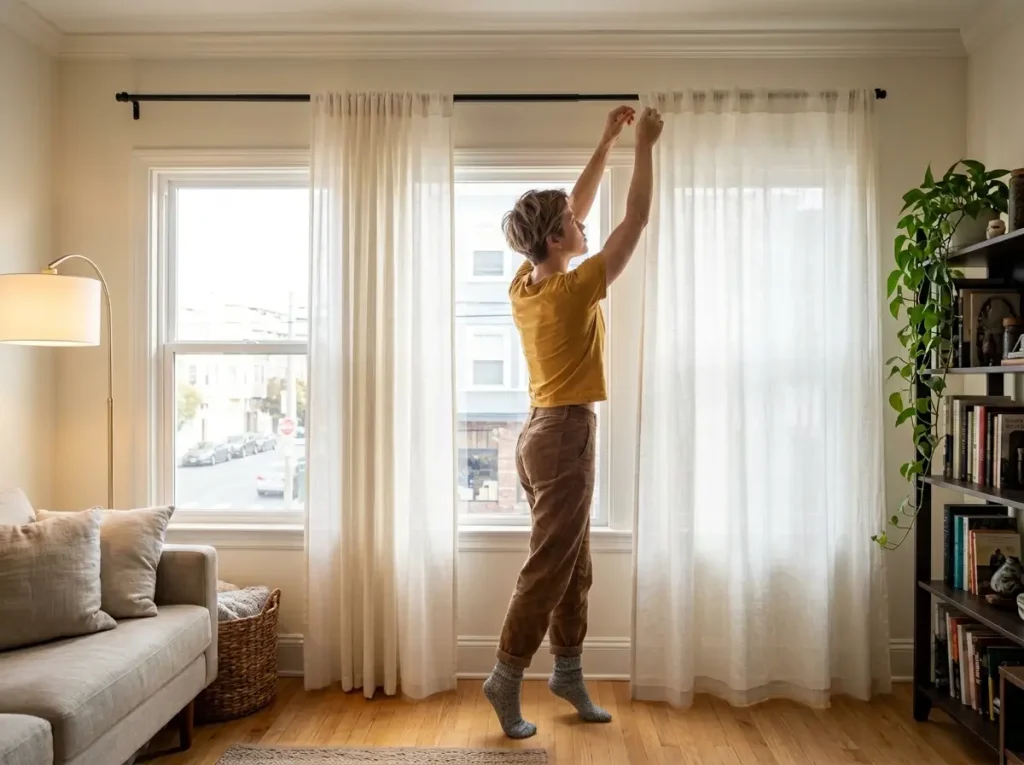
A room with curtains hung at the top of the window frame looks like a room with windows. A room with curtains hung near the ceiling looks like a room with tall windows. Same curtains. Different rod position. Here are the numbers: hang the rod 4–6 inches below the ceiling molding, not at the window frame. Extend the rod 6–12 inches past the window frame on each side.
This makes the window appear both taller and wider than it actually is. The curtain length should run floor-to-ceiling — ending exactly 1 inch above the floor. Curtains that stop at the window sill or mid-wall cut the vertical proportion in half and actually make the ceiling feel lower than it is.
Sheer or light fabrics work best for small rooms because they let light through while maintaining the height illusion. If you need blackout curtains for sleep or light control, still hang them at ceiling height — you get the vertical effect even when they’re open during the day.
Pro tip: Measure from your ceiling molding down 4 inches and make a small pencil mark. Then measure from that mark to 1 inch above the floor — that’s your curtain panel length. Buying panels that are “close enough” is how you end up with curtains that puddle on the floor or hover awkwardly six inches above the baseboard.
Tall Furniture as a Visual Anchor
Your eye follows the tallest object in a room. If every piece of furniture sits at 30 inches or lower — standard sofa and coffee table height — the eye stays in the bottom half of the room and the upper half reads as dead space. That makes the ceiling feel lower than it is. One tall, narrow piece of furniture in a corner changes the whole proportion.
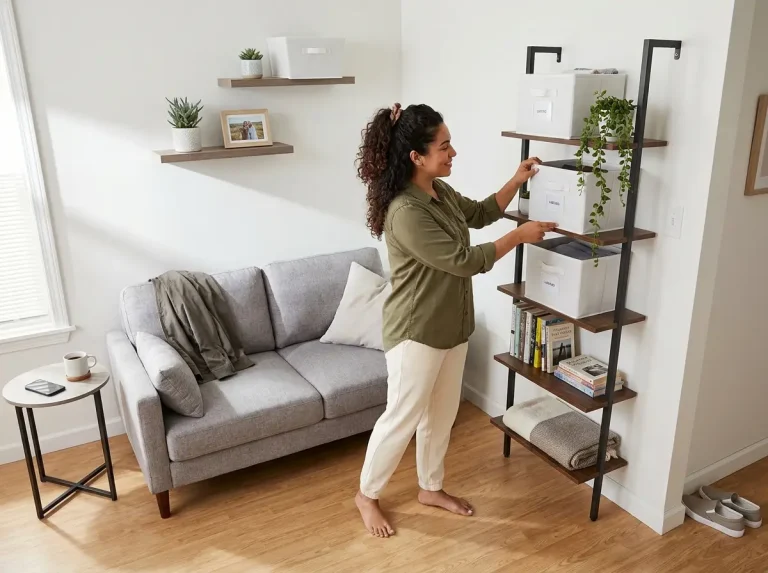
The VASAGLE 5-Tier Narrow Bookshelf (11.8″D x 13.3″W x 66.9″H) does this right — 66.9 inches tall pulls the eye toward the ceiling, and at only 13.3 inches wide, the floor footprint stays minimal. Put it in a corner with a trailing plant on the top shelf and books on the middle shelves, and you’ve created a vertical anchor that makes the whole room feel taller. It comes with an anti-tip strap that attaches to the bookshelf base (not the wall), so it’s deposit-safe for renters.
The narrow width is the detail that makes this work. A wide bookcase fills the wall and adds visual weight. A narrow one draws the eye up without eating into the room’s horizontal real estate.
Low-Hanging Artwork and Other Height Killers
Standard advice says hang art at “eye level” — about 57 inches from the floor. In a small living room, push it higher. Art hung at 65–68 inches center height creates vertical emphasis and draws the eye above the furniture line. It feels intentional, not wrong — your eye reads it as the room having more vertical space to fill.
Other height killers to watch for: curtains that stop at the window frame (covered above), wide low-profile furniture that hugs the floor with no visible legs, and squat storage cubes that keep all the visual weight in the bottom third of the room.
Furniture with visible legs at least 6 inches tall shows floor beneath it, which reads as more open space. A sofa on stubby 2-inch legs looks heavier than the exact same sofa on 7-inch tapered legs — the dimensions are identical, but the visual weight is completely different. You see floor, you read space.
The vertical choices here work best alongside good furniture arrangement in a small living room — the height illusion reads strongest when the floor plan is already functioning well.
The Renter’s Full Toolkit: All of This Without a Single Hole in the Wall
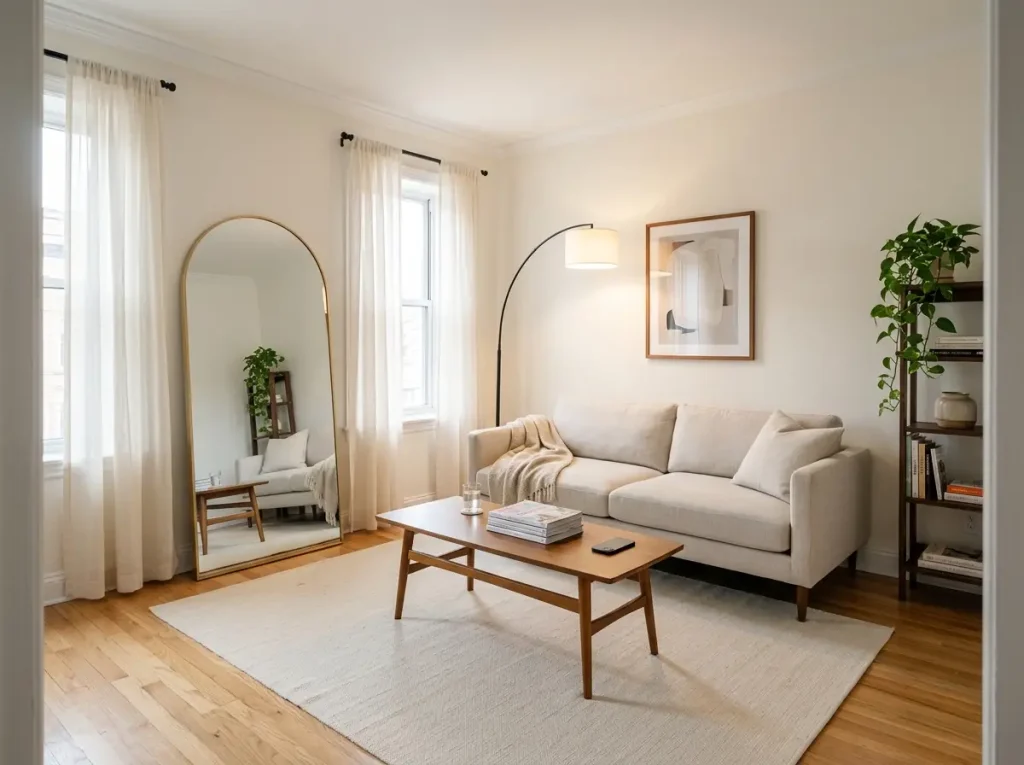
No-Drill Mirror and Curtain Setup
Half the tips in every “make your room look bigger” article assume you can drill into walls, mount hardware, or repaint. If you’re renting, you probably can’t — or won’t risk the deposit. Here’s the thing: every technique in this article has a renter-safe version that works just as well.
Mirrors: the leaning format from the mirror section needs zero hardware. A 76-inch arched floor mirror leans against the wall, repositions when you rearrange, and leaves no marks. You move it when you move apartments.
Curtains: a tension curtain rod replaces the traditional rod-and-bracket setup entirely. The ALLZONE Tension Curtain Rod (83–123 Inches) spring-loads into your window frame — no drilling, no screws, no wall damage. The 83–123 inch adjustable range covers most apartment living room windows. Hang it at ceiling height with sheer panels and you get the full vertical illusion from earlier in this article. The limitation: tension rods hold sheer and lightweight curtain panels reliably, but heavy blackout curtains can cause slippage over time. If you go blackout, check the rod’s grip every few weeks.
The same no-drill organizing approach that works in rental closets applies here — tension, adhesive, and freestanding solutions instead of permanent hardware.
Lighting and Color for Renters
Floor lamps and table lamps are plug-in by default — no ceiling work, no electrician, no landlord conversation needed. The arc floor lamp from the lighting section stands on the floor and plugs into a standard outlet. If outlets are limited in the problem corner, battery-powered stick-on puck lights fill the same dark-corner role without any wiring.
For color without paint, go back to the soft furnishings approach: keep sofa, curtains, rug, and pillows in the same warm or cool neutral family. The room reads as cohesive without touching a single wall. Removable peel-and-stick wallpaper on one accent wall adds a design layer that makes the room feel intentional — and it peels off clean when your lease ends.
If you’re also thinking about furniture upgrades, multi-functional furniture for small apartments covers the specific pieces that work hardest in small rental spaces.
The 10-Minute Monthly Reset
Here’s the part nobody mentions about any of these changes. They drift.
Furniture drift is real — the sofa gets pushed back against the wall when someone vacuums. The coffee table gets nudged forward every time someone walks past it. The throw pillows accumulate on one end. Within three months, the floating arrangement you spent a Saturday perfecting looks exactly like it did before.
The rug shifts. Surfaces collect mail, remotes, a laptop charger, and three half-read books. The sightlines you opened up get blocked by stuff that accumulated so gradually you didn’t notice.
The fix isn’t a one-time weekend project. It’s a 10-minute monthly reset: push the sofa back to its floating position (2–4 inches from the wall), clear every flat surface to its baseline, check that the rug hasn’t shifted off-center, and confirm the mirror is still angled toward the light source.
Walk to the doorway and scan. Does the room feel open? Good. Does your eye keep stopping somewhere it shouldn’t? Fix that spot.
Ten minutes, once a month. This is the difference between a room that stays open and a room that reverts to cramped by September. The arrangement was fine. The maintenance didn’t exist — and that’s why most “room makeovers” quietly undo themselves within a season.
Conclusion
Three things move the needle most. First, start with the rug — if yours is under 8×10 in a standard apartment living room, swap it or layer a larger one underneath. Use painter’s tape to confirm the size before you spend anything. Second, add height wherever you can — curtains at ceiling level, a tall narrow shelf in the corner, art hung above the standard 57-inch mark. Vertical emphasis does more for perceived space than any single color decision. Third, light the corners — one warm floor lamp per dark corner at 2700K prevents the visual compression that unlit corners create.
Three months from now, check that the sofa hasn’t migrated back against the wall and that your flat surfaces haven’t collected enough clutter to block the sightlines across the room. Five minutes of course correction is all it takes.
Start with the rug if you haven’t already. Tape it out on the floor this weekend — that’s the test that takes ten minutes and tells you everything.
Q1 What color makes a small living room look bigger?
Soft warm off-whites and light greiges work best — but consistency matters more than the shade. Paint walls and trim the same color to eliminate the contrast line where the wall meets the molding. That visual stop point is what actually chops up the room and makes it feel smaller.
Q2 What size rug should I get for a small living room?
An 8×10 rug is the minimum for most apartment living rooms (10×12 to 12×14 feet). For rooms 12×14 or larger, go to 9×12. Leave 12–18 inches of bare floor between the rug edge and the wall, and keep at minimum the front legs of your sofa and chairs on the rug.
Q3 How can I make my living room look bigger without buying new furniture?
Pull your sofa 2–4 inches away from the wall, lean a large mirror across from your main window, and put a warm floor lamp in your darkest corner. Those three low-cost or zero-cost moves make a visible difference without replacing any furniture.
Q4 Does a large sofa make a small living room look smaller?
Not necessarily. A right-sized apartment sofa (around 72–76 inches wide) with exposed legs won’t feel heavy. What makes a sofa look large is no visible clearance from the floor. Furniture with 6+ inches of exposed leg shows floor beneath it, which reads as more open space.
Q5 How can I make my apartment living room look bigger without painting?
Keep your sofa, curtains, rug, and pillows in the same color family so the room reads as one cohesive palette. Add a large leaning mirror and hang curtains at ceiling height using a tension rod — both are renter-safe and both make the room feel noticeably larger without touching the walls.
Disclaimer: ClutterlessNest is a participant in the Amazon Services LLC Associates Program. As an Amazon Associate we earn from qualifying purchases. This article may contain affiliate links — if you buy through them, we may earn a small commission at no extra cost to you. We only recommend products we have tested or genuinely believe in.