Getting rid of your dresser is the right call — until the first morning you can’t find a matching pair of socks. The dresser was doing real work: it held your folded clothes, it corralled socks and underwear, and it gave your accessories somewhere to live that wasn’t the floor. Your closet can handle all of that, but only if you solve those same three problems on purpose. These nine ideas walk you through a complete dresser-free closet system that holds up past the first week.
Quick Answer: A dresser-free closet works when your rod, your floor, and your closet door all carry clothing load — not just the rod. Work through these in order and the system holds.
- Do a wardrobe edit first: three piles (Keep, Donate, Out)
- Switch to slim velvet hangers; add a second rod below for folded jeans
- Hang a shelf organizer from your rod for t-shirts; add floor cubes for jeans and loungewear
- Use an over-door organizer on the closet door — assign every pocket a specific category
- Use shelf dividers for sweater stacks; store seasonal items in labeled top-shelf bins
- Run a 10-minute monthly reset using the backward hanger test
Your Closet Can Replace a Dresser — If You Solve Three Problems First
Closets are built for hanging. Every standard reach-in closet gives you a rod, a shelf above it, and a floor below — none of which was designed for the folded, rolled, and small-item storage a dresser handles. That’s why most dresser-free setups fall apart: someone adds a hanging shelf organizer and calls it done, then spends the next six months digging for socks in a bin on the closet floor.
The three problems your dresser was solving
A dresser handles three distinct jobs. First, it holds your folded clothes — t-shirts, knits, jeans — in a way that makes each item visible and accessible without disrupting the rest. Second, it keeps small items contained: socks, underwear, bras, all in their own drawers so they don’t scatter. Third, it gives accessories a home — belts, scarves, sunglasses, all the small things that end up on a nightstand or a chair when there’s no dedicated spot. If your closet doesn’t solve all three categories, the system breaks down — not all at once, but incrementally. Folded clothes migrate back to laundry baskets. Socks colonize the nightstand. Accessories disappear until you find them behind the bed in March.
Start with a wardrobe edit — before anything else
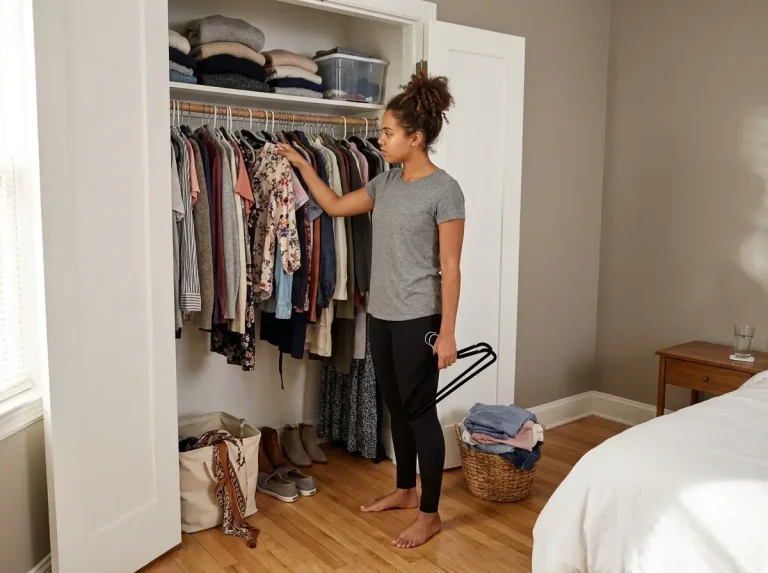
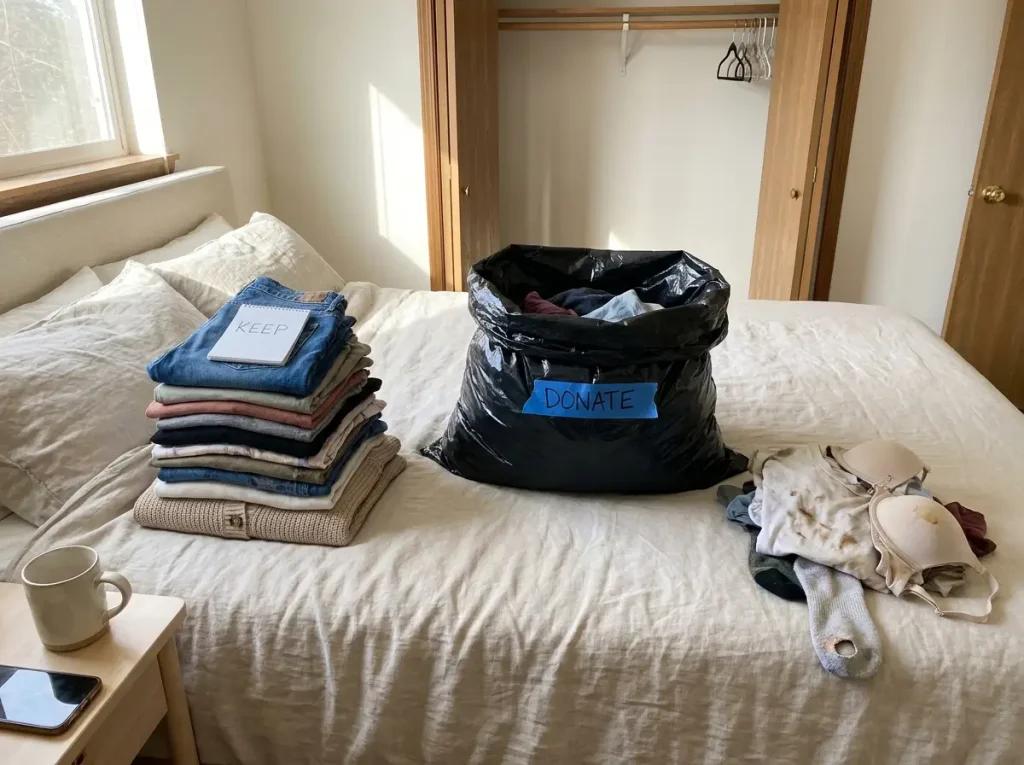
The closet you have right now has too much in it. Not because you’re bad at editing, but because closets accumulate the way junk drawers do — slowly, item by item, until the rod is so packed you can’t see individual garments. NAPO (the National Association of Productivity and Organizing Professionals) consistently identifies wardrobe editing as the prerequisite step before any storage system goes in — not because it’s philosophically satisfying, but because you cannot design a functional system around a volume of clothes the space can’t physically hold. Pull everything out. Three piles: Keep, Donate, Out. The Out pile is for anything worn through, stained, or broken beyond use. The Donate pile is for anything you haven’t worn in over a year or that no longer fits. If you hesitate on an item, it goes in Donate. You can work through the full wardrobe edit process step by step — but the working rule is simple: after the edit, your rod should have visible breathing room between every hanger. If it doesn’t, the edit isn’t finished.
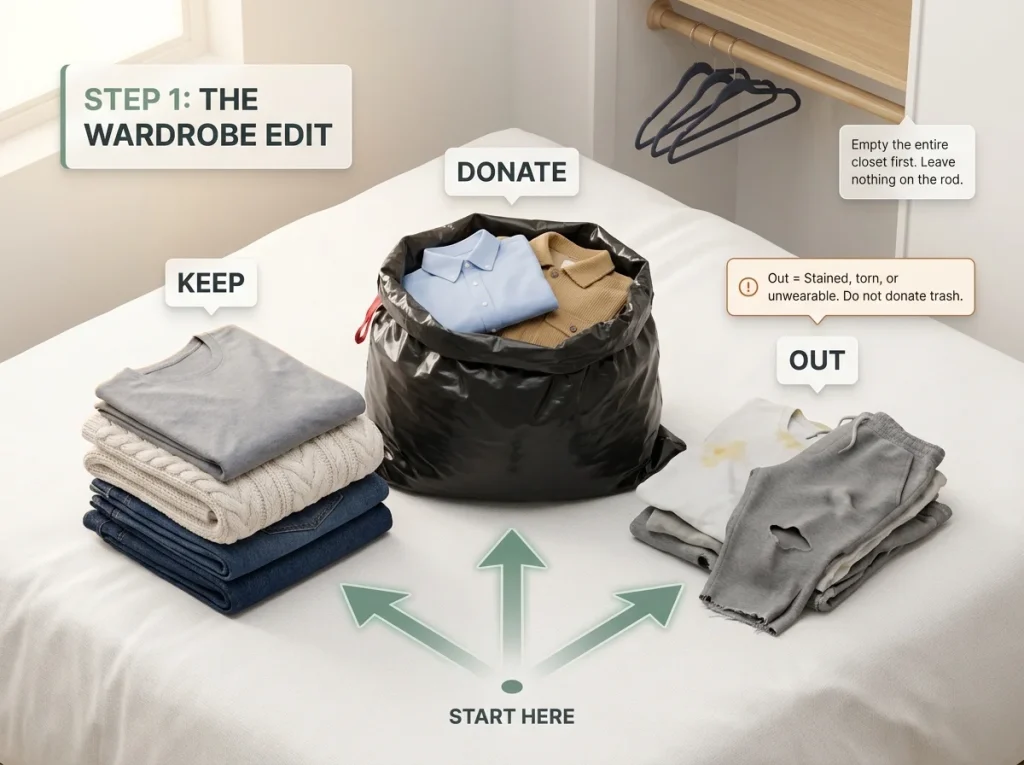
Pro tip: The edit feels slower than buying organizers, but it’s faster in practice. An hour of editing saves you three months of adjusting a system packed too tight to actually function.
Ideas 1–2: Reclaim Your Hanging Rod First
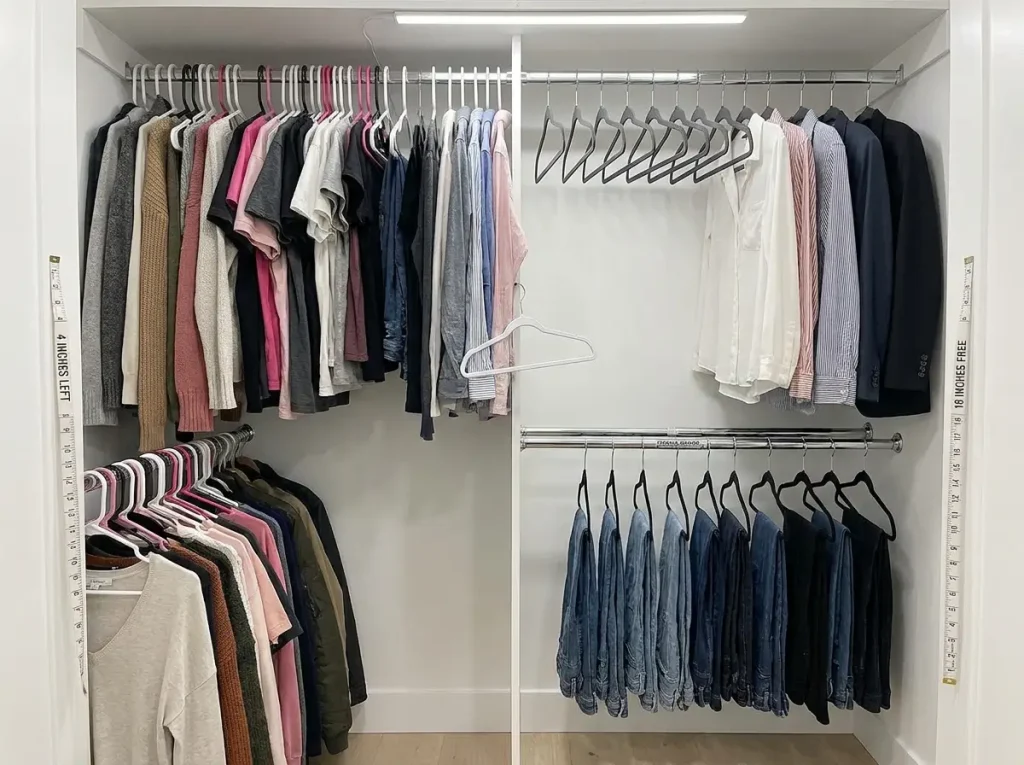
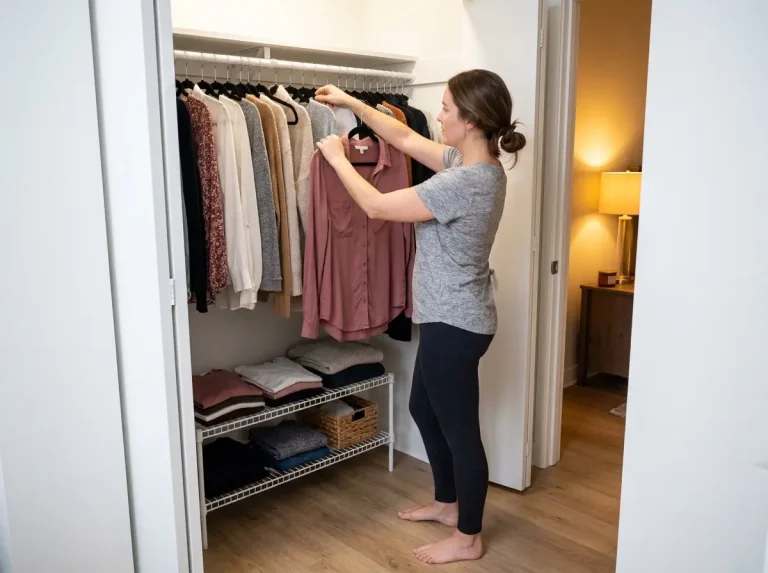
Your rod is doing half the work it could. In a standard 36-inch-wide reach-in closet with a single rod at about 66 inches from the floor, most people load it with thick plastic hangers crammed together — which means moving five garments to reach the one you want. These two ideas fix the rod zone before anything else goes in, because every other organizer in the system depends on having a rod that isn’t at capacity.
Idea 1: Switch to velvet hangers
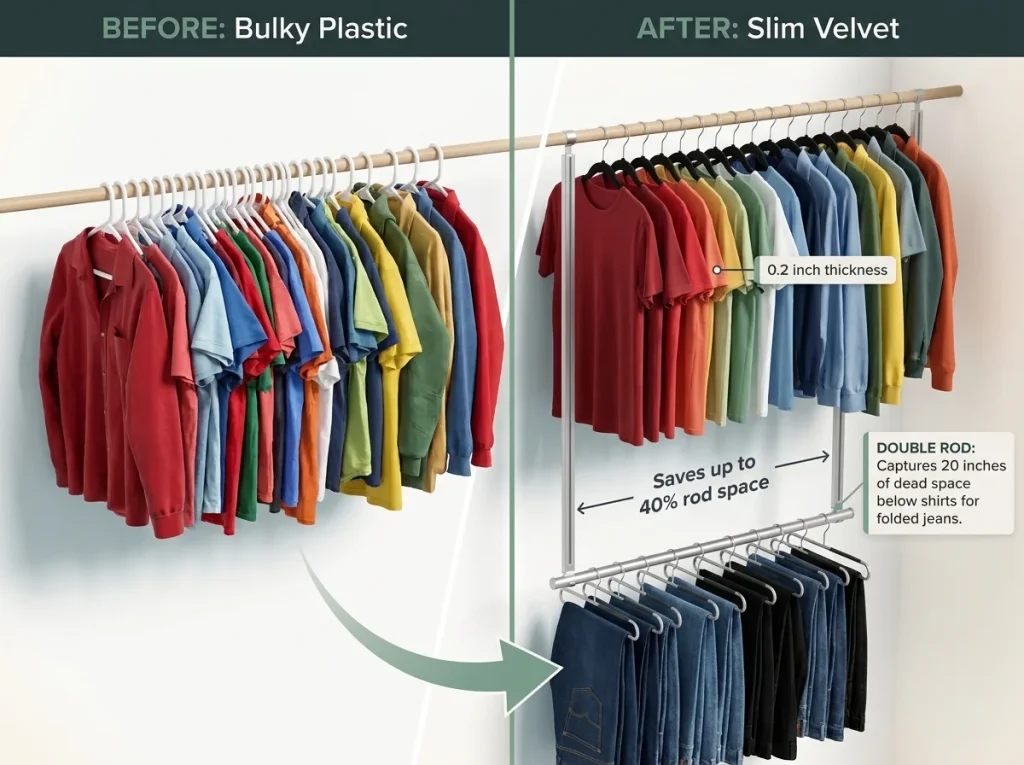
Plastic hangers run 2–3 inches wide per hanger. Standard velvet hangers run about 0.2 inches. On a 36-inch rod holding 30 garments, switching from plastic to velvet frees 11–14 inches of rod length — roughly 30–40% more usable space — without adding a single new organizer. You can compare slim hanger types side by side in a full tested breakdown, but for most closets the Zober Premium Velvet Hangers (50-pack, 17.5″W × 9.5″H × 0.2″ thick) are the right starting point — they don’t bend under weight, they grip fabric without leaving shoulder marks, and the hook swivels for easy one-handed access. One real limitation: heavy wool coats need a wider shoulder to keep their shape. Keep two or three wooden hangers specifically for those.
Idea 2: Add a second hanging rod
Once you have breathing room on the main rod, look at the space below it. Shirts hang at roughly 40 inches from collar to hem — which means the bottom 20+ inches below your shirts is completely empty air. A second rod installed under your main rod creates a lower tier for folded jeans draped over pant hangers, or for shorter items that don’t need full-length clearance.
The STORAGE MANIAC Adjustable Closet Double Rod (2-pack, 110 lb total capacity) hooks onto your existing rod — no drilling, no wall anchors. It adjusts for rods between 1.25 and 2 inches in diameter, so measure your rod before ordering (most standard closet rods are 1.25 inches). If you’re renting and this still feels like too much modification, the full no-drill closet system for renters covers additional options that work without touching any surfaces permanently.
Ideas 3–4: Where Your Folded Clothes Live Now
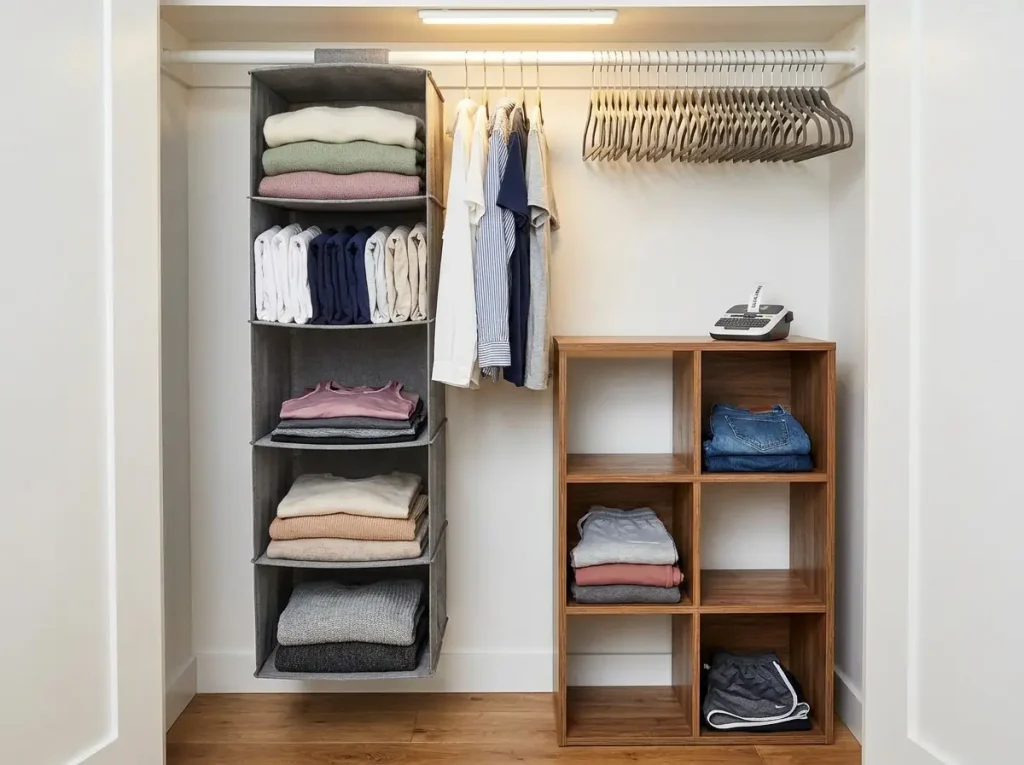
This is the section most people jump to first, which is why their systems fail. The folded clothes problem — where do your t-shirts, sweaters, and knits go when there’s no dresser? — has two answers, and you need both of them.
Idea 3: Hang a shelf organizer from your rod
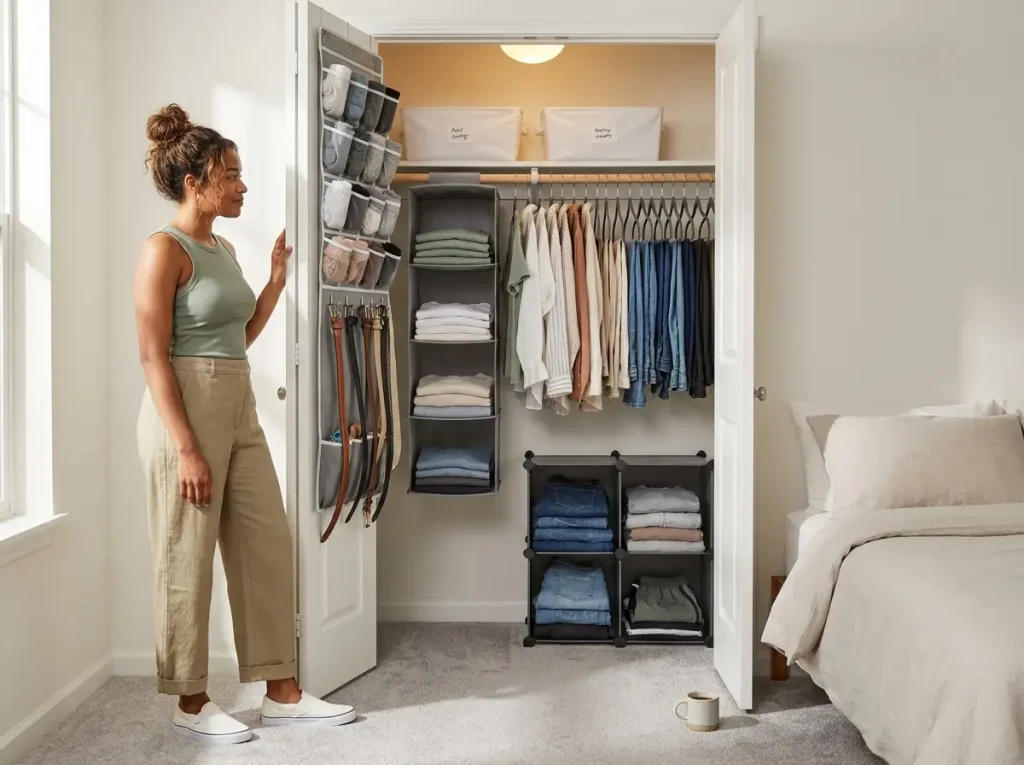
A hanging fabric shelf organizer clips to your existing rod and converts dead vertical space into five or six shelves of folded-clothing storage. The thing that makes this work is file-folding: instead of stacking items flat on top of each other the way you would in a dresser drawer, you fold each item into a small rectangle and stand them upright, side by side. Every item is visible at a glance. Grabbing one doesn’t disturb the others.
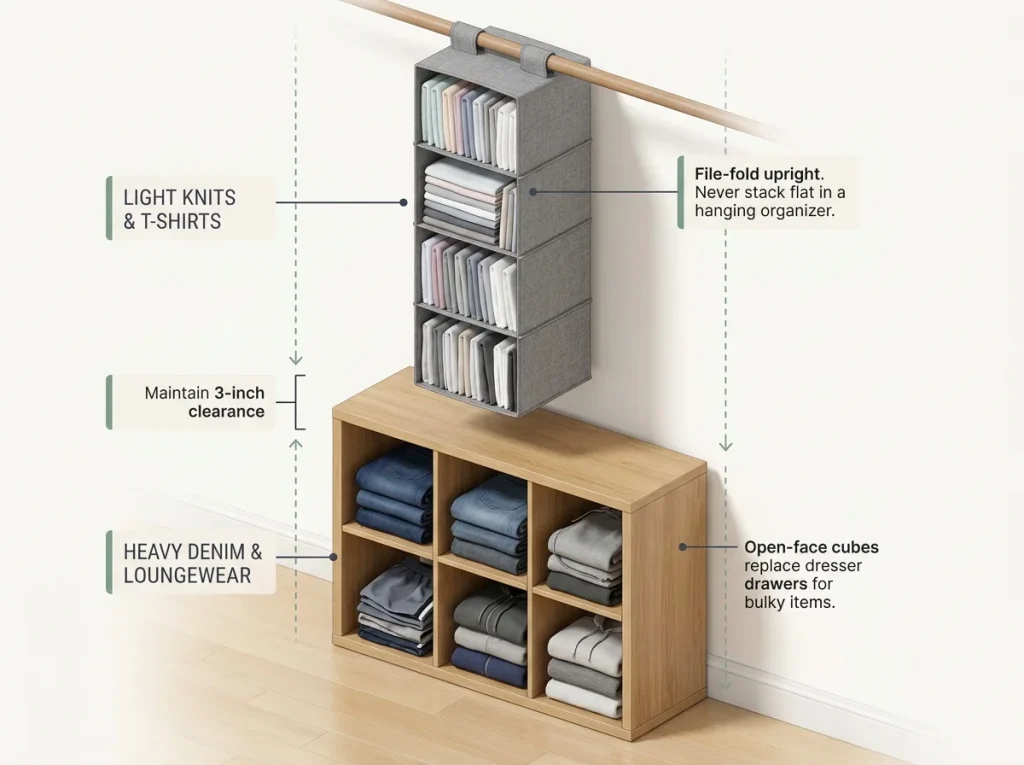
The YOUDENOVA Hanging Closet Organizer (5-shelf, grey) fits rods up to about 1.25 inches in diameter and clears the floor by roughly 3 inches at a standard 65-inch rod height — which matters if you need your floor zone clear for the cube organizer. One real limitation: the shelves are fabric, not rigid. If you overstuff them, the sides bow outward and items become harder to pull out cleanly. Six to eight file-folded items per shelf is the practical maximum before the shelf loses its shape.
Idea 4: Add a floor cube organizer for bulkier items
The hanging organizer handles lighter folded items well — t-shirts, workout tops, thin knits. It doesn’t work for folded jeans, loungewear pants, or gym shorts, which are heavier and thicker and slide off fabric shelves when file-folded. Those go in a freestanding floor cube organizer instead. Open-face cubes give you the dresser drawer experience — you see the contents immediately without opening anything — without the footprint a dresser requires.
The AWTATOS Stackable Cube Organizer (freestanding, 6-cube) uses a warm wood-grain melamine finish that doesn’t look like a storage product in a bedroom. Each cube handles two pairs of folded jeans stacked flat, or three pairs of gym shorts. No drawers, no handles, nothing to break or misalign.
Pro tip: Assign each cube before you put a single item in it. One cube = folded jeans. One cube = loungewear. One cube = gym gear. Without assignment, everything migrates to whichever cube is nearest, and the system becomes a re-sorting project every month instead of a grab-and-go setup.
Idea 5: The Socks-and-Underwear Problem (and the Assignment System)
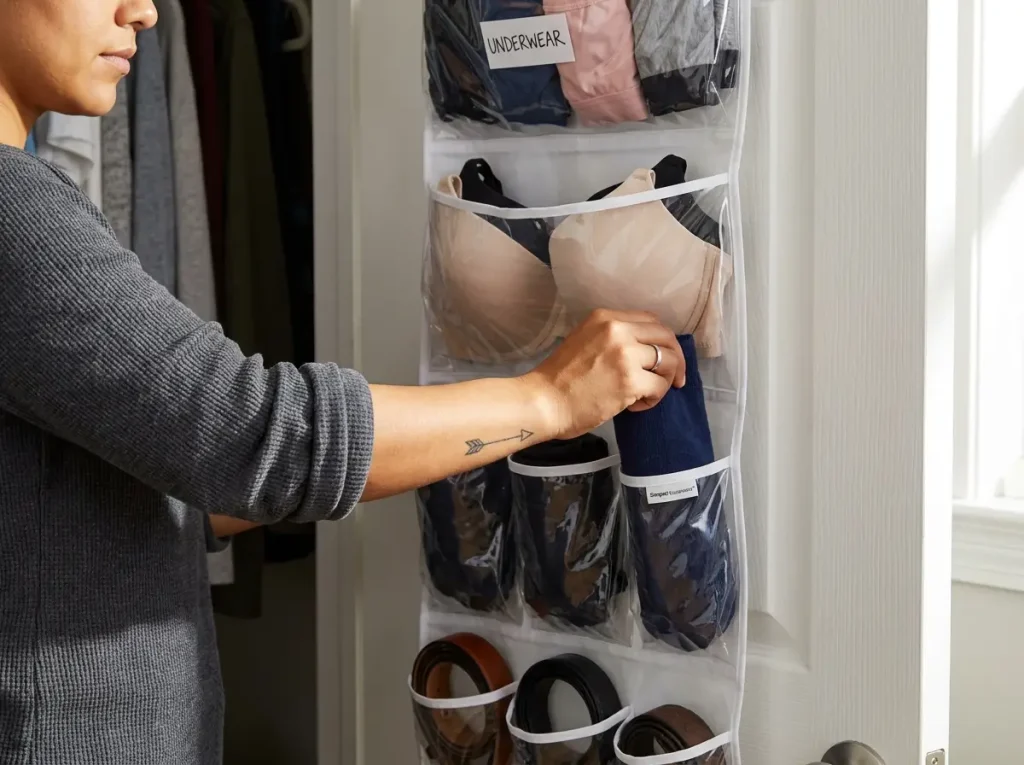
This is the part nobody plans for. Folded clothes go in the hanging organizer and the cube system — that’s the easy part. But where do socks and underwear go without a dresser? Most people end up with a bin somewhere. The bin works for about two weeks. Then people start putting things in the wrong section because a bin has no visible structure, and within a month it’s a pile you dig through every morning.
The over-door organizer with pocket assignment
An over-door organizer with 24 pockets turns the inside of your closet door into a fully organized small-items zone. The reason most people’s over-door organizers don’t stay organized is that they never assigned the pockets. Without assignment, pockets become a free-for-all that reverts to disorder within a week — same as the bin.
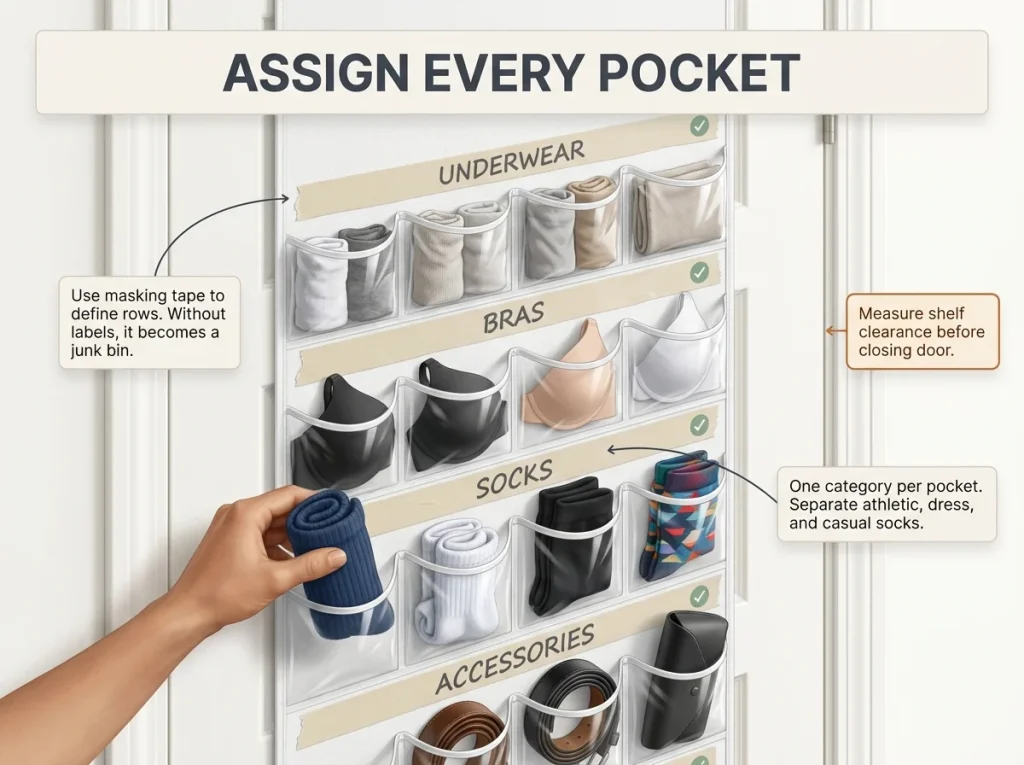
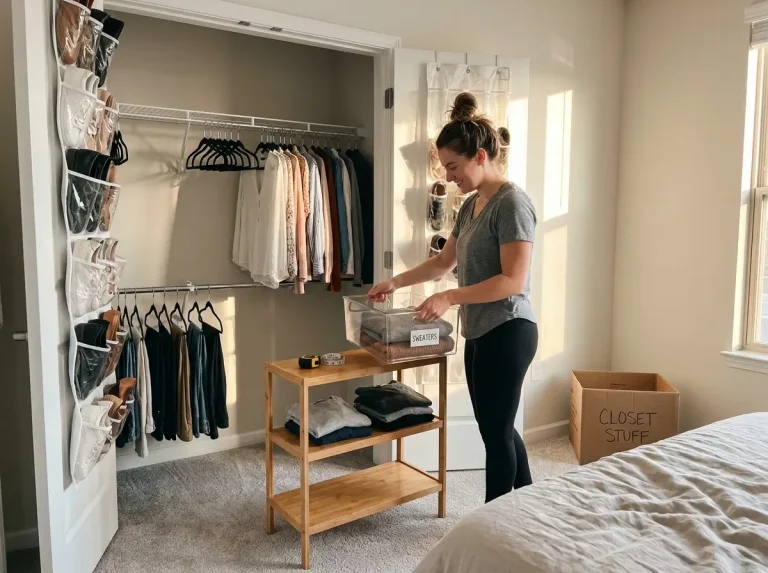
The assignment system takes three minutes to set up: rows 1–2 hold underwear and bras, rows 3–4 hold socks (assign one category per pocket — black socks, white socks, sport socks, each in their own pocket), rows 5–6 hold belts rolled into coils, sunglasses cases, and small accessories. Write the category label on a strip of masking tape and stick it at the top of each row. That label is what keeps every person in the household putting things back correctly instead of into the nearest pocket. The SimpleHouseware Over-the-Door Shoe Organizer (24 pockets) fits both hollow-core and solid-core doors. Before hanging it, measure the gap between the inside of your closet door and the nearest shelf edge — if the shelf extends more than 2 inches past the door frame, the organizer will contact the shelf when you close the door.
Ideas 6–7: The Shelf Zone and Seasonal Overflow
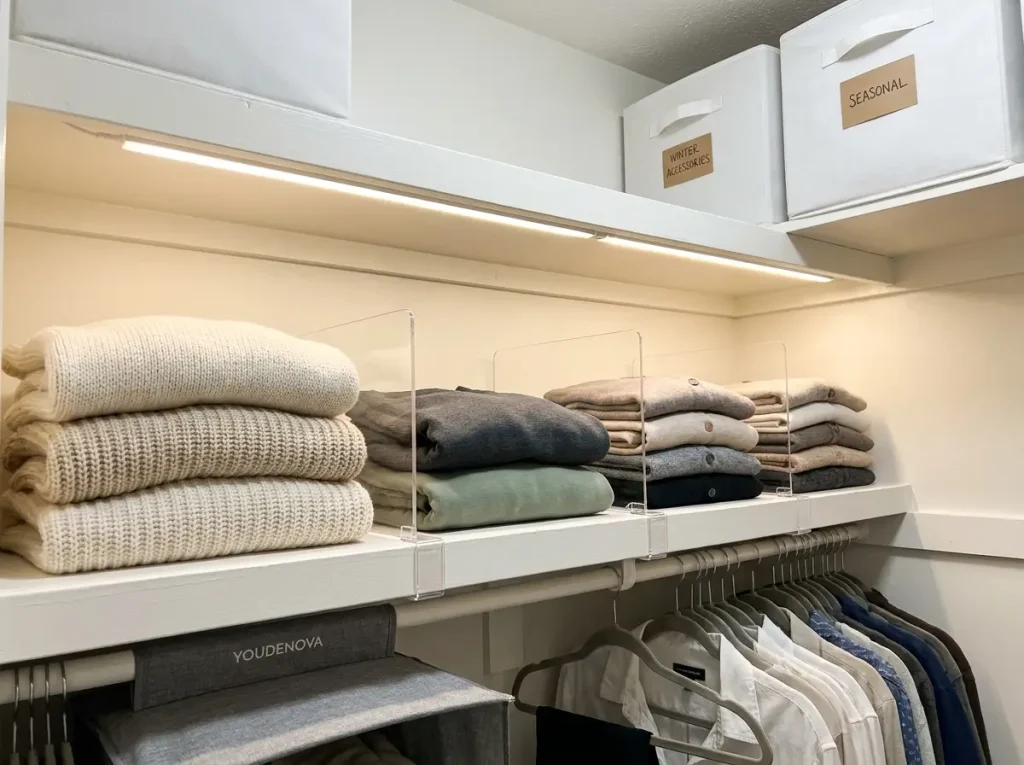
The shelf above your rod and the top shelf near the ceiling are probably doing one job right now: holding a half-collapsed stack of sweaters and a few items nobody has touched since last winter. These two ideas fix both zones.
Idea 6: Use shelf dividers for sweater stacks
Folded sweaters and sweatshirts on an open shelf fall over because there’s nothing holding the stacks upright on the sides. The stack tilts, the top item slides off, and within two weeks the shelf looks like a laundry pile again. Shelf dividers clip to the shelf edge and hold each stack between them — four dividers create three stable stacking columns on a standard 36-inch shelf.
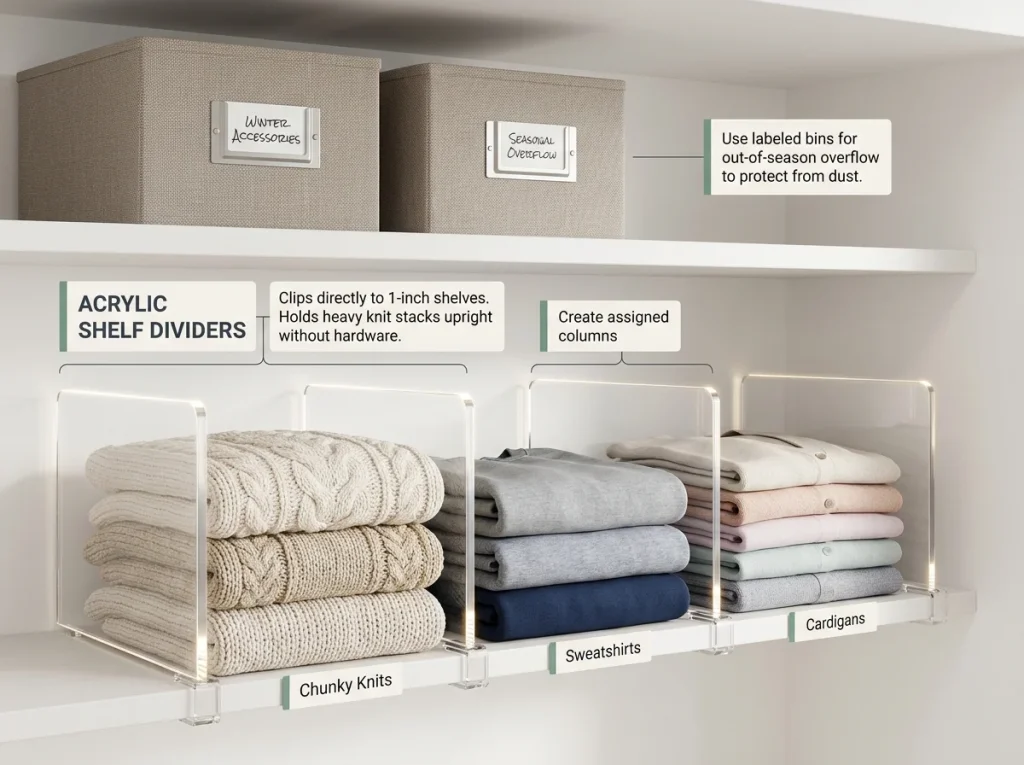
The HBlife Acrylic Shelf Dividers (6-pack, 15 lb capacity per divider) clip onto shelves up to 1 inch thick without any adhesive or screws. Clear acrylic disappears visually once installed — you see the clothes, not the hardware. Six dividers give you five organizing columns, which covers a 36-inch shelf with room to spare. For more detail on why shelf piles keep collapsing and how to fix the problem at the source, the closet shelf organization guide covers the full system.
Pro tip: Assign each column the same way you assigned the cubes and the door pockets. Left column = chunky knit sweaters. Middle = sweatshirts. Right = cardigans. The shelf stays organized because there are rules, not because you spend time re-sorting it.
Idea 7: Labeled bins for seasonal items on the top shelf
The top shelf near the ceiling is hard to reach and rarely accessed — which makes it useful for things you only need a few times a year. Two fabric bins with label holders (handwritten kraft-paper labels work fine) handle winter accessories and seasonal overflow without competing for space in the main zones. Put “WINTER ACCESSORIES” on one, “SEASONAL” on the other, and you’ve created a holding area for items that don’t need daily access. If you want a full seasonal swap strategy, including what should and shouldn’t go into vacuum bags, the seasonal closet rotation system covers the complete process.
Ideas 8–9: The Reset That Keeps All of It Working
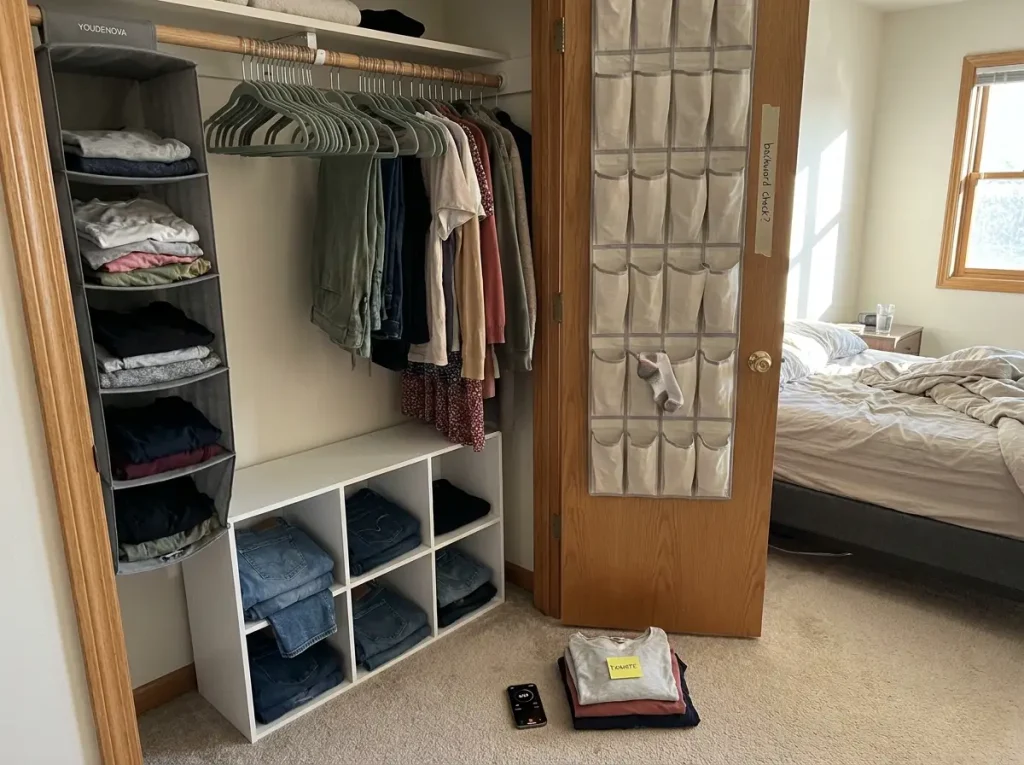
Any system that depends on perfect execution every single day will fall apart — because no one is perfectly consistent, every day, indefinitely. These two ideas replace “trying harder to be organized” with a maintenance structure that catches drift before it turns into a project.
Idea 8: The backward hanger test
At the start of each month, turn all of your hangers so the hook faces outward — toward you, instead of toward the rod. When you wear something and return it to the closet, hang it the normal way. After three months, everything still hanging backward is something you haven’t touched. That’s your next Donate pile. The test works because it makes non-use visible without requiring you to manually audit each item. You can look at the rod and immediately see drift. The full closet organization system covers how to run this test as part of a broader monthly audit.
Idea 9: The 10-minute monthly reset
Once a month, walk through each zone in order: rod, hanging organizer, cube organizer, door pockets, shelf. Each zone gets 60–90 seconds. Refold anything that’s out of shape. Return anything that migrated to the wrong spot. Pull anything that’s clearly ready to leave. The whole pass takes 10 minutes when you do it monthly. Let it go for three months and it becomes an afternoon.
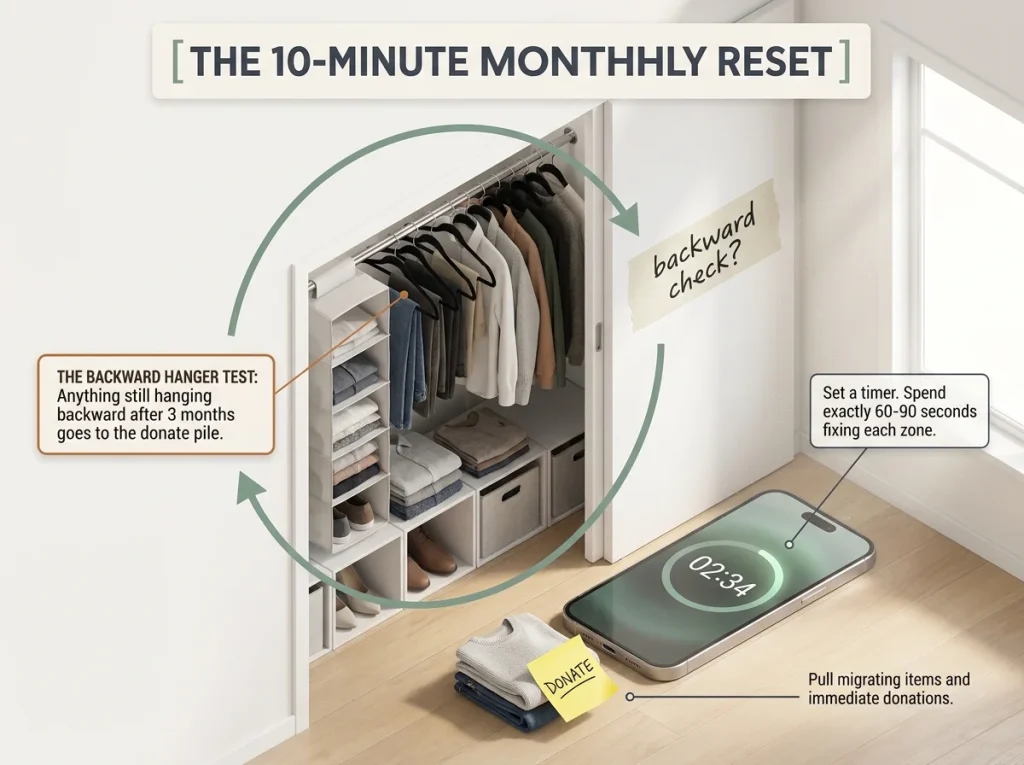
The reset is also when you check whether the system still fits your actual life. If you started going to the gym four times a week and now own eight pairs of workout shorts, the one cube assigned to gym gear isn’t enough anymore. Adjust zone assignments when the reset reveals friction — don’t just jam things in and hope the problem resolves itself. If two people are sharing the closet, the shared closet organization guide covers how to run the monthly reset when both halves of the closet belong to different people with different habits.
Three things that make a dresser-free closet actually work
First, every item needs an assigned category and zone before the organizers go in — the system creates the structure, not the products themselves. Second, small items (socks, underwear, accessories) need dedicated spots with visible assignment, not a communal bin. Third, the monthly reset is the difference between a closet organized once and a closet that stays organized. Without it, any system reverts — not because the system was wrong, but because drift is normal and the reset is what catches it.
Three months from now, check whether your cube organizer zones still match what you’re actually wearing. Seasonal changes shift which categories get daily use — a setup that works perfectly in October may need adjustment by March.
Start with the wardrobe edit. Get to visible breathing room between every hanger on the rod. Then add one zone at a time, and let the closet tell you what it needs before you add more.
Q1 Can a closet really replace a dresser?
Yes — a closet replaces a dresser when it covers all three functions: folded clothes storage, small item containment, and accessory organization. A hanging shelf organizer and a floor cube system handle folded clothes; an over-door organizer with assigned pockets handles socks, underwear, and accessories. Without all three, at least one zone will revert to disorder within weeks.
Q2 What’s the best way to store folded clothes in a closet without a dresser?
File-fold t-shirts and knits in a hanging shelf organizer — stand items upright so you can see everything at a glance without disrupting the stack. For heavier items like jeans and loungewear, use a freestanding floor cube organizer instead. Together they replace a 6-drawer dresser without taking floor space in the bedroom.
Q3 How do I store socks and underwear without a dresser?
An over-door organizer with 24 pockets works better than a bin for socks and underwear — but only if you assign every pocket to a specific category before putting anything in. One pocket per sock type, two rows for underwear, one row for bras. Label each row. Without assignment, the pockets revert to a pile within a week.
Q4 Does a dresser-free closet work in a small bedroom?
Yes — and it often works better in a small bedroom, because it moves all clothing storage into the closet and returns floor space to the room. The key is measuring first: rod height, rod width, and shelf depth determine which organizers fit. Standard reach-in closets (36 wide, 24 deep) accommodate the full hanging organizer, floor cube, and over-door system without modification.
Q5 How often should I reorganize a dresser-free closet?
Monthly, for 10 minutes — not seasonally, and not only when things fall apart. The monthly pass (refold, reassign, remove one donation item) catches drift before it compounds. Seasonal reviews are for adjusting zone assignments to match what’s in active rotation, not rebuilding the system from scratch.
Disclaimer: ClutterlessNest is a participant in the Amazon Services LLC Associates Program. As an Amazon Associate we earn from qualifying purchases. This article may contain affiliate links — if you buy through them, we may earn a small commission at no extra cost to you. We only recommend products we have tested or genuinely believe in.