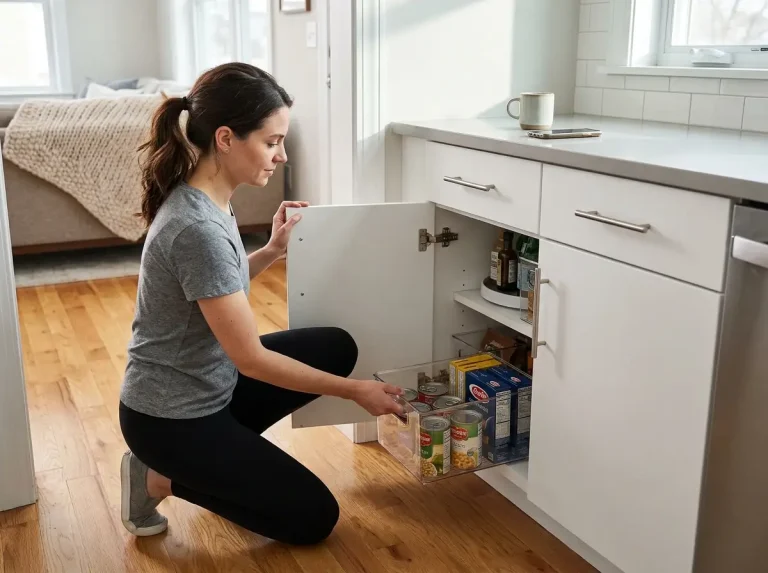
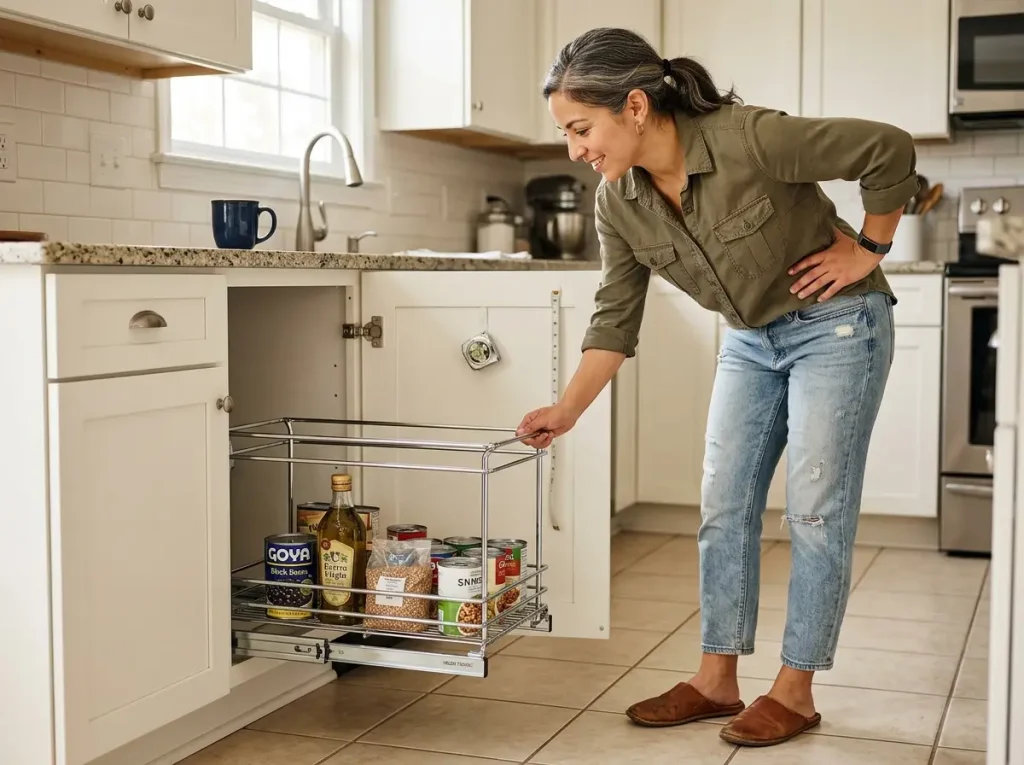
You measured your cabinet, ordered a pull-out organizer, waited three days for it to show up — and it doesn’t fit. The basket is too wide for the opening by half an inch. You measured the cabinet face, not the actual opening between the frame edges.
This is the most common return reason for pull-out organizers, and it’s entirely avoidable once you know the difference. After installing pull-outs in over a dozen kitchens — mine and others — the process comes down to five decisions that determine whether your organizer works long-term or becomes an expensive return label.
Quick Answer: Here’s the decision sequence for choosing the right pull-out cabinet organizer:
- Measure the cabinet opening width (not the face) and subtract 1-1/4″ for hardware
- Choose screw-mounted for heavy loads or adhesive for renter-friendly light use
- Pick single-tier for mixed-height items or two-tier only for uniform cans and bottles
- Match the product to your specific cabinet dimensions and weight needs
- Clean the ball-bearing slides twice a year to prevent grinding after month 12
Measure the Opening, Not the Cabinet
Here’s the scenario that plays out every week in Amazon reviews: someone owns a 15-inch-wide base cabinet. They search for “15 inch pull-out organizer.” They buy it. It arrives. It doesn’t fit.
The problem is that a 15-inch cabinet doesn’t have a 15-inch opening. If your kitchen has face-frame cabinets — the traditional style found in most builder-grade and older American kitchens — the frame overlaps the interior box by about 1 to 1-1/2 inches on each side. That 15-inch face dimension gives you roughly 13 to 13.5 inches of actual clear opening between the frame edges.
The Measurement That Matters
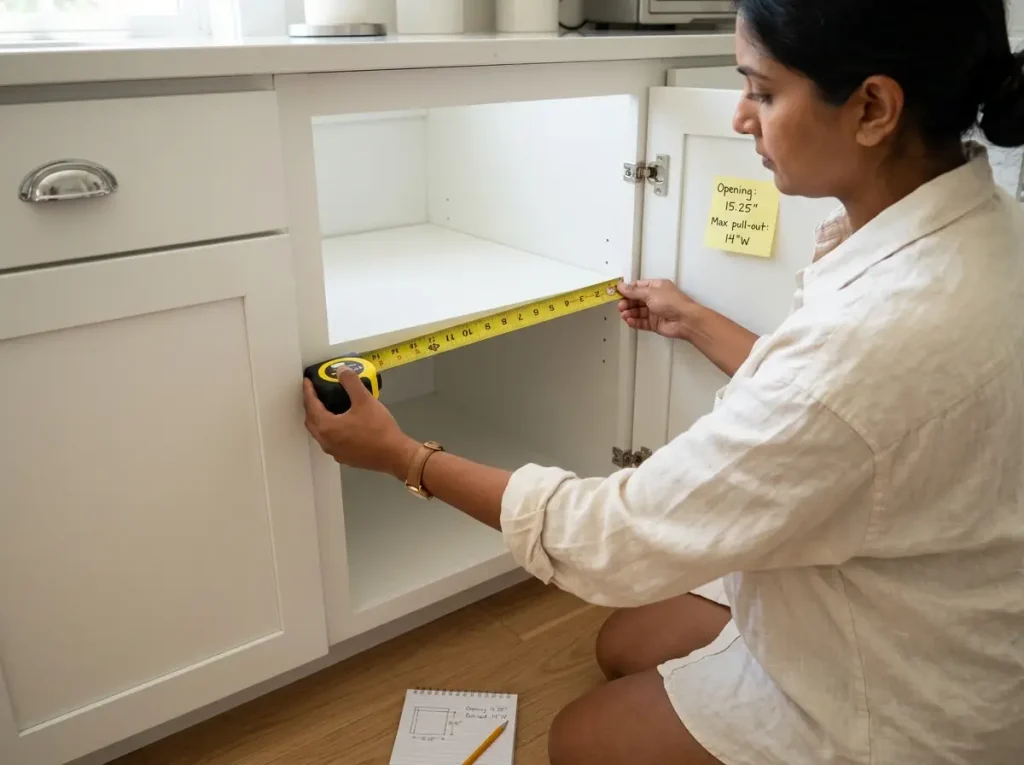
Grab a tape measure and open the cabinet door completely. Look at the front edge of the cabinet — if there’s a wooden frame around the interior opening (separate from the door), that’s a face-frame cabinet. Measure the distance between the inside edges of that frame at the widest point. That number is your usable opening width.
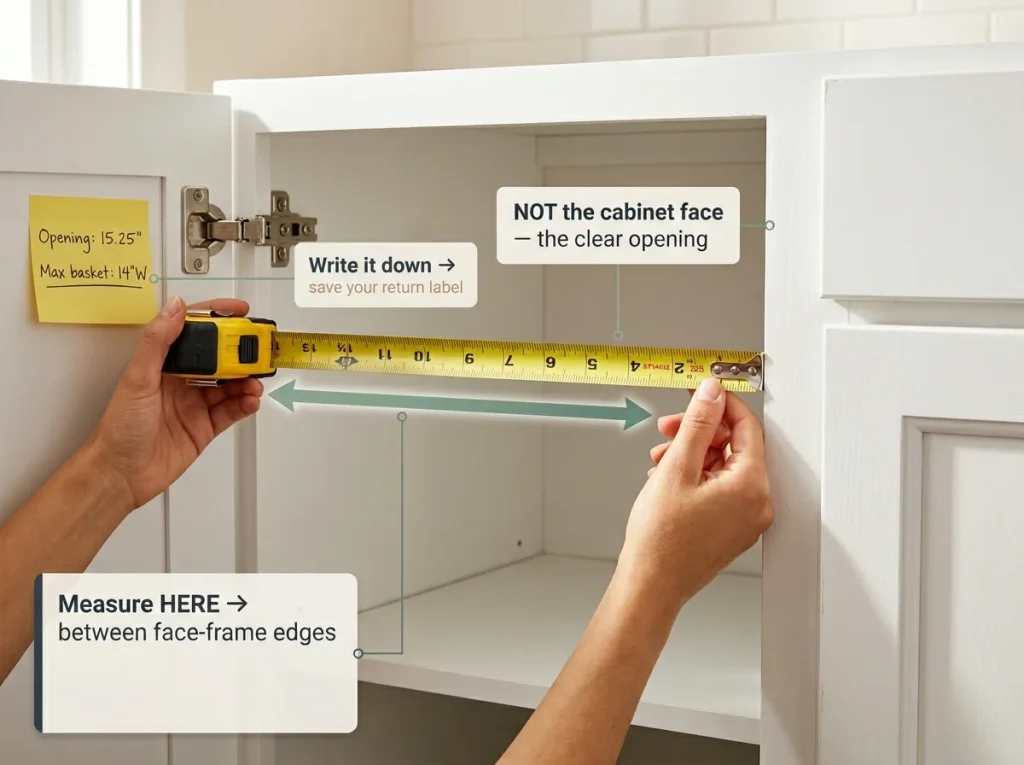
Now apply the hardware clearance rule. HOLDN’ STORAGE — the most popular pull-out brand on Amazon — states it directly: your basket width must be at least 1-1/4 inches less than your measured opening. So a 15.25-inch opening means the maximum basket width you can install is 14 inches. A 12.25-inch opening means an 11-inch basket. Write both numbers on a sticky note and stick it to the cabinet door before you order anything.
Pro tip: If your kitchen has frameless cabinets (European-style, no face frame — the opening IS the box interior), you still need to subtract 3/4 to 1 inch per side for the slide rail mounting hardware. The opening is wider, but the clearance rule still applies.
Depth and Height — the Measurements Nobody Forgets to Skip
Most pull-out organizers are designed for 21-inch deep cabinets. Standard base cabinets run 21 to 24 inches deep. If your cabinets are 24 inches deep, a 21-inch pull-out leaves about 3 inches of dead space behind it. That’s normal — tuck a small bin back there for items you rarely use.
For height, single-tier pull-outs sit around 3 to 5 inches tall — they fit everywhere. Two-tier models are 16.5 inches tall and need at least 17.5 inches of clear vertical space inside the cabinet. Standard base cabinets give you 28 to 30 inches of interior height, so two-tier fits. But check before you order — plumbing, electrical, or uneven shelving can steal vertical inches you didn’t expect.
Screw-Mounted vs. No-Drill (How to Choose)
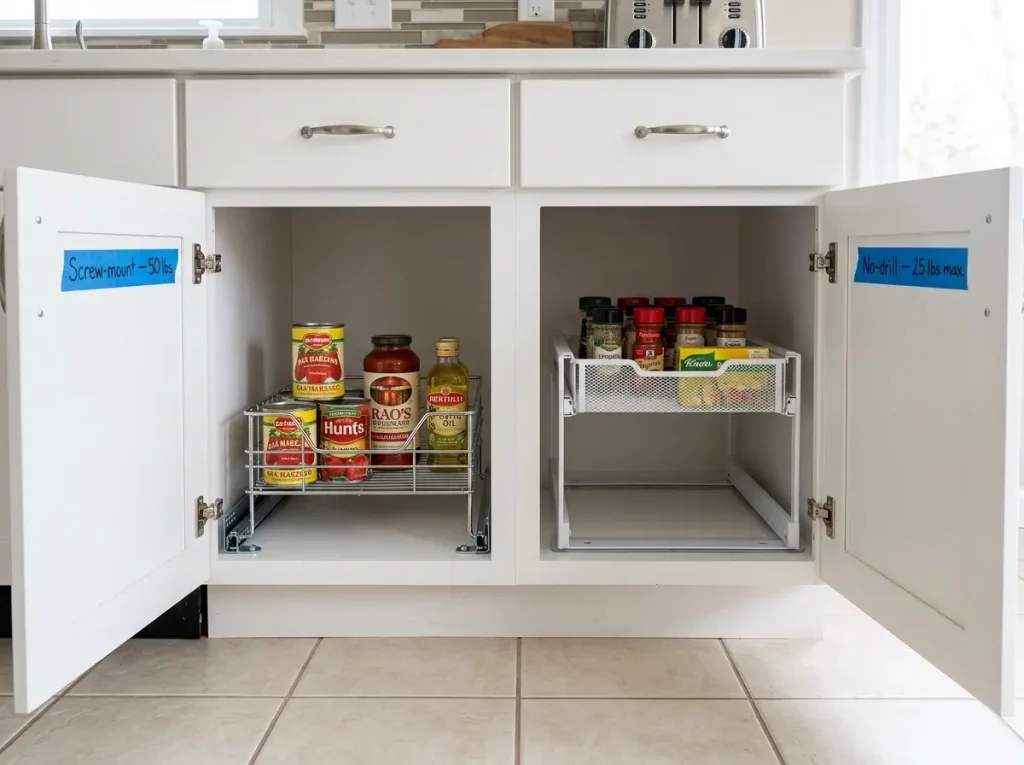
A friend of mine installed an adhesive pull-out for her pots and pans. At 2 AM three weeks later, she heard the crash. The basket detached from the cabinet floor with everything in it. The adhesive didn’t fail because the product was bad — it failed because she loaded 40 pounds onto a strip rated for 25.
The installation type determines the weight your pull-out can handle. Everything else — the basket material, the brand, the slide mechanism — is secondary to this one choice.
When to Drill (and Why It’s Less Scary Than It Sounds)
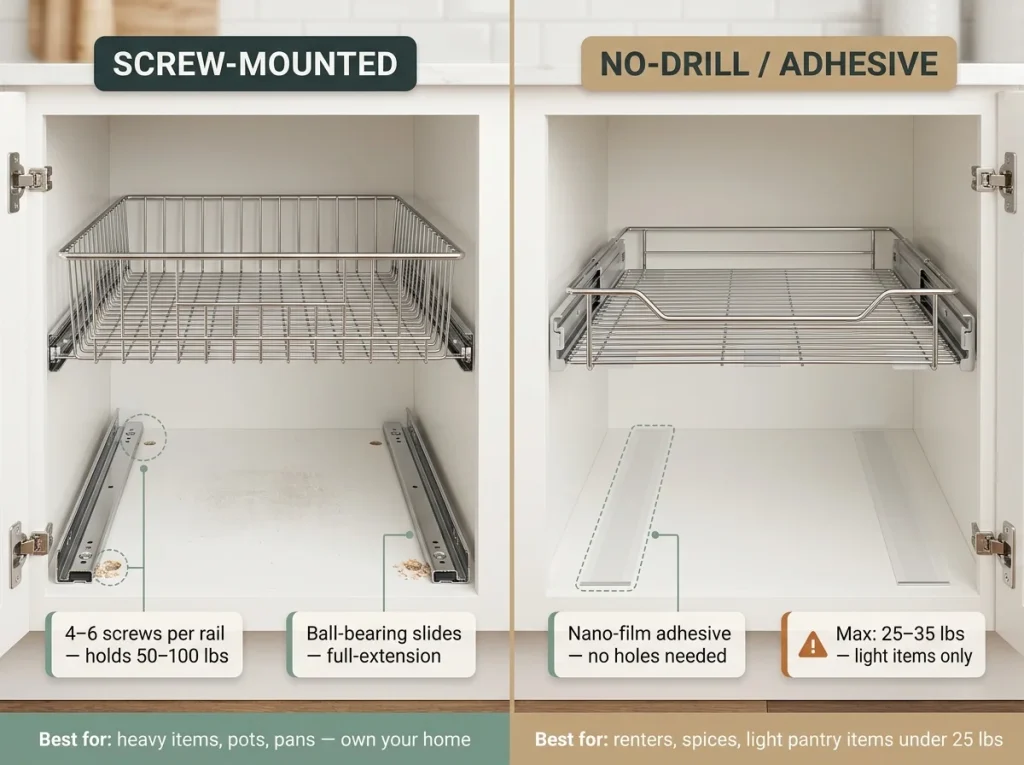
Screw-mounted pull-outs attach to the cabinet floor with 4 to 6 pilot holes. You’re drilling into MDF or plywood — not concrete, not steel. A basic drill with a small bit handles it in 15 minutes. The rails sit flat on the cabinet floor, screws secure them in place, and the basket slides on ball-bearing slides rated for 50 to 100 pounds.
This is the right choice for pots, pans, canned goods, cast iron, mixing bowls, or anything else where the combined weight will exceed 25 pounds. If you own your home or have a landlord who allows minor modifications, screw-mounted is the default answer. The screws leave four small holes that fill with wood putty in 30 seconds if you ever remove the system.
The Adhesive Path (and Where It Fails)
Adhesive pull-outs use nano-film strips that create suction on smooth, clean surfaces. The weight limit stamped on the box — 25 to 35 pounds — applies to the adhesive bond, not the basket structure. The steel basket could hold 80 pounds. The adhesive can’t.
Here’s what the product listings don’t tell you: nano-film adhesive fails on surfaces that aren’t perfectly smooth and dry. Old shelf liner — the kind the previous tenant left in place — blocks the suction completely. Painted cabinet floors with even minor flaking or wax coating prevent bonding. And under-sink cabinet floors with any chronic moisture from pipe condensation will weaken the adhesive within weeks.
If your cabinet floor is clean, smooth, and dry — and you plan to store items totaling under 25 pounds — adhesive pull-outs work. The Adhesive Pull-Out Cabinet Organizer (expandable 12-20″W) adjusts from 12 to 20.5 inches wide, which eliminates precise width measurement for light loads like spice collections, small cans, and single-use pantry items. It peels off clean when you move.
For renters who need more capacity without drilling, the SpaceAid No-Drill Pull-Out Cabinet Shelf uses wall-press mounting brackets instead of floor adhesive — a different system that handles heavier loads by pressing against the cabinet side walls rather than relying on surface suction. If the standard adhesive limit doesn’t cover what you need to store, this is the next step before committing to screws. For a broader look at renter-friendly kitchen cabinet solutions, the sibling guide covers the full range of no-drill approaches.
Pro tip: Before applying any adhesive pull-out, wipe the cabinet floor with rubbing alcohol and let it dry completely. If there’s old shelf liner in place, peel it off first. The difference between a 16-month hold and a 3-week failure usually comes down to surface prep.
Single-Tier vs. Two-Tier (When Each Actually Works)
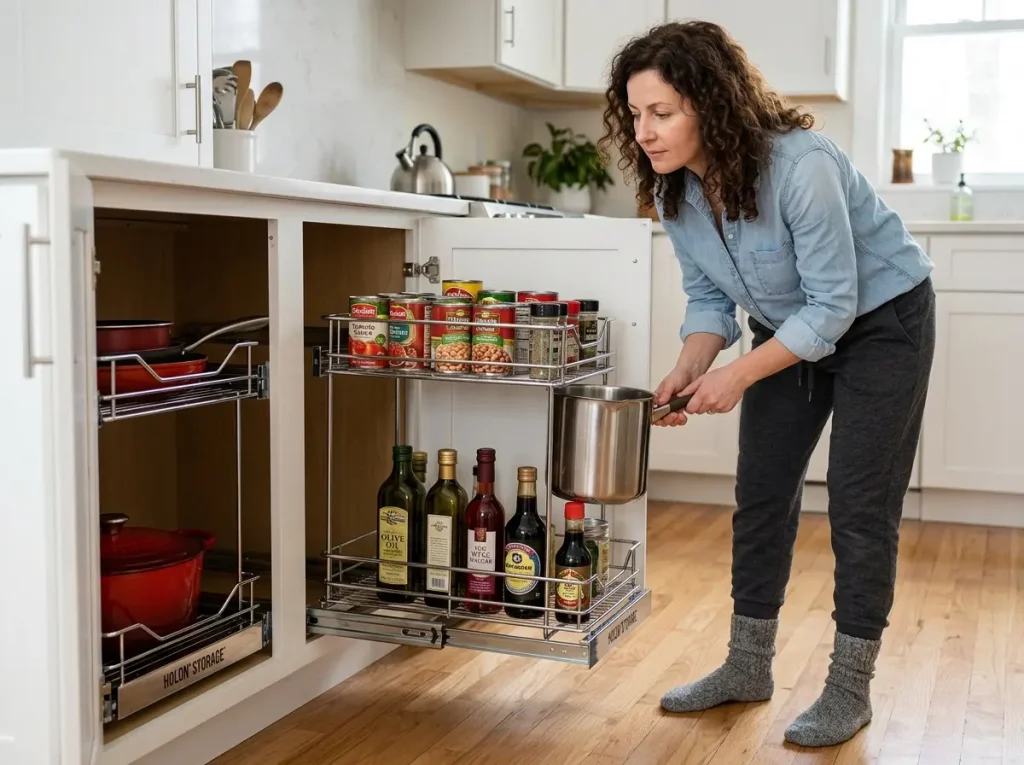
The two-tier pull-out looks like double the storage in the same footprint. In the product photos it’s loaded with perfectly uniform cans and bottles, and it seems like an obvious upgrade over a single-tier. Then you try to put your 6-inch tall pot in the lower basket and realize the clearance between tiers is only 5 inches.
This is the two-tier trap, and it catches people every week.
Single-Tier: Works for Most Kitchen Cabinets
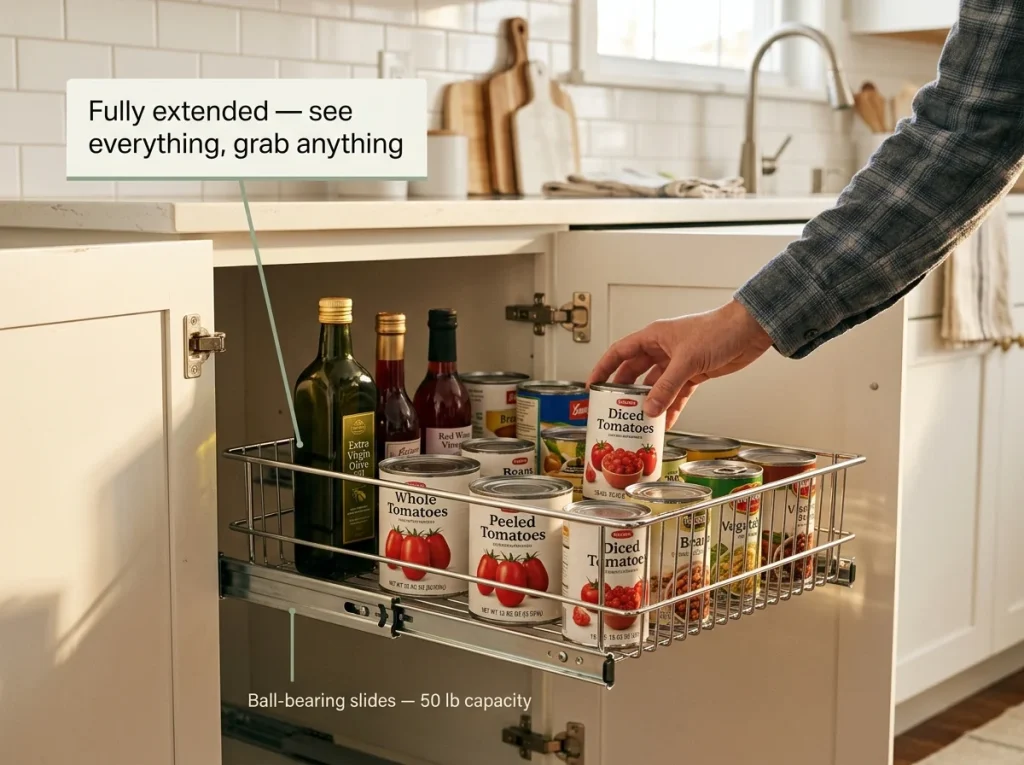
A single-tier pull-out sits 3 to 5 inches tall with no height restriction above it. Anything that fits inside the cabinet can sit on the basket — pots, dutch ovens, tall bottles, small appliances, Tupperware stacked two high. The typical capacity is 50 pounds on ball-bearing slides.
For most base cabinets where you’re storing a mix of different-height items, single-tier is the correct choice. You’re not wasting vertical space — you’re keeping access unrestricted. The basket extends fully, you see everything in one layer, you grab what you need. No Tetris required.
Two-Tier: Only for Uniform-Height Items
A two-tier pull-out divides the vertical space into two baskets. The upper basket sits 10 to 11 inches above the cabinet floor. The lower basket has roughly 4 to 5 inches of usable height between the basket floor and the underside of the upper tier’s frame.
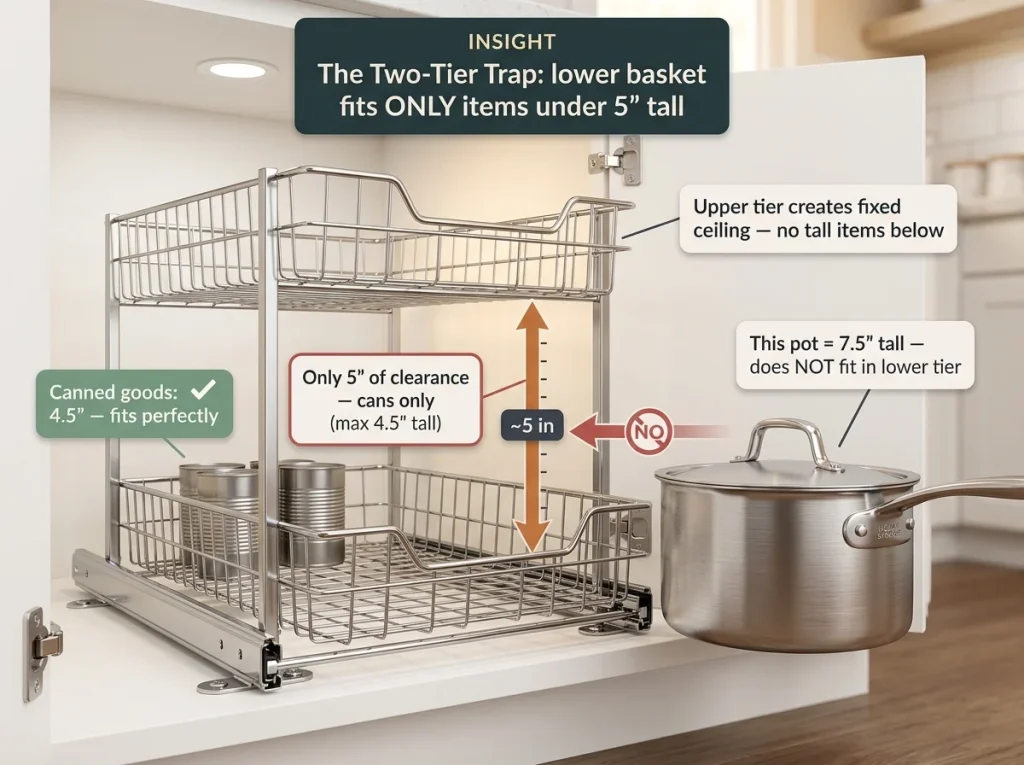
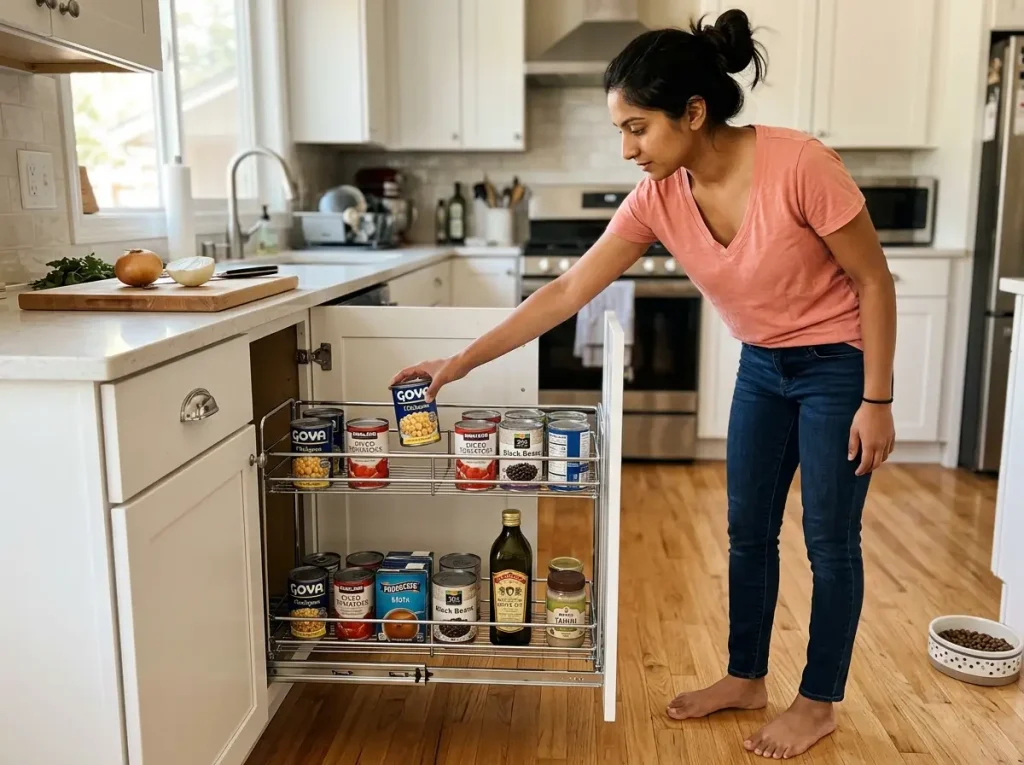
That 5-inch lower clearance means two-tier works for: canned goods (standard 4.5 inches tall), wine bottles on their side, olive oil and vinegar bottles, spice jars, and boxes of pasta or broth. Items under 5 inches tall with uniform dimensions. If your cabinet is dedicated to a single category of uniform items — a pantry cabinet full of cans, for example — two-tier genuinely doubles your accessible storage.
But if your cabinet holds a mix of pots, containers with lids, cereal boxes, or anything else that varies in height, the lower tier becomes a frustration. You end up storing only small items down there while the upper tier holds everything else. One forum user summed it up: they “regretted pull-out shelves” in their pantry because they preferred the flexibility of an open shelf where they could pile things without hitting a ceiling 5 inches up.
The Under-Sink Height Problem
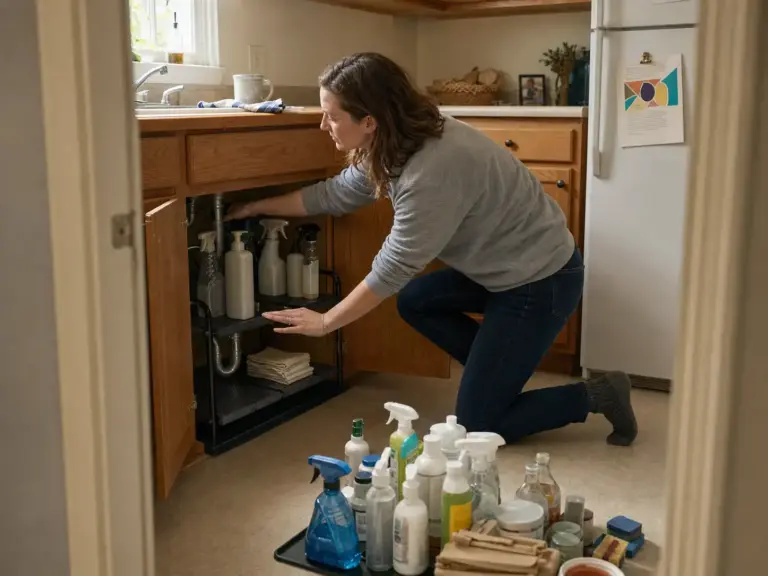
Two-tier pull-outs need 17.5 inches of clear vertical height. Standard base cabinets have 28 to 30 inches — plenty of room. But under-sink base cabinets have P-trap plumbing that drops the usable height to 12 to 18 inches in the lower portion. If you’re planning a two-tier for under the sink, measure from the cabinet floor to the lowest point of the pipe. Most of the time, you’ll need a single-tier instead.
The Pull-Out Organizers Worth Buying
There are hundreds of pull-out organizers on Amazon. Most work fine for the first six months. The difference between the ones worth buying and the ones that end up in a garage sale is build quality, slide mechanism, and whether the manufacturer actually tested the weight rating over time. Professional organizers consistently recommend pull-outs for deep base cabinets as the single highest-impact upgrade for kitchen accessibility.
Best Value: Heavy-Duty Single-Tier
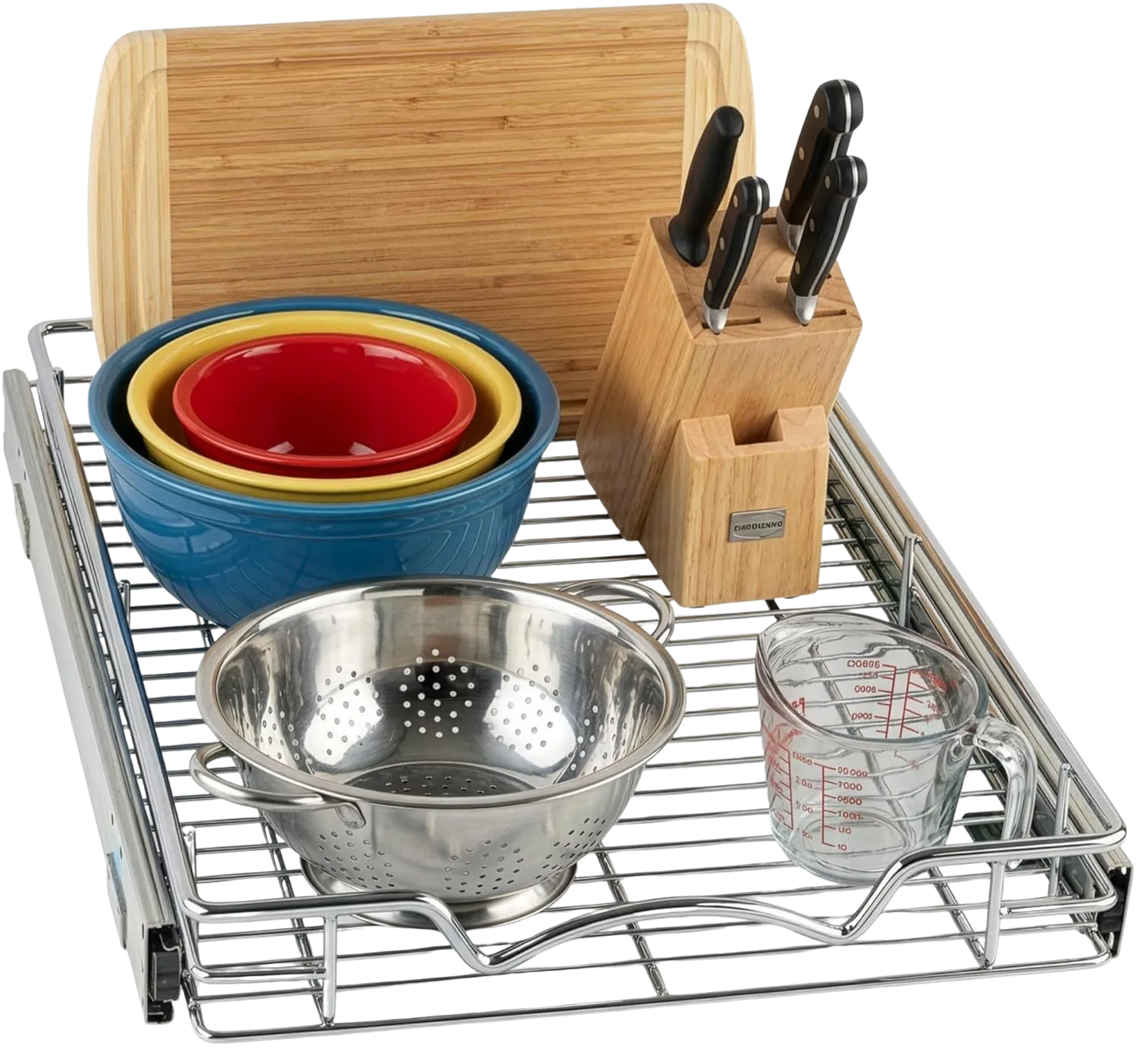
The organizer I install most often in my own projects is the HOLDN’ STORAGE single-tier. Steel construction, ball-bearing slides, 50-pound capacity, and a size range from 11 to 24 inches wide that covers every standard base cabinet opening. The 14-inch wide model fits cabinets with a 15.25-inch or wider opening — the most common size in builder-grade kitchens.
What makes it the value pick: it performs at the same level as custom pull-outs that cost three to four times more when professionally installed. According to Bob Vila, professional installation typically runs $140-$350 per shelf unit — this does the same job with 30 minutes of your time and a basic drill.
Premium Pick: When Aesthetics Matter
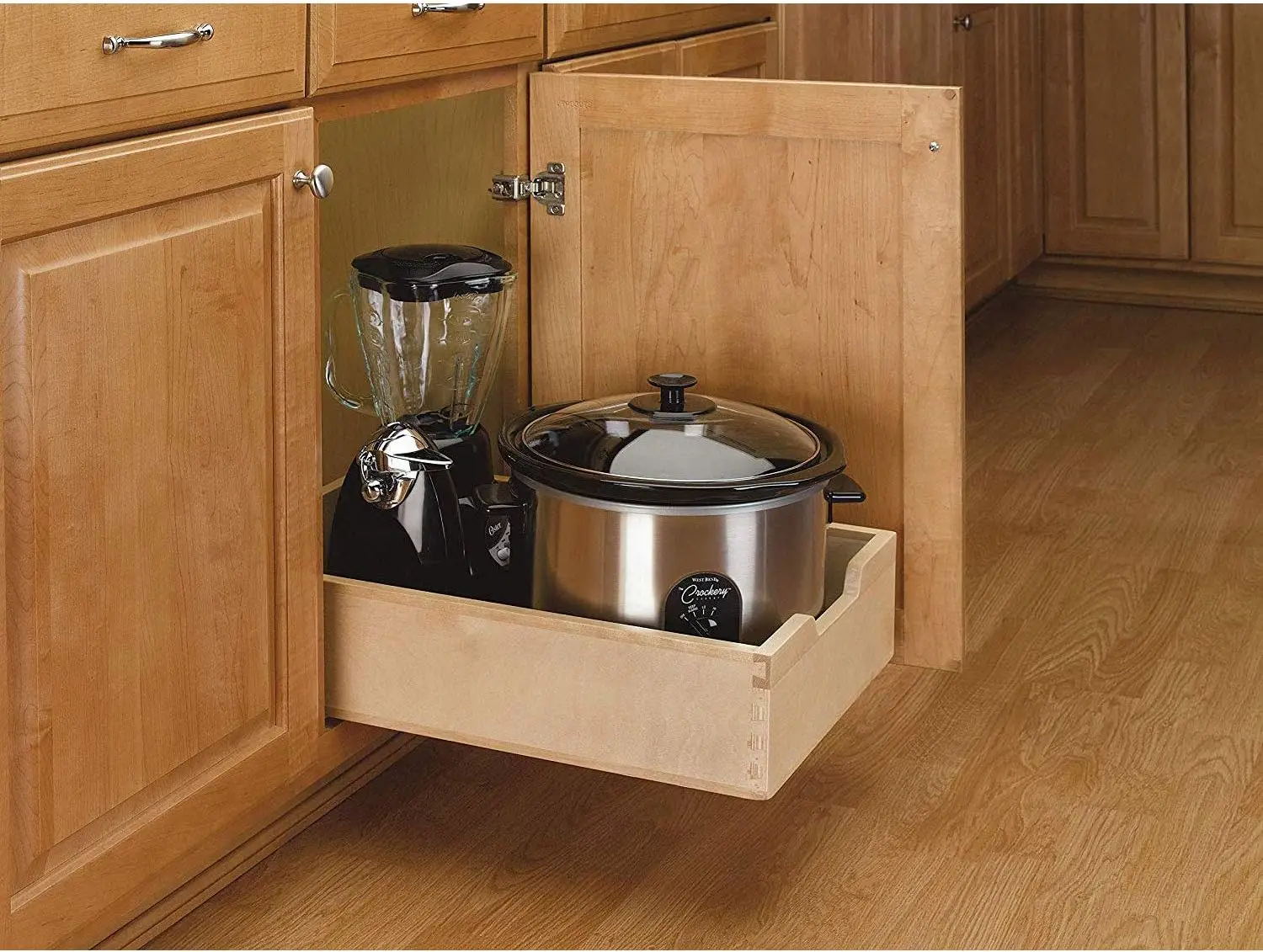
If your kitchen has wood-finish cabinetry and the pull-out will be visible every time you open the door, the Rev-A-Shelf 4WDB series is the one to get. Maple wood base instead of chrome wire, ball-bearing slides with a soft-close mechanism, and 75-pound capacity. It costs significantly more than the HOLDN’ STORAGE — but in a kitchen where you chose your cabinet finish deliberately, a chrome wire basket looks like an afterthought.
Best Two-Tier (for the Right Use Case)
If you’ve read the section above and confirmed your cabinet holds uniform-height items — cans, bottles, spice jars — the HOLDN’ STORAGE 2-Tier Pull-Out Organizer (12″W × 21″D × 16.5″H) handles 100 pounds across both tiers with a lifetime warranty. It requires a 13.25-inch minimum opening and 17.5 inches of clear vertical space. For a dedicated pantry cabinet full of canned goods, this genuinely doubles accessible storage. For mixed-contents cabinets, stick with the single-tier.
Installation Walkthrough
The actual install takes 20 to 30 minutes with a basic drill.
The key steps: position the rails flush against the cabinet floor, mark pilot holes with a pencil, drill shallow pilot holes (don’t go through the cabinet floor), drive the mounting screws, and clip the basket onto the rails. The slide mechanism self-aligns once both rails are level.
Pro tip: Before drilling, slide the rails into the cabinet without screws and test the basket extension. If the basket catches on the face frame at any point, you need to shift the rails inward by 1/8 inch. Finding this before you drill saves filling holes and re-drilling.
For the full range of kitchen cabinet organizers — including turntables, shelf risers, and door-mounted options — the sibling guide covers everything beyond pull-outs.
Why Pull-Outs Stop Sliding Smoothly (and the Fix)
At month 3, your pull-out glides like butter. At month 18, it grinds. You’ll think the product failed. It didn’t.
Here’s what happened: ball-bearing slides are factory-lubricated with a thin layer of grease that allows smooth extension. In a kitchen, cooking vapors deposit an invisible film of oil and grease on every surface — including the inside of your cabinet and the slide rails. Combine that with crumbs, dust, and the occasional splash of sauce, and you get a paste that works its way into the bearing mechanism over 12 to 18 months.
The Five-Minute Fix (Twice a Year)
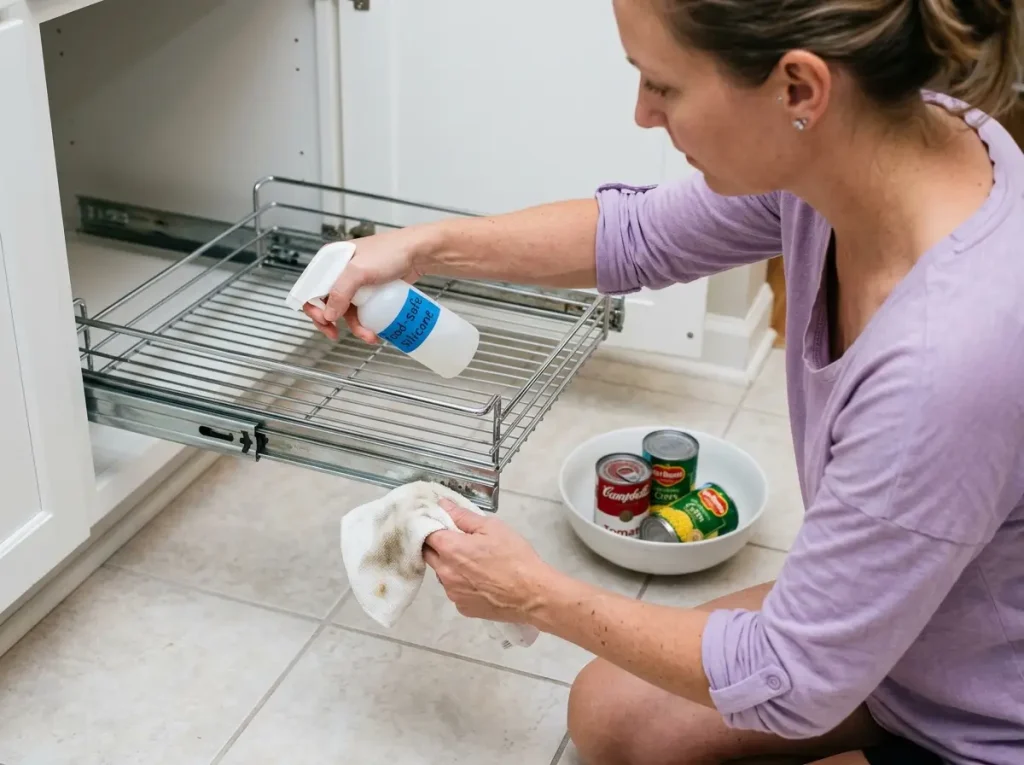
Pull the organizer all the way out to full extension. Look at the chrome rails on both sides — you’ll probably see a dull film or slight stickiness. That’s the accumulated kitchen grime that’s causing the resistance.
Wipe both rails with a damp cloth from front to back, removing loose debris and the greasy film. Then spray a small amount of food-safe degreaser (not WD-40) along each rail and wipe again. Let the rails air-dry for two minutes.
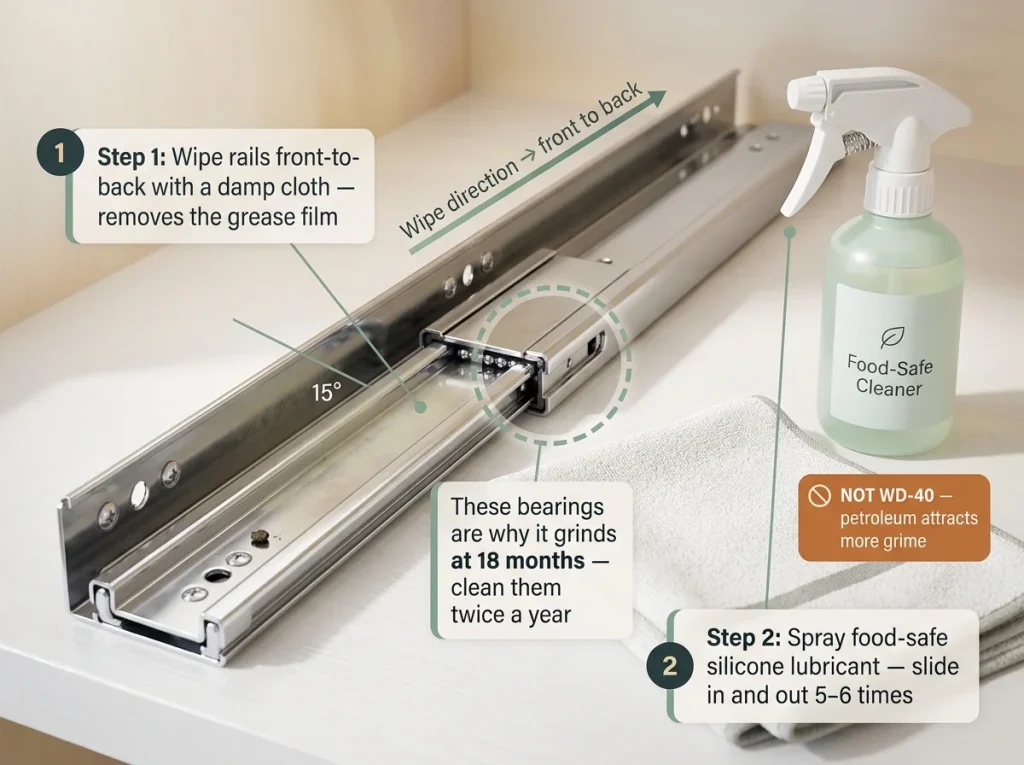
Once dry, apply a light coat of dry silicone spray lubricant to both rails. Slide the basket in and out 5 to 6 times to distribute the lubricant evenly across the bearings. Done. The pull-out runs smooth again.
Why Not WD-40
WD-40 is petroleum-based. In a kitchen cabinet where food is stored, that’s the first problem. The second problem: petroleum lubricants attract dust and grime faster than dry alternatives.
Within 6 weeks of WD-40 application, the slides feel worse than before you sprayed them. You created a new layer of sticky buildup on top of the old one.
Food-safe silicone spray is available at any hardware store. It dries to a slick film that doesn’t attract particulates. It’s the same thing used on food-processing equipment — safe for surfaces near food, and it stays slippery instead of getting gunky.
Pro tip: Set a recurring reminder for every six months — spring and fall. Two minutes of rail cleaning prevents the year-two grinding problem that makes people replace perfectly functional pull-outs.
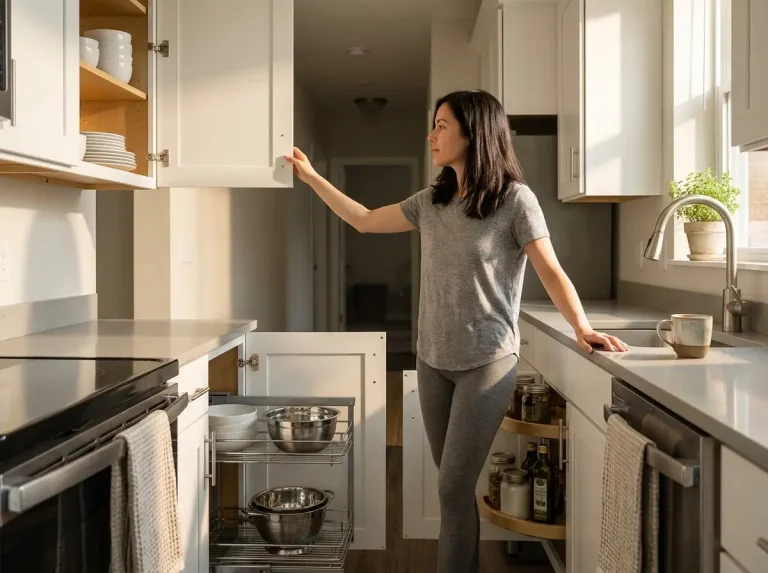
Making your pull-outs part of a complete kitchen cabinet organization system means the rest of your cabinets support the same level of accessibility — pull-outs solve one cabinet at a time, but the overall system is what keeps the kitchen functional long-term.
Conclusion
Three things to remember from this guide:
- Measure the opening between the frame edges — not the cabinet face — and subtract 1-1/4 inches for hardware clearance. This single measurement prevents the most common pull-out return.
- Match the installation type to your situation. Adhesive for renters storing light items under 25 pounds. Screw-mounted for everything else. The adhesive limit is real — respect it.
- Single-tier handles more of what’s actually in your cabinets than two-tier. Use two-tier only when your cabinet holds uniform-height items like cans or bottles. For mixed contents, single-tier gives better access.
Three-Month Check: Three months after install, pull the organizer fully out and check the slide rails. A quick wipe with a damp cloth now takes 30 seconds and prevents the 18-month grinding problem that makes people think their pull-out broke.
Start with the cabinet that annoys you most — the one where three things fall out every time you open the door. Measure the opening. Order the right width. You’ll have it installed by the weekend.
Q1 Are pull-out cabinet organizers worth it?
Yes — for deep base cabinets where items disappear into the back, pull-outs eliminate food waste and the daily frustration of searching blind. They’re most worth it in cabinets 18 inches wide or larger where reaching the back requires crouching or full-arm extension.
Q2 How do I measure my cabinet for a pull-out organizer?
Measure the clear opening width between the face-frame edges — not the outer cabinet dimension. Subtract 1-1/4 inches from that number to get your maximum basket width. Also measure depth (21-24 inches is standard) and clear vertical height if buying a two-tier model.
Q3 Can you install pull-out cabinet organizers without drilling?
Yes — adhesive nano-film pull-outs install without tools and hold 25-35 pounds. They’re appropriate for spices, light pantry items, and small bottles. For heavier renter-friendly loads without drilling, wall-press mounting models like the SpaceAid hold more weight through a different attachment method.
Q4 How much weight can pull-out cabinet organizers hold?
Screw-mounted pull-outs with ball-bearing slides hold 50-100 pounds depending on the model. Adhesive models max out at 25-35 pounds. If you plan to store pots, pans, or stacked canned goods, screw-mounted is the only reliable option.
Q5 What is the best pull-out organizer for a deep kitchen cabinet?
For standard 24-inch deep base cabinets, a screw-mounted single-tier with 21-inch depth fits without modification and holds 50 pounds. The 3 inches of remaining space behind the basket is normal — use it for a small bin of rarely accessed items.
Disclaimer: ClutterlessNest is a participant in the Amazon Services LLC Associates Program. As an Amazon Associate we earn from qualifying purchases. This article may contain affiliate links — if you buy through them, we may earn a small commission at no extra cost to you. We only recommend products we have tested or genuinely believe in.