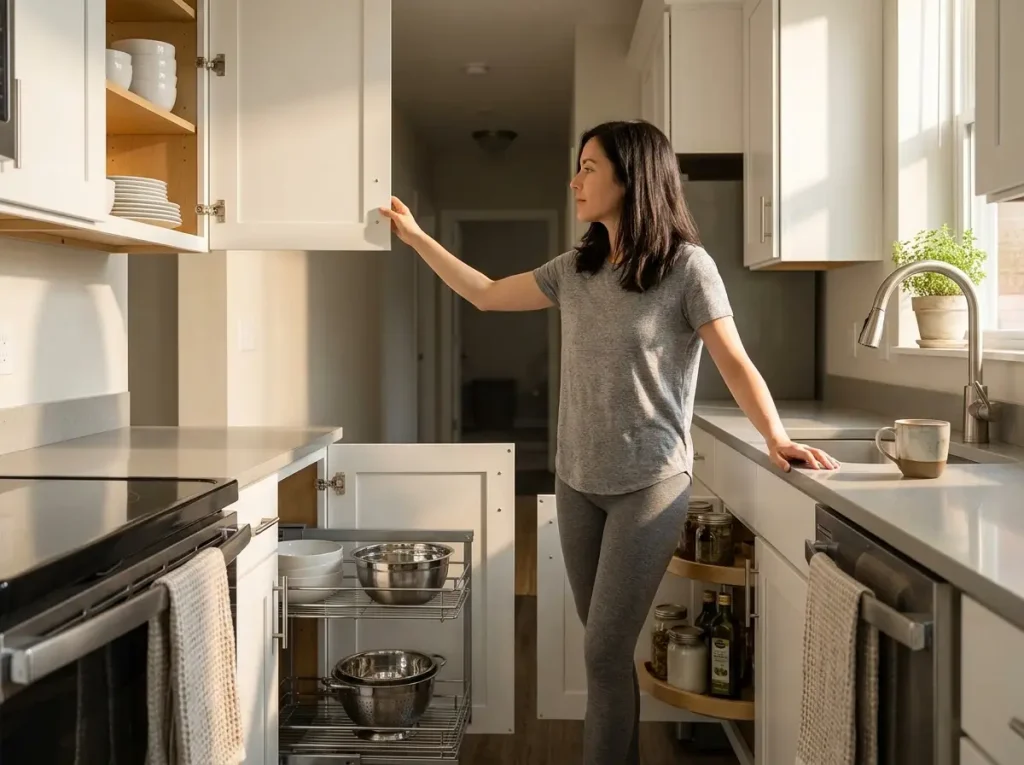
You bought a set of cabinet organizers, installed them on a Saturday, felt proud for about a week — and now half of them are shoved in a drawer because they didn’t actually fit your cabinets. That’s not a you problem. It’s a measurement problem. Most organizers are designed for one cabinet depth, and most kitchens have at least three different depths between upper cabinets (12 inches), lower cabinets (24 inches), and that corner cabinet you’ve been ignoring.
I’ve tested organizers in every type of kitchen cabinet over the past several years, including rentals where I couldn’t drill a single hole. The difference between an organizer that works and one that ends up in a donation box comes down to matching the right product to the right cabinet type — not buying the most-reviewed option on Amazon.
This guide breaks down the best kitchen cabinet organizers by the specific cabinet they belong in, with exact dimensions, renter-friendly picks, and budget alternatives for every recommendation.
Quick Answer: The best kitchen cabinet organizers depend on your cabinet type:
- Upper cabinets (12″ deep): Expandable shelf risers and under-shelf baskets to double vertical space
- Lower cabinets (24″ deep): Adhesive pull-out organizers or turntables to reach the back
- Corner cabinets: 16-inch turntables to access the dead zone
- Pots and pans: Vertical pan racks and adjustable lid organizers
- Cabinet doors: Door-mounted wrap organizers for hidden storage
| Comparison Table | |||
|---|---|---|---|
| Product | Price | Best For | Renter-Friendly |
| SimpleHouseware Shelf Riser | $15 | Upper cabinets (12″ deep) | Yes |
| Adhesive Pull-Out Organizer | $28 | Lower cabinets (24″ deep) | Smooth surfaces only |
| OXO Good Grips Lazy Susan 16″ | $22 | Corner cabinets | Yes |
| SimpleHouseware Pan Rack 5-Tier | $20 | Pots, pans, and lids | Yes |
| SimpleHouseware Wrap Organizer | $15 | Cabinet doors | Screws (or Command strips) |
Why most kitchen cabinet organizers end up in a drawer
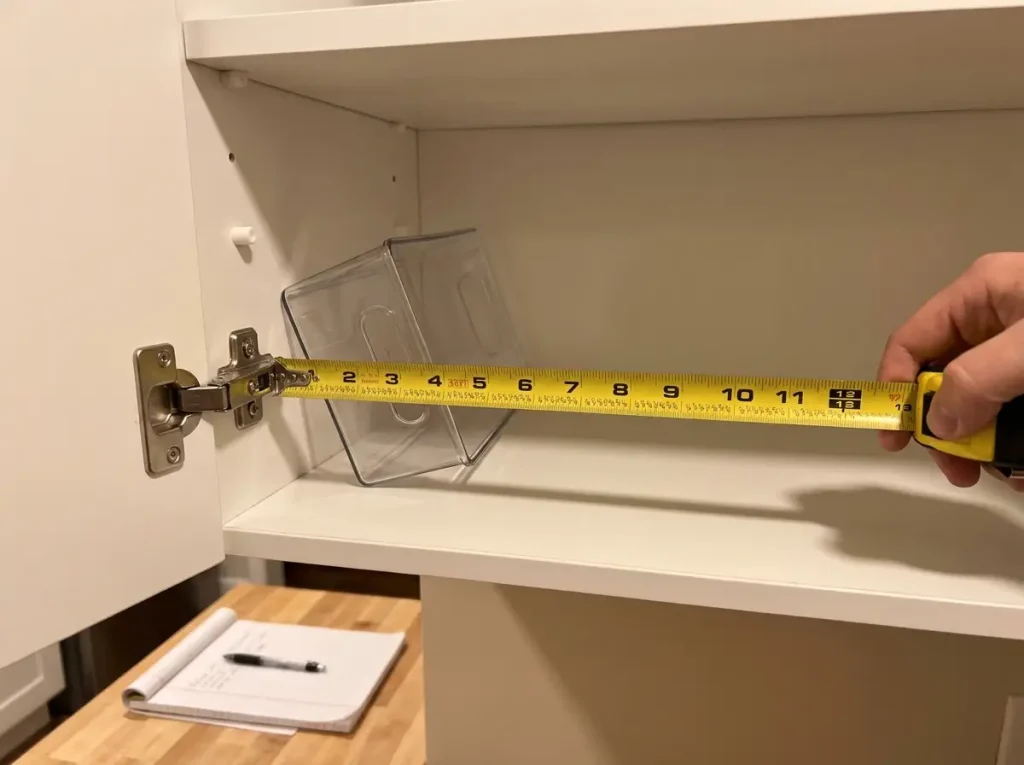
The reason most cabinet organizers fail has nothing to do with quality. It’s a fit problem. Your upper cabinets are typically 12 inches deep. Your lower cabinets are about 24 inches deep. Corner cabinets can be 36 inches wide but only accessible through a 15-inch opening. And every one of those cabinets has hinges that jut inward anywhere from 1 to 2 inches, eating into the usable width.
Here’s what happens: you buy a “kitchen cabinet organizer” based on a review that doesn’t mention depth. It arrives, you try to fit it in your upper cabinet, and it sticks out past the door frame. Or you put it in a lower cabinet and it leaves 12 inches of wasted space behind it. The organizer isn’t bad — it just wasn’t designed for that specific cabinet.
Before you buy anything, grab a measuring tape and record three numbers for each cabinet: interior depth (back wall to the front edge of the frame), interior width (side wall to side wall, minus the hinge protrusion), and shelf spacing (bottom of one shelf to the top of the shelf below). Those three measurements eliminate 90% of organizer returns. If you’re working with standard kitchen cabinet dimensions, upper cabinets are usually 12 inches deep with shelf spacing around 10-12 inches, and lower cabinets run 23-24 inches deep.
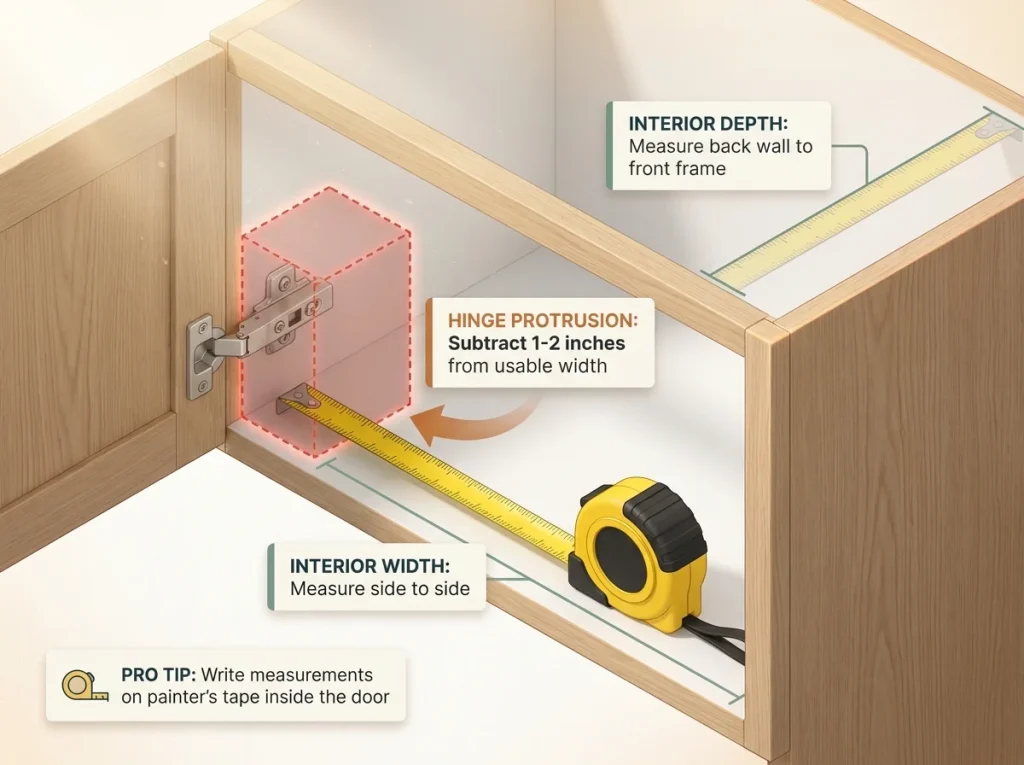
Pro tip: Write your cabinet measurements on painter’s tape and stick it inside each cabinet door. When you’re browsing products online at midnight, you won’t have to get up and re-measure.
Best organizers for upper cabinets (12-inch depth)
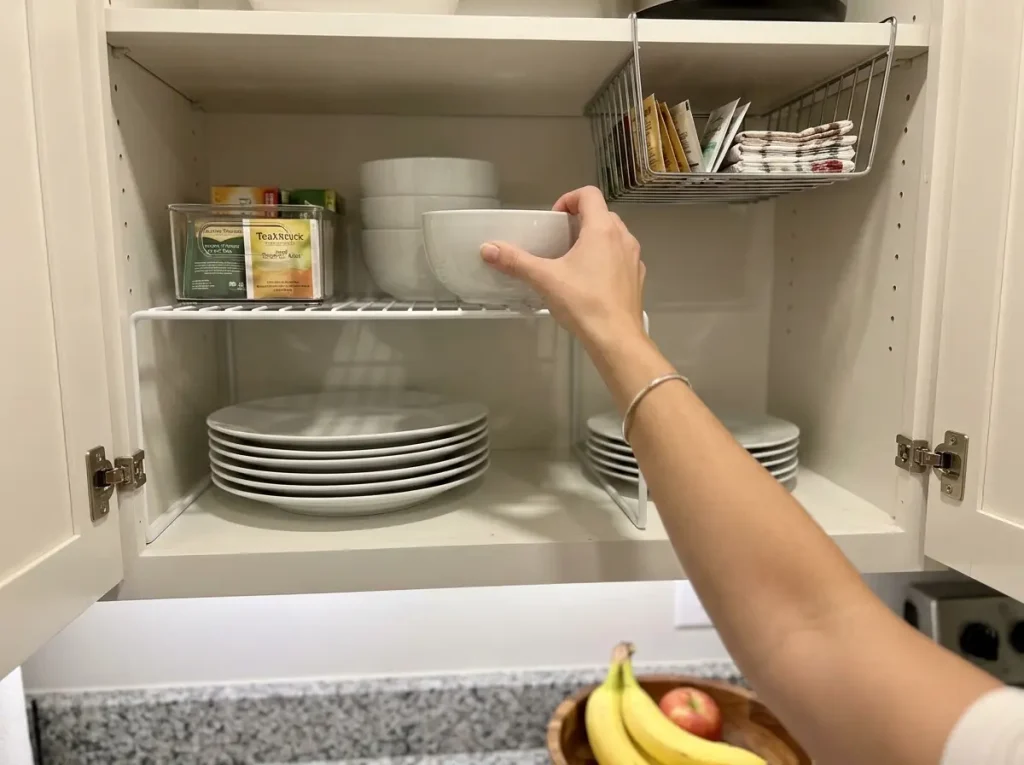
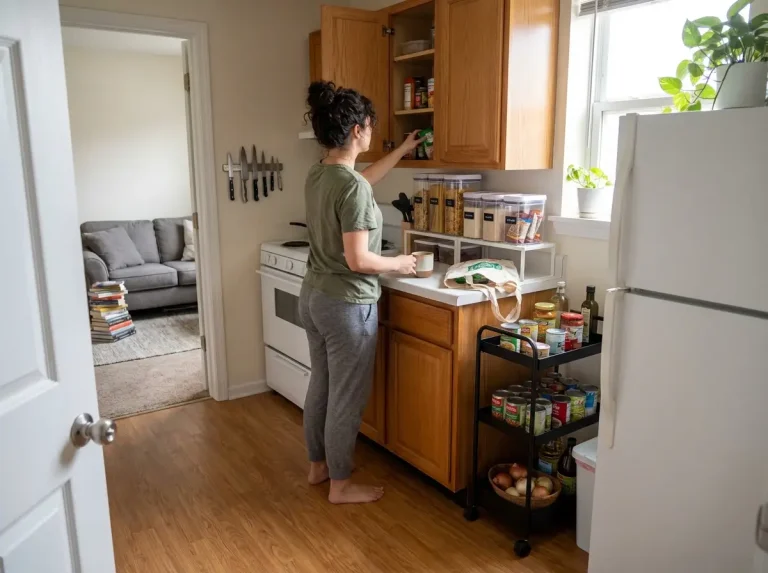
Upper cabinets waste the most space per square inch because you can only reach the front 8 inches comfortably. Everything behind that becomes a graveyard for expired spices and forgotten tea boxes. The fix is vertical — you need to create layers so items stack up, not back.
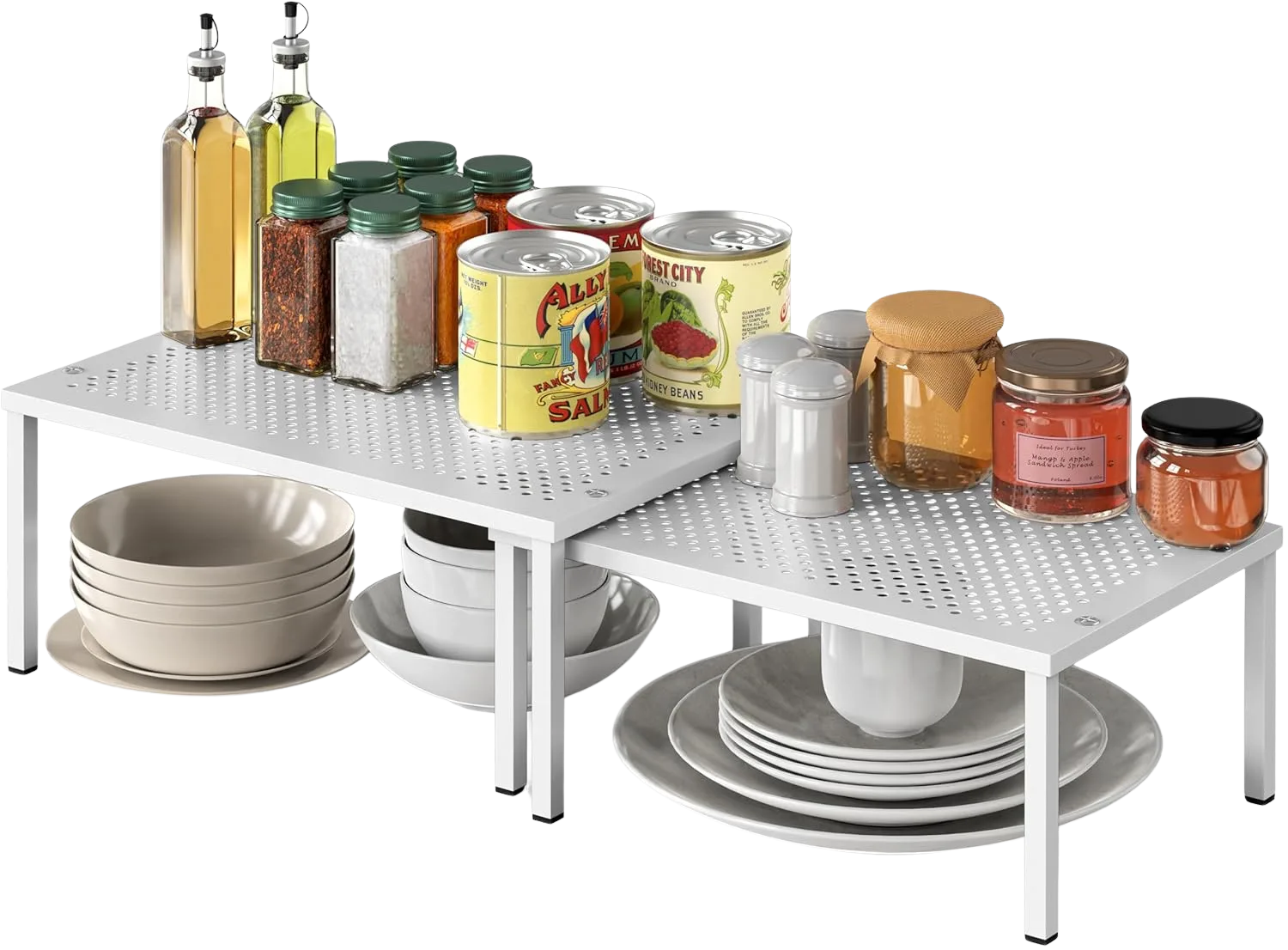
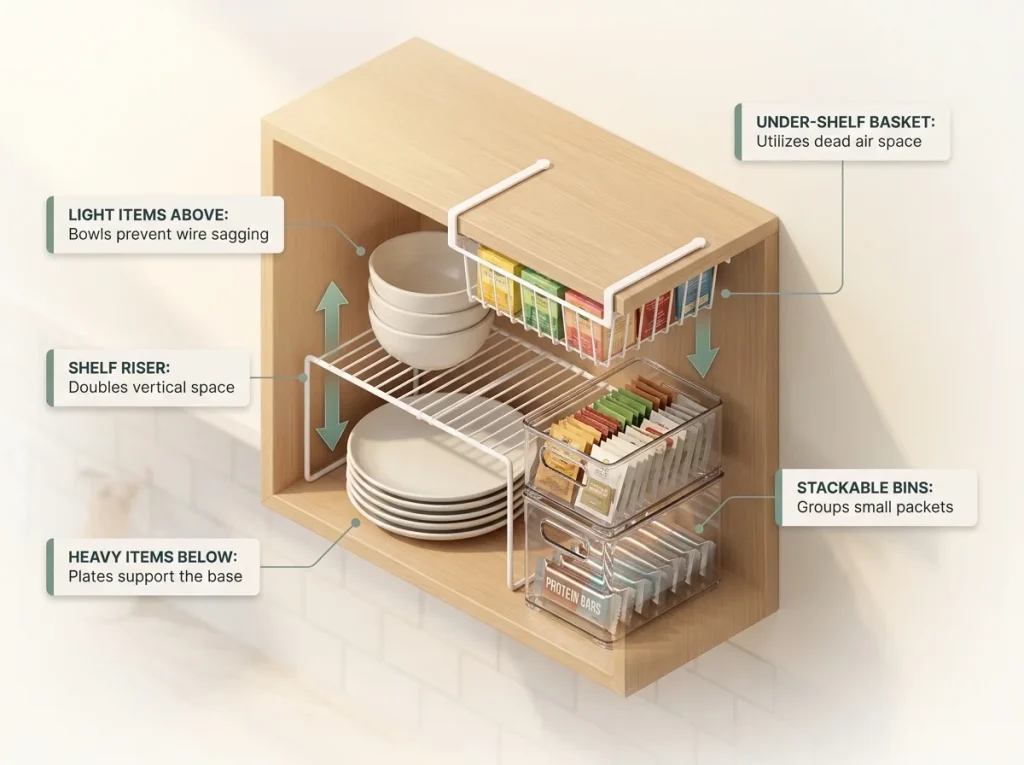
The fastest fix is a shelf riser. It sits on your existing shelf and creates a second level, so you can stack plates on the bottom and bowls on top without them touching. The SimpleHouseware Expandable Shelf Rack ($15) expands from 13 to 22 inches wide, fits the standard 12-inch upper cabinet depth, and needs zero tools. You drop it in and it works. The catch: it adds weight to a single shelf, so don’t load both levels with heavy stoneware. Stick to lighter items on the riser level — mugs, bowls, spice jars.
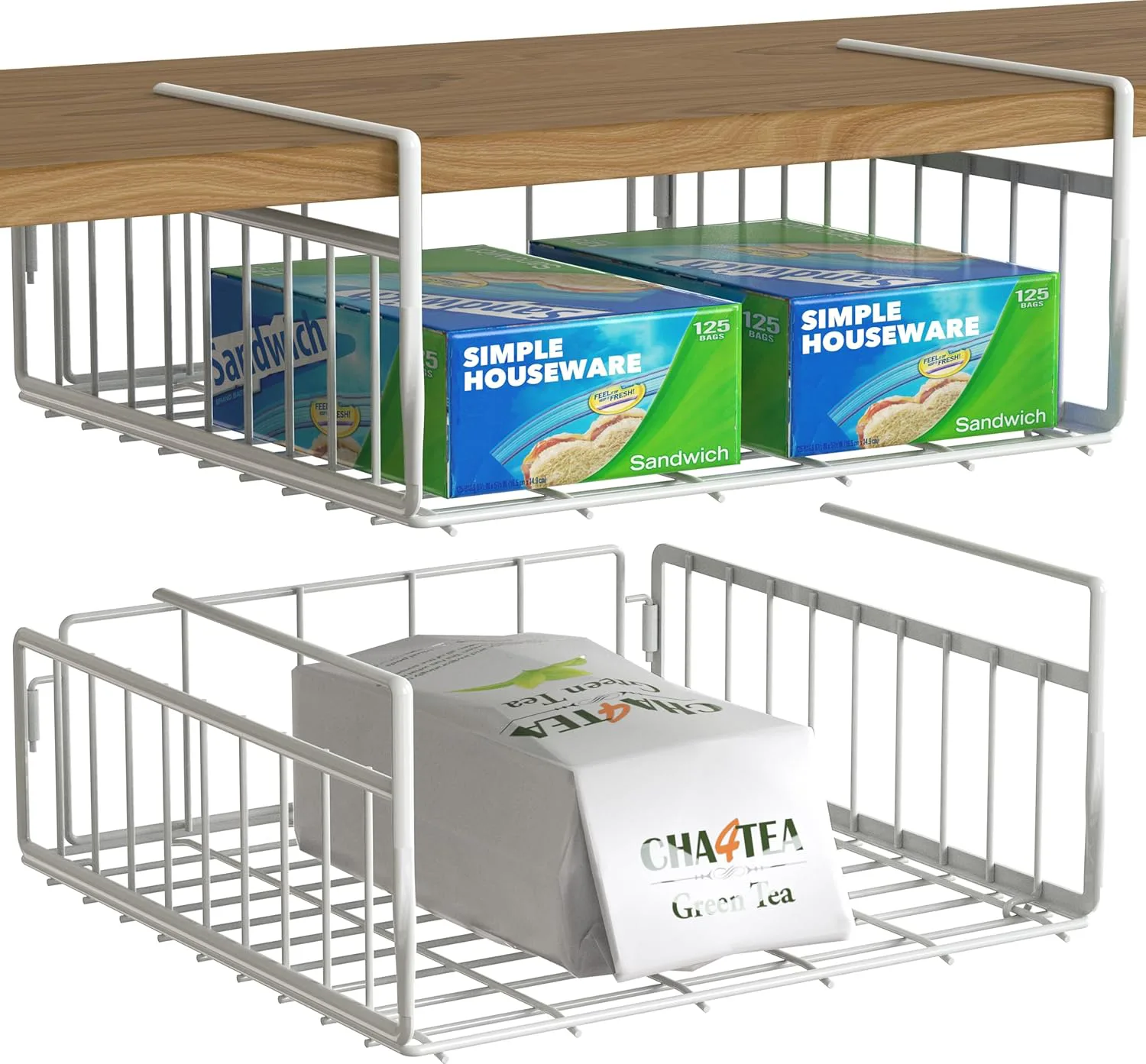
The second trick for uppers is the space underneath your shelves — the gap between the bottom of one shelf and the tops of the items on the shelf below. An Under-Shelf Wire Basket ($10) hooks over the shelf edge and hangs down, creating a sliding drawer where nothing existed before. It’s 16 x 10 x 4.5 inches, fits standard shelves, and holds napkins, tea bags, snack bars, or anything flat and light. The downside: it reduces the clearance below the shelf by about 5 inches, so measure your shelf spacing before buying.
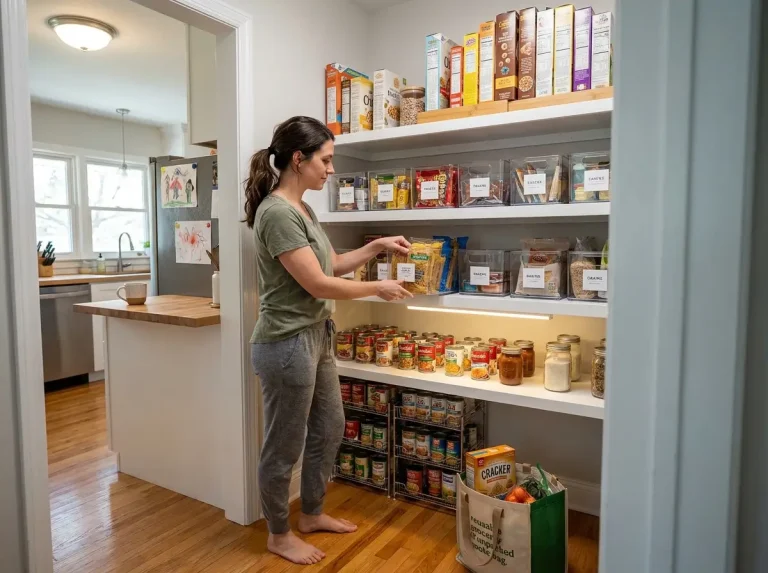
For grouping smaller items like spice packets, tea boxes, or condiment bottles, transparent stackable bins keep everything visible without digging. The mDesign Stackable Plastic Storage Bins ($22 for a 4-pack) are 10 x 6 x 5 inches each and fit 12-inch deep upper cabinets with room to spare. The clear plastic lets you see contents from any angle. Budget alternative: Dollar Tree sells similar clear bins for $1.25 each — they’re thinner plastic and won’t last as long, but they’ll work for a year or two.
If you’re working with upper cabinets in a small apartment kitchen where cabinet space doubles as pantry space, check out our guide to pantry organization for small apartments — it covers how to treat cabinet space as a micro-pantry zone.
Best organizers for lower and deep cabinets (24-inch depth)
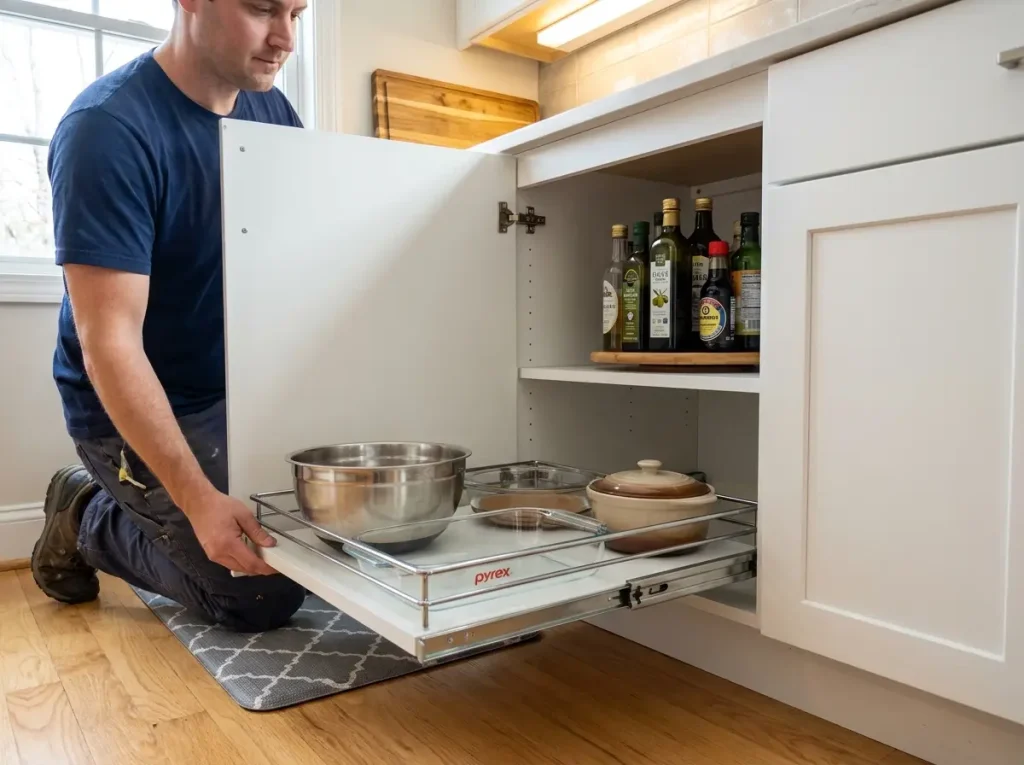
Lower cabinets are where things go to disappear. They’re 24 inches deep, and most people can only comfortably reach the front 10-12 inches. Everything behind that becomes a forgotten layer of expired canned goods, duplicate spice bottles, and that slow cooker you used once in 2019. The problem isn’t that you have too much stuff — it’s that your cabinet is twice as deep as your arm is long.
The best fix for deep cabinets is a pull-out shelf that brings the back of the cabinet to you. The Adhesive Pull-Out Cabinet Organizer ($28) expands from 12 to 20 inches wide and fits the full 24-inch depth of standard base cabinets. It mounts with nano-adhesive strips — no drilling, no screws, and it comes off clean if you move. That said, the adhesive only works on smooth surfaces like melamine or painted wood. If your cabinet interior is rough or textured, the adhesive won’t hold and you’ll need the screw-mount version instead.
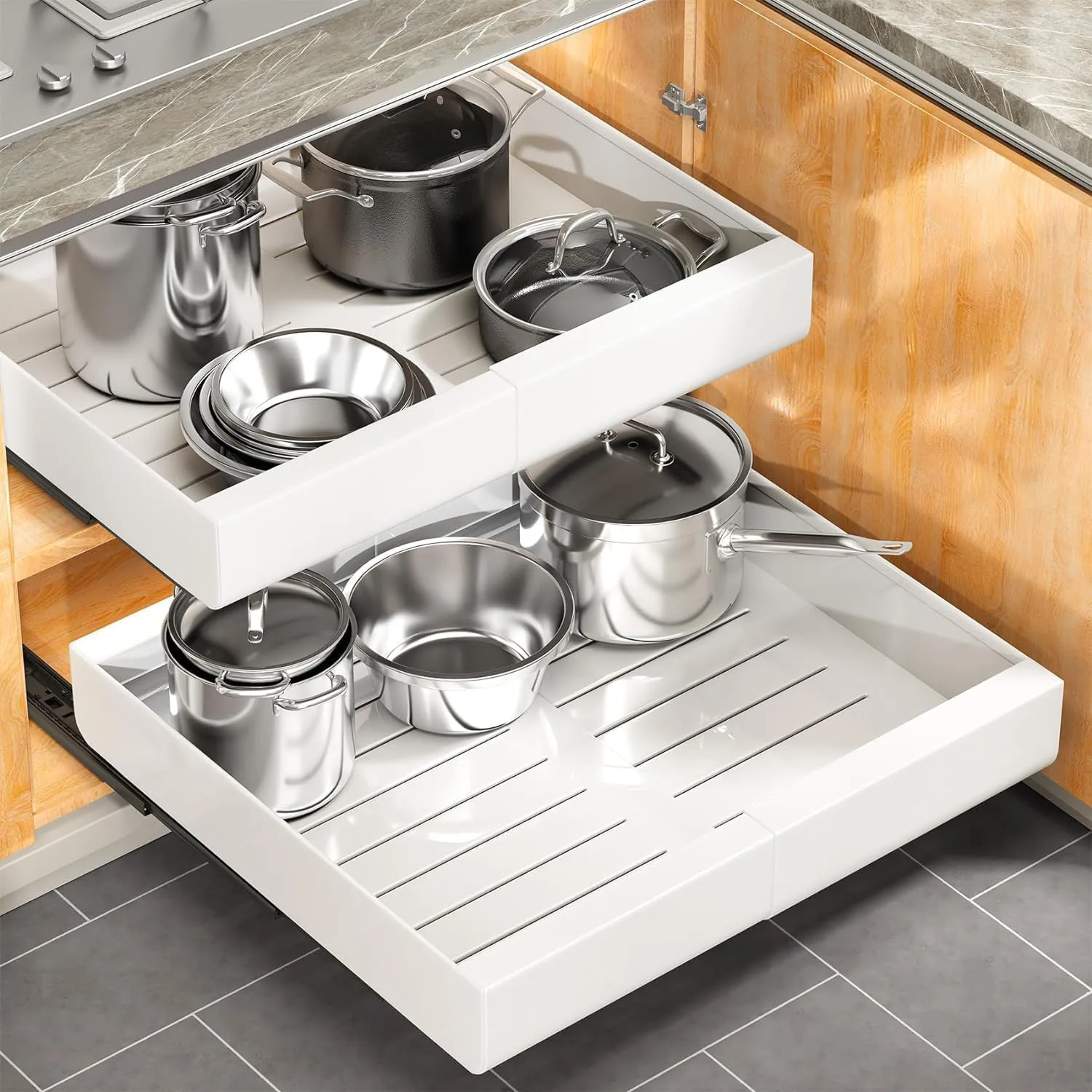
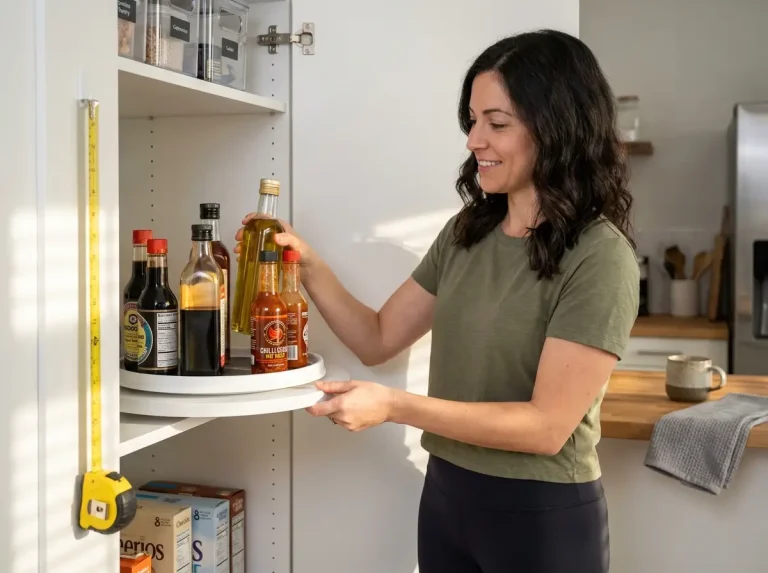
If $28 is more than you want to spend, a turntable in a deep cabinet gives you partial access to the back for a lot less money. The Copco Non-Skid Turntable ($10) has a 12-inch diameter and a non-skid surface that keeps bottles from flying off when you spin it. Put it in the back half of the cabinet with oils, vinegars, and condiments grouped on it. One spin and you can see everything. It won’t solve the deep-cabinet problem completely — items not on the turntable still get lost — but at $10 it’s the cheapest meaningful improvement you can make.
Pro tip: In deep lower cabinets, use the turntable for the back zone and a pull-out for the front zone. This two-layer approach gives you full access to the entire 24-inch depth without bending or digging.
The same depth problem affects deep pantry shelves. If you have a pantry with shelves over 20 inches deep, our guide on organizing deep pantry shelves covers the full playbook including stadium-seating risers and the monthly back-shelf sweep.
Best organizers for corner cabinets (the black hole fix)
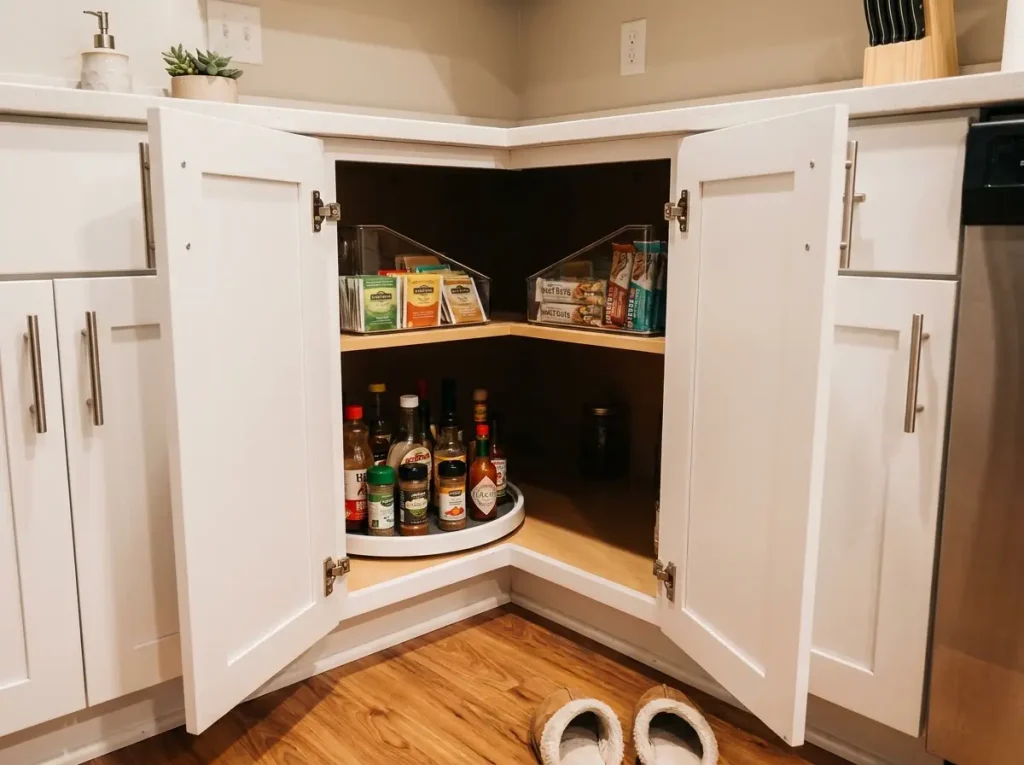
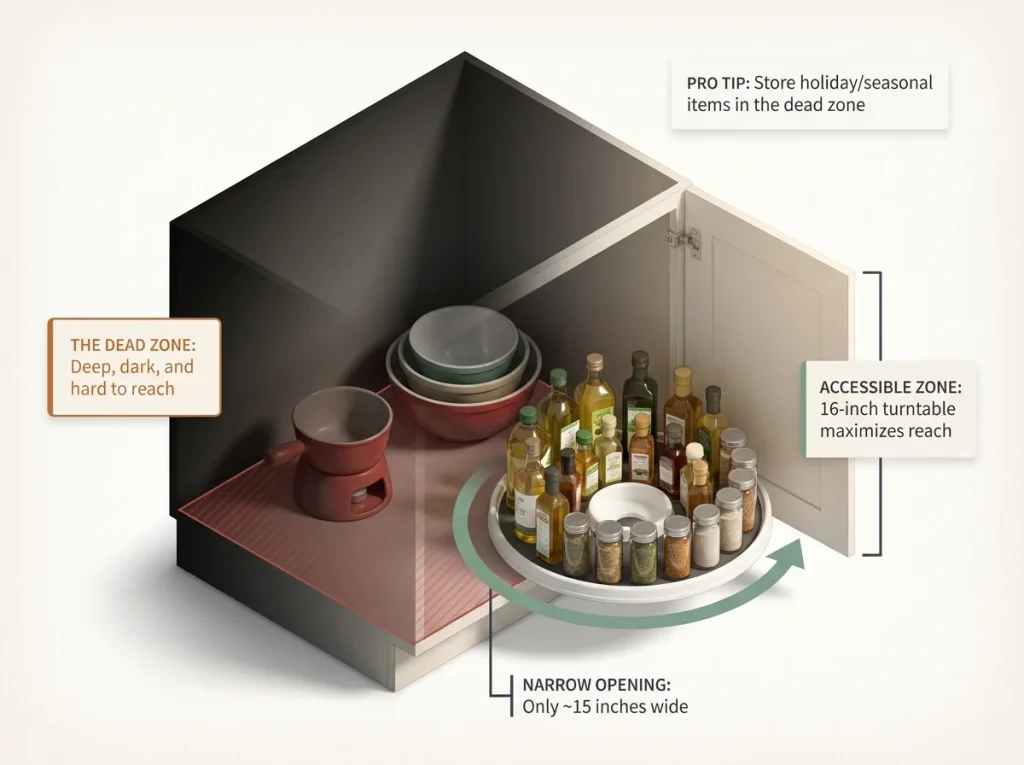
Corner cabinets are the most wasted space in any kitchen. They’re wide — usually 33 to 36 inches — but the opening is only about 15 inches. Anything you push past the door opening goes into a zone you can’t see and can barely reach. Most people eventually give up and just store things they rarely use back there. That’s actually fine as a strategy, but if you want actual access to that space, a turntable is the simplest fix.
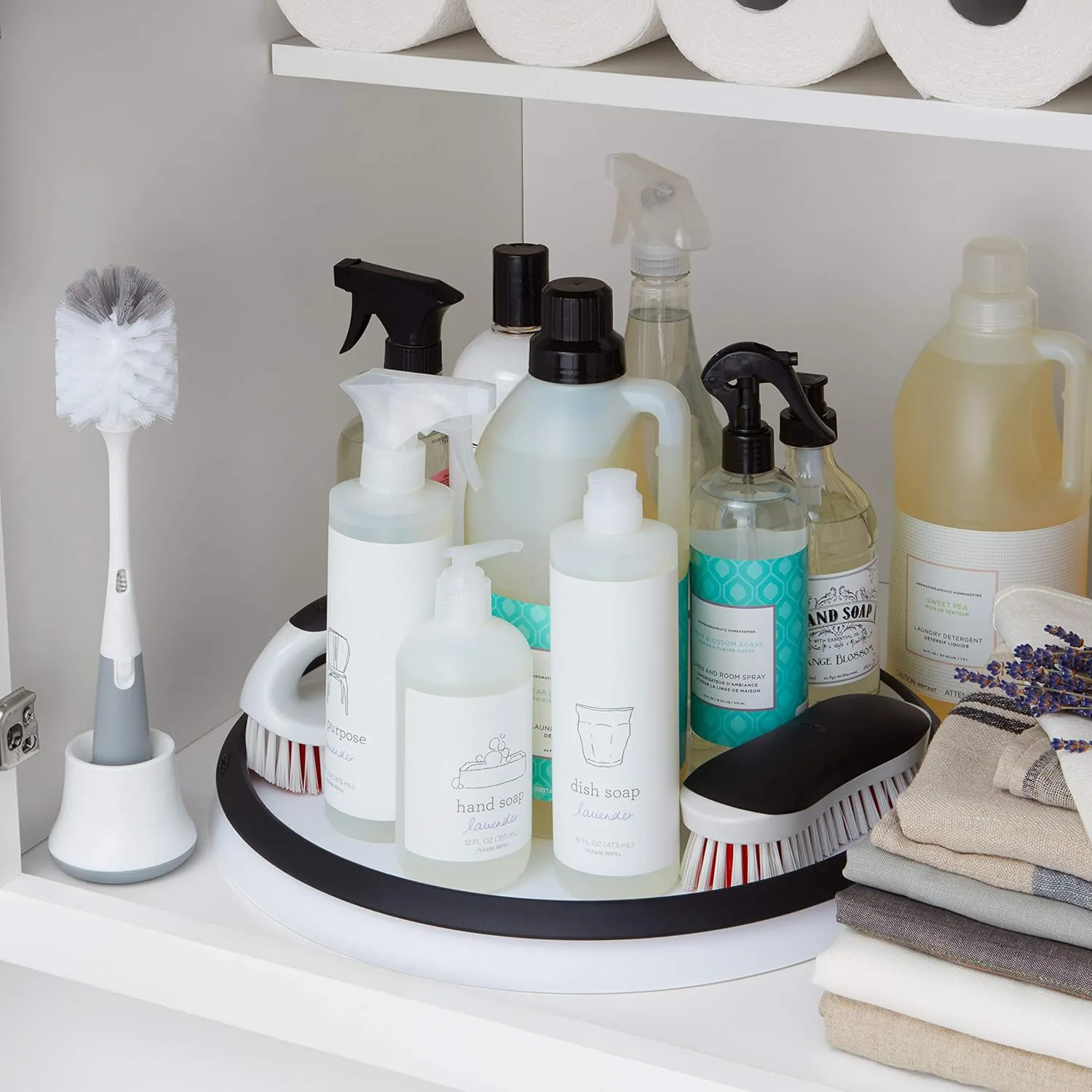
The OXO Good Grips Lazy Susan Turntable ($22) is 16 inches in diameter — large enough to use the deep corner space without being too big for the cabinet opening. The non-skid surface keeps jars and bottles from sliding around when you rotate it. You set it on the shelf, load your condiments and spices around the perimeter, and spin to access. No installation, no tools, pick it up and move it whenever you need to.
The honest truth about corner cabinets: no organizer makes them as accessible as a regular cabinet. A turntable improves access to maybe 70% of the space. The deep back corners behind the turntable will always be hard to reach. Accept that and use those pockets for things you need once a month — holiday baking supplies, the fondue pot, your extra set of mixing bowls. That’s not a failure of organization. It’s smart zoning.
If you also have corner issues in a pantry, our lazy susan pantry organization guide covers turntable sizing rules (hint: shelf depth minus 2-4 inches = your maximum turntable diameter).
Best organizers for pots, pans, and lids
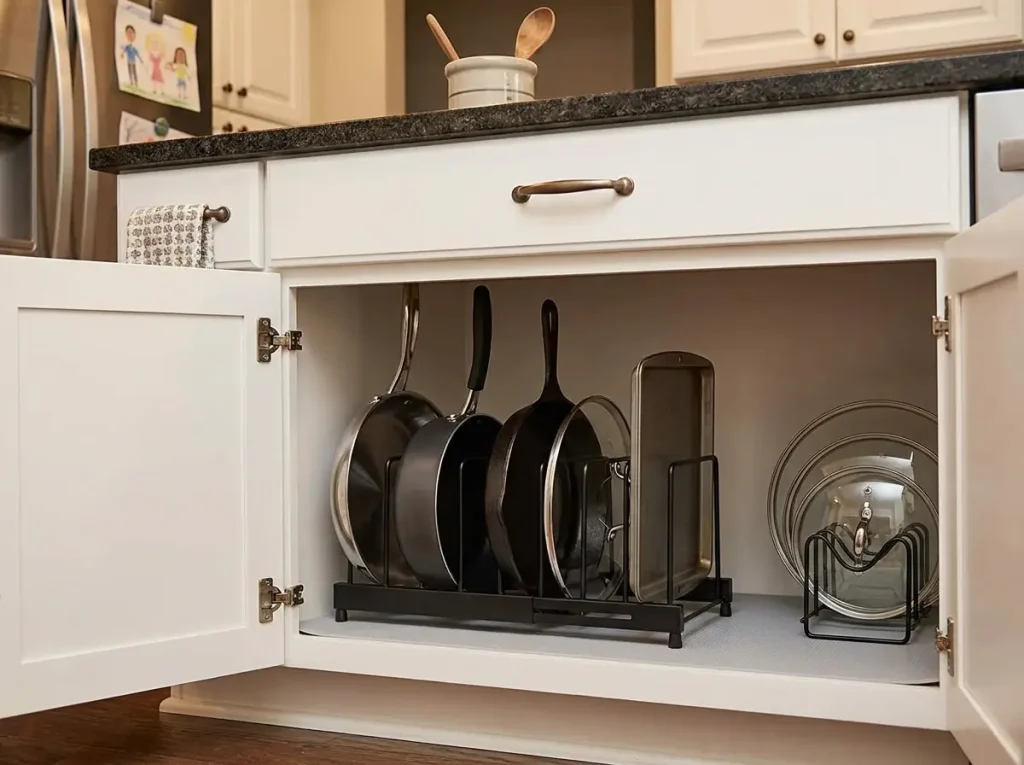
Pots and pans stacked horizontally inside a cabinet is one of the most frustrating storage setups in any kitchen. You need the skillet on the bottom? Lift four pans to get it. Need a matching lid? Dig through a pile that inevitably crashes when you pull one out. The fix is dead simple: store pans vertically, like file folders.
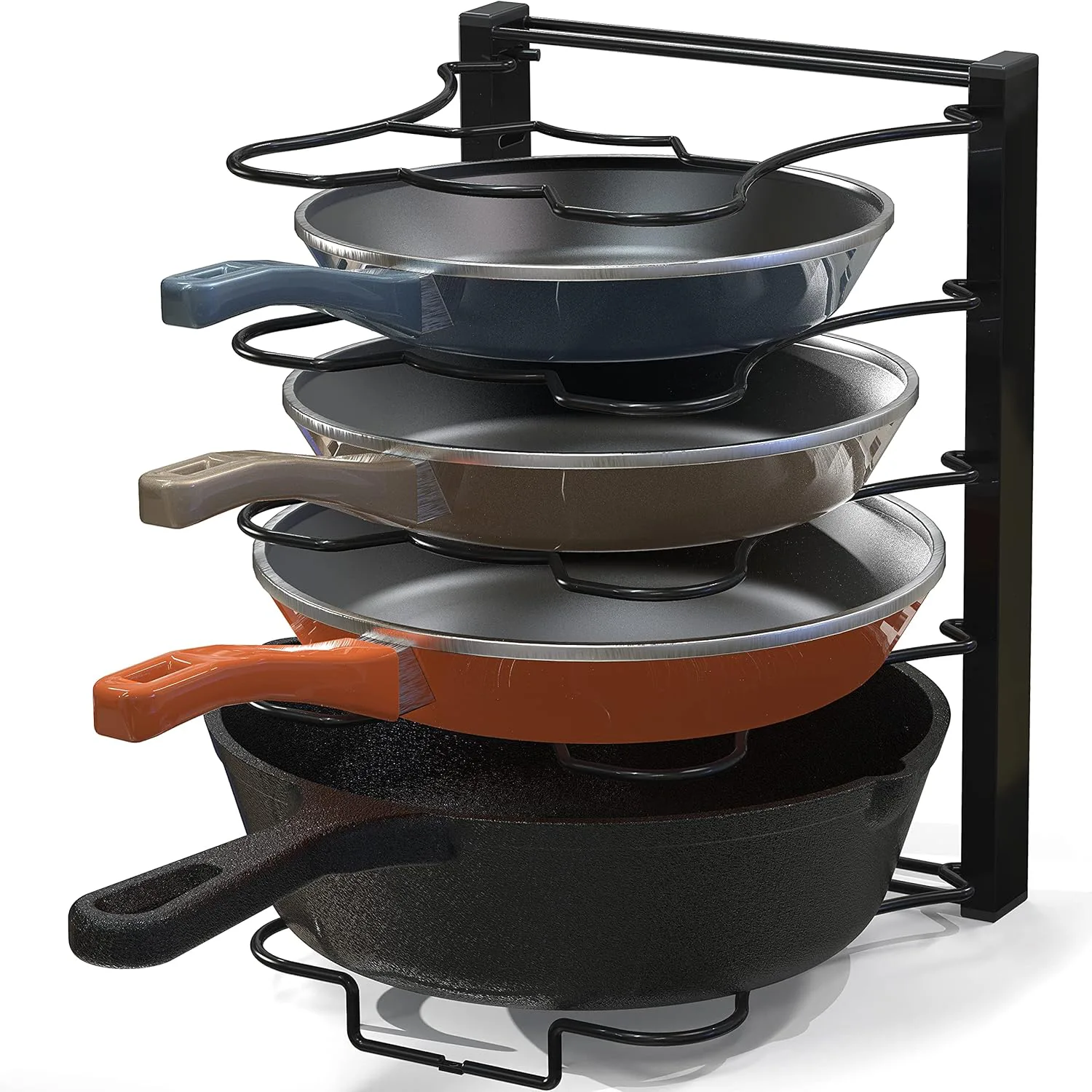
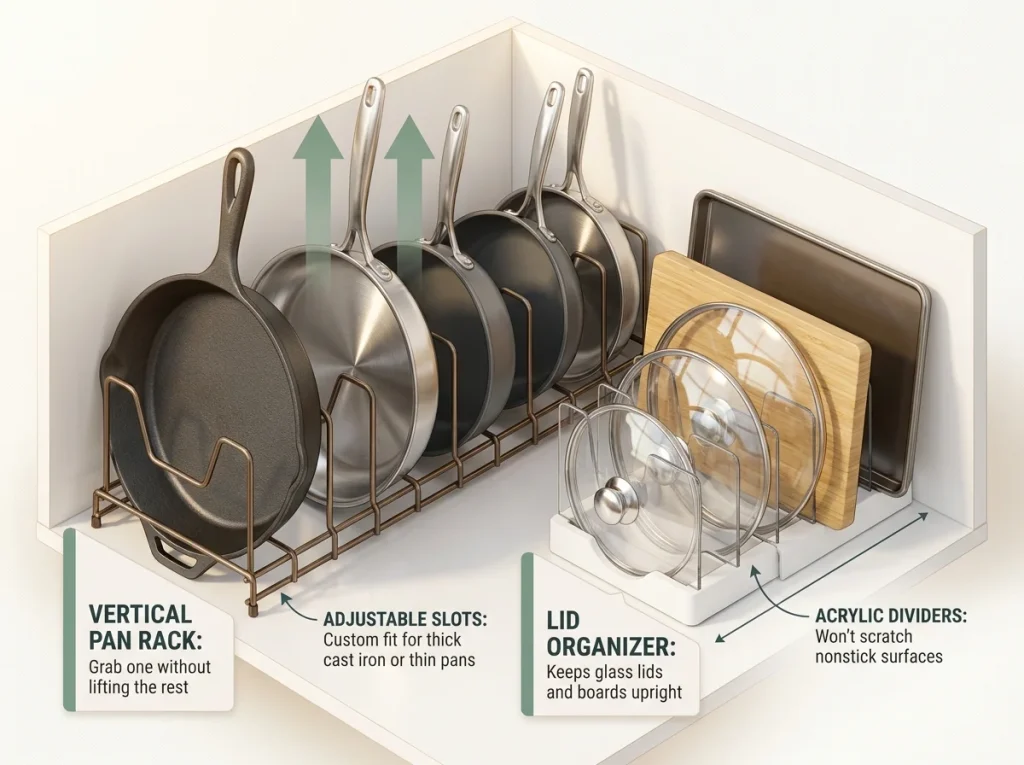
The SimpleHouseware Adjustable Pan Organizer Rack ($20) has 5 adjustable tiers at 12.5 x 9 x 11.5 inches and fits standard base cabinets. Each pan slots in vertically — skillet, saucepan, cast iron, baking sheet — and you pull out exactly what you need without moving anything else. The dividers adjust to fit different pan widths, which matters because a 12-inch skillet and an 8-inch saucepan don’t need the same slot width.
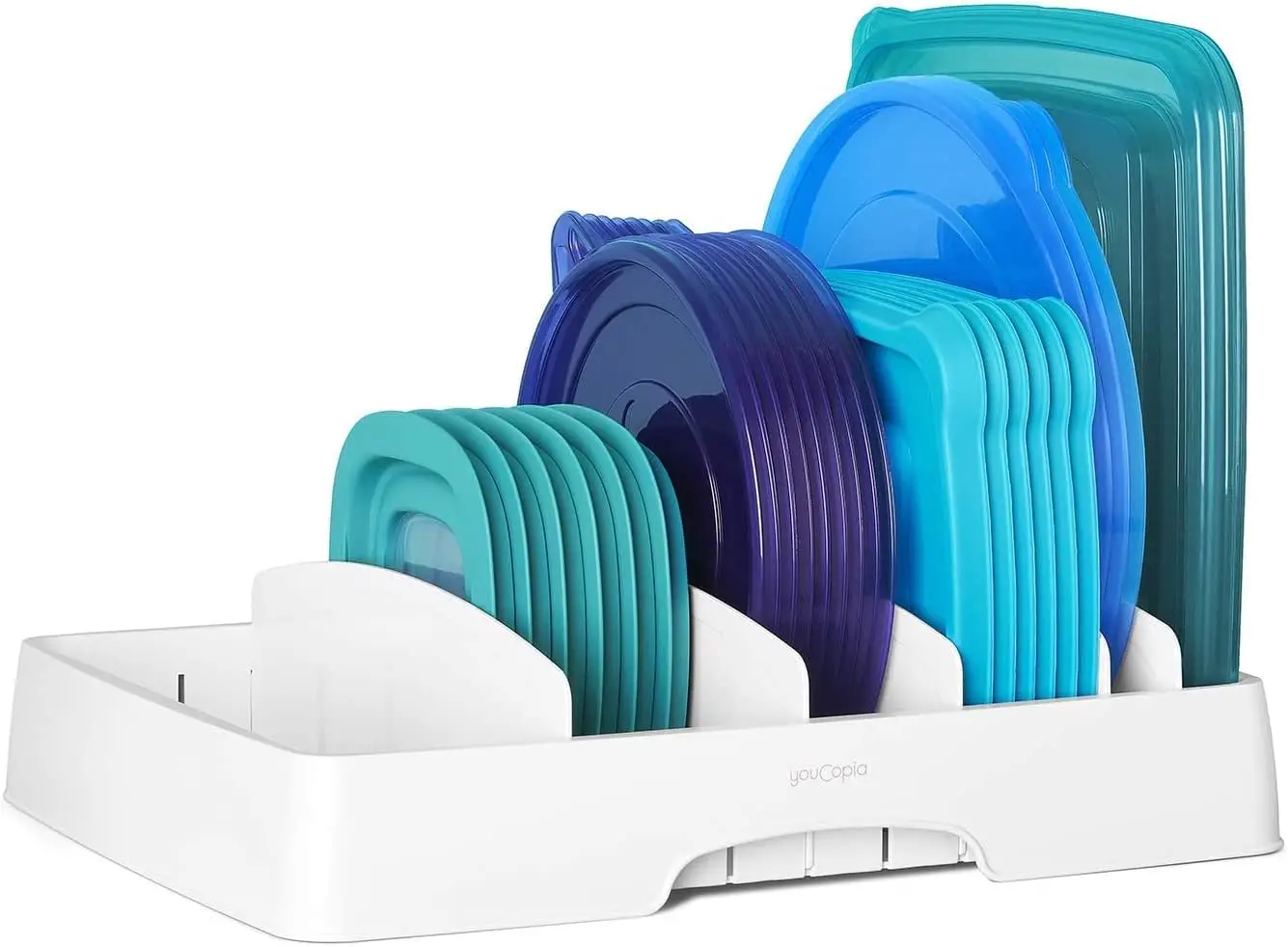
Lids are the other half of the problem. They don’t stack neatly, they slide around, and they always end up in a pile at the bottom of the cabinet. The YouCopia StoraLid Pot Lid Organizer ($25) has 10 adjustable dividers that expand to 22 inches wide, so it holds lids, cutting boards, and baking sheets vertically in one unit. It sits on the cabinet floor and you adjust the divider spacing to match your lid sizes. The build quality is better than cheaper wire alternatives — the plastic dividers don’t scratch nonstick lids.
Budget alternative for both: a single tension rod mounted vertically inside your cabinet ($3 from any dollar store) creates a basic divider that keeps lids from falling into the pan pile. Two tension rods side by side create a slot rack. It’s not as clean as a dedicated organizer, but for $6 total it keeps lids upright and separated.
Pro tip: Store your most-used pan at the outside edge of the rack — the slot closest to you when the door opens. You reach for it every day; make it the easiest grab.
Best organizers for cabinet doors (free storage you’re ignoring)
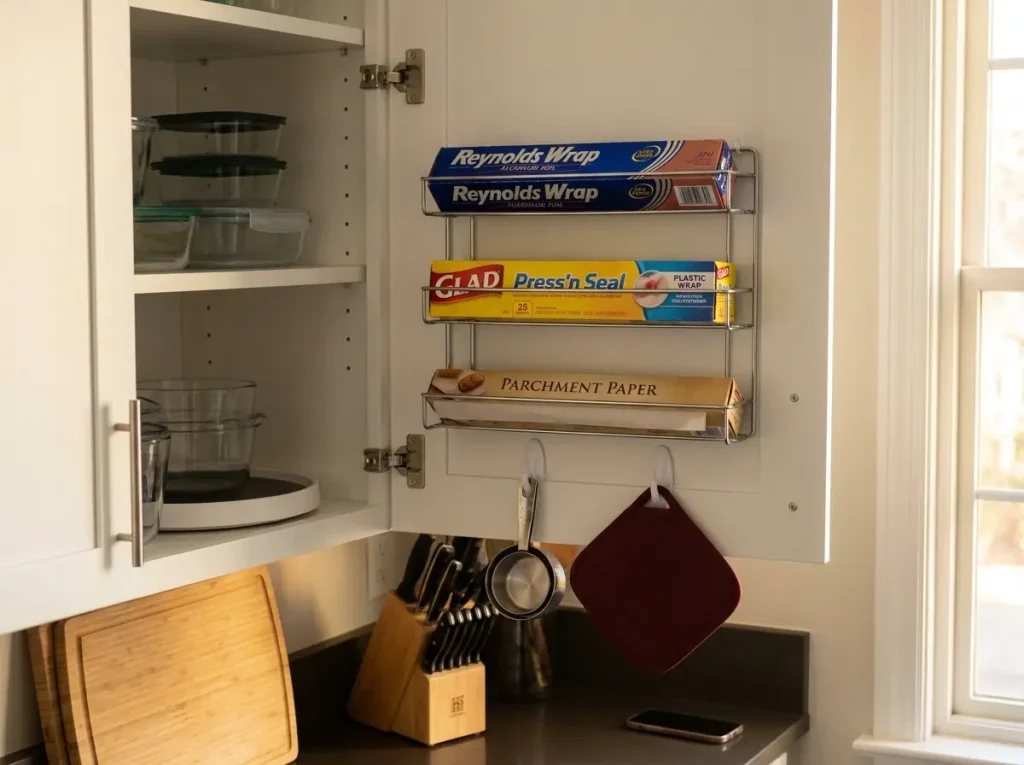
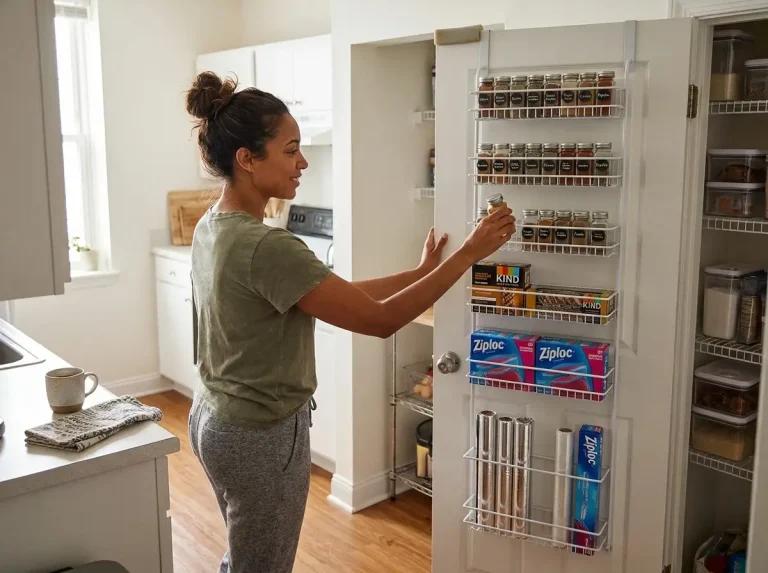
The inside of your cabinet doors is wasted space in almost every kitchen. You walk past it multiple times a day without thinking about it. That flat surface can hold wraps, cleaning supplies, measuring cups, spice jars, or pot holders — all without taking up a single inch of shelf space inside the cabinet.
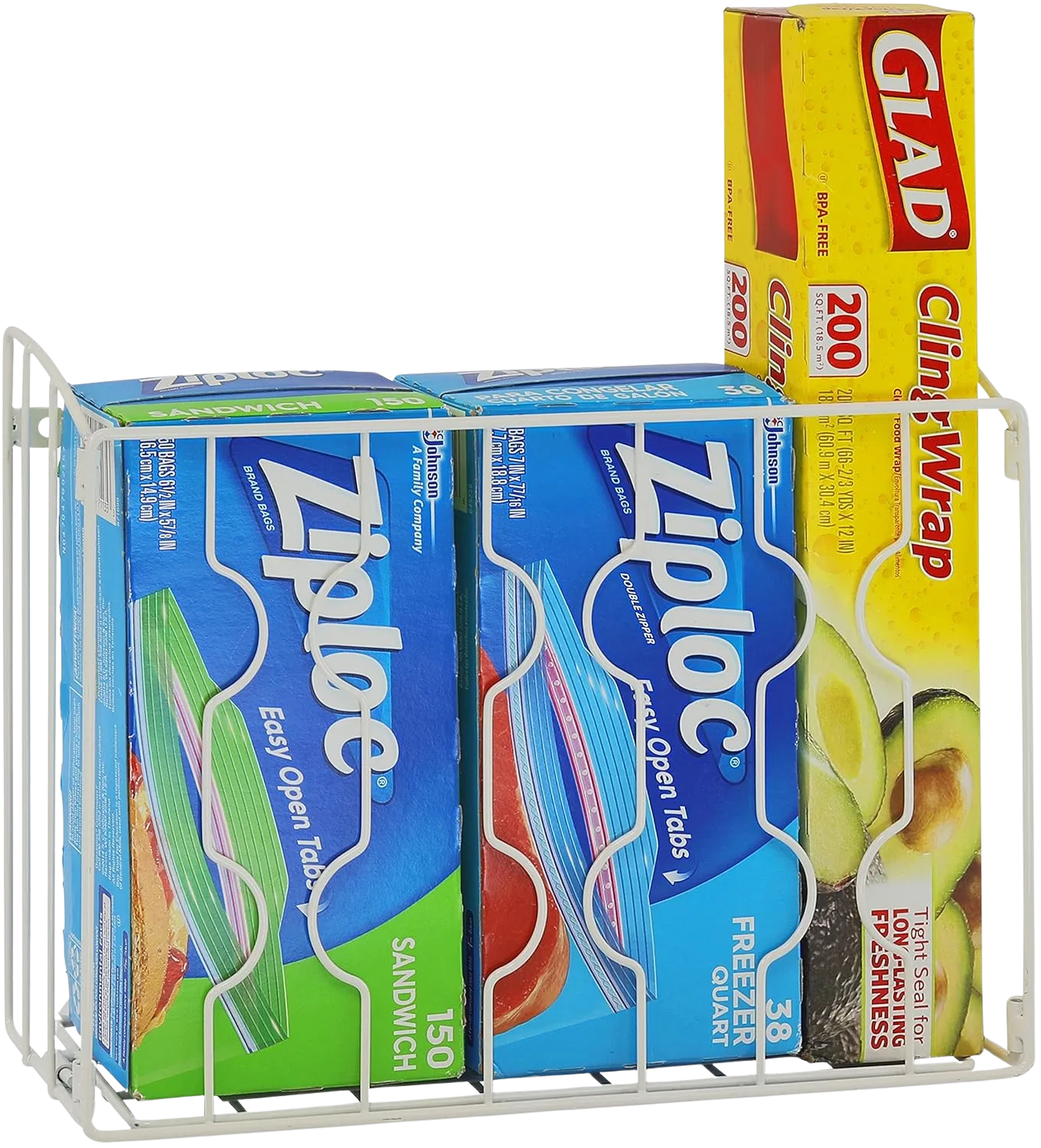
The SimpleHouseware Wall/Door Mount Kitchen Wrap Organizer ($15) holds aluminum foil, plastic wrap, and parchment paper on the inside of a cabinet door, moving three bulky items out of your drawers and off your counter. The standard mounting uses screws into the door, which works on solid wood doors. If you’re renting, use Command strips rated for 4+ pounds as an alternative mount — they’ll hold the organizer plus three full rolls without issues on smooth-finish doors.
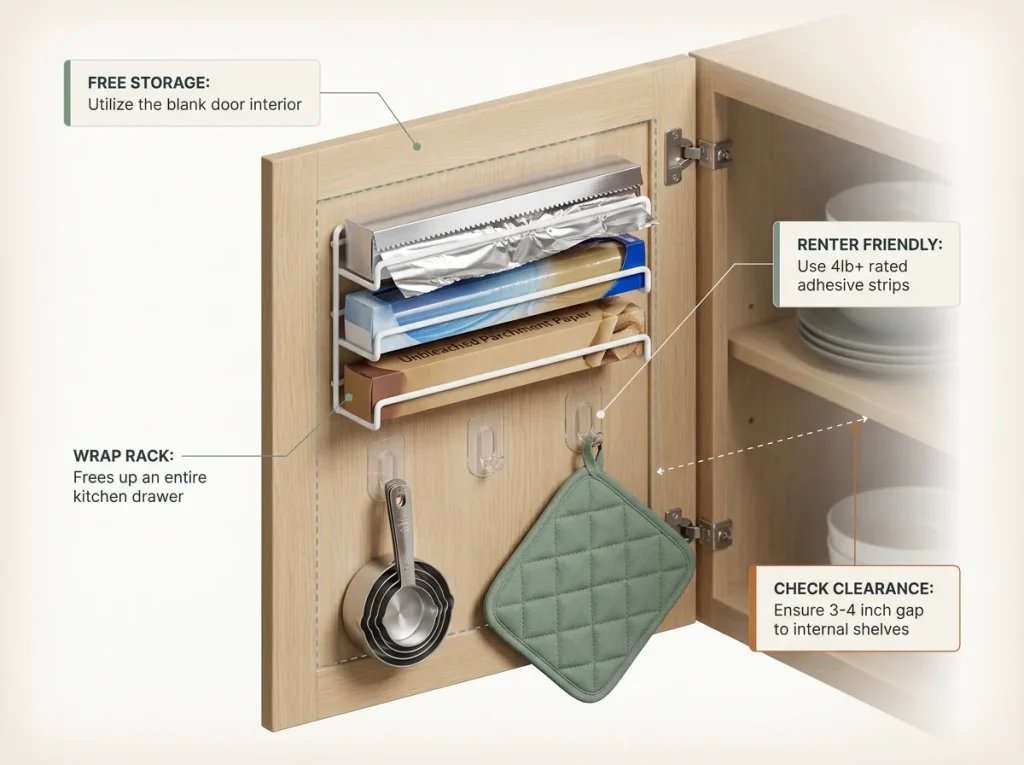
One thing to check before mounting anything on a cabinet door: open the door and look at the clearance between the door’s interior surface and the nearest shelf edge. You need at least 3-4 inches of gap. If your shelves are adjustable, you can move the closest shelf down one peg to create space. If you skip this step, you’ll mount the organizer, load it up, close the door — and hear it smack against the shelf. Ask me how I know.
Our guide to pantry door organizer ideas covers door weight limits by material (hollow-core vs. solid wood) and the exact clearance measurements you need — the same principles apply to kitchen cabinet doors.
How to keep your cabinets organized after the first month
Organizing your cabinets is the easy part. Keeping them organized is where most people fail. The system looks great on day one, gradually gets messier over weeks two through four, and by month two it’s back to chaos. That cycle isn’t a character flaw — it’s a maintenance gap.
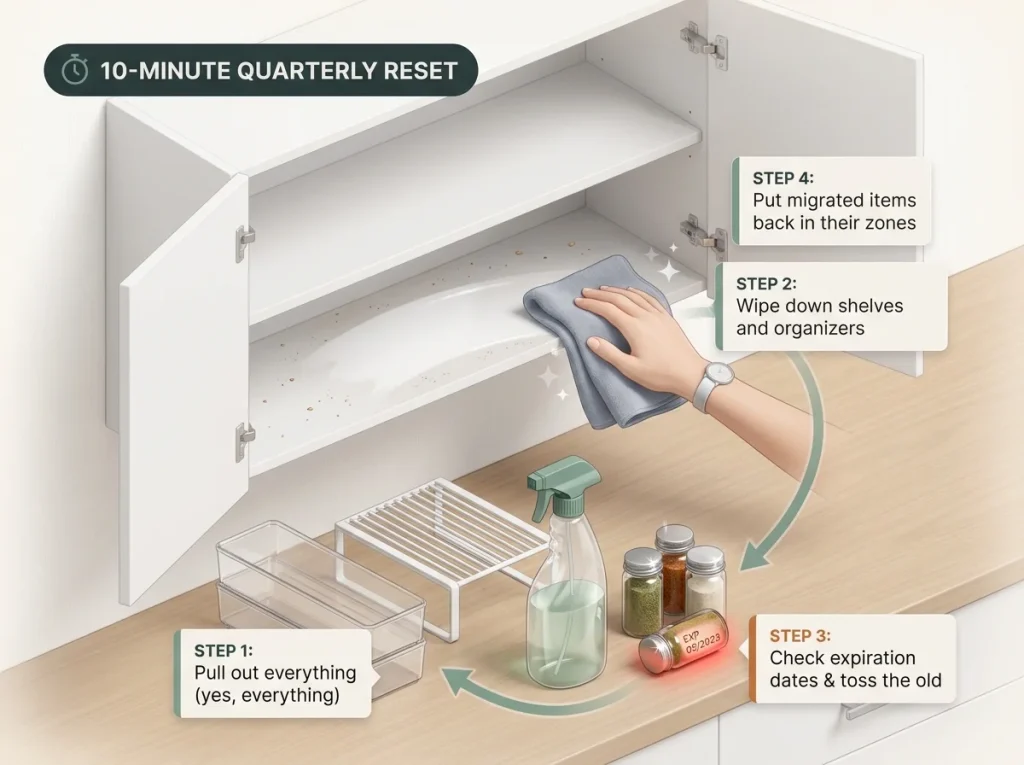
Here’s a 10-minute quarterly cabinet reset that prevents the slow slide back into disorder. Set a recurring reminder on your phone for every three months.
First, open every cabinet and pull out anything that migrated to the wrong spot. In my experience, about 30% of items drift from their assigned zone within the first month. Just put them back where they belong. That alone takes five minutes and fixes most of the mess.
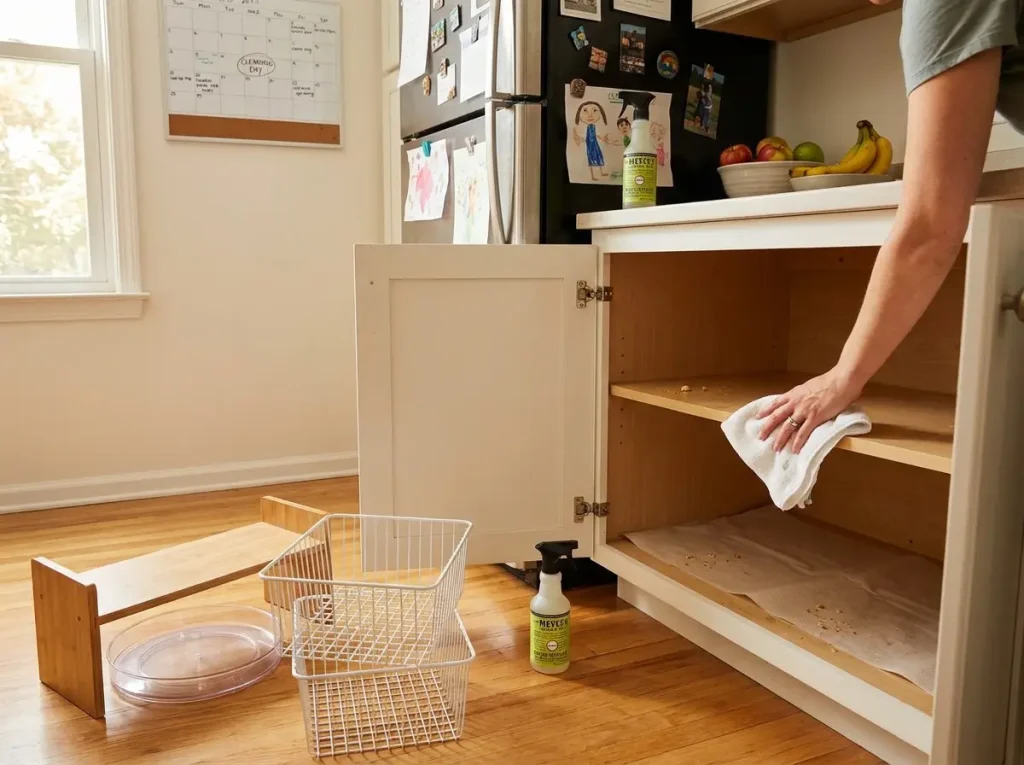
Second, wipe down the organizers and shelf surfaces. Pull out shelf risers, turntables, and bins. Wipe the shelf underneath. Crumbs, sticky residue, and dust accumulate under organizers even in clean kitchens. If you skip this, the grime builds up and you eventually avoid using the organizer because it feels gross. Two minutes with a damp cloth prevents that.
Third, do a quick inventory. Throw out expired items, consolidate half-empty duplicates, and note anything you’re running low on. This is also when you check if any organizer stopped working. If a shelf riser wobbles, a turntable sticks, or an under-shelf basket sags — fix or replace it now, not “later.” Later means never.
Pro tip: Take a phone photo of each cabinet right after you organize it. When you do the quarterly reset, open the photo and compare. You’ll instantly see what drifted and what needs to go back.
If you want a deeper breakdown of maintenance routines for kitchen storage, our kitchen cabinet organization seed guide covers the weekly 5-minute check and the full seasonal audit.
Conclusion
Three things matter more than which specific organizer you buy. First, measure your cabinets before you shop — depth, width minus hinges, and shelf spacing eliminate 90% of bad purchases. Second, match the organizer type to the cabinet type: shelf risers for 12-inch uppers, pull-outs or turntables for 24-inch lowers, turntables for corners, vertical racks for pans, and door-mount organizers for the free space you’re not using. Third, commit to a 10-minute quarterly reset so the system actually holds.
Three-month check: Revisit your setup after 90 days. Any organizer you haven’t touched in three months is in the wrong cabinet or solving the wrong problem. Move it or donate it.
Start with the one cabinet that frustrates you most. Get it right. Live with it for two weeks. If the system holds, do the next one. That’s how organization that lasts actually gets built. If you need a broader starting point, our guide on how to organize kitchen cabinets walks through the full zone-by-zone approach.
Q1 What is the best way to organize kitchen cabinets?
Measure each cabinet’s depth first, then match organizers to that specific cabinet type — shelf risers for 12-inch uppers, pull-outs for 24-inch lowers, turntables for corners. Group items by how you cook, not by category. A 10-minute quarterly reset prevents the system from reverting.
Q2 How do I organize kitchen cabinets on a budget?
Start with free fixes: group items by use frequency and move rarely-used items to harder-to-reach spots. Dollar Tree sells shelf risers for $1.25 and clear bins for $1.25 each. A tension rod ($3) works as a basic lid divider. You can organize most kitchens for under $20. Check our guide to pantry organization on a budget for more low-cost methods.
Q3 What organizers work in rental kitchens where I can’t drill?
Freestanding organizers like shelf risers, turntables, stackable bins, and pan racks need zero installation. For pull-outs, look for nano-adhesive mounting that removes cleanly. For cabinet door organizers, Command strips rated for 4+ pounds replace screws on smooth doors. All nine products in this guide are renter-friendly or have a renter-friendly alternative.
Q4 How deep are standard kitchen cabinets?
Upper wall cabinets are typically 12 inches deep. Lower base cabinets are 24 inches deep. Corner base cabinets are 33-36 inches wide but have a narrow 15-inch opening. Always measure your actual cabinets before buying organizers — rental and older kitchens often vary from these standards by 1-2 inches.
Q5 How often should I reorganize my kitchen cabinets?
A full reorganization once is enough if you maintain it. Do a 10-minute quarterly reset: put migrated items back in their zones, wipe down organizers and shelves, toss expired items, and fix or replace any organizer that stopped working. Take a photo after organizing so you have a reference point for each reset.
Disclaimer: ClutterlessNest is a participant in the Amazon Services LLC Associates Program. As an Amazon Associate we earn from qualifying purchases. This article may contain affiliate links — if you buy through them, we may earn a small commission at no extra cost to you. We only recommend products we have tested or genuinely believe in.