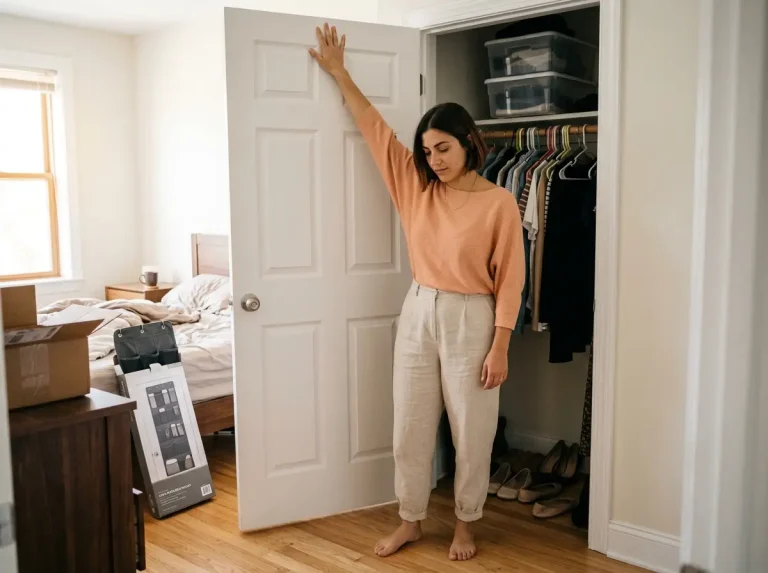
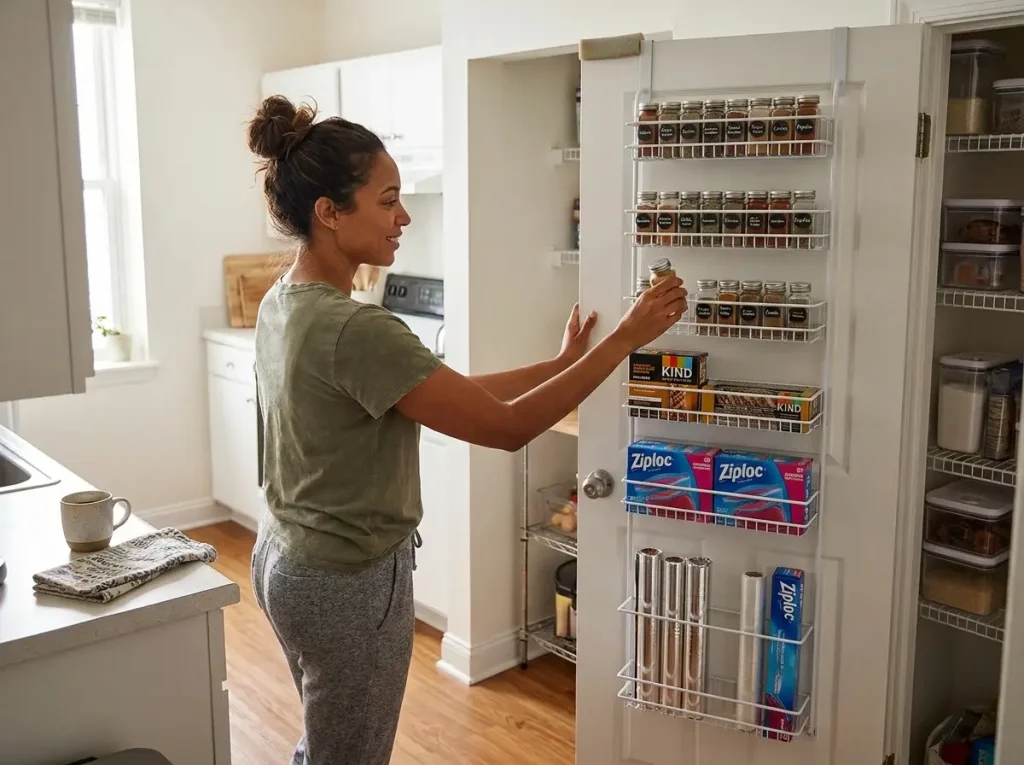
You’ve got 4-6 square feet of perfectly good storage space on the back of your pantry door, and right now it’s doing nothing. Maybe holding an apron you haven’t worn since 2019. That’s dead space in a room where every inch matters — especially if your pantry is a shallow reach-in closet pretending to be a real pantry.
I’ve organized enough pantries to know that the door is the last spot most people think about and the first one that makes a visible difference. But here’s the thing nobody mentions online: not every door organizer fits every door. There’s one measurement you need to take before you spend a dollar, and skipping it is why half the over-the-door racks on Amazon end up returned. Here’s how to use your pantry door the right way — and what to check first.
Quick Answer: The best pantry door organizer ideas depend on your door type and clearance:
- Measure the gap between the closed door and your first shelf — you need at least 5-6 inches for a standard rack
- Over-the-door multi-tier racks work best for snacks, wraps, and lightweight items
- Mount a spice rack at eye level for daily-use spices only
- Use a wrap/foil dispenser to free up an entire kitchen drawer
- Hollow-core doors max out at 15-20 pounds — load accordingly
- Add bumper pads and mounting tape to prevent scratching and swinging
The Clearance Check Nobody Mentions
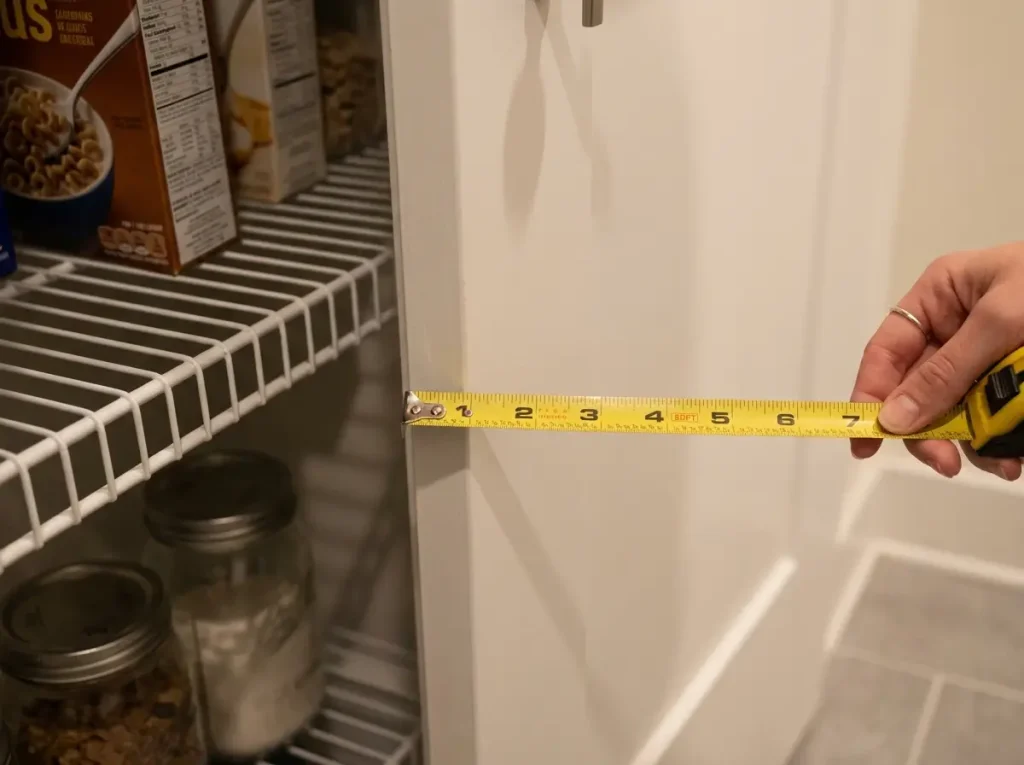
How to Measure Your Door-to-Shelf Gap
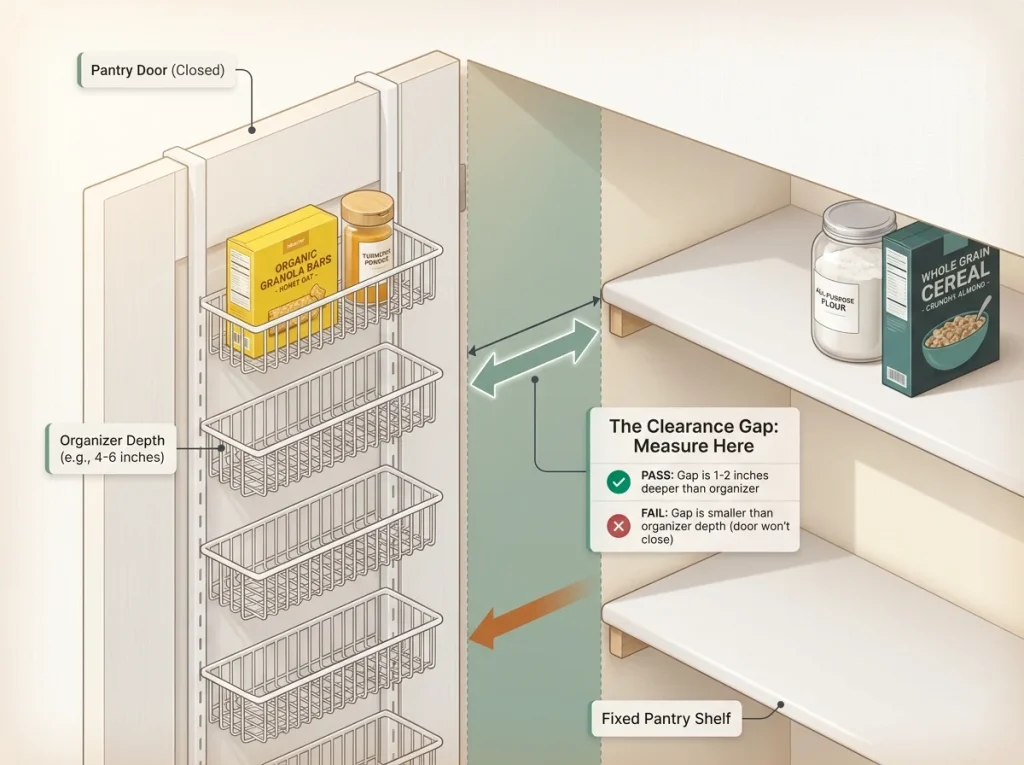
Before you shop for anything, close your pantry door and measure the distance from the back of the door to the front edge of your nearest shelf. This is your clearance gap, and it determines what will fit.
Most over-the-door organizers are 4-6 inches deep. The Delamu 6-tier is 5 inches deep. The SimpleHouseware 5-tier is closer to 4.5 inches. If your gap is 5 inches and your organizer is 5 inches deep, the door won’t close. You need at least 1-2 inches of breathing room beyond the organizer depth.
What to Do When Clearance Is Tight
If your clearance is under 5 inches — common in small pantries with limited shelves — skip the multi-tier rack entirely. Flat-profile solutions work instead: single-row wire spice racks, Command hook and basket combos, or a slim wrap dispenser. These add storage without adding the 5-6 inches of depth that a full rack demands.
When You Have Room to Work With
If your gap is 6 inches or more, you’ve got options. Full multi-tier racks, deeper basket organizers, and even DIY wooden frames will all fit. Walk-in pantries almost always have enough clearance because the shelves sit deeper and the door swings into open floor space.
Pro tip: Measure at three heights — top, middle, and bottom of the door. Shelves aren’t always perfectly aligned, and that bottom shelf might stick out farther than the top one. Your tightest measurement is the one that matters.
Over-the-Door Multi-Tier Racks
Why These Are the Most Popular Option
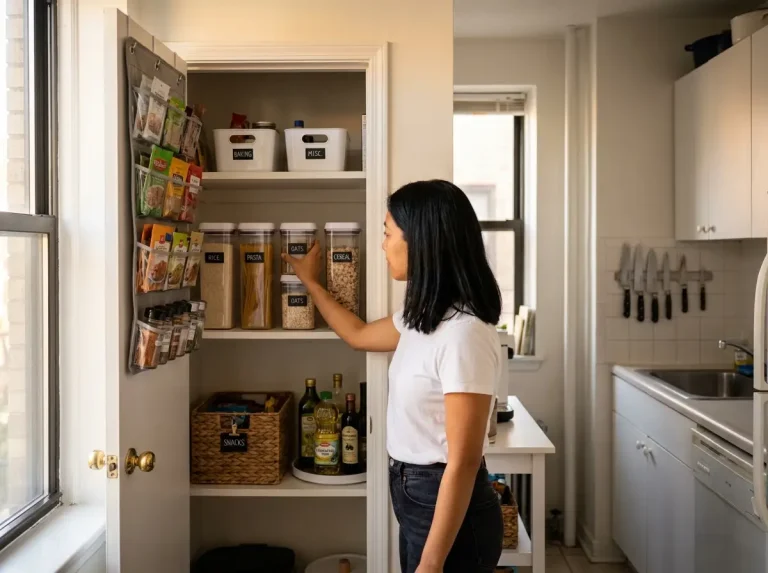
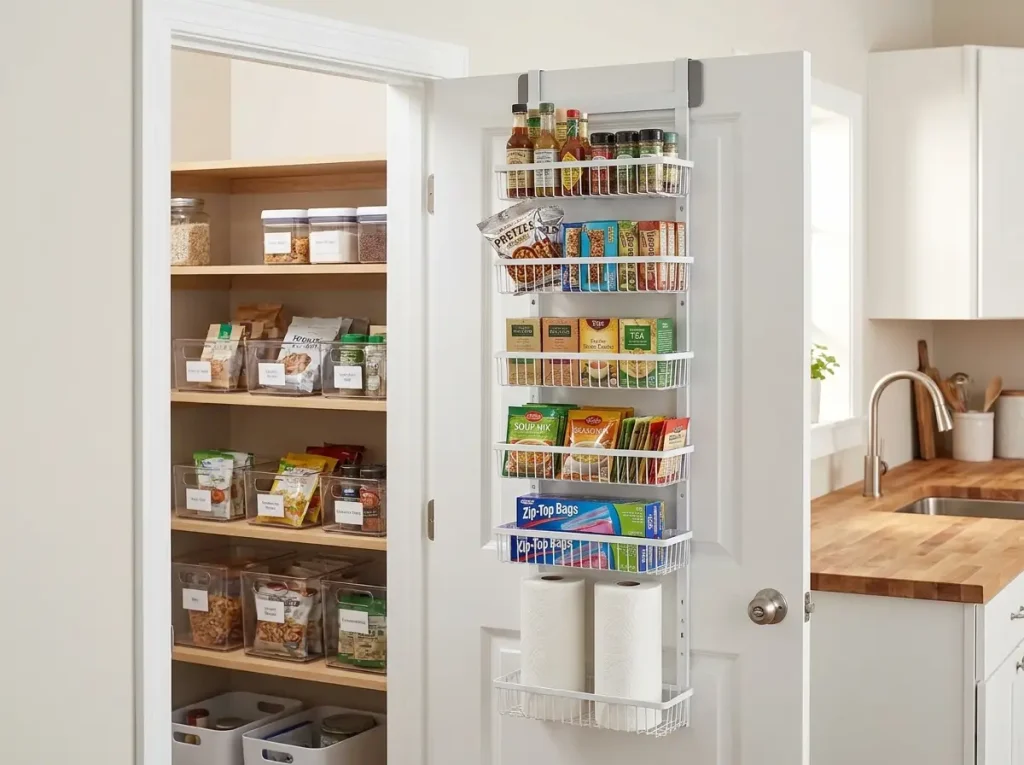
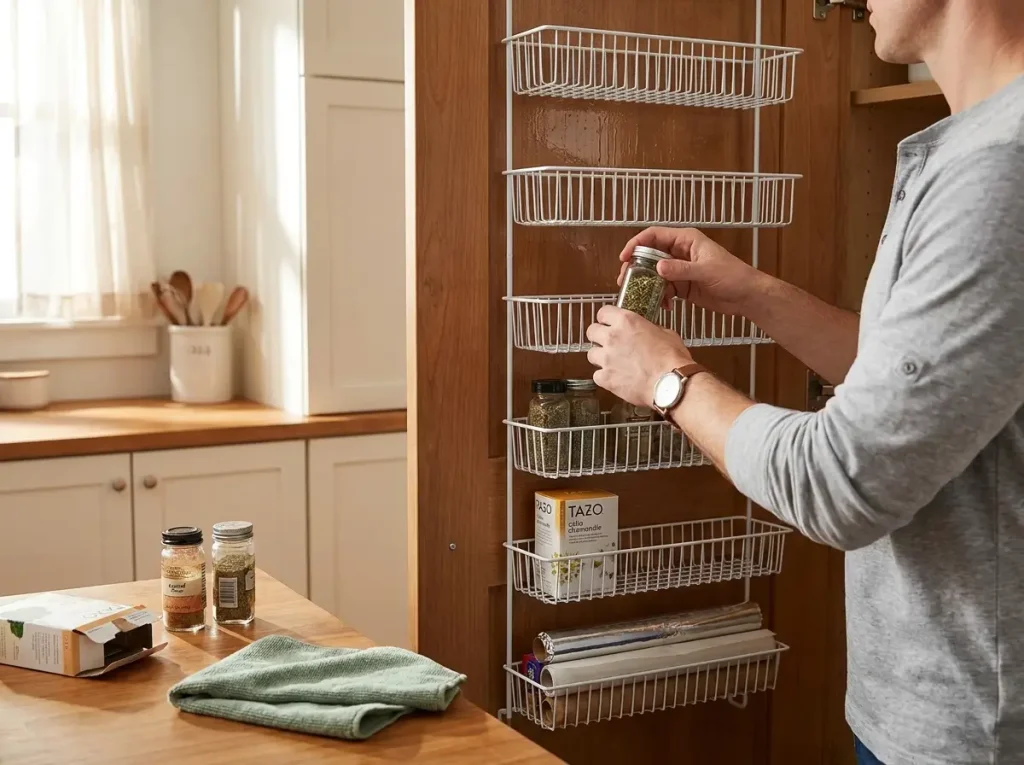
Multi-tier over-the-door racks are everywhere for a reason: they add 5-8 shelves of usable storage without a single screw. Hooks sit over the door top, baskets hang down the back, and you’ve got vertical storage in under five minutes. They work best for lightweight items — snack packets, tea boxes, zip-top bag boxes, seasoning packets, and small condiment bottles.
The Two Worth Buying
The Delamu Over-the-Door Pantry Organizer (6-tier) ($30-35) is the one I’d start with. It measures D5 x W18 x H50 inches, holds up to 60 pounds total (10 pounds per tier), and has adjustable basket spacing so you can fit tall cereal boxes on one tier and short spice jars on another. The EVA foam pads on the hooks are the detail that matters — they prevent the metal-on-wood grinding that scratches your door frame over the first month.
The SimpleHouseware Over-The-Door Organizer (5-tier) ($18-22) is the budget pick. Fewer adjustment options and one less tier, but it does the job for $10-15 less. If your pantry is narrow and you only need room for wraps and snack bars, this is enough.
The Loading Mistake Everyone Makes
The number one reason these racks fail is top-heavy loading. People put glass spice jars and canned goods on the top tiers because that’s eye level. Then the door swings open fast and the whole rack tips forward. Heavy items go on the bottom. Light items — packets, boxes, bags — go on top. Every time.
How They Fit Into Your Broader Pantry System
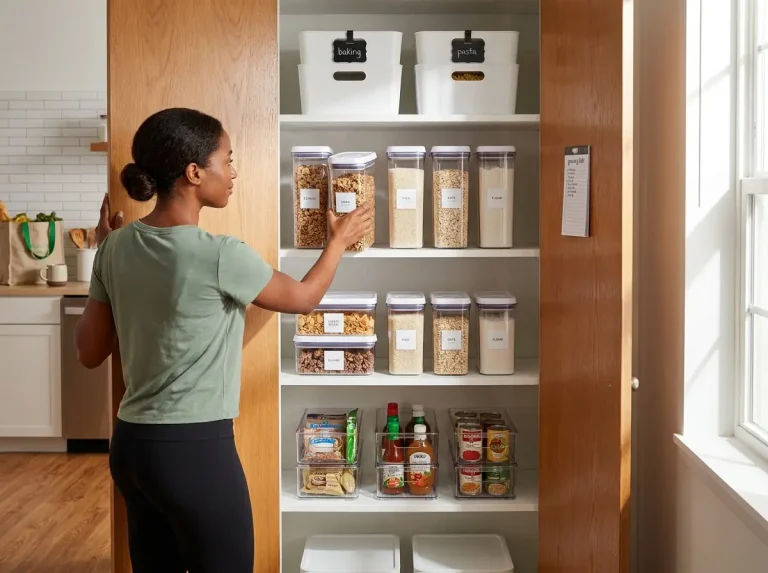
A door rack isn’t a replacement for shelf organization — it’s the overflow lane. Use your shelves for heavy, bulky items and your door for lightweight daily-grab items. If you haven’t set up a pantry organization system for your shelves yet, start there. The door is the finishing touch, not the foundation.
Pro tip: Leave the top tier of the rack empty for the first week. You’ll figure out what you actually reach for every day, and that’s what goes on the door. Everything else stays on the shelves.
Pantry Door Spice Storage That Won’t Shift
Why Spice Jars Are Trickier Than They Look
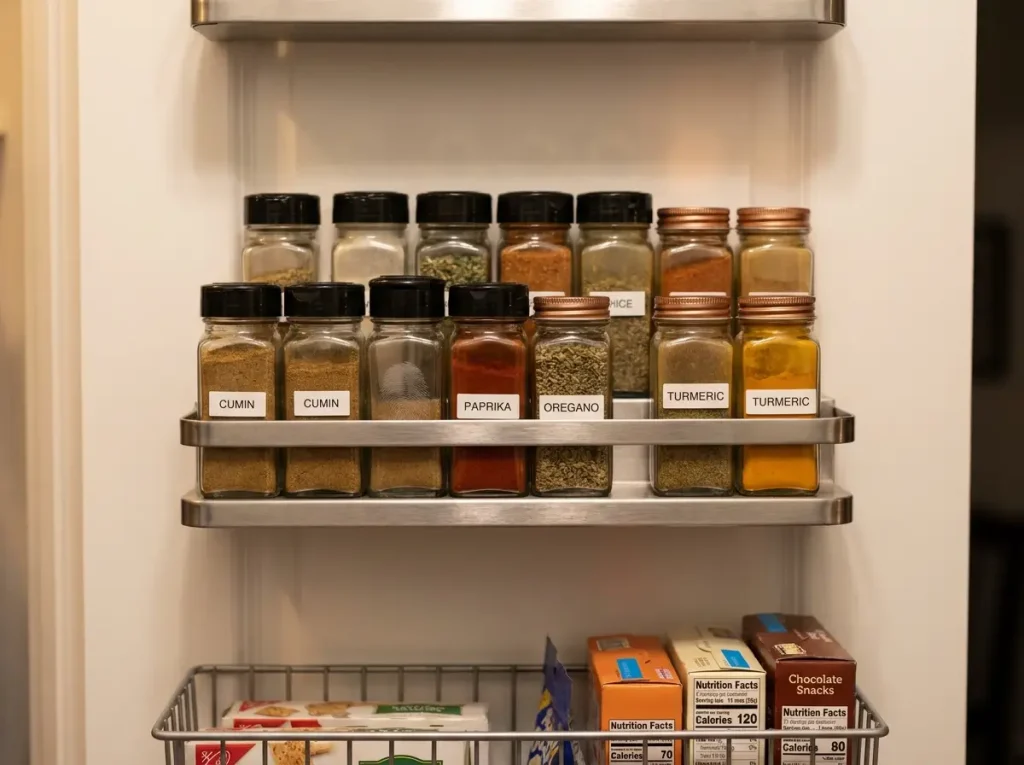
Spice jars are deceptively heavy for their size. Twenty glass jars weigh 3-5 pounds concentrated in a small area. And they shift every time the door swings. The wrong rack lets them slide forward and drop behind the canned goods on your pantry shelf — where they’ll stay until you do a deep clean six months later.
What Actually Works on a Door
Tiered racks with raised lips or rails on each shelf prevent jars from sliding during the door swing. That lip is the single most important feature — flat shelves without lips are useless on a door. Magnetic strips work on refrigerators but not on wooden pantry doors (obviously). Wire spice racks with individual slots hold jars in place but limit you to one jar size.
The YouCopia SpiceStack Spice Rack Organizer (24-bottle) ($22-28) solves the “all my jars are different sizes” problem with tiered pull-down drawers that fit bottles from tiny McCormick tins to tall grinder bottles. It does require screws to mount, so if you’re renting, you’ll need to check your lease or use the adhesive mounting approach.
For a no-cost alternative, check what you already have. A dollar store wire rack ($3-5) mounted with Command strips holds 8-12 standard spice jars and costs almost nothing. It won’t look magazine-ready, but it works.
Where to Mount Your Spice Rack
Mid-height on the door — roughly eye level when you’re standing in front of the pantry. You grab spices while cooking, usually with one hand and without looking. If they’re at knee height or above your head, you’ll stop using the door rack within a week.
Keep only daily-use spices on the door. The cumin, paprika, garlic powder, and salt you reach for three times a week belong here. The saffron you bought for one recipe in 2023 stays on the shelf. For more on what to store where, our pantry containers guide breaks down the container-to-food matching logic.
Pro tip: Put your most-used spices at the center of the rack, not the edges. Your hand naturally reaches to the middle first. You’ll grab cumin faster when it’s dead center than when it’s tucked in a corner.
Wrap, Foil, and Bag Storage on the Door
Why This Is the Biggest Win
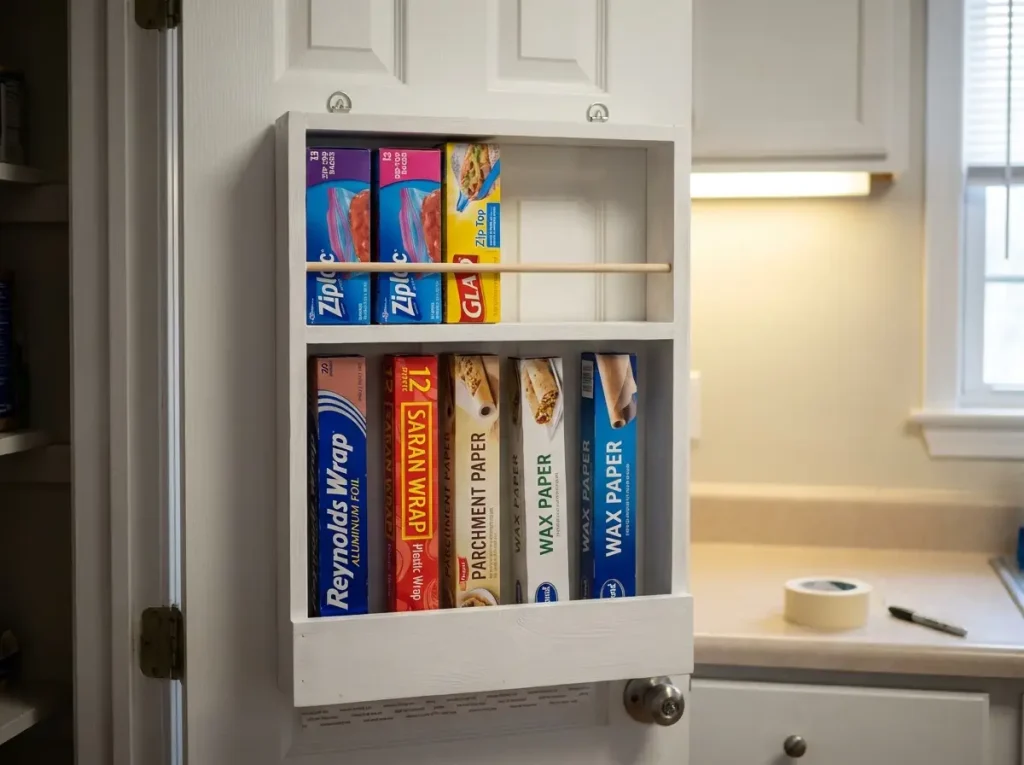
Moving your foil, plastic wrap, parchment paper, and zip-top bag boxes to the pantry door frees up an entire kitchen drawer. Not half a drawer. A full drawer. That’s real space reclaimed — enough for utensils, towels, or the junk drawer you’ve been meaning to organize.
Off-the-Shelf Dispensers
The SimpleHouseware Wall/Door Mount Kitchen Wrap Organizer ($12-15) holds 3-4 standard-width boxes (foil, plastic wrap, wax paper, parchment) in dedicated slots. It mounts with screws or adhesive strips. Under $15, simple design, and the boxes stay upright instead of rolling around loose in a tier.
If you’re renting and can’t use screws, the adhesive option holds for lightweight boxes. Foil boxes with a full roll get heavy though — if the adhesive lets go after a month, switch to the Command Large Wire Hooks ($8-12 per pack) as an anchor system instead.
The DIY Route
A simple wooden frame with a front lip takes one afternoon and about $10-15 in pine boards. Build a rectangle (25″ tall x 20″ wide works for most doors), add one horizontal shelf to create two sections, and attach a thin dowel rail 3 inches up from the front edge to keep boxes from falling forward when the door swings. Hang it with D-ring picture hangers and hollow-core door anchors. Add mounting tape along the bottom edge so it doesn’t flop away from the door.
This is the approach from the pantry organization on a budget playbook: spend $12 on materials and keep that $30 for something else.
The Box-Slide Fix
Wrap and foil boxes are tall, narrow, and top-heavy. They slide forward every time the door opens. Any rack or frame you use needs a front lip at least 3 inches high — enough to hold the boxes upright without blocking you from pulling them out. If your organizer doesn’t have a lip, add a strip of wood, a tension rod, or even a bungee cord across the front. Ugly? Maybe. Functional? Absolutely.
Door Type and Weight Limits
Hollow-Core vs. Solid-Core
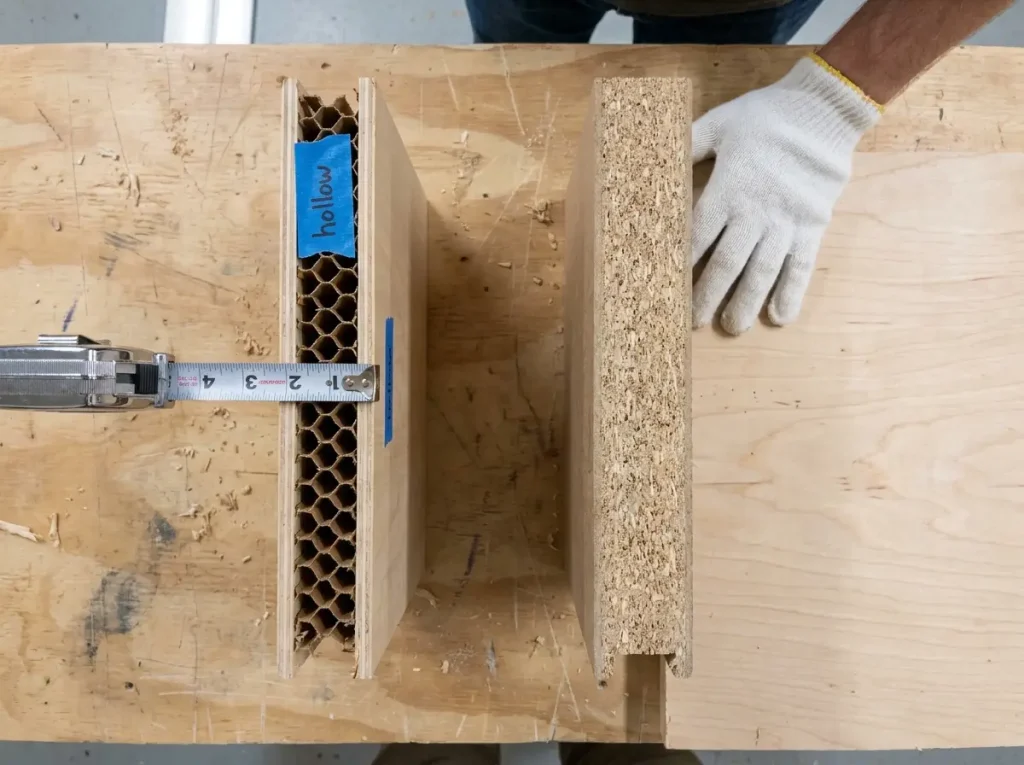
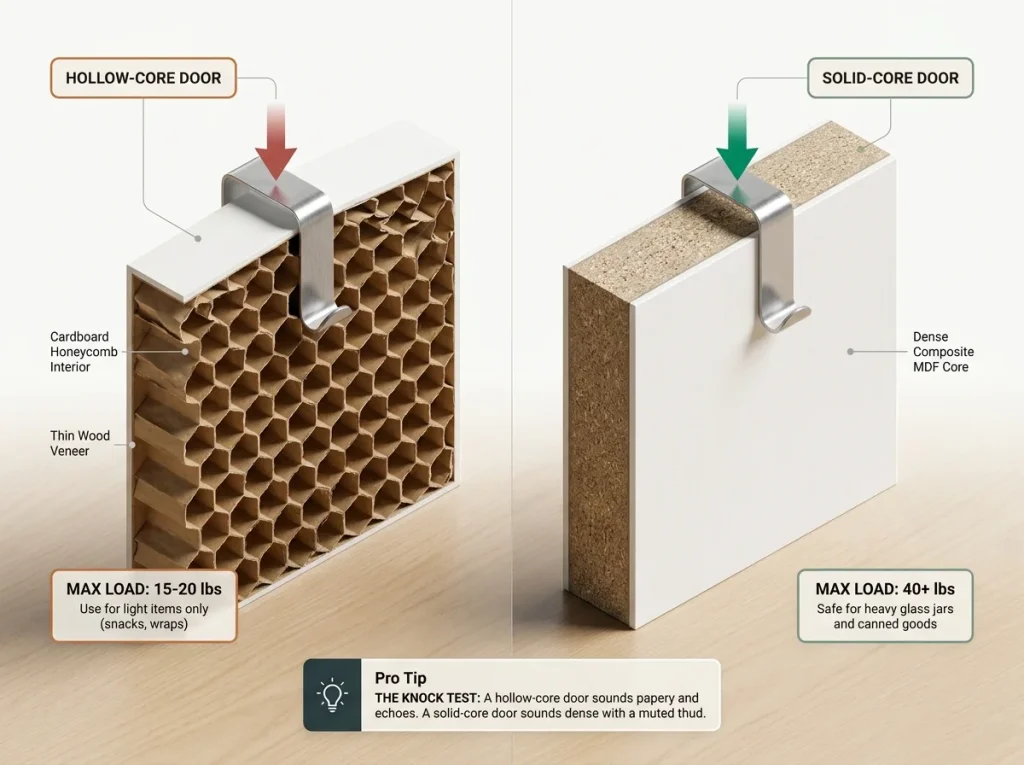
Your door type determines everything about what you can hang on it, and most people don’t know which one they have. Here’s the fast test: knock on it. A hollow-core door sounds hollow — a light, papery thud. A solid-core door sounds dense and muted. If you’re still not sure, look at the top edge of the door. Hollow-core doors show thin veneer panels sandwiching a cardboard honeycomb interior. Solid-core doors are dense composite all the way through.
Weight Limits by Door Type
Hollow-core doors (most interior doors built after 1970, virtually all rental apartments): safe maximum is 15-20 pounds with standard 2-hinge hardware. That includes the weight of the organizer itself — a steel 6-tier rack weighs 3-5 pounds before you put anything on it. So you’ve got roughly 10-15 pounds of actual storage capacity.
Solid-core doors: handle 40+ pounds without issue. You can mount heavier screw-in organizers, load glass jars, and not worry about sag.
The Third-Hinge Upgrade
Most interior doors have two hinges. Adding a third hinge in the center increases weight capacity by roughly 50% and costs $8-12 per hinge. It’s a 20-minute install with a chisel and a screwdriver. If you own the place and want to load your door with a full spice rack plus a multi-tier organizer, this is the upgrade that makes it safe.
Protecting Your Door Frame
Over-the-door hooks grind against the door top every time it swings. After a month, you’ve got a visible scratch line. EVA foam bumper pads stuck to the door frame top — right where the hook contacts — prevent this entirely. Cost: under $3 for a pack. The National Association of Productivity and Organizing Professionals recommends sticking to “tall, thin, lightweight items” for door storage, which is smart advice — but protecting the contact points matters too.
For renters, over-the-door hook-style organizers are better than screw-mounted ones because they distribute weight along the door top edge and leave zero holes when you move out. Pair them with Command hooks ($8-12) for modular additions that come off clean.
Pro tip: Stick a strip of mounting tape along the bottom edge of your organizer. This keeps the rack flush against the door when it swings, preventing the bottom from flopping outward and banging against the shelf behind it. One strip of tape eliminates the noise and the swing.
Keeping It Organized Past the First Week
The Monthly Door Audit
The “after” photo is the easy part. Your pantry door swings 20-30 times a day. Items shift, packets migrate, and that one spice jar that’s slightly too tall for its tier slowly pushes everything else sideways. Once a month, take everything off the door organizer. Wipe down the tiers. Put back only what you’ve actually used in the past month. The expired packets and the spice blend you tried once go in the trash. This takes 10 minutes.
Loading Rules That Prevent Chaos
Never fill a tier more than 80% full. Leave grab room so items don’t jam against each other when you reach for something. When tiers are packed edge to edge, you knock three things over reaching for one.
Heavy items always go on the bottom tiers. Light items — packets, boxes, bags — go on top. And if you have a walk-in pantry, you have more clearance and door capacity than reach-in pantries, so you can afford slightly heavier items on the door.
Fixing the Crooked-Door Problem
“Everything migrated to one side because the door hangs slightly crooked.” This is more common than you’d think — especially in older apartments where door frames have settled. If your organizer contents consistently shift to one side, your door isn’t hanging perfectly plumb. Fix it by shimming the hook (fold a small piece of cardboard under one side) or adjusting the top hinge slightly. Five minutes fixes a problem that slowly wrecks your organization every day.
When to Replace Instead of Reorganize
If your organizer baskets are sagging forward, the hooks are bent, or the coating is peeling and rusting, the rack has served its time. Cheap wire racks last 1-2 years of daily use. The powder-coated steel ones like the Delamu last longer. But nothing lasts forever when it swings 30 times a day under load.
Conclusion
Three things to remember about pantry door organizers. First, measure the clearance gap before buying anything — the distance between your closed door and your first shelf determines what fits, and skipping this step is why most organizers get returned. Second, match your organizer weight to your door type — hollow-core doors max out at 15-20 pounds, and that includes the rack itself. Third, the best door organizer is the one that still works after a month of daily swinging, slamming, and grabbing — load light, add bumper pads, and do a quick reset once a month.
Three-Month Check: Open your pantry door three months from now and look at it with fresh eyes. Are items still in their zones? Has everything migrated to one side? Is the door still closing cleanly without dragging? If not, redistribute weight, check the hinge screws for looseness, and toss anything you haven’t touched since you put it up there.
Grab a tape measure. Open your pantry. Measure the gap. That single number tells you exactly what will fit on your door — and what won’t.
Q1 How much weight can a pantry door hold?
Most hollow-core interior doors safely hold 15-20 pounds with standard 2-hinge hardware. Solid-core doors handle 40+ pounds. Adding a third hinge in the center increases capacity by roughly 50% and costs under $12 to install.
Q2 Do over-the-door organizers damage doors?
The hooks can scratch the door top and frame over time from daily swinging. Choose organizers with EVA foam padding on the hooks, and add bumper pads at all contact points. A strip of mounting tape along the bottom prevents the organizer from swinging and banging.
Q3 What should you NOT store on a pantry door?
Avoid heavy items like canned goods, glass jars of sauce, and full-size bottles. These exceed weight limits on most tiers and shift forward when the door swings fast. Keep heavy items on pantry shelves where they’re stable and supported.
Q4 Can you put a door organizer on a hollow-core door?
Yes, but stick to lightweight items — spice jars, wrap boxes, snack packets, and zip-top bags. Over-the-door hook-style organizers work better than screw-mounted ones on hollow-core doors because they distribute weight along the door top edge instead of pulling on a single anchor point.
Q5 How do you keep things from falling off a pantry door organizer?
Load tiers no more than 80% full, place heavier items on bottom tiers, and apply mounting tape along the organizer’s bottom edge to keep it flush against the door. Racks with raised lips or rails on each tier prevent items from sliding off during the door swing.
Disclaimer: ClutterlessNest is a participant in the Amazon Services LLC Associates Program. As an Amazon Associate we earn from qualifying purchases. This article may contain affiliate links — if you buy through them, we may earn a small commission at no extra cost to you. We only recommend products we have tested or genuinely believe in.