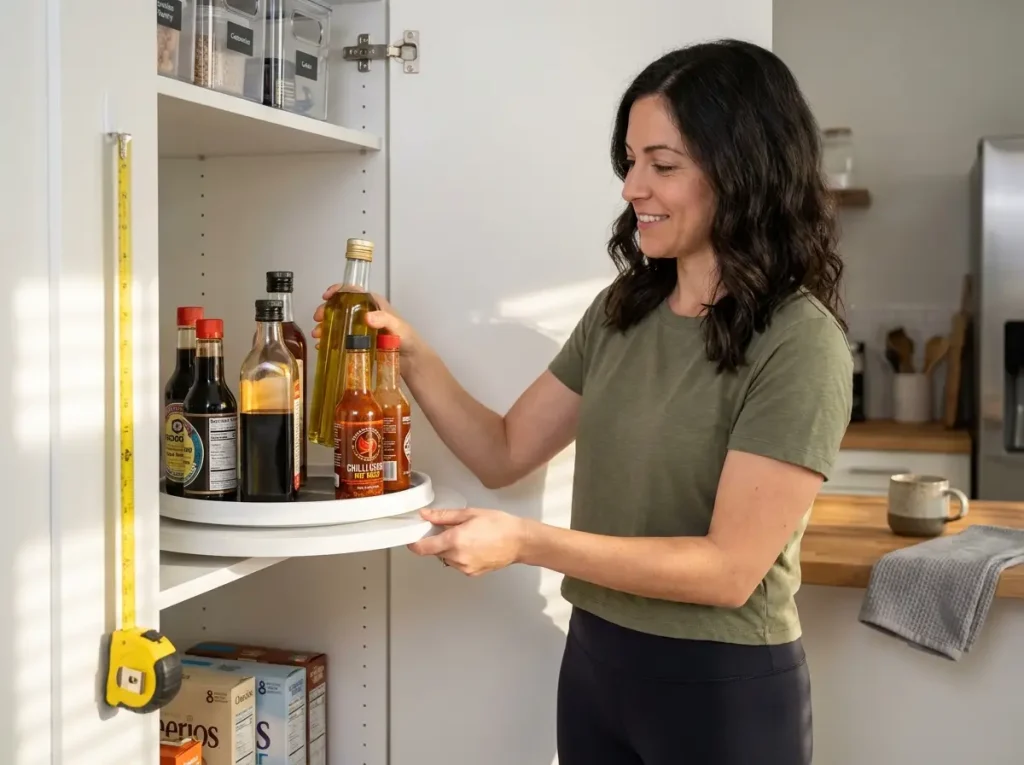
You bought a turntable for your pantry. It looked great for about a week — bottles lined up, spices within reach, everything spinning smoothly. Then the olive oil started leaning against the cabinet wall. A jar of something you forgot you owned migrated to the dead zone behind the turntable. The whole thing turned into a spinning junkyard you avoid touching because it’ll knock something over.
That’s not a turntable problem. That’s a sizing problem. Most people grab whatever lazy susan looks right at the store and shove it onto a shelf without measuring anything. The turntable is either too big to spin freely or too small to use the shelf, and the wrong items end up on it. I’ve set up turntables in more pantries than I can count, and the ones that still work months later all started the same way — with a tape measure, not a shopping cart.
This guide covers how to match a turntable to your actual shelf dimensions, what belongs on it (and what doesn’t), and the five-minute monthly reset that keeps it spinning past the first week.
Quick Answer: Measure your pantry shelf depth first, then pick a turntable 2–4 inches smaller than that number. A 12-inch turntable fits most standard pantry shelves (14–18 inches deep). Put daily-use items like oils, spices, and condiments on it — keep heavy cans and bulk items off. A monthly lift-and-wipe prevents the bearing from gunking up.
Why Most Pantry Lazy Susans Stop Working
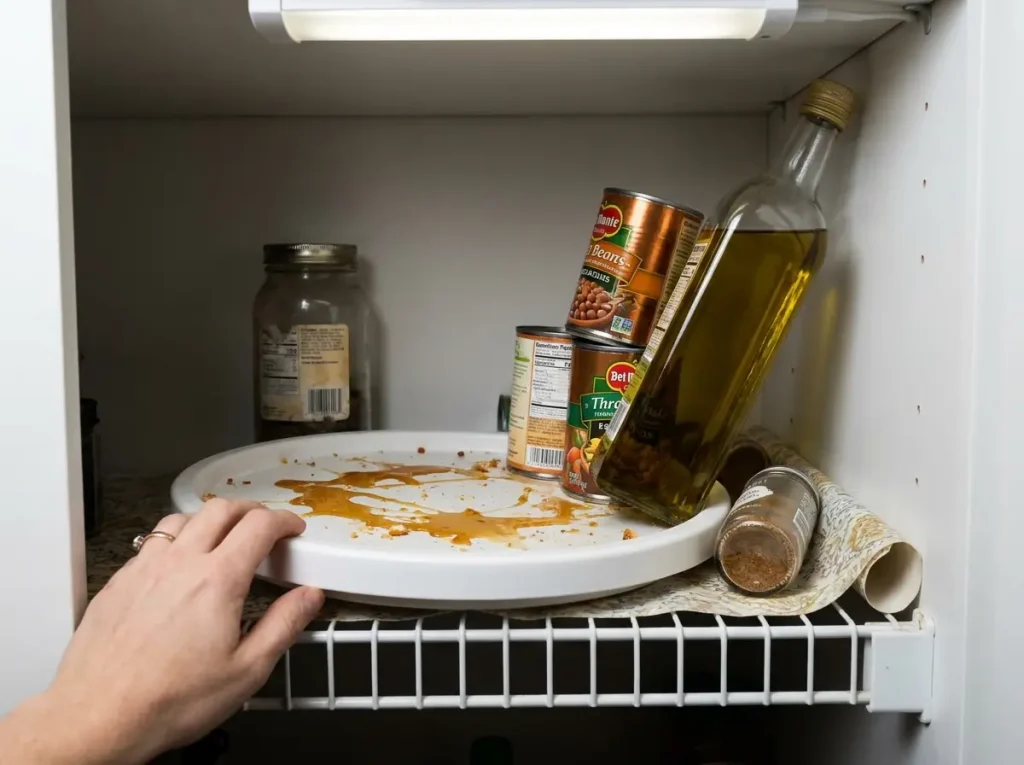
The turntable itself isn’t the problem. The way people use them is. Three things go wrong in almost every pantry where a lazy susan has been abandoned.
Wrong Size for the Shelf
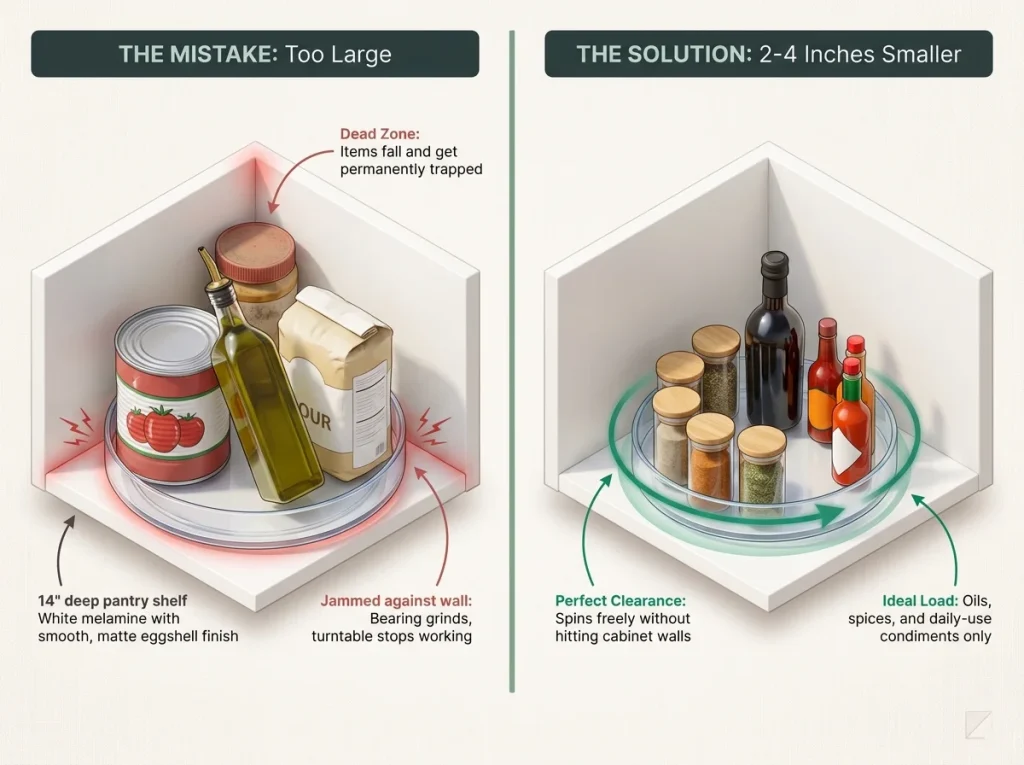
A turntable that’s too large for the shelf catches on the side walls when you spin it. You force it, something tips, and you stop bothering. A turntable that’s too small leaves a gap between the edge and the shelf wall — that gap becomes the dead zone where jars fall and expire quietly for months.
The fix is simple math that nobody mentions: your turntable diameter should be 2–4 inches less than the shortest dimension of your shelf (depth or width, whichever is smaller). A 14-inch-deep shelf needs a 10–12-inch turntable. That clearance lets it rotate without catching and without leaving enough gap for items to fall behind.
Wrong Items on the Turntable
Heavy canned goods grind down a plastic bearing within months. You’ll hear it — a scratchy, reluctant spin that gets worse until the turntable barely moves. Tall bottles without any support lean against the cabinet wall and block rotation entirely. One bottle of soy sauce wedged against the side stops everything.
A turntable is for daily-reach items — things you grab every time you cook. If you use something once a month, it doesn’t earn a spot on the turntable. That’s prime real estate.
No Maintenance System
Oil drips. Honey crystallizes. Spice dust settles. All of it collects under the turntable base and around the bearing. After two or three months, the sticky residue creates enough friction that the turntable stops spinning smoothly. At that point, most people just stop using it instead of cleaning it.
The fix takes five minutes a month. We’ll cover it in the last section, but knowing that maintenance exists — and that it’s quick — changes whether a turntable becomes a permanent system or a temporary experiment.
If your current pantry setup could use a broader overhaul beyond turntables, start with a pantry system that works past the first week — the turntable is one piece of that system, not the whole thing.
How to Measure Your Shelf for a Lazy Susan
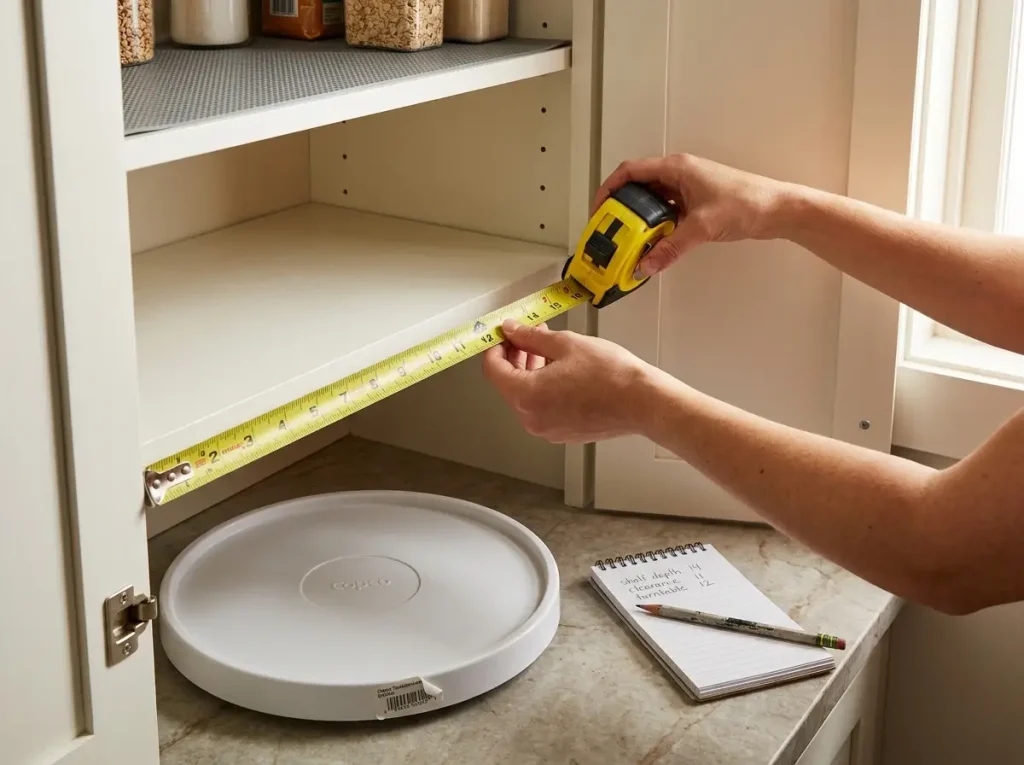
Before you search Amazon, grab a tape measure. Three numbers determine which turntable fits your pantry — and whether a two-tier option is even possible.
Measuring Shelf Depth and Width
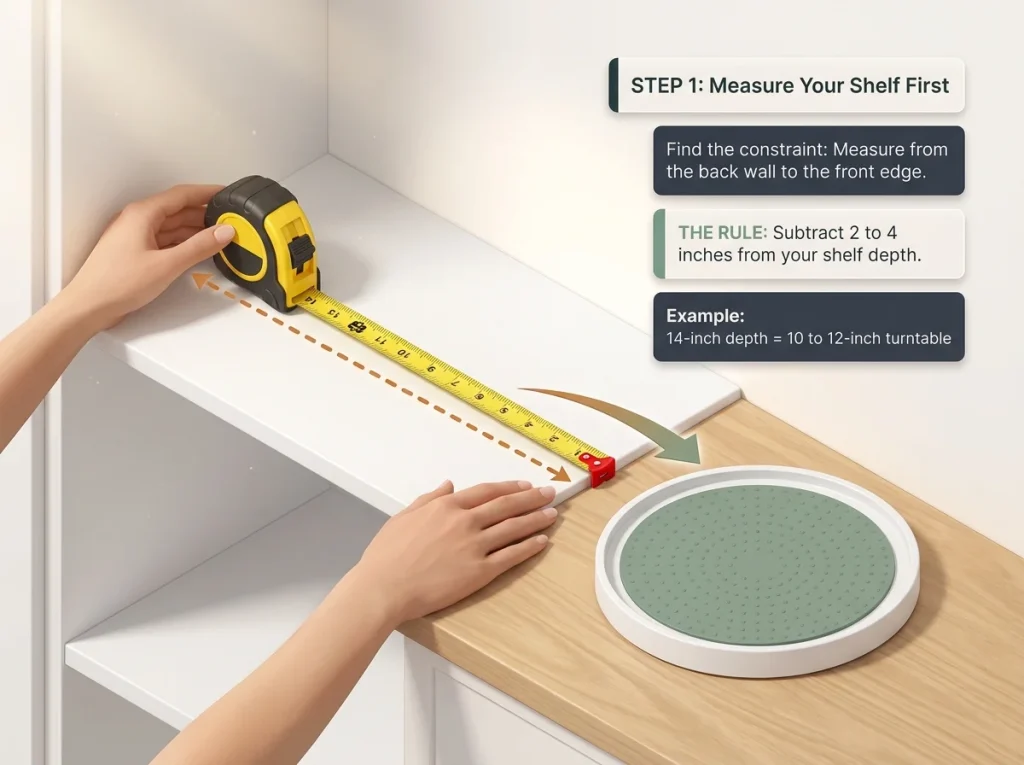
Pull everything off one shelf. Measure the depth from the back wall to the front edge of the shelf. Then measure the width from side to side. The smaller of those two numbers is your constraint — that’s the maximum turntable diameter that would physically fit.
Now subtract 2–4 inches. That’s your target turntable diameter. The subtracted inches give the turntable room to spin without the items on it bumping into the shelf walls.
For example: a shelf that’s 14 inches deep and 24 inches wide → the constraint is the 14-inch depth → your target turntable is 10–12 inches. A 12-inch Copco Non-Skid Turntable ($10) fits with one inch of clearance on each side. That’s tight but functional.
Measuring Vertical Clearance
This is the number most people skip — and it determines whether a two-tier turntable is even an option.
Measure the distance between the shelf surface and the bottom of the shelf above it. Most standard pantry shelves sit 10–11 inches apart. A single-tier turntable is about 1.5 inches tall, so you need at least 4 inches of clearance above the tallest item on the turntable (bottles of oil are typically 10–12 inches tall, which means you need 12–14 inches of vertical clearance for a single tier with tall bottles).
A two-tier turntable like the YouCopia Crazy Susan ($25) stands 9.5 inches tall. Add the height of the items on the top tier and you need at least 12 inches of clearance. If your shelves are the standard 10–11 inches apart, a two-tier won’t fit — and you’ll find out the hard way when it jams against the shelf above.
Pro tip: If your shelves are adjustable, move one shelf up 2–3 inches to create room for a two-tier turntable on the shelf below. One sacrifice gives you double the turntable capacity.
Wire Shelving vs. Solid Shelving
Freestanding turntables on wire shelves wobble. The turntable base sits on the wire bars instead of a flat surface, and the gaps between bars let the turntable rock when you spin it.
The fix costs less than a dollar: cut a piece of shelf liner or a flat piece of cardboard to sit between the wire shelf and the turntable base. This creates a stable, flat surface. If you want something sturdier, a thin cutting board or a scrap of plywood works even better.
Solid shelves — melamine, wood, or laminate — don’t need this. But adding a non-skid shelf liner pad under the turntable prevents it from sliding when you spin it aggressively (and you will, when you’re looking for the cumin at 6 PM).
If your pantry has narrow shelves and limited depth, you’re dealing with organizing a small pantry with limited shelves — a turntable is one tool in that toolkit, not the only one.
What to Put on a Pantry Lazy Susan (and What to Keep Off)
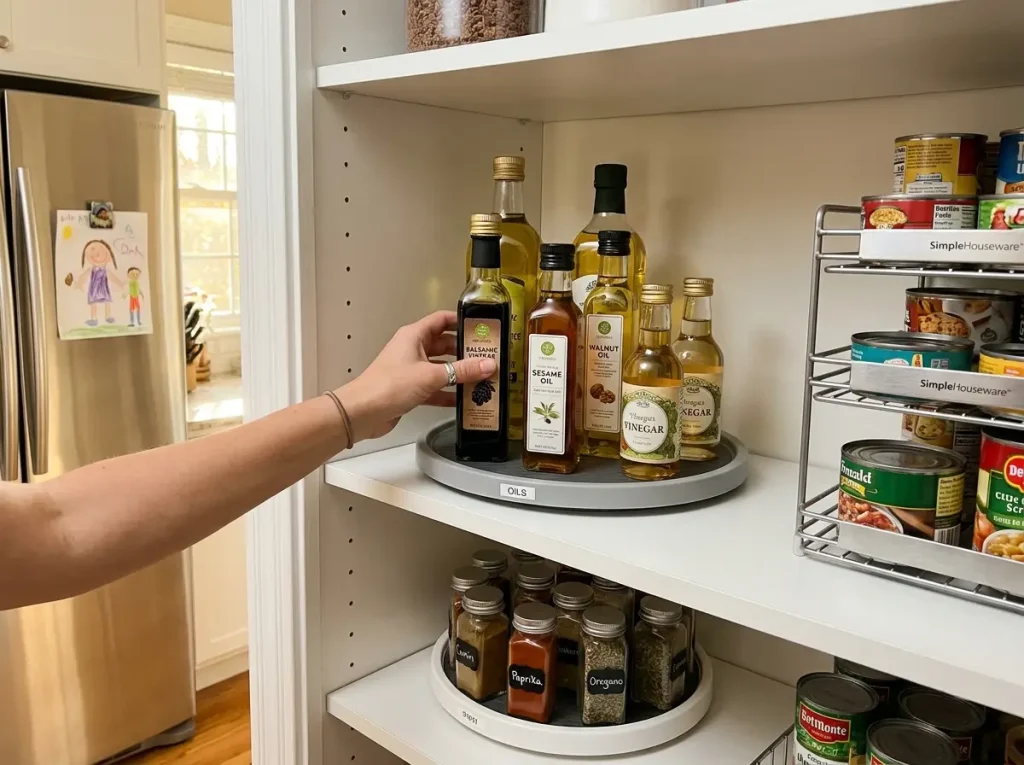
A turntable is not a shelf. It’s a high-access zone for items you reach for constantly. The moment you load it with things you use once a month, it becomes a storage shelf that happens to spin — and that’s not useful.
Best Items for a Pantry Turntable
Cooking oils and vinegars — bottle shapes fit turntables naturally, and you reach for these every time you cook. Olive oil, vegetable oil, sesame oil, balsamic, rice vinegar — they all sit upright and spin well.
Spices and seasoning blends — small jars with high rotation. If you cook regularly, you touch five to ten spice jars per meal. Having them on a turntable means spinning to the right jar instead of digging through a shelf.
Condiments and sauces — soy sauce, hot sauce, Worcestershire, fish sauce, whatever your cooking rotation includes. These are the bottles that get lost in the back of a deep shelf without a turntable.
Baking supplies in small containers — vanilla extract, baking powder, cocoa powder, food coloring. Keep these on a dedicated turntable separate from cooking oils if you bake frequently.
The Copco Non-Skid Turntable 12-inch ($10) handles a full set of cooking oils — the non-skid surface keeps glass bottles from sliding when you spin, and the rimmed edge catches anything that drifts toward the edge.
What to Keep Off
Heavy canned goods — a dozen cans of beans weigh 10+ pounds. That grinds a plastic bearing down fast. Cans belong on a tiered can rack, not a turntable.
Tall bottles without a lip to stop them — a 12-inch bottle of olive oil on a turntable with no raised edge will lean against the cabinet wall and block rotation. If your turntable has no lip, keep bottles under 8 inches.
Bulk items or anything you use less than once a week — that bag of rice flour you bought for one recipe six months ago does not earn turntable space. Turntable spots are for daily-reach items only.
Open bags or loose packets — seasoning packets, half-open bags of nuts, anything without a sealed container. These slide around, spill, and create the mess that makes you stop using the turntable.
The Zone System
One turntable, one category. Mixing oils with spices with snack bars creates the same chaos you’re trying to avoid. This is the same zone principle that professional organizers use — assign each turntable a role (“OILS,” “SPICES,” “BAKING”) and stick to it.
Label the turntable edge, not the individual items. A small adhesive label on the rim tells you and everyone else in the household which turntable is which without reading bottle labels. Front-face the labels so you can identify the section without spinning.
If you want to go deeper on matching containers to what you actually store, that’s a separate question from turntable placement — bins and turntables solve different problems.
Pro tip: If you share a kitchen, label the turntable edge with the category AND a short rule — “OILS — tall bottles in back” — so the system survives someone else putting things back.
Best Pantry Turntables by Shelf Size
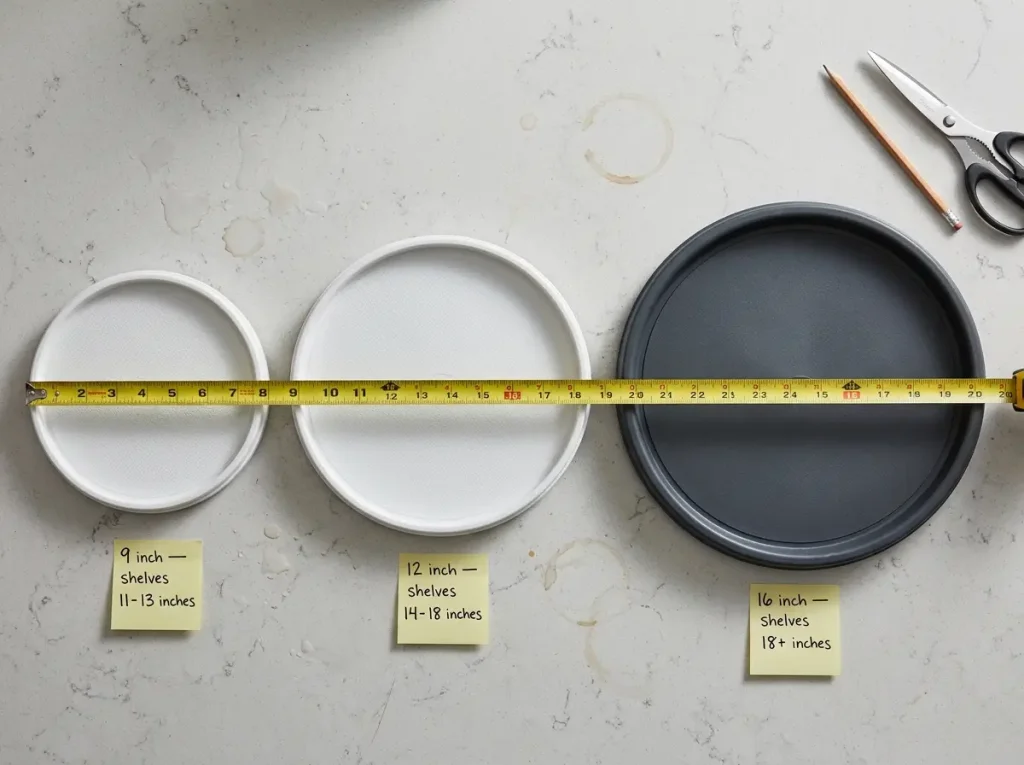
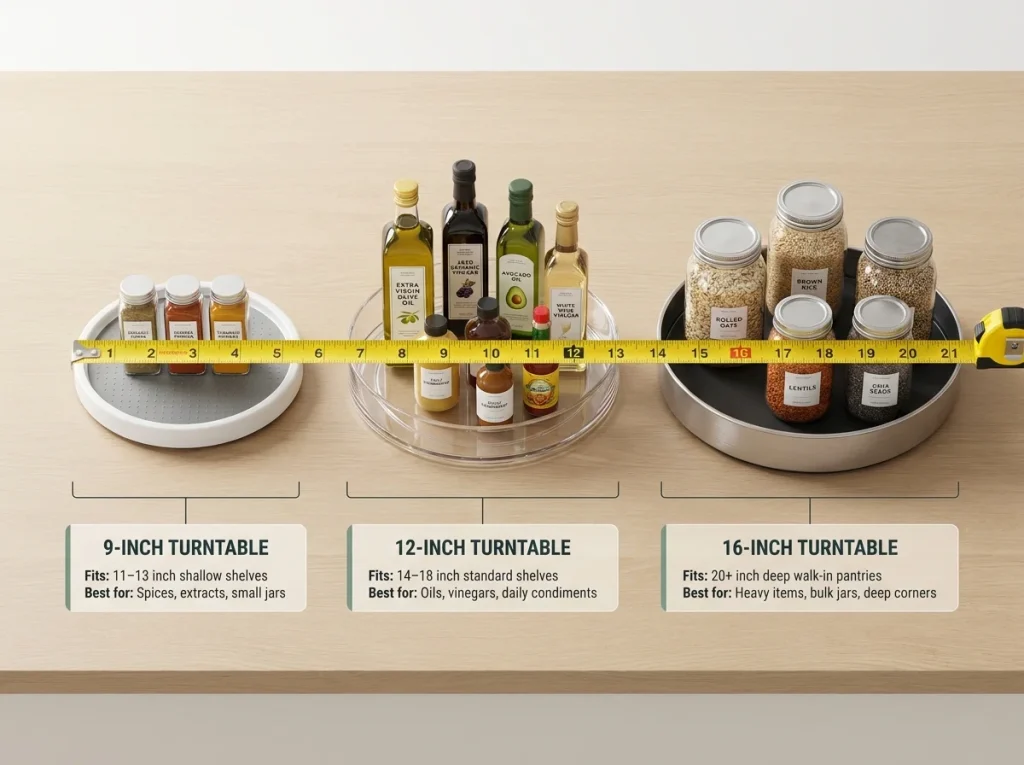
Not every turntable fits every shelf. Here’s what works at each depth, with a budget option and a premium option for each range.
For Shelves 11–13 Inches Deep (Small/Compact Pantries)
The Copco Non-Skid Turntable 9-inch ($7) is the right pick here. It leaves 1–2 inches of clearance on a 12-inch shelf, spins freely, and the non-skid surface handles spice jars and small condiment bottles without sliding.
If your budget is tight, a Dollar Tree turntable (~$1.25) works for spices. It won’t have a non-skid surface, so cut a circle of rubber shelf liner to fit the turntable top. That $1.25 turntable with a $1 liner does 70% of what the Copco does for a fraction of the cost. If you’re working through a full pantry organization under $15, this is the turntable tier to use.
For Shelves 14–18 Inches Deep (Standard Pantries)
This is where most people’s pantries fall, and you have three solid options depending on what you need.
The Copco 12-inch ($10) is the workhorse — fits standard shelves with 2–6 inches of clearance, non-skid surface, rimmed edge. For most pantries, this is the one to buy and stop thinking about it.
For heavy loads or if you’ve had turntables fail from bearing wear, the OXO Good Grips 16-inch ($20) is a significant upgrade. Steel ball bearings instead of plastic, a raised lip that prevents items from sliding off, and 14 inches of usable space inside the lip. It costs twice what the Copco does, but the bearing lasts years longer under daily use.
If you have 12+ inches of vertical clearance between shelves, the YouCopia Crazy Susan Two-Tier ($25) doubles your capacity. Three divided sections per tier keep spices separated from oils without mixing. But measure that vertical clearance first — this turntable is 9.5 inches tall, and most pantry shelves are 10–11 inches apart. It fits in some pantries and jams in others.
Pro tip: If the OXO is out of your budget, the Copco 12-inch with a rubber shelf liner cut to fit on top gets you 80% of the anti-slide benefit for half the price. The liner won’t replace the raised lip, but it stops most bottles from drifting.
For Deep Shelves 20+ Inches (Walk-In Pantries)
An 18-inch turntable fills a deep shelf, but they’re harder to find in freestanding form. An alternative: use two 12-inch turntables side by side — one for oils, one for spices — or stagger one in front and one behind.
If you have a built-in corner cabinet with a lazy susan mechanism, the iDesign Linus Wedge Organizer Bin ($8 each) transforms it. Three wedge-shaped bins fit one shelf tier, each with handles and high sides that prevent items from tipping during rotation. They’re clear, so you can see contents without pulling them out.
For walk-in pantries with deep shelves and more floor space, turntables are one part of a bigger layout — see fixing deep pantry shelves for the full approach.
Monthly Reset: How to Keep Your Lazy Susan Working
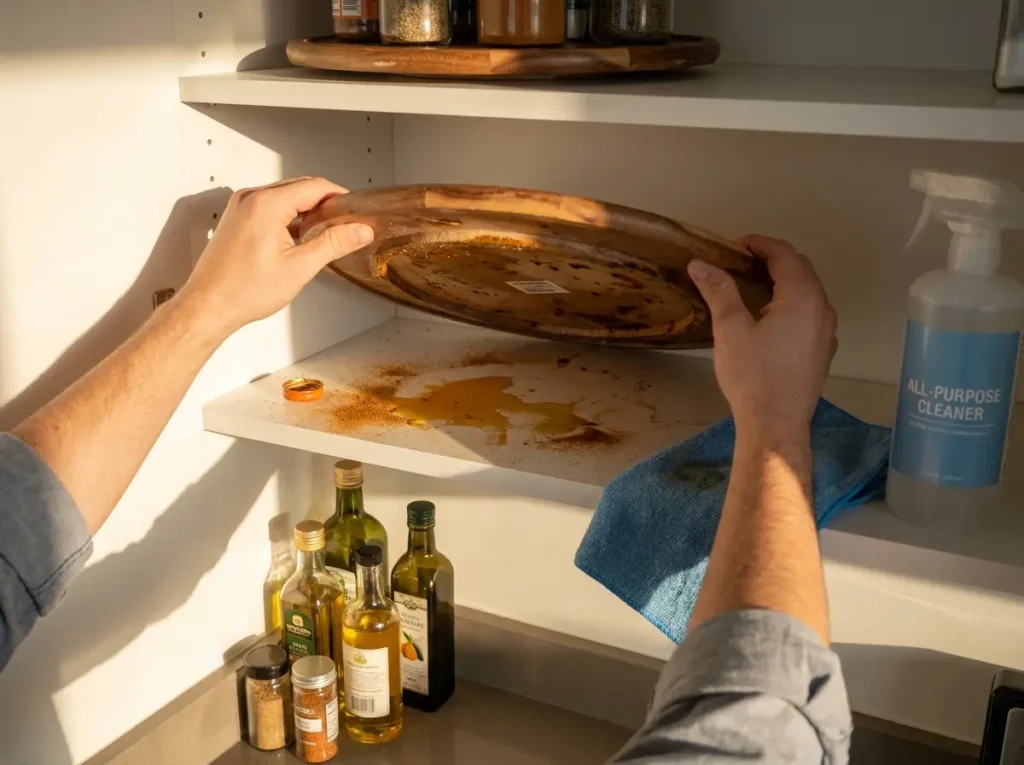
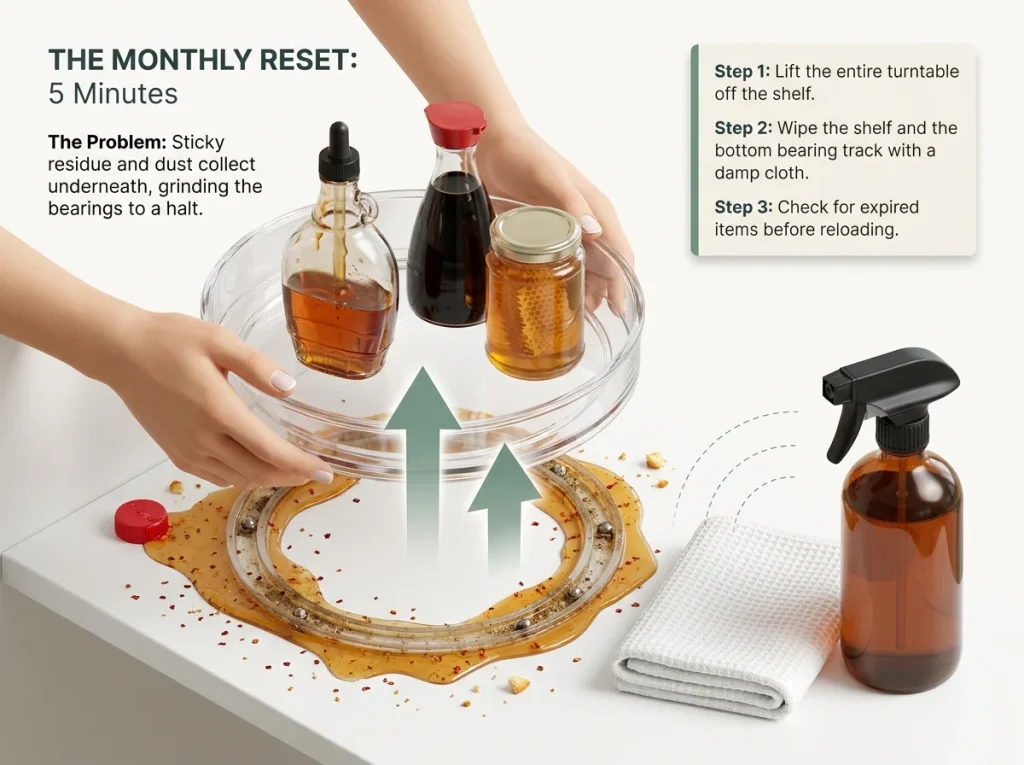
This is the section nobody writes. Every article shows you the organized turntable. None of them mention that turntables collect grime underneath and stop spinning within a few months if you don’t clean them. Five minutes a month prevents that.
The Lift-and-Wipe (5 Minutes Monthly)
Take everything off the turntable. Lift the turntable off the shelf entirely. Flip it over and look at the bottom — you’ll find sticky oil residue, spice dust, maybe a bottle cap that fell and got lodged under the base months ago.
Wipe the shelf surface with a warm, damp cloth. Wipe the turntable bottom and the area around the bearing. For sticky spots — dried honey, crystallized oil — let a soapy sponge sit on the spot for a minute, then scrub with the rough side. Don’t submerge the turntable if it has a mechanical bearing inside; just wipe and dry.
Replace the turntable, reload your items, and the spin should feel smooth again. If it doesn’t, the bearing may be worn — see the replacement section below.
The Expiration Sweep
While everything is off the turntable, check expiration dates. Turntables hide expired items in plain sight because you spin past them without reading labels. You’ll find things. A half-empty jar of something from last year. A spice blend you bought for one recipe and never touched again.
Remove expired items, consolidate duplicates (how many half-full bottles of soy sauce does one household need?), and only reload items you’ve used in the past two weeks. Everything else goes back on the regular shelf or gets tossed.
Also check behind where the turntable sits. The dead zone between the turntable edge and the shelf wall is where things migrate when they fall off. Pull out anything that’s hiding there.
When to Replace Instead of Clean
If the turntable still grinds or catches after a thorough cleaning, the bearing is worn. Plastic bearings on budget turntables typically last 2–3 years of daily use. Steel-bearing models like the OXO last 5+ years.
If the turntable wobbles on a flat surface, it’s warped — usually from heat (sitting near the stove) or from sustained heavy weight. Replace it. A warped turntable won’t spin evenly no matter how clean the bearing is.
Budget turntables are cheap enough to treat as consumables. Replace the $7 Copco every two years and you’ll spend less over five years than one premium turntable, with the same result. Or buy the OXO once and stop thinking about it.
If your walk-in pantry uses a monthly reset system, fold the turntable wipe into that routine. Same day, same five minutes, same habit.
Pro tip: Set a recurring reminder on your phone for the first Sunday of each month — “wipe pantry turntables.” You’ll forget otherwise. Everyone does.
Conclusion
Three things determine whether a pantry turntable works or becomes a spinning junkyard.
First, measure your shelf depth before you buy — the right turntable diameter is 2–4 inches less than the shortest shelf dimension. A 12-inch turntable fits most standard pantry shelves.
Second, put daily-use items on it and keep everything else off — oils, spices, and condiments earn turntable space. Cans, bulk items, and anything you use less than once a week don’t.
Third, wipe underneath once a month — five minutes prevents the sticky buildup that kills the bearing and stops the spin.
Three-Month Check: In three months, test the spin with a full load of items. If it grinds, wipe the bearing area. If it still grinds, the bearing is worn — replace the turntable. Also sweep expiration dates and remove anything you haven’t touched since you set it up.
Grab a tape measure. Measure one pantry shelf. That single number tells you which turntable to buy — everything else follows from there.
Q1 What is the best way to organize a lazy susan in the pantry?
Group items by category — oils together, spices together, baking supplies together. Label the turntable edge with the category name, not individual items, so you can find the right section without spinning through everything. One turntable per category keeps things from mixing.
Q2 What size lazy susan fits a standard pantry shelf?
Most standard pantry shelves are 12–16 inches deep. A 12-inch turntable fits most of them with enough clearance to spin freely. Measure your shelf depth and subtract 2–4 inches to find the right diameter — that gap lets the turntable rotate without items catching on the walls.
Q3 What should you not put on a lazy susan?
Heavy canned goods, tall bottles without support, bulk items, and anything you use less than once a week. Cans overload the bearing and tip when spinning. Tall bottles lean against the cabinet wall and block rotation. Bulk items waste turntable space that should go to daily-reach items.
Q4 How do you keep items from sliding on a lazy susan?
Use a turntable with a non-skid surface and a raised lip or rim. If yours is smooth, cut a circle of rubber shelf liner to fit the turntable top — that alone stops most sliding. The OXO 16-inch model has both a non-skid surface and a raised lip built in.
Q5 Is a lazy susan worth it for a small pantry?
Yes — a 9-inch turntable on a 12-inch shelf reclaims corner and back-of-shelf space that would otherwise become a dead zone for lost items. The key is picking the right size so it fits without wasting space around it, and loading it only with items you use daily.
Disclaimer: ClutterlessNest is a participant in the Amazon Services LLC Associates Program. As an Amazon Associate we earn from qualifying purchases. This article may contain affiliate links — if you buy through them, we may earn a small commission at no extra cost to you. We only recommend products we have tested or genuinely believe in.