

You cleared the coffee table on Sunday. By Wednesday there’s a stack of mail, a charger with no device attached, two mugs and a hairbrush that belongs in the bathroom. Nobody decided to do that. It happened one uncontested item at a time, which is the whole point: learning how to keep surfaces clutter-free has almost nothing to do with willpower and almost everything to do with whether the stuff landing there has somewhere else to go.
There’s a documented mechanism behind the refill, and once you see it the fix stops being “try harder” and starts being structural. Clutter-free surfaces are a maintenance system, not a weekend project. Here’s why surfaces refill, which nine do it worst, the one rule that stops the cycle, the tools that make it stick even if you rent and can’t drill, and the reset habit that catches the rest.
Quick Answer
Keeping a surface clear is a five-step system, not a tidying session:
- Clear the surface completely, then name what actually lands there
- Give every recurring item an assigned home, off the surface and ideally on a wall
- Leave one contained catchall sized to 70–80% of the surface’s shorter side
- Run a 60-second reset every time you leave the room
- Empty the catchall on a fixed weekly checkpoint
Why Cleared Surfaces Get Cluttered Again

Everyone has heard that clutter attracts clutter. Almost nobody explains why it’s literally true, which leaves you with a slogan and the sense that you’re bad at this. You’re not bad at this. You’re missing a decision point.
The half-second of friction a clear surface buys you
A clear surface creates resistance. Walk in holding mail and a jacket, glance at an empty table, and something registers this doesn’t belong here. That half-second is your whole defense system.
The research behind it is stronger than most organizing advice admits. In a field test cited by a University of Chicago study on visual disorder, theft from a vandalized, littered mailbox rose from 13% to 27% versus an identical clean one. Same mailbox, same envelope. The only variable was a visible signal that disorder was already tolerated here.
It roughly doubled the rate at which people crossed a line.
Your table works the same way. The first item down removes the friction for every item after it, which is why the sequence runs slow, slow, then avalanche: item one costs a small internal argument, item two costs nothing, and by item six the surface has changed category from “table” to “where things go.”
If you only have five minutes, spend them removing the single oldest item on the surface rather than straightening all of them. The thing that has sat there longest is what teaches everyone in the house that this surface accepts deposits.
What a growing pile is actually telling you
Here’s the reframe the rest of this runs on. A surface collecting items is not a tidiness failure. It’s a signal that something in your home has no assigned address yet, and the surface is holding it in view so you don’t lose it.
Read any pile that way and it gets legible. The junk mail is there because opening it needs a decision and a shredder you’d have to go get, and the one real bill underneath it needs a bill organizer nobody has set up. The charger’s home is a drawer in another room. The hairbrush is there because the bathroom drawer is full.
Every item is a deferred decision wearing a disguise, and that slow accumulation of postponed calls is what clutter creep actually is. One r/declutter post described a surface that had become “the mortuary of many papers, books, cards, letters, hand-tools and grocery bags.” The word that matters is mortuary: nothing there is in use. It’s all in storage, in the worst possible location.
Why “just be tidier” has never worked
Because it treats a systems problem as a character flaw, and character flaws don’t respond to instructions. There’s also a cost that advice never accounts for, and it runs underneath the whole habit loop.
Professional organizers at NAPO make the point that visual clutter keeps the nervous system on low-grade alert, because the environment signals things are out of control even after you’ve stopped consciously noticing the pile. You aren’t looking at the table anymore. Your nervous system still is, which is why “I’ll deal with it later” never gets easier.
If you haven’t set up the underlying zone system yet, start with the surface system this all sits on top of, because everything below assumes the surface got cleared at least once.
The Nine Surfaces That Collect Clutter First

“Flat surfaces” is a useless category. You can’t picture it, so you can’t fix it. “The end of the kitchen counter closest to the door” is a place you can walk to right now, and it’s almost never the one you’d have guessed.
The nine usual suspects
The same nine recur across organizing sources: the kitchen counter (the kitchen island too, if you have one), the dining table, the coffee table, the bedroom chair, the entryway table or console table, the bathroom counter, the desk top, the furniture tops in every room (a dresser top, a bookcase, the top of the fridge), and any surface that was just cleared.
A few deserve a note. The kitchen counter is its own specific fight, because it also works as a workspace several times a day, so “clear it and leave it alone” isn’t available. The bedroom chair isn’t really furniture and everyone knows it. And the top of a media console collects remotes, cables and controllers that nobody puts away because they’ll be needed again in four hours.
Then the cruel one at the end: any surface you just cleared. A freshly bare table is the most vulnerable in the house, for exactly the reason above. You removed every friction-reducing signal, and now it sits at maximum capacity and maximum appeal.
The drop point nobody plans for
Here’s the rule that finds your real problem surface faster than any audit: the worst surface in your home is the first flat thing you pass after walking through the door with your hands full. Not the one you look at most. The one that intercepts you when both hands are occupied and your head is still on the commute.
Keys, mail, bag, phone, the package from the porch. Everything gets set down at the first opportunity, and that opportunity is a piece of furniture you probably chose for looks. Tidying elsewhere never touches it, because the drop point is a geometry problem, not a discipline one. Your front door and your first horizontal plane sit in a fixed relationship, and until that changes the pile is inevitable.
Photograph the room on a normal Wednesday evening, not after you’ve tidied. Your eye stopped registering the hot spot months ago. A photo hasn’t, and most people are genuinely surprised by which surface the camera calls the worst one.
When the fix is removing the surface, not organizing it
I used to treat every drop point as a containment problem: find the right tray, give the pile a border. Enough community accounts point the other way that I’ve changed my mind about the entry specifically. Sometimes the answer is fewer flat surfaces, not better-organized ones.
In a widely-upvoted r/declutter thread titled “FLAT SURFACES are the Enemy,” the poster moved a dining table out of the entry path, the clutter migrated to an ottoman they’d put there instead, so they moved that out too. The furniture kept changing and the outcome kept repeating, which told them the furniture was never the problem. Their conclusion: make it hard for clutter to find a place to land.
That’s genuinely an option for a narrow console you don’t use or a bench that exists to hold coats. Ask what the piece does for you on a day when it’s empty. If the answer is nothing, removing it costs you a landing strip, not storage.
Give Everything a Home Before It Touches the Surface
“A place for everything” is the oldest line in organizing and almost nobody executes it, because it gets stated as a virtue instead of a test. Virtues are unfalsifiable. Tests you can run this afternoon.
The Flat Surface Clutter Rule puts it operationally: the clearer a surface stays, the easier it is to keep that way, and a surface collecting random items means a decision is being delayed, not that the surface is the problem. You’re looking at a queue of postponed decisions with a physical footprint.
The address test, item by item
The old filing maxim behind this is only handle it once, sometimes taught as the OHIO method: the moment an item is in your hand it goes to its address, not to the nearest table.
For one week, every time something lands on your worst surface, name its home in one phrase. “Chargers live in the left nightstand drawer.” “Mail lives in the wall pocket by the door.” Anything you can’t finish that sentence for is the item refilling your table, and it’s usually a list you can count on one hand.
Each one gets a designated home today or it leaves the house, because an item with no address always ends up on the nearest horizontal plane.
Addresses have one more test to pass. If returning an item means opening two doors and moving a box, that address gets abandoned by week three and the item is back on the table by week four. Addresses have to be lazier than the surface.
Why “miscellaneous” always wins
The most common failure in this system is an address called “miscellaneous.” It feels like a solution. It’s a black hole with a label on it, because a container with no rule accepts everything and returns nothing.
You’ve watched it happen already, because the junk drawer runs on the same mechanism. Dividers only work if every section has a rule: batteries here, tape here, pens here. Leave one undefined and give it three weeks. It eats the drawer.
So the catchall gets a rule, not a category. “Small things I carry in my pockets” is a rule. “Stuff” is not.
The one catchall that’s allowed
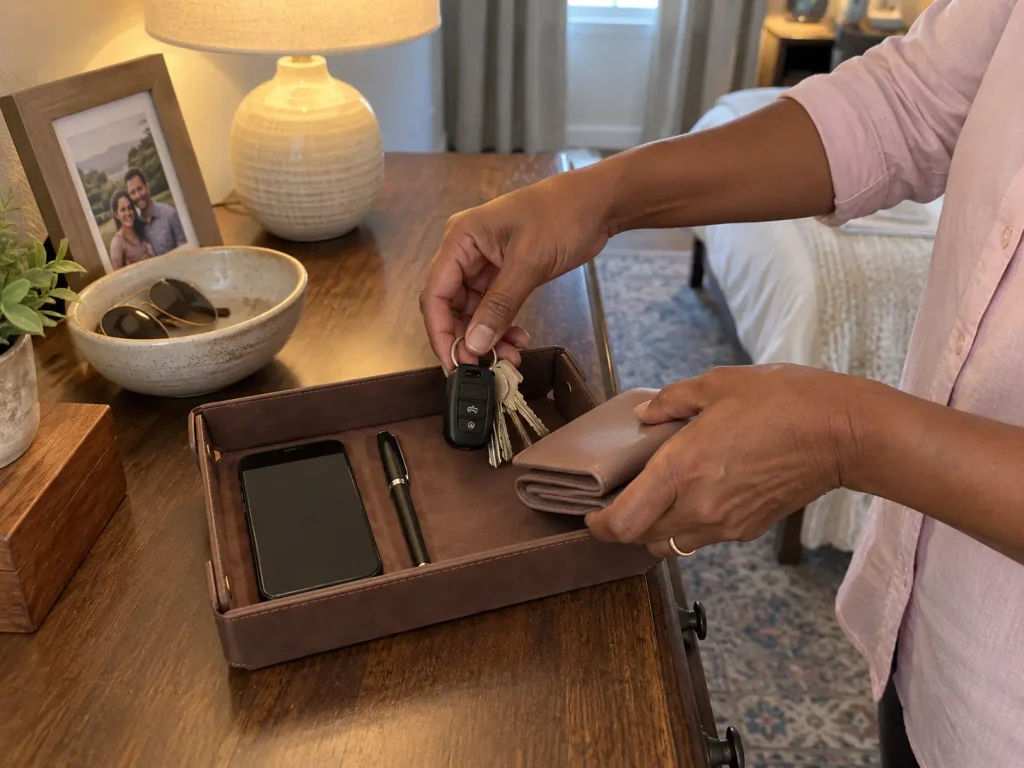
Some things genuinely have no better home than the surface, and pretending otherwise is how systems fail. Keys, wallet, loose change, sunglasses, the earbuds case. You need them at the exit point, so their address is the entry table.
The rule isn’t that they go elsewhere, it’s that they go in one catchall tray. A tray turns “stuff piled on a table” into “stuff in a container,” and the eye reads the second as intentional, so it doesn’t fire the disorder cue from the first section.
Before buying any budget-friendly organizer, go look in your cupboard. A shallow bowl you already own does this job completely, and “don’t solve a problem you don’t have” is the most repeated line in budget decluttering threads for a reason: people own plastic tubs and decorative boxes that sit untouched or became clutter magnets themselves, because the container was never the missing piece.
Once it does, the CASIRENA Faux Leather Valet Tray Organizer runs about 8×6 inches, enough for keys, a wallet, change and a watch without becoming a shelf in its own right. The faux leather wipes clean, though it’s not the pick for a bathroom counter where it’ll sit in standing water. The small footprint is deliberate: a catchall you can overfill will be overfilled.
Renter-Friendly Containment That Makes the Rule Stick
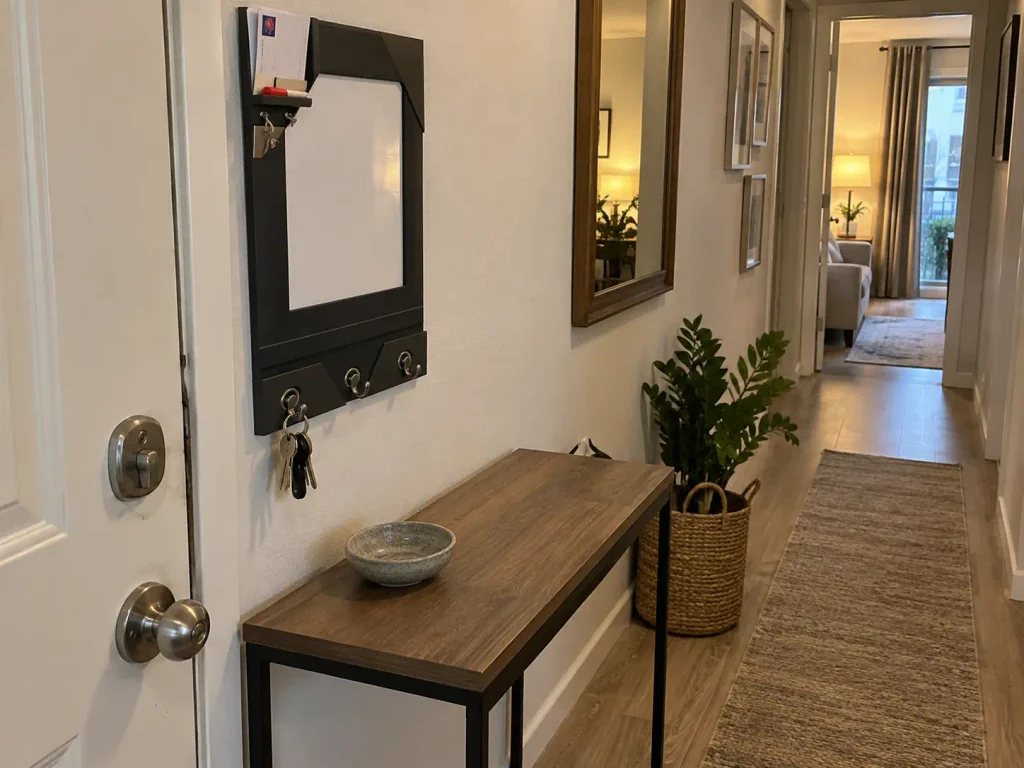
Every guide says “give it a home” and then shows a built-in mudroom with custom cubbies. Most people rent, can’t drill, and are working with a console 14 inches deep. That constraint isn’t a footnote to the design problem. It is the design problem.
Move it to the wall, not to a better spot on the table
The highest-leverage move here comes from a decluttering thread, phrased better than I could: surface area is precious, wall space is not. Someone there moved a knife block off the counter onto a magnetic wall strip and got the counter back without buying furniture. Whatever is worst on your surface, ask whether it could live on a vertical plane instead.
This is the point where a scattered entry becomes a proper drop zone: one wall, one set of addresses, nothing left on the horizontal. Mail is where this matters most, because mail compounds. It arrives daily whether or not you dealt with yesterday’s, so any container needs a ceiling or it becomes a taller pile with a nicer border. A tabletop tray has no ceiling: it fills, the overflow sits on top, and now there’s a pile with a tray buried in the middle.
A wall-mounted mail sorter has a physical limit, and full is a prompt.
The Command Message Center handles the category in one adhesive mount: a ledge for mail plus hooks for keys, mounted on command strips rather than screws, removable without wall damage. Mount it where you actually walk in, not where it looks best. The tradeoff is that adhesive wants a clean, smooth, cured wall, and on textured or fresh paint the failure mode is everything hitting the floor at once.
If keys are your only real offender, don’t buy the bigger thing. The Command Key Rail 8″ with 4 Key Hooks is eight inches of wall and four hooks, solving the most-dropped item in most homes for less. It won’t hold mail, which is the point: one job, no invitation for anything else. For the full entry zone rather than the one mount, there’s a full no-drill key and mail setup by the door.
Bags are the third category: totes, backpacks, jackets, the grocery bags draped over a chair back. They land on surfaces because hanging them needs a hook that doesn’t exist yet. A 6-pack of black metal adhesive wall hooks rated to 20 pounds each covers an entry wall without a single hole, and six is right because you’ll misjudge the first two placements. Mount them at the height of the person who actually drops the bag.
Sizing the tray to the table
This is the difference between a tray that reads as containment and one that reads as a second surface.
Console tables run 12 to 24 inches deep, most commonly 12 to 18. Coffee tables run 18 to 30 inches wide. Common decorative trays sold for coffee tables land around 16 by 12 inches. Run those against each other and the problem shows up immediately: that 16×12 tray leaves a comfortable bare margin on a 28-inch coffee table and swallows a 14-inch-deep console edge to edge.
So here’s the rule. Size the container to roughly 70–80% of the surface’s shorter dimension, never the full footprint. On a 12-inch-deep console that’s nothing wider than about 9 inches. On a 24-inch coffee table, 16 to 19.
The bare rim isn’t a decorating preference, it’s the functional part: that margin is what makes a surface read as contained rather than covered, and a covered surface has already lost the friction from section one.
The Hanobe Round Decorative Tray sits in the 12-inch-diameter class, the right band for most coffee tables. Round is a real advantage: a circle inside a rectangle leaves margin at the corners automatically, so it’s more forgiving than a rectangle of the same width. MDF is the limitation, since it doesn’t want repeated moisture, so for a bathroom or kitchen version a plain plastic counter tray does the job for less. If you haven’t settled what actually belongs on a coffee table, do that first: the tray contains a decision, it doesn’t make one.
Measure the shorter side of the surface before you shop, then write that number on your phone. Product photos get staged on oversized furniture so trays look modest, and a tray that seemed reasonable online arrives and covers half your console.
No-drill options that come off cleanly
Adhesive mounting is the renter’s real answer, but only if you respect what it needs. Wipe the wall with rubbing alcohol rather than a household cleaner, because most cleaners leave a residue film that’s exactly what the adhesive fails to grip. Press firmly for the full 30 seconds, then let it cure an hour before hanging anything. Most failures blamed on the product are really an impatient first hour.
Paint matters more than the weight rating: fresh paint needs a full week of curing first or it lifts on removal, flat and matte finishes are the likeliest to chip, and heavily textured walls are a no because the adhesive never makes full contact. When you move out, pull the tab slowly and straight down along the wall, never outward. That’s the whole trick.
The Reset Habit That Keeps It Clear

Every system survives its first week. The three-month question is what happens when you’re tired, when the week goes sideways, and when someone in the house doesn’t see clutter the way you do.
The 60-second room-exit reset
The habit that actually holds is smaller than a nightly tidy: every time you leave a room, take with you whatever doesn’t live there. A mug to the kitchen, a hairbrush to the bathroom, a jacket to the hook. Sixty seconds, on a trip you were making anyway.
It works because it never accumulates into a chore. A nightly reset has a start time you can dread and postpone, which is why that kind of daily tidy up rarely lasts past the second week. A room-exit reset has no start time; it attaches to something you already do dozens of times a day.
For the kitchen counter, pair it with a countable cap. The three-object rule is exactly that: three permanent occupants per section, everything else is a visitor.
Going from a dozen permanent objects down to three cuts the daily wipe-down from four to six minutes to under one, because you stop lifting and replacing things to clean underneath. A number also settles arguments that “keep it tidy” never will. Four objects is four objects. Nobody has to be judged.
The clutter box and the weekly checkpoint
For whatever the reset doesn’t catch, there’s a system from the decluttering community worth copying almost verbatim: the clutter box. One accessible bin per room. Anything without an assigned home goes in it immediately, no deliberation. No purchase required, since a bin you already own is the correct bin.
Then on a fixed weekly checkpoint, which is the whole of your weekly declutter, you empty it, and each item does one of three things: gets a real permanent home, goes back where it belongs, or goes in the donation box. That last option is the one people skip, and it is why a small weekly purge beats a twice-yearly one. That is the entire maintenance routine. The point is that you stop making decisions in the moment, when you have neither the time nor the interest, and batch them into one weekly pass where you do.
Here’s what makes it diagnostic rather than just tidy. If the box overflows before the checkpoint arrives, the system isn’t failing, it’s reporting. Something in there keeps reappearing, and that repeat offender is an item that never got a real address. Pull it out, solve it properly, and the overflow stops.
Attach the weekly checkpoint to something already on a schedule, like the night the bins go out or the morning you change the sheets. A checkpoint floating on “sometime Sunday” quietly becomes “sometime,” and then nothing.
When the other person doesn’t see the mess
The conventional advice is communicate better, and it mostly doesn’t work, because it assumes you’re negotiating about effort. Usually you’re negotiating about perception.
A widely-shared r/declutter account captures it. The poster’s clutter alert had gone off, books stacked, surfaces covered, while their partner genuinely felt the space was already decluttered, because he had in fact sorted through his own collection by his own standard. He wasn’t refusing. They simply had different thresholds for what the word “clutter” points at, and asking harder closes no gap like that.
So the takeaway is blunt: any system that depends on household buy-in to one shared standard will fail, because you cannot get it.
Assign surfaces instead of negotiating standards. Family declutter rules hold when they are about territory, not about taste.
One surface is theirs, genuinely theirs, and not your problem in any week of any month. The shared ones get the rule, the catchall and the fixed weekly empty, none of which require agreement about what “messy” means.
No splurge organizer fixes this either, which is worth saying plainly: a designated home for items costs nothing and settles more than a purchase ever has. That conversation also goes better: “this surface is yours and I’ll leave it alone, these two we both reset on Sundays” is a proposal. “Why can’t you see this” is an accusation with a question mark on it.
It all compounds in a small place. When every surface is doing three jobs at once, the dining table doubling as desk and folding station, there’s no slack anywhere, so the weekly checkpoint stops being optional. It’s the only thing between you and a permanent state of mid-project.
Conclusion
Three things to carry out of this. A refilling surface is an addressing problem, not a discipline problem, so stop auditing your character and go find the two or three items with no home. Wall space is free and surface area isn’t, so the highest-leverage move available to you, renter or owner, is taking the worst offenders off the horizontal plane. And one contained catchall sized to 70–80% of the surface’s shorter side, emptied on a fixed weekly checkpoint, outperforms any amount of tidying, because it converts a hundred small daily decisions into one scheduled batch.
In three months, look at what’s sitting in the catchall. If the same item keeps reappearing, it never got a real address, and fixing that one item will do more for the room than re-tidying all of it.
Pick the one surface that annoys you most. Clear it, watch for a week to see what lands there, and give those five things an address. Then leave the rest of the house alone until that one holds.
Frequently Asked Questions
01Why does my counter get cluttered again right after I clear it?
Because a cleared surface is the most vulnerable surface in the house. Visual-disorder research shows a single visible sign of disorder measurably lowers resistance to adding to it, so the first item down removes the friction for every item after it. The fix is making sure what lands there has somewhere else to go.
02What is the flat surface clutter rule?
The clearer a surface stays, the easier it is to keep it that way, and a surface collecting random items means a decision is being delayed rather than that the surface is the problem. In practice, every recurring item needs an assigned home before it ever touches the table.
03How do I keep surfaces clear when I rent and cannot drill?
Adhesive-mount hooks, key rails and wall organizers come off without wall damage, which makes the best move in surface organizing available to renters too: taking mail, keys and bags off the horizontal plane and onto a vertical one. Mount at the door, not above the table you are protecting.
04How do I get my partner to stop leaving things on shared surfaces?
Usually they are not ignoring the mess. They have a different threshold for what counts as clutter, which community accounts bear out. Assign surfaces instead of negotiating standards: one is theirs, and the shared ones get a visible catchall plus a fixed weekly empty that needs no agreement on what messy means.
05What size tray should I use on a coffee table or console?
Size it to roughly 70–80% of the surface’s shorter dimension, never the full footprint. A common 16×12-inch tray leaves a visible bare margin on a 24 to 30-inch-wide coffee table but swallows a narrow 12-inch console, and that bare rim is what makes a surface read as contained instead of covered.
Disclaimer: ClutterlessNest is a participant in the Amazon Services LLC Associates Program. As an Amazon Associate we earn from qualifying purchases. This article may contain affiliate links — if you buy through them, we may earn a small commission at no extra cost to you. We only recommend products we have tested or genuinely believe in.