
You bought the woven basket for the throw blanket. It looked right for about two weeks. Now it holds a stack of mail, two charging cables, a remote nobody claims, and the blanket lives on the arm of the sofa where it always did. The basket is not the problem.
Nobody sized it to the surface it was going to sit on, and nobody gave it a job. Both of those are decisions you make before you order, not after. This guide covers how to size decorative storage baskets to the surface they live on, which materials survive which rooms, the picks worth buying by material, and the three categories to skip.
Quick Answer
Measure the surface first, then pick by material. These are the picks by use case:
- Best open woven: StorageWorks Wicker Storage Basket, Seagrass
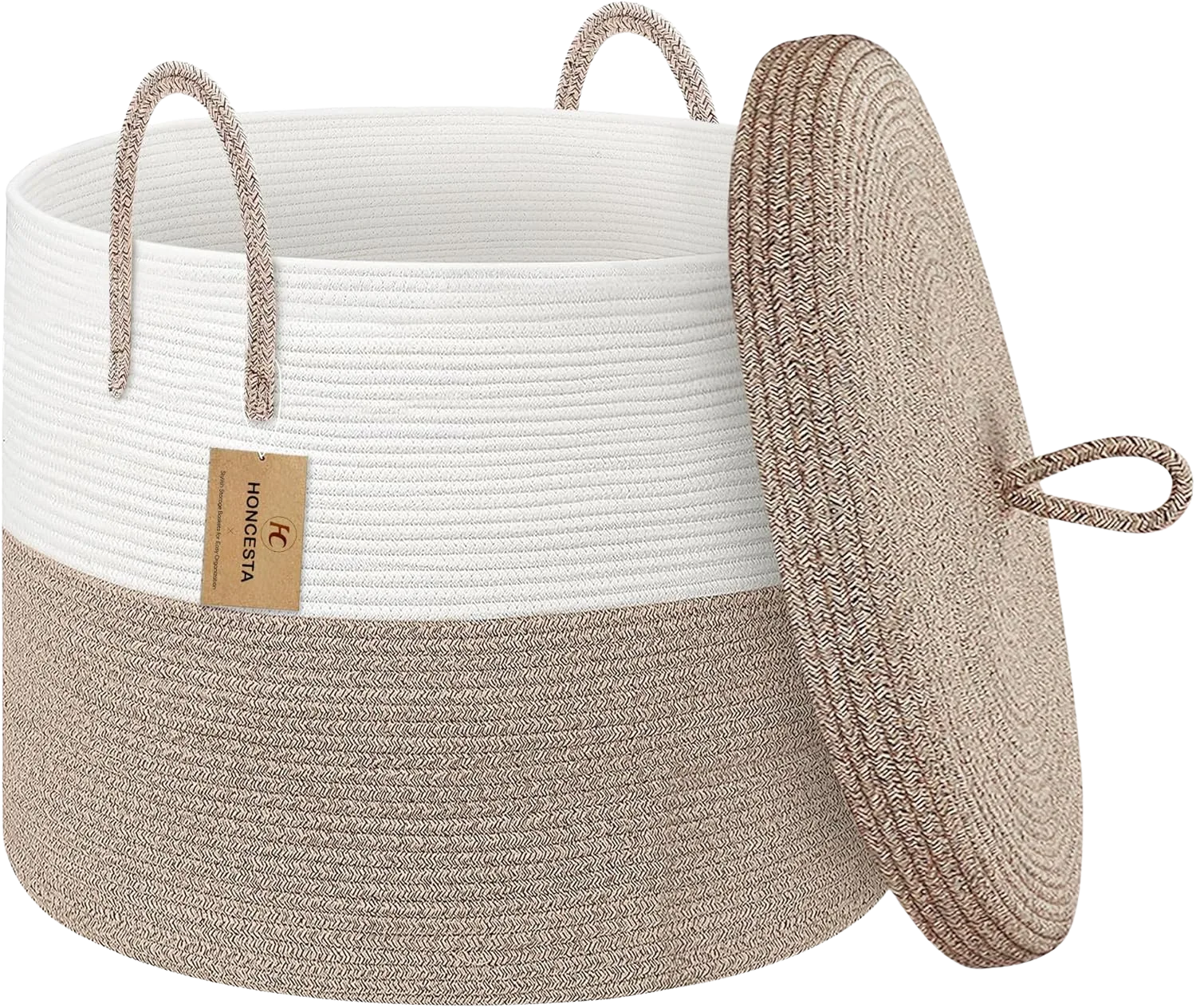
- Best lidded: HONCESTA Extra Large Woven Basket with Lid
- Best nesting set for sizing: Didaey Set of 4 Seagrass Basket with Lid
- Best budget set: Best Choice Products Rustic Set of 4 Seagrass
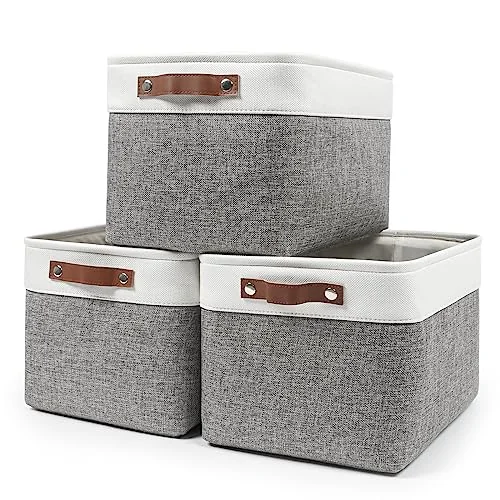
- Best for kids and pets: Bagnizer Fabric Storage Baskets, 3-Pack
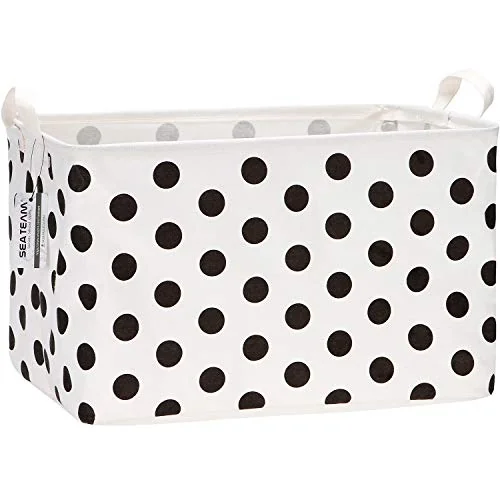
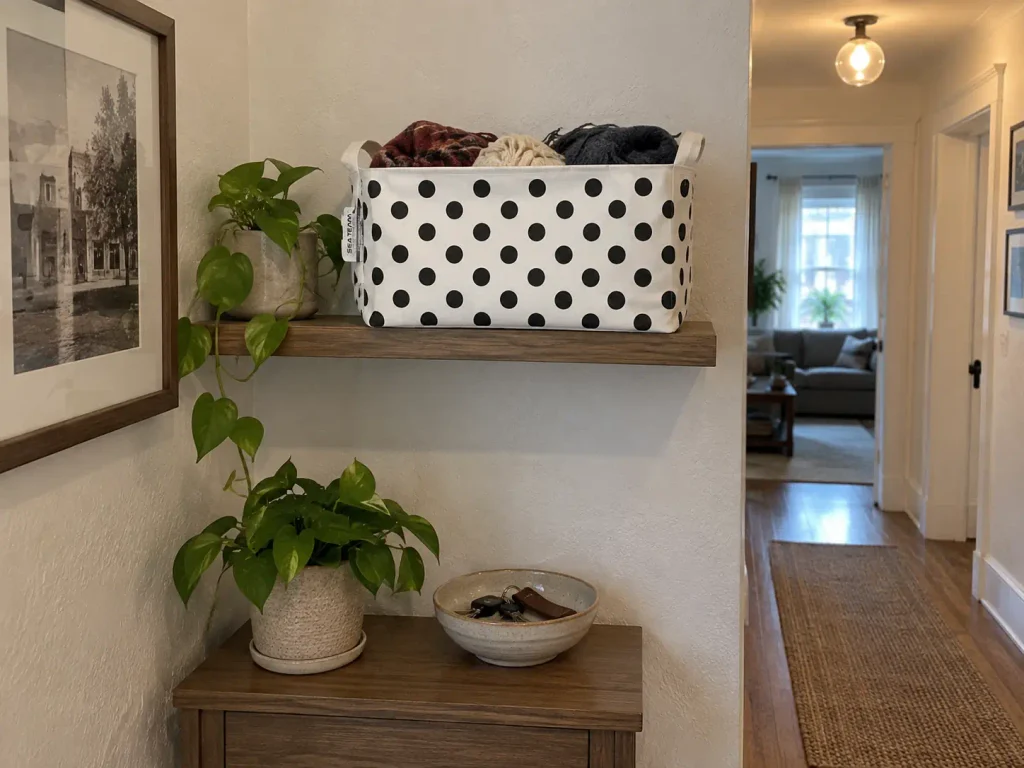
- Best collapsible for renters: Sea Team Canvas Storage Basket
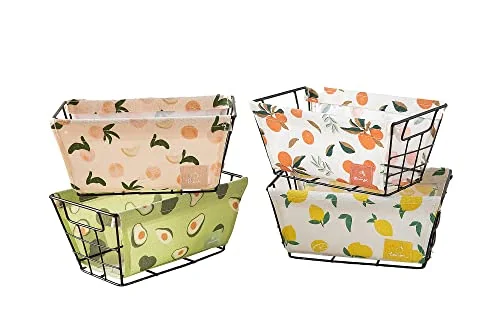
- Best washable: Set of 4 Decorative Wire Storage Baskets with Fabric Liners
How to Size a Decorative Basket to the Surface It Sits On
Everyone buys the basket first and discovers the fit afterward. It arrives, you set it on the console, and it looks like a lunchbox somebody abandoned. Or it swallows the whole tabletop and you can no longer put a coffee cup down. The product photo told you nothing, because product photos are shot in empty rooms with nothing to be out of scale against.
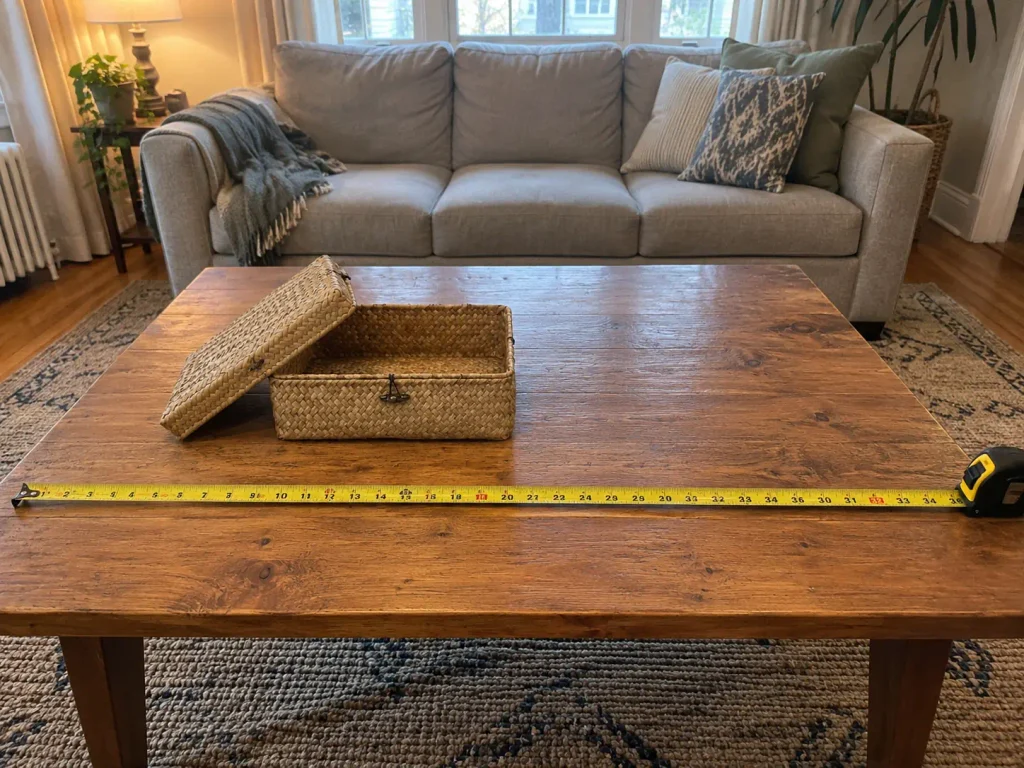
The fix takes two minutes and a tape measure, and it uses the same tray sizing rule that governs how a tray is sized to a coffee table: fill roughly 70 to 80 percent of the bare surface footprint, a surface-to-basket proportion that holds on any flat surface in the house. Under 70 percent and the basket reads as an accident. Over 80 percent and the surface has stopped being a surface.
The word doing the work in that rule is bare. You are not measuring the coffee table. You are measuring what is genuinely free on it once the lamp, the coaster stack and the plant have their territory. A 48-inch table with a lamp at one end has maybe 34 usable inches, and the basket you size for 48 will crowd the lamp every time you reach past it.
Measure the empty part.
Here is where the abstract advice falls apart. Standard coffee tables run 36 to 48 inches long and 18 to 24 inches wide, per furniture-sizing guidance from HomeyFad, which means “a coffee table basket” is not a real size. A basket that lands beautifully on a 48-inch table is oversized on a 36-inch one, and no brand will tell you which one you own.
Shelf depth is the constraint almost nobody checks before ordering, and it produces the most visible failure of all: a basket deeper than the shelf overhangs the front edge, and an overhanging basket at eye level is exactly what people are seeing when they say a room looks cluttered without being able to say why.
Before you order, cut a piece of cardboard or newspaper to the exact footprint of the basket you are considering and set it on the surface for a day. You will know within an hour whether it is right, and you will know it without a return label. Cardboard is free and shipping boxes are already in the recycling.
There is a second failure mode built into the same rule, and it arrives after the first basket works. Homes & Gardens and NEAT Method warn about the same thing: once the look lands, people start adding baskets to every available surface, and the room ends up feeling more cluttered rather than less. A coffee table with three decorative baskets on it has quietly stopped being a table. The 70 to 80 percent band is a ceiling for the total, not a per-basket allowance. Two baskets that each fill 40 percent are still one basket too many if you also wanted to set a plate down, and the same ceiling applies if you mix in a decorative bin or two.
If you would rather not gamble on a single size, a nesting basket set removes the guesswork. You measure, pull out the size that lands in the band, and the other three wait on a shelf until you need them. That is what makes a set the best budget pick for a first purchase.
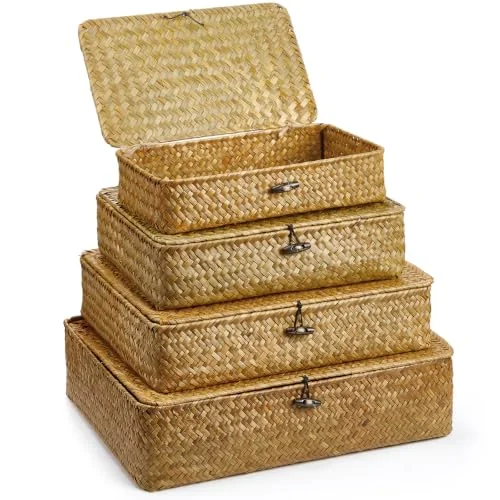
Two more numbers worth writing down while the tape measure is out. The first is the height of the shelf above, because a stackable basket that fits the footprint perfectly and cannot be lifted out without tilting it is a basket you will stop using. Leave an inch of clearance above the rim.
The second is the handle. Handles are almost never counted in the listed basket dimensions, and a woven basket with side handles is routinely an inch and a half wider than the number on the page. On a shelf with a side wall, or between two other objects, that inch and a half is the whole difference between fits and does not fit. If the listing gives you one number, assume it is the body and add for the handles yourself.
Best Woven and Seagrass Baskets (and Where They Belong)
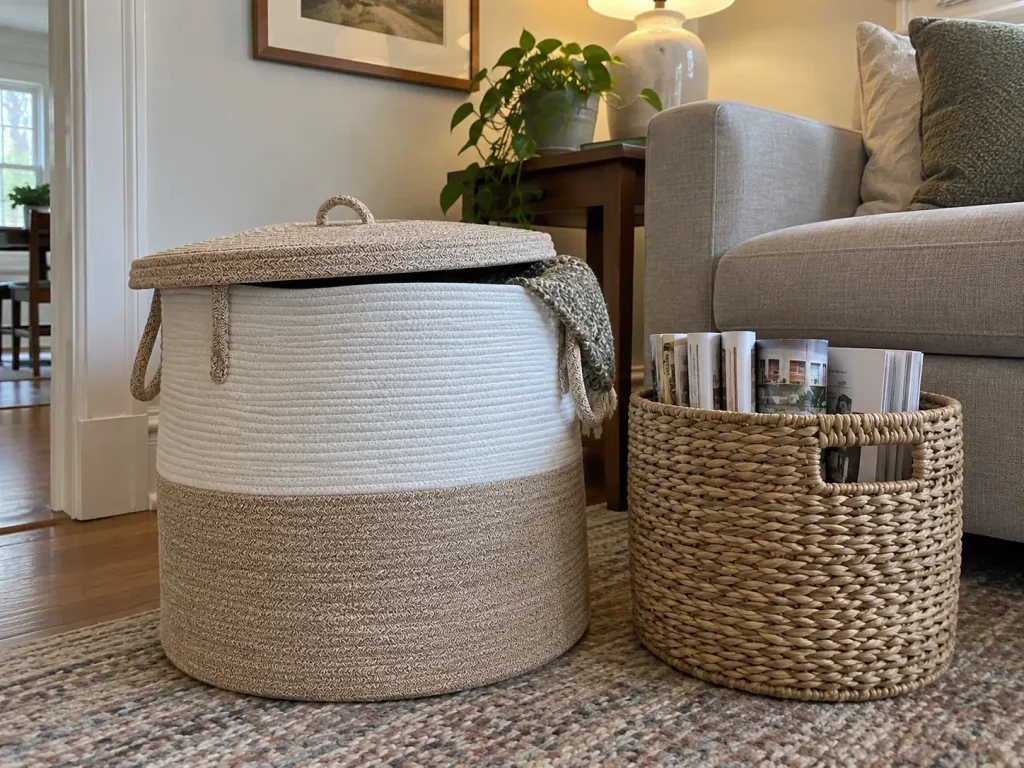
Woven is what people picture when they say decorative basket, and the reason is honest: it is the only material in this roundup that reads as decor rather than as storage. A seagrass basket on an open shelf looks like something you chose. A plastic bin on the same shelf looks like something you needed. Natural fiber also carries one real weakness, and nobody selling it puts that in the listing.
What Seagrass, Rattan and Wicker Actually Do Differently
They are closer than the marketing suggests, and the same goes for the jute basket and sisal basket you will see alongside them, both coarser underfoot cousins of the same family. Seagrass is the tightest and smoothest, with a greenish cast when new that mellows to tan. Rattan is a vine, so it takes structured shapes and holds them, which is why the pricier baskets tend to be rattan. Wicker is a weaving technique rather than a plant, so a wicker basket can be made from any of these.
The difference that actually changes your decision is weave density: an open weave is breathable material that lets you see the contents from across the room, which is fine for folded throws and terrible for charging cables. If the contents are visually noisy, buy tight or buy a lid.
Then there is the part the listings skip. Seagrass, rattan, wicker and the water hyacinth basket are all porous natural fibers that absorb ambient moisture, which is why natural fiber baskets are prone to mold in humid rooms. Below the recommended 40 to 55 percent indoor humidity range, a woven basket lasts for years. Above it, natural fiber is a bad bet no matter how good it looks in the photo, and plenty of un-air-conditioned apartments run above that range all summer.
Check what your living room does in August, not in February when everything is dry.
The Open Basket vs. the Lidded One
The rule is about reach frequency, not tidiness. Open storage earns its place on a surface you reach into daily, because there is no friction between you and the thing you need. A lid adds a step, and any step you add to a daily action will lose. Give it three weeks and the lid is leaning against the wall behind the basket, which is worse than no lid at all.
Hidden storage belongs where the contents are genuinely ugly and genuinely infrequent: extra cables, seasonal throws, the board games. Used that way, a lid does real work. Used on a coffee table, it turns the basket into a box.
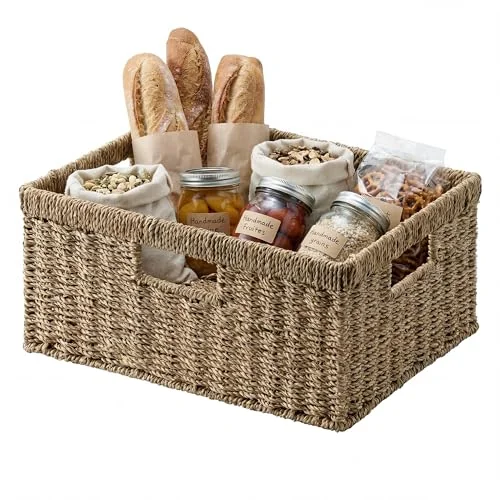
If the contents are the problem rather than the container, the lidded counterpart is the same idea at a larger scale.
Budget Versus Boutique, Without the Price Tag
The splurge-worthy rattan basket is not a scam. It is not a dupe situation where the cheap one is identical. It buys you three real things: handwoven weave consistency, so the pattern does not wander halfway up one side; handle construction, which is where the inexpensive ones give out first, because a glued handle is a stress point with a countdown on it; and a rim that holds its shape instead of going oval after a season under weight. Some of that tier also buys genuinely sustainable materials, which matters to some buyers and not to others.
It does not buy you more storage, and it does not buy you a longer life in a humid room, because the price does not change the fiber’s porosity. It also does not buy you a better system, because the basket that fails is almost never the cheap one. It is the one with no job.
I used to point people toward the pricier single basket as the smarter long-term buy. I have changed my mind: with a set, you find out what size you actually needed by using them. Buy the refined single basket after you know what shape your surface takes, not before.
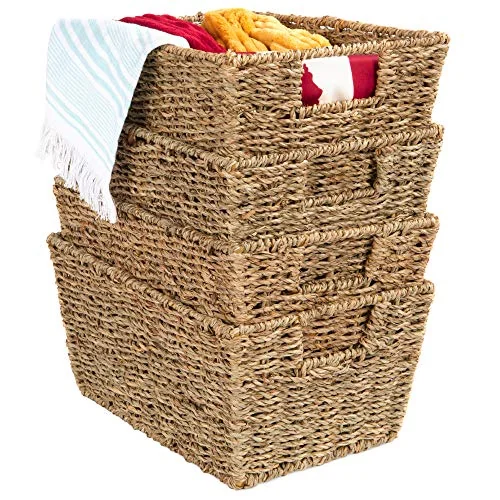
One warning applies to every woven basket regardless of tier, and it is the failure both NEAT Method and Homes & Gardens keep naming: a basket bought because it looked nice, with no category assigned to it, becomes a dumping ground within weeks. Nothing protects you from that except a rule.
Best Fabric and Wire Baskets for Renters, Kids and Pets
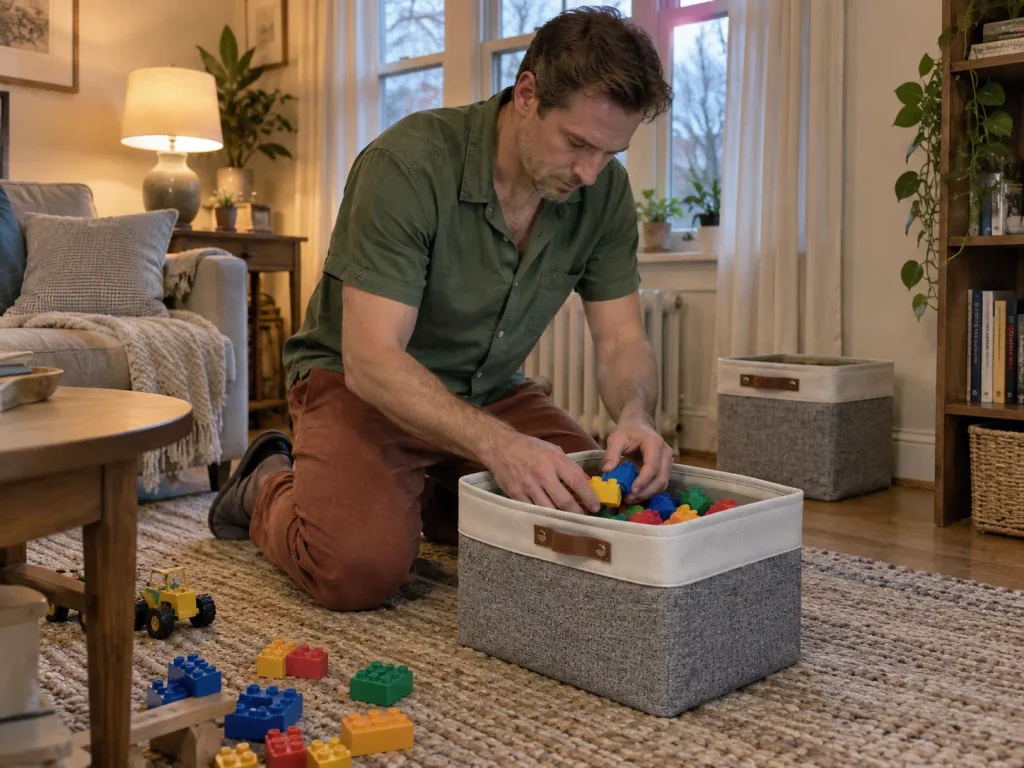
If you rent, if you move every couple of years, if there is a toddler operating at exactly coffee-table height, or if you have a cat that considers any open basket to be furniture, the material question stops being about looks. It becomes a question about what survives, and what it does to the floor under it on the way.
Fabric Baskets and the Floor Underneath Them
Here is the thing nobody mentions about a heavy woven basket on hardwood. It is not the weight. It is that the base of a natural-fiber basket is a grid of stiff dried plant material, and every time you slide it three inches to vacuum, that grid drags across the finish. A felt pad acting as floor protector under the base reduces the friction and the micro-scratching, which is standard flooring-protection guidance from sources like Jason’s Carpet & Tile, but cheap felt compresses flat and then starts sliding on its own adhesive. Check the felt every month or so, hooked onto the nightly reset habit and the weekly reset that keeps surfaces from refilling, since you are already handling the surface at that point.
The second floor issue is shedding. Natural fiber sheds, in small dry fragments that end up on the rug around the basket and in the vacuum. A cotton basket or canvas one does not. On a rental floor, or on a rug you are responsible for at move-out, that is the entire argument.
Fabric also changes the calculation with small people and animals. An open basket at coffee-table height is precisely where a toddler reaches and where a cat settles in, and that is not a supervision problem you can solve by watching harder. It is a material decision: softer edges instead of a rigid woven rim, and nothing to mount, which keeps it no-drill in a rental, and nothing to shed into a mouth that will test anything once.
Collapsible Storage for People Who Move
Rigid baskets are a tax on anyone who moves. They are not stackable or collapsible with anything outside their own set, they cannot be flattened, and they travel as air. If you have moved with woven baskets you already know how it goes: they ride loose in the back of the truck, get crushed under something, and arrive oval.
A canvas basket that collapses folds flat to roughly an inch when empty. That is the whole feature, and it is a genuinely different product, because the basket you are not using takes up the space of a folded towel instead of the space of a basket. Between apartments, it goes in a suitcase. In a small place, it means you can own the right basket for a season and store it rather than choosing between keeping it out and getting rid of it.
Wire Frames With Washable Liners
Every basket in this article gets dirty. Only one of them can actually be cleaned, which sounds like a small distinction until you own a shedding dog.
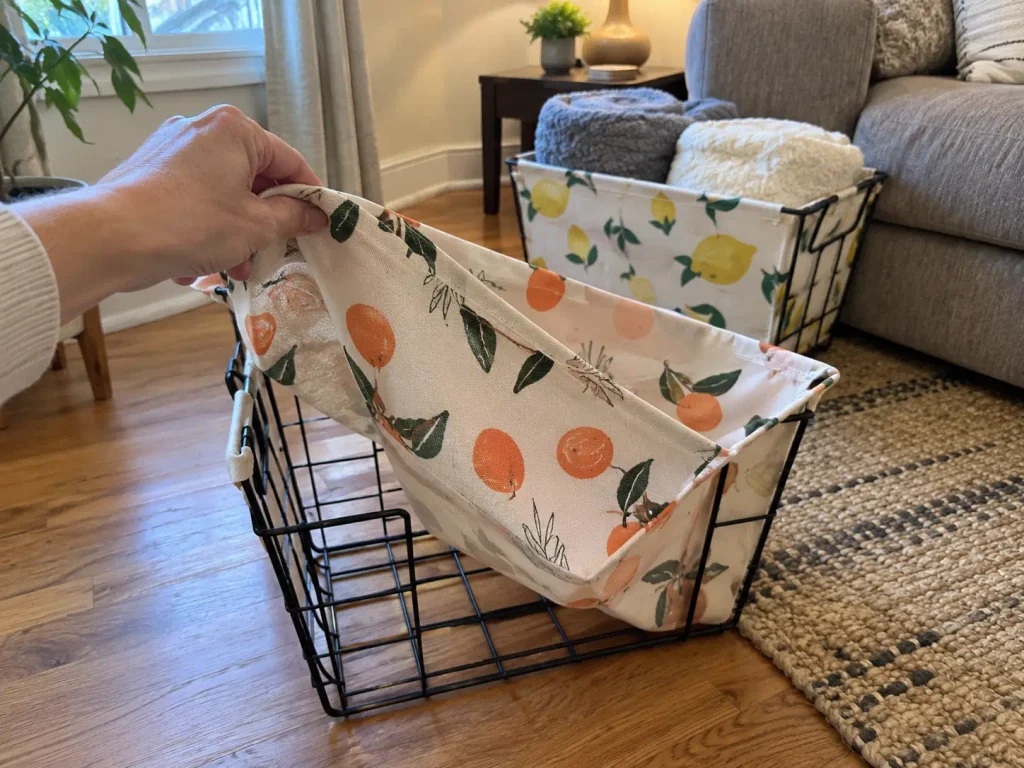
A wire basket with a removable fabric liner separates the two jobs. The frame gives structure and holds its shape empty, which fabric cannot do. The basket liner takes the contact, the dust, the hair and the one time something leaked, then comes out and goes in the machine. Wire is a ventilated basket by construction, so it solves the humidity and mold risk outright, since there is no porous fiber to absorb anything, which makes it the honest pick for a room that runs damp.
The trade-off is visual. A metal basket reads as farmhouse or industrial rather than soft and organic, and if the room’s palette is all linen and light wood, a wire basket will announce itself.
Which Basket Goes on Which Surface
The same basket that works on a floating shelf fails on a coffee table, and style has nothing to do with it. What changes is who reaches into it, how often, and what is directly underneath. Sort by those three and the material and size questions mostly answer themselves.
Coffee Table
This is the highest-traffic surface in your living room and the one where a basket most often goes wrong. Reach frequency here is daily and often hourly, so open beats lidded every single time. A lid on a coffee-table basket is a lid nobody lifts by week three, and then it is a lid sitting on top of an overflowing basket, which looks worse than the pile it was meant to hide.
Go shallow, too. A tall basket blocks sight lines across the room and becomes a well, where things sink to the bottom and never resurface. Six to eight inches is plenty for what actually belongs on a surface you want to keep tidy: remotes, one set of coasters, the current book.
One basket, one category, and only one. This category grouping is the same discipline behind corralling one named category on a tray, translated into a container with sides. Two categories in one basket is not organization, it is a pile with a nicer perimeter.
Say the category out loud when you set the basket down, and say it in two words or fewer. Remotes. Current reading. Dog toys. If it takes a sentence to describe what goes in there, it is not a category, it is a miscellaneous section, and the miscellaneous section always wins.
Console and Entryway
This is the drop zone, where keys, mail, sunglasses and receipts land within four seconds of the door closing. It is also the one surface where a lid genuinely earns its place, because the contents here are visually noisy by nature and the reach pattern is different. You are not browsing this basket. You are dropping into it and, later, digging through it once.
The move that works is two containers rather than one big one: a shallow open dish, or a small storage bin, for the things you need back in your hand tomorrow morning, and a lidded basket beside it for the mail-and-cables layer you will sort on Sunday. Splitting by urgency instead of by object type is what keeps the keys findable.
Floating Shelf and Bookshelf
Measure the depth first, and measure the shelf itself rather than trusting the listing, because floating shelves are frequently shallower than they look. A basket deeper than the shelf overhangs the front edge, and overhang on a shelf at eye level is the single most visible sizing failure in a room. It reads as wrong from the doorway even to someone who could not tell you why.
On a bookshelf, baskets belong on the lower shelves, acting as the catch-all basket for things that have no shelf-shape at all. Cables, controllers, chargers, batteries. These are the objects that make an otherwise tidy bookshelf look chaotic, precisely because they have no flat side to line up against anything.
And whichever surface you are working on, hold the line on count. The one-basket-per-category rule professional organizers use is not about tidiness for its own sake. It is what stops you from solving a full basket by adding a second one, which is how a console ends up with four baskets and no console.
Why Decorative Baskets Stop Looking Decorative
Nobody writes about what a basket looks like in month four. That is where the actual disappointment lives, and the annoying part is that all three causes are predictable from the day you buy it.
The Overflow Creep
The mechanism is simple, and it is not about willpower. A basket with no assigned category has no rule about what is allowed in, and anything without a rule against it drifts in by default. The mail arrives because there was space. The chargers arrive because they were nearby. The one sock arrives because someone was holding it and the basket was the nearest horizontal opening.
Three weeks later it is full, and a basket filled past its rim reads as a pile that happens to be contained.
The tell is the rim line. Once the contents rise above it, the visual logic breaks, because the thing your eye registers as tidy is a clean edge with an empty margin above it. Keep it around two-thirds full and it reads as intentional. Fill it to the top and it reads as coping.
This is also why professional organizing guidance on using storage baskets without overwhelming a room warns against adding baskets to every surface: the instinct when one overflows is to buy another, and two overflowing baskets are exactly twice as bad as one.
The fix is not a bigger basket. A bigger basket buys you about six weeks and then you are in the same place with more volume. The fix is naming the category and enforcing it.
Dust, Pet Hair and the Weave
The second failure is physical, and it is the one people take personally, as if their basket aged badly because they were careless. An open weave is a grid of small gaps, and small gaps collect. Dust settles into the weave and stays there.
Pet hair works its way into the same gaps and knits itself in. Shaking the basket out over a bin does something, but not enough, and a vacuum brush attachment does better on the outside surface and almost nothing down in the weave.
Line a woven basket you cannot wash. A cheap fabric liner, or even a folded pillowcase tucked over the rim, takes the dust and the hair instead of the weave, and it comes out and goes in the machine. It also stops the inside of the weave from snagging whatever you keep in there, which is the quiet reason throws come out of woven baskets with pulls in them.
The third failure is the one that catches people out completely, and it is a season rather than a habit. A natural-fiber basket that looked fine all winter starts smelling faintly musty the first genuinely humid week of summer. Nothing changed about how you used it. The room went above the 40 to 55 percent humidity range and the porous fiber did what porous fiber does.
That moment is worth naming, because it reframes the entire purchase: which basket you buy is partly a climate question, not only a style one, and no amount of maintenance fixes a material that is wrong for the room. If that is your apartment, buy fabric or buy wire, and buy it the first time.
This is also where the wire-and-liner set earns its position in this roundup. It is the only pick here whose dirt-collecting part comes out and goes in a machine. Everything else is a shake and a hope.
So the honest skip list, after all of that. Skip natural fiber in a room that runs humid, no matter how good the weave looks, because you will be replacing it inside two summers. Skip lidded baskets on daily-reach surfaces, because the lid loses to the habit every time. And skip the third basket on a surface that already has two, which is the one most people have to learn twice.
Conclusion
Measure the bare surface before you shop, then buy the basket that fills 70 to 80 percent of what is actually free on it. Match the material to the room and to who reaches into it: woven for dry rooms where the basket is part of the decor, fabric where kids and pets are involved or where the floor is somebody else’s, wire-and-liner for anything that needs real cleaning. And give every basket exactly one named category, because that single rule is doing more work than the material, the weave, and the price tier combined.
Run the three-month test: look at what is actually inside each basket. If it still holds the one category you bought it for, the system is working and you can leave it alone. If it has quietly picked up mail and chargers, the basket did not fail, and no amount of extra decluttering will fix it. The rule did, and re-stating it takes a minute.
Start with the one surface that annoys you most. Measure it tonight, buy one basket, give it a job. Then do the next one.
Frequently Asked Questions
01Which storage basket is best?
The best basket is the one sized to fill 70 to 80 percent of the bare surface it sits on, in a material that matches the room’s humidity. Woven seagrass suits dry rooms where the basket is part of the decor, fabric suits homes with kids and pets, and wire with a washable liner suits anything that needs real cleaning.
02Where is the best place to buy storage baskets?
Amazon carries the widest range of sizes and materials at every tier, which matters more than the retailer once you know your measurement. Home and decor stores carry fewer sizes at higher prices for the same materials. The retailer only determines how many options you see; your measurement and your room’s humidity determine which one is right.
03Who makes the best storage containers?
There is no single best maker, because material and size decide the outcome far more than the brand name does. StorageWorks covers the open seagrass case, HONCESTA the large lidded one, Bagnizer the kid and pet case, and Sea Team the collapsible renter case. Pick by the problem you have, not by the logo.
04What is an attractive storage box?
An attractive storage box is one whose material suits the room and whose footprint suits the surface it sits on. Lidded boxes work where contents are visually noisy and rarely needed; open baskets work where you reach in daily. Either way, give it one named category, because an overflowing box stops looking attractive regardless of what it is made of.
05Do woven baskets get moldy?
Yes. Natural fibers like seagrass, rattan and water hyacinth are porous and can mold or smell musty in rooms that run above the 40 to 55 percent humidity range. The fix is material choice rather than maintenance: in a room that runs damp, a fabric or wire-frame basket holds up where woven will not.
Disclaimer: ClutterlessNest is a participant in the Amazon Services LLC Associates Program. As an Amazon Associate we earn from qualifying purchases. This article may contain affiliate links — if you buy through them, we may earn a small commission at no extra cost to you. We only recommend products we have tested or genuinely believe in.