
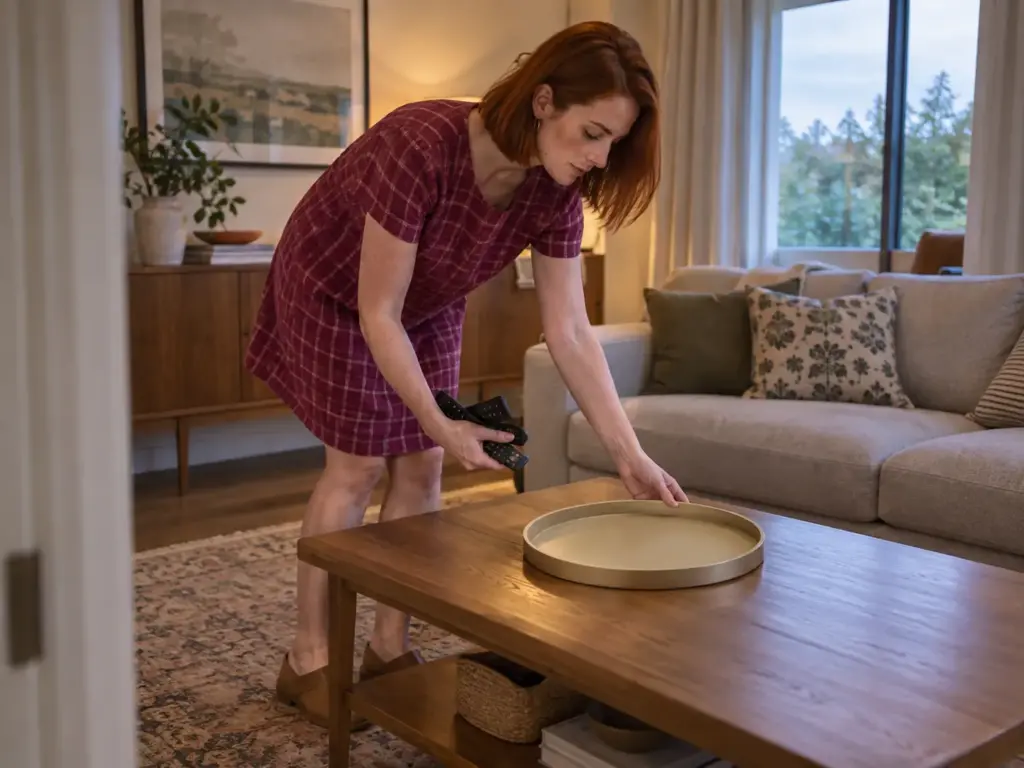
You look up mid-episode and there it is: the tray you set out on move-in day, the one that was going to keep everything tidy, now holding three remotes, a phone charger, and a chapstick balanced on top of a candle. Most coffee table organization ideas fail for the same reason, and it isn’t that you picked the wrong tray. It’s that nearly every guide treats the coffee table as a display surface when it’s actually the surface in the house that gets touched most times per day. So here are five organizing approaches, each judged on the three things that actually matter: whether it survives being grabbed at one-handed, whether it needs a weekly empty-and-sort to keep working, and whether the table can still go fully bare in under a minute when someone wants to eat dinner on it.
Quick Answer
Five approaches that hold up under daily use, from easiest to most structural:
- Corral loose items on one tray with a single named category
- Group objects by height into two or three liftable clusters
- Conceal the ugly necessities in a small lidded box
- Give couch-reached items a divided, one-handed home
- Fix it structurally with a storage ottoman or lift-top table
Corral Everything Onto One Tray (And Give That Tray a Rule)
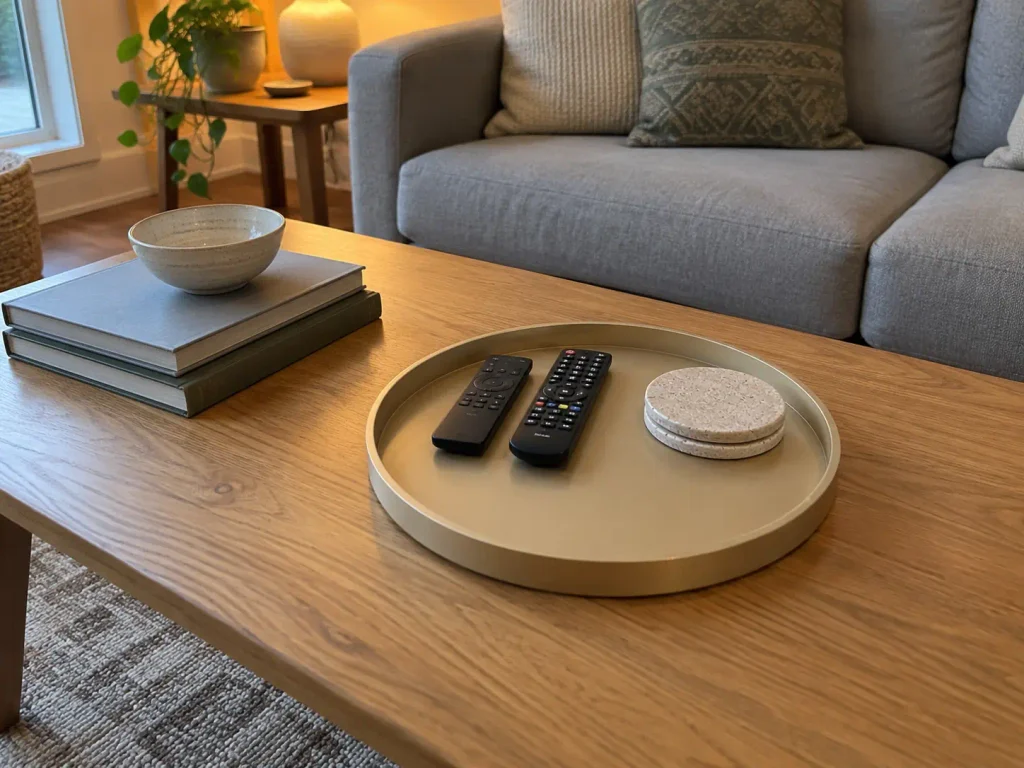
Everyone’s first move is a tray, and the tray is genuinely a good move. Corralling works because it converts a spread of scattered objects into one visual unit. Same number of things on the table, completely different read: a pile becomes an arrangement, and your eye stops registering it as mess.
But the tray on its own is only half a system. Nobody ever decides what’s allowed on it, so within about three weeks it’s a nicer-looking version of the pile it replaced.
How big the tray should actually be
The proportion most styling sources land on: your tray should cover roughly a third to half of the tabletop and run about two-thirds of the table’s length. On a 48-inch table, that’s somewhere around 30 to 32 inches. Big enough that everything on it reads as one block, small enough that you still have bare table to set down a plate, a laptop, or a book you’re halfway through.
You don’t need a custom size for this. Standard off-the-shelf trays run about 16 by 12 inches rectangular, and round ones cluster in the 14 to 18 inch range, which fits most tables without hanging off the edge. A rattan tray and a marble tray at those sizes behave identically here, so pick on weight and on how it sounds when something lands on it. If you want the proportion rule and the bare-rim measurement worked out in detail, the seed guide covers the exact tray-to-table proportion method and the one-container-per-category system behind it, rather than the rule of thumb.
The one rule that keeps a tray from becoming a catch-all
Here is the failure mode nobody writing about coffee table styling mentions. A poster in an r/organization thread about this exact problem described it precisely: the tray reaches a point where “it can become a catch-all” and they “can’t even find the things I put the basket there to hold.” The container meant to solve the clutter had quietly become the clutter, with a rim around it.
That’s not a one-person problem. Professional organizers at NAPO recommend assigning every container a defined purpose for the same reason, and organizer roundups keep landing on the same verdict about decorative trays: a catch-all tray with no assigned category turns into yet another landing spot.
Two independent sources, one conclusion. The tray didn’t fail because it was the wrong object. It failed because nothing was ever taken off it.
So give the tray one named category. Not “small stuff.” Remote storage and coaster storage. Or keys and reading glasses.
One of those, not both plus whatever else lands there over the weekend.
The moment a category is named, anything that doesn’t belong looks visibly wrong sitting there and you remove it without thinking. A tray holding “small stuff” has no such signal, because everything qualifies. That is the difference between a dump tray and a container with a job.
The second half of the rule is a visual stop signal. If you can’t see empty tray between the objects, the tray is full. That’s the cue, not “when it starts to look messy,” because by the time it looks messy to you it’s been bad for two weeks.
Start with a tray you already own
Before buying anything, walk into the kitchen. A flat serving tray does this job. So does a shallow woven basket, a large ceramic platter you never use, or in a genuine pinch a rimmed baking sheet, which sounds ridiculous until you see it under a stack of books.
There’s a real reason to start free rather than shopping first: you don’t yet know which category the tray should hold, and you won’t until you’ve watched what actually lands on the table for a week. Buy the nice tray after you know its job.
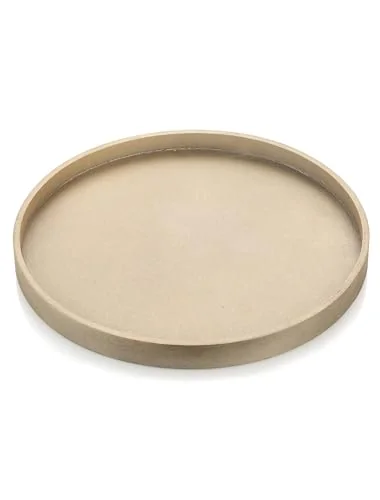
Pick a tray with a raised rim rather than a flat board. The rim does two jobs at once: it keeps a remote from sliding off when someone’s foot catches the table, and it gives you a hard visual edge so you can tell at a glance when the tray is over capacity. A flat board has no boundary, which means it has no stop signal either.
Group Objects by Height Instead of Spreading Them Flat
The reason a styled table in a photo looks calm and yours looks busy usually has nothing to do with how many objects are on it. Count them sometime. It’s often the same number. The difference is that theirs are stacked into two or three vertical clusters and yours are spread evenly across the whole surface like a chessboard.
Why flat spreading reads as clutter
Your eye groups objects that sit close together and reads them as one shape. Spread those same objects out with equal gaps and your eye has to process each one separately, which is the sensation you experience as visual noise. The working rule for grouping objects: arrange in groups of two or three, vary the height inside each group, and leave at least a third of the tray’s own surface bare. Odd numbers styling is the shorthand most decorators use for it, and texture mixing across a group (wood, ceramic, paper) is what keeps three objects from reading as a matching set.
Height variation is the part people skip. Three objects of similar height in a row read as a fence, not a group.
One tall, one medium, one low, clustered tight enough that they overlap slightly from where you sit, reads as deliberate. That stacking and layering is the same grouping logic that works on a bookshelf, applied to a horizontal plane instead of a vertical one. It transfers straight to a console table or a side table in the same room.
One constraint keeps this from scaling the way photos suggest: your coffee table is already sized down to roughly two-thirds of the sofa’s length, so whatever sits on top has a smaller footprint than the room in the magazine had. Two clusters on a standard table is the honest number. Three is pushing it.
Books are the cheapest height you own
A short stack of coffee table books is the most useful object in this entire article, and you probably already own the raw materials. Three books give you a platform that lifts a small object toward eye level from a seated position, they fill volume without adding a new category of clutter, and unlike a decorative orb they’re a thing a person might actually pick up.
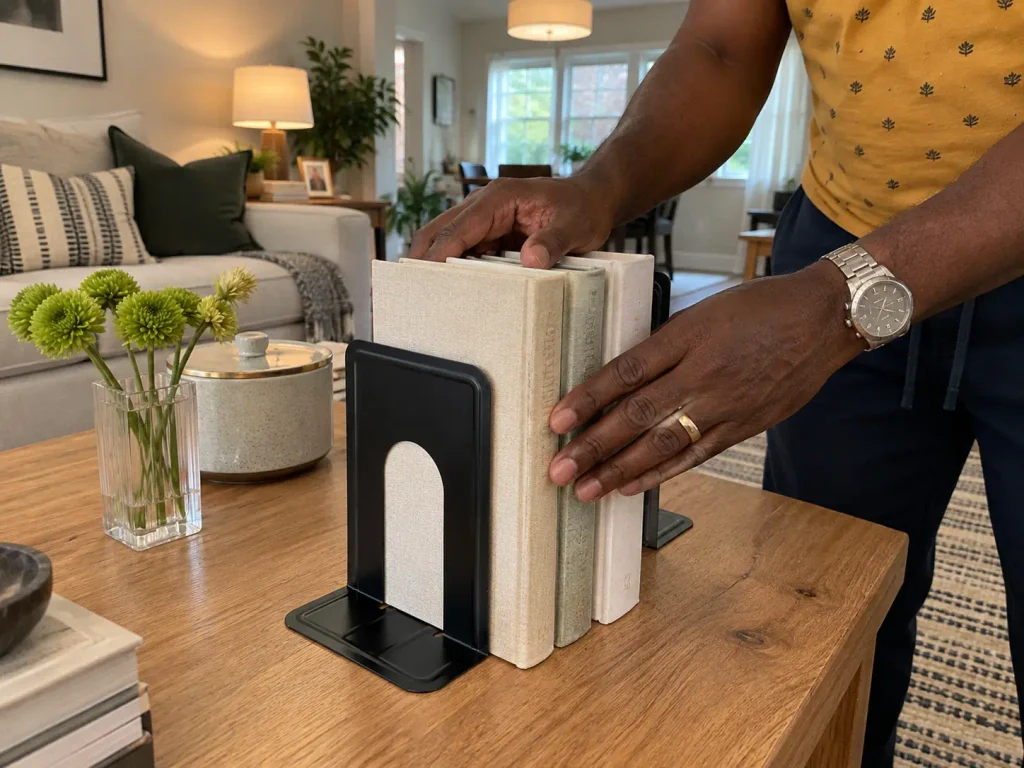
Stacked books alone, no accessories, is the zero-purchase version, and honestly it’s the one I’d start with. Bookends and a book stand only earn their place when the stack has an actual problem, and it has exactly one: on a glass or lacquered tabletop, a stack slides. If that’s happening on your table, the MaxGear 8.5 in Heavy Duty Metal Book Ends come as two pairs of solid metal, and the weight is the point rather than the tree cutout. The honest limitation: bookends on a coffee table can read as bookshelf furniture that wandered into the living room.
For the natural elements slot, same logic before you buy. A small drinking glass works fine as a bud vase, and one green stem or a few fresh flowers do more for a table than three decorative objects. A plain ceramic vase you already own counts.
If you want something that plays along with the book theme, the Puransen Clear Book Flower Vase is a book-shaped acrylic vase that sits flush against a stack. Its narrow profile holds little water, so fresh stems need topping up every couple of days. A tall candle in a low candle holder does the same height job without adding a fourth object.
Build your clusters and then look at the table from the sofa, sitting down, not from above while standing. Standing over a coffee table is the one angle you almost never see it from in real life. Objects that look nicely varied from above frequently flatten into a single blurry mass at seated eye level, which is the view that actually shapes how cluttered the room feels to you.
Build groups you can lift in one hand
Here’s the test that decides whether a grouped arrangement survives past week two: can you pick up each cluster as a single unit? If clearing the table means handling nine separate objects, you will stop clearing the table. Not because you’re lazy, but because nine decisions is a task and lifting two things is a gesture.
That’s why a tray under a group matters more than it looks like it should. The tray isn’t only visual containment, it’s a handle. Two loaded trays come off a table in about four seconds.
Hide the Ugly Necessities in a Lidded Box
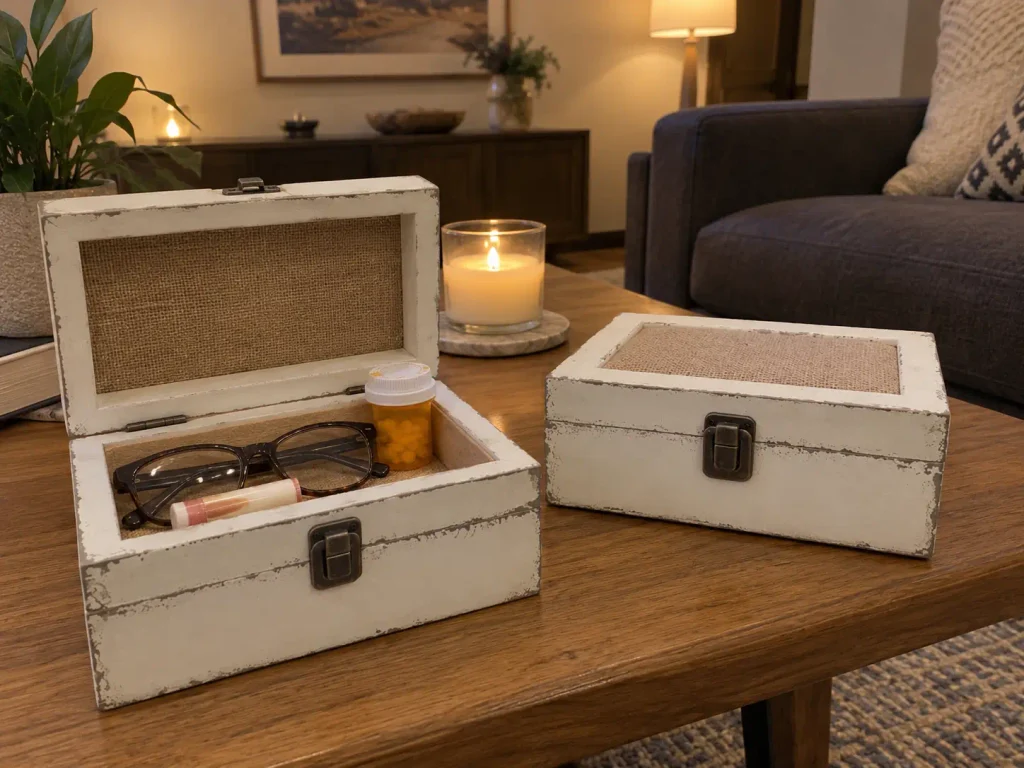
Some things have genuinely earned their place on the coffee table and still look terrible sitting on it. Pill bottles. Chapstick.
The charging cable for the one device that always dies at 9pm. Nail clippers somebody left there in March.
A tray does nothing for these, and that’s not a flaw in the tray. A tray’s entire function is to display a category neatly, and these items have no neat version. Chapstick storage and pill bottle storage are concealment problems, not display problems.
When a lid beats a tray
The choice between open and closed containment comes down to one question: do you want to see the contents? Open containment makes a category visible, which is exactly right for remotes and coasters, because seeing them is how you find them. Closed containment makes a category invisible, which is exactly right for medication, small toiletries, and cables.
Applied to the coffee table, that means most tables want both. One open zone for the things you reach for without looking, one closed zone for the things that would otherwise make the room read as a nightstand.
Two small boxes beat one big one
Small hinged-lid boxes for this job typically run in the 8 to 10 inch length range, the scale that swallows chapstick, a pill bottle, a couple of rings, and a cable without turning into furniture. Small enough to disappear on the table, big enough to hold what actually piles up.
Now apply the same rule from the tray section, because this is where people repeat the mistake with a lid on it. One big box labeled “everything small” in your head is the catch-all failure again, just hidden. You open it looking for the nail clippers and find a stratified record of every small object that entered the room since spring.
Two small boxes, each holding one named category, beat one large box every time. It’s the same principle behind matching the container to one category anywhere else in living room organization, and it is what turns a trinket box into real small item containment rather than decor.
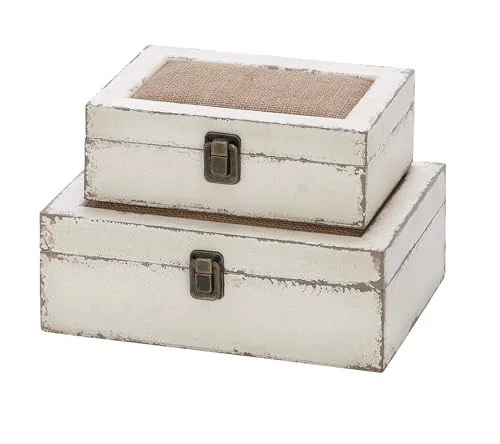
If you only need one container and the second box would sit empty, the Juvale Wooden Box with Hinged Lid measures 9.5 by 5.9 by 3.2 inches, which is squarely in the small-chest scale that community threads keep describing for chapstick and pill bottles. At 3.2 inches deep it won’t take a tall bottle standing upright, so check the height of whatever you’re hiding before you commit.
Before either of those, though: check the house. A small wooden box you got as a gift, a cigar box, a lidded ceramic bowl in a cabinet, an old tea tin, even the zippered pouches that come with bedding sets. Any of those does this job today for nothing. The purchase is worth making when you know the category and nothing you own is the right size, not before.
The one-handed test
This is the constraint the styling guides skip entirely, and it’s the one that decides whether a box is still in use three months from now. A lid only works if opening it is a one-handed move from a seated position.
Picture the actual moment. You’re sunk into the sofa, a drink in your left hand, and you want the chapstick. A hinged lid means one motion with your thumb.
A lift-off lid means a second hand for the lid, plus somewhere to put it down, which is the table you were trying to keep clear. Give that box two weeks of real evenings and the lid will be sitting beside it permanently, which makes it a small awkward tray with extra steps.
The same test rules out anything you have to move something else to reach. If the box lives under a stack of magazines, it’s not a box, it’s storage.
Give the Daily-Use Items a Home You Can Reach Without Looking

Every organizing idea written for a coffee table quietly assumes you’re standing over it, looking down, with both hands free. That’s how you set it up, so it’s how you evaluate it. It’s also a position you’re almost never in when you use the table.
In reality you’re sitting down, one hand occupied, reaching for a remote without taking your eyes off the screen. An arrangement that only works when you’re standing is an arrangement that stops working by Thursday.
Blind retrieval is the real test
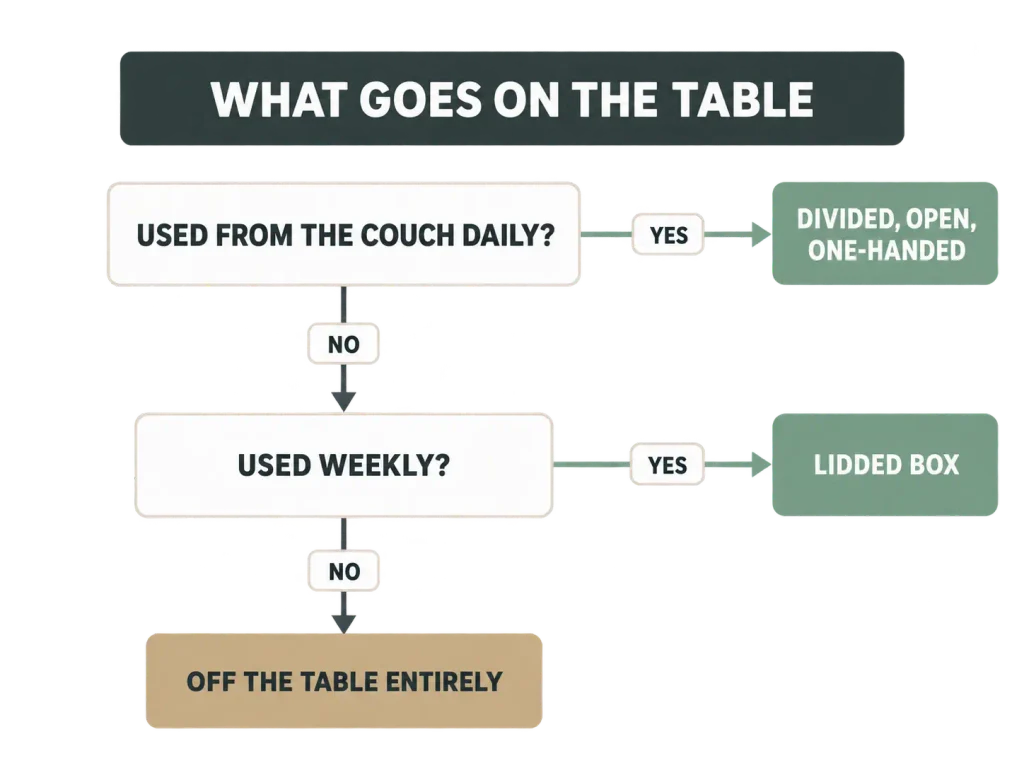
Being used from the couch changes three concrete things. Retrieval has to be blind, meaning you find the thing by feel and position rather than by looking. It has to be one-handed, because the other hand has a drink in it. And nothing can be stacked on anything else you need, because lifting one thing off to reach a second requires somewhere to put the first, and you’re already out of hands.
That constraint eliminates more popular coffee table decor advice than anything else in this article. Nested trays: out. A decorative bowl sitting on a stack of books: out, since you’ll never lift the bowl to get a book and the books become furniture.
Anything with a lid that needs two hands: out. What survives is flat, divided, and permanently open at the point of use. Everything else becomes visual clutter you have to work around.
Divided beats open for anything you own two of
One remote in an open bowl is fine. Three remotes plus a phone plus a pair of reading glasses in an open bowl is a rummage, and rummaging is exactly what you can’t do without looking. The moment you own more than one of something, dividers stop being decorative and start being the retrieval system: the TV remote is always in the front left slot, so your hand goes there without a decision.
Remote caddies commonly come in 2- to 6-compartment configurations, and rotating versions exist specifically because the far side of a caddy on a coffee table is a genuinely awkward reach from a seated position. Spinning the base beats leaning across the table.
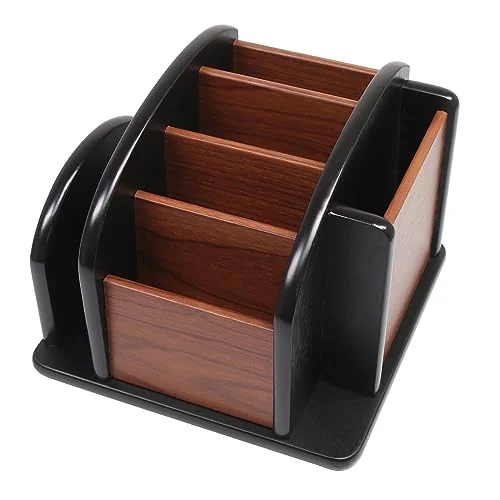
I used to recommend a plain open bowl for remotes, on the theory that fewer rules means the system survives other people using it. After enough threads where the bowl turned into the same rummage as a loose pile, I changed position: the divisions are the rule, and a physical divider is the only rule a household reliably follows without being reminded.
Clearing the table for dinner in under a minute
The same r/organization thread surfaces a second constraint that no styling guide accounts for, and it’s arguably the bigger one. At least one person in that conversation needs the coffee table to go completely bare, because that’s where dinner happens. Or homework. Or a board game that takes up the entire surface.
That requirement rules out the permanently centered styled arrangement outright. If the table has to be empty twice a week, a fixed tableau is something you dismantle and rebuild twice a week, and nobody sustains that past the first month. What you rebuild the third time is always smaller and uglier than what you set up the first.
So the real test isn’t how the table photographs. It’s whether one person can clear the entire surface in under a minute without deciding where anything goes, and get a genuinely functional surface back.
Meeting that bar takes one structural choice: everything on the table lives in one or two liftable units, and each unit has a defined off-table home. A shelf under the table. The ottoman. The end of a console.
With those, clearing becomes carrying, and carrying takes about eight seconds. Without them, clearing becomes sorting, and sorting takes eleven minutes and a certain amount of resentment.
Which is why a nightly reset works as a habit rather than a weekend project, with a longer weekly reset only when something has genuinely drifted. You’re not tidying, you’re returning two objects to a place they already have. Small enough that it still happens on the nights you don’t feel like doing anything.
Time yourself clearing the table once, with a phone timer, the way you’d actually do it before guests arrive. Anything over sixty seconds means you own too many separate units, not that you own too much stuff. Consolidating nine loose objects onto two trays usually cuts the time by two-thirds without removing a single item from the room.
Fix It at the Furniture Level Instead of the Surface

If you’ve already been through a tray, then a box, then a second box, and the table is still cluttered by Wednesday afternoon, stop buying containers. The container isn’t the problem. The problem is that the room holds more small items than it has places to put them, and your coffee table is the only horizontal surface absorbing the difference.
When containers stop working, the problem is capacity
The mechanism, stated plainly: surface containers only relocate items within the surface. A tray doesn’t remove anything from the table, it rearranges what’s already there. That’s useful when the table holds eight things that belong in the living room. It does nothing when the table holds twenty-two things, eighteen of which have no home anywhere in the room.
The diagnostic is simple. Pick everything off the table and try to put each item away. Whatever you can’t put away because there’s no place for it, that’s your real number.
If that pile runs past four or five items, no amount of styling will hold. You need volume, not arrangement.
An ottoman adds volume without replacing the table
The cheapest way to add hidden volume to a living room is a storage ottoman, and for what it’s worth it’s the move I’d make before replacing any furniture. Models in the 43-inch range work either as a coffee table substitute or as a companion piece sitting beside or in front of the one you have, with hinged lids built for opening and closing daily rather than seasonally. It also happens to be the most renter-friendly structural fix there is: no drilling, no wall anchors, no permission, and it leaves with you. Weighing splurge vs budget on this pair is simple: the ottoman is the budget half, the lift-top is the splurge.
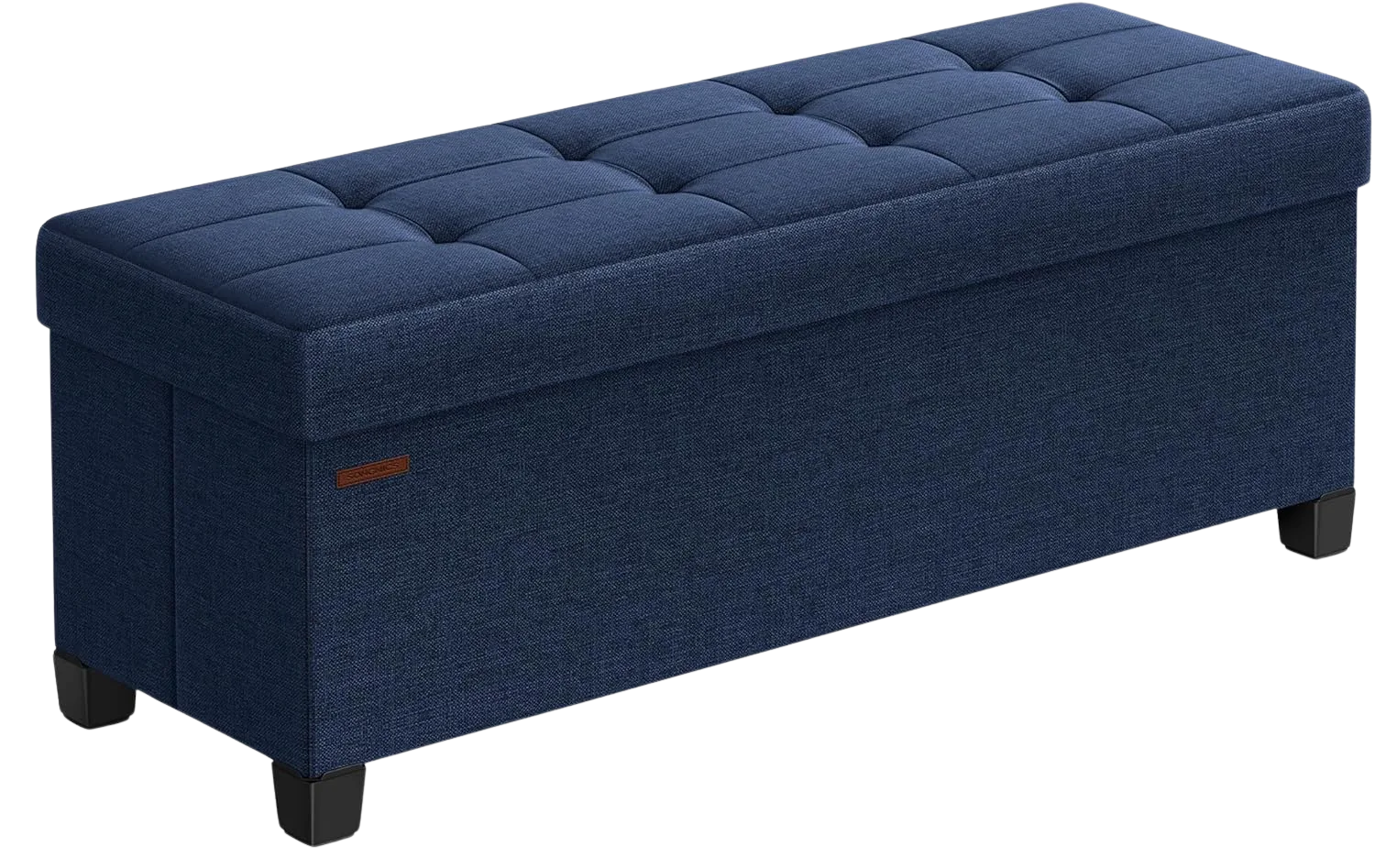
The splurge counterpart solves the eating conflict from the last section at the furniture level rather than the habit level. A lift-top coffee table raises the tabletop toward laptop or dining height and reveals a compartment underneath, so the clutter goes down and the surface stays a plain flat table. It is the one piece of multi-functional furniture that fixes this without changing how the room is laid out. The HOMCOM Lift Top Coffee Table with Hidden Storage Compartment answers “the table has to be bare for dinner” most directly, because clearing becomes a lever rather than a tidy-up.
The trade-offs are real: more moving parts than a plain table, and lift-tops want a few inches of clearance in front to raise without hitting the sofa. Measure that gap before ordering.
On safety, the honest version rather than the alarmist one: the CPSC’s mandatory tip-over standard covers clothing storage furniture like dressers and excludes lighter pieces, so a coffee table isn’t regulated the way a chest of drawers is. That said, CPSC’s Anchor It! campaign still recommends securing anything a child could climb or pull down. Worth thinking about for a storage ottoman a toddler will absolutely stand on.
Hidden storage needs a rule too
Hidden volume has its own failure mode, and it’s quieter than the others because you can’t see it happening. A compartment nobody opens becomes a box of things nobody owns any more. Six months in, you lift the lid looking for the good scissors and find a dead router, three instruction manuals, and half a deck of cards.
The fix is the same rule as the tray, which is the pattern running under every idea here: give the compartment one named category. Board games. Throws. Cables.
And open it once a month even when you don’t need anything, because that’s the only thing that keeps a closed container honest. For the full buying-guide treatment rather than this one-idea-among-five version, the full rundown on multi-functional living room pieces compares the same two products in more depth.
Conclusion
Three things worth carrying out of this. Every container on the table needs one named category, because the containers that fail are always the ones quietly assigned to “small stuff.” Judge each idea by whether it works one-handed from the sofa rather than by how it photographs from above, since standing over the table is the one angle you almost never use it from. And if containment keeps failing no matter which container you buy, the table is out of capacity, so add hidden volume instead of another bowl.
In three months, open every container on the table and empty it completely onto the floor. Whatever goes back in is the real category. Whatever doesn’t tells you the container has been doing a different job than the one you assigned it, and now you know which job to name.
Start with the surface’s single worst offender, which for most people is the remotes. Give just that one thing a defined spot this week and leave everything else exactly as it is. If it’s still holding in two weeks, pick the next one.
Frequently Asked Questions
01What is the 2/3 rule for coffee tables?
The 2/3 rule says a coffee table should run about two-thirds the length of the sofa it sits in front of. It matters for organizing because the table is already sized down from the sofa, so a tray or arrangement that looked right in a photo of a bigger room will crowd yours.
02What do you put in the middle of a coffee table?
One grouped cluster with varied height, such as a short stack of books with a small object on top, or a tray holding a single category. Keep the middle as the one anchor and leave the edges clear, because the edges are where a plate or a laptop actually lands.
03How do you keep a coffee table tray from becoming a catch-all?
Assign the tray one named category and remove anything that does not belong to it. A tray labeled small stuff in your head collects everything, while a tray that holds remotes and coasters only stays usable, because anything else that lands on it looks visibly out of place.
04How to style a 2 tier coffee table?
Treat the two levels as two categories rather than one arrangement split in half. The top gets the things you look at and use daily, and the lower shelf gets what you want off the surface but still within reach: magazines, a board game, a folded throw.
05What should you not keep on a coffee table?
Anything you do not use in that room and anything that has a home elsewhere: mail, chargers for devices charged in another room, paperwork. Those items are the reason containment fails. They are not clutter on the table, they are items in transit that stopped moving.
Disclaimer: ClutterlessNest is a participant in the Amazon Services LLC Associates Program. As an Amazon Associate we earn from qualifying purchases. This article may contain affiliate links — if you buy through them, we may earn a small commission at no extra cost to you. We only recommend products we have tested or genuinely believe in.