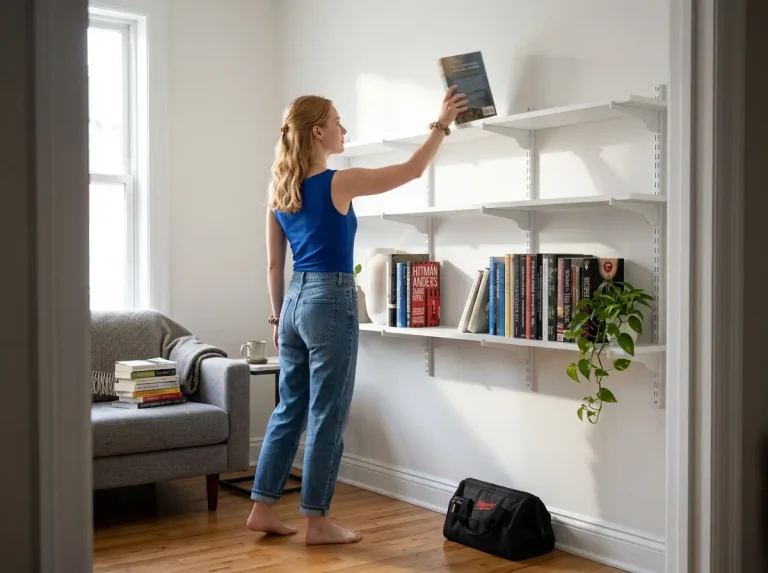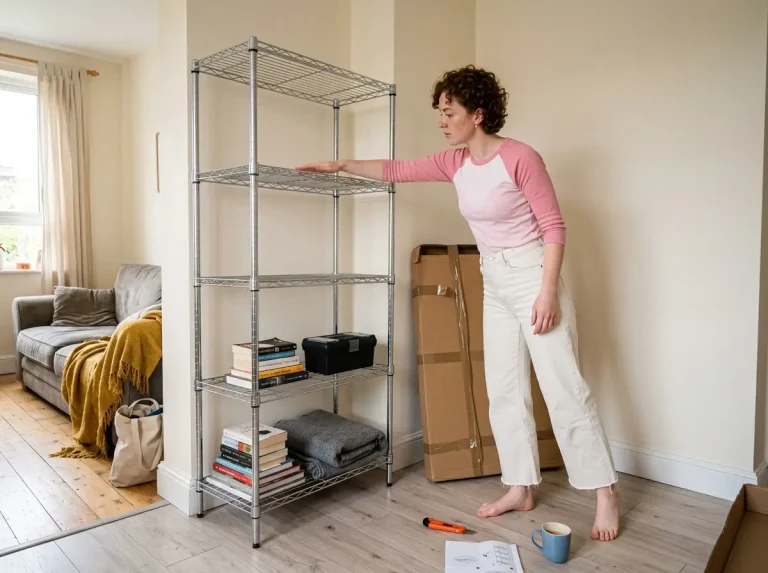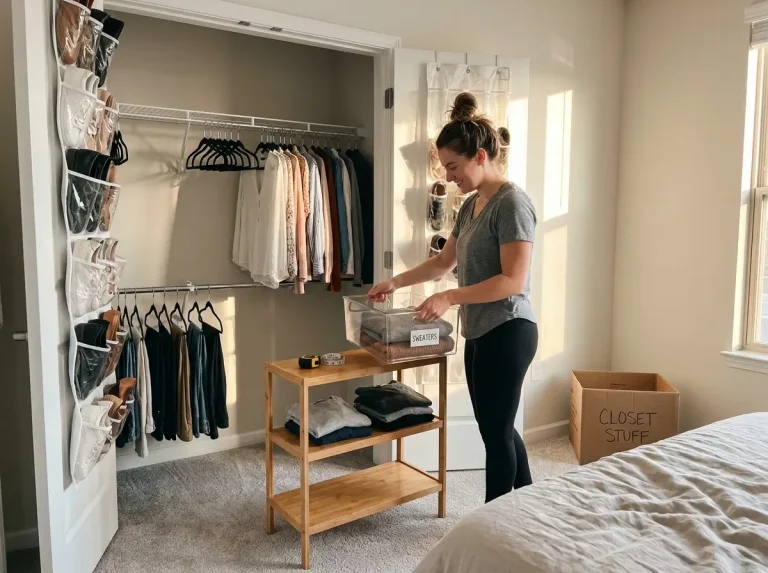

You mounted the pretty floating shelf, loaded it with books, and three weeks later you were standing there holding it, two drywall plugs still stuck in the back. The shelf didn’t fail. The wall did. And the fix is almost never a fancier shelf, it’s matching the shelf type to your weight, your wall, and your lease, which is the part most shopping guides skip right past. This is the hub for every shelf and rack type that works in a real home: what each one actually holds, and how to pick the one that survives where you live, especially if you rent and can’t put a single hole in the wall.
Quick Answer
Shelving is hand-loaded for lighter, reach-in items; racking is the heavy frame-and-beam system built for bulk loads, mostly in a garage. In a home you want shelving, in one of five types: wall-mounted or floating, freestanding, corner, over-door, and tension-rod. Pick by your weight, your wall, and whether you can drill.
Shelving vs Racking (and Why Your Home Wants Shelving)
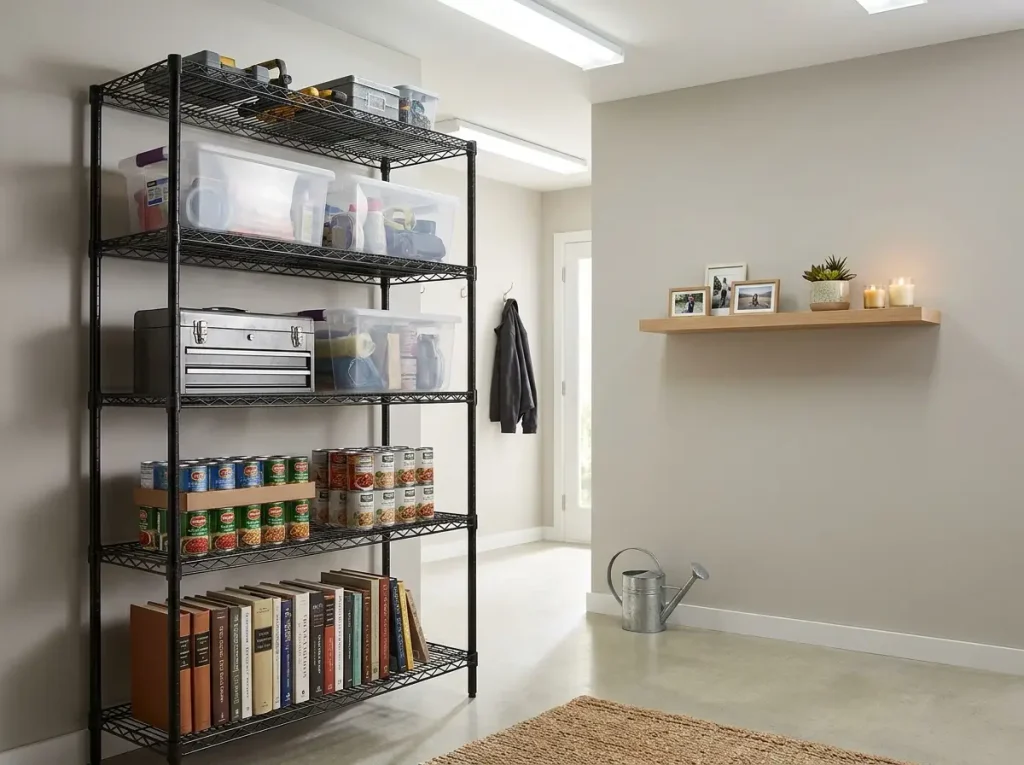
Walk into any storage aisle and the words get used like they mean the same thing. They don’t. Shelving is the hand-reach stuff: you load it by arm, with everyday items that one person can lift. Racking is the industrial cousin, the tall frame-and-beam systems with uprights and hooks built to carry pallet loads measured in tons. If you’ve been shopping “racks” because the word sounds tougher, you’ve probably been over-buying.
Shelving is for hand-reach loads
A home shelf holds what your hand puts on it: books, bins, linens, canned goods, a row of shoes. The storage trade draws the line at roughly fifty-five pounds per shelf for hand-loaded shelving, which covers nearly everything a house throws at it. That’s your category. Almost every shelf in this guide lives here.
Racking is heavy frames for bulk
True racking is the bolted upright-and-beam system you see in warehouses, rated for hundreds or thousands of pounds per level and loaded by forklift, not by hand. According to the working distinction between shelving and racking, the dividing line is both depth and how you load it. In a home, the only place racking-style strength earns its keep is a garage with real bulk weight.
The one-line test
Here’s the shortcut: shallower than about thirty inches deep and loaded by hand, it’s shelving. Deeper than thirty inches and built for bulk, it’s racking. For 95% of homes, the answer is shelving. So don’t pay for forklift capacity to hold a stack of bath towels.
Start With One Question — Can You Drill?
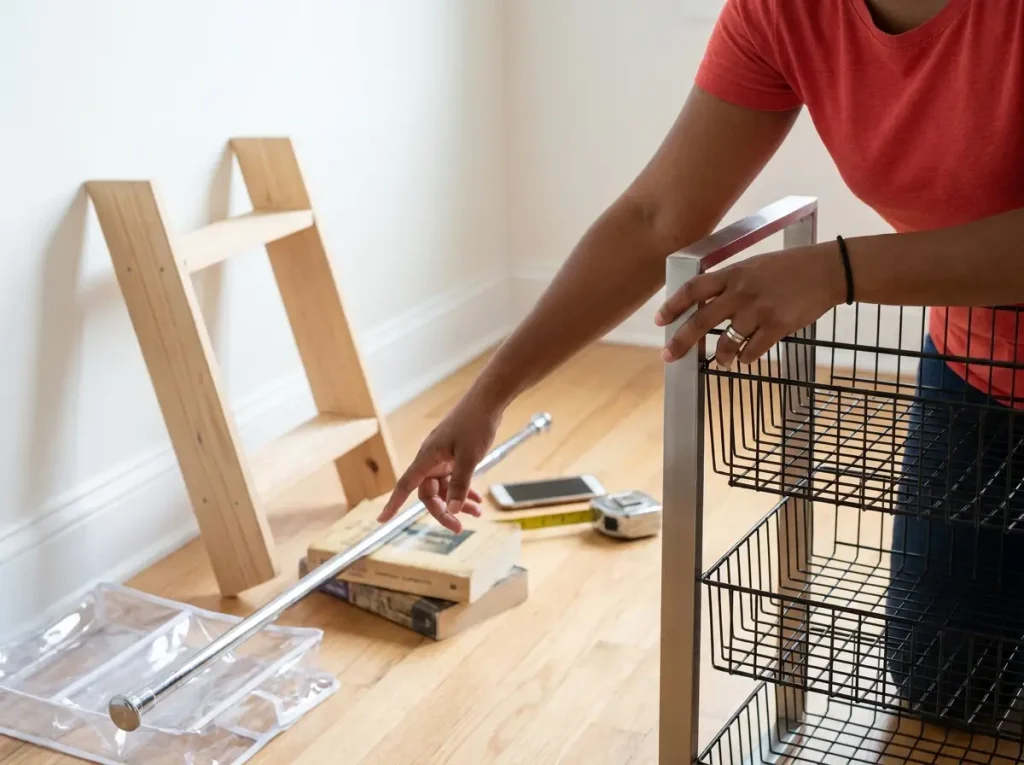
Before you look at a single product, answer this: can you put a hole in the wall? Everything downstream changes based on that one question, and leading with it saves you from buying the wrong thing twice. If you own your place, or your lease allows anchors, heavier wall-mounted options open up. If you rent and the security deposit is real, you have a shortlist that moves with you and leaves the walls untouched.
Own vs rent, the question that decides everything
Owning means you can hit a stud and hang real weight on the wall. Renting means your shelving lives on the floor, leans, or hangs off a door, and it all comes down again on move-out day without a patch kit. Neither is worse. They’re just different starting points, and pretending you can drill when you can’t is how people lose a deposit over four screw holes.
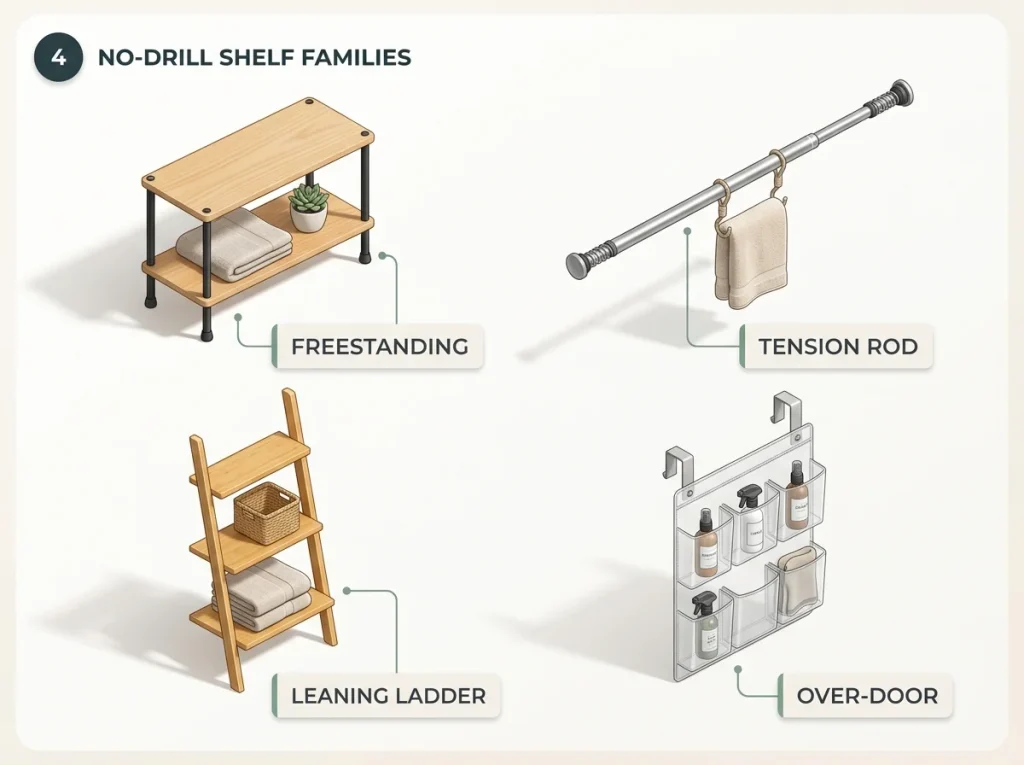
The four no-drill shelf families
If you can’t drill, you still have four full categories, not scraps. Freestanding units stand on the floor. Tension shelving wedges between two surfaces by pressure. Leaning (ladder) shelves rest against the wall at an angle. And over-door organizers hang off the top of a door. These four cover the overwhelming majority of renter needs, and none of them care that you can’t use a drill. If you want the closet-specific version of this, our guide to no-drill closet setups that won’t cost your deposit goes deeper on the same idea.
Where adhesive fits (and where it doesn’t)
There’s a fifth lane, and it’s the one people abuse: adhesive. Stick-on shelves and Command strips are renter-friendly and genuinely useful, but only for light, display-weight items. Most adhesive mounts safely hold somewhere around five to fifteen pounds, and that’s with the wall prepped perfectly. Put a stack of hardcovers on one and you’re back to standing in the living room holding a shelf. Use adhesive for what it’s good at, and load the weight somewhere else.
Before you buy anything, walk the room and label each spot out loud: floor, corner, wall, door. Renters who match the spot to a no-drill family first almost never end up with a returned box and a hole they have to spackle.
Wall-Mounted and Floating Shelves (Pretty, but Know the Weight)
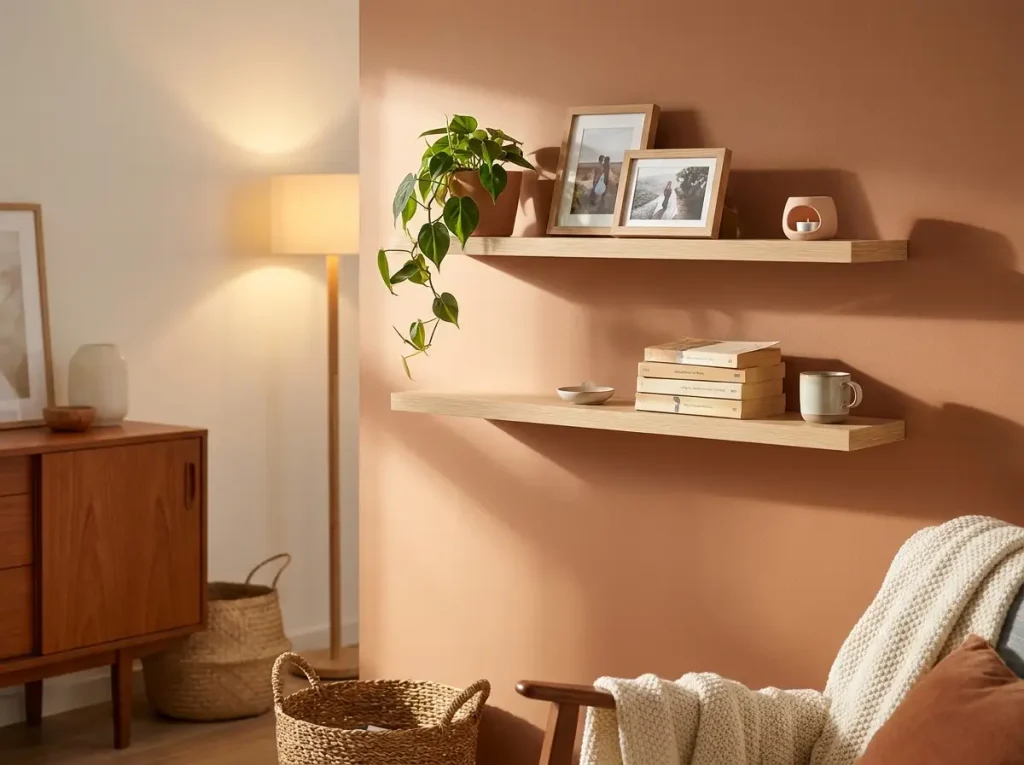
Floating shelves are the look everyone wants: clean line, no visible bracket, shelf seeming to hover off the wall. Wall-mounted shelves really split into two styles, fixed-bracket shelves with a visible support and floating shelves that hide the hardware. They’re also where the most expensive mistakes happen, because the thin floating shelf is a display shelf, not a book shelf, and almost nobody checks the difference until a row of hardcovers is behind the couch.
What floating shelves actually hold
The honest numbers on weight capacity: a solid wood or metal floating shelf anchored into a stud can hold roughly thirty to seventy-five pounds. A particleboard or glass one tops out around fifteen to thirty. And anything mounted with adhesive is back in that five-to-fifteen-pound display range. There’s also a counterintuitive rule worth knowing: the deeper the floating shelf, the less weight it safely holds, because a deeper shelf puts more leverage on the bracket. A deep shelf looks like it should carry more. It actually sags sooner.
Stud vs hollow wall, the real variable
Here’s the thing the weight rating never tells you: the shelf is usually fine, the wall is the question. “The wall failed, not the shelf” is the most common floating-shelf story there is, and it almost always means the bracket was screwed into hollow drywall with no stud behind it. Find the stud, or use a drywall anchor genuinely rated for the load. If you can’t do either, you’re in renter territory, which is exactly what the no-drill version is for.
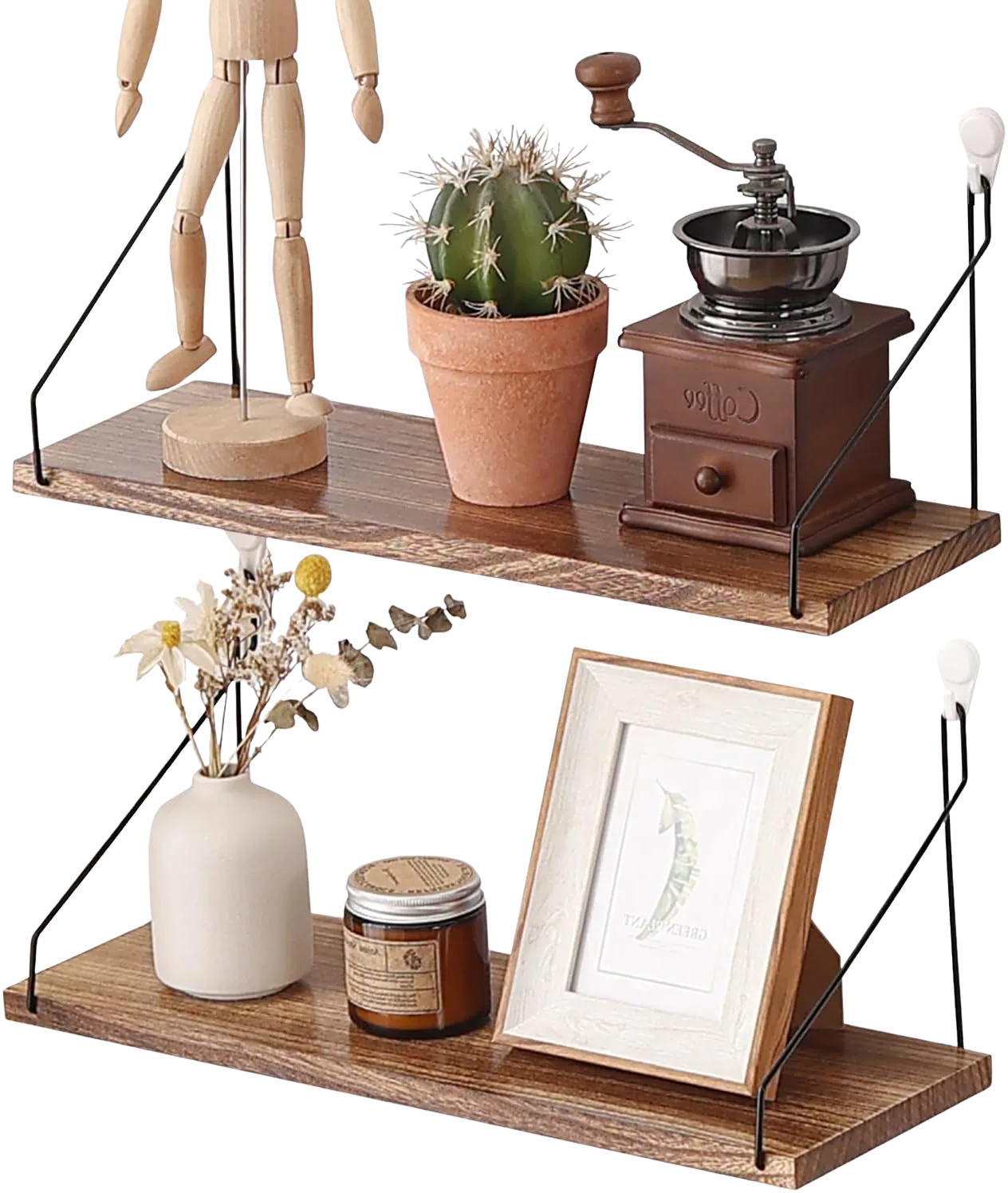
The renter-friendly floating look does exist, as long as you respect what adhesive can carry. The Floating Wall Shelf No-Drill 16.5″ 2-Pack mounts with adhesive strips and gives you the hovering shelf line without a single hole, which is its whole appeal. Just keep it to the display lane: frames, a small plant, a couple of paperbacks, the adhesive bond is the limit, not the board.
What belongs on a floating shelf
Treat floating shelves as your display layer. Frames, a trailing plant, candles, a short stack of paperbacks, the things that make a room feel like yours without testing the bracket. This is also where you reclaim vertical storage in a small room, using wall height to draw the eye up so the place feels taller than it is. Save the heavy stuff for the floor. We have a deeper guide coming on the best floating shelves for small spaces, but the rule holds no matter which one you buy: weight goes low, display goes on the wall.
Corner Shelves — Reclaim the Dead Rectangle
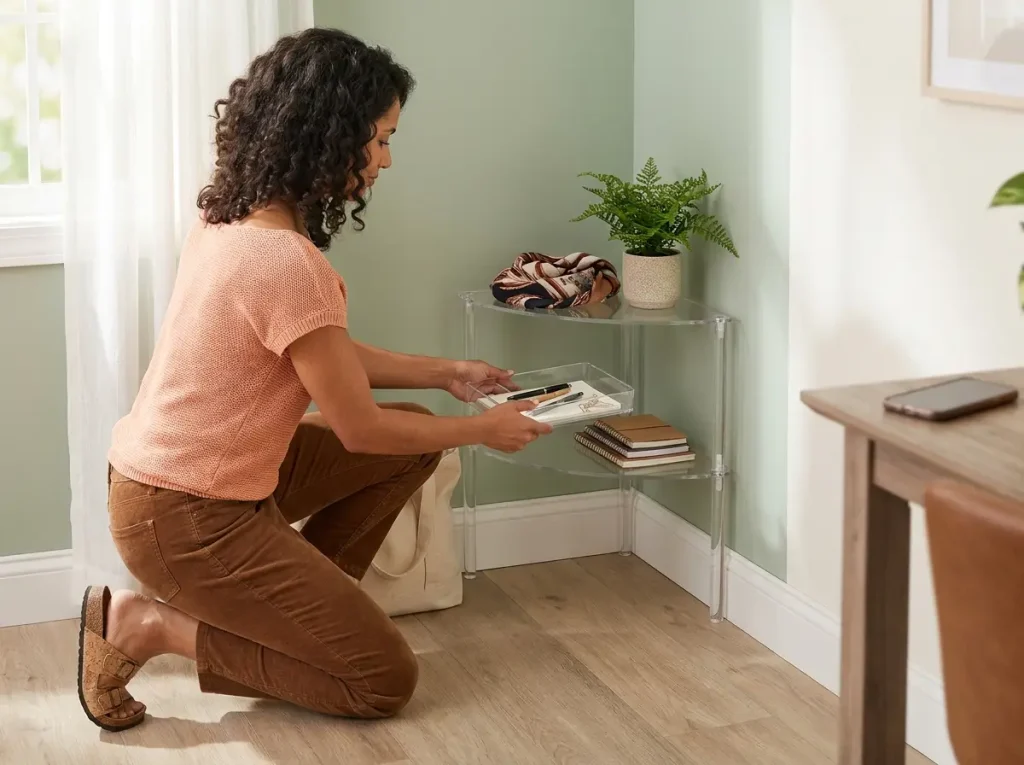
Every room has one: the corner nobody uses, a wasted rectangle of floor and wall where two surfaces meet. A corner shelf turns that dead space into storage, and the corner happens to be the single safest place to put a leaning shelf. Two facts, one underused spot.
Why corners get wasted
Corners feel awkward because most furniture is built for flat walls, so the right-angle just sits there collecting a houseplant and dust. But that meeting of two walls is structurally the most stable spot in the room. It’s the one place a leaning shelf has two surfaces backing it up instead of one.
Freestanding corner units vs leaning ladders
You’ve got two ways to work a corner. A freestanding corner unit slots into the angle and needs no mounting at all, which makes it renter-safe by default. A leaning ladder shelf rests against the corner and uses the lean for stability. I used to point people toward leaning ladder shelves on any flat wall, because they look great in photos. After hearing the same story too many times, the one where the shelf slowly “walks” out from a flat wall and tips, I changed the advice: put the lean in a corner, where two walls keep it honest.
For a light countertop or vanity corner, the mDesign 2-Tier Freestanding Corner Shelf captures the angle with no tools and lifts a second tier of storage out of nothing. It’s a display-weight piece, so if you need a corner that holds real load, step up to a floor unit like the MAGCOLOR 5-Tier Corner Shelf Rack instead.
Keep the weight low and the lean in a corner
Whatever you choose, load the bottom and go light up top. A top-heavy leaning shelf is a tip waiting to happen, and a corner only protects you so far. Heavy on the floor, airy at eye level. That’s the whole rule.
A leaning shelf in a corner wants the heaviest items on the lowest rung and almost nothing on the top. If you find yourself reaching up to set a stack of books on the highest shelf, that’s the move that eventually tips it. Flip the load.
Freestanding Units — The Honest Heavy Pick
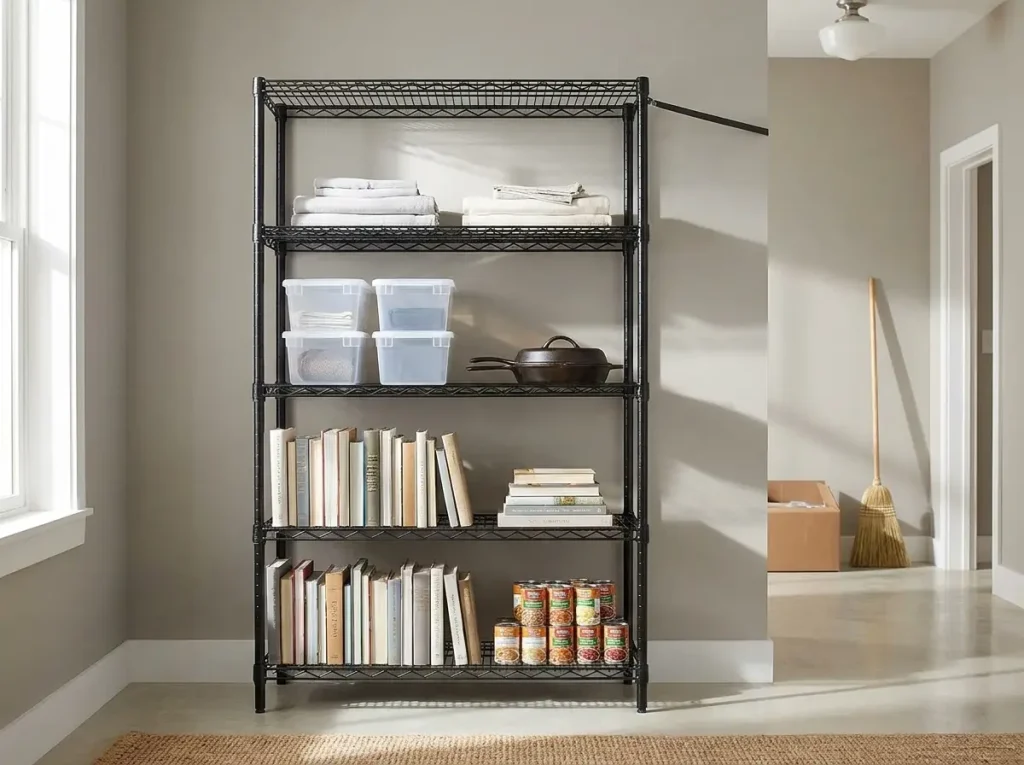
At some point the honest answer stops being a wall and starts being the floor. If you’re storing weight, real weight, the floor-standing unit is the pick that doesn’t argue with physics. Stop blaming your drywall and let the floor do the work.
Weight goes to the floor, not the wall
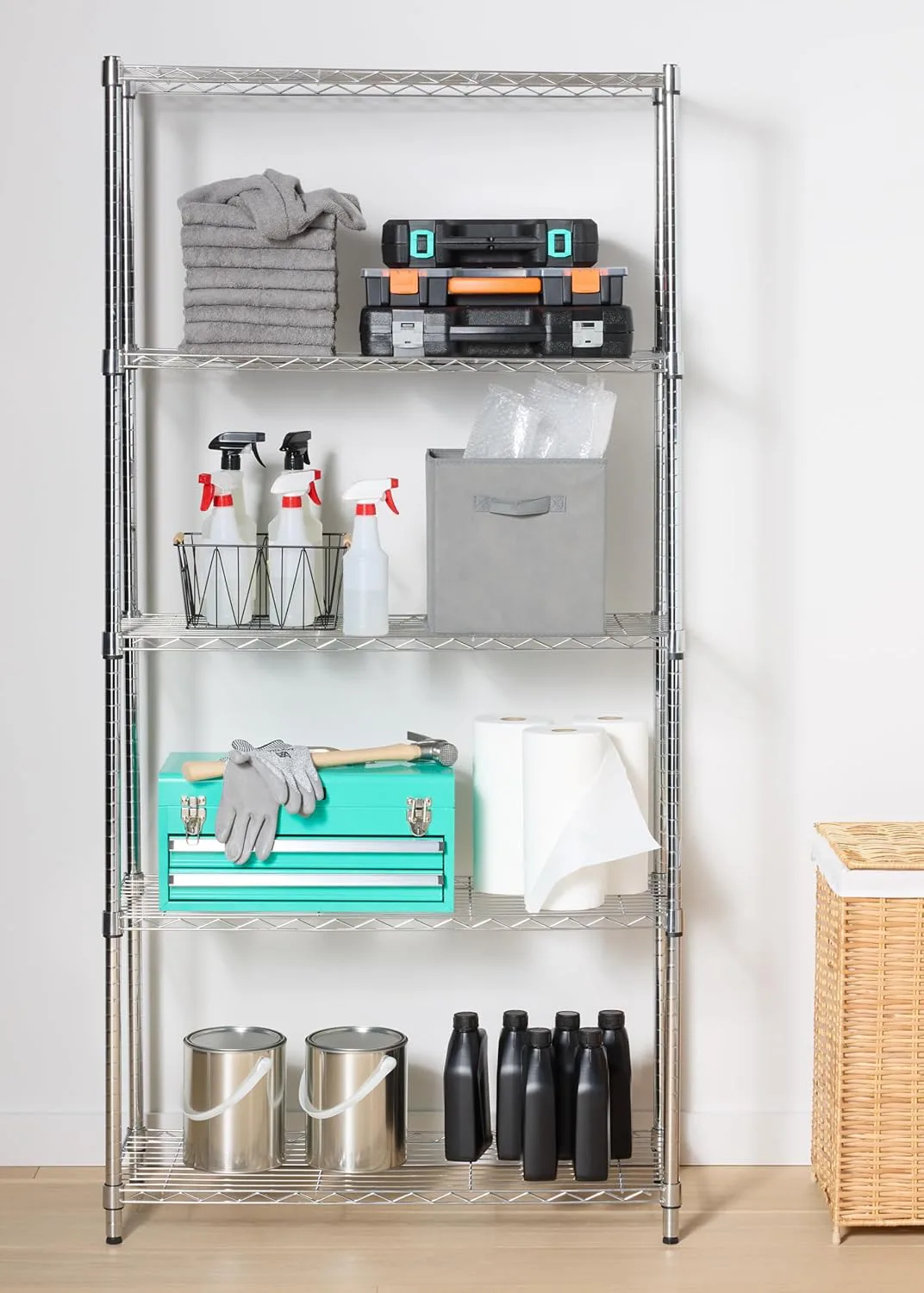
The numbers make the case for metal shelving. A standard wire freestanding shelf averages around eighty pounds per shelf, and a heavy-duty steel wire unit can rate two hundred to three hundred fifty pounds per shelf. Compare that to thirty to seventy-five pounds for even a well-mounted floating shelf, and the gap is obvious. When the load sits on legs on the floor, your wall never enters the equation. This is the type for cast iron, canned bulk, tools, and books by the dozen.
The honest heavy anchor of the whole category is a plain steel wire unit. The Amazon Basics 5-Shelf Heavy Duty Steel Wire Shelving Unit is rated for 350 pounds per shelf at 36 inches wide and 14 deep, which is more load capacity than most people will ever use, and the open wire means nothing traps dust or moisture. Load it heavy-low and light-high. The one caveat is footprint: at six feet tall it’s a commitment, so measure the spot before it arrives.
The narrow-tall unit for small rooms
Not every freestanding pick needs to be a workhorse. In a small room, a narrow tall unit buys you storage without eating the floor, and the slim footprint draws the eye up so the room reads taller. A bookshelf-depth piece like the VASAGLE 5-Tier Narrow Bookshelf is under twelve inches deep, which slides into a gap a 24-inch unit would never fit, and it works as a narrow bookshelf that earns its floor space in a studio or hallway. Honestly, a clean secondhand bookcase does the same job for less, so check the thrift route before you buy new. Our roundup of the best freestanding shelving units will go deeper on sizing.
Anchor it, the law skips shelving
Here’s the part nobody mentions at checkout. The federal tip-over standard that fixed wobbly dressers, the one that requires anchor kits in the box, only covers clothing storage units. It explicitly leaves shelving out. Per the federal STURDY tip-over standard, which notably exempts bookcases and shelving units, your tall shelf likely ships with no required strap at all. So add one yourself. A cheap anti-tip anchor, a strap rated to fifty pounds of pull, is the difference between a stable unit and a tip-over, and in a kid’s room that’s not optional.
Over-Door Shelving — The Free Vertical Wall
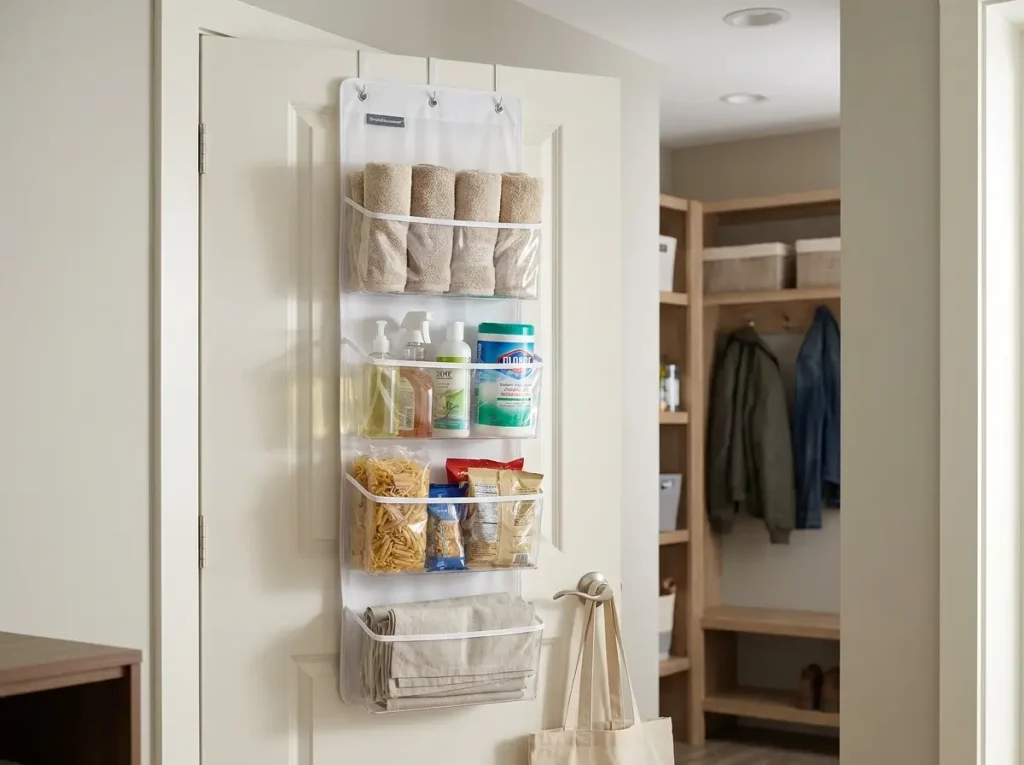
The back of a door is the most ignored vertical surface in the house. It’s free real estate, it touches no wall, and it’s pure renter territory, which makes over-door shelving one of the highest-value no-drill moves there is. The catch is that it only works if you do two minutes of measuring first.
The 2-inch clearance rule
An over-door organizer needs the door to still close, which sounds obvious until yours won’t. Before you buy, measure the gap between the door and the frame, and the depth the organizer adds. You want roughly two inches of clearance so the door swings shut over the loaded shelves. The SimpleHouseware Crystal Clear Over-the-Door Organizer runs about twelve inches deep across six clear shelves, so it’s the kind of unit where that clearance math matters before, not after.
Check your door material first
The other variable is the door itself. A hollow-core door, the kind most rentals have, can only take so much weight hung off its top edge before the whole thing strains. A loaded organizer full of canned goods is a lot of leverage on a light door. This is the same clearance-and-weight problem behind over-door storage that won’t wreck your door, and it’s why the heaviest items don’t belong up there.
What belongs on an over-door shelf
Keep it light and frequent-grab. Pantry packets, cleaning bottles, craft supplies, hair tools, the small stuff you reach for daily and want visible. Clear shelves earn their keep here because you can see what’s there without opening anything. We have a dedicated guide coming on the best over-door organizers, but the principle is constant: light, frequent, and measured to clear the frame.
Measure the door-to-frame gap with the organizer’s hooks already counted in. The hooks that drape over the top add about an inch of their own, and that’s the inch people forget right up until the door bumps the shelves and won’t latch.
Tension-Rod and No-Drill Shelving (Where the Anti-Sell Lives)

This is the section where I tell you that you might not need to buy a shelving system at all. Tension shelving works by pressure, wedging between two walls or two surfaces with no hardware, and it’s the backbone of the cheapest fix in this entire guide.
How tension shelving holds (and slips)
A tension shelf stays up because it’s pushing outward against two fixed points. That’s also how it fails: overload it, or extend it too far past its rating, and the pressure gives, usually at the worst possible moment. The “instant closet shelf that landed on the floor at 2 a.m.” is a real and repeated story, and it almost always traces back to too much weight or too much extension. Stay well under the rating and tension shelving is reliable for years.
The rod-and-S-hooks anti-sell
Here’s the honest version: a plain tension rod and a handful of S-hooks does something like eighty percent of what a marketed hanging system does, for a few dollars from any hardware store. Under a sink, across a cabinet, inside a cupboard, the rod holds the bottles and the hooks hang the rest. If you’d rather buy a ready-made version, the Home in Bold Expandable Tension Rod Shelving is a solid, budget-friendly no-drill pick, but I’d genuinely try the rod-and-hooks route first. You can always squeeze more storage out of a small apartment without drilling before you spend on a system.
Keep it light, keep it centered
Tension is not a book-weight system, so don’t ask it to be one. Light, centered loads, nothing hanging off the far end where the leverage works against you. Pair it with a leaning shelf in a corner and a freestanding unit for the heavy stuff, and you’ve covered a whole apartment without a single screw. That’s the renter playbook in one line.
Match the Shelf to Your Room
The “best” shelf is the one that fits the room’s depth, weight, and moisture, which means a bathroom and a garage want almost opposite answers. Measure before you buy, because shelf depth is where most purchases go wrong.
Kitchen and pantry
Pantry and kitchen shelves usually run twelve to eighteen inches deep, and that depth is a trap: a deep shelf swallows everything at the back. The fix is shelf risers and tiered organizers so you can see the second row, the same problem we break down in deep pantry shelves that waste their back 12 inches. Whatever bins you add, size them to the shelf, which is half the reason the bins that go on the shelves matter as much as the shelving itself.
Closet, size the bin to the depth
Closet shelves run twelve to sixteen inches deep, but here’s the rental gotcha: a “standard” closet is about twenty-four inches, and a lot of rental reach-ins are closer to twenty-two. That two-inch difference is exactly why a bin that “fit” sticks past the door frame and the door stops closing. Measure your actual closet, not the standard one, then buy the bin. An inch decides it.
Bathroom and humid rooms, material matters
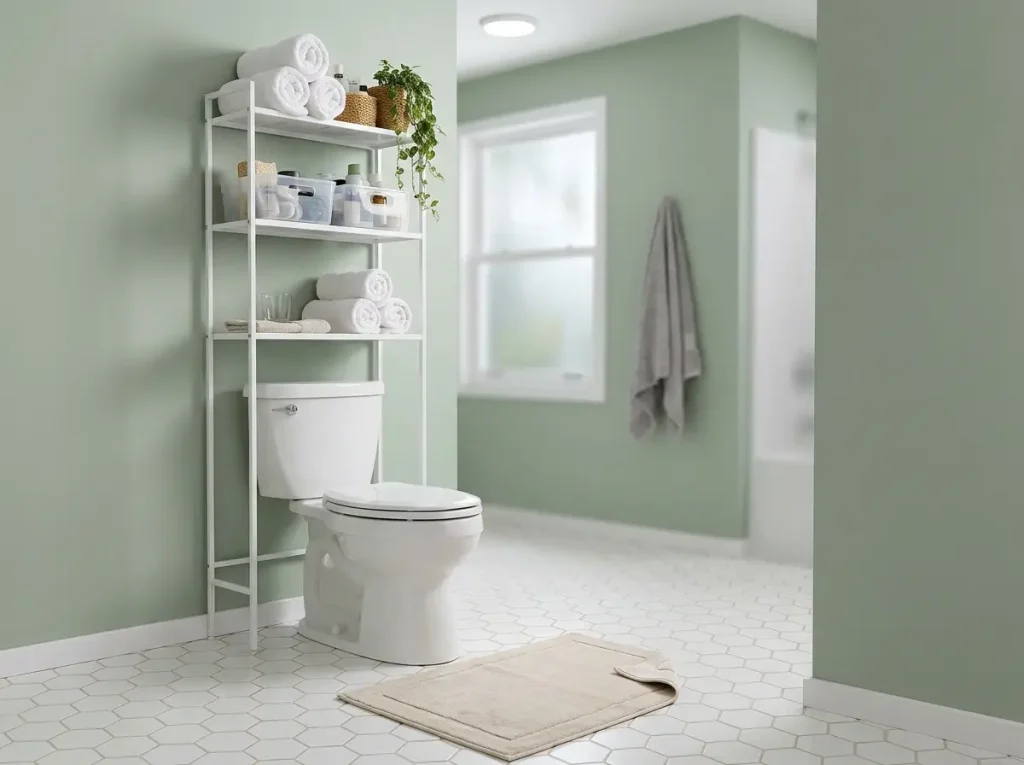
Bathrooms add water to the equation, so skip bare particleboard or engineered wood that swells and warps, and choose metal, plastic, or sealed wood. A freestanding shelf that straddles the toilet is the classic small-bath move because it captures vertical air over a fixture without touching the wall. The UTEX 3-Tier Over-the-Toilet Storage Shelf does exactly that, and if you want a chrome alternative, the Honey-Can-Do 4-Tier Over-Toilet Shelf is a fine swap. For the fuller breakdown, over-toilet shelves that held up in testing compares the field.
Garage and overhead, where racks earn it
The garage is the one room where heavy-duty garage shelving genuinely earns its place. Boltless or widespan steel shelving units carry more than a bookcase at twelve-to-twenty-four-inch depths, and overhead ceiling racks capture the dead air above your head for seasonal bins. This is also the only corner of a home where true racking-style strength makes sense, because it’s the only place with real bulk weight to hold.
Why Shelves Fail at Month Three (and How to Make Yours Hold)
Almost no shelf “breaks.” The bond fails, or the wall fails, or the rod slips, or the stack topples. Name the actual failure and the fix is usually cheap and obvious. Think of it as the three-month test: the difference between a shelf that looks good in the after photo and one that still works months later.
The four ways a shelf fails
Failure one is adhesive: stick-on shelves creep and peel off painted drywall, especially in summer heat, because the bond gives even though the shelf is fine. Prep and cure the wall before you trust it, and keep adhesive light. Failure two is the bracket that pulls out of a hollow wall with no stud behind it, the wall-failed-not-the-shelf classic. Failure three is the tension rod that slips because it was overloaded or stretched past its rating. And failure four is the tall unit that tips because nothing ever anchored it. Four failures, four fixes, none expensive.
Anchor it before it walks
Because the tip-over standard skips shelving, anchoring a tall unit is on you, and it’s the single highest-value thing on this list. A strap to the wall stops a loaded unit from walking forward and going over, which matters most anywhere a kid can climb. The CPSC’s Anchor It! campaign on securing tall furniture to the wall lays out why, and the hardware costs about as much as a coffee. Do it the same day the unit goes up, not “later.”
Stop the stack-fall with dividers
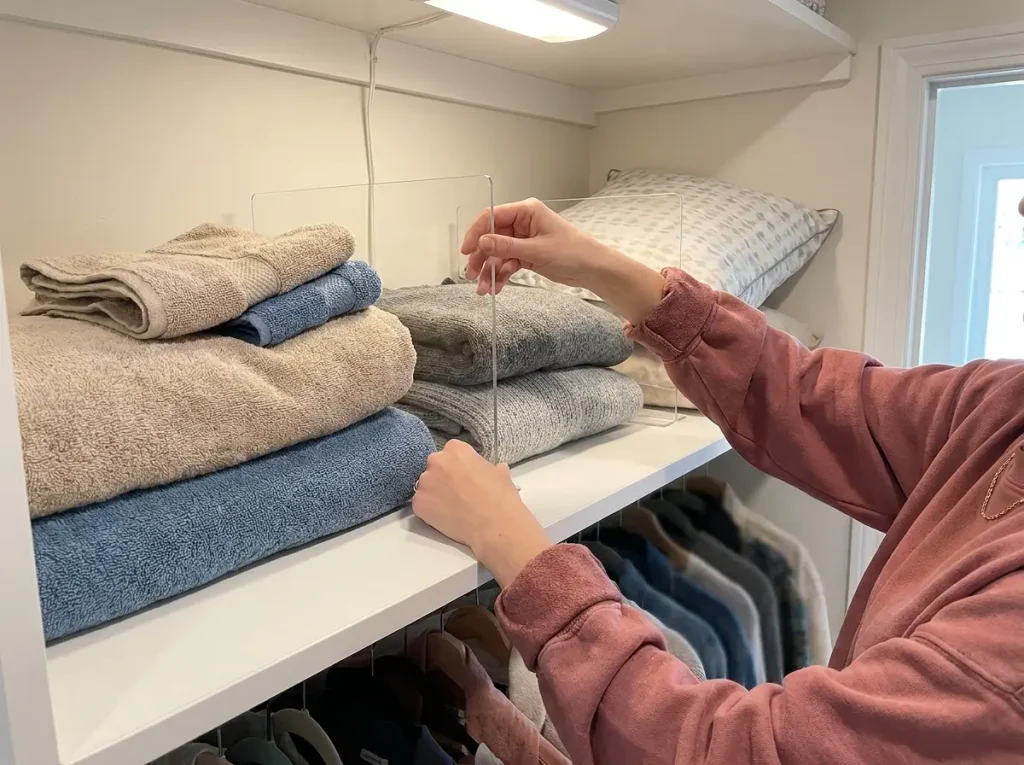
The quiet failure is the stack that topples: fold a pile of sweaters or towels on a deep shelf and the column slowly leans until it collapses into its neighbor. Shelf dividers turn one wide shelf into stable vertical slots, which is the whole fix.
The HBlife Acrylic Shelf Dividers 6-Pack slide onto shelves around half an inch to an inch thick and hold each pile upright, and they’re the same reason your closet shelf piles keep falling over until you add them. If you’d rather not spend, a few cut pieces of stiff cardboard do a rougher version of the same job. But the acrylic ones disappear visually and last, so this is the rare case where I’d just buy them.
Set a phone reminder for ninety days out the day you put up any adhesive or tension shelf. When it pings, push on the bond and the rod and re-check that no bin is creeping past the door frame. Thirty seconds then beats a 2 a.m. crash later.
Conclusion
Three things to carry out of here. First, match the shelf type to your weight, your wall, and your lease, not to the photo that sold you on it. Second, renters aren’t stuck: freestanding, tension, leaning, and over-door give you four full no-drill families before adhesive even enters the picture. And third, the cheap strap, the right stud, and the simple divider are what turn a good-looking shelf into one that’s still standing next season.
In three months, do a thirty-second pass: push on every adhesive bond, tug every anchor strap, and check whether any bin has crept out past a door frame. That single habit catches almost every failure on this page before it becomes a pile on the floor.
Pick the one wall or corner that annoys you most. Match the type to it. Get it holding. Then move to the next one.
Frequently Asked Questions
01What is the difference between shelving and racking?
Shelving is hand-loaded and built for lighter, everyday items; racking is a heavy frame-and-beam system made for bulk loads measured in hundreds of pounds. The rough line is depth and load: under about 30 inches deep and loaded by hand is shelving, deeper and built for bulk is racking. Homes almost always want shelving.
02What type of shelf holds the most weight?
A floor-standing steel wire unit holds the most, because the load goes to the floor instead of the wall. Heavy-duty steel units rate roughly 200 to 350 pounds per shelf, versus about 30 to 75 pounds for a well-mounted floating shelf. For anything heavy, go freestanding.
03How do you put up shelves without drilling?
You have four no-drill families: freestanding units that stand on the floor, tension shelving that wedges by pressure, leaning ladder shelves, and over-door organizers. Adhesive shelves are a fifth option but for light display only, around 5 to 15 pounds. None of these touch a stud or cost you a deposit.
04What is the best shelving for a small apartment?
A narrow-tall freestanding unit or a corner shelf usually wins, because both draw the eye up and use vertical height instead of precious floor space. A bookshelf-depth unit under 12 inches deep fits gaps a standard 24-inch unit can’t, and a corner shelf reclaims space that was already wasted.
05How deep should a shelf be in a small space?
For display and books, 10 to 12 inches is plenty; for a closet, 12 to 16 inches. The key move is to measure your actual space first. Many rental reach-in closets are about 22 inches rather than the standard 24, and that two-inch gap decides whether a bin clears the door frame.
Disclaimer: ClutterlessNest is a participant in the Amazon Services LLC Associates Program. As an Amazon Associate we earn from qualifying purchases. This article may contain affiliate links — if you buy through them, we may earn a small commission at no extra cost to you. We only recommend products we have tested or genuinely believe in.