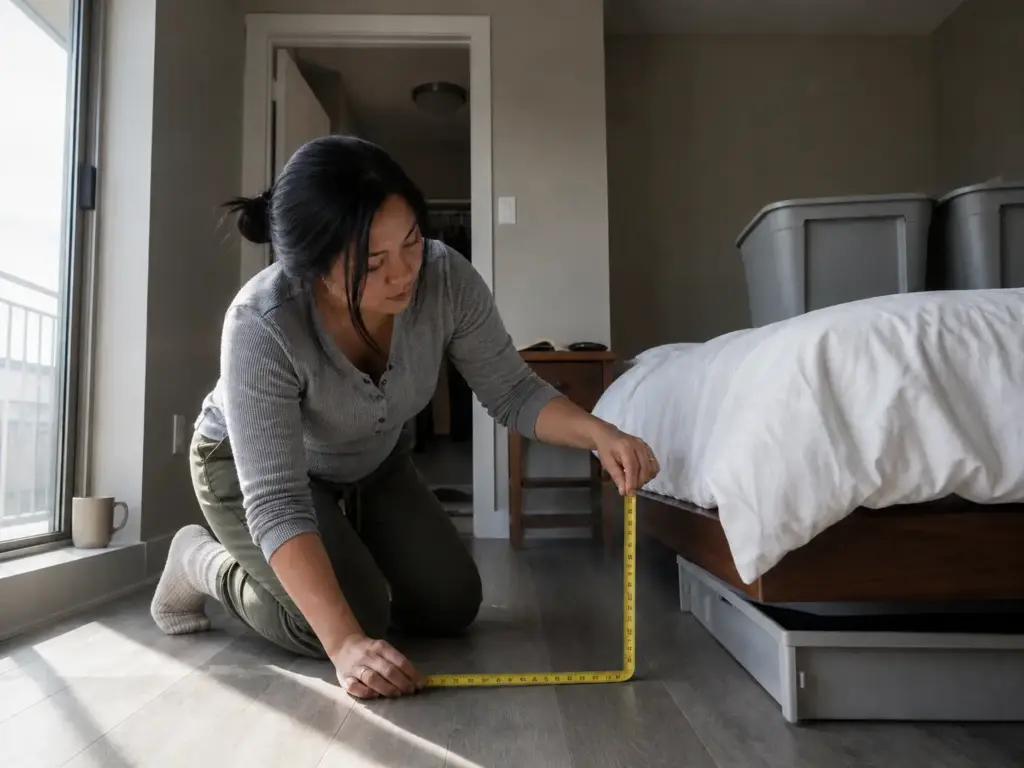
You already tried this. The bins went under the bed, the hooks went on the door, the ottoman went at the foot of the bed, and for about six weeks the room looked like the photo you saved. Then the ottoman stopped staying open, the vacuum bags puffed back up into lumpy pillows, and the door hooks left two dents you now have to explain at move-out.
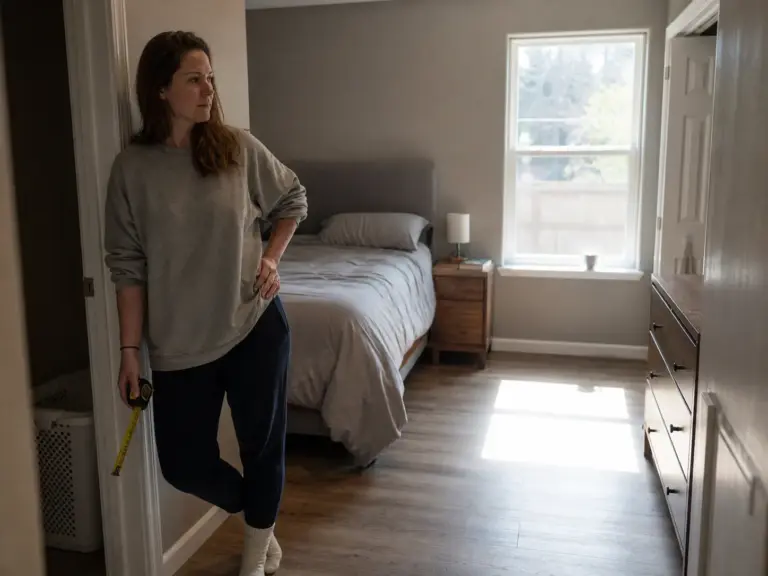
The ideas weren’t wrong. Nobody checked whether your room could physically carry them. Almost every list of bedroom storage ideas for small rooms skips the three numbers that decide which ideas are even available to you: bed frame clearance, wall capacity, and door type. This walks through six storage zones, splits each one into what works if you can’t drill and what changes if you can, and names the specific reason each one quits on you around month two.
Quick Answer
A small bedroom has six storage zones, and one measurement decides whether each one works:
- Under the bed: measure frame clearance, not mattress height
- Walls: stud, toggle bolt or adhesive decides the weight limit
- Behind the door: hollow-core or solid-core changes everything
- Storage furniture: only worth it if it replaces footprint you already spend
- Bedside: a nightstand eats about 30 inches of clearance
- Corners: narrow depth wins where a standard bookcase can’t fit
Measure Three Things Before You Buy Any Bedroom Storage
Nearly everyone buys the container first and measures second. That’s why return shelves are stacked with under-bed boxes that missed by half an inch and floating shelves that came with anchors rated for a fraction of what the buyer planned to put on them. Three numbers, taken once with an actual tape measure, eliminate most of the wrong purchases before your card ever leaves your wallet. None of them take longer than a minute.
The other thing worth admitting up front: “small bedroom” isn’t one room. It’s at least three. A small bedroom no closet situation, a small bedroom with a shallow one, and a shared bedroom each have completely different answers, and most published advice quietly assumes the easiest of the three.
A standard reach-in closet runs 3 to 5 feet wide and 24 to 30 inches deep, and once a bedroom drops under roughly 10 by 12 feet there’s usually nowhere to add closet volume without the room feeling like a hallway. If that’s your room, closet-adjacent storage isn’t a bonus. It’s the primary system, and it needs to be planned like one. The math behind that sits in the clearance rules that decide a small bedroom layout, which is worth reading before you commit to a furniture plan.
One more calibration. The room that shows up over and over in apartment threads is closer to a 7×8 bedroom than 10 by 12, and at that size the honest answer shrinks: under-bed, vertical storage, and behind-the-door survive, and everything else is competing for floor you don’t have. If your room is that tiny bedroom size, read the next four sections as a ranking, not a menu.
The bed clearance number (and why the mattress lies)
Get on the floor and measure from the carpet to the underside of the frame rail. Not to the bottom of the mattress, not to the bottom of the box spring, not to whatever the bed skirt suggests. The rail is the lowest thing the bin has to clear, and it’s usually a few inches below where your eye wants to measure. Platform beds commonly run 4 to 7 inches of clearance, which is shorter than most storage bins sold for exactly this purpose.
Write that number down and treat it as a hard ceiling minus half an inch. A bin that technically fits at 6 inches into a 6-inch gap becomes a bin you have to wrestle out sideways every time, which means within a month you stop using it. Give yourself the buffer.
What your walls can actually carry
A three-foot shelf anchored into two studs holds roughly 100 pounds, about 50 per stud. That same shelf mounted into drywall alone with standard screws holds around 20 pounds per screw before the gypsum gives up and dumps everything on your floor. The gap between those two numbers is why “it fell off the wall” is such a common complaint, and it’s almost never a defective shelf.
Toggle bolts rewrite the math entirely. SNAPTOGGLE-style hardware is rated to 356 pounds in 5/8-inch drywall and 238 pounds in 1/2-inch, while the little plastic expansion anchors that come free in the box top out somewhere between 5 and 25 pounds. Those are independently tested weight ratings for drywall anchors, not marketing numbers. The catch is that a toggle bolt is a drilled solution, so it belongs to the “I own the walls” or “my landlord tolerates small holes” branch, not the true no-drill branch.
Hollow-core or solid — the knock test
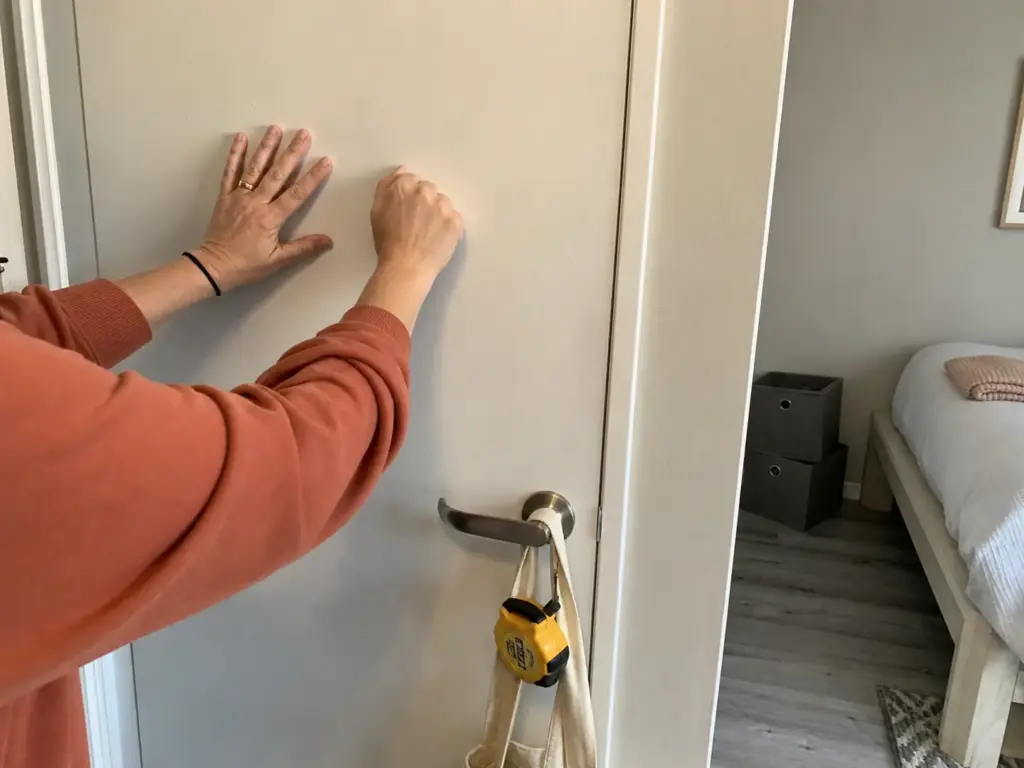
Knock on your bedroom door. A solid-core door gives you a dull thud. A hollow-core door sounds like a drum, because it mostly is one: two thin skins over a cardboard honeycomb.
Most interior doors in rentals are hollow-core, and they crack or dent under concentrated load rather than distributed load. Guidance for these caps over-door hooks at roughly 5 pounds each and pushes hard toward a wide backplate that spreads the force instead of pressing it into one point. That’s the number that decides whether a door rack is realistic for you or whether you’re limited to a couple of hooks.
That’s a ten-second test that determines whether the back of your door is a real storage zone or a place to hang one robe.
Write all three numbers in your phone’s notes app the day you measure: bed clearance, door type, and whether you found studs. You will be standing in a store or scrolling a listing six weeks from now with no memory of any of them, and you will guess. Guessing is how the return pile happens.
Under-Bed Storage That Fits the Clearance You Actually Have
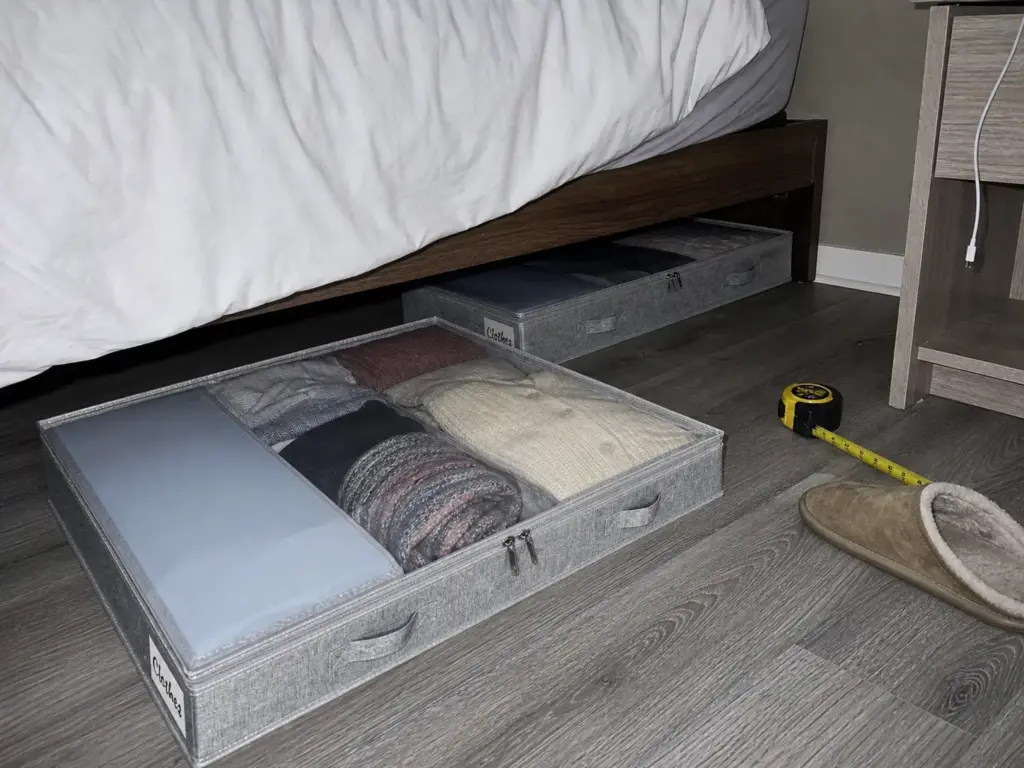
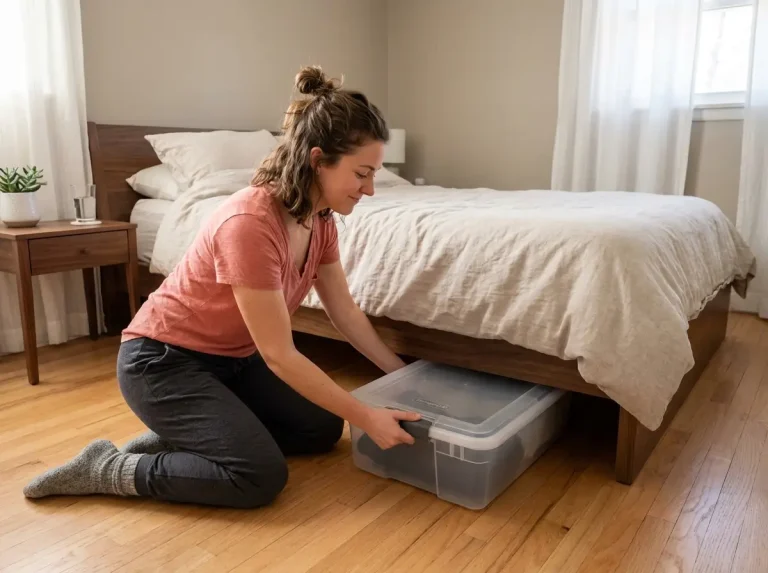
Under the bed is the highest-volume storage in a small bedroom and the most consistently wasted, for one boring reason: the gap on a modern platform bed is shorter than the bins marketed for it. You’ve got two moves. Buy shorter containers, or raise the bed. Raising is cheaper, and in most rooms it’s the better call, which is the opposite of what the product listings want you to do.
Start with the honest version of the anti-sell. If you own flat bins, shallow boxes, or a couple of duffel bags already, put the off-season stuff in those and see whether the zone gets used before you buy anything. A lot of under-bed failure isn’t a container problem at all. It’s that nothing was ever assigned to live there.
Low-profile drawers for a platform bed gap
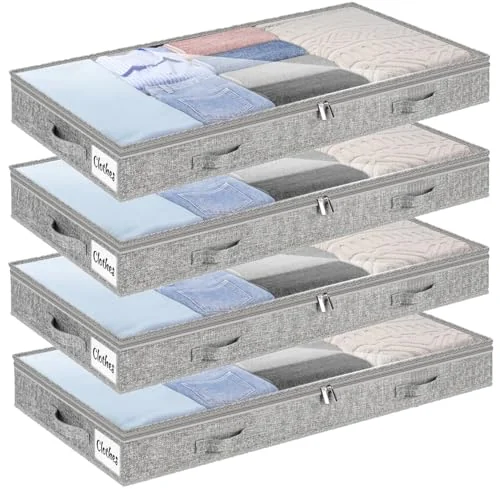
If you can’t or won’t raise the bed, the container has to shrink to fit. A drawer built for a 4-inch gap slides into clearance where a standard 6-inch bin simply won’t go, and the drawer format matters more than the height alone. Lidded boxes force you to pull the whole thing out, unstack, open, dig, reverse. Drawers open where they sit.
Risers — the cheapest way to buy clearance
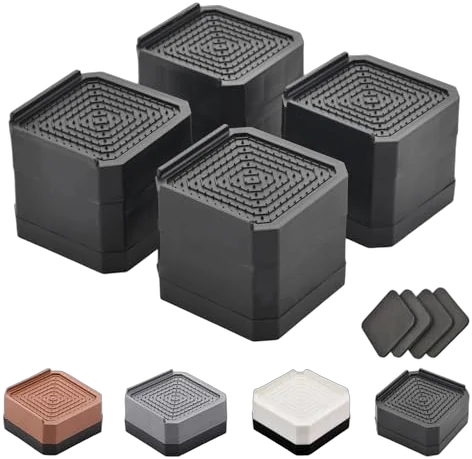
Here’s the move most idea galleries never make, because a set of plastic blocks doesn’t photograph well. Bed risers add 3 to 8 inches of clearance with no tools, no frame modification, and nothing permanent. A 4-inch gap becomes 8 to 12 inches, which is the difference between shallow drawers and standard-height bins holding real volume. You can install them on move-in day and pull them out on move-out day with nobody the wiser.
I used to lead with slim containers for tight platform beds. Enough of the same complaint in apartment threads changed my mind: people were paying more per cubic inch for less usable space, then discovering the under bed drawers didn’t hold what they needed anyway.
Fix the gap first. Buy the container second. If the gap is the problem, shrinking the container is solving the wrong thing.
What vacuum bags are good for (and what ruins them)
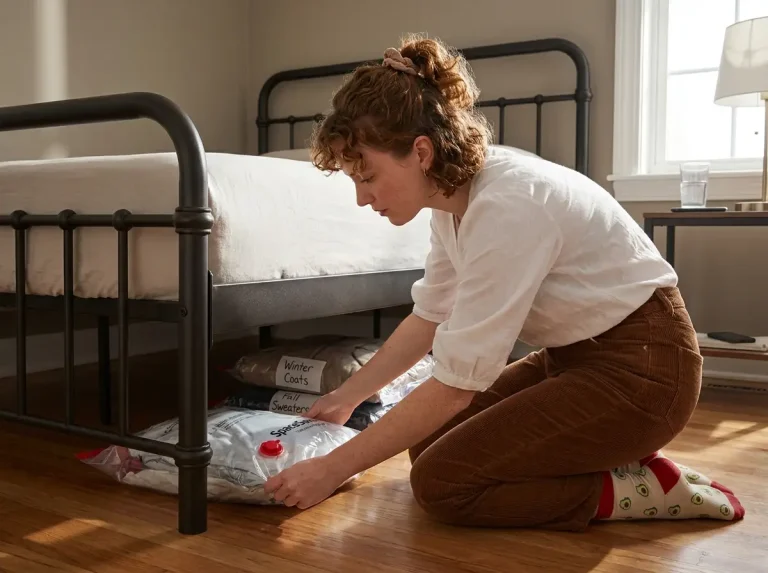
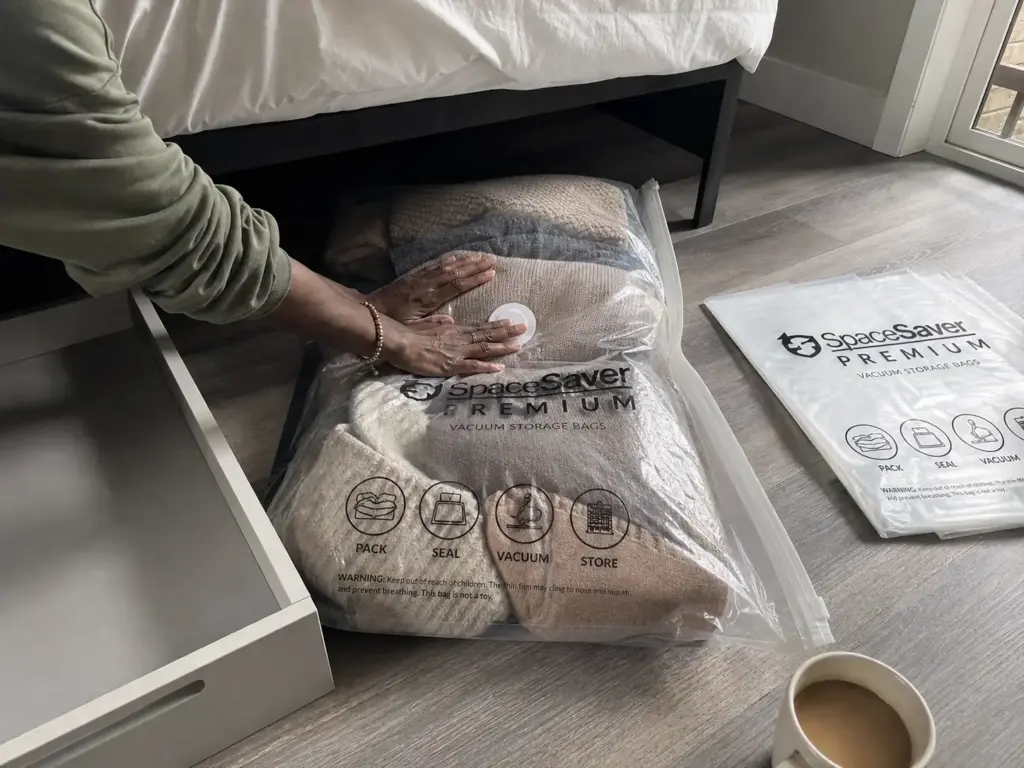
Vacuum bags compress off-season bedding into the shallowest profile any container can manage, which makes them genuinely useful under a low bed. The SpaceSaver Premium Vacuum Storage Bags come in mixed sizes so you can match the bag to the gap instead of forcing one jumbo bag flat, and a compressed comforter will slide under clearance that would reject a rigid bin outright. Two rules come attached, though, and they’re not optional.
Never put wool, down, or cashmere in one for long-term storage. Sustained compression damages the fiber structure, and a down comforter that spends eight months squashed doesn’t fully recover its loft. Cotton, synthetics, and polyester-filled bedding are fine.
The second rule is about the failure everyone hits and nobody warns about. Around month three, the flat bag of sweaters is a lumpy bag of sweaters again. Two causes: the valve leaks slowly, or the bag was overfilled past the seal line, so the closure never fully bit in the first place.
Both are quiet failures, which is why they get discovered on the day you need the sweaters. Fill to the fill line, not to the zipper, and press the bag once a season to check whether it’s still firm. If you want the mechanics of that failure in detail, we covered why vacuum bags lose their seal under a low bed separately.
That’s the zone. Measure the rail, decide whether you’re buying clearance or buying shorter, and give whatever goes down there a category so it doesn’t turn into deep storage for things you’ll never retrieve. Stackable storage boxes are the wrong instinct here, incidentally: stacking under a bed means unstacking every time you want the bottom one. For the full system, including rolling versus flat and how to sequence a seasonal swap, there’s the full breakdown of under-bed storage for a small bedroom.
Wall Storage for Renters and Everyone Else
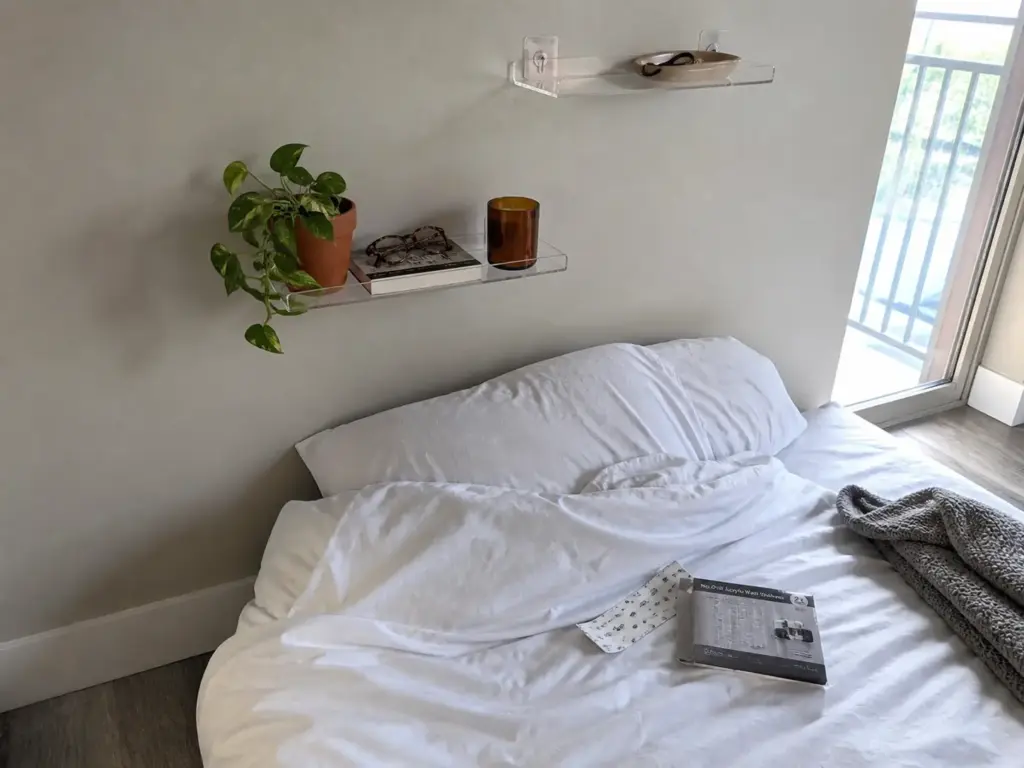
Vertical space is where small bedrooms find volume they didn’t know they had, and it’s also where advice goes most useless most quickly. Almost nothing in the search results separates “you own these walls” from “you don’t,” which means half the ideas you’re reading are unusable to you and there’s no label telling you which half.
So here’s the fork, stated plainly.
What adhesive shelving can and can’t hold
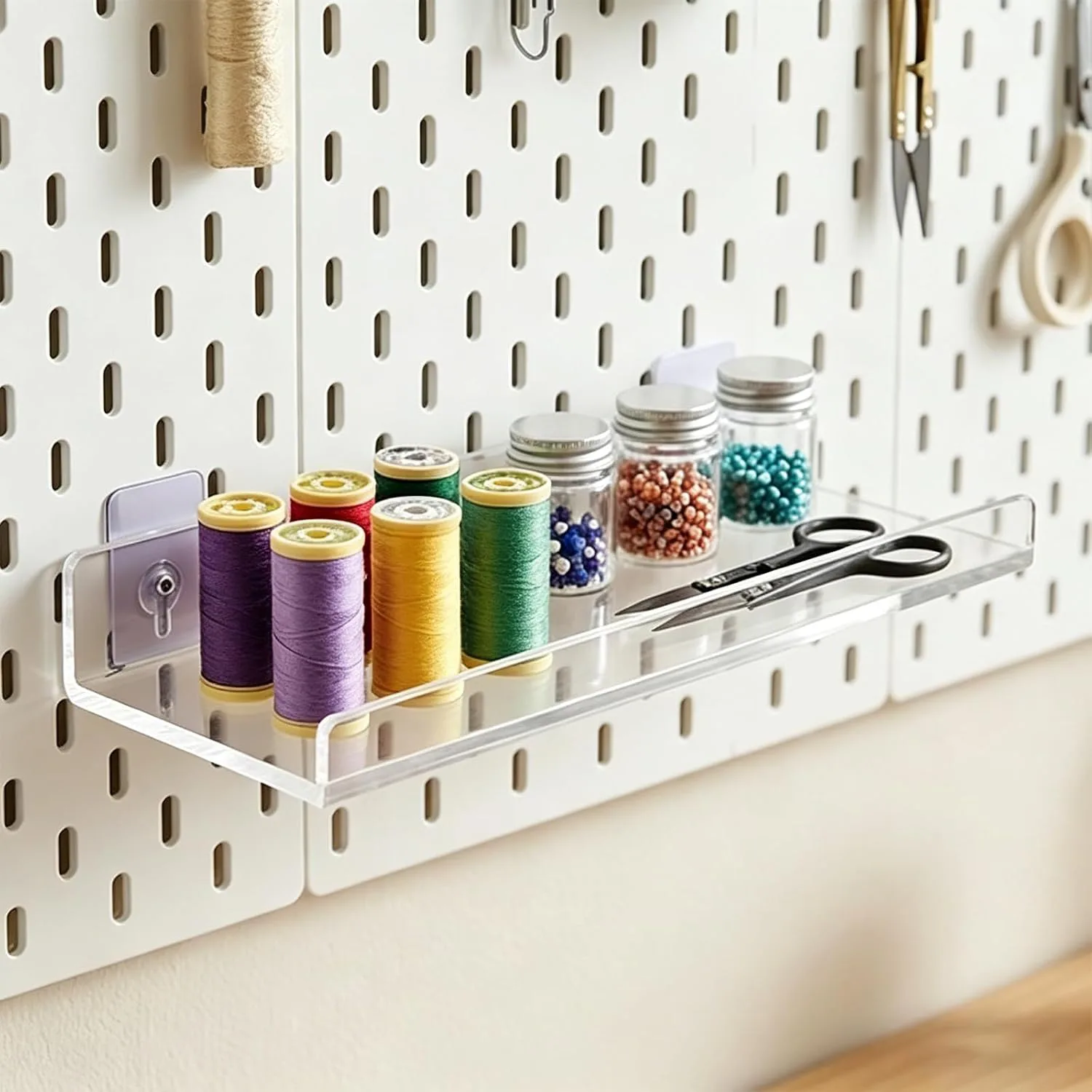
The ceiling on no-drill storage is real, and it’s lower than the packaging suggests. Adhesive-mounted shelves handle a phone, glasses, a small plant, a candle, one or two paperbacks. They do not handle a stack of hardcovers, a lamp with a weighted base, or the accumulated small heavy objects that migrate onto any horizontal surface within a month.
Adhesive strips have published per-unit weight limits and the near-universal habit is treating those limits as a rough suggestion. That habit is where “it fell off the wall” comes from, almost every time. Wall texture matters too: a lightly textured or freshly painted wall holds noticeably worse than smooth, cured paint. A picture ledge has the same ceiling, for the same reason.
Set the expectation and the no-drill shelf is a genuinely good tool. Pretend it’s a bookshelf and it becomes a hole in your drywall plus a broken shelf.
Studs, toggle bolts and the drilled branch
If you can put holes in the wall, the capacity conversation changes completely. Find the stud first, always. Two studs under a three-foot shelf gives you around 100 pounds of capacity, which covers books, a small speaker, and whatever else migrates up there over the next year.
No wall stud where you need the shelf? Toggle bolts, not the plastic anchors in the box. The spread between roughly 143 to 356 pounds for a proper toggle and 5 to 25 pounds for a plastic expansion anchor is the entire ballgame, and the toggle costs a couple of dollars more.
This is still a drilled solution, so it lives on the “landlord allows small holes” side of the fork, not the renter-friendly storage side. Toggle holes are also bigger than screw holes, which means a slightly more involved patch job later. Worth knowing before you commit to eight of them.
Putting the right things at the right height
A wall with no height logic becomes a display shelf you walk past. Three zones fix that: daily items at arm’s height where you’d naturally reach without thinking, weekly items above that, seasonal and rarely-touched at the very top. It sounds obvious and it’s the step almost everyone skips, because shelves get filled in the order things happen to be sitting on the floor. We break down the three-zone system for vertical wall storage with more room than this section allows.
One correction to the corner shelving enthusiasm you’ll see elsewhere. Corner floating shelf sets on standard drywall anchors are commonly rated around 15 pounds each. That’s folded sweaters, a plant, a couple of frames. It is not books and it is not electronics, no matter how sturdy the bracket looks in the listing photo.
Before you mount anything above the bed, sit on the mattress and look up. A shelf directly over a pillow is a shelf that eventually drops something on someone’s head at 3 a.m. Mount above the foot of the bed or the side wall instead, and keep whatever is genuinely heavy on the floor-based storage.
Furniture That Stores Things You Already Have Room For
In a room this size, every new piece of furniture costs floor you can’t spare. So the rule is narrow: the only furniture worth adding is furniture that replaces footprint you’re already spending.
A bench that stores instead of a bench that just sits. A bed with drawers instead of a bed with a dust zone underneath. If a piece adds square footage without absorbing a function you already had, it’s making the room smaller in exchange for storage you could have gotten from a wall. That logic is why a built-in wardrobe rarely pencils out in a rental and a chest of drawers usually does.
And if the room already has a bench, a trunk, or a bed with drawers, the answer isn’t a purchase at all. It’s a sorting rule for the thing you already own, which is the section-six problem in disguise.
Benches and ottomans at the foot of the bed
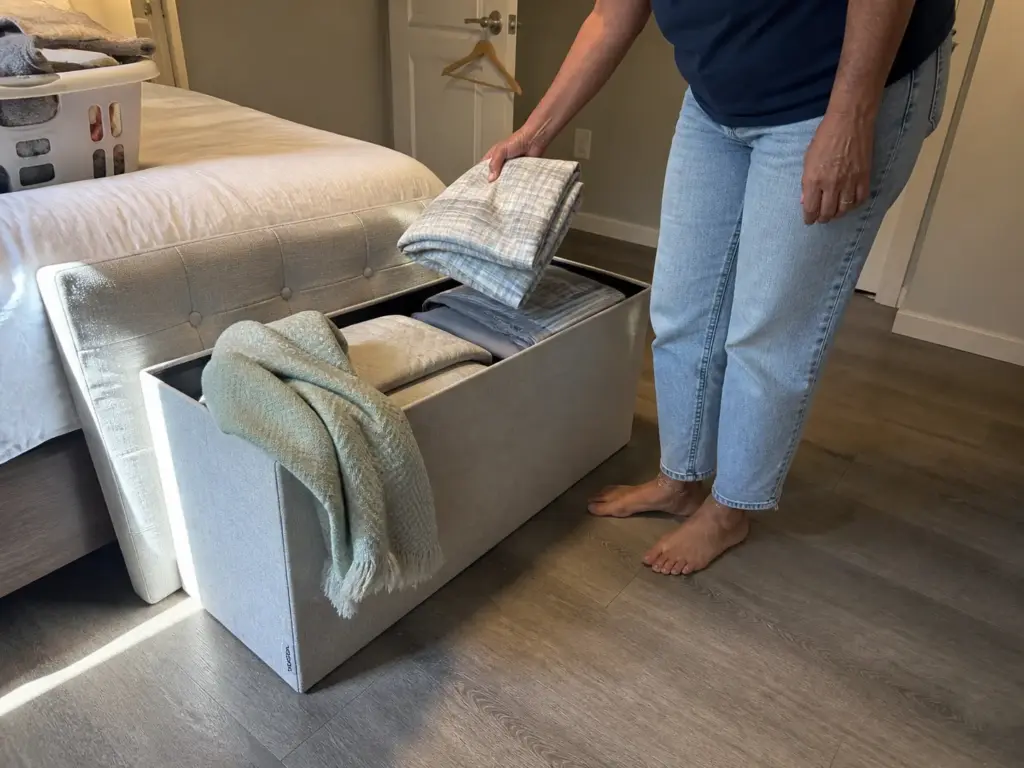
The strip of floor at the foot of the bed is already lost. You walk around it, you don’t put anything permanent there, and in a tight room it’s often the only place a person can stand to get dressed. A storage bench converts that committed footprint into closed volume plus a seat, which is about as close to free storage as a small bedroom gets.
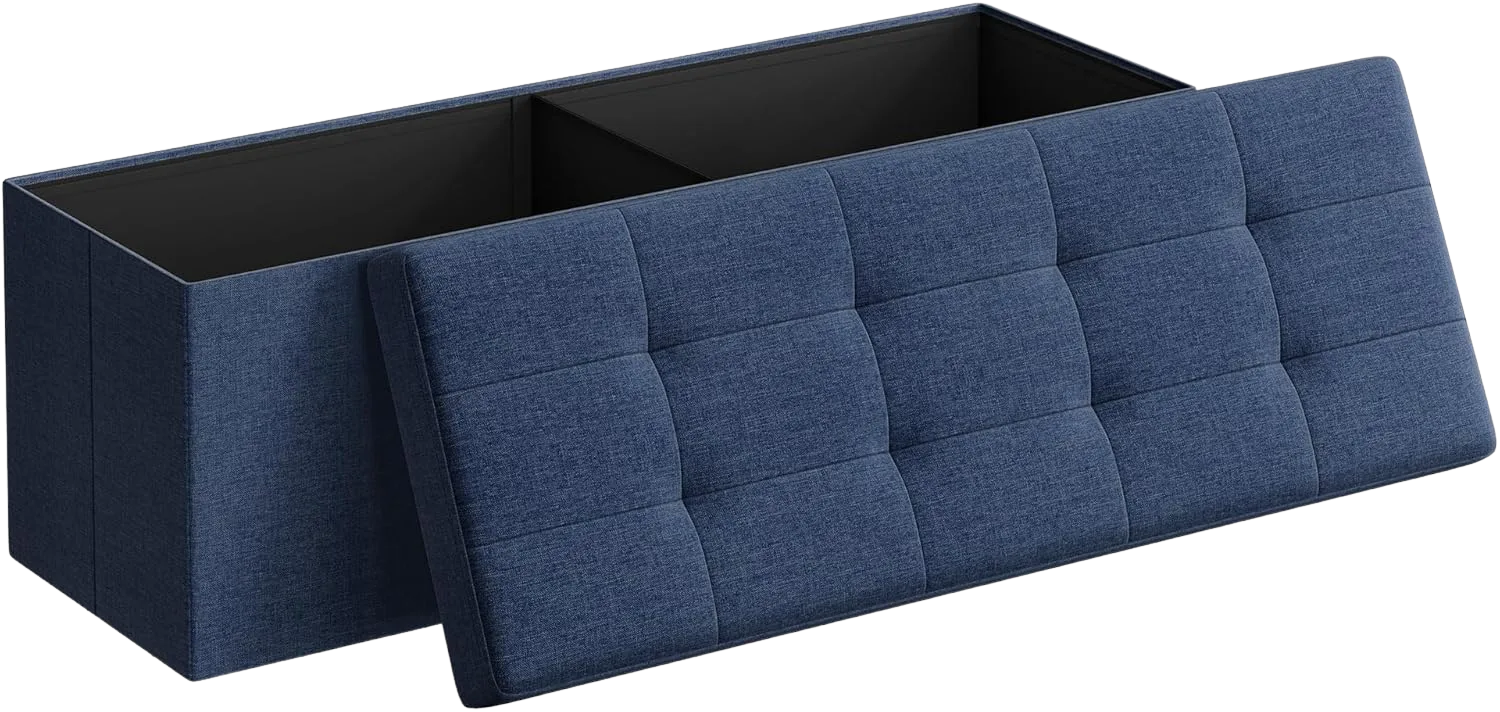
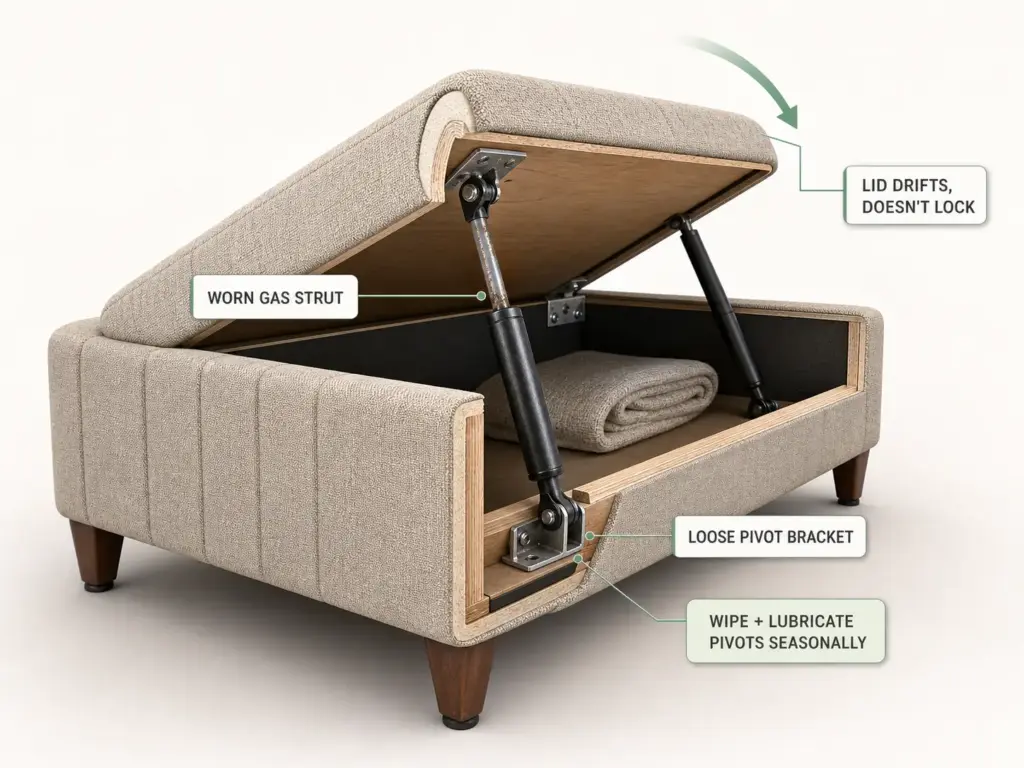
Now the failure nobody photographs. Ottoman beds and lift-top storage benches most often stop staying open because the gas struts wear out or the hinge pivots seize from rust and dried grease. The lid rises slowly, then it rises and drifts back down, then one day it drops on your forearm while you’re reaching in.
That’s months in, not day one, which is exactly why an idea gallery can’t warn you about it. It’s hardware wear, not user error, and the two-minute version of prevention is a wipe and a drop of lubricant on the pivots once a season. If the struts are already soft, they’re a replaceable part, not a reason to throw out the furniture. For more pieces built on this same footprint-replacing logic, we’ve covered multi-functional furniture built for small apartments.
When the dresser is the closet
If your room has no closet or a closet so shallow it’s basically a coat hook, the dresser stops being furniture and becomes the primary clothing system. That changes what you need from it. A dresser as backup storage can survive being disorganized. A dresser as your entire wardrobe cannot.
The mechanism that breaks it is folded stacks with nothing holding them upright. You fold everything beautifully on Sunday, you pull one shirt from the middle of a stack on Tuesday, and by the following week the drawer is a single layer of loose clothing with a few sad columns at the edges. Vertical filing plus internal structure is what stops it.
A set of SpaceAid Bamboo Drawer Dividers adjusts from 17 to 22 inches to fit most standard dresser drawers and gives each category a wall to lean against, which is the whole reason the stack stays a stack. The caveat is that dividers slide when the drawer opens hard unless the tension fit is snug, so measure the interior width rather than the drawer front. If the room has no dresser at all, that’s a different problem with its own answers, and we mapped clothing storage when there’s no dresser in the room separately.
Anchoring anything tall
This one isn’t editorial preference. CPSC’s Safety Standard for Clothing Storage Units requires that a unit stay upright when one fully open drawer is loaded with 50 pounds, a test built to simulate a child climbing the front of it. That’s the federal tip-over safety standard for clothing storage units, not a suggestion from a blog.
Anchor anything tall to the wall. Yes, even in a rental, and yes, even if the piece feels heavy enough on its own. Two small screw holes patch in about five minutes with spackle and a fingertip. A tipped wardrobe does not.
Bedside, Behind the Door and the Corners Nobody Uses
“Dead space” is the community’s own term for it, and it’s the right one. The back of the door, the corner by the window, the narrow strip beside the bed, the wall above the headboard. In a small apartment bedroom those add up to more than another dresser would, and none of them cost you floor you’re currently standing on.
They’re also the last places people look, because none of them look like storage. Headboard storage belongs on that list too, with one caveat covered below: what goes above a sleeping head has a weight limit that isn’t really about the bracket.
Nightstand alternatives that give back the floor
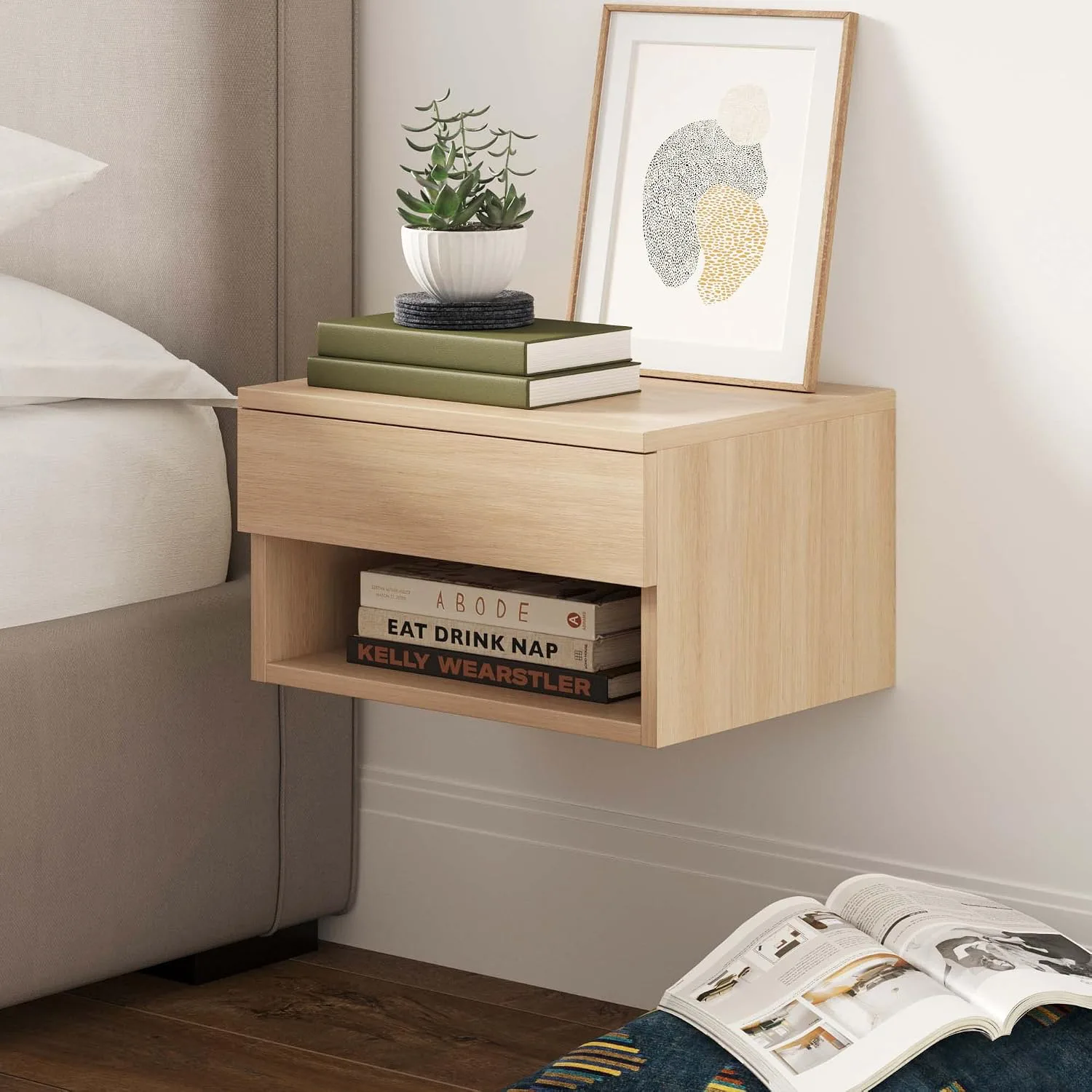
A standard nightstand eats into the roughly 30 inches of bedside clearance a small bedroom layout needs to function, and it does it at exactly the point where you’re squeezing past to get into bed. A wall-mounted bedside table gives back that floor and keeps the surface you actually use for the lamp and the charger. It’s a drilled solution, so it belongs to the owners-and-tolerant-landlords branch. The sibling piece on the bedside and walkway clearances a small bedroom needs carries the full clearance math if you want to check your room before you drill.
The back of the door
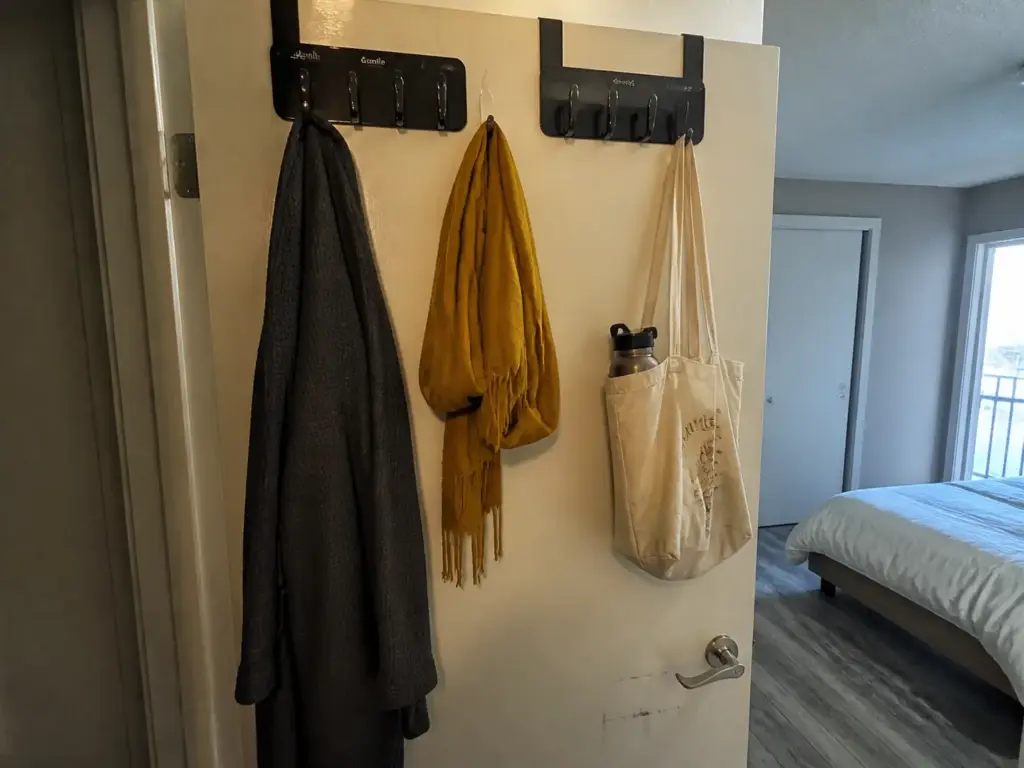
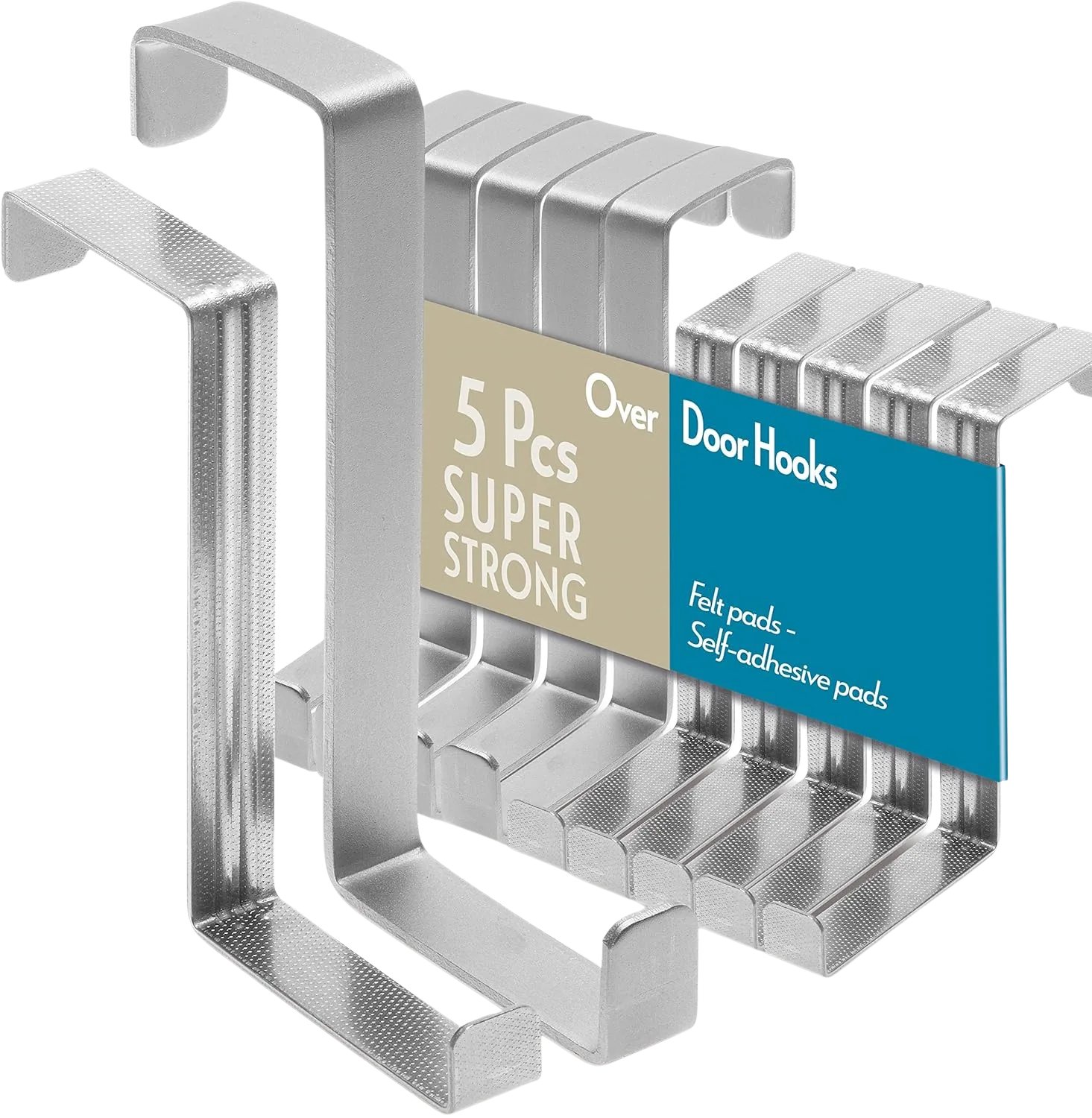
The back of the bedroom door is the most overlooked square footage in the room, and it’s free. It’s also where the hollow-core problem shows up most often, because a rack loaded with jeans, a robe, and a tote crosses a hollow door’s tolerance without anyone noticing. The crack or the dent appears weeks later, long after the purchase, so nobody connects the two events. It reads as a defective door rather than an overloaded one.
Spread the load across the width of the door instead of clustering it on one or two hooks near the handle, stay near the 5-pounds-per-hook guidance if you knocked and heard a drum, and use a wide backplate. Same total weight, distributed instead of concentrated, is the whole difference. If you want the deeper version of this, we documented what over-door organizers do to a hollow-core door.
Corners and the awkward wall
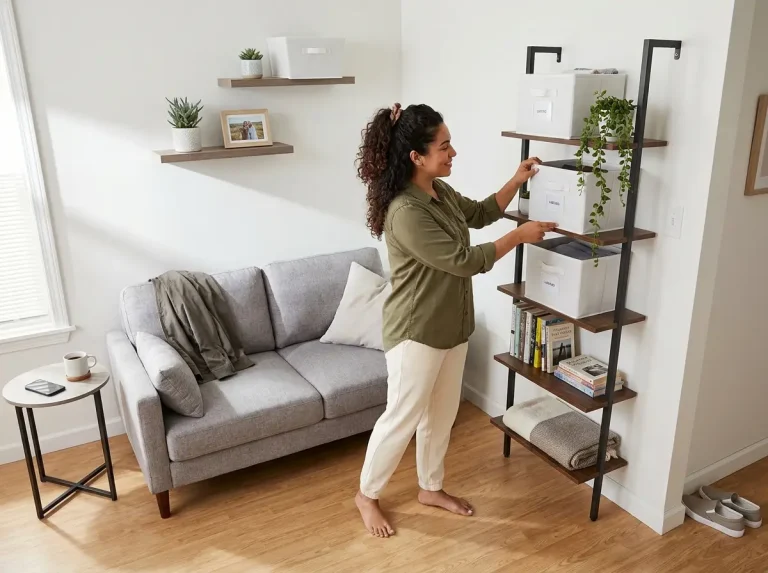
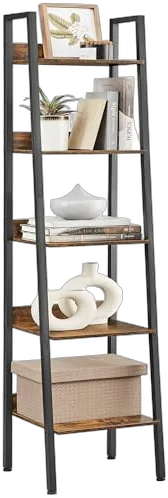
Corners lose to geometry. A standard bookcase is 11 to 13 inches deep and 30 or more inches wide, so it pushes into the walkway the moment you set it in a corner of a small room. A narrow-footprint shelving unit solves it by going up instead of out, which is the only direction small bedroom storage has left.
The headboard wall follows the same rule with one extra constraint. Shelving above the pillows is real square footage, but keep it to soft, light objects and mount it toward the foot-side edge rather than directly over a sleeping head. The weight limit that matters there isn’t the bracket rating. It’s what you’d be comfortable having land on someone.
Open your bedroom door all the way and look at where it stops. That arc of floor is permanently unusable, but the wall behind the open door usually isn’t. In rooms where the door swings against a wall, that panel is often the only stretch of vertical space nothing is competing for.
Why Small-Bedroom Storage Reverts by Month Two
Every idea above works on installation day. That’s not the interesting part. The interesting part is which ones are still working in November, and the pattern is consistent enough to state flatly: the systems that survive have a rule attached, and the ones that fail were only ever containers. An idea gallery structurally cannot tell you this, because a gallery ends at the photograph and the failure starts afterward.
Budget honesty to go with it. If a zone keeps reverting, the fix is almost never another purchase. It’s a rule or a measurement you skipped the first time, and buying a second set of bins to fix the first set of bins is how a small bedroom ends up with less floor than it started with.
Every bin needs a rule
Woven baskets and decorative storage baskets sold on looks become an unsorted dumping ground within weeks. This is the single most repeated confession in bedroom-organizing threads, and it’s not a discipline failure. It’s a design gap. A bin with no defined contents becomes the place things go when you don’t want to decide, and undecided things multiply faster than anything else in a house. No amount of declutter work upstream fixes a container that was never assigned a job.
Three questions per container fix it: what goes in, what specifically does not, and when does it get emptied. Miss any one of them and the bin drifts. The “miscellaneous” basket is the worst offender, because it’s the one container where the rule is explicitly “anything,” and anything is what it gets. A bin with no rule is a pile with a lid.
The same logic applies to the whole room, and it works better as a sequence than as a menu. If you want the ordered version of this, the sibling piece walks through the five-step process for organizing a small bedroom rather than the zone-by-zone approach here.
The seasonal hardware check
Four things in this article wear out on a schedule, and all four fail quietly. Ottoman struts soften until the lid drifts down. Adhesive bonds creep under sustained load, especially in a room that gets warm.
Vacuum valves leak. Over-door hooks work their felt backing thin and start pressing metal into the door edge.
None of those announce themselves. Every one of them is catchable in a two-minute pass:
- Lift the ottoman lid and let go. It should hold position, not sink.
- Press down on the top of any adhesive shelf and check for give at the wall.
- Squeeze the vacuum bags. Firm is fine, spongy means the seal is going.
- Look at the door edge under the hooks for shine, dents, or a compressed felt pad.
Do it when the seasons turn, because the seasonal swap is already the moment you’re pulling things out from under the bed. Four checks, once a quarter, catches everything before it fails loudly. The rotation itself deserves its own system, and a seasonal rotation that doesn’t collapse by spring covers why most of them don’t survive the second cycle.
A weekly reset covers the drift between those quarterly checks: five minutes returning things to their assigned zone before the categories blur.
One more variable people plan around instead of for. A system that depends on one person’s discipline breaks the first time somebody else uses the room. If you share it with a partner, a kid, or a roommate, build for the person who doesn’t care about the system, because that person is going to use it anyway.
Lidless bins over lidded ones. Broad categories over precise ones. The bin someone will actually use at 11 p.m. while half asleep beats the elegant one they’ll ignore.
Wrapping It Up
Three things carry the whole article. Measure clearance, wall capacity, and door type before you buy anything, because those three numbers eliminate most wrong purchases before they happen. Raise the bed before you shrink the bin, and split every zone into what works with no holes in the wall versus what changes if you can drill. And attach a rule to every container you own, or it turns into a pile with a lid by the second month.
In three months, do the ten-second version of the hardware check: open the ottoman and see whether it holds position, press a vacuum bag to see if it’s puffed back up, and pull down gently on the adhesive shelf. All three fail silently, which is the only reason they catch anyone by surprise.
Start with the bed. Measure the gap to the frame rail, decide whether you’re buying shorter bins or buying clearance, and get that one zone working before you touch the walls.
Frequently Asked Questions
01What to put in a bedroom instead of a dresser?
A wardrobe or a wall-mounted clothing bar handles the same volume in a narrower footprint than a dresser. Add under-bed drawers for off-season items and a foot-of-bed storage bench for bulk, and the dresser stops being necessary at all.
02How to maximize storage in a tiny room?
Work the zones that cost no floor first: under the bed, the walls, the back of the door, and the corners. Only add furniture that replaces footprint you already spend, like a storage bench where a plain bench would have gone.
03How to organize a small room with too much stuff?
Reduce before you contain. Storage volume in a small bedroom is finite, so containers only work once the volume fits, otherwise you are buying bins to hold the overflow that caused the problem. Then assign every zone a category so nothing floats.
04How to organize a very small bedroom closet?
Double the hanging space with a second rod, move off-season clothing out to under-bed storage, and keep the closet floor clear so shoes stop blocking access. A shallow closet works best as daily-wear only, with everything else stored elsewhere.
05Do over-the-door hooks damage a hollow-core door?
They can, if the load is clustered on one or two hooks. Spread the weight across the door width, stay near the 5-pound-per-hook guidance for hollow-core, and use a wide felt-lined backplate that distributes force instead of concentrating it.
Disclaimer: ClutterlessNest is a participant in the Amazon Services LLC Associates Program. As an Amazon Associate we earn from qualifying purchases. This article may contain affiliate links — if you buy through them, we may earn a small commission at no extra cost to you. We only recommend products we have tested or genuinely believe in.