
It’s 3 a.m. and you’re reaching for your phone, except your phone is on the floor because there’s nowhere else for it to go. Your water glass is balanced on a pile of stacked books. The phone charger cable runs across the walking path to the door, which you find out about again every morning. Most nightstand alternatives for small bedrooms fail for the same reason a real nightstand failed: people shop for the object before checking the two numbers that decide whether any object works beside a bed. Below, every bedside table alternative worth using, sorted by the constraint you’re actually living with: whether you can drill, whether you need storage, and whether you want to buy anything at all.
Quick Answer
Any substitute works if its surface lands within a couple of inches of your mattress top, usually 24 to 28 inches off the floor. Sort by constraint:
- Floor-standing, no wall contact: stool, slim rolling cart, nesting tables, storage ottoman
- Bed-mounted: a clamp-on bed-rail shelf, the only option when the bed sits in a corner
- Wall-mounted: a floating shelf or floating nightstand, if you can drill into a stud
- Storage-capable: ottoman, narrow bookshelf, three-tier cart
- No-buy: a step stool, dining chair, plant stand, deep windowsill, or a book stack with a tray on top
Why a Standard Nightstand Doesn’t Fit (and the One Measurement That Governs Every Substitute)
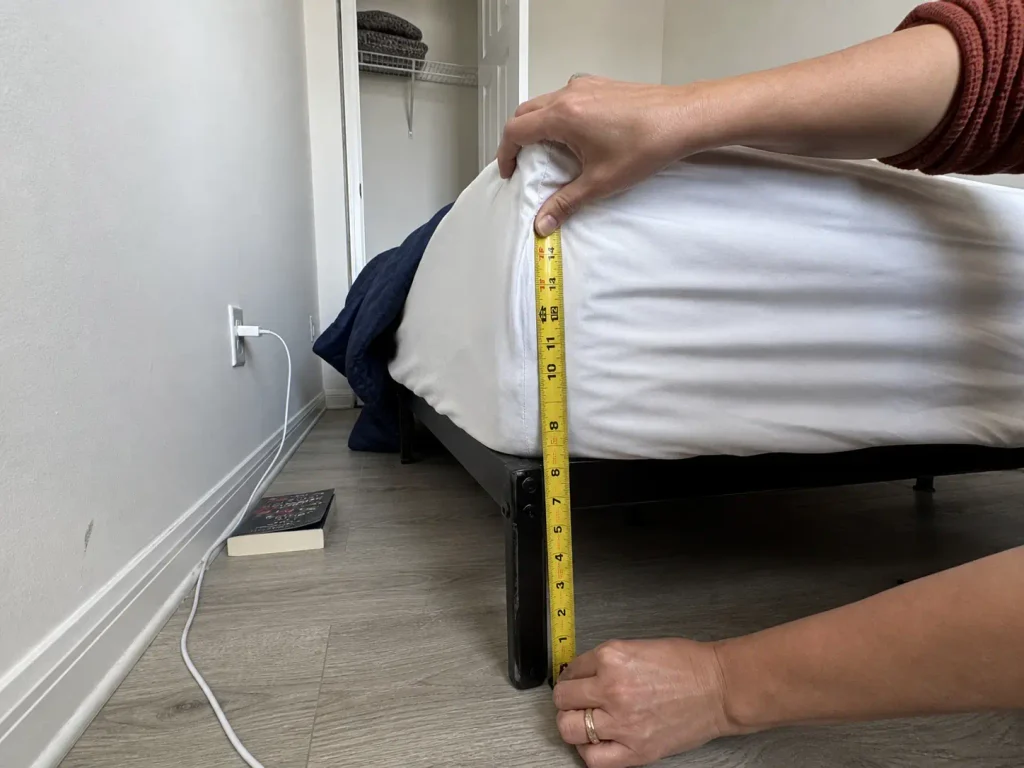
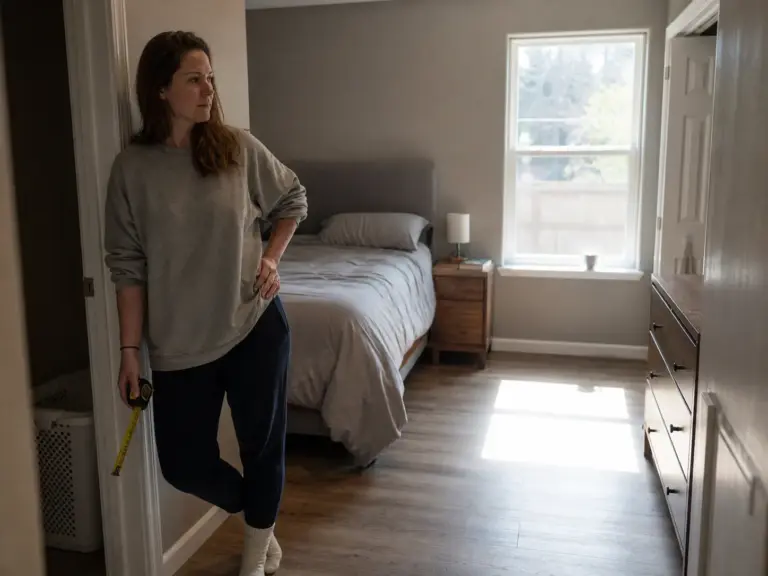
You have probably already returned one nightstand. It looked narrow enough online, it arrived, and it either blocked the path to the closet or sat so low that you knocked the glass over reaching down for it. The problem was never the width. It was that nobody told you a bedside surface has two numbers to satisfy, and the second one has nothing to do with the object at all.
The Height Rule (and the Couple-of-Inches Window)
Standard nightstands cluster in the 24 to 28 inch range, and that is not a design convention. It comes from how tall a made bed actually sits: a mattress on a typical frame or box spring puts the mattress top somewhere around 24 to 26 inches off the floor. The surface height of whatever you put beside the bed should land at that line or slightly above it, within a couple of inches either way.
Go too low and you reach down instead of across, which is exactly the motion that tips a water glass at 3 a.m. Go too high and the thing looms over your pillow, which sounds like a small complaint until you sleep next to it for a month. Here’s the practical version: stand beside your made bed, hold your hand flat where the mattress top is, and shop for something that meets your palm. That’s the whole test.
This is also why the “just use a step stool” advice works for some people and not others. A tall step stool lands close enough to the mattress line to feel fine. A milk crate on its side sits barely above your knee, and that is not a bedside surface, it’s a floor with extra steps.
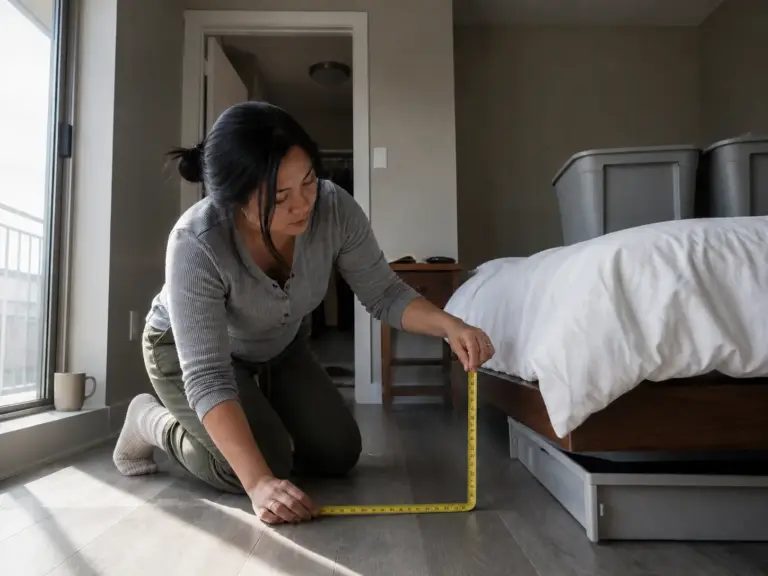
Measure the mattress top with the bed made, not stripped. A thick duvet and a mattress topper can add three or four inches, and that is the surface your arm actually travels over when you reach sideways in the dark.
The Clearance Number Nobody Publishes
Here is the number every competing list skips. A piece of furniture beside your bed also has to leave you a walkway, and there is published guidance for that: NKBA-derived clearance standards put roughly 24 inches as the absolute minimum for a path you can physically walk through, with 30 to 36 inches being the range where the room stops fighting you. Those numbers come from the same design guidance that governs standard bedroom clearance guidelines for the rest of the room.
The distinction matters more than it sounds. At 24 inches you can pass. At 24 inches you cannot change a fitted sheet without dancing, open a drawer while standing beside it, or walk past in the dark without a hip finding a corner. If your bedside gap is close to that minimum, the object you put there needs to be shallow or it needs wheels, and this is one of the layout mistakes that eat a small bedroom more reliably than any single piece of furniture.
Run the math before you shop. Measure the floor gap between the mattress edge and the wall, then subtract the depth of the object you’re considering. What’s left is your walkway. If that leftover number starts with a 1, you’re about to buy something you’ll resent by October.
When the Gap Is Too Narrow for Any Nightstand
Sometimes the subtraction ends the conversation. If the gap between the bed and the wall is under about a foot, no conventional nightstand fits at any width, and searching for a narrower one is wasted effort. The bed is where it is because the room only allows one arrangement, and that’s the constraint you work with.
That reader needs a different category of object, not a smaller version of the same one. Wall-mounted or bed-mounted becomes the only path, because both of them use zero floor. And if you land on something tall instead (a slim shelving unit rather than a low table), read the CPSC’s anchoring guidance for taller furniture before it goes in. Anything with shelves standing next to a bed is worth anchoring, and we’ll come back to why in the last section.
No-Drill Nightstand Alternatives That Renters Can Actually Use
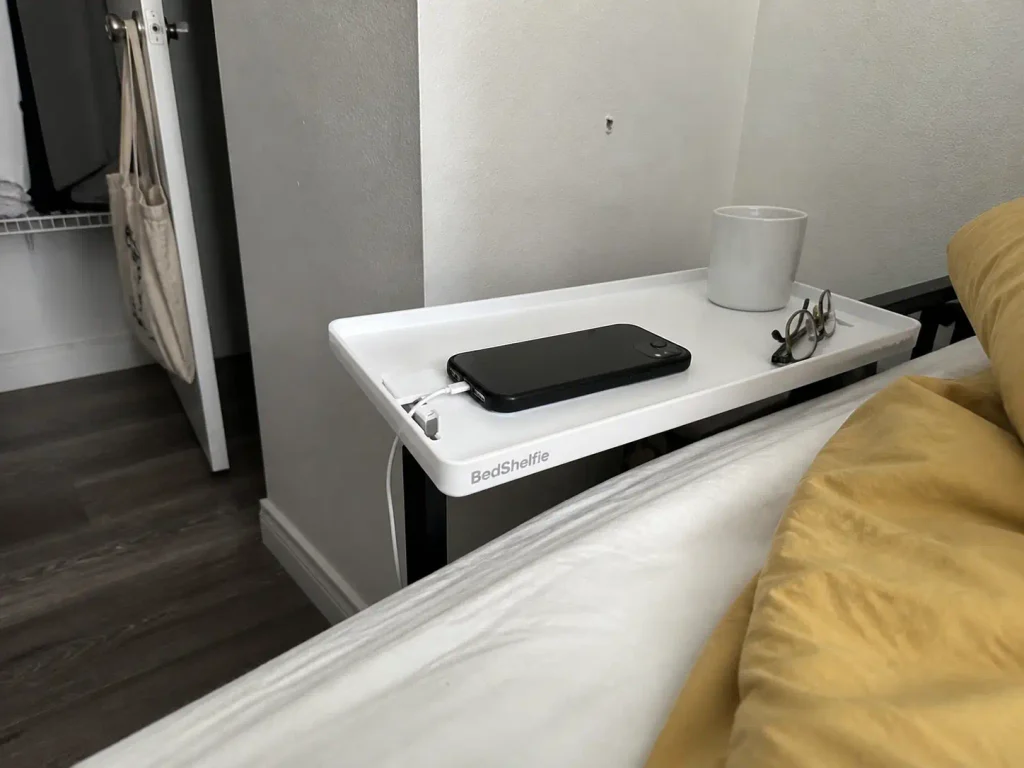
Half the “nightstand alternatives” lists on the internet recommend floating shelves to people whose lease forbids drilling. It’s advice written for homeowners and served to renters, which is why so many of these lists feel useless the moment you reach the part where you’d need a stud finder. So start where you actually are: nothing gets drilled, nothing gets patched, and the security deposit stays intact. That’s the same principle behind most renter-friendly changes that don’t cost the deposit.
Floor-Standing Substitutes (Nothing Touches the Wall)
The simplest category is anything that stands on the floor and touches nothing else: a small stool, a slim rolling cart, a set of nesting tables, a storage ottoman. Zero wall contact means zero deposit exposure and zero weight-rating math. You put it down, it works, and when you move out there is nothing to spackle.
The tradeoff is floor space, which loops straight back to the clearance number. A floor-standing piece eats depth from your walkway, so this category works when you have a gap to spend and fails when you don’t. Measure first. Then pick.
The Bed-Rail Shelf — for When There Is No Wall to Use
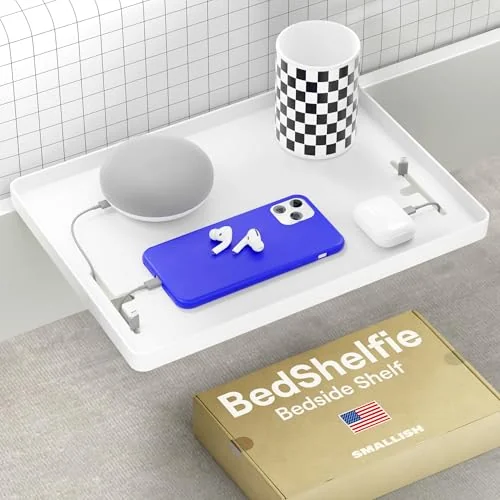
This is the category almost nobody covers, and it’s the answer for the reader whose bed is jammed into a corner. A bed-rail clamp shelf mounts to the frame of the bed itself. It touches no wall, needs no floor, and doesn’t care that both sides of your mattress are boxed in by drywall. The Reddit thread that ranks on this exact search is a renter describing precisely this situation, and the whole comment section circles it without naming the fix.
Capacity on these is real but bounded. The clamp-mount models are commonly rated around 35 pounds, which comfortably covers a small lamp, a phone, a book and a glass of water. It won’t hold a stack of textbooks and a plant, and it isn’t meant to. What it holds is your nightly kit, at the exact height of your mattress, in a space that had no other option.
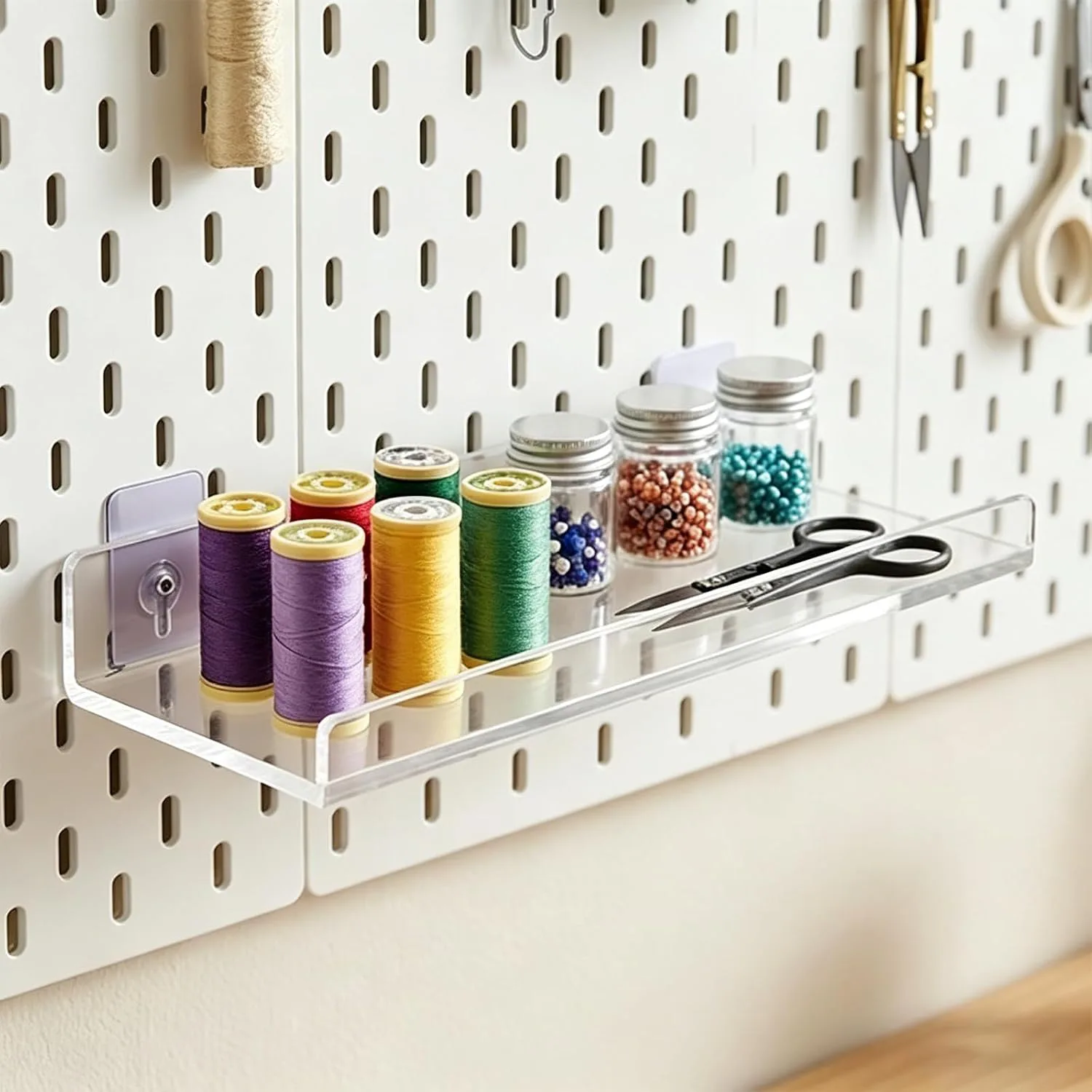
There’s a second no-drill route worth knowing about, and it’s where renters most often get burned. The most repeated mistake in renter organizing threads is mounting a real shelf on adhesive strips or command strips meant for picture frames.
Picture-hanging strips top out around 20 pounds under ideal conditions, and that rating assumes a flat frame pressed against the wall, not a shelf sticking out with weight levering down on the front edge. A lamp base plus two books plus a full glass gets to that ceiling faster than anyone expects, and the failure isn’t gradual. It’s a 2 a.m. noise you don’t forget.
Shelf systems built specifically for adhesive mounting are a different product. Their bracket geometry pushes the load back toward the wall instead of hanging it off the strip, which is why the purpose-built ones carry meaningfully higher ratings than the strips people repurpose into furniture duty.
Two Surfaces in One Footprint
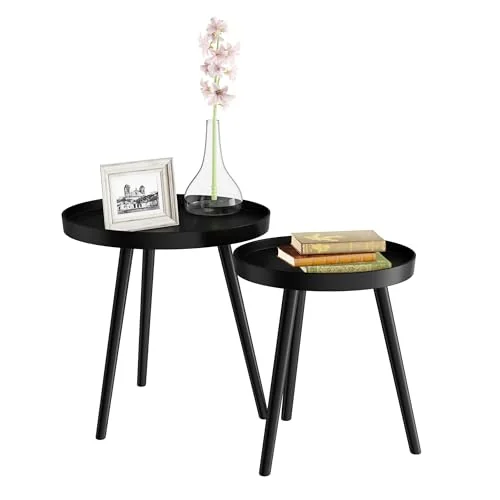
Nesting tables solve a problem most people don’t articulate until they hit it: you need one surface every night and a second surface about four times a year. A guest stays over. You work from bed with a laptop and a mug. Someone’s sick and needs water plus tissues plus a thermometer within reach. A folding tray table or foldable table covers that same occasional second surface, though it lives in a closet between uses rather than beside the bed.
Buying two tables for that is absurd, and living without the second one is mildly annoying forever. A nesting set is the compromise that actually resolves it. The taller table lives beside the bed doing daily duty, the shorter one tucks underneath and disappears, and the footprint on the floor never changes. That’s the part that matters in a small bedroom: your walkway measurement stays the same whether you’re using one table or two.
Before you buy any of this, though, check whether a windowsill, a step stool or an unused kitchen cart already does the job. That tier gets its own section further down, and it costs nothing.
Wall-Mounted Alternatives (and the No-Drill Workaround)
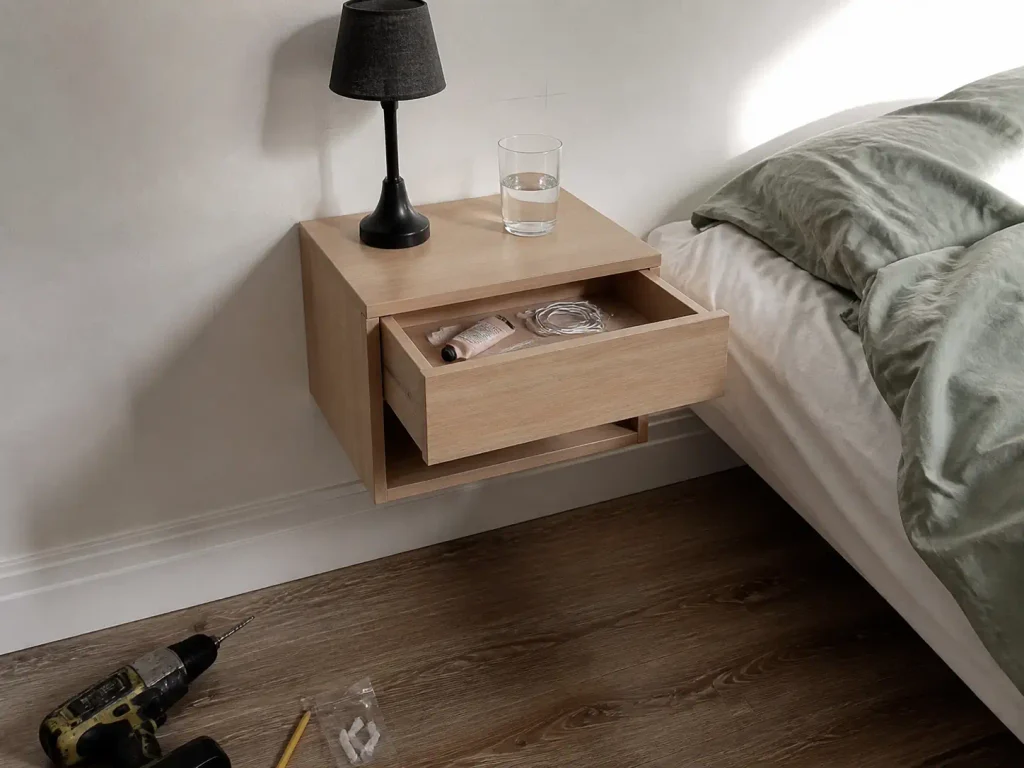
Going wall-mounted is the only move that gives you the entire floor back. Nothing to vacuum around, nothing to catch a shin on in the dark, and in a room where the walkway measurement is the whole problem, that is worth more than any amount of storage. If you own the place or your lease allows anchors, this is the strongest category on the list.
What the Wall Can Actually Hold
The shelf is not what holds the weight. The mounting method is, and that’s the part every listicle skips.
A bracket driven into a wall stud holds roughly 45 to 50 pounds per stud, so a two-stud mount handles about 100 pounds without drama. Drywall anchors alone are a different world, generally reliable under 20 pounds. Adhesive strips are lower still. Same shelf, three completely different products depending on what’s behind the drywall.
There’s a second variable nobody mentions at the store: depth costs you capacity. The deeper the shelf, the longer the lever arm working against the fasteners, so a 12-inch shelf holds noticeably less than a 6-inch one on the same bracket. This is counterintuitive because deeper shelves look sturdier, and it explains why an overloaded deep shelf sags at the front edge first. For bedside use, 8 to 10 inches of depth is plenty for a lamp, a phone and a glass, and the details of how floating shelf weight capacity actually works are worth two minutes before you pick a size.
Go shallow. It holds more.
Find your studs before you decide where the shelf goes, not after. Studs sit on a fixed spacing that has no interest in where your pillow is, and the most common wall-mount regret is a shelf that holds beautifully but sits eight inches too far left to reach without sitting up.
Floating Shelf vs. Floating Nightstand With a Drawer
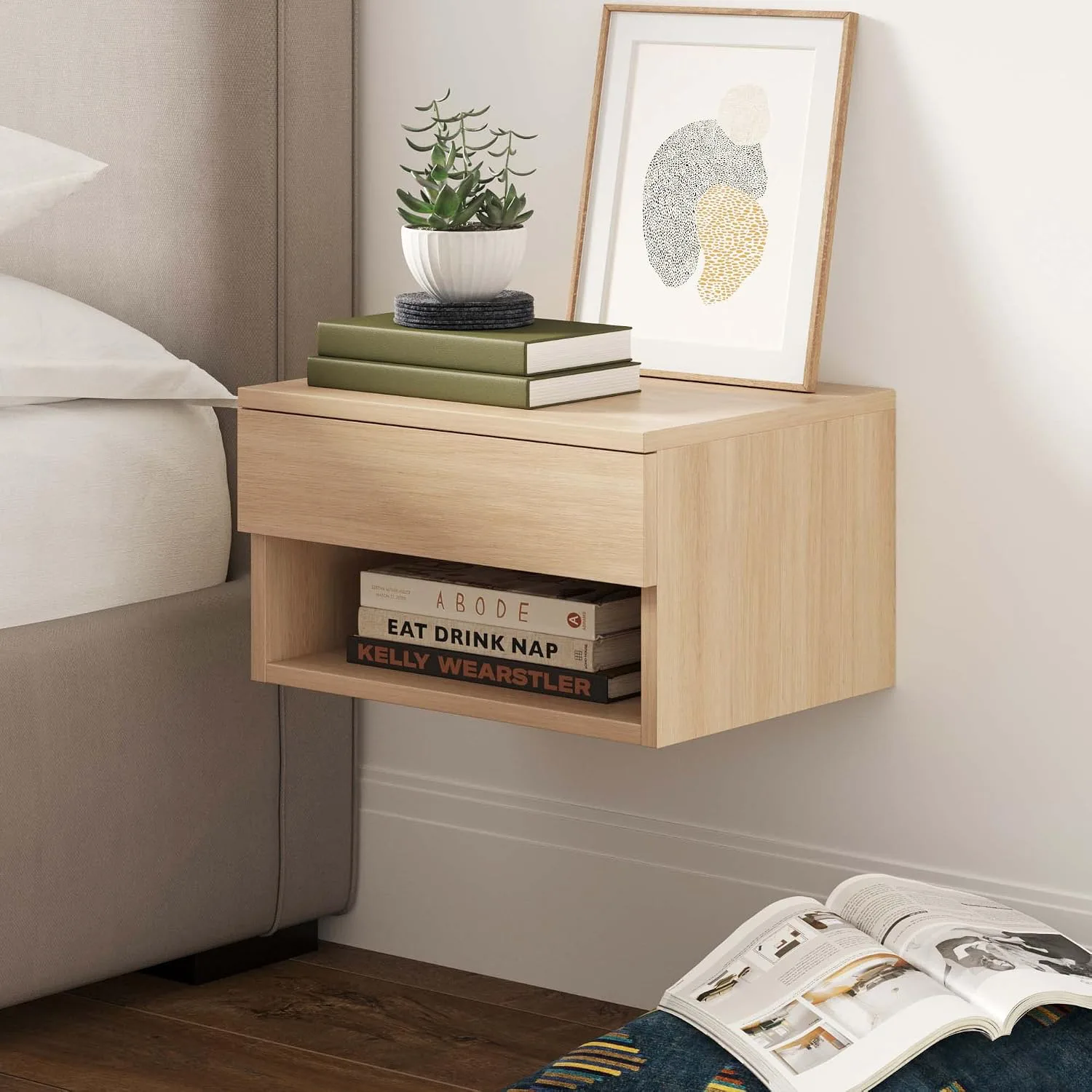
Community language treats these as the same thing, and they aren’t. A floating shelf, or any wall-mounted shelf rated for real weight, gives you a surface. A floating nightstand gives you a surface plus a drawer, which is the difference between having somewhere to put your phone and having somewhere to put the things you don’t want visible: medication, earplugs, the reading glasses you keep losing.
I’d point most people toward the drawer version if they’re drilling anyway. The hole count is the same, the effort is the same, and concealed storage in a small bedroom is not a luxury.
The tradeoff is that a loaded drawer unit genuinely needs stud mounting, which means the studs dictate the mounting position rather than your bed doing it. Find the stud first, then decide whether that location works. Sometimes it doesn’t, and knowing that before you open the box saves a return.
If You Cannot Drill, Read This Instead
Everything in this section frees up floor space by moving the surface onto the wall. The bed-rail clamp shelf from the previous section does the same thing by moving it onto the frame, with no holes involved. Same result, different anchor point.
I used to treat wall-mounting as the default answer for tight bedrooms and the no-drill options as the consolation prize. Enough renter threads describing landlords who deduct for anchor holes changed my mind: for anyone on a lease, the frame-mounted shelf is the first thing to try, not the fallback. The wall is a better anchor. It’s just not always yours.
Alternatives That Also Store Something
In a small bedroom, the thing beside your bed is often the only storage left in the room. That changes the question. A surface that holds a phone and a glass is fine in a house with closets to spare, and quietly useless if your extra blankets currently live in a pile on a chair.
Surface-Only vs. Storage-Capable — Pick a Lane First
Split the field before you shop. Surface-only covers the stool, the floating shelf, the clamp shelf, the nesting tables: they give you a place to set things down and nothing more. Storage-capable covers the ottoman, the cart, the bookshelf, the stackable set: they give you a surface plus cubic feet underneath it.
Picking the lane first saves you from the most common regret in this whole category, which is buying something beautiful and shallow, then discovering three weeks later that you still have nowhere to put the winter duvet. Decide what the object owes you. Then shop.
Ottomans and Benches
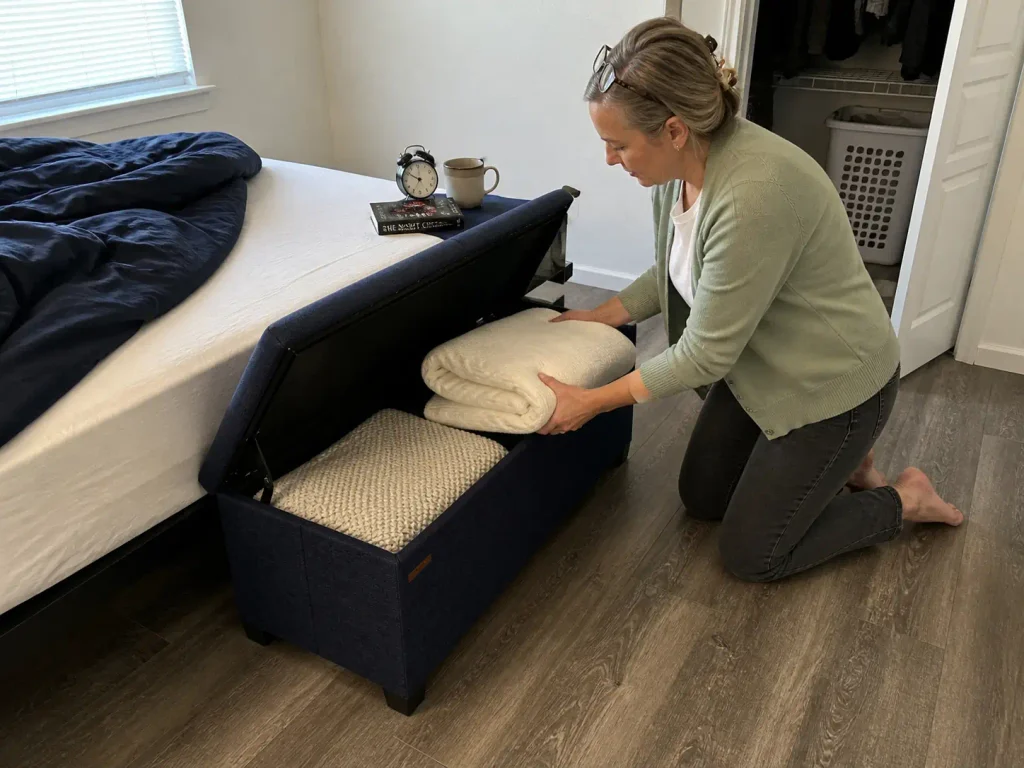
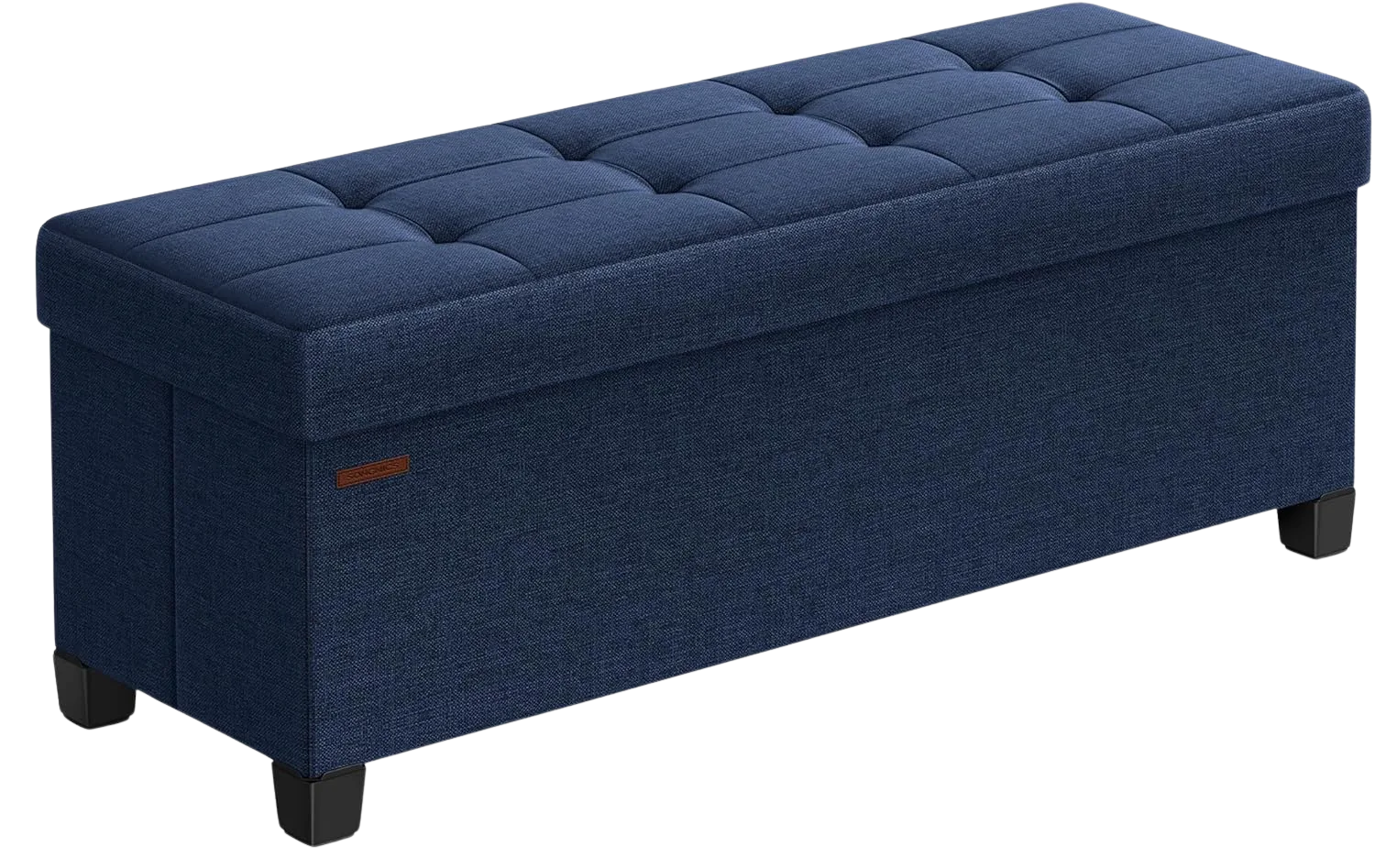
A storage ottoman is the quiet winner for renters who need storage. It stands on the floor, touches no wall, opens to swallow blankets and off-season items, and doubles as a seat when someone needs somewhere to sit and put shoes on. The flat top is the bedside surface, and a small tray on it keeps a glass from sliding on upholstery.
The honest caveat is height. Most ottomans sit lower than the 24 to 28 inch bedside target, which means the surface lands below your mattress line and you’re reaching down again. That’s a fair trade if storage is the priority, and a bad one if you mainly wanted somewhere to set a water glass at 3 a.m.
Going Vertical Beside the Bed
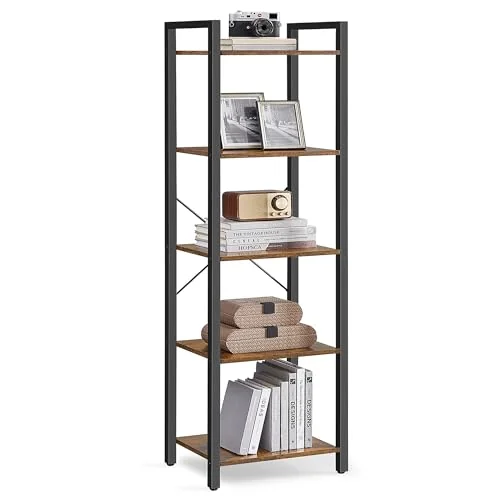
When the floor gap is narrow, the answer is frequently up rather than out. A narrow bookshelf stood beside the bed gives you a bedside surface on one of its shelves plus four more tiers of real storage, in a footprint shallower than most conventional nightstands. Books, a bin of chargers, folded sweaters, whatever the room has nowhere else to put.
Pick the shelf whose height puts a tier near your mattress line, and use that one as the surface. Everything above it becomes storage you look at, everything below becomes storage you forget about, which is fine as long as you put the right things down there.
And then anchor it. A shelving unit taller than 27 inches falls under the CPSC’s tip-over guidance, and a tall unit standing next to a bed is the exact placement where anchoring stops being paperwork and starts being the point.
Kids climb shelves. Cats climb everything. The anchor kit takes ten minutes and one screw into a stud, which is a very different commitment than mounting a loaded nightstand.
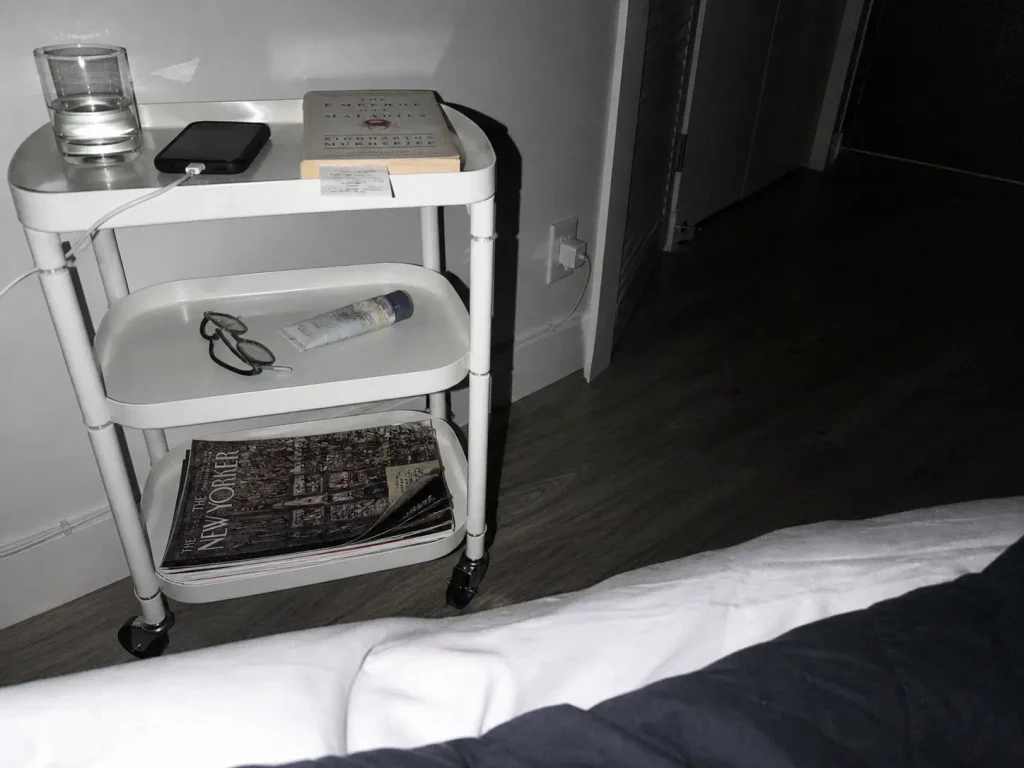
The Cart That Rolls Out of the Way
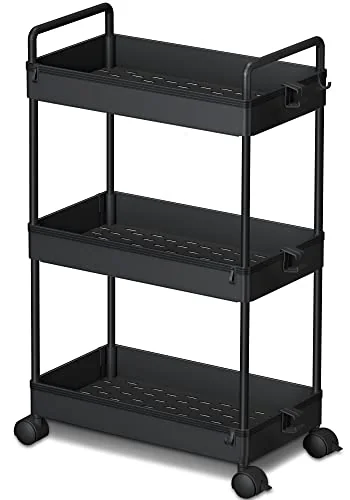
Then there’s the option for the reader whose clearance math came out ugly. A slim rolling cart is the only storage-capable piece on this list that stops occupying the walkway when you need the walkway. It sits beside the bed at night and rolls aside when you’re changing the sheets or hauling a laundry basket through.
Three open tiers handle books, chargers, skincare, the water bottle, the humidifier, whatever your nightly kit actually contains. Open tiers mean no drawer to open in a tight gap, which matters more than it sounds when your clearance number is close to that 24-inch minimum. The tradeoff is visibility: everything on an open cart is on display, so this is not the piece for someone whose bedside collection is a bit personal.
If the bedside piece is carrying storage the rest of the room should be handling, that’s a signal worth following up on with bedroom storage that holds up in a small room rather than asking one small object to fix a room-wide shortage.
The Alternatives You Already Own
The best nightstand alternative is frequently already in your apartment doing a worse job somewhere else. Every competing article treats this as a throwaway line before the shopping starts. It deserves to go first, because the success rate is high and the cost is zero.
Furniture Already in the Apartment
Walk the apartment and look for anything with a flat top in the low-to-mid twenties. This is repurposed furniture at its most literal, and it’s the zero-cost tier worth exhausting before you spend anything.
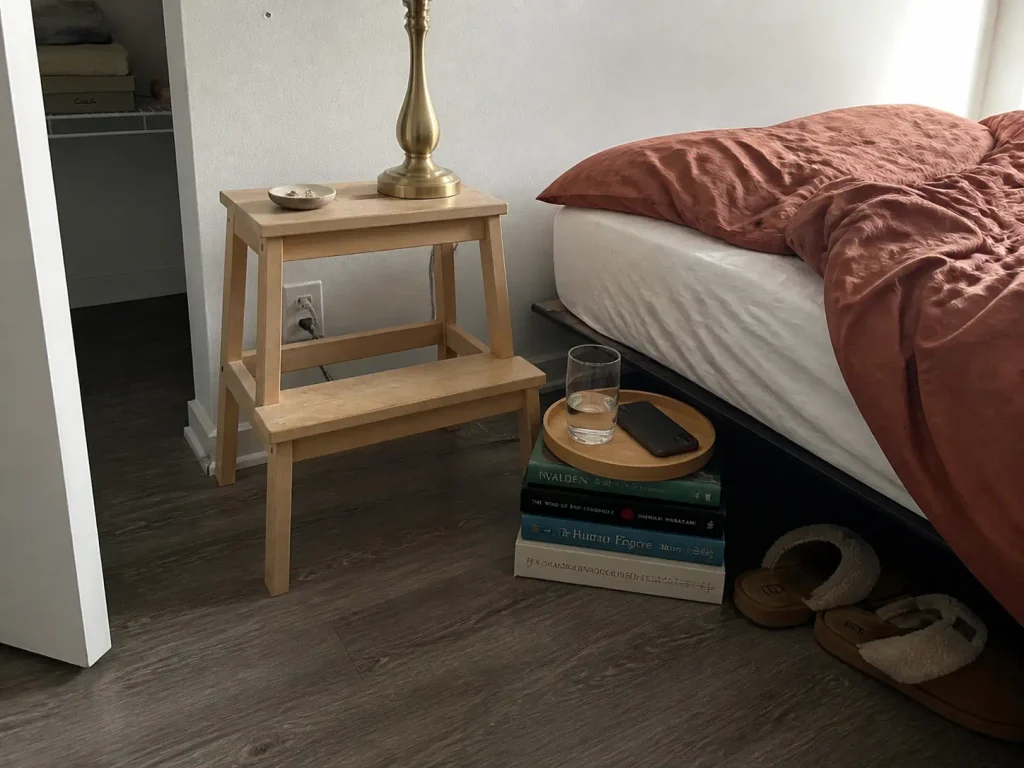
A wooden step stool. A small plant stand. A kitchen cart or bar cart that’s been holding a bread machine you use twice a year. A sturdy dining chair. A narrow console table pulled from a hallway, or a ladder shelf that leans instead of mounting. A suitcase or small trunk, which gives you storage inside as a bonus. DIY wooden crates stacked open-side-out, if the height works for your bed.
The dining chair deserves special mention because it’s the most available object in any home and its seat height lands close to the target range by accident. Chair seats generally sit in the 18 to 20 inch range, which runs low against a tall bed and lands fine against a platform bed with a thin mattress. Measure yours. If it’s within a few inches, you have a nightstand and you’re done, and the back of the chair even doubles as a place to hang a robe.
The windowsill is the one nobody thinks of. Older buildings frequently have sills deep enough to hold your bedside essentials (a phone, a book and a glass), and if one runs alongside your bed you already have a built-in ledge that needs nothing but clearing off. It costs nothing, it takes no floor, and it’s the single most overlooked bedside surface in pre-war housing stock.
The one thing a sill won’t do is hold a reading lamp with a plug, unless there’s an outlet close enough to reach without running a cord across the bed.
The Stacked-Books Surface, Done So It Doesn’t Tip
Every list mentions stacking books. None of them mention the part that makes it work, which is why so many people try it and give up in a week.
A bare book stack fails because the top book is smaller than the things you want to put on it and its cover is slick. A glass sits half on the spine and half over the edge, and eventually your hand finds it in the dark. Put a small flat tray on top and the whole thing changes: the tray spans the full stack, gives you a lip that stops a glass from walking off the edge, and turns four hardcovers into an actual surface. That’s the fix, and it costs nothing if you own a tray already.
Two conditions. Use hardcovers, not paperbacks, and use books of similar footprint so the stack doesn’t taper. Stack to your palm-height measurement, which is usually five or six thick volumes. And skip this one entirely if you have a toddler or a cat with opinions, because an unfixed stack is exactly the kind of thing they’ll test.
The tray trick works on more than books. A tray on top of a storage ottoman, a stool with a slightly rounded seat, or a chair with a woven seat converts any wobbly or uneven top into a flat surface a glass will sit on. If the object is the right height but the top is wrong, the answer is almost always a tray, not a different object.
The Cheapest Thing Worth Buying
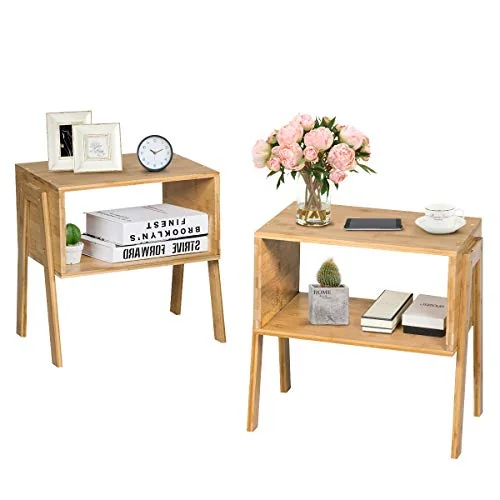
If you’ve walked the apartment and nothing fits, that’s a real answer and not a failure. The bed is too tall for the chair, the sills are shallow, and the only stool in the house lives in the kitchen for a reason. At that point you’re buying something, and the cheapest genuine nightstand replacement is a stackable set: two low units that stack into one bedside-height piece with open storage, and unstack into two separate low tables when you rearrange or move.
That flexibility is the point for renters. Your next apartment will have a different bed placement, and a piece that can be one tall thing or two short things adapts to a layout you haven’t seen yet. If you’re rethinking the whole room rather than just the bedside gap, it’s worth working through the whole small bedroom before you commit to any single piece.
What Survives Three Months of Real Nightly Use
Every alternative on this list looks fine the day it goes in. The real question is what it looks like after ninety nights of half-asleep reaching, and no competing article asks it. This is the filter that separates a substitute that photographs well from one that still works in October.
The Half-Asleep Test
Here’s the standard: the surface has to survive being reached for in the dark, without looking, by someone who is not fully awake. That is the actual use case. Not setting a phone down neatly at bedtime. Groping sideways at 3 a.m. and planting a hand somewhere unplanned on the way to the glass.
Anything that tips, slides or requires aiming fails that test within weeks. A stool on a rug that bunches. A cart with wheels that don’t lock. A book stack without a tray. They all technically work when you’re paying attention, and none of them work when you aren’t.
What you want is something close to tip-proof: a wide base, a low center of gravity, and no wheels that roll when you lean on it.
Which is why stability beats capacity every time. A rated weight limit assumes even, static loading, and a hand planted on the front edge at 3 a.m. is neither even nor static.
Two shelves rated the same can behave completely differently under that load: the shallow one absorbs it, the deep one levers against the fasteners. Before you commit, press down hard on the front edge of whatever you’ve installed. If it flexes, moves, or makes a noise, you have your answer now instead of at 3 a.m.
Cords, Pets, and the Things That Loosen a Mount
Cord routing quietly decides whether the whole setup survives. A charger cable that crosses the walkway gets kicked loose every few nights, and each kick drags whatever the cable is attached to a little closer to the edge. Give it a month and the phone has migrated to the floor and you’re back where you started.
Route the cable behind the object or along the bed frame, and use whatever cable channel or clip the piece came with. This is the least glamorous advice in the article and it fixes more failed setups than any product choice.
Pets and kids change the answer completely. A clamp-on shelf gets bumped by a cat landing on it. A lightweight cart gets pushed. Anything tall gets climbed by a toddler who’s decided the fifth shelf looks interesting, which is where the CPSC’s furniture anchoring guidelines stop being theoretical paperwork and become the actual reason the piece stays upright.
If there are small kids or climbing animals in the home, cross the freestanding tall options off unless you’re anchoring them, and treat that as a hard rule rather than a suggestion.
Then run the three-month test. Does the surface still hold what it started with, or have things migrated to the floor? Is the cable still routed, or is it back across the walking path? Does the mount have any play in it when you press down? Fail any of the three and the problem usually isn’t installation. It’s that the object was the wrong category for the space, and the fix is going back to the two numbers from the first section.
Conclusion
Check the two numbers before you shop for an object. Surface height against your mattress top, walkway clearance against the gap you have left. Those two measurements rule out most of the options on any list, including this one, and that’s exactly what you want them to do.
Sort by constraint rather than by looks. Whether you can drill decides the category: wall-mounted and floating nightstands for owners, floor-standing and frame-mounted for renters. Whether you need storage decides the object within that category. And check the apartment before you check a cart, because a step stool, a dining chair, a deep windowsill or a book stack with a tray on top solves this for a lot of people at zero cost.
Revisit it in three months. If the surface has drifted, the cable keeps getting kicked loose, or the mount has developed any play, the object was the wrong category for the space rather than badly installed, and swapping categories will fix what tightening a screw won’t.
Measure the gap beside your bed tonight. That one number rules out most of this list for you, and that’s the point.
Frequently Asked Questions
01What are some alternatives to a bedside table for small spaces?
Floor-standing options that touch no wall work best: a small stool, a slim rolling cart, a nesting table set or a storage ottoman. Bed-rail clamp shelves and wall-mounted floating shelves cover the rest. Pick the category by whether you can drill and whether the piece needs to store anything.
02What can I use instead of a nightstand if my bed is against a corner?
Use a bed-rail clamp shelf, which mounts to the bed frame instead of the wall. It is the only substitute that works when there is no free wall on either side of the bed, and it needs no floor gap at all. Check that your frame has a rail it can grip.
03How tall should a nightstand alternative be?
Aim for roughly the height of your mattress top, which usually falls in the 24 to 28 inch range. Within a couple of inches either way is fine. Much lower means reaching down for everything, and much higher means it looms over your pillow.
04Can I use a floating shelf as a nightstand in a rental?
Only with a mounting method your lease allows and the weight demands. Adhesive picture-hanging strips are rated far below what a lamp, a book and a glass of water add up to. Use a purpose-built no-drill shelf system or a floor-standing option instead.
05What is the cheapest nightstand alternative?
Something already in the home: a step stool, a dining chair, a plant stand, or a stack of hardcover books with a small tray on top. The tray is what turns the stack into a surface that will not tip a glass, and it is the step most people skip.
Disclaimer: ClutterlessNest is a participant in the Amazon Services LLC Associates Program. As an Amazon Associate we earn from qualifying purchases. This article may contain affiliate links — if you buy through them, we may earn a small commission at no extra cost to you. We only recommend products we have tested or genuinely believe in.