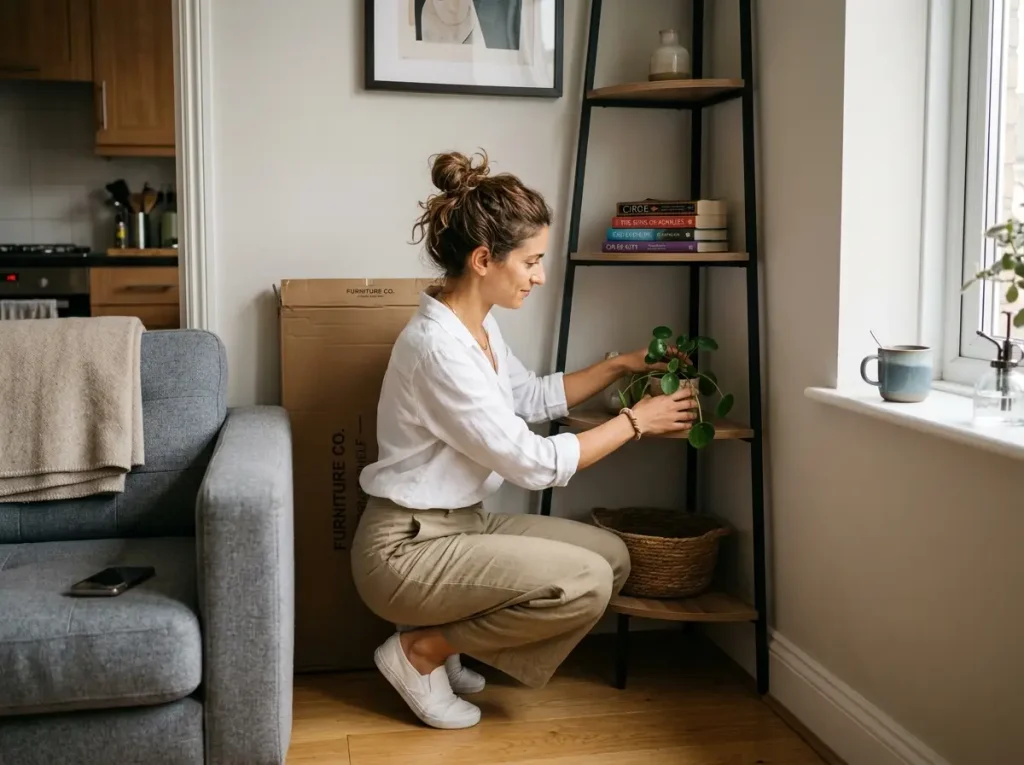
You’ve got an awkward corner and a phone full of saved photos. It’s a patch of dead space you keep meaning to use, and what none of those photos tell you is whether the shelf actually holds a stack of books, or slowly tilts, sags, and pulls out of the wall a month after you hang it. That gap is exactly where most corner shelf ideas for small rooms fall apart: they’re picked for the look, not for what they can carry or whether they even fit the corner you have. The difference between a corner shelf that lasts and one that ends up on the floor comes down to three things nobody photographs: depth, mount type, and one bracing trick corners have that flat walls don’t. Here’s how to pick the right shelf for each room, get the depth right, and mount it so it stays put.
Quick Answer
Match the shelf to the room, the depth, and how you can mount it:
- Bedroom or reading nook: 8–10″ deep, a narrow freestanding bookshelf or ladder shelf
- Kitchen corner: 10–14″ deep, a freestanding tiered rack
- Bathroom corner: 6–8″ deep, a countertop or adhesive shelf for light items only
- Entryway corner: 4–6″ deep so it doesn’t narrow the walkway
- Renter, no drilling: tension-rod or freestanding units hold real weight; skip adhesive for anything heavier than decor
Corner Shelf Ideas for Every Small Room
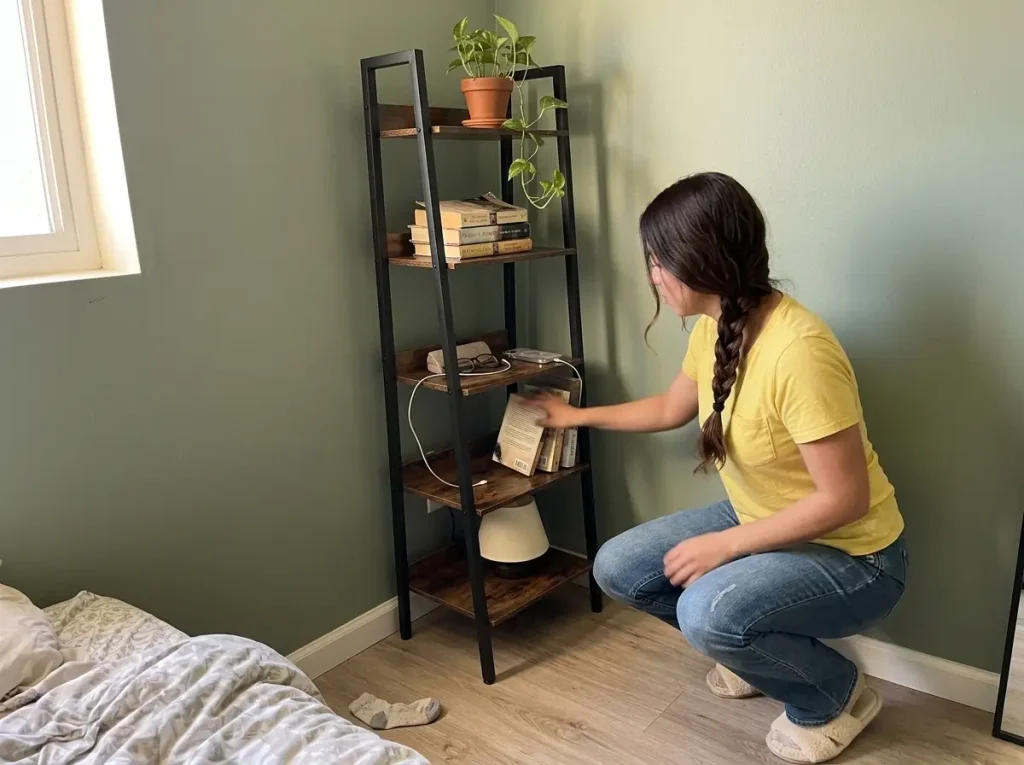
Every room has a different corner problem, so one shelf type won’t solve all of them. The bedroom corner wants a nightstand replacement. The living room corner wants display plus real book storage. The entryway corner just needs to hold your keys without bruising your hip every time you walk past. Start with what the corner has to do, then pick the shelf.
Living room and reading-nook corners
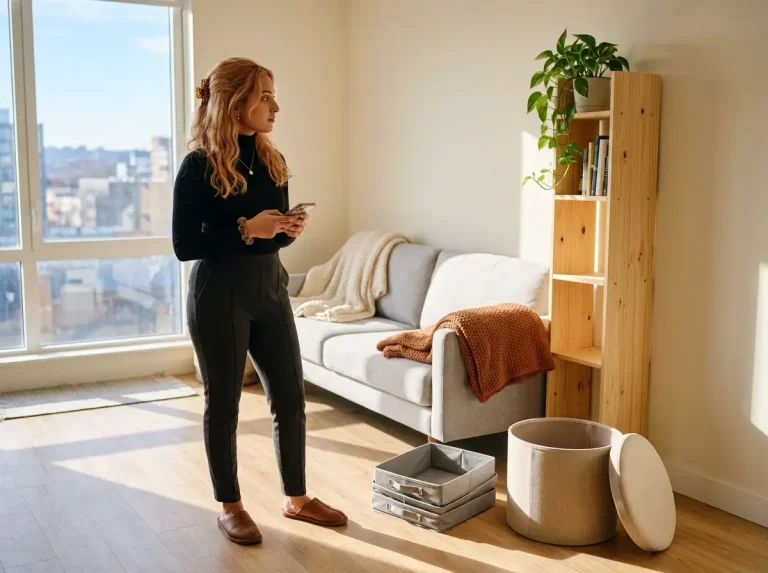
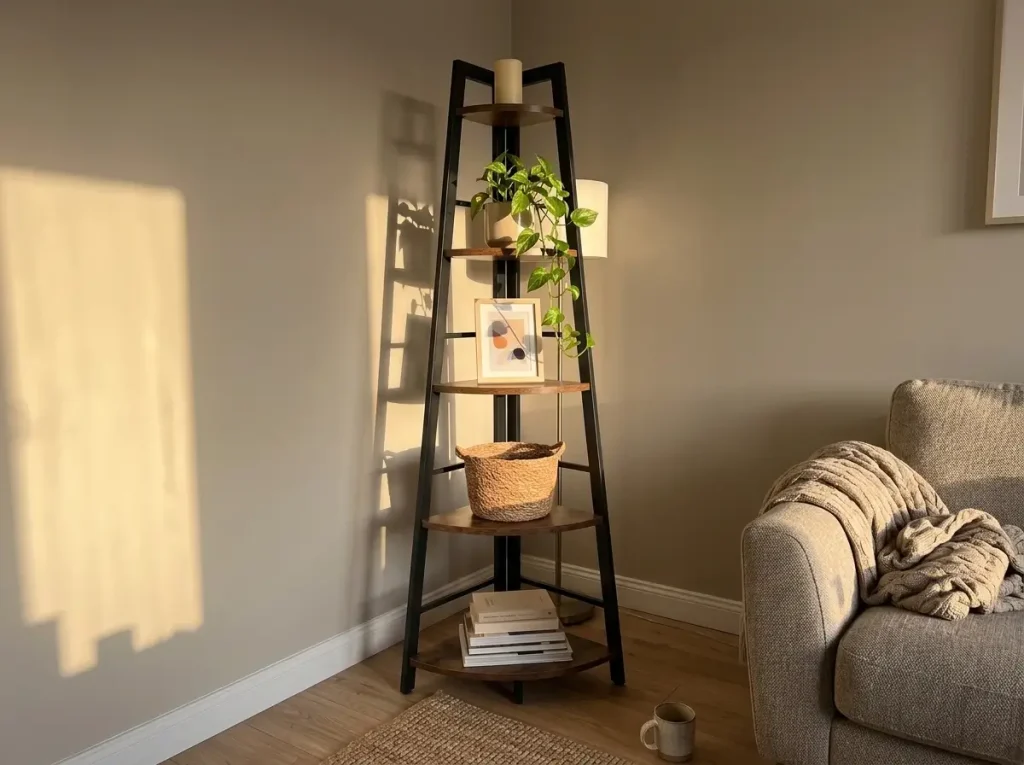
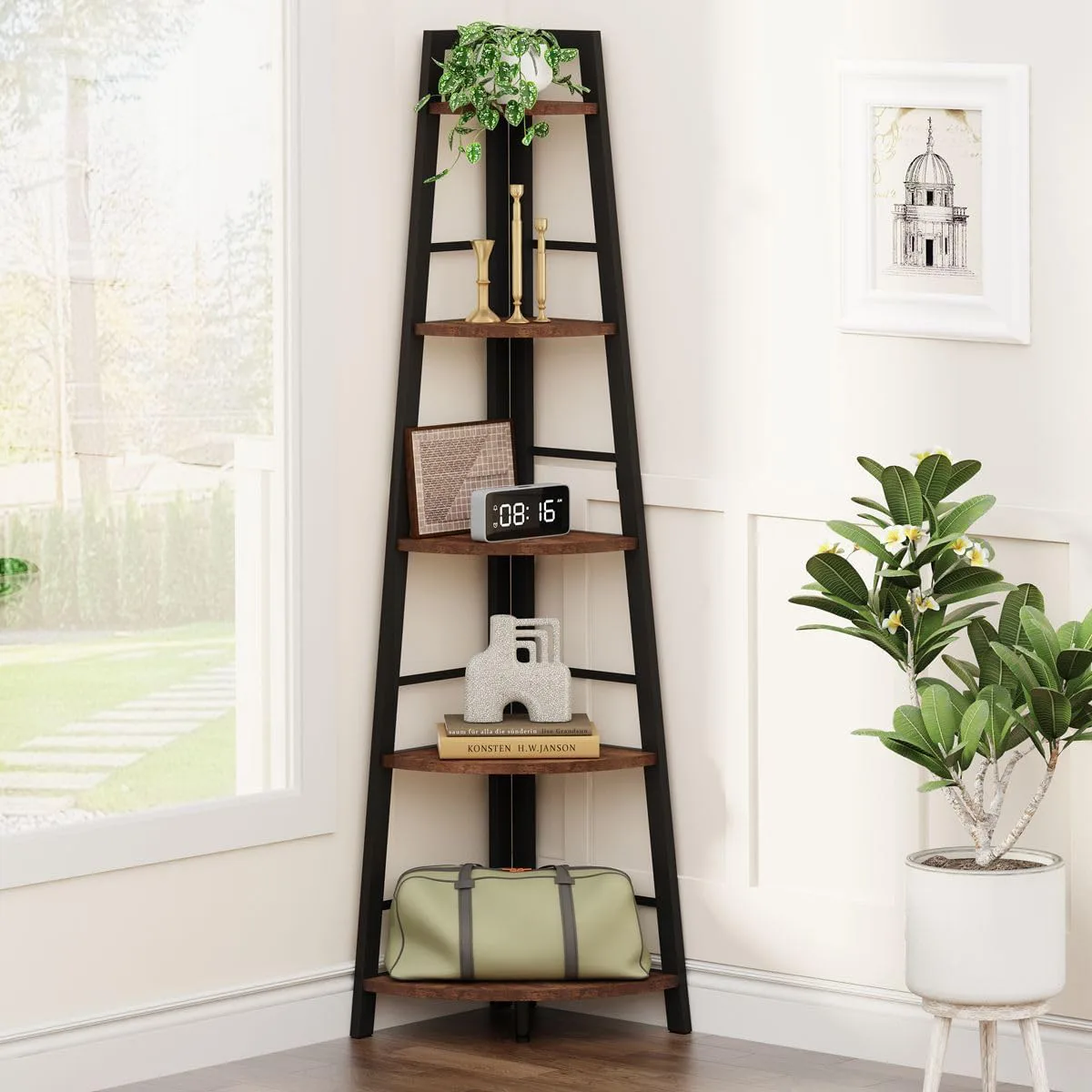
A living room corner is the one place you can go tall without eating floor space. A freestanding vertical unit gives you display and book storage without touching the walls, which matters if you can’t drill. The Tribesigns 70″ Tall Corner Shelf is built for exactly this: five tiers stepping up a corner for books, plants, and framed photos, no wall mounting involved. It’s a statement piece, so it earns its footprint in a reading nook or beside a sofa. If you want something less bulky, that’s the next idea. For more ways to work storage into a tight corner, our small living room storage ideas go deeper on the whole room.
Bedroom corners that double as a nightstand
If your bed sits in a corner, a narrow bookshelf can stand in for a nightstand and give you shelves you’d never get from a single flat table. The trick is width: you want something slim enough to sit flush without crowding the bed. The VASAGLE 5-Tier Narrow Bookshelf is only about 13 inches wide, so it tucks into a real corner and holds a lamp, books, and your phone charging without sticking out into the walkway. Freestanding, so there’s no anchoring question at all.
Kitchen, bathroom, and entryway corners
These three corners are all about depth discipline, which gets its own section next. Kitchen corners can carry a freestanding tiered rack for jars and bowls. Bathroom corners do best with a shallow countertop or adhesive shelf. Entryway corners need the shallowest shelf you own, because anything deep turns a hallway into an obstacle course. The mistake people make in all three is buying for the room they wish they had. Measure the actual corner first, and check whether it’s even a true 90-degree corner, because plenty of them aren’t.
Before you buy anything, set a coffee mug in the corner where the shelf will go. If the mug already feels crowded against the walls, the shelf will feel crowded too. It’s a five-second scale check that saves a return.
How Deep a Corner Shelf Should Be, Room by Room
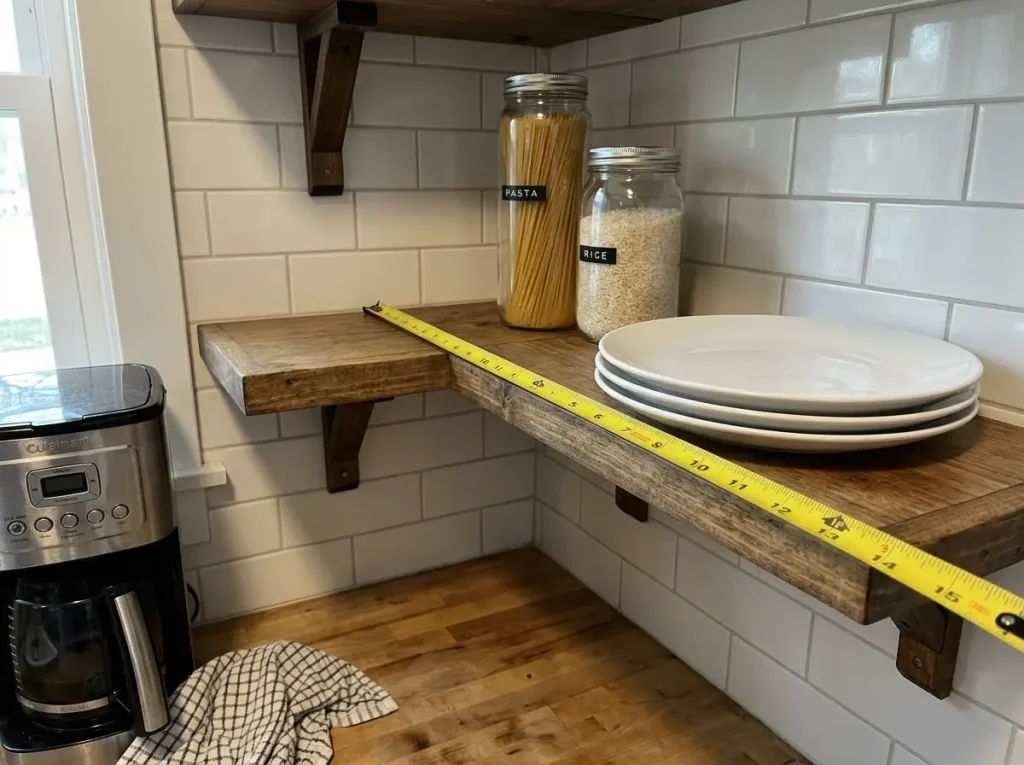
Depth is the question nobody asks until the shelf is already up and the dinner plates hang off the front edge. And it’s decided by the room, not by the look you’re going for. Get it wrong and the shelf still holds weight, it just doesn’t hold the thing you needed it to. Here’s what actually works, room by room.
The depth chart
| Room | Depth | Best for |
|---|---|---|
| Entryway / hallway | 4–6″ | Keys, mail, a small dish |
| Bathroom | 6–8″ | Toiletries, a plant, above-toilet storage |
| Bedroom | 8–10″ | Lamp, books, phone, alarm clock |
| Kitchen | 10–14″ | Plates, bowls, jars, cookbooks |
A bedroom corner shelf at 10 inches deep holds a lamp, a phone, a book, and an alarm clock, which is why it works as a nightstand stand-in. Drop under 8 inches and a lamp base won’t sit flat. Kitchen corners need the most room, usually 11 to 12 inches, so plates and bowls don’t hang off the edge. Bathrooms go shallow at 6 to 8 inches, especially above a toilet where you need head clearance. And entryways stay at 4 to 6 inches, because a deeper shelf in a hallway corner stops being storage and starts being the thing you bang your hip on.
Why depth is a room decision, not a style one
The quiet failure here isn’t a shelf that collapses. It’s a shelf that holds fine but can’t fit what you bought it for, so getting shelf depth right matters as much as the mount, and you end up with a beautiful corner shelf and your stuff still on the counter otherwise. Deep shelves in shallow-need rooms are just as wrong as shallow shelves in deep-need rooms. A 12-inch shelf in a narrow hallway is a bruise waiting to happen. If you’re weighing a floating shelf on a flat wall instead, our guide to floating shelves for small spaces breaks depth down the same way.
The Main Types of Corner Shelves (and Who Each Suits)
The type you pick is really a decision about drilling and weight, dressed up as a style choice. Once you see it that way, the options sort themselves fast.
Freestanding vs wall-mounted (the real fork)
This is the fork that decides everything else. Freestanding units, ladder shelves, tiered racks, and narrow bookshelves need zero wall contact, so they sidestep the whole anchor debate and every rental rule about holes. Wall-mounted floating shelves look cleaner and save floor space, but their capacity depends entirely on how you mount them, which is the single most common way corner shelves disappoint people. If you’re a renter or you’re not confident about finding a stud, freestanding is the safer default. Our roundup of freestanding shelving units that won’t tip covers the stability side in detail.
Ladder and tiered corner shelves
Ladder-style corner shelves lean into the corner, freestanding, no drilling, and they carry real weight on the lower tiers where the frame is widest. They’re the honest middle ground between a flimsy floating shelf and a permanent built-in. I used to steer people toward wall-mounted floating shelves for corners by default. After enough “it pulled out of the drywall” stories in organizing threads, I switched to recommending a freestanding ladder for anyone who isn’t drilling into a stud.
Floating and geometric corner shelves
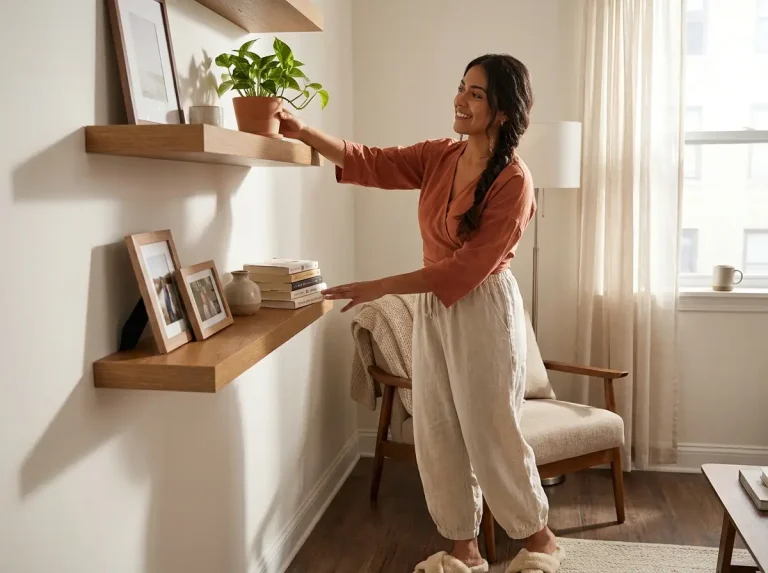
Floating corner shelves give you the cleanest look, no visible legs, but they’re also the ones most likely to fail if you mount them wrong. Geometric and staggered wall shelves are display pieces, built for light loads like a small plant or a candle, not for books. Both are fine choices as long as you’re honest about weight, which is the next section. The anti-sell here is worth saying plainly: those sculptural “tree branch” corner shelves that run into the thousands look incredible and tell you nothing about what they hold. A freestanding ladder is the budget-friendly pick that gives you most of the effect without the splurge, and you can take it with you when you move.
What a Corner Shelf Can Actually Hold
Nobody tells you the number, so people guess, and the guess is almost always “it looks sturdy.” That’s how a shelf of paperbacks ends up on the floor at 2 a.m. Here are the real weight capacity numbers by mount type, because this is the part every competitor skips.
Drywall vs stud vs toggle (the numbers)
A bare screw driven into drywall alone holds only 5 to 10 pounds before it pulls through. A standard drywall anchor gets you 10 to 25 pounds. A toggle bolt holds 25 to 50 pounds per anchor. But the real strength comes from wood: a screw into a stud supports roughly 45 to 50 pounds, and a shelf long enough to catch two studs can carry around 100 pounds. The practical rule is simple. Keep any shelf that’s mounted on drywall anchors alone under about 20 pounds total load, which is less than three gallons of milk. Anything heavier needs a stud or a two-point mount. If you want the full breakdown of stud versus drywall capacity, our guide to wall-mounted shelves that hold real weight lays it out. Federal safety testing backs this up, too: the CPSC’s tip-over prevention research on anchor strength shows rated anchor straps must hold at least 50 pounds, while plain wall anchors carry no such minimum.
The truth about “no-drill, 20 lb” adhesive claims
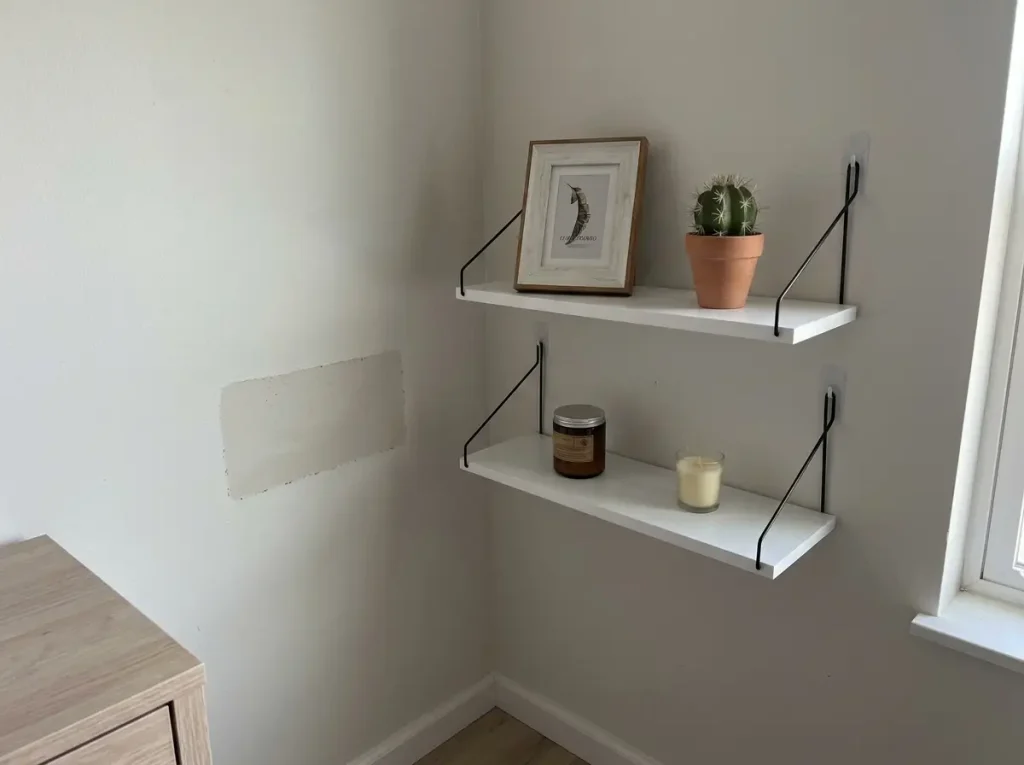
Here’s the failure that shows up weeks later instead of on install day. Renters consistently report that adhesive strips rated for 20 pounds are unreliable in a corner, and when they let go, they peel off with the paint, damaging the wall you were trying to protect. So treat any “no-drill, 20 lb” listing as a ceiling for very light, evenly spread items only. The Floating Wall Shelf No-Drill 16.5″ 2-Pack is genuinely fine for a plant, a frame, or a candle, but it is not the answer for books. In a bathroom, where humidity works against every adhesive, the Command Bath Water-Resistant Adhesive Strips hold up better than standard strips, though the same light-duty rule applies. Adhesive is for decor, not for load.
Weigh what you plan to put on the shelf before you pick a mount. Stack the books or bowls on a bathroom scale. If the pile clears 20 pounds, adhesive and lone drywall anchors are off the table, and you’re looking at a stud, a toggle, or a freestanding unit.
Why Corner Shelves Wobble — and the Two-Wall Fix
Most people mount a corner shelf the same way they’d mount a flat-wall shelf: one bracket, one wall. Then they wonder why it sags or wobbles. The fix is sitting right there, because it’s a corner, not a flat wall.
Why the single-wall mount wobbles
Three things make a corner shelf feel loose. First, a single anchor point is doing all the work, so any weight levers against one small patch of wall. Second, drywall-only anchoring pulls through under 20 pounds, so the shelf loosens over time even if it felt solid on day one. Third, an off-level install reads as crooked in a corner in a way it never would on a flat wall, because you see both walls at once. That last one is the “looks crooked but isn’t broken” moment people describe: the shelf is secure, it just draws every eye because it’s a hair off level.
Two-wall bracing, step by step
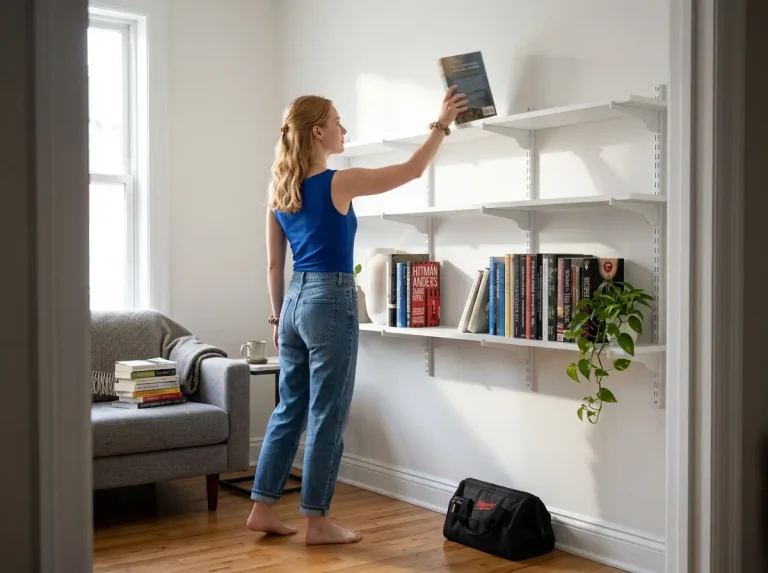
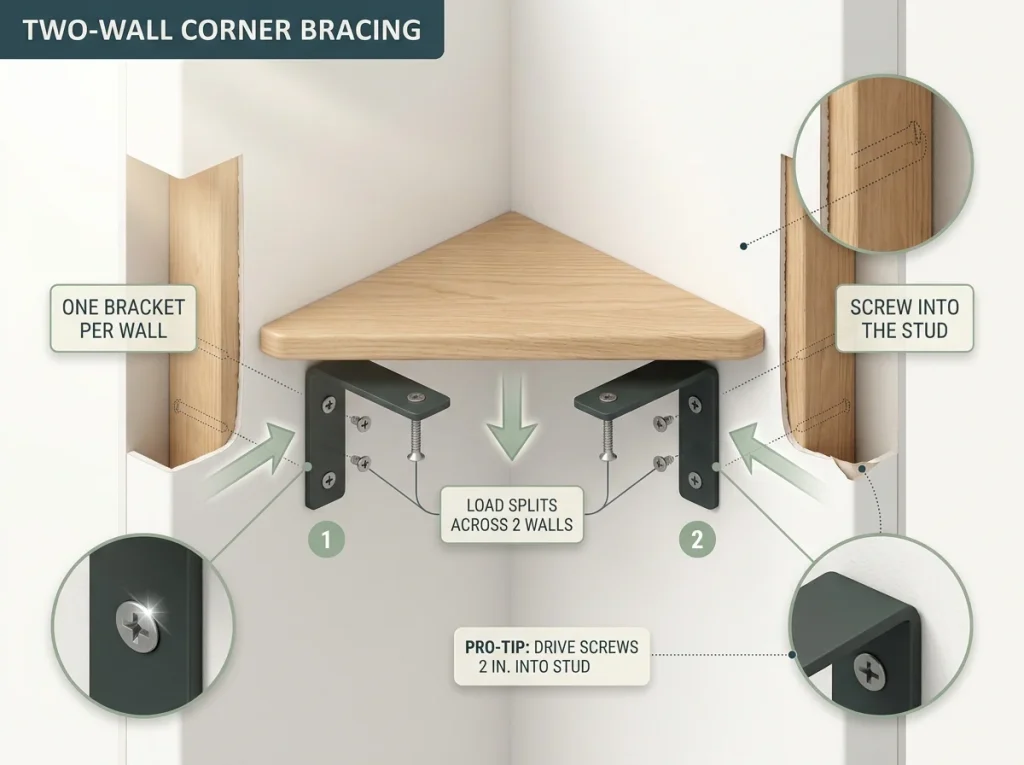
Here’s the trick corners have that flat walls don’t. Instead of one bracket on one wall, you put a bracket on each of the two intersecting walls and join the shelf to both. That roughly doubles the real-world hold compared to a single-wall mount, because the load splits across two anchor points on two surfaces. Find a stud on at least one wall if you can, and drive the screws so they penetrate at least 2 inches into it. The CPSC’s Anchor It! guidelines for securing wall-mounted storage are blunt about this: screws seated only in drywall pull out over time, so reaching a stud is what makes the difference months down the line.
The no-drill option that actually holds weight
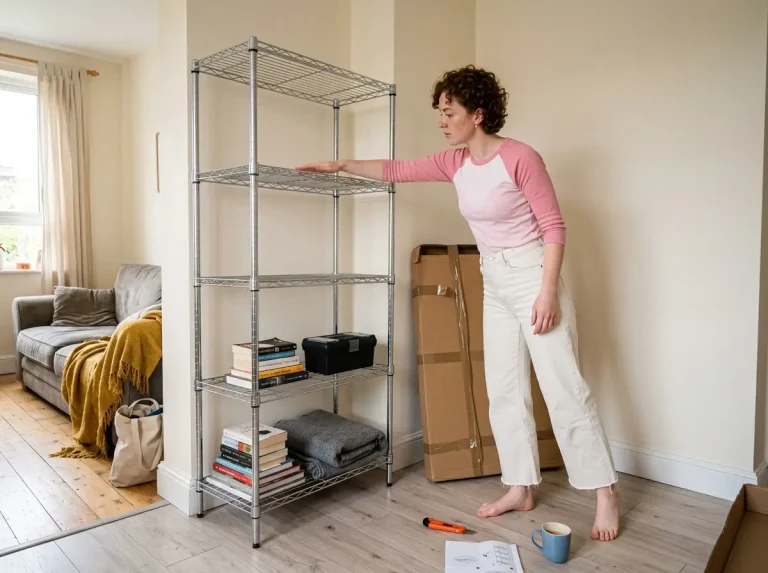
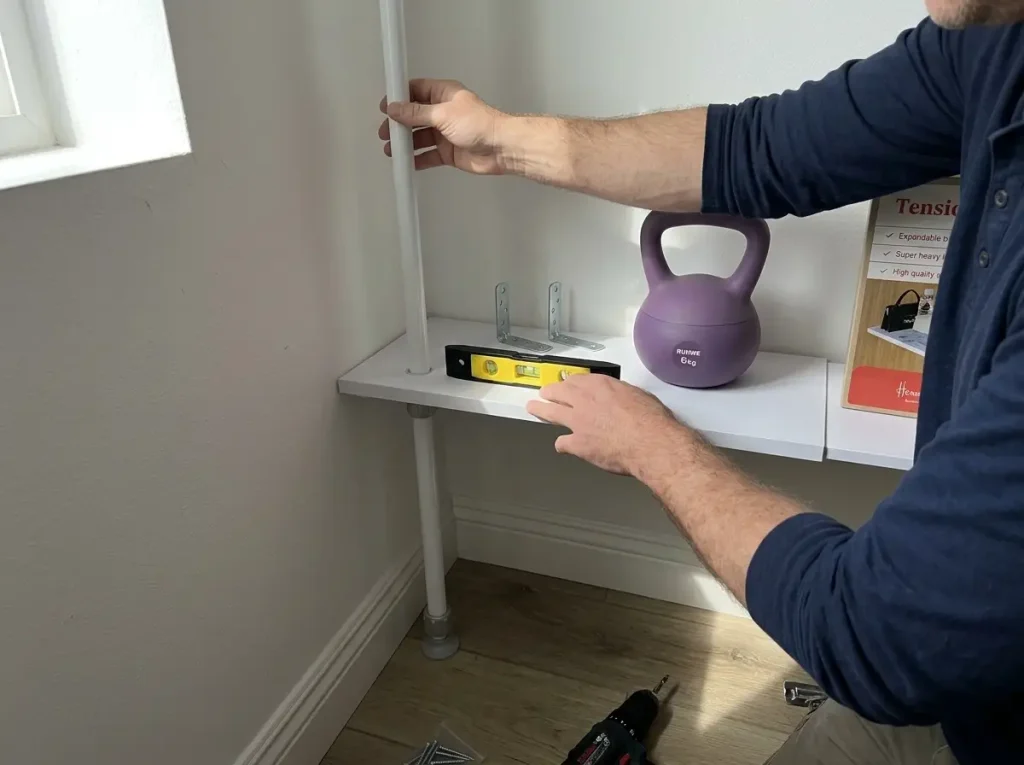
If drilling is off the table, there’s one no-drill route that carries real weight instead of pretending to. Floor-to-ceiling tension-mounted shelving braces against pressure between the floor and ceiling, so it sidesteps the drywall-anchor weight limit entirely. The Home in Bold Tension Rod Shelving is expandable and genuinely no-drill, which puts it in a different class than adhesive. It’s the option renters reach for when they need capacity without holes. Our tension rod shelving ideas that hold real weight cover a few more ways to use the same idea.
The False-Corner Problem Nobody Warns You About
You buy the perfect corner shelf, go to mount it, and the baseboard, an outlet, or a wall that isn’t actually square stops you cold. Older apartments are full of these “false corners,” and no product page mentions them.
What makes a corner “false”
A few things quietly ruin a flush corner mount. A chunky baseboard holds the shelf off the wall seam. An outlet or an HVAC vent sits right where the bracket needs to go. And plenty of walls meet at 88 or 93 degrees instead of a true 90, which is common in older buildings and just enough to leave a gap or a tilt. Standard corner brackets assume a clean square seam, so a false corner leaves you fighting the hardware. The tell is easy to miss until you’re holding a drill.
Hold a carpenter’s square (or anything with a known right angle, like a hardcover book) into the corner before you buy. If light shows through on one side, your corner isn’t 90 degrees, and a freestanding unit will save you an afternoon of frustration.
Freestanding picks that ignore the problem
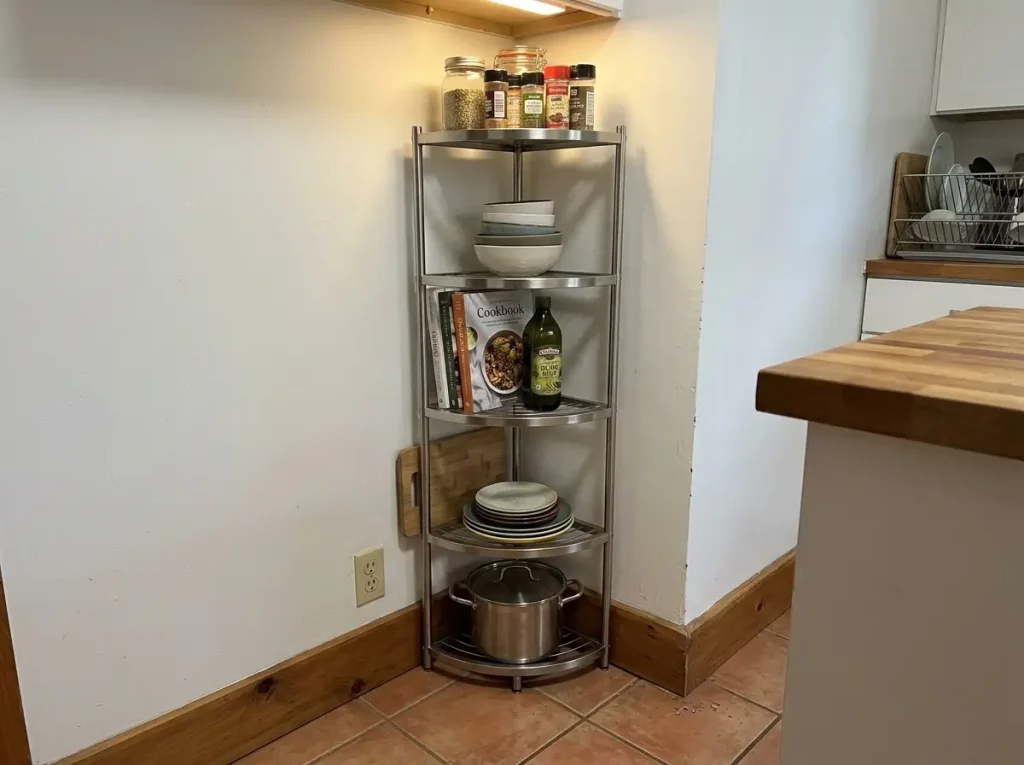
The workaround is to stop fighting the wall. Freestanding and countertop units don’t need contact at the seam, so baseboards, outlets, and off-square walls stop mattering. In a kitchen, a freestanding stainless rack handles humidity and grease better than particleboard and doesn’t care what the baseboard is doing.
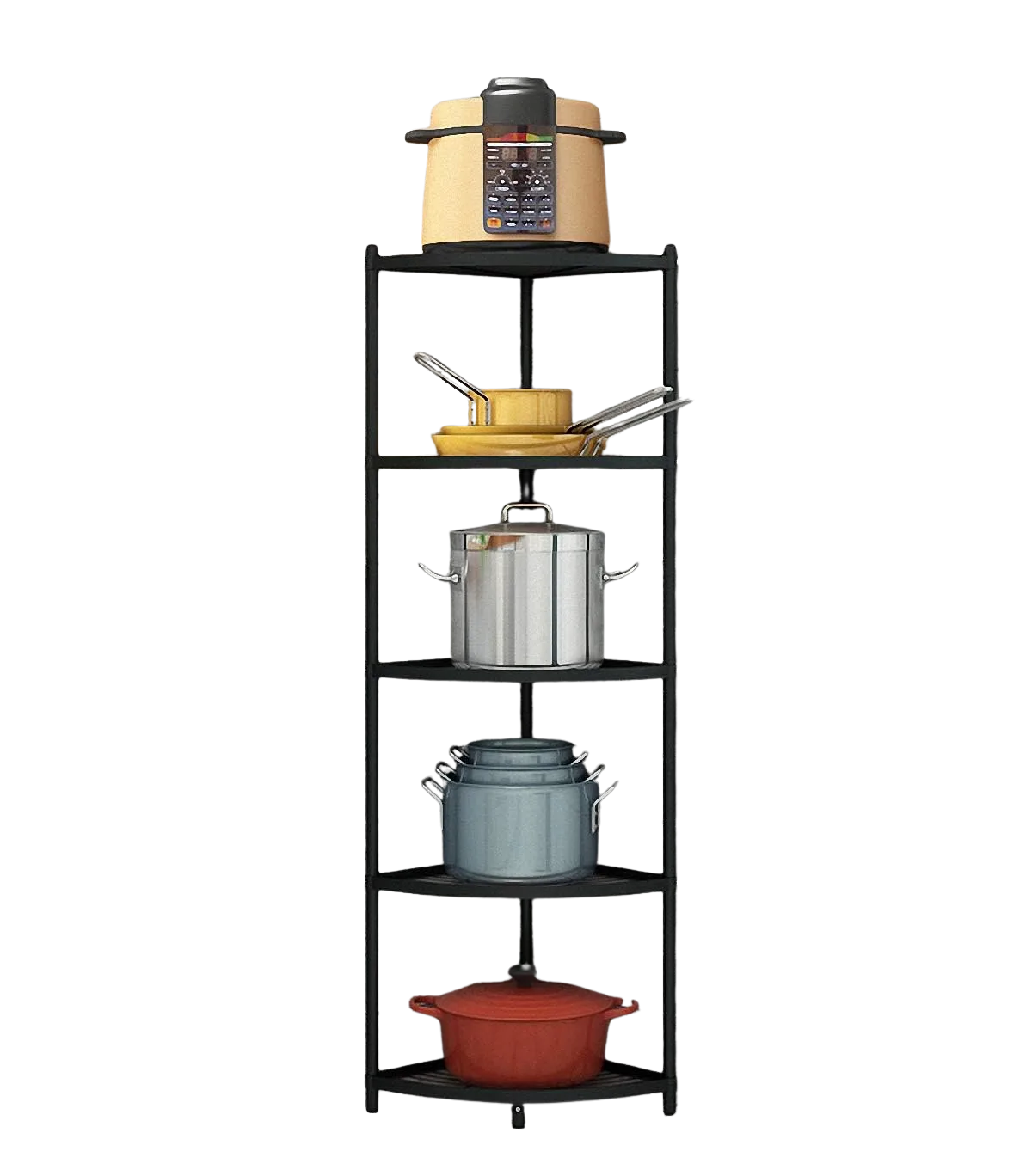
For a bathroom or a kitchen counter corner, the mDesign 2-Tier Freestanding Countertop Corner Shelf takes the idea to its logical end: it sits right on the counter, so there’s no wall contact and no anchoring question at all. It’s the ultimate false-corner workaround. If your bathroom is the tight one, our bathroom storage ideas for small spaces pair well with this pick.
Mounting a Corner Shelf Without Wrecking Your Walls
Renters treat drilling like it’s forbidden and adhesive like a savior. The honest math often runs the other way. If you want the wider view on renter-safe systems, our vertical storage ideas for apartments and the full shelving and racks guide cover how to match a shelf to your wall and your lease.
The renter drill-vs-adhesive trade-off (honest version)
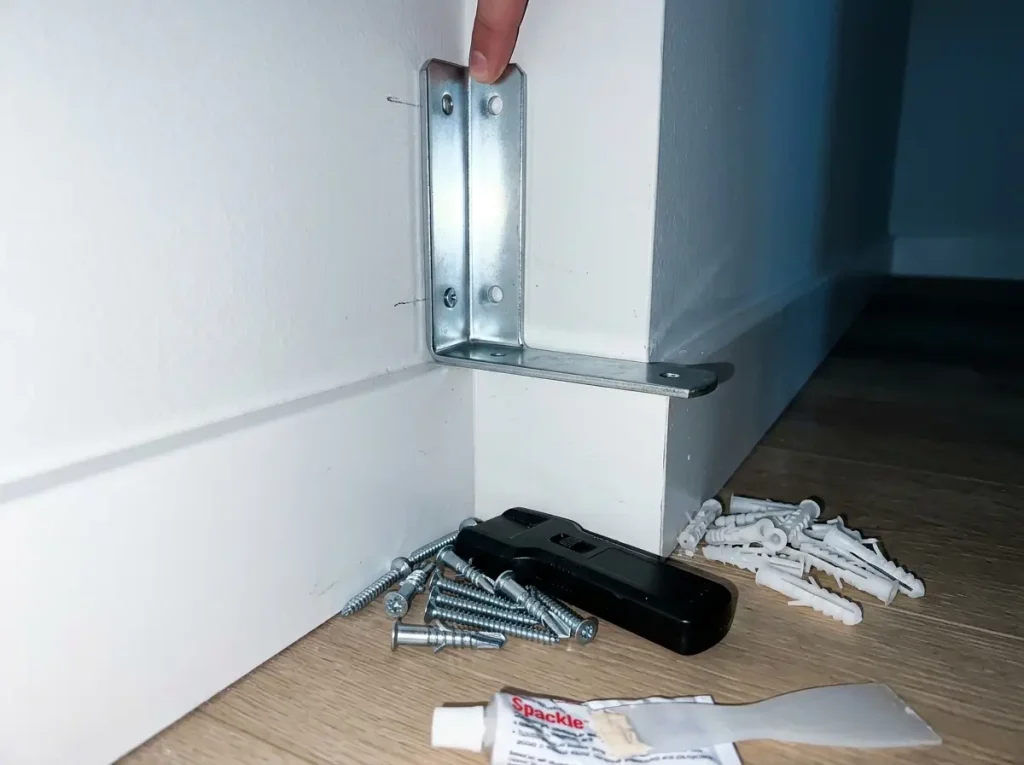
Patching a few drywall screw holes at move-out takes ten minutes and a small tube of spackle. Adhesive-only mounting, meanwhile, can’t hold real weight and often peels the paint when it fails, which is the exact damage you were trying to avoid. So “just drill and patch” is frequently the better renter option, not the forbidden one. The exception is a lease that flatly bans wall damage, in which case freestanding and tension-rod units are your whole toolkit. Weigh the trade honestly instead of defaulting to adhesive because it feels safer.
Hardware worth upgrading
The plastic anchors that ship in the box with cheap shelving are the first thing to throw out. Swap them for metal L-brackets, which is exactly what safety testers recommend. Consumer Reports’ tests of furniture anchor kits point to metal hardware over brittle plastic after failures tied to the flimsy stuff. A metal L-bracket from the hardware store costs pocket change and is the single cheapest upgrade you can make. Then re-check the level and the anchor grip after a few weeks, because the first month is when a marginal mount reveals itself.
Styling a Corner Shelf So It Looks Right (and Stays That Way)
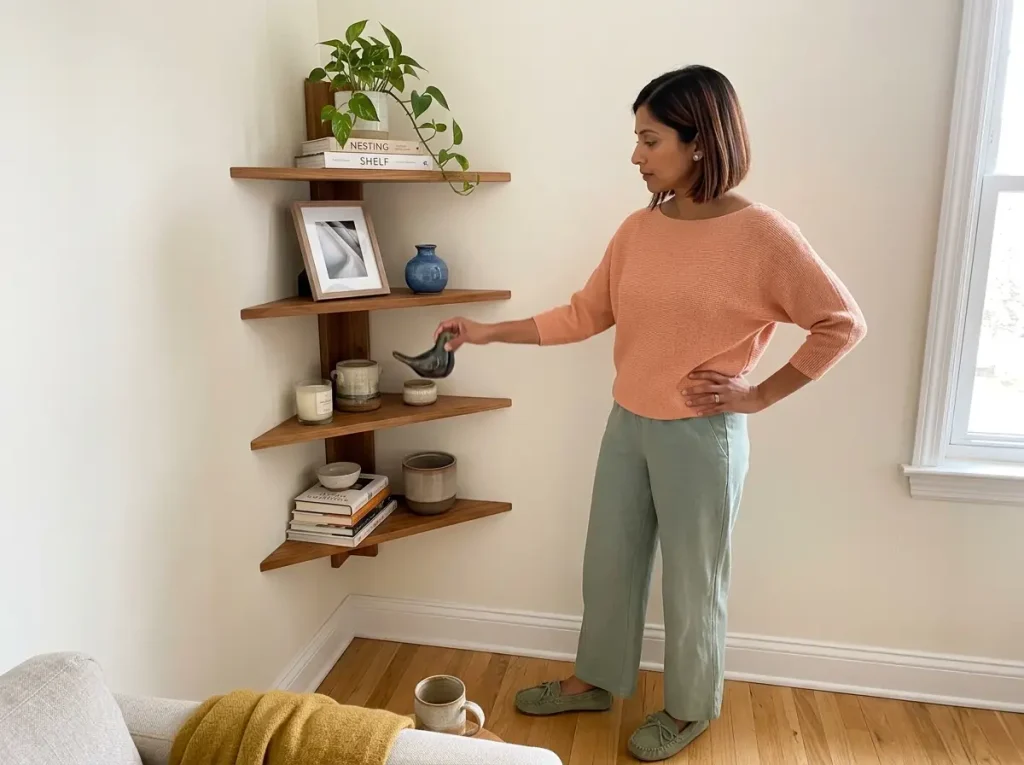
A corner shelf styled like a store display looks great in the photo and annoying by Tuesday. Style it for how you actually reach into it, not for one perfect shot.
The two-thirds rule and weight distribution
Fill about two-thirds of the shelf and leave breathing room. A packed corner shelf reads as clutter, and it makes any tilt more obvious because the eye has nowhere to rest. Vary the height and texture so it looks intentional, and put the heaviest items on the lowest tier. On a freestanding unit that’s not just about looks: a lower center of gravity means less tip risk. Keep the daily-use things at reach height and let the purely decorative stuff live up top where you won’t be grabbing it.
Keeping it from becoming a catch-all
Give the shelf about three months and, without a rule, it drifts into a catch-all for chargers, mail, and whatever’s in your hand when you walk by. The fix is the same one that saves any open surface: one rule per tier. Books on this shelf, plants on that one, a single small basket for the odds and ends. The basket contains the chaos instead of letting it spread across every tier, and that’s what keeps the corner looking the way it did the day you set it up.
Conclusion
Three things decide whether your corner shelf earns its spot. Match the depth to the room, from 4 to 6 inches in an entryway up to 10 to 14 in a kitchen. Let the mount decide the weight, because a freestanding unit or two-wall bracing beats a lone drywall anchor every time. And when the corner is awkward, baseboards, outlets, or walls that aren’t square, a freestanding piece sidesteps the whole problem.
In three months, re-level the shelf and check the anchor grip. A marginal mount and a growing catch-all pile both tend to show up right around then, and both take two minutes to fix if you catch them early.
Start with the one corner that annoys you most. Measure it, depth and angle, before you buy a single thing.
Frequently Asked Questions
01How deep should a corner shelf be in a small room?
It depends on the room: 4–6″ in an entryway, 6–8″ in a bathroom, 8–10″ in a bedroom, and 10–14″ in a kitchen. Match the depth to what the shelf has to hold, since plates need far more room than keys.
02How much weight can a corner shelf hold?
A screw in bare drywall holds only 5–10 lbs, a drywall anchor 10–25 lbs, and a wood stud around 45–50 lbs. Keep drywall-anchor-only shelves under about 20 lbs total, and use a stud or two-wall bracing for anything heavier.
03Can you put up a corner shelf without drilling?
Yes, but pick the right no-drill method. Freestanding and tension-rod units hold real weight with zero holes, while adhesive-only shelves are light-decor-only. Renters widely report adhesive shelves peel off with the paint under any real load.
04Why does my corner shelf look crooked even though it’s secure?
Because a corner puts two walls in the same sightline, so even a half-degree tilt reads as obviously off. Use a level during install, since it’s the single biggest factor in whether a corner shelf looks right.
05What can you put on a corner shelf in a small room?
Match the load to the mount and depth: books and dishes only on a stud-mounted or freestanding unit, and light decor like plants, frames, and candles on adhesive or shallow shelves. Style to about two-thirds full so it doesn’t read as clutter.
Disclaimer: ClutterlessNest is a participant in the Amazon Services LLC Associates Program. As an Amazon Associate we earn from qualifying purchases. This article may contain affiliate links — if you buy through them, we may earn a small commission at no extra cost to you. We only recommend products we have tested or genuinely believe in.