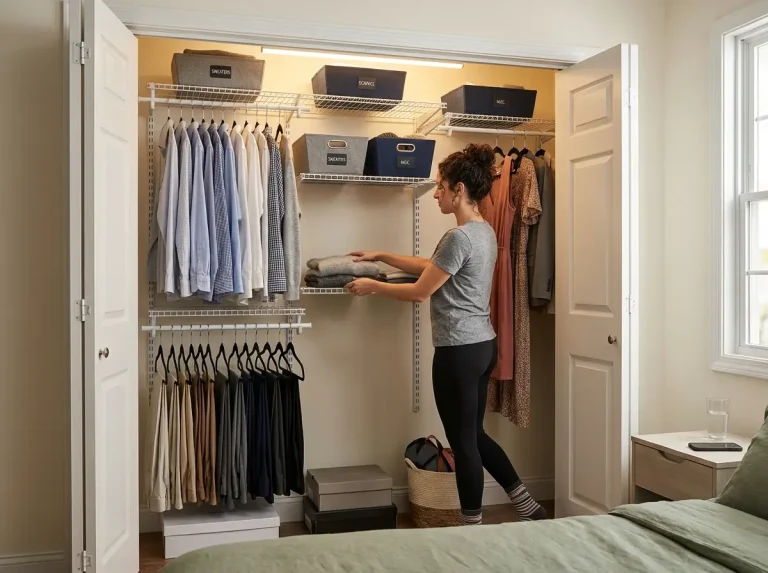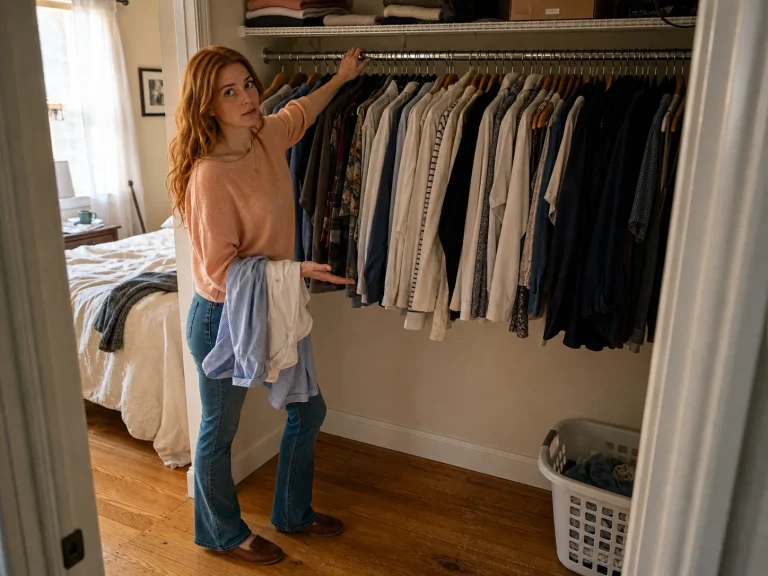
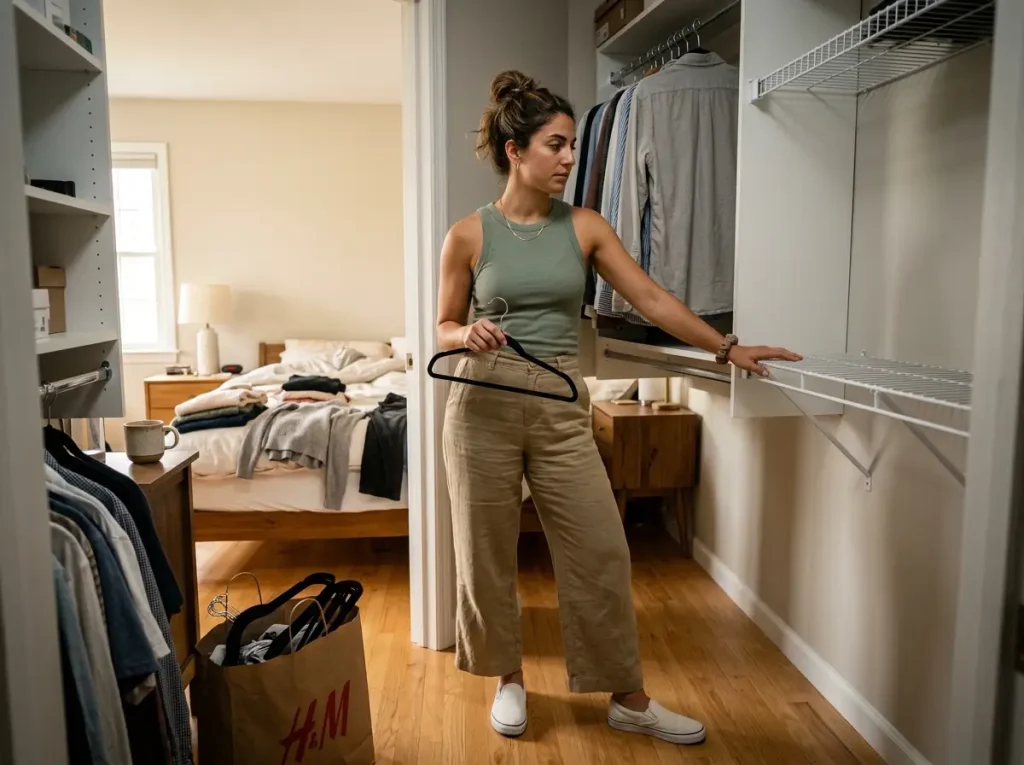
You bought a freestanding rack to fix a crowded closet, assembled it on a Saturday, and a week later the closet looked exactly the same, only now there was a second crowded rack blocking the bedroom. It happens constantly, and the reason is simple: more rod doesn’t fix hanger bunching, and most crowded closets don’t actually need a whole closet system at all. The honest first question isn’t “wire or wood” or “which brand” but something nobody selling systems wants to ask: do you need a system, or would four accessories get you eighty percent of the way for a fraction of the cost? This guide is the buying framework that sits above the specific-product roundup, so you spend money on the right problem. Here’s how the three material types compare, whether you can install any of them as a renter, and when accessories alone are the smarter buy.
Quick Answer
Closet systems come in three materials, and many closets need accessories instead of a full system:
- Wire is the cheapest and lightest-duty, and bows under heavy coats.
- Laminate adds solid shelves for folded knits, at a mid tier.
- Solid wood is the priciest and holds the most weight for the longest.
- Renters should default to freestanding or tension formats and skip stud-anchored laminate.
- If the closet is just crowded, better hangers, a rod doubler, and dividers often fix it without a system.
The Three Closet System Types and What They Cost You Over Time
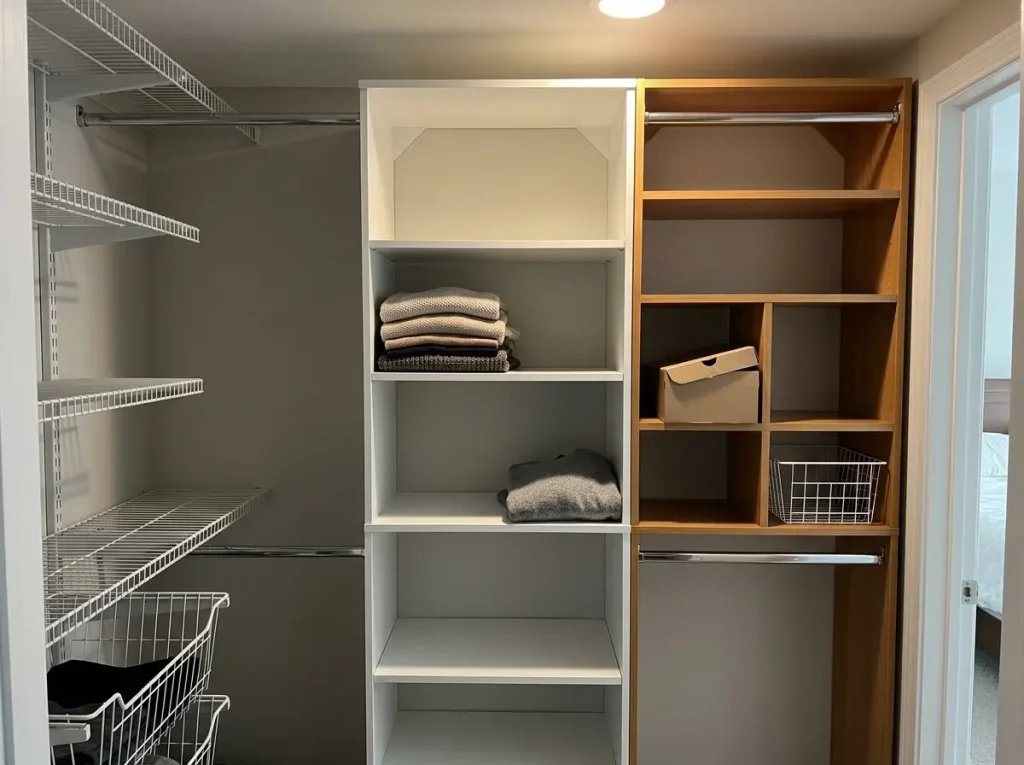
Most people hear “closet system” and picture one thing, but the phrase splits into three materials that behave completely differently the moment you load them with real clothes. The gap between them isn’t looks. It’s how they hold up under a stack of winter coats, and how long they last before you’re shopping again.
| System Type | Best For | Under Weight | Renter-Friendly? |
|---|---|---|---|
| Wire (ClosetMaid ShelfTrack) | Light loads, short stays | Bows under heavy coats | Only on existing brackets |
| Laminate (ClosetMaid Style+) | Everyday mixed clothing | Sags if built too thin | Rarely, stud-anchored |
| Solid Wood (ClosetMaid SuiteSymphony) | Heavy long-term storage | Holds firm, resists warping | No, permanent install |
Wire systems, ventilated and cheap but easy to overload
Wire is the budget tier, and it earns that spot honestly. It ventilates clothes, it’s light to handle, and it goes up fast. The tradeoff is weight capacity: pile a wire shelf with folded sweaters or hang it full of heavy coats and it starts to bow in the middle, because wire has the lowest load rating of the three materials. Wire shelving gets recommended everywhere as the default budget pick. And it works, right up until the closet is holding a winter’s worth of wool, which is exactly the load it was never built for.
For a lightweight or short-term closet, that’s a fair trade. The ClosetMaid ShelfTrack Adjustable Wire Closet System is the recognizable version of this tier, an adjustable track setup sized for a standard reach-in. Just be honest about the load. If your closet leans heavy and long-term, wire is the wrong floor to start from.
Laminate and melamine, solid shelves that still sag if you cheap out
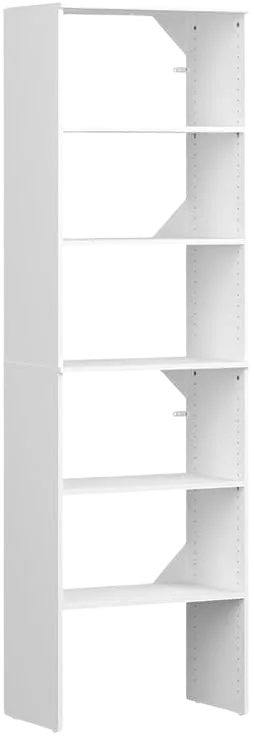
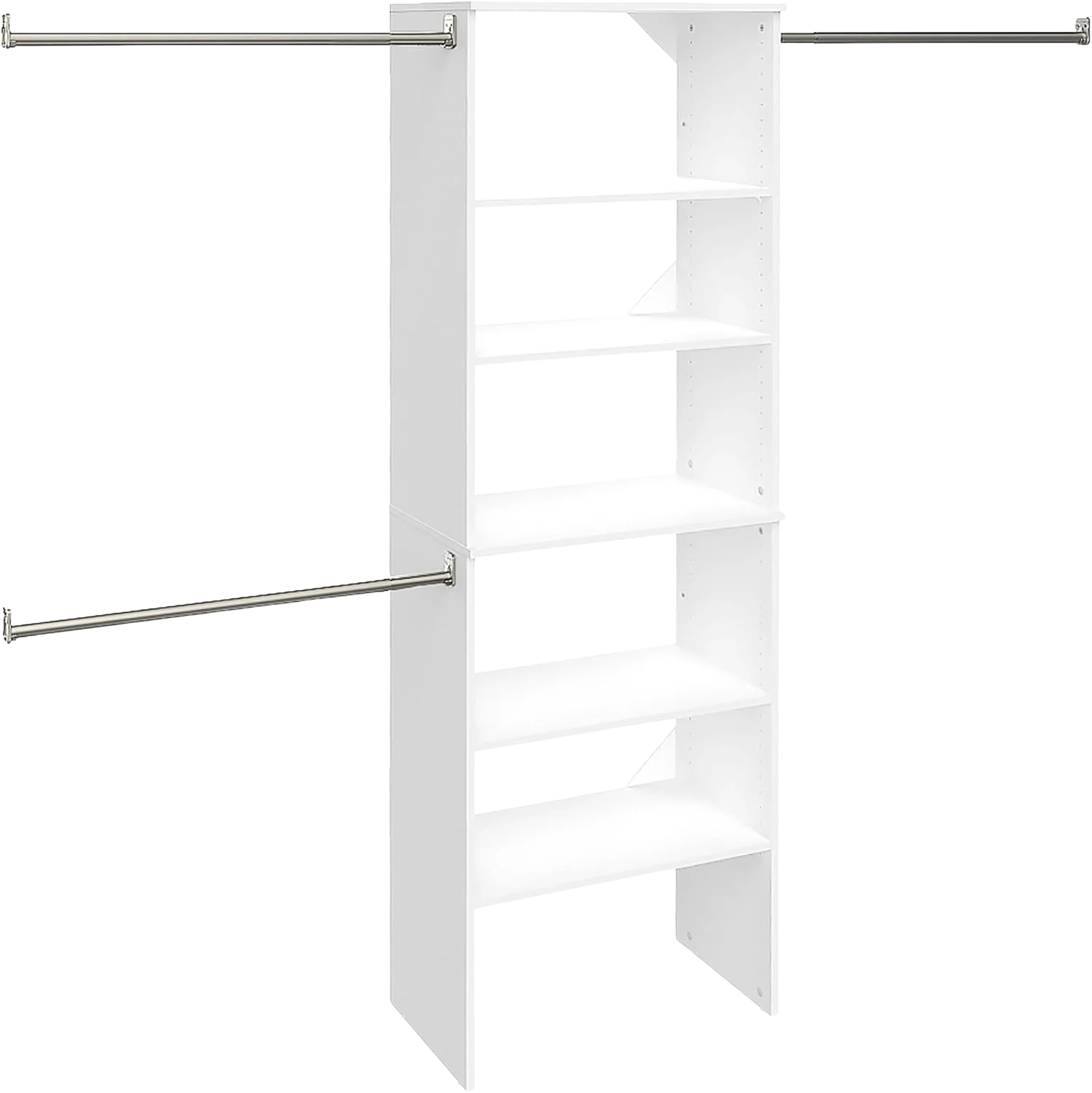
Laminate, sometimes labeled melamine, is engineered wood, a particleboard or MDF core wrapped in a printed finish, and it solves wire’s most annoying problem: the solid flat shelves don’t snag folded knits, and the component range is wider, so you get drawers and cubbies that wire can’t match. It sits in the middle on price and on capacity. The catch is that a bargain laminate kit will still sag under the same heavy seasonal load a wire shelf would, because thickness and how far apart the supports sit matter more than the word “laminate” on the box.
Solid wood, the heaviest-duty and the longest-lived
Solid wood is the top tier, and it’s the format to reach for when the closet is doing double duty as heavy off-season storage: boots, stacked bins, folded blankets, the stuff that crushes wire and sags cheap laminate. Cut-to-fit custom wood systems can support up to roughly 1,200 pounds of static load and resist the warping that wire and plastic develop over years. It’s the buy-it-once option if you own the home and the closet is staying.
The tier people regret is the one that ignores their timeline: premium wood in a rental they leave before it pays off, or bargain wire in a closet stuffed with coats it was never rated to hold. Once you know which specific kit you’re leaning toward, our roundup of the specific closet systems that actually hold up walks through the individual models side by side.
Wall-Mounted vs Freestanding, the Renter Question by Material
Every buying guide quietly assumes you own the place and can drill into a stud. Renters get one sentence, usually buried at the end. So let’s flip it and make the install format the first decision, because for a lot of people it rules out two of the three materials before price ever comes up.
Wall-mounted, the strongest hold and the owner’s territory
Wall-mounted systems anchor into studs or drywall, which gives them the strongest hold and the cleanest look. That strength is also the catch: holes, hardware, and a security deposit on the line. This is owner territory, or a long lease where you’ve cleared it in writing. It’s where laminate and wood belong, because both usually assume a stud-anchored mount.
Freestanding and modular, no drilling but anchor it yourself
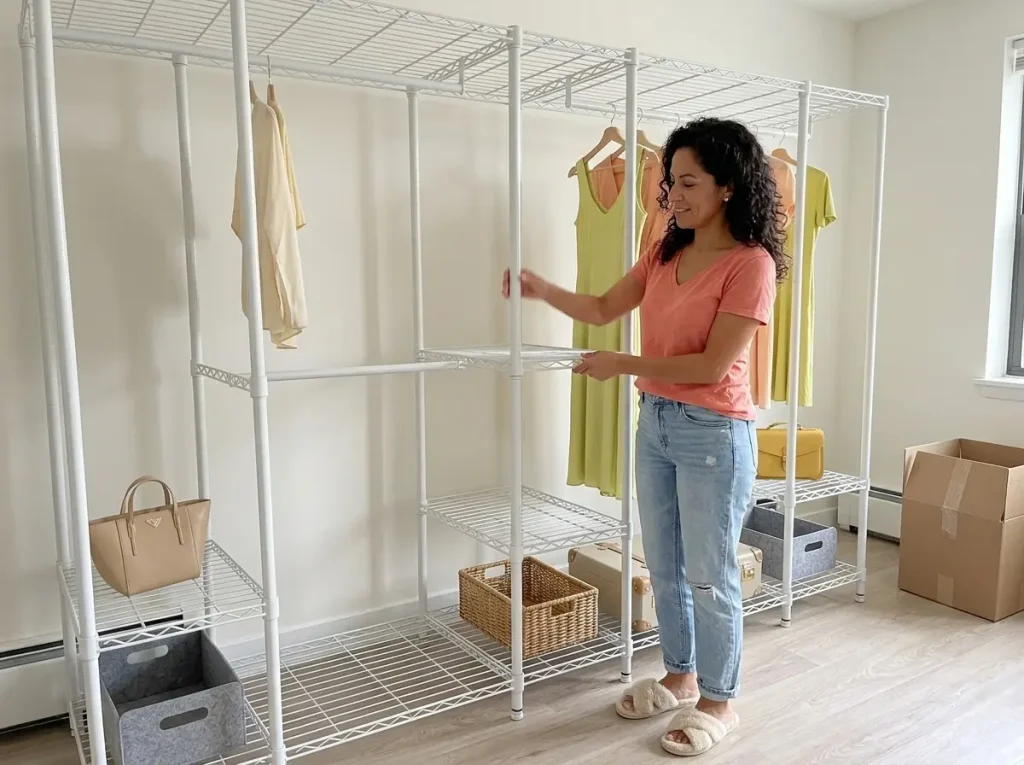
Freestanding and modular systems are the only category that fully sidesteps the wall-anchor problem, which makes them the renter’s real answer. They stand on their own feet, so there’s nothing to patch at move-out. One safety note people miss: a tall freestanding tower is not automatically covered by the federal tip-over rule the way a dresser is, so you anchor it yourself. That standard, the CPSC’s mandatory tip-over safety standard for clothing storage units, explicitly leaves shelving units out, so a strap is on you.
The VIPEK V50 Closet Organizer System is a heavy-duty freestanding example that avoids wall anchors entirely, which is the whole point for a renter. One honest limit, though: a freestanding rack adds a second place to hang things, not individual hanger positions, so on its own it relocates crowding rather than solving it.
A rubber-ended tension rod is a genuinely no-damage second rod for a renter, as long as you don’t overtighten it. But it won’t stop hangers from sliding together, so pair it with hanger spacing or dividers. On its own, it’s half a fix.
Which materials a renter can actually use
Map it across all three and the picture is clear. Wire is renter-viable only when there are already fixed brackets on the wall or you use a load-rated no-drill mounting kit. Laminate is the least renter-friendly format, because most kits are designed to bolt into studs. Freestanding and tension setups are the only two categories that fully avoid wall anchors, which is why renters almost always land there. If that’s you, the no-drill closet systems built specifically for renters go deeper on the exact setups that come down clean at move-out.
Do You Need a Full System, or Will Accessories Fix It?
Here’s the question the whole category is built to skip. Before you spend on any system, figure out what’s actually wrong with the closet, because a crowded closet is usually not a shelving shortage. It’s wasted vertical space and bulky hangers eating the room you already have. Name the real problem first, and the right purchase often turns out to be a fraction of what you were about to spend.
I used to point people straight at a full system whenever they described a jammed closet. After enough “bought a rack, still crowded” stories in organizing threads, I changed the opening question to a different one: is this a capacity problem, or a wasted-space problem? Nine times out of ten it’s the second, and the second doesn’t need a system.
Diagnose the real problem before you buy
Stand in front of the closet and look up. If there’s a foot of dead air above the rod and the clothes are packed shoulder to shoulder, you don’t have a storage-capacity problem, you have a layout problem. That distinction decides everything downstream. A capacity problem, genuinely too much to fit, might justify a system. A layout problem, space you’re wasting, almost never does.
The freestanding-rack failure is the clearest tell. People buy one to relieve a crammed closet, and weeks later they’ve got the same hanger bunching spread across two rods instead of one. More rod added length; it never added fixed spacing, which is what the clothes actually needed.
The accessories that replace a system
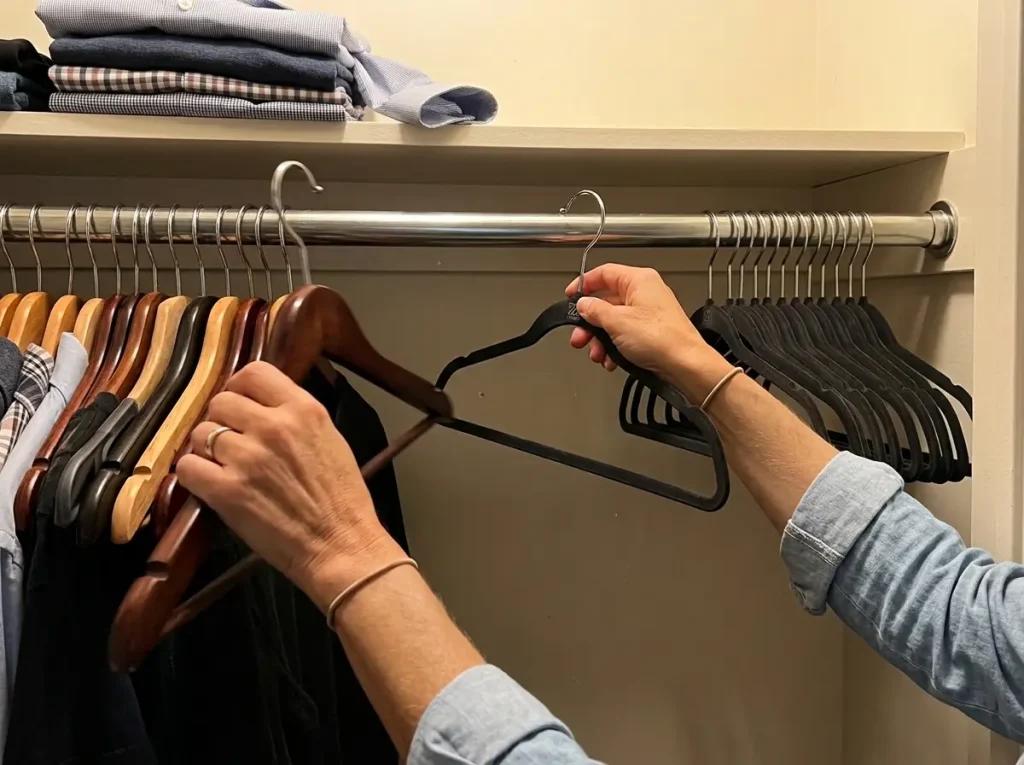
Once you’ve named it as a wasted-space problem, a short list of accessories does the work a system was going to do. The single highest-return swap is hangers. Switching from bulky wood or plastic hangers to slim velvet reclaims a measurable stretch of rod without buying anything structural, because velvet hangers are thinner and grip fabric so clothes stop sliding into a pile.
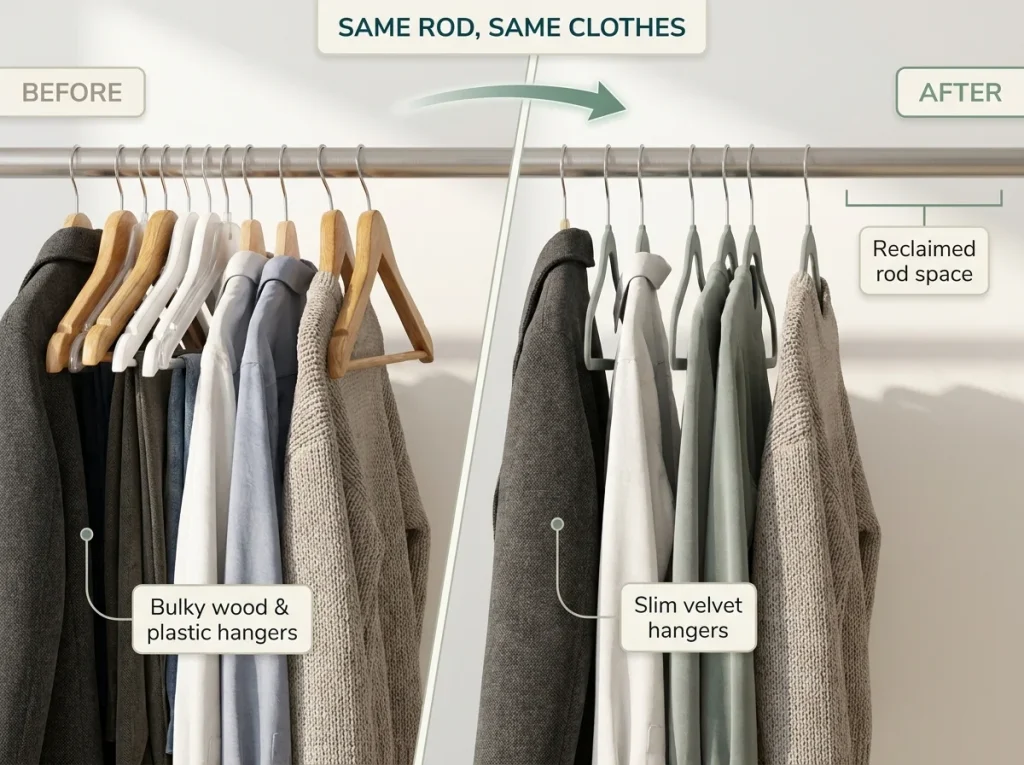
The Zober Premium Velvet Hangers are the standard version of this swap, thin enough that the same rod holds noticeably more, with a flocked surface that keeps silk and rayon from slipping off. Add a rod doubler for a second hang zone and a set of dividers to stop shelf piles toppling, and you’ve handled the most common crowding for a small share of a full system’s cost. If you’re weighing the swap, how velvet and wood hangers really compare for rod space breaks down the tradeoffs by garment type. The budget logic here is the same one behind why the cheapest closet fixes usually last longest.
When a full system is actually worth it
Accessories aren’t always the answer, and it’s worth being straight about when they’re not. A full system earns its cost in three situations: heavy long-term storage that needs real load capacity, a full closet rebuild where you’re starting from bare walls, or an owner investing in a home they’re keeping. If none of those describe you, the accessories route almost always wins on both cost and reversibility.
Run the accessory route first, then live with it for two weeks before you buy anything bigger. Most people find the hanger swap plus a rod doubler solved the problem, and the system they almost bought would have been an expensive way to store air.
The Closet Accessories That Actually Matter
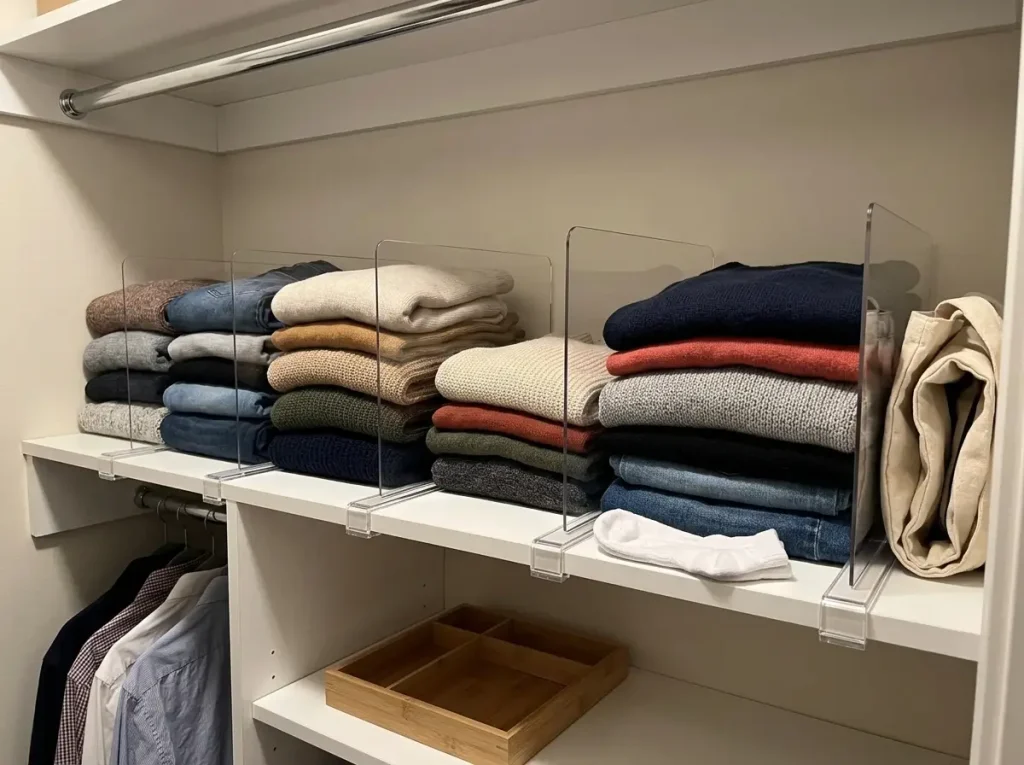
Not every accessory earns its shelf space, and the closet aisle is full of ones that look useful and fail quietly. These are the categories worth knowing, along with the failure mode for each, so you buy the version that lasts instead of the version that bows.
Rod doublers and extenders, great idea and the weakest hardware
A rod doubler adds a second hang zone for shirts and pants, and it’s one of the best space returns in the closet. But the hollow telescoping extender is the weakest hardware category in here. A solid metal rod holds roughly 50 pounds per linear foot and a thick wood rod about 100, while hollow telescoping and extender rods often manage only 20 to 30. People load them like a solid rod and get visible bowing before the closet is even full. The conventional move is to buy the highest weight rating on the label. In practice, thickness tells you more than the sticker does.
The STORAGE MANIAC Adjustable Closet Double Rod is a sturdier take on the double-rod idea, built heavier than the flimsy telescoping versions that bow within a season. Hang it, load it evenly, and it adds a genuine second tier instead of a slow droop.
Shelf dividers and drawer inserts, where fit beats quantity
Shelf dividers stop the toppling-pile problem, the one where a stack of folded sweaters leans into its neighbor until the whole shelf is a landslide. The failure mode is subtle: non-tension-fit dividers slide out of position, so the fit matters far more than how many come in the pack. The HBlife Acrylic Shelf Dividers slot over the shelf edge to hold their spot, which is exactly what a loose divider can’t do. If falling piles are your specific headache, why closet shelf piles keep falling over goes deeper on the mechanics.
Drawer inserts have their own trap: they only work when sized to the drawer’s depth. Buy a fixed insert too deep and the drawer won’t close, which is why an adjustable set is worth the small premium. The SpaceAid Bamboo Drawer Dividers expand to fit varying drawer depths, so you size them to the drawer instead of hoping the drawer matches the box.
Measure the drawer’s interior depth before buying any insert, and check that it clears the drawer front when closed. A wrong-depth insert that blocks the drawer from shutting is the most common accessory return, and it’s entirely avoidable with a tape measure.
Hanging organizers and hangers, small reversible wins
Fabric hanging organizers and better hangers round out the set, and their strength is that every one is small, reversible, and renter-safe. None of them puts a hole in a wall, and any of them can come out at move-out with nothing to patch. That’s the quiet advantage of building with accessories: you can undo it. For a broader look at the pieces worth keeping, the renter-friendly accessory picks worth keeping rounds up the dividers, rod doublers, and over-door organizers that actually hold up.
Matching a System or Accessory Set to Your Actual Closet

The most expensive closet mistake is buying for the aspirational closet, the roomy one in the product photo, instead of the one you have. The fix is three measurements, taken before you order anything, and one of them is the one almost everyone forgets.
The standard reach-in baseline and how to measure yours
Standard reach-in closets run three to eight feet wide, about eight feet tall, and roughly 24 inches deep. Every off-the-shelf wire or laminate kit is sized against that baseline first, so knowing where yours falls tells you immediately whether a stock kit fits or whether you’re in cut-to-fit territory. A walk-in closet changes the math entirely, with room for systems on two or three walls, but the reach-in is the box most kits are built for. Measure width at the rod height, not just at the door, because closets aren’t always square. For a fuller picture of what that standard box can do, how a standard reach-in wastes half its space is worth a read.
Shallow and rental closets, where the standard breaks
Rental and older closets often skew narrower and shallower than the 24-inch standard, and that changes which kits fit before you even look at material. A shallow closet can rule out deeper drawer units entirely. Standard shelf depth runs 12 to 14 inches for a reason, so don’t assume deeper is automatically better in a tight closet.
The three measurements that prevent a return
Here’s the one people skip: the door header height. A 16-inch shelf can fit the 24-inch closet footprint perfectly and still collide with the door header on the way in, because the header sits lower than the closet is deep. Measure width, depth, and header height before you buy anything. The shelf or bin that sticks out past the door frame so the door won’t close is the mistake nearly everyone makes exactly once, and then they measure the header forever after. The same depth logic decides which storage bins that actually fit real closet shelves are worth buying.
Why Closet Systems and Accessories Fail Within Months
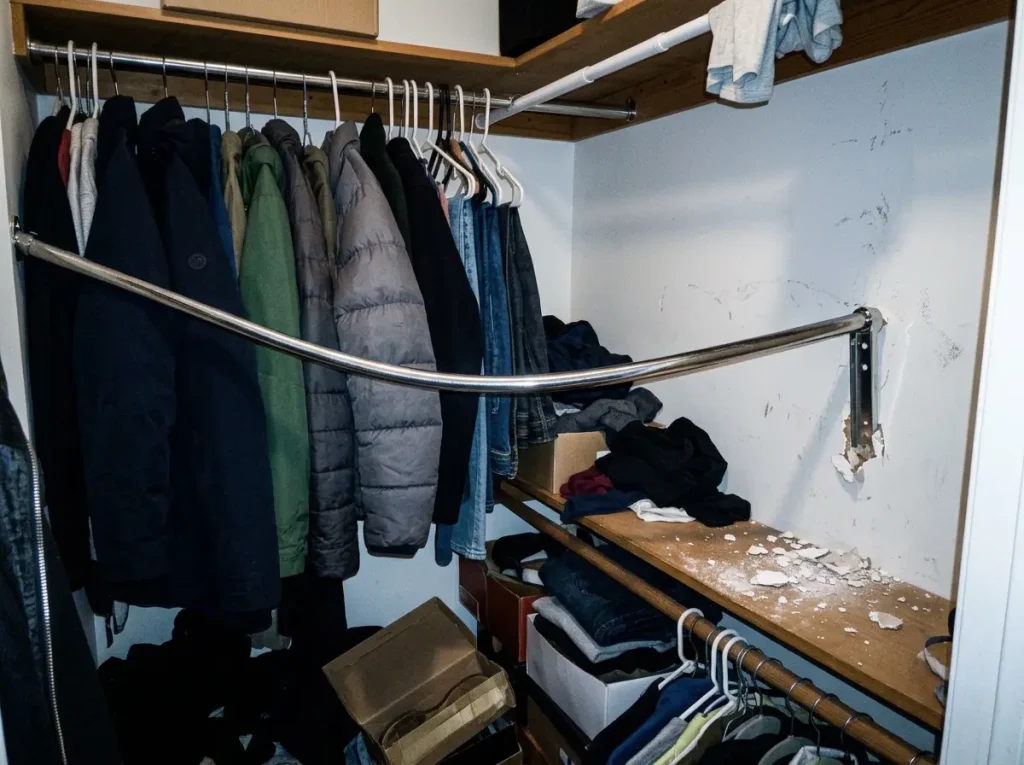
The “after” photo is never the finish line. Daily life is. Most closet setups don’t fail because the parts were bad; they fail because one weak link gets blamed for the wrong reason, and people replace the part that was never the problem. Here’s what actually breaks, and how to catch it before you buy twice.
The sagging-rod misdiagnosis, it’s the anchor, not the rod
A drooping closet rod looks like a rod problem, so people buy a stronger rod. But over 60 percent of the time the real failure is the wall anchor pulling out of the drywall or missing the stud entirely. The rod is fine; the mount let go. Swapping in a beefier rod on the same failed anchor just buys you a few weeks before it sags again. Check the anchor first, every time, before you blame the rod’s rating.
Why extenders and dividers fail, thickness and fit
Extender rods bow because they’re the weakest hardware category loaded like the strongest, and thickness predicts bowing far better than the printed weight rating. Dividers slide because they aren’t tension-fit to the shelf. Drawer inserts jam because they were sized wrong. Notice the pattern: accessory failures are almost always a fit or a spec problem, not a quality problem. Buy for the actual load and the actual dimensions and most of these never happen.
The three-month check that saves a second purchase
Freestanding towers add one more failure point worth naming: the anti-tip anchor. Federal safety guidance sets the floor at 50 pounds of holding force for anchor hardware, so a cheap adhesive-only strap with no stated rating falls short of it. The CPSC’s Anchor It! campaign for freestanding storage spells out the anchoring basics. Put all of it on a calendar: at the three-month mark, re-seat any wall anchors, confirm nothing is bowing, and check that the dividers still hold their spacing. Ten minutes twice a year is the whole difference between a setup that lasts and one you buy again. If tip-over is a live worry, freestanding units rated for real weight are built for it.
The Bottom Line on Systems vs Accessories
Three things to carry out of here. First, match the material to the load and to how long you’ll stay: wire for light and short, laminate for everyday, wood for heavy and permanent. Second, if you rent, default to freestanding or tension formats and skip stud-anchored laminate. Third, and most important, diagnose before you buy, because most crowded closets are a hanger or a rod problem wearing a system’s price tag.
In three months, run the ten-minute check: re-seat any wall anchors, look for bowing, and confirm the dividers still hold their spacing. That pass is what keeps you from buying the same fix twice.
Start with a tape measure, not a shopping cart. Measure width, depth, and header height, then look up at the dead space above your rod. If a hanger swap and a rod doubler close the gap, you just saved the cost of an entire system.
Frequently Asked Questions
01What is the difference between a wire and laminate closet system?
Wire is the cheapest tier, ventilates clothes, and bows under heavy loads. Laminate adds solid shelves so folded knits do not snag and handles more weight, but a bargain laminate kit still sags if overloaded. Wire suits light or short-term closets; laminate suits everyday mixed use.
02Are closet systems worth the cost?
A full system is worth it for heavy long-term storage, a full rebuild, or a home you own. If your closet is just crowded, better hangers, a rod doubler, and dividers often fix most of the problem for a fraction of the cost. Diagnose the real issue before you buy.
03Can you install a closet system if you rent your home?
Yes, but stick to freestanding or tension-rod formats that avoid wall anchors. Most laminate kits assume a stud-anchored install and are the least renter-viable. Wire works only on brackets already present or with a load-rated no-drill kit.
04How much weight can a closet rod hold before it sags?
A solid metal rod holds roughly 50 pounds per linear foot and a thick wood rod about 100, but hollow telescoping and extender rods often manage only 20 to 30. And most sag is not the rod at all. Over 60 percent of the time it is the wall anchor pulling loose.
05What closet accessories make the biggest difference in a small closet?
Slim velvet hangers reclaim measurable rod space with zero install, a rod doubler adds a second hang zone, and tension-fit shelf dividers stop toppling piles. Together they solve the most common crowding without a full system.
Disclaimer: ClutterlessNest is a participant in the Amazon Services LLC Associates Program. As an Amazon Associate we earn from qualifying purchases. This article may contain affiliate links — if you buy through them, we may earn a small commission at no extra cost to you. We only recommend products we have tested or genuinely believe in.