

You’re standing at a rod that won’t hold one more shirt, a cart of velvet hangers open in one tab and wood in another, trying to pick a winner. Here’s the thing almost nobody tells you before you buy: there isn’t one. Velvet wins the space fight. Wood wins the structure-and-longevity fight. The verdict that keeps surfacing in organizing threads is the same one an honest closet gives you after a year of real use, which is to stop picking a side and split the rod by what you’re actually hanging. This guide covers the real rod-capacity math for a rental closet, where each material earns its keep, why velvet quietly stops working after the first year, and how to build the hybrid setup without buying a full closet’s worth of anything.
| Factor | Velvet hangers | Wood hangers |
|---|---|---|
| Rod space | Fits about 25% more | Bulkier, fewer per foot |
| Best garments | Everyday, silky, delicate tops | Coats, suits, structured pieces |
| Durability | Flocking peels in 1–2 years | Lasts 10–20 years |
| Grip on slippery fabric | Strong, non-slip grip | Smooth surface can slip |
| Where it fails | Snaps, peels, transfers fuzz | Eats more rod space |
How Much Rod Space Each Hanger Actually Saves
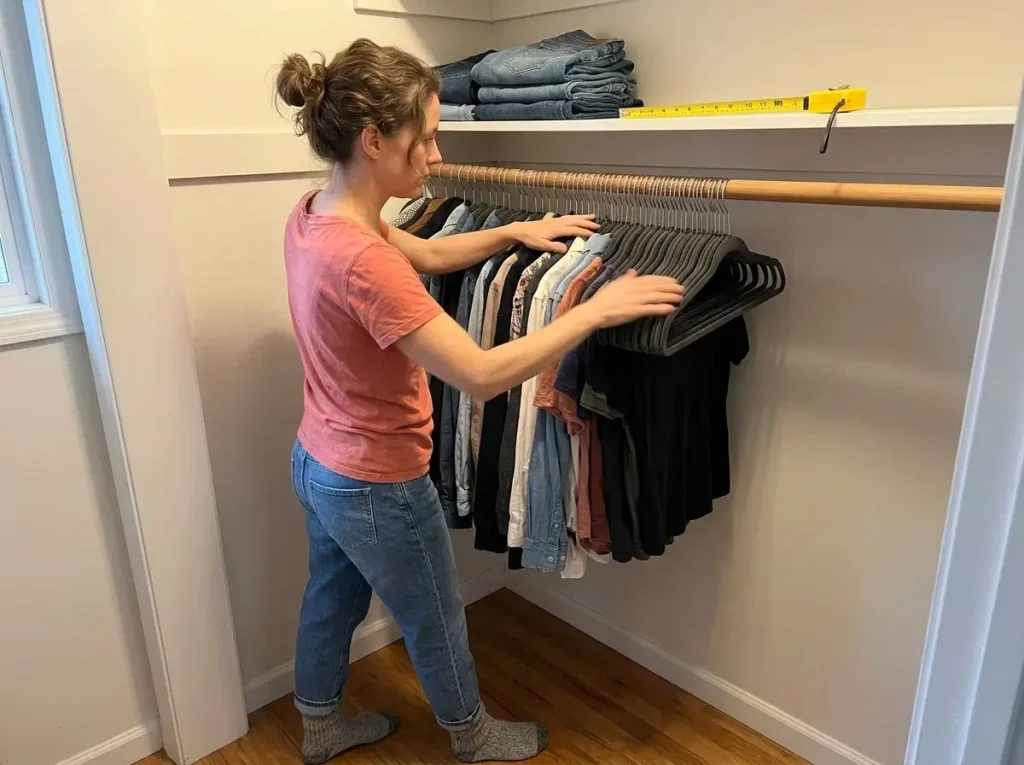
The space claim is the whole reason people switch to velvet, and it’s true. But the problem is, every comparison you’ll read runs the math for a rod length renters don’t actually have. They quote a generous six-foot rod. You’re working with a reach-in closet that’s closer to 48 inches wide, and the math changes when you anchor it to the rod in front of you.
The Thickness Math That Creates the Gap
A velvet hanger runs about 0.2 inches thick. A wood hanger runs half an inch to well over an inch at the shoulder, where it’s widest. Line them up and roughly six velvet hangers fit in the rod space of two-and-a-half wooden ones. Across a standard 36-inch section, that works out to about 18 to 20 velvet hangers versus 14 to 16 wooden ones. Call it 25% more hanging units on velvet, which sounds abstract until you picture it on your rod.
For the space-saving side, the house reference is the Zober Premium Velvet Hangers. At 0.2 inches thick they’re exactly the slim profile the math above is built on, and a 50-pack covers most of a reach-in closet in one shot. The one caveat worth naming up front: slim and grippy is great for shirts and blouses, less great for a winter coat, which is a problem the next section gets into.
Do the Math for Your Rod, Not a Showroom’s
Most rental reach-in closets fall in a predictable range, and it helps to know it before you buy anything. According to standard reach-in closet measurement guidelines, the single rod usually spans 48 to 72 inches, mounted around 60 to 66 inches high, in a closet 24 to 30 inches deep. Use the low end as your real floor. On a 48-inch rod, that 25% difference is the gap between fitting your whole work wardrobe and leaving three shirts folded in a drawer.
The space you gain on day one is real, but it’s front-loaded. You swap the hangers, admire the empty stretch of rod, and then quietly fill it back up within a month, because empty rod space reads as an invitation. Freeing space and keeping it free are two different projects.
A quick side-by-side is easier to trust than any inch count, and this walkthrough shows the rod density difference on a real closet.
If you want the full breakdown of how far slim hangers actually stretch a crowded rod, that comparison goes deeper on the numbers. And if your closet is fighting you on depth as much as width, the reach-in closet geometry most rentals share explains where the rest of your dead space is hiding.
Which Hangers Hold Up Under Weight and Years

Velvet saves space. It does not save your coat’s shoulders. The difference between the two materials isn’t cosmetic once weight enters the picture, because you’re comparing a thin wire core to a rigid frame, and that shows up on anything with structure.
Why Wire-Core Velvet Warps Under Weight
Inside a velvet hanger is a wire core, and it’s thinner than it looks, around 1.8mm. It starts to bend under roughly three pounds of sustained weight. A heavy wool coat or a structured blazer left hanging overnight doesn’t fall, it slowly distorts at the shoulder. This is the failure people miss because it isn’t dramatic. You don’t notice it until you put the coat on and the shoulders sit wrong, and by then the shape has set. Structured pieces are exactly the garments you don’t want to learn this lesson on.
Where Wood Earns Its Extra Inches
Wood gives up rod space and gets durability in return. Cedar and maple hangers, both dense hardwoods, are rated to last 10 to 20 years with almost no care, which puts them closer to a one-time purchase than a recurring one. Cedar adds a property velvet can’t match: it repels moths, which matters for anything you store across a season. The SONGMICS Red Cedar Wood Hangers are a solid pick for your keeper pieces, with the contoured shoulder that holds a coat square and the natural cedar that earns its spot in a seasonal storage zone.
Here’s the honest part, though. You do not need wood for your whole closet. I used to think of it as the upgrade you eventually make for everything, until the pattern in side-by-side threads made the case for restraint: you need wood for the handful of pieces that have shoulders worth protecting, and slim hangers for everything else. Buying a full set of wood hangers for T-shirts is spending rod space and money to solve a problem T-shirts don’t have.
Count your structured pieces before you buy a single wood hanger. Most people land somewhere between five and ten: a couple of blazers, a wool coat, a suit, maybe a heavy cardigan. That number is your wood-hanger shopping list. Everything past it is momentum, not need.
When the season turns, where to hang heavy winter coats without wrecking the shoulders walks through the same structure-first logic for your bulkiest pieces.
Matching the Hanger to the Garment
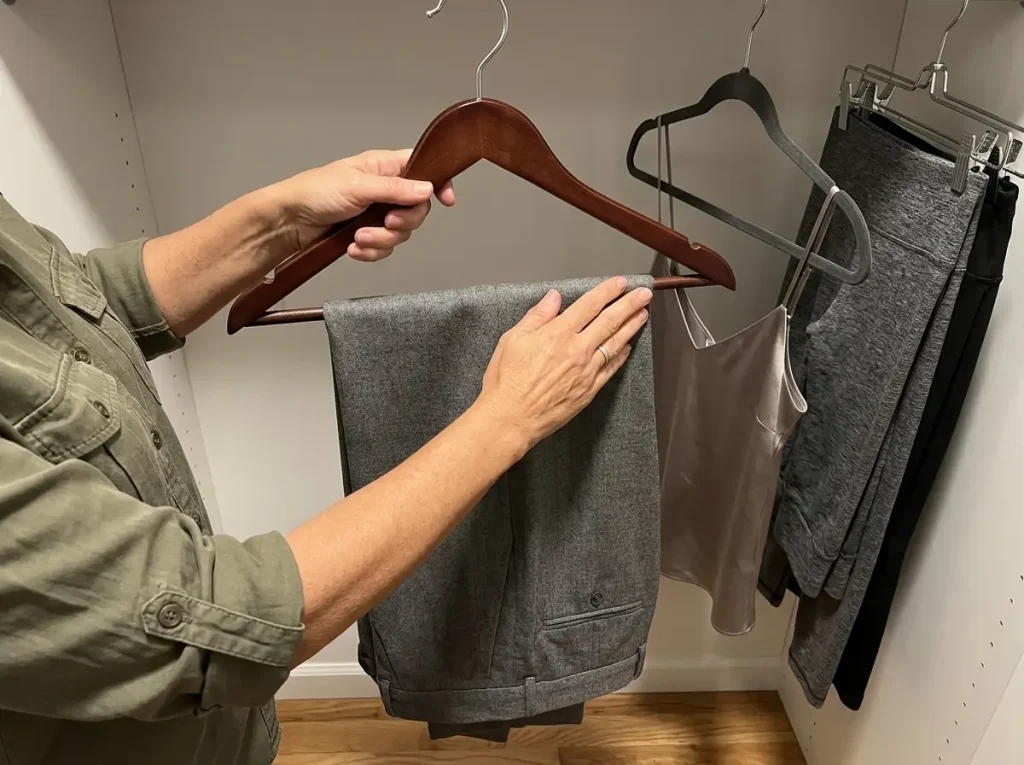
Once you stop asking which hanger is better and start asking which hanger for this shirt, the whole decision gets simple. The material follows the garment. Here’s the sort.
Velvet and Slim for Everyday and Delicate
Velvet and slim hangers own the everyday and the slippery. Silk, satin, jersey, camisoles, everyday dress shirts, anything that slides off a smooth hanger and ends up in a puddle on the closet floor at two in the morning. The flocking, that fuzzy grip coating, is the entire point here. It holds a slippery strap in place where a wood or wire hanger lets it slide. For the bulk of a closet, which is everyday lightweight clothing, this is where velvet is genuinely the right call.
Wood for Structure, Clips for Casual Pants
Structured and heavy goes on wood: blazers, suits, wool coats, tailored jackets. The rigid frame holds the shoulder line the way a wire core can’t. Tailored trousers are their own small problem, because they slip and crease at the fold on a plain bar. A locking bar solves it, and the LOHAS Home Curved Wooden Suit Hangers pair a contoured shoulder with a non-slip locking pant bar, which is the direct answer to hanging a suit and its trousers together. A heavy denim jacket sits on the fence between the two piles, but its weight tips it toward wood. Casual pants are a different question. For leggings and workout pants, a multi-clip design like the Volnamal Multi-Clip Legging Hanger stacks several pairs vertically and reclaims the floor space they’d otherwise eat.
The Garments That Shouldn’t Hang at All
Some clothes don’t belong on any hanger, velvet included. Sweaters stretch out under their own weight when you hang them, because knit plus gravity gives you shoulder horns that no amount of grip prevents. That’s a fold pile, not a hanger decision. The same goes for most heavy knits and anything that’s lost its shape once already. If you’re wondering why sweaters belong in a fold pile, not on a rod, the short version is that hanging is the thing quietly ruining them.
Grip is easier to trust when you see it tested across different fabrics, and this hands-on review runs velvet against a few slippery materials.
Why Velvet Hangers Quietly Fail (and What to Upgrade To)

The velvet switch feels like a win for about a year. Then it quietly stops working, and most people keep using the hangers anyway, because they still technically hold clothes. This is the part the comparison articles skip, and it’s the part that decides whether velvet was worth it.
The Two Ways Velvet Gives Out
Velvet fails in two directions. The sudden one is the metal neck. Reach for a garment on a top rod, tug it free, and the thin hook can separate from the shoulder, dumping the hanger and whatever was on it onto the floor. Anyone who’s used velvet hangers for a few years has a version of this story: the grab, the yank, the velvety arms and a snapped hook on the closet floor. The slow one is the flocking. That grip coating starts peeling somewhere in the 12-to-24-month window, and once it’s gone, the reason you bought velvet is gone with it, even though the hanger still hangs.
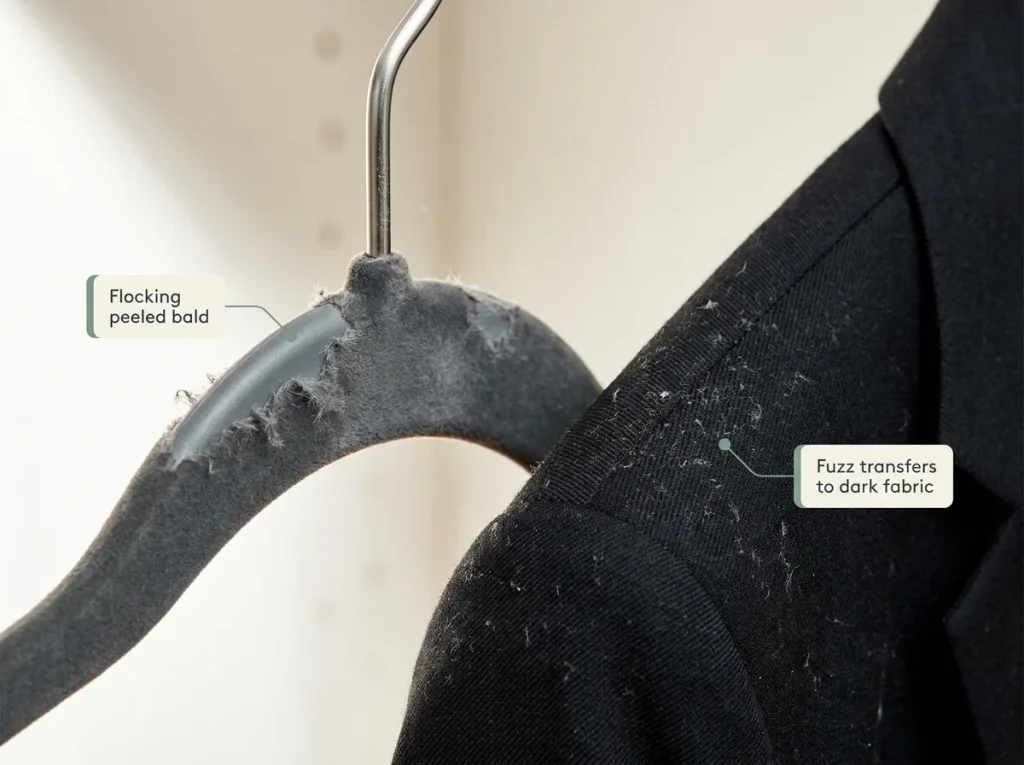
There’s a cosmetic layer to this too. Dark velvet hangers shed fuzz onto light-colored clothing, and white or pale velvet yellows over time. Neither is obvious until you’re picking lint off a black blazer and wondering where it came from.
Humidity Speeds the Whole Thing Up
Where your closet sits changes the timeline. If it backs onto a bathroom wall or lives in an apartment without much climate control, the flocking peels closer to the 12-month mark than the 24. The reason is straightforward cause and effect. Hot showers push moisture through a shared wall, so a bathroom-adjacent closet runs measurably higher ambient humidity, and that’s the same condition that breaks flocking down faster. It’s worth understanding how humidity behaves in a bathroom-adjacent closet if that’s your setup, because it’s the reader most likely to see velvet fail early. Think of it as the Three-Month Test stretched to twelve.
Graduating to Rubber
Here’s the upgrade path nobody in the comparison articles mentions. People who’ve already burned through a cheap velvet set tend to graduate to rubber-coated hangers rather than going back to wood for everything. The ELONG HOME Rubber Non-Slip Hangers keep the slim profile and the grip that made velvet appealing, without the flocking that peels or the wire neck that snaps. They’re the fix for the reader who liked what velvet promised and got tired of replacing it. For a budget-friendly version of the same idea, plain rubber-coated trouser hangers do the non-slip job for less.
A peeling velvet hanger still works well enough to fool you into keeping it, and that’s the trap. Run a hand down the shoulder curve every few months. Any bald patches mean the grip is going, so move anything slippery off it before a silk blouse teaches you the hard way.
Velvet feeling like a win and then reverting is the same arc as a whole closet refresh that looks perfect for a week. If you’ve watched that happen, why a cheap closet refresh often reverts within the year covers the pattern in full.
Building a Hybrid Closet Without Buying Everything

The answer was never buy velvet or buy wood. It’s split the rod by garment and buy only what that split actually requires, which is almost never a full closet’s worth of anything.
Split the Rod by Garment, Not by Loyalty
The verdict in one line: velvet and slim for lightweight and delicate, wood for structured and heavy, rubber for the everyday pieces you want grip on without the peel. The material follows the garment, not a brand loyalty or a blanket rule you picked at checkout. This is also the setup most professional organizers land on, and it starts with whether your closet needs a full system or just better accessories, because hangers are the accessory-level fix before you spend on anything structural.
Buy a Section of a Closet, Not the Whole Thing
The budget-honest move is to not replace everything at once. Keep the hangers you already have for the pieces they already suit. Count your structured keepers (the blazers, the wool coat, the suit you wear twice a year), and buy wood for just those. Put everyday clothes on slim or rubber hangers. You’re buying a section of a closet, not a closet. Velvet is the budget-friendly, buy-in-bulk side of this, and wood is the splurge-per-piece side, which is the exact reason you reserve wood for the few garments that earn it.
Your rod isn’t getting any longer, so in a small closet the split is a capacity strategy as much as a budget one: slim where you can, structured where you must. The same logic pairs well with a no-drill closet setup that protects your deposit if you’re renting and want the whole closet to stay damage-free. Get the hanger split right and you’ve done most of the work toward closet organization that still holds up three months later.
The Bottom Line
Velvet wins rod space and grips slippery fabric; wood wins structure and lasts for years. Those are different jobs, so give them to different hangers. Velvet quietly fails somewhere between one and two years, faster if your closet sits near a bathroom, and rubber-coated slim hangers are the graduate-from-velvet fix when it does. And the hybrid split lets you buy a section of a closet instead of a whole one, which is the move that actually respects both your rod and your budget.
In three months, run a hand along your velvet hangers. Any bald patches in the flocking mean the grip is going, so move anything slippery to rubber before a blouse hits the floor.
Start with your five structured pieces. Those are the only ones that genuinely need wood. Everything else can wait on the slim hangers you already own.
Frequently Asked Questions
01Are velvet or wood hangers better for a closet?
Neither wins outright. Velvet saves the most rod space and grips slippery fabric, while wood supports structured and heavy garments and lasts for years. Split your rod by garment type instead of picking one material.
02Do velvet hangers ruin clothes?
Not usually, but dark velvet can transfer fuzz onto light-colored clothing, and the thin wire core can warp heavy garments over time. They work best for lightweight, everyday pieces rather than coats.
03How long do velvet hangers last?
The flocking that gives them grip typically starts peeling at 12 to 24 months of regular use, sooner in humid or bathroom-adjacent closets. They still hang clothes after that, but the grip is gone.
04Can you mix velvet and wood hangers in the same closet?
Yes, and it’s the setup most organizers actually recommend. Use slim velvet for everyday and delicate clothes and wood for structured and heavy pieces, so each garment gets the support it needs.
05What should you use instead of velvet hangers when they wear out?
Rubber-coated slim hangers are the common upgrade. They keep the same space savings and grip as velvet, without the flocking that peels or the wire neck that can snap under a hard tug.
Disclaimer: ClutterlessNest is a participant in the Amazon Services LLC Associates Program. As an Amazon Associate we earn from qualifying purchases. This article may contain affiliate links — if you buy through them, we may earn a small commission at no extra cost to you. We only recommend products we have tested or genuinely believe in.