
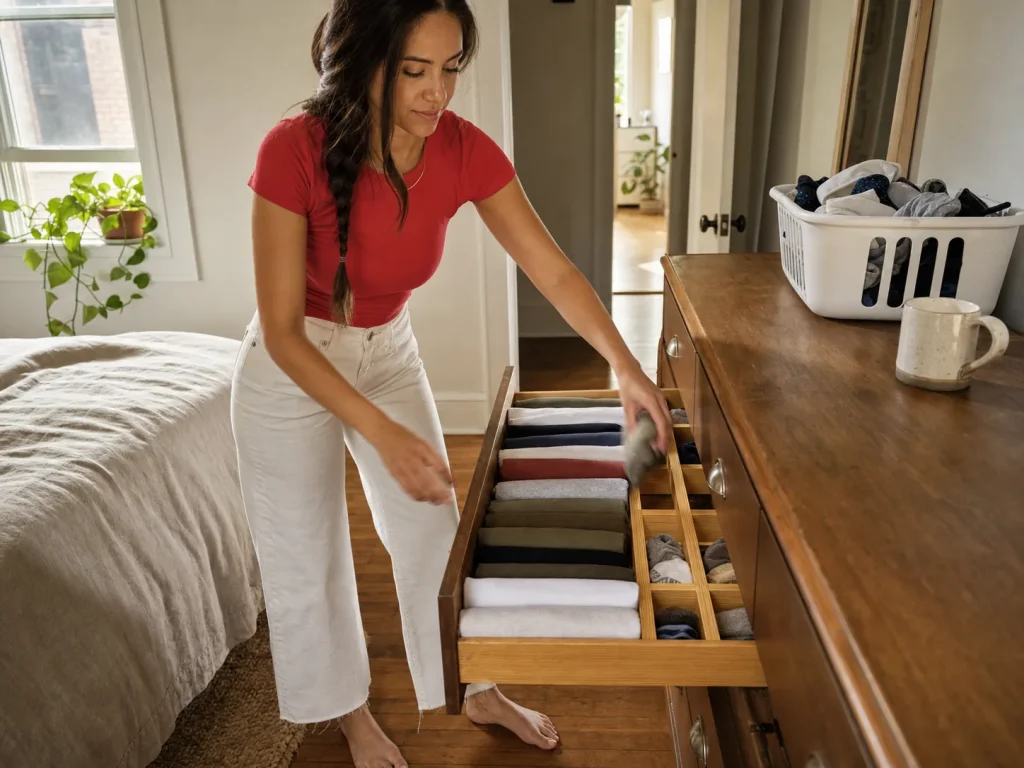
You bought a set of “best drawer organizers,” opened the box, and the expandable dividers were an inch too long to sit in your sock drawer. Here’s the part nobody says out loud: almost every drawer organizer roundup online is quietly a kitchen roundup. The products are sized for utensil drawers, the photos show silverware, and the dimensions assume a wide, shallow kitchen drawer, not the deep bedroom dresser you actually own. The recurring confession in dresser-organizing threads is exactly this, an insert that fits the listing photo but not the real drawer. So before any product, the fix professional organizers lead with is boring and free: measure first. This guide sorts inserts by the dresser drawer they belong in, wide, narrow, or small-item, explains why each type slides or sags over time, and ends with the free options and the three-month check that separates a system from a one-week “after” photo.
| Insert Type | Best Dresser Drawer | Watch-Out |
|---|---|---|
| Adjustable bamboo dividers | Wide, standard-depth drawers | Too long for a 12″ sock drawer |
| Short-span plastic dividers | Narrow & shallow drawers | Confirm the height clears a top drawer |
| Fixed-compartment trays | Socks, underwear, jewelry | Sized for one drawer only |
| Fabric bins | Folded knits, bulky items | Sag without an internal board |
Measure Your Drawer Before You Buy Anything
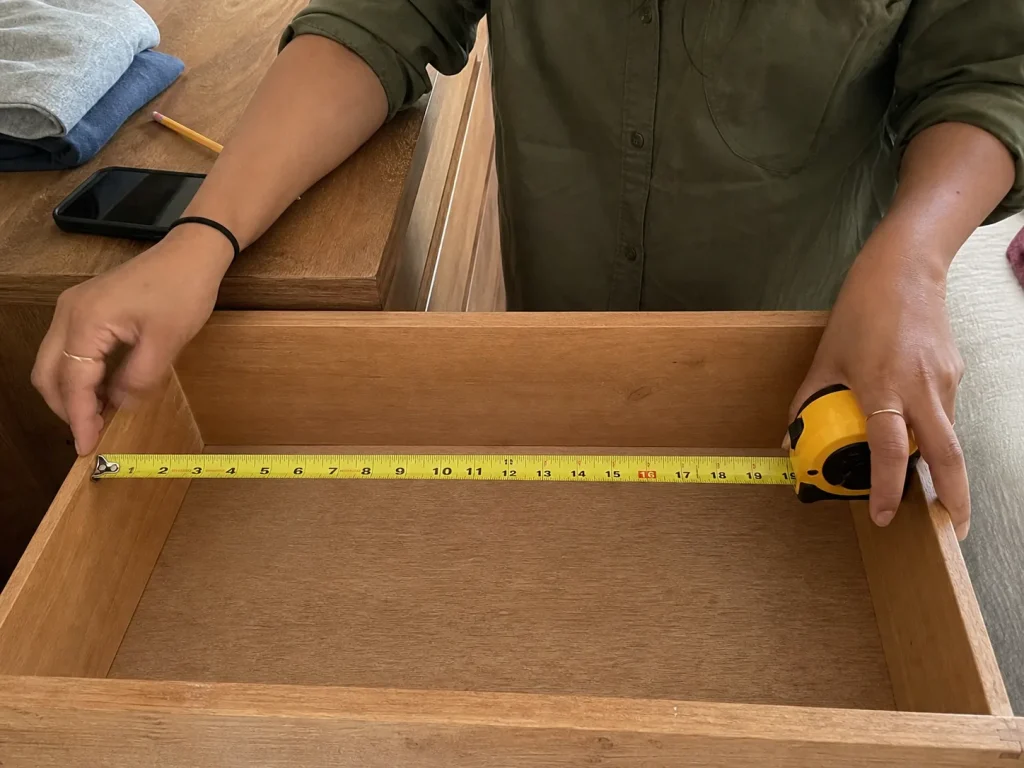
The single most common self-inflicted mistake with drawer inserts is buying the pretty expandable set before pulling the drawer out and measuring inside it. Kitchen drawers and dresser drawers are different animals, and the product listing almost never tells you which one the insert was designed around. So you order a well-reviewed divider, it arrives, and it physically cannot sit flat because it was built for a drawer eight inches wider than yours.
Here are the numbers worth knowing. Standard dresser drawers run about 14 to 18 inches deep, with 18 inches being the most common. Small drawers tend to be around 12 inches wide, while a medium drawer runs closer to 28 inches. That range matters because the most-recommended expandable bamboo dividers open to 17 to 22 inches, which is built for a wide kitchen or utility drawer. Drop one into a 12-inch sock drawer and it simply won’t compress that small.
Height is the dimension everyone forgets
Width and depth get all the attention, but drawer height is where inserts quietly fail. Standard dresser drawers run roughly 4 to 8 inches tall, and the bottom drawer of a dresser often runs 8 to 12 inches. A 4-inch divider or a stack of jewelry trays might clear a deep bottom drawer easily and then refuse to let a shallow top drawer close flush. If the drawer won’t shut, the insert is useless no matter how good it looked in the photo.
The method organizers use is simple and it never fails you. Pull the drawer all the way out, and measure the interior width, depth, and height from inside the frame, not the outside of the furniture. Professional organizers recommend measuring all three drawer dimensions before buying anything, because the interior is always smaller than you’d guess from eyeballing the dresser front. Write the three numbers down and keep them on your phone while you shop.
Subtract about half an inch from your measured interior width before you buy. Inserts that span the drawer exactly are the ones you can’t lift out without scraping your knuckles, and a divider you can’t remove is a divider you’ll never clean under.
I used to point people straight to the popular bamboo set. After enough “why is this too long for my sock drawer” complaints piling up in dresser threads, I flipped my advice to lead with the tape measure. It’s the least exciting step and the one that saves the return. Whether you need a full closet system or just the right accessories, the drawer insert is one of those small fixes that only works when it actually fits the space you have.
Best Adjustable Bamboo Dividers for Wide Dresser Drawers
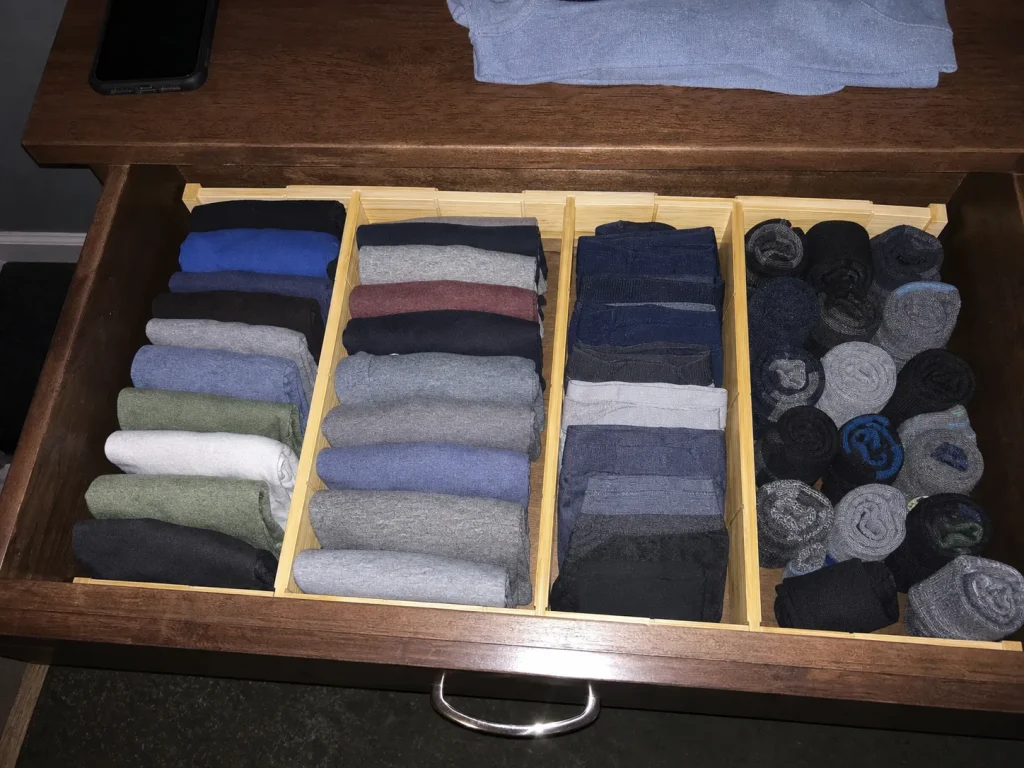
For a wide drawer, fixed trays are the wrong tool because they waste the corners and lock you into one layout forever. Adjustable dividers let you build lanes to your own plan, socks in one channel this season, folded tees in the next when your needs change. This is the drawer type where the popular bamboo sets genuinely shine, as long as your interior width lands in their range.
There’s one failure mode to name up front, because it’s almost always an install error mistaken for a defect. Spring-loaded and tension dividers fail when you overextend them during setup. Force the divider past its intended length to make it “grip harder,” and you pop the internal spring out of alignment, which permanently kills the lock. If a tension divider feels loose the moment you install it, you probably cranked it to its maximum width. Back it off and reinstall gently, and it holds.
Best overall for a standard-to-wide drawer
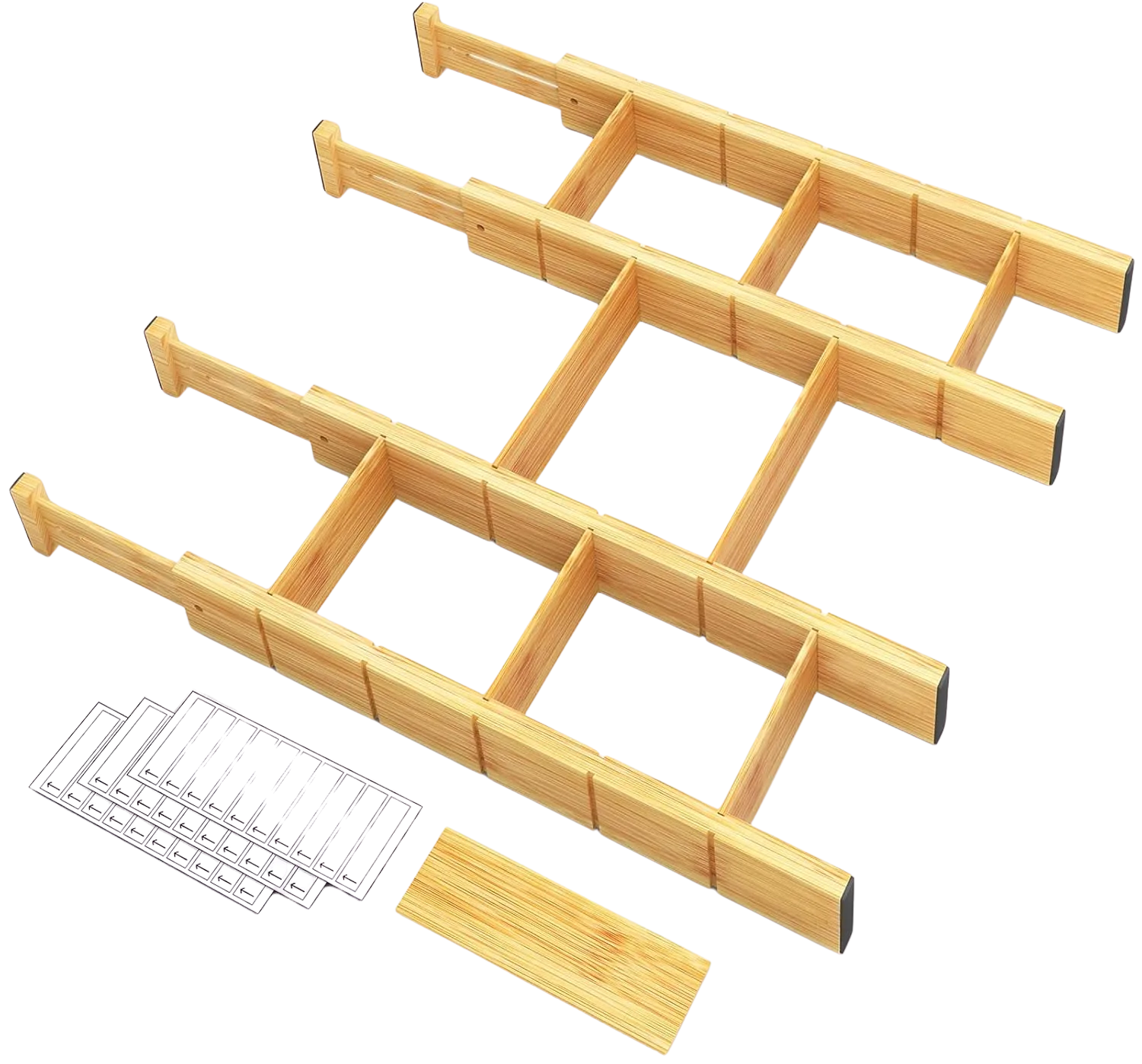
The SpaceAid Bamboo Drawer Dividers (4-pack, adjustable 17-22 in) are the pick when your drawer is standard-to-wide and you want lanes plus smaller sub-compartments in one purchase. The four dividers set the main channels, and the included inserts break a lane down further for socks, small accessories, or folded underwear. Bamboo has one honest tradeoff worth stating: it looks nicer than plastic, but skip it in a humid, bathroom-adjacent room where steam eventually warps the wood. In a dry bedroom it lasts for years.
Best value when you need more lanes
If your drawer is wider or deeper and you want more channels than four, the VaeFae 6-Pack Adjustable Bamboo Drawer Dividers (16.6-21.8 in) give you six dividers for the same kind of money, which works out to more lanes per dollar. It’s the better buy for a big underwear-and-tee drawer where you want narrower channels so nothing tips over sideways. The tradeoff is that six dividers in a wide drawer can crowd each other if you don’t plan the spacing, so lay them out before you load anything in.
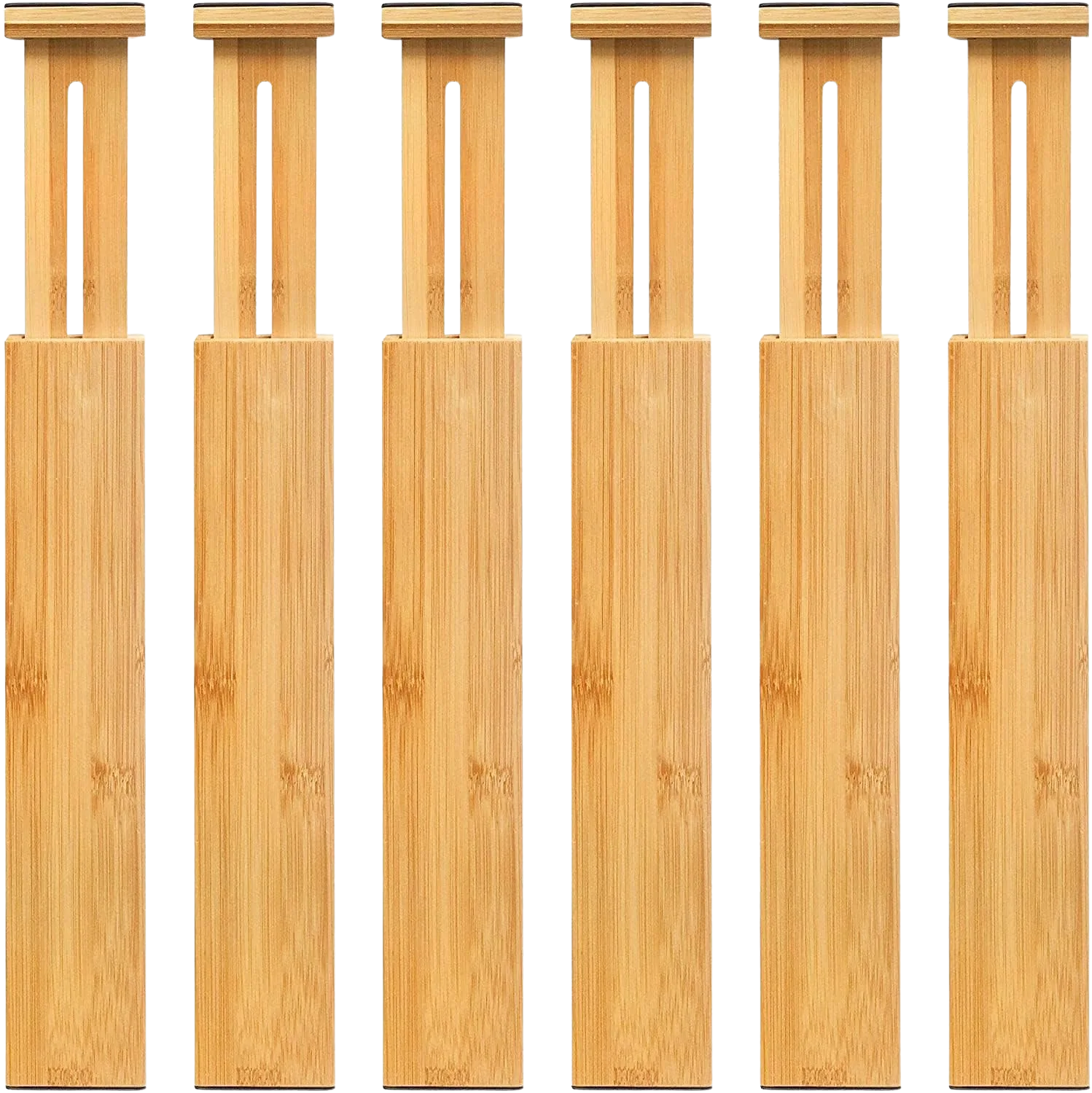
A quick word on how these dividers earn a renter’s trust, because it’s the whole reason drawer inserts are the easy category. They’re fully drop-in. No adhesive, no drilling, no wall contact. Inserts sit loose inside the drawer by design, so there’s nothing to patch or explain at move-out. If you want to see how lanes plus a couple of small trays share one drawer, this short demo shows the mixed approach in action.
Best Inserts for Narrow and Shallow Dresser Drawers
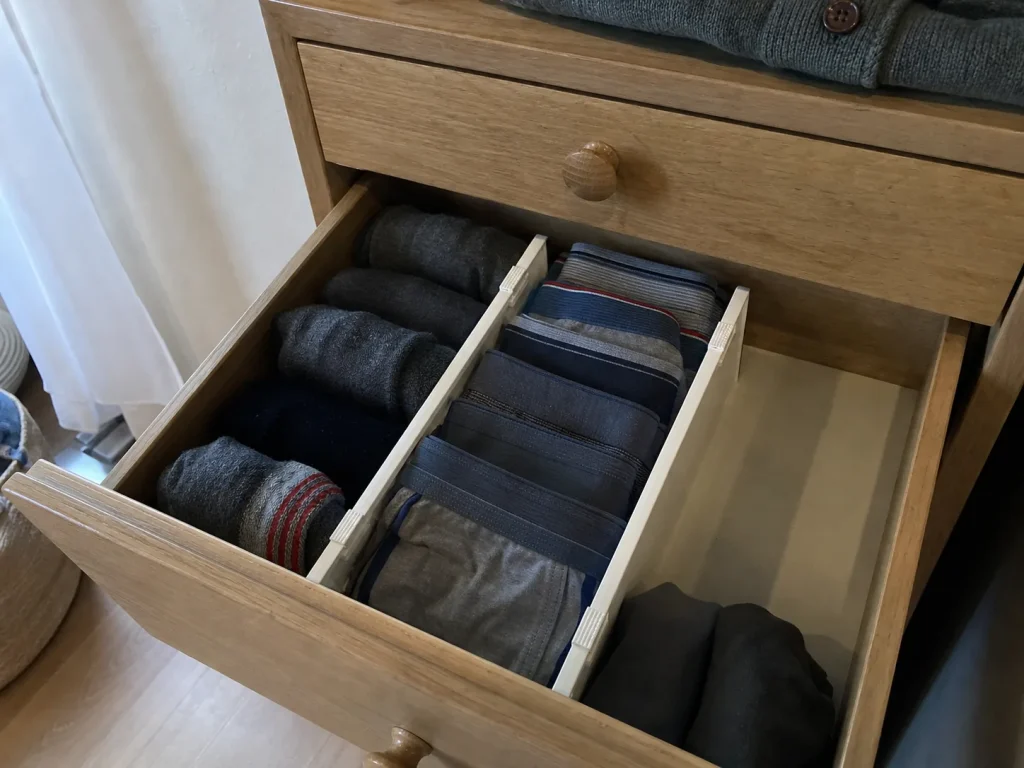
This is where measuring first pays off, and it’s the exact case the kitchen-focused roundups skip. If your drawer is 12 inches wide, the popular bamboo set is already too long before it comes out of the box. What you need is a short-span divider that adjusts down to a small width, not one built to stretch across a wide utility drawer.
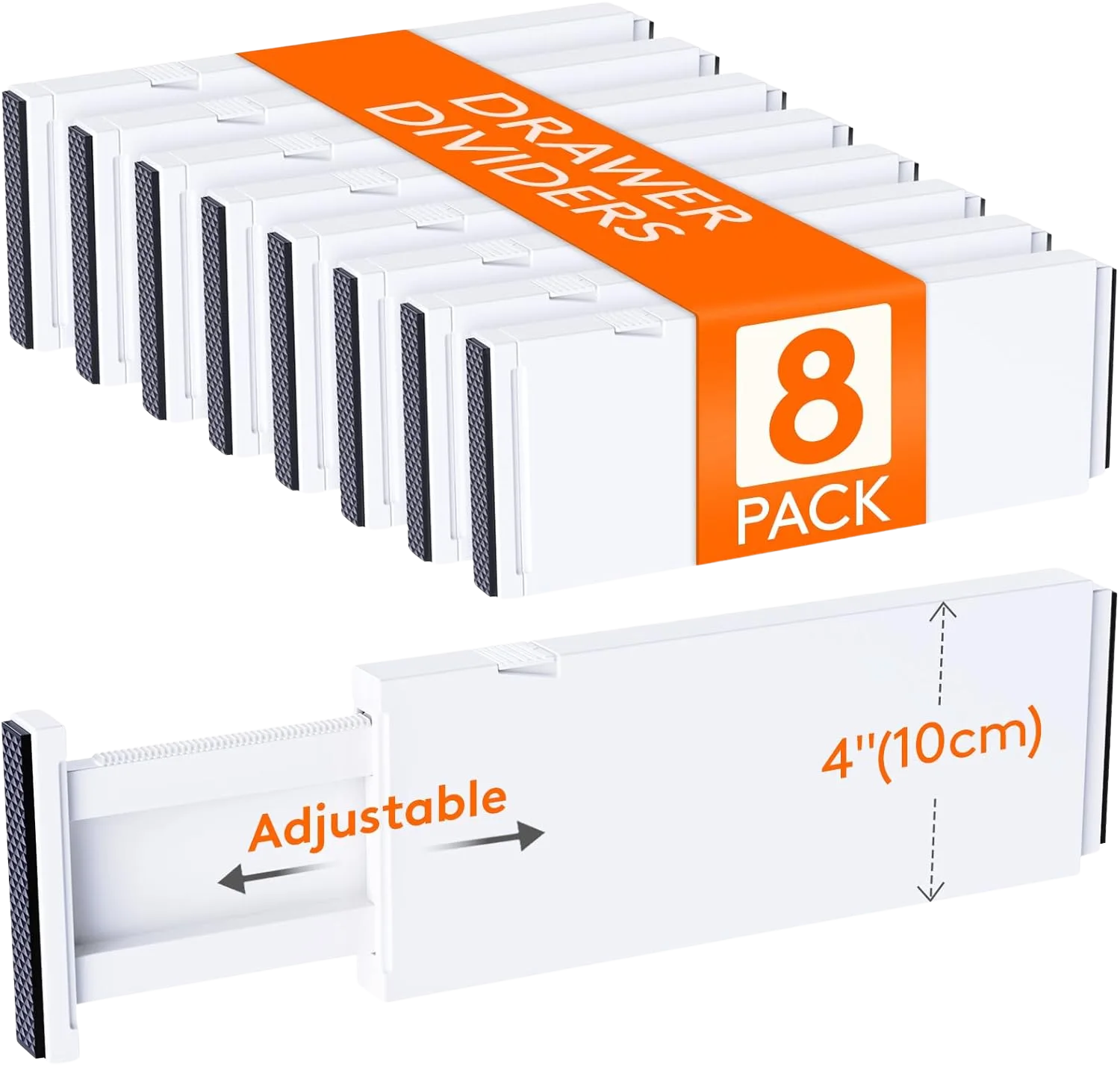
The Lifewit 8 Pack Drawer Dividers, 4″ High, 11″-17″ Adjustable are built for exactly this. The 11-to-17-inch range fits the small and medium dresser drawers that wider bamboo dividers overshoot, and the 4-inch height clears most standard drawers. Confirm that height against a shallow top drawer before you commit, since the shallowest drawers can still be tight. The plastic construction shrugs off humidity better than bamboo too, which makes these a safer pick if your dresser lives anywhere near a bathroom.
Why short-span dividers slide, and how to stop it
Here’s the failure to name before you blame a product. Foam and friction-only dividers, the kind that grip by pressure alone, develop visible gaps within days. The technical name is shear creep, which just means normal drawer-slamming vibration slowly displaces a divider that gripped fine on install day. It’s not a defect, it’s how passive friction behaves when a drawer never gives it the constant even pressure it needs.
The fix is mechanical, not magical. Use dividers that span close to the full drawer width so the non-slip end pads actually make contact across the whole bottom. Partial-contact feet can only grip part of the drawer floor, which is why an undersized insert wanders no matter how grippy the pads feel in your hand. If a divider is a touch short, a couple of small adhesive bumpers on the ends close the gap for pocket change. And if you want to test the layout before buying anything, a cut-down cardboard box makes a perfectly good trim-to-fit divider for a few days, which I’ll come back to further down.
If you don’t have a dresser at all and you’re working with a standalone drawer unit, the same divider logic still applies to a drawer unit or cart. Match the span to the interior, span the full width, and check the height.
Best Fixed-Compartment Trays for Socks, Underwear and Jewelry
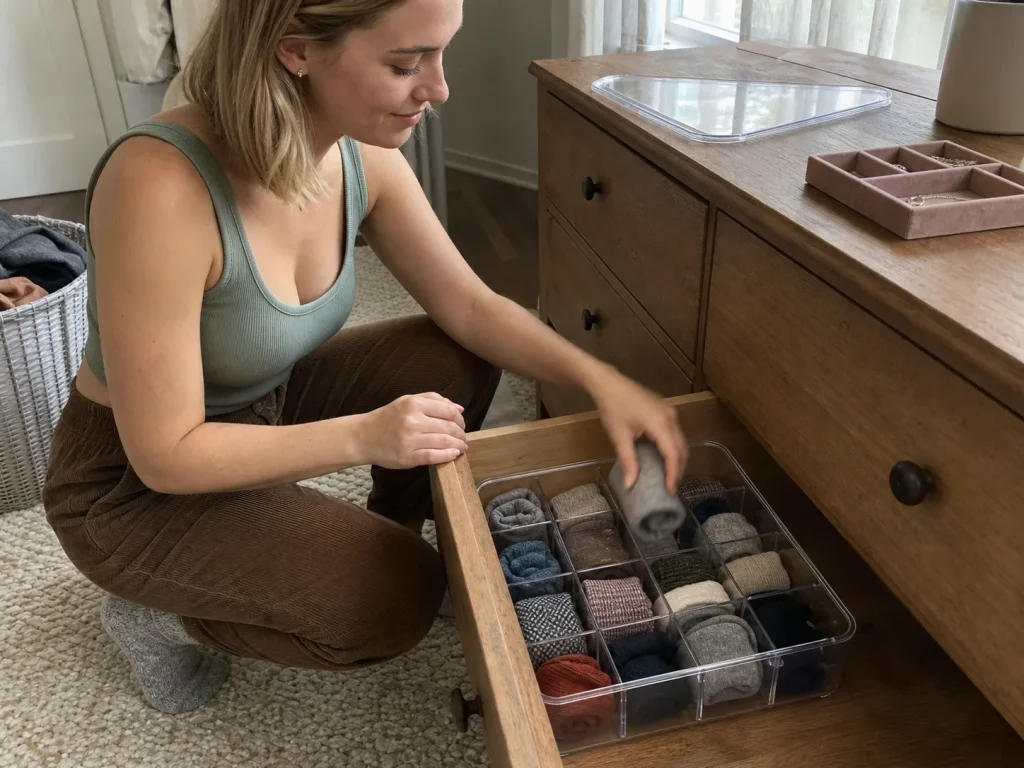
Adjustable lanes are great until you’re storing twenty pairs of socks and a tangle of earrings. Small items don’t want open channels, they want a fixed cell each, and this is where a divided tray earns its spot in the drawer. It’s also the category the kitchen-drawer roundups ignore entirely, because a silverware tray was never designed for the “hot mess” drawer where socks, tights, and underwear live in one pile with an unused divider buried somewhere at the bottom.
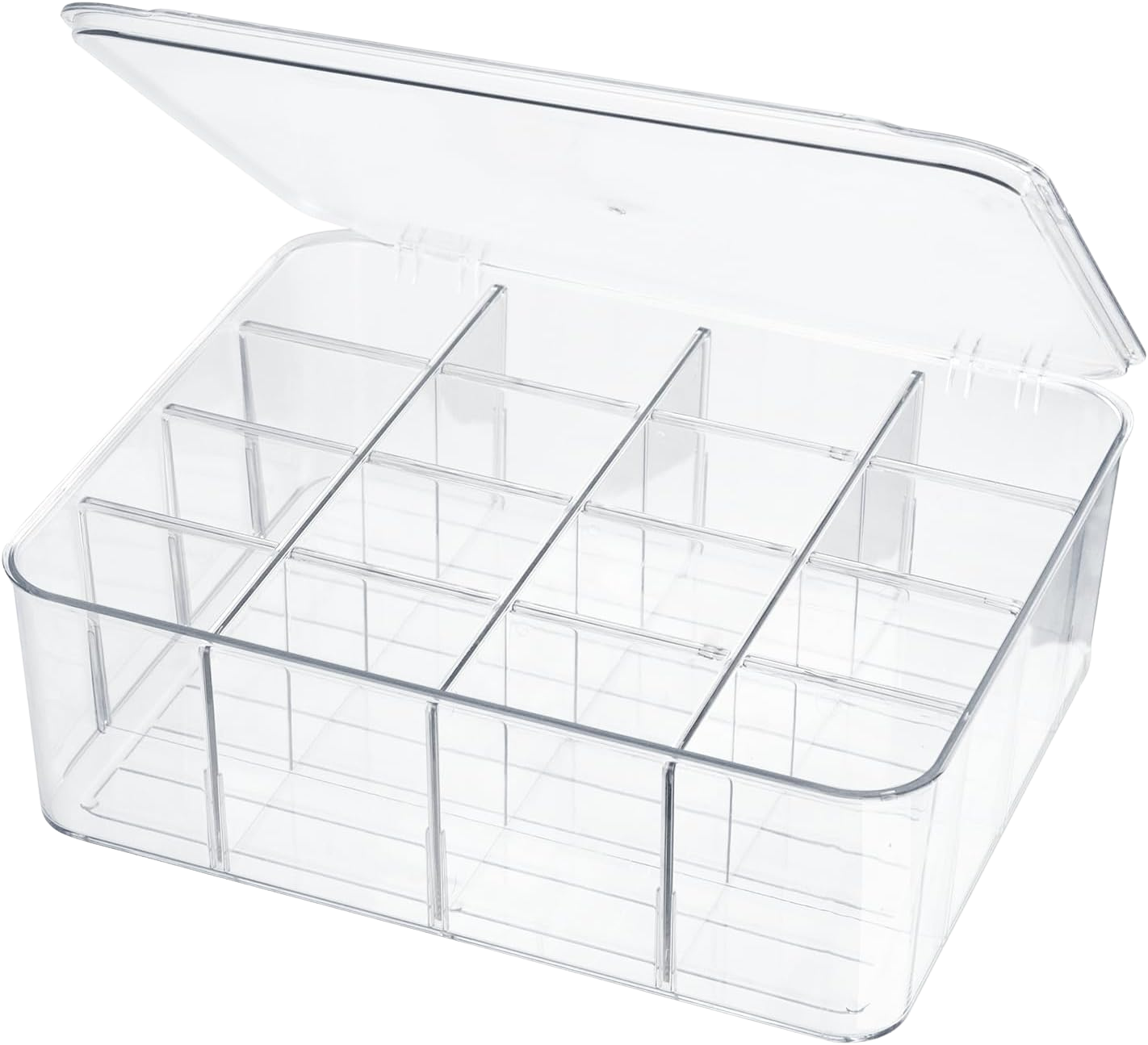
For socks and underwear, the ZEXALOR Socks Underwear Drawer Organizer, 16-Compartment Removable Divided Plastic Storage Bin with Lid gives every pair a home and keeps the whole thing visible. The BPA-free clear plastic means you see what you’ve got without digging, and the lid keeps a low-use drawer dust-free, which matters more than you’d think for a drawer you open twice a week. The honest limit is that a fixed tray fits one drawer size, so if your drawer is an odd width, a short-span adjustable divider beats a tray that leaves awkward gaps around the edges.
Jewelry is its own problem
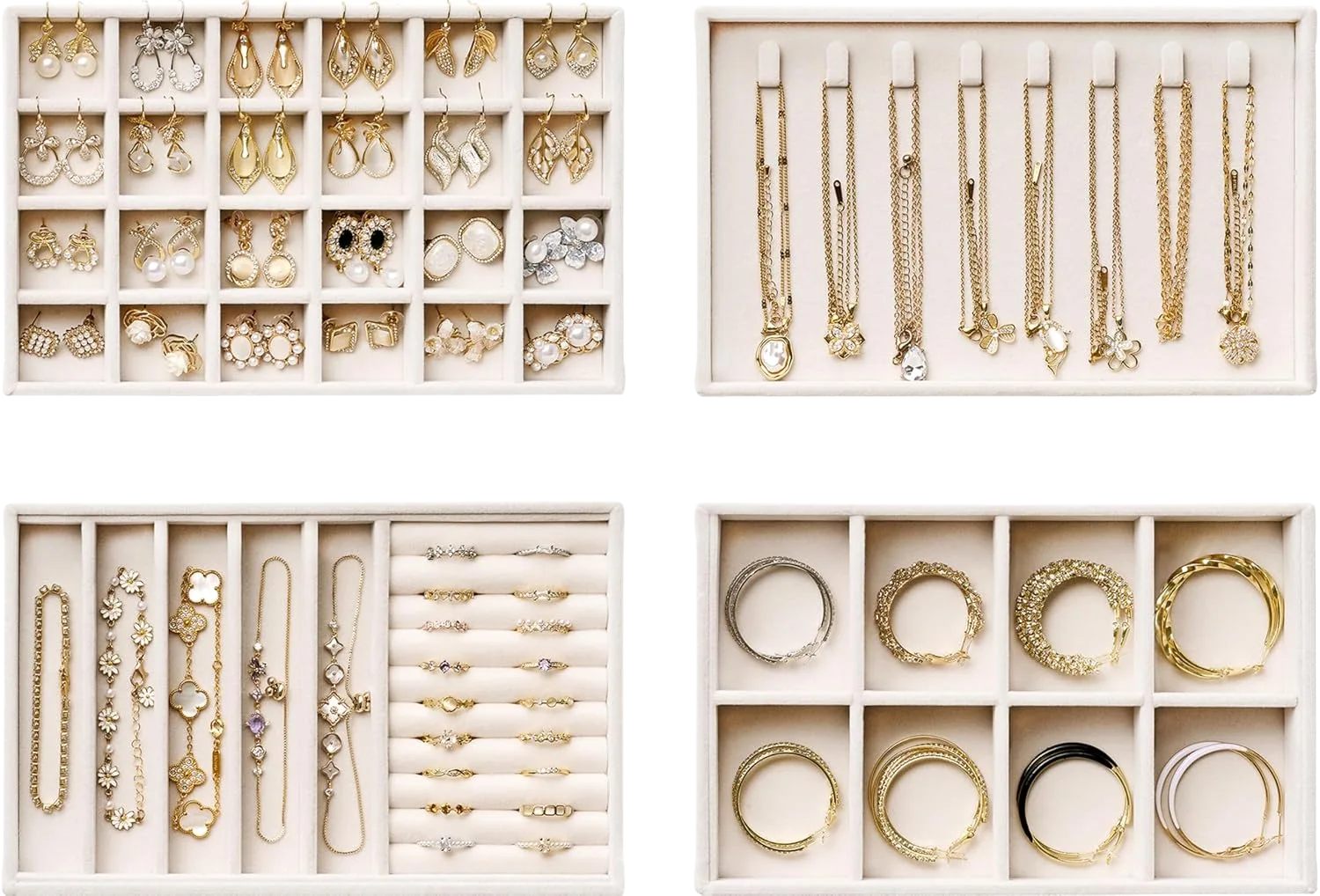
Jewelry needs different cells than socks. Rings want small squares, chains want a flat run where they can’t tangle, and everything wants a soft surface that won’t scratch a finish. The Velvet Jewelry Drawer Organizer Trays, 4-Layer Stackable Set with Removable Dividers handle all three, and the stackable design means a shallow drawer can hold four layers of separation instead of one messy pile. The removable dividers let you resize a compartment for a watch or a stack of bangles, and the velvet keeps chains from sliding into each other. This is the category the kitchen roundups never touch, which is exactly why it belongs in a dresser guide.
Match the compartment to the fold, not just the drawer
One detail turns a good tray into a great one: the fold. Fixed compartments only stay tidy if the compartment height matches how tall your folded garment stands. The KonMari vertical fold, where each item stands on edge so you see everything at a glance, only works when the cell is deep enough to hold the fold upright without it flopping over. Measure the fold, not just the drawer, before you decide a tray’s cell depth is right. The same fold-to-fit rule governs how you store bulkier knits, where a too-shallow bin lets a sweater slump and lose its shape. This short video shows the vertical fold going straight into compartments, which makes the height relationship obvious in a way text can’t.
Fold one shirt the way you plan to store it, stand it up, and measure that height before you buy a tray. If the fold is taller than the compartment, the garment tips over and you’re back to a pile within a week.
Budget Picks and the Free Options Nobody Mentions
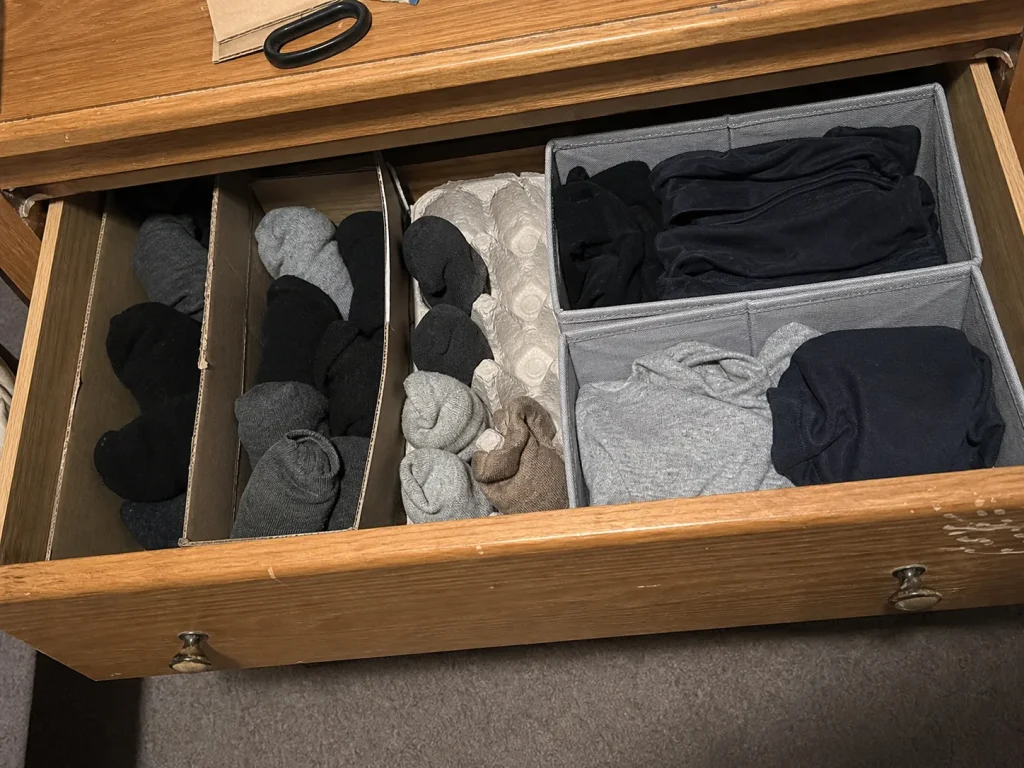
Before you buy anything, check the recycling bin. A good chunk of the catch-all drawer problem, the “drawer of chaos” everyone has, is solved for free, and the part that isn’t usually needs one cheap set, not a matching system. This is the anti-sell talking, and it’s the whole reason people trust a product list that also tells them when not to buy.
The free fixes people actually use are more legitimate than they sound. Repurposed egg cartons hold sock pairs one to a cup and cost nothing. Cut sections of PVC pipe stood on end keep rolled socks upright and are washable and basically indestructible. Cut-down cardboard boxes make free dividers that let you test a layout before you commit to buying anything. None of it is pretty, but all of it works, and for a drawer nobody sees, “works” is the whole spec.
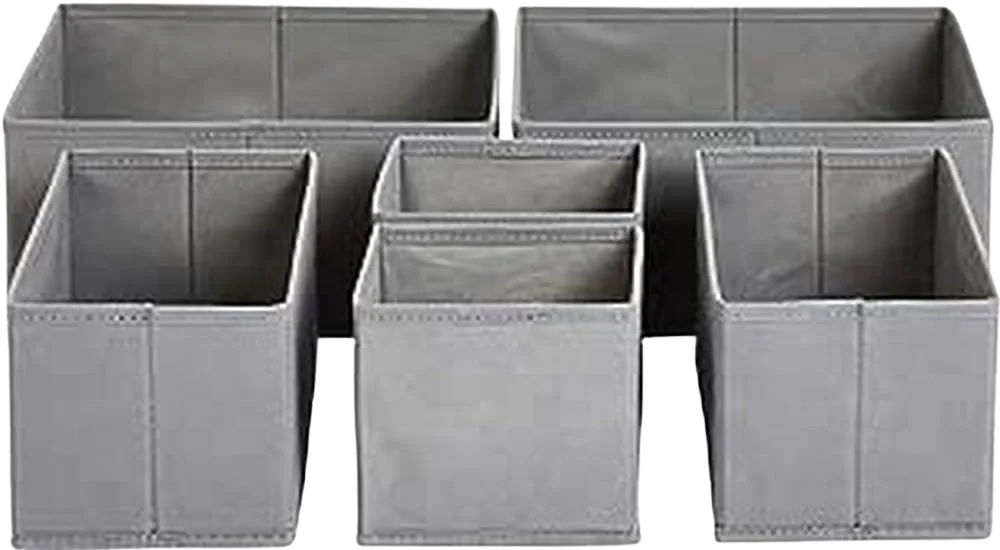
So when should you actually buy something? When the free version can’t survive daily use, or when a partner won’t respect a cardboard divider the way they’d respect a real one. That’s where a cheap collapsible cloth set earns its keep. The Amazon Basics Collapsible Cloth Drawer Organizer Boxes for Socks, Underwear and Baby Items (Set of 6) are the low-commitment upgrade, a recognizable, low-risk set that folds flat when empty. The collapsible design makes them a genuinely good pick for renters and frequent movers, since they pack down to nothing between apartments.
Say it plainly, because the affiliate-driven roundups never will: if a shoebox, a cardboard divider, or an egg carton already fits your drawer and holds up, you don’t need to buy an insert at all. The same no-spend, no-damage mindset runs through renter closet fixes elsewhere on the site, and it applies here too. Buy the set when it solves a problem the free version can’t, not because a list told you to.
Making Inserts Last (The Three-Month Test)
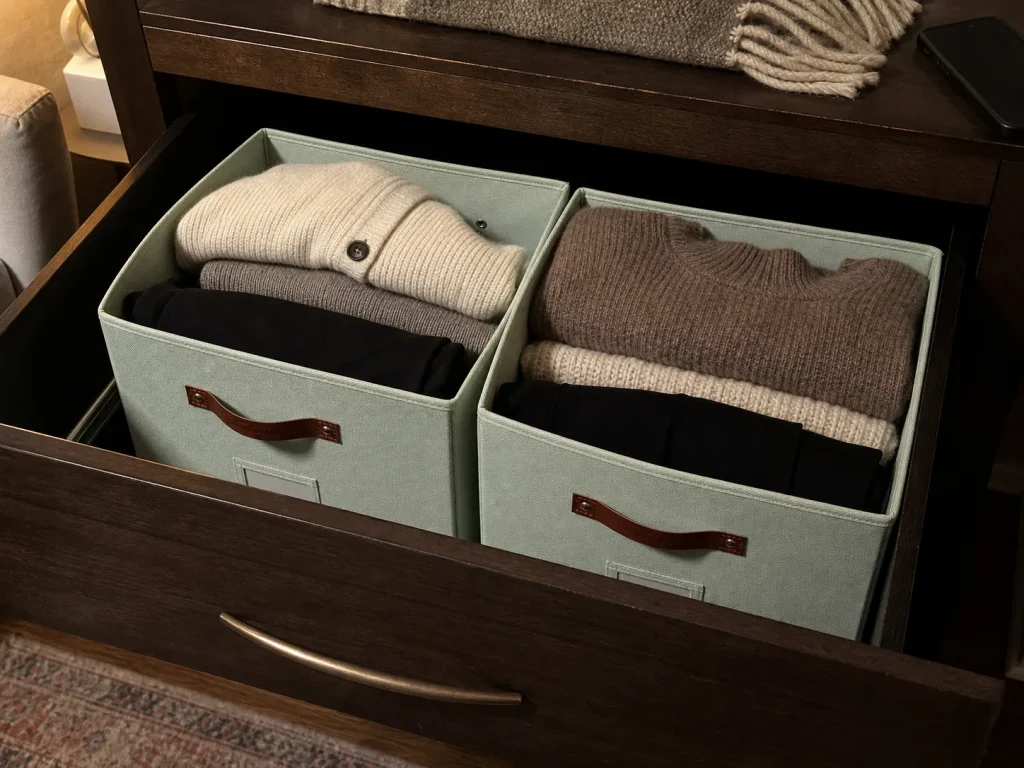
Every insert looks perfect on install day. The question ClutterlessNest actually cares about is whether it still works in three months with normal, careless, real-life use. The gap between the day-one unboxing photo and the month-three reality is where most drawer systems quietly fall apart, and none of the roundups show you that part.
Start with the maintenance nobody mentions. Grip aids and adhesive pads should be checked and refreshed roughly every 6 to 12 months, and faster in a humid room. An insert that slid a year in isn’t defective, it aged, the same way tape loses its stick. Building that quick check into your routine is the difference between a divider that holds for years and one you fight with every season.
Why fabric bins sag, and the fix
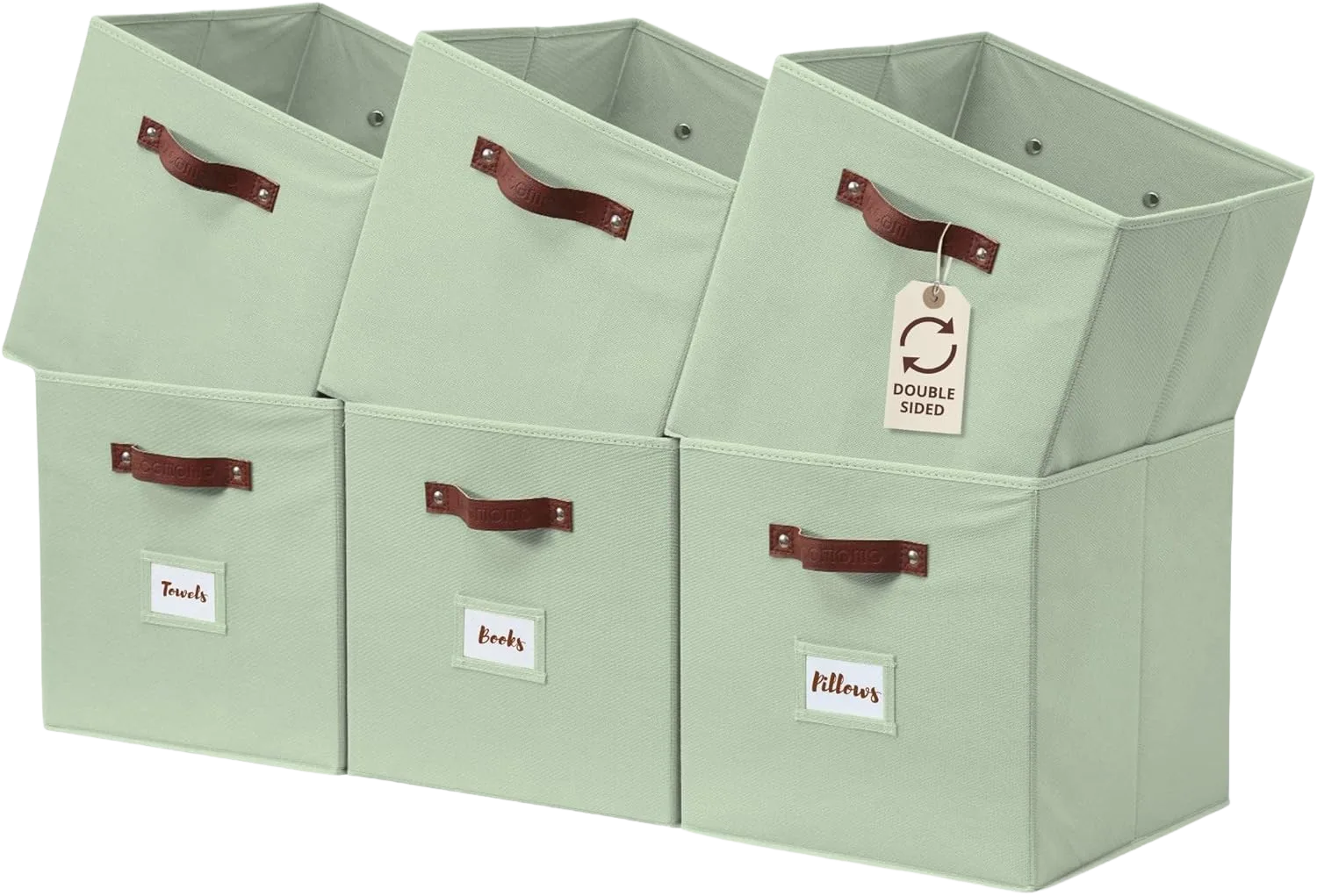
Fabric bins get recommended everywhere for drawers. And they work, right up until you learn that a bin with no internal board sags under a stack of folded knits by month two. The reinforcement board inside the fabric, not the cloth itself, is what does the structural work of holding the shape. A bin that’s all fabric collapses inward the moment you load it with sweaters, and then your neat stacks lean and topple.
The Fabric Storage Bins with Labels (Set of 6, Collapsible) are the reference point here because the reinforced sides keep their shape under folded knits, and the small label windows let you run a zone system without relabeling every time the contents change. Buy bins with a board, skip the ones that feel like a limp sack in your hand, and your folded stacks stay upright past the three-month mark.
The three-month checklist
Give yourself five minutes every season and the whole drawer keeps working. Re-seat any divider that has crept out of position, confirm the feet or pads still grip the drawer floor, and empty-and-wipe once, because dust under a lidded sock tray is the silent one nobody notices until it’s a problem. For renters and movers, drop-in inserts travel beautifully, so label the bins before a move and the system survives the re-setup on the other end. That buy-once logic is the same thing that governs which hangers actually last, spend a little on the version that holds its shape and you replace it far less often.
Set one recurring reminder for the same weekend you flip your seasonal clothes. Re-seating dividers and checking grip pads takes five minutes, and doing it on a schedule beats waiting until the drawer is already a mess again.
Conclusion
Three things carry the whole guide. Measure all three interior dimensions before you buy, so the insert actually fits the drawer instead of the listing photo. Match the insert type to the drawer, adjustable lanes for wide drawers, short-span dividers for narrow ones, and fixed trays for socks, underwear, and jewelry. And check the recycling bin before you spend, because a cardboard divider or an egg carton solves more of this than the roundups admit.
In three months, pull each drawer out and give it the five-minute check: re-seat any divider that has crept, and confirm the feet still grip. That single habit is the difference between a real system and a one-week “after” photo.
Start with the one drawer that annoys you most. Get it right. Then do the next one.
Frequently Asked Questions
01What size drawer organizer inserts do I need for a dresser?
Measure the interior width, depth, and height of the drawer from inside the frame before buying. Standard dresser drawers run 14 to 18 inches deep, with small drawers around 12 inches wide and medium ones near 28, so the popular expandable dividers built for 17 to 22 inches are often too long for a sock drawer.
02Are expandable drawer dividers better than fixed-compartment trays?
It depends on the drawer. Adjustable dividers win in wide drawers where your contents change, while fixed-compartment trays win for socks, underwear, and jewelry that each need a set cell. Odd-sized drawers usually favor a short-span adjustable divider over a tray that leaves gaps around the edges.
03How do I keep drawer organizer inserts from sliding around?
Use inserts that span close to the full drawer width so the non-slip feet actually make contact, since partial-contact feet can’t grip. Foam-only dividers tend to creep within days from normal drawer vibration, and adhesive grip pads should be refreshed every 6 to 12 months, sooner in humid rooms.
04Do bamboo drawer organizers hold up over time?
Bamboo dividers last well in dry bedrooms but can warp in humid, bathroom-adjacent spaces, so choose plastic there instead. For fabric bins, longevity comes from an internal reinforcement board, since without it the cloth sags under folded knits within a few months.
05How do I organize a dresser drawer without buying anything?
Repurpose what you already have. Egg cartons hold sock pairs, cut sections of PVC pipe stand rolled socks upright, and cut-down cardboard boxes work as free dividers. Buy a set only when the free version can’t survive daily use or a partner who won’t play along.
Disclaimer: ClutterlessNest is a participant in the Amazon Services LLC Associates Program. As an Amazon Associate we earn from qualifying purchases. This article may contain affiliate links — if you buy through them, we may earn a small commission at no extra cost to you. We only recommend products we have tested or genuinely believe in.